Comparative Microbiota and Metabolite Profiles of Undried and Dried Typica Luwak (Civet) Coffee Beans


Abstract
1. Introduction
2. Materials and Methods
2.1. Sample Collection and Preparation
2.2. Microbiome Sequencing and Bioinformatic Analysis of Bacterial Communities
2.2.1. DNA Extraction and Polymerase Chain Reaction (PCR) Amplification
2.2.2. Illumina Sequencing
2.2.3. Microbiota Data Analysis
2.3. Untargeted Metabolomics
2.3.1. Sample Preparation
2.3.2. LC–MS/MS Analysis
2.3.3. Data Processing and Metabolite Annotation
2.3.4. Statistical and Pathway Analysis
2.4. Multi-Omics Integration Network Analysis
2.5. Statistical Analysis
3. Results
3.1. Difference in Microbiota Profiles Between Undried and Dried Kopi Luwak Beans
3.1.1. Microbial Community Diversity
3.1.2. Microbial Community Structures
3.1.3. Microbial Key Phylotypes
3.1.4. Predicted Metabolic Profiles of the Microbiota
3.2. Difference in Metabolite Profiles Between Undried and Dried Kopi Luwak Beans
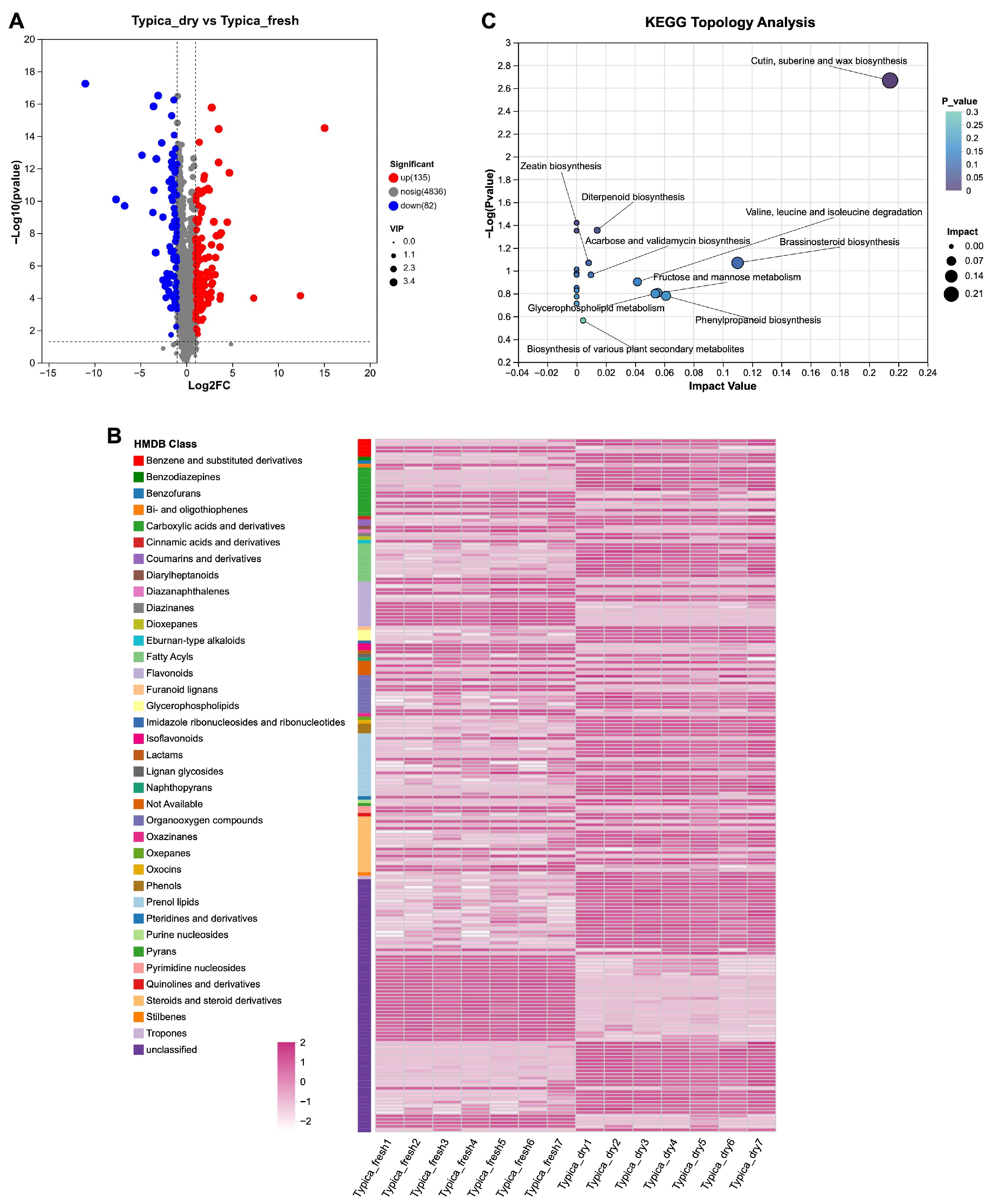
3.2.1. Metabolite Profiles Analysis
3.2.2. Differential Metabolite Analysis
3.2.3. Pathway Enrichment Analysis of Metabolic Pathways
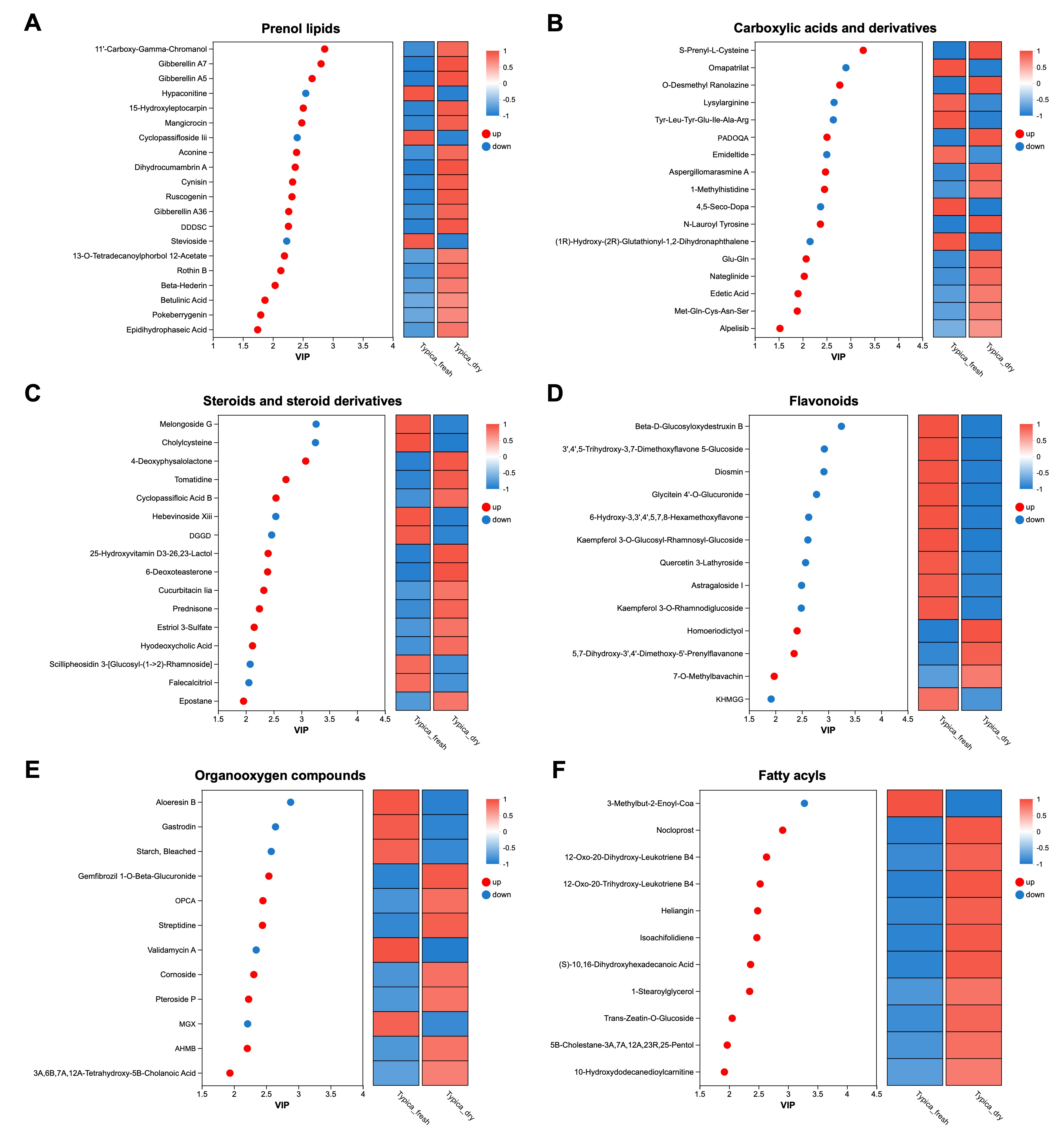
3.2.4. Classification of Differential Metabolites
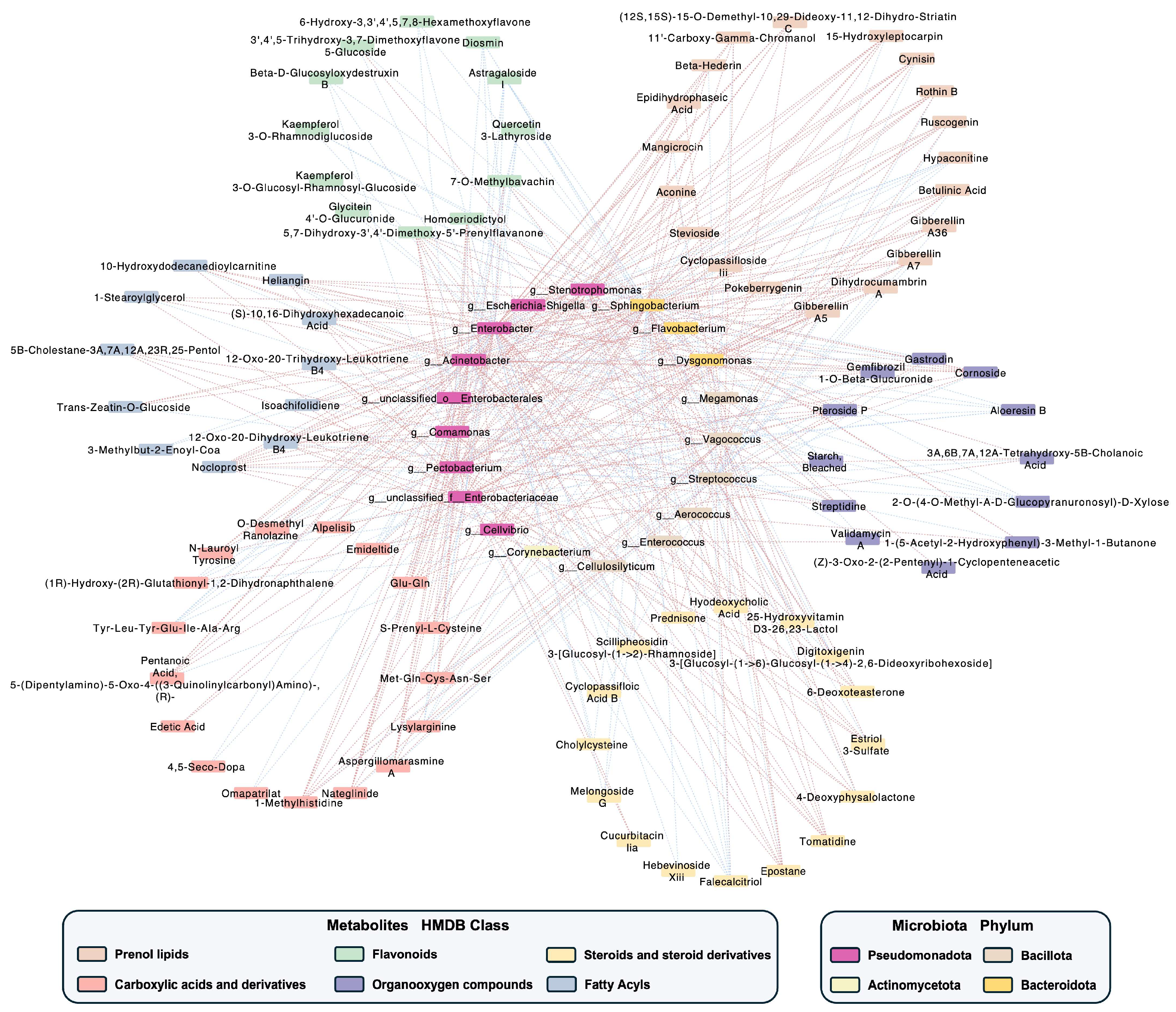
3.3. Correlation Between Microbiota and Metabolites Regulated by Drying
4. Discussion
5. Conclusions
Supplementary Materials
Author Contributions
Funding
Institutional Review Board Statement
Informed Consent Statement
Data Availability Statement
Conflicts of Interest
Abbreviations
| PCR | Polymerase Chain Reaction |
| ASVs | Amplicon Sequence Variants |
| Pd | Phylogenetic Diversity |
| PCA | Principal Component Analysis |
| ANOSIM | Analysis of Similarities |
| LDA | Linear Discriminant Analysis |
| LEfSe | LDA Effect Size |
| ANCOM | Analysis of Composition of Microbiomes |
| LC–MS | Liquid Chromatography–Tandem Mass Spectrometry |
| PLS-DA | Partial Least Squares Discriminant Analysis |
| HMDB | Human Metabolome Database |
| VIP | Variable Importance in Projection |
| FC | Fold Change |
| KEGG | Kyoto Encyclopedia of Genes and Genomes |
| SEM | Standard Error of the Mean |
References
- Saud, S.; Salamatullah, A.M. Relationship between the Chemical Composition and the Biological Functions of Coffee. Molecules 2021, 26, 7634. [Google Scholar] [CrossRef] [Scilit]
- de Melo Pereira, G.V.; de Carvalho Neto, D.P.; Magalhães Júnior, A.I.; Vásquez, Z.S.; Medeiros, A.B.P.; Vandenberghe, L.P.S.; Soccol, C.R. Exploring the impacts of postharvest processing on the aroma formation of coffee beans—A review. Food Chem. 2019, 272, 441–452. [Google Scholar] [CrossRef] [Scilit]
- Bastian, F.; Hutabarat, O.S.; Dirpan, A.; Nainu, F.; Harapan, H.; Emran, T.B.; Simal-Gandara, J. From Plantation to Cup: Changes in Bioactive Compounds during Coffee Processing. Foods 2021, 10, 2827. [Google Scholar] [CrossRef] [Scilit]
- Raveendran, A.; Murthy, P.S. New trends in specialty coffees—“the digested coffees”. Crit. Rev. Food Sci. 2022, 62, 4622–4628. [Google Scholar] [CrossRef] [Scilit]
- Farag, M.A.; Mohamed, T.A.; El-Hawary, E.A.; Abdelwareth, A. Metabolite Profiling of Premium Civet Luwak Bio-Transformed Coffee Compared with Conventional Coffee Types, as Analyzed Using Chemometric Tools. Metabolites 2023, 13, 173. [Google Scholar] [CrossRef] [Scilit]
- Marcone, M.F. Composition and properties of Indonesian palm civet coffee (Kopi Luwak) and Ethiopian civet coffee. Food Res. Int. 2004, 37, 901–912. [Google Scholar] [CrossRef] [Scilit]
- Febrina, L.; Happyana, N.; Syah, Y.M. Metabolite profiles and antidiabetic activity of the green beans of Luwak (civet) coffees. Food Chem. 2021, 355, 129496. [Google Scholar] [CrossRef] [Scilit] [PubMed]
- Febrina, L.; Happyana, N.; Syah, Y.M. Metabolic Profiling, Antioxidant Activity, and Alpha-Glucosidase Inhibitory Activity of the Roasted Beans of Luwak (Civet) Coffee. ACS Food Sci. Technol. 2023, 3, 1864–1876. [Google Scholar] [CrossRef] [Scilit]
- Ismayawati, A.D.; Yokoyama, D.; Goto, R.; Oya, Y.; Watanabe, I.; Horai, S.; Sakakibara, H. Mineral composition and antioxidant activity of partially digested coffee “Kopi Luwak”. Funct. Foods Health Dis. 2024, 14, 801–813. [Google Scholar] [CrossRef] [Scilit]
- Sawangproh, W.; Teangsompong, T.; Saputro, N.W. Unveiling trends in civet coffee research: A bibliometric perspective from Scopus (2004–2025). Br. Food J. 2025, 127, 838–861. [Google Scholar] [CrossRef] [Scilit]
- Cui, D.D.; Liu, Y.; Chen, Y.P.; Feng, X.; Lu, Y.; Yu, B. Application of SPME-GC-TOFMS, E-nose, and sensory evaluation to investigate the flavor characteristics of Chinese Yunnan coffee at three different conditions (beans, ground powder, and brewed coffee). Flavour Fragr. J. 2020, 35, 541–560. [Google Scholar] [CrossRef] [Scilit]
- Wang, Y.; Wang, X.; Hu, G.; Zhang, Z.; Al-Romaima, A.; Bai, X.; Li, J.; Zhou, L.; Li, Z.; Qiu, M. Comparative studies of fermented coffee fruits post-treatments on chemical and sensory properties of roasted beans in Yunnan, China. Food Chem. 2023, 423, 136332. [Google Scholar] [CrossRef] [Scilit] [PubMed]
- Nearing, J.T.; Douglas, G.M.; Hayes, M.G.; MacDonald, J.; Desai, D.K.; Allward, N.; Jones, C.M.A.; Wright, R.J.; Dhanani, A.S.; Comeau, A.M.; et al. Microbiome differential abundance methods produce different results across 38 datasets. Nat. Commun. 2022, 13, 342. [Google Scholar] [CrossRef] [Scilit]
- Lyu, F.; Han, F.; Ge, C.; Mao, W.; Chen, L.; Hu, H.; Chen, G.; Lang, Q.; Fang, C. OmicStudio: A composable bioinformatics cloud platform with real-time feedback that can generate high-quality graphs for publication. iMeta 2023, 2, e85. [Google Scholar] [CrossRef] [Scilit]
- Aung Moon, S.; Wongsakul, S.; Kitazawa, H.; Saengrayap, R. Comparative analysis of post-harvest processing and drying techniques on the cupping quality of Thai Arabica coffee. J. Agric. Food Res. 2025, 21, 101991. [Google Scholar] [CrossRef] [Scilit]
- Abreu, D.J.M.d.; Lorenço, M.S.; Machado, G.G.L.; Silva, J.M.; Azevedo, E.C.d.; Carvalho, E.E.N. Influence of Drying Methods on the Post-Harvest Quality of Coffee: Effects on Physicochemical, Sensory, and Microbiological Composition. Foods 2025, 14, 1463. [Google Scholar] [CrossRef] [Scilit] [PubMed]
- Kulapichitr, F.; Borompichaichartkul, C.; Suppavorasatit, I.; Cadwallader, K.R. Impact of drying process on chemical composition and key aroma components of Arabica coffee. Food Chem. 2019, 291, 49–58. [Google Scholar] [CrossRef] [Scilit] [PubMed]
- Zhu, T.; Lu, K.; He, Y.; Mao, X.; Liu, L.; Li, H.; Hu, Y. Integrated multi-omics analysis to reveal roles of fungal and bacterial microbiota in regulating the taste compounds of sun-dried processing coffee in Baoshan of Yunnan province, China. J. Future Foods 2025, in press. [Google Scholar] [CrossRef] [Scilit]
- Winarsih, S.; Hasanah, U.; Nuraida, L.; Andarwulan, N.; Kusuma, W.A. Microbial community of civet excreta fed by robusta cherry coffee in Indonesian civet coffee production. J. Adv. Vet. Anim. Res. 2025, 12, 565–581. [Google Scholar] [CrossRef] [Scilit]
- Muzaifa, M.; Hasni, D.; Patria, A.; Abubakar, A. Sensory and microbial characteristics of civet coffee. Int. J. Adv. Sci. Eng. Inf. Technol. 2018, 8, 165. [Google Scholar] [CrossRef] [Scilit]
- Nuraisyah, A.; Alwi, A.L.; Kusumaningtyas, R.N.; Fatimah, T.; Irawan, T.B.; NH, U.H.K. Effect of civet-derived bacteria and fermentation duration on basic physical characteristics of robusta green coffee beans. BIO Web Conf. 2026, 210, 02036. [Google Scholar] [CrossRef] [Scilit]
- Muliawati, A.; Bulan, R. Performance of mixed-microbial culture from civet fecal suspensions on physicochemical composition of wet fermented Arabica coffee. Curr. Res. Nutr. Food Sci. J. 2022, 10, 918–927. [Google Scholar] [CrossRef] [Scilit]
- de Sousa, L.H.B.P.; da Luz, J.M.R.; da Silva, M.d.C.S.; Moreli, A.P.; Veloso, T.G.R.; Guarçoni, R.C.; Moreira, T.R.; Barros, M.V.P.; Kasuya, M.C.M.; Marcate, J.P.P.; et al. Relationship between sensory and microbial profiles of fermented coffee by dry and washed methods. Food Chem. Adv. 2023, 2, 100259. [Google Scholar] [CrossRef] [Scilit]
- De Bruyn, F.; Zhang Sophia, J.; Pothakos, V.; Torres, J.; Lambot, C.; Moroni Alice, V.; Callanan, M.; Sybesma, W.; Weckx, S.; De Vuyst, L. Exploring the Impacts of Postharvest Processing on the Microbiota and Metabolite Profiles during Green Coffee Bean Production. Appl. Environ. Microbiol. 2016, 83, e02398-16. [Google Scholar] [CrossRef] [Scilit]
- Shankar, K.; Kulkarni, N.S.; Jayalakshmi, S.K.; Sreeramulu, K. Saccharification of the pretreated husks of corn, peanut and coffee cherry by the lignocellulolytic enzymes secreted by Sphingobacterium sp. ksn for the production of bioethanol. Biomass Bioenergy 2019, 127, 105298. [Google Scholar] [CrossRef] [Scilit]
- Ndayambaje, J.B.; Nsabimana, A.; Dushime, S.; Ishimwe, F.; Janvier, H.; Ongol, M.P. Microbial identification of potato taste defect from coffee beans. Food Sci. Nutr. 2019, 7, 287–292. [Google Scholar] [CrossRef] [Scilit]
- Peñuela-Martínez, A.E.; Velasquez-Emiliani, A.V.; Angel, C.A. Microbial Diversity Using a Metataxonomic Approach, Associated with Coffee Fermentation Processes in the Department of Quindío, Colombia. Fermentation 2023, 9, 343. [Google Scholar] [CrossRef] [Scilit]
- Wu, Y.; Zaiden, N.; Cao, B. The Core- and Pan-Genomic Analyses of the Genus Comamonas: From Environmental Adaptation to Potential Virulence. Front. Microbiol. 2018, 9, 3096. [Google Scholar] [CrossRef] [Scilit]
- Shanmugam, M.K.; Gummadi, S.N. Degradation of synthetic coffee wastewater using induced cells of Pseudomonas sp. NCIM 5235. Int. J. Environ. Sci. Technol. 2021, 18, 3013–3022. [Google Scholar] [CrossRef] [Scilit]
- Arimurti, S.; Wicaksono, B.A.; Siswanto, S. A Growth Pattern, and Caffeine Degradation of Acinetobacter gerneri KAFS 47 on Glucose Media with Addition of Caffeine. J. Coffee Sustain. 2024, 1, 73–78. [Google Scholar] [CrossRef] [Scilit]
- Adadi, P.; Mensah, E.O.; Blay, B.; Ahmmed, M.K.; Sumaiya, K.; Agyei, D.; Kebede, B. Advancements in civet coffee production and analytical techniques: From aroma profiling to market dynamics and ethical considerations. Trends Food Sci. Tech. 2024, 154, 104772. [Google Scholar] [CrossRef] [Scilit]
- Mitra, R.; Jose, T.; Abhiram Krishnan, P.; Hariraveendra, M.; Sinu, P.A. Civet Robusta and natural Robusta coffee are different on key fatty acid methyl esters and total fat. Sci. Rep. 2025, 15, 36281. [Google Scholar] [CrossRef] [Scilit] [PubMed]
- Kulapichitr, F.; Borompichaichartkul, C.; Fang, M.; Suppavorasatit, I.; Cadwallader, K.R. Effect of post-harvest drying process on chlorogenic acids, antioxidant activities and CIE-Lab color of Thai Arabica green coffee beans. Food Chem. 2022, 366, 130504. [Google Scholar] [CrossRef] [Scilit] [PubMed]
- Pasquet, P.L.; Julien-David, D.; Zhao, M.; Villain-Gambier, M.; Trébouet, D. Stability and preservation of phenolic compounds and related antioxidant capacity from agro-food matrix: Effect of pH and atmosphere. Food Biosci. 2024, 57, 103586. [Google Scholar] [CrossRef] [Scilit]
- Cheng, K.; Dong, W.; Long, Y.; Zhao, J.; Hu, R.; Zhang, Y.; Zhu, K. Evaluation of the impact of different drying methods on the phenolic compounds, antioxidant activity, and in vitro digestion of green coffee beans. Food Sci. Nutr. 2019, 7, 1084–1095. [Google Scholar] [CrossRef] [Scilit]
- Dong, W.; Hu, R.; Chu, Z.; Zhao, J.; Tan, L. Effect of different drying techniques on bioactive components, fatty acid composition, and volatile profile of robusta coffee beans. Food Chem. 2017, 234, 121–130. [Google Scholar] [CrossRef] [Scilit]
- Lachenmeier, D.W.; Schwarz, S. Digested Civet Coffee Beans (Kopi Luwak)—An Unfortunate Trend in Specialty Coffee Caused by Mislabeling of Coffea liberica? Foods 2021, 10, 1329. [Google Scholar] [CrossRef] [Scilit]



| Feature | W | Reject Null Hypothesis | Typica_dry vs. Typica_fresh |
|---|---|---|---|
| Streptococcus | 116 | TRUE | down |
| Sphingobacterium | 108 | TRUE | up |
Disclaimer/Publisher’s Note: The statements, opinions and data contained in all publications are solely those of the individual author(s) and contributor(s) and not of MDPI and/or the editor(s). MDPI and/or the editor(s) disclaim responsibility for any injury to people or property resulting from any ideas, methods, instructions or products referred to in the content. |
© 2026 by the authors. Licensee MDPI, Basel, Switzerland. This article is an open access article distributed under the terms and conditions of the Creative Commons Attribution (CC BY) license.
Share and Cite
Li, M.; Wang, X.; Ma, L.; Huang, K.; Tong, T. Comparative Microbiota and Metabolite Profiles of Undried and Dried Typica Luwak (Civet) Coffee Beans. Foods 2026, 15, 1334. https://doi.org/10.3390/foods15081334
Li M, Wang X, Ma L, Huang K, Tong T. Comparative Microbiota and Metabolite Profiles of Undried and Dried Typica Luwak (Civet) Coffee Beans. Foods. 2026; 15(8):1334. https://doi.org/10.3390/foods15081334
Chicago/Turabian StyleLi, Mengjie, Xianwen Wang, Liyan Ma, Kunlun Huang, and Tao Tong. 2026. "Comparative Microbiota and Metabolite Profiles of Undried and Dried Typica Luwak (Civet) Coffee Beans" Foods 15, no. 8: 1334. https://doi.org/10.3390/foods15081334
APA StyleLi, M., Wang, X., Ma, L., Huang, K., & Tong, T. (2026). Comparative Microbiota and Metabolite Profiles of Undried and Dried Typica Luwak (Civet) Coffee Beans. Foods, 15(8), 1334. https://doi.org/10.3390/foods15081334