


Abstract
Hydrophobic smart packaging has emerged as a promising approach for protecting foods against moisture-induced deterioration while supporting sustainable alternatives to conventional plastics. Recent advances in biodegradable polymers, composite materials, and surface engineering have enabled the development of packaging systems with enhanced water repellency, mechanical stability, and multifunctional performance. Despite rapid progress, current knowledge remains dispersed across material science, interface engineering, and food packaging research, limiting a comprehensive understanding of how hydrophobic design influences practical preservation performance. This review integrates recent developments in hydrophobic smart packaging by linking material selection, surface modification approaches, fabrication strategies, and functional mechanisms responsible for moisture management, antimicrobial activity, controlled release, and shelf-life extension. Particular attention is given to distinguishing surface hydrophobicity from bulk moisture barrier performance. Furthermore, the review discusses material safety, migration behavior, regulatory considerations, manufacturing scalability, and commercialization challenges. Finally, future research priorities are proposed to facilitate the development of robust, sustainable, and industrially viable hydrophobic packaging technologies for next-generation food protection.
1. Introduction
Food packaging has evolved beyond its conventional role as a passive protective barrier to become an essential component of modern food preservation systems. In addition to preventing physical damage during storage and transportation, packaging is expected to minimize microbial contamination, regulate moisture and gas transfer, preserve nutritional and sensory quality, and reduce food losses throughout increasingly complex supply chains. These growing demands, together with consumer preference for minimally processed foods and environmentally sustainable materials, have accelerated the development of advanced packaging technologies capable of delivering both protective and functional performance [1,2]. Among these innovations, active and intelligent packaging systems have attracted considerable attention because they provide functions beyond conventional containment. Active packaging incorporates functional agents, including antimicrobials, antioxidants, and moisture regulators, that actively delay quality deterioration, whereas intelligent packaging enables continuous monitoring of product freshness and storage conditions through responsive indicators or sensing technologies. Unlike active and intelligent packaging, hydrophobic packaging primarily refers to materials engineered to resist surface wetting and does not necessarily provide antimicrobial activity or freshness-monitoring functions. The effectiveness of these systems depends not only on the incorporated functional components but also on the physicochemical properties of the packaging material itself. Consequently, engineering hydrophobic surfaces has emerged as an effective strategy for improving moisture management and reducing water-induced deterioration in packaged foods [3,4].
Hydrophobicity is primarily governed by the combined effects of surface chemistry and surface architecture. Materials possessing low surface energy limit interactions with water, while engineered micro- and nanoscale surface structures further reduce liquid adhesion by promoting droplet mobility. The lotus leaf provides a biological example of extreme water repellency arising from the combined effects of low-surface-energy chemistry and hierarchical micro- and nanoscale surface structures. This multiscale architecture reduces effective solid–liquid contact by retaining air beneath water droplets, thereby increasing the apparent contact angle and reducing droplet adhesion. From an interfacial-energy perspective, wettability is governed by the balance among solid–vapor, solid–liquid, and liquid–vapor interfacial energies, while surface roughness further modifies the apparent wetting state. Drawing inspiration from such biological systems, researchers have developed artificial hydrophobic coatings and textured surfaces that effectively suppress moisture accumulation, reduce microbial attachment, and improve the durability of food-packaging materials.
These advances demonstrate the potential of surface wettability control to reduce liquid-water adhesion, although improvements in bulk moisture-barrier performance depend on additional material and structural properties [5,6]. Recent progress in materials science has further expanded the potential of hydrophobic smart packaging through the incorporation of biodegradable polymers and multifunctional composite materials. Renewable polymers, including chitosan, cellulose, starch, gelatin, and polylactic acid (PLA), have become attractive alternatives to petroleum-based plastics because of their biodegradability and environmental compatibility. Nevertheless, their inherent sensitivity to moisture often compromises mechanical stability and barrier performance. To address these limitations, researchers have incorporated hydrophobic additives such as waxes, fatty acids, silica nanoparticles, and metal oxide nanoparticles, while fabrication techniques including solvent casting, electrospinning, plasma treatment, and surface coating have provided additional control over surface morphology and hydrophobic behavior [7]. Previous reviews have primarily examined hydrophobic coatings, biodegradable materials, and active or intelligent packaging separately, with limited integration of their underlying mechanisms and practical performance. Unlike these studies, the present review connects surface wettability, material design, barrier properties, and multifunctional packaging applications while critically examining durability, food-contact safety, and commercialization challenges.
Despite substantial advances, several obstacles continue to limit the widespread commercial adoption of hydrophobic packaging technologies. Many published studies remain confined to laboratory-scale evaluations, while differences in testing protocols make direct comparison among materials difficult. Additional concerns regarding additive migration, food-contact safety, regulatory compliance, manufacturing scalability, and production cost continue to restrict industrial implementation. Addressing these challenges requires integrated research that combines material development with standardized performance evaluation and practical considerations for commercial deployment [8]. This review addresses these gaps by integrating material selection, surface engineering, fabrication strategies, and functional performance. Particular emphasis is placed on distinguishing surface hydrophobicity from moisture-barrier properties while critically examining food-preservation outcomes, durability, food-contact safety, regulatory requirements, and industrial scalability. Particular emphasis is placed on moisture management, antimicrobial activity, controlled release of active compounds, gas regulation, and shelf-life extension. This review also discusses safety considerations, regulatory requirements, industrial challenges, and future research directions relevant to the development of sustainable hydrophobic packaging technologies for next-generation food systems.
Relevant studies were identified through Web of Science, Scopus, and Google Scholar using keywords related to hydrophobic food packaging, biodegradable polymers, surface modification, moisture barriers, and smart packaging. Peer-reviewed studies were selected based on their relevance to material development, functional performance, and food preservation, while unrelated studies were excluded. Recent publications were prioritized, with earlier studies included where necessary to establish fundamental concepts.
2. Properties and Surface Design of Hydrophobic Smart Packaging Materials
The performance of hydrophobic smart packaging largely depends on the materials used and how their surfaces are designed to repel water. Suitable materials must provide mechanical strength, flexibility, and resistance to moisture while remaining safe for food contact. Many biodegradable polymers are widely studied for packaging applications, but their natural sensitivity to moisture often limits their effectiveness. To overcome this limitation, researchers use surface modification techniques and functional additives to improve water resistance and durability. Combining appropriate materials with controlled surface structures can improve water repellency, although moisture-barrier performance and long-term stability also depend on the composition and structural integrity of the packaging film.
2.1. Hydrophobic Biopolymer and Composite Materials
Hydrophobic biopolymers and composite materials provide the material foundation for developing sustainable food-packaging systems with improved resistance to moisture. Biodegradable polymers, including cellulose, starch, chitosan, gelatin, and polylactic acid (PLA), have attracted considerable interest because of their film-forming ability and potential environmental advantages under appropriate end-of-life conditions. Nevertheless, their widespread application remains constrained by their intrinsic hydrophilicity, which promotes water absorption, weakens barrier performance, and reduces structural stability under humid storage conditions. To overcome these limitations, extensive efforts have focused on incorporating hydrophobic additives, nanomaterials, and composite structures to improve water resistance, although their effects on biodegradability and environmental performance require careful evaluation [9,10,11]. The diversity of materials and modification strategies currently employed for hydrophobic food packaging is summarized in Table 1. The table highlights that a wide range of biodegradable polymers have been combined with lipids, waxes, nanoparticles, natural extracts, and other functional additives to enhance hydrophobicity. Beyond improving moisture resistance, many of these modifications also strengthen mechanical properties, enhance antimicrobial and antioxidant performance, provide UV protection, and extend food shelf life. These developments illustrate the transition from conventional biodegradable films toward multifunctional packaging systems capable of simultaneously providing barrier protection and active preservation.
Among the available biopolymers, cellulose-based materials remain one of the most extensively investigated because of their excellent mechanical strength, renewability, and compatibility with numerous reinforcing materials. Their performance can be enhanced by incorporating nanocellulose or inorganic nanofillers, which may strengthen the polymer network, reduce water-vapor transmission, and improve structural stability depending on filler dispersion and matrix compatibility [12,13,14]. Das et al. [15] demonstrated that cellulose nanofiber-reinforced films exhibited lower water-vapor permeability together with improved mechanical durability, confirming the effectiveness of nanoscale reinforcement for biodegradable food-packaging applications. Starch has also received widespread attention because it is inexpensive, renewable, and readily available. However, its high affinity for water often restricts practical applications unless its surface characteristics are modified. Consequently, hydrophobic compounds such as fatty acids, waxes, and lipid-based materials are frequently incorporated to decrease water sensitivity while preserving the structural integrity of starch-based films [11,16,17,18]. In one representative study, Lin et al. [19] demonstrated that introducing hydrophobic components into starch composites significantly reduced film swelling and improved resistance to moisture during storage, illustrating the importance of matrix modification for improving packaging performance. Figure 1 demonstrates several important bio-based hydrophobic packaging systems and their applications in food preservation. Starch-based materials can be formulated as films, coatings, and nanoemulsions for food-packaging applications. Figure 1A shows their potential applications in active and intelligent packaging systems for food preservation. Seaweed-derived materials, including alginate and other seaweed-based biopolymers, can also be processed into biodegradable films for food-packaging applications, including seafood preservation (Figure 1B). In addition, edible coatings composed of polysaccharides, proteins, lipids, and plasticizers can form protective barriers on food surfaces, helping to retain moisture, restrict oxygen penetration, and maintain product quality during storage (Figure 1C).
Polylactic acid (PLA) has emerged as an important biodegradable polymer for food packaging because of its favorable mechanical properties, thermal processability, and relatively good barrier characteristics. However, neat PLA can exhibit limitations such as brittleness and insufficient moisture-barrier performance for demanding food-packaging conditions, particularly when prolonged exposure to moisture is involved. These limitations can be addressed through polymer blending, filler incorporation, hydrophobic modification, and multilayer composite design, which can improve flexibility, reduce moisture transport, and enhance structural and barrier performance [2,20]. For instance, Arrieta et al. [21] reported that incorporating limonene into PLA matrices increased surface hydrophobicity and water resistance without compromising film integrity, demonstrating how bio-based modification can improve PLA performance for food-packaging applications. In addition, reinforcing PLA-based systems with nanofillers or incorporating PLA into multilayer structures can reduce porosity and create more resistant pathways for moisture transport, thereby improving their suitability for foods requiring greater moisture protection.
Combining biodegradable polymers with hydrophobic additives and reinforcing materials has become one of the most effective approaches for improving the functional performance of sustainable food-packaging systems. These material-engineering strategies not only enhance moisture resistance and mechanical stability but also introduce additional protective functions that support food preservation while reducing dependence on conventional petroleum-based plastics.
Figure 1.
Representative bio-based packaging materials and their applications in food preservation. (A) Schematic illustration of starch-based packaging materials and their potential applications in active and intelligent food packaging. (B) Seaweed-derived biodegradable films and their application in food packaging, highlighting biodegradability and preservation performance. (C) Edible coating systems based on polysaccharides, proteins, lipids, and plasticizers that improve moisture retention and oxygen-barrier properties during food storage. Reproduced with permission from [22].
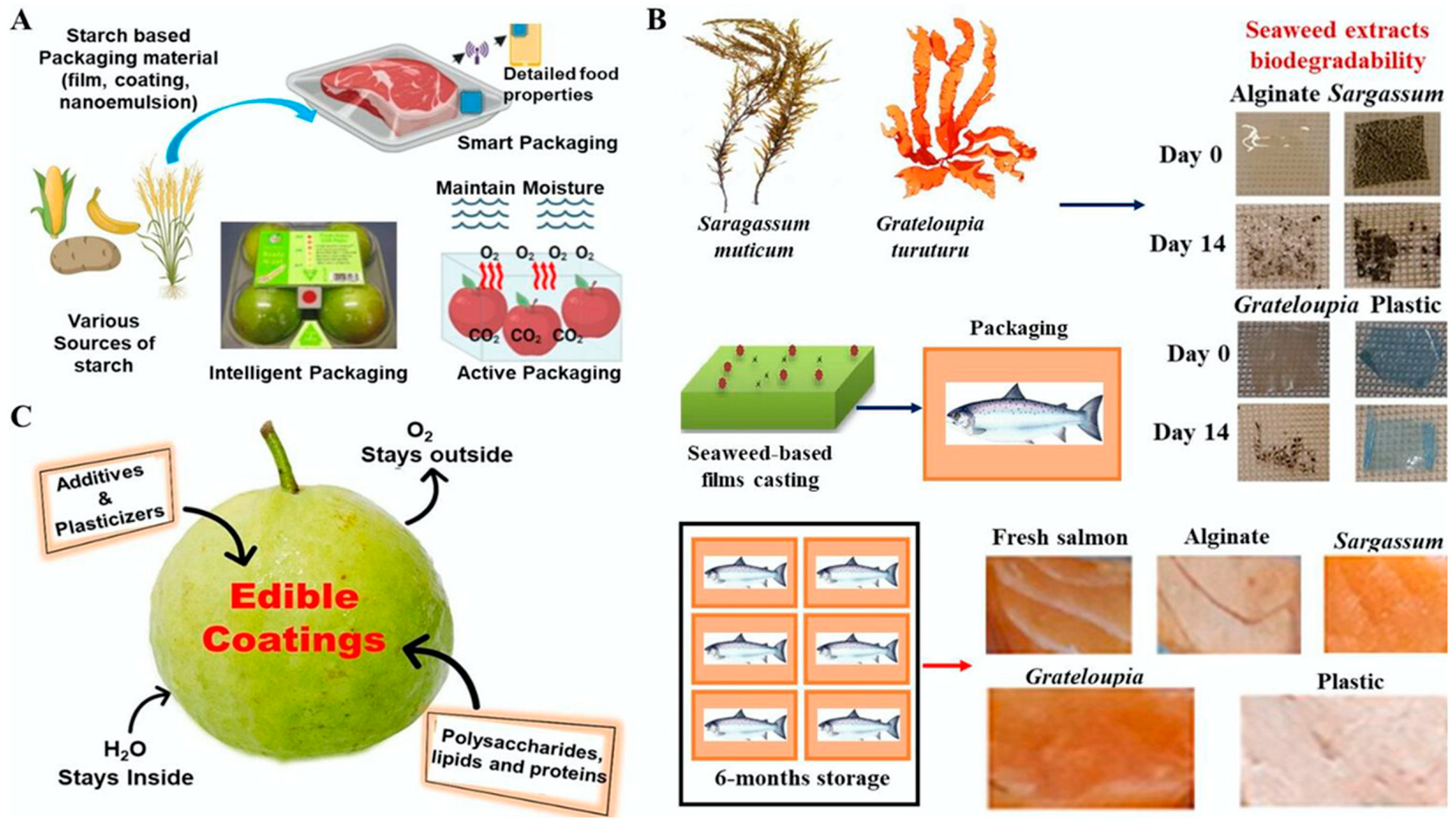
Table 1.
Materials, modification strategies, and functional properties of hydrophobic and active food packaging systems.
Although Table 1 summarizes reported performance improvements, differences in material formulations, testing conditions, and measured parameters limit direct quantitative comparisons across studies. The hydrophobic modification strategies in Table 1 also differ in practical feasibility. Natural waxes, lipids, and polymer blending offer relatively simple processing, whereas nanoparticle-based approaches can provide improved surface and barrier properties but may involve higher costs, dispersion challenges, and safety concerns. More complex techniques, such as electrospinning and hierarchical surface engineering, offer greater functional control but may be difficult to scale. Therefore, material selection should balance performance with cost, safety, processing complexity, and scalability.
2.2. Methods for Making Packaging Surfaces Water-Resistant
Developing water-resistant packaging surfaces is an important approach for reducing surface wetting and potentially improving the durability and barrier performance of biodegradable food-packaging materials. Instead of modifying the entire polymer matrix, surface engineering focuses on altering only the outer layer to reduce surface wettability, minimize water penetration, and enhance resistance to humid environments. This targeted approach preserves the desirable properties of the bulk material while improving its ability to withstand moisture during food storage. Among the most widely adopted techniques are wax and lipid coatings, plasma treatment, sol–gel deposition, and spray-coating methods, each offering distinct advantages depending on the packaging application [42,43,44]. Wax and lipid-based coatings remain among the simplest and most practical approaches for increasing surface hydrophobicity. These coatings can form water-repellent layers that reduce surface wetting and, when sufficiently continuous and compatible with the substrate, may also reduce water-vapor transmission and improve film stability under humid conditions. Their effectiveness has been widely demonstrated in starch-based packaging systems, where hydrophobic lipids compensate for the inherent moisture sensitivity of starch. For example, Cui et al. [45] reported that waxes, lipids, and hydrophobic bioactive compounds effectively improved the water resistance of starch-based films. Supporting this observation, de Oleveira et al. [46] developed arrowroot starch films containing carnauba wax nanoemulsion, cellulose nanocrystals, and essential oils, achieving improved barrier performance and greater suitability for food-packaging applications. Furthermore, Oliveira et al. [47] demonstrated that similar wax-based coatings successfully preserved strawberry quality and prolonged storage life.
Despite these advantages, wax- and lipid-based coatings also present important practical limitations. Their performance depends strongly on maintaining a uniform and stable coating layer on the packaging substrate. Poor interfacial compatibility between the hydrophobic coating and the underlying biopolymer may lead to coating separation or delamination during handling and storage. Lipid components may also migrate or redistribute within the packaging matrix over time, potentially reducing coating uniformity and moisture-barrier performance. In addition, mechanical deformation and changes in storage conditions can promote cracking or disruption of the hydrophobic layer, creating pathways for moisture penetration. These limitations indicate that the effectiveness of wax- and lipid-based coatings should be evaluated not only from their initial hydrophobicity but also from their adhesion, structural integrity, and stability throughout the intended storage period.
Plasma treatment provides a different strategy by modifying the surface without altering the internal structure of the packaging material. Depending on the treatment conditions, plasma can alter surface chemistry and roughness, improve coating adhesion, and facilitate subsequent hydrophobic modification. Bayanloo et al. [48] showed that cold plasma treatment effectively altered the surface characteristics of starch-based packaging materials and improved their functional performance. Likewise, Bahrami et al. [42] emphasized that cold plasma technology enhances coating adhesion and barrier properties while preserving the bulk characteristics of biodegradable substrates.
Sol–gel technology offers another effective route for producing thin silica-based hybrid coatings that can improve moisture-barrier performance when appropriately formulated. The formation of dense inorganic–organic networks limits water diffusion and strengthens surface stability. Rovera et al. [49] demonstrated that wheat gluten/silica hybrid coatings significantly improved the water vapor barrier of paperboard, while Dond et al. [50] reported enhanced functional properties after incorporating modified silica nanoparticles into chitosan films. These findings illustrate the value of silica-based systems for improving moisture resistance through hybrid surface engineering. Spray and dip coating techniques are attractive for industrial implementation because of their relative simplicity and potential compatibility with existing manufacturing processes. By depositing hydrophobic materials directly onto the packaging surface, these methods improve water resistance without changing the composition of the underlying film. For example, Ahuja et al. [51] demonstrated that spray-coated edible insect waxes substantially increased the water repellency of paper-based packaging materials while maintaining their lightweight and renewable characteristics. The available surface-modification strategies provide complementary solutions for enhancing the hydrophobic performance of biodegradable packaging materials. Wax and lipid coatings are particularly suitable for practical food-packaging applications because of their simplicity and scalability, whereas plasma treatment and sol–gel technologies offer additional benefits where stronger surface adhesion, improved durability, or multifunctional barrier layers are required.
2.3. Surface Texture and Structure for Water Repellency
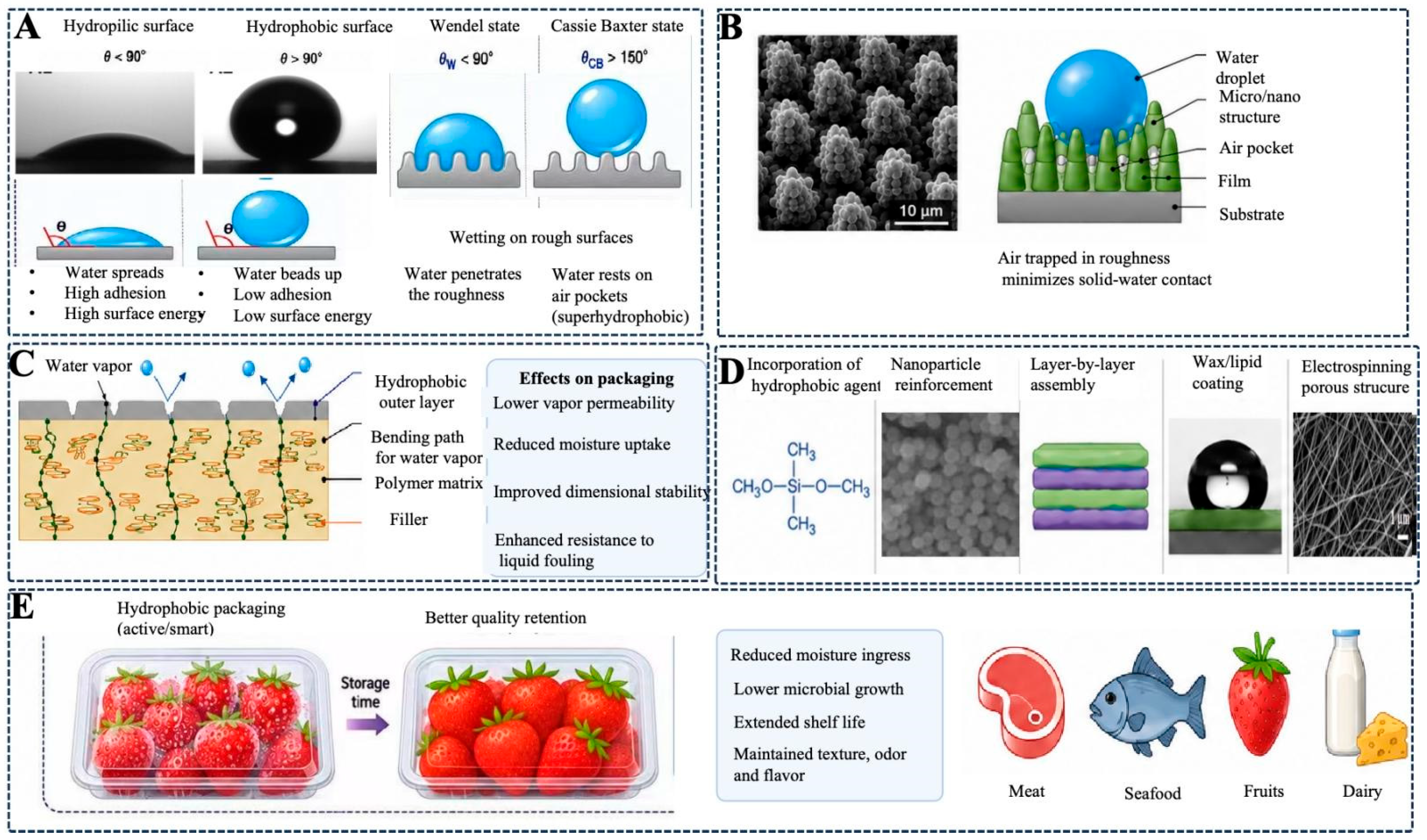
Surface texture and structural architecture play decisive roles in determining the hydrophobic behavior of food-packaging materials because surface morphology directly influences how water droplets interact with the packaging interface. Although lowering surface energy is essential for achieving hydrophobicity, it is rarely sufficient on its own. The combination of appropriate surface chemistry with engineered micro- and nanoscale architectures has therefore become an important strategy for minimizing water adhesion and suppressing moisture accumulation on biodegradable packaging materials [5,52,53]. The relationship between surface roughness and wettability is commonly interpreted using the Wenzel and Cassie–Baxter models, which describe distinct wetting configurations on textured surfaces. In the Wenzel state, the liquid completely penetrates the surface asperities, increasing the actual solid–liquid contact area. The apparent contact angle is described by cos θW = r cos θY, where θW is the apparent Wenzel contact angle, θY is the Young contact angle on an ideal smooth surface, and r is the surface roughness factor. Thus, surface roughness amplifies the intrinsic wetting tendency of the material: roughening an intrinsically hydrophobic surface can increase its apparent hydrophobicity, whereas roughening a hydrophilic surface can enhance wetting. In contrast, the Cassie–Baxter state occurs when air remains trapped within surface cavities and the droplet contacts a composite solid–air interface. This behavior is described by cos θCB = fS(cos θY + 1) − 1, where θCB is the apparent contact angle and fS represents the fraction of the droplet contacting the solid surface. A lower solid-contact fraction can therefore produce a larger apparent contact angle and, under suitable wetting conditions, lower droplet adhesion. Hierarchical micro/nanoscale structures can favor this state by reducing solid–liquid contact and stabilizing trapped air beneath the droplet. However, these wetting states are not necessarily fixed, and disruption of the trapped air layer can promote greater liquid penetration into the surface structure and a shift toward Wenzel-type wetting [5,52,54].
Figure 2 shows an overview of the structural principles and fabrication strategies used to achieve hydrophobicity in food-packaging materials. Differences between hydrophilic and hydrophobic surfaces can be explained through their distinct wetting behavior, while the Wenzel and Cassie–Baxter states describe how surface roughness and liquid penetration influence droplet–surface interactions (Figure 2A). Micro- and nanoscale surface structures can enhance water repellency by trapping air pockets and reducing direct solid–water contact (Figure 2B). Hydrophobic surface layers can reduce liquid-water wetting, while appropriately dispersed fillers may create more tortuous pathways for water-vapor diffusion, thereby improving moisture-barrier performance (Figure 2C). These properties can be achieved through several fabrication approaches, including hydrophobic-agent incorporation, nanoparticle reinforcement, layer-by-layer assembly, wax or lipid coatings, and electrospinning (Figure 2D). Collectively, these structural and fabrication strategies can improve surface water repellency and, when combined with suitable barrier or active components, may contribute to food-quality preservation and shelf-life extension (Figure 2E). Representative SEM images from previous studies illustrate the surface morphologies associated with these fabrication approaches [55,56].
Engineering surface roughness across multiple length scales has proven particularly effective for improving packaging performance. Microscale structures generated through coating deposition, electrospinning, phase separation, or surface patterning can reduce droplet spreading and enhance surface water repellency [53,57]. Introducing nanoscale features further enhances this effect by stabilizing air pockets while simultaneously reinforcing the polymer matrix [58,59]. For example, [50] demonstrated that modified silica nanoparticles increased the surface roughness of chitosan films and significantly improved their hydrophobic performance. The greatest improvements are generally achieved when micro- and nanoscale features are integrated into hierarchical structures. Inspired by naturally water-repellent surfaces, these architectures maintain stable air pockets beneath water droplets, resulting in higher contact angles and lower droplet adhesion than single-scale textures [5,60]. For instance, Cai et al. [61] developed a bioinspired starch nanofibrous film with hierarchical micro/nanostructures that exhibited enhanced hydrophobicity and self-cleaning behavior. Similarly, Liu et al. [62] fabricated starch composite nanofibrous films with interconnected fibrous networks that improved both hydrophobic and antibacterial performance.
Beyond moisture control, textured hydrophobic surfaces can facilitate self-cleaning and reduce droplet retention, although condensation may promote fogging and reduce package transparency depending on the surface structure and storage conditions [63]. These multifunctional benefits are particularly valuable for refrigerated foods, fresh produce, meat, and seafood products where condensation frequently affects product quality and appearance. Overall, the incorporation of micro-, nano-, and hierarchical surface structures provides an effective approach for enhancing water repellency and packaging functionality. By controlling droplet–surface interactions, these architectures can enhance water repellency and self-cleaning behavior, although their long-term performance depends on surface durability and environmental conditions.
Figure 2.
Surface texture and structural strategies for enhancing hydrophobicity in food-packaging materials. (A) Comparison of hydrophilic and hydrophobic wetting behavior and illustration of the Wenzel and Cassie–Baxter wetting models. Reproduced with permission from [64,65]. (B) Formation of air pockets within micro/nano-structured surfaces that reduce solid–water contact and enhance water repellency. Reproduced with permission from [66]. (C) Barrier mechanism of hydrophobic packaging materials showing reduced water-vapor transmission and moisture uptake. Adapted with permission from [67]. (D) Hydrophobic modification strategies for food packaging, including hydrophobic agents, nanoparticle reinforcement, layer-by-layer assembly, wax/lipid coating, and electrospinning. SEM images illustrate surface morphology and fibrous structures. Reproduced with permission from [55,56]. (E) Applications and benefits of hydrophobic packaging for food preservation, including moisture control, reduced microbial growth, improved quality retention, and shelf-life extension.
2.4. Additives for Improving Surface Properties
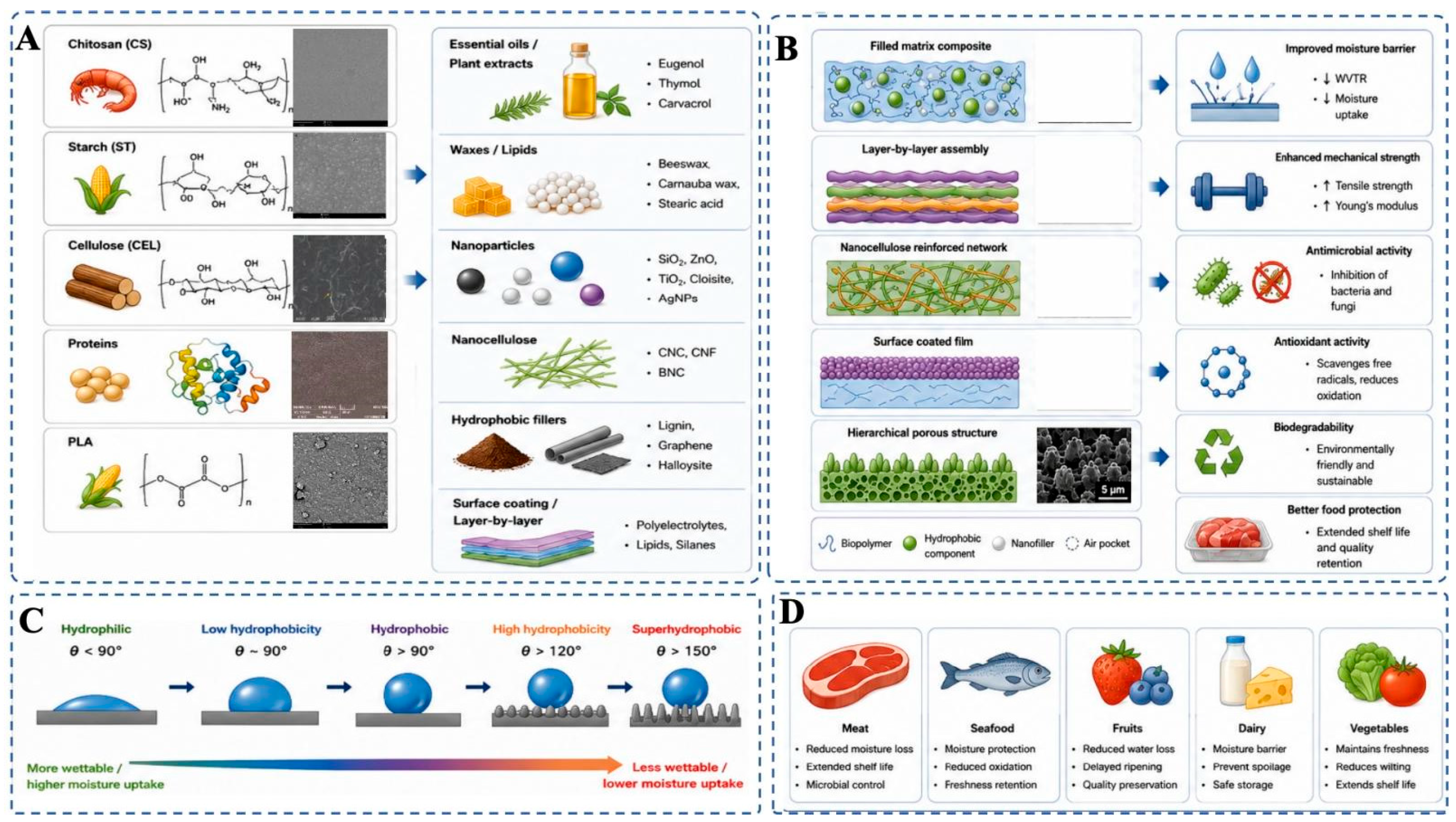
Functional additives are widely incorporated into hydrophobic packaging materials to enhance surface performance, improve moisture resistance, and provide additional preservation functions. While surface engineering and structural modification contribute to water repellency, additives offer an effective means of modifying surface energy, strengthening barrier properties, and introducing antimicrobial and antioxidant activities. Consequently, nanoparticles, essential oils, natural extracts, and hybrid filler systems have become important components of advanced hydrophobic food-packaging materials [1,68,69,70,71]. Nanoparticles are widely investigated as functional additives because they can modify both surface and bulk properties. Silica nanoparticles, metal oxides, nanoclays, and nanocellulose may reduce moisture permeability by creating tortuous diffusion pathways within polymer matrices while enhancing mechanical strength and stability, depending on their dispersion and compatibility with the polymer matrix [72,73,74]. Figure 3 summarizes the major additives used to improve the surface properties of hydrophobic food-packaging materials. Biodegradable polymers can be combined with hydrophobic modifiers such as waxes, essential oils, nanoparticles, and nanocellulose to tailor the surface and functional properties of food-packaging materials (Figure 3A) [75,76]. Incorporating their composition and concentration, these additives can improve moisture resistance and mechanical strength, while selected bioactive compounds may also provide antimicrobial and antioxidant functions (Figure 3B). Depending on the modification strategy and resulting surface characteristics, packaging surfaces can exhibit wettability ranging from hydrophilic to highly hydrophobic or superhydrophobic states (Figure 3C). These additive-enhanced packaging materials have potential applications across fruits, vegetables, meat, seafood, and dairy products, where their combined barrier and functional properties can contribute to quality preservation and shelf-life extension (Figure 3D).
Natural extracts and essential oils have also gained considerable attention because of their potential antioxidant and antimicrobial functions. Essential oils derived from clove, cinnamon, oregano, thyme, and rosemary are frequently incorporated into biodegradable films to improve food preservation and may contribute to moisture resistance depending on their compatibility with the polymer matrix [21,77]. Hybrid additive systems that combine nanoparticles with bioactive compounds have recently emerged as a promising strategy for developing multifunctional packaging materials. These systems can simultaneously improve barrier properties, mechanical stability, antioxidant activity, and microbial resistance. Such approaches highlight the potential advantages of integrating multiple additives within a single packaging system [78]. Functional additives play a crucial role in improving the surface properties and preservation performance of hydrophobic packaging materials. Through the incorporation of nanoparticles, natural extracts, essential oils, and hybrid systems, packaging films can achieve improved moisture resistance and, where suitable active compounds are incorporated, additional antimicrobial and antioxidant functions. These multifunctional characteristics are expected to support the continued development of sustainable next-generation food-packaging technologies.
Figure 3.
Additives and modification strategies for improving the surface properties of hydrophobic food-packaging materials. (A) Common food-packaging biopolymers, including chitosan, starch, cellulose, proteins, and PLA, with corresponding SEM micrographs illustrating their surface morphology, alongside hydrophobic modifiers such as essential oils, plant extracts, waxes, lipids, nanoparticles, nanocellulose, hydrophobic fillers, and surface coatings. Reproduced with permission from [79,80,81]. (B) Functional improvements achieved through additive incorporation, including enhanced moisture resistance, mechanical strength, antimicrobial activity, antioxidant activity, and food protection. Reproduced with permission from [66]. (C) Transition of surface wettability from hydrophilic to superhydrophobic states. (D) Applications of additive-enhanced hydrophobic packaging materials in fruits, vegetables, meat, seafood, and dairy products for quality preservation and shelf-life extension.
3. Fabrication and Structure of Hydrophobic Packaging Films
3.1. Film Formation and Coating Techniques
Film formation and coating techniques play important roles in determining the structure, surface properties, and hydrophobic performance of packaging films. Hydrophobic films and coatings should be distinguished because they differ in structure and application. Films are generally self-supporting packaging materials produced by casting, extrusion, or related techniques, whereas coatings are thin layers applied directly to food surfaces or packaging substrates. Consequently, their fabrication requirements, mechanical and barrier properties, and practical applications may differ. The fabrication method influences film morphology, thickness, additive distribution, mechanical strength, and moisture-barrier behavior. Common approaches include solution casting, extrusion, electrospinning, and surface-coating technologies, each offering distinct advantages depending on the intended application [82,83]. Solution casting is widely used for laboratory-scale film development because it allows precise control over polymer composition and additive incorporation. This method is particularly useful for evaluating the effects of hydrophobic agents, nanofillers, and bioactive compounds on film performance before industrial production [82,84,85].
In contrast, extrusion is more suitable for large-scale manufacturing because it enables continuous, solvent-free processing of biodegradable polymers. However, transferring a formulation from laboratory-scale solution casting to industrial extrusion is not straightforward because the material is exposed to substantially different processing conditions. During extrusion, polymer rheology must be suitable for continuous flow and film formation, while processing temperature must be carefully controlled to avoid thermal degradation of the polymer and heat-sensitive functional additives, particularly volatile compounds such as essential oils that may evaporate or lose activity during melt processing. The shear forces generated during mixing and extrusion can also influence polymer structure, filler dispersion, and the stability of incorporated active compounds. Consequently, formulations that perform well during solution casting may require substantial optimization of composition, temperature, shear conditions, and processing parameters before they can be successfully translated to industrial extrusion. Zhai et al. [86] developed a hydrophobic low-density polyethylene–curcumin film through melt extrusion, demonstrating its stability under aqueous conditions and its sensitivity to ammonia generated during meat and fish spoilage. The film exhibited an ammonia detection limit of 0.18 μM, highlighting the potential of extrusion-based processing for producing hydrophobic intelligent packaging materials.
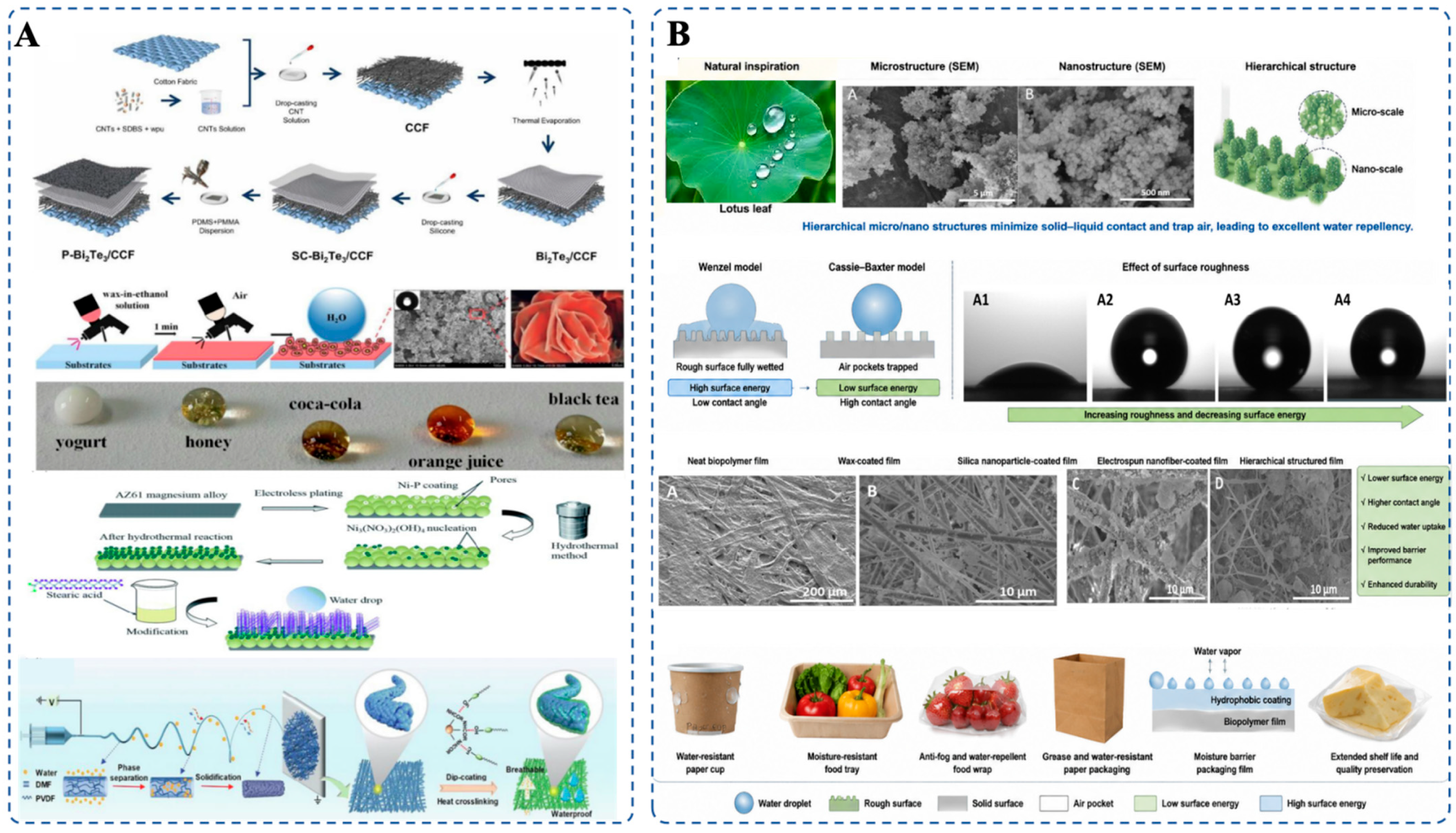
Different fabrication techniques can be employed to construct hydrophobic packaging materials with enhanced moisture resistance and surface functionality (Figure 4). Representative approaches include coating deposition, hydrothermal treatment, phase separation, electrospinning, and surface modification, which can be used to generate hydrophobic and superhydrophobic surfaces (Figure 4A). These fabrication strategies can produce micro- and nanoscale surface structures inspired by naturally water-repellent systems such as lotus leaves (Figure 4B). The surface morphologies illustrated in Figure 4B highlight the role of hierarchical roughness in regulating water–surface interactions. According to the Wenzel model, water penetrates surface irregularities, whereas the Cassie–Baxter model describes a composite interface in which air pockets may remain trapped beneath the droplet. These wetting states influence the apparent water contact angle and resulting surface water repellency. Although such structural modifications can improve hydrophobic behavior, their effects on water-vapor barrier performance also depend on the composition, continuity, and integrity of the packaging material. Electrospinning has emerged as a promising technique for producing nanofibrous films with high surface area and tunable surface morphology. These structures can enhance active compound loading and improve surface functionality. For instance, Zhao et al. [87] produced electrospun polypeptide-based nanofabrics enriched with antioxidant polyphenols, demonstrating their potential for active food preservation.
Surface-coating and lamination methods are widely employed to improve the outer layer of packaging materials without altering the bulk film structure. Such structural modifications can enhance surface water repellency, while improvements in moisture-barrier performance depend on the composition and integrity of the packaging material [88]. In summary, solution casting, extrusion, electrospinning, and surface-coating technologies provide complementary routes for fabricating hydrophobic packaging films. The choice of technique depends on the desired film structure, processing scale, functional requirements, and intended food-packaging application.
Figure 4.
Fabrication techniques and surface-structure engineering strategies for hydrophobic food-packaging materials. (A) Representative fabrication approaches, including coating deposition, hydrothermal treatment, phase separation, electrospinning, and surface modification for the development of hydrophobic and superhydrophobic surfaces. Reproduced with permission from [89]. (B) Surface wettability mechanisms illustrating lotus-inspired hierarchical structures, Wenzel and Cassie–Baxter wetting states, contact-angle enhancement, and their influence on water repellency and food-packaging performance. Reproduced with permission from [65].
3.2. Multilayer and Composite Film Structures
Multilayer and composite film structures are widely used to enhance the performance of hydrophobic packaging materials by combining materials with complementary properties. Unlike single-layer films, these systems integrate multiple functional components to improve moisture resistance, mechanical strength, gas barrier performance, and food preservation. As a result, they have become important design strategies for sustainable packaging applications [90,91]. Multilayer films are designed so that individual layers perform specific functions. Hydrophobic outer layers provide moisture protection, while inner layers contribute mechanical support, flexibility, or barrier properties. This layered arrangement can improve overall packaging performance, although its effectiveness depends on inter-layer compatibility, adhesion, and structural integrity. Recent studies have shown that multilayer architectures can significantly enhance moisture and gas barrier properties compared with conventional mono-layer films [92].
Composite films can improve packaging performance through the incorporation of reinforcing fillers such as nanocellulose, nanoclays, and metal oxide nanoparticles. When appropriately dispersed and compatible with the polymer matrix, these fillers can enhance mechanical strength and create more tortuous pathways for water-vapor and gas diffusion, potentially improving barrier performance [57]. For example, Chen et al. [93] developed biodegradable and recyclable laminated films based on poly(lactic acid) and cellulose nanocrystals and reported enhanced barrier performance, improved structural stability, and reduced moisture transmission. These findings demonstrate the effectiveness of cellulose nanocrystal reinforcement and multilayer design in improving the performance of sustainable food-packaging materials. Another advantage of multilayer and composite structures is their ability to incorporate active compounds such as antimicrobial and antioxidant agents [94]. These substances can be strategically localized within specific layers or matrices to enhance food protection while maintaining film integrity. For instance, Rodriguez et al. [95] developed multilayer polycaprolactone–pullulan nanofiber mats incorporating the antimicrobial peptide LfcinB(21–25)Pal and demonstrated their potential for active packaging applications. The multilayer architecture enabled the integration of structural support and antimicrobial functionality within a single packaging system, highlighting the advantages of multilayer designs for improving food protection and extending shelf life. By integrating materials with complementary properties, these systems can provide improved barrier performance and food protection compared with conventional single-layer packaging materials, depending on their composition, structural design, and intended application.
3.3. Processing Conditions Affecting Film Structure
Processing conditions play a critical role in determining the final properties of hydrophobic packaging materials by influencing polymer interactions, additive dispersion, film morphology, and barrier performance. Beyond material selection and film architecture, parameters such as temperature, drying conditions, mixing intensity, and film thickness govern the development of film microstructure and ultimately determine moisture resistance, mechanical stability, and long-term functionality [84,96,97]. Temperature and drying conditions strongly affect solvent evaporation, polymer chain arrangement, and matrix consolidation during film formation. Inappropriate processing temperatures may result in phase separation, non-uniform surfaces, and structural defects that compromise barrier performance. Similarly, excessive drying can induce shrinkage and cracking, whereas insufficient drying may leave residual moisture within the film, potentially affecting its structural integrity, dimensional stability, and moisture-barrier performance. Consequently, careful control of these parameters is essential for producing films with consistent morphology and functional properties [88,98].
Mixing conditions also play an important role by influencing the dispersion of nanoparticles, waxes, essential oils, and other hydrophobic additives within the polymer matrix. Uniform dispersion promotes structural homogeneity and improves the effectiveness of reinforcing or active components, whereas particle aggregation may introduce structural defects and compromise mechanical or barrier performance. Processing variables can additionally affect crystallinity, interfacial interactions, and filler distribution, all of which contribute to the final barrier and mechanical properties of the film [83]. For example, Zhou et al. [99] developed intelligent κ-carrageenan-based packaging films incorporating curcumin–anthocyannin–EGCG nanoparticles and demonstrated that the successful integration and dispersion of the nanoparticles significantly influenced film structure, mechanical performance, and functional properties. The findings highlighted the importance of controlling fabrication conditions to achieve uniform film morphology and consistent packaging performance. Film thickness represents another key processing parameter because it directly influences moisture and gas diffusion pathways. Increasing film thickness generally reduces gas and water-vapor transmission by extending the diffusion pathway, although it does not necessarily improve intrinsic material permeability, and excessive thickness may reduce flexibility, transparency, and material efficiency. Therefore, achieving an appropriate balance between thickness and functionality is essential for developing effective hydrophobic packaging systems [82,96]. Processing conditions play a fundamental role in determining the structure, stability, and performance of hydrophobic packaging films. Optimizing temperature, drying, mixing, and thickness is therefore necessary to produce packaging materials with reliable barrier properties and long-term food-protection capabilities.
3.4. Stability and Durability of Hydrophobic Film Structures
Stability and durability of hydrophobic film structures are essential for ensuring that packaging materials maintain their protective performance throughout storage, transportation, and practical use. Hydrophobic films are exposed to humidity, temperature fluctuations, mechanical stress, and environmental aging, all of which can alter film morphology, weaken intermolecular interactions, and reduce barrier effectiveness. Therefore, maintaining long-term structural stability is critical for preserving packaging functionality [1,100,101]. Humidity is one of the primary factors affecting film durability because moisture can plasticize polymer matrices, disrupt structural cohesion, and accelerate degradation. Consequently, prolonged exposure to humid environments may increase water uptake and compromise barrier performance. Studies have emphasized that improving surface hydrophobicity, matrix integrity, and resistance to moisture-induced structural changes can contribute to maintaining stability under moisture-rich conditions [102,103]. For example, Fernandez et al. [104] demonstrated that the incorporation of biodegradable plasticizers improved both the mechanical integrity and barrier properties of nanocellulose films, highlighting the importance of structural optimization for maintaining long-term packaging performance.
Mechanical durability is equally important because packaging materials must withstand handling and transportation without losing structural integrity. Reinforcement strategies involving nanofillers, fibers, and multilayer structures have therefore been widely adopted to improve resistance to deformation and extend service life [100,105]. The long-term stability of hydrophobic coatings is another important consideration because surface degradation can reduce water repellency and overall packaging performance. Zong et al. [106] highlighted that the durability of bioinspired hydrophobic surfaces depends strongly on surface architecture and interfacial stability, which are essential for maintaining long-term water repellency and functional performance under practical conditions. In practical applications, mechanical stress may cause coating cracking, abrasion, or delamination, while repeated wetting, sterilization, and processing conditions can alter surface structure and reduce hydrophobic performance.
Therefore, coating durability should be evaluated under realistic processing, handling, and storage conditions, including repeated wetting and abrasion, to determine whether initial laboratory performance is maintained throughout extended packaging use. Temperature fluctuations may further influence polymer mobility and coating stability, affecting long-term performance [107]. Furthermore, wax- and oil-based coatings containing oxidation-sensitive lipid components may undergo oxidative degradation during prolonged exposure to oxygen, light, and elevated temperatures, potentially affecting their structural integrity and protective performance. In summary, stability and durability are fundamental requirements for hydrophobic packaging films because they determine the ability of the material to maintain moisture resistance, mechanical integrity, and functional performance throughout its service life. Improving resistance to humidity, mechanical stress, and environmental aging therefore remains essential for the successful application of hydrophobic food-packaging systems.
4. Functional Roles of Hydrophobic Packaging in Food Protection
Hydrophobic packaging materials can contribute to food protection by regulating surface moisture interactions and, when combined with appropriate barrier or active components, helping to limit contamination and maintain product quality during storage. While previous chapters discussed material design and fabrication strategies, this chapter focuses on how hydrophobic packaging functions in practical food systems. The ability of hydrophobic surfaces to repel water can reduce droplet adhesion and facilitate water removal, although their effectiveness in controlling condensation and microbial growth depends on surface structure, environmental conditions, and the presence of additional functional components. Beyond surface moisture control, hydrophobic materials may reduce microbial adhesion, while incorporated active compounds and appropriately designed barrier layers can provide additional antimicrobial activity and protection against environmental factors. Figure 5 demonstrates the complementary functions and underlying mechanisms of multifunctional food-packaging systems. As shown in Figure 5A, gas regulation, antimicrobial activity, and freshness monitoring contribute to food protection through different mechanisms. These functions may involve gas adsorption or selective gas transmission, antimicrobial compounds that inhibit microbial growth, and colorimetric or fluorescent indicators that respond to changes associated with food deterioration (Figure 5B). When integrated with hydrophobic materials, these active and intelligent components can provide additional functionality beyond surface water repellency. Understanding these functional roles is essential for the development of effective and commercially viable hydrophobic packaging systems.
Figure 5.
Conceptual illustrations of the multifunctional roles and mechanisms of hydrophobic smart packaging for food protection. (A) Schematic representation of gas regulation, antimicrobial activity, and freshness monitoring. (B) Schematic illustration of the underlying mechanisms, including gas adsorption, antimicrobial action, and colorimetric and fluorescent sensing responses. Reproduced with permission from [108].
4.1. Moisture Control and Anti-Fogging Behavior
Moisture control and anti-fogging behavior are among the most important functional advantages of hydrophobic packaging materials because excessive water accumulation can accelerate food deterioration and reduce product quality. Moisture condensation within packaging systems promotes microbial growth, alters food texture, and compromises visual appearance, particularly in fresh and refrigerated products. By reducing surface wettability and limiting water adhesion, hydrophobic materials can facilitate droplet removal, although their effectiveness in controlling moisture accumulation depends on packaging conditions and water-vapor barrier properties [1,101,109]. Anti-fogging performance is particularly important for foods stored under refrigerated conditions, where temperature fluctuations frequently induce condensation. Fog formation on the inner packaging surface reduces product visibility and negatively influences consumer perception. Importantly, anti-fogging can be achieved through different surface-wetting mechanisms. Hydrophilic anti-fogging surfaces promote the spreading of condensed water into a relatively uniform and transparent film, thereby reducing light scattering by discrete droplets. In contrast, highly hydrophobic or superhydrophobic surfaces can minimize water adhesion and promote droplet removal, although condensation within surface microstructures may reduce their water-repellent performance. Thus, hydrophilic and superhydrophobic anti-fogging strategies can both maintain package transparency, but they operate through fundamentally different droplet–surface interactions [102,110]. These characteristics are especially beneficial for fresh produce, meat products, and ready-to-eat foods, where visual quality strongly influences market acceptance.
As shown in Figure 6, moisture regulation and complementary packaging functions can contribute to food preservation through different mechanisms. Hydrophobic films and coatings may help limit water loss and maintain fruit freshness when combined with suitable moisture-barrier properties (Figure 6A). Microbial growth in bakery products can be reduced through appropriate moisture management and antimicrobial functionality (Figure 6B), while oxygen-barrier properties and antioxidant components may help limit lipid oxidation and color deterioration in meat and seafood (Figure 6C). In vegetables and fresh-cut foods, controlled moisture exchange can contribute to maintaining texture, color, and visual quality during storage (Figure 6D). Together, these effects illustrate the importance of integrating surface properties, barrier performance, and active functions to improve food preservation (Figure 6E). Surface morphology also contributes significantly to moisture management. Appropriately designed micro- and nanostructured surfaces can reduce water–solid contact and facilitate droplet removal, whereas unfavorable surface structures may promote liquid penetration and increased water adhesion.
Figure 6.
Effects of hydrophobic packaging on food preservation through moisture control and quality retention. (A) Reduced water loss and improved freshness retention in fruits during storage. (B) Suppression of microbial growth in bakery products. (C) Reduced lipid oxidation and color deterioration in seafood and meat products. (D) Maintenance of texture, color, and visual quality in vegetables and fresh-cut foods. (E) Summary of the major preservation benefits provided by hydrophobic packaging. Reproduced with permission from [111,112,113,114].
These findings highlight the importance of combining appropriate surface structures with effective moisture-barrier properties to regulate water accumulation and support food preservation. Nevertheless, anti-fogging performance depends on condensation behavior and environmental conditions, making application-specific evaluation essential.
4.2. Controlled Release of Active Compounds
Controlled release of active compounds is another important functional advantage of hydrophobic packaging systems because it allows antimicrobial and antioxidant agents to remain effective throughout food storage. Unlike conventional passive packaging, appropriately designed active hydrophobic films can regulate the release of bioactive substances, potentially reducing their rapid depletion and providing prolonged protection against spoilage. The release behavior is influenced by the interaction between the active compound and the packaging matrix, as well as the hydrophobicity and barrier properties of the film [98,115]. Hydrophobic matrices may slow the diffusion of certain encapsulated compounds, although release behavior depends on the physicochemical properties of the active agents, their interactions with the polymer matrix, and environmental conditions. This controlled migration is particularly beneficial for volatile antimicrobial agents and natural antioxidants, which can lose effectiveness when released too rapidly. The incorporation of nanofillers, encapsulation systems, and multilayer structures has further enhanced the ability of packaging materials to regulate the delivery of active compounds during storage [116,117,118].
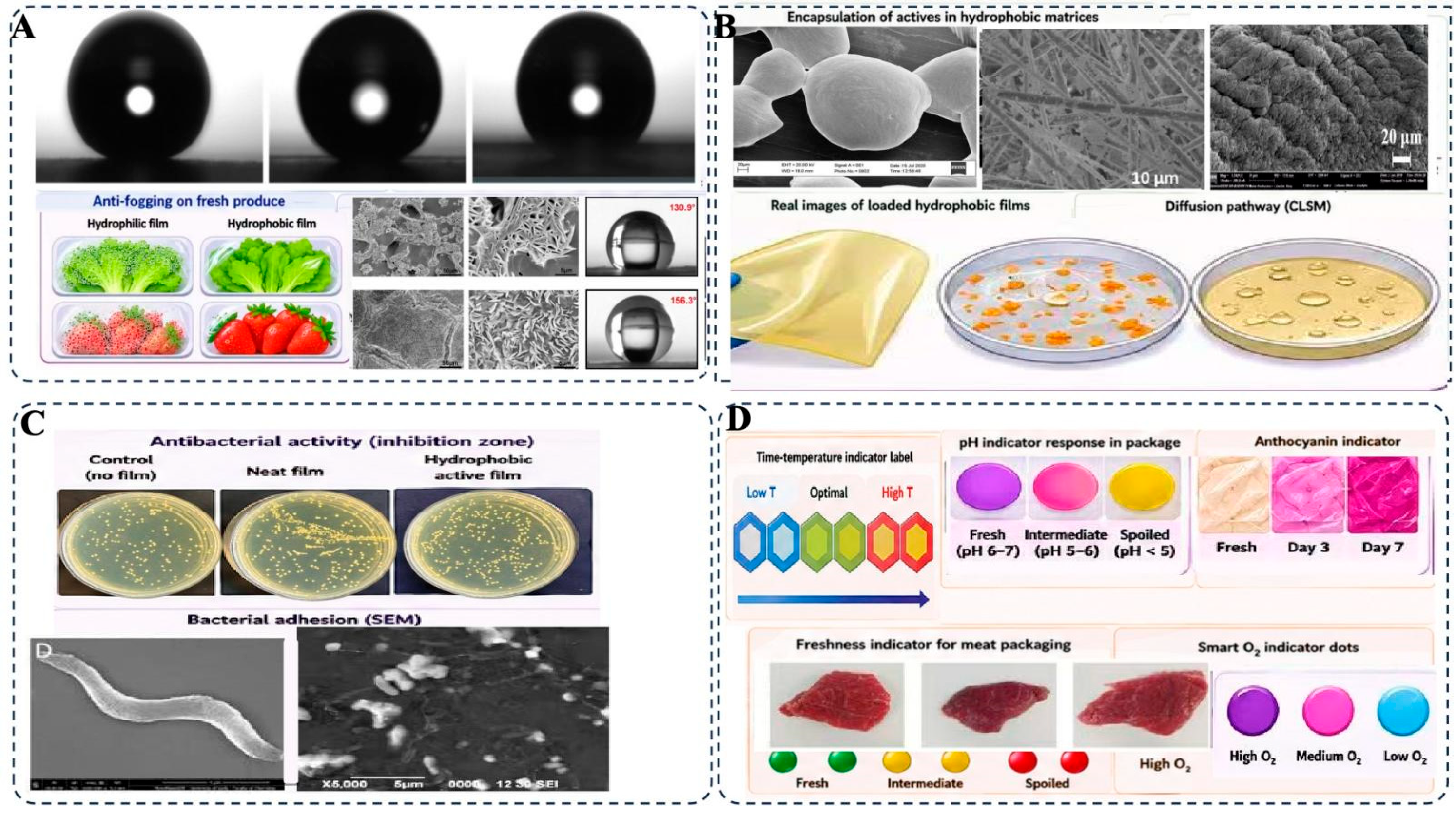
As shown in Figure 7, hydrophobic packaging materials provide multiple functions that contribute to food preservation. Figure 7A illustrates the potential contribution of surface hydrophobicity to moisture management, although its effectiveness depends on the surface structure and condensation conditions. Hydrophobic matrices can support the encapsulation and controlled release of antimicrobial or antioxidant compounds, depending on their compatibility with the packaging material (Figure 7B). Microbial inhibition may result from incorporated antimicrobial agents, whereas reduced microbial adhesion is associated with suitable surface properties (Figure 7C). Gas-barrier layers and responsive indicators can provide additional functions, with the latter enabling intelligent freshness monitoring through detectable changes in food quality (Figure 7D). Collectively, these functions demonstrate how hydrophobic packaging can integrate barrier protection, controlled release, microbial control, and freshness monitoring within a multifunctional food-packaging system.
For example, Zhou et al. [119] highlighted that essential oil-based intelligent packaging systems can achieve sustained antimicrobial activity through controlled release mechanisms and encapsulation strategies, thereby improving the long-term preservation of packaged foods. Similarly, Elshamy et al. [120] reported that chitosan films incorporated with essential oil nanoemulsions exhibited enhanced antimicrobial activity due to the improved retention and gradual release of bioactive compounds from the film matrix. These studies highlight the importance of controlling release kinetics to maximize the effectiveness of active ingredients during storage. When appropriately formulated with bioactive compounds, hydrophobic packaging materials can function as protective barriers and delivery systems for antimicrobial or antioxidant agents. Controlling the release of these compounds may contribute to maintaining food quality and extending shelf life, provided their effectiveness and safety are demonstrated under relevant storage conditions.
Figure 7.
Functional mechanisms of hydrophobic active packaging for food preservation. (A) Moisture-barrier and anti-fogging performance. Reproduced with permission from [65,121]. (B) Encapsulation and controlled release of active compounds from hydrophobic matrices; SEM images illustrating the morphology of encapsulated active compounds, fibrous structures, and hydrophobic matrices. Reproduced with permission from [65,122,123]. (C) Antimicrobial performance of food-packaging films, showing inhibition zones, live/dead bacterial staining, SEM images of bacterial adhesion, and antibacterial efficiency. Reproduced with permission from [124,125,126]. (D) Gas-barrier performance and smart freshness-monitoring indicators. Reproduced with permission from [127].
4.3. Microbial Control at the Packaging Surface
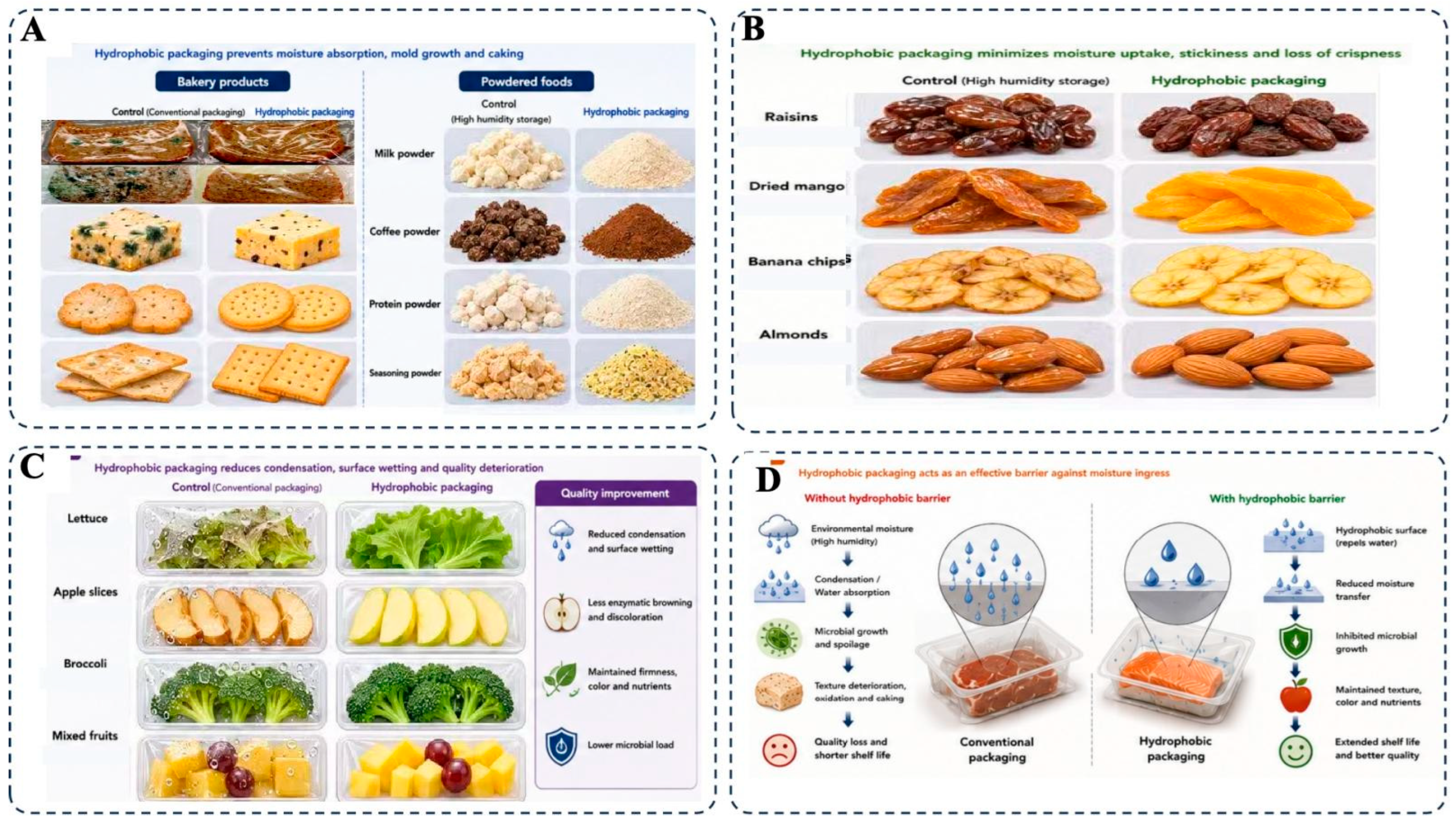
Microbial control at the packaging surface is an important consideration in hydrophobic food packaging because microbial contamination is strongly influenced by moisture availability and interfacial conditions. By reducing surface wetting and moisture accumulation, hydrophobic materials can create less favorable conditions for microbial colonization; however, hydrophobicity alone should not be considered inherently antimicrobial. Microbial attachment depends on multiple factors, including surface wettability, material composition, surface structure, microbial characteristics, and the composition of the food contacting the packaging surface [6,128]. In practical food systems, particularly high-moisture products such as meat and seafood, food-derived components deposited on the packaging interface may modify the original surface characteristics and consequently influence microbial attachment. Therefore, the anti-adhesion effect observed on an initially hydrophobic surface may not be maintained to the same extent under actual food-contact conditions. For this reason, surface-engineering approaches that combine hydrophobicity with specific antimicrobial functionality provide a more reliable strategy for microbial control than hydrophobicity alone [64,129]. As shown in Figure 8, moisture-control strategies can contribute to food preservation by limiting water uptake and moisture-associated deterioration, although these effects should be distinguished from direct antimicrobial activity. Reduced moisture accumulation can help limit caking and mold development in bakery and powdered foods (Figure 8A), while reduced moisture uptake can contribute to improved texture retention in dried foods and nuts under humid conditions (Figure 8B). In fresh produce, limiting condensation and surface wetting can contribute to better quality retention during storage (Figure 8C). More broadly, hydrophobic barriers can restrict moisture ingress and create less favorable conditions for moisture-associated deterioration, thereby supporting food-quality preservation and shelf-life extension (Figure 8D).
For example, Liu et al. [130] reported that hydrophobic and antibacterial coatings significantly inhibited bacterial adhesion and biofilm formation on treated surfaces, indicating that combining water-repellent surface characteristics with antibacterial functionality can contribute to improved microbial control. Likewise, Zhang et al. [131] highlighted that chitosan–essential oil films and coatings provide sustained antimicrobial activity by combining the barrier properties of chitosan with the bioactive effects of essential oils, thereby improving microbial control and food preservation during storage. These findings indicate that hydrophobic surface design can contribute to microbial control primarily through moisture management and, when combined with antimicrobial agents, through additional inhibition of microbial growth and biofilm formation.
Figure 8.
Moisture-control mechanisms and preservation benefits of hydrophobic packaging in food systems. (A) Prevention of moisture absorption, caking, and mold growth in bakery and powdered foods. (B) Reduced moisture uptake and improved texture retention in dried foods and nuts under humid conditions. (C) Reduced condensation and surface wetting in fresh produce, resulting in improved quality retention. (D) Schematic illustration of the moisture-barrier function of hydrophobic packaging and its role in preserving food quality and extending shelf life. Reproduced with permission from [114,132].
4.4. Gas Control and Smart Packaging Response
Gas control and smart packaging response are important functions of hydrophobic packaging materials because maintaining a stable internal atmosphere helps preserve food quality and extend shelf life. Many foods are sensitive to changes in oxygen, carbon dioxide, and water-vapor levels during storage. Packaging materials with appropriately designed gas-barrier and moisture-management properties can help maintain suitable internal conditions, although surface hydrophobicity alone does not determine oxygen or carbon dioxide transmission. In addition, advances in smart packaging technologies have enabled hydrophobic materials to respond to environmental changes and provide information about food quality and storage conditions [133,134]. One of the primary functions of hydrophobic packaging is controlling oxygen transfer. Excess oxygen can accelerate oxidation reactions that cause color deterioration, nutrient loss, and undesirable flavor changes. Improved barrier properties can help slow these processes and contribute to longer storage stability [135,136]. Gas regulation is also important for fresh produce, where maintaining appropriate oxygen and carbon dioxide levels helps control respiration and delay quality deterioration. However, packaging design requires balancing moisture resistance with appropriate oxygen and carbon dioxide transmission, particularly for fresh produce, where excessively restricted gas exchange may promote anaerobic respiration and accelerate quality deterioration.
For example, Xie et al. [137] reported that biopolymer-based multilayer films and coatings significantly improved gas-barrier performance by creating multiple diffusion pathways that restricted oxygen transfer and enhanced food preservation during storage. Meanwhile, Su et al. [138] developed a microporous modified-atmosphere packaging system capable of sustained antibacterial release and selective regulation of CO2 and O2 transfer, which helped maintain fruit quality and extend storage stability. Beyond passive gas regulation, recent developments have also introduced responsive features into hydrophobic packaging systems. When integrated with suitable sensing components, these systems can detect changes in humidity, gas composition, or food-spoilage indicators and provide information about food quality or storage conditions [86,139]. Figure 9 shows the integration of barrier functions and responsive technologies in multifunctional food-packaging systems. Freshness indicators can respond to changes in pH, microbial activity, or spoilage-related gases (Figure 9A), while additional components may provide moisture control, antimicrobial activity, controlled release, temperature responsiveness, and traceability (Figure 9B). Different fabrication approaches enable the incorporation of these functional components into packaging structures (Figure 9C). Stimulus-responsive indicators can then generate detectable signals associated with food deterioration or changes in storage conditions (Figure 9D). These developments show how hydrophobic packaging can combine passive regulation of the package environment with responsive functions that provide the basis for active and intelligent food-quality monitoring. Overall, moisture management, gas regulation, and antimicrobial activity are interconnected functions that collectively influence food preservation. Their effectiveness depends on the properties of the packaging materials and the specific storage requirements of different food products. Therefore, these functions should be considered together when evaluating the ability of hydrophobic packaging to maintain food quality and extend shelf life.
Figure 9.
Smart hydrophobic packaging systems for food-quality monitoring and preservation. (A) Freshness-sensing mechanism based on spoilage-induced changes in pH, gases, and microbial activity. (B) Functional roles of smart hydrophobic packaging, including sensing, antimicrobial protection, moisture control, active release, and traceability. (C) Fabrication approaches and key design considerations for responsive packaging systems. (D) Examples of stimulus-responsive indicators used for monitoring food spoilage and storage conditions.
5. Applications of Hydrophobic Packaging
5.1. Applications in Different Food Products
Applications in different food products highlight the practical value of hydrophobic packaging materials in maintaining food quality and extending shelf life under diverse storage conditions. Many food products are susceptible to moisture accumulation, microbial contamination, and quality deterioration during storage. Through appropriate surface modification and barrier design, hydrophobic packaging materials can contribute to moisture management and improved storage stability, depending on the requirements of the packaged food [140,141]. The diversity of food systems that benefit from hydrophobic packaging is summarized in Table 2. Current applications extend from fresh fruits and vegetables to meat, seafood, dairy products, bakery products, nuts, and frozen foods. Despite differences in composition, storage requirements, and spoilage mechanisms, a common objective is the reduction in moisture-related deterioration through improved barrier performance and surface water management. The studies compiled in Table 2 further demonstrate that hydrophobic packaging can be combined with antimicrobial, antioxidant, intelligent monitoring, and active preservation functions, highlighting its versatility across a broad range of food preservation applications.
The effectiveness of hydrophobic packaging should be considered in relation to the moisture characteristics and water activity (aw) of the packaged food rather than food category alone. High-aw foods, such as fresh fruits, vegetables, meat, seafood, and many dairy products, require packaging that balances moisture retention with the control of condensation, exudate accumulation, and gas exchange. Excessive surface moisture can promote quality deterioration and microbial growth, whereas excessive water loss can cause dehydration and undesirable textural changes. In contrast, lower-aw and moisture-sensitive foods, including bakery products, nuts, and seeds, benefit primarily from barriers that limit external moisture uptake and help maintain texture and storage stability. Therefore, hydrophobic packaging should be designed according to the moisture-transfer behavior, water activity, and storage requirements of the specific food system. Fresh produce often requires effective moisture and gas management to slow respiration and maintain quality, while meat and seafood products benefit from reduced surface moisture that can otherwise promote microbial growth.
Similarly, dairy and bakery products rely on proper moisture regulation to preserve texture, freshness, and overall product stability during storage [142,143]. In fresh produce applications, Zhang et al. [144] developed a hydrophobic microporous bionanocomposite film containing visible light-activated photocatalytic nanoparticles for fruit packaging. The film exhibited improved hydrophobicity, regulated gas exchange, and enhanced antimicrobial activity, contributing to better fruit quality retention and shelf-life extension during storage. Cazon et al. [145] highlighted the growing application of active biopolymer-based packaging systems incorporating fruit by-products for food preservation. These materials improved barrier, antimicrobial, and antioxidant properties, helping maintain food quality and extend shelf life across a range of food products.
Figure 10 illustrates the diverse applications of hydrophobic packaging across different food categories. Hydrophobic materials have been successfully applied to meat, poultry, seafood, fruits, vegetables, dairy products, and bakery products, where they help reduce moisture loss, suppress microbial growth, limit oxidation, and maintain product freshness [34]. The figure also outlines the general preparation and application process of hydrophobic packaging, from material formulation and film formation to food packaging, storage, and distribution. These benefits contribute to improved quality retention and extended shelf life across a wide range of food systems.
Figure 10.
Applications of hydrophobic packaging in different food products and the general packaging process. Hydrophobic packaging improves moisture protection, microbial safety, oxidation control, freshness retention, and shelf-life extension in meat and poultry, seafood, fruits, vegetables, dairy products, and bakery products. The figure also illustrates the preparation, application, packaging, and storage stages involved in hydrophobic food-packaging systems. Reproduced with permission from [112,113,114].
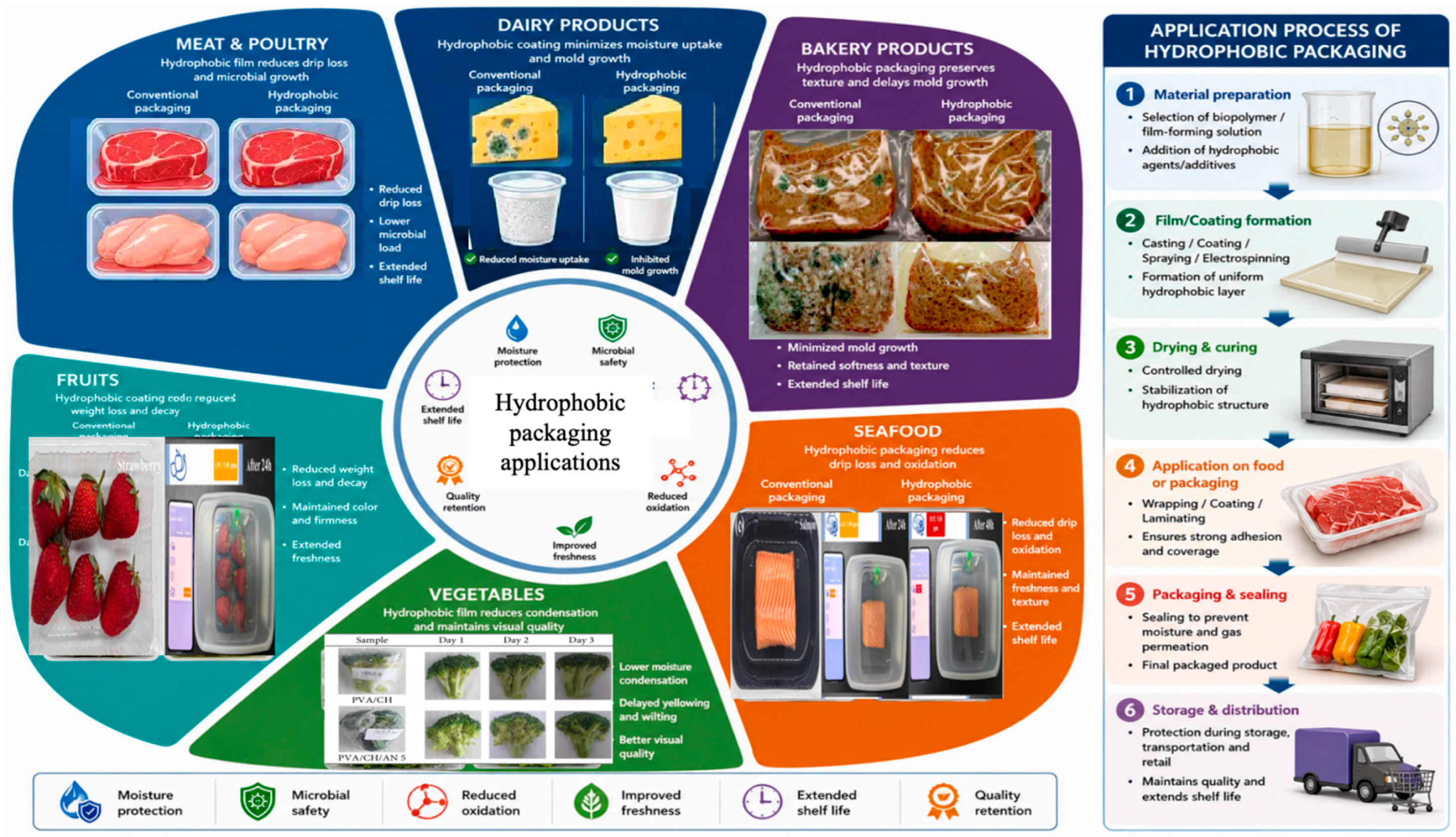
Table 2.
Applications of hydrophobic and multifunctional packaging in food systems.
5.2. Shelf-Life Improvement and Quality Preservation
Shelf-life improvement and quality preservation are among the most important benefits of hydrophobic packaging because controlling moisture and environmental exposure helps slow food deterioration during storage. When combined with appropriate moisture-barrier properties, hydrophobic materials can contribute to maintaining suitable storage conditions, reducing moisture-related deterioration, and preserving food quality. As a result, hydrophobic packaging materials have attracted increasing attention as potential solutions for extending the storage life of perishable foods, although their environmental sustainability depends on material composition and end-of-life management [2,11]. The effectiveness of hydrophobic packaging is closely related to its ability to limit moisture transfer, reduce oxidation, and maintain favorable conditions for food preservation. Improved barrier properties help protect foods from external environmental factors that can accelerate quality loss, while also supporting the retention of important sensory characteristics such as texture, color, and flavor [161,162]. For example, the review presented in [163] summarized advances in smart packaging technologies for fruit and vegetable preservation, including packaging approaches designed to improve environmental control and reduce quality deterioration during storage. These packaging systems helped maintain freshness, delay spoilage, and preserve important quality attributes, thereby contributing to longer shelf life. Similarly, Hou et al. [164] highlighted the potential of controlled-release active packaging systems to maintain antimicrobial activity during storage and contribute to food preservation. The gradual release of active compounds helped delay spoilage, preserve product quality, and extend the shelf life of packaged foods. In addition to preserving physical quality, appropriately designed hydrophobic packaging systems may contribute to food safety by limiting moisture-associated deterioration and, when antimicrobial components are incorporated, inhibiting microbial growth. These combined effects help maintain product acceptability for longer periods and support more efficient food distribution and storage systems.
5.3. Hydrophobic Packaging in Moisture-Sensitive Foods
Hydrophobic packaging is particularly valuable for moisture-sensitive foods because excessive moisture gain or loss can significantly affect product quality and shelf life. Foods such as fresh produce, bakery products, dairy products, and dehydrated foods require stable moisture conditions to maintain their texture, appearance, and overall acceptability. Hydrophobic materials can reduce surface water absorption, while their moisture-barrier performance depends on material composition and structure [11,165]. The ability of hydrophobic packaging to resist water penetration is especially important for preventing quality deterioration during storage. Appropriate moisture control can reduce condensation and moisture-related deterioration, although microbial inhibition requires additional consideration.
Recent developments in bio-based packaging materials have improved moisture management, although their environmental benefits require further assessment [6]. Liu et al. [166] reported improved moisture resistance and antibacterial performance in smart packaging films. These findings highlight the importance of hydrophobic packaging for moisture-sensitive foods, where effective moisture management plays a critical role in preserving quality, reducing spoilage, and extending shelf life.
5.4. Hydrophobic Packaging for Active and Smart Food Monitoring
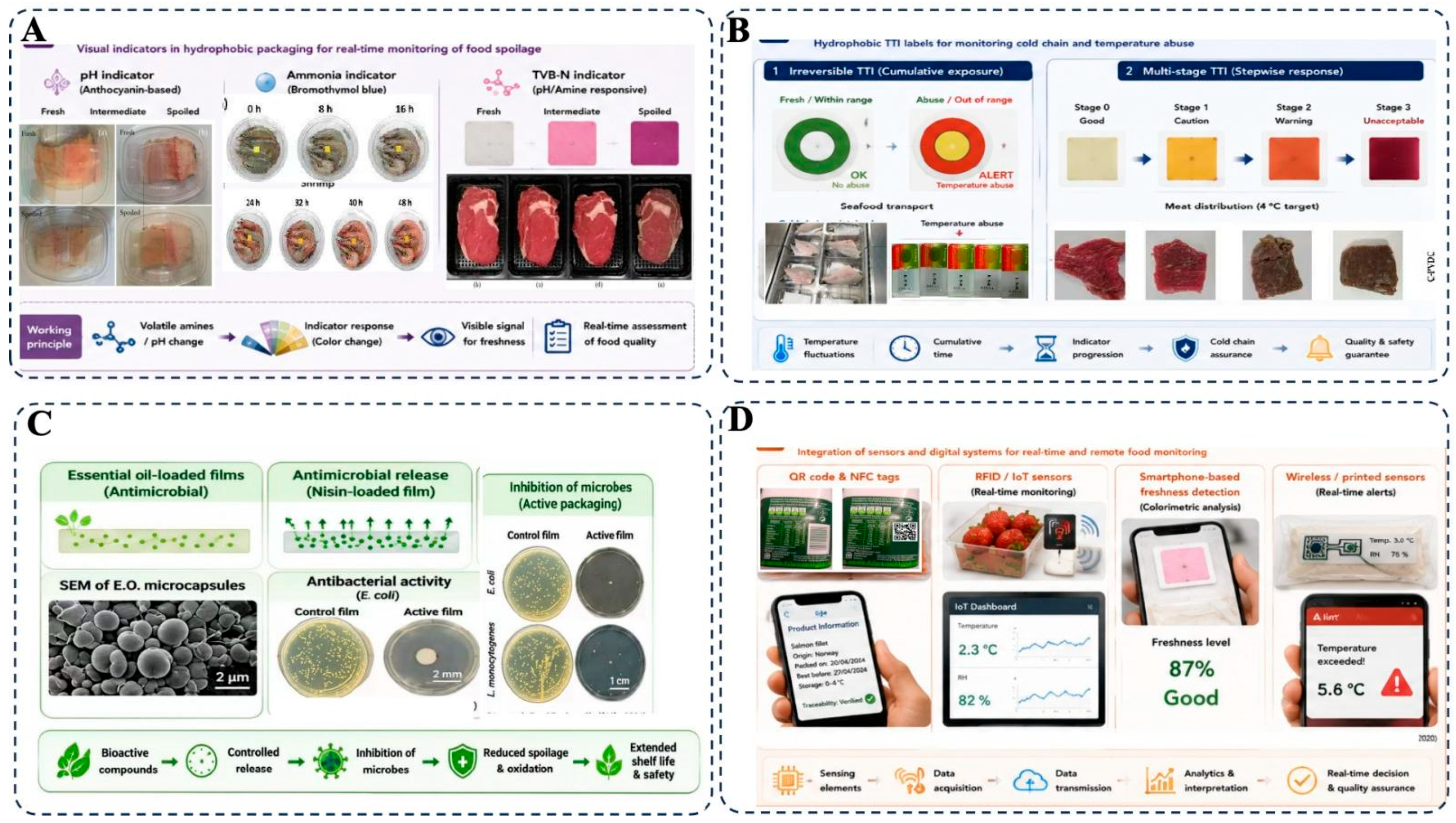
Hydrophobic packaging materials are increasingly being integrated into active and smart food-packaging systems that combine food protection with practical quality-monitoring functions. Appropriate moisture-resistant designs may improve the stability of incorporated sensors, indicators, and active components during storage. In practical applications, these systems can provide information about freshness, temperature history, spoilage development, and product traceability throughout storage and distribution [167]. Figure 11 summarizes major active and intelligent monitoring applications associated with hydrophobic food-packaging systems. Colorimetric freshness indicators can respond to spoilage-related changes in pH, volatile amines, and total volatile basic nitrogen (TVB-N), providing visible information about changes in food freshness (Figure 11A). Time–temperature indicators (TTIs) can monitor cold-chain integrity and identify temperature abuse during storage and distribution (Figure 11B). Controlled-release active packaging can deliver antimicrobial and antioxidant compounds during storage (Figure 11C). Digital technologies, including RFID, NFC, IoT sensors, and smartphone-based platforms, can further enable food traceability, real-time sensing, and remote quality monitoring (Figure 11D). Hydrophobic structures may improve moisture resistance and sensor durability, depending on material design and operating conditions [1,161,168,169,170,171,172]. Wang et al. [173] developed a hydrophobic colorimetric film using ethylcellulose, castor oil, and purple potato anthocyannin for pork freshness monitoring. The incorporation of castor oil improved the film’s physical properties and color stability while limiting anthocyannin leaching, demonstrating the potential of hydrophobic composite films for intelligent food-packaging applications [174].
Jiang et al. [175] developed a room-temperature phosphorescent biocomposite for intelligent food packaging that integrated anti-counterfeiting functionality with real-time visual freshness monitoring. The material generated visible optical responses associated with changes in food quality, allowing consumers and distributors to assess freshness without opening the package. The packaging matrix may also influence signal stability and monitoring performance during storage [176]. Likewise, Yao et al. [177] developed polysaccharide-based intelligent packaging systems capable of combining food preservation with quality-monitoring functions. The incorporated components contributed to moisture protection and supported the packaging system’s monitoring functionality. The study demonstrated how hydrophobic materials can simultaneously support preservation and intelligent monitoring functions within a single packaging platform. More recently, Zhai et al. [178] developed an electrospun PVDF-based ratiometric fluorescent indicator film with a water contact angle of 113.45° for monitoring meat freshness. The film demonstrated sensitivity to trimethylamine, with a detection limit of 0.54 μM, and produced visible fluorescence changes during pork and beef storage, providing an example of integrating hydrophobicity with intelligent freshness monitoring. These developments demonstrate the practical potential of hydrophobic materials in next-generation active and smart food-packaging technologies. By combining protective functions with freshness indication, temperature monitoring, controlled release, traceability, and digital sensing, these systems offer opportunities to improve food-quality management and support food safety throughout the supply chain.
Figure 11.
Smart hydrophobic packaging systems for food quality monitoring and preservation. (A) Visual freshness indicators based on pH, ammonia, and volatile nitrogen compounds for real-time spoilage detection. Reproduced with permission from [179,180,181]. (B) Time–temperature indicators (TTIs) for monitoring cold-chain integrity, temperature abuse, and meat freshness. Reproduced with permission from [127,182]. (C) Controlled release of antimicrobial and antioxidant compounds, including essential oils, nisin, and green tea polyphenols; SEM micrographs of essential-oil microcapsules; and antibacterial activity assessed using inhibition-zone and microbial growth assays. Reproduced with permission from [126,183]. (D) Integration of QR codes, RFID, IoT sensors, and smartphone-based systems for real-time food-quality monitoring and traceability. Reproduced with permission from [184].
6. Challenges and Future Perspectives
6.1. Safety of Added Functional Materials in Hydrophobic Films
The safety of added functional materials in hydrophobic films is a critical consideration in the development of advanced food-packaging systems. Nanoparticles, antimicrobial agents, natural extracts, and colorimetric indicators can improve packaging functionality, depending on their composition and incorporation method. However, these additives may also raise concerns regarding toxicity, migration behavior, environmental impact, and long-term consumer exposure. Consequently, ensuring the safety of functional materials remains essential for their successful application in food packaging [3,162,165,185]. One of the major concerns is the migration of active substances from packaging materials into food during storage. Migration depends on additive concentration, food composition, contact duration, and storage conditions, particularly temperature and food acidity or fat content. The use of nanomaterials and multifunctional composites requires appropriate migration testing, toxicological assessment, and compliance with applicable food-contact regulations [161,186].
Regulatory compliance is particularly important for packaging materials containing functional additives and nanomaterials. In the European Union, Regulation (EU) No 10/2011 establishes requirements for plastic materials and articles intended to come into contact with food, including applicable migration limits and restrictions on authorized substances [187]. In the United States, the Food and Drug Administration (FDA) regulates food-contact substances through applicable authorization pathways, while the Generally Recognized as Safe (GRAS) framework applies to substances used under qualifying conditions. Therefore, the incorporation of novel hydrophobic additives requires appropriate safety assessment and verification of regulatory compliance before commercial application.
Recent studies have demonstrated efforts to improve packaging functionality while maintaining safety. For example, Huang et al. [188] developed an antibacterial cellulose-based membrane with enhanced liquid transport and thermal-management properties, highlighting the importance of material stability and controlled release of active components. Similarly, Mobhani et al. [169] reported an AI-integrated bio-nanocomposite packaging system for sustainable food preservation and emphasized the need for evaluating the migration behavior and regulatory compliance of incorporated functional materials before commercialization. Despite considerable progress, challenges remain in establishing universally accepted safety assessment frameworks for emerging hydrophobic packaging materials. Future research should focus on long-term migration studies, toxicity evaluation, and harmonized regulatory standards to support the safe and widespread adoption of advanced hydrophobic packaging technologies.
6.2. Loss of Water Repellency over Time
The loss of water repellency over time remains a challenge because prolonged exposure to environmental and mechanical stresses can reduce the effectiveness of hydrophobic surfaces. Prolonged exposure to moisture, temperature fluctuations, mechanical abrasion, and environmental stress can gradually weaken hydrophobic surfaces, reducing their ability to repel water and protect food products. As a result, maintaining long-term hydrophobic performance is essential for ensuring consistent packaging functionality and shelf-life extension [10,61,189,190]. One of the primary causes of hydrophobicity deterioration is the gradual degradation of surface structures and functional coatings responsible for water repellency. Changes in surface roughness, chemical composition, and prolonged humidity exposure can reduce water repellency and, in some cases, barrier performance. These effects may lead to increased moisture penetration and reduced effectiveness during prolonged storage.
Recent studies have explored strategies to improve the durability of hydrophobic packaging materials. For example, Li et al. [191] developed nanostructured materials for smart food packaging and demonstrated that improved surface engineering can enhance resistance to environmental degradation while maintaining hydrophobic functionality. Similarly, Edo et al. [192] highlighted the role of green nanomaterials in sustainable food packaging, showing that carefully designed nanostructures can improve the long-term stability of hydrophobic surfaces while preserving packaging performance. Despite these advances, maintaining durable water-repellent properties under real storage and transportation conditions remains a challenge. Practical durability should therefore be evaluated through abrasion, repeated wetting, temperature cycling, and prolonged humidity exposure. Future research should focus on developing more robust surface modifications, improving coating durability, and designing environmentally friendly hydrophobic materials capable of retaining their functionality throughout the entire service life of food-packaging systems.
6.3. Use of Bio-Based Materials
The use of bio-based materials has become an important strategy in the development of sustainable hydrophobic packaging systems. Renewable materials, including polysaccharides, proteins, cellulose, and plant-based compounds, offer potential alternatives to petroleum-based packaging, although their biodegradability and environmental impact depend on their composition and processing. However, despite their sustainability advantages, many bio-based materials face challenges related to moisture sensitivity, mechanical stability, and long-term durability, which can limit their practical application in food packaging. Consequently, improving the performance of bio-based hydrophobic materials remains a major research focus [2,28,189,193]. Despite their potential benefits, bio-based materials present several challenges when incorporated into hydrophobic food-packaging systems. Many renewable materials exhibit lower mechanical strength, reduced storage stability, and greater sensitivity to environmental conditions than conventional petroleum-based polymers. These limitations can affect package durability and barrier performance during transportation and storage. Furthermore, achieving a balance between sustainability and functional performance often requires additional processing steps or the incorporation of reinforcing components, which may increase formulation complexity.
Consequently, the development of bio-based hydrophobic packaging requires careful material design to ensure that environmental benefits are achieved without compromising food protection and product quality. Recent studies have demonstrated promising advances in this area. For example, Cheng et al. [194] developed a hydrophobic interface starch nanofibrous film for food packaging and reported significant improvements in water resistance and barrier performance compared with conventional starch-based materials. Despite these advances, further research is needed to balance sustainability, hydrophobicity, and packaging performance. Life-cycle assessment and end-of-life evaluation are also necessary to establish the environmental benefits of these materials. Future efforts should focus on developing cost-effective modification techniques, improving long-term stability, and enhancing the commercial viability of bio-based hydrophobic materials to support their wider adoption in sustainable food-packaging applications.
6.4. Future Directions for Hydrophobic Smart Packaging
Future research should prioritize multifunctional hydrophobic packaging that combines moisture resistance, durability, sustainability, and intelligent monitoring. Advances in smart food packaging are increasingly moving toward systems that can provide real-time information on food quality, freshness, and storage conditions while maintaining effective protection against moisture and environmental contamination. The integration of sensing technologies, bio-based materials, and advanced surface engineering is expected to play a key role in the next generation of food-packaging systems [170,177,195]. Another important research priority is improving the long-term durability and practical applicability of hydrophobic packaging under real storage, transportation, and retail conditions. Commercial adoption requires validation of packaging performance, shelf-life benefits, production scalability, and cost-effectiveness under practical conditions. Future development should emphasize cost-effective, environmentally responsible materials compatible with existing manufacturing processes. Emerging technologies such as AI-assisted packaging systems, intelligent freshness indicators, and responsive barrier materials may further enhance food preservation and supply-chain management [8,196,197].
Future development should emphasize cost-effective, environmentally responsible materials compatible with existing manufacturing processes. As advances in smart sensing, responsive materials, and sustainable packaging continue to emerge, hydrophobic smart packaging is expected to play an increasingly important role in improving food quality, reducing waste, and enhancing supply-chain efficiency across the food industry.
7. Conclusions
Hydrophobic packaging offers promising opportunities for food preservation by improving surface water repellency and supporting moisture management and product quality during storage. This review examined the fundamental principles of hydrophobicity and highlighted how surface chemistry and structural design influence water-repellent performance. Various materials, including synthetic polymers, natural biopolymers, nanomaterials, and bio-based composites, have been explored for the development of hydrophobic packaging systems, each offering distinct advantages and limitations. This review also discussed the major fabrication approaches used to create hydrophobic surfaces and summarized their influence on barrier properties, durability, and packaging performance. Particular attention was given to the functional roles of hydrophobic packaging in food protection, including moisture control, anti-fogging behavior, controlled release of active compounds, microbial inhibition, gas regulation, and smart monitoring capabilities. Reported applications across different food products suggest that appropriately designed hydrophobic packaging can help preserve freshness, improve storage stability, and extend shelf life.
In addition, this review highlighted current challenges associated with the safety of functional additives, long-term retention of hydrophobic properties, and the use of bio-based materials. Recent advances in active and smart packaging technologies indicate that hydrophobic materials are evolving beyond passive barriers toward multifunctional systems capable of both protecting and monitoring food quality. Overall, hydrophobic packaging shows considerable potential for food preservation, although challenges involving durability, food-contact safety, scalability, and environmental sustainability remain. Addressing these limitations is essential for developing practical, reliable, and multifunctional packaging systems.
Author Contributions
N.Y.A.P.: Conceptualization, Investigation, Writing—original draft, Visualization, Writing—review and editing. X.N.: Conceptualization, Investigation, Validation, Writing—original draft, Writing—review and editing. W.J.: Writing—review and editing. H.L.: Supervision, Conceptualization, Investigation, Writing—review and editing. All authors have read and agreed to the published version of the manuscript.
Funding
This research was funded by by the Zhenjiang Key Research and Develop Project (NY2024009).
Institutional Review Board Statement
Not applicable.
Informed Consent Statement
Not applicable.
Data Availability Statement
No new data were created or analyzed in this study. Data sharing is not applicable to this article.
Conflicts of Interest
The authors declare no conflicts of interest.
References
- Du, H.; Sun, X.; Chong, X.; Yang, M.; Zhu, Z.; Wen, Y. A review on smart active packaging systems for food preservation: Applications and future trends. Trends Food Sci. Technol. 2023, 141, 104200. [Google Scholar] [CrossRef] [Scilit]
- Cheng, J.; Gao, R.; Zhu, Y.; Lin, Q. Applications of biodegradable materials in food packaging: A review. Alex. Eng. J. 2024, 91, 70–83. [Google Scholar] [CrossRef] [Scilit]
- Khan, S.; Monteiro, J.K.; Prasad, A.; Filipe, C.D.M.; Li, Y.; Didar, T.F. Material Breakthroughs in Smart Food Monitoring: Intelligent Packaging and On-Site Testing Technologies for Spoilage and Contamination Detection. Adv. Mater. 2024, 36, 2300875. [Google Scholar] [CrossRef] [Scilit] [PubMed]
- Ahmed, M.W.; Haque, M.A.; Mohibbullah, M.; Khan, M.S.I.; Islam, M.A.; Mondal, M.H.T.; Ahmmed, R. A review on active packaging for quality and safety of foods: Current trends, applications, prospects and challenges. Food Packag. Shelf Life 2022, 33, 100913. [Google Scholar] [CrossRef] [Scilit]
- Ruzi, M.; Celik, N.; Onses, M.S. Superhydrophobic coatings for food packaging applications: A review. Food Packag. Shelf Life 2022, 32, 100823. [Google Scholar] [CrossRef] [Scilit]
- Udana Eranda, D.H.; Chaijan, M.; Castro-Muñoz, R. Current advances in surface wettability in food packaging materials: Strategies, methods and future trends. J. Food Eng. 2025, 391, 112440. [Google Scholar] [CrossRef] [Scilit]
- Yildirim, S.; Röcker, B.; Pettersen, M.K.; Nilsen-Nygaard, J.; Ayhan, Z.; Rutkaite, R.; Radusin, T.; Suminska, P.; Marcos, B.; Coma, V. Active Packaging Applications for Food. Compr. Rev. Food Sci. Food Saf. 2018, 17, 165–199. [Google Scholar] [CrossRef] [Scilit] [PubMed]
- Onyeaka, H.; Passaretti, P.; Miri, T.; Al-Sharify, Z.T. The safety of nanomaterials in food production and packaging. Curr. Res. Food Sci. 2022, 5, 763–774. [Google Scholar] [CrossRef] [Scilit] [PubMed]
- Paidari, S.; Tahergorabi, R.; Anari, E.S.; Nafchi, A.M.; Zamindar, N.; Goli, M. Migration of Various Nanoparticles into Food Samples: A Review. Foods 2021, 10, 2114. [Google Scholar] [CrossRef] [Scilit] [PubMed]
- Suleman, A.; Bora, J.; Kalita, A.J.; Chetia, B. Starch-Based Nanocomposite for Food Packaging Applications. In Engineering Applications of Polymer-Based Nanocomposites; Visakh, P.M., Ed.; Springer Nature: Cham, Switzerland, 2025; pp. 47–68. [Google Scholar]
- Kalita, P.; Bora, N.S.; Gogoi, B.; Goswami, A.; Pachuau, L.; Das, P.J.; Baishya, D.; Roy, S. Improving the hydrophobic nature of biopolymer based edible packaging film: A review. Food Chem. 2025, 479, 143793. [Google Scholar] [CrossRef] [Scilit] [PubMed]
- Zhang, J.; Youngblood, J.P. Cellulose nanofibril-based hybrid coatings with enhanced moisture barrier properties. Mater. Adv. 2025, 6, 2833–2844. [Google Scholar] [CrossRef] [Scilit]
- Bangar, S.P.; Whiteside, W.S. Nano-cellulose reinforced starch bio composite films–A review on green composites. Int. J. Biol. Macromol. 2021, 185, 849–860. [Google Scholar] [CrossRef] [Scilit] [PubMed]
- Liu, Y.; Chen, Y.; Qi, H. Recyclable cellulose nanofibers reinforced poly (vinyl alcohol) films with high mechanical strength and water resistance. Carbohydr. Polym. 2022, 293, 119729. [Google Scholar] [CrossRef] [Scilit] [PubMed]
- Das, P.P.; Kalyani, P.; Kumar, R.; Khandelwal, M. Cellulose-based natural nanofibers for fresh produce packaging: Current status, sustainability and future outlook. Sustain. Food Technol. 2023, 1, 528–544. [Google Scholar] [CrossRef] [Scilit]
- Rashid, A.; Li, M.; Gao, S.; Hou, H. Starch-based food packaging films from fundamental challenges to intelligent applications. Food Chem. 2026, 515, 149279. [Google Scholar] [CrossRef] [Scilit] [PubMed]
- García-Guzmán, L.; Cabrera-Barjas, G.; Soria-Hernández, C.G.; Castaño, J.; Guadarrama-Lezama, A.Y.; Rodríguez Llamazares, S. Progress in Starch-Based Materials for Food Packaging Applications. Polysaccharides 2022, 3, 136–177. [Google Scholar] [CrossRef] [Scilit]
- Vitoria, J.S.; Fonseca, L.M.; Siebeneichler, T.J.; Campos, D.; Poças, F.; Pintado, M.M.E.; Zavareze, E.d.R.; Gandra, E.A. Active Bilayer Material Formed by Starch Film and Thyme Essential Oil Encapsulated into Zein Electrospun Fibers. Food Bioprocess Technol. 2025, 18, 9438–9460. [Google Scholar] [CrossRef] [Scilit]
- Lin, Z.; Cheng, H.; He, K.; McClements, D.J.; Jin, Z.; Xu, Z.; Meng, M.; Peng, X.; Chen, L. Recent progress in the hydrophobic modification of starch-based films. Food Hydrocoll. 2024, 151, 109860. [Google Scholar] [CrossRef] [Scilit]
- Trivedi, A.K.; Gupta, M.K.; Singh, H. PLA based biocomposites for sustainable products: A review. Adv. Ind. Eng. Polym. Res. 2023, 6, 382–395. [Google Scholar] [CrossRef] [Scilit]
- Arrieta, M.P.; López, J.; Ferrándiz, S.; Peltzer, M.A. Characterization of PLA-limonene blends for food packaging applications. Polym. Test. 2013, 32, 760–768. [Google Scholar] [CrossRef] [Scilit]
- Murugesan, A.; Li, H. Toward Sustainable Food Packaging: Innovations in Biodegradable Materials, Smart Technologies, and AI Integration. Compr. Rev. Food Sci. Food Saf. 2026, 25, e70397. [Google Scholar] [CrossRef] [Scilit] [PubMed]
- Huang, S.; Chen, Y.; Peng, X.; Yang, D.; Zhang, Y.; Qiu, F.; Zhang, T. An asymmetric wettability cellulose packaging with moisture management properties for vegetable preservation. Food Bioprod. Process. 2025, 153, 430–440. [Google Scholar] [CrossRef] [Scilit]
- Yan, X.; Li, Z.; Cheng, W.; Chen, R.; Liu, J.; Song, J.; Xiao, H.; Du, H.; Guo, J. Cellulose nanocrystals for functional food packaging: Enhancing performance and enabling intelligence. Trends Food Sci. Technol. 2025, 163, 105163. [Google Scholar] [CrossRef] [Scilit]
- Wu, Y.; Zhang, J.; Hu, X.; Huang, X.; Zhang, X.; Zou, X.; Shi, J. Preparation of edible antibacterial films based on corn starch /carbon nanodots for bioactive food packaging. Food Chem. 2024, 444, 138467. [Google Scholar] [CrossRef] [Scilit] [PubMed]
- Zhu, Z.; Liang, J.; Zhou, C.; Huang, K.; Fan, X.; Zhou, M.; Xu, B.; Huang, C.; Li, H.; Ma, H.; et al. Synergistic enhancement of gelatin-chitosan films with vanillin Schiff base and ZnO for effective strawberry preservation. Food Control 2026, 180, 111647. [Google Scholar] [CrossRef] [Scilit]
- Khin, M.N.; Easdani, M.; Aziz, T.; Shami, A.; Alharbi, N.K.; Al-Asmari, F.; Lin, L. Schiff’s base crosslinked gelatin-dialdehyde cellulose film with gallic acid for improved water resistance and antimicrobial properties. Food Hydrocoll. 2025, 166, 111331. [Google Scholar] [CrossRef] [Scilit]
- Atta, O.M.; Manan, S.; Shahzad, A.; Ul-Islam, M.; Ullah, M.W.; Yang, G. Biobased materials for active food packaging: A review. Food Hydrocoll. 2022, 125, 107419. [Google Scholar] [CrossRef] [Scilit]
- Ren, X.; Wang, J.; Rashid, A.; Hou, T.; Ma, H.; Liang, Q. Characterization of Nano-SiO2/Zein Film Prepared Using Ultrasonic Treatment and the Ability of the Prepared Film to Resist Different Storage Environments. Foods 2023, 12, 3056. [Google Scholar] [CrossRef] [Scilit] [PubMed]
- Xu, J.; Shi, X.; Liu, M.; Gu, M.; Dai, X.; Aziz, T.; Alharbi, N.K.; Mojally, M.A.; Al-Asmari, F.; Al-Joufi, F.A.; et al. Bionanocomposite films constituted by chitosan and ZnO nanoparticles stabilized by tea polyphenols for mango preservation. Food Hydrocoll. 2026, 173, 112226. [Google Scholar] [CrossRef] [Scilit]
- Khan, S.; Ke, Z.; Shishir, M.R.I.; Karim, N.; Ji, Y.; Xiaobo, Z.; Li, F. Synergistic effect of berry wax and miswak extract in a carboxymethylcellulose-based coating for banana preservation. Food Res. Int. 2026, 225, 118120. [Google Scholar] [CrossRef] [Scilit] [PubMed]
- Rashid, A.; Qayum, A.; Bacha, S.A.S.; Liang, Q.; Liu, Y.; Kang, L.; Chi, Z.; Chi, R.; Han, X.; Ekumah, J.-N.; et al. Preparation and functional characterization of pullulan-sodium alginate composite film enhanced with ultrasound-assisted clove essential oil Nanoemulsions for effective preservation of cherries and mushrooms. Food Chem. 2024, 457, 140048. [Google Scholar] [CrossRef] [Scilit] [PubMed]
- Zhou, M.; Fakayode, O.A.; Ren, M.; Li, H.; Liang, J.; Zhou, C. Green and sustainable extraction of lignin by deep eutectic solvent, its antioxidant activity, and applications in the food industry. Crit. Rev. Food Sci. Nutr. 2024, 64, 7201–7219. [Google Scholar] [CrossRef] [Scilit] [PubMed]
- Cheng, K.; Xu, F.; Du, J.; Li, C.; Wang, Z.; Zhang, L.; Wang, X.; Liu, J. Enhancing the preservation of blueberry with a tough and biodegradable soy protein isolate-carboxymethyl chitosan film integrated with TiO2 nanotube arrays. Food Packag. Shelf Life 2025, 48, 101467. [Google Scholar] [CrossRef] [Scilit]
- Cheng, K.; Du, J.; Xu, F.; Wang, Z.; Zhang, L.; Bai, M.; Wang, X.; Liu, J. Preparation and characterization of zein-based active packaging films integrated with TiO2 nanotube arrays. Food Packag. Shelf Life 2024, 45, 101348. [Google Scholar] [CrossRef] [Scilit]
- Zhang, X.; Chen, X.; Dai, J.; Cui, H.; Lin, L. Edible films of pectin extracted from dragon fruit peel: Effects of boiling water treatment on pectin and film properties. Food Hydrocoll. 2024, 147, 109324. [Google Scholar] [CrossRef] [Scilit]
- Yang, Z.; Li, M.; Li, Y.; Huang, X.; Li, Z.; Zhai, X.; Shi, J.; Zou, X.; Xiao, J.; Sun, Y.; et al. Sodium alginate/guar gum based nanocomposite film incorporating β-Cyclodextrin/persimmon pectin-stabilized baobab seed oil Pickering emulsion for mushroom preservation. Food Chem. 2024, 437, 137891. [Google Scholar] [CrossRef] [Scilit] [PubMed]
- Wang, K.; Wu, L.; Li, Y.; Li, H. Preparation and characterization of chitosan/halloysite nanotubes composite film with ethylene scavenging and gas resistance for active food packaging. J. Food Saf. 2023, 43, e13027. [Google Scholar] [CrossRef] [Scilit]
- Eskitoros-Togay, Ş.M. Effects of graphene oxide and silane-grafted graphene oxide on chitosan packaging nanocomposite films for bread preservation. J. Polym. Sci. 2024, 62, 5424–5433. [Google Scholar] [CrossRef] [Scilit]
- Ding, F.; Long, S.; Huang, X.; Shi, J.; Povey, M.; Zou, X. Emerging Pickering emulsion films for bio-based food packaging applications. Food Packag. Shelf Life 2024, 42, 101242. [Google Scholar] [CrossRef] [Scilit]
- Guan, Y.; Zhang, J.; Zhang, J.; Song, W.; Shi, J.; Huang, X.; Zhai, X.; Zhang, D.; Li, Z.; Zou, X. Preparation of active film based on cinnamon essential oil into β-cyclodextrin with high hydrophobic and its preservation for griskin. Food Control 2024, 160, 110344. [Google Scholar] [CrossRef] [Scilit]
- Bahrami, R.; Zibaei, R.; Hashami, Z.; Hasanvand, S.; Garavand, F.; Rouhi, M.; Jafari, S.M.; Mohammadi, R. Modification and improvement of biodegradable packaging films by cold plasma; a critical review. Crit. Rev. Food Sci. Nutr. 2022, 62, 1936–1950. [Google Scholar] [CrossRef] [Scilit] [PubMed]
- Sasikumar, R.; T, S.K.; Mangang, I.B.; Kaviarasu, G.; Kaushik, R.; Mansingh, P.; Tomer, V.; Jaiswal, A.K. A comprehensive review on cold plasma applications in the food industry. Sustain. Food Technol. 2025, 3, 1251–1274. [Google Scholar] [CrossRef] [Scilit]
- Zhu, Y.; Li, C.; Cui, H.; Lin, L. Feasibility of cold plasma for the control of biofilms in food industry. Trends Food Sci. Technol. 2020, 99, 142–151. [Google Scholar] [CrossRef] [Scilit]
- Cui, C.; Ji, N.; Wang, Y.; Xiong, L.; Sun, Q. Bioactive and intelligent starch-based films: A review. Trends Food Sci. Technol. 2021, 116, 854–869. [Google Scholar] [CrossRef] [Scilit]
- de Oliveira Filho, J.G.; Albiero, B.R.; Cipriano, L.; de Oliveira Nobre Bezerra, C.C.; Oldoni, F.C.A.; Egea, M.B.; de Azeredo, H.M.C.; Ferreira, M.D. Arrowroot starch-based films incorporated with a carnauba wax nanoemulsion, cellulose nanocrystals, and essential oils: A new functional material for food packaging applications. Cellulose 2021, 28, 6499–6511. [Google Scholar] [CrossRef] [Scilit]
- Oliveira Filho, J.G.d.; Albiero, B.R.; Calisto, Í.H.; Bertolo, M.R.V.; Oldoni, F.C.A.; Egea, M.B.; Bogusz Junior, S.; de Azeredo, H.M.C.; Ferreira, M.D. Bio-nanocomposite edible coatings based on arrowroot starch/cellulose nanocrystals/carnauba wax nanoemulsion containing essential oils to preserve quality and improve shelf life of strawberry. Int. J. Biol. Macromol. 2022, 219, 812–823. [Google Scholar] [CrossRef] [Scilit] [PubMed]
- Bayanloo, A.-H.; Shahabi-Ghahfarrokhi, I.; Hagh Nazari, S. Modification and Characterization of Starch-Based Food-Packaging Material by Cold Plasma as a Green Approach. Starch-Stärke 2024, 76, 2300077. [Google Scholar] [CrossRef] [Scilit]
- Rovera, C.; Türe, H.; Hedenqvist, M.S.; Farris, S. Water vapor barrier properties of wheat gluten/silica hybrid coatings on paperboard for food packaging applications. Food Packag. Shelf Life 2020, 26, 100561. [Google Scholar] [CrossRef] [Scilit]
- Dong, W.; Su, J.; Chen, Y.; Xu, D.; Cheng, L.; Mao, L.; Gao, Y.; Yuan, F. Characterization and antioxidant properties of chitosan film incorporated with modified silica nanoparticles as an active food packaging. Food Chem. 2022, 373, 131414. [Google Scholar] [CrossRef] [Scilit] [PubMed]
- Ahuja, A.; Kumar Rastogi, V. Spray coating of edible insect waxes for liquid food packaging. Appl. Surf. Sci. 2023, 624, 157150. [Google Scholar] [CrossRef] [Scilit]
- Jeevahan, J.; Chandrasekaran, M.; Britto Joseph, G.; Durairaj, R.B.; Mageshwaran, G. Superhydrophobic surfaces: A review on fundamentals, applications, and challenges. J. Coat. Technol. Res. 2018, 15, 231–250. [Google Scholar] [CrossRef] [Scilit]
- Mohammadi, M.; Sheidaei, Z.; Farhoodi, M. Strategies to Create Superhydrophobic Surfaces in Food Industry. Packag. Technol. Sci. 2024, 37, 585–601. [Google Scholar] [CrossRef] [Scilit]
- Zhang, D.; Ji, J.; Yan, C.; Zhang, J.; An, Z.; Shen, Y. Research advances in bio-inspired superhydrophobic surface: Bridging nature to practical applications. J. Ind. Eng. Chem. 2024, 140, 20–46. [Google Scholar] [CrossRef] [Scilit]
- Shen, R.; Guo, Y.; Wang, S.; Tuerxun, A.; He, J.; Bian, Y. Biodegradable Electrospun Nanofiber Membranes as Promising Candidates for the Development of Face Masks. Int. J. Environ. Res. Public Health 2023, 20, 1306. [Google Scholar] [CrossRef] [Scilit] [PubMed]
- Mamaeva, V.; Sahlgren, C.; Lindén, M. Mesoporous silica nanoparticles in medicine—Recent advances. Adv. Drug Deliv. Rev. 2013, 65, 689–702. [Google Scholar] [CrossRef] [Scilit] [PubMed]
- He, B.; Gao, Y.; Lou, W.; Wang, J.; Xin, S.; Ma, K.; Li, L. Biodegradable food packaging films: Material source, mechanical and water vapor barrier properties, and improvement strategies—A comprehensive review. Food Res. Int. 2025, 211, 116431. [Google Scholar] [CrossRef] [Scilit] [PubMed]
- Amara, C.; El Mahdi, A.; Medimagh, R.; Khwaldia, K. Nanocellulose-based composites for packaging applications. Curr. Opin. Green Sustain. Chem. 2021, 31, 100512. [Google Scholar] [CrossRef] [Scilit]
- Ansari, M.D.I.; Principato, L.; De Nardo, L.; Punta, C. Nanomaterials in food packaging: An overview of regulatory frameworks and migration assessment. Food Control 2026, 181, 111707. [Google Scholar] [CrossRef] [Scilit]
- Tang, Z.Q.; Tian, T.; Molino, P.J.; Skvortsov, A.; Ruan, D.; Ding, J.; Li, Y. Recent Advances in Superhydrophobic Materials Development for Maritime Applications. Adv. Sci. 2024, 11, 2308152. [Google Scholar] [CrossRef] [Scilit] [PubMed]
- Cai, J.; Zhang, D.; Zhou, R.; Zhu, R.; Fei, P.; Zhu, Z.-Z.; Cheng, S.-Y.; Ding, W.-P. Hydrophobic Interface Starch Nanofibrous Film for Food Packaging: From Bioinspired Design to Self-Cleaning Action. J. Agric. Food Chem. 2021, 69, 5067–5075. [Google Scholar] [CrossRef] [Scilit] [PubMed]
- Liu, X.; Chen, L.; Dong, Q.; Wang, Z.; Zhang, D.; He, J.; Ye, Y.; Zhou, J.; Zhu, W.; Hu, Z.; et al. Emerging starch composite nanofibrous films for food packaging: Facile construction, hydrophobic property, and antibacterial activity enhancement. Int. J. Biol. Macromol. 2022, 222, 868–879. [Google Scholar] [CrossRef] [Scilit] [PubMed]
- Amin, U.; Khan, M.K.I.; Maan, A.A.; Nazir, A.; Riaz, S.; Khan, M.U.; Sultan, M.; Munekata, P.E.S.; Lorenzo, J.M. Biodegradable active, intelligent, and smart packaging materials for food applications. Food Packag. Shelf Life 2022, 33, 100903. [Google Scholar] [CrossRef] [Scilit]
- Chen, Y.; Ao, J.; Zhang, J.; Gao, J.; Hao, L.; Jiang, R.; Zhang, Z.; Liu, Z.; Zhao, J.; Ren, L. Bioinspired superhydrophobic surfaces, inhibiting or promoting microbial contamination? Mater. Today 2023, 67, 468–494. [Google Scholar] [CrossRef] [Scilit]
- Lafraya, A.; Prieto, C.; Pardo-Figuerez, M.; Chiva, A.; Lagaron, J.M. Super-Repellent Paper Coated with Electrospun Biopolymers and Electrosprayed Silica of Interest in Food Packaging Applications. Nanomaterials 2021, 11, 3354. [Google Scholar] [CrossRef] [Scilit] [PubMed]
- Liter, S.G.; Kaviany, M. Pool-boiling CHF enhancement by modulated porous-layer coating: Theory and experiment. Int. J. Heat Mass Transf. 2020, 44, 4287–4311. [Google Scholar] [CrossRef] [Scilit]
- Sun, H.; Chai, X.; Yang, H.; Wei, J.; Yu, Y. Photo- and Humidity-Responsive Liquid Crystal Copolymer Actuators Fabricated via Vapor-Assisted Alignment. ACS Appl. Mater. Interfaces 2024, 16, 15405–15415. [Google Scholar] [CrossRef] [Scilit] [PubMed]
- Gupta, D.; Lall, A.; Kumar, S.; Patil, T.D.; Gaikwad, K.K. Plant-based edible films and coatings for food-packaging applications: Recent advances, applications, and trends. Sustain. Food Technol. 2024, 2, 1428–1455. [Google Scholar] [CrossRef] [Scilit]
- Peng, B.; Qin, J.; Li, Y.; Wu, K.; Kuang, Y.; Jiang, F. Recent advances in nanomaterials-enabled active food packaging: Nanomaterials synthesis, applications and future prospects. Food Control 2024, 163, 110542. [Google Scholar] [CrossRef] [Scilit]
- Cui, H.; Surendhiran, D.; Li, C.; Lin, L. Biodegradable zein active film containing chitosan nanoparticle encapsulated with pomegranate peel extract for food packaging. Food Packag. Shelf Life 2020, 24, 100511. [Google Scholar] [CrossRef] [Scilit]
- Zhang, J.; Zhang, J.; Huang, X.; Zhai, X.; Li, Z.; Shi, J.; Sobhy, R.; Khalifa, I.; Zou, X. Lemon-derived carbon quantum dots incorporated guar gum/sodium alginate films with enhanced the preservability for blanched asparagus active packaging. Food Res. Int. 2025, 202, 115736. [Google Scholar] [CrossRef] [Scilit] [PubMed]
- Roy, S.; Ezati, P.; Rhim, J.-W. Gelatin/Carrageenan-Based Functional Films with Carbon Dots from Enoki Mushroom for Active Food Packaging Applications. ACS Appl. Polym. Mater. 2021, 3, 6437–6445. [Google Scholar] [CrossRef] [Scilit]
- Nirmal, N.; Vashisht, P.; Sharma, S.; Singh, L.; Awasti, N.; Mahanta, S.; Gill, A.; Rathnakumar, K.; Khanashyam, A.C. Enhancement in the active food packaging system through metal-based nanomaterials: A review of innovations, challenges, and future directions. Discov. Food 2024, 4, 108. [Google Scholar] [CrossRef] [Scilit]
- Baishya, H.; Dutta, J.; Kumar, S. Nanofillers Reinforcing Biopolymer Composites for Sustainable Food Packaging Applications: A State-of-the-Art Review. Adv. Funct. Mater. 2025, 35, 2503819. [Google Scholar] [CrossRef] [Scilit]
- Hashim, S.B.H.; Tahir, H.E.; Liu, L.; Zhang, J.; Zhai, X.; Mahdi, A.A.; Awad, F.N.; Hassan, M.M.; Zou, X.; Shi, J. Intelligent colorimetric pH sensoring packaging films based on sugarcane wax/agar integrated with butterfly pea flower extract for optical tracking of shrimp freshness. Food Chem. 2022, 373, 131514. [Google Scholar] [CrossRef] [Scilit] [PubMed]
- Hashim, S.B.H.; Tahir, H.E.; Liu, L.; Zhang, J.; Zhai, X.; Mahdi, A.A.; Ibrahim, N.A.; Mahunu, G.K.; Hassan, M.M.; Zou, X.; et al. Smart films of carbohydrate-based/sunflower wax/purple Chinese cabbage anthocyanins: A biomarker of chicken freshness. Food Chem. 2023, 399, 133824. [Google Scholar] [CrossRef] [Scilit] [PubMed]
- Ju, J.; Chen, X.; Xie, Y.; Yu, H.; Guo, Y.; Cheng, Y.; Qian, H.; Yao, W. Application of essential oil as a sustained release preparation in food packaging. Trends Food Sci. Technol. 2019, 92, 22–32. [Google Scholar] [CrossRef] [Scilit]
- Shi, J.; Zhang, R.; Liu, X.; Zhang, Y.; Du, Y.; Dong, H.; Ma, Y.; Li, X.; Cheung, P.C.-K.; Chen, F. Advances in multifunctional biomass-derived nanocomposite films for active and sustainable food packaging. Carbohydr. Polym. 2022, 301, 120323. [Google Scholar] [CrossRef] [Scilit] [PubMed]
- Janik, W.; Nowotarski, M.; Shyntum, D.Y.; Banaś, A.; Krukiewicz, K.; Kudła, S.; Dudek, G. Antibacterial and Biodegradable Polysaccharide-Based Films for Food Packaging Applications: Comparative Study. Materials 2022, 15, 3236. [Google Scholar] [CrossRef] [Scilit] [PubMed]
- Shams, B.; Ebrahimi, N.G.; Khodaiyan, F. Development of Antibacterial Nanocomposite: Whey Protein-Gelatin-Nanoclay Films with Orange Peel Extract and Tripolyphosphate as Potential Food Packaging. Adv. Polym. Technol. 2019, 2019, 1973184. [Google Scholar] [CrossRef] [Scilit]
- Abral, H.; Pratama, A.B.; Handayani, D.; Mahardika, M.; Aminah, I.; Sandrawati, N.; Sugiarti, E.; Muslimin, A.N.; Sapuan, S.M.; Ilyas, R. Antimicrobial edible film prepared from bacterial cellulose nanofibers/starch/chitosan for a food packaging alternative. Int. J. Polym. Sci. 2021, 2021, 6641284. [Google Scholar] [CrossRef] [Scilit]
- Nilsen-Nygaard, J.; Fernández, E.N.; Radusin, T.; Rotabakk, B.T.; Sarfraz, J.; Sharmin, N.; Sivertsvik, M.; Sone, I.; Pettersen, M.K. Current status of biobased and biodegradable food packaging materials: Impact on food quality and effect of innovative processing technologies. Compr. Rev. Food Sci. Food Saf. 2021, 20, 1333–1380. [Google Scholar] [CrossRef] [Scilit] [PubMed]
- Jahangiri, F.; Mohanty, A.K.; Misra, M. Sustainable biodegradable coatings for food packaging: Challenges and opportunities. Green Chem. 2024, 26, 4934–4974. [Google Scholar] [CrossRef] [Scilit]
- Weng, S.; Marcet, I.; Rendueles, M.; Díaz, M. Edible Films from the Laboratory to Industry: A Review of the Different Production Methods. Food Bioprocess Technol. 2025, 18, 3245–3271. [Google Scholar] [CrossRef] [Scilit]
- Surendhiran, D.; Li, C.; Cui, H.; Lin, L. Fabrication of high stability active nanofibers encapsulated with pomegranate peel extract using chitosan/PEO for meat preservation. Food Packag. Shelf Life 2020, 23, 100439. [Google Scholar] [CrossRef] [Scilit]
- Zhai, X.; Wang, X.; Zhang, J.; Yang, Z.; Sun, Y.; Li, Z.; Huang, X.; Holmes, M.; Gong, Y.; Povey, M.; et al. Extruded low density polyethylene-curcumin film: A hydrophobic ammonia sensor for intelligent food packaging. Food Packag. Shelf Life 2020, 26, 100595. [Google Scholar] [CrossRef] [Scilit]
- Zhao, Y.; Guo, G.; Xu, B.; Liu, H.; Tian, H.; Li, J.; Ouyang, Y.; Xiang, A.; Kumar, R. Electrospun natural polypeptides based nanofabrics enriched with antioxidant polyphenols for active food preservation. Food Chem. 2023, 405, 134991. [Google Scholar] [CrossRef] [Scilit] [PubMed]
- Debeaufort, F.; Kurek, M.; Fabra, M.-J.; Ghasemi, Y.; Ščetar, M.; Galić, K.; Benbettaieb, N. Hydrocolloid-based coatings applied on biobased/biodegradable food flexible packaging, A review. Part 1—Biopolymer to coat and available technologies. Food Hydrocoll. 2025, 169, 111624. [Google Scholar] [CrossRef] [Scilit]
- Li, Z.; Li, Q.; Ren, D.; Wu, X.; Xu, D. Superhydrophobic surfaces: A promising strategy for addressing food industry challenges. Innov. Food Sci. Emerg. Technol. 2025, 100, 103899. [Google Scholar] [CrossRef] [Scilit]
- Nyam, K.L.; Kong, I.; Ali, M.A.; Akanda, M.J.H.; Pui, L.P. Recent advancements in Multi-Layer edible packaging: Techniques, properties, and applications for food preservation. J. Food Meas. Charact. 2026, 20, 1248–1259. [Google Scholar] [CrossRef] [Scilit]
- Nowak, N.; Tkaczewska, J.; Cholewa-Wójcik, A.; Grzebieniarz, W.; Piasna-Słupecka, E.; Drozdowska, M.; Jamróz, E. Multi-layer Active Biopolymer System as a Perspective for Improving the Quality and Scope of Applying Semi-rigid Biodegradable Packaging. Food Bioprocess Technol. 2025, 18, 2682–2696. [Google Scholar] [CrossRef] [Scilit]
- Alias, A.R.; Wan, M.K.; Sarbon, N.M. Emerging materials and technologies of multi-layer film for food packaging application: A review. Food Control 2022, 136, 108875. [Google Scholar] [CrossRef] [Scilit]
- Chen, C.; Wang, L.; Shams Es-haghi, S.; Tajvidi, M.; Wang, J.; Gardner, D.J. Biodegradable and recyclable bio-based laminated films of poly (lactic acid) and cellulose nanocrystals for food barrier packaging. Food Packag. Shelf Life 2024, 42, 101244. [Google Scholar] [CrossRef] [Scilit]
- Zhang, J.; Yang, Y.; Zhang, J.; Shi, J.; Liu, L.; Huang, X.; Song, W.; Li, Z.; Zou, X.; Povey, M. High-Stability Bi-Layer Films Incorporated with Liposomes@Anthocyanin/Carrageenan/Agar for Shrimp Freshness Monitoring. Foods 2023, 12, 732. [Google Scholar] [CrossRef] [Scilit] [PubMed]
- Rodríguez-Sánchez, I.J.; Rivera-Monroy, Z.J.; García-Castañeda, J.E.; Clavijo-Grimaldo, D.; Fuenmayor, C.A.; Zuluaga-Domínguez, C.M. Multilayer polycaprolactone–pullulan nanofiber mats incorporated with the antimicrobial palindromic peptide LfcinB (21-25)Pal as a potential application in active packaging. Food Packag. Shelf Life 2023, 38, 101110. [Google Scholar] [CrossRef] [Scilit]
- Lara-Gómez, A.B.; Castro-Rosas, J.; Hernández-Hernández, E.; Cadena-Ramírez, A.; Hernández-Cruz, M.Á.; Gómez-Aldapa, C.A. Mechanical and Barrier Properties of Films Containing Bioactive Compounds with Antimicrobial and Antioxidant Activity. Food Bioprocess Technol. 2025, 18, 8260–8290. [Google Scholar] [CrossRef] [Scilit]
- Xie, D.; Ma, H.; Xie, Q.; Guo, J.; Liu, G.; Zhang, B.; Li, X.; Zhang, Q.; Cao, Q.; Li, X.; et al. Developing active and intelligent biodegradable packaging from food waste and byproducts: A review of sources, properties, film production methods, and their application in food preservation. Compr. Rev. Food Sci. Food Saf. 2024, 23, e13334. [Google Scholar] [CrossRef] [Scilit] [PubMed]
- Matloob, A.; Ayub, H.; Mohsin, M.; Ambreen, S.; Khan, F.A.; Oranab, S.; Rahim, M.A.; Khalid, W.; Nayik, G.A.; Ramniwas, S.; et al. A Review on Edible Coatings and Films: Advances, Composition, Production Methods, and Safety Concerns. ACS Omega 2023, 8, 28932–28944. [Google Scholar] [CrossRef] [Scilit] [PubMed]
- Zhou, M.; Chen, M.; Ai, Y.; Hou, W.; Yi, Y.; Wang, H.; Han, Y. Intelligent κ-carrageenan-Based packaging films enhanced with curcumin–anthocyanin–EGCG nanoparticles: Fabrication, characterization, and application. Food Control 2026, 182, 111844. [Google Scholar] [CrossRef] [Scilit]
- Kumar, A.; Kumar, A.; Wei, S.; Chopra, S.; Rudra, S.G.; Rabbani, A. Biodegradable and smart packaging films for food quality and safety: A review. Appl. Food Res. 2025, 5, 101491. [Google Scholar] [CrossRef] [Scilit]
- Huang, K.; Wang, Y. Advances in bio-based smart food packaging for enhanced food safety. Trends Food Sci. Technol. 2025, 159, 104960. [Google Scholar] [CrossRef] [Scilit]
- Wang, Q.; Chen, W.; Zhu, W.; McClements, D.J.; Liu, X.; Liu, F. A review of multilayer and composite films and coatings for active biodegradable packaging. npj Sci. Food 2022, 6, 18. [Google Scholar] [CrossRef] [Scilit] [PubMed]
- Abdullah; Cai, J.; Hafeez, M.A.; Wang, Q.; Farooq, S.; Huang, Q.; Tian, W.; Xiao, J. Biopolymer-based functional films for packaging applications: A review. Front. Nutr. 2022, 9, 1000116. [Google Scholar] [CrossRef] [Scilit] [PubMed]
- Fernández-Santos, J.; Valls, C.; Cusola, O.; Roncero, M.B. Improving Filmogenic and Barrier Properties of Nanocellulose Films by Addition of Biodegradable Plasticizers. ACS Sustain. Chem. Eng. 2021, 9, 9647–9660. [Google Scholar] [CrossRef] [Scilit]
- Donkor, L.; Kontoh, G.; Yaya, A.; Bediako, J.K.; Apalangya, V. Bio-based and sustainable food packaging systems: Relevance, challenges, and prospects. Appl. Food Res. 2023, 3, 100356. [Google Scholar] [CrossRef] [Scilit]
- Zong, W.; Gao, B.; Qu, B.; Han, S.; Zhang, X. Advances in bioinspired hydrophobic materials: From surface engineering to multifunctional applications. Mater. Sci. Eng. B 2025, 322, 118564. [Google Scholar] [CrossRef] [Scilit]
- Ramli, R.A. A critical review of biodegradable polymers for food packaging: Enhancing functionality and environmental sustainability. Food Res. Int. 2026, 229, 118497. [Google Scholar] [CrossRef] [Scilit] [PubMed]
- Zhang, H.; Noykaew, P.; Kong, H.; Huang, S.; Tian, H.; Xie, Y.; Yu, Z. Functionalized metal-organic frameworks in smart packaging: Synthesis and application in perishable foods. Trends Food Sci. Technol. 2025, 166, 105395. [Google Scholar] [CrossRef] [Scilit]
- Rocha, A.C.d.S.; Muniz, J.d.L.D.B.; Silvino, A.C.; da Silva, E.O.; de Menezes, L.R. Smart Food Packaging With Biodegradable Polymers: Progress and Prospects of Colorimetric Indicators. Polym. Adv. Technol. 2025, 36, e70411. [Google Scholar] [CrossRef] [Scilit]
- Li, J.; Rhim, J.-W.; Zhang, W.; Shao, Y.; Li, W. Innovations in Biopolymer-Based Anti-Fog Food Packaging: From Surface Engineering to Sustainable Food Preservation. Compr. Rev. Food Sci. Food Saf. 2025, 24, e70321. [Google Scholar] [CrossRef] [Scilit] [PubMed]
- Li, Y.; Shi, Y.; Zhang, Y.; Zhang, K.; Cui, Z. Chitosan-based hydrogel films incorporated with CEO: Preparation, characterization, antioxidant and bacteriostatic activities, pH-responsive release and preservation for blueberry. Mater. Today Chem. 2025, 50, 103239. [Google Scholar] [CrossRef] [Scilit]
- Li, S.; Wang, S.; Wu, B.; Jiang, M.; Yu, H.-Y.; Ge, D.; Dong, Y.; Xu, W.; Tam, K.C. Unlocking pomegranate-structured wireless sensors with superhigh sensitivity via room-temperature water-driven rapid solidification of conductive pathways. Nano Energy 2024, 120, 109148. [Google Scholar] [CrossRef] [Scilit]
- Khanifah, S.; Legowo, A.D.K.; Sholihun, S.; Nugraheni, A.D. Physical Properties of Polyvinyl Alcohol/Chitosan Films with the Addition of Anthocyanin Extract from Butterfly Pea for Food Packaging Applications. Indones. J. Chem. 2023, 23, 1021–1031. [Google Scholar] [CrossRef] [Scilit]
- Balaguer, M.P.; Lopez-Carballo, G.; Catala, R.; Gavara, R.; Hernandez-Munoz, P. Antifungal properties of gliadin films incorporating cinnamaldehyde and application in active food packaging of bread and cheese spread foodstuffs. Int. J. Food Microbiol. 2020, 166, 369–377. [Google Scholar] [CrossRef] [Scilit] [PubMed]
- Dai, L.; Wang, X.; Mao, X.; He, L.; Li, C.; Zhang, J.; Chen, Y. Recent advances in starch-based coatings for the postharvest preservation of fruits and vegetables. Carbohydr. Polym. 2024, 328, 121736. [Google Scholar] [CrossRef] [Scilit] [PubMed]
- Wardana, A.A.; Marcellino, V.; Wigati, L.P.; Nkede, F.N.; Tanaka, F.; Tanaka, F.; Setiarto, R.H.B. Application of Pickering emulsion-based coatings/films stabilized with chitosan nanoparticles for the preservation of fresh postharvest commodities. Front. Sustain. Food Syst. 2025, 9, 1646457. [Google Scholar] [CrossRef] [Scilit]
- Khodaei, S.M.; Gholami-Ahangaran, M.; Karimi Sani, I.; Esfandiari, Z.; Eghbaljoo, H. Application of intelligent packaging for meat products: A systematic review. Vet. Med. Sci. 2023, 9, 481–493. [Google Scholar] [CrossRef] [Scilit] [PubMed]
- Zhang, J.; Qin, Z.; Zhang, R.; Zhang, J.; Huang, X.; Zhang, L.; Shen, T.; Shi, J.; Zou, X. Advances in Controlled-Release Packaging for Food Applications. Compr. Rev. Food Sci. Food Saf. 2025, 24, e70311. [Google Scholar] [CrossRef] [Scilit] [PubMed]
- Zhou, Y.; Yun, X.; Lin, W.; Shi, H.; Li, Z.; Yun, Y.; Xie, M.; Chen, L. Essential oil-based intelligent packaging with controlled release: A review on mechanisms, encapsulation, and molecular interactions. Food Chem. 2026, 506, 148084. [Google Scholar] [CrossRef] [Scilit] [PubMed]
- Elshamy, S.; Khadizatul, K.; Uemura, K.; Nakajima, M.; Neves, M.A. Chitosan-based film incorporated with essential oil nanoemulsion foreseeing enhanced antimicrobial effect. J. Food Sci. Technol. 2021, 58, 3314–3327. [Google Scholar] [CrossRef] [Scilit] [PubMed]
- Jiang, X.; Li, Q.; Li, X.; Meng, Y.; Ling, Z.; Ji, Z.; Chen, F. Preparation and Characterization of Degradable Cellulose−Based Paper with Superhydrophobic, Antibacterial, and Barrier Properties for Food Packaging. Int. J. Mol. Sci. 2022, 23, 11158. [Google Scholar] [CrossRef] [Scilit] [PubMed]
- Amor, G.; Sabbah, M.; Caputo, L.; Idbella, M.; De Feo, V.; Porta, R.; Fechtali, T.; Mauriello, G. Basil Essential Oil: Composition, Antimicrobial Properties, and Microencapsulation to Produce Active Chitosan Films for Food Packaging. Foods 2021, 10, 121. [Google Scholar] [CrossRef] [Scilit] [PubMed]
- Berraaouan, D.; Essifi, K.; Addi, M.; Hano, C.; Fauconnier, M.-L.; Tahani, A. Hybrid Microcapsules for Encapsulation and Controlled Release of Rosemary Essential Oil. Polymers 2023, 15, 823. [Google Scholar] [CrossRef] [Scilit] [PubMed]
- Wrońska, N.; Katir, N.; Miłowska, K.; Hammi, N.; Nowak, M.; Kędzierska, M.; Anouar, A.; Zawadzka, K.; Bryszewska, M.; El Kadib, A.; et al. Antimicrobial Effect of Chitosan Films on Food Spoilage Bacteria. Int. J. Mol. Sci. 2021, 22, 5839. [Google Scholar] [CrossRef] [Scilit] [PubMed]
- Romainor, A.N.; Chin, S.F.; Lihan, S. Antimicrobial Starch-Based Film for Food Packaging Application. Starch–Stärke 2022, 74, 2100207. [Google Scholar] [CrossRef] [Scilit]
- Cai, X.; Li, C.; Mo, Y.; Qiao, M.; Xiang, J.; Wang, S.; Li, M. Anthocyanin-Functionalized Hydrophobic Cellulose Composite Films as Sensitive Colorimetric Indicators to Monitor Beef Freshness. Foods 2025, 14, 3944. [Google Scholar] [CrossRef] [Scilit] [PubMed]
- Huang, C.-W.; Takeda, S.; Chen, Y.-P.; Cheng, F.-Y.; Wu, P.-J.; Lin, L.-C.; Liu, Y.-T. Effectiveness of Ozone Treatment and Packaging Techniques in Preserving Taiwanese Domestic Beef During Refrigerated Storage. Foods 2024, 13, 3471. [Google Scholar] [CrossRef] [Scilit] [PubMed]
- Shiam, M.A.H.; Alam, A.; Biswas, B. Antimicrobial food packaging materials: A comprehensive review of innovations, challenges, and future applications. Nutr. Food Sci. 2026, 56, 657–676. [Google Scholar] [CrossRef] [Scilit]
- Priyadarshi, R.; Roy, S.; Ghosh, T.; Biswas, D.; Rhim, J.-W. Antimicrobial nanofillers reinforced biopolymer composite films for active food packaging applications—A review. Sustain. Mater. Technol. 2022, 32, e00353. [Google Scholar] [CrossRef] [Scilit]
- Liu, Y.; Fang, N.; Jin, Y.; Zhou, M.; Xu, B.; Wang, P. Fabrication of hydrophobic and antibacterial coatings on cotton fabric surface. Colloids Surf. A Physicochem. Eng. Asp. 2025, 721, 137231. [Google Scholar] [CrossRef] [Scilit]
- Zhang, X.; Ismail, B.B.; Cheng, H.; Jin, T.Z.; Qian, M.; Arabi, S.A.; Liu, D.; Guo, M. Emerging chitosan-essential oil films and coatings for food preservation—A review of advances and applications. Carbohydr. Polym. 2021, 273, 118616. [Google Scholar] [CrossRef] [Scilit] [PubMed]
- Mena, B.; Ashman, H.; Dunshea, F.R.; Hutchings, S.; Ha, M.; Warner, R.D. Exploring Meal and Snacking Behaviour of Older Adults in Australia and China. Foods 2020, 9, 426. [Google Scholar] [CrossRef] [Scilit] [PubMed]
- Akbari, N.; Razavi, S.H.; Esmaeili, N.; Amini Valashani, A.; Barzegar Marvasti, F.; Salehian, R. Recent developments in bio-based smart food packaging: Incorporating innovation and sensitive technologies for improved production. Nutr. Food Sci. 2026, 56, 883–903. [Google Scholar] [CrossRef] [Scilit]
- Siciliano, S.; Lopresto, C.G.; Lamonaca, F. From traditional packaging to smart bio-packaging for food safety: A review. Euro-Mediterr. J. Environ. Integr. 2024, 9, 1971–1986. [Google Scholar] [CrossRef] [Scilit]
- G, T.U.; Jaiswal, S.; Jain, N.V.; Gowtham, G.K.; Somashekar, R. Biodegradable polymer composite materials for sustainable food packaging applications: A review. Polym. Bull. 2025, 83, 167. [Google Scholar] [CrossRef] [Scilit]
- Sagar, N.A.; Rani, N. Recent trends and innovations in smart and AI-based food packaging: A review. Front. Food Sci. Technol. 2026, 5, 1665055. [Google Scholar] [CrossRef] [Scilit]
- Xie, F. Biopolymer-Based Multilayer Films and Coatings for Food Preservation: An Update of the Recent Development. Curr. Food Sci. Technol. Rep. 2023, 1, 1–12. [Google Scholar] [CrossRef] [Scilit]
- Su, Y.; Zhang, X.; Liu, F.; Liang, J.; Wang, J.; Duan, F. Microporous modified atmosphere packaging triggered by sustained antibacterial release from double Pickering emulsion for fruit preservation. Chem. Eng. J. 2025, 526, 170728. [Google Scholar] [CrossRef] [Scilit]
- Xu, Z.; Chen, J.; Lv, Y.; Du, J.; Rojas, O.J.; Wang, H. Controlled release of active food packaging by nanocarriers: Design, mechanism, models and applications. Food Packag. Shelf Life 2025, 49, 101524. [Google Scholar] [CrossRef] [Scilit]
- Nie, X.; Zuo, Z.; Zhang, R.; Luo, S.; Chi, Y.; Yuan, X.; Song, C.; Wu, Y. New advances in biological preservation technology for aquatic products. npj Sci. Food 2025, 9, 15. [Google Scholar] [CrossRef] [Scilit] [PubMed]
- Lohita, B.; Srijaya, M. Novel Technologies for Shelf-Life Extension of Food Products as a Competitive Advantage: A Review. In Food Production, Diversity, and Safety Under Climate Change; Chakraborty, R., Mathur, P., Roy, S., Eds.; Springer Nature: Cham, Switzerland, 2024; pp. 285–306. [Google Scholar]
- Upadhyay, A.; Sharma, D.; Kumar, J.; Kumar, A. Organic Nano-packaging Material for Shelf-Life Extension and Quality Retention of Foodstuffs. In Nanotechnology in Food Packaging; Kumar, A., Ed.; Springer Nature: Cham, Switzerland, 2025; pp. 17–31. [Google Scholar]
- Lou, W.; Huang, Z.; Shao, Q.; Shan, Y.; Shi, D.; Chen, Z.; Zhang, J.; Yu, W.; Wang, J.; Yang, H.; et al. Recent advances in active packaging: Insights into novel functional elements, response strategies and applications for food preservation. Food Packag. Shelf Life 2025, 49, 101489. [Google Scholar] [CrossRef] [Scilit]
- Zhang, H.; Huang, S.; Zhao, Y.; Tian, H.S.; Lin, M.; Xie, Y.; Yu, Z. Modification of microporous bionanocomposite films with visible light-activated photocatalytic antimicrobial TNT-CuO nanoparticles for active fruit packaging. Food Res. Int. 2025, 199, 115356. [Google Scholar] [CrossRef] [Scilit] [PubMed]
- Cazón, P.; Mateus, A.R.; Silva, A.S. Advances in active packaging using natural biopolymers and fruit by-products for enhanced food preservation. Food Res. Int. 2025, 213, 116439. [Google Scholar] [CrossRef] [Scilit] [PubMed]
- Qin, Y.; Yu, H.; Chen, K.; Cui, R.; Cao, J.; Wang, Z.; Zhang, Z.-H.; Soteyome, T. Effects of chitosan/eugenol-loaded IRMOF-3 nanoparticles composite films on reactive oxygen species metabolism and microbial community dynamics in postharvest strawberries. Food Biosci. 2025, 63, 105652. [Google Scholar] [CrossRef] [Scilit]
- Ji, Q.; Su, L.; Boateng, I.D.; Li, Z.; Zhou, C.; Liu, X.; Ma, Y. Preparation of chitosan/peanut shell nano-lignocellulose (CS/NLC) composite film and its preservation effect on cherry tomato and blueberry. Ind. Crops Prod. 2025, 228, 120881. [Google Scholar] [CrossRef] [Scilit]
- Agustin-Salazar, S.; Torrieri, E.; Immirzi, B.; Di Lorenzo, M.L. Cellulose-based sustainable packaging of leafy vegetables: An experimental study on the shelf life of baby spinach. Org. Agric. 2024, 14, 167–180. [Google Scholar] [CrossRef] [Scilit]
- Lin, L.; Mei, C.; Shi, C.; Li, C.; Abdel-Samie, M.A.; Cui, H. Preparation and characterization of gelatin active packaging film loaded with eugenol nanoparticles and its application in chicken preservation. Food Biosci. 2023, 53, 102778. [Google Scholar] [CrossRef] [Scilit]
- Yang, Z.; Zhai, X.; Zou, X.; Shi, J.; Huang, X.; Li, Z.; Gong, Y.; Holmes, M.; Povey, M.; Xiao, J. Bilayer pH-sensitive colorimetric films with light-blocking ability and electrochemical writing property: Application in monitoring crucian spoilage in smart packaging. Food Chem. 2021, 336, 127634. [Google Scholar] [CrossRef] [Scilit] [PubMed]
- Cui, H.; Chen, Y.; Aziz, T.; Al-Asmari, F.; Alwethaynani, M.S.; Shi, C.; Lin, L. Antibacterial mechanisms of diacetyl on Listeria monocytogenes and its application in Inner Mongolian cheese preservation via gelatin-based edible films. Food Control 2025, 168, 110920. [Google Scholar] [CrossRef] [Scilit]
- Cui, H.; Cheng, Q.; Li, C.; Khin, M.N.; Lin, L. Schiff base cross-linked dialdehyde β-cyclodextrin/gelatin-carrageenan active packaging film for the application of carvacrol on ready-to-eat foods. Food Hydrocoll. 2023, 141, 108744. [Google Scholar] [CrossRef] [Scilit]
- Tahir, H.E.; Zhihua, L.; Mahunu, G.K.; Xiaobo, Z.; Arslan, M.; Xiaowei, H.; Yang, Z.; Mariod, A.A. Effect of gum arabic edible coating incorporated with African baobab pulp extract on postharvest quality of cold stored blueberries. Food Sci. Biotechnol. 2020, 29, 217–226. [Google Scholar] [CrossRef] [Scilit] [PubMed]
- Ruan, C.-Q.; Zhao, M.; Zhang, W.; Zeng, K. Carboxymethyl cellulose based edible nanocomposite coating with tunable functionalities and the application on the preservation of postharvest Satsuma mandarin fruit. Food Packag. Shelf Life 2024, 46, 101364. [Google Scholar] [CrossRef] [Scilit]
- NeysariFam, V.; Golmohammadi, A.; Tabatabaekoloor, R.; Tahmasebi, M.; Nematollahzadeh, A.; Razavi, M.S.; Nowacka, M.; Ghaani, M. Preservation of button mushrooms using modified atmosphere and bio-nanocomposite film: A combined approach. Appl. Food Res. 2025, 5, 101043. [Google Scholar] [CrossRef] [Scilit]
- Zhang, M.; Xiao, D.; Zhu, C.; Younis, K.; Yousuf, O. Shelf-Life Extension and Quality Changes of Fresh-Cut Apple via Sago and Soy-Oil-Based Edible Coatings. Coatings 2024, 14, 1202. [Google Scholar] [CrossRef] [Scilit]
- Bagheri, V.; Ghanbarzadeh, B.; Parastouei, K.; Baghersad, M.H. The Caucasian Whortleberry Extract/Myrtle Essential Oil Loaded Active Films: Physicochemical Properties and Effects on Quality Parameters of Wrapped Turkey Breast Meat. Foods 2022, 11, 3553. [Google Scholar] [CrossRef] [Scilit] [PubMed]
- Zhong, C.; Bao, S.-W.; Shen, K.-S.; Shu, M.; Geng, J.-T.; Wu, G.-P. Characterization and coating application of composite gelatin packaging containing eucalyptus leaf essential oil liposome and phage endolysin for preservation of Pacific white shrimp (Penaeus vannamei). Food Control 2025, 169, 111017. [Google Scholar] [CrossRef] [Scilit]
- Verde, A.B.; Alvim, I.D.; Luccas, V.; Marangoni Júnior, L.; Alves, R.M.V. The influence of formulation and packaging material on the rheological properties of milk chocolate. Appl. Food Res. 2022, 2, 100199. [Google Scholar] [CrossRef] [Scilit]
- Atarés, L.; Pérez-Masiá, R.; Chiralt, A. The role of some antioxidants in the HPMC film properties and lipid protection in coated toasted almonds. J. Food Eng. 2011, 104, 649–656. [Google Scholar] [CrossRef] [Scilit]
- Khan, S.; Hosseinidoust, Z.; Li, Y.; Filipe, C.D.M.; Didar, T.F. Smart food packaging commercialization. Nat. Rev. Bioeng. 2024, 2, 535–537. [Google Scholar] [CrossRef] [Scilit]
- Kumari, S.; Debbarma, R.; Nasrin, N.; Khan, T.; Taj, S.; Bhuyan, T. Recent advances in packaging materials for food products. Food Bioeng. 2024, 3, 236–249. [Google Scholar] [CrossRef] [Scilit]
- Du, L.; Xiaowei, H.; Zhihua, L.; Qin, Z.; Zhang, N.; Xiaodong, Z.; Shi, J.; Zhang, J.; Shen, T.; Zhang, R.; et al. Application of Smart Packaging in Fruit and Vegetable Preservation: A Review. Foods 2025, 14, 447. [Google Scholar] [CrossRef] [Scilit] [PubMed]
- Hou, T.; Ma, S.; Wang, F.; Wang, L. A comprehensive review of intelligent controlled release antimicrobial packaging in food preservation. Food Sci. Biotechnol. 2023, 32, 1459–1478. [Google Scholar] [CrossRef] [Scilit] [PubMed]
- Gupta, V.; Biswas, D.; Roy, S. A Comprehensive Review of Biodegradable Polymer-Based Films and Coatings and Their Food Packaging Applications. Materials 2022, 15, 5899. [Google Scholar] [CrossRef] [Scilit] [PubMed]
- Liu, C.; Li, N.; Niu, L.; Li, X.; Feng, J.; Liu, Z. Eco-friendly Smart Packaging Film with High Thermal Stabilities, Antibacterial Activities, and Food Freshness Monitoring. Food Bioprocess Technol. 2025, 18, 1549–1562. [Google Scholar] [CrossRef] [Scilit]
- Song, W.; Zhai, X.; Shi, J.; Zou, X.; Xue, Y.; Sun, Y.; Sun, W.; Zhang, J.; Huang, X.; Li, Z.; et al. A ratiometric fluorescence amine sensor based on carbon quantum dot-loaded electrospun polyvinylidene fluoride film for visual monitoring of food freshness. Food Chem. 2024, 434, 137423. [Google Scholar] [CrossRef] [Scilit] [PubMed]
- Xu, X.; Chen, H.; Wang, Q.; Su, C.; Sun, Y.; Qiu, C.; Pang, J. Research progress and future trends in smart response packaging for food preservation. J. Stored Prod. Res. 2025, 112, 102597. [Google Scholar] [CrossRef] [Scilit]
- Mobahi, N.; Razavi, M.A.; Ekrami, M.; Emam-Djomeh, Z.; Razavi, S.H. AI-integrated bio-nanocomposite food packaging: Sustainable, functional, and intelligent solutions. Trends Food Sci. Technol. 2025, 165, 105336. [Google Scholar] [CrossRef] [Scilit]
- Thirupathi Vasuki, M.; Kadirvel, V.; Pejavara Narayana, G. Smart packaging—An overview of concepts and applications in various food industries. Food Bioeng. 2023, 2, 25–41. [Google Scholar] [CrossRef] [Scilit]
- Zhai, X.; Shi, J.; Zou, X.; Wang, S.; Jiang, C.; Zhang, J.; Huang, X.; Zhang, W.; Holmes, M. Novel colorimetric films based on starch/polyvinyl alcohol incorporated with roselle anthocyanins for fish freshness monitoring. Food Hydrocoll. 2017, 69, 308–317. [Google Scholar] [CrossRef] [Scilit]
- Wu, S.; Wu, S.; Feng, T.; Shi, X.; Yan, Y.; Wang, Y.; Wang, Q.; Hu, N.; Wang, L.; Ding, F. Development of multifunctional green food packaging based on chitosan and quercetin for visual monitoring of fish spoilage. Food Packag. Shelf Life 2025, 52, 101605. [Google Scholar] [CrossRef] [Scilit]
- Wang, X.; Zhai, X.; Zou, X.; Li, Z.; Shi, J.; Yang, Z.; Sun, Y.; Arslan, M.; Chen, Z.; Xiao, J. Novel hydrophobic colorimetric films based on ethylcellulose/castor oil/anthocyanins for pork freshness monitoring. LWT 2022, 164, 113631. [Google Scholar] [CrossRef] [Scilit]
- Yildirim-Yalcin, M.; Kemerli-Kalbaran, T.; Ceyhan, T.; Mojtahedi, E.; Olcay, H.S.; Sahin, S.; Falsafi, S.R.; Toker, O.S. A review of the use of natural pigments in multilayer and composite films for intelligent biodegradable food packaging. Prog. Org. Coat. 2026, 213, 109955. [Google Scholar] [CrossRef] [Scilit]
- Jiang, H.; Zou, L.; Li, Z.; Guo, P.; Ju, H.; Mo, H.; Liu, X. Molecularly orchestrated room-temperature phosphorescent biocomposite for intelligent food packaging: Integrating anti-counterfeiting and real-time visual freshness supervision. Food Packag. Shelf Life 2025, 52, 101660. [Google Scholar] [CrossRef] [Scilit]
- Zhai, X.; Sun, Y.; Cen, S.; Wang, X.; Zhang, J.; Yang, Z.; Li, Y.; Wang, X.; Zhou, C.; Arslan, M.; et al. Anthocyanins-encapsulated 3D-printable bigels: A colorimetric and leaching-resistant volatile amines sensor for intelligent food packaging. Food Hydrocoll. 2022, 133, 107989. [Google Scholar] [CrossRef] [Scilit]
- Yao, Q.-b.; Huang, F.; Lu, Y.-h.; Huang, J.-m.; Ali, M.; Jia, X.-Z.; Zeng, X.-A.; Huang, Y.-y. Polysaccharide-based food packaging and intelligent packaging applications: A comprehensive review. Trends Food Sci. Technol. 2024, 147, 104390. [Google Scholar] [CrossRef] [Scilit]
- Zhai, X.; Ma, X.; Sun, Y.; Xue, Y.; Ban, W.; Song, W.; Shen, T.; Li, Z.; Huang, X.; Sun, Q.; et al. A Hydrophobic Ratiometric Fluorescent Indicator Film Using Electrospinning for Visual Monitoring of Meat Freshness. Foods 2025, 14, 2200. [Google Scholar] [CrossRef] [Scilit] [PubMed]
- Tavassoli, M.; Alizadeh Sani, M.; Khezerlou, A.; Ehsani, A.; Jahed-Khaniki, G.; McClements, D.J. Smart Biopolymer-Based Nanocomposite Materials Containing pH-Sensing Colorimetric Indicators for Food Freshness Monitoring. Molecules 2022, 27, 3168. [Google Scholar] [CrossRef] [Scilit] [PubMed]
- Liu, K.; Zhang, S.; Han, X.; Zhong, Y.; Huang, S.; Ke, X. Integrated Curcumin-Based Polylactic Acid Film with Screen-Printed Indicator for Real-Time Shrimp Freshness Monitoring. Foods 2026, 15, 1453. [Google Scholar] [CrossRef] [Scilit] [PubMed]
- Lai, W.-F. Design of Polymeric Films for Antioxidant Active Food Packaging. Int. J. Mol. Sci. 2022, 23, 12. [Google Scholar] [CrossRef] [Scilit] [PubMed]
- Katsouli, M.; Semenoglou, I.; Kotsiri, M.; Gogou, E.; Tsironi, T.; Taoukis, P. Active and Intelligent Packaging for Enhancing Modified Atmospheres and Monitoring Quality and Shelf Life of Packed Gilthead Seabream Fillets at Isothermal and Variable Temperature Conditions. Foods 2022, 11, 2245. [Google Scholar] [CrossRef] [Scilit] [PubMed]
- Pan, P.; Yan, X.; Peng, W. Tung Oil Microcapsules Prepared with Different Emulsifiers and Their Effects on the Properties of Coating Film. Coatings 2022, 12, 1166. [Google Scholar] [CrossRef] [Scilit]
- Rotsios, K.; Konstantoglou, A.; Folinas, D.; Fotiadis, T.; Hatzithomas, L.; Boutsouki, C. Evaluating the Use of QR Codes on Food Products. Sustainability 2022, 14, 4437. [Google Scholar] [CrossRef] [Scilit]
- Frota, M.M.; Mattos, A.L.A.; Miranda, K.W.E.; Cheng, H.N.; Biswas, A.; Bastos, M.d.S.R. Superhydrophobic systems in food science and technology: Concepts, trends, challenges, and technological innovations. Appl. Food Res. 2022, 2, 100213. [Google Scholar] [CrossRef] [Scilit]
- Dubey, A.; Irudhayaraj, S.; Jaiswal, A. Bio-nanocomposites: A Next Generation Food Packaging Materials. In Synthesis and Applications of Nanomaterials and Nanocomposites; Uddin, I., Ahmad, I., Eds.; Springer Nature: Singapore, 2023; pp. 197–231. [Google Scholar]
- European Commission. Commission Regulation (EU) No 10/2011 of 14 January 2011 on plastic materials and articles intended to come into contact with food. Off. J. Eur. Union 2011, L12, 1–89. [Google Scholar] [CrossRef]
- Huang, S.; Deng, C.; Zhang, H.; Yue, X.; Qiu, F.; Zhang, T. Antibacterial cellulose-based membrane with heat dissipation and liquid transportation for food packaging applications. Food Bioprod. Process. 2025, 149, 284–293. [Google Scholar] [CrossRef] [Scilit]
- Salgado, P.R.; Di Giorgio, L.; Musso, Y.S.; Mauri, A.N. Recent Developments in Smart Food Packaging Focused on Biobased and Biodegradable Polymers. Front. Sustain. Food Syst. 2021, 5, 630393. [Google Scholar] [CrossRef] [Scilit]
- Ganeson, K.; Mouriya, G.K.; Bhubalan, K.; Razifah, M.R.; Jasmine, R.; Sowmiya, S.; Amirul, A.-A.A.; Vigneswari, S.; Ramakrishna, S. Smart packaging—A pragmatic solution to approach sustainable food waste management. Food Packag. Shelf Life 2023, 36, 101044. [Google Scholar] [CrossRef] [Scilit]
- Li, D.; Xue, R. Nanostructured materials for smart food packaging: Integrating preservation and antimicrobial properties. Alex. Eng. J. 2025, 124, 446–461. [Google Scholar] [CrossRef] [Scilit]
- Edo, G.I.; Mafe, A.N.; Ali, A.B.M.; Akpoghelie, P.O.; Yousif, E.; Isoje, E.F.; Igbuku, U.A.; Zainulabdeen, K.; Owheruo, J.O.; Essaghah, A.E.A.; et al. Advancing Sustainable Food Packaging: The Role of Green Nanomaterials in Enhancing Barrier Properties. Food Eng. Rev. 2025, 17, 573–607. [Google Scholar] [CrossRef] [Scilit]
- Azeredo, H.; Correa, D. Smart choices: Mechanisms of intelligent food packaging. Curr. Res. Food Sci. 2021, 4, 932–936. [Google Scholar] [CrossRef] [Scilit] [PubMed]
- Cheng, H.; Chen, L.; McClements, D.J.; Yang, T.; Zhang, Z.; Ren, F.; Miao, M.; Tian, Y.; Jin, Z. Starch-based biodegradable packaging materials: A review of their preparation, characterization and diverse applications in the food industry. Trends Food Sci. Technol. 2021, 114, 70–82. [Google Scholar] [CrossRef] [Scilit]
- Han, Y.; Wang, S.; Cao, Y.; Singh, G.P.; Loh, S.I.; Cheerlavancha, R.; Ang, M.C.-Y.; Khong, D.T.; Chua, P.W.L.; Ho, P.; et al. Design of Biodegradable, Climate-Specific Packaging Materials That Sense Food Spoilage and Extend Shelf Life. ACS Nano 2023, 17, 8333–8344. [Google Scholar] [CrossRef] [Scilit] [PubMed]
- Mafe, A.N.; Edo, G.I.; Ali, A.B.M.; Akpoghelie, P.O.; Yousif, E.; Isoje, E.F.; Igbuku, U.A.; Opiti, R.A.; Ajiduku, L.A.; Owheruo, J.O.; et al. Next-Generation Biopolymers for Sustainable Food Packaging: Innovations in Material Science, Circular Economy, and Smart Technologies. Food Bioprocess Technol. 2025, 18, 9052–9108. [Google Scholar] [CrossRef] [Scilit]
- Wang, Y.-m.; Wu, Y.; Chen, Z.-x.; Zhong, B.-c.; Liu, B. Intelligent food packaging materials: Principles, types, applications, and hydrophobization. Food Control 2025, 171, 111138. [Google Scholar] [CrossRef] [Scilit]
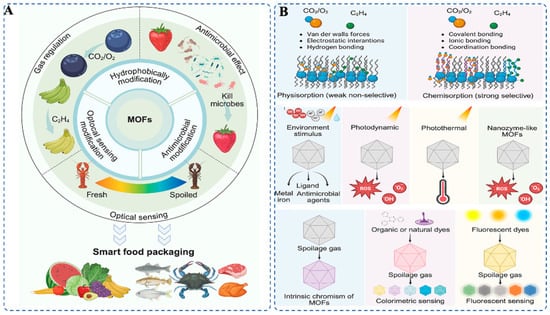
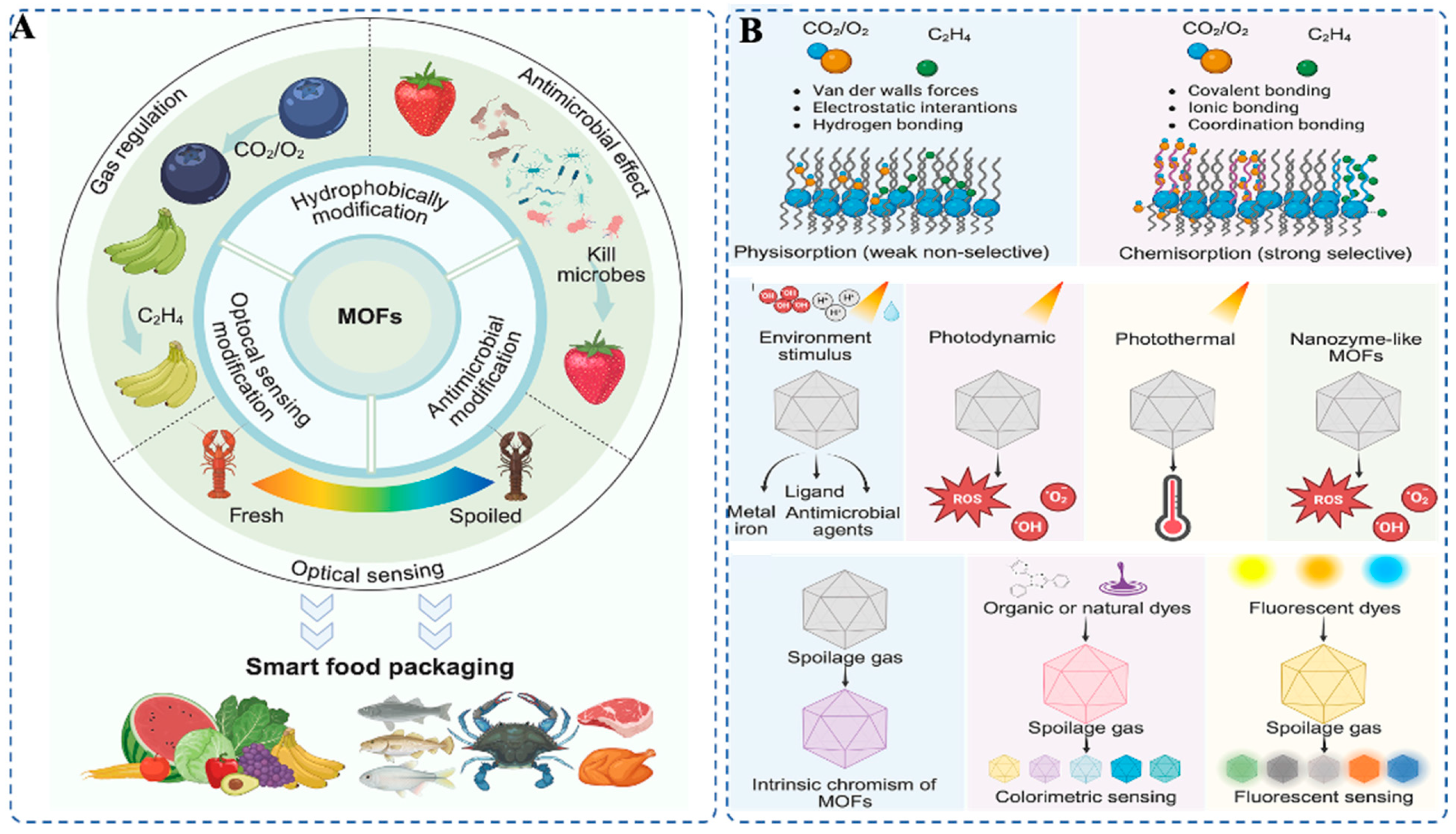
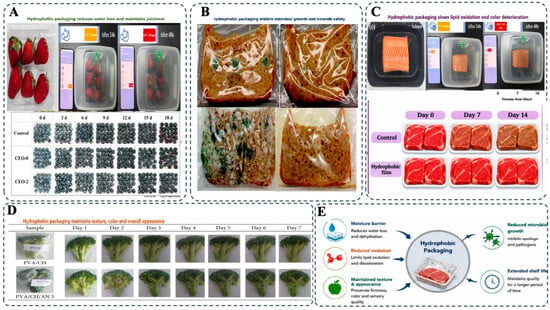
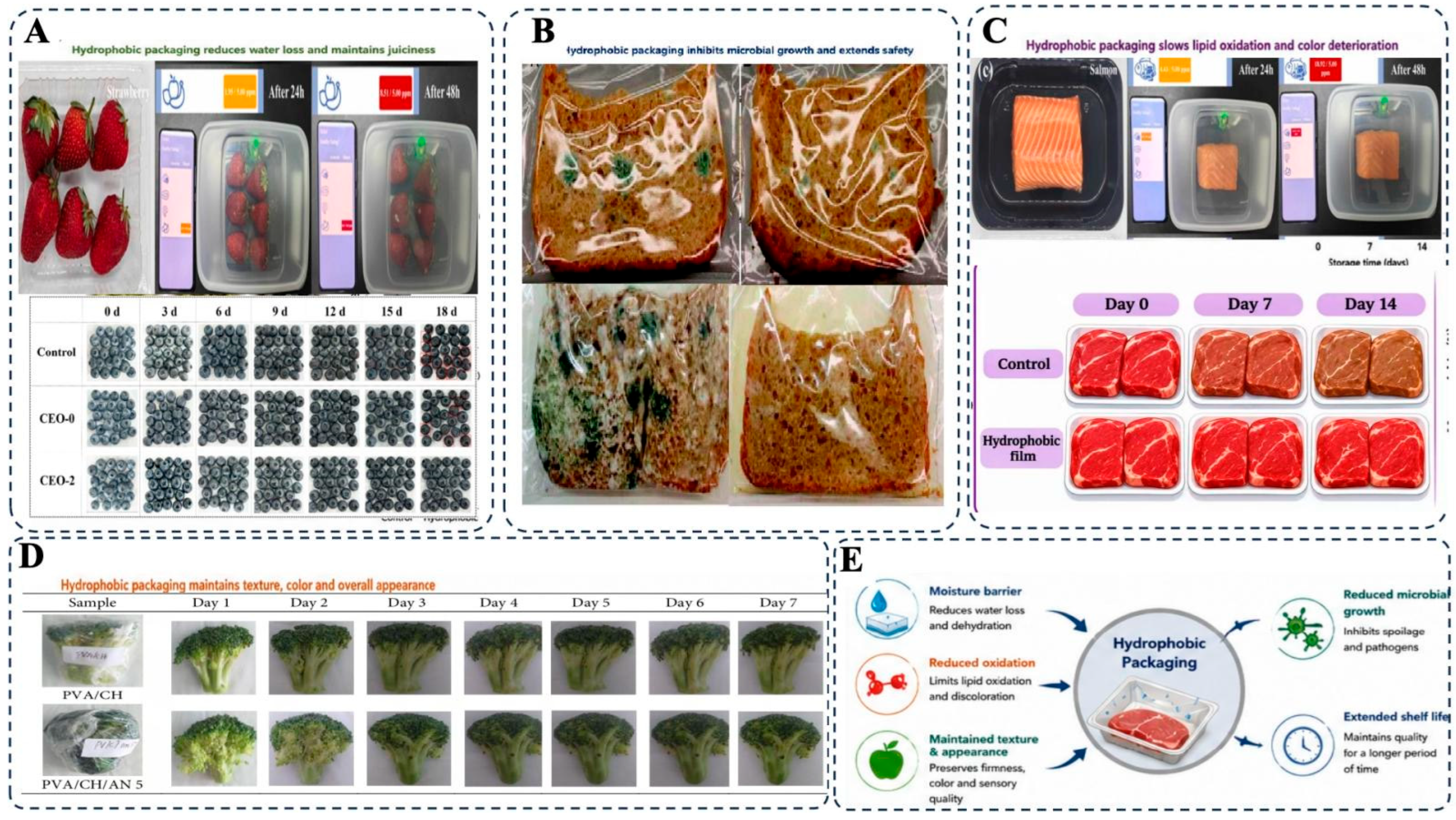
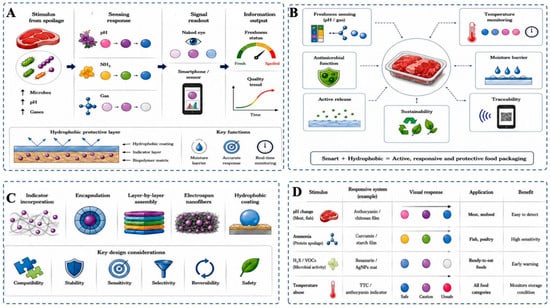
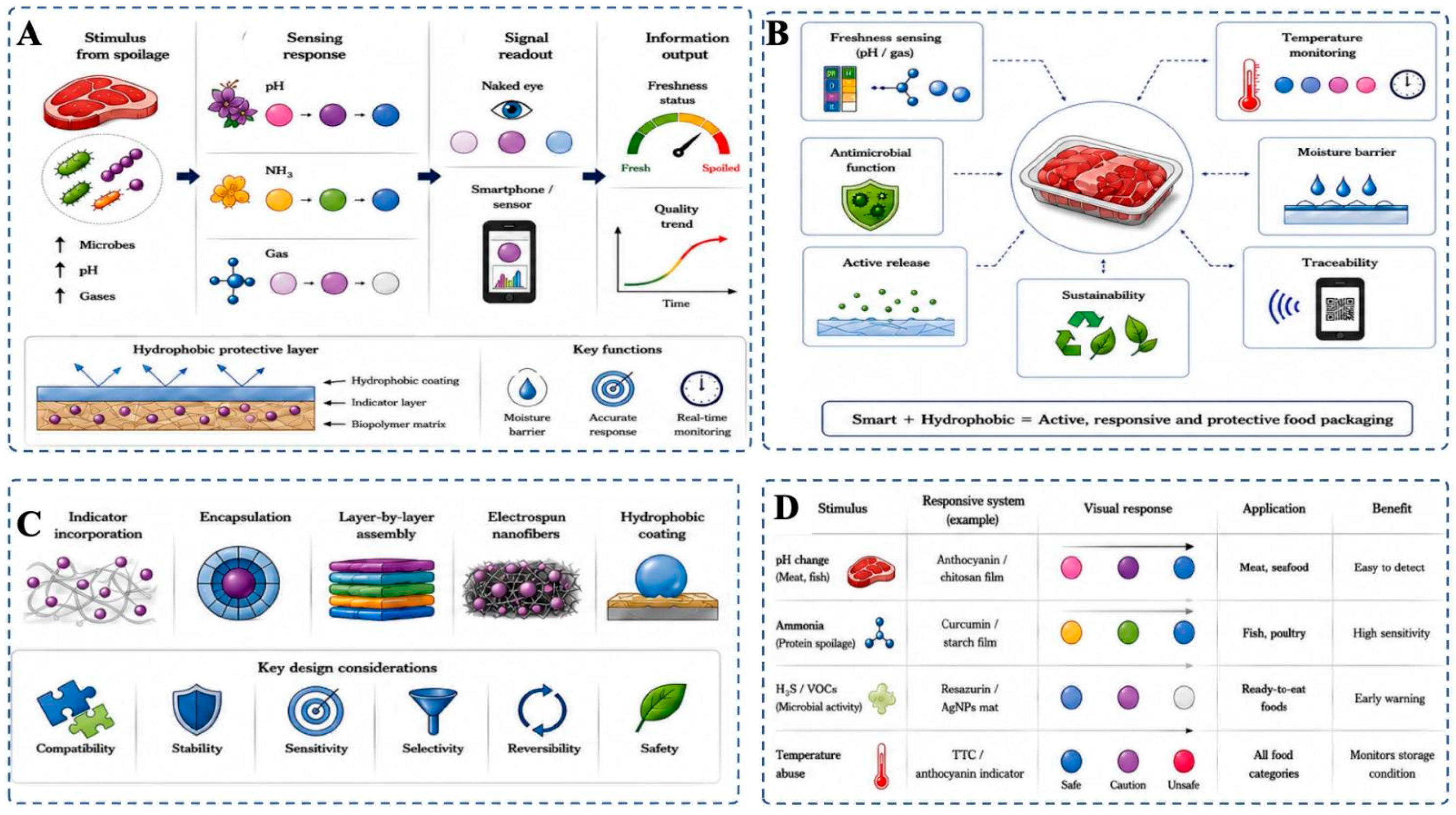
Disclaimer/Publisher’s Note: The statements, opinions and data contained in all publications are solely those of the individual author(s) and contributor(s) and not of MDPI and/or the editor(s). MDPI and/or the editor(s) disclaim responsibility for any injury to people or property resulting from any ideas, methods, instructions or products referred to in the content. |
© 2026 by the authors. Licensee MDPI, Basel, Switzerland. This article is an open access article distributed under the terms and conditions of the Creative Commons Attribution (CC BY) license.