


Abstract
To establish a green and efficient deodorization process for bighead carp surimi, Kombucha was used as the fermentation agent, and the fermentation deodorization process parameters were optimized through single-factor experiments combined with a Box-Behnken response surface design. Bighead carp fish balls were prepared using the optimized surimi, and their textural characteristics and sensory properties were measured. The results indicated that the optimal deodorization process involved a fermentation temperature of 35 °C, a fermentation time of 50 min, and a Kombucha film level of 4%. GC-MS analysis revealed a reduction in the relative contents of key off-flavor compounds, specifically hexanal and heptanal, following fermentation. Concurrently, the levels of desirable aroma-active compounds, such as esters and alcohols, increased markedly. Microstructure observations indicated that the myofibrils in the fermented surimi exhibited only slight dissociation, with the overall tissue architecture remaining largely intact. Fish balls prepared from fermented surimi showed a significant 14.0% increase in water-holding capacity and a significant 34.1% reduction in cooking loss; Springiness and chewiness increased by 47.5% and 51.4%, respectively, and the overall sensory score rose from 62.0 ± 2.1 points to 75.0 ± 3.0 points. This study provides a scientific theoretical foundation and reference for the further processing of surimi and the development of functional fish products.
1. Introduction
Fish balls, as typical surimi-based products, are conventionally prepared by comminuting fish flesh into a homogeneous paste, followed by blending with starch, salt, and other functional ingredients, and subsequently shaping the mixture into spherical forms via thermal or cold-setting processes [1]. Owing to their desirable textural properties, high protein content, low fat content and convenience, fish balls have gained widespread consumer acceptance and are increasingly favored in both domestic and global markets [2,3]. The availability of suitable raw materials is an important basis for the development of surimi products. Bighead carp is a major freshwater aquaculture species; its global aquaculture production reached approximately 7.72 million tonnes in 2022 [4]. However, freshwater fish and products made from them may develop undesirable earthy or muddy, musty, grassy, and fishy odors, which can impair flavor quality and consumer acceptance. These off-flavors may be associated with compounds such as geosmin and 2-methylisoborneol, as well as trimethylamine and lipid-oxidation-derived aldehydes [5,6]. Consequently, the efficient, convenient, and safe elimination of these off-flavor compounds, coupled with comprehensive analysis of odor characteristics, has emerged as a pivotal research focus within the fish processing industry [7,8]. Current research on fish balls has primarily focused on the development of novel formulations and the assessment of antioxidant activity and physicochemical quality. In contrast, studies specifically addressing deodorization techniques for bighead carp surimi are scarce. Conventional deodorization strategies predominantly rely on chemical methods utilizing compound deodorizing agents or sensory masking techniques that obscure off-flavors with other strong flavors [9]. However, these approaches may pose risks of chemical residues or unintended alterations to nutritional quality. Recently, microbial fermentation has emerged as a promising alternative, offering advantages such as environmental friendliness, safety, and the potential for concurrent flavor enhancement through the biotransformation of off-odor compounds into pleasant metabolites [1,5,10].
Kombucha is a symbiotic community composed of lactic acid bacteria (LAB), Acetobacter, yeast, and other microbial genera, and possesses multiple metabolic pathways [11]. Its fermented liquid contains various nutrients, including organic acids, tea polyphenols, and glucuronic acid, as well as beneficial microorganisms. Therefore, Kombucha fermentation yields a complex array of organic acids, vitamins, and polyphenols, which have been associated with various health-promoting effects, such as antimicrobial, antioxidant, anti-inflammatory, hypoglycemic, and even anticancer activities [12]. Fermentation with LAB and yeasts has been extensively documented as an effective strategy to mitigate fishy off-odors by degrading key malodorous compounds such as trimethylamine (TMA) and aldehydes [9]. However, systematic investigations into the optimization of kombucha fermentation parameters for bighead carp surimi, the mechanisms underlying off-flavor changes, and the relationship between fermentation and the quality of the resulting fish balls remain limited. We hypothesized that kombucha fermentation, under appropriately optimized conditions, would reduce the intensity or abundance of undesirable volatile compounds in bighead carp surimi while retaining or improving the gel structure and overall quality of the resulting fish balls. Therefore, this study employed kombucha as a starter culture to optimize the deodorization process of bighead carp surimi using single-factor experiments and response surface methodology. Gas Chromatography–Mass Spectrometry (GC-MS) was utilized to elucidate the changes in volatile profiles, while scanning electron microscopy (SEM) was applied to characterize the microstructural modifications of the surimi gel network. Furthermore, the quality and safety of fish balls produced from the fermented surimi were validated. This research aims to provide a green and efficient technological solution for the deep processing of bighead carp surimi, thereby promoting the high-quality development of the freshwater fish processing industry.
2. Materials and Methods
2.1. Materials
Fresh bighead carp (30–35 cm in length, weighing 1.0–1.5 kg), Xinyang black tea, and granulated sugar were all purchased at a local supermarket (Xinyang, China). The kombucha culture (food grade, containing a mixed culture of acetic acid bacteria, lactic acid bacteria, and yeast) was prepared in-house at the laboratory. All other chemical reagents were purchased from the Nanjing Chemical Reagent Co. Ltd. (Nanjing, China).
2.2. Cultivation of Kombucha and Preparation of Bighead Carp Surimi
Cultivation of Kombucha: 5 g of black tea and 100 g of sugar were added to 1000 mL of water and mixed well. The mixture was heated to maintain a slight boil for 20 min and stirred every 5 min, and then filtered through 200-mesh gauze. The filtrate was fixed to 1000 mL with water and sterilized at 108 °C for 15 min, followed by cooling to room temperature. The commercial Kombucha liquid and 1 piece of Kombucha film were inoculated into the configured fermentation substrate at a ratio of 10% (v/v). After mixing well, the mixtures were incubated at 30 °C for 7 d. After fermentation, the Kombucha was stored at 4 °C for reserve.
Preparation of bighead carp surimi: The bighead carp was scaled, headed, tailed and gutted, with skin, bones and spines removed. Following preparation, the flesh was cut into small pieces and minced to a fine consistency using a mincer. An equal quantity of ice water was added, and the mixture was further processed for 5 min. The prepared surimi was refrigerated at 4 °C.
2.3. Optimization of Fermentation Process of Bighead Carp Surimi with Kombucha
In this experiment, the wet bighead carp surimi (50 g) was used as the reference basis. Both the kombucha inoculum and glucose were added at a fixed level of 4% (w/w) relative to the wet weight of the surimi; five fermentation temperatures were selected: 25 °C, 30 °C, 35 °C, 40 °C, and 45 °C; the fermentation times were set at 20 min, 30 min, 40 min, 50 min, and 60 min; and the additions of Kombucha film (based on the wet weight of surimi; wet culture, %) were considered as 1%, 2%, 3%, 4%, and 5% amount. The three single factors of fermentation temperature, fermentation time, and the Kombucha film level were evaluated independently while other factors were kept constant.
Based on the results of single-factor experiments, Box–Behnken’s principal design (Table 1) was employed to optimize the processing parameters. The TMA content (Y1; to be minimized) and the fishy odor score (Y2; to be maximized) of Bighead carp surimi were selected as the response variables. Data were subjected to analysis of variance (ANOVA) using Design-Expert 13.0 software, and the optimal process conditions were determined by response surface methodology.
Table 1.
Factors and levels of response surface methodology design.
2.4. Determination of Trimethylamine Content
The TMA content in the sample was determined using the headspace-gas chromatography-mass spectrometry (HS-GC-MS) method specified in the national standard GB 5009.179—2016 [13]. The test was repeated three times, and the average value was calculated.
2.5. Evaluation of the Fishy Odor in Fermented Surimi
Ten food industry professionals participated in the sensory evaluation of fermented surimi using quantitative descriptive analysis. All participants voluntarily agreed to take part in the sensory evaluation of these samples. Between tastings of different samples, participants rinsed their mouths 2–3 times with distilled water to prevent flavor carryover [14]. The specific scoring criteria are presented in Table S1.
2.6. Microscope Observation
Samples were examined for microstructure using a scanning electron microscope (SEM, Phenom ParticleX, Thermo Fisher, Eindhoven, The Netherlands). The samples were examined under conditions of 15 kV and 500× magnification. The samples were placed in a 2.5% (v/v) glutaraldehyde solution and fixed at 4 °C for 24 h. They were rinsed three times each with PBS buffer (0.1 mol/L, pH 7.0) and distilled water, for 15 min each time. The samples were eluted three times with ethanol at 50%, 70%, and 90% by volume, respectively, for 15 min each. Finally, the samples were dehydrated three times with anhydrous ethanol for 10 min each [15]. The processed samples were then freeze-dried. Freeze-dried samples were affixed to a SEM copper platform using double-sided conductive tape and subsequently coated with a thin gold film in a vacuum evaporator. Then the specimens were visualized using SEM.
2.7. Determination of Colony, pH, Lipoxygenase (LOX) Activity, and Trimethylamine N-Demethylase Activity
20 mL of pre-chilled distilled water was added to 10 g of fermented surimi (under optimal fermentation conditions). Unfermented surimi was used as the control group. Each mixture was homogenized at 4 °C in a high-speed homogenizer at 8000 rpm for 2 min to prepare homogenized surimi samples for subsequent parameter analysis.
The determination of Lactic Acid Bacteria in accordance with National Food Safety Standard GB 4789.35—2016 [16]; The determination of yeast in accordance with National Food Safety Standard GB 4789.15—2016 [17]; Acetobacter were determined using the Glucose-Yeast Extract-Calcium Carbonate agar medium supplemented with 2% (v/v) ethanol, following the method described by [18] with adaptations. Plates were incubated aerobically at 30 °C for 3–5 d. Colonies surrounded by a clear zone were recorded as Acetobacter.
The pH of the sample was measured using a precision pH meter.
Following the method described by [19], the measurements of LOX activity were performed using a UV spectrophotometer(UV-1800, Shimadzu Corporation, Kyoto, Japan). A 50 mmol L−1 phosphate buffer (pH 7.0) was pre-chilled to 4 °C. Three grams of surimi were added to 8 mL of phosphate buffer, thoroughly ground and extracted, then centrifuged at 15,000× g for 15 min at 4 °C. The supernatant crude enzyme solution was collected for LOX activity determination. A 3 mL reaction system was used, containing 0.2 mL of crude enzyme solution, 2.775 mL of 100 mmol L−1 acetic acid buffer (pH 5.5), and 25 μL of the reaction substrate—sodium linoleate stock solution. The reaction was conducted at 30 °C, and LOX activity was measured at a wavelength of 430 nm. Timing began 15 s after the addition of the crude enzyme solution, and changes in OD values were recorded over a 1 min period. Enzyme activity was expressed as ΔOD430 g−1FW min−1. The experiment was repeated three times.
TMAO demethylase activity was determined by high-performance liquid chromatography (HPLC), using the amount of DMA produced from TMAO as the measure of enzyme activity. TMAO was added to the supernatant of the surimi homogenate to a final concentration of 10 mmol/L, together with an ascorbate–Fe2+ activation system. After incubation at 30 °C for 60 min, the reaction was terminated by adding trichloroacetic acid to a final concentration of 5% (w/w). Following derivatization, the amount of DMA produced was quantified by HPLC. One unit (U) of enzyme activity was defined as the amount of enzyme that produced 1 μmol of DMA per minute per gram of protein.
2.8. Determination of Mainvolatile Components in Surimi by GC-MS
2.8.1. Sample Preparation
3 g of surimi was homogenized with 7 mL of saturated saline solution, placed in a 20 mL headspace sampling vial, and the vial was placed on a magnetic stirrer. The extraction head of the solid-phase microextraction (Polydimethylsiloxane/Divinyibenzene/Carboxen /PDMS/DVB/CAR) into the headspace sampling vial. After adsorption at 60 °C for 50 min, the head was quickly removed and directly inserted into the injection port of a GC-MS system, allowing the volatile compounds adsorbed onto the SPME fiber coating to undergo rapid thermal desorption at high temperature for 5 min, followed by analysis and identification using GC-MS.
2.8.2. GC-MS Conditions
The chromatographic conditions were DB-5MS (30 m × 0.25 mm × 0.25 um). The split mode was set to “no split,” and the flow rate was 1 mL/min. The injector temperature was 250 °C. To heat the sample, the temperature was kept at 40 °C for 3 min, then the sample was heated at 5 °C/min to 200 °C and held for 2 min; followed by heating at 50 °C/min to 250 °C and held for 5 min.
The mass spectrometry conditions were as follows: ionization mode was set to “(EI) ionization source,” transfer line temperature was 280 °C; ion source temperature was 230 °C; quadrupole temperature was 150 °C; electron energy was 70 eV; mass scan range was m/z 40–400.
Identification criteria: Peaks in the total ion chromatogram were searched against the NIST 17 mass spectral library, and only compounds with a similarity score of ≥80 were retained. For compounds with authentic standards, identification was confirmed by comparing their retention times with those of the standards. For compounds without authentic standards, identification was supported by comparing their retention indices (RIs), calculated using C7–C30 n-alkanes, with values reported in the literature. Without derivatization, HS-SPME is suitable only for volatile and semi-volatile compounds; highly polar, low-volatility substances—including sugars, nucleotides, amino acids, and their silylated derivatives—are outside the scope of detection by this method. Signals attributed to column bleed or to silicon- or fluorine-containing artifacts introduced during sample preparation were also excluded.
2.9. Preparation of Bighead Carp Fish Balls
The fish balls were prepared using a modified method described previously [20]. Bighead carp surimi was fermented using an optimized process to remove fishy odors and was thoroughly mixed to ensure uniformity. The surimi mixture was extruded into uniform balls, heated in a constant-temperature water bath at 45 °C for 30 min to set the shape, and then heated in a water bath at 90 °C for 10 min. Finally, the fish balls are cooled in ice water for 10 min, vacuum-packed, and refrigerated at 4 °C for subsequent quality and safety testing. The control group consists of fish balls prepared using unfermented surimi.
2.10. Determination of Physicochemical Properties and Microbiological Indexes of Bighead Carp Fish Balls
5 g sample of fish balls was added to 10 mL of 5% trichloroacetic acid. The mixture was vortexed for 10 min until thoroughly mixed, then centrifuged at 8000× g rpm at 4 °C for 15 min. The supernatant was collected and set aside for later use. The determination of biogenic amines (histamine, tyramine) content follows Method 1 (liquid chromatography) as specified in GB/T 5009.208—2016 [21], “National Food Safety Standard: Determination of Biogenic Amines in Foods.” The determination of protein content shall comply with GB 5009.5—2016 [22], “National Food Safety Standard: Determination of Protein in Foods”; the determination of total colony count in accordance with GB 4789.2—2022 [23], “Microbiological Testing of Foods—Determination of Total Colony Count”; the determination of E. coli counts refers to GB 4789.3-2025 [24], National Food Safety Standard: Microbiological Testing of Foods—Enter bacillus Count; and the test results shall comply with GB 29921—2021 [25], “National Food Safety Standard: Maximum Limits for Pathogenic Bacteria in Prepackaged Foods.”
2.11. Texture Profile Analysis (TPA)
Texture profile analysis (TPA) of the fish balls was performed using a texture analyser (TMS-Pro, Food Technology Corporation Ltd.,Sterling, Virginia, USA) equipped with probe P/50. The TPA settings were selected based on a modified method described previously [26]. The fish balls were cut into 1 cm3 shapes, then compressed at a compression degree of 40% with both the pre- and post-test speed set at 2 mm/s and the test speed set at 1 mm/s to obtain TPA parameters (hardness, springiness, cohesiveness, and chewiness). The trigger type was set to auto with a 5.0 g trigger force, and the test distance was 15 mm. All sample measurements were performed in decomplicate and repeated triplicate [26].
2.12. Determination of Fish Balls Water Holding Capacity
The determination of water-holding capacity (WHC) in fish ball samples was based on the method described by [27], with appropriate modifications. The sample (2 g) was wrapped in two layers of quantitative filter paper and placed in a 50 mL standard centrifuge tube and centrifuged at 8000× g rpm for 15 min at 4 °C. Then the water was removed and the tubes with samples were accurately weighed. WHC was computed as the following Equation (1):
where m1 is the total weight (g) before centrifugation, including the sample, two layers of filter paper and the centrifuge tube; and m2 is the total weight (g) after centrifugation and removal of the expelled water, including the sample after removing water, two layers of filter paper and the centrifuge tube.
WHC(%) = (m1 − m2)/m1 × 100%
2.13. Determination of Fish Balls Cooking Loss
The method for determining cooking loss was adapted from the study [28] with minor modifications. 5 g sample of fish balls was placed in an aluminum tray, heated in a water bath at 90 °C for 15 min, and then weighed after cooling to room temperature. The cooking loss was calculated using the following Equation (2):
where M1 and M2 represented the weight of the fish balls before and after cooking, respectively.
Cooking loss (%) = (M1 − M2)/M1 × 100
2.14. Descriptive Sensory Measurement
The sensory measurement of fish balls was carried out according to the method with minor modifications [29,30]. Panel selection and training were conducted with reference to GB/T 16291.1-2012 [31], Sensory analysis—General guidance for the selection, training and monitoring of assessors—Part 1: Selected assessors. The panel consisted of eight members, including students, teachers, and industry professionals in the field of food science. All panelists had a food science background and had received specialized training in sensory evaluation. Before evaluation, freshly prepared fish balls were sliced and allowed to equilibrate at room temperature for 30 min. Four attributes (Color and gloss, Cross-sectional structure, Elasticity and mouthfeel, Fish aroma and fishy odor) were evaluated according to the sensory scoring criteria in Table S2.
2.15. Statistical Analysis
Data were presented as mean ± standard deviation. Means were analyzed using one-way analysis of variance (ANOVA), followed by Duncan’s multiple-range test using SPSS software (SPSS Inc., Chicago, IL, USA; Version 26.0). Homogeneity of variance was assessed before the parametric analyses. For the sensory data, each product group was evaluated in a single assessment, and assessor and repetition effects were not included in the statistical model. Therefore, sensory results are reported as descriptive panel scores, and the potential effects of assessor variation and repeatability were not separately estimated. The level of significance was set at p < 0.05.
3. Results and Discussion
3.1. Optimization of Fermented Bighead Carp Surimi Processing
3.1.1. Effects of Additions of Fermentation Temperature on TMA Content and Fishy Odor Scores of Fermented Surimi
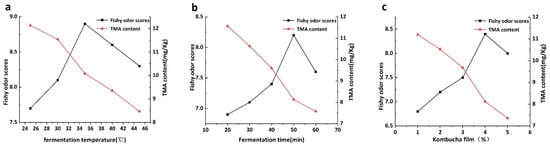
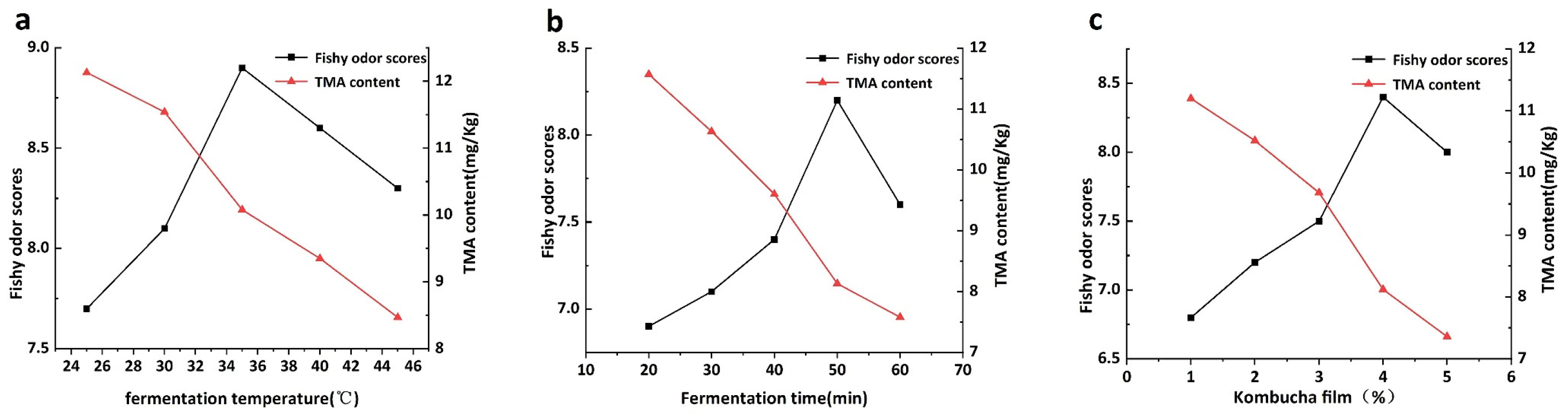
As shown in Figure 1a, fermentation temperature significantly influenced the TMA content and fishy odor scores of Bighead carp surimi. At a relatively low temperature of 25 °C, the TMA content remained at a high level. However, as the temperature increased, the metabolic activity of the microbiota was enhanced, leading to a continuous downward trend in TMA content. During this process, the intensified metabolic pathways of functional microbes, such as Saccharomyces and Acetobacter, promoted the accumulation of volatile aroma compounds, including esters and alcohols. These pleasant aroma-active compounds effectively masked the characteristic fishy odor of TMA [32], thereby improving the sensory off-flavor evaluation of the surimi. As the fermentation temperature increased from 25 °C to 35 °C, the sensory off-flavor score peaked, reaching its optimum level (8.5), indicating that the microbial metabolic pathways within this temperature range were most favorable for the transformation of fishy precursors. However, when the temperature exceeded 35 °C, excessive thermal stress activated endogenous lipases in the fish muscle, accelerating the enzymatic and autoxidation of unsaturated fatty acids. This resulted in the massive accumulation of hydroperoxides, which further decomposed into small-molecule volatile compounds such as aldehydes, ketones, and short-chain fatty acids [33]. These compounds typically possess pungent and unpleasant odors, which exacerbated the overall off-flavor of the surimi and consequently led to a decline in the sensory score. Based on the comprehensive evaluation of TMA degradation efficiency and sensory quality, 35 °C was selected for further optimization according to the design principle of RSM.
Figure 1.
Effects of fermentation temperature (a), fermentation time (b) and additions of Kombucha film (c) on TMA content and fishy odor scores of fermented surimi.
3.1.2. Effects of Fermentation Time on TMA Content and Fishy Odor Scores of Fermented Surimi
As illustrated in Figure 1b, fermentation time significantly regulated the degradation kinetics of TMA and fishy odor scores of Bighead carp surimi. At the initial stage (20 min), the TMA content remained at a high level. With prolonged fermentation, the TMA content decreased continuously, exhibiting a dynamic degradation pattern characterized by an initial acceleration followed by a deceleration. When the fermentation time reached 50 min, the TMA content declined to its minimum value (7.04 mg/kg), corresponding to the peak sensory score (8.2), indicating that the deodorization efficiency was optimal at this point. This phenomenon could be attributed to the metabolic shift within the kombucha symbiotic consortium: during the early fermentation stage, the microbiota preferentially utilized nitrogenous substrates such as TMA for growth and metabolism, achieving efficient biological deodorization. However, upon extending the fermentation time to 60 min, microbial metabolism shifted toward the substantial accumulation of organic acids (e.g., acetic and lactic acids), resulting in prominent sourness and the generation of off-flavors, which ultimately led to flavor deterioration [34]. Consequently, considering both deodorization efficiency and flavor stability, 50 min was selected for further optimization.
3.1.3. Effects of Additions of Kombucha Film on TMA Content and Fishy Odor Scores of Fermented Surimi
As shown in Figure 1c, the inoculum level of the kombucha film significantly regulated the TMA content and fishy odor scores of Bighead carp surimi. Within the range of 1% to 4%, the TMA content decreased significantly with increasing kombucha film addition, whereas the sensory odor scores increased significantly. When the inoculum level exceeded 4%, the TMA content rebounded slightly, the fishy odor scores declined, and sensory evaluation revealed the emergence of undesirable fermented off-notes. This phenomenon could be attributed to microbial metabolic dynamics during fermentation. At insufficient inoculum levels, the population density of functional microorganisms (e.g., Saccharomyces spp., Acetobacter spp.) was inadequate, limiting their capacity to metabolize nitrogenous off-odor precursors such as TMA and resulting in low deodorization efficiency [9]. Conversely, an excessive inoculum level may trigger rapid microbial proliferation, leading to the premature depletion of available nutrients and substantial accumulation of undesirable metabolic by-products, including organic acids and alcohols, which can adversely affect the flavor profile and cause process acidification [35]. This not only interfered with the continuous degradation of TMA but also led to an imbalance in flavor, manifested as a distinct sour taste and fermented off-flavors, ultimately affecting the overall quality of the surimi.
3.1.4. Response Surface Optimization Results
Preliminary model fitting indicated that the quadratic response surface model for trimethylamine (TMA) content had inadequate predictive performance; therefore, response surface analysis was not performed for this response (Table 2). Instead, the sensory score for fishy odor was selected as the primary response, and a Box–Behnken design was used to optimize the surimi fermentation conditions (Table 3). The experimental data were analyzed using Design-Expert 13, and the following second-order regression equation was obtained: Y2 = 8.16 + 0.20A + 0.70B + 0.15C − 0.025AB + 0.18AC + 0.48BC − 0.97A2 − 1.92B2 − 1.02C2.
Table 2.
Design and results of Box–Behnken experiments.
Table 3.
Variance analysis of regression model (Y2).
Analysis of variance (ANOVA) showed that the lack-of-fit term was not significant (p = 0.4067 > 0.05), whereas the overall model was highly significant (p < 0.0001), indicating that the model adequately fitted the experimental data. The coefficient of determination (R2) was 0.9861, suggesting that the model explained 98.61% of the variation in the sensory scores. The adjusted R2 (Radj2 = 0.9681) was close to the predicted R2, supporting the model’s predictive adequacy and the reproducibility of the sensory evaluation. Among the linear terms, B was highly significant (p = 0.0001), A approached significance, and C was not significant. Of the interaction terms, BC was significant (p = 0.0071), whereas AB and AC were not significant. The factors ranked in descending order of influence as follows: B > A > C.
These results identify B as the most influential factor affecting the sensory perception of fishy odor in fermented surimi. The significant positive interaction between B and C indicates that their levels should be considered jointly when optimizing the fermentation conditions to reduce fishy odor and improve the sensory score. No significant interactions were observed for AB or AC. Because sensory evaluation provides a direct measure of perceived fishy odor, it was prioritized as the optimization response in this study. Although TMA is a characteristic fishy-odor compound, the odor of fermented surimi arises from multiple volatile compounds, whose changes do not necessarily correspond directly to changes in sensory scores. In addition, the TMA data were not adequately described by a second-order response surface model. Accordingly, the sensory response model was used as the primary basis for process optimization, while measured TMA concentrations were used as a complementary reference for evaluating the effect of fermentation on fishy odor.
3.1.5. Validation of Test Results
Based on the regression model developed using Design-Expert 13.0, the predicted optimum conditions for reducing fishy odor in surimi were a fermentation temperature of 35.55 °C, a fermentation time of 52.00 min, and a kombucha film addition level of 4.13%. Under these conditions, the predicted sensory score for fishy odor was 8.25. For practical implementation, the conditions were rounded to a fermentation temperature of 35 °C, a fermentation time of 50 min, and a kombucha film addition level of 4%. Three parallel validation experiments were conducted under these optimized conditions. The fermented surimi had a TMA content of 6.68 ± 0.38 mg/kg and a fishy-odor sensory score of 8.0 ± 0.5. The relative deviation between the observed sensory score and the predicted value of 8.25 was 3.03%, indicating that the response surface model provided a feasible and effective basis for optimizing the kombucha fermentation conditions for fishy-odor reduction in surimi.
3.2. Comparison of Surimi Before and After Fermentation
3.2.1. Microstructure of Fermented Surimi
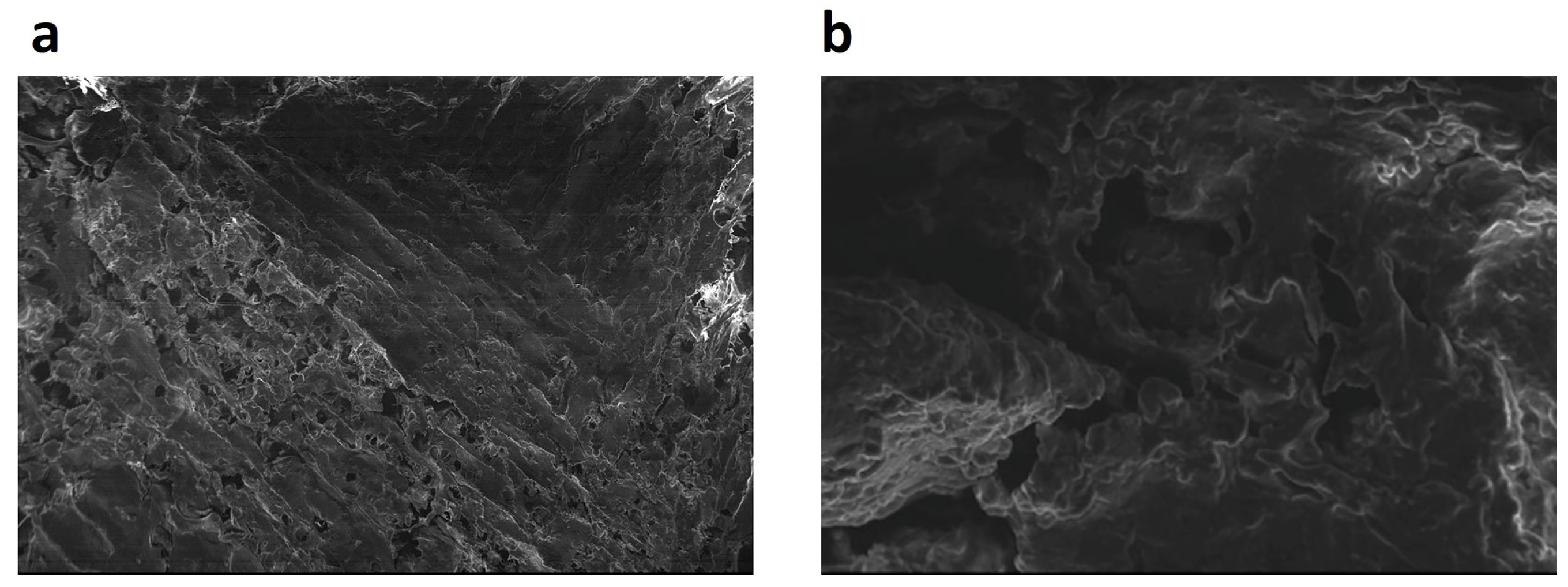
SEM observations (Figure 2) revealed that the unfermented surimi (Figure 2a) exhibited a well-organized microstructure. The myofibrils were arranged regularly with an ordered orientation, showing no obvious aggregation or fragmentation. The pores between the fibrils were uniformly distributed with moderate size, forming an overall compact and stable network structure, which is a typical characteristic of the native assembly state of myofibrillar proteins. Compared to the control, the microstructure of the kombucha-fermented surimi (Figure 2b) showed minimal alterations: only slight dissociation was observed at the edges of a few myofibrils, with no large-scale fiber breakage or protrusion. The uniformity and compactness of the original porous structure remained largely intact. These results align with previously reported patterns regarding the impact of microbial fermentation on surimi protein structure [36]. One possible explanation is that during the early fermentation stage, proteases secreted by the microbiota induced mild hydrolysis at specific sites on the myofibrillar proteins, promoting moderate unfolding and exposure of internal active groups. However, the mechanisms were not directly measured in this study and require further confirmation.
Figure 2.
Scanning election microscope (SEM) images (500×) of surimi. (a) Unfermented surimi; (b) Fermented surimi.
3.2.2. Changes in Colony, pH, LOX Activity and TMAOase Activity of Surimi During Fermentation
As presented in Table 4, the population of lactic acid bacteria exhibited the most rapid growth during the surimi fermentation process, a trend that correlated strongly with the decreasing TMA content (Figure 1b). It is hypothesized that lactic acid bacteria serve as the core deodorizing microbiota, primarily through the production of lactic acid, which lowers the system pH and inhibits TMA formation. In contrast, Acetobacter and yeasts acted as auxiliary metabolic agents, contributing to the enhancement of aroma-active compound levels [37]. By the end of fermentation, the pH had dropped to 5.83. This mildly acidic environment played a dual regulatory role: it suppressed the activity of LOX, thereby reducing the generation of aldehyde-based off-flavor compounds, while simultaneously activating TMAOase activity to accelerate TMA degradation. Consequently, the fermentation process effectively minimized fishy odor by synergistically reducing its generation and promoting its catabolism.
Table 4.
Effect of Kombucha on colony, pH, LOX activity and TMAOase activity of surimi during fermentation.
3.2.3. Analysis of Volatile Components of Surimi
As presented in Table 5, a total of 24 volatile compounds were identified in the fresh surimi, predominantly comprising alcohols (6 species, 6.07%), aldehydes (6 species, 12.65%), ketones (4 species, 1.96%), esters (4 species, 2.18%), and carboxylic acids (2 species, 2.27%). This profile was characterized by a limited variety of compounds and pronounced fishy off-notes. Following kombucha fermentation, the number of volatile components surged to 50, indicating a significant restructuring of the flavor profile. Specifically, the categories and proportions of alcohols, aldehydes, ketones, esters, and carboxylic acids underwent varying degrees of change. Crucially, characteristic fractions such as ethers (5 species, 23.32%) and heterocyclic compounds (1 species,0.49%) were newly detected. This substantial diversification of volatile constituents greatly enriched the aromatic hierarchy of the fermented surimi. Regarding changes in key odor-active compounds, kombucha fermentation markedly reduced several compounds associated with fishy off-flavors. The relative contents of hexanal and heptanal decreased from 8.46% and 1.31% in the unfermented sample to 3.11% and 0.47% in the fermented sample, respectively. This decrease may be related to acid production during fermentation, which could inhibit lipoxygenase activity (Table 4) and consequently limit the formation of aldehydes during lipid oxidation. Meanwhile, fermentation altered the aroma profile by retaining some of the original desirable flavor compounds and increasing the relative contents of compounds associated with floral and fruity notes. For example, the relative content of ethyl glycolate increased from 0.33% to 2.30%. Ethers and heterocyclic compounds were also detected in the fermented sample, potentially contributing to its more complex aroma profile. Overall, kombucha fermentation was associated with a shift in the surimi aroma from a predominantly fishy profile toward a more complex profile, which may improve its sensory quality.
Table 5.
Volatile components in fresh surimi and kombucha fermented surimi.
3.3. Physicochemical Indexes and Microbial Indexes of Bighead Carp Fish Balls
According to the definition of “high-protein foods” (protein content ≥ 12 g/100 g) in GB 28050—2011 [38], “National Food Safety Standard—General Rules for Nutrition Labeling of Prepackaged Foods,” the protein content of fish balls (Table 6) meets the requirements for high-protein foods, indicating that the fermentation process did not significantly reduce the retention of protein in the surimi. The total colony count and E. coli levels complied with the National Food Safety Standard Animal-derived Aquatic Products (GB 10136—2015) [39]. Furthermore, the levels of histamine and tyramine were substantially lower than the safety thresholds for aquatic products outlined in the National Food Safety Standard Maximum Levels of Contaminants in Foods (GB 2762—2022) [40], which typically sets limits at ≤100 mg/kg for histamine and ≤200 mg/kg for tyramine. In conclusion, the fish balls prepared from Bighead carp surimi fermented with kombucha comply with national standards in terms of both nutritional quality and food safety. The kombucha fermentation strategy not only enhanced the flavor profile of the surimi via microbial metabolism but also guaranteed the overall edible quality of the final product.
Table 6.
Physicochemical indexes and microbial indexes of fish balls prepared by kombucha-fermented surimi.
3.4. Quality Analysis of Fish Balls Prepared by Fermenting Surimi with Kombucha
3.4.1. Texture Profile Analysis (TPA)
TPA is a pivotal technique for objectively quantifying the sensory characteristics of food products by simulating the double-compression cycle of oral mastication instrumental approach effectively mitigates the subjective biases and individual variations inherent in traditional sensory evaluation [41], serving as a crucial tool for assessing the textural quality of gel-based products [42]. Table 7 summarizes the TPA parameters including hardness, chewiness, springiness and chewiness cohesiveness for the fish balls. Within the TPA framework, hardness reflects the sample’s resistance to deformation; springiness characterizes the extent to which the sample recovers its original shape after the removal of deforming force; chewiness comprehensively represents the energy required to masticate the sample into a state suitable for swallowing; and cohesiveness describes the tendency of the sample to adhere to oral tissues. Compared with the unfermented fresh surimi control, fish balls prepared from kombucha-fermented surimi exhibited significant improvements across multiple textural parameters. Specifically, the hardness of the fermented fish balls increased to 4.43 ± 0.13 N. Furthermore, the increase in springiness indicates that fermentation not only strengthened the gel matrix but also optimized its viscoelastic properties, granting the fish balls superior recovery capabilities after deformation. This may be closely associated with stabilized water-binding interactions and the reconstruction of the protein network. Chewiness, calculated as the product of hardness, springiness and cohesiveness, increased to 5.127 ± 0.632 N·mm, representing a substantial rise of 51.4%. This marked elevation in chewiness implies that the fermented fish balls require more mechanical work to be masticated into a swallowable bolus, thereby imparting a more resilient and substantial mouthfeel to the product. This may be due to the fermentation of kombucha improving the textural properties of surimi fish balls by promoting protein denaturation and intermolecular cross-linking, making the fish balls firmer, more elastic, and chewier. These results showed that kombucha fermentation not only enhanced the mechanical strength of the product but also delivered a richer and more layered sensory experience for consumers.
Table 7.
The texture profile analysis (TPA) of the fish balls.
3.4.2. WHC and Cooking Loss of Fish Balls
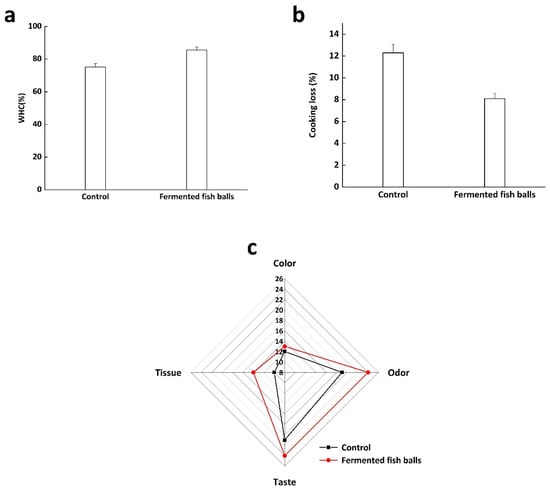
WHC and cooking loss are the essential indicators of water retention capacity and textural quality in fish balls [43]. WHC reflects the ability of the three-dimensional network structure of the surimi protein gel in fish balls to retain water molecules [44]. A higher value indicates that the gel matrix is more efficient at locking in moisture through physicochemical forces such as hydrogen bonding and electrostatic interactions, thereby imparting better juiciness and a fuller mouthfeel to the product [45]. Cooking loss reflects the gel’s ability to retain its own moisture during heating. A lower value indicates tighter cross-linking between protein molecules and water molecules, as well as between protein molecules themselves, resulting in a denser network structure that effectively reduces moisture loss [46]. As illustrated in Figure 3a, compared with the control group, the WHC of fish balls prepared with kombucha-fermented surimi increased significantly by 14.0%. This enhancement was attributed to the production of organic acids during fermentation, which lowered the system pH. This acidification induced the moderate denaturation of myofibrillar proteins, exposing additional polar groups and strengthening the intermolecular binding forces between proteins and water. Concurrently, Figure 3b demonstrated that the cooking loss rate of the fermented fish balls decreased significantly by 34.1%. This inverse correlation with WHC further substantiates that fermentation reinforced the structural integrity of the protein gel network, effectively reducing moisture expulsion during heating.
Figure 3.
(a) Water-holding capacity (WHC); (b) Cooking loss; (c) Sensory evaluation of fish balls.
3.4.3. Sensory Characteristics of Fish Balls
Sensory evaluation serves as a pivotal link connecting the physicochemical properties of food with consumer acceptance, providing an objective measure of the integrated perceptual responses elicited by food stimuli. Flavor perception is a multifaceted experience grounded in complex chemical matrices, involving the interplay of chemosensory, physical, and psychological interactions, wherein the subject’s perception plays a decisive role in the characterization of flavor attributes [47]. Conventional sensory profiling allows for the quantification of organoleptic traits that are often difficult to capture via instrumental analysis; its simplicity and rapidity enable a direct reflection of product quality and consumer preference [48]. As illustrated in Figure 3c, compared with the fish balls prepared from unfermented Bighead carp surimi, the samples subjected to kombucha fermentation exhibited significant improvements in critical dimensions such as odor and taste. This was primarily attributed to the effective degradation of key off-odor compounds, such as TMA and aldehydes, through microbial metabolic activity during the fermentation process, as well as the formation of flavor compounds such as derived esters and characteristic aldehydes, which imparted a richer aroma to the product. Furthermore, in conjunction with the texture analysis results (Table 7), it is evident that kombucha fermentation induced the moderate denaturation and intermolecular cross-linking of myofibrillar proteins. This process facilitated the formation of a denser and more elastic three-dimensional gel network. Such microstructural optimization endowed the fish balls with superior hardness and springiness during mastication, thereby elevating the overall eating quality.
4. Limitations and Future Perspectives
This study has several limitations. First, the sensory evaluation panel was relatively small, which may have limited the representativeness and statistical power of the sensory results. Consumer acceptance and potential preference differences among demographic or consumer subgroups were not assessed. At the same time, sensory analysis was evaluated in a single assessment, and assessor-specific and repeat-assessment effects were not included in the statistical model. Future studies should use a repeated and appropriately randomized sensory design and analyze the assessor-level data using a model that accounts for assessor and repetition effects. In addition, the study did not examine changes in product quality during storage, and thus cannot establish the stability of the observed properties over time. Finally, although the results provide insights into the product’s overall characteristics, the microbial community and the specific metabolic pathways potentially underlying these characteristics were not investigated in depth. Future studies should include storage trials and targeted analyses of microbial communities and associated metabolic pathways.
5. Conclusions
In this study, the deodorization process of surimi via kombucha fermentation was successfully optimized using single factor experiments combined with a Box–Behnken response surface methodology. Furthermore, the impact of this optimized process on the volatile flavor profile of surimi and the quality attributes of the resultant fish balls was systematically evaluated. The results indicated that the optimal deodorization parameters were determined as follows: a fermentation temperature of 35 °C, a fermentation time of 50 min, and a Kombucha film level of 4%. Under these conditions, the volatile-compound profile of the fermented surimi changed markedly. The relative contents of compounds associated with fishy odors, including hexanal and heptanal, decreased, whereas compounds associated with other aroma notes—including various esters, alcohols, and ethers—were detected. Collectively, these changes shifted the aroma profile from predominantly fishy to more complex. Microstructural analysis showed that the myofibrillar network structure remained intact after fermentation, with no evidence of large-scale fragmentation or aggregation, indicating that this process effectively removes fishy odors while preserving the original tissue morphology of the fish muscle. Subsequent production of fish balls using the optimized surimi resulted in a significant 14.0% increase in WHC and a notable 34.1% reduction in cooking loss compared to the control. It’s speculated that these improvements are primarily attributed to the moderate denaturation of myofibrillar proteins and enhanced intra-/intermolecular cross-linking induced by organic acids produced during fermentation. At the same time, these changes facilitated the construction of a denser and more stable three-dimensional gel network. TPA and sensory evaluation further corroborated these findings: the hardness, springiness, and chewiness of the fermented fish balls increased by 36.3%, 47.5%, and 51.4%, respectively, with improvements in odor and taste scores. In summary, kombucha fermentation serves not only as a highly efficient biological deodorization strategy but also as an effective texture-modifying approach. It successfully ameliorates flavor defects in freshwater surimi products while significantly enhancing water retention and chewiness. This study provides a robust theoretical basis and technical support for the development of high-quality fermented surimi products.
Supplementary Materials
The following supporting information can be downloaded at: https://www.mdpi.com/article/10.3390/foods15234264/s1, Table S1: Sensory evaluation and standard of fishy smell of surimi; Table S2: Criteria for sensory evaluation of fish balls.
Author Contributions
Y.Z.: Methodology, Investigation, Formal analysis, Writing—original draft. X.Z.: Methodology, Investigation. C.L.: Methodology. J.L.: Conceptualization, Supervision, Project administration, Writing—reviewing and editing. All authors have read and agreed to the published version of the manuscript.
Funding
This research was funded by the Henan Province Key Science and Technology Research Program (grant number [252102110096]).
Institutional Review Board Statement
This study involved only a sensory evaluation of food products (bighead carp surimi and fish balls) for odor and quality assessment. All participants provided informed consent before taking part, and all food samples were safe for consumption and complied with national food safety standards. Our affiliated institution does not have an independent institutional ethics committee, nor a formal ethics documentation process. In accordance with your ethics policy, we therefore provide the following information based on local regulations. According to Article 32 of the Measures for Ethical Review of Life Science and Medical Research Involving Human Subjects (National Health Commission of China, 2023; https://www.gov.cn/zhengce/zhengceku/2023-02/28/content_5743658.htm, accessed on 15 June 2026), taste and food quality evaluation and consumer acceptance studies are exempted from ethical review when the food is safe and its additives, pesticide residues, and contaminants are within the national safety limits. On this basis, ethical review and approval were waived for this study.
Informed Consent Statement
Written informed consent has been obtained from the patient(s) to publish this paper.
Data Availability Statement
Data will be made available on request.
Conflicts of Interest
There are no conflicts of interest to declare.
References
- Yin, T.; Park, J.W. Optimum processing conditions for slowly heated surimi seafood using protease-laden Pacific whiting surimi. LWT—Food Sci. Technol. 2015, 63, 490–496. [Google Scholar] [CrossRef] [Scilit]
- Kadokura, K.; Tomita, T.; Suruga, K. Effect of fish paste products, fish balls ‘tsumire’, intake in Sprague-Dawley rats. J. Nutr. Sci. 2021, 10, e62. [Google Scholar] [CrossRef] [Scilit]
- Luo, H.B.; Sheng, Z.Z.; Guo, C.X.; Jia, R.; Yang, W.G. Quality attributes enhancement of ready-to-eat hairtail fish balls by high-pressure processing. LWT—Food Sci. Technol. 2021, 147, 111658. [Google Scholar] [CrossRef] [Scilit]
- Food and Agriculture Organization of the United Nations (FAO). The State of World Fisheries and Aquaculture 2022: Towards Blue Transformation; FAO: Rome, Italy, 2022. [Google Scholar] [CrossRef] [Scilit]
- Martinez Noguera, P.; Egiddi, M. More than just geosmin and 2-methylisoborneol? Off-flavours associated with recirculating aquaculture systems. Rev. Aquac. 2024, 16, 2034–2063. [Google Scholar] [CrossRef] [Scilit]
- Liu, Y.; Huang, Y.; Wang, Z.; Cai, S.; Zhu, B.; Dong, X. Recent advances in fishy odour in aquatic fish products, from formation to control. Int. J. Food Sci. Technol. 2021, 56, 4959–4969. [Google Scholar] [CrossRef] [Scilit]
- Zhou, Y.J.; Zhang, Y.; Liang, J.M.; Hong, H.; Luo, Y.K.; Li, B.; Tan, Y.Q. From formation to solutions: Off-flavors and innovative removal strategies for farmed freshwater fish. Trends Food Sci. Technol. 2024, 144, 104318. [Google Scholar] [CrossRef] [Scilit]
- Liu, L.; Zhao, Y.H.; Zeng, M.Y.; Xu, X.X. Research progress of fishy odor in aquatic products: From substance identification, formation mechanism, to elimination pathway. Food Res. Int. 2024, 178, 113914. [Google Scholar] [CrossRef] [Scilit]
- Dai, W.T.; He, S.Y.; Huang, L.S.; Lin, S.F.; Zhang, M.; Chi, C.D.; Chen, H.B. Strategies to reduce fishy odor in aquatic products: Focusing on formation mechanism and mitigation means. Food Chem. 2024, 444, 138625. [Google Scholar] [CrossRef] [Scilit]
- Yin, C.J.; Zhang, W.W.; Xu, Y.L.; Su, L.J. Unlock the deodorization password of large yellow croaker (Larimichthys crocea) fermented by yeast: Flavor optimization and innovation mechanism research based on flavoromics and microbial community analysis. Food Chem. 2025, 496, 146810. [Google Scholar] [CrossRef] [Scilit]
- Marsh, A.J.; O’Sullivan, O.; Hill, C.; Ross, R.P.; Cotter, P.D. Sequence-based analysis of the bacterial and fungal compositions of multiple kombucha (tea fungus) samples. Food Microbiol. 2014, 38, 171–178. [Google Scholar] [CrossRef] [Scilit]
- Villarreal-Soto, S.A.; Beaufort, S.; Bouajila, J.; Souchard, J.P.; Taillandier, P. Understanding Kombucha Tea Fermentation: A Review. J. Food Sci. 2018, 83, 580–588. [Google Scholar] [CrossRef] [Scilit]
- GB 5009.179-2016; National Food Safety Standard—Determination of Trimethylamine in Foods. National Health and Family Planning Commission of the People’s Republic of China: Beijing, China, 2016.
- Schrader, K.K.; Dennis, M.E. Cyanobacteria and earthy/musty compounds found in commercial catfish (Ictalurus punctatus ) ponds in the Mississippi Delta and Mississippi–Alabama Blackland Prairie. Water Res. 2005, 39, 2807–2814. [Google Scholar] [CrossRef] [Scilit]
- Oujifard, A.; Benjakul, S.; Ahmad, M.; Seyfabadi, J. Effect of bambara groundnut protein isolate on autolysis and gel properties of surimi from threadfin bream (Nemipterus bleekeri). LWT—Food Sci. Technol. 2012, 47, 261–266. [Google Scholar] [CrossRef] [Scilit]
- GB 4789.35-2016; National Food Safety Standard—Food Microbiological Examination: Examination of Lactic Acid Bacteria. Standards Press of China: Beijing, China, 2016.
- GB 4789.15-2016; National Food Safety Standard—Food Microbiological Examination: Enumeration of Moulds and Yeasts. Standards Press of China: Beijing, China, 2016.
- Martin, S.; Sylvia, S.; Michael, T. Acetobacter europaeus sp. nov., a Main Component of Industrial Vinegar Fermenters in Central Europe. Syst. Appl. Microbiol. 1992, 15, 386–392. [Google Scholar] [CrossRef] [Scilit]
- Hsieh, R.J.; German, J.B.; Kinsella, J.E. Lipoxygenase in fish tissue some properties of the 12-lipoxygenase from trout gill. J. Agric. Food Chem. 1988, 36, 680–685. [Google Scholar] [CrossRef] [Scilit]
- Yao, Y.N.; Lin, Z.X.; Zhang, Y.; Zheng, B.D.; Zeng, H.L. Enhancement of surimi gel quality using textured proteins from different plant sources: Product characteristics and in vitro digestion paradigm. Food Hydrocoll. 2025, 160, 110797. [Google Scholar] [CrossRef] [Scilit]
- GB 5009.208-2016; National Food Safety Standard—Determination of Biogenic Amines in Foods. Standards Press of China: Beijing, China, 2016.
- GB 5009.5-2016; National Food Safety Standard—Determination of Protein in Foods. Standards Press of China: Beijing, China, 2016.
- GB 4789.2-2022; National Food Safety Standard—Food Microbiological Examination: Aerobic Plate Count. Standards Press of China: Beijing, China, 2022.
- GB 4789.3-2025; National Food Safety Standard—Food Microbiological Examination: Enumeration of Coliforms. Standards Press of China: Beijing, China, 2025.
- GB 29921-2021; National Food Safety Standard—Limits of Pathogenic Bacteria in Prepackaged Foods. Standards Press of China: Beijing, China, 2021.
- Zhang, H.; Xiong, Y.; Bakry, A.M.; Xiong, S.; Yin, T.; Zhang, B.; Huang, J.; Liu, Z.; Huang, Q. Effect of yeast β-glucan on gel properties, spatial structure and sensory characteristics of silver carp surimi. Food Hydrocoll. 2019, 88, 256–264. [Google Scholar] [CrossRef] [Scilit]
- Chen, Z.; Dai, Z.; Liu, C.; Wang, S.; Li, J.; Mao, X. Microbial transglutaminase promotes cross-linking for enhancing gelation of myofibrillar protein in frozen Litopenaeus vannamei through deamination reaction. Food Hydrocoll. 2024, 147, 109332. [Google Scholar] [CrossRef] [Scilit]
- Fan, L.; Ruan, D.; Shen, J.; Hu, Z.; Liu, C.; Chen, X.; Xia, W.; Xu, Y. The role of water and oil migration in juiciness loss of stuffed fish ball with the fillings of pig fat/meat as affected by freeze-thaw cycles and cooking process. LWT 2022, 159, 113244. [Google Scholar] [CrossRef] [Scilit]
- Hong, J.; Wu, J.; Chen, Y.; Jiang, Z.; Zhu, Y.; Li, Z.; Chen, X.; Ni, H.; Zheng, M. Effect of Black Tea Powder on Antioxidant Activity and Gel Characteristics of Silver Carp Fish Balls. Gels 2023, 9, 215. [Google Scholar] [CrossRef] [Scilit]
- Wang, Y.; Yan, H.; Zhuang, Y.; Tian, Y.; Yang, H. Effect of soy protein isolate, egg white protein and whey protein isolate on the flavor characteristics of silver carp (Hypophthalmichthys molitrix) surimi. LWT 2023, 186, 115237. [Google Scholar] [CrossRef] [Scilit]
- GB/T 16291.1-2012; Sensory Analysis—General Guidance for the Selection, Training and Monitoring of Assessors—Part 1: Selected Assessors. Standards Press of China: Beijing, China, 2012.
- Li, S.; Liu, R.; Jing, Z.; Guo, Y.; Wang, Z. Enhancing functional metabolites and antioxidant activity of a novel alternative kombucha-like beverage: Tailor-made symbiotic microbial consortium for apple juice fermentation. Food Biosci. 2025, 68, 106615. [Google Scholar] [CrossRef] [Scilit]
- Yang, H.; Li, T.; Yang, W.; Shan, Y.; Xiong, S.; An, Y. Key enzymes and reaction pathways driving intensified fishy odor in chilled grass carp fillets: Kinetic analysis of “substrate-enzyme” simulated systems. Food Chem. 2026, 510, 148727. [Google Scholar] [CrossRef] [Scilit]
- Xu, C.; Zhou, S.; Zhang, J.; Bu, D.; Zang, C.; Fan, R.; Wang, J.; Guo, T.; Han, R.; Yang, Y. Dynamic changes in microbial communities and volatile compounds in kombucha fermentation using Flos sophorae and Elm fruits, compared to black and green tea. Food Res. Int. 2024, 197, 115233. [Google Scholar] [CrossRef] [Scilit]
- Gandhi, B.P.; Otite, S.V.; Fofie, E.A.; Lag-Brotons, A.J.; Ezemonye, L.I.; Semple, K.T.; Martin, A.D. Kinetic investigations into the effect of inoculum to substrate ratio on batch anaerobic digestion of simulated food waste. Renew. Energy 2022, 195, 311–321. [Google Scholar] [CrossRef] [Scilit]
- Buamard, N.; Benjakul, S. Improvement of gel properties of sardine (Sardinella albella) surimi using coconut husk extracts. Food Hydrocoll. 2015, 51, 146–155. [Google Scholar] [CrossRef] [Scilit]
- Chunsheng, L.; Qiaoyan, C.; Laihao, L.; Hui, H.; Shengjun, C.; Yongqiang, Z.; Yueqi, W. Formation and improvement mechanism of physical property and volatile flavor of fermented tilapia surimi by newly isolated lactic acid bacteria based on two dimensional correlation networks. Food Chem. 2024, 440, 138260. [Google Scholar] [CrossRef] [Scilit]
- GB 28050-2011; National Food Safety Standard—General Rules for Nutrition Labeling of Prepackaged Foods. Standards Press of China: Beijing, China, 2011.
- GB 10136-2015; National Food Safety Standard—Aquatic Products of Animal Origin. Standards Press of China: Beijing, China, 2015.
- GB 2762-2022; National Food Safety Standard—Maximum Levels of Contaminants in Foods. Standards Press of China: Beijing, China, 2022.
- Cardoso, C.; Ribeiro, B.; Mendes, R. Effects of dietary fibre and microbial transglutaminase addition on the rheological and textural properties of protein gels from different fish species. J. Food Eng. 2012, 113, 520–526. [Google Scholar] [CrossRef] [Scilit]
- Debusca, A.; Tahergorabi, R.; Beamer, S.K.; Matak, K.E.; Jaczynski, J. Physicochemical properties of surimi gels fortified with dietary fiber. Food Chem. 2014, 148, 70–76. [Google Scholar] [CrossRef] [Scilit]
- Du, X.; Chang, P.; Tian, J.; Kong, B.; Sun, F.; Xia, X. Effect of ice structuring protein on the quality, thermal stability and oxidation of mirror carp (Cyprinus carpio L.) induced by freeze-thaw cycles. LWT 2020, 124, 109140. [Google Scholar] [CrossRef] [Scilit]
- Stadnik, J.; Dolatowski, Z.J.; Baranowska, H.M. Effect of ultrasound treatment on water holding properties and microstructure of beef (m. semimembranosus) during ageing. LWT—Food Sci. Technol. 2007, 41, 2151–2158. [Google Scholar] [CrossRef] [Scilit]
- Jia, D.; Huang, Q.; Xiong, S. Chemical interactions and gel properties of black carp actomyosin affected by MTGase and their relationships. Food Chem. 2016, 196, 1180–1187. [Google Scholar] [CrossRef] [Scilit]
- Sun, Q.X.; Sun, F.D.; Xia, X.F.; Xu, H.H.; Kong, B.H. The comparison of ultrasound-assisted immersion freezing, air freezing and immersion freezing on the muscle quality and physicochemical properties of common carp (Cyprinus carpio) during freezing storage. Ultrason. Sonochem. 2019, 51, 281–291. [Google Scholar] [CrossRef] [Scilit]
- Kuo, W.Y.; Lee, Y. Effect of Food Matrix on Saltiness Perception—Implications for Sodium Reduction. Compr. Rev. Food Sci. Food Saf. 2014, 13, 906–923. [Google Scholar] [CrossRef] [Scilit]
- Chen, J. Food oral processing—A review. Food Hydrocoll. 2007, 23, 1–25. [Google Scholar] [CrossRef] [Scilit]

Disclaimer/Publisher’s Note: The statements, opinions and data contained in all publications are solely those of the individual author(s) and contributor(s) and not of MDPI and/or the editor(s). MDPI and/or the editor(s) disclaim responsibility for any injury to people or property resulting from any ideas, methods, instructions or products referred to in the content. |
© 2026 by the authors. Licensee MDPI, Basel, Switzerland. This article is an open access article distributed under the terms and conditions of the Creative Commons Attribution (CC BY) license.