


Abstract
The development of functional foods that modulate the intestinal microbiota by incorporating probiotics and prebiotics into food matrices has gained increasing attention. This study evaluated the effects of novel cereal flours enriched with probiotic Bacillus coagulans GBI-30 spores (PCF) and B. coagulans GBI-30 spores + beta-glucan (SCF) on human fecal microbiota. Probiotic survival was determined during storage and simulated gastrointestinal digestion. The effects of PCF and SCF on selected bacterial groups and metabolite production were evaluated during in vitro fecal fermentation. The formulated flours demonstrated high nutritional value, physical stability, and high viable spore counts of B. coagulans GBI-30 during simulated digestion throughout 150 days of storage. PCF and SCF increased or maintained the relative abundance of Lactobacillus spp./Enterococcus spp., Bifidobacterium spp., and Ruminococcus albus/R. flavefaciens, while reducing the relative abundance of undesirable bacterial groups during 48 h of fecal fermentation, resulting in decreased pH, reduced sugar content, increased short-chain fatty acid production, and high positive prebiotic indices at 48 h (>8.73). Incorporating B. coagulans GBI-30 spores and/or beta-glucan into cereal flours could be a promising strategy for developing novel functional food formulations that promote beneficial effects on intestinal microbiota and systemic health.
1. Introduction
Consumers have increasingly incorporated functional foods into their diets to prevent intestinal dysbiosis and the diseases associated with imbalances in the human intestinal microbiome [1]. The seven most widely consumed cereals worldwide include rice, rye, corn, barley, maize, sorghum, and wheat. These cereals are essential sources of accessible calories globally, are readily available throughout the year, and are rich in various nutrients and bioactive compounds that exert beneficial effects on the intestinal microbiota [2,3].
Cereals are promising vehicles for delivering probiotics, offering numerous advantages, including global cultivation and widespread consumption. Additionally, cereals contain non-digestible carbohydrates (e.g., soluble fiber and oligosaccharides) that can stimulate the growth of probiotics and other beneficial intestinal bacteria, thereby helping to maintain intestinal and systemic health [4]. Probiotics are defined as live microorganisms that, when ingested in sufficient amounts, exert beneficial effects on the host [5]. The efficacy of probiotic-containing products can be enhanced by maintaining probiotic cell survival during storage and digestion, thereby facilitating intestinal colonization [6].
Bacillus coagulans GBI-30 is a rod-shaped, aerobic, Gram-positive, spore-forming probiotic that survives the acidic environment of the stomach until it reaches the intestine, where it can germinate and colonize [7]. B. coagulans GBI-30 improved gastrointestinal functions, including an increased number of stools per week and improved fecal consistency in healthy adults [8]. Ingestion of B. coagulans GBI-30 alleviated irritable bowel syndrome symptoms in mice, attributable to the resistance of vegetative cells to bile salts and their capacity to produce specific lipids and secondary metabolites, thereby regulating the intestinal microbiota dysbiosis [9].
The prospect of enhancing intestinal microbiota composition and overall health through probiotic ingestion has generated considerable interest in developing dietary supplements containing these microorganisms. Fermented dairy products have traditionally served as the primary matrices for delivering probiotics; however, there is concern about the growing incidence of intolerance and allergies to dairy products and their derivatives, as well as high serum cholesterol levels. Still, the rise in the vegan population has spurred investigations into developing non-dairy alternatives for delivering probiotics [4,10].
Prebiotics are characterized as components selectively metabolized by microorganisms that provide health benefits to the host and act as fuel for probiotics, helping maintain their viability and improving gastrointestinal health [11]. A mixture of probiotics and substrates with prebiotic properties that confer health benefits to the host is referred to as a synbiotic [12]. The prebiotics most extensively documented in the literature are inulin, beta-glucan, fructo- and galacto-oligosaccharides [11], which are classified as dietary fibers [13]. Early studies have reported several health benefits of beta-glucan fiber, including prebiotic [14,15] and immunomodulatory effects [16,17], as well as reduced serum cholesterol levels [15].
Although the technological feasibility and sensory acceptability of cereal flours enriched with B. coagulans GBI-30 spores and beta-glucan had already been demonstrated [18], their functionality as probiotic delivery systems and their potential to modulate the gut microbiota remained unexplored. Furthermore, while the beneficial effects of B. coagulans GBI-30 on gastrointestinal health were reported [8], most studies had focused on probiotic supplementation rather than developing stable, functional cereal-based food matrices. In this context, this study hypothesized that incorporating probiotic B. coagulans GBI-30 spores and/or beta-glucan into cereal flours would improve probiotic survival during storage and throughout in vitro gastrointestinal digestion, as well as positively influence human fecal microbiota composition by promoting the growth of beneficial bacteria and production of metabolites that potentially improve gut health during in vitro fecal fermentation.
2. Materials and Methods
2.1. Cereal Flour Formulations
The cereal flours (corn, rice, wheat, and oat flours) were formulated using the ingredients listed in Table S1, in partnership with a food industry company in Cabedelo (PB, Brazil). The flour manufacturing process was briefly described in a previous study [18]. The partner company did not disclose the formulations of the examined flours due to industrial secrecy.
Three formulations were evaluated: cereal flour enriched with B. coagulans GBI-30 spores (probiotic cereal flour; PCF), cereal flour enriched with B. coagulans GBI-30 spores and beta-glucan (synbiotic cereal flour; SCF), and a control cereal flour without B. coagulans GBI-30 spores and beta-glucan (CCF). The B. coagulans GBI-30 spores (GanedenBC30®, Kerry do Brasil Ltd.a., Barueri, SP, Brazil) were added at a 3.5% (w/w) proportion to the formulated flours, whereas beta-glucan (Kerry do Brasil Ltd.a., Barueri, SP, Brazil) was added at a 5% (w/w) proportion. PCF, SCF, and CCF were packaged in hermetically sealed, metallized polypropylene bags and stored at 28 ± 1 °C until use in the experiments.
2.2. Determination of Nutritional Composition and Physicochemical Parameters
Analyses to determine the nutritional composition and physicochemical parameters of the formulated cereal flours were conducted according to standard methods [19]. Protein content was determined by the Kjeldahl method using a conversion factor of 5.75 for plant-derived products. Lipid content was determined by Soxhlet extraction with petroleum ether. Total energy value was expressed in kilocalories (kcal) per 100 g of flour, and total carbohydrate and fiber contents were estimated from indirect calculation of the formulations based on the nutritional information of the ingredients specified in the flours. Results were expressed in g per 100 g of flour on a dry basis.
Water activity was determined at 25 ± 1 °C using the Aqualab Series 4TEV (São José dos Campos, SP, Brazil). pH values were directly recorded at 25 ± 1 °C using a digital pH meter (Digimed DM-22, São Paulo, SP, Brazil). Moisture content was determined gravimetrically as the mass loss of the sample after drying in an oven at 105 °C. Ash content was calculated after carbonization and incineration in a muffle furnace, heating at 550 °C. Acidity was determined by titration with 0.1 N sodium hydroxide, and chloride content was determined by volumetric analysis.
2.3. Physical Analysis of the Cereal Flours
2.3.1. Granulometric Analysis
The particle size distribution of the flours was determined according to AOAC [19], using a set of vibrating sieves with Tyler mesh sizes of 14, 20, 28, and 48, corresponding to openings of 1.180 mm, 0.850 mm, 0.600 mm, and 0.300 mm, respectively, and the base, for the separation of larger and smaller particles in a mechanical shaker model VP-01 (Bertel, Caieiras, SP, Brazil).
2.3.2. Bulk, Tapped, and True Densities
Bulk density was determined using a previously described method [20], with some modifications. A 5 g flour sample was transferred to a graduated 5 mL cylinder without compaction. The initial volume occupied by the sample was recorded, after which the cylinder was manually tapped 50 times against a bench surface from a height of 10 cm to determine the tapped volume and density. The liquid-displacement technique was employed to measure true density, with oil serving as the displacement medium [21]. One g of sample was weighed in a 10 mL graduated cylinder; soybean oil was added until the volume reached 10 mL, and the volume of oil used was measured. Densities were calculated according to Equations (1)–(3).
where ρb represents bulk density (g/mL); ms is the mass of the solid (g); Vt is the total volume (mL); ρt is the tapped density (g/mL); Vc is the volume of the solid after compaction (mL); ρr is the true density (g/mL); and Vg is the volume of oil used (mL).
2.3.3. Carr’s Index, Hausner Ratio, and Porosity
The Carr’s index (CI) was calculated as the difference between the tapped density (ρc) and the bulk density (ρa) relative to the tapped density (ρc). The Hausner ratio (HR) was calculated as the ratio of tapped density to bulk density, following a previously described method [22]. Porosity (ε) was estimated from the relationship between bulk density and true density [23]. The equations for CI, HR, and porosity are presented in Equations (4), (5), and (6), respectively.
where CI is Carr’s index; FH is the Hausner ratio; ε denotes porosity; ρa represents bulk density (g/mL); ρc denotes tapped density (g/mL); ρr denotes true density (g/mL).
2.3.4. Hygroscopicity
A total of 1 g of flour was placed in a glass capsule and subsequently transferred to a sealed chamber containing a saturated NaCl solution at 25 °C (relative humidity of 75%) for 7 days. The result was obtained by dividing the amount of water absorbed by the initial dry sample mass, expressed in g per 100 g of sample [24], according to Equation (7).
In which H is hygroscopicity (%); ma is the mass of absorbed water (g); and Pi is the initial mass of the sample (g).
2.3.5. Solubility
Solubility was determined by adding 1 g of sample to 100 mL of distilled water at 25 °C, then agitating for 1 min and filtering through a 11 cm diameter filter paper (porosity 4–12 µm; Unifil, Ribeirão Preto, SP, Brazil). The retained material was dried in an oven at 105 °C for 24 h. Solubility was measured as the fraction of undissolved material, expressed in g per 100 g of sample [25], and calculated using Equation (8).
where mi is the initial mass of dry material (g), and mf is the final mass that did not dissolve (g).
2.3.6. Water and Oil Absorption Capacity
Initially, 10 mL of distilled water or oil was added to 1 g of the sample in 50 mL Falcon tubes. The suspensions were homogenized for 3 min and then allowed to stand for 30 min. The tubes were then closed and centrifuged at 1049× g for 10 min. The supernatant was drained, and the wet sediment was weighed [26]. The water absorption capacity (WAC) and oil absorption capacity (OAC) were calculated using Equations (9) and (10), respectively.
2.3.7. Bacterial Endospore Detection
The PCF and SCF samples were gently dispersed on glass slides and immersed in an aqueous malachite green dye solution (5.0%, w/w). The slides were heated with the dye for 5 min under steam. Afterward, the samples were cooled to room temperature, delicately washed with distilled water, counterstained with an aqueous fuchsin solution (0.1% w/w) for 30 s, rewashed with distilled water, and allowed to dry at room temperature. Photomicrographs were obtained using an optical microscope (Leica DM100; Leica Microsystems, Wetzlar, Hessen, Germany) at 20×, 40×, and 100× magnification [27].
2.3.8. Acridine Orange Fluorescence Protocol for Endospore Tracking
The PCF and SCF samples were diluted in distilled water at 40 °C. Ten-microliter aliquots were dispensed onto glass slides and air-dried at 42 °C for 3 min to achieve fixation. The slides were immersed in Petri dishes containing 20 mL of methanol-acetic acid solution (3:1, v/v) at −20 °C for 5 min, washed with anhydrous ethanol (8 °C) for 1 min, and dried on a heating plate at 42 °C for 3 min. Finally, to track B. coagulans endospores in the prepared flour samples, 10 µL of an aqueous acridine orange solution (0.1 µg/mL) was gently spread onto the slide, and a coverslip was placed over it. Photomicrographs were acquired using an epifluorescence microscope equipped with an L5 filter cube (Leica DM100; Leica Microsystems, Wetzlar, Hessen, Germany) at 20×, 40×, and 100× magnification [28].
2.4. In Vitro Gastrointestinal Digestion of Cereal Flours
An in vitro gastrointestinal digestion procedure, simulating the oral, gastric, and intestinal phases, was employed to convert PCF and SCF samples into substrates resembling those that reach the colon and are subsequently fermented by the colonic microbiota. The analysis was performed in an orbital incubator (Tecnal, São Paulo, SP, Brazil), with rotation adjusted at each phase to simulate peristaltic movements at 37 ± 1 °C. The procedure followed the internationally harmonized protocol INFOGEST 1.0 [29,30]. Sigma-Aldrich (St. Louis, MO, USA) supplied all enzymes and reagents used in the study.
After each phase, a water bath at 80 °C was used for 10 min (Quimis model Q334M-28, Diadema, SP, Brazil), followed by cooling in an ice bath to activate spores [16]. Viable spore count analyses in PCF and SCF were performed during exposure to simulated gastrointestinal digestion at 1, 75, and 150 days of storage at 26–28 °C. After each simulated gastrointestinal phase, an aliquot (100 μL) of the samples was serially diluted (1:9 v/v, 10−1 to 10−5) in sterile peptone water (0.1%, w/v) and plated on Tryptic Soy Agar. After 72 h of anaerobic incubation at 50 °C ± 1 °C (AnaeroGen, Oxoid, Basingstoke, UK), visible colonies were enumerated, and results were expressed as CFU/g (detection limit: 2 log CFU/g).
The digestion product was dialyzed for 18 h against NaCl (0.01 mol/L) at 5 ± 0.5 °C to remove low-molecular-weight digestion products. The process utilized regenerated cellulose dialysis tubing (1 kDa nominal molecular weight cut-off; Spectra/Por 6, Spectrum Europe BV, Breda, The Netherlands). The PCF- and SCF-dialyzed samples were used for in vitro fecal fermentation [30,31].
2.5. In Vitro Fecal Fermentation of Cereal Flours
2.5.1. Preparation of Human Fecal Inoculum
The in vitro fecal fermentation procedure was approved by a Human Research Ethics Committee (Federal University of Paraíba, João Pessoa, PB, Brazil) under protocol 6.078.164, CAAE: 31347620.0.0000.5188. Fresh fecal samples were collected from six healthy volunteer donors (three men and three women, aged 20 to 30 years) following an omnivorous diet, with no previous associated comorbidities (e.g., diabetes mellitus type 2, obesity, dyslipidemia, and liver disease), no gastric or intestinal diseases, and no use of concentrated prebiotics, probiotics, and synbiotics, as well as antibiotics in the previous 6 months [32].
Fresh fecal samples were collected in sterile tubes and placed in an anaerobic jar containing an anaerobic gas generator (AnaeroGen), mixed in equal amounts (1:1:1:1:1:1, w/w), diluted (1:10, w/v) using a reduced physiological salt solution (0.5 g/L of cysteine-HCl + 8.5 g/L of NaCl; Sigma-Aldrich), homogenized (2 min, 200 rpm), filtered using sterile triple-layer gauze, and used immediately [33]. From this mixture, aliquots were taken to conduct the experiments in triplicate.
2.5.2. In Vitro Fecal Fermentation System
The fermentation experiment comprised 40% sterile fermentation medium (v/v), formulated with 4.5 g NaCl, 4.5 g KCl, 1.5 g NaHCO3, 0.69 g MgSO4, 0.8 g L-cysteine, 0.5 g KH2PO4, 0.4 g bile salt, 0.08 g CaCl2, 0.005 g FeSO4, 1 mL Tween 80, and 4 mL resazurin solution (0.25 g/L); 40% fecal inoculum (v/v); and 20% of the examined digested sample (PCF and SCF, w/v). The fermentation system was adjusted to a pH of 6.8 with 1 M NaOH to simulate colonic conditions. Fermentation was performed at 37 ± 1 °C for 48 h under anaerobic conditions (AnaeroGen). A positive control included fructooligosaccharides (FOS, 20 g/L) as a substitute for digested cereal flour, while a negative control (NC) received no fermentable substrate [34,35]. Each fermentation system was carried out in 3 separate batches to perform the experiment in triplicate. All reagents used in the experiment were purchased from Sigma-Aldrich.
2.5.3. Quantification of Selected Bacterial Populations During Fecal Fermentation
The relative abundance (RA) of several bacterial groups present in the human intestinal microbiota was assessed during fecal fermentation using fluorescent in situ hybridization coupled with flow cytometry (FISH-FC) [34]. To quantify the RA in specific regions of the 16S rRNA gene, the fluorescent dye Cy3 (Sigma-Aldrich) was used in six different oligonucleotide probes (Lab 158 to enumerate Lactobacillus spp./Enterococcus spp., Bif 164 to enumerate Bifidobacterium spp., Rfla 729 to enumerate Ruminococcus albus/R. flavefaciens, Bac 303 to enumerate Bacteroides spp./Prevotella spp., Chis 150 to enumerate Clostridium histolyticum, and Erec 482 to enumerate Eubacterium rectale/Clostridium coccoides) (Table S3). These populations serve as representative targets for investigating prebiotic candidates, as they reflect crucial populations of the human intestinal microbiota [34,36]. SYBR Green staining was utilized to quantify the total bacterial population (Molecular Probes, Invitrogen, Carlsbad, CA, USA).
The different bacterial populations were enumerated at 0, 24, and 48 h of fecal fermentation and hybridized with fluorescent probes as described in previous studies [34,35]. The RA of the target bacterial populations was measured using a flow cytometer (BD Accuri C6, BD Biosciences, East Rutherford, NJ, USA) with 488 nm excitation from a solid-state blue laser. Signals from individual cells through the laser zone were collected (logarithmic signals), and fluorescence signals were recorded as cytograms on FL1 (SYBR Green) and FL2 (Lab 158, Bif 164, Rfla 729, Bac 303, Chis 150, and Erec 482) channels using BD Accuri C6 software Version 227 and expressed as the RA (percentage) of cells hybridized with each probe concerning the total bacterial population.
2.5.4. Determination of the Prebiotic Index During Fecal Fermentation
A putative measure of the selective modulatory effects of PCF and SCF on intestinal microbiota during fecal fermentation was calculated from FISH-FC analysis data and expressed as a prebiotic index [34]. The prebiotic index in the fermentation media containing PCF, SCF, FOS, or NC was calculated based on the RA of each bacterial group measured at 24 and 48 h of fecal fermentation with the equation:
where %Lab = RA found for Lactobacillus spp./Enterococcus spp. after 24 or 48 h − RA found for Lactobacillus spp./Enterococcus spp. at time zero; %Bif = RA found for Bifidobacterium spp. after 24 or 48 h − RA found for Bifidobacterium spp. at time zero; %Rfla = RA found for R. albus/R. flavefaciens after 24 or 48 h − RA found for R. albus/R. flavefaciens at time zero; %Bac = RA found for Bacteroides spp./Prevotella spp. after 24 or 48 h − RA found for Bacteroides spp./Prevotella spp. at time zero; %Chis = RA found for C. histolyticum after 24 or 48 h − RA found for C. histolyticum at time zero; and %Erec = RA found for E. rectale/C. coccoides after 24 or 48 h − RA found for E. rectale/C. coccoides at time zero.
PI = (% Lab) + (% Bif) + (% Rfla) − (% Bac) − (% Chis) − (% Erec)
A positive prebiotic index indicates an overall beneficial impact on the fecal microbiota and a potential prebiotic effect. In contrast, a negative prebiotic index indicates an overall unfavorable impact on the fecal microbiota [34,37].
2.5.5. Evaluation of the Microbial Metabolic Activity During Fecal Fermentation
Microbial metabolic activity was evaluated at 0, 24, and 48 h during in vitro fecal fermentation. pH values of the fermentation media were determined as described in Section 2.2. Samples were collected from the fermentation system to determine the concentrations of sugars (glucose and fructose) and organic acids (acetic, butyric, malic, propionic, and succinic acids). Aliquots (1 mL) of the different fermentation media were centrifuged (28,342× g, 10 min, 4 °C) and filtered through a 0.45 μm pore filter (Whatman, Maidstone, UK) to remove suspended particles and then subjected to analysis on an HPLC system (model 1260 Infinity LC, Agilent Technologies, Santa Clara, CA, USA). The other analytical conditions were as follows: an Agilent Hi-Plex H column (7.7 × 300 mm, 8 µm), a mobile phase of 0.004 mol/L H2SO4 in ultrapure water, and a flow rate of 0.7 mL/min. Data were analyzed using OpenLAB CDS ChemStation EditionTM software version 2.2 (Agilent Technologies, Santa Clara, USA). Peaks corresponding to the samples were identified by comparing their retention times with those of sugar and organic acid standards (Sigma-Aldrich) [35,36].
2.6. Statistical Analysis
The experiments were performed in triplicate across three independent experiments, with results expressed as the average ± standard deviation and evaluated using univariate analysis of variance (ANOVA), followed by Tukey’s test. A Student’s t-test compared two independent samples (PCF and SCF) at the p ≤ 0.05 significance level. Principal Component Analysis (PCA) and Pearson’s correlation tests were used to assess relationships between the RA of the examined bacterial groups and the concentrations of sugars, organic acids, and the prebiotic index. The analyses were performed using the mean of the replicates. A p-value of <0.05 was considered statistically significant. Statistica software (version 7.0, Statsoft Inc., Tulsa, OK, USA) and R software (version 2.15.3, Ross Ihaka & Robert Gentleman, University of Auckland, Auckland, New Zealand) were used for the statistical analyses.
3. Results and Discussion
3.1. Nutritional Composition and Physicochemical Parameters of Cereal Flours
PCF and SCF had lower energy values (≤348.04 ± 0.06 kcal/100 g) and total carbohydrate contents (≤77.98 ± 0.04 g/100 g) than CCF (p ≤ 0.05). SCF had the highest fiber content (4.26 ± 0.03 g/100 g), primarily due to the addition of beta-glucan, and the highest protein content (7.97 ± 0.03 g/100 g) (p ≤ 0.05), with values higher than those observed for rice porridge flours with added beta-glucan (3.50%) and for functional flour from Juca fruit peel (3.95%) [38,39]. CCS, PCF, and SCF had low lipid contents (≤0.93 ± 0.04 g/100 g) (Table 1).
Table 1.
Nutritional composition and physicochemical parameters (average ± standard deviation, n: 3) of control cereal flours (CCF), probiotic cereal flour (PCF), and synbiotic cereal flour (SCF).
CCS, PCF, and SCF did not differ in water activity, pH, titratable acidity, ash, and chloride content (p > 0.05) (Table 1). CCF, PCF, and SCF had a moisture content of ~6.0% (p ≤ 0.05), which was lower than values observed for other cereal flours [40]. These parameters may contribute to greater stability, reduce susceptibility to proliferation of contaminant microorganisms, extend shelf life, and preserve bioactive compounds in the examined cereal flours [41].
3.2. Physical Characteristics of Cereal Flours
The granulometric analyses of CCF, PCF, and SCF did not differ during the storage period (p > 0.05), regardless of the mesh evaluated (Table 2). Particle sizes varied progressively across the sieves tested: mesh 14 (~0.46%), mesh 20 (~5%), mesh 28 (~11%), mesh 48 (~30%), and base (~52%). These results indicate that no particle agglomeration, compaction, or fragmentation occurred during storage, thereby maintaining the desired physical stability [42].
Table 2.
Granulometry (%; average ± standard deviation, n: 3) of control cereal flours (CCF), probiotic cereal flour (PCF), and synbiotic cereal flour (SCF) after 1, 75, and 150 days of storage.
The bulk and tapped densities did not differ among the examined cereal flours (p > 0.05) (Table 3). The bulk density values of CCF, PCF, and SCF were low (0.52–0.54 g/mL). Powders with low bulk density sink more slowly in water, facilitating water incorporation into the powder [39]. Materials with low density require more storage space and increase logistics and packaging costs, so density is a crucial parameter in the flour production chain [43]. Additionally, flours with low bulk density are suitable for preparing baby foods, as this parameter influences food texture [39]. The same behavior was observed for tapped density, with an average value of 0.63 g/mL.
Table 3.
Physical parameters (average ± standard deviation, n: 3) of control cereal flours (CCF), probiotic cereal flour (PCF), and synbiotic cereal flour (SCF).
CCF had the lowest true density of 1.20 g/mL (p > 0.05), indicating that the addition of the probiotic (PCF) and the prebiotic (SCF) affected this parameter (Table 3). Powder flowability is driven by gravitational forces, and materials with higher bulk density generally exhibit lower cohesiveness than less dense materials. Accordingly, retrograded starch may display improved flow properties compared with its native counterpart, as is the case with the studied flours, which are extruded flours with their modified structure [20]. Starch is recognized as the major carbohydrate constituent of cereal grains and cereal flours, generally accounting for approximately 65–75% of their dry weight [44].
HR, indicative of particle friction, did not differ among CCF, PCF, and SCF (p > 0.05). CI indicates the material’s ability to decrease in volume (Table 3). Both parameters are indirect measures of flour flow properties. An HR greater than 2.5 indicates poor flow, and higher values indicate decreased powder flow [20]. Thus, the observed values for CCF, PCF, and SCF indicated intermediate flow.
CI and porosity differed among CCF, PCF, and SCF (p ≤ 0.05) (Table 3). The flours examined exhibited values indicating low CI. A Carr’s index below 15% is considered very good, indicating good flowability, implying a good initial packing arrangement with a lower void volume, whereas values above 35% indicate cohesion [23]. The CI for CCF, PCF, and SCF was average, ranging from 12.61 ± 0.88% to 16.12 ± 0.87%, indicating good flowability.
Adding probiotics and/or beta-glucan to the flours increased porosity by up to 15% relative to the CCF (Table 3). Porosity can increase a material’s water absorption and promote oxygen diffusion, thereby accelerating the degradation of oxidizable compounds [26]. Similar values were reported for rice (60.52), wheat (43.48), and corn flour (41.83) [40]. Starch swelling capacity is determined by porosity, as higher porosity provides more interparticle spaces for water absorption [20].
Regarding hygroscopicity, solubility, and water and oil absorption capacity, no differences were observed among the examined flour formulations (p > 0.05) (Table 3). The flours exhibited intermediate water solubility, with a maximum of 53.30% (SCF). Similar results were observed for jack bean flour and stem bark flour, with water solubility of 54.04% and 56.67%, respectively [39].
Hygroscopicity was ~7.5% for CCF, PCF, and SCF (Table 3). Density, porosity, and solubility influence hygroscopicity by determining the amount of water that spontaneously adsorbs in the matrix, a characteristic primarily attributed to carbohydrates [21]. Similar results were observed in by-product flours (6.98%) [45], while values ranging from 5.94 to 7.00% were found in wheat flours, both whole grain and refined, respectively [46]. These values are likely influenced by the high carbohydrate content of the flours.
The water absorption capacities were 5.22–5.27 g H2O/g (Table 3). Despite the extrusion process used in flour processing, water absorption was lower than the previously reported value for corn flour (7.71 g H2O/g) [47]. However, the flours’ rehydration capacity was suitable for porridge production. This parameter relates to the availability of hydrophilic groups (-OH) that bind water molecules and enhance starch gelling capacity [48]. Water absorption capacity indicates the flour’s ability to reconstitute under limited water conditions; the higher it is, the better the flour’s reconstitution capacity, which directly affects flour viscosity [43]. This means less water is needed to produce a less viscous porridge.
The oil absorption capacity ranged from 1.94 to 1.98 g oil/g for CCF, PCF, and SCF (Table 3). Values within this range underscore the importance of the oil absorption index, which is associated with characteristics such as enhancing the product’s mouthfeel and preserving its flavor [49]. An oil absorption index of approximately 2.10 g oil/g was observed for corn flour for porridge [43].
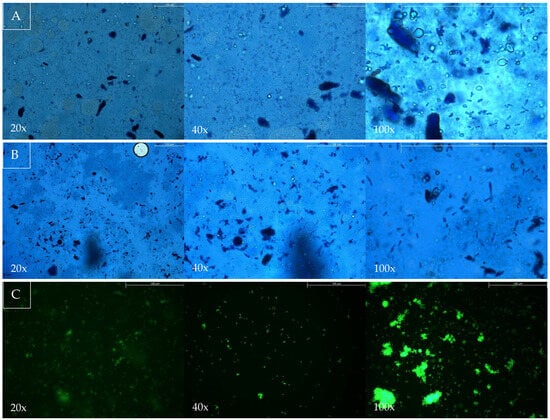
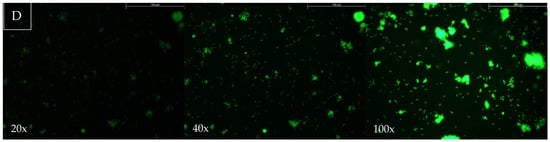
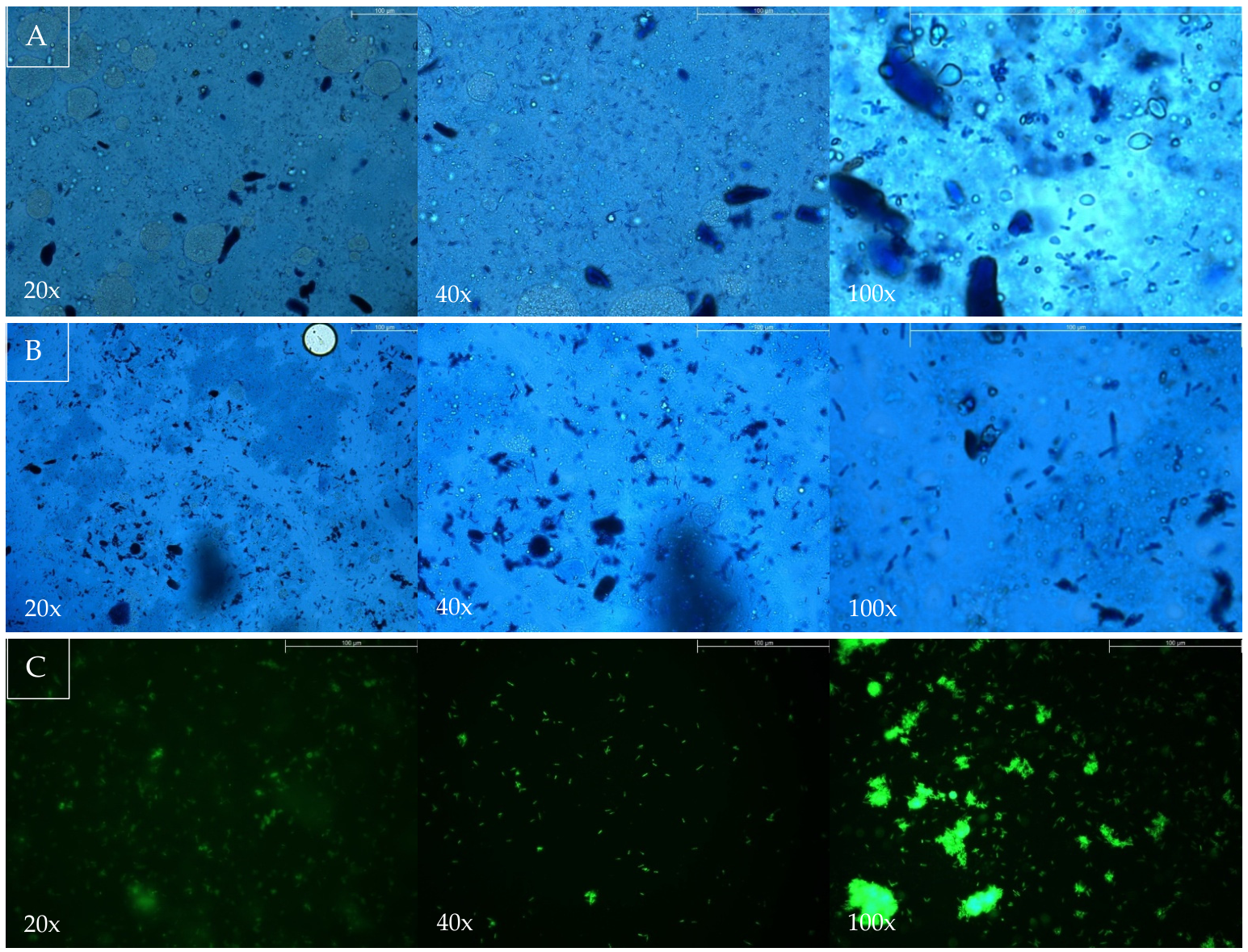
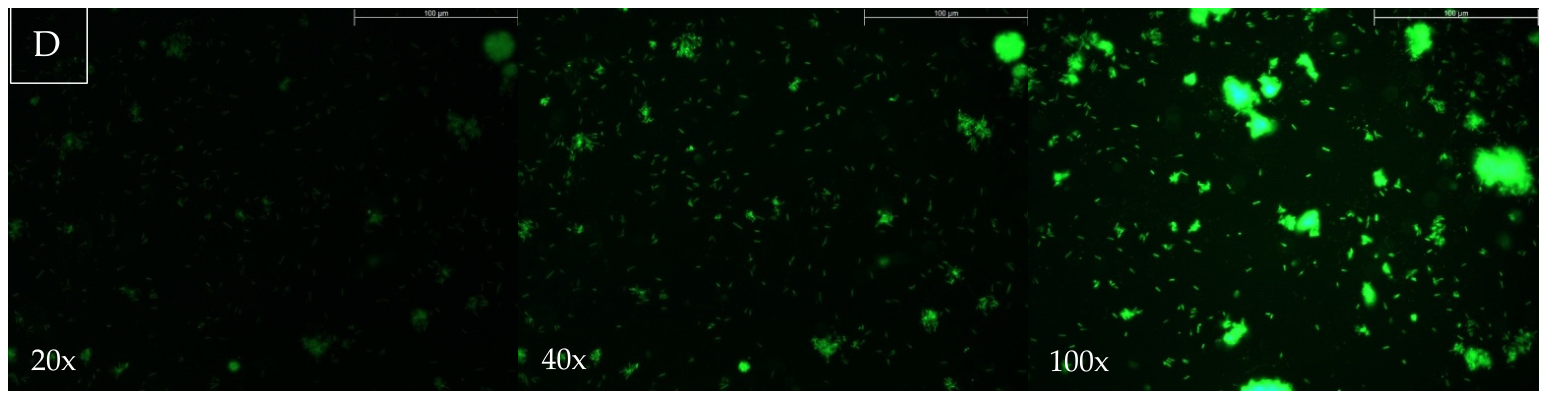
Microscopic analyses of B. coagulans GBI-30 spores in PCF and SCF are shown in Figure 1A,B. B. coagulans GBI-30 spores were identified in PCF and SCF under all objectives (20×, 40×, and 100× magnification). The presence of B. coagulans GBI-30 spores in PCF and SCF was identified using a simple bacterial tracking technique [28], which has not been previously employed for this purpose.
Figure 1.
Optical microscopic observation of the microstructure and stained bacterial/spore-like structures of Bacillus coagulans GBI-30 spores in probiotic cereal flour (A) and synbiotic cereal flour (B), and fluorescence optical microscopic observation of the microstructure and stained bacterial/spore-like structures of Bacillus coagulans GBI-30 spores in probiotic cereal flour (C) and synbiotic cereal flour (D), at 20×, 40×, and 100× objective lenses.
As observed in Figure 1C,D, the fluorescent probe acridine orange successfully intercalated into the minor groove of the spore DNA double helix. It emitted a fluorescence signal with a maximum emission at λ = 530 nm [50]. This indicates that, even when dispersed in a medium containing various organic and inorganic flour compounds, the fluorescent probe effectively tracks the presence of beneficial sporulating probiotic bacteria. This technique is recommended to industry as a rapid, practical method for assessing the presence of bacterial spores in commercial probiotic formulations [51]. Acridine orange is a classic reagent used in health and food studies [52]. However, this is the first report to demonstrate the successful use of such a reagent to track B. coagulans in probiotic and synbiotic cereal flours.
3.3. Viable Cell Counts of B. coagulans GBI-30 Spores in the Cereal Flours During Storage and Exposure to In Vitro Gastrointestinal Digestion
The viable cell counts of B. coagulans GBI-30 spores in undigested PCF and SCF, i.e., before exposure to in vitro gastrointestinal digestion, were above 8 log CFU/g on day 1 and 75 of storage (p > 0.05). On day 150, undigested flours decreased viable cell counts by approximately 1 log CFU/g. These results demonstrated the efficacy of incorporating B. coagulans GBI-30 spores into cereal flours as delivery vehicles [18]. Various studies with B. coagulans spores have successfully maintained high viable cell counts across different food matrices, including baked and dairy products, indicating that the reported health benefits of this bacterium could be exploited in various food matrices [53].
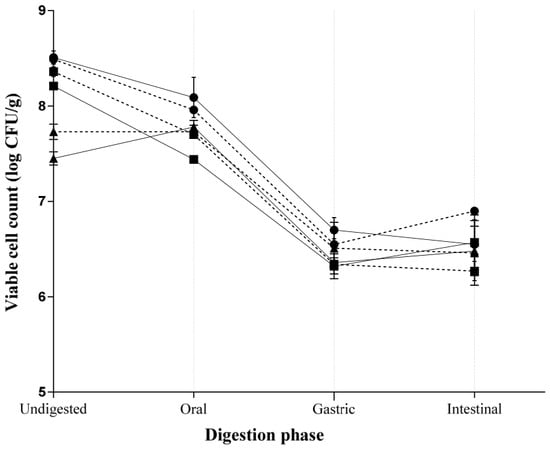
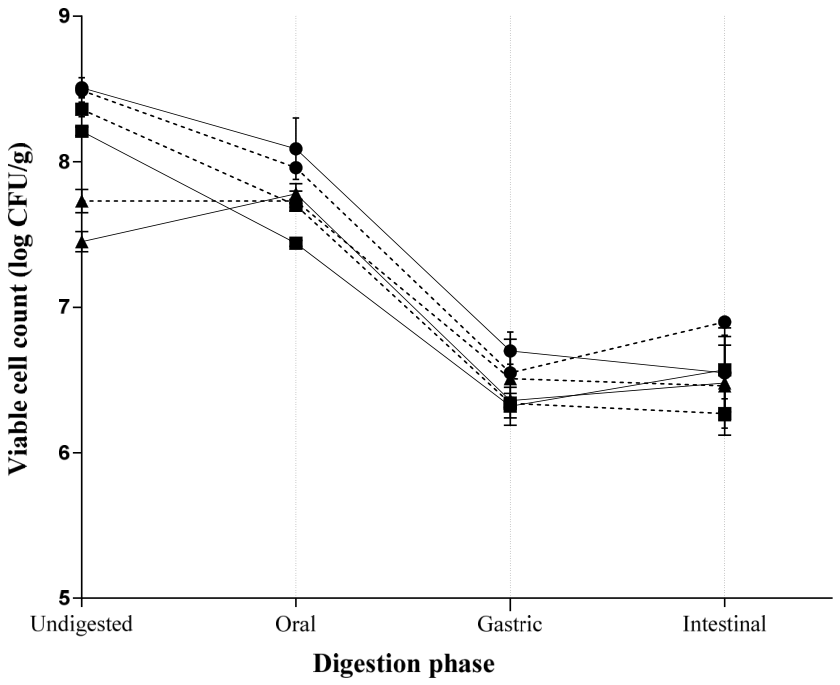
Overall, in vitro gastrointestinal digestion of PCF and SCF reduced B. coagulans GBI-30 spores CFU/g by 2 logs, regardless of storage time (Figure 2). In the mouth phase, the highest viable cell counts of B. coagulans GBI-30 spores were observed on day 1 in PCF (7.96 ± 0.03 log CFU/g) and SCF (8.09 ± 0.21 log CFU/g) (p ≤ 0.05). On days 75 and 150, the flours had viable cell counts of approximately 7 log CFU/g (p ≤ 0.05). Exposure of PCF and SCF to the stomach phase decreased viable cell counts (p ≤ 0.05). The highest viable cell count in the stomach phase was observed in SCF (6.70 ± 0.13 log CFU/g) on day 1, whereas the lowest was observed in SCF (6.32 ± 0.13 log CFU/g) on day 75. Viable cell counts in the intestine phase ranged from 6.90 ± 0.02 log CFU/g in PCF on day 1 to 6.27 ± 0.10 log CFU/g in SCF on day 75 (p ≤ 0.05).
Figure 2.
Viable cell count (log CFU/g; average ± standard deviation; n: 3) of Bacillus coagulans GBI-30 in probiotic cereal flour (PCF;  ) and synbiotic cereal flour (SCF, ─) during 1 (●), 75 (■), and 150 (▲) days of storage and when exposed to in vitro gastrointestinal digestion.
Overall, PCF and SCF had similar viable cell counts for each in vitro gastrointestinal digestion phase at the end of the evaluated storage period (p > 0.05), demonstrating the ability of compounds present in cereal flour (e.g., carbohydrates, total fiber, and protein) to protect B. coagulans GBI-30 spores during storage and exposure to gastrointestinal digestion, regardless of the presence of beta-glucan [54]. Cereal fibers have been found to stimulate the growth of Bacillus spp. probiotic strains [55]. In addition, B. coagulans GBI-30 spores are highly stable across various products, maintaining higher viability than Lactobacillus and Bifidobacterium during storage and under simulated gastrointestinal conditions [16,53,56].
An important quality indicator of probiotic health benefits is the presence of viable probiotic cells, typically at counts of 6 log CFU/mL or g [57]. Upon reaching the small intestine, viable spores can germinate under favorable physiological conditions, including exposure to nutrients, bile salts, and body temperature, giving rise to new vegetative cells, thereby providing health benefits [7,58]. Therefore, although germination is considered a likely mechanism of action in vivo, the present results only demonstrated the maintenance of spore viability throughout the simulated gastrointestinal conditions.
3.4. Effects of Cereal Flours on Selected Intestinal Bacterial Groups During Fecal Fermentation
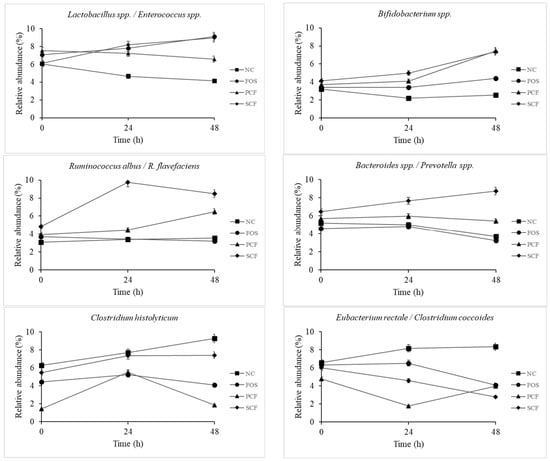
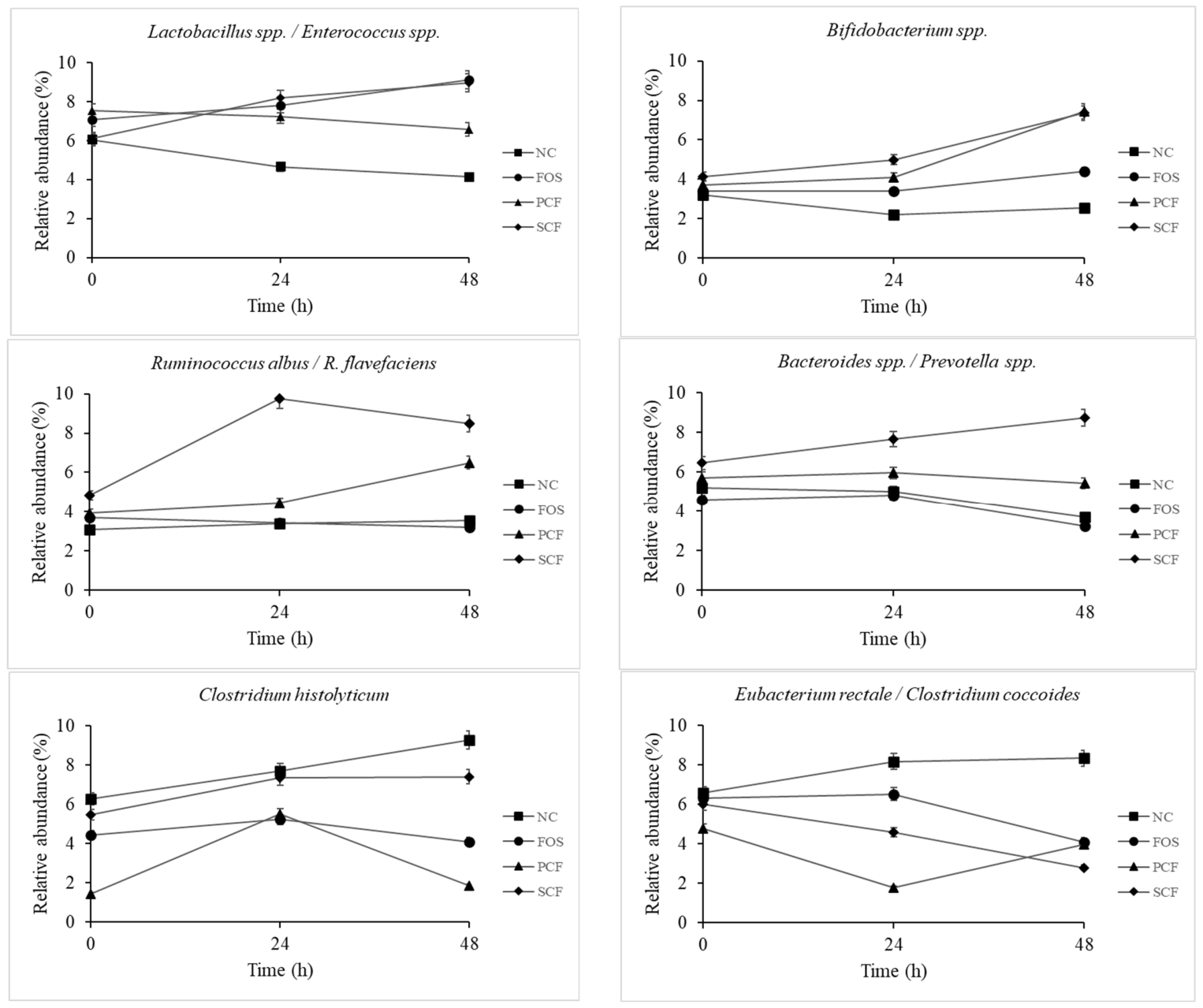
The RA of the various target intestinal bacterial groups (Lactobacillus spp./Enterococcus spp., Bifidobacterium spp., R. albus/R. flavefaciens, Bacteroides spp./Prevotella spp., C. histolyticum, and E. rectale/C. coccoides) in media with PCF, SCF, FOS, and NC during 48 h of in vitro fecal fermentation is shown in Figure 3, as well as in Table S2.
Figure 3.
Relative abundance (%, average ± standard deviation; n = 3) of different bacterial groups in media with probiotic cereal flour (PCF), synbiotic cereal flour (SCF), fructooligosaccharides (FOS), as well as in the negative control (NC, no added fermentable substrate) at 0, 24, and 48 h of in vitro fecal fermentation.
The RA of Lactobacillus spp./Enterococcus spp. increased in media with SCF and FOS during 48 h of fecal fermentation (8.97 ± 0.66% and 9.11 ± 0.15%, p ≤ 0.05). In contrast, the RA of Bifidobacterium spp. increased in media with PCF (from 4.14 ± 0.20 to 7.45 ± 0.25%), with the highest values in media with PCF and SCF (7.45 ± 0.25% and 7.36 ± 0.50%), respectively (p ≤ 0.05). The RA of Lactobacillus spp./Enterococcus spp. and Bifidobacterium spp. in NC decreased during 48 h of fecal fermentation (p ≤ 0.05).
The fermentable carbohydrates present in the tested flours, including resistant starches and soluble and insoluble fibers, could remain undigested and unabsorbed in the human small intestine and eventually reach the colon, where they could become substrates for intestinal microbiota metabolism [59]. Notably, Lactobacillus spp./Enterococcus spp. and Bifidobacterium spp. showed increased growth in media containing PCF and SCF during fecal fermentation, suggesting that unabsorbed nutrients in the colon may facilitate prebiotic effects. These bacterial groups are well recognized as inhabitants of the intestinal environment and are known to promote beneficial functions for human health, including local effects on the large intestine [41].
Enterococcus spp., a diverse group of lactic acid bacteria, have also been shown to provide functional health benefits. Some Enterococcus strains are particularly effective in controlling resistance to multiple pathogens by producing various metabolites, including exopolysaccharides, organic acids, and peptides, as well as enhancing the immune response, reducing cholesterol levels, and producing SCFA [60].
The RA of R. albus/R. flavefaciens increased at 48 h of fecal fermentation in the media with SCF and PCF (p ≤ 0.05), in contrast to the medium with FOS and NC, where the medium with SCF presented the highest value (p ≤ 0.05), followed by the medium with PCF. The RA of Bacteroides spp./Prevotella spp. increased only in the medium with SCF during fecal fermentation (p ≤ 0.05), while it did not change in the other fermentation media (p > 0.05).
The bacterial genera Ruminococcus, Bacteroides, and Prevotella are present in the adult intestinal microbiota and play a crucial role in degrading fiber, starch, and proteins. Additionally, these genera contribute to amino acid metabolism and vitamin synthesis. The genera Ruminococcus and Bacteroides can also break down cellulose and soluble saccharides [61]. This might explain their increased abundance, especially in the medium supplemented with beta-glucan (SCF).
The probiotic B. coagulans GBI-30 could enhance the RA of R. albus/R. flavefaciens during fecal fermentation, as previously reported [62]. Consumption of B. coagulans has been shown to increase populations of specific potentially probiotic microorganisms in the intestine, including Lactobacillus and Bifidobacterium. Additionally, B. coagulans exhibits competitive advantages over opportunistic pathogens, such as vancomycin-resistant Enterococcus, thereby helping maintain intestinal microbiota homeostasis [56]. The increase in the populations of Lactobacillus spp., Bifidobacterium spp., and Ruminococcus spp. plays a role in promoting cellular stability and improving intestinal microbiota composition. This, in turn, alleviates inflammatory symptoms, improves lipid profile, and reduces cardiovascular risk [63].
The RA of C. histolyticum did not change in the FOS medium (p > 0.05) and increased slightly in the SCF medium at 48 h of fecal fermentation (p ≤ 0.05). However, the RA of C. histolyticum decreased drastically in the medium with PCF at 48 h, while it increased in NC, reaching the highest values observed for this group (p ≤ 0.05). The media with PCF and SCF had the lowest RA of C. histolyticum and E. rectale/C. coccoides at 48 h of fecal fermentation (p ≤ 0.05). Dietary fiber in PCF and SCF may be associated with a decreased RA of C. histolyticum and E. rectale/C. coccoides during fecal fermentation [36]. A low RA of C. histolyticum during fecal fermentation could be considered a positive result, indicating the selective stimulatory effects of PCF and SCF on beneficial intestinal bacterial groups, as C. histolyticum is recognized as a potential enteric pathogen [64].
B. coagulans can play a role in establishing an anaerobic and acidic intestinal environment, which can be detrimental to specific pathogens. B. coagulans is a facultative anaerobic bacterium capable of metabolizing free oxygen in the intestine, reducing redox reactions. This metabolic characteristic is advantageous for the growth of anaerobic microorganisms, such as Lactobacillus and Bifidobacterium [55,56].
3.5. Prebiotic Index During Fecal Fermentation
The positive prebiotic index indicates a predominance of beneficial bacteria over pathogenic bacteria during fecal fermentation [65]. The equation predicts that an increase in RA of Lactobacillus spp./Enterococcus spp., Bifidobacterium spp., and/or R. albus/R. flavefaciens during fecal fermentation is considered a positive effect, while an increase in RA of Bacteroides spp./Prevotella spp., C. histolyticum and/or E. rectale/C. coccoides is considered a negative effect. The prebiotic index has become a valuable indicator of the potential prebiotic properties of diverse foods [34]. This could complement the measurements of the RA of the selected intestinal bacterial groups during the fecal fermentation of PCF and SCF (Table 4).
Table 4.
Prebiotic index (average ± standard deviation; n: 3) of probiotic cereal flour (PCF), synbiotic cereal flour (SCF), and fructooligosaccharides (FOS), as well as in negative control (NC, no added fermentable substrate) at 24 and 48 h of in vitro fecal fermentation.
At 24 h of fecal fermentation, the medium with SCF presented a higher prebiotic index, followed by the medium with PCF and FOS (6.20 ± 0.40 versus −0.66 ± 3.98 and −0.73 ± 3.08, respectively; p ≤ 0.05). Furthermore, at 48 h of fecal fermentation, the medium with SCF had the highest prebiotic index (p ≤ 0.05), followed by the media with PCF and FOS (8.73 ± 4.22 versus 5.99 ± 5.18–6.41 ± 2.40, respectively; p ≤ 0.05). In contrast, the NC showed a decrease in the prebiotic index during fecal fermentation (p ≤ 0.05).
The prebiotic index serves as a quantitative screening for the prebiotic effects of a food or bioactive compound [66]. The positive indices observed in 48 h for PCF and SCF are linked to the higher RA of Lactobacillus spp./Enterococcus spp., Bifidobacterium spp., and R. albus/R. flavefaciens, as well as the lower RA of C. histolyticum and E. rectale/C. coccoides. In addition to exhibiting higher prebiotic indices than FOS, used as a positive control, the medium with SCF showed higher prebiotic indices during fecal fermentation, indicating enhanced prebiotic activity from the combination of B. coagulans with beta-glucan as a prebiotic agent [16].
3.6. Microbial Metabolic Activity During Fecal Fermentation
During 48 h of fecal fermentation, sugars (fructose and glucose) were consumed, and organic acids (lactic, acetic, malic, and butyric acids) were produced in media with PCF, SCF, and FOS, resulting in a reduction in pH. At the end of 48 h of fecal fermentation, pH did not differ between media with PCF and FOS (p > 0.05), whereas it was higher in the medium with SCF (p ≤ 0.05). In general, glucose and fructose contents decreased in media with PCF, SCF, and FOS during the 48 h of fecal fermentation (p ≤ 0.05), but no decrease was detected in NC (Table 5). The production of organic acids could promote a hostile environment for the survival of intestinal pathogens [35]. These results agree with the reduction in the RA of C. histolyticum and E. rectale/C. coccoides in media containing PCF, SCF, and FOS during fecal fermentation, as these bacterial groups are highly affected when colonic pH becomes more acidic [34].
Table 5.
pH values, contents of sugars, lactic acid, and short-chain fatty acids (SCFA) (g/L; average ± standard deviation; n: 3) in media with probiotic cereal flour (PCF), synbiotic cereal flour (SCF), fructooligosaccharides (FOS), as well as in negative control (NC, no added fermentable substrate) at 0, 24 and 48 h of in vitro fecal fermentation.
In general, the contents of malic, succinic, lactic, and acetic acids increased up to 48 h of fecal fermentation in the examined media (Table 5). The highest contents of malic and succinic acids were observed in the medium supplemented with SCF. The production of formic, citric, malic, succinic, and lactic acids during fecal fermentation was attributed to the metabolic activity of bacteria in the intestinal microbiota, which ferment plant-derived carbohydrates to generate these organic acids [67,68]. Additionally, formic, succinic, lactic, and pyruvic acids are intermediate metabolites in SCFA synthesis [69].
Lactic acid content increased during fecal fermentation, especially in the media with PCF and SCF, where the highest contents were detected (p ≤ 0.05). The high lactic acid content during fecal fermentation may be linked to the increased RA of Lactobacillus spp./Enterococcus spp., as these bacterial groups are the primary producers of lactic acid in the intestinal environment. At the same time, Bifidobacterium spp. produces lactic acid in smaller quantities [64].
The media with PCF and SCF showed increased SCFA contents, particularly acetic and butyric acids, at 24 and 48 h of fecal fermentation (p ≤0.05). In contrast, propionic acid content did not change in these media (p >0.05). Interestingly, B. coagulans can produce metabolites, including SCFA, during colonic fermentation [62]. B. coagulans has also shown the ability to improve the absorption and bioavailability of nutrients, facilitating the digestive process [69]. Furthermore, these results align with the high RA of Lactobacillus spp./Enterococcus spp., Bifidobacterium spp., and R. albus/R. flavefaciens, which are known to produce SCFA as byproducts of their intestinal metabolism [34,63]. SCFA exert various local and systemic health benefits, including protection of intestinal epithelial cells, enhanced resistance to pathogens, modulation of immune response, and anti-inflammatory effects [70].
3.7. Chemometric Analysis
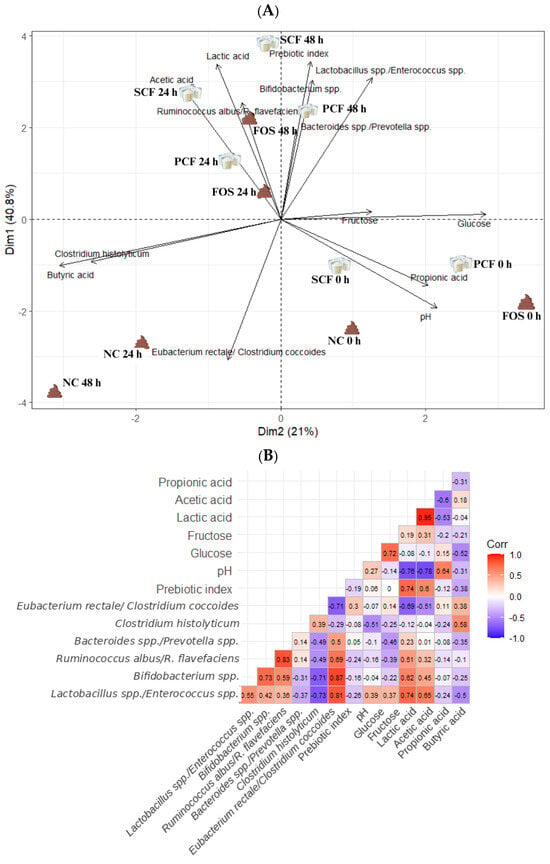
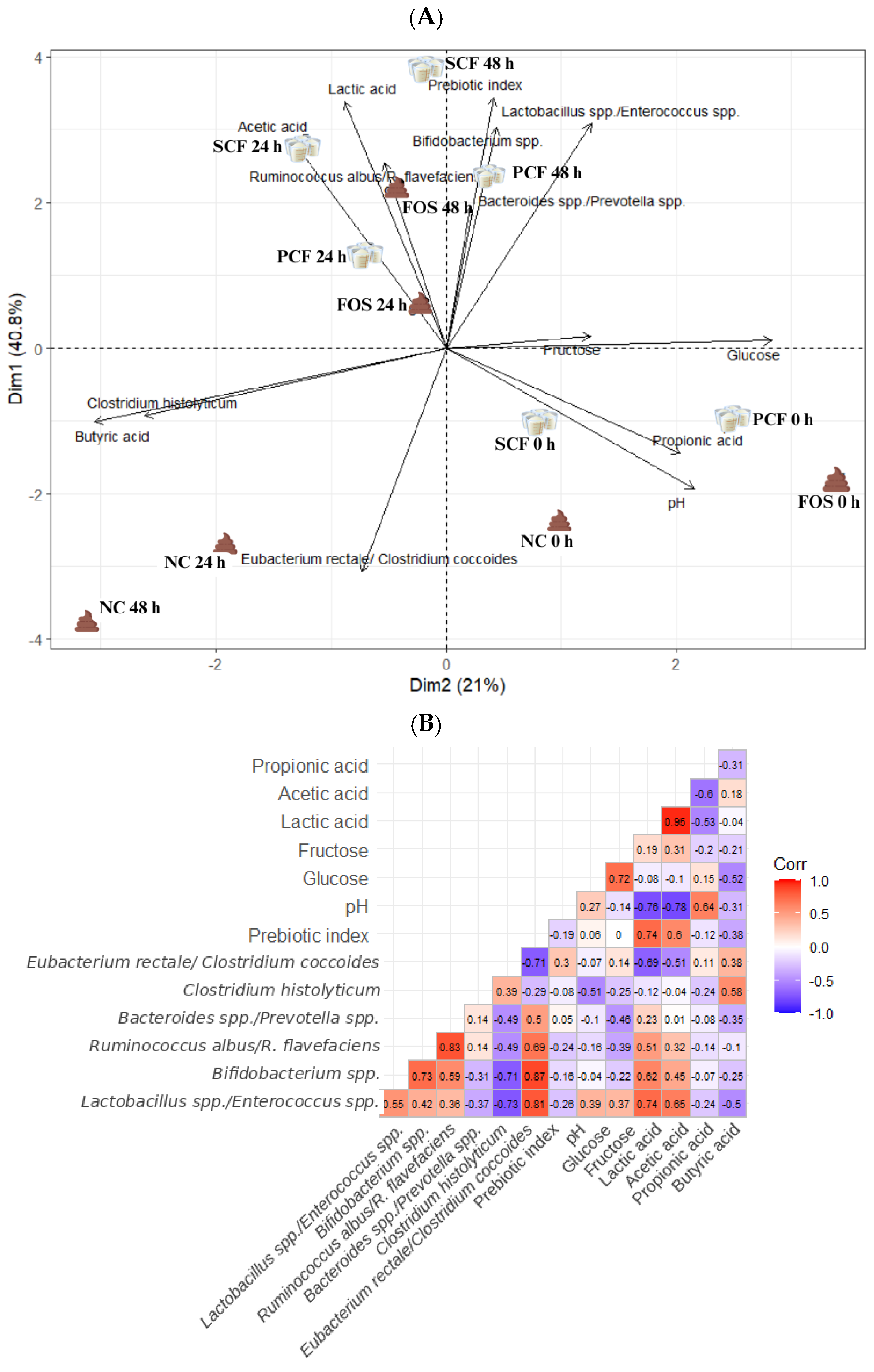
PCA was run to obtain an overview of the results and analyze data dispersion (Figure 4A). It was observed in the PCA analysis (Dim1: 40.8% and Dim2: 21%) that the media with PCF, SCF, and FOS were located in the upper quadrants, along with the variables of most significant interest to direct a prebiotic effect, such as lactic acid and SCFA contents, prebiotic index, and RA of Lactobacillus spp./Enterococcus spp., Bifidobacterium spp., and R. albus/R. flavefaciens. This arrangement indicates that media with PCF and SCF yielded better results, especially the sample with SCF at 48 h of fecal fermentation.
Figure 4.
(A) Principal Component Analysis (PCA) run and (B) Correlation coefficients indicate the associations among the relative abundance of distinct bacterial groups, prebiotic index, contents of sugars and organic acids, and pH values in media with probiotic cereal flour (PCF), synbiotic cereal flour (SCF), fructooligosaccharides (FOS), as well as in negative control (NC, no added fermentable substrate) at 0, 24 and 48 h of in vitro fecal fermentation.
The Pearson correlation test (Figure 4B) revealed that the prebiotic index positively correlated (p < 0.001) with the RA of Lactobacillus spp./Enterococcus spp., Bifidobacterium spp., and R. albus/R. flavefaciens in media with PCF and SCF during fecal fermentation. Additionally, the RA of these bacterial groups was positively correlated (p < 0.001) with succinic, malic, lactic, and acetic acid contents, reinforcing the prebiotic index as a putative indicator of the prebiotic effects exerted by PCF and SCF [34]. The comprehensive analysis of PCA and Pearson correlation results demonstrated that PCF and SCF performed better across multiple variables during fecal fermentation, particularly SCF. These results indicated that PCF and SCF can induce beneficial changes in the composition and metabolic activity of the human intestinal microbiota.
4. Conclusions
The examined cereal flours exhibited characteristics indicative of high nutritional value and physical stability. Probiotic and synbiotic cereal flours consistently maintained high viable cell counts of B. coagulans GBI-30 during in vitro gastrointestinal digestion throughout storage, indicating probiotic tolerance to these conditions. Probiotic and synbiotic cereal flours increased the relative abundance of beneficial intestinal bacterial groups measured during fecal fermentation, while decreasing the relative abundance of intestinal bacterial groups associated with harmful effects on intestinal health. Probiotic and synbiotic cereal flours increased microbial metabolic activity, as evidenced by reduced pH and increased production of several organic acids, particularly short-chain fatty acids. These results were consistent with the positive prebiotic indices at 48 h induced by probiotic and synbiotic cereal flours during fecal fermentation, which were higher than those of fructooligosaccharides, a well-known prebiotic, indicating their potential to favorably alter the composition of the human intestinal microbiota. Interestingly, the flour combining B. coagulans GBI-30 and beta-glucan showed the most promising results during in vitro fecal fermentation, highlighting its potential as a synbiotic cereal flour. The results highlight the potential of incorporating combined B. coagulans GBI-30 with beta-glucan as a strategy for developing novel functional flour formulations that may promote beneficial effects on the intestinal microbiota and systemic health. Further studies, including controlled human intervention trials, are needed to investigate the effects of the examined four formulations in vivo.
Supplementary Materials
The following supporting information can be downloaded at https://www.mdpi.com/article/10.3390/foods15234263/s1, Table S1: List of ingredients used in the formulations of probiotic cereal flour (PCF) and synbiotic cereal flour (SCF) studied; Table S2: Relative abundance (%, average ± standard deviation; n: 3) of different bacterial groups in media with probiotic cereal flour (PCF), synbiotic cereal flour (SCF), fructooligosaccharides (FOS), as well as in negative control (NC, no added fermentable substrate) at 0, 24 and 48 h of in vitro colonic fermentation; Table S3: 16S rRNA oligonucleotide probes and hybridization conditions used in fluorescent in situ hybridization coupled with flow cytometry (FISH-FC) analysis.
Author Contributions
Conceptualization: P.I.F.d.C.C., K.B.S., C.V.B.G. and H.R.C.; data curation: P.I.F.d.C.C., K.B.S., I.S.d.S.S.M., K.S.d.S.L. and H.R.C.; formal analysis: P.I.F.d.C.C., T.M.R.d.A. and K.B.S.; investigation: P.I.F.d.C.C., I.S.d.S.S.M. and K.S.d.S.L.; methodology: P.I.F.d.C.C., T.M.R.d.A., K.B.S., C.V.B.G., E.L.d.S. and H.R.C.; project administration: C.V.B.G., E.L.d.S. and H.R.C.; Supervision: C.V.B.G. and H.R.C.; writing—original draft: P.I.F.d.C.C., T.M.R.d.A., K.B.S., C.V.B.G., E.L.d.S. and H.R.C.; writing—review and editing: T.M.R.d.A., K.B.S., E.L.d.S. and H.R.C. All authors have read and agreed to the published version of the manuscript.
Funding
This research was funded by the Federal University of Paraíba/PRPG/PROPESQ (project number PVM13515-2020). The authors also thank the Paraíba State Research Foundation (FAPESQ) for providing a scholarship to C. V. B. Grisi (grant 2023/3390.18).
Institutional Review Board Statement
The study was conducted in accordance with the Declaration of Helsinki, and approved by the Human Research Ethics Committee of Federal University of Paraíba (protocol code 6.078.164; CAAE: 31347620.0.0000.5188).
Informed Consent Statement
Informed consent was obtained from all subjects involved in the study.
Data Availability Statement
All data is incorporated into the article and its online Supplementary Material.
Acknowledgments
The authors thank São Braz S.A. (João Pessoa, PB, Brazil) for supporting this project by providing production facilities and raw materials to develop the tested cereal flour formulations. The authors thank UFPB for its equipment and facilities for some analyses.
Conflicts of Interest
The authors declare no conflicts of interest.
Abbreviations
The following abbreviations are used in this manuscript:
| AOAC | Association of Official Analytical Chemists |
| CaCl2 | Calcium chloride |
| CCF | Control cereal flour |
| CI | Carr’s index |
| DNA | Deoxyribonucleic acid |
| FC | Flow cytometry |
| FeSO4 | Ferrous sulfate |
| FISH | Fluorescent in situ hybridization |
| FOS | Fructooligosaccharides |
| HR | Hausner ratio |
| KCl | Potassium chloride |
| KH2PO4 | Monopotassium phosphate |
| MgSO4 | Magnesium sulfate |
| NaCl | Sodium chloride |
| NaHCO3 | Sodium bicarbonate |
| NC | Negative control |
| OAC | Oil absorption capacity |
| PCF | Probiotic cereal flour |
| pH | Potential of hydrogen |
| SCF | Synbiotic cereal flour |
| SCFA | Short-chain fatty acids |
| WAC | Water absorption capacity |
References
- Ballini, A.; Charitos, I.A.; Cantore, S.; Topi, S.; Bottalico, L.; Santacroce, L. About Functional Foods: The Probiotics and Prebiotics State of Art. Antibiotics 2023, 12, 635. [Google Scholar] [CrossRef] [Scilit] [PubMed]
- Fernandes, C.G.; Sonawaneb, S.K.; Arya, S.S. Cereal based functional beverages: A review. J. Microbiol. Biotechnol. Food Sci. 2018, 8, 914–919. [Google Scholar] [CrossRef] [Scilit]
- Wang, Q.; Li, L.; Wang, T.; Zheng, X. A review of extrusion-modified underutilized cereal flour: Chemical composition, functionality, and its modulation on starchy food quality. Food Chem. 2022, 370, 131361. [Google Scholar] [CrossRef] [Scilit] [PubMed]
- Vijaya Kumar, B.; Vijayendra, S.V.N.; Reddy, O.V.S. Trends in dairy and non-dairy probiotic products-a review. J. Food Sci. Technol. 2015, 52, 6112–6124. [Google Scholar] [CrossRef] [Scilit] [PubMed]
- Hill, C.; Guarner, F.; Reid, G.; Gibson, G.R.; Merenstein, D.J.; Pot, B.; Morelli, L.; Canani, R.B.; Flint, H.J.; Salminen, S.; et al. The International Scientific Association for Probiotics and Prebiotics consensus statement on the scope and appropriate use of the term probiotic. Nat. Rev. Gastroenterol. Hepatol. 2014, 11, 506–514. [Google Scholar] [CrossRef] [Scilit] [PubMed]
- da Silva, M.N.; Tagliapietra, B.L.; do Amaral Flores, V.; Richards, N.S. In vitro test to evaluate survival in the gastrointestinal tract of commercial probiotics. Curr. Res. Food Sci. 2021, 4, 320–325. [Google Scholar] [CrossRef] [Scilit] [PubMed]
- Keller, D.; Van Dinter, R.; Cash, H.; Farmer, S.; Venema, K. Bacillus coagulans GBI-30, 6086 increases plant protein digestion in a dynamic, computer-controlled in vitro model of the small intestine (TIM-1). Benef. Microbes 2017, 8, 491–496. [Google Scholar] [CrossRef] [Scilit] [PubMed]
- Gang, H.; Wei, J.; McFarland, L.V.; Zahra, R.; Saez, M.E.; Blanco-Rojo, R.; Millette, M. Impact of Heyndrickxia (Bacillus) coagulans GBI-30, 6086 (BC30) probiotic on gastrointestinal function in healthy adults: A randomised controlled trial. Benef. Microbes 2025, 17, 29–46. [Google Scholar] [CrossRef] [Scilit] [PubMed]
- Cao, J.; Yu, L.; Zhao, J.; Zhang, H.; Chen, W.; Xue, Y.; Zhai, Q. Alleviative effects of Bacillus coagulans strains on IBS-unraveling strain specificity through physiological and genomic analysis. Food Sci. Hum. Wellness 2024, 13, 1845–1855. [Google Scholar] [CrossRef] [Scilit]
- Aleman, R.S.; Yadav, A. Systematic review of probiotics and their potential for developing functional nondairy foods. Appl. Microbiol. 2023, 4, 47–69. [Google Scholar] [CrossRef] [Scilit]
- Gibson, G.R.; Hutkins, R.; Sanders, M.E.; Prescott, S.L.; Reimer, R.A.; Salminen, S.J.; Scott, K.; Stanton, C.; Swanson, K.S.; Cani, P.D.; et al. Expert consensus document: The International Scientific Association for Probiotics and Prebiotics (ISAPP) consensus statement on the definition and scope of prebiotics. Nat. Rev. Gastroenterol. Hepatol. 2017, 14, 491–502. [Google Scholar] [CrossRef] [Scilit] [PubMed]
- Swanson, K.S.; Gibson, G.R.; Hutkins, R.; Reimer, R.A.; Reid, G.; Verbeke, K.; Scott, K.P.; Holscher, H.D.; Azad, M.B.; Delzenne, N.M.; et al. The International Scientific Association for Probiotics and Prebiotics (ISAPP) consensus statement on the definition and scope of synbiotics. Nat. Rev. Gastroenterol. Hepatol. 2020, 17, 687–701. [Google Scholar] [CrossRef] [Scilit] [PubMed]
- Rezende, E.S.V.; Lima, G.C.; Naves, M.M.V. Dietary fibers as beneficial microbiota modulators: A proposed classification by prebiotic categories. Nutrition 2021, 89, 111217. [Google Scholar] [CrossRef] [Scilit] [PubMed]
- Wang, H.; Chen, G.; Li, X.; Zheng, F.; Zeng, X. Yeast β-glucan, a potential prebiotic, showed a similar probiotic activity to inulin. Food Funct. 2020, 11, 10386–10396. [Google Scholar] [CrossRef] [Scilit] [PubMed]
- Shoukat, M.; Sorrentino, A. Cereal β-glucan: A promising prebiotic polysaccharide and its impact on the gut health. Int. J. Food Sci. Technol. 2021, 56, 2088–2097. [Google Scholar] [CrossRef] [Scilit]
- Soares, M.B.; Martinez, R.C.; Pereira, E.P.; Balthazar, C.F.; Cruz, A.G.; Ranadheera, C.S.; Sant’Ana, A.S. The resistance of Bacillus, Bifidobacterium, and Lactobacillus strains with claimed probiotic properties in different food matrices exposed to simulated gastrointestinal tract conditions. Food Res. Int. 2019, 125, 108542. [Google Scholar] [CrossRef] [Scilit] [PubMed]
- Mäkelä, N.; Rosa-Sibakov, N.; Wang, Y.J.; Mattila, O.; Nordlund, E.; Sontag-Strohm, T. Role of β-glucan content, molecular weight and phytate in the bile acid binding of oat β-glucan. Food Chem. 2021, 358, 129917. [Google Scholar] [CrossRef] [Scilit] [PubMed]
- da Costa Cardoso, P.I.F.; Grisi, C.V.B.; de Andrade Vieira, É.; de Almeida, D.K.L.; Cardarelli, H.R. Cereal flours with Bacillus coagulans and beta-glucan: Technological properties and sensory acceptability. Food Chem. 2024, 448, 139146. [Google Scholar] [CrossRef] [Scilit] [PubMed]
- Association of Official Analytical Chemists—AOAC. Official Methods of Analysis of the AOAC International, 21st ed.; AOAC: Washington, DC, USA, 2019. [Google Scholar]
- Achor, M.; Oyeniyi, J.Y.; Musa, M.; Gwarzo, M.S. Physicochemical properties of cassava starch retrograded in alcohol. J. App. Pharm. Sci. 2015, 5, 126–131. [Google Scholar] [CrossRef] [Scilit]
- Pragati, S.; Genitha, I.; Ravish, K. Comparative study of ripe and unripe banana flour during storage. J. Appl. Pharm. Sci. 2014, 5, 1–6. [Google Scholar]
- Hausner, H.H. Friction conditions in a mass of metal powder. Int. J. Powder Metall. 1967, 3, 7–13. [Google Scholar]
- Jinapong, N.; Suphantharika, M.; Jamnong, P. Production of instant soymilk powders by ultrafiltration, spray drying and fluidized bed agglomeration. J. Food Eng. 2008, 84, 194–205. [Google Scholar] [CrossRef] [Scilit]
- Caparino, O.A.; Tang, J.; Nindo, C.I.; Sablani, S.S.; Powers, J.R.; Fellman, J.K. Effect of drying methods on the physical properties and microstructures of mango (Philippine ‘Carabao’var.) powder. J. Food Eng. 2012, 111, 135–148. [Google Scholar] [CrossRef] [Scilit]
- Dacanal, G.C.; Menegalli, F.C. Experimental study and optimization of the agglomeration of acerola powder in a conical fluid bed. Powder Technol. 2009, 188, 187–194. [Google Scholar] [CrossRef] [Scilit]
- Drakos, A.; Kyriakakis, G.; Evageliou, V.; Protonotariou, S.; Mandala, I.; Ritzoulis, C. Influence of jet milling and particle size on the composition, physicochemical and mechanical properties of barley and rye flours. Food Chem. 2017, 215, 326–332. [Google Scholar] [CrossRef] [Scilit] [PubMed]
- Biermann, R.; Niemeyer, L.; Rösner, L.; Ude, C.; Lindner, P.; Bice, I.; Beutel, S. Facilitated endospore detection for Bacillus spp. through automated algorithm-based image processing. Eng. Life Sci. 2022, 22, 299–307. [Google Scholar] [CrossRef] [Scilit] [PubMed]
- Schichnes, D.; Nemson, J.A.; Ruzin, S.E. Fluorescent staining method for bacterial endospores. Microscope 2006, 54, 91. [Google Scholar]
- Minékus, M.; Alminger, M.; Alvito, P.; Ballance, S.; Bohn, T.O.R.S.T.E.N.; Bourlieu, C.; Carrière, F.; Boutrou, R.; Corredig, M.; Dupont, D.; et al. A standardised static in vitro digestion method suitable for food—An international consensus. Food Funct. 2014, 5, 1113–1124. [Google Scholar] [CrossRef] [Scilit] [PubMed]
- Miranda, J.S.; Costa, B.V.; de Oliveira, I.V.; de Lima, D.C.N.; Martins, E.M.F.; Leite Júnior, B.R.D.C.; Benevenuto, W.C.A.D.N.; de Queiroz, I.C.; da Silva, R.R.; Martins, M.L. Probiotic jelly candies enriched with native Atlantic Forest fruits and Bacillus coagulans GBI-30 6086. LWT 2020, 126, 109275. [Google Scholar] [CrossRef] [Scilit]
- Sampaio, K.B.; Nascimento, D.S.; Garcia, E.F.; de Souza, E.L. An outlook on fluorescent in situ hybridization coupled to flow cytometry as a versatile technique to evaluate the effects of foods and dietary interventions on gut microbiota. Arch. Microbiol. 2022, 204, 469. [Google Scholar] [CrossRef] [Scilit] [PubMed]
- Silva, G.S.; Moreira, F.I.N.; de Albuquerque, T.M.R.; Abreu, T.L.; de Souza, E.G.T.; da Silva, L.R.; Marques, A.D.J.d.F.; Galvão, M.d.S.; Lima, M.d.S.; de Souza, E.L.; et al. Microencapsulated phenolic compounds from organic coffee husk: Impacts on human gut microbiota and in vitro prebiotic potential. Food Res. Int. 2025, 201, 115597. [Google Scholar] [CrossRef] [Scilit] [PubMed]
- Rodrigues, D.; Walton, G.; Sousa, S.; Rocha-Santos, T.A.P.; Duarte, A.C.; Freitas, A.C.; Gomes, A.M.P. In vitro fermentation and prebiotic potential of selected extracts from seaweeds and mushrooms. LWT 2016, 73, 131–139. [Google Scholar] [CrossRef] [Scilit]
- de Albuquerque, T.M.R.; Magnani, M.; Lima, M.D.S.; Castellano, L.R.C.; de Souza, E.L. Effects of digested flours from four different sweet potato (Ipomoea batatas L.) root varieties on the composition and metabolic activity of human colonic microbiota in vitro. J. Food Sci. 2021, 86, 3707–3719. [Google Scholar] [CrossRef] [Scilit] [PubMed]
- Menezes, F.N.D.D.; Almeida, E.T.C.; Vieira, A.R.S.V.; Aquino, J.S.; Lima, M.S.; Magnani, M.; de Souza, E.L. Impact of cashew (Anacardium occidentale L.) by-product on composition and metabolic activity of human colonic microbiota in vitro indicates prebiotic properties. Curr. Microbiol. 2021, 78, 2264–2274. [Google Scholar] [CrossRef] [Scilit] [PubMed]
- Massa, N.M.L.; de Oliveira, S.P.A.; Rodrigues, N.P.A.; Menezes, F.N.D.D.; Santos Lima, M.S.; Magnani, M.; de Souza, E.L. In vitro colonic fermentation and potential prebiotic properties of pre-digested jabuticaba (Myrciaria jaboticaba (Vell.) Berg) by-products. Food Chem. 2022, 388, 133003. [Google Scholar] [CrossRef] [Scilit] [PubMed]
- Andrade, G.M.; Souza, E.L.; Zárate-Salazar, J.R.; Oliveira, J.N.D.; Tavares, J.F.; dos Santos Lima, M.; de Medeiros, R.L.; de Albuquerque, T.M.R.; Pereira, F.D.O. Unveiling the potential prebiotic effects of edible mushroom Pleurotus djamor during in vitro colonic fermentation. J. Agric. Food Chem. 2024, 72, 26722–26732. [Google Scholar] [CrossRef] [Scilit] [PubMed]
- Ng, J.; Brownlee, I.A. The effect of high β-glucan flour incorporation into instant rice porridge on satiety and energy intake. Bioact. Carbohydr. Diet. Fibre 2017, 11, 60–66. [Google Scholar] [CrossRef] [Scilit]
- Grisi, C.V.B.; de Magalhães Cordeiro, A.M.T.; de Carvalho Ferreira, A.S.; Vieira, A.F.; Rocha, A.P.T.; de Araújo, G.T. Nutritional, anti-nutritional and technological functionality of flour from Libidibia ferrea. Rev. Principia 2021, 53, 206–217. [Google Scholar] [CrossRef] [Scilit]
- Nayik, G.A.; Tufail, T.; Anjum, F.M.; Ansari, M.J. (Eds.) Cereal Grains: Composition, Nutritional Attributes, and Potential Applications; CRC Press: Boca Raton, FL, USA, 2023. [Google Scholar]
- de Albuquerque, T.M.R.; Borges, C.W.P.; Cavalcanti, M.T.; Lima, M.S.; Magnani, M.; de Souza, E.L. Potential prebiotic properties of flours from different varieties of sweet potato (Ipomoea batatas L.) roots cultivated in Northeastern Brazil. Food Biosci. 2020, 36, 100614. [Google Scholar] [CrossRef] [Scilit]
- Li, X.; Zhang, Y.; Wang, L.; Chen, H.; Liu, Q. Study on the effect of sorghum flour particle size on the storage quality of leavened pancakes. Foods 2024, 13, 1890. [Google Scholar] [CrossRef] [Scilit] [PubMed]
- Ukom, A.N.; Adiegwu, E.C.; Ojimelukwe, P.C.; Okwunodulu, I.N. Quality and sensory acceptability of yellow maize ogi porridge enriched with orange-fleshed sweet potato and African yam bean seed flours for infants. Sci. Afr. 2019, 6, e00194. [Google Scholar] [CrossRef] [Scilit]
- El Halal, S.L.M.; Kringel, D.H.; Zavareze, E.D.R.; Dias, A.R.G. Methods for extracting cereal starches from different sources: A review. Starch 2019, 71, 1900128. [Google Scholar] [CrossRef] [Scilit]
- de Melo, A.M.; Barbi, R.C.T.; Costa, B.P.; Ikeda, M.; Carpiné, D.; Ribani, R.H. Valorization of the agro-industrial by-products of bacupari (Garcinia brasiliensis (Mart.)) through production of flour with bioactive properties. Food Biosc. 2022, 45, 101343. [Google Scholar] [CrossRef] [Scilit]
- Kömürcü, T.C.; Bilgiçli, N. Effect of ancient wheat flours and fermentation types on tarhana properties. Food Biosc. 2022, 50, 101982. [Google Scholar] [CrossRef] [Scilit]
- Jiang, C.; Lin, S.; Yang, Y.; Yang, X.; Yang, Y.; Tang, Y. Enhancing acceptability of Chinese steamed bread through corn and oats blending: Formulation, physical, and sensory properties. Food Chem. Adv. 2024, 4, 100635. [Google Scholar] [CrossRef] [Scilit]
- Reyniers, S.; De Brier, N.; Matthijs, S.; Brijs, K.; Delcour, J.A. Impact of mineral ions on the release of starch and gel forming capacity of potato flakes in relation to water dynamics and oil uptake during the production of snacks made thereof. Food Res. Int. 2019, 122, 419–431. [Google Scholar] [CrossRef] [Scilit] [PubMed]
- Tharise, N.; Julianti, E.; Nurminah, M. Evaluation of physico-chemical and functional properties of composite flour from cassava, rice, potato, soybean and xanthan gum as alternative of wheat flour. Int. Food Res. J. 2014, 21, 1641–1649. [Google Scholar]
- Bag, S.; Hasan, M.I.; Halder, D.; Ghosh, A. Biosorption of organic dye Acridine orange from aqueous solution using dry biomass of Bacillus cereus M116. Arch. Microbiol. 2021, 203, 3811–3823. [Google Scholar] [CrossRef] [Scilit] [PubMed]
- Pithva, S.P.; Dave, J.M.; Vyas, B.R.M. Binding of acridine orange by probiotic Lactobacillus rhamnosus strains of human origin. Ann. Microbiol. 2015, 65, 1373–1379. [Google Scholar] [CrossRef] [Scilit]
- Gan, Z.; Zhang, Y.; Gao, W.; Wang, S.; Liu, Y.; Xiao, Y.; Zhuang, X.; Sun, A.; Wang, R. Effects of nonthermal plasma-activated water on the microbial sterilization and storage quality of blueberry. Food Biosci. 2022, 49, 101857. [Google Scholar] [CrossRef] [Scilit]
- Almada-Érix, C.N.; Almada, C.N.; Pedrosa, G.T.S.; Biachi, J.P.; Bonatto, M.S.; Schmiele, M.; Nabeshima, E.H.; Clerici, M.T.P.; Magnani, M.; Sant’ANa, A.S. Bread as probiotic carriers: Resistance of Bacillus coagulans GBI-30 6086 spores through processing steps. Food Res. Int. 2022, 155, 111040. [Google Scholar] [CrossRef] [Scilit] [PubMed]
- Costantini, A.; Da Ros, A.; Nikoloudaki, O.; Montemurro, M.; Di Cagno, R.; Genot, B.; Gobbetti, M.; Rizzello, C.G. How cereal flours, starters, enzymes, and process parameters affect the in vitro digestibility of sourdough bread. Food Res. Int. 2022, 159, 111614. [Google Scholar] [CrossRef] [Scilit] [PubMed]
- Koj, K.; Pejcz, E. Rye dietary fiber components upon the influence of fermentation inoculated with probiotic microorganisms. Molecules 2023, 28, 1910. [Google Scholar] [CrossRef] [Scilit] [PubMed]
- Cao, J.; Yu, Z.; Liu, W.; Zhao, J.; Zhang, H.; Zhai, Q.; Chen, W. Probiotic characteristics of Bacillus coagulans and associated implications for human health and diseases. J. Funct. Foods 2020, 64, 103643. [Google Scholar] [CrossRef] [Scilit]
- Žuntar, I.; Petric, Z.; Bursać Kovačević, D.; Putnik, P. Safety of probiotics: Functional fruit beverages and nutraceuticals. Foods 2020, 9, 947. [Google Scholar] [CrossRef] [Scilit] [PubMed]
- Jäger, R.; Purpura, M.; Farmer, S.; Cash, H.A.; Keller, D. Probiotic Bacillus coagulans GBI-30, 6086 improves protein absorption and utilization. Probiotics Antimicrob. Proteins 2018, 10, 611–615. [Google Scholar] [CrossRef] [Scilit] [PubMed]
- Soong, Y.Y.; Tan, S.P.; Leong, L.P.; Henry, J.K. Total antioxidant capacity and starch digestibility of muffins baked with rice, wheat, oat, corn and barley flour. Food Chem. 2014, 164, 462–469. [Google Scholar] [CrossRef] [Scilit] [PubMed]
- Kavitake, D.; Tiwari, S.; Shah, I.A.; Devi, P.B.; Delattre, C.; Reddy, G.B.; Shetty, P.H. Antipathogenic potentials of exopolysaccharides produced by lactic acid bacteria and their food and health applications. Food Control 2023, 152, 109850. [Google Scholar] [CrossRef] [Scilit]
- Wang, X.; Gibson, G.R.; Sailer, M.; Theis, S.; Rastall, R.A. Prebiotics inhibit proteolysis by gut bacteria in a host diet-dependent manner: A three-stage continuous in vitro gut model experiment. Appl. Environ. Microbiol. 2020, 86, e02730–e02819. [Google Scholar] [CrossRef] [Scilit] [PubMed]
- Majeed, M.; Nagabhushanam, K.; Mundkur, L.; Paulose, S.; Divakar, H.; Rao, S.; Arumugam, S. Probiotic modulation of gut microbiota by Bacillus coagulans MTCC 5856 in healthy subjects: A randomized, double-blind, placebo-control study. Medicine 2023, 102, e33751. [Google Scholar] [CrossRef] [Scilit] [PubMed]
- Zhao, X.; Zhong, X.; Liu, X.; Wang, X.; Gao, X. Therapeutic and improving function of lactobacilli in the prevention and treatment of cardiovascular-related diseases: A novel perspective from gut microbiota. Front. Nutr. 2021, 8, 693412. [Google Scholar] [CrossRef] [Scilit] [PubMed]
- Liu, C.; Kolida, S.; Charalampopoulos, D.; Rastall, R.A. An evaluation of the prebiotic potential of microbial levans from Erwinia sp. 10119. J. Funct. Foods 2020, 64, 103668. [Google Scholar] [CrossRef] [Scilit]
- de Medeiros, V.P.B.; de Souza, E.L.; de Albuquerque, T.M.R.; da Costa Sassi, C.F.; Lima, M.S.; Sivieri, K.; Pimentel, T.C.; Magnani, M. Freshwater microalgae biomasses exert a prebiotic effect on human colonic microbiota. Algal Res. 2021, 60, 102547. [Google Scholar] [CrossRef] [Scilit]
- Owolabi, I.O.; Dat-arun, P.; Yupanqui, C.T.; Wichienchot, S. Gut microbiota metabolism of functional carbohydrates and phenolic compounds from soaked and germinated purple rice. J. Funct. Foods 2020, 66, 103787. [Google Scholar] [CrossRef] [Scilit]
- Dessie, W.; Xin, F.; Zhang, W.; Jiang, Y.; Wu, H.; Ma, J.; Jiang, M. Opportunities, challenges, and future perspectives of succinic acid production by Actinobacillus succinogenes. Appl. Microbiol. Biotechnol. 2018, 102, 9893–9910. [Google Scholar] [CrossRef] [Scilit] [PubMed]
- Yang, Y.; Zhang, Y.; Xu, Y.; Luo, T.; Ge, Y.; Jiang, Y.; Xi, Y.; Sun, J.; Le, G. Dietary methionine restriction improves the gut microbiota and reduces intestinal permeability and inflammation in high-fat-fed mice. Food Funct. 2019, 10, 5952–5968. [Google Scholar] [CrossRef] [Scilit] [PubMed]
- Maathuis, A.; Keller, D.; Farmer, S. Survival and metabolic activity of the GanedenBC30 strain of Bacillus coagulans in a dynamic in vitro model of the stomach and small intestine. Benef. Microbes 2010, 1, 31–36. [Google Scholar] [CrossRef] [Scilit] [PubMed]
- Chengxiao, Y.; Dongmei, W.; Kai, Z.; Hou, L.; Xiao, H.; Ding, T.; Liu, D.; Ye, X.; Linhardt, R.J.; Chen, S. Challenges of pectic polysaccharides as a prebiotic from the perspective of fermentation characteristics and anti-colitis activity. Carbohydr. Polym. 2021, 270, 118377. [Google Scholar] [CrossRef] [Scilit] [PubMed]

Disclaimer/Publisher’s Note: The statements, opinions and data contained in all publications are solely those of the individual author(s) and contributor(s) and not of MDPI and/or the editor(s). MDPI and/or the editor(s) disclaim responsibility for any injury to people or property resulting from any ideas, methods, instructions or products referred to in the content. |
© 2026 by the authors. Licensee MDPI, Basel, Switzerland. This article is an open access article distributed under the terms and conditions of the Creative Commons Attribution (CC BY) license.