


Abstract
The human health effects of barley are considered to arise mainly from its undigested carbohydrates, yet how its grain composition translates to physiological effects is not fully understood. Most studies focus on total dietary fibre content rather than on how carbohydrates are arranged within the grain, leaving open questions about how barley grain structure may influence fermentation within the colon. The organisation of cell walls, starch granules, and the surrounding non-starch polysaccharides decides what escapes digestion in the gastrointestinal tract and is therefore accessible to gut microbes during colonic fermentation. This narrative review explores how barley grain morphology may influence the onset, duration, and location of gut fermentation, and how this may affect metabolic pathways. Therefore, we propose hypotheses linking processing formats to fermentation patterns and host signalling, aiming to address clear gaps in our understanding of this area. Closing these gaps could enable processing strategies that modulate colonic fermentation dynamics and target specific colonic responses.
1. Introduction
Consumption of barley (Hordeum vulgare) is often associated with health benefits in humans, such as improved cardiovascular health [1], but the mechanisms underlying these effects are not entirely clear. Most studies have examined barley’s non-starch polysaccharides (NSPs), especially β-glucans, and their roles in glucose homeostasis, gastrointestinal signalling of satiety hormones, and changes in the gut microbiota [2,3]. Studies show that the viscosity and amount of β-glucan are key factors in postprandial glucose and fermentation outcomes [4]. However, most work has focused on isolated or dissolved fibre, and not on how the grain’s morphology might affect whether β-glucan is trapped inside cell walls or easily available. Barley’s structure can be described at three levels: the grain’s layers, the cell wall matrix, and the molecular makeup of its polysaccharides. Differences at each of these levels could influence where and when fermentation may happen in the colon, regardless of the total dietary fibre content of barley [5,6].
The duration and timing of short-chain fatty acid (SCFA) exposure are particularly important because these chemicals affect gut hormones and neural pathways involved in appetite and energy balance [7]. Previous reviews have examined how food structure, particularly that of wheat and highland barley, affects microbial use of carbohydrates [8,9,10], have described SCFA production pathways and how they interact with host receptors, and have linked their production to disease [11]. In addition, a recent framework proposes that both the timing of fermentation and the gut transit rate may influence where fermentation occurs along the colon and may therefore affect host physiology [6,12,13]. This is an exciting concept, but to date, researchers have used isolated fibres and have not focused on grain morphology or its effects on gut hormones and host signalling.
2. Search Strategy
We carried out a narrative review of the literature using PubMed, Scopus, and Google Scholar. We grouped search items into three main themes based on the review’s conceptual pathway: 1. Barley structure and the impact of processing (i.e., barley β-glucan, resistant starch (RS), grain morphology, cell wall encapsulation, milling, gelatinisation); 2. Microbial fermentation (i.e., gut microbiota, colonic fermentation, SCFAs, cross-feeding, fermentation kinetics, colonic transit time); and 3. Host signalling (i.e., GLP-1, PYY, INSL5, enteroendocrine cells, L-cells, FFAR2, FFAR3, satiety, appetite regulation). We used Boolean operators to combine terms from these groups. For example (“barley” OR “β-glucan” OR “resistant starch”) AND (“colonic fermentation” OR “SCFA”) AND (“GLP-1” OR “enteroendocrine”).
We focused on peer-reviewed primary research articles and systematic reviews published between 2010 and March 2026. We also included earlier foundational work if it offered important mechanistic insights not found in more recent studies. This review covers human intervention trials, animal models, and in vitro fermentation studies to inform mechanistic frameworks. We focused on whole-grain and minimally processed grain matrices, using barley as the main model.
We excluded studies that used isolated or synthetic fibres in the structural and processing sections but retained mechanistic studies using purified substrates when they provided evidence of microbial utilisation pathways. We also excluded studies not published in English. Since the studies employed various experimental models and barley preparations, a formal meta-analysis was not possible. Instead, we used a narrative synthesis to combine mechanistic evidence from structural, microbiological, and physiological research, highlighting knowledge gaps that informed the testable hypotheses in Section 8.
3. Barley Grain Structure: Fermentable Substrates
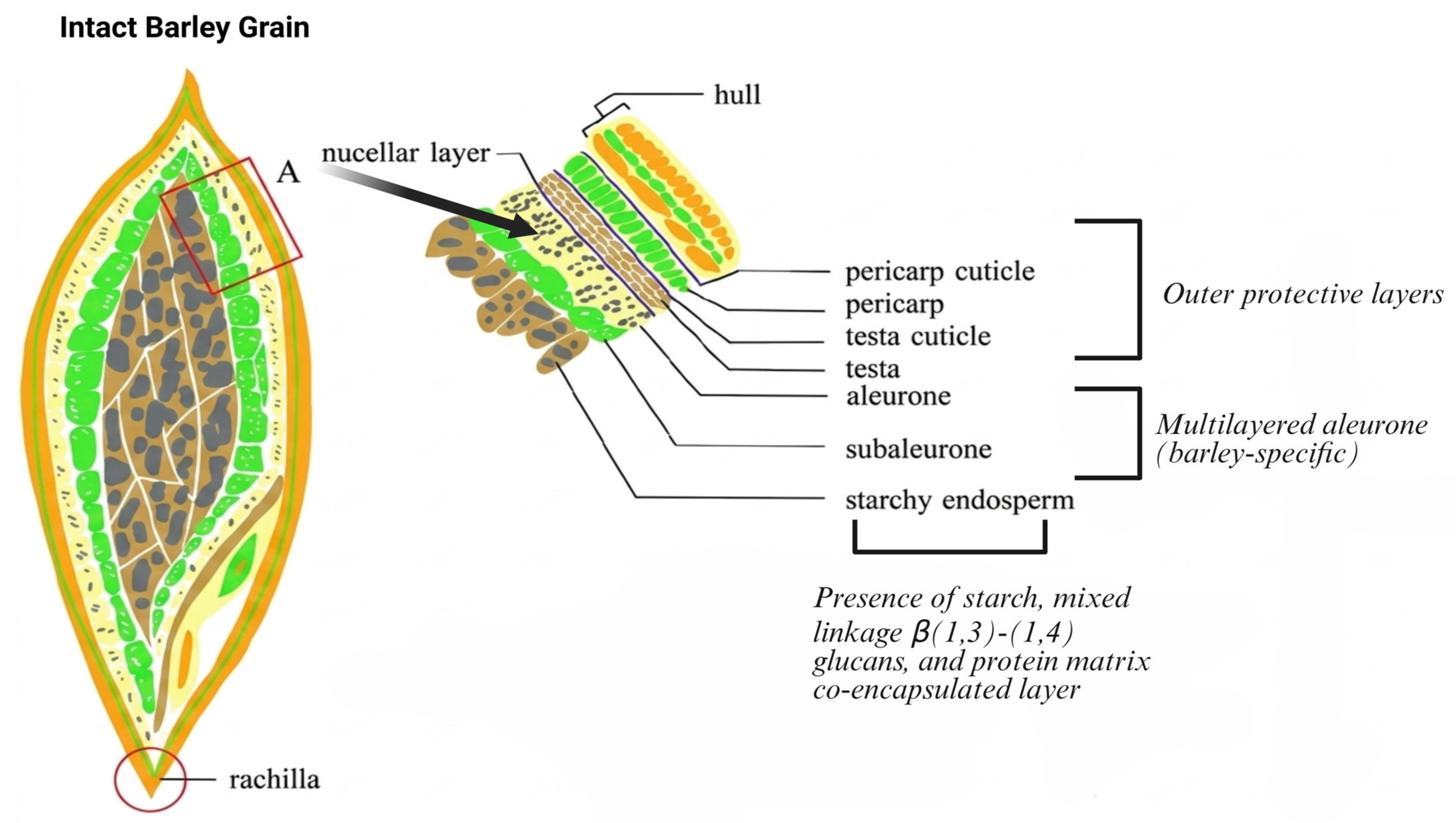
Barley is a useful model for studying how different levels of structure (Figure 1) affect carbohydrate accessibility in grains and when they become available for microbial fermentation in the colon. The starchy endosperm makes up about 77 to 82% of the grain’s dry mass (DM) and is the main region for storing starch (51–65% DM) and β-glucan (3.7–6.5% DM). β-glucan accounts for about 75% of the endosperm wall [14]. The outer layers, namely, the bran, pericarp, and aleurone, make up about 10–15% of the grain’s mass and are rich in non-starch polysaccharides. The cell walls of the aleurone layer are dominated by arabinoxylan: monosaccharide analysis of isolated barley aleurone walls gives arabinose plus xylose at 67% w/w and glucose at 29% w/w, of which 91% is mixed-linkage β-glucan, which is the inverse of the starchy endosperm wall [15]. These structural differences act as barriers that limit how readily digestive enzymes and gut microbes can access carbohydrates, which may then influence when and where fermentation occurs in the colon (the influence on location and timing is discussed in detail in Section 5 and Section 6).
Figure 1.
Diagram of the longitudinal section of a mature barley grain shows a layered structure from the outer hull to the starchy endosperm. Glucose accounts for 75–79% w/w of starchy endosperm wall monosaccharides, and arabinose plus xylose accounts for 19–22% w/w [16,17]. The inset (panel A) highlights tissue layers involved in carbohydrate encapsulation: the outer protective layers (pericarp cuticle, pericarp, testa cuticle, testa), the multilayered aleurone (thicker in barley), the sub-aleurone, and the starchy endosperm with starch granules enclosed by cell walls and embedded within a hordein protein matrix. This structure supports the carbohydrate-encapsulation system described in Section 3. Adapted from [18] DOI: 10.1093/fqsafe/fyac012. Licensed under Creative Commons Attribution 4.0 International (CC BY 4.0). Edited in BioRender. Chakraborty, S. (2026) https://BioRender.com/jpmhgnm.
3.1. Starch and Resistant Starch Organisation
In barley endosperm, starch is mainly stored as amylose, which is mostly linear with some branch points, and amylopectin, which is branched with many short chains [17,19]. Barley grains with 25–30% amylose are considered normal, although the less common, waxy types of barley have less than 5% amylose. Since amylopectin has short branches, it gelatinises faster and more completely than the longer, more linear amylose chains [20,21]. The amount of amylose and the structure of starch granules affect which type of resistant starch (RS) remains in the colon following digestion [22]. High-amylose barley has more than 35% RS [19,20,23]. Resistant starch is currently divided into five types, numbered from 1 to 5: resistant starch type 1 (RS1) is trapped within intact cell walls, which slow enzyme access, and is common in coarsely milled or whole barley; resistant starch type 2 (RS2) is an ungelatinized starch with a tightly packed structure that resists amylase and is found in raw or minimally processed barley; resistant starch type 3 (RS3) forms when gelatinised starch cools and sets; resistant starch type 4 (RS4) is made by chemical modification and does not occur naturally in barley; resistant starch type 5 (RS5) consists of amylose-lipid complexes formed during heating with lipids, and it adds a small amount of RS to processed barley. Although a recent review has expanded the classification of resistant starch (RS) to 10 types, depending on preparation and/or formation [24], the five-type classification system remains standard in the literature. In minimally processed barley, RS1 and RS2 are most common because cell walls and the crystalline structure of granules are the main barriers [22,24]. However, the actual ratio of these starch types in barley does not match the classification labels across the literature. Isolated native highland barley starch contains only around 3% resistant starch (RS2) of total starch [25], making RS2 a minor component. Consequently, most resistant starch reaching the colon from whole or coarsely processed barley is likely RS1, characterised by preserved cell wall structure rather than specific chemical properties. The fermentable carbohydrates in barley vary in structural resistance, position within the grain, response to processing (Table 1), and how well their behaviour in the colon has been studied.
Table 1.
Major fermentable carbohydrates in barley: structural basis of resistance, distribution within the grain, and responses to processing.
3.2. β-Glucan and Arabinoxylan
β-glucans are non-starch polysaccharides located in the cell walls surrounding the starch-containing endosperm cells of barley, where they are the dominant polysaccharide [14]. Barley’s endosperm cells are different from those in other cereals because they have thicker cell walls and a unique multi-layered aleurone. This is why barley keeps its fibrous parts unless it is very finely processed [35]. In barley, β-glucans have 2–3 β-(1,4) linkages interrupted by a β-(1,3) linkage, which creates alternating cellotriose (DP3; Degree of Polymerisation 3) and cellotetraose (DP4) units throughout the polymer. The ratio of DP3 to DP4 units and the overall molecular size differ among barley species, leading to changes in physicochemical properties and physiological effects [36]. The polysaccharide-utilisation loci (PUL) are present in certain bacterial species and strains and are essential not only for breaking down β-glucan but also for supporting the growth of other essential microbes through cross-feeding. For example, the surface-binding protein for Bacteroides ovatus (BoSGBPMLG-A) and Segatella copri (Prevotellaceae) is characterised by MLG-PUL with a GH16 endo-glucanase [37,38]. Additionally, a synthetic ecology study using batch and continuous culture showed that Bacteroides ovatus extracellularly depolymerised barley β-glucan, releasing DP3 and DP4 oligosaccharides and supporting the growth of Subdoligranulum variabile and Hungatella hathewayi (formerly Clostridium hathewayi), confirming a cross-feeding relationship [39]. β-glucan may affect starch digestibility not only through encapsulation but also via direct molecular interactions. When barley β-glucan is added to barley starch, it delays retrogradation by creating steric hindrance and competing for water, while forming a hydrogen-bonded β-glucan–starch network that increases viscosity independently of β-glucan’s own viscosity [26]. This network limits enzyme access without relying on starch recrystallisation, representing a distinct mechanism from cell wall encapsulation and bulk viscosity. It functions whenever β-glucan and starch are in molecular contact, even in disrupted matrices where the wall barrier is absent. Arabinoxylan, the other major cell-wall polysaccharide, is distributed inversely to β-glucan: it is minor in the starchy endosperm wall but the dominant constituent of the aleurone wall [17,35,40]. Its content also decreases from the outer to the inner pearled fractions of the grain, correlated with bound ferulic and p-coumaric acid [29].
3.3. Barley Endosperm: Co-Encapsulation Layer
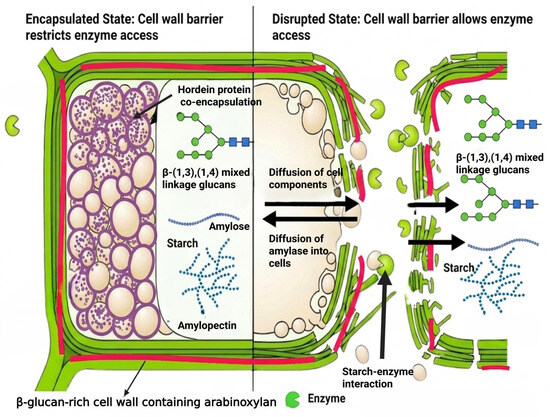
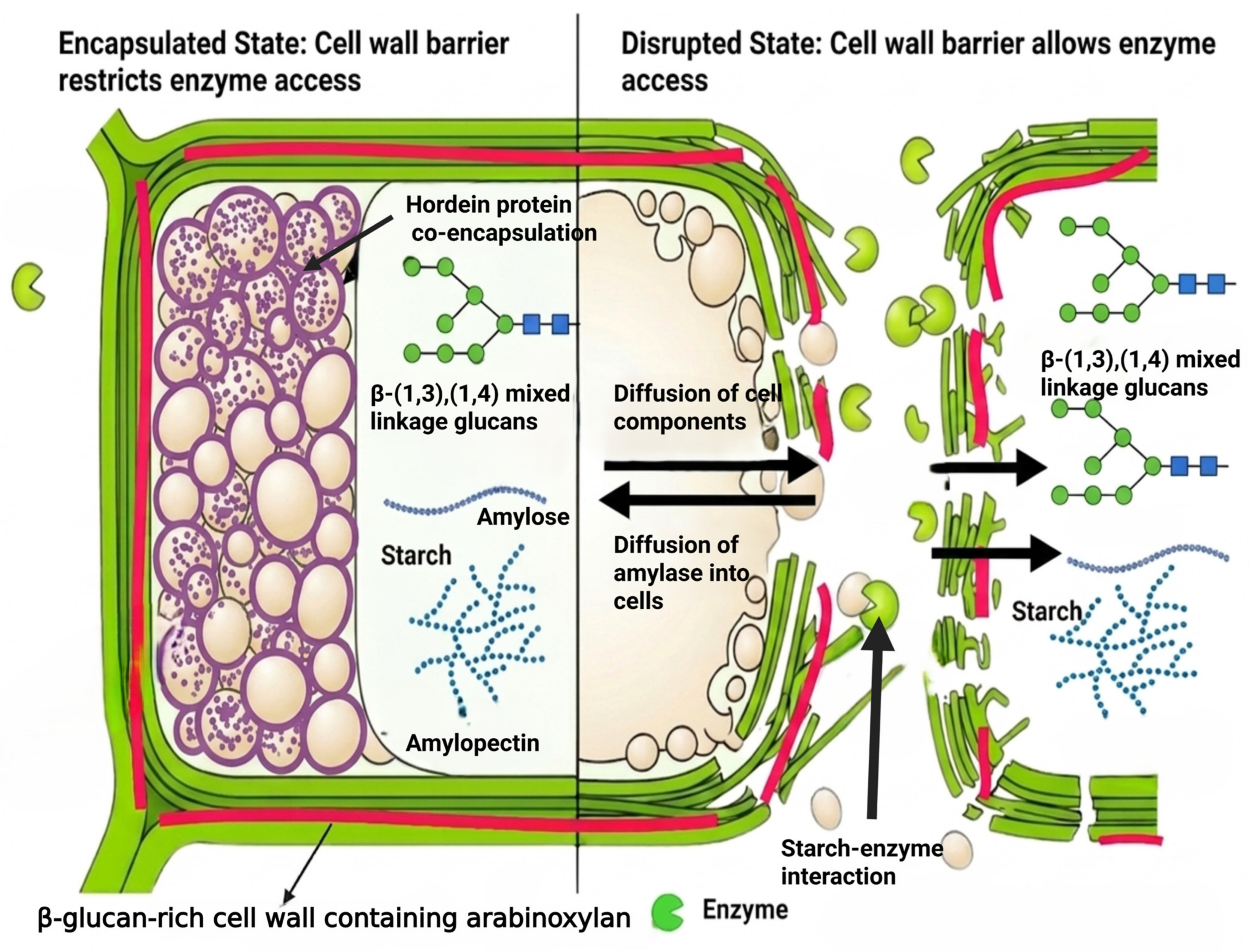
The cell wall is porous, and the pore size largely limits amylase access to the cell interior. The internal protein matrix, which forms a composite with the cell wall, also limits amylase access (Figure 2). Cooking does not always abolish this barrier. A study showed that amylase-sized probes fail to penetrate the walls of isolated highland barley endosperm cells whether raw or cooked, and progressive enzymatic degradation of the wall raises starch digestibility toward that of mechanically crushed flour [31]. Encapsulation is therefore lost by mechanical disruption rather than by thermal treatment alone. Another foundational study identified a protein matrix in barley grains composed of hordeins (major endosperm proteins) that surrounds the starch granules and is interconnected throughout the endosperm [41]. Because the cell wall and the protein matrix are not separate layers but rather a composite system, the cell wall limits enzyme entry at the outer surface, while the protein matrix slows amylase at the granule surface [41]. Hordeins are the main storage proteins, making up 30–50%, while glutelin accounts for 35–45% of the total barley storage protein fraction. Protein Z is the major barley albumin protein [42]. More recently, a study showed that, upon cooking highland barley, scanning electron microscopy revealed a continuous protein matrix encapsulating the starch granules, which may have slowed access to amylases [43]. Additionally, another study by Xie et al. (2024) showed that after removing non-starch components, such as β-glucan and proteins, from highland barley, the estimated glycaemic index (GI) increased and resistant starch content was significantly reduced [33].
Figure 2.
This illustration shows how starch is stored within barley endosperm and how breaking cell walls influences enzyme access. The left panel features an intact endosperm cell, where starch granules are shielded by a β-glucan-rich cell wall containing arabinoxylan that restricts enzyme entry, along with a hordein protein coating, forming a co-encapsulation system. Inside the cell, starch containing amylose and amylopectin is present; β-glucan is a constituent of the surrounding wall. Amylase outside the cell cannot penetrate the cell wall. The right panel illustrates a structurally disrupted cell in which mechanical processing has compromised cell-wall integrity, allowing enzymes greater access to intracellular starch. Thermal processing can alter starch and protein organisation but does not necessarily abolish an intact cell-wall barrier. Enzymes can then directly interact with starch at the boundary. The extent of residual co-encapsulation influences starch degradation and the release of fermentable substrates. Created in BioRender. Chakraborty, S. (2026) https://BioRender.com/juwcfvi.
4. Effects of Processing on Grain Structure
Techniques such as milling, heating, fractionation and de-branning alter the chemical makeup of barley, as well as the structure, distribution, and organisation of its polysaccharides [36,44].
4.1. Mechanical Size Reduction
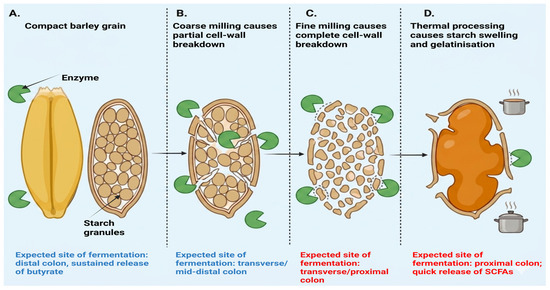
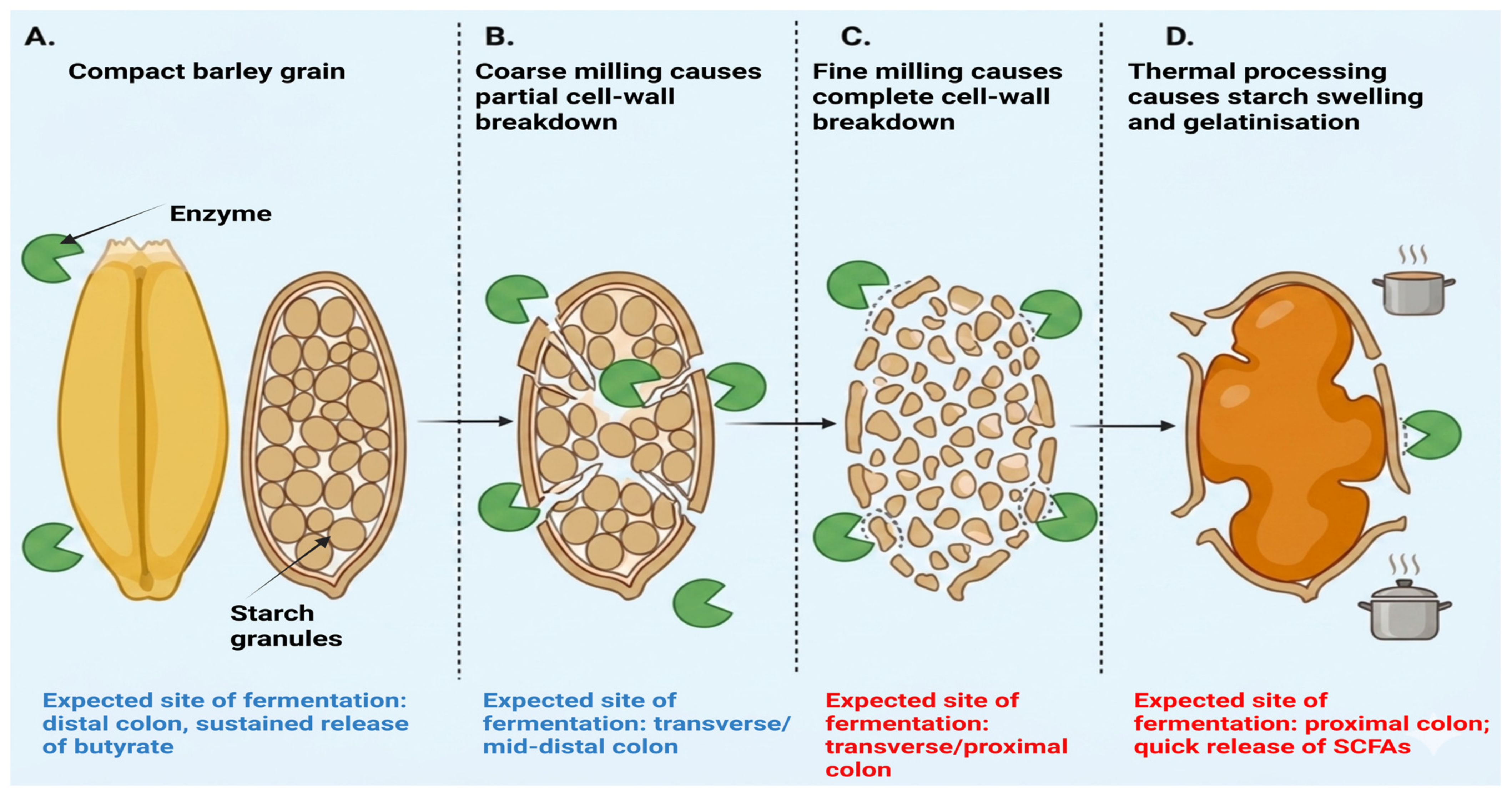
Recent studies show that kibbling and fine milling can reduce wheat particle size and break cell walls, exposing starch and non-starch polysaccharides that were previously protected [9]. This allows digestive enzymes in the upper gastrointestinal tract to access these molecules [8,45] (Figure 3). Recently, an in vitro study reported that larger or more intact grain particles slow enzyme access and delay the onset of fermentation [32], suggesting that structural barriers may be better preserved. Another study on highland barley directly showed the contrast in fermentation output. Milling intact barley kernels into flour increased starch digestibility from 29% to 76%. The higher starch digestibility was accompanied by higher early fermentation activity, but lower total short-chain fatty acid yield over 48 h in an in vitro model [10]. The greater early fermentation activity observed after intensive milling is consistent with more rapid substrate utilisation and could, in vivo, favour earlier fermentation. These findings are consistent across the literature available to date; however, the specific structural regions of the grains affected by coarse versus fine milling remain largely unknown. Therefore, until targeted, coupled imaging and fermentation studies fully characterise these structural changes, the true effect of grain processing on fermentation will remain unclear.
Figure 3.
Progressive processing reduces barriers to enzyme access in barley endosperm. (A) Native barley has a dense matrix with starch inside intact cell walls and proteins, limiting enzyme reach. (B) Coarse milling partially disrupts cell walls, exposing some starch, but fragments and proteins hinder access. (C) Fine milling nearly removes wall encapsulation, increasing starch surface and enzyme accessibility. (D) Thermal treatment gelatinises starch within already-disrupted cells; the cell wall itself remains a barrier to enzyme entry. The progression shows increased carbohydrate accessibility, possibly shifting fermentation from the distal to the proximal colon. Figure by Microsoft® PowerPoint and BioRender. Chakraborty, S. (2026) https://BioRender.com/w4m78vi.
4.2. Thermal and Thermochemical Treatments
Heating grains through steaming, boiling, or roasting alters barley starch structures by breaking bonds within the grain matrix, causing starch swelling, loss of granular structure, and birefringence. This process is known as gelatinisation [46]. These modifications decrease the resistant starch fraction because gelatinised starch is more easily hydrolysed once enzymes have access to it. However, gelatinisation does not break open the cell wall (Section 3.3), so in intact structures, the enhanced accessibility mainly affects cells with already disrupted walls [47]. Because β-glucan dissolves under the same hydrothermal conditions that gelatinise starch, cooking brings the two polymers into molecular contact. Thus, processing forms interactions between solubilised β-glucan and retrograding amylose rather than breaking them apart, unlike an encapsulation barrier. Additionally, when starch cools after heating, retrogradation occurs, leading to RS3 formation, which enables more material to reach the colon and may slow fermentation [48]. A study shows that sand-roasted highland barley, rather than flaked or milled, retained more of its structure [10]. These studies suggest that conditions such as cell wall breakdown, gelatinisation, and retrogradation may affect how much starch escapes upper-gut digestion and how accessible it is to enzymes. These changes may influence the amount and rate at which fermentable material becomes available to the colonic microbiota and could therefore affect the timing, and potentially the regional distribution, of fermentation.
4.3. Fractionation and De-Branning
Fractionation (isolation of grain macromolecules) and de-branning (removing the bran layer from the grain), also termed pearling, redistribute grain components anatomically. For example, β-glucan content can vary by genotype and growing environment, and dry fractionation can concentrate β-glucan into particular milling streams [49,50]. Additionally, pearling sequentially strips away the outer layers of the kernel, which in hull-less barley contain the lowest levels of β-glucan. Specifically, β-glucan makes up 2–4% of the dry weight in the outermost 10% (pericarp and testa) and approximately doubles in the next 10% (aleurone). It peaks in the endosperm after 30–60% of the kernel is removed in most genotypes [27]. Consequently, pearling mainly removes outer material rich in arabinoxylan and phenolics [29], while the β-glucan content becomes concentrated in the remaining kernel.
5. Colonic Microbial Ecology and the Influence of Cross-Feeding on Colonic Fermentation
How starch and non-starch polysaccharides that reach the colon are processed and digested (as discussed in Section 3 and Section 4) may influence which bacterial species can utilise the nutrients and how quickly. In addition, different types of non-starch polysaccharides reaching the colon have distinct effects on the bacterial community and its activity [51]. In this context, both the microbes present in the colon (i.e., microbial ecology) and their dependence on each other for substrates (i.e., cross-feeding) likely shape the products of fermentation of processed grains and their downstream metabolic effects. Colonic transit time also likely modifies these outcomes.
It is worth noting that, due to substantial recent changes in bacterial taxonomic nomenclature, bacterial names were checked against the List of Prokaryotic names with Standing in Nomenclature (LPSN) and recent taxonomic literature [52]. Where a name has been revised since the cited source was published, the name used in that source is provided in parentheses at first mention (e.g., ‘Bacteroidota’ formerly ‘Bacteroidetes’) [53]. Names that are unchanged remain without annotation. This aligns the review with current taxonomy while preserving its traceability to the primary literature.
The widely used approach of 16S rRNA gene amplicon sequencing reveals bacterial community patterns but cannot identify the specific pathways organisms use. This requires evidence such as growth on defined substrates, enzyme- or gene-level data, or characterisation of polysaccharide utilisation loci (PULs). For this reason, organisms identified through abundance shifts are best termed as candidate responders rather than confirmed degraders [54,55].
The colonic microbiota operates across trophic levels, with primary degraders (responders) constituting the first tier. These organisms initiate fermentation by attacking intact barley non-starch polysaccharides. Several taxa have been implicated in the initial or downstream utilisation of barley-derived carbohydrates. For example, Ruminococcus bromii is a well-known resistant starch degrader [56], while members of Bacteroides spp. are known to possess substrate-specific PULs [57,58]. Blautia spp. may contribute through downstream acetogenesis. Resistant starch and cereal β-glucans are metabolised through substrate-specific trophic networks rather than by just a single organism, because the gut microbiota rely on specialised carbohydrate-active enzymes (CAZymes) and PULs to sense, bind, depolymerise, and import distinct dietary glycans [38,59,60]. For example, Bacteroides ovatus prefers plant glycans with structural complexity and hemicellulose-targeting loci, whereas Bacteroides thetaiotaomicron relies more extensively on host mucin glycan utilisation [61,62].
Mixed-linkage β-glucan utilisation is now mechanistically resolved in several organisms, including Bacteroides ovatus and related organisms that carry specific utilisation loci. Segatella copri (formerly Prevotella copri) [63] appears to extend the primary degradative capacity beyond Bacteroides through a distinct Prevotellaceae system and is therefore assigned to Tier 1 rather than to secondary fermenters. Protein-level specificity, such as differences in surface-binding proteins and glycoside hydrolases, shapes the β-glucan utilisation capability of organisms [38,64]. Primary degraders (responders) have also been reported to produce short-chain fatty acids such as acetate, propionate, and succinate, whereas butyrate production is negligible. The secondary fermenters in Tier 2 include Bifidobacterium and lactobacilli (previously all grouped within Lactobacillus) [65]. These organisms then consume the oligosaccharides broken down by Tier 1 members, often producing an overlapping yet distinct metabolite profile, including acetate, propionate, and lactate [32,66]. Lactate is suggested to be the characteristic Tier 2 output, especially for Bifidobacterium (via the bifid shunt, distinct phosphoketolase pathway) and lactobacilli. Tier 3 species are primarily butyrate producers, including Faecalibacterium prausnitzii, Roseburia intestinalis, Megasphaera indica, and Anaerobutyricum hallii (formerly Eubacterium hallii) [67]. These taxa are commonly associated with butyrate production and often utilise fermentation intermediates such as lactate and acetate, although substrate-use capacity varies among species and strains [68,69]. The microbial network can therefore be conceptualised as a sequential cross-feeding cascade, while recognising that functional overlap occurs among taxa. Some lineages historically reported within Faecalibacterium prausnitzii have subsequently been resolved as distinct species, including F. duncaniae, F. hattorii, and F. gallinarum. Species-level attribution in older butyrate studies should therefore be interpreted with caution [70].
Cross-feeding is a key mechanism in gut ecology. Primary β-glucan degradation releases oligosaccharides, sustaining other organisms along the cross-feeding chain [39]. Similar ecological studies on resistant starch show that only a limited set of organisms can initiate their breakdown, but butyrate production depends on interactions between degraders and secondary fermenters rather than on degraders alone [60,71]. Community output is also shaped by glycan system structure [72].
Fermentation outcomes in both human and in vitro fibre studies have been shown to vary based on substrate structure and the baseline microbiome composition. Studies show that fibre breakdown does not reliably translate into higher butyrate unless the appropriate primary degraders and cross-feeding partners are already present [71,73]. Overall, these findings indicate that the physical state of barley-derived substrates in the colon, whether as intact polymers, oligosaccharides, or granular resistant starch, may influence which microbial groups are involved and the specific short-chain fatty acid profile produced. This is consistent with the architectural hypothesis proposed in this review.
Influence of Colonic Transit Time on Fermentation Outcomes
Colonic transit time and substrate delivery may modulate the site of colonic fermentation. Non-digestible polysaccharides enter the caecum and proximal colon first, and when fermentable carbohydrates are depleted, microbial metabolism can shift from saccharolysis to proteolysis [74]. Human marker studies show that longer colonic transit is associated with overall microbiota composition, higher richness, and a metabolic shift toward protein catabolism, indicating that transit time is a key factor for both community structure and function [75].
Distal fermentation has attracted particular attention because butyrate generated in the distal colon is believed to enhance epithelial integrity and provide other colonic benefits, which is crucial since colorectal disease frequently develops in this area [76,77]. Additionally, the presence of substrate reaching this far suggests continuous rather than rapid utilisation. Rat studies indicate that BARLEYmax, containing fructan, β-glucan, and resistant starch, boosts distal colonic acetate and overall short-chain fatty acids, unlike a high β-glucan variety [3]. This rat-based study is the only barley study measuring regional fermentation; the human barley interventions mentioned here did not assess regional fermentation, so caution must be exercised when extrapolating (Table 2). This limitation matters because faecal short-chain fatty acids are only a small fraction of total colonic production [78] and can correlate inversely with transit time, making stool endpoints alone an imperfect readout of fermentation location or magnitude [75,79]. β-glucan is rapidly depleted in vitro and may therefore be butyrogenic but ferments too quickly to reach the distal colon. Butyrate yield and the site of butyrate production are distinct properties, and neither can be inferred from the other. In addition, although evidence supports the idea that a structurally preserved grain matrix may sustain all three tiers sequentially and deliver substrate progressively, evidence remains limited [71] on how structurally distinct grain matrices might control the rate and sequence of metabolite transfer among the three tiers.
Whether dietary means can shift fermentation distally, and whether doing so is beneficial, remains unclear. In a 12-week human trial, an isolated mixed-fibre supplement designed to increase distal fermentation produced increased colonic permeability and circulating interleukin-6 with no change in insulin sensitivity [80]. Additionally, increased delivery to the colon is not uniformly beneficial, and when relevant primary degraders or cross-feeding partners are absent, gas production may increase without a corresponding increase in butyrate [71,73], thereby imposing a symptom burden in individuals with impaired gastrointestinal homeostasis. It has not yet been tested whether a grain matrix that maintains its structure and releases substrate gradually, rather than as a bolus of isolated fibre, sustains fermentation without these effects.
Table 2.
Evidence base for the fermentation and host-signalling claims discussed in this review, classified by substrate and model system.
6. Microbial Metabolites and Host Signalling
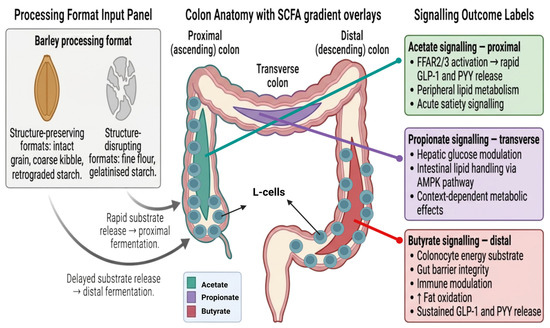
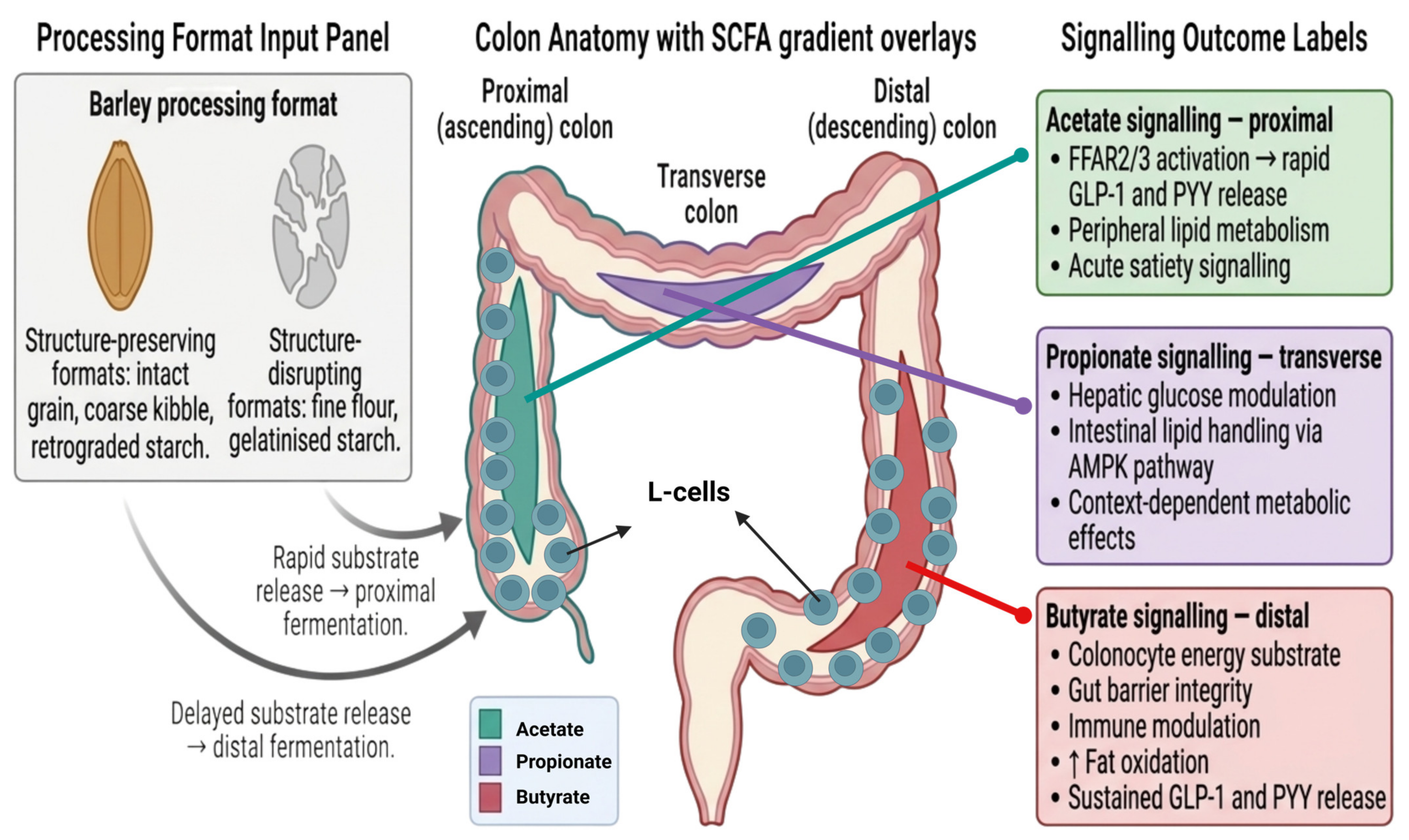
The role of short-chain fatty acids may depend not only on how much of them is produced, but also on where, when, and for how long they are produced in the colon. The types of receptors and the location of hormone-producing cells vary along the colon, which affects the signals triggered [84,85,86]. When short-chain fatty acids are present, they activate free fatty acid receptors (FFAR2 and FFAR3) on L-cells lining the colon, leading to the release of hormones such as glucagon-like peptide-1 (GLP-1) and peptide YY (PYY), depending on the amount and location of the receptors [87,88]. These receptors are more common in the distal small intestine and colon, where L-cells are more abundant. In the colon, L-cells release GLP-1, PYY and INSL5 when short-chain fatty acids activate receptors such as FFAR2, FFAR3, and TGR5 [86,89]. GLP-1 and PYY may reduce appetite and slow colonic motility, while INSL5, expressed only in colonic L-cells, may increase hunger and glucose production in the liver. This suggests that colonic L-cells act as energy sensors, connecting fermentation signals to the host’s metabolism [89,90]. As a result, the native barley structure may not only influence the amount of short-chain fatty acids produced, but also where they appear in the colon and which L-cells are involved (Figure 4). So far, no human study has directly examined these signalling pathways using structurally preserved versus disrupted grain matrices.
Figure 4.
Proposed conceptual framework linking barley grain-matrix integrity with colonic fermentation dynamics and regional host signalling. The chosen processing method is proposed to influence where fermentation occurs along the colon and its rate of release [91,92]. This may influence regional SCFA profiles and host responses. Structure-preserving formats, such as coarsely kibbled grain, may slow substrate release, directing fermentation towards the distal colon [10,32], whereas disrupting formats, such as fine flour, may encourage fermentation in the proximal region [9,45]. Short-chain fatty acid products (acetate, propionate, butyrate) may be produced in specific areas depending on substrate availability and microbial presence [93,94]. Subsequent regional differences in enteroendocrine L-cell population density and FFAR2/3-receptor-mediated signalling suggest that the fermentation site plays a key role in engaging these metabolic pathways [13,86]. Created in BioRender. Chakraborty, S. (2026) https://BioRender.com/1l1zakt.
Gut–Brain Axis and Satiety
The differences in GLP-1 and PYY release from L-cells in the proximal and distal colon depend more on what these cells do than just on where they are located. Studies in mice show that L-cells in the distal colon produce about twice as much GLP-1 per cell as those in the upper colon, and that they release PYY and INSL5 when stimulated by short-chain fatty acids, triggering a long-lasting, complex hormonal response [85,86]. Experiments in genetically modified mice treated with a drug that activates lower-colon L-cells show that these cells can function as an endocrine organ. Activating these cells improves postprandial glucose via GLP-1 and reduces food intake via PYY, even without the usual GLP-1 receptor [89]. Consistent with this in humans, a study showed that while distal colonic acetate infusion in overweight adults increased fasting fat oxidation and PYY levels, proximal colonic infusion produced no significant effects, suggesting that fermentation site may play a key role in governing host signalling [12]. The types and amounts of SCFAs are likely to affect L-cell signalling. Acetate and propionate are the strongest activators of L-cells via FFAR2. Whether barley fermentation in the distal colon favours butyrate over acetate and propionate remains unclear, including whether available profiles differ by substrate form. Additionally, it is unclear whether butyrate directly activates L-cells via FFAR2 or FFAR3, or whether it primarily acts on the cells lining the colon where it is produced, with only indirect effects on hormones [86,87]. These regional differences in L-cell density and function provide a plausible basis for linking the site of fermentation to host hormonal signalling, but no human study has yet explored this area with structurally defined barley preparations; the requirements for doing so are discussed in Section 8.
7. Negative Effects of Ultra-Processing
Ultra-processing of grains such as barley dismantles much of the grain’s natural carbohydrate architecture. The progression from intact grain to refined, extruded, or otherwise highly processed products disrupts cell-wall structures, reduces native starch granule organisation, lowers starch crystallinity, may depolymerise β-glucan, and diminishes viscosity. Importantly, the most significant consequence of ultra-processing is often not a fundamental change in carbohydrate chemistry itself, but rather the alteration of the grain’s multiscale physical structure, which has evolved to regulate digestion, nutrient accessibility, and the rate of nutrient release [95,96].
Diets rich in highly processed carbohydrates and ultra-processed foods may adversely affect the gut ecosystem by providing rapidly digestible carbohydrates while supplying relatively little microbiota-accessible fibre. This dietary pattern can reduce microbial diversity, decrease the abundance of health-associated bacteria such as Faecalibacterium prausnitzii, and lower SCFA production, particularly butyrate, which plays an important role in maintaining intestinal barrier integrity and regulating immune and inflammatory responses [97,98]. These changes may impair colonisation resistance against opportunistic microorganisms, promote intestinal barrier dysfunction, and contribute to chronic low-grade inflammation [99].
Although evidence directly linking processed carbohydrates to intestinal protozoan parasite infections remains limited, diet-induced dysbiosis may influence host immunity and microbial interactions that affect susceptibility to both bacterial and parasitic pathogens. Consequently, individuals with disturbances in gastrointestinal homeostasis, including irritable bowel syndrome, inflammatory bowel disease, post-infectious dysbiosis, or other conditions associated with impaired gut-barrier function, may be particularly susceptible to symptom exacerbation and further microbiome disruption when consuming diets high in highly processed carbohydrates and ultra-processed foods [99,100].
8. Conclusions
Current evidence suggests that barley grain structure affects carbohydrate accessibility during digestion and can influence fermentation kinetics. Factors such as cell-wall encapsulation, resistant starch organisation, and the physical form of β-glucan may explain how processing changes the substrates reaching the colonic microbiota. However, no human research has directly examined the specific site of fermentation or analysed regional SCFA profiles using structurally defined barley preparations. Consequently, it remains unclear whether maintaining the barley matrix shifts fermentation to more distal parts of the colon or produces different regional metabolite profiles. We propose that barley formats which preserve structure may prolong substrate availability and potentially extend fermentation further along the colon, while highly disrupted formats may promote faster fermentation. Confirming this will require spatially resolved fermentation models followed by well-designed human studies.
This framework could inform functional-food development by placing greater emphasis on fibre structure and accessibility, rather than quantity alone.
9. Future Perspectives
The relationship between barley architecture and colonic fermentation discussed in this review raises three questions that existing methods can test:
Does structural preservation slow substrate utilisation? Intact plant cell walls restrict enzyme access to starch inside the cells; for example, purified cellulose can directly inhibit α-amylase activity, and the cell wall’s integrity decreases starch breakdown in preserved plant tissues compared to disrupted ones in kinetic assays [91]. However, barley endosperm cell walls are mainly composed of β-glucan and arabinoxylan, which remain underexplored. This is more significant in barley than in cereals with higher native resistant starch, since barley starch itself is only mildly resistant (Section 3.1). If most of the resistant fraction results from encapsulation rather than granule crystallinity, then processing that breaks the wall may substantially reduce this fraction. Consequently, the difference between coarse and fine formats should be correspondingly large. Grain structural properties may affect both small-intestinal digestion and the timing and location of fermentation [92]. Building on these observations, we hypothesise that encapsulated resistant starch and β-glucan in structurally preserved barley matrices may delay access by Tier 1 organisms and thereby postpone the downstream cross-feeding cascade involving Tier 3 butyrate producers. In contrast, in disrupted matrices like barley flour, degraders may allow earlier microbial access to substrates. Two studies support this idea: Lu et al. (2023) reported delayed starch utilisation in intact highland barley matrices, with significant butyrate production after 24–48 h in batch in vitro fermentations [10]. Similarly, Ntouranidi (2025) found that coarser barley husk slowed utilisation by human faecal microbiota compared to finer husk, with both particle size and composition playing roles [32]. Resolving this requires comparison of coarse and fine formats from the same batch under identical digestion and fermentation conditions and separating two mechanisms that both slow digestion but respond in opposite ways to processing: physical encapsulation, which may be disrupted by milling and other forms of mechanical breakdown, and molecular interaction between solubilised β-glucan and starch, which cooking may modulate. Measuring β-glucan solubility alongside starch hydrolysis kinetics would separate them.
Does structural preservation shift fermentation distally? A structurally preserved matrix could sustain substrate delivery further along the colon, extending the cross-feeding cascade into the distal region [86]. Human studies show that both the site and amount of SCFA delivery may matter in determining host hormonal signalling, as discussed in Section 6. Addressing this requires a spatially resolved model such as M-SHIME, with time-resolved SCFA measurement across the proximal, transverse and distal colon. Neither faecal endpoints nor single in vitro batch fermentations can resolve the site of fermentation (Section 5).
Do fermentation kinetics and transit time interact? A gap exists between studies that vary particle size while holding fermentation conditions constant and those that vary transit time while holding substrate constant. To our knowledge, no studies have examined the combined effects of fermentation kinetics and the distribution of butyrate, although Minnebo et al. (2023) [101] reported non-linearity. Linking the two would require fermentation of structurally defined barley formats under controlled retention times, followed by human studies that measure transit time in real time and treat it as a variable rather than a nuisance. Grain architecture could then potentially become a tractable variable in personalised nutrition.
Beyond these questions, the consequences of a modified fermentation site on host hormonal signalling remain open-ended. Regional differences in L-cell content and per-cell hormonal output (Section 6), together with human evidence that distal SCFA delivery alters fat oxidation and PYY [12], suggest that site of fermentation may have both endocrine and epithelial consequences. However, whether SCFA patterns created by structurally intact barley matrices are large enough to engage these pathways is largely unexplored. This will further require human studies that combine region-specific SCFA production with plasma hormone and appetite endpoints.
Author Contributions
Conceptualisation, S.C., J.M., M.W.T. and P.K.G.; writing—original draft preparation, S.C.; writing—review and editing, S.C., J.M., M.W.T., N.C.R., A.-L.M.H. and P.K.G.; supervision, J.M., M.W.T., N.C.R., A.-L.M.H. and P.K.G.; funding acquisition, P.K.G. All authors have read and agreed to the published version of the manuscript.
Funding
S.C. is supported by a doctoral scholarship funded by the New Zealand Tertiary Education Commission through the Riddet Institute Centre of Research Excellence research programme. No additional external funding was received specifically for this review.
Institutional Review Board Statement
Not applicable.
Informed Consent Statement
Not applicable.
Data Availability Statement
No new data were created or analyzed in this study. Data sharing is not applicable to this article.
Acknowledgments
The authors used Grammarly (v1.2.306.1984) (Grammarly Inc., San Francisco, CA, USA) to assist with editing and improving the manuscript’s clarity and take full responsibility for the content.
Conflicts of Interest
Authors J.M. and P.K.G. are employed by the Bioeconomy Science Institute Limited. Bioeconomy Science Institute is one of the Crown Research Institutes of the Government of New Zealand. The company had no role in this study. The authors declare that the research was conducted without any commercial or financial relationship that could be construed as a potential conflict of interest.
Abbreviations
The following abbreviations are used in this manuscript:
| CAZyme | Carbohydrate-active enzyme |
| DM | Dry mass |
| DP3 | Degree of polymerisation 3 (cellotriose unit) |
| DP4 | Degree of polymerisation 4 (cellotetraose unit) |
| FFAR2 | Free fatty acid receptor 2 |
| FFAR3 | Free fatty acid receptor 3 |
| GI | Glycaemic index |
| GLP-1 | Glucagon-like peptide-1 |
| INSL5 | Insulin-like peptide 5 |
| M-SHIME | Mucosal Simulator of the Human Intestinal Microbial Ecosystem |
| NSP | Non-starch polysaccharide |
| PUL | Polysaccharide utilisation locus |
| PYY | Peptide YY |
| RS | Resistant starch |
| RS1-RS5 | Resistant starch types 1 to 5 |
| SCFA | Short-chain fatty acid |
| TGR5 | Takeda G protein-coupled receptor 5 (bile acid receptor GPBAR1) |
References
- AbuMweis, S.S.; Jew, S.; Ames, N.P. Beta-glucan from barley and its lipid-lowering capacity: A meta-analysis of randomized, controlled trials. Eur. J. Clin. Nutr. 2010, 64, 1472–1480. [Google Scholar] [CrossRef] [Scilit]
- Nie, C.; Yan, X.; Xie, X.; Zhang, Z.; Zhu, J.; Wang, Y.; Wang, X.; Xu, N.; Luo, Y.; Sa, Z.; et al. Structure of β-glucan from Tibetan hull-less barley and its in vitro fermentation by human gut microbiota. Chem. Biol. Technol. Agric. 2021, 8, 12. [Google Scholar] [CrossRef] [Scilit]
- Aoe, S.; Yamanaka, C.; Fuwa, M.; Tamiya, T.; Nakayama, Y.; Miyoshi, T.; Kitazono, E. Effects of BARLEYmax and high-beta-glucan barley line on short-chain fatty acids production and microbiota from the cecum to the distal colon in rats. PLoS ONE 2019, 14, e0218118. [Google Scholar] [CrossRef] [Scilit]
- Brennan, C.S. Dietary fibre, glycaemic response, and diabetes. Mol. Nutr. Food Res. 2005, 49, 560–570, Erratum in Mol. Nutr. Food Res. 2005, 49, 716. [Google Scholar] [CrossRef] [Scilit]
- Miller, G.D.; Ragalie-Carr, J.; Torres-Gonzalez, M. Perspective: Seeing the Forest Through the Trees: The Importance of Food Matrix in Diet Quality and Human Health. Adv. Nutr. 2023, 14, 363–365. [Google Scholar] [CrossRef] [Scilit]
- Ratanpaul, V.; Stanley, R.; Brennan, C.J.; Eri, R. Manipulating the kinetics and site of colonic fermentation with different fibre combinations—A review. Int. J. Food Sci. Technol. 2023, 58, 2216–2227. [Google Scholar] [CrossRef] [Scilit]
- Byrne, C.S.; Chambers, E.S.; Morrison, D.J.; Frost, G. The role of short chain fatty acids in appetite regulation and energy homeostasis. Int. J. Obes. 2015, 39, 1331–1338. [Google Scholar] [CrossRef] [Scilit]
- Monro, J.; Mishra, S. In Vitro Digestive Analysis of Digestible and Resistant Starch Fractions, with Concurrent Glycemic Index Determination, in Whole Grain Wheat Products Minimally Processed for Reduced Glycaemic Impact. Foods 2022, 11, 1904. [Google Scholar] [CrossRef] [Scilit]
- Abhilasha, A.; Kaur, L.; Monro, J.; Hardacre, A.; Singh, J. Intact, Kibbled, and Cut Wheat Grains: Physico-Chemical, Microstructural Characteristics and Gastro-Small Intestinal Digestion In Vitro. Starch 2021, 73, 2000267. [Google Scholar] [CrossRef] [Scilit]
- Lu, C.; Zhao, Z.; Huang, G.; Liu, J.; Ye, F.; Chen, J.; Ming, J.; Zhao, G.; Lei, L. The contribution of cell wall integrity to gastric emptying and in vitro starch digestibility and fermentation performance of highland barley foods. Food Res. Int. 2023, 169, 112912. [Google Scholar] [CrossRef] [Scilit]
- Mukhopadhya, I.; Louis, P. Gut microbiota-derived short-chain fatty acids and their role in human health and disease. Nat. Rev. Microbiol. 2025, 23, 635–651. [Google Scholar] [CrossRef] [Scilit]
- Van der Beek, C.M.; Canfora, E.E.; Lenaerts, K.; Troost, F.J.; Olde Damink, S.W.M.; Holst, J.J.; Masclee, A.A.M.; Dejong, C.H.C.; Blaak, E.E. Distal, not proximal, colonic acetate infusions promote fat oxidation and improve metabolic markers in overweight/obese men. Clin. Sci. 2016, 130, 2073–2082. [Google Scholar] [CrossRef] [Scilit]
- Van Deuren, T.; Umanets, A.; Venema, K.; Moreno, L.L.; Zoetendal, E.G.; Canfora, E.E.; Blaak, E.E. Specific dietary fibers steer toward distal colonic saccharolytic fermentation using the microbiota of individuals with overweight/obesity. Food Res. Int. 2025, 209, 116271. [Google Scholar] [CrossRef] [Scilit]
- Fincher, G.B. Morphology and Chemical Composition of Barley Endosperm Cell Walls. J. Inst. Brew. 1975, 81, 116–122. [Google Scholar] [CrossRef] [Scilit]
- Bacic, A.; Stone, B. Chemistry and Organization of Aleurone Cell Wall Components From Wheat and Barley. Aust. J. Plant Physiol. 1981, 8, 475–495. [Google Scholar] [CrossRef] [Scilit]
- Lazaridou, A.; Biliaderis, C.G.; Izydorczyk, M.S. Cereal beta-glucans: Structures, physical properties, and physiological functions. In Functional Food Carbohydrates; Cui, S.W., Ed.; CRC Press: Boca Raton, FL, USA, 2007; pp. 1–72. [Google Scholar]
- Izydorczyk, M.S.; Jacobs, M.; Dexter, J.E. Distribution and Structural Variation of Nonstarch Polysaccharides in Milling Fractions of Hull-less Barley with Variable Amylose Content. Cereal Chem. 2003, 80, 645–653. [Google Scholar] [CrossRef] [Scilit]
- Geng, L.; Li, M.; Zhang, G.; Ye, L. Barley: A potential cereal for producing healthy and functional foods. Food Qual. Saf. 2022, 6, fyac012. [Google Scholar] [CrossRef] [Scilit]
- Bhatty, R.S.; Rossnagel, B.G. Comparison of Pearled and Unpearled Canadian and Japanese Barleys. Cereal Chem. 1998, 75, 15–21. [Google Scholar] [CrossRef] [Scilit]
- Sullivan, P.; Arendt, E.; Gallagher, E. The increasing use of barley and barley by-products in the production of healthier baked goods. Trends Food Sci. Technol. 2013, 29, 124–134. [Google Scholar] [CrossRef] [Scilit]
- Li, M.; Geng, L.; Xie, S.; Wu, D.; Ye, L.; Zhang, G. Genome-Wide Association Study on Total Starch, Amylose and Amylopectin in Barley Grain Reveals Novel Putative Alleles. Int. J. Mol. Sci. 2021, 22, 553. [Google Scholar] [CrossRef] [Scilit]
- Birt, D.F.; Boylston, T.; Hendrich, S.; Jane, J.L.; Hollis, J.; Li, L.; McClelland, J.; Moore, S.; Phillips, G.J.; Rowling, M.; et al. Resistant starch: Promise for improving human health. Adv. Nutr. 2013, 4, 587–601. [Google Scholar] [CrossRef] [Scilit]
- Izydorczyk, M.S.; Storsley, J.; Labossiere, D.; MacGregor, A.W.; Rossnagel, B.G. Variation in total and soluble beta-glucan content in hulless barley: Effects of thermal, physical, and enzymic treatments. J. Agric. Food Chem. 2000, 48, 982–989. [Google Scholar] [CrossRef] [Scilit]
- Zhong, H.; Chen, Z.; Han, Y.; Hu, K. The molecular mechanisms and new classification of resistant starch—A review. Curr. Res. Food Sci. 2025, 10, 101023. [Google Scholar] [CrossRef] [Scilit]
- Gu, X.; Wang, Z. Insights Into the Digestibility, Properties, and Structure of Highland Barley Starch Using Dry Heat Treatment, Heat Moisture Treatment, and Annealing Treatment. Starch—Stärke 2025, 77, e70016. [Google Scholar] [CrossRef] [Scilit]
- Chen, X.; Li, Y.; Wei, J.; Han, Z.; Wang, H.; Cao, R.; Wang, L. Insights into the role of highland barley beta-glucan in enhancing gel properties and delaying retrogradation of highland barley starch. Int. J. Biol. Macromol. 2026, 351, 150989. [Google Scholar] [CrossRef] [Scilit]
- Zheng, G.H.; Rossnagel, B.G.; Tyler, R.T.; Bhatty, R.S. Distribution of β-Glucan in the Grain of Hull-less Barley. Cereal Chem. 2000, 77, 140–144. [Google Scholar] [CrossRef] [Scilit]
- Mosele, J.I.; Motilva, M.J.; Ludwig, I.A. Beta-Glucan and Phenolic Compounds: Their Concentration and Behavior during in Vitro Gastrointestinal Digestion and Colonic Fermentation of Different Barley-Based Food Products. J. Agric. Food Chem. 2018, 66, 8966–8975. [Google Scholar] [CrossRef] [Scilit]
- Drawbridge, P.; Herrera-Balandrano, D.D.; Beta, T. Phenolic Composition and Arabinoxylan Characterization of Pearled Barley Fractions. Cereal Chem. 2025, 102, 840–848. [Google Scholar] [CrossRef] [Scilit]
- Chen, X.; Zhu, L.; Zhang, H.; Wu, G.; Cheng, L.; Li, J. Effects of composition, starch structural orders, and kernel structure on starch in vitro digestion of highland barley. Carbohydr. Polym. 2023, 301, 120274. [Google Scholar] [CrossRef] [Scilit]
- Chen, X.; Zhu, L.; Zhang, H.; Zhang, Y.; Cheng, L.; Wu, G. Structural barriers governing starch digestibility in intact highland barley cells: A closer insight from cell wall and protein matrix. Carbohydr. Polym. 2025, 348, 122796. [Google Scholar] [CrossRef] [Scilit]
- Ntouranidi, S.; Fryganas, C.; Fogliano, V.; Smidt, H.; Zoetendal, E.G.; Capuano, E. In vitro utilization of barley husk by human gut microbiota depends on husk composition and particle size. Food Res. Int. 2025, 221, 117136. [Google Scholar] [CrossRef] [Scilit]
- Xie, J.; Cheng, L.; Li, Z.; Li, C.; Hong, Y.; Gu, Z. Effect of non-starch components on the structural properties, physicochemical properties and in vitro digestibility of waxy highland barley starch. Int. J. Biol. Macromol. 2024, 255, 128013. [Google Scholar] [CrossRef] [Scilit]
- Fu, L.; Zhao, Y.; Chen, X.; Cheng, L.; Zhao, C.; Liu, Y.; Zheng, Y.; Yan, Y.; Xiang, Q.; Zhang, W.; et al. Molecular orchestration of highland barley starch-beta-glucan complexes under extrusion thermomechanics: Linking hierarchical structure to digestive resistance. Food Res. Int. 2026, 238, 119446. [Google Scholar] [CrossRef] [Scilit]
- Farag, M.A.; Xiao, J.; Abdallah, H.M. Nutritional value of barley cereal and better opportunities for its processing as a value-added food: A comprehensive review. Crit. Rev. Food Sci. Nutr. 2022, 62, 1092–1104. [Google Scholar] [CrossRef] [Scilit]
- Izydorczyk, M.S.; Dexter, J.E. Barley β-glucans and arabinoxylans: Molecular structure, physicochemical properties, and uses in food products–a Review. Food Res. Int. 2008, 41, 850–868. [Google Scholar] [CrossRef] [Scilit]
- Tamura, K.; Dejean, G.; Van Petegem, F.; Brumer, H. Distinct protein architectures mediate species-specific beta-glucan binding and metabolism in the human gut microbiota. J. Biol. Chem. 2021, 296, 100415. [Google Scholar] [CrossRef] [Scilit]
- Golisch, B.; Cordeiro, R.L.; Fraser, A.S.C.; Briggs, J.; Stewart, W.A.; Van Petegem, F.; Brumer, H. The molecular basis of cereal mixed-linkage beta-glucan utilization by the human gut bacterium Segatella copri. J. Biol. Chem. 2024, 300, 107625. [Google Scholar] [CrossRef] [Scilit]
- Centanni, M.; Sims, I.M.; Bell, T.J.; Biswas, A.; Tannock, G.W. Sharing a β-Glucan Meal: Transcriptomic Eavesdropping on a Bacteroides ovatus-Subdoligranulum variabile-Hungatella hathewayi Consortium. Appl. Environ. Microbiol. 2020, 86, e01651-20. [Google Scholar] [CrossRef] [Scilit]
- Sinkovic, L.; Rakszegi, M.; Pipan, B.; Meglic, V. Compositional Traits of Grains and Groats of Barley, Oat and Spelt Grown at Organic and Conventional Fields. Foods 2023, 12, 1054. [Google Scholar] [CrossRef] [Scilit]
- Slack, P.T.; Baxter, E.D.; Wainwright, T. Inhibition by Hordein of Starch Degradation. J. Inst. Brew. 1979, 85, 112–114. [Google Scholar] [CrossRef] [Scilit]
- Jaeger, A.; Zannini, E.; Sahin, A.W.; Arendt, E.K. Barley Protein Properties, Extraction and Applications, with a Focus on Brewers’ Spent Grain Protein. Foods 2021, 10, 1389. [Google Scholar] [CrossRef] [Scilit]
- Chen, X.; Zhu, L.; Zhang, H.; Wu, G.; Cheng, L.; Zhang, Y. Unraveling cereal physical barriers composed of cell walls and protein matrix: Insights from structural changes and starch digestion. Int. J. Biol. Macromol. 2024, 279, 135513. [Google Scholar] [CrossRef] [Scilit]
- Farooq, M.A.; Yu, J. Recent Advances in Physical Processing Techniques to Enhance the Resistant Starch Content in Foods: A Review. Foods 2024, 13, 2770. [Google Scholar] [CrossRef] [Scilit]
- Pellegrini, N.; Vittadini, E.; Fogliano, V. Designing food structure to slow down digestion in starch-rich products. Curr. Opin. Food Sci. 2020, 32, 50–57. [Google Scholar] [CrossRef] [Scilit]
- Tester, R.F.; Morrison, W.R. Swelling and Gelatinization of Cereal Starches. VI. Starches from Waxy Hector and Hector Barleys at Four Stages of Grain Development. J. Cereal Sci. 1993, 17, 11–18. [Google Scholar] [CrossRef] [Scilit]
- Ai, Y.; Guo, Q.; Zhao, Y.; Xu, J. Thermal processing improved dietary fiber quality of whole grain highland barley: Studies on structural, physiochemical and functional properties. J. Cereal Sci. 2025, 121, 104087. [Google Scholar] [CrossRef] [Scilit]
- Ahmed, Z.; Tetlow, I.J.; Falk, D.E.; Liu, Q.; Emes, M.J. Resistant Starch Content Is Related to Granule Size in Barley. Cereal Chem. 2016, 93, 618–630. [Google Scholar] [CrossRef] [Scilit]
- Choi, H.; Esser, A.; Murphy, K.M. Genotype × environment interaction and stability of β-glucan content in barley in the Palouse region of eastern Washington. Crop Sci. 2020, 60, 2500–2510. [Google Scholar] [CrossRef] [Scilit]
- Mejia, S.M.V.; de Francisco, A.; Bohrer, B. A comprehensive review on cereal beta-glucan: Extraction, characterization, causes of degradation, and food application. Crit. Rev. Food Sci. Nutr. 2020, 60, 3693–3704. [Google Scholar] [CrossRef] [Scilit]
- Little, A.S.; Younker, I.T.; Schechter, M.S.; Bernardino, P.N.; Meheust, R.; Stemczynski, J.; Scorza, K.; Mullowney, M.W.; Sharan, D.; Waligurski, E.; et al. Dietary- and host-derived metabolites are used by diverse gut bacteria for anaerobic respiration. Nat. Microbiol. 2024, 9, 55–69, Correction in Nat. Microbiol. 2025, 10, 1550. [Google Scholar] [CrossRef] [Scilit]
- Parte, A.C.; Sarda Carbasse, J.; Meier-Kolthoff, J.P.; Reimer, L.C.; Goker, M. List of Prokaryotic names with Standing in Nomenclature (LPSN) moves to the DSMZ. Int. J. Syst. Evol. Microbiol. 2020, 70, 5607–5612. [Google Scholar] [CrossRef] [Scilit]
- Oren, A.; Garrity, G.M. Valid publication of the names of forty-two phyla of prokaryotes. Int. J. Syst. Evol. Microbiol. 2021, 71, 005056. [Google Scholar] [CrossRef] [Scilit]
- Poretsky, R.; Rodriguez, R.L.; Luo, C.; Tsementzi, D.; Konstantinidis, K.T. Strengths and limitations of 16S rRNA gene amplicon sequencing in revealing temporal microbial community dynamics. PLoS ONE 2014, 9, e93827. [Google Scholar] [CrossRef] [Scilit]
- Ruppert, K.M.; Kline, R.J.; Rahman, M.S. Past, present, and future perspectives of environmental DNA (eDNA) metabarcoding: A systematic review in methods, monitoring, and applications of global eDNA. Glob. Ecol. Conserv. 2019, 17, e00547. [Google Scholar] [CrossRef] [Scilit]
- Wimmer, B.H.; Morais, S.; Amit, I.; Tovar-Herrera, O.; Tatli, M.; Trautwein-Schult, A.; Pfister, B.; Zalk, R.; Todtli, P.; Simoni, S.; et al. Spatial constraints drive amylosome-mediated resistant starch degradation by Ruminococcus bromii in the human colon. Nat. Commun. 2025, 16, 10763. [Google Scholar] [CrossRef] [Scilit]
- Flint, H.J.; Scott, K.P.; Duncan, S.H.; Louis, P.; Forano, E. Microbial degradation of complex carbohydrates in the gut. Gut Microbes 2012, 3, 289–306. [Google Scholar] [CrossRef] [Scilit]
- Zeng, Y.; Pu, X.; Du, J.; Yang, X.; Li, X.; Mandal, M.S.N.; Yang, T.; Yang, J. Molecular Mechanism of Functional Ingredients in Barley to Combat Human Chronic Diseases. Oxid. Med. Cell Longev. 2020, 2020, 3836172. [Google Scholar] [CrossRef] [Scilit]
- McKee, L.S.; La Rosa, S.L.; Westereng, B.; Eijsink, V.G.; Pope, P.B.; Larsbrink, J. Polysaccharide degradation by the Bacteroidetes: Mechanisms and nomenclature. Environ. Microbiol. Rep. 2021, 13, 559–581. [Google Scholar] [CrossRef] [Scilit]
- Feng, J.; Qian, Y.; Zhou, Z.; Ertmer, S.; Vivas, E.I.; Lan, F.; Hamilton, J.J.; Rey, F.E.; Anantharaman, K.; Venturelli, O.S. Polysaccharide utilization loci in Bacteroides determine population fitness and community-level interactions. Cell Host Microbe 2022, 30, 200–215.e12. [Google Scholar] [CrossRef] [Scilit]
- Centanni, M.; Bell, T.J.; Sims, I.M.; Tannock, G.W. Preferential use of plant glycans for growth by Bacteroides ovatus. Anaerobe 2020, 66, 102276. [Google Scholar] [CrossRef] [Scilit]
- Martens, E.C.; Lowe, E.C.; Chiang, H.; Pudlo, N.A.; Wu, M.; McNulty, N.P.; Abbott, D.W.; Henrissat, B.; Gilbert, H.J.; Bolam, D.N.; et al. Recognition and degradation of plant cell wall polysaccharides by two human gut symbionts. PLoS Biol. 2011, 9, e1001221. [Google Scholar] [CrossRef] [Scilit]
- Hitch, T.C.A.; Bisdorf, K.; Afrizal, A.; Riedel, T.; Overmann, J.; Strowig, T.; Clavel, T. A taxonomic note on the genus Prevotella: Description of four novel genera and emended description of the genera Hallella and Xylanibacter. Syst. Appl. Microbiol. 2022, 45, 126354. [Google Scholar] [CrossRef] [Scilit]
- Tamura, K.; Foley, M.H.; Gardill, B.R.; Dejean, G.; Schnizlein, M.; Bahr, C.M.E.; Louise Creagh, A.; van Petegem, F.; Koropatkin, N.M.; Brumer, H. Surface glycan-binding proteins are essential for cereal beta-glucan utilization by the human gut symbiont Bacteroides ovatus. Cell Mol. Life Sci. 2019, 76, 4319–4340. [Google Scholar] [CrossRef] [Scilit]
- Zheng, J.; Wittouck, S.; Salvetti, E.; Franz, C.; Harris, H.M.B.; Mattarelli, P.; O’Toole, P.W.; Pot, B.; Vandamme, P.; Walter, J.; et al. A taxonomic note on the genus Lactobacillus: Description of 23 novel genera, emended description of the genus Lactobacillus Beijerinck 1901, and union of Lactobacillaceae and Leuconostocaceae. Int. J. Syst. Evol. Microbiol. 2020, 70, 2782–2858. [Google Scholar] [CrossRef] [Scilit]
- De Angelis, M.; Montemurno, E.; Vannini, L.; Cosola, C.; Cavallo, N.; Gozzi, G.; Maranzano, V.; Di Cagno, R.; Gobbetti, M.; Gesualdo, L. Effect of Whole-Grain Barley on the Human Fecal Microbiota and Metabolome. Appl. Environ. Microbiol. 2015, 81, 7945–7956. [Google Scholar] [CrossRef] [Scilit]
- Shetty, S.A.; Zuffa, S.; Bui, T.P.N.; Aalvink, S.; Smidt, H.; De Vos, W.M. Reclassification of Eubacterium hallii as Anaerobutyricum hallii gen. nov., comb. nov., and description of Anaerobutyricum soehngenii sp. nov., a butyrate and propionate-producing bacterium from infant faeces. Int. J. Syst. Evol. Microbiol. 2018, 68, 3741–3746. [Google Scholar] [CrossRef] [Scilit]
- Louis, P.; Duncan, S.H.; Sheridan, P.O.; Walker, A.W.; Flint, H.J. Microbial lactate utilisation and the stability of the gut microbiome. Gut Microbiome 2022, 3, e3. [Google Scholar] [CrossRef] [Scilit]
- Zhao, Y.; Jiang, Q. Roles of the Polyphenol-Gut Microbiota Interaction in Alleviating Colitis and Preventing Colitis-Associated Colorectal Cancer. Adv. Nutr. 2021, 12, 546–565. [Google Scholar] [CrossRef] [Scilit]
- Sakamoto, M.; Sakurai, N.; Tanno, H.; Iino, T.; Ohkuma, M.; Endo, A. Genome-based, phenotypic and chemotaxonomic classification of Faecalibacterium strains: Proposal of three novel species Faecalibacterium duncaniae sp. nov., Faecalibacterium hattorii sp. nov. and Faecalibacterium gallinarum sp. nov. Int. J. Syst. Evol. Microbiol. 2022, 72. [Google Scholar] [CrossRef] [Scilit]
- Teichmann, J.; Cockburn, D.W. In vitro Fermentation Reveals Changes in Butyrate Production Dependent on Resistant Starch Source and Microbiome Composition. Front. Microbiol. 2021, 12, 640253. [Google Scholar] [CrossRef] [Scilit]
- Belenguer, A.; Duncan, S.H.; Calder, A.G.; Holtrop, G.; Louis, P.; Lobley, G.E.; Flint, H.J. Two routes of metabolic cross-feeding between Bifidobacterium adolescentis and butyrate-producing anaerobes from the human gut. Appl. Environ. Microbiol. 2006, 72, 3593–3599. [Google Scholar] [CrossRef] [Scilit]
- Reichardt, N.; Vollmer, M.; Holtrop, G.; Farquharson, F.M.; Wefers, D.; Bunzel, M.; Duncan, S.H.; Drew, J.E.; Williams, L.M.; Milligan, G.; et al. Specific substrate-driven changes in human faecal microbiota composition contrast with functional redundancy in short-chain fatty acid production. ISME J. 2018, 12, 610–622. [Google Scholar] [CrossRef] [Scilit]
- Procházková, N.; Venlet, N.V.; Hansen, M.; Lieberoth, C.B.; Dragsted, L.O.; Bahl, M.I.; Licht, T.R.; Kleerebezem, M.; Lauritzen, L.; Roager, H.M. Effects of a Wholegrain-Rich Diet on Markers of Colonic Fermentation and Bowel Function and Their Associations With the Gut Microbiome: A Randomised Controlled Cross-Over Trial. Front. Nutr. 2023, 10, 1187165. [Google Scholar] [CrossRef] [Scilit]
- Roager, H.A.-O.; Hansen, L.B.; Bahl, M.I.; Frandsen, H.L.; Carvalho, V.; Gøbel, R.J.; Dalgaard, M.D.; Plichta, D.A.-O.; Sparholt, M.H.; Vestergaard, H.A.-O.X.; et al. Colonic transit time is related to bacterial metabolism and mucosal turnover in the gut. Nat. Microbiol. 2016, 1, 16093. [Google Scholar] [CrossRef] [Scilit] [PubMed]
- McIntyre, A.; Gibson Pr Fau-Young, G.P.; Young, G.P. Butyrate production from dietary fibre and protection against large bowel cancer in a rat model. Gut 1993, 34, 386–391. [Google Scholar] [CrossRef] [Scilit]
- Hodgkinson, K.; El Abbar, F.; Dobranowski, P.; Manoogian, J.; Butcher, J.; Figeys, D.; Mack, D.; Stintzi, A. Butyrate’s role in human health and the current progress towards its clinical application to treat gastrointestinal disease. Clin. Nutr. 2023, 42, 61–75. [Google Scholar] [CrossRef] [Scilit]
- Cummings, J.H.; Pomare, E.W.; Branch, W.J.; Naylor, C.P.E.; Macfarlane, G.T. Short chain fatty acids in human large intestine, portal, hepatic and venous blood. Gut 1987, 28, 1221–1227. [Google Scholar] [CrossRef] [Scilit]
- Ba, Z.; Lee, Y.; Meng, H.; Kris-Etherton, P.M.; Rogers, C.J.; Lewis, Z.T.; Mills, D.A.; Furumoto, E.J.; Rolon, M.L.; Fleming, J.A.; et al. Matrix Effects on the Delivery Efficacy of Bifidobacterium animalis subsp. lactis BB-12 on Fecal Microbiota, Gut Transit Time, and Short-Chain Fatty Acids in Healthy Young Adults. mSphere 2021, 6, e0008421. [Google Scholar] [CrossRef] [Scilit]
- Van Kalkeren, C.A.J.; van Deuren, T.; Coenjaerds, M.M.J.; Galazzo, G.; Barnett, D.J.M.; Penders, J.; Hartmann, B.; Holst, J.J.; Canfora, E.E.; Blaak, E.E. Effects of a slowly fermentable fiber mixture against the background of a high-protein diet on insulin sensitivity and metabolic health in individuals with overweight: A randomized, placebo-controlled trial. Gut Microbes 2026, 18, 2606473. [Google Scholar] [CrossRef] [Scilit]
- Kovatcheva-Datchary, P.; Nilsson, A.; Akrami, R.; Lee, Y.S.; De Vadder, F.; Arora, T.; Hallen, A.; Martens, E.; Bjorck, I.; Backhed, F. Dietary Fiber-Induced Improvement in Glucose Metabolism Is Associated with Increased Abundance of Prevotella. Cell Metab. 2015, 22, 971–982. [Google Scholar] [CrossRef] [Scilit]
- Martinez-Subira, M.; Cortijo Alfonso, M.E.; Friero, I.; Macia, A.; Pena, R.N.; Molinero, N.; Moreno-Arribas, M.V.; Rubio-Pique, L.; Moralejo, M. Barley extrudates modulate the gut microbiome-metabolome axis in vitro through beta-glucan fermentation and polyphenol biotransformation. Food Funct. 2026, 17, 4834–4849. [Google Scholar] [CrossRef] [Scilit]
- Hughes, S.A.; Shewry, P.R.; Gibson, G.R.; McCleary, B.V.; Rastall, R.A. In vitro fermentation of oat and barley derived beta-glucans by human faecal microbiota. FEMS Microbiol. Ecol. 2008, 64, 482–493. [Google Scholar] [CrossRef] [Scilit]
- Jorsal, T.; Rhee, N.A.; Pedersen, J.; Wahlgren, C.D.; Mortensen, B.; Jepsen, S.L.; Jelsing, J.; Dalboge, L.S.; Vilmann, P.; Hassan, H.; et al. Enteroendocrine K and L cells in healthy and type 2 diabetic individuals. Diabetologia 2018, 61, 284–294. [Google Scholar] [CrossRef] [Scilit]
- Billing, L.J.; Smith, C.A.; Larraufie, P.; Goldspink, D.A.; Galvin, S.; Kay, R.G.; Howe, J.D.; Walker, R.; Pruna, M.; Glass, L.; et al. Co-storage and release of insulin-like peptide-5, glucagon-like peptide-1 and peptideYY from murine and human colonic enteroendocrine cells. Mol. Metab. 2018, 16, 65–75. [Google Scholar] [CrossRef] [Scilit]
- Kuhre, R.E.; Deacon, C.F.; Holst, J.J.; Petersen, N. What Is an L-Cell and How Do We Study the Secretory Mechanisms of the L-Cell? Front. Endocrinol. 2021, 12, 694284. [Google Scholar] [CrossRef] [Scilit]
- Tolhurst, G.; Heffron, H.; Lam, Y.S.; Parker, H.E.; Habib, A.M.; Diakogiannaki, E.; Cameron, J.; Grosse, J.; Reimann, F.; Gribble, F.M. Short-chain fatty acids stimulate glucagon-like peptide-1 secretion via the G-protein-coupled receptor FFAR2. Diabetes 2012, 61, 364–371. [Google Scholar] [CrossRef] [Scilit]
- Chambers, E.S.; Morrison, D.J.; Frost, G. Control of appetite and energy intake by SCFA: What are the potential underlying mechanisms? Proc. Nutr. Soc. 2015, 74, 328–336. [Google Scholar] [CrossRef] [Scilit]
- Lewis, J.E.; Miedzybrodzka, E.L.; Foreman, R.E.; Woodward, O.R.M.; Kay, R.G.; Goldspink, D.A.; Gribble, F.M.; Reimann, F. Selective stimulation of colonic L cells improves metabolic outcomes in mice. Diabetologia 2020, 63, 1396–1407. [Google Scholar] [CrossRef] [Scilit]
- Greiner, T.U.; Backhed, F. Microbial regulation of GLP-1 and L-cell biology. Mol. Metab. 2016, 5, 753–758. [Google Scholar] [CrossRef] [Scilit]
- Dhital, S.; Gidley, M.J.; Warren, F.J. Inhibition of alpha-amylase activity by cellulose: Kinetic analysis and nutritional implications. Carbohydr. Polym. 2015, 123, 305–312. [Google Scholar] [CrossRef] [Scilit]
- Gidley, M.J. Grain factors in food and feed that influence digestion and gut fermentation outcomes. Cereal Chem. 2024, 101, 288–298. [Google Scholar] [CrossRef] [Scilit]
- Morrison, D.J.; Preston, T. Formation of short chain fatty acids by the gut microbiota and their impact on human metabolism. Gut Microbes 2016, 7, 189–200. [Google Scholar] [CrossRef] [Scilit]
- Louis, P.; Flint, H.J. Formation of propionate and butyrate by the human colonic microbiota. Environ. Microbiol. 2017, 19, 29–41. [Google Scholar] [CrossRef] [Scilit]
- Magallanes-Cruz, P.A.; Flores-Silva, P.C.; Bello-Perez, L.A. Starch Structure Influences Its Digestibility: A Review. J. Food Sci. 2017, 82, 2016–2023. [Google Scholar] [CrossRef] [Scilit]
- Šárka, E.; Smrčková, P.; Sluková, M. Crystallinity of starch, food composition, and digestibility of starch. Czech J. Food Sci. 2025, 43, 90–104. [Google Scholar] [CrossRef] [Scilit]
- Rondinella, D.; Raoul, P.C.; Valeriani, E.; Venturini, I.; Cintoni, M.; Severino, A.; Galli, F.S.; Mora, V.; Mele, M.C.; Cammarota, G.; et al. The Detrimental Impact of Ultra-Processed Foods on the Human Gut Microbiome and Gut Barrier. Nutrients 2025, 17, 859. [Google Scholar] [CrossRef] [Scilit]
- Bach Knudsen, K.E.; Laerke, H.N.; Hedemann, M.S.; Nielsen, T.S.; Ingerslev, A.K.; Gundelund Nielsen, D.S.; Theil, P.K.; Purup, S.; Hald, S.; Schioldan, A.G.; et al. Impact of Diet-Modulated Butyrate Production on Intestinal Barrier Function and Inflammation. Nutrients 2018, 10, 1499. [Google Scholar] [CrossRef] [Scilit]
- Fekete, E.; Allain, T.; Siddiq, A.; Sosnowski, O.; Buret, A.G. Giardia spp. and the Gut Microbiota: Dangerous Liaisons. Front. Microbiol. 2020, 11, 618106. [Google Scholar] [CrossRef] [Scilit]
- Whelan, K.; Bancil, A.S.; Lindsay, J.O.; Chassaing, B. Ultra-processed foods and food additives in gut health and disease. Nat. Rev. Gastroenterol. Hepatol. 2024, 21, 406–427. [Google Scholar] [CrossRef] [Scilit]
- Minnebo, Y.; Delbaere, K.; Goethals, V.; Raes, J.; Van de Wiele, T.; De Paepe, K. Gut microbiota response to in vitro transit time variation is mediated by microbial growth rates, nutrient use efficiency and adaptation to in vivo transit time. Microbiome 2023, 11, 240. [Google Scholar] [CrossRef] [Scilit]
Disclaimer/Publisher’s Note: The statements, opinions and data contained in all publications are solely those of the individual author(s) and contributor(s) and not of MDPI and/or the editor(s). MDPI and/or the editor(s) disclaim responsibility for any injury to people or property resulting from any ideas, methods, instructions or products referred to in the content. |
© 2026 by the authors. Licensee MDPI, Basel, Switzerland. This article is an open access article distributed under the terms and conditions of the Creative Commons Attribution (CC BY) license.