


Abstract
Goji leaves and buds are used as vegetables and teas, but their composition and behavior in formulated foods differ from those of the berries. This critical narrative review examines their phytochemistry, processing, food applications, digestion, and safety, with selected comparisons to berry-processing residues and orchard biomass. The literature includes leaf-tea processing, polysaccharide-modified dough, emulsion delivery systems, and bud-tea or leaf-extract additions to savory foods. Genotype, harvest stage, and extraction account for substantial compositional variation. In food matrices, improvements in rheology, oxidative stability, or flavor depend on formulation and dose—higher inclusion does not consistently improve sensory quality. Simulated digestion and biological models provide preparation-specific findings but do not establish clinical efficacy. Safety evidence includes a short-term toxicology study of one roasted Lycium chinense leaf extract and pesticide occurrence and infusion-transfer measurements in bud tea. Neither dataset establishes safety across all leaf-derived products. Berry residues have separate applications in bakery products, ingredient recovery, and animal feed, whereas woody branches are predominantly agricultural biomass. Extraction yield alone establishes neither food suitability nor environmental benefit. The main unresolved issue is whether the compositional and technological effects observed in individual experiments persist across production batches, realistic servings, storage, and longer-term exposure.
1. Introduction
Goji berries from Lycium barbarum L. and Lycium chinense Mill. have received considerable attention as foods and sources of phytochemicals [1,2,3,4]. Leaves and buds have a different food history and chemical profile. They can be harvested as vegetables or processed into tea, whereas mature woody branches and berry pomace originate from orchard management and fruit processing, respectively [5]. These materials differ not only in plant organ but also in the fraction consumed: fresh leaves, an infusion, a purified extract, and a seed-rich pressing residue expose consumers to different mixtures.
Food research on goji leaves has expanded since the leaf-focused review published in 2022 [5]. Studies now compare tea aroma across plant lines, distinguish bud from mature-leaf tea, and examine fermentation, polysaccharide-modified dough, colloidal delivery systems, and savory-food formulations [6,7,8,9,10,11,12]. Pesticide-transfer measurements in bud tea also permit closer examination of the relationship between the dry ingredient and the consumed infusion [13]. Together, these studies raise a more specific question than whether leaves contain bioactive compounds: how do their constituents behave during processing and in the foods in which they are used?
Existing reviews cover whole-plant utilization, bioactive constituents from different organs, flavonoid processing, seed products, and pharmacological applications [14,15,16,17,18]. The present review focuses instead on leaves and buds as food resources, particularly the relationship between composition, processing, matrix performance, digestion, and preparation-specific safety. Berry-processing residues are considered where food incorporation or ingredient recovery provides a relevant comparison, while feed and orchard-biomass routes receive a shorter, separate treatment. Detailed root-bark pharmacology and comprehensive seed chemistry are outside this scope. Supplementary Table S1 summarizes the coverage of related reviews.
The distinction between harvested foods and residual biomass also affects the interpretation of valorization. Deliberately produced leaf tea is not a fruit-processing by-product. Conversely, pomace used in bakery products, peptide discovery, volatile release, or oil recovery can contain different proportions of pulp, peel, and seed [19,20,21,22]. Treating these fractions as interchangeable obscures both their technological properties and the additional processing required for their use.
2. Review Approach
2.1. Search and Selection
This critical narrative review used the archived PubMed and Europe PMC searches updated to 29 July 2026, supplemented by OpenAlex, Crossref, publisher searches, and citation checking. Queries combined Lycium/goji/wolfberry with leaf, bud, shoot, and defined residue terms and with food-processing, composition, digestion, safety, feed, and biomass terms. A targeted update during revision on 6 September 2026 examined additional recent processing and agronomic records. Web of Science, Scopus, FSTA, and CAB Abstracts were not searched, so food formulation, cultivation, feed, and industrial-processing studies outside biomedical indexes may, therefore, be underrepresented. The relative amount of evidence discussed for each material cannot be interpreted as the relative extent of research on that material. Exact archived queries, source dates, and the separately logged revision update are provided in Supplementary Methods S1 and Data S1a and S1b.
Primary studies were retained when the tested material could be assigned to goji leaves or buds, or to a defined comparator organ or side stream. Species identity was retained as reported, chiefly L. barbarum or L. chinense. Commercial products and abstract-only records without an assignable species were retained as source-defined materials, not treated as species-confirmed observations. Reviews supplied context, and official documents supported jurisdiction-specific regulatory statements. Title grouping and DOI reconciliation were performed with a project-specific Python script (version 3.12.14 for the final consistency check) using normalized titles and DOI strings—conflicting title–DOI associations were not automatically merged. The archived discovery counts describe retrieved records, not a prospectively screened set of included studies. No systematic review completeness claim or quantitative pooling is made.
2.2. Source Access and Evidence Description
For each cited source, the register records material identity, preparation, test system, endpoint, and source-access status. Full text, abstract-level information, and official documents are distinguished in Supplementary Table S2 and the application tables. Detailed composition values were retained only where the full text and reporting basis could be checked (Supplementary Table S3). Missing information is distinguished from fields not applicable to contextual or regulatory sources. The archived ClinicalTrials.gov check used four exact leaf-related intervention terms—it was not a comprehensive search of human studies, synonyms, buds, or residues.
Evidence domains are described without scores or ordinal development stages: composition, processing or formulation, food-matrix performance, simulated digestion or fermentation, biological models, toxicology or exposure, and target-use studies. These domains address different questions and can coexist in one paper. Interpretation considers the tested species, preparation, dose, comparator, and outcome—it does not combine separate preparations into a single validated product. A formal design-specific risk-of-bias assessment was not conducted. AI-assisted preparation is disclosed in the Acknowledgments.
3. Botanical Identity and Uses of Leaves and Buds
3.1. Species, Cultivars, and Harvested Tissues
L. barbarum and L. chinense belong to the Solanaceae, but leaf chemistry cannot be assumed to be identical between them. Within L. barbarum, a direct comparison of fruit, leaf, and root-bark extracts found organ-dependent constituent profiles [23]. Leaf production is also an agronomic objective in its own right: planting density and cutting height experiments in L. chinense examined harvestable foliage rather than incidental orchard waste [24]. A recent L. chinense breeding study described the tetraploid cultivar Cheongsoon, selected for sprout and leaf production, with broader, thicker leaves and greater sprouting capacity than its diploid comparator [25]. These observations connect the food raw material to cultivar selection and repeated shoot harvest. Harvesting studies in L. barbarum further show that flowers, leaves, and fruits respond differently to vibration, affecting the composition of mechanically collected material [26].
3.2. Food Use and the Medicinal Root-Bark Context
The leaf review by Lei et al. describes the traditional name Tianjingcao and consumption of tender Lycium leaves as vegetables or herbal tea [5]. The historical account is based partly on secondary citations, whereas contemporary food experiments identify bud tea, mature-leaf tea, leaf powder, and isolated fractions as distinct preparations. Lycii Radicis Cortex, also called Cortex Lycii or Digupi, is the medicinal root bark [27]. Its pharmacopoeial context differs from that of edible leaves, and the implementation notice for the 2025 Chinese Pharmacopoeia identifies the applicable edition but does not reproduce the root-bark monograph [28].
3.3. Distinct Side Streams
Orchard pruning produces lignified branches, sometimes mixed with residual foliage. A dairy cow study tested branch material as a roughage replacement, whereas a sheep study used branches and leaves together [29,30]. The mixed material is neither a pure branch ingredient nor edible tender shoots. L. barbarum branches have also been tested as a tomato cultivation substrate, a use of woody biomass rather than a food ingredient [31].
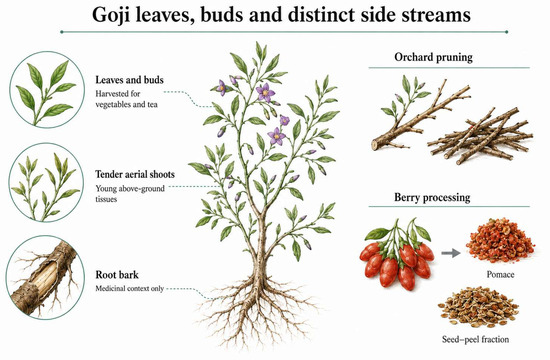
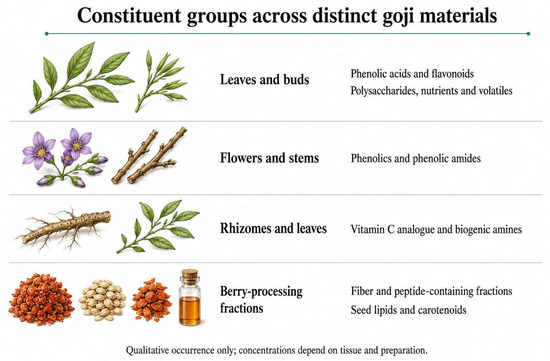
Berry-processing residues are defined by the preceding operation. Pressing, extraction, separation of seeds and peel, and fermentation produce fractions with different fiber, lipid, and soluble-component contents [20,21,22,32]. Seeds are considered here only as constituents of a defined processing residue, rather than as a separate survey of seed phytochemistry [17]. Figure 1 distinguishes these source materials from deliberately harvested leaves and buds.
Figure 1.
Botanical sources and production streams considered in the review. Leaves, buds, and tender shoots are food-oriented harvested tissues, and woody branches arise from pruning, whereas pomace and seed–peel fractions arise from berry processing. Root bark is shown only as medicinal context. The botanical artwork is schematic and AI-assisted, not a specimen photograph or a species identification key.
4. Composition of Leaves and Buds
4.1. Leaf Nutrients, Taste Compounds, and Volatiles
Seasonal analyses of L. chinense leaves reported variation in micronutrients, fiber, and rutin [33], while a separate study, available here at abstract level, described seasonal sugars, organic acids, free amino acids, and volatiles [34]. These observations link harvest time to nutritional and flavor-related composition, although the abstract-only record permits less detailed appraisal. An abstract-level report of elemental analysis in L. barbarum leaves provides a complementary description of inorganic constituents [35]. Whole-leaf measurements and infusion composition are different quantities: brewing extracts only part of the dry material, whereas incorporation of leaf powder retains the insoluble fraction.
Genotype and tea processing modify aroma alongside these nutritional differences. Green- and white-tea procedures applied to leaves from 25 L. barbarum lines produced distinct volatile profiles [6]. A comparison of bud tea and mature-leaf tea also found differences in composition and enzyme inhibition responses [7]. Thus, a difference attributed to “goji leaf tea” can originate in the harvested tissue, the plant line, or the processing treatment. Within-study comparisons are particularly informative because they hold some of these factors constant.
4.2. Phenolics, Flavonoids, and Phenolic Amides
Rutin, chlorogenic-acid-related compounds, caffeoylquinic acids, and other flavonoid glycosides recur in leaf analyses [36,37,38]. Their concentrations differ with plant population, position on the shoot, and harvest date. Huang et al. applied reflux, ultrasound, and enzyme-assisted extraction to each of three L. barbarum tissues: bud, young, and old leaves [37]. The nine tissue–method combinations permit comparisons among tissues within the same extraction method and among methods within the same tissue. Zhang et al., in contrast, used HPLC fingerprints and four markers to follow harvest period differences in a fruitless cultivar [38]. Tissue maturity, extraction procedure, and seasonal variation, therefore, represent distinct sources of compositional heterogeneity. Analytical selectivity is another source of variation. In a seasonal L. chinense study, spectrophotometry gave much higher apparent rutin contents than HPLC on the same leaf extracts, and the authors attributed this difference to co-extracted interfering substances [33]. Such method effects cannot be explained by harvest or genotype and make total colorimetric responses unsuitable substitutes for compound-specific concentrations.
The magnitude of the reported differences is illustrated in Table 1. Dong et al. reported rutin concentrations of 16.03–16.33 mg/g dry leaf in four cultivated varieties supplied by a Ningxia institute, compared with 6.24–7.55 mg/g in wild populations from Qinghai, Xinjiang, Ningxia, and Inner Mongolia [36]. All were young leaves collected before flowering. In Romanian leaves extracted with 70% methanol, chlorogenic acid was 0.511 mg/g in a wild population and 17.811 and 24.887 mg/g in Biglifeberry and Erma, respectively [39]. Across 10 harvests of a fruitless cultivar, catechin ranged from 2.63 to 16.33 mg/g, approximately a 6.2-fold difference, while epicatechin, rutin, and chlorogenic acid each varied by more than 10-fold [38]. These are within-study contrasts, not interchangeable concentration ranges for commercial goji leaves.
Table 1.
Illustrative within-study comparisons of goji leaf composition from selected full texts.
Isolation studies extend the leaf profile beyond the commonly quantified phenolics, reporting sesquiterpenoid glycosides, water-soluble constituents, and compounds isolated from tender leaves [40,41,42]. Hydroxycinnamic acid amides show organ-dependent distributions in direct root-bark and leaf analyses [43]. Caffeoyl spermidine derivatives have also been recovered from L. barbarum leaf tea, linking this compound class to a processed beverage material [44]. A separate stem–fruit comparison illustrates further organ variation but is not evidence for the nutritional composition of edible leaves [45].
4.3. Polysaccharides and Other Macromolecular Fractions
Leaf polysaccharides differ with the extraction sequence and subsequent degradation. Isolation and sequential-extraction studies describe fractions with different molecular and monosaccharide characteristics, together with splenocyte or in vitro fermentation responses [46,47]. Ascorbic acid–hydrogen peroxide treatment reduces the molecular size of a crude leaf preparation and alters its physicochemical behavior [48]. Because this treatment can change more than chain length, the resulting fraction is not simply a lower-molecular-weight version of an otherwise unchanged food ingredient.
The 2021 dough study and the 2022 characterization study report crude and degraded fractions of approximately 223.5 and 64.3 kDa [48,49], whereas the 2024 dough study reports 223.5 and 94.3 kDa [9]. Their preparation histories differ. The 2021 and 2022 studies used leaves collected in August 2019 and August 2020, respectively, extracted them at 121 or 120 °C for 1 h, and selected a 0.1 M NaCl fraction by DEAE chromatography [48,49]. The 2024 study instead describes two 4 h extractions at 70 °C and AB-8 resin purification, without reporting the same DEAE selection [9]. Although all three used hydrogen peroxide/ascorbic acid degradation, the 2024 method gives a 1:1 ratio without the absolute reagent quantities reported in the earlier protocols. The preparations consequently cannot be treated as a common polysaccharide fraction varied only in molecular mass.
Analytical comparability is also incomplete. The 2022 study estimated molecular mass by refractive-index detection with dextran calibration, while multi-angle light scattering supplied the radius of gyration [48]. The 2021 report describes laser-light-scattering gel chromatography, and the 2024 report cites earlier gel permeation methods without restating the full measurement conditions [9,49]. Within the 2022 experiment, increasing degradation reagent concentration produced fractions of 187.7, 144.9, 96.26, and 64.3 kDa [48]. That within-protocol series is more interpretable than a cross-paper comparison. The difference between 64.3 and 94.3 kDa does not by itself establish a reporting error, and the documented method differences do not prove its cause. The source-specific protocols and unresolved measurement details are compared in Supplementary Methods S1.
4.4. Other Organs and Residual Fractions
An ethanolic L. barbarum flower extract contained phenolics and showed chemical antioxidant responses and mild activity against the tested Gram-positive bacteria [50]. In contrast, the stem phenolic-amide study evaluated glioma stem cell responses, not antimicrobial activity [51]. Analyses of the vitamin C analog 2-O-β-D-glucopyranosyl-L-ascorbic acid distinguish underground rhizomes from aerial stems and leaves [52]. Biogenic-amine profiles also differed between young leaves, mature leaves, and main-stem bark [53]. These organ-specific investigations broaden the known chemical distribution, although food formulation evidence remains concentrated in leaves and buds.
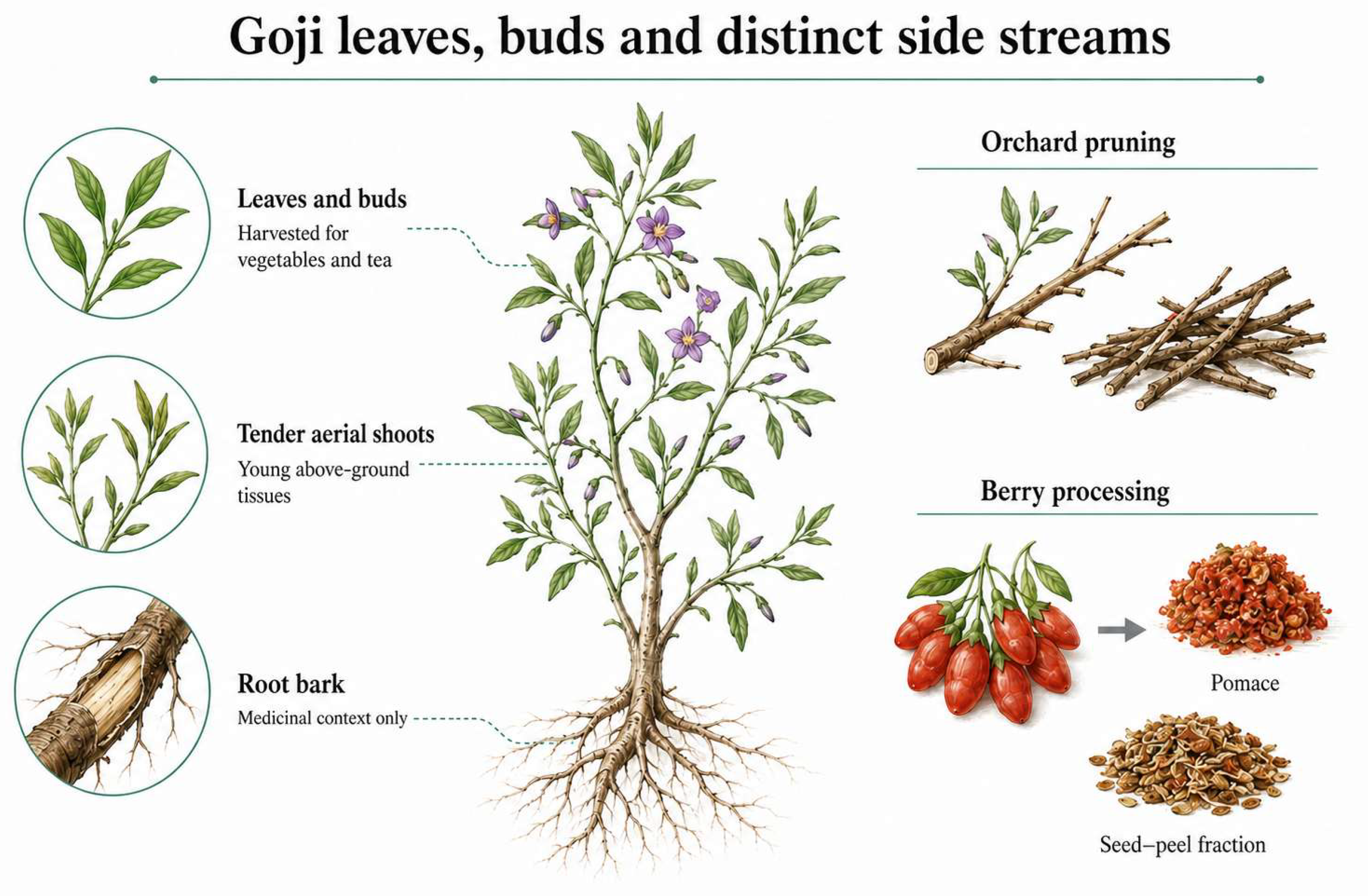
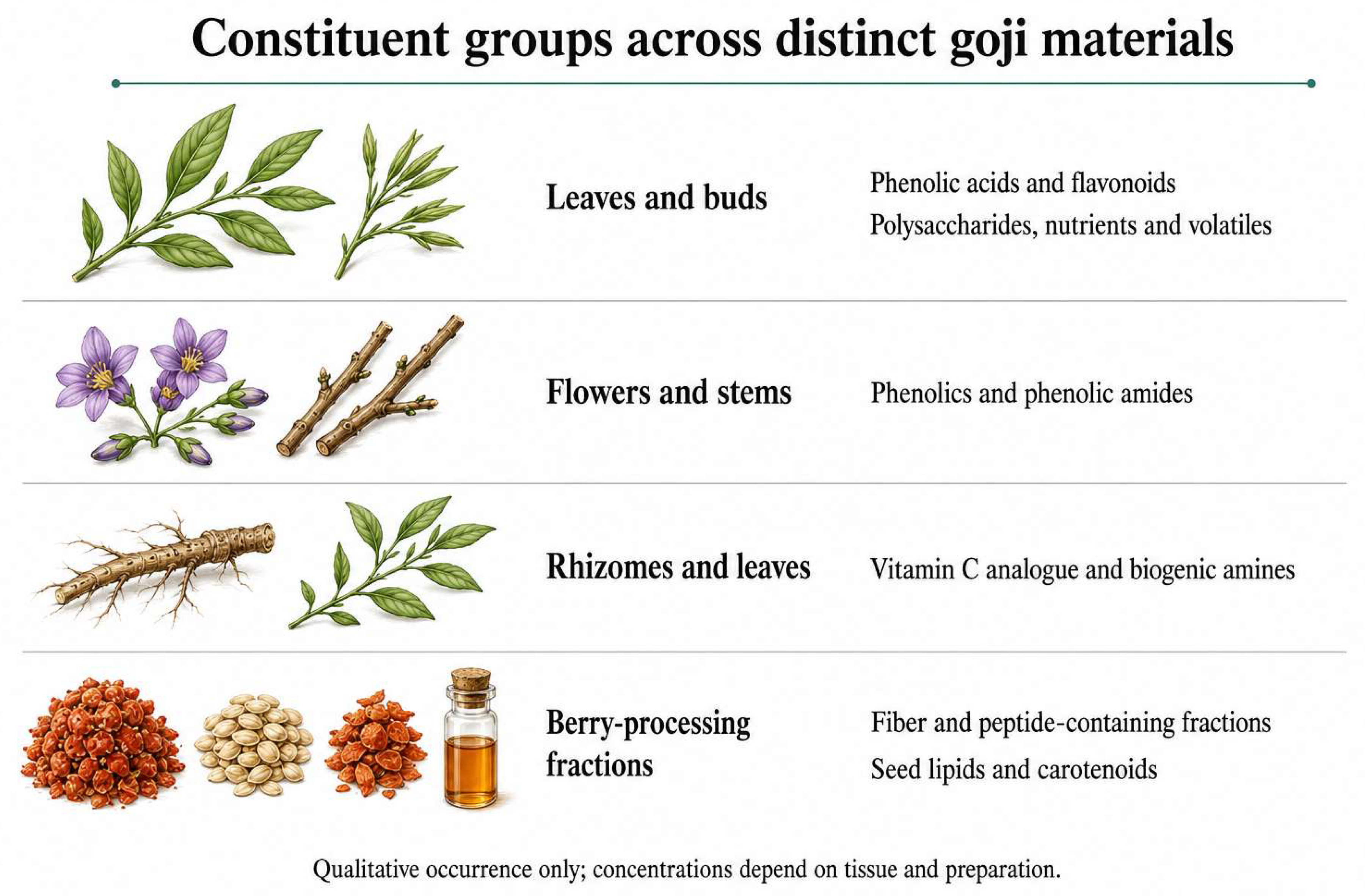
Berry residues provide contrasting ingredient sources. An ACE-inhibitory peptide, GPFN, was identified from ultrafine L. barbarum pomace powder using enzyme assays and in silico analysis [20]. A different study used trivalent iron salts to release sweet-enhancing volatiles from pomace [21], while supercritical carbon dioxide extraction recovered an oil rich in zeaxanthin dipalmitate from a seed–peel residue [22]. The peptide-containing powder, treated pomace, and recovered oil are distinct products of different processes. Fermentation changes residual biomass further, and feeding and multi-omics studies examine these altered residues rather than intact leaves or berries [32,54,55]. Figure 2 summarizes the principal compositional groups without implying equal abundance among materials.
Figure 2.
Principal constituent groups reported for goji leaves, buds, and selected comparator materials. The map is qualitative—it does not compare concentrations or nutritional value. Tender aerial shoots and underground rhizomes are distinct tissues. Illustrations are AI-assisted schematic artwork.
5. Processing and Applications in Food Matrices
5.1. Teas and Fermented Products
Tea aroma varies with both plant line and processing. Green- and white-tea procedures produced different volatile profiles across 25 goji lines [6], while bud-versus-leaf comparisons showed variation in phenolics and enzyme inhibition responses [7]. A 2026 metabolomics study followed Ningqicai No. 1 shoot tips from fresh material through withering, fixation, stir-firing, and fragrance enhancement [56]. Early and heated stages differed in metabolite profiles, but the reported pre-injection β-glucosidase treatment complicates attribution of glycoside-to-aglycone changes to tea manufacture alone. The study supports stage-associated chemical variation more directly than its proposed enzymatic mechanism. Microbial processing offers a separate route: a 12-day pile fermentation study reported microbial succession accompanied by changes in volatiles, bitterness, and astringency [8]. Only its abstract was available for appraisal. Together, the studies indicate that genotype, tissue maturity, thermal treatment, and fermentation contribute different sources of flavor variation.
5.2. Extraction and Fractionation
Aqueous extraction followed by ultrafiltration and nanofiltration clarified and concentrated leaf constituents [57]. Membrane fractionation separates components from an extract mixture, whereas solvent-assisted extraction changes their initial recovery from the plant matrix. This difference is important when comparing an aqueous concentrate with the phenolic-enriched fractions obtained using eutectic solvents.
Three recent studies used choline chloride–lactic acid, betaine–ethylene glycol, and betaine–1,3-butanediol–lactic acid, respectively, to extract leaf phenolics or flavonoids [58,59,60]. Downstream separation is important to interpreting their products. In the betaine–ethylene glycol study, the extract underwent D101 resin separation, washing with 3.5 bed volumes of water, elution with 70% ethanol, and lyophilization [59]. The betaine–1,3-butanediol–lactic acid study also used D101 resin but reported a two-bed-volume water wash and 75% ethanol elution before solvent removal and freeze-drying [60]. The choline chloride–lactic acid paper was available only at abstract level, so its downstream cleanup could not be appraised here [58].
The betaine–ethylene glycol study reported extraction performance above 90% after three solvent-reuse cycles [59]. This is a relative extraction result, not a measurement of solvent mass recovery or residual solvent in the final ingredient. Likewise, the reported biological assays on purified fractions do not assess dietary safety of the original extraction mixtures [59,60]. Resin washing and ethanol elution establish that a cleanup step was performed, but do not by themselves quantify residual exposure. Food-use interpretation, therefore, depends on the final ingredient rather than on the starting extract: residual concentrations and the amount consumed are needed to relate purification to exposure. Neither extraction yield nor the designation “natural” establishes food suitability or environmental superiority.
Ion-exchange separation of caffeoyl spermidine derivatives from L. barbarum leaf tea produced a combined fraction with reported recovery of 92.5% and purity of 87.6% [44]. Further preparative separation yielded individual derivatives. The result demonstrates enrichment of a compound class present in tea, but the concentrated fraction is chemically different from the beverage. Its production also introduces salt and ethanol recovery operations, for which the study does not establish a complete manufacturing mass balance or commercial cost.
5.3. Cereal and Bakery Matrices
Leaf polysaccharides modified wheat dough at additions of 0.5–2.0% of flour weight [9,49]. In the 2021 experiment, the degraded preparation increased extension resistance and extension area under selected addition levels, with concurrent changes in protein interaction and microstructural measurements [49]. The 2024 study found dose-dependent changes in hydration, texture, extensographic behavior, and cooking loss, but not a significant improvement in the trained-panel sensory scores of rinsed dough [9]. Thus, an instrumental rheological change did not translate automatically into a sensory advantage. The 2024 results also describe the color of baked dough, but the reported methods provide no corresponding baking protocol. Without those conditions, the color observations cannot be related to a reproducible finished-product test. Within-study dose comparisons remain more informative than a combined molecular-weight–response relationship because the preparations are not demonstrably equivalent.
In muffins and cookies, a berry-processing by-product increased protein, fiber, and phenolic measures while also changing physical and sensory properties [19]. The publisher abstract describes product-dependent effects but does not support a detailed comparison of acceptable substitution limits. This multi-component addition differs from the purified leaf polysaccharides used in dough experiments: its fiber and other residual components remain in the baked product alongside extractable phenolics.
5.4. Delivery Systems, Emulsions, and Savory Foods
Protein-based carriers alter the stability of leaf constituents and co-encapsulated carotenoids. An abstract-level report describes whey protein isolate and bovine serum albumin nanoparticles containing a leaf extract [10]. In a full-text study, purified L. barbarum leaf flavonoids were coupled to whey protein using hydrogen peroxide and ascorbic acid, followed by dialysis [11]. The conjugates improved β-carotene retention during storage and simulated digestion relative to whey protein alone. However, the model emulsions contained 0.02% sodium azide as a preservative and were prepared at pH 8—they were not edible test formulations. Their endpoint was retained β-carotene content, not micellar bioaccessibility or absorption. A separate abstract-level study used collagen–leaf-flavonoid conjugates for lutein emulsions [61]. Differences in protein, carotenoid, pH, and preparation prevent treating these systems as a common validated food ingredient.
Leaf-polyphenol liposomes were examined for storage stability, release into phosphate buffer at pH 7.4, and protection of hydrogen-peroxide-treated L929 fibroblasts [62]. Buffer release is not simulated gastrointestinal digestion. A separate leaf-polysaccharide Pickering emulsion study did include simulated digestion, but curcumin loading destabilized the tested emulsions [63]. Demineralization increased free-fatty-acid release while reducing micellar curcumin recovery. These divergent responses show why greater lipid digestion cannot be equated with greater bioaccessibility of the encapsulated compound. Neither experiment measured human absorption or the sensory performance of a finished food.
Savory-food experiments show a clearer trade-off between ingredient addition and taste. The abstract of a chicken soup study reports changes in composition, volatiles, and sensory attributes after addition of bud tea [12]. In a full-text stewed chicken study, L. barbarum bud tea was added at 15, 20, or 25 g/kg [64]. The 20 g/kg treatment achieved the highest tenderness and overall sensory scores among the tested formulations, whereas 25 g/kg increased bitterness. These scores came from ten trained assessors, not a consumer sample. The response consequently identifies a formulation-specific balance rather than a generally optimal intake.
A 70% ethanol leaf-flavonoid extract was evaluated at 0.01%, 0.1%, and 1% in bowl-steamed Tan lamb [65]. After seven days of storage and reheating, the 0.1% treatment most consistently limited warmed-over flavor and associated lipid oxidation volatiles. The ten-person trained-panel experiment thus favored an intermediate rather than maximal addition. The methods specify −4 °C storage, whereas the results describe 4 °C, leaving the storage regime unresolved and preventing an inference about refrigerated shelf life. The within-experiment flavor comparison remains relevant, but the lamb and chicken studies used different matrices, preparations, and sensory protocols and do not establish a common optimal inclusion level.
Table 2 compares the tested preparations, experimental systems, and measured outcomes in processing and food application studies.
Table 2.
Experimental systems and reported outcomes in processing and food application studies.
6. Digestion and Biological Activities
6.1. Digestion and Bioaccessibility
Digestion changes the fraction available to subsequent assays. A leaf-phenolic study combined simulated gastrointestinal digestion with an alcohol-damaged AML-12 hepatocyte model and observed activity of the post-digestion fraction within that cell system [66]. The choline chloride–lactic acid study, available here at abstract level, reported losses of recoverable phenolics and assay responses during simulated digestion [58]. Conversely, whey-protein–leaf-flavonoid emulsions retained more β-carotene than the protein-only comparator [11]. Chemical recovery after digestion and release into a potentially absorbable fraction are different endpoints: retention alone does not demonstrate bioaccessibility, and neither measures intestinal absorption or systemic bioavailability. Sequentially extracted leaf polysaccharides also differed in in vitro fermentation behavior, extending the evidence to a colonic model rather than solely the upper-gastrointestinal compartment [47].
6.2. Biological Models and Interpretation
The biological literature examines different preparations and endpoints. Wild and cultivated L. barbarum leaf extracts differed in phenolic profiles and in chemical or enzyme-based assay responses [39]. Flavonoid preparations were associated with changes in metabolic, oxidative stress, and microbiota endpoints in high-fat-diet-fed mice, and with redox-related responses in cells and Caenorhabditis elegans [67,68]. Polysaccharide studies instead include splenocyte proliferation and an ovalbumin-induced asthma mouse model [46,69]. These findings cannot be collapsed into a single mechanism: the interventions differ in composition, concentration, and disease model. In particular, an antioxidant assay or a change in microbial abundance does not establish the pathway by which a leaf-containing food would affect human health.
Target-animal feeding studies have a different interpretation from rodent disease models. Branch roughage in dairy cows, mixed branch–leaf biomass in sheep, and processing residue in grass carp were tested for outcomes relevant to those feed uses [29,30,70]. Their dietary formulations and endpoints are directly relevant to the target species but do not provide human food efficacy evidence.
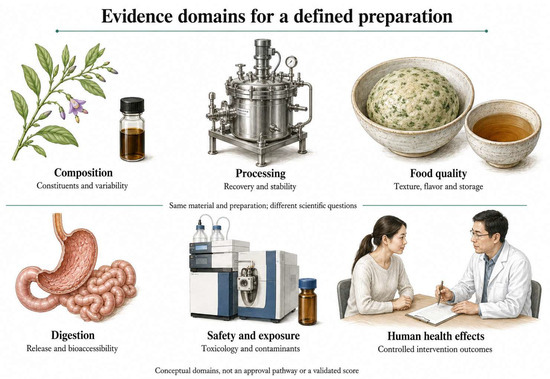
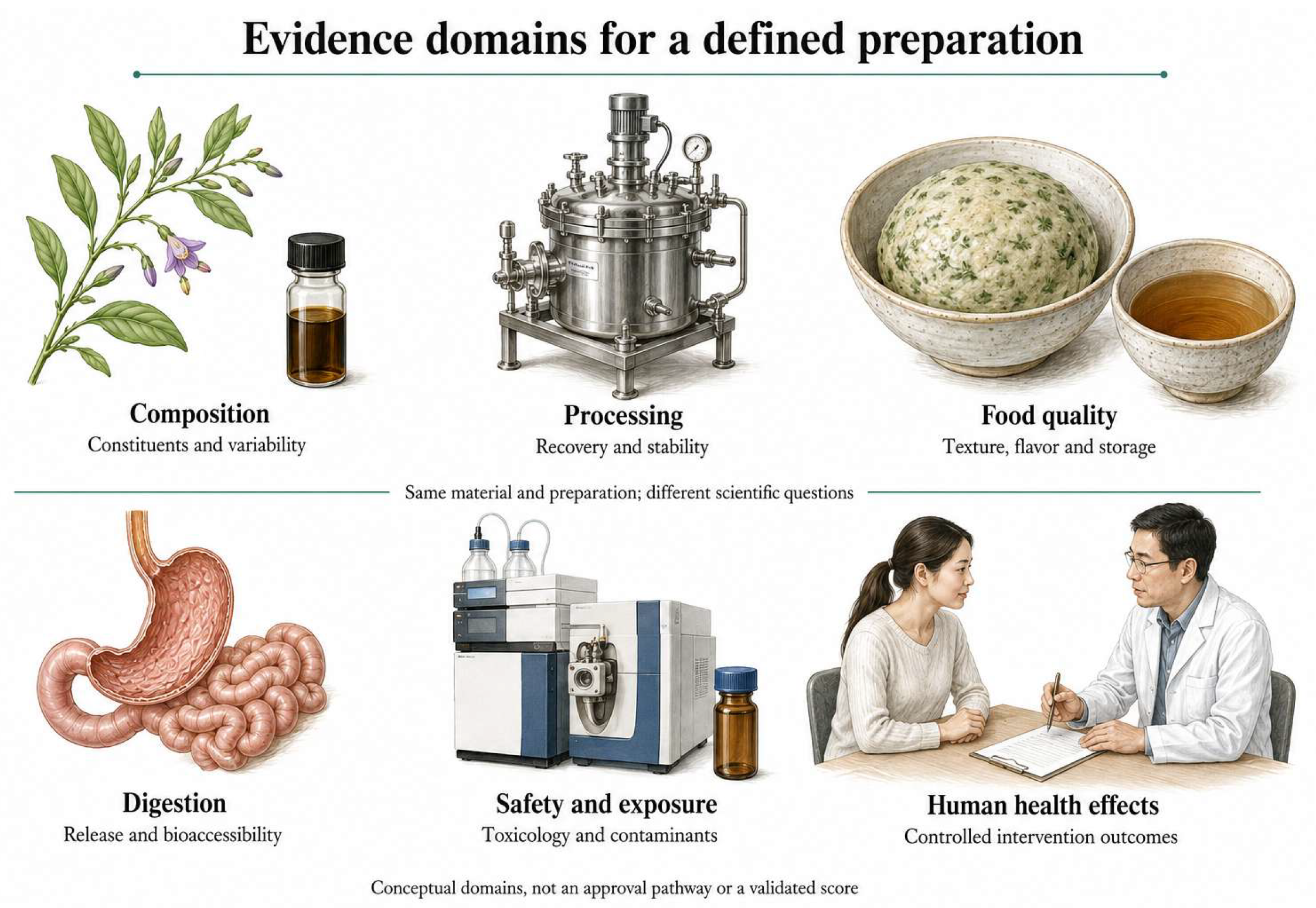
Clinical efficacy of a defined leaf- or bud-derived food is not established by the studies represented in this review. Their principal outcomes are chemical, technological, simulated-digestion, cell, or animal measurements. Figure 3 distinguishes these evidence domains and the different outcomes they address.
Figure 3.
Different claims require different evidence. Composition, processing performance, food quality, digestion, safety, and human health effects are separate evidence domains linked to a defined preparation. The layout is non-sequential: it is not a six-stage approval pathway, and not every type of claim requires all domains. Illustrations are AI-assisted schematic artwork.
7. Safety, Quality Control, and Regulatory Considerations
7.1. Preparation-Specific Safety
A toxicology study examined roasted L. chinense leaves extracted with 30% ethanol, concentrated and spray-dried, and standardized to a kaempferol glycoside [71]. Acute toxicity, 14-day repeated-dose exposure, and genotoxicity assays did not identify evident toxicity under the tested conditions. The exposure duration limits this result to short-term safety of the specified extract. Longer-term intake, fresh-leaf consumption, and preparations from other species were not evaluated in that experiment.
In a direct organ comparison, solasonine and 5,6-dihydrosolasonine were detected in the tested fruit powder but not in the analyzed leaf or root-bark samples [23]. Non-detection is conditional on the sampled material and analytical method—it does not establish absence from all production batches. The cited evidence also does not resolve product-specific allergenicity or a broad antinutrient profile. These uncertainties are particularly relevant when extraction concentrates constituents or when a whole-leaf food replaces an infusion.
7.2. Pesticides, Elements, and Biogenic Amines
Pesticide occurrence in dry tea and transfer into the beverage are related but distinct observations. A field study found that spray adjuvants affected deposition differently on leaves and fruits [72]. In market surveillance, Li et al. detected 23 pesticides in 28 of 30 goji bud-tea samples [13]. The main-text description of these market samples did not assign a Latin species, and the findings, therefore, remain product-specific rather than species-specific. Their infusion experiment used one selected sample, 2.0 g tea per 100 mL boiling water, and three successive brews. Transfer varied by compound, increased with infusion duration in the tested conditions, and generally declined over successive brews. Although the modeled dietary risks remained below the authors’ thresholds, the result depends on that exposure model and cannot substitute for batch compliance testing. A one-sample transfer experiment also leaves uncertainty about seasonal and manufacturing variation.
Processing effects on residues have also been measured in goji fruit. Drying concentrated the four investigated pesticides, whereas decoction and brewing reduced transfer into consumed products under the tested conditions [73]. The different organs and processing protocols preclude using these numerical factors to estimate bud-tea exposure. The elemental analysis report available here at abstract level supports occurrence in L. barbarum leaves, not a serving-based exposure or compliance assessment [35]. The biogenic-amine study sampled eight L. barbarum materials: young and mature leaves, young and mature stems, main-stem bark, flowers, fruit, and roots [53]. The leaf–bark comparison discussed here is a subset of that design, and the sampled bark was main-stem bark rather than medicinal root bark. Histamine was higher in the tested main-stem bark, whereas the tissue patterns of other amines differed. These measurements neither establish a common hazard for all biogenic amines nor quantify the dose consumed in a leaf infusion.
7.3. Identity, Specification, and Regulatory Status
Published leaf position and harvest period studies show that a chemically variable raw material can retain the same commercial name [37,38]. A fingerprint can distinguish such batches, but no single phenolic marker describes aroma, microbial quality, contaminant burden, and technological function simultaneously. Whole-leaf powder also differs from tea because the insoluble material is consumed rather than discarded. These distinctions explain why a specification established for a dry leaf extract cannot be applied unchanged to the beverage.
Processing creates further differences in the attributes that define an ingredient. Molecular-size distribution and degradation history distinguish the polysaccharides used in dough experiments [9,48,49]. Seed and peel proportions distinguish the oil-recovery residue from other pomaces [22], whereas fiber content and residual foliage are central to branch and mixed branch–leaf feeds [29,30]. Quality control is, therefore, preparation-specific, not a common phenolic threshold for every goji-derived resource.
The regulatory examples considered here concern China and the European Union, not a global assessment. In the European Union, the Novel Food Status Catalogue is non-binding and non-exhaustive. A history of significant consumption before 15 May 1997, the identity of the preparation, and the applicable consultation or authorization route are relevant to novel-food status [74,75]. Historical consumption of one plant part does not by itself establish the status of a concentrated extract or another organ. The Commission also identifies extraction solvents used in food production as a separate regulatory subject under Directive 2009/32/EC [75]. Novel-food status and extraction solvent compliance are thus different questions, and the cited guidance does not establish authorization of the specific eutectic mixtures discussed above. A regulatory status record is also distinct from toxicological evidence.
In China, GB/T 18672-2014 addresses wolfberry fruit, rather than establishing a specification for leaf tea or concentrated leaf ingredients [76]. A Tibet Autonomous Region notice records an enterprise standard filing for goji bud tea, while expressly stating that filing is not evidence of product safety or a prerequisite for production licensing [77]. The notice thus documents a filing, not nationwide authorization or a safety endorsement. Product development requires confirmation of the applicable current rules for the precise species, part, process, and market.
8. Side-Stream Valorization: Tested Routes and Constraints
8.1. Berry-Processing Residues in Food and Feed
Circular valorization refers here to recovery or reuse of residual material from an existing production chain. It does not mean that every recovered product has demonstrated economic or environmental superiority. Goji by-product incorporation in muffins and cookies retains multiple components in a food matrix [19], whereas peptide recovery, iron-assisted volatile release, and residue-oil extraction isolate or modify selected fractions [20,21,22]. These routes differ in product yield, additional reagents, and the remaining biomass, and their results are not directly comparable measures of value.
A sequence of oil recovery, extraction of other constituents, and use of the remaining solids is a possible cascade, but it has not been demonstrated as an integrated goji process by the studies considered here. The individual experiments do not provide a common-batch mass balance, techno-economic analysis, or life-cycle comparison of competing routes. Greater extraction yield can also involve additional solvent, water, drying, or separation. Consequently, “green” extraction and “high-value” recovery remain process claims requiring evidence beyond laboratory yield.
Raw and fermented residues have been incorporated into sheep, lamb, and grass-carp diets, with measurements of growth, immune, intestinal, or meat-quality endpoints [32,54,55,70]. Other sheep studies measured energy and nitrogen metabolism, methane emissions, rumen fermentation, and digestive or antioxidant indices [78,79]. Silage experiments examined fermentation quality and microbial communities after addition of goji by-products [80]. These studies address different feed-processing questions, and a fermentation-associated change in residue composition is not necessarily equivalent to a benefit from the untreated residue.
Interpretation depends on the basal diet and inclusion level as well as on residue composition. Replacing part of a conventional feed changes both the added material and the displaced ingredient, while fermentation can alter moisture, nutrient availability, and storage behavior. The reported animal or silage outcomes, therefore, apply to the tested formulations. They do not establish that the same residue can enter a human food chain or that a feed route is economically preferable to another recovery option.
8.2. Orchard Branches and Non-Food Leaf Biomass
Woody branches have been examined as dairy cow roughage and as a cultivation substrate [29,31]. These applications exploit structural biomass rather than the edible-leaf composition emphasized in food studies. Separately, leaf biomass has undergone enzymatic saccharification with fungal enzyme cocktails [81]. This is a leaf-derived biorefinery experiment, not a branch conversion study, and its carbohydrate-release endpoint is distinct from nutritional or sensory performance. Table 3 separates the materials and the direct evidence for each use.
Table 3.
Preparation-specific safety, exposure, regulatory, and side-stream evidence.
Food incorporation and ingredient recovery favor different properties of the same biomass. Retaining a multi-component residue in bakery products can increase fiber and phenolic measures but also alters texture [19]. Fractionation yields more concentrated constituents, at the cost of additional separation and recovery operations [20,21,22]. Feed and cultivation routes instead use larger residual fractions with fewer requirements for isolation. Comparisons of their net value remain limited by the absence of common-input mass balances, costs, and environmental measurements.
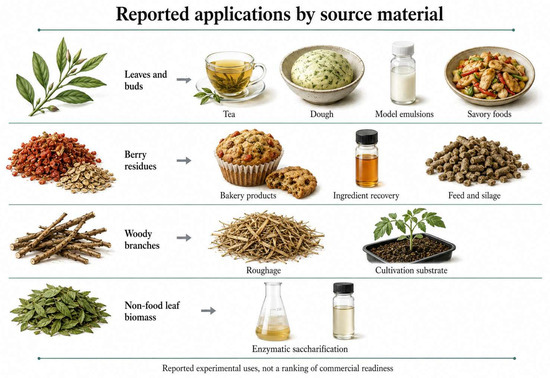
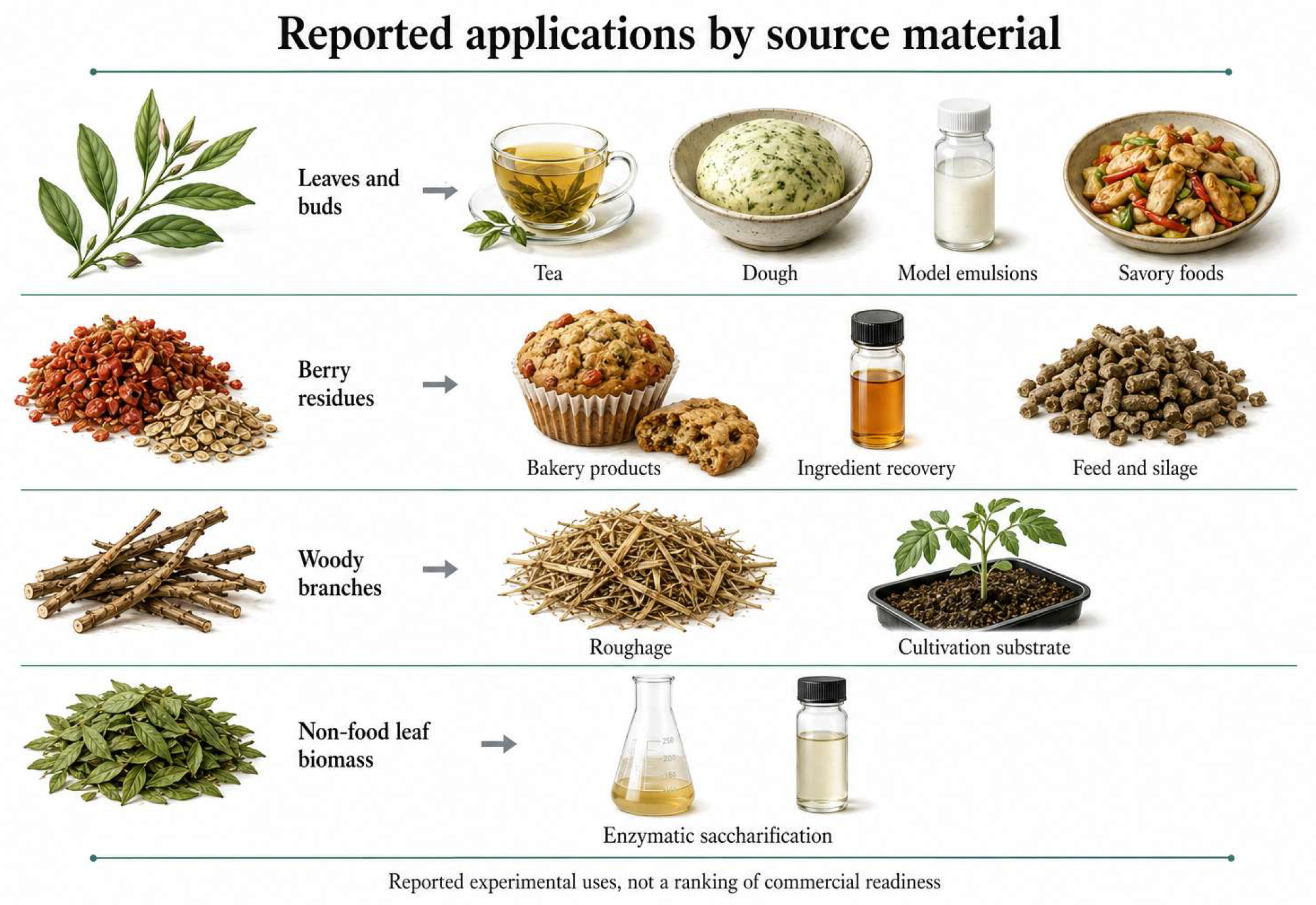
Reported applications consequently fall into distinct material and product groups (Figure 4). Leaf and bud experiments chiefly examine tea chemistry and formulated food performance, berry residues enter food incorporation, fraction recovery, and feeding trials, and woody branches are used as structural agricultural biomass. This distribution reflects the systems studied, rather than a demonstrated order of commercial readiness.
Figure 4.
Reported applications of distinct goji resources. The unranked map links leaves and buds to food and formulation studies, berry residues to food/feed or recovery experiments, and woody branches to agricultural uses. Non-food leaf saccharification is identified separately. Layout does not denote readiness, safety approval, or superiority. Illustrations are AI-assisted schematic artwork.
9. Conclusions
Goji leaves and buds are compositionally variable food materials, with differences attributable to species, cultivar, tissue maturity, harvest, and processing. Research now includes tea, dough, colloidal carriers, and savory foods, but the outcomes are not uniformly favorable: improved instrumental properties or greater phenolic content can coexist with bitterness, altered texture, or unchanged sensory scores. The most informative results are, therefore, the preparation- and dose-specific comparisons, rather than a general claim of leaf bioactivity.
Simulated digestion and biological models provide preparation-specific observations, while safety information remains limited to particular extracts, batches, and exposure models. The main food development uncertainties concern reproducibility of composition and technological performance, serving-based exposure, and the balance between enrichment and sensory quality. Berry-processing residues and woody branches have separate recovery and agricultural uses. Their comparative environmental and economic performance remains unresolved because integrated, common-input evaluations are scarce.
Supplementary Materials
The following supporting information can be downloaded at: https://www.mdpi.com/article/10.3390/foods15183298/s1. Supplementary Methods S1: Archived search procedures, revision-update log, source-access definitions, and evidence description. Supplementary Table S1: Scope of related reviews. Supplementary Table S2: Source register. Supplementary Table S3: Quantitative composition extraction. Supplementary Data S1a: Archived discovery ledger (29 July 2026). Supplementary Data S1b: Revision-addition records (6 September 2026). Supplementary Data S2a: Reference number crosswalk. Supplementary Data S2b: Current manuscript citation audit.
Author Contributions
Conceptualization, J.Z., S.W. and Y.S.; methodology, J.Z., X.T. and Y.S.; investigation, J.Z. and X.T.; data curation, J.Z. and X.T.; validation, S.W. and Y.S.; visualization, J.Z. and X.T.; writing—original draft preparation, J.Z. and X.T.; writing—review and editing, J.Z., X.T., S.W. and Y.S.; supervision, S.W. and Y.S.; project administration, S.W.; funding acquisition, S.W. and Y.S. All authors have read and agreed to the published version of the manuscript.
Funding
This research was funded by the National Natural Science Foundation of China, grant numbers 82607889, 82660883, and 82607890; the Ningxia Natural Science Foundation, grant number 2025AAC050076, the Key Research and Development Program of Ningxia Hui Autonomous Region, grant number 2025BEH04093, and the Scientific Research Funding Project of Ningxia Medical University, grant numbers XT2025037 and XT2025071.
Institutional Review Board Statement
Not applicable.
Informed Consent Statement
Not applicable.
Data Availability Statement
No new data were created or analyzed in this study. Data sharing is not applicable to this article.
Acknowledgments
OpenAI Codex was used for search query refinement, literature record organization, assisted extraction, English drafting and substantive revision, language editing, and document formatting. An OpenAI image generation service accessed through Codex was used to generate and revise schematic botanical and material illustrations—the image-model identifier was not exposed by the interface. AI outputs were not used as scientific references or experimental data. Responsibility for verification of the sources, interpretations, illustrations, and final manuscript rests with the authors.
Conflicts of Interest
The authors declare no conflicts of interest.
References
- Potterat, O. Goji (Lycium barbarum and L. chinense): Phytochemistry, Pharmacology and Safety in the Perspective of Traditional Uses and Recent Popularity. Planta Medica 2010, 76, 7–19. [Google Scholar] [CrossRef] [Scilit]
- Vidović, B.B.; Milinčić, D.D.; Marčetić, M.D.; Djuriš, J.D.; Ilić, T.D.; Kostić, A.; Pešić, M.B. Health Benefits and Applications of Goji Berries in Functional Food Products Development: A Review. Antioxidants 2022, 11, 248. [Google Scholar] [CrossRef] [Scilit]
- Jurikova, T.; Tinakova, S.M.; Ziarovska, J.; Szekeres, L.; Mlcek, J.; Fatrcova-Sramkova, K.; Knazicka, Z.; Skrovankova, S. Polyphenolic Spectrum of Goji Berries and Their Health-Promoting Activity. Foods 2025, 14, 1387. [Google Scholar] [CrossRef] [Scilit]
- Noreen, S.; Niazi, M.K.; Arshad, M.T.; Ikram, A.; Gnedeka, K.T. Goji berries: A review of their bioactive components and health-promoting properties. Int. J. Food Sci. Technol. 2025, 60, vvaf232. [Google Scholar] [CrossRef] [Scilit]
- Lei, Z.; Chen, X.; Cao, F.; Guo, Q.; Wang, J. Phytochemicals and bioactivities of Goji (Lycium barbarum L. and Lycium chinense Mill.) leaves and their potential applications in the food industry: A review. Int. J. Food Sci. Technol. 2022, 57, 1451–1461. [Google Scholar] [CrossRef] [Scilit]
- Zhang, M.; Lu, L.; Hu, X.; Zhou, C.; Zhang, C.; Fang, J.; Duan, L.; Zhang, B.; Guo, Y. Aroma characteristics and adaptability of Goji (Lycium barbarum L.) leaf tea prepared from 25 different Goji lines. Food Chem. 2025, 489, 144973. [Google Scholar] [CrossRef] [Scilit]
- Wei, J.; Zhang, L.; Mi, J.; Wei, J.; Luo, Q.; Lu, L.; Yan, Y. Chemical Composition and Inhibitory Effect of Lycium barbarum L. Bud Tea and Leaf Tea on Pancreatic Lipase and α-Amylase Activity. Foods 2025, 14, 3167. [Google Scholar] [CrossRef] [Scilit]
- Zhao, Y.; Gu, C.; Qian, H.; Yao, W.; Cheng, Y. Multi-omics analysis uncovers an integrated network that reshapes flavor compound profile of goji bud tea by fermentation. Int. J. Food Microbiol. 2026, 450, 111649. [Google Scholar] [CrossRef] [Scilit]
- Al-Wraikat, M.; Abubaker, M.A.; Li, L.; Liu, Y.; Li, J. Impact of Lycium barbarum polysaccharides on wheat dough quality and hydration dynamics. LWT 2024, 209, 116753. [Google Scholar] [CrossRef] [Scilit]
- Ni, Z.-J.; Liu, C.-B.; Xue, Y.; Huang, H.; Ma, Y.-L.; Thakur, K.; Shang, Y.-F.; Khan, M.R.; Wei, Z.-J. Enhanced protection and bioavailability of Lycium barbarum leaf extract through encapsulation in whey protein isolate and bovine serum albumin nanoparticles. Food Chem. 2025, 463, 141506. [Google Scholar] [CrossRef] [Scilit]
- Fan, Y.; Sun, X.; Fang, T.; Ma, M.; Wu, Y.; Zha, X. Utilisation of flavonoids from Lycium barbarum L. leaves cross-linked with whey protein for the stabilisation and delivery of β-carotene emulsions. Int. J. Food Sci. Technol. 2023, 58, 249–258. [Google Scholar] [CrossRef] [Scilit]
- Zhou, J.; Wu, J.; Luo, Y.; Yao, L.; Zhu, J.; Ma, H.; Luo, R.; Wang, S.; Bai, S. Enrichment of the nutritional and flavor profiles of chicken soup using goji bud tea: Flavor analysis based on intelligent algorithms. Food Chem. 2026, 501, 147587. [Google Scholar] [CrossRef] [Scilit]
- Li, S.; Fu, J.; Song, R.; Pan, W.; Wang, Y.; Chen, Z.; Li, L. Integrating occurrence and transfer to understand the risks of multi-pesticides in goji berry bud tea. J. Food Compos. Anal. 2025, 142, 107547. [Google Scholar] [CrossRef] [Scilit]
- Yu, J.; Yan, Y.; Zhang, L.; Mi, J.; Yu, L.; Zhang, F.; Lu, L.; Luo, Q.; Li, X.; Zhou, X.; et al. A comprehensive review of goji berry processing and utilization. Food Sci. Nutr. 2023, 11, 7445–7457. [Google Scholar] [CrossRef] [Scilit]
- Peng, M.; Li, C.; Yang, X.; Ye, T.; Liu, B. Health Benefits and Food Applications of Bioactive Constituents From Different Medicinal Parts (Bark, Leaf, and Fruit) of Lycium barbarum. Food Sci. Nutr. 2025, 13, e71018. [Google Scholar] [CrossRef] [Scilit]
- Lan, T.; Zhou, K.; Duan, G.; Zhang, Y.; Ma, Y.; Fan, G.; Qi, Y. Lycium L. flavonoids: Extraction, purification, signal transduction pathways, and interactions with intestinal microbiota. npj Sci. Food 2026, 10, 128. [Google Scholar] [CrossRef] [Scilit]
- Li, Y.; Shen, R.; Wang, S.; Zhang, J.; Deng, J.; Liu, Y.; Sun, Q.; Yang, H. A comprehensive review on bioactive compounds from Lycium seeds: Extraction, characterization, bioactivities, and applications. Food Innov. Adv. 2025, 4, 212–227. [Google Scholar] [CrossRef] [Scilit]
- Lan, Y.; Ma, L.; Kong, Y.; Mahemuti, D.; Zhang, C.; Zhang, Y.; Li, W.; Maimaitijiang, A. From Whole-Plant Phytochemistry to Precision Oncology: A Paradigm-Shifting Systematic Review of Lycium barbarum L. (Goji Berries). Pharmaceuticals 2026, 19, 1115. [Google Scholar] [CrossRef] [Scilit]
- Bora, P.; Ragaee, S.; Abdel-Aal, E.-S.M. Effect of incorporation of goji berry by-product on biochemical, physical and sensory properties of selected bakery products. LWT 2019, 112, 108225. [Google Scholar] [CrossRef] [Scilit]
- Zhao, Y.; Cui, H.; Lin, H.; Gong, W.; Li, N.; Yang, J. Angiotensin-Converting Enzyme Inhibitory Peptide Derived from Ultrafine Lycium barbarum Pomace Powder: In Vitro and In Silico Analysis. J. Agric. Food Chem. 2025, 73, 20149–20162. [Google Scholar] [CrossRef] [Scilit]
- Han, X.; Zhang, N.; Luo, L.; Zhang, Y.; Wang, M.; Yin, X.; Zhang, B.; Fan, J. A new strategy to strongly release sweet-enhancing volatiles from goji pomace using trivalent iron salts. Food Res. Int. 2023, 167, 112659. [Google Scholar] [CrossRef] [Scilit]
- Men, Y.; Fu, S.; Xu, C.; Zhu, Y.; Sun, Y. Supercritical Fluid CO2 Extraction and Microcapsule Preparation of Lycium barbarum Residue Oil Rich in Zeaxanthin Dipalmitate. Foods 2021, 10, 1468. [Google Scholar] [CrossRef] [Scilit]
- Xiao, X.; Ren, W.; Zhang, N.; Bing, T.; Liu, X.; Zhao, Z.; Shangguan, D. Comparative Study of the Chemical Constituents and Bioactivities of the Extracts from Fruits, Leaves and Root Barks of Lycium barbarum. Molecules 2019, 24, 1585. [Google Scholar] [CrossRef] [Scilit]
- Paik, S.W.; Lee, J.; Yun, T.S.; Park, Y.C.; Lee, B.H.; Son, S.W.; Ju, J.I. Effects of Planting Density and Cutting Height on Production of Leaves for Processing Raw Materials in Goji Berry. Korean J. Med. Crop Sci. 2020, 28, 136–141. [Google Scholar] [CrossRef] [Scilit]
- Lee, J.; Lee, B.; Kim, S.; Yoon, S.; Choi, H.; Kim, J.; Kim, S. ‘Cheongsoon’, A Tetraploid Goji Berry (Lycium chinense Mill.) Cultivar Suitable for Sprout and Leaf Production. Korean J. Breed. Sci. 2025, 57, 483–491. [Google Scholar] [CrossRef] [Scilit]
- Chen, Q.; Wei, N.; Fan, Y.; Wang, Z.; Zhou, J.; Gao, Z.; Chen, Y.; Chen, J. Fruit-flower-leaf dynamic response of Lycium barbarum L. for vibration harvesting. Smart Agric. Technol. 2025, 10, 100722. [Google Scholar] [CrossRef] [Scilit]
- Wagner, H.; Bauer, R.; Melchart, D.; Xiao, P.-G.; Staudinger, A. Cortex Lycii radicis Digupi. In Chromatographic Fingerprint Analysis of Herbal Medicines; Springer: Vienna, Austria, 2011; pp. 509–519. [Google Scholar] [CrossRef] [Scilit]
- National Medical Products Administration. NMPA Announcement on Matters Related to the Implementation of the 2025 Edition of the Pharmacopoeia of the People’s Republic of China (No. 32, 2025). Available online: https://english.nmpa.gov.cn/2025-06/11/c_1102157.htm (accessed on 6 September 2026).
- Liu, Y.; Guo, H.; Wen, W.; Shen, Y.; Ma, L.; Bu, D. Effects of replacing alfalfa hay with Lycium barbarum branch on milk performance, nutrient digestibility, and ruminal fermentation in Holstein dairy cows. J. Dairy Sci. 2026, 109, 3778–3789. [Google Scholar] [CrossRef] [Scilit]
- Duan, P.; Rehemujiang, H.; Zhang, L.; Lu, M.; Li, C.; Hu, L.; Wang, Y.; Diao, Q.; Xu, G. Lycium barbarum (Wolfberry) Branches and Leaves Enhance the Growth Performance and Improve the Rumen Microbiota in Hu Sheep. Animals 2024, 14, 1610. [Google Scholar] [CrossRef] [Scilit]
- Wang, X.; Tian, W.; Tian, X.; Qin, X.; Ma, Y.; Yang, T.; Cao, S.; Wu, L.; Feng, H.; Ma, B. Metagenomic analysis of wolfberry branch substrates under tomato cultivation without additional nitrogen fertilization. BMC Plant Biol. 2026, 26, 729. [Google Scholar] [CrossRef] [Scilit]
- Zhang, Y.; Guo, Y.; Luo, Y.; Du, M.; Yin, X.; Xu, X.; Zhang, G. Integrated Metabolomics and Transcriptome Revealed the Effect of Fermented Lycium barbarum Residue Promoting Ovis aries Immunity. Front. Immunol. 2022, 13, 889436. [Google Scholar] [CrossRef] [Scilit]
- Kim, S.Y.; Lee, K.H.; Lee, M.Y.; Jung, M.Y. Selected Phytochemicals and Minerals in Box Thorn (Lycium chinense Miller) Leaves. Food Sci. Technol. Int. Tokyo 1997, 3, 210–214. [Google Scholar] [CrossRef] [Scilit]
- Kim, S.Y.; Lee, K.H.; Chang, K.S.; Bock, J.Y.; Jung, M.Y. Taste and flavor compounds in box thorn (Lycium chinense Miller) leaves. Food Chem. 1997, 58, 297–303. [Google Scholar] [CrossRef] [Scilit]
- Chen, C.; Shao, Y.; Li, Y.; Chen, T. Trace Elements in Lycium barbarum L. Leaves by Inductively Coupled Plasma Mass Spectrometry after Microwave Assisted Digestion and Multivariate Analysis. Spectrosc. Lett. 2015, 48, 775–780. [Google Scholar] [CrossRef] [Scilit]
- Dong, J.Z.; Lu, D.Y.; Wang, Y. Analysis of Flavonoids from Leaves of Cultivated Lycium barbarum L. Plant Foods Hum. Nutr. 2009, 64, 199–204. [Google Scholar] [CrossRef] [Scilit]
- Huang, H.; Ni, Z.-J.; Wu, Z.-F.; Ma, Y.-L.; Hu, F.; Thakur, K.; Zhang, J.-G.; Khan, M.R.; Wei, Z.-J. Comparison of polyphenols in Goji (Lycium barbarum L.) leaves at different leaf positions under different extraction methods. Ind. Crops Prod. 2024, 209, 117982. [Google Scholar] [CrossRef] [Scilit]
- Zhang, L.; Li, Y.; Yan, Q.; Ning, Y.; Wang, Y.; Liu, K.; Qiang, Y.; Ma, X.; Sun, X. Establishment of high performance liquid chromatographic fingerprint and determination of 4 kinds of phenolic acid bioactive substances of fruitless Lycium barbarum leaves from Ningxia at different harvesting periods. Heliyon 2024, 10, e24614. [Google Scholar] [CrossRef] [Scilit]
- Mocan, A.; Zengin, G.K.; Simirgiotis, M.; Schafberg, M.; Mollica, A.; Vodnar, D.C.; Crişan, G.; Rohn, S. Functional constituents of wild and cultivated Goji (L. barbarum L.) leaves: Phytochemical characterization, biological profile, and computational studies. J. Enzym. Inhib. Med. Chem. 2017, 32, 153–168. [Google Scholar] [CrossRef] [Scilit]
- Wang, Y.; Zhao, B.; Ma, H.-R.; Aisa, H.A. Two new sesquiterpenoid glycosides from the leaves of Lycium barbarum. J. Asian Nat. Prod. Res. 2016, 18, 871–877. [Google Scholar] [CrossRef] [Scilit]
- Dang, J.; Wen, H.-X.; Wang, W.-D.; Jiao, L.-J.; Zhang, L.; Tao, Y.-D.; Pei, J.-J.; Shao, Y.; Mei, L.-J.; Wang, Q.-L. Isolation and Identification of Water-Soluble Components of Lycium barbarum Leaves. Chem. Nat. Compd. 2019, 55, 138–140. [Google Scholar] [CrossRef] [Scilit]
- Chen, T.-Y.; Mei, H.; Zhang, D.-M.; Zhang, C.-M.; Li, D.-P.; Yao, X.; Zhang, L.; Cao, J.-F.; Ding, J.-H. Chemical Constituents and Antioxidant Activities from the Tender Leaves of Lycium barbarum. Chem. Nat. Compd. 2025, 61, 968–970. [Google Scholar] [CrossRef] [Scilit]
- Wang, S.; Suh, J.H.; Hung, W.-L.; Zheng, X.; Wang, Y.; Ho, C.-T. Use of UHPLC-TripleQ with synthetic standards to profile anti-inflammatory hydroxycinnamic acid amides in root barks and leaves of Lycium barbarum. J. Food Drug Anal. 2018, 26, 572–582. [Google Scholar] [CrossRef] [Scilit]
- Wang, W.; Sa, Y.; Zhang, W.; Wang, X.; Wang, Y.; Yuan, H.; Li, L.; Ding, S.; Wilson, G.; Ma, X. Purification and separation of caffeoyl spermidine derivatives from goji leaf tea with ion exchange resin and the mechanisms involved. Food Bioprod. Process. 2024, 147, 53–69. [Google Scholar] [CrossRef] [Scilit]
- Pires, T.C.S.P.; Dias, M.I.; Barros, L.; Calhelha, R.C.; Alves, M.J.; Santos-Buelga, C.; Ferreira, I.C.F.R. Phenolic compounds profile, nutritional compounds and bioactive properties of Lycium barbarum L.: A comparative study with stems and fruits. Ind. Crops Prod. 2018, 122, 574–581. [Google Scholar] [CrossRef] [Scilit]
- Liu, H.; Fan, Y.; Wang, W.; Liu, N.; Zhang, H.; Zhu, Z.; Liu, A. Polysaccharides from Lycium barbarum leaves: Isolation, characterization and splenocyte proliferation activity. Int. J. Biol. Macromol. 2012, 51, 417–422. [Google Scholar] [CrossRef] [Scilit]
- Yu, C.; Hu, X.; Ahmadi, S.; Wu, D.; Xiao, H.; Zhang, H.; Ding, T.; Liu, D.; Ye, X.; Chen, S.; et al. Structure and In Vitro Fermentation Characteristics of Polysaccharides Sequentially Extracted from Goji Berry (Lycium barbarum) Leaves. J. Agric. Food Chem. 2022, 70, 7535–7546. [Google Scholar] [CrossRef] [Scilit]
- Al-Wraikat, M.; Liu, Y.; Wu, L.; Ali, Z.; Li, J. Structural Characterization of Degraded Lycium barbarum L. Leaves’ Polysaccharide Using Ascorbic Acid and Hydrogen Peroxide. Polymers 2022, 14, 1404. [Google Scholar] [CrossRef] [Scilit]
- Al-Wraikat, M.; Hou, C.; Zhao, G.; Lu, H.; Zhang, H.; Lei, Y.; Ali, Z.; Li, J. Degraded polysaccharide from Lycium barbarum L. leaves improve wheat dough structure and rheology. LWT 2021, 145, 111372. [Google Scholar] [CrossRef] [Scilit]
- Mocan, A.; Vlase, L.; Vodnar, D.; Gheldiu, A.-M.; Oprean, R.; Crișan, G. Antioxidant, Antimicrobial Effects and Phenolic Profile of Lycium barbarum L. Flowers. Molecules 2015, 20, 15060–15071. [Google Scholar] [CrossRef] [Scilit]
- Zhu, P.-F.; Dai, Z.; Wang, B.; Wei, X.; Yu, H.-F.; Yan, Z.-R.; Zhao, X.-D.; Liu, Y.-P.; Luo, X.-D. The Anticancer Activities Phenolic Amides from the Stem of Lycium barbarum. Nat. Prod. Bioprospecting 2017, 7, 421–431. [Google Scholar] [CrossRef] [Scilit]
- Bubloz, C.; Udrisard, I.; Micaux, F.; Piantini, U.; Amini-Rentsch, L.; Marti, R.; Andlauer, W. The Vitamin C Analogue 2-O-β-D-Glucopyranosyl-L-ascorbic Acid in Rhizomes, Stems and Leaves of Lycium barbarum. Chimia 2020, 74, 828. [Google Scholar] [CrossRef] [Scilit]
- Ai, Y.; Sun, Y.N.; Liu, L.; Yao, F.Y.; Zhang, Y.; Guo, F.Y.; Zhao, W.J.; Liu, J.L.; Zhang, N. Determination of Biogenic Amines in Different Parts of Lycium barbarum L. by HPLC with Precolumn Dansylation. Molecules 2021, 26, 1046. [Google Scholar] [CrossRef] [Scilit]
- Liao, J.; Ke, W.; Wang, B.; Du, M.; Lu, Q.; Zhang, Y.; Zhang, G. Transcriptomics and non-targeted metabolomics provide mechanistic insights into the improvement of the growth performance and meat quality of lambs supplemented with fermented Lycium barbarum residues. Anim. Nutr. 2025, 21, 11–24. [Google Scholar] [CrossRef] [Scilit]
- Zhan, C.; Li, M.; Li, D.; Li, P.; Zhang, Q.; Wu, M.; Zhong, G.; Xu, X. Metabolomics and Transcriptomics Reveal the Effects of Fermented Lycium barbarum (Goji) Berry Residue on Muscle Nutrition and Flavor Quality in Fattening Tan Sheep. Metabolites 2026, 16, 39. [Google Scholar] [CrossRef] [Scilit]
- Zhang, B.; Duan, L.; Pan, G.; Hao, Z.; Zhang, J.; Dai, G.; Qin, K.; He, X.; Zhao, J.; Cao, Y. The metabolite changes of wolfberry (Lycium barbarum) tea in different processing stages. PeerJ 2026, 14, e21226. [Google Scholar] [CrossRef] [Scilit]
- Conidi, C.; Drioli, E.; Cassano, A. Biologically Active Compounds from Goji (Lycium barbarum L.) Leaves Aqueous Extracts: Purification and Concentration by Membrane Processes. Biomolecules 2020, 10, 935. [Google Scholar] [CrossRef] [Scilit]
- Ma, Y.-L.; Wu, Q.-L.; Jian, L.; Guo, X.; Li, J.; Mao, T.-L.; Li, Z.; Shang, Y.-F.; Thakur, K.; Yang, S.-H.; et al. Sustainable extraction of Lycium barbarum leaf Phenolics using deep eutectic solvents: Optimization, bioactivity, and functional food potential. Food Chem. 2025, 487, 144800. [Google Scholar] [CrossRef] [Scilit]
- Yuan, Y.-J.; Liu, Z.; Wang, Y.-R.; Zhang, X.-Y.; Ma, Q.; Xiang, C.; Yu, J.-W.; Teng, Y.-O. Optimized green extraction of flavonoids from Lycium barbarum leaves using betaine-ethylene glycol NADES: Mechanisms, identification, and bioactivity. Food Chem. 2026, 523, 150149. [Google Scholar] [CrossRef] [Scilit]
- Yuan, Y.-J.; Liu, Z.; Wang, Y.-R.; Wang, J.-Y.; Ma, Q.; Xiang, C.; Yu, J.-W.; Teng, Y.-O. Green and efficient extraction of polyphenols from Lycium barbarum leaves using a betaine-based natural deep eutectic solvent: Process optimization, mechanistic elucidation, and bioactivity evaluation. Food Chem. 2026, 516, 149413. [Google Scholar] [CrossRef] [Scilit]
- Ma, L.; Yang, X.; Yang, X.; Lu, S.; Zhang, H.; Fan, Y. Stability protection of lutein emulsions by utilizing a functional conjugate of collagen and Lycium barbarum L. leaf flavonoid. Food Res. Int. 2024, 176, 113775. [Google Scholar] [CrossRef] [Scilit]
- Păvăloiu, R.-D.; Sha’at, F.; Neagu, G.; Deaconu, M.; Bubueanu, C.; Albulescu, A.; Sha’at, M.; Hlevca, C. Encapsulation of Polyphenols from Lycium barbarum Leaves into Liposomes as a Strategy to Improve Their Delivery. Nanomaterials 2021, 11, 1938. [Google Scholar] [CrossRef] [Scilit]
- Yu, M.; Yu, R.; Yin, X.; Yan, B.; Zhang, P.; Lu, L.; Zhai, Z.; Fan, J.; Yan, Y.; Li, X.; et al. Lycium barbarum leaf polysaccharide Pickering emulsion for curcumin delivery: Interactions between curcumin and polysaccharides at the oil-water interface. Int. J. Biol. Macromol. 2026, 337, 149553. [Google Scholar] [CrossRef] [Scilit]
- Wu, J.; Zhou, J.; Yao, L.; Zhang, C.; Dong, Y.; Wang, S.; Bai, S.; Luo, Y. Effects of Goji bud tea on bioactive compounds, myofibrillar protein characteristics, and flavor quality in stewed chicken. LWT 2025, 233, 118523. [Google Scholar] [CrossRef] [Scilit]
- Cao, Q.; Li, X.; Zhang, Q.; Liu, G. Improvement of warmed-over flavor of bowl-steamed Tan lamb by flavonoids from the leaves of Lycium barbarum: Using oxidation and flavor indicators for evaluation. J. Food Meas. Charact. 2025, 19, 8525–8545. [Google Scholar] [CrossRef] [Scilit]
- Wu, Q.-L.; Li, J.; Mao, T.-L.; Guo, X.; Ni, Z.-J.; Thakur, K.; Ma, Y.-L.; Wei, Z.-J. In vitro bioaccessibility and alcoholic injury-alleviation effect of Lycium barbarum leaf phenolics. J. Future Foods, 2026; in press. [CrossRef] [Scilit]
- Liao, J.; Guo, J.; Niu, Y.; Fang, T.; Wang, F.; Fan, Y. Flavonoids from Lycium barbarum leaves attenuate obesity through modulating glycolipid levels, oxidative stress, and gut bacterial composition in high-fat diet-fed mice. Front. Nutr. 2022, 9, 972794. [Google Scholar] [CrossRef] [Scilit]
- Niu, Y.; Liao, J.; Zhou, H.; Wang, C.-C.; Wang, L.; Fan, Y. Flavonoids from Lycium barbarum Leaves Exhibit Anti-Aging Effects through the Redox-Modulation. Molecules 2022, 27, 4952. [Google Scholar] [CrossRef] [Scilit]
- Cui, F.; Shi, C.-L.; Zhou, X.-J.; Wen, W.; Gao, X.-P.; Wang, L.-Y.; He, B.; Yin, M.; Zhao, J.-Q. Lycium barbarum Polysaccharide Extracted from Lycium barbarum Leaves Ameliorates Asthma in Mice by Reducing Inflammation and Modulating Gut Microbiota. J. Med. Food 2020, 23, 699–710. [Google Scholar] [CrossRef] [Scilit]
- Jia, X.; Yu, H.; Du, B.; Shen, Y.; Gui, L.; Xu, X.; Li, J. Incorporating Lycium barbarum residue in diet boosts survival, growth, and liver health in juvenile grass carp (Ctenopharyngodon idellus). Fish Shellfish Immunol. 2024, 149, 109573. [Google Scholar] [CrossRef] [Scilit]
- Lee, H.J.; Lee, S.; Ryu, H.Y.; Shim, S.-M. Safety evaluation of kaempferol glycosides-rich standardized roasted goji berry leaf extract. Regul. Toxicol. Pharmacol. 2023, 140, 105382. [Google Scholar] [CrossRef] [Scilit]
- Ding, L.; Zhou, X.; Liang, X.; Dong, Y.; Fang, C.; Wu, Y.; Li, B.; Mu, W.; Lin, J.; Li, Y. Achieving High Efficacy and Low Safety Risk by Balancing Pesticide Deposition on Leaves and Fruits of Chinese Wolfberry (Lycium barbarum L.). ACS Omega 2023, 8, 14672–14683. [Google Scholar] [CrossRef] [Scilit]
- Li, X.; Xiao, O.; Zhu, H. Residue behaviors and dietary risk assessments of four field-applied pesticides in common food products derived from goji berries (Lycium barbarum L.). Food Control 2024, 163, 110493. [Google Scholar] [CrossRef] [Scilit]
- European Commission. Novel Food Status Catalogue. Available online: https://food.ec.europa.eu/food-safety/novel-food/novel-food-status-catalogue_en (accessed on 7 September 2026).
- European Commission. Novel Food Legislation. Available online: https://food.ec.europa.eu/food-safety/novel-food/legislation_en (accessed on 7 September 2026).
- Standardization Administration of China. GB/T 18672-2014: Wolfberry. Available online: https://std.samr.gov.cn/gb/search/gbDetailed?id=71F772D7EF83D3A7E05397BE0A0AB82A (accessed on 7 September 2026).
- Health Commission of the Tibet Autonomous Region. Announcement on the Filing of Enterprise Food-Safety Standards. Available online: https://wjw.xizang.gov.cn/ztzl/spaq/202212/t20221229_335625.html (accessed on 7 September 2026).
- Zhang, X.; Du, W.; Xie, K.; Ran, L.; Zhu, W.; Hou, F. Supplementation with Lycium barbarum byproducts improves energy and nitrogen metabolism, and reduces methane emissions in sheep grazing alfalfa/tall fescue pastures. Anim. Nutr. 2025, 23, 206–219. [Google Scholar] [CrossRef] [Scilit]
- Zhang, X.; Du, W.; Xie, K.; Hou, F. Lycium barbarum Byproducts Modulate Rumen Fermentation, Enhance Digestive Enzyme Activity, and Improve Immune and Antioxidant Status in Grazing Sheep. Food Sci. Nutr. 2026, 14, e71509. [Google Scholar] [CrossRef] [Scilit]
- Zhang, Y.; Liao, J.; Pan, Y.; Zhang, Q.; Lu, Q.; Chen, X.; Ke, W.; Zhang, G. Recycling of Lycium barbarum by-products and bioactive substance application in silage—Insight into antioxidant activity and the regulation mechanism of anaerobic fermentation. BMC Microbiol. 2025, 25, 431. [Google Scholar] [CrossRef] [Scilit]
- Lei, Z.; Chen, X.; Cao, F.; Guo, Q.; Wang, J. Efficient saccharification of Lycium barbarum leaf biomass by using enzyme cocktails produced by a novel fungus Aspergillus costaricensis LS18. J. Environ. Manag. 2022, 321, 115969. [Google Scholar] [CrossRef] [Scilit]

Disclaimer/Publisher’s Note: The statements, opinions and data contained in all publications are solely those of the individual author(s) and contributor(s) and not of MDPI and/or the editor(s). MDPI and/or the editor(s) disclaim responsibility for any injury to people or property resulting from any ideas, methods, instructions or products referred to in the content. |
© 2026 by the authors. Licensee MDPI, Basel, Switzerland. This article is an open access article distributed under the terms and conditions of the Creative Commons Attribution (CC BY) license.