


Abstract
Starch modification through physical processing represents a promising “green” strategy to enhance food functionality and nutritional quality while meeting clean-label demands. This review offers a critical overview of the structural and nutritional impacts of physical modifications coupled with an exploratory use of artificial intelligence (AI)-assisted literature for screening and mining. Focused on literature published between 2001 and 2026, a traditional human-led systematic search identifies eligible studies that examined the effects of three major commercially relevant modification techniques—annealing (ANN), heat–moisture treatment (HMT), and autoclaving—on rapidly digestible starch (RDS), slowly digestible starch (SDS), and resistant starch (RS), with emphasis on resistant starch type III (RS3). Among the evaluated techniques, autoclaving, particularly when followed by retrogradation, appears to offer the greatest potential for increasing RS relative to the original native starch. However, its effectiveness is strongly dependent on the raw material, with substantial gains arising from its amylose content, while waxy starches may show little improvement or even a reduction in RS. ANN tends to produce milder and more variable effects, often shifting starch from RDS toward SDS. HMT generally reduces RDS and increases SDS, making it a promising approach for attenuating glycemic responses. However, the extent of these changes can vary substantially depending on the starch source, amylose content, moisture level, and processing temperature. Overall, the work revisits the potential of physical processing as an avenue for starch engineering while underlining a pressing need for standardized workflows, harmonized methodologies, and unified protocols for quantification of starch digestibility, namely, of RS levels. Lastly, the review exemplifies AI can accelerate preliminary literature identification and synthesis yet highlights gaps in AI aptitudes for independent quantitative integration that still maintains a need for thorough human-driven validation.
1. Introduction
Nowadays, the food industry seeks to deepen its abilities to harness processing to enhance and extend food safety, shelf life and wholesomeness. From the nutritional perspective, processing has been explored as a tool to influence nutritional profile of foods as well as direct their digestive fate. To this end, starch, a natural abundant and affordable macronutrient, is widely used across various industries [1] and highly affects bodily responses, like glycemic responses, satiety and satiation [2,3]. Strach is also a highly versatile food component and energy source whose versatility arises from its unique structure, composed primarily of a-glucans intertwined in complex architectures: mixtures of amylose and amylopectin [4].
Native starches often have techno-functional limitations, such as poor solubility, viscosity loss, syneresis, and a high tendency for retrogradation. As a result, the global market for starch modification reached up to USD 17.15 billion in 2026 and is expected to expand at an average annual growth rate of 2.67% over the 2026–2031 period [5]. A range of methods are employed to obtain starches with the desired properties for various industrial applications, including chemical, enzymatic, and physical approaches [6,7,8]. Such modifications are frequently used to extend food shelf life and safe use but not devoid of disadvantages such as changes in food matrix properties, palatability and compromised nutritional properties. To this end, starches are categorized into three types according to their digestibility: rapidly digestible starch (RDS, measured after 20 min of digestion), slowly digestible starch (SDS, measured after 120 min of digestion) and resistant starch (RS, defined as the undigested fraction). The latter persists into the colon where it undergoes fermentation by the microbiota [9,10]. Thus, many studies seek to increase RS content of starchy foods as well as change the ratio between RDS/SDS/RS.
Chemical modification techniques focus on starch derivatization and are widely used due to their cost-effectiveness and simplicity of application [11]. These include chemical substitution, degradation, cross-linking, oxidation, esterification, and acetylation [12,13,14]. Such techniques yield significant effluents that require recycling and can pose environmental risks as well as dampen the food sectors’ demand for “clean labels”. Consequently, physical modifications are increasingly preferred as “cleaner” or “greener” methodologies for starch modification [15,16,17]. These involve heat treatment (dry and moisturized), high pressure processing, ultrasonic, pulse electric field, annealing, and extrusion to change starch structure or physical state without altering its chemical composition [18]. These processes can alter starch’s physical properties such as granule size, crystallinity, gelatinization temperature, water absorption capacity, and the RDS/SDS/RS ratio. In fact, RS is an advocated prebiotic with associated health benefits, including improved insulin sensitivity, lowered risk of colon cancer and cardiovascular disease, and elevated feeling of satiety [19,20,21], thus stimulating efforts to boost RS levels in foods. However, most commercial food contains low levels of RS which are well below levels needed for physiological effects or the current recommendations for dietary fiber intake [22,23]. Thus, it is essential to systematically develop methods to increase its content in food products as well as in the starch itself, as a staple ingredient [22].
To date, numerous studies have examined how physical modifications affect starch properties and digestibility. However, the large volume of data generated over the years, together with limited methodological harmonization, has constrained the ability to translate vast volumes of data into a “cook and look” approach towards rational design of processing and formulation strategies [24]. This review therefore revisits studies on starch physical modifications to identify processing and formulation determinants that drive starch digestibility. Extending the past focus on starch techno-functionality, emphasis is drawn to commercially relevant scenarios aimed at enriching foods with RS while considering the balances among RDS, SDS, and RS.
Given the soaring availability of artificial intelligence (AI) tools, there is a growing concern that AI tools could compromise the skills of professionals rather than advance knowledge and professional capacities [25]. Thus, this review is further supported by an exploratory evaluation of their simple and practical use in literature mining and qualitative knowledge extraction. Specifically, AI tools were deployed to identify, categorize and organize the diverse food science literature to recognize recurring research themes, metrics and key starch determinants. These outputs were qualitatively assessed against a parallel human-led process. Accordingly, this work offers two complementary contributions: first, a critical synthesis of scientific literature from the past 25 years to help underpin effective techniques and process metrics for starch physical modification; and second, an exploratory assessment of AI-assisted qualitative knowledge extraction, including its utility and limitations. Overall, the review aims to support food engineering strategies for enhancing SDS and RS levels in starchy foods, with potential implications for improved health outcomes.
2. Mining for Studies on Physical Starch Modification—Literature Survey Strategy
2.1. Materials and Methods to Identify Relevant Studies
The literature review and data analysis carried out herein followed several steps, that is, article identification and screening, data extraction, and integration. To this end, the survey conducted targeted research articles on physical modification of starch via thermal processes, specifically annealing (ANN), heat-moisture treatment (HMT), and autoclaving, published during 2001–2026 (autoclave 2001–2025, HMT 2002–2025, ANN 2005–2026) and listed in Google Scholar and/or ISI Web of Science.
2.2. Human-Driven Versus AI-Assisted Article Search
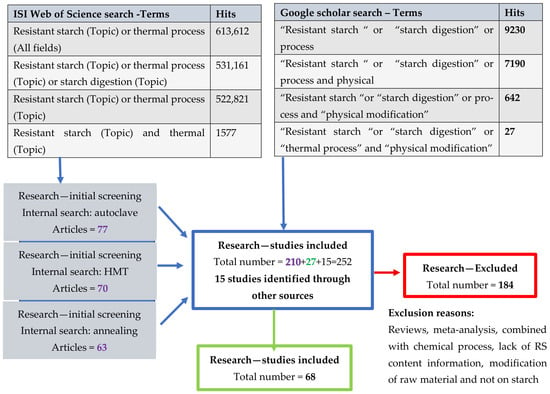
A thorough data analysis was conducted to examine how different starch modification techniques influenced levels of RDS, SDS and RS and the determinants thereof. The materials needed for the data analyses and literature review were research articles targeting starch modification by thermal physical techniques containing qualitative and/or quantitative data of the values of RDS, SDS, and RS prior and post modification. In fact, the AI component in this study was used for mining and qualitative knowledge extraction rather than for autonomous quantitative synthesis. This qualitative approach was adapted, assuming expected simplistic use of AI tools by food professionals inexperienced in AI and professional use of LLMs as well as some identified limitations of the AI and the data presented in the scientific literature. To ensure an accurate and systematic screening process, inclusion and exclusion criteria for identified studies were established, as detailed in Figure 1. This work is presented as a critical narrative review of the literature on physical starch modification rather than as a meta-analysis review. Therefore, a formal PRISMA checklist was not applied. Nevertheless, the search strategy, search strings, database results, and inclusion/exclusion criteria are transparently described in Figure 1.
Figure 1.
Flowchart of the systematic literature search strategy and selection process. The diagram illustrates the initial search questions and total hits retrieved from the ISI Web of Science and Google Scholar databases, followed by internal screening (autoclaving, HMT, and ANN). A total of 252 studies were initially identified (including 210 from database screening, 27 from specific refined criteria, and 15 from alternative sources). After applying exclusion criteria (n = 184) due to reasons such as review papers, lack of RS content data, etc., 68 final studies were included in the analysis.
The inclusion criteria included articles published in English between 2001 and 2026 that used native starch as the initial substrate and applied thermal–physical modification techniques under varying experimental parameters. The review was limited to three modification methods: ANN, HMT, and autoclaving. Data extraction focused on both starch characteristics and processing conditions. Starch-related information included the botanical source and amylose content. Process-related variables included the water-to-starch ratio, equilibration conditions following starch hydration, number of processing cycles, heating temperature, heating duration, retrogradation conditions, and the number of repetitions.
Based on these data, the change in RS content was calculated by comparing RS values prior and post modification treatment. In addition, information regarding RS quantification methods and drying procedures was collected, as these parameters varied considerably among studies and may have influenced the magnitude of the reported RS alterations. It should be noted that not all extracted parameters were applicable to each modification technique. For example, multiple processing cycles are characteristic of autoclaving treatments but are uncommon in ANN and HMT processes. Similarly, retrogradation is frequently incorporated as part of autoclaving protocols but is generally not applied in ANN or HMT treatments. Further, the study exclusion criteria dropped studies that used pre-treated starch, dual or combined processes (e.g., enzymatic and thermal processing), had experimental flaws (e.g., lack of proper experimental controls such as untreated sample), non-experimental literature reviews, and articles with missing or incomplete data on resistant starch content. The absence of RDS and SDS data did not constitute an exclusion criterion; however, when such data were available, they were also examined and discussed in this study.
This initial ISI web of science search yielded 1577 studies, but further refinement based on the production method (autoclave, HMT or annealing) trimmed the database to 210 articles. These were augmented with 27 papers identified via Google Scholar and 15 articles identified through other sources. This generated a literature base of 252 full-text articles that were subsequently refined to a total of 68 studies following removal of duplicates and exclusion of studies (according to the criteria detailed in Figure 1).
Concomitantly, ChatGPT (free version, accessed on 11 January 2026) and Perplexity (Pro version, accessed 11 January 2026) Large Language Models (LLMs) were prompted in January 2026 with the following single prompt, focusing on autoclaving: “Act as a scientific literature review assistant specialized in food chemistry and starch science. Systematically identify, analyze, and synthesize peer-reviewed research articles on the modification of starch using **physical and thermal methods** to increase **resistant starch (RS) content**. Focus on methods such as heat–moisture treatment, annealing, autoclaving–cooling cycles”. This prompt yielded a rapid response with two literature datasets: one with a list of 16 research papers (from ChatGPT) and another with a list of 15 articles with direct links or Digital Object Identifiers (DOIs) identified by Perplexity. Screening the references revealed two internal-list duplicities and two inter-list duplicities, therefore yielding a limited aggregate result of 28 articles compared to the human-driven list generated via ISI Web of Science and Goggle Scholar that yielded 210 articles.
The sharp contrast between the 210 scientific articles identified by manual search and the list of 28 articles generated by AI emphasizes the possible gaps and limitations between the tedious, time-consuming human search with a simple, straightforward, one-time conversational AI query. On one hand, laborious manual search retrieved a higher number of publications through access to free and subscribed resources compared to conversational AI interfaces that operate primarily within open-access networks and lack built-in programming integration into subscription-based, indexed academic databases. Moreover, LLMs like ChatGPT and Perplexity are non-deterministic which means their outputs can vary even with identical prompts presented at different times. Therefore, this study highlights the gaps between human and AI-driven literature mining, illustrating the constraints of AI-based literature mining. Rather than a reproducible systematic review framework, the AI component here is used as an exemplary case for a simplistic use of AI by food professionals that are not AI tech-savvy. This emphasizes the critical need for human-expert inspection and increasing AI savviness of food professionals; all automated findings in this work were thoroughly cross-referenced and manually verified to guarantee scientific merit. Furthermore, the present evaluation was based on a single, standardized prompt for each platform, reflecting how a non-AI savvy food professional might use an LLM for an initial literature search, rather than the more iterative approach typically used by an expert. This approach does not capture the full potential of LLM-assisted literature searching, which can benefit from an iterative process in which prompts are refined, additional or missed references are requested, and the search is progressively improved through multiple rounds of interaction. Therefore, the AI-assisted search results presented here should be viewed as simple exemplars of how LLMs perform when used with a single prompt, rather than as a measure of their full potential. Future studies and applications of AI should compare this simple approach with more interactive and refined search strategies, including multiple rounds of prompting and, where possible, LLM tools connected to scientific databases. Such comparisons would provide a clearer understanding of how effectively AI can support systematic literature searching in food science.
2.3. AI-Assisted Harvesting of Articles
The overall goal of this review was to revisit starch modifications and integrate the available evidence from the literature to generate an overarching trajectory and/or identify optimal conditions to maximize RS content. The use of AI in academic literature searches and data integration offers clear advantages that are particularly appreciable during the initial stages of a literature review. In these stages, AI-based tools facilitate rapid identification of relevant concepts, processing methods, and process parameters that are often studied in food research. This may help unveil research trends and predominant experimental approaches, such as the frequent use of autoclaving–cooling cycles to increase RS content, thereby helping researchers navigate the literature more efficiently and focus on individual studies. When used with verified open-access sources, AI can summarize complex experiments and results more efficiently, reducing search time, screening, and focusing discussions according to relevant subjects that emerge from an AI review. On the contrary, AI-based search lacks the ability to critically distinguish between study differences, delve into nuances of experimental design and analytical approaches. For example, AI commonly compares reported RS values without adequately accounting for methodological differences (such as method for RS determination or process parameters like temperature profile, number of heating–cooling cycles, drying method, and storage conditions) or alterations from baseline measurements, potentially leading to misleading interpretations regarding process efficiency or superiority. Thus, conclusions based on AI-assisted comparisons may oversimplify outcomes or include invalid comparison of experimental evidence. This is augmented by the limited ability of AI searches to access paywalled or less-cited scientific journals, compromising the comprehensiveness of literature reviews or identifying underlying mechanistic insights. Importantly, AI has limited ability to critically evaluate experimental design and analytical validity. Thus, variations in analytical methods to determine RS (e.g., Englyst method versus AOAC protocols), sample identity (e.g., botanical origin of the starch), preparation procedures, or the absence of native starch baselines can substantially dampen reported RS values and the ability to synthesize studies into a unifying conclusion or trend. This is particularly concerning as a recent review clearly voiced a need to calibrate and standardize a unified method for assessing RS values in a comprehensive update on the underlying modulation mechanisms of starch digestion [24].
Overall, this exploratory, straightforward single-prompt evaluation suggests that AI-based searching can provide rapid access to relevant information from openly available sources, but with more limited coverage than a human-led search. The human-led approach enabled broader searching, access to specific resources, and a more comprehensive assessment of the relevance, methodological details, and intricate significance of the identified studies. Ultimately, AI appears to be most effective as a complementary tool to extend and intensify critical human reading. It is also important to note that AI-based search did not lead to dead ends or broken links; neither did the human-driven search.
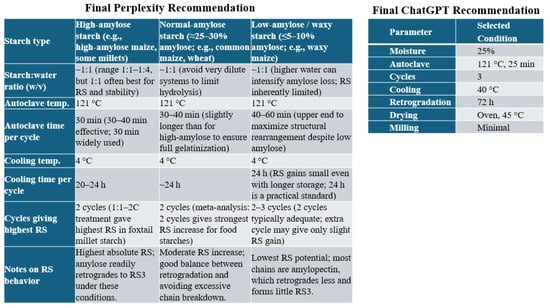
Next, both AI platforms were prompted to “summarize the parameters reported across different studies and highlight the values recommended to maximize RS content based on this comparative analysis”. This sought to explore the potential of AI to offer an overview and extract valuable determinants applicable to food engineering with RS as the key outcome. Figure 2 shows the raw, unedited recommendations generated by the AI tools. It is important to note that these outputs are not presented as established evidence in food science but rather as a baseline for further evaluation. To reframe and validate these recommendations, each parameter generated by the AI tools was systematically cross-referenced against the human-reviewed literature. This human validation process revealed significant variances and deviations from the initial suggestions provided by the AI tools.
Figure 2.
Summary of raw, unverified AI-generated processing recommendations for increase in RS content prior to human-expert validation. Formatting of outputs in table format was generated independently by both the freely accessible Standard version of Perplexity and ChatGPT 5.3.
For example, the literature suggested that using an autoclave at a temperature of 145 °C [26] resulted in a higher RS yield compared to 121 °C, the key temperature that was suggested by both ChatGPT and Perplexity. Regarding process duration, the AI-generated printout did not align with the findings obtained through human-led research and analysis. For example, AI platforms suggested a duration of 30–40 min while studies like Onyango et al. [27] yielded high RS within a relatively short process window. Their study indicates that exceeding optimal points (e.g., beyond 45 min) decrease RS yield, thus challenging the pragmatics of setting the autoclaving duration to 40 min, as suggested by AI. Similarly, the non-deterministic nature of AI yielded inconsistent parameters of autoclave–cooling cycles and moisture content. Moreover, both AI tools disregarded starch pretreatment, which may affect RS formation, as previously shown [28]. Thus, AI was found to be a robust and simple tool to expedite search and offer opportunities for supervised integration of studies that should be handled with caution. This could facilitate qualitative identification of determinants (such as retrogradation time, retrogradation temperature, moisture content) or overall trends but not to be used as an unrestrained or unsupervised replacement of professional researchers.
3. Integrative Mining of Starch Parameters and Processing Determinants
Native starches often exhibit health-related and technological-related benefits stimulating the use of physical modification techniques in commercial processing in a quest to tailor their functionalities without chemical derivatization. This review focused on adapting the current state of the art for evidence-based physical modifications of starch while attempting to harness an AI-based approach. The studies identified herein highlight that the content of RS, specifically retrograded type III starch (RS3), is significantly influenced by the interplay of multiple processing and formulation variables. To this end, the botanical origin of the starch and the size of its granules have been found to be the most critical factors in determining susceptibility to enzymatic attack and the breakdown of starch molecules [24,29]. For instance, cereal starches like rice and corn often possess granules with surface pores and channels that facilitate enzyme infiltration while tubers like potato lack these fissures, thereby proving to be more resistant to digestion [29]. Relevant studies further establish that amylose content of the raw material is possibly the strongest determinant of RS3 formation believed to arise from intricate amylose–amylose and amylose–amylopectin interactions which lead to more compact starch structures with reduced enzyme accessibility. Accordingly, a strong positive correlation has been reported between high amylose levels in starch and process-induced RS formation [29,30]. HACS typically yields significantly higher RS content than normal or waxy corn starch attributable to its tendency to easily form stable, double-helical structures made from closely aligned linear biopolymer chains through hydrogen bonding [31]. In contrast, waxy starches, poor in amylose, tend to produce very low amounts of RS3 upon processing [26,32,33]. Altogether, amylose content, determined mostly by the botanical origin of the starch, is inversely related to its digestibility associated with increased SDS and RS, and decreased RDS [34]. However, it is important to note that high-amylose starches tend to exhibit higher absolute RS contents, whereas lower-amylose starches show greater relative process-induced increases in RS compared to their native counterparts [35].
3.1. Process Parameters Influencing RS Content
While intrinsic starch factors are detrimental to starch functionality, they pose inherent challenges that might be tackled through processing techniques and conditions that facilitate diverting the interplay between RDS, SDS and RS. In the face of the reviewed body of scientific literature, this study focused on three prominent commercially viable techniques: ANN, HMT, and autoclaving. Due to pragmatic considerations, inter-comparison of processes while operating in the same manufacturing conditions could not be attained.
This is because each modification technique is defined by a distinct combination of temperature, moisture content, pressure, and treatment duration that collectively determines its mode of action.
First, unlike other hydrothermal methods, ANN is a hydrothermal method that uses higher moisture content, either excess water (>65% w/w) or intermediate water content (40–50% w/w) and temperatures exceeding the glass transition temperature (Tg) while below the starch onset temperature of gelatinization (To), and its duration can vary from hours to days. This process alters the physicochemical properties of starch without destroying the granule by improving its crystalline structure and promoting interactions between starch chains (such as amylose–amylose and amylose–amylopectin interactions) under mild conditions and prolonged durations. During annealing, starch undergoes reorganization, resulting in a more arranged configuration and generation of RS [15,17,36,37,38,39,40]. In search of evidence that could facilitate mild starch processing, this work offers a summary of studies that report the impact of annealing on digestible and indigestible fractions of various starches (Table 1 and Supplementary Table S1).
These studies indicate treatment temperature is critical and set not to exceed the onset temperature (To) of gelatinization (typically 50–55 °C or 10–15 °C below the To of the specific starch). However, if the ANN temperature is too high, it may disrupt starch crystallites or increase porosity, leading to higher fractions of RDS at the expense of lower RS content.
For example, Chung et al. [41] observed that starch annealed at 10 °C below the onset gelatinization temperature (To-10 °C) compared to annealing at 15 °C below the onset temperature (To-15 °C) improved RS content of corn, pea, and lentil starches and attributed it to the improved crystalline structure rendered more resistant to enzymatic hydrolysis. On the other hand, application of annealing to two different Grass pea starch, at To-10, significantly decreased the RS content, while increasing SDS levels [42]. Similarly, ANN duration (typically 24–72 h) has been found to have distinct but insignificant effects on RS content [43]. Notably, ANN seems to be implicated in a significant increase in SDS and RS at the expense of reducing RDS levels. However, Table 1 highlights that mixed trends were observed in the relevant studies, and some also emphasized selective effects of heating/cooling cycles [43] and/or moisture content. For example, excess moisture attenuated RS content for four different starches after specific ANN conditions (72 h, 55 °C, 90% moisture) [39].
On the contrary, HMT is considered a more intensive unit operation that involves treatments at low moisture content (less than 35%) but a higher temperature range (80–140 °C), exceeding the glass transition temperature. It is conducted for several hours while still retaining the granular structure without inducing gelatinization [11,38,44,45]. In line with the review’s objective, Table 2 and Supplementary Table S2 summarize relevant studies. Such combined heat and moisture treatments can enhance the flexibility and mobility of the starch chains, leading to disruption and in some cases even breaking of the intermolecular and intramolecular hydrogen bonds within the starch granules [46,47]. Overall, higher moisture levels (within the HMT range) typically correlate with higher RS formation. Again, in the case of HMT processing, the effect of moisture and other process parameters on RS content is not straightforward.
Lastly, autoclaving is considered highly energy intensive and involves treatment of starch slurries (typically at 70–90% moisture), at elevated temperatures (120–150 °C) and high-pressure steam of 1.5–3.0 atm, for controlled durations of 30–120 min. This process has been extensively studied (as detailed in Table 3, and Supplementary Table S3) and found to involve hydration and swelling of starch amorphous regions while the crystalline regions melt and are disrupted (gelatinize); this destruction leads to the leaching of amylose and rearrangement of amylopectin, which leads to the generation of RS during the retrogradation phase [48,49,50,51].
Similar to the previous processes, the identified studies comparing autoclaving at different temperatures indicated processing temperature increased RS content [52]. Again, this trend can be counteracted by other studies, like the study by Soler et al. that showed that this trend was delineated by amylose content. For example, when very high amylose content (around 70%) in starch was examined, RS levels increased as the autoclaving temperature rose from 105 °C to 120 °C, but a further increase in temperature to 135 °C resulted in a reduction in RS content [53]. Additionally, repetitive thermal treatments (heating and cooling cycles) were found to be commonly applied to increase the proportion of RS via autoclaving, typically 3–5 cycles [33,54]. Reviewing the evidence, this trend also differed between waxy and non-waxy starches with waxy starch decreasing RS content as the number of cycles increased [32]. Moreover, a significant proportion of studies dwelled on the importance and impact of starch retrogradation to the buildup of RS.
It is important to note that a small number of individual studies, applying a single internally consistent protocol across several conditions, offer illustrative examples of potential parameter interactions that merit dedicated future investigation. In the study by Rahayu, increasing the autoclaving temperature resulted in higher RS content. At the same autoclaving temperature, extending the retrogradation period from 24 to 48 h further increased the RS content. The combination of these two conditions, higher autoclaving temperature and longer retrogradation, resulted in the greatest RS increase compared with the other temperature and retrogradation-time combinations evaluated [52]. When comparing retrogradation after applying an autoclave process, at a fixed temperature but for a longer duration, RS content generally increased across most of the temperatures examined (−20, 4, 30, 60, and 100 °C), with the exception of 30 °C. In contrast, when the retrogradation time was kept constant while the temperature was varied, an optimal temperature of 4 °C was observed for a 6 h retrogradation period, with RS enhancement decreasing as the temperature increased above or below that value. However, for longer retrogradation periods of 24 and 48 h, the greatest RS increase was observed at 100 °C [27]. When examining the effect of moisture content (80% vs. 90%) on RS formation after autoclaving, higher RS levels were generally obtained at the lower moisture content of 80%. Increasing the number of processing cycles from one to two and three resulted in an overall reduction in RS content, although RS increased progressively with each additional cycle; however, the values remained below those of the native starch. A positive RS response was observed only when the maximum number of cycles evaluated was combined with 80% moisture [33]. These findings are presented as illustrative observations from individual studies rather than as a cross-study synthesis, given the substantial methodological heterogeneity among the protocols, which limits the validity of direct comparisons across the broader body of literature summarized in Table 1, Table 2 and Table 3.
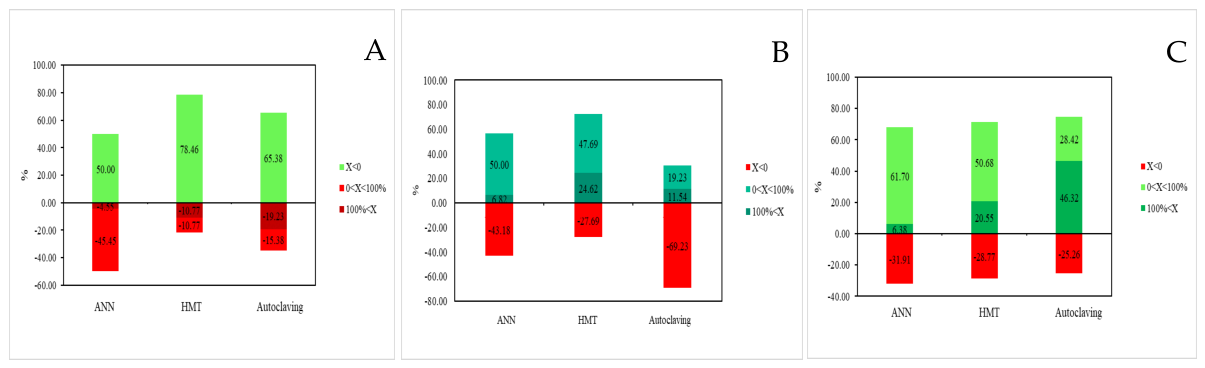
In summary, a considerable body of evidence gives note to a mixed trend where processing can boost or compromise the digestibility of starch and its content of RS. Therefore, an additional analysis of the gathered studies was performed to qualitatively assess the magnitude of the processing effects on starch qualities. For this, the processing impact on each starch fraction (RDS:SDS:RS) was color-coded with shades of green indicating increasing levels of the corresponding fraction and red indicating attenuation in their content, based on the percentage of change compared to baseline level of the same starch before processing (as detailed in Table 1, Table 2 and Table 3). Plotting alterations in starch fractions of RDS, SDS and RS (Figure 3) enables the visualization of the trends observed throughout the identified studies. First, this analysis enables a qualitative differentiation between the magnitudes of studies indicating an increase in starch fraction versus those who demonstrated an attenuation, i.e., balancing between the magnitude of green and red bars. Moreover, Figure 3 facilitates a comparison between the various processes of ANN, HMT, and autoclaving. Altogether, Figure 3A,B stress that HMT has an overall positive trend on digestible starch fractions, expressed as a lowering of RDS and increasing SDS levels of starch. Moreover, autoclaving is found to have detrimental effects on the SDS content of starch. Having starch digestibility in mind, one could suggest HMT as a favorable processing pathway towards physical modulation of starch. In contrast, Figure 3C highlights a clear benefit for autoclaving as a pathway to boost RS content of starch. This figure also demonstrates that the most significant effect of autoclaving is a dramatic increase in RS levels (marked in dark green) exceeding 100%, compared to the corresponding unprocessed starch fraction.
Figure 3.
Percentage changes in RDS (noted (A)), SDS (noted (B)), and RS (noted (C)) following different processing treatments. Percentage changes are calculated relative to each study’s native-starch control and should not be interpreted as direct rankings of process efficiency, due to differences in RS assays, drying procedures, moisture basis, and starch sources across studies (see Section 3.2).
It is important to note that the variation between the green and red bars in Figure 3 reflects the strong influence of raw material and processing conditions. None of the processes showed consistently positive or negative effect across all studies. The magnitude, and in some cases even the direction, of the response varied with starch source, amylose content, moisture level, and temperature. Thus, Figure 3 should therefore be viewed as illustrating general trends rather than predicting a specific response for every raw material. To facilitate comparison among the three modification techniques, Table 4 summarizes the recommended processing conditions, expected changes in RDS, SDS, and RS, and the underlying mechanisms of ANN, HMT, and autoclaving. By bringing together the trends presented in Table 1, Table 2 and Table 3 and Figure 3, this synthesis provides a practical reference for selecting and optimizing modification process according to the amylose content of the target starch.
The three processes provide distinct advantages rather than a single “best” approach. ANN is the mildest option, offering a modest shift from RDS to SDS while minimizing the risk of over-processing or undesirable structural changes. It is therefore particularly suitable when gentle, granule-preserving modification is preferred over maximizing RS yield. HMT provides a more consistent single-step approach for achieving a substantial RDS-to-SDS shift and can produce considerable RS increases without the need for multiple processing cycles. This makes it attractive when processing time and energy efficiency are important. Autoclaving can achieve the greatest overall increases in RS. Its benefits increase markedly with the number of cycles. Although autoclaving offers the greatest potential for RS enhancement, it also carries the highest risk of decreasing SDS content and requires careful tailoring of process parameters in order to minimize unwanted SDS content decreases.
3.2. Limitations and Challenges When Comparing Studies
A key limitation of the dataset is the methodological heterogeneity across studies, including differences in RS assay methods, drying procedures, moisture basis, and starch sources. Therefore, the percentage changes reported in Table 1, Table 2, Table 3 and Table 4 and Figure 3 should be viewed primarily as within-study indicators of direction and magnitude, rather than as directly comparable rankings across studies.
Table 1.
Alteration percentage after applying the annealing process.
Table 2.
Alteration percentage after applying the HMT process.
Table 3.
Alteration percentage after applying the autoclaving process.
Table 4.
Comparison of ANN, HMT and autoclaving: recommended conditions, expected RS, mechanistic rationale, and process selection note specific to raw material.
While this review offers a wide overview of studies, one cannot avoid identifying some central internal and external limitations that challenge this and future comparisons between studies. First, the current review mined several articles through the website https://automeris.io/wpd/ (accessed during November 2025) to extract RDS, SDS, and RS values from graphs, as the values were not provided in table form and had to be extracted directly from the figures. That computational tool enabled us to address a larger cohort of studies; however, its accuracy depends both on the computational tool as well as the operator, thus limiting the power of the analysis.
On top of this, two external thematic limitations were identified: one is the methods to obtain starch fractions, and another is the analytical means to determine starch fractions, namely, protocols to determine RS. Most studies mainly involved drying and pulverizing samples and starch fractions that can impact the determination of balances between RDS, SDS, and RS. Notably, samples that are oven-dried often contain more RS than those that are freeze-dried (lyophilized). This effect is attributed to the high temperatures used during oven drying (e.g., ~50 °C compared to freeze-dry), which enable sufficient molecular mobility for retrogradation to continue during the drying stage. In contrast, freeze-drying effectively freezes the starch structure in place, restricting chain movement and limiting further interactions and crystallization [30,93].
Beyond the effect itself, differences in drying procedures can also make it difficult to compare different studies. Oven drying is typically performed at 40–60 °C for 12–24 h until constant weight, conditions that may allow starch chains to remain mobile and continue to retrograde during drying. In contrast, freeze-drying typically involves pre-freezing at −20 to −80 °C (impacting the speed of freezing and lowering chain mobility) followed by vacuum sublimation for 24–72 h. As these methods are not fully reported in all the literature, there is a need to establish a standardized drying protocol or at least unify reporting standards.
Secondly, overviewing the body of evidence echoed a clear gap in methods used to determine RS content and overall starch digestibility, as also identified by others [24]. These studies reveal variations in processing temperatures, durations and specific enzymes used (and their concentrations) in experiments attempting to mimic digestion. This lack of analytical harmonization may dramatically compromise the comparability of findings and generate inconsistencies and confusion. In fact, Polesi et al. [94] provides a direct comparison of how these methods drastically affect the calculated RS content of the same autoclaved chickpea starch samples. Aparicio-Saguilán et al. also noted that RS values determined using Novelose 330 were lower when measured using the TDF method than those obtained using the Goni method [83]. Thus, there is a clear need for methodological harmonization to help converge and disentangle scientific efforts.
4. Conclusions
This review offered a targeted overview on the effects of key starch physical modification techniques—ANN, HMT, and autoclaving—on starch digestibility metrics, specifically, digestible RDS and SDS fractions as well as RS. Further, the work demonstrated the use of 21st century tools for an exploratory evaluation of a number of studies through the combined use of human-driven evidence search with an AI-assisted identification of recurring research dimensions and qualitative knowledge extraction. This review highlighted the power of AI to offer a fast and broad overview of open-access literature which was complementary and coincided with a concomitant human-driven search. Collectively, this gathered and significant body of literature supports the notion that modulation of starch digestibility is governed by a delicate balance between structural starch disruption and molecular reassembly of amylose and amylopectin, strongly influenced by intrinsic factors such as botanical origin and amylose content, and extrinsic processing parameters including temperature, moisture, duration, cycle number, and retrogradation conditions. Crucially, the use of AI as a tool in the hands of unsavvy food professionals seeking to underpin qualitative patterns and catalyze conceptual sorting highlighted its strong advantages alongside limitations that warrant a need for careful and responsible use.
From an applied processing perspective, raw material selection should guide protocol choice because starch composition strongly influences treatment outcomes. For high-amylose starches (e.g., Hylon V, Hylon VII, and HACS-55/70), even a single autoclaving heating–cooling cycle already yields marked RS gains owing to their inherent tendency to form stable double-helical amylose structures [29,31,53]. Additional cycles or temperatures above approximately 120–125 °C may provide diminishing or even negative returns because excessive heat can disrupt newly formed crystallites [53]. Therefore, milder HMT conditions are often more resource-efficient for these starches [35,73]. For common starches, using multiple autoclaving–cooling cycles (typically 1–5) followed by retrogradation provides a reliable method for substantial RS enrichment, with RS levels generally increasing as the number of cycles increases [32,33,54]. However, longer autoclaving does not necessarily produce additional RS. Likewise, the optimal retrogradation duration depends on temperature, meaning that longer processing or storage does not inherently increase RS formation [27]. In HMT, higher moisture levels generally favor RS formation although the effects on SDS and RDS are not consistent across studies. During Annealing (ANN), longer treatment times generally promote RS formation. In fact, processing at a temperature approximately 10 °C below the onset temperature of gelatinization (To) has been reported to increase RS content [41], while higher moisture levels may further enhance RS formation [59]. In contrast, all processing methods have relatively limited impact on the RS content of waxy (low/near-zero amylose) starches that contain little or no amylose. Moreover, in such starches increasing processing intensity (i.e., cycles and/or duration) or moisture level may compromise RS levels owing to the intrinsic limitations of amylopectin to reorganize into RS double helices during retrogradation [32,66]. Thus, such starches may benefit more greatly from pairing physical modification with a subsequent chemical or enzymatic treatment.
Overall, autoclaving appears to have the greatest potential for increasing RS when processing conditions are well adapted to the raw material. HMT and ANN can also be useful alternatives for altering the RDS:SDS balance. However, as summarized in Table 4, the magnitude and direction of the effects can vary considerably depending on the amylose content of the native starch. Therefore, it cannot be assumed that the effects observed for one starch type are universally transferable to other raw materials. Importantly, this review highlights that inter-study comparability remains a challenge due to inconsistent analytical methodologies and heterogeneous reporting standards. This limitation is particularly evident in RS research, where variation in analytical protocols and the lack of methodological consensus across quantification approaches compromise the comparability and physiological interpretation of results. Accordingly, the need to develop harmonized methodologies and standardized reporting protocols for RS quantification emerges as a priority area for future research. This need is heightened when seeking to adopt AI-assisted tools to accelerate literature identification and mapping of trends; however, it is important to note that the use of AI tools should be made carefully to circumvent AI limitations to critically evaluate experimental nuances, address methodological variability, and deduce mechanistic insights. Moving forward, supervised and more sophisticated AI-based analyses could help shed new light on the old paradigm of starch modification and transition from empirical “cook and look” schemes toward rational, design-oriented starch engineering. Such 21st century progress is essential to meet aspirations for clean-label processing strategies, enhancing RS intake, and responsible evidence-based innovations.
Supplementary Materials
The following supporting information can be downloaded at: https://www.mdpi.com/article/10.3390/foods15173137/s1, Table S1: Annealing process parameters, Table S2: HMT process parameters, Table S3: Autoclaving process parameters.
Author Contributions
This work was part of the PhD thesis of M.Y.H. Conceptualization, M.Y.H. and U.L.; methodology, M.Y.H. and U.L.; formal analysis, M.Y.H.; investigation, M.Y.H.; resources, U.L.; data curation, M.Y.H.; writing—original draft preparation, M.Y.H. and U.L.; writing review and editing, M.Y.H., C.S.L. and U.L.; visualization, M.Y.H.; supervision, U.L.; project administration, C.S.L.; funding acquisition, U.L. All authors have read and agreed to the published version of the manuscript.
Funding
This research was supported by the Israeli Ministry of Science and Technology Grant #3-0007438 and the Russell Berrie Nanotechnology Institute (Technion-Israel Institute of Technology, Haifa) with both grants held by Prof. U.L.
Institutional Review Board Statement
Not applicable.
Informed Consent Statement
Not applicable.
Data Availability Statement
The data presented in this study are available on request from the corresponding author due to the size, diversity and complexity of the data.
Acknowledgments
M.Y.H dedicates this research to her late mother, Billa Yaskin RIP, who encouraged her to pursue doctoral studies, and to her father, Hagay Yaskin, may he live a long life, who encouraged her to complete her PhD studies.
Conflicts of Interest
The authors declare no conflicts of interest.
Abbreviations
The following abbreviations are used in this manuscript:
| AI | Artificial intelligence |
| ANN | Annealing |
| HMT | Heat–moisture treatment |
| RDS | Rapidly digestible starch |
| SDS | Slowly digestible starch |
| RS | Resistant starch |
| RS3 | Resistant starch type III |
| USD | United States Dollar |
| ISI | Institute for Scientific Information |
| LLMs | Large language models |
| DOIs | Digital Object Identifiers |
| AOAC | Association of Official Analytical Chemists |
| HACS | High-amylose corn starch |
| Tg | Glass transition temperature |
| To | Onset temperature of gelatinization |
| YM | Sweet potato starch Yulmi |
| YHM | Sweet potato starch Yeonwhangmi |
| SSPS | Sweet potato starch from Samyang Genex |
| CSPS | Commercial sweet potato starch |
| TBS | Tartary buckwheat starch |
| SS | Sorghum starch |
| N/A | Not applicable/not available |
| PF | Tsai-ou lotus rhizome starch |
| WS | Shih-lian lotus rhizome starch |
| RMS | Regular maize starch |
| G50 | Gelose 50 high-amylose maize starch |
| MPG87 | Wrinkled pea starch |
| CDC 4140-4 | Wrinkled pea starch |
| NS | Normal corn starch |
| HS | Hylon VII |
| KDML105 | Non-waxy rice |
| RD6 | Waxy rice |
| SR | Rice starch |
| NCS | Normal amylose starch |
| HACS-55 | High-amylose corn starch, 55% amylose |
| HACS-70 | High-amylose corn starch, 70% amylose |
| HAM | High-amylose maize |
| TDF | Total dietary fiber |
References
- Amaraweera, S.M.; Gunathilake, C.; Gunawardene, O.H.P.; Fernando, N.M.L.; Wanninayaka, D.B.; Dassanayake, R.S.; Rajapaksha, S.M.; Manamperi, A.; Fernando, C.A.N.; Kulatunga, A.K.; et al. Development of Starch-Based Materials Using Current Modification Techniques and Their Applications: A Review. Molecules 2021, 26, 6880. [Google Scholar] [CrossRef] [Scilit]
- Guo, J.; Tan, L.; Kong, L. Impact of Dietary Intake of Resistant Starch on Obesity and Associated Metabolic Profiles in Human: A Systematic Review of the Literature. Crit. Rev. Food Sci. Nutr. 2021, 61, 889–905. [Google Scholar] [CrossRef] [Scilit]
- Noraidah, H.; Mansoor, A.H.; Zainol, M.K.; Ahmad Hazim, A.A.; Hasmadi, M. A Review on the Effects of Resistant Starch on the Postprandial Glycaemic Response and the Influence of Processing Conditions on the Formation of Resistant Starch. Food Res. 2023, 7, 119–131. [Google Scholar] [CrossRef] [Scilit]
- Tester, R.F.; Karkalas, J.; Qi, X. Starch—Composition, Fine Structure and Architecture. J. Cereal Sci. 2004, 39, 151–165. [Google Scholar] [CrossRef] [Scilit]
- Modified Starch Market Size & Share Analysis—Growth Trends and Forecast (2026–2031). Available online: https://www.mordorintelligence.com/industry-reports/modified-starch-market (accessed on 5 January 2026).
- Zhang, Z.; Bao, J. Recent Advances in Modification Approaches, Health Benefits, and Food Applications of Resistant Starch. Starch/Staerke 2023, 75, 2100141. [Google Scholar] [CrossRef] [Scilit]
- Kim, H.R.; Jeong, G.A.; Bae, J.E.; Hong, J.S.; Choi, H.D.; Lee, C.J. Impact of Chemical Modification by Immersion with Malic Acid on the Physicochemical Properties and Resistant Starch Formation in Rice. J. Food Sci. 2022, 87, 1058–1068. [Google Scholar] [CrossRef] [Scilit]
- Sidhu, R.K.; Riar, C.S.; Singh, S. In Vitro Starch Digestibility and Physicochemical Properties of Chemical and Enzymatic Modified Indian Teff (Eragrostis Tef) Starch for Industrial Applications. Int. J. Biol. Macromol. 2025, 307, 141910. [Google Scholar] [CrossRef] [Scilit]
- Li, H.; Gui, Y.; Li, J.; Zhu, Y.; Cui, B.; Guo, L. Modification of Rice Starch Using a Combination of Autoclaving and Triple Enzyme Treatment: Structural, Physicochemical and Digestibility Properties. Int. J. Biol. Macromol. 2020, 144, 500–508. [Google Scholar] [CrossRef] [Scilit]
- Englyst, H.N.; Hudson, G.J. The classification and measurement of dietary carbohydrates. Food Chem. 1996, 57, 15–21. [Google Scholar] [CrossRef] [Scilit]
- Maniglia, B.C.; Castanha, N.; Le-Bail, P.; Le-Bail, A.; Augusto, P.E.D. Starch Modification through Environmentally Friendly Alternatives: A Review. Crit. Rev. Food Sci. Nutr. 2021, 61, 2482–2505. [Google Scholar] [CrossRef] [Scilit]
- Liu, Y.; Liu, J.; Kong, J.; Wang, R.; Liu, M.; Strappe, P.; Blanchard, C.; Zhou, Z. Citrate Esterification of Debranched Waxy Maize Starch: Structural, Physicochemical and Amylolysis Properties. Food Hydrocoll. 2020, 104, 105704. [Google Scholar] [CrossRef] [Scilit]
- Chung, H.J.; Shin, D.H.; Lim, S.T. In Vitro Starch Digestibility and Estimated Glycemic Index of Chemically Modified Corn Starches. Food Res. Int. 2008, 41, 579–585. [Google Scholar] [CrossRef] [Scilit]
- Liu, J.; Wang, Z.; Hu, C.; Xu, J.; Chang, R. Manipulation of the Structure of Type 4 Resistant Starch Using Cross-Linking and Acylation Treatment and Its Diverse Influence on Digestion and in Vitro Fermentation Characteristics: Structure, Digestion, Fermentation of RS4. Curr. Res. Food Sci. 2025, 11, 101125. [Google Scholar] [CrossRef] [Scilit]
- Nawaz, H.; Waheed, R.; Nawaz, M.; Shahwar, D. Physical and Chemical Modifications in Starch Structure and Reactivity. Chem. Prop. Starch 2020, 9, 13–35. [Google Scholar] [CrossRef] [Scilit]
- Gałkowska, D.; Kapuśniak, K.; Juszczak, L. Chemically Modified Starches as Food Additives. Molecules 2023, 28, 7543. [Google Scholar] [CrossRef] [Scilit]
- Fonseca, L.M.; El Halal, S.L.M.; Dias, A.R.G.; Zavareze, E.d.R. Physical Modification of Starch by Heat-Moisture Treatment and Annealing and Their Applications: A Review. Carbohydr. Polym. 2021, 274, 118665. [Google Scholar] [CrossRef] [Scilit]
- BeMiller, J.N. Physical Modification of Starch. In Starch in Food: Structure, Function and Applications; Elsevier: Amsterdam, The Netherlands, 2017; pp. 223–253. [Google Scholar]
- Thompson, M.S.; Hui Yan, T.; Saari, N.; Sarbini, S.R. A Review: Resistant Starch, a Promising Prebiotic for Obesity and Weight Management. Food Biosci. 2022, 50, 101965. [Google Scholar] [CrossRef] [Scilit]
- Higgins, J.A.; Brown, I.L. Resistant Starch: A Promising Dietary Agent for the Prevention/Treatment of Inflammatory Bowel Disease and Bowel Cancer. Curr. Opin. Gastroenterol. 2013, 29, 190–194. [Google Scholar]
- Ridlon, J.M.; Hylemon, P.B. A Potential Role for Resistant Starch Fermentation in Modulating Colonic Bacterial Metabolism and Colon Cancer Risk. Cancer Biol. Ther. 2006, 5, 273–274. [Google Scholar] [CrossRef] [Scilit]
- Dupuis, J.H.; Liu, Q.; Yada, R.Y. Methodologies for Increasing the Resistant Starch Content of Food Starches: A Review. Compr. Rev. Food Sci. Food Saf. 2014, 13, 1219–1234. [Google Scholar] [CrossRef] [Scilit]
- McKeown, N.M.; Fahey, G.C.; Slavin, J.; van der Kamp, J.W. Fibre Intake for Optimal Health: How Can Healthcare Professionals Support People to Reach Dietary Recommendations? BMJ 2022, 378, e054370. [Google Scholar] [CrossRef] [Scilit]
- Freitas, D.; Lazaridou, A.; Duijsens, D.; Kotsiou, K.; Corbin, K.R.; Alongi, M.; Perez-Moral, N.; Simsek, S.; El, S.N.; Gwala, S.; et al. Starch Digestion: A Comprehensive Update on the Underlying Modulation Mechanisms and Its in Vitro Assessment Methodologies. Trends Food Sci. Technol. 2025, 159, 104969. [Google Scholar] [CrossRef] [Scilit]
- Lenharo, M. Is AI Ruining Our Skills? Early Results Are in—And They’re Not Good. Nature 2026, 655, 15–16. [Google Scholar] [CrossRef] [Scilit]
- Dundar, A.N.; Gocmen, D. Effects of Autoclaving Temperature and Storing Time on Resistant Starch Formation and Its Functional and Physicochemical Properties. Carbohydr. Polym. 2013, 97, 764–771. [Google Scholar] [CrossRef] [Scilit]
- Onyango, C.; Bley, T.; Jacob, A.; Henle, T.; Rohm, H. Influence of Incubation Temperature and Time on Resistant Starch Type III Formation from Autoclaved and Acid-Hydrolysed Cassava Starch. Carbohydr. Polym. 2006, 66, 494–499. [Google Scholar] [CrossRef] [Scilit]
- Sun, H.; Fan, J.; Tian, Z.; Ma, L.; Meng, Y.; Yang, Z.; Zeng, X.; Liu, X.; Kang, L.; Nan, X. Effects of Treatment Methods on the Formation of Resistant Starch in Purple Sweet Potato. Food Chem. 2022, 367, 130580. [Google Scholar] [CrossRef] [Scilit]
- Li, Q.; Ma, L.; Liu, J.; Cheng, Y.; Liang, J. The Multiscale Structural Properties and In-Vitro Digestibility of High Amylose Corn Starch During Autoclaving-Cooling Treatment. Starch/Staerke 2025, 77, 2300250. [Google Scholar] [CrossRef] [Scilit]
- Ozturk, S.; Koksel, H.; Perry, K.W.N. Characterization of Resistant Starch Samples Prepared from Two High-Amylose Maize Starches through Debranching and Heat Treatments. Cereal Chem. 2009, 86, 503–510. [Google Scholar] [CrossRef] [Scilit]
- Zheng, F.; Xu, Q.; Zeng, S.; Zhao, Z.; Xing, Y.; Chen, J.; Zhang, P. Multi-Scale Structural Characteristics of Black Tartary Buckwheat Resistant Starch by Autoclaving Combined with Debranching Modification. Int. J. Biol. Macromol. 2023, 249, 126102. [Google Scholar] [CrossRef] [Scilit]
- Sangwongchai, W.; Sa-ingthong, N.; Phothiset, S.; Saenubon, C.; Thitisaksakul, M. Resistant Starch Formation and Changes in Physicochemical properties of Waxy and Non-Waxy Rice Starches by Autoclaving-Cooling Treatment. Int. J. Food Prop. 2024, 27, 532–548. [Google Scholar] [CrossRef] [Scilit]
- Khawas, P.; Deka, S.C. Effect of Modified Resistant Starch of Culinary Banana on Physicochemical, Functional, Morphological, Diffraction, and Thermal Properties. Int. J. Food Prop. 2017, 20, 133–150. [Google Scholar] [CrossRef] [Scilit]
- Liu, H.; Wang, L.; Shen, M.; Guo, X.; Lv, M.; Wang, M. Changes in Physicochemical Properties and in Vitro Digestibility of Tartary Buckwheat and Sorghum Starches Induced by Annealing. Starch/Staerke 2016, 68, 709–718. [Google Scholar] [CrossRef] [Scilit]
- Cheng, F.; Ren, Y.; Warkentin, T.D.; Ai, Y. Heat-Moisture Treatment to Modify Structure and Functionality and Reduce Digestibility of Wrinkled and Round Pea Starches. Carbohydr. Polym. 2024, 324, 121506. [Google Scholar] [CrossRef] [Scilit]
- Ariyantoro, A.R.; Fitriyani, A.; Affandi, D.R.; Muhammad, D.R.A.; Yulviatun, A.; Nishizu, T. The Effect of Dual Modification with Annealing and Heat Moisture Treatment (HMT) on Physicochemical Properties of Jack Bean Starch (Canavalia Ensiformis). Food Res. 2022, 6, 189–198. [Google Scholar] [CrossRef] [Scilit]
- Zavareze, E.D.R.; Dias, A.R.G. Impact of Heat-Moisture Treatment and Annealing in Starches: A Review. Carbohydr. Polym. 2011, 83, 317–328. [Google Scholar] [CrossRef] [Scilit]
- Farooq, M.A.; Yu, J. Recent Advances in Physical Processing Techniques to Enhance the Resistant Starch Content in Foods: A Review. Foods 2024, 13, 2770. [Google Scholar] [CrossRef] [Scilit]
- Song, H.Y.; Lee, S.Y.; Choi, S.J.; Kim, K.M.; Kim, J.S.; Han, G.J.; Moon, T.W. Digestibility and Physicochemical Properties of Granular Sweet Potato Starch as Affected by Annealing. Food Sci. Biotechnol. 2014, 23, 23–31. [Google Scholar] [CrossRef] [Scilit]
- Liu, H.; Tian, G.; Gao, S.; Liu, S. Understanding the Changes in Multi-Structure, Physicochemical Properties, and in Vitro Digestibility of Quinoa Starch by Annealing with Hydrogen-Infused and Plasma-Activated Water Samples. J. Future Foods 2026, 6, 292–300. [Google Scholar] [CrossRef] [Scilit]
- Chung, H.J.; Liu, Q.; Hoover, R. Impact of Annealing and Heat-Moisture Treatment on Rapidly Digestible, Slowly Digestible and Resistant Starch Levels in Native and Gelatinized Corn, Pea and Lentil Starches. Carbohydr. Polym. 2009, 75, 436–447. [Google Scholar] [CrossRef] [Scilit]
- Piecyk, M.; Drużyńska, B.; Ołtarzewska, A.; Wołosiak, R.; Worobiej, E.; Ostrowska-Ligęza, E. Effect of Hydrothermal Modifications on Properties and Digestibility of Grass Pea Starch. Int. J. Biol. Macromol. 2018, 118, 2113–2120. [Google Scholar] [CrossRef] [Scilit]
- Shi, X.; Ding, Y.; Wan, J.; Liu, C.; Prakash, S.; Xia, X. Effect of Annealing on Structural, Physicochemical, and In Vitro Digestive Properties of Starch from Castanopsis Sclerophylla. Starch/Staerke 2021, 73, 2100005. [Google Scholar] [CrossRef] [Scilit]
- Wang, Q.; Li, L.; Zheng, X. Recent Advances in Heat-Moisture Modified Cereal Starch: Structure, Functionality and Its Applications in Starchy Food Systems. Food Chem. 2021, 344, 128700. [Google Scholar] [CrossRef] [Scilit]
- Brahma, B.; Sit, N. Physicochemical Properties and Digestibility of Heat Moisture–Treated Potato Starches for Different Treatment Conditions. Potato Res. 2020, 63, 367–383. [Google Scholar] [CrossRef] [Scilit]
- Wang, H.; Liu, Y.; Chen, L.; Li, X.; Wang, J.; Xie, F. Insights into the Multi-Scale Structure and Digestibility of heat-Moisture Treated Rice Starch. Food Chem. 2018, 242, 323–329. [Google Scholar] [CrossRef] [Scilit]
- Sun, Y.; Qin, R.; Zeng, J.; Li, G. Effect of Heat–Moisture Treatment on the Structure and Digestibility of Sweet Potato Starch. Foods 2023, 12, 3076. [Google Scholar] [CrossRef] [Scilit]
- Sharanagat, V.S.; Saxena, D.C.; Kumar, K.; Kumar, Y. Starch: Advances in Modifications, Technologies and Applications; Springer: Berlin/Heidelberg, Germany, 2023. [Google Scholar]
- Tantray, J.A.; Mansoor, S.; Wani, R.F.C.; Nissa, N.U. Chapter 4—Principle and Working of Autoclave. In Basic Life Science Methods; Tantray, J.A., Mansoor, S., Wani, R.F.C., Nissa, N.U., Eds.; Academic Press: Cambridge, MA, USA, 2023; pp. 11–14. [Google Scholar]
- Pratiwi, M.; Faridah, D.N.; Lioe, H.N. Structural Changes to Starch after Acid Hydrolysis, Debranching, Autoclaving-Cooling Cycles, and Heat Moisture Treatment (HMT): A Review. Starch/Staerke 2018, 70, 1700028. [Google Scholar] [CrossRef] [Scilit]
- Zheng, M.Z.; Xiao, Y.; Yang, S.; Liu, H.M.; Liu, M.H.; Yaqoob, S.; Xu, X.Y.; Liu, J.S. Effects of Heat–Moisture, Autoclaving, and Microwave Treatments on Physicochemical Properties of Proso Millet Starch. Food Sci. Nutr. 2020, 8, 735–743. [Google Scholar] [CrossRef] [Scilit]
- Rahayu, N.S.; Samanhudi; Praseptiangga, D.; Haryanto, B. Physicochemical and functional properties of RS3 obtained from cilacap breadfruit (Artocarpus Altilis (Parkinson) Fosberg) starch. Suranaree J. Sci. Technol. 2023, 30, 020022. [Google Scholar] [CrossRef] [Scilit]
- Soler, A.; Mendez-Montealvo, G.; Velazquez-Castillo, R.; Hernández-Gama, R.; Osorio-Diaz, P.; Velazquez, G. Effect of Crystalline and Double Helical Structures on the Resistant Fraction of Autoclaved Corn Starch with Different Amylose Content. Starch/Staerke 2020, 72, 1900306. [Google Scholar] [CrossRef] [Scilit]
- Junden, S.; Panya, A.; Umar, M.; Raungrusmee, S.; Anal, A.K. Improving the Techno-Functional Properties and Glycemic Index of Khai Mod Rin Rice Starch through Autoclaving–Chilling Cycles. Int. J. Biol. Macromol. 2025, 315, 144470. [Google Scholar] [CrossRef] [Scilit]
- Simsek, S.; Ovando-Martínez, M.; Whitney, K.; Bello-Pérez, L.A. Effect of Acetylation, Oxidation and Annealing on Physicochemical Properties of Bean Starch. Food Chem. 2012, 134, 1796–1803. [Google Scholar] [CrossRef] [Scilit]
- Yeh, Y.; Lai, L.S. Effect of Single and Dual Hydrothermal Treatments on the Resistant Starch Content and Physicochemical Properties of Lotus Rhizome Starches. Molecules 2021, 26, 4339. [Google Scholar] [CrossRef] [Scilit]
- Chung, H.J.; Liu, Q.; Hoover, R. Effect of Single and Dual Hydrothermal Treatments on the Crystalline Structure, Thermal Properties, and Nutritional Fractions of Pea, Lentil, and Navy Bean Starches. Food Res. Int. 2010, 43, 501–508. [Google Scholar] [CrossRef] [Scilit]
- Gu, X.; Wang, Z. Insights into the Digestibility, Properties, and Structure of Highland Barley Starch Using Dry Heat Treatment, Heat Moisture Treatment, and Annealing Treatment. Starch/Staerke 2025, 77, e70016. [Google Scholar] [CrossRef] [Scilit]
- Bora, J.; Mahnot, N.K.; Makroo, H.A.; Mahanta, C.L. Impact of Hydrothermal Treatments on the Functional, Thermal, Pasting, Morphological and Rheological Properties of Underutilized Yam Starches. J. Food Meas. Charact. 2023, 17, 2285–2300. [Google Scholar] [CrossRef] [Scilit]
- De La Rosa-Millán, J. Physicochemical, Molecular, and Digestion Characteristics of Annealed and Heat-Moisture Treated Starches under Acidic, Neutral, or Alkaline PH. Cereal Chem. 2017, 94, 770–779. [Google Scholar] [CrossRef] [Scilit]
- Lan, X.; Xie, S.; Xie, F.; Liu, X.; Wu, J.; Wang, Z. The Effect of Thermal and Enzymatic Degradation on the Physicochemical Properties and in Vitro Digestibility of Canna Starch. Starch/Staerke 2016, 68, 389–398. [Google Scholar] [CrossRef] [Scilit]
- Zeng, F.; Ma, F.; Kong, F.; Gao, Q.; Yu, S. Physicochemical Properties and Digestibility of Hydrothermally Treated Waxy Rice Starch. Food Chem. 2015, 172, 92–98. [Google Scholar] [CrossRef] [Scilit]
- Sudheesh, C.; Sunooj, K.V.; Navaf, M.; Bhasha, S.A.; George, J.; Mounir, S.; Kumar, S.; Sajeevkumar, V.A. Hydrothermal Modifications of Nonconventional Kithul (Caryota urens) Starch: Physico-Chemical, Rheological Properties and in Vitro Digestibility. J. Food Sci. Technol. 2020, 57, 2916–2925. [Google Scholar] [CrossRef] [Scilit]
- Liu, H.; Guo, X.; Li, W.; Wang, X.; Lv, M.; Peng, Q.; Wang, M. Changes in Physicochemical Properties and in Vitro Digestibility of Common Buckwheat Starch by Heat-Moisture Treatment and Annealing. Carbohydr. Polym. 2015, 132, 237–244. [Google Scholar] [CrossRef] [Scilit]
- Sudheesh, C.; Sunooj, K.V.; George, J. Kithul Palm (Caryota urens) as a New Source of Starch: Effect of Single, Dual Chemical Modifications and Annealing on the Physicochemical Properties and in Vitro Digestibility. Int. J. Biol. Macromol. 2019, 125, 1084–1092. [Google Scholar] [CrossRef] [Scilit]
- Liu, J.L.; Tsai, P.C.; Lai, L.S. Impacts of Hydrothermal Treatments on the Morphology, Structural Characteristics, and in Vitro Digestibility of Water Caltrop Starch. Molecules 2021, 26, 4974. [Google Scholar] [CrossRef] [Scilit]
- Yu, B.; Li, J.; Tao, H.; Zhao, H.; Liu, P.; Cui, B. Physicochemical Properties and in Vitro Digestibility of Hydrothermal Treated Chinese Yam (Dioscorea opposita Thunb.) Starch and Flour. Int. J. Biol. Macromol. 2021, 176, 177–185. [Google Scholar] [CrossRef] [Scilit]
- Liang, Z.; Chen, X.; Luo, J.; Zhao, H.B.; Yang, Z.; Zhu, J. Addition of Amino Acids to Modulate Structural, Physicochemical, and Digestive Properties of Corn Starch-Amino Acid Complexes under Hydrothermal Treatment. Int. J. Biol. Macromol. 2020, 160, 741–749. [Google Scholar] [CrossRef] [Scilit]
- Tarahi, M.; Hedayati, S.; Mejares, C.T.; Dokouhaki, M.; Niakousari, M. Effect of Sequential Hydrothermal Treatments on the Physicochemical Properties and in Vitro Digestibility of Bitter Vetch (Vicia Ervilia) Starch. Food Chem. 2025, 495, 146434. [Google Scholar] [CrossRef] [Scilit]
- Giuberti, G.; Marti, A.; Gallo, A.; Grassi, S.; Spigno, G. Resistant Starch from Isolated White Sorghum Starch: Functional and Physicochemical Properties and Resistant Starch Retention After Cooking. A Comparative Study. Starch/Staerke 2019, 71, 1800194. [Google Scholar] [CrossRef] [Scilit]
- Wang, H.; Wang, Z.; Li, X.; Chen, L.; Zhang, B. Multi-Scale Structure, Pasting and Digestibility of Heat Moisture Treated Red Adzuki Bean Starch. Int. J. Biol. Macromol. 2017, 102, 162–169. [Google Scholar] [CrossRef] [Scilit]
- Vu, M.T.; Nguyen, T.K.A.; Nguyen, M.H.; Nguyen, T.H.; Nguyen, T.T.; Pham, T.T.H.; Nguyen, T.D.; Nguyen, N.T.; Nguyen, P.H. Preparation of Resistant Starch-Type III from Jackfruit Seed Starch as a Promising Prebiotic for the Treatment of Diabetes. Int. J. Food Sci. Technol. 2024, 59, 2908–2916. [Google Scholar] [CrossRef] [Scilit]
- Wang, H.; Zhang, B.; Chen, L.; Li, X. Understanding the Structure and Digestibility of Heat-Moisture Treated Starch. Int. J. Biol. Macromol. 2016, 88, 1–8. [Google Scholar] [CrossRef] [Scilit]
- Sun, Y.; Xiao, D.; Zheng, X.; Yang, Y.; Zheng, L.; Ai, B.; Sheng, Z. Integrative Approach to Modifying Banana Starch: The Role of Physical Treatment and Polyphenol Enrichment on Physicochemical and Digestive Characteristics. Food Res. Int. 2025, 202, 115676. [Google Scholar] [CrossRef] [Scilit]
- Xie, X.; Qi, L.; Xu, C.; Shen, Y.; Wang, H.; Zhang, H. Understanding How the Cooking Methods Affected Structures and Digestibility of Native and Heat-Moisture Treated Rice Starches. J. Cereal Sci. 2020, 95, 103085. [Google Scholar] [CrossRef] [Scilit]
- Aaliya, B.; Sunooj, K.V.; Rajkumar, C.B.S.; Navaf, M.; Akhila, P.P.; Sudheesh, C.; George, J.; Lackner, M. Effect of Thermal Pretreatments on Phosphorylation of Corypha Umbraculifera l. Stem Pith Starch: A Comparative Study Using Dry-Heat, Heat-Moisture and Autoclave Treatments. Polymers 2021, 13, 3855. [Google Scholar] [CrossRef] [Scilit]
- Sung, S.; Kim, H.R.; Park, C.S.; Choi, S.J.; Moon, T.W. Structure and in Vitro Digestion of Amylosucrase-Modified Waxy Corn Starch as Affected by Iterative Retrogradation. Int. J. Food Prop. 2020, 23, 1176–1186. [Google Scholar] [CrossRef] [Scilit]
- Ratnaningsih, N.; Suparmo; Harmayani, E.; Marsono, Y. Physicochemical Properties, in Vitro Starch Digestibility, and Estimated Glycemic Index of Resistant Starch from Cowpea (Vigna unguiculata) Starch by Autoclaving-Cooling Cycles. Int. J. Biol. Macromol. 2020, 142, 191–200. [Google Scholar] [CrossRef] [Scilit]
- Ashwar, B.A.; Gani, A.; Wani, I.A.; Shah, A.; Masoodi, F.A.; Saxena, D.C. Production of Resistant Starch from Rice by Dual Autoclaving-Retrogradation Treatment: Invitro Digestibility, Thermal and Structural Characterization. Food Hydrocoll. 2016, 56, 108–117. [Google Scholar] [CrossRef] [Scilit]
- Yaskin Harush, M.; Shani Levi, C.; Lesmes, U. Potential of Process-Induced Modification of Potato Starch to Modulate Starch Digestibility and Levels of Resistant Starch Type III. Foods 2025, 14, 880. [Google Scholar] [CrossRef] [Scilit]
- Piecyk, M.; Druzyńska, B.; Worobiej, E.; Wołosiak, R.; Ostrowska-Ligeogonekza, E. Effect of Hydrothermal Treatment of Runner Bean (Phaseolus coccineus) Seeds and Starch Isolation on Starch Digestibility. Food Res. Int. 2013, 50, 428–437. [Google Scholar] [CrossRef] [Scilit]
- Khurshida, S.; Deka, S.C. Application of Microwave and Hydrothermal Treatments for Modification of Cassava Starch of Manipur Region, India and Development of Cookies. J. Food Sci. Technol. 2022, 59, 344–354. [Google Scholar] [CrossRef] [Scilit]
- Aparicio-Saguilán, A.; Flores-Huicochea, E.; Tovar, J.; García-Suárez, F.; Gutiérrez-Meraz, F.; Bello-Pérez, L.A. Resistant Starch-Rich Powders Prepared by Autoclaving of Native and Lintnerized Banana Starch: Partial Characterization. Starch/Staerke 2005, 57, 405–412. [Google Scholar] [CrossRef] [Scilit]
- Li, J.; Han, W.; Zhang, B.; Zhao, S.; Du, H. Structure and Physicochemical Properties of Resistant Starch Prepared by Autoclaving-Microwave. Starch/Staerke 2018, 70, 1800060. [Google Scholar] [CrossRef] [Scilit]
- Yang, Y.; Chen, Q.; Yu, A.; Tong, S.; Gu, Z. Study on Structural Characterization, Physicochemical Properties and Digestive Properties of Euryale Ferox Resistant Starch. Food Chem. 2021, 359, 129924. [Google Scholar] [CrossRef] [Scilit]
- Bodjrenou, D.M.; Li, X.; Chen, W.; Zhang, Y.; Zheng, B.; Zeng, H. Effect of Pullulanase Debranching Time Combined with Autoclaving on the Structural, Physicochemical Properties, and In Vitro Digestibility of Purple Sweet Potato Starch. Foods 2022, 11, 3779. [Google Scholar] [CrossRef] [Scilit]
- Wang, X.; Liu, L.; Chen, W.; Jia, R.; Zheng, B.; Guo, Z. Insights into Impact of Chlorogenic Acid on Multi-Scale Structure and Digestive Properties of Lotus Seed Starch under Autoclaving Treatment. Int. J. Biol. Macromol. 2024, 278, 134863. [Google Scholar] [CrossRef] [Scilit]
- Tao, J.; Bu, T.; Xie, Q.; Jia, Y.; Wang, Q.; Shen, N.; Zhang, X.; Xiao, Y.; Ye, L.; Chen, Z.; et al. Physicochemical Properties and Functional Characterization of Buckwheat Type 3 Resistant Starch Prepared by Various Treatment Methods. LWT 2025, 218, 117467. [Google Scholar] [CrossRef] [Scilit]
- Frasson, S.F.; Colussi, R.; Hackbart, H.C.d.S.; Borges, C.D.; Flores, W.H.; Mendonça, C.R.B. Rice Starch Modification by Thermal Treatments with Avocado Oil: Autoclave versus Microwave Methods. Int. J. Biol. Macromol. 2024, 267, 131426. [Google Scholar] [CrossRef] [Scilit]
- Li, X.; Zhang, X.; Yang, W.; Guo, L.; Huang, L.; Li, X.; Gao, W. Preparation and Characterization of Native and Autoclaving-Cooling Treated Pinellia Ternate Starch and Its Impact on Gut Microbiota. Int. J. Biol. Macromol. 2021, 182, 1351–1361. [Google Scholar] [CrossRef] [Scilit]
- Xie, S.; Chen, H.; Jiang, X.; Zhou, B.; Guo, Z.; Zeng, H.; Zhang, Y. Structural and Physicochemical Properties of a Chinese Yam Starch–Tea Polyphenol Complex Prepared Using Autoclave-Assisted Pullulanase Treatment. Foods 2023, 12, 3763. [Google Scholar] [CrossRef] [Scilit]
- Cui, W.; Ma, Z.; Li, X.; Hu, X. Structural Rearrangement of Native and Processed Pea Starches Following Simulated Digestion in Vitro and Fermentation Characteristics of Their Resistant Starch Residues Using Human Fecal Inoculum. Int. J. Biol. Macromol. 2021, 172, 490–502. [Google Scholar] [CrossRef] [Scilit]
- Ozturk, S.; Koksel, H.; Ng, P.K.W. Production of Resistant Starch from Acid-Modified Amylotype Starches with Enhanced Functional Properties. J. Food Eng. 2011, 103, 156–164. [Google Scholar] [CrossRef] [Scilit]
- Polesi, L.F.; Sarmento, S.B.S. Structural and Physicochemical Characterization of RS Prepared Using Hydrolysis and Heat Treatments of Chickpea Starch. Starch/Staerke 2011, 63, 226–235. [Google Scholar] [CrossRef] [Scilit]
Disclaimer/Publisher’s Note: The statements, opinions and data contained in all publications are solely those of the individual author(s) and contributor(s) and not of MDPI and/or the editor(s). MDPI and/or the editor(s) disclaim responsibility for any injury to people or property resulting from any ideas, methods, instructions or products referred to in the content. |
© 2026 by the authors. Licensee MDPI, Basel, Switzerland. This article is an open access article distributed under the terms and conditions of the Creative Commons Attribution (CC BY) license.