


Abstract
Flammulina velutipes roots, abundant edible mushroom by-products, have potential for value-added utilization. This study evaluated the effects of Lactiplantibacillus plantarum (Lpb. plantarum) and Lactobacillus delbrueckii subsp. bulgaricus (Lab. bulgaricus) fermentation on the physicochemical properties, antioxidant activity, flavor characteristics, sensory characteristics, and metabolite profiles of F. velutipes roots. Fermentation significantly increased soluble dietary fiber (SDF) from 1.537 to 1.722 g/100 g and DPPH radical scavenging activity from 27.88% to 59.92% in Lpb. plantarum-treated samples. GC-IMS analysis showed that fermentation increased several flavor-active aldehydes, esters, alcohols, organic acids, and ketones, thereby improving aroma complexity. LC-MS-based untargeted metabolomics revealed that amino acid metabolism, fatty acid metabolism, organic acid metabolism, and phenylpropanoid-related pathways were closely associated with flavor formation and antioxidant enhancement. Both Lpb. Plantarum and Lab. bulgaricus fermentation enhanced the accumulation of organic acids, sugar alcohols, and aromatic precursors, supporting improved antioxidant activity. Notably, Lpb. plantarum elicited broader metabolic shifts involving hydroxy fatty acids, esters, while Lab. bulgaricus more strongly promoted organic acid and aromatic metabolite accumulation, contributing to a more acidic and malty flavor profile. Sensory evaluation and electronic tongue analysis further confirmed that fermentation enhanced aroma and palatability, while increasing sourness and reducing bitterness and astringency. These results suggest that starter-culture-dependent lactic acid bacteria fermentation is an effective strategy for improving the functional and sensory characteristics of F. velutipes root by-products.
1. Introduction
Flammulina velutipes, also known as F. filiformis in East Asia, is one of the most widely cultivated edible mushrooms worldwide [1]. The industrial processing of F. velutipes inevitably generates substantial root waste, accounting for approximately 10–15% of the fruiting body biomass. In 2023, F. velutipes production reached 1.87 million tons according to the China Edible Fungi Association (https://bigdata.cefa.org.cn/) (accessed on 15 February 2025), meaning that approximately 187,000 tons of Flammulina velutipes roots-the basal stipe fragments-were discarded. These roots are rich in proteins, polysaccharides, dietary fiber, phenolics, and flavonoids and exhibit notable antibacterial and antioxidant activities [2,3]. However, they are largely discarded as industrial waste, resulting in both resource loss and environmental burden. Therefore, the development of effective strategies for the valorization of F. velutipes roots is of considerable interest.
Lactic acid bacteria (LAB) fermentation is an effective bioprocessing strategy to improve the nutritional value, bioactivity, and sensory characteristics of agricultural by-products [4]. Among LAB species, Lactiplantibacillus plantarum (Lpb. plantarum) and Lactobacillus delbrueckii subsp. bulgaricus (Lab. bulgaricus) possess distinct metabolic characteristics. Lpb. plantarum exhibits strong polysaccharide-degrading capacity and can generate diverse flavor-active metabolites, whereas Lab. bulgaricus is characterized by rapid acidification and aroma formation [5,6]. These complementary metabolic properties make them suitable agents for restructuring the fibrous matrix of F. velutipes roots and improving their functional and sensory characteristics.
Flavor is a key factor driving consumer acceptance of fermented foods. With its high sensitivity, rapid detection, simple sample preparation, and intuitive data visualization, gas chromatography-ion mobility spectrometry (GC-IMS) has become a powerful tool for volatile compound analysis [7]. To further relate instrumental measurements to consumer perception, sensory evaluation, and electronic tongue (E-tongue) analysis can be integrated to characterize both aroma and taste attributes, providing a comprehensive assessment of flavor [8,9]. However, flavor changes represent only the phenotypic outcome of complex metabolic reprogramming during fermentation. Untargeted metabolomics based on liquid chromatography-mass spectrometry (LC-MS) enables comprehensive profiling of small-molecule metabolites. It has become an important tool for elucidating fermentation-induced alterations [10]. Previous studies have successfully applied LC-MS metabolomics to reveal biochemical changes in various fermented food matrices, which offers mechanistic insights into quality improvement during fermentation [11].
Although F. velutipes roots have been investigated for polysaccharide extraction and dietary supplementation [3,12,13,14], research on their biotransformation through LAB fermentation remains limited. Moreover, existing research on fermented edible-fungus by-products has mainly focused on either physicochemical characteristics or volatile flavor profiles, with little attention given to linking sensory changes with global metabolic responses [15,16,17,18]. Consequently, the mechanisms by which different LAB strains regulate nutritional components, flavor profiles, and antioxidant activity in F. velutipes roots remain largely unclear.
Therefore, this study examined the starter-culture-dependent effects of Lpb. plantarum and Lab. bulgaricus fermentations on F. velutipes roots. A comprehensive evaluation was conducted to characterize the fermentation-induced changes in physicochemical properties, antioxidant activity, sensory characteristics, taste attributes, volatile compounds, and non-volatile metabolites, using conventional analytical methods, sensory evaluation, E-tongue, GC-IMS, and LC-MS-based untargeted metabolomics. The objectives were to elucidate LAB-induced modifications in nutritional, functional, and sensory properties, and to pinpoint key flavor-associated metabolites. These findings support the valorization of F. velutipes root by-products through Lpb. plantarum and Lab. bulgaricus fermentations.
2. Materials and Methods
2.1. Materials and Reagents
F. velutipes roots were purchased from Xinxiang Xinghe Biotechnology Co., Ltd. (Xinxiang, China). Lactiplantibacillus plantarum (Lpb. plantarum) (GDMCC NO.1.2685) and Lactobacillus delbrueckii subsp. bulgaricus (Lab. bulgaricus) (ATCC 11842) were purchased from the Guangdong Microbial Culture Collection Center (Guangzhou, China) and Zhengzhou Hehe Bioengineering Technology Co., Ltd. (Zhengzhou, China), respectively. De Man–Rogosa–Sharpe (MRS) broth and agar medium (No. R42468), 2,2-diphenyl-1-picrylhydrazyl (DPPH) (No. R43058) and Folin–Ciocalteu reagent (No. S29851) were purchased from Tianjin Huasheng Chemical Reagent Co., Ltd. (Tianjin, China). MRS-selective medium (No. wp1003) was purchased from Shenzhen Weitong Biotechnology Co., Ltd. (Shenzhen, China). All other analytical-grade reagents were purchased from China National Pharmaceutical Group Corporation.
2.2. Preparation of Starter Culture
Freeze-dried Lpb. plantarum and Lab. bulgaricus cultures were rehydrated in sterile water, followed by activation on MRS agar at 37 °C for 48 h and subsequent propagation in MRS broth at 37 °C for another 48 h. Cells were collected by centrifugation (4000× g, 10 min, 4 °C), rinsed twice with sterile saline, and resuspended to approximately 2.2 × 10⁹ CFU/mL as confirmed by plate counting.
2.3. Fermentation of F. velutipes Roots
Fermentations were conducted separately for each strain to clearly attribute metabolic outcomes to their specific activities. Briefly, F. velutipes roots (2 × 2 × 2 cm, 100 g) were combined with distilled water (100 mL), supplemented with glucose (2%, w/w) and salt (1%, w/w) to promote initial LAB growth and suppress spoilage organisms [19]. The mixture was transferred into 250 mL bottles and sterilized at 115 °C for 10 min, a condition that preliminary tests confirmed that did not cause significant browning or textural collapse associated with severe nutrient loss. After cooling, activated Lpb. plantarum or Lab. bulgaricus cultures were inoculated at 3% (w/w, approximately 2.7 × 10⁷ CFU/mL). The fermentation process was carried out at 37 °C over a time course of 0, 8, 16, 24, 32, 40, and 48 h. At designated intervals, F. velutipes roots were harvested, lyophilized under vacuum, and pulverized for further analysis. Based on time-course changes in SDF, total sugar, pH, total polyphenols, total flavonoids, and antioxidant activity, samples fermented for 48 h were selected for GC-IMS, E-tongue, sensory evaluation, and metabolomics analyses [20]. Uninoculated 0-h samples served as the control for physicochemical measurements, whereas uninoculated samples incubated under the same conditions for 48 h served as the control (CK) for flavor and metabolomic assessments. All control samples were processed in parallel without starter addition.
2.4. Determination of pH and Titration of Acidity
The pH was measured using a pH meter (Shanghai Instrument and Electrical Instrument Co., Ltd., Shanghai, China), and titratable acidity was determined according to the method of Cardinali et al. [21].
2.5. Analysis of Dietary Fiber and Total Sugar
All chemical composition analyses were performed on freeze-dried and comminuted samples. The contents of soluble dietary fiber (SDF), insoluble dietary fiber (IDF), and total dietary fiber (TDF) were determined in line with GB 5009.88-2023 [22], whereas ash and protein contents were measured according to GB 5009.4-2016 and GB 5009.5-2016 [23,24], respectively. Equation (1) details the calculations of SDF, IDF, and TDF.
where
- X = content of dietary fiber in the test sample (g/100 g);
- = average mass of the duplicate sample residues and crucibles (g);
- MP = mass of protein in the residue, in grams (g);
- MA = mass of ash in the residue, in grams (g);
- MB = mass of the reagent blank, determined separately according to the national standard method, in grams (g);
- = average sample mass of the duplicate portions, in grams (g);
- f = correction factor (f = 1, if the sample has not undergone pretreatment procedures such as drying or defatting).
The phenol-sulfuric acid method with glucose as the standard was employed for total sugar determination [25]. The resulting calibration curve (y = 1.3312x − 0.0403, R2 = 0.9994) correlated absorbance (y) with glucose equivalent concentration (x, mg/mL) (Figure S1). Total sugar content (mg/g) was subsequently calculated using Equation (2).
where C (mg/mL) is the glucose equivalent concentration derived from the standard curve, V (mL) is the constant volume of the sample extraction, D is the dilution factor, and M (g) is the sample weight. Results were expressed as mg glucose equivalents per gram of dry sample (mg/g, as glucose equivalent).
2.6. Total Phenolic Content (TPC) and Total Flavonoid Content (TFC)
TPC was determined using the Folin–Ciocalteu method [26]. Briefly, 0.25 mL of diluted sample was mixed with 0.25 mL of Folin–Ciocalteu reagent (1:1, v/v). The mixture was supplemented with 0.5 mL of saturated sodium carbonate (200 g/L) and 4.0 mL of distilled water, incubated for 45 min at room temperature, and then measured for absorbance at 760 nm. The results were expressed as gallic acid equivalents (GAE).
TFC was determined using a colorimetric procedure [27]. In brief, 0.25 mL of extract was mixed with 0.75 mL methanol, 0.05 mL 10% (w/v) AlCl3, 0.05 mL 1 M potassium acetate, and 1.4 mL distilled water. After 30 min incubation at room temperature, the absorbance at 420 nm was recorded and calculated as rutin equivalents (RE).
2.7. Analysis of Antioxidant Activity
Antioxidant assays were performed on supernatants obtained by ultrasonication (30 min) of freeze-dried material in 70% methanol (1:20, w/v).
DPPH radical scavenging activity was conducted following the protocol of Baliyan et al. [28]. Briefly, 50 µL of extract was mixed with 3 mL of 60 µM DPPH solution and allowed to react in the dark for 30 min. The absorbance at 517 nm was recorded, and scavenging activity was calculated using Equation (3).
where AS is the sample absorbance and A0 is the absorbance of the control.
Reducing power was determined using a standard ferricyanide protocol as described by Li et al. [29]. In this assay, 1 mL of the sample was incubated with phosphate buffer (0.2 M, pH 6.6, 2.5 mL) and 1% K3[Fe(CN)6] (2.5 mL) at 50 °C for 20 min. The reaction was stopped by adding 2.5 mL of 10% trichloroacetic acid (TCA), followed by centrifugation at 1760× g for 15 min. An aliquot (2.5 mL) of the supernatant was then mixed with distilled water (2.5 mL) and 0.1% FeCl3 (0.5 mL) for 30 min at room temperature. The absorbance of the colored product was measured at 700 nm against a water blank; the resulting value (A700) was directly proportional to the reducing potential of the sample. To express the reducing power as mg Vc equivalent per gram of dry weight (DW), a calibration curve was constructed using ascorbic acid standards (0, 50, 100, 150, 200, and 250 µg/mL), following the same ferricyanide reduction protocol. The linear regression equation obtained was y = 0.00344 + 0.00184x (R2 = 0.997) (Figure S2), where x is the Vc concentration (µg/mL) and y is the absorbance at 700 nm. The Vc equivalent concentration (C, µg/mL) was calculated, and the reducing power was determined as follows:
where V is the final volume of the extract (mL), D is the dilution factor, and M is the sample dry weight (g).
2.8. GC-IMS Analysis of Volatile Components
The analytical procedure employed a FlavourSpec® GC-IMS system (G.A.S., Dortmund, Germany). 2 g of fresh fermented samples was heated at 60 °C for 20 min in a 20-mL headspace vial, and 500 μL of the vapor phase was auto-injected. The flow rate of the nitrogen carrier gas (≥99.999%) was programmed as: 2 mL/min (0–2 min), 10 mL/min (2–10 min), and 100 mL/min (10–40 min), following reported conditions [30]. Compound identification was based on dual matching of retention index (RI), relative drift time (Dt [RIPrel]), and NIST 2020 and VOCal databases. RI was derived via linear interpolation from a calibration curve constructed using six ketone homologs (C4–C9) run under the same conditions. The Reporter, Gallery Plot, and Dynamic principal component analysis (PCA) plug-ins enabled data visualization and comparative analysis.
2.9. Sensory Evaluation
All samples were stored at 4 °C overnight and then equilibrated to room temperature. The evaluation panel consisted of 20 healthy volunteers (10 males and 10 females, aged 20–35 years) recruited from Henan Institute of Science and Technology, all of whom provided written informed consent. Each panelist received protocol-specific training prior to the formal assessment. For each session, samples were sliced to uniform weight, placed on white plates, and assigned random three-digit codes. Panelists were asked to evaluate color, flavor, texture, and palatability using a five-point scale.
2.10. E-Tongue Analysis
Taste profiles of 48-h samples were analyzed using an SA402B electronic tongue system (Insent Co., Ltd., Atsugi, Japan). Samples were diluted 50-fold with distilled water before measurement. Each analysis consisted of 120 s sample detection, 40 s aftertaste acquisition, and 10 s sensor cleaning.
2.11. Untargeted Metabolomics Analysis
Following the method described by Vasilev et al. [31], each sample was weighed into a 2 mL tube, mixed with 600 µL MeOH (containing 20 ppm 2-amino-3-(2-chloro-phenyl)-propionic acid as internal standard (IS)), vortexed (30 s), homogenized with steel balls (55 Hz, 60 s), ultrasonicated (room temperature, 15 min), and centrifuged (12,000 rpm, 4 °C, 10 min). Supernatants were filtered (0.22 µm) for LC-MS analysis. A pooled QC sample was prepared from equal aliquots of all extracts to monitor analytical reproducibility.
LC-MS conditions: Separation used an ACQUITY UPLC HSS T3 column (150 × 2.1 mm, 1.8 µm) at 40 °C, with mobile phases of 0.1% formic acid in water (A) and acetonitrile (B), flow rate 0.25 mL/min, injection 5 µL. Gradient: 0–1 min, 2% B; 1–9.5 min, 2–50% B; 9.5–14 min, 50–98% B; 14–15 min, 98% B; 15–15.5 min, 98–2% B; 15.5–17 min, 2% B. Mass detection employed an LTQ Orbitrap XL with ESI± in Full MS-ddMS2 mode. Parameters: sheath/aux gas 45/15 arb, spray voltage ±4.80/−4.50 kV, capillary temperature 325 °C; MS1 resolving power 60,000 FWHM, ranges m/z 89–1000 (+) and 114–1000 (−); data-dependent MS/MS (4 scans/cycle) at 30% normalized collision energy (NCE) (normal resolution), dynamic exclusion 15 s. All data processing steps—including peak picking, alignment, and compound identification—were executed in Compound Discoverer 3.3, with metabolite assignments verified using the mzCloud, KEGG, and Panomics in-house metabolite standard databases.
2.12. Statistical Analysis
All experiments were carried out in triplicate, and the data are expressed as means with standard deviations (SD). All statistical analyses were performed with SPSS 17.0 (SPSS Inc., Chicago, IL, USA), using one-way ANOVA and Tukey’s HSD post-hoc test for multiple group comparisons, with the significance threshold set at p < 0.05. Multivariate analyses, including PCA and OPLS-DA, were run in SIMCA 14.1 (Umetrics, Umeå, Sweden), and the robustness of the models was verified through 200-fold permutation testing. Metabolites showing VIP scores > 1.0 and FDR-adjusted p < 0.05 were deemed to be significantly different. Heatmap visualization was performed with MetaboAnalyst 5.0, and pathway enrichment was explored using the KEGG database.
3. Results and Discussion
3.1. pH Value and Titratable Acidity During Fermentation
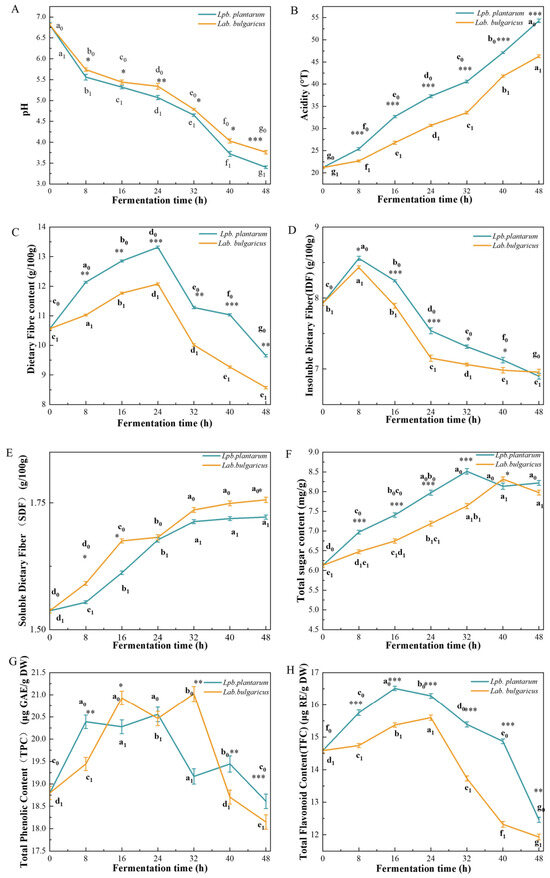
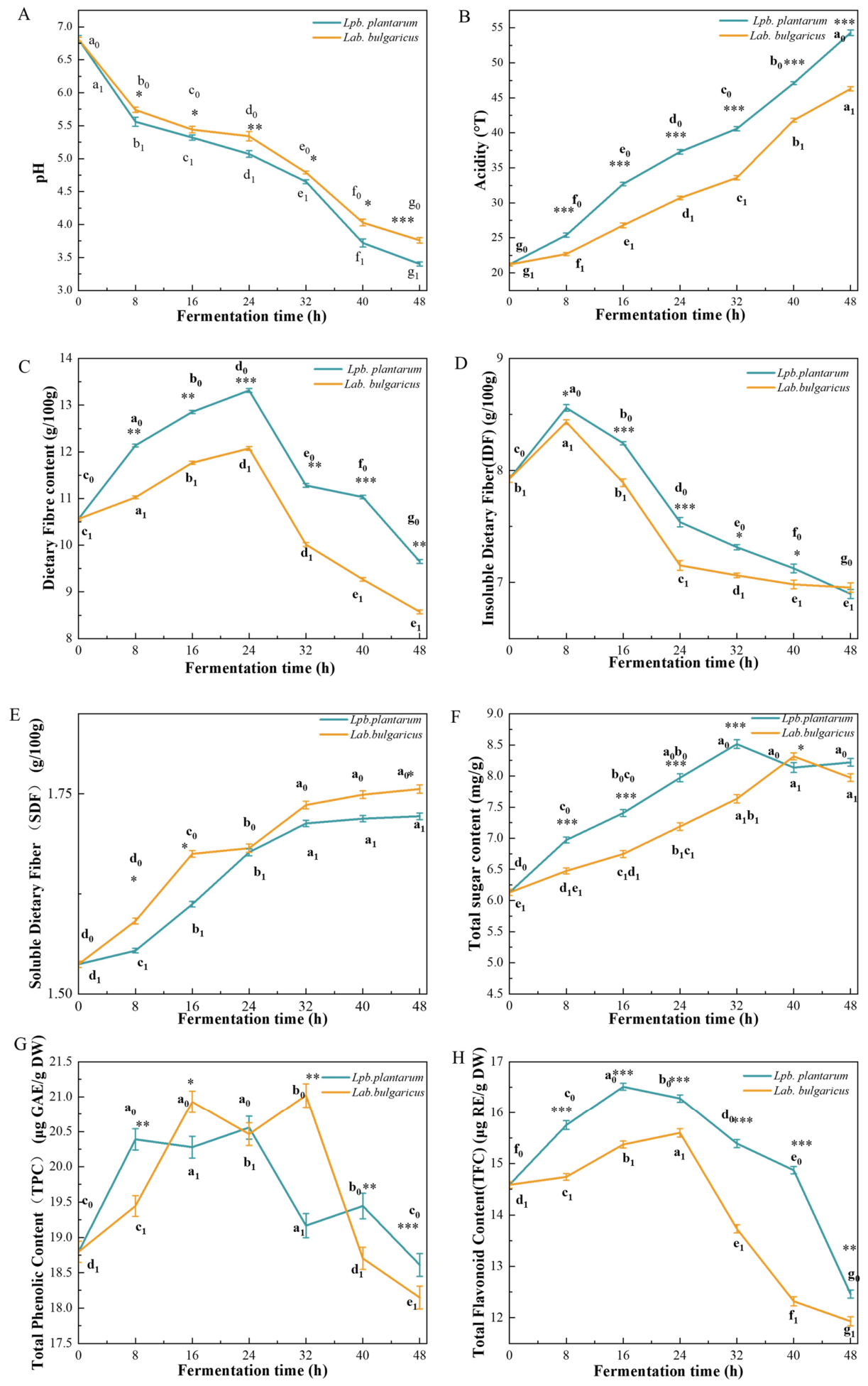
Fermentation with Lab. bulgaricus and Lpb. plantarum significantly affected the pH and titratable acidity of F. velutipes roots (Figure 1A,B). As fermentation proceeded, pH gradually decreased, whereas titratable acidity increased, with Lpb. plantarum showing a greater acidifying effect than Lab. bulgaricus. This difference may be attributed to the broader acid-producing capacity of Lpb. plantarum, which can convert diverse substrates into organic acids such as lactic, acetic, and phenyllactic acid [32]. In the early stage of fermentation, the rapid pH decline was accompanied by a marked accumulation of organic acids, reflecting vigorous LAB metabolic activity. As fermentation progressed, substrate depletion and the increasingly acidic environment likely slowed LAB growth and metabolism and eventually limited further acid production [33].
Figure 1.
Effects of Lactobacillus delbrueckii subsp. bulgaricus (Lab. bulgaricus) and Lactiplantibacillus plantarum (Lpb. plantarum) fermentation on pH (A), acidity (B), total dietary fiber ((C), TDF), insoluble dietary fiber ((D), IDF), soluble dietary fiber ((E), SDF), total sugar content (F), total phenolic content ((G), TPC), and total flavonoid content ((H), TFC). For comparisons between Lab. bulgaricus and Lpb. plantarum, asterisks indicate significance levels (* p < 0.05, ** p < 0.01, *** p < 0.001), whereas different letters denote p < 0.05 for comparisons among other groups.
3.2. Changes in Dietary Fiber and Total Sugar Content During Fermentation
LAB fermentation significantly affected the dietary fiber composition of F. velutipes roots (Figure 1C). TDF content increased initially and then declined, reaching the maximum at 24 h in both Lab. bulgaricus and Lpb. plantarum fermentation groups. During fermentation, IDF (Figure 1D) generally decreased, whereas SDF (Figure 1E) progressively increased, suggesting a conversion of insoluble fiber into soluble fractions. This change may be related to fibrolytic enzymes, such as endoglucanases, which hydrolyze insoluble fibers into smaller soluble fragments, thereby potentially improving the physiological functions of dietary fiber [34].
A pattern of initial rise and subsequent fall was observed for total sugar content over the course of LAB fermentation (Figure 1F). In the Lab. bulgaricus group, the maximum sugar content appeared at 32 h, while the Lpb. plantarum group reached this peak at 40 h. Overall, Lpb. plantarum produced higher sugar levels than Lab. bulgaricus throughout fermentation. The prolonged fermentation period led to sustained consumption of soluble sugars and polysaccharide-derived carbohydrates by LAB, which is the probable reason for the subsequent drop in total sugar content [35,36].
3.3. Changes in Total Phenolic Content (TPC) and Total Flavonoid Content (TFC)
TPC and TFC initially increased and then declined with prolonged fermentation time (Figure 1G,H). The variation in TPC was more pronounced in the Lab. bulgaricus group than in Lpb. plantarum, whereas the opposite trend was observed for TFC. LAB fermentation is a complex process in which microorganisms release phenolic compounds from bound forms through enzymatic hydrolysis. At the onset of fermentation, the metabolic and enzymatic activities of LAB enhance biochemical reactions, thus favoring the accumulation of phenolic and flavonoid metabolites [37,38]. As fermentation progressed, reduced microbial activity and possible degradation or transformation of these compounds may have contributed to the decline in TPC and TFC. Similar changes have been reported in other LAB-fermented substrates [39,40].
3.4. Changes in Antioxidant Activity During Fermentation
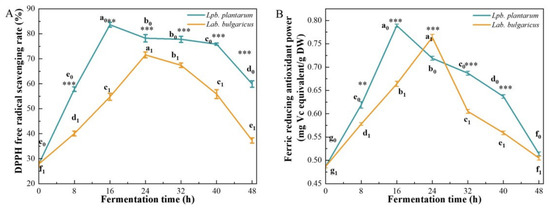
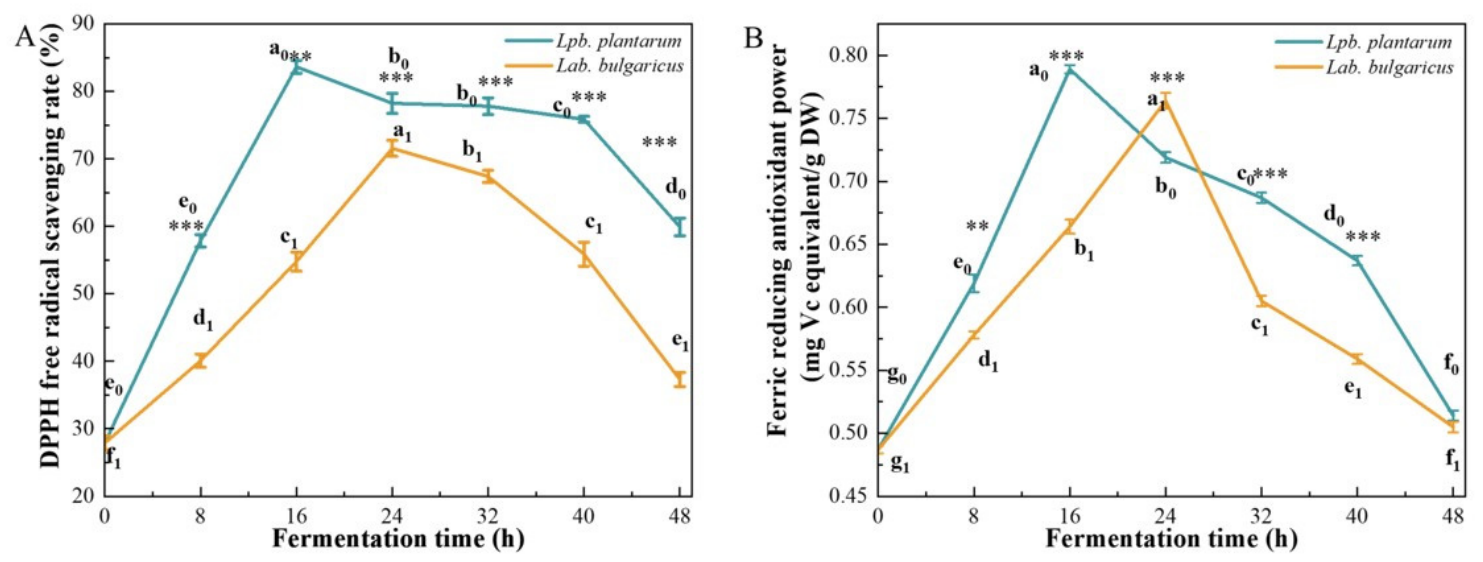
The antioxidant potential of the fermented substrates was primarily linked to their phenolic and flavonoid contents. Thus, the dynamic changes observed in these phytochemicals during LAB fermentation were considered a major factor affecting the DPPH scavenging and ferric-reducing activities [41]. The DPPH radical scavenging and ferric reducing assays were performed to assess the antioxidant capacity of F. velutipes roots throughout fermentation. Both antioxidant indices increased significantly at the early fermentation stage and then gradually declined with prolonged fermentation (Figure 2). The antioxidant capacity of the fermented materials was correlated with their phenolic and flavonoid contents, as evidenced by the consistency between the overall trends in antioxidant capacity and the TPC/TFC profiles [42].
Figure 2.
Effects of fermentation on DPPH radical scavenging activity (A) and ferric reducing ability (B) in F. velutipes roots during fermentation. Different letters indicate significant differences between groups (p < 0.05). Asterisks indicate significant differences between the Lactobacillus delbrueckii subsp. bulgaricus (Lab. bulgaricus) and Lactiplantibacillus plantarum (Lpb. plantarum) groups (* p < 0.05, ** p < 0.01, *** p < 0.001).
However, antioxidant capacity remained relatively high at the later fermentation stage despite the reduction in TPC and TFC, indicating that additional antioxidant metabolites may also be involved [43]. LAB fermentation can facilitate the accumulation of low-molecular-weight metabolites with known antioxidant functions [44,45,46]. Our metabolomics data revealed significant accumulation of organic acids (e.g., citraconic acid), aromatic amino acid precursors (e.g., N-acetyl-L-phenylalanine), and reducing equivalents (e.g., nicotinic acid), which may collectively contribute to the enhanced antioxidant properties [47,48]. These results suggest that the antioxidant capacity of fermented samples is regulated by multiple metabolites rather than solely by TPC and TFC.
3.5. Analysis of Volatile Flavor Components in F. velutipes Roots
3.5.1. Volatile Components in F. velutipes Roots Fermented by Lab. bulgaricus and Lpb. plantarum
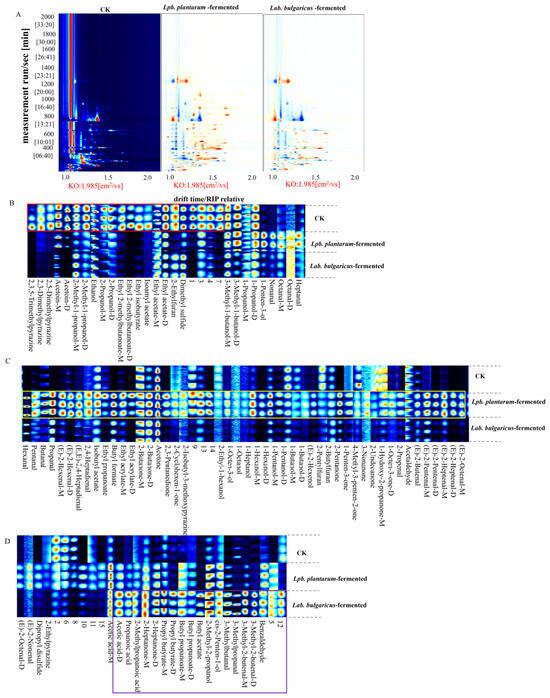
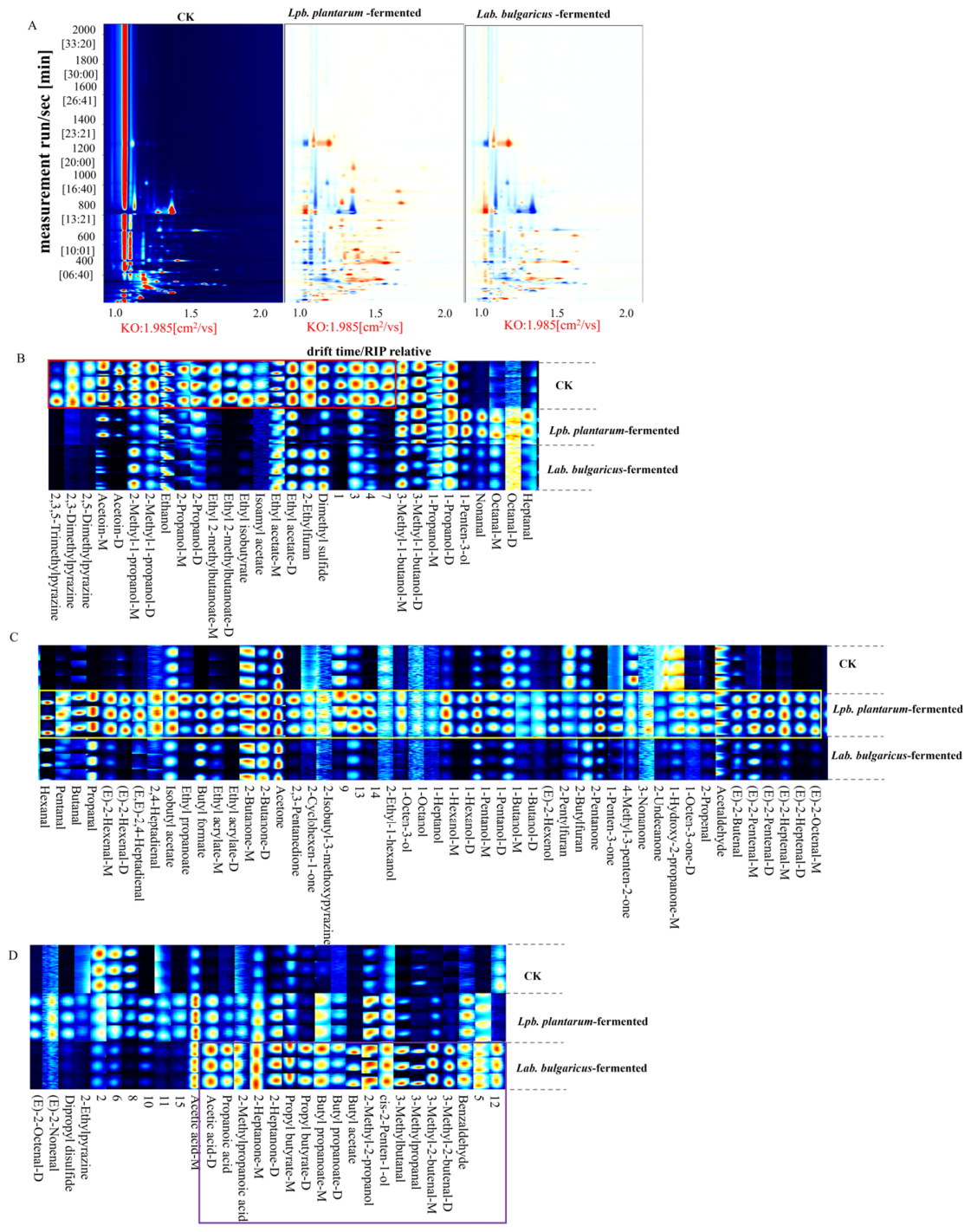
GC-IMS analysis of F. velutipes roots fermented with Lpb. plantarum or Lab. bulgaricus, alongside a non-fermented at 48 h as control (CK), was performed for volatile profiling. The two-dimensional topographic plots showed clear differences among the samples (Figure 3A). In the differential comparison plots, the CK served as the baseline, where red and blue coloration denoted elevated and diminished volatile signal intensities, respectively [49]. Notably, Lpb. plantarum-fermented samples exhibited marked changes within the retention time range of 400–800 s and drift time range of 1.2–1.6 s, suggesting that Lpb. plantarum fermentation substantially altered volatile profiles in F. velutipes roots.
Figure 3.
Compositional profiles of volatiles in the control (CK), Lactiplantibacillus plantarum (Lpb. plantarum)-fermented and Lactobacillus delbrueckii subsp. bulgaricus (Lab. bulgaricus)-fermented groups of F. velutipes roots. Plots of peak areas of selected signals (A) and fingerprints (B–D).
The fingerprint patterns provided strong evidence for the pronounced volatile differences observed between the fermented samples and their unfermented counterparts (Figure 3B–D). A total of 112 volatile compounds were identified, including 23 alcohols, 17 ketones, 27 aldehydes, 16 esters, and 4 acids, among others (Table S5). Compared with the CK, fermentation markedly reduced the levels of several pyrazines (e.g., 2, 3, 5-trimethylpyrazine), esters (e.g., ethyl acetate), alcohols (e.g., ethanol and 2-propanol), furans (e.g., 2-ethylfuran) and sulfur-containing compounds (e.g., dimethyl sulfide) (Figure 3B, red area). Lpb. plantarum fermentation enhanced the production of aldehydes and alcohols, including nonanal, octanal, heptanal, hexanal, pentanal, butanal, propanal, E-2-hexenal, (E,E)-2,4-heptadienal, 3-methyl-1-butanol, and 1-penten-3-ol. Lpb. plantarum fermentation also led to a marked accumulation of organic acids, with acetic acid showing an approximately 12-fold increase compared to the control (CK) (Table S2) (Figure 3C, yellow area). Lab. bulgaricus fermentation similarly resulted in elevated organic acid levels, alongside higher abundances of certain ketones (e.g., 2-heptanone), esters (e.g., propyl butyrate, butyl acetate, and butyl propionate), alcohols (e.g., 2-methyl-2-propanol), and aldehydes (e.g., 3-methylbutanal, 2-methylpropanal, and benzaldehyde) (Figure 3D, purple area). Thus, both Lpb. plantarum and Lab. bulgaricus contributed substantially to organic acid production, although they differed quantitatively in their modulation of other volatile categories.
Certain volatiles—hexanal, (E)-2-hexenal, butyl formate, 2,3-pentanedione, and 1-hexanol—emerged solely in the fermented samples. These are characterized by green, fruity, creamy, floral, and fatty notes, likely contributing to the enhanced flavor complexity of F. velutipes roots following LAB fermentation. The two LAB strains also showed distinct but overlapping volatile-forming patterns. Lpb. plantarum fermentation promoted the formation of aldehydes and esters, whereas Lab. bulgaricus fermentation showed relatively higher abundances of ketones and some ester species. Notably, organic acid accumulation, particularly acetic acid, was not exclusive to either strain; both strains exhibited substantial increases, with the Lab. bulgaricus group showing the highest levels among all samples, approximately 1.5-fold higher than the Lpb. plantarum group (Table S2). The observed differences between the two strains may be partly attributed to their distinct metabolic capacities, including enzymatic activities involved in fatty acid oxidation, amino acid conversion, glycolytic pathways, and esterification [50].
Multivariate analysis was performed to identify the key volatile compounds contributing to sample discrimination. Features with VIP > 1.0 were regarded as important contributors to the observed sample clustering [51]. Five compounds, namely 2,3-pentanedione, butyl formate, ethyl propenoate, heptenal, and 1-hexanol-D were identified as key differential volatiles (Table S2). Their peak intensities increased after fermentation, particularly in the Lpb. plantarum fermentation group, highlighting the marked impact of LAB fermentation on the volatile profile of F. velutipes roots.
Overall, pyrazines were the dominant volatile compounds in the CK group, especially 2,3,5-trimethylpyrazine, 2,3-dimethylpyrazine, and 2,5-dimethylpyrazine, followed by alcohols, whereas esters and acids were present at relatively low levels. After fermentation, organic acids such as acetic and propionic acids accumulated substantially in both fermentation groups, reflecting the likely involvement of LAB-mediated metabolism. These acids can be converted into esters, ketones, alcohols, and aldehydes. Overall, LAB fermentation, particularly with Lpb. plantarum, substantially modified the volatile composition of F. velutipes roots, with each strain exerting a distinct influence on the volatile profile.
3.5.2. Multivariate Statistical Analysis of Volatile Components
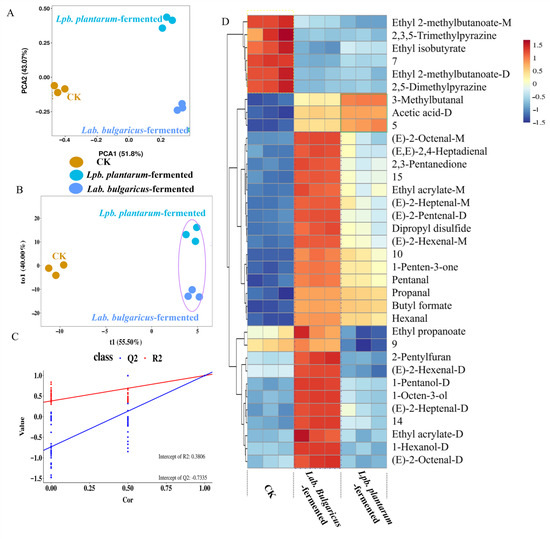
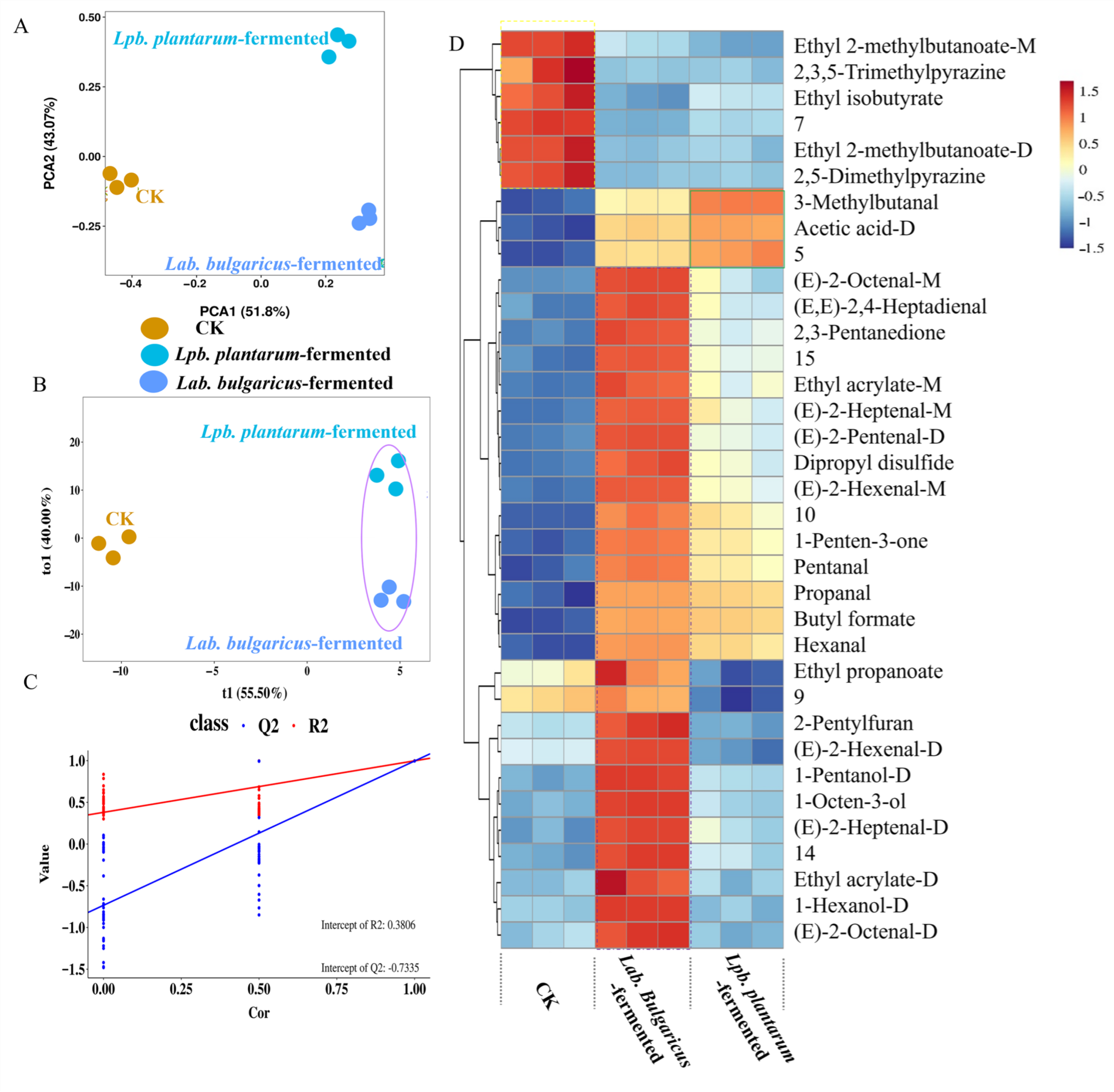
To visualize the volatile profile differences among the sample groups, PCA was applied. The first two PCs together explained 94.87% of the total variance, with PC1 and PC2 contributing 51.8% and 43.07%, respectively. The PCA score plot showed clear separation among the control (CK), Lpb. plantarum-fermented, and Lab. bulgaricus-fermented groups (Figure 4A), indicating that LAB fermentation substantially altered the volatile makeup of F. velutipes roots. The distinct distribution of the Lpb. plantarum and Lab. bulgaricus groups further suggested that the volatile profile was influenced by the choice of starter culture.
Figure 4.
PCA score (A), OPLS-DA (B,C), and heatmap (D) of volatile components. The yellow area represents substances with higher content in the control (CK) group, the green area represents substances with higher content in Lpb. plantarum-fermented group, and the purple area represents substances with higher content in group Lab. bulgaricus-fermented.
An OPLS-DA model was then established to further evaluate differences among the three groups. Clear separation was observed in the OPLS-DA score plot (Figure 4B), indicating significant differences in volatile profiles. Model validation was performed via 200 permutation tests, which gave R2 = 0.998, Q2 = 0.996, and a Q2 intercept of −0.7335 (Figure 4C), indicating good stability and no obvious overfitting. The heatmap of volatile compounds with VIP values > 1 showed distinct differences in signal intensity among groups (Figure 4D; Table S2). Notably, the Lpb. plantarum-fermented group exhibited higher intensities of several key volatiles than the CK and Lab. bulgaricus-fermented groups, suggesting that Lpb. plantarum fermentation may have a more pronounced effect on the accumulation of these specific compounds.
Fatty acid oxidation, amino acid degradation, and glycoside hydrolysis may all contribute to the production of key volatile compounds during fermentation. Linoleic acid oxidation can produce hexanal, 1-octen-3-ol, (E)-2-heptenal, (E)-2-octenal, and (E)-2-nonenal, whereas linolenic acid degradation can generate (Z)-3-hexen-1-ol and (E)-2-hexenal, which are commonly related to grassy and fruity aromas [48]. Thus, enzymatic oxidation of lipids may be partly responsible for the increased hexanal content observed after fermentation. In addition, 2,3-pentanedione, associated with buttery and toffee-like notes associated with fruity aroma, may be formed through enzymatic reactions linked to glycoside hydrolysis and amino acid metabolism [52].
To further clarify the metabolic basis of these volatile changes, LC-MS analysis was conducted to identify related non-volatile metabolites.
3.6. Untargeted Metabolomics Analysis
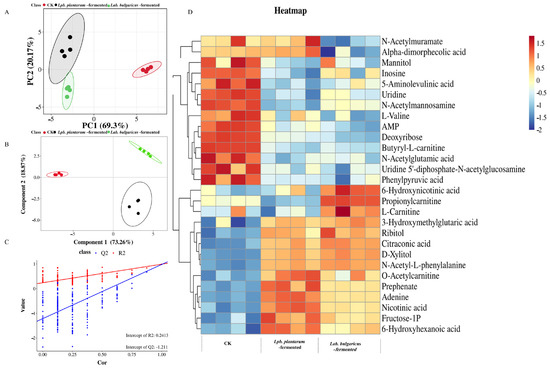
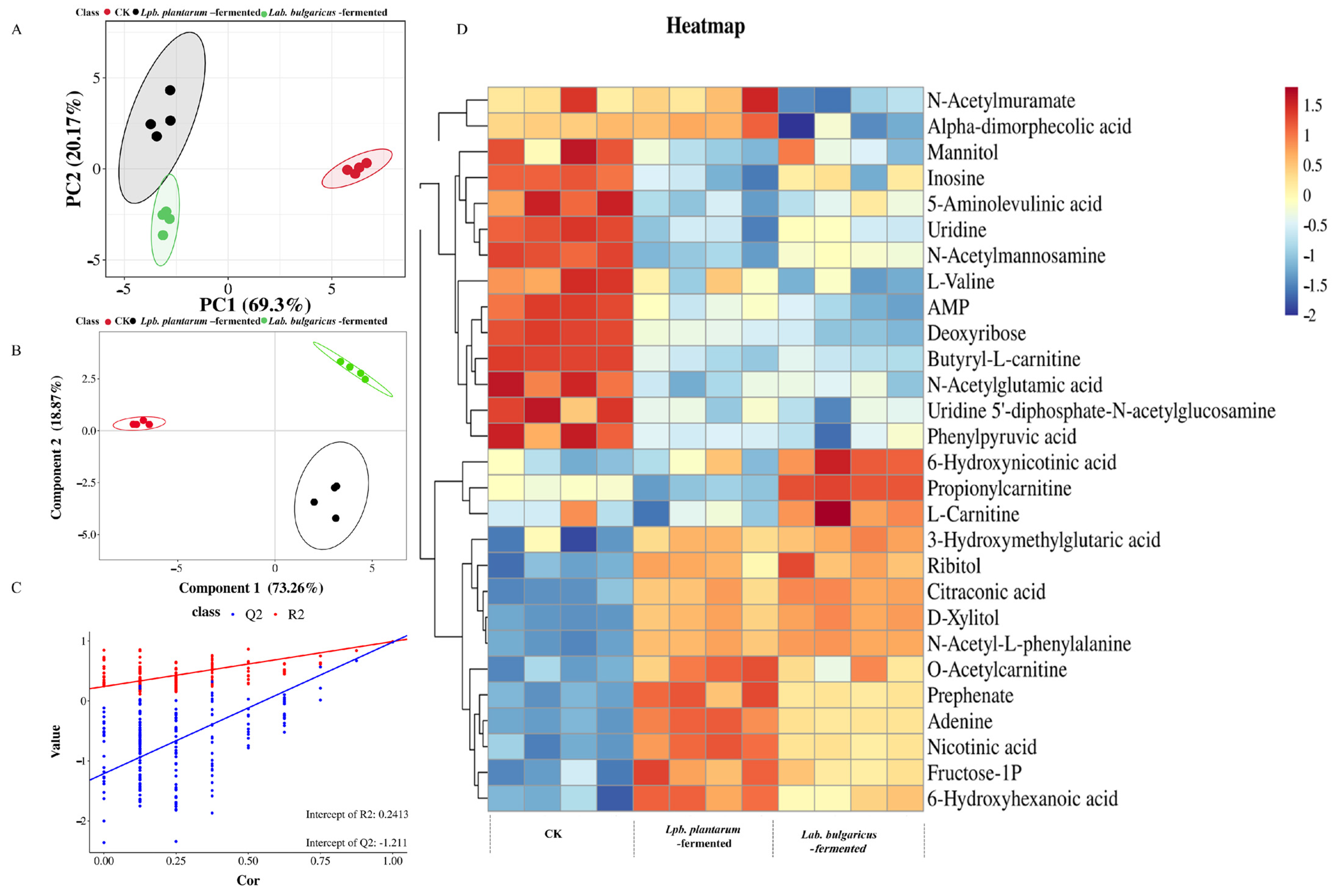
Building on the above observations, LAB fermentation also markedly affected the non-volatile metabolite profiles of F. velutipes roots. To gain deeper insight into the non-volatile metabolite changes following fermentation, we conducted untargeted metabolomic profiling via LC-MS. A total of 48 metabolites were annotated across the control (CK) and fermented samples. The identified metabolites fell into 12 broad classes, namely amino acids, organic acids and derivatives, carbohydrates and derivatives, lipids and lipid-like molecules, alcohols and polyols, amines, terpenoids, phenolic compounds, aldehydes, alkane derivatives, ketones, and other compounds.
To visualize the metabolic signatures distinguishing the various treatments, PCA was applied. The first two principal components jointly captured 89.47% of the total variance, with PC1 and PC2 accounting for 69.3% and 20.17%, respectively (Figure 5A). The PCA score plot clearly separated the control (CK) samples from the fermented groups and also distinguished the Lpb. plantarum- and Lab. bulgaricus-fermented samples, suggesting that the metabolite profiles were influenced by the choice of starter culture. The OPLS-DA model also supported this group discrimination (Figure 5B), with good reliability and predictive ability (R2Y = 0.991, Q2 = 0.981), and a negative Q2 intercept, suggesting no obvious over-fitting. Metabolites with VIP > 1.0 and FDR-adjusted p < 0.05 were defined as differential (Table S3).
Figure 5.
Comparison of metabolites. PCA score chart (A). OPLS-DA score chart (B). OPLS-DA (C) replacement test diagram. Differential metabolite clustering heat map (D).
The cluster heatmap further confirmed distinct metabolic patterns among groups (Figure 5D). Compared with the CK, Lab. bulgaricus fermentation significantly decreased the levels of N-acetylmuramate, linoleic acid, and mannitol (FDR-adjusted p < 0.05), while increasing those of D-xylitol, N-acetyl-L-phenylalanine, and 3-hydroxymethylglutaric acid (FDR-adjusted p < 0.05). A significant reduction in linoleic acid, L-valine, and phenylpyruvic acid was observed in the Lpb. plantarum-fermented group (FDR-adjusted p < 0.05), whereas nicotinic acid, prephenate, and N-acetyl-L-phenylalanine showed significant accumulation (FDR-adjusted p < 0.05). The enhanced antioxidant activity of the fermented samples may be partly associated with the accumulation of N-acetyl-L-phenylalanine, D-xylitol, nicotinic acid, adenine, and citraconic acid, among other metabolites. These results suggest that organic acids, amino acids, carbohydrates, and nucleoside-related compounds were among the metabolite groups substantially affected by fermentation with Lpb. plantarum and Lb. bulgaricus.
Volcano plot analysis further revealed substantial metabolic shifts after fermentation (Figure S3). In comparison with the control (CK), the number of upregulated and downregulated metabolites was 19 and 56, respectively, for the Lpb. plantarum-treated group, and 23 and 23 for the Lab. bulgaricus-treated group. The comparison between Lpb. plantarum- and Lab. bulgaricus-fermented samples identified 12 upregulated and 42 downregulated metabolites, further suggesting that the two LAB strains exerted distinct metabolic effects.
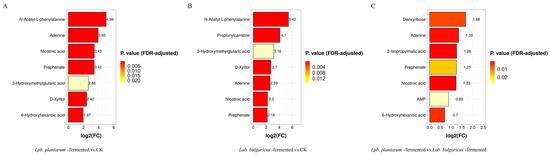
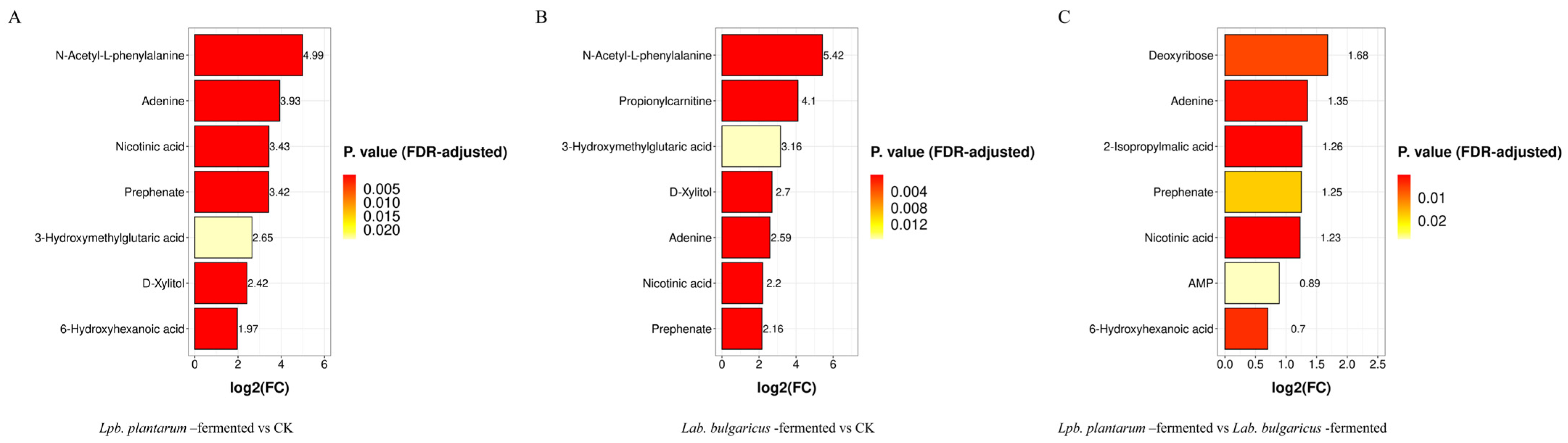
To identify the most relevant differential metabolites, fold-change thresholds were combined with VIP values. For the comparisons of Lpb. plantarum or Lab. bulgaricus against the control (CK), FC > 3 and VIP > 1 were used, whereas FC > 1.5 and VIP > 1 were applied for the Lpb. plantarum versus Lab. bulgaricus comparison. In the Lpb. plantarum-fermented group, the major differential metabolites included carboxylic acids and derivatives, alcohols, and aromatic amino acid-related compounds. Representative metabolites with significant increases included N-acetyl-L-phenylalanine, adenine, nicotinic acid, prephenate, D-xylitol, and 6-hydroxyhexanoic acid (Figure 6A). Among these, nicotinic acid and D-xylitol are associated with antioxidant activities potentially through enhancing reducing power and free radical scavenging, among other mechanisms [53,54].
Figure 6.
Significant differential metabolites identified in the group comparisons. Lpb. plantarum vs. control (CK) (A), Lab. bulgaricus vs. control (CK) (B), and Lpb. plantarum vs. Lab. bulgaricus group (C).
The metabolite profile of the Lab. bulgaricus-fermented group was dominated by amino acids, carboxylic acids, alcohols, and carnitine derivatives. Among these, the most abundant compounds were N-acetyl-L-phenylalanine, propionylcarnitine, D-xylitol, adenine, nicotinic acid, and prephenate (Figure 6B). Propionylcarnitine is of particular interest because of its reported involvement in mitochondrial fatty acid oxidation and antioxidant defense under oxidative stress [55]. The comparison between Lpb. plantarum-fermented and Lab. bulgaricus-fermented groups further identified deoxyribose, 6-hydroxyhexanoic acid, and citraconic acid as major differential metabolites (Figure 6C), implying that these compounds may contribute to the metabolic divergence between the two LAB strains.
Overall, LC-MS-based metabolomics revealed that fermentation by Lpb. plantarum and Lab. bulgaricus substantially altered the non-volatile metabolite profile of F. velutipes roots. The accumulation of amino acids, organic acids, carbohydrates, and nucleosides may be associated with both the improved biological activity and the production of volatile odor-active compounds in the fermented samples. These metabolites can serve as precursors or intermediates in fatty acid oxidation, amino acid degradation, Strecker degradation, Maillard reactions, and microbial biotransformation, thereby contributing to the generation of various GC-IMS-detected aroma-active substances, including aldehydes, alcohols, ketones, and esters.
3.7. Metabolic Pathway Analysis
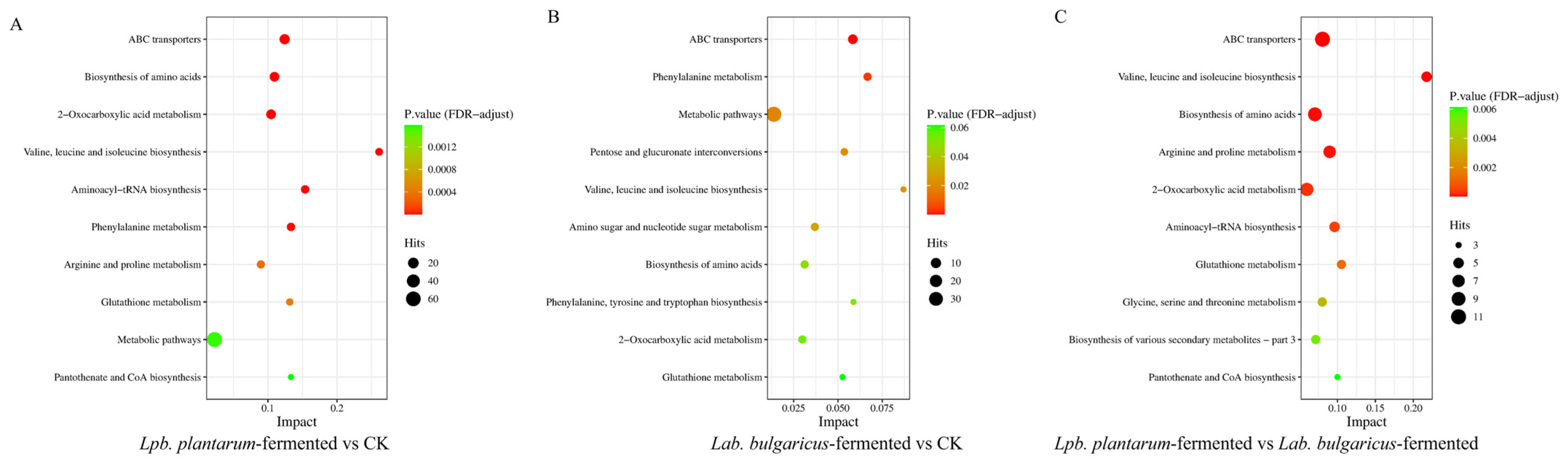
To gain further insight into the metabolic mechanisms associated with by LAB fermentation in F. velutipes roots, KEGG pathway enrichment analysis was conducted. Significant pathway alterations were observed in all comparison groups. In the Lpb. plantarum-fermented vs. CK comparison, the top 10 pathways are shown in Figure 7A (FDR-adjusted p < 0.05). The major enriched pathways included 2-Oxocarboxylic acid metabolism, Valine, leucine, and isoleucine biosynthesis, and aminoacyl-tRNA biosynthesis. This suggests that the metabolic perturbation associated with Lpb. plantarum fermentation is substantial relative to the control (CK) group.
Figure 7.
KEGG enrichment pathways of differential metabolites in group comparisons. Lpb. plantarum vs. control (CK) group (A), Lab. bulgaricus vs. control (CK) group (B), Lpb. plantarum vs. Lab. bulgaricus group (C).
In the Lab. bulgaricus-fermented vs. CK comparison, 10 significantly enriched pathways were shown in Figure 7B (FDR-adjusted p < 0.05), mainly involving phenylalanine metabolism and ABC transporters.
Direct comparison between the Lpb. plantarum-fermented and Lab. bulgaricus-fermented groups identified the top 10 pathways, as shown in Figure 7C (FDR-adjusted p < 0.05). The ABC transporters were among the significantly enriched pathways. In addition, the pathways involved in the biosynthesis of amino acids and 2-Oxocarboxylic acid metabolism were also enriched.
Overall, pathway enrichment analysis suggested that Lpb. plantarum fermentation associated with robust Valine, leucine, and isoleucine biosynthesis and 2-oxocarboxylic acid metabolism. In contrast, Lab. bulgaricus showed more prominent perturbations in phenylalanine metabolism, with less pronounced involvement in valine, leucine, and isoleucine biosynthesis. The observed inter-strain differences were partly associated with variations in ABC transporter functionality and valine, leucine, and isoleucine biosynthetic capacity.
3.8. Sensory Evaluation and Electronic Tongue Analysis
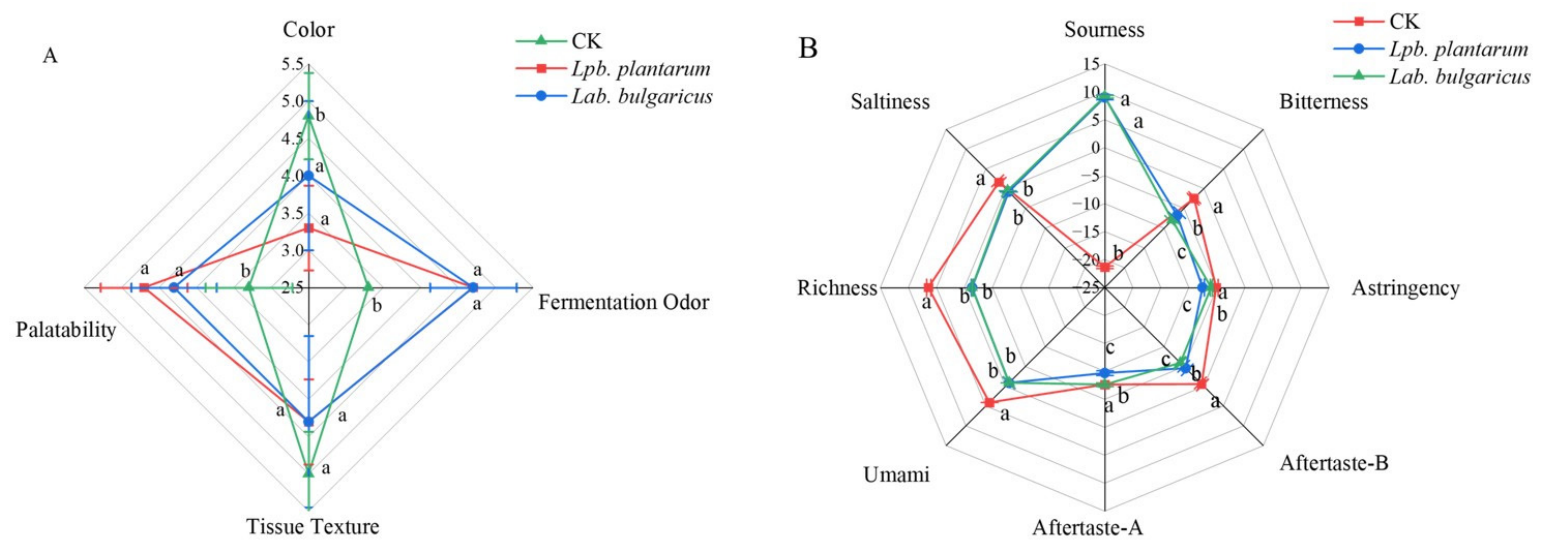
Sensory evaluation and E-tongue analysis were conducted to assess the effects of LAB fermentation on the sensory characteristics of F. velutipes roots. The sensory results showed that fermentation improved odor and palatability, although color and tissue texture scores decreased slightly (Figure 8A).
Figure 8.
Radar charts of sensory evaluation (A) and electronic tongue measurements (B). The different letters denote p < 0.05 for comparisons among other groups.
E-tongue analysis further revealed the changes in taste profiles after fermentation (Figure 8B). Compared with the control (CK), both Lpb. plantarum-fermented and Lab. bulgaricus-fermented samples showed higher sourness, which may be partly attributable to the accumulation of organic acids during fermentation. In contrast, bitterness, astringency, and bitter aftertaste were generally reduced, suggesting that fermentation contributed to the attenuation of undesirable taste attributes. The control (CK) group showed relatively higher umami and richness, suggesting that certain native taste-active compounds were likely consumed or transformed during fermentation. Differences between Lpb. plantarum and Lab. bulgaricus were also observed, suggesting that the two starter cultures exerted distinct effects on taste-related metabolites.
Overall, the sensory and E-tongue results indicated that Lpb. plantarum and Lab. bulgaricus fermentation enhanced the palatability of F. velutipes roots, likely through a combination of enhanced aroma, increased sourness, and reduced bitterness and astringency. These changes were consistent with the metabolomic results, especially the alterations in organic acids, amino acids, sugar alcohols, and phenolic compounds.
4. Conclusions
This study showed that fermentation with Lab. bulgaricus and Lpb. plantarum improved the odor and palatability while reducing the bitterness of F. velutipes roots. The partial conversion of insoluble fiber to soluble fiber was observed during fermentation with Lpb. plantarum and Lab. bulgaricus, which also altered the levels of sugars, organic acids, phenolic acids, and other bioactive compounds. These compositional changes were correlated with enhanced antioxidant activity, improved flavor complexity, and better palatability.
Starter-culture-dependent metabolic regulation was associated with the observed improvements in odor and bitterness of fermented samples. Lpb. plantarum fermentation was associated with metabolic alterations including sugar alcohols, hydroxy fatty acids, esters, and amino acid derivatives, which correlated with improved antioxidant defenses and enhanced flavor complexity, whereas Lab. bulgaricus fermentation showed a more pronounced enrichment of organic acids. Combined GC-IMS and LC-MS analyses suggested that amino acid metabolism, fatty acid degradation, and organic acid metabolism pathways were potentially involved in the formation of volatile flavor compounds. However, as no formal integrative analysis was performed, these observed associations should be considered exploratory and warrant further investigation. Sensory evaluation and E-tongue analysis further indicated that Lpb. plantarum and Lab. bulgaricus fermentations improved fermentation-derived aroma and palatability, while increasing sourness and reducing bitterness and astringency. It should be noted that the present study employed only one strain each of Lactobacillus delbrueckii subsp. bulgaricus and Lactiplantibacillus plantarum. The observed differences, therefore, represent only the phenotypic variations between these two specific starter cultures under the experimental conditions employed. Given the potential metabolic diversity among strains within a species, the present results should not be directly extrapolated to generalized conclusions at the species level. Future studies aiming to establish species-level patterns would require the inclusion of multiple representative strains per species for systematic comparison and cross-validation. Collectively, these results suggest that Lpb. plantarum and Lab. bulgaricus fermentations are a promising route for upcycling F. velutipes root residues, and may pave the way for the design of fermented mushroom preparations with customizable functional and organoleptic properties.
Supplementary Materials
The following supporting information can be downloaded at: https://www.mdpi.com/article/10.3390/foods15172973/s1, Figure S1: Glucose standard curve, Figure S2: Vc standard curve, Figure S3: Volcano plots for Lpb. plantarum vs. control (CK) (A), Lab. bulgaricus vs. control (CK) (B), and Lpb. plantarum vs. Lab. bulgaricus groups (C), Table S1: Sensory evaluation standards for Flammulina velutipes roots, Table S2: Volatile substances in control (CK), Lpb. plantarum-fermented and Lab. bulgaricus-fermented samples (VIP > 1, p (FDR-adjusted) < 0.05), Table S3: Category A (genuine endogenous) differential metabolites in Lpb. plantarum and Lab. bulgaricus-fermented samples compared to the control (CK), Table S4: Category B (exogenous-derived residues) detected in the samples, Table S5: Volatile substances in control (CK), Lpb. plantarum-fermented and Lab. bulgaricus-fermented sample.
Author Contributions
H.Z.: Conceptualization, Methodology, Validation, Writing—review and editing, Funding acquisition. M.Z. and H.N.: Methodology, Formal analysis, Software, Resources, Writing—original draft. S.Z.: Methodology, Formal analysis, Software. Y.W.: Validation Resources. M.C. and Z.Q.: Software. All authors have read and agreed to the published version of the manuscript.
Funding
This study was supported by the Science and Technology Research Program of Henan Province [grant numbers 252102110132, 262102220129, 252102220093], and the Training Program for Young Backbone Teachers in Higher Education Institutions of Henan Province (2024).
Institutional Review Board Statement
(1) Nature of the Study: The panelists (n = 20) were trained to perform routine quality assessment under normal consumption conditions, without any physiological interventions or health risks. (2) Ethical Compliance Statement: According to Article 32 of the Measures for Ethical Review of Life Science and Medical Research Involving Humans (National Health Commission Document No. 4 [2023]), food sensory analysis for product development falls under the “exempt category” when no vulnerable populations are involved. (3) This study was reviewed and approved by the Ethics Committee of Food Science College, and was granted an exemption from full ethics review (Certificate No. 2026-001).
Informed Consent Statement
Informed consent was obtained from all subjects involved in the study.
Data Availability Statement
The original contributions presented in the study are included in the article/Supplementary Materials, further inquiries can be directed to the corresponding author.
Conflicts of Interest
The authors declare no conflicts of interest.
References
- Shen, Y.; Li, H.; Li, Q.; Ge, N.; Song, T.; Liu, Y.; Cai, W. Recycling of Flammulina filiformis mushroom root waste as novel raw material for the cultivation of F. filiformis. Waste Biomass Valorization 2024, 15, 2191–2200. [Google Scholar] [CrossRef] [Scilit]
- Luo, Z.; Gao, Q.; Li, Y.; Bai, Y.; Zhang, J.; Xu, W.; Xu, J. Flammulina velutipes mycorrhizae attenuate high fat diet-induced lipid disorder, oxidative stress and inflammation in the liver and perirenal adipose tissue of mice. Nutrients 2022, 14, 3830. [Google Scholar] [CrossRef] [Scilit] [PubMed]
- Ma, C.; Ni, L.; Sun, M.; Hu, F.; Guo, Z.; Zeng, H.; Sun, W.; Zhang, M.; Wu, M.; Zheng, B. Enhancing the hypolipidemic and functional properties of Flammulina velutipes root dietary fiber via steam explosion. Foods 2024, 13, 3621. [Google Scholar] [CrossRef] [Scilit] [PubMed]
- Sá, A.G.A.; Moreno, Y.M.F.; Carciofi, B.A.M. Plant proteins as high-quality nutritional source for human diet. Trends Food Sci. Technol. 2020, 97, 170–184. [Google Scholar] [CrossRef] [Scilit]
- Nie, Y.; Zhang, J.; Zhao, Z.; Tian, D.; Zhao, X.; Li, B. Screening of mixed lactic acid bacteria starter and exploring the sources of flavor substances in co-fermentation of Flammulina velutipes with different vegetables. Food Biosci. 2025, 64, 105988. [Google Scholar] [CrossRef] [Scilit]
- Nie, Y.; Jia, Y.; Zhang, X.; Lu, S.; Li, B. Screening of mixed lactic acid bacteria starter and its effects on the quality and flavor compounds of fermented Lentinus edodes. Food Sci. Technol. 2022, 42, e39222. [Google Scholar] [CrossRef] [Scilit]
- Capitain, C.; Weller, P. Non-targeted screening approaches for profiling of volatile organic compounds based on gas chromatography-ion mobility spectroscopy (GC-IMS) and machine learning. Molecules 2021, 26, 5457. [Google Scholar] [CrossRef] [Scilit] [PubMed]
- Lee, M.; Kim, D.; Lee, K.W.; Chang, J.Y. Kimchi lactic acid bacteria starter culture: Impact on fermented malt beverage volatile profile, sensory analysis, and physicochemical traits. Food Microbiol. Biotechnol. 2024, 34, 1653–1659. [Google Scholar] [CrossRef] [Scilit] [PubMed]
- López-Salas, D.; Oney-Montalvo, J.E.; Ramírez-Rivera, E.; Ramírez-Sucre, M.O.; Rodríguez-Buenfil, I.M. Evaluation of the volatile composition and sensory behavior of Habanero Pepper during lactic acid fermentation by L. plantarum. Foods 2022, 11, 3618. [Google Scholar] [CrossRef] [Scilit] [PubMed]
- Kenjeric, L.; Sulyok, M.; Malachova, A.; Greer, B.; Kolawole, O.; Quinn, B.; Elliott, C.T.; Krska, R. Extention and interlaboratory comparison of an LC-MS/MS multi-class method for the determination of 15 different classes of veterinary drug residues in milk and poultry feed. Food Chem. 2024, 449, 138834. [Google Scholar] [CrossRef] [Scilit] [PubMed]
- Ter, Z.Y.; Chang, L.S.; Zaini, N.A.M.; Fazry, S.; Babji, A.S.; Koketsu, M.; Takashima, S.; Kamal, N.; Lim, S. Untargeted metabolomics profiling for revealing water-soluble bioactive components and biological activities in edible bird’s nest. Food Res. Int. 2024, 198, 115289. [Google Scholar] [CrossRef] [Scilit] [PubMed]
- Que, Y.; Zhang, Y.; Liang, F.; Wang, L.; Yang, Y.; Zhang, J.; Wang, W.; Sun, Y.; Zhong, C.; Zhang, H.; et al. Structural characterization, antioxidant activity, and fermentation characteristics of Flammulina velutipes residue polysaccharide degraded by ultrasonic assisted H2O2-Vc technique. Ultrason. Sonochem. 2024, 111, 107085. [Google Scholar] [CrossRef] [Scilit] [PubMed]
- Wang, L.; Zhang, Y.; Zang, X.; Yang, Y.; Wang, W.; Zhang, J.; Que, Y.; Liang, F.; Wang, T.; Zhang, J.; et al. Physicochemical properties and fermentation characteristics of a novel polysaccharide degraded from Flammulina velutipes residues polysaccharide. Food Chem. X 2024, 24, 102049. [Google Scholar] [CrossRef] [Scilit] [PubMed]
- Zhang, Y.; Zhong, C.; Liu, S.; Du, L.; Ma, H.; Zhang, H.; Li, Y.; He, C.; Guan, L. Ultrasonic assisted three-phase partitioning extraction and bioactivities validation of polysaccharides from Flammulina velutipes residues. Food Chem. X 2025, 31, 103177. [Google Scholar] [CrossRef] [Scilit] [PubMed]
- Liang, F.; Que, Y.; Liu, Y.; Inam, M.; Yang, Y.; Zhang, Y.; Zhang, J.; Wang, L.; Liu, S.; Guan, L.; et al. Metabolic profiles of Flammulina velutipes residues during Lactiplantibacillus plantarum fermentation. Environ. Technol. Innov. 2025, 37, 103931. [Google Scholar] [CrossRef] [Scilit]
- Qiu, L.; Zhang, M.; Chang, L. Effects of lactic acid bacteria fermentation on the phytochemicals content, taste and aroma of blended edible rose and shiitake beverage. Food Chem. 2023, 405, 134722. [Google Scholar] [CrossRef] [Scilit] [PubMed]
- Yi, Q.; Wang, P.; Tang, H.; Yu, M.; Zhao, T.; Sheng, Z.; Luo, H. Fermentation quality, in vitro digestibility, and aerobic stability of ensiling spent mushroom substrate with microbial additives. Animals 2023, 13, 920. [Google Scholar] [CrossRef] [Scilit] [PubMed]
- Ayar-Sümer, E.N.; Verheust, Y.; Özçelik, B.; Raes, K. Impact of lactic acid bacteria fermentation based on biotransformation of phenolic compounds and antioxidant capacity of mushrooms. Foods 2024, 13, 1616. [Google Scholar] [CrossRef] [Scilit] [PubMed]
- Yang, X.; Hong, J.; Wang, L.; Cai, C.; Mo, H.; Wang, J.; Fang, X.; Liao, Z. Effect of lactic acid bacteria fermentation on plant-based products. Fermentation 2024, 10, 48. [Google Scholar] [CrossRef] [Scilit]
- Yin, L.; Liu, Z.; Lu, X.; Cheng, J.; Lu, G.; Sun, J.; Yang, H.; Guan, Y.; Pang, L. Analysis of the nutritional properties and flavor profile of sweetpotato residue fermented with Rhizopus oligosporus. LWT-Food Sci. Technol. 2023, 174, 114401. [Google Scholar] [CrossRef] [Scilit]
- Cardinali, F.; Botta, C.; Harasym, J.; Reale, A.; Ferrocino, I.; Boscaino, F.; Orkusz, A.; Milanović, V.; Garofalo, C.; Rampanti, G.; et al. Tasting of traditional polish fermented cucumbers: Microbiology, morpho-textural features, and volatilome. Food Res. Int. 2024, 177, 113851. [Google Scholar] [CrossRef] [Scilit] [PubMed]
- GB 5009.88-2023; National Food Safety Standard—Determination of Dietary Fiber in Foods. National Health Commission, State Administration for Market Regulation: Beijing, China, 2023.
- GB 5009.4-2016; National Food Safety Standard—Determination of Ash Content in Foods. National Health Commission, State Administration for Market Regulation: Beijing, China, 2016.
- GB 5009.5-2016; National Food Safety Standard—Determination of Protein in Foods. National Health Commission, State Administration for Market Regulation: Beijing, China, 2016.
- Jin, W.; Zhou, H.; Zhao, H.; Pei, Y.; Su, F.; Li, Y.; Luo, T. Isolation, in vitro antioxidant capacity, hypoglycemic activity and immunoactivity evaluation of polysaccharides from Coriandrum sativum L. Antioxidants 2025, 14, 149. [Google Scholar] [CrossRef] [Scilit] [PubMed]
- Kukhtenko, H.; Bevz, N.; Konechnyi, Y.; Kukhtenko, O.; Jasicka-Misiak, I. Spectrophotometric and chromatographic assessment of total polyphenol and flavonoid content in Rhododendron tomentosum extracts and their antioxidant and antimicrobial activity. Molecules 2024, 29, 1095. [Google Scholar] [CrossRef] [Scilit] [PubMed]
- Hiranpradith, V.; Therdthai, N.; Soontrunnarudrungsri, A.; Rungsuriyawiboon, O. Optimisation of ultrasound-assisted extraction of total phenolics and flavonoids content from Centella asiatica. Foods 2025, 14, 291. [Google Scholar] [CrossRef] [Scilit] [PubMed]
- Baliyan, S.; Mukherjee, R.; Priyadarshini, A.; Vibhuti, A.; Gupta, A.; Pandey, R.P.; Chang, C.M. Determination of antioxidants by DPPH radical scavenging activity and quantitative phytochemical analysis of ficus religiosa. Molecules 2022, 27, 1326. [Google Scholar] [CrossRef] [Scilit] [PubMed]
- Li, G.; Cheng, Y.; Zhang, T.; Li, Y.; Han, L.; Liang, G. Characterization of oxygenated heterocyclic compounds and in vitro antioxidant activity of pomelo essential Oil. Drug Des. Dev. Ther. 2021, 15, 937–947. [Google Scholar] [CrossRef] [Scilit] [PubMed]
- Zhang, J.; Zhang, W.; Zhou, L.; Zhang, R. Study on the influences of ultrasound on the flavor profile of unsmoked bacon and its underlying metabolic mechanism by using HS-GC-IMS. Ultrason. Sonochem. 2021, 80, 105807. [Google Scholar] [CrossRef] [Scilit] [PubMed]
- Vasilev, N.; Boccard, J.; Lang, G.; Grömping, U.; Fischer, R.; Goepfert, S.; Rudaz, S.; Schillberg, S. Structured plant metabolomics for the simultaneous exploration of multiple factors. Sci. Rep. 2016, 6, 37390. [Google Scholar] [CrossRef] [Scilit] [PubMed]
- Ruan, Y.; Chen, Y.; Wang, J.; Zheng, K.; Zhu, S.; Guan, Q.; Xiong, T.; Xie, M. Lactic acid bacteria fermentation improves the physicochemical properties, bioactivity, and metabolic profiles of lychee pulp. Food Chem. X 2026, 34, 103535. [Google Scholar] [CrossRef] [Scilit] [PubMed]
- Li, S.; Guo, L.; Gu, J.; Mu, G.; Tuo, Y. Screening lactic acid bacteria and yeast strains for soybean paste fermentation in northeast of China. Food Sci. Nutr. 2023, 11, 4502–4515. [Google Scholar] [CrossRef] [Scilit] [PubMed]
- Xu, X.; Zhang, X.; Sun, M.; Li, D.; Hua, M.; Miao, X.; Su, Y.; Chi, Y.; Wang, J.; Niu, H. Optimization of mixed fermentation conditions of dietary fiber from Soybean residue and the effect on structure, properties and potential biological activity of dietary fiber from Soybean residue. Molecules 2023, 28, 1322. [Google Scholar] [CrossRef] [Scilit] [PubMed]
- Du, J.; Song, Y.; Li, X.; Liu, N.; An, X.; Qi, J. Dynamic changes and correlation analysis of polysaccharide content and color parameters in Glycyrrhiza stems and leaves during fermentation. Fermentation 2023, 9, 900. [Google Scholar] [CrossRef] [Scilit]
- Mantzouridou, F.; Naziri, E.; Tsimidou, M.Z. Squalene versus ergosterol formation using Saccharomyces cerevisiae: Combined effect of oxygen supply, inoculum size, and fermentation time on yield and selectivity of the bioprocess. J. Agric. Food Chem. 2009, 57, 6189. [Google Scholar] [CrossRef] [Scilit] [PubMed]
- He, Z.; Zhang, H.; Wang, T.; Wang, R.; Luo, X. Effects of five different lactic acid bacteria on bioactive components and volatile compounds of Oat. Foods 2022, 11, 3230. [Google Scholar] [CrossRef] [Scilit] [PubMed]
- Kuligowski, M.; Radziejewska-Kubzdela, E.; Górna, O.; Jasińska-Kuligowska, I.; Kidoń, M. Sustainable use of by-products (Okara and Linseed Cake) in tempeh fermentation: Effects on isoflavones and lignans. Sustainability 2024, 16, 9936. [Google Scholar] [CrossRef] [Scilit]
- Liu, F.; Chen, Z.; Shao, J.; Wang, C.; Zhan, C. Effect of fermentation on the peptide content, phenolics and antioxidant activity of defatted wheat germ. Food Biosci. 2017, 20, 141–148. [Google Scholar] [CrossRef] [Scilit]
- Liu, X.; Yuan, Q.; Yang, Y.; Yang, M.; Qing, Y.; Li, X.; Liao, X.; Shi, B. Antimicrobial activity and mechanism of gallic acid-gadolinium complex against multidrug-resistant Salmonella. Ind. Crops Prod. 2025, 229, 120980. [Google Scholar] [CrossRef] [Scilit]
- Babaei-Rad, S.; Mumivand, H.; Mollaei, S.; Khadivi, A. Postharvest UV-B and UV-C treatments combined with fermentation enhance the quality characteristics of Capparis spinosa L. fruit, improving total phenols, flavonoids, anthocyanins, phenolic acids, and antioxidant activity. Food Chem. 2025, 483, 144306. [Google Scholar] [CrossRef] [Scilit] [PubMed]
- Zhu, Q.; Shi, G.; Gu, J.; Du, J.; Guo, J.; Wu, Y.; Yang, S.; Jiang, J. Impact of lactic acid bacterial fermentation on the chemical composition, antioxidant capacities and flavor properties of dandelion. Food Biosci. 2024, 62, 105313. [Google Scholar] [CrossRef] [Scilit]
- Sarıtaş, S.; Portocarrero, A.C.M.; López, J.M.M.; Lombardo, M.; Koch, W.; Raposo, A.; EI-Seedi, H.R.; Alves, J.L.B.; Esatbeyoglu, T.; Karav, S.; et al. The impact of fermentation on the antioxidant activity of food products. Molecules 2024, 29, 3941. [Google Scholar] [CrossRef] [Scilit] [PubMed]
- Hur, S.J.; Lee, S.Y.; Kim, Y.C.; Choi, I.; Kim, G.B. Effect of fermentation on the antioxidant activity in plant-based foods. Food Chem. 2014, 160, 346–356. [Google Scholar] [CrossRef] [Scilit] [PubMed]
- Coda, R.; Rizzello, C.G.; Pinto, D.; Gobbetti, M. Selected lactic acid bacteria synthesize antioxidant peptides during sourdough fermentation of cereal flours. Appl. Environ. Microbiol. 2012, 78, 1087–1096. [Google Scholar] [CrossRef] [Scilit] [PubMed]
- Liu, S.; Peng, Y.J.; He, W.W.; Song, X.X.; He, Y.X.; Hu, X.Y.; Bian, S.G.; Li, Y.H.; Yin, J.Y.; Nie, S.P.; et al. Metabolomics-based mechanistic insights into antioxidant enhancement in mango juice fermented by various lactic acid bacteria. Food Chem. 2025, 466, 142078. [Google Scholar] [CrossRef] [Scilit] [PubMed]
- Chen, F.; Elgaher, W.A.M.; Winterhoff, M.; Büssow, K.; Waqas, F.H.; Graner, E.; Pires-Afonso, Y.; Perez, L.C.; de la Vega, L.; Sahini, N.; et al. Citraconate inhibits ACOD1 (IRG1) catalysis, reduces interferon responses and oxidative stress, and modulates inflammation and cell metabolism. Nat. Metab. 2022, 4, 534–546. [Google Scholar] [CrossRef] [Scilit] [PubMed]
- Hara, N.; Yamada, K.; Shibata, T.; Osago, H.; Hashimoto, T.; Tsuchiya, M. Elevation of cellular NAD levels by nicotinic acid and involvement of nicotinic acid phosphoribosyltransferase in human cells. J. Biol. Chem. 2007, 282, 24574–24582. [Google Scholar] [CrossRef] [Scilit] [PubMed]
- Zhao, H.; Chen, H.; Wu, G.; Xu, J.; Zhu, W.; Chen, J.; Luo, D.; Guo, S. Integrative metabolomics—GC-IMS approach to assess metabolic and flavour substance shifts during fermentation of Yangjiang douchi. Food Chem. 2024, 466, 142199. [Google Scholar] [CrossRef] [Scilit] [PubMed]
- Latha Ravi, J.; Ghosh, P.; Ahmad, F.; Haque, S.; Barciela, P.; Chamorro, F.; Jorge, A.O.S.; Prieto, M.A.; Rana, S.S. Microbialconversion of vegetable waste for flavoradditives via solid-state fermentation: Acomprehensive review. Front. Nutr. 2025, 12, 1445189. [Google Scholar] [PubMed]
- Wang, J.; Cui, J.; Liu, Z.; Yang, Y.; Li, Z.; Liu, H. Untargeted metabolomics based on ultra-high-performance liquid chromatography coupled with quadrupole orbitrap high-resolution mass spectrometry for differential metabolite analysis of pinelliae rhizoma and its adulterants. Molecules 2024, 29, 2155. [Google Scholar] [CrossRef] [Scilit] [PubMed]
- Osorio Alises, M.; Sánchez-Palomo, E.S.; González Viñas, M.A. Effects of winemaking techniques on the volatile compounds of Chelva wines. Food Biosci. 2024, 59, 104121. [Google Scholar] [CrossRef] [Scilit]
- Wu, H.; Niu, L.; Chen, J.; Xu, H.; Kong, C.; Xiao, J. A comprehensive metabolomic analysis of volatile and non-volatile compounds in Folium Artemisia argyi tea from different harvest times. Foods 2025, 14, 843. [Google Scholar] [CrossRef] [Scilit] [PubMed]
- Shende, V.V.; Bauman, K.D.; Moore, B.S. The shikimate pathway: Gateway to metabolic diversity. Nat. Prod. Rep. 2024, 41, 604–648. [Google Scholar] [CrossRef] [Scilit] [PubMed]
- Placidi, M.; Vergara, T.; Casoli, G.; Flati, I.; Capece, D.; Artini, P.G.; Virmani, A.; Zanatta, S.; D’Alessandro, A.M.; Tatone, C.; et al. Acyl-carnitines exert positive effects on mitochondrial activity under oxidative stress in mouse oocytes: A potential mechanism underlying carnitine efficacy on PCOS. Biomedicines 2023, 11, 2474. [Google Scholar] [CrossRef] [Scilit] [PubMed]
Disclaimer/Publisher’s Note: The statements, opinions and data contained in all publications are solely those of the individual author(s) and contributor(s) and not of MDPI and/or the editor(s). MDPI and/or the editor(s) disclaim responsibility for any injury to people or property resulting from any ideas, methods, instructions or products referred to in the content. |
© 2026 by the authors. Licensee MDPI, Basel, Switzerland. This article is an open access article distributed under the terms and conditions of the Creative Commons Attribution (CC BY) license.