Communication

Lab-Scale Methodology for New-Make Bourbon Whiskey Production

1
Department of Horticulture, University of Kentucky, Lexington, KY 40503, USA
2
Department of Biosystems and Agricultural Engineering, University of Kentucky, Lexington, KY 40503, USA
3
James B. Beam Institute for Kentucky Spirits, University of Kentucky, Lexington, KY 40503, USA
*
Author to whom correspondence should be addressed.
Foods 2023, 12(3), 457; https://doi.org/10.3390/foods12030457
Submission received: 29 November 2022 / Revised: 23 December 2022 / Accepted: 12 January 2023 / Published: 18 January 2023
(This article belongs to the Special Issue Grain Products: Traditional and Innovative Technologies)

Abstract

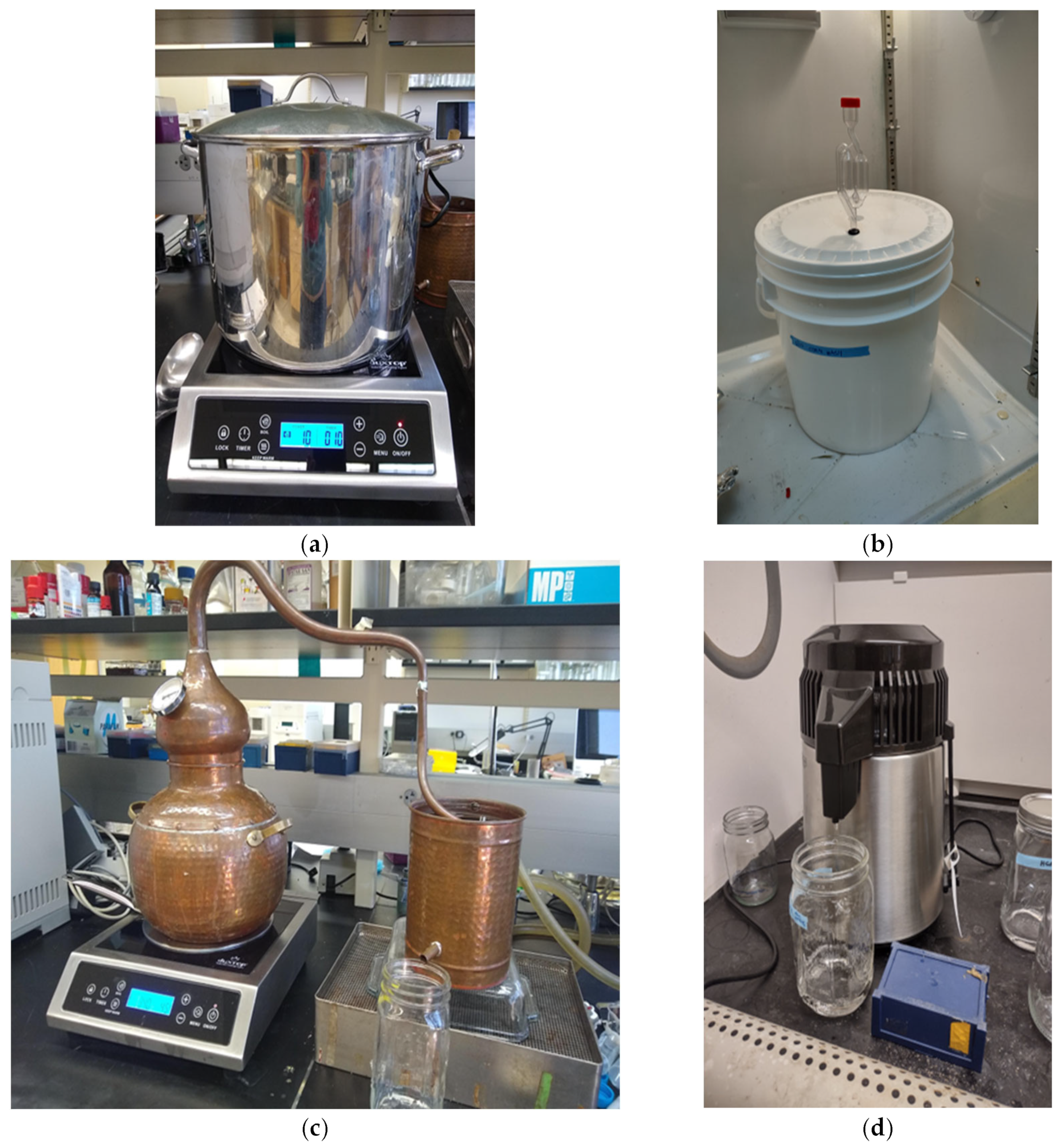
Whiskey production originated in Scotland in the 15th century and was based on malted barley. As Scotch-Irish settlers came into the Ohio river valley, they began fermenting and distilling the primary grain of North America, maize. These earlier settlers started a heritage; they created American Whiskey. The bourbon industry in Kentucky had tremendous growth in the last 20 years, and currently, distilleries have a broad increase in product innovation, new raw materials, improved sustainability, efficient processes, and product diversification. Our study presents a new lab-scale method for new-make bourbon whiskey production. It was developed to mimic distilleries’ processes; therefore, results can be extrapolated and adopted by commercial distilleries. The method focused on reproducibility with consistency from batch to batch when handled by an operator or small crew in a university lab. The method consisted of a first cooking step to make a “mash”, a fermentation phase of 96 h, a first distillation accomplished with a copper pot still to obtain the “low wines” and a second distillation carried out with an air still to collect the “hearts”. The method produced a final distillate of 500–700 mL for further sensory analysis and tasting. This lab-scale method showed consistency between samples in the different parameters quantified and will be also used to train students in fermentation and distillation studies.
Keywords: bourbon; new-make whiskey; maize; fermentation; distillation; cereals bourbon; new-make whiskey; maize; fermentation; distillation; cereals