Review

Potential Application of Marine Fucosyl-Polysaccharides in Regulating Blood Glucose and Hyperglycemic Complications

College of Food Science and Engineering, Ocean University of China, No. 1299 Sansha Road, Qingdao 266003, China
*
Author to whom correspondence should be addressed.
Foods 2023, 12(13), 2600; https://doi.org/10.3390/foods12132600
Submission received: 4 June 2023 / Revised: 22 June 2023 / Accepted: 27 June 2023 / Published: 5 July 2023
(This article belongs to the Special Issue Marine Food: Development, Quality and Functionality)

Abstract

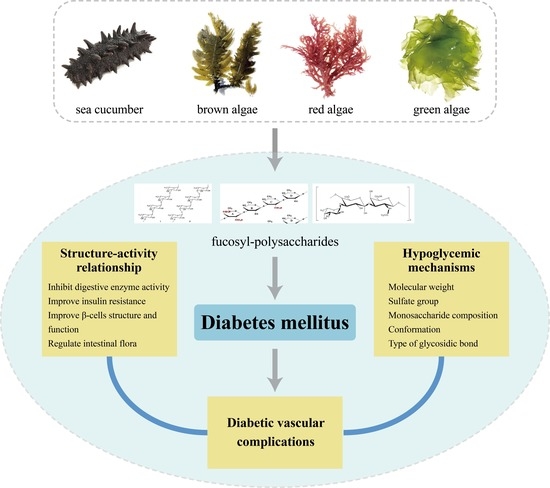
Diabetes mellitus (DM) has become the world’s third major disease after tumors and cardiovascular disease. With the exploitation of marine biological resources, the efficacy of using polysaccharides isolated from marine organisms in blood glucose regulation has received widespread attention. Some marine polysaccharides can reduce blood glucose by inhibiting digestive enzyme activity, eliminating insulin resistance, and regulating gut microbiota. These polysaccharides are mainly fucose-containing sulphated polysaccharides from algae and sea cucumbers. It follows that the hypoglycemic activity of marine fucosyl-polysaccharides is closely related to their structure, such as their sulfate group, monosaccharide composition, molecular weight and glycosidic bond type. However, the structure of marine fucosyl-polysaccharides and the mechanism of their hypoglycemic activity are not yet clear. Therefore, this review comprehensively covers the effects of marine fucosyl-polysaccharides sources, mechanisms and the structure–activity relationship on hypoglycemic activity. Moreover, the potential regulatory effects of fucosyl-polysaccharides on vascular complications caused by hyperglycemia are also summarized in this review. This review provides rationales for the activity study of marine fucosyl-polysaccharides and new insights into the high-value utilization of marine biological resources.
Keywords: marine fucosyl-polysaccharides; bioactivity; blood glucose; structure–activity relationship; hyperglycemic complications marine fucosyl-polysaccharides; bioactivity; blood glucose; structure–activity relationship; hyperglycemic complications
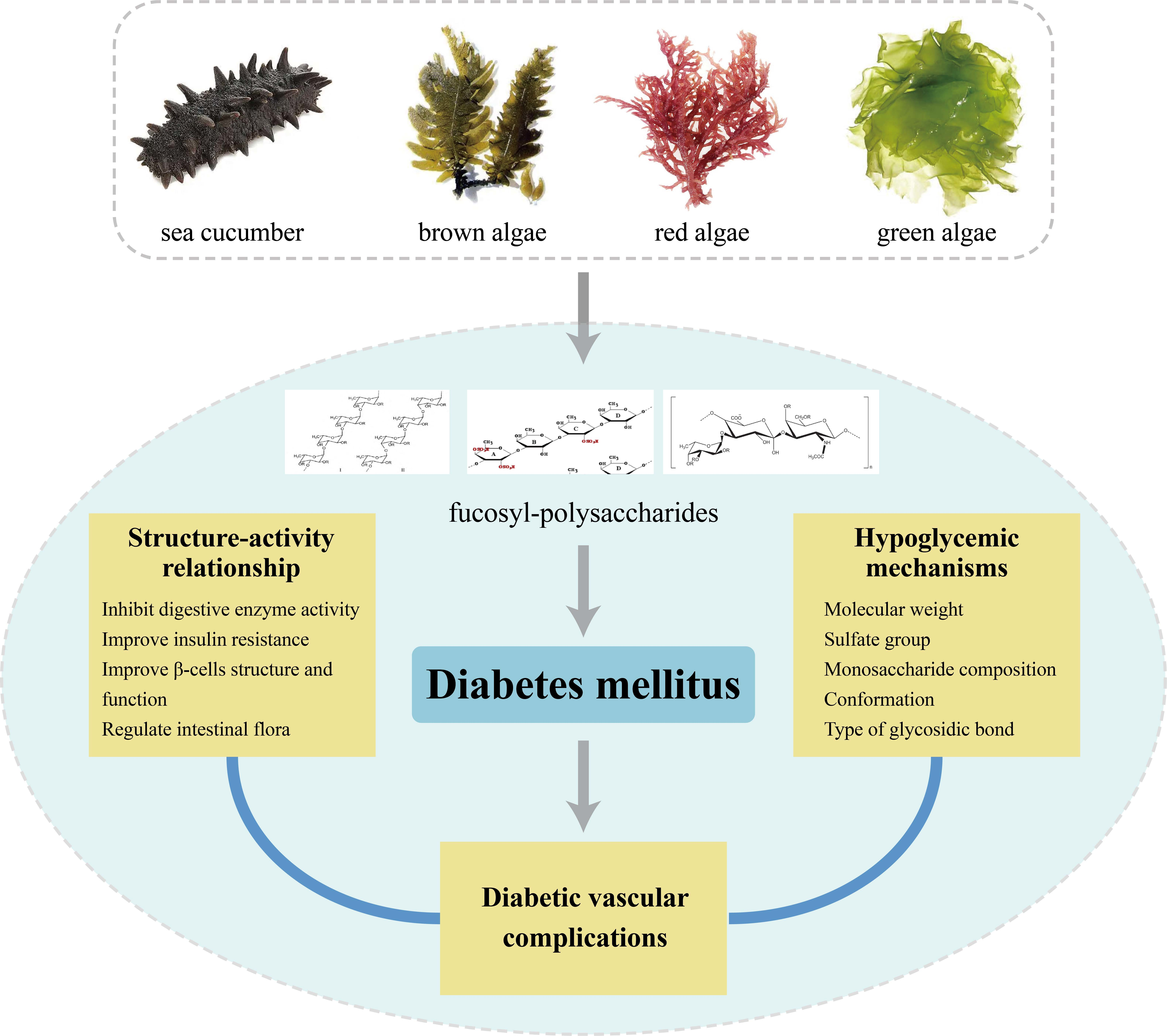
Graphical Abstract