


Abstract
Ethylene cross-bridged tetraazamacrocycles have been used to stabilize first-row transition metal complexes for applications under harsh conditions, such as biomedical imaging and aqueous oxidation catalysis. We have applied these ligands to the synthesis of complexes of a larger second row transition metal, namely, square pyramidal Pd2+ complexes, which may be useful for future catalytic processes. We now report the synthesis and crystal structure determination of four novel Pd2+ complexes of the general formula [PdLCl]PF6, where L is the dimethyl ethylene cross-bridged derivative of 12aneN4 (cyclen), 13aneN4 (homocyclen), or 14aneN4 (cyclam), or the dibenzyl ethylene cross-bridged derivative of 14aneN4 (cyclam). Solid-state structures of all four complexes can be described as a distorted square pyramidal with τ5 values ranging from 0.01 to 0.20, with three macrocycle nitrogen atoms and one chloride in the square base and the fourth ligand nitrogen constrained by the cross-bridge to the axial position. Cyclic voltammetry of the complexes in acetonitrile shows stabilization of the Pd3+ oxidation state by all four complexes. Electronic spectroscopy reveals the typical behavior for square pyramidal Pd2+.
1. Introduction
Functional coordination compounds comprise two components: (1) the transition metal of choice and (2) a ligand set, often containing coordinating anions or neutral monodentate small molecules, along with more complicated, typically polydentate, carefully chemist-designed species. Designed synthetic ligands typically mimic the structure and/or reactivity of ubiquitous prosthetic groups like the hemes in nature [1] but can often modify or even surpass nature’s toolbox. Combining the inherent properties of a given metal ion with a constraining or enhancing synthetic ligand can tailor the chemistry of the resulting complex to attack diverse chemical problems or applications. There is significant interest in finding utility for such synthetic constructs in the fields of photochemistry [2], biochemistry [3], and catalysis. Of the many choices of transition metals to manipulate by their combination with synthetic ligands, one of the most highly exploited is palladium [4,5,6,7,8,9,10,11,12,13,14]. Used for the Heck, Suzuki, Sonogashira, and Stille reactions [15], Pd is one of the most versatile and valuable transition metals used to empower chemists to control the precise syntheses of the unlimited chemical space of novel organic compounds [14,16,17,18,19,20,21,22]. Palladium catalysts produce conversions at the ppm or ppb level due to their high turnover frequencies, and more details of the reasons for palladium’s domination of C-C bond formation catalysis are revealed regularly [23].
Palladium-based catalysts have shown great promise, specifically in their ability to produce C-H functionalization [24,25] and C-C, C-N, C-O, and C-S bonds via cross-coupling [15]. There are frequent reports of new Pd catalysts, both homogeneous and heterogenous [26]. While homogenous catalysis is generally considered to be the better at specificity, heterogenous catalysts are widely regarded as the greener of the two due to their recyclability and ease of separation from reaction mixtures. However, recently, there has been contention as to how much of the catalyzed reactions are due to palladium metal leaching rather than true catalysis from the palladium complex added to the reaction [27].
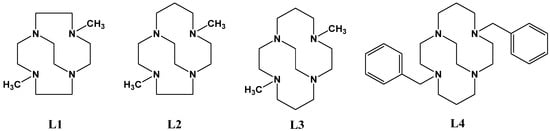
One ligand type not fully exploited for palladium chemistry is the ethylene cross-bridged tetraazamacrocycle. These ligands have been the focus of our research for the last three decades. Due to their rigidifying, short ethylene cross-bridge, which imparts the topological constraint of the cryptands at the same time, their first-row transition metal complexes are unusually stable, particularly compared to unbridged analogs and particularly under harsh aqueous conditions [28]. We hypothesize that these ligands’ topological constraints and rigidity might similarly stabilize their Pd2+ complexes and limit the leaching of the Pd from the complex during catalytic reactions. Previously, we synthesized the Pd2+ complex of L3 [29] (Figure 1) but never explored its chemistry or attempted to make other derivatives. Thus, we set out to generalize the synthesis of palladium(II) complexes of ethylene cross-bridged tetraazamacrocycles (Figure 1) and to determine their molecular structures. These results will be presented below.
Figure 1.
Structures of the ethylene cross-bridged tetraazamacrocyclic ligands discussed in this work.
2. Results and Discussion
2.1. Synthesis of Palladium(II) Complexes
In 1999, we disclosed the first synthesis of the palladium(II) complex of an ethylene cross-bridged tetraazamacrocycle, [(L3)PdCl]Cl·2H2O, and its X-ray crystal structure [29]. The synthesis used Pd(MeCN)2Cl2 and L3 in acetonitrile as reactants and resulted in a relatively good yield (55%), although the complex was not particularly clean nor the synthetic procedure particularly reproducible [30]. Thus, no more work has appeared with this or any other palladium(II) complexes with similar ligands until now. Two issues were identified, with the original synthesis to be accounted for in order to reproducibly make pure palladium(II) complexes with similar ligands: (1) What appeared to be Pd0 metal is produced, apparently by some type of disproportionation reaction during complexation; (2) based on 1:1 metal to ligand stoichiometry, excess or a possibly decomposed ligand would result from the disproportionation reaction and would need to be reliably removed in order to produce pure complexes.
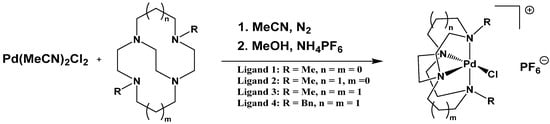
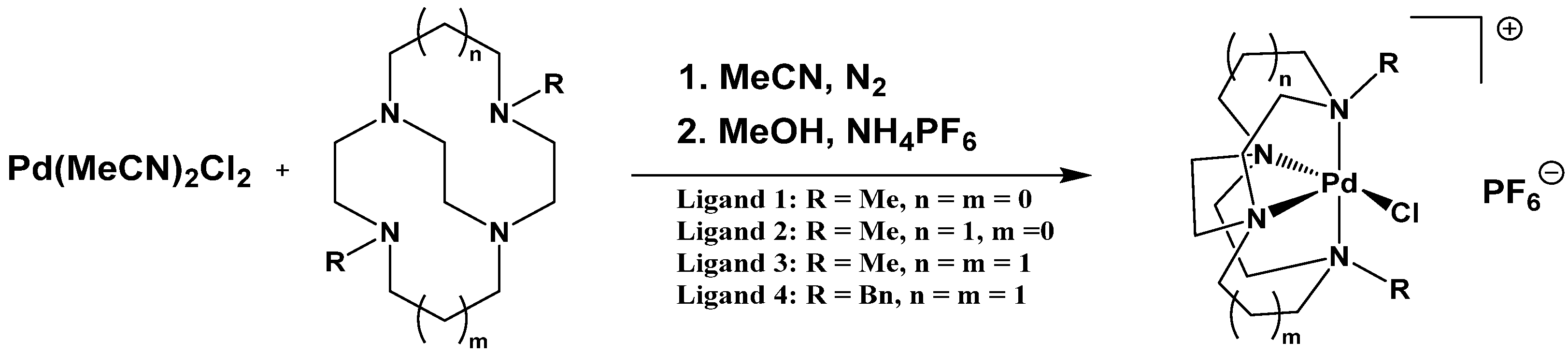
In the present synthetic procedure (Scheme 1; see Experimental section for details), we perform the complexation in acetonitrile in an inert atmosphere glovebox, stirring from 2.5 to 15 h. Pd0 is then removed by filtration of the black solid suspended in the reaction mixture. Then, the solvent is removed under vacuum and the residue dissolved in methanol in the inert atmosphere glovebox. The methanolic solution is blue or purple and may have undissolved white and/or orange solids, which may be decomposed ligands and/or square planar Pd2+ complexes with decomposed ligand fragments. Another filtration removes these solids, and then five equivalents of NH4PF6, dissolved separately in minimal methanol, are added to the filtrate to metathesize the chloride anion to PF6−. In some cases, chilling the methanolic solution directly precipitates the [(L)PdCl]PF6 as a blue or purple solid, which can be filtered off and vacuum dried. In other cases, in order to produce either crystalline or powder final products, the methanol was evaporated and the residue stirred with dichloromethane, which dissolves the desired product, and excess NH4PF6 is filtered off. Finally, diethyl ether diffusion into the dichloromethane solution precipitates out blue or purple powder or crystals of the pure products in yields from 30 to 58%.
Scheme 1.
Synthetic scheme for [(L)PdCl]PF6 complexation.
2.2. X-Ray Crystallographic Structural Studies
2.2.1. [(L1)PdCl]PF6
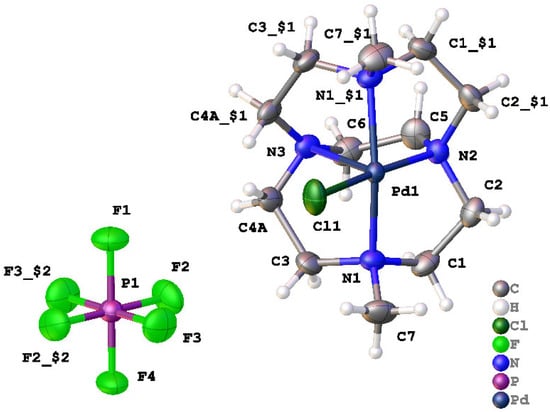
The crystal structure of [(L1)PdCl]PF6 adopts the centric space group Cmce with two symmetry-unique half complexes and half anions in the asymmetric unit; the complete species are generated by the mirror plane (Table 1, Figure 2). In each of the metal complexes, the coordination about the metal ion is similar and features Pd2+ with five ligating atoms in an unusual coordination environment. Three nitrogen atoms from L1 and one chloride are approximately in the same plane (rms 0.1795 Å) and form a distorted square planar coordination because the Pd1-Cl1 bond (2.3115(8) Å) is longer than the Pd1-N bonds (symmetry-unique bond lengths are 2.0540(18) and 2.071(2) Å; Table 2). In addition to this arrangement, there is another nitrogen atom from the ligand, but this is much further from the metal ion and forms an extremely distorted square-based pyramid (Pd1-N3 = 2.575(3) Å), as shown in Figure 2. Presumably this unusual coordination is a result of the geometric limitation imposed by the bite angle of the ethylene bridge and the electronic preference of the d8 metal. The binding of the ligand can be classified in terms of the bite angle of nitrogen atoms at either end of the ethylene bridge (N2-Pd1-N3) and the relative length of the Pd1-N3 bond compared with the mean Pd-N length of the other nitrogen atoms. The bite angle N2-Pd1-N3 is 74.66(9)° and the Pd1-N3 bond is 0.515 Å longer than the mean of the others. The coordination about Pd2 is similar (rms deviation from the mean plane of the four principal coordinating atoms is 0.1601 Å), with a bite angle of 75.49(9)° and bond elongation for Pd2-N6 of 0.464 Å.
Table 1.
Crystal data and structural refinement details.
Figure 2.
Coordination environment of one of the metal ions within [(L1)PdCl]PF6, with atoms drawn as 50% probability ellipsoids. Symmetry operators used to generate equivalent atoms: $1 = −x, y, z; $2 = x, −y, −z.
Table 2.
Selected bond lengths (Å) and angles (deg).
In the solid, the orientation of the two symmetry-unique complexes is such that there is a relatively close approach of Pd1 and Cl2 (3.5044(8) Å), which may signal a very weak interaction between them (sum of vdW radii is 3.38 Å). The CSD has numerous structures of coordination compounds with Pd-Cl bonds. The mean bond length of a subset of 2000 of these was 2.34(6) Å. For a set of 474 compounds with a least three nitrogen donor atoms, there is a broad spread of Pd···Cl distances for non-bonded chloride, and a value of ~3.5 Å is not unusual. Additionally, there is evidence for C-H···Cl interactions, and it may be that the relative orientation of adjacent complexes maximizes this interaction.
Minor disorder is present because the ethylene bridge can adopt one of two different orientations in equal amounts, and this has an impact on the orientation of the rest of the ligand. In one of the two symmetry-unique complexes, there are two different orientations of the -CH2CH2- groups within the ligand, but the nitrogen positions do not appear to alter. The disordered atom occupancies are given in the ESI.
2.2.2. [(L2)PdCl]PF6
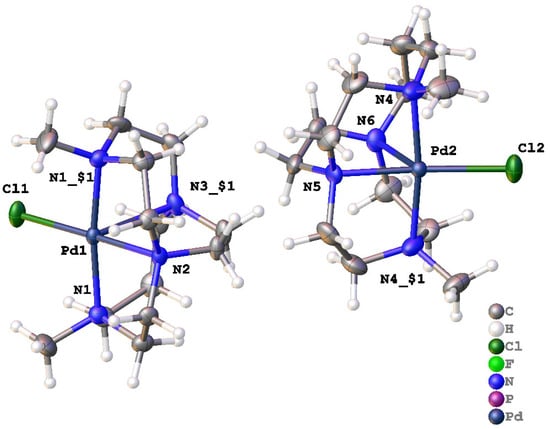
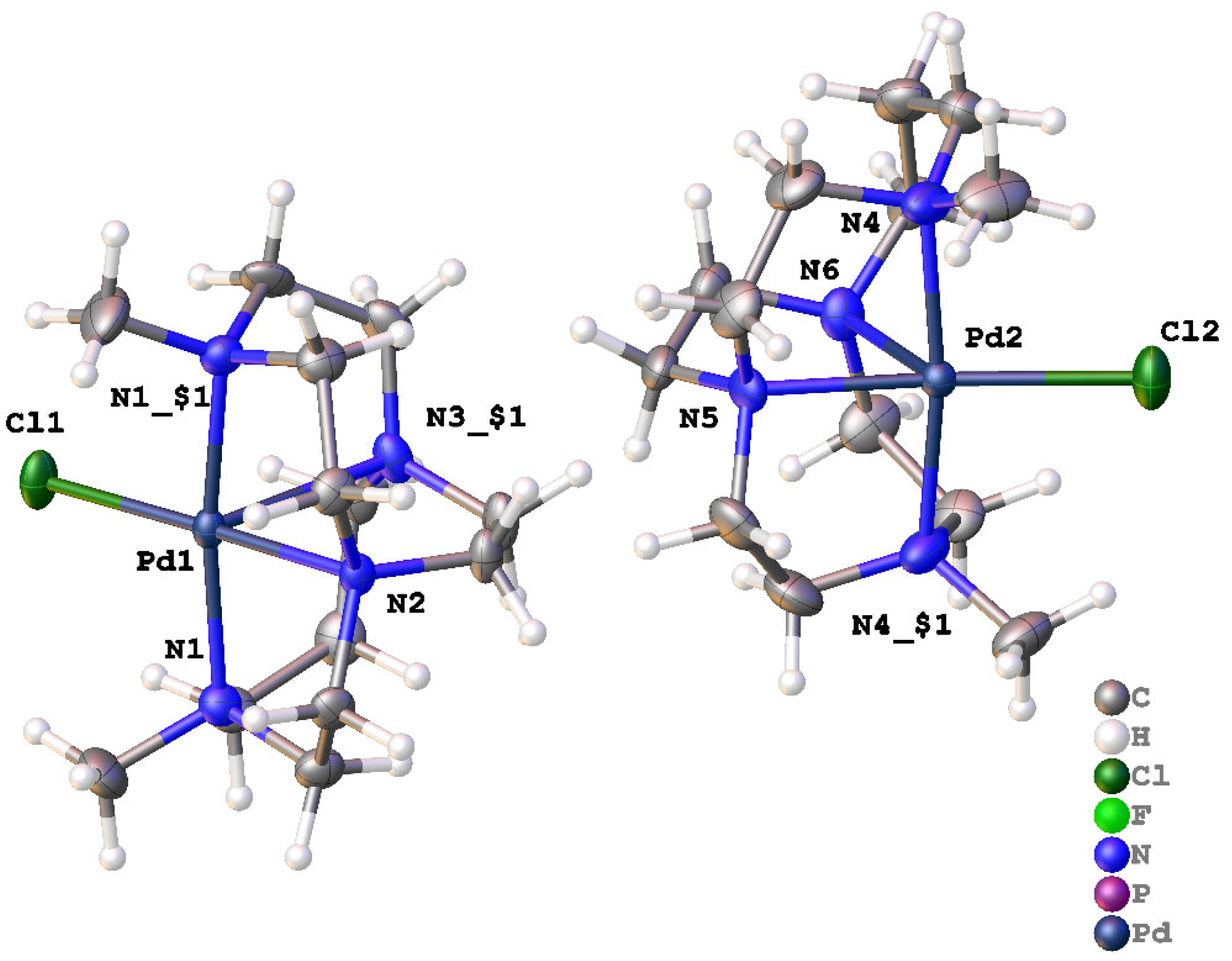
[(L2)PdCl]PF6 crystallizes in the centric space group Pnma with two symmetry-unique half [(L2)PdCl]+ complexes and one PF6− anion in the asymmetric unit (Table 1, Figure 3). There is also disorder present in both the anion and the two symmetry-unique complexes. The two metal complexes are identical in coordination environment but vary slightly in geometry. It is sufficient to describe the coordination about Pd1 and highlight the differences for Pd2. Unusually, the Pd2+ ion is in a five-coordinate geometry formed by four atoms in a kite shape with chloride, three nitrogen atoms at approximately equal distances, and is capped by a fourth nitrogen atom with a much longer distance from the metal than the others. The symmetry present means that the kite is perfectly flat. The unique Pd1-N distances are 2.047(3) and 2.077(3) Å, while the capping nitrogen distance, Pd1-N3_$1 ($1 = x, 1.5-y, z), is 2.524(5) Å (Table 2). The bite angle at the ethylene bridge for Pd1 is 76.56(14)°, and the bond elongation is 0.462 Å. The geometry about Pd2 is similar with a capped kite coordination geometry about the metal ion. The bite angle of N5 and N6 at Pd2 is 74.76(16)°, and the bond elongation is also 0.467 Å.
Figure 3.
Coordination environments within the two unique metal ions in the cation of [(L2)PdCl]PF6, with atoms drawn as 50% probability ellipsoids.
The solid-state structure exhibits considerable disorder that arises because of the crystallographic symmetry imposed on the aliphatic chains in the ligand; the palladium ions are arranged in fixed positions in the structure, but the -CH2CH2CH2- linker moiety can be on either side of the molecule. This means the -CH2CH2- and -CH2CH2CH2- linkers each occur in 50% occupancy in the same region of space in the asymmetric unit. The disordered atom occupancies are given in the ESI. The anion is disordered, as is commonly observed. The analysis of unique interactions between adjacent species in the solid state is complicated by the disorder. However, it is clear that there are Cl···H-C interactions between adjacent cations that form tapes running parallel with the c-axis. Between these tapes lie the PF6− anions, and there is a very extensive set of F···H-C interactions within the solid.
2.2.3. [(L3)PdCl]PF6
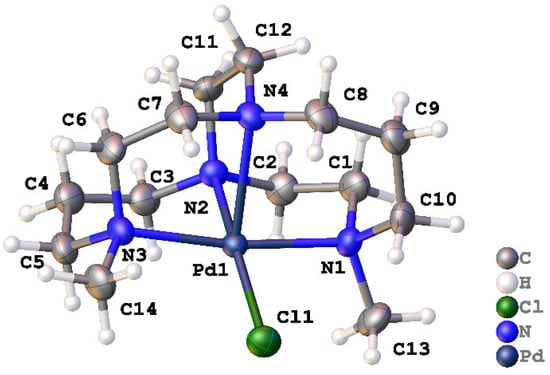
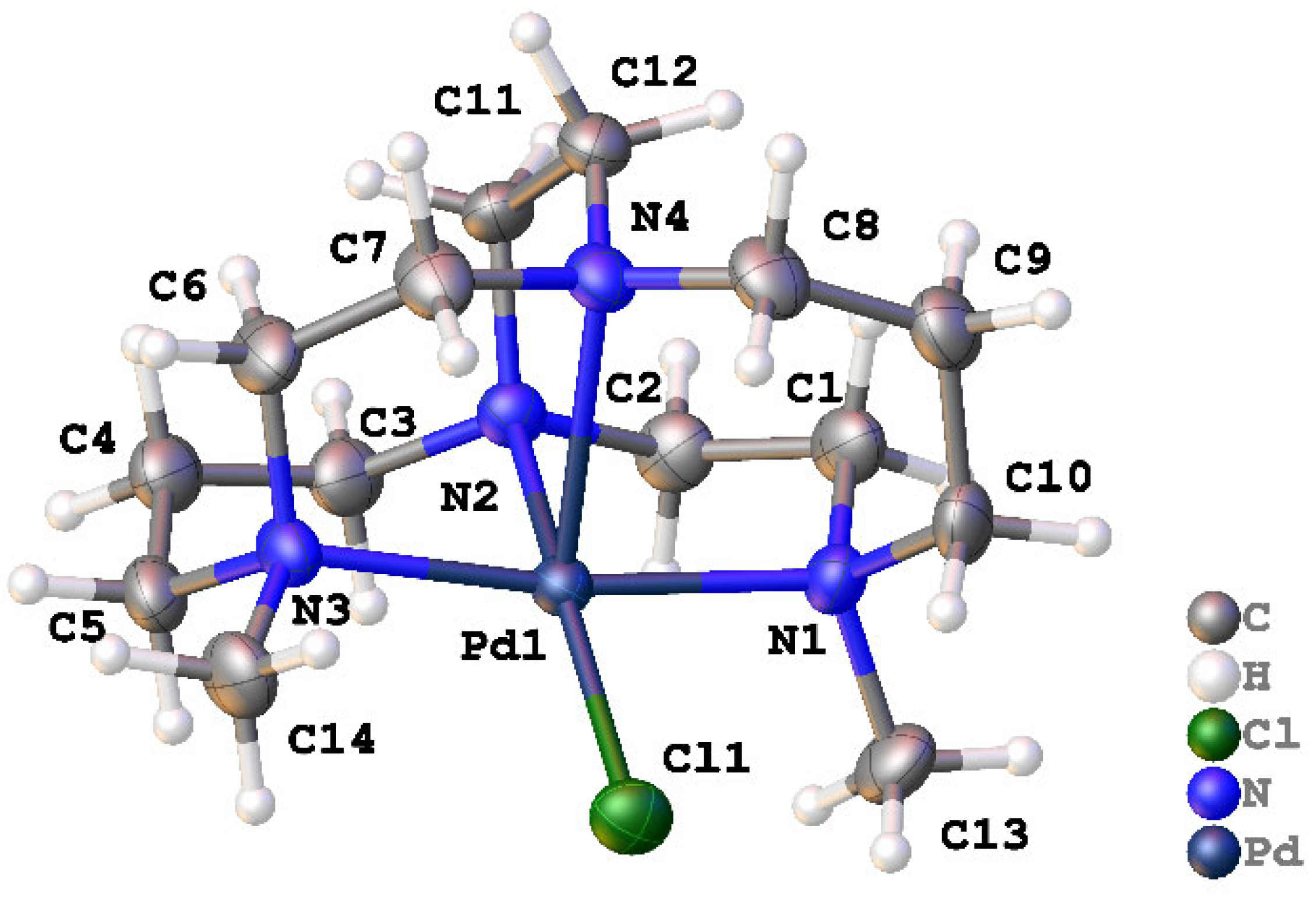
[(L3)PdCl]PF6 crystallizes in the chiral space group P212121, with one complete [(L3)PdCl]+ ion and one PF6− anion in the asymmetric unit (Table 1, Figure 4). Each Pd2+ has five coordinates with three nitrogen atoms of the ligand L3 and chloride bound in a distorted square plane, with Pd−N distances in the range 2.079(3) to 2.104(3) Å and Pd−Cl distance 2.3294(10) Å. The rms deviation of atoms from this plane is 0.1553 Å. The final coordinating atom is one of the nitrogen atoms in L3 that is linked by the ethylene bridge. This does not form a perfect square pyramid because of the geometric limitation imposed by the bite angle of the ethylene bridge. The geometric requirement of the ligand and electronic preference of the d8 metal ion lead to the final nitrogen being very weakly bound so that the distance Pd1−N4 is 2.474(3) Å. Here, the bite angle is 79.71(11)°, and the bond extension is 0.378 Å. The coordination about the metal is shown in Figure 4. Adjacent molecules related by the 21 screw axis along the crystallographic a-axis are held together by Cl···H-C interactions into tapes that are two molecules wide. Between these tapes lie the PF6− anions, and these form F···H-C interactions with the complexes.
Figure 4.
Coordination environment of the metal complex cation [(L3)PdCl]+, with atoms drawn as 50% probability ellipsoids.
2.2.4. [(L4)PdCl]PF6
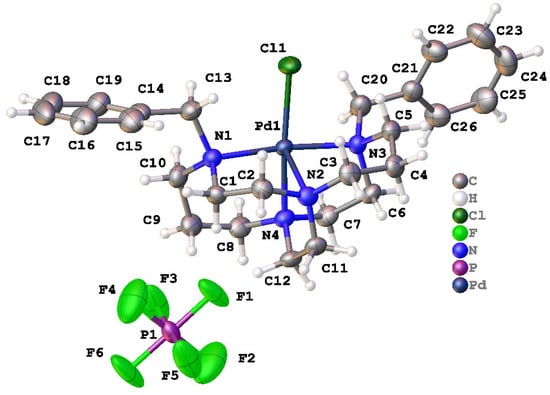
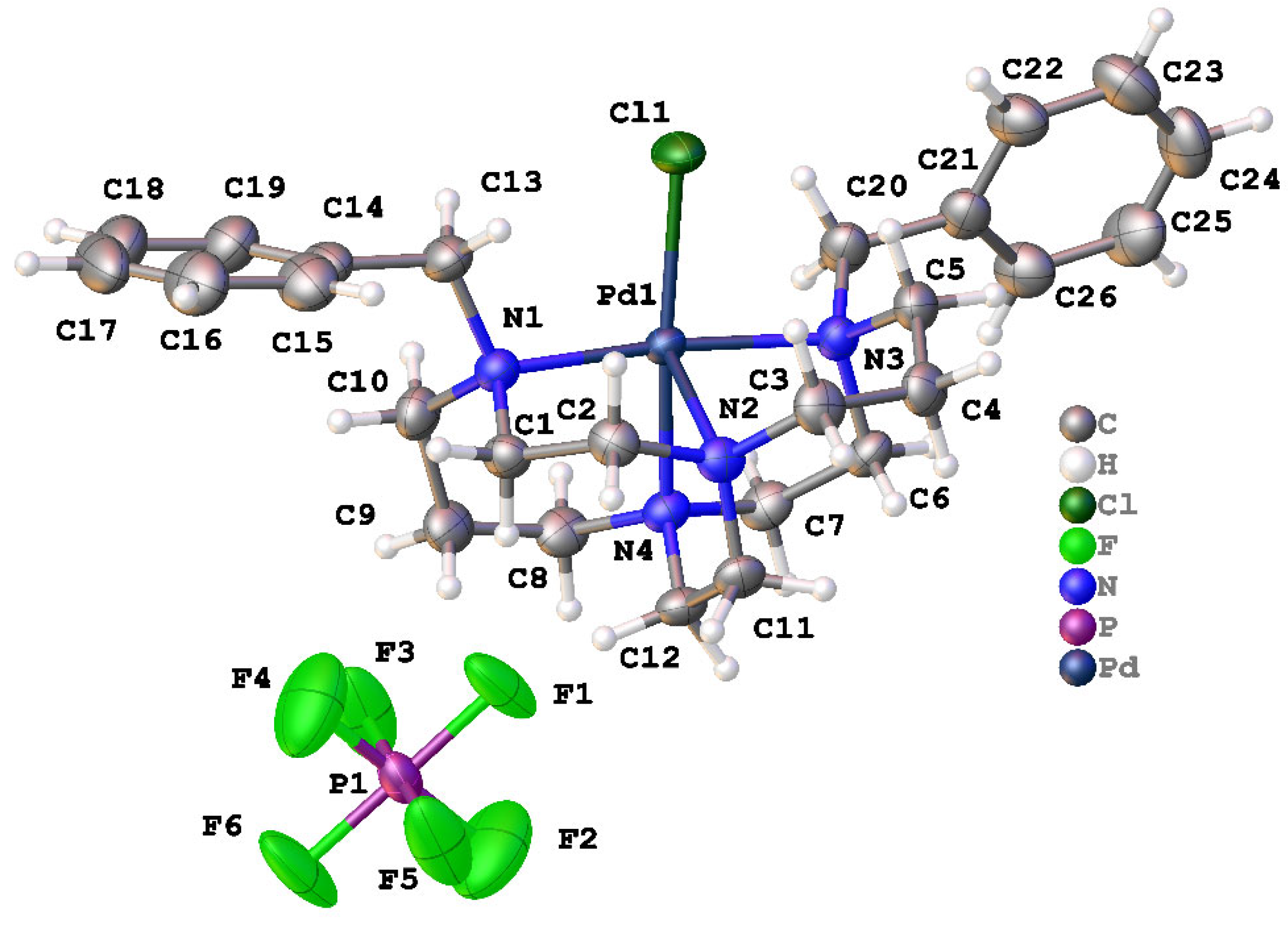
The crystal structure of [(L4)PdCl]PF6 displays many features similar to the other structures presented here. The asymmetric unit in space group P212121 contains a single [(L4)PdCl]+ ion and one PF6− anion (Table 1, Figure 5). The metal coordination aligns with the other structures: three nitrogen atoms from L4 and chloride are approximately in the same plane in a kite shape and an additional, much longer Pd-N bond (see Table 2, Figure 5). The rms deviation from planarity of the four atoms in the close bonding plane is 0.1126 Å. The ethylene bridge constrains the coordination, the bite angle of N2 and N4 is 80.11(9)°, and the distal nitrogen Pd-N bond is 0.346 Å longer than the mean of the others.
Figure 5.
Asymmetric unit of [(L4)PdCl]PF6, with atoms shown as 50% probability ellipsoids.
Within the solid-state structure, there is a single important C-H···Cl interaction (C2-H2A···Cl1_$1, where $1 = x + 1/2, −y + 3/2, −z + 1, C-H···Cl angle = 148.7°, and d(H···Cl) = 2.692 Å) that is close to linear. This is an intermolecular hydrogen bond between complexes related by the 21 screw axis along the c-direction. This leads to tapes of molecules running parallel with the c-axis, between which are the anions participating in C-H···F interactions.
2.2.5. Pd Coordination Geometry
The geometry about the Pd2+ ion in these complexes is unexpected but not unprecedented. There exist a small number of complexes with similar geometry, specifically three short Pd-N bonds and one Pd-Cl bond lying roughly within the same plane, with a fifth nitrogen rather distant from the metal. The simplest example is [PdCl(diMephen)]PF6, where diMephen = 2,9-dimethyl 1,10-phenantholine [31]. The coordination about the metal is very similar to the current examples, with a bite angle of 72.94° and bond elongation of the fifth ligand of 0.494 Å. Chemically very similar to [(L3)PdCl]PF6 is the chloride anion equivalent, which has a composition of [(L3)PdCl]Cl·2H2O and adopts a geometry with a bite angle of 80.13° and a bond elongation of 0.364 Å [14]; these metrics are nearly identical to [(L3)PdCl]PF6. Another similar complex is acetonitrile-chloro-(1,4,7-trimethyl-1,4,7-triazonane)-palladium(II) perchlorate, which has the acetonitrile molecule coordinated to the palladium in place of one of the nitrogen atoms from the systems described here [32]. This has a rather long Pd-N bond for the “fifth” ligand; the bite angle is 77.96°, and there is a bond elongation of 0.568 Å.
Finally, calculation of the Addison Parameter [33], τ5, which provides a numerical value to help classify the geometry around five-coordinate transition metal complexes, may be of some use here. As discussed above, the coordination geometries of these new complexes can be described in several ways. The geometric parameter τ5 is used to describe five-coordinate geometries on a continuum between trigonal bipyramidal (τ5 = 1.00) and square pyramidal (τ5 = 0.00). The parameter is calculated by taking the difference between the two largest bond angles containing the metal ion at the center (called β and α) and then dividing by 60. In the present cases, all four complexes lie much closer to square pyramidal than trigonal. In all cases, the square base of the pyramid is made of three nitrogen atoms from the cross-bridged macrocycle and the single coordinated chloride anion. Since the fourth nitrogen donor is constrained by the short cross-bridge from occupying the fourth planar site, it must bind as the apex of the pyramid. For [(L1)PdCl]+, τ5 = 0.20 and τ5 = 0.17 for the two slightly different complex cations in the crystal structure. The deviation from purely square planar is greatest in this complex, likely due to L1 being the smallest macrocycle ring (12 atoms), which strains to allow full encapsulation of the Pd2+ cation. For [(L2)PdCl]+ τ5 = 0.09 and τ5 = 0.01, showing that addition of a single macrocycle ring atom (L2 has a 13-atom ring) allows for closer congruence with the square planar geometry. [(L3)PdCl]+ τ5 = 0.04 and [(L4)PdCl]+ τ5 = 0.02, with 14-membered macrocycle rings, closely approach pure square pyramidal coordination geometries.
To provide evidence that the solid-state structures were the same as the solution structures of the complexes in acetonitrile, where the electrochemical and electronic spectroscopy of the complexes were obtained, the molar conductance of each complex in acetonitrile was obtained. In all cases, the molar conductance values agree with 1:1 cation–anion conductance behavior [34], indicating that the chloro ligand remains bound to the metal cation, and only the PF6− non-coordinated anion (as observed in all four crystal structures) and the overall +1 charged [LPdCl+] complex cation are present in the solution. A 1:1 behavior in acetonitrile is defined as ΛM = 100–140 ohm−1cm2mole−1 [34]. Experimental values obtained were [(L1)PdCl]PF6 = 138 ohm−1cm2mole−1, [(L2)PdCl]PF6 = 124 ohm−1cm2mole−1, [(L3)PdCl]PF6 = 113 ohm−1cm2mole−1, and [(L4)PdCl]PF6 = 127 ohm−1cm2mole−1.
2.3. Electrochemistry of PdII-Complexes
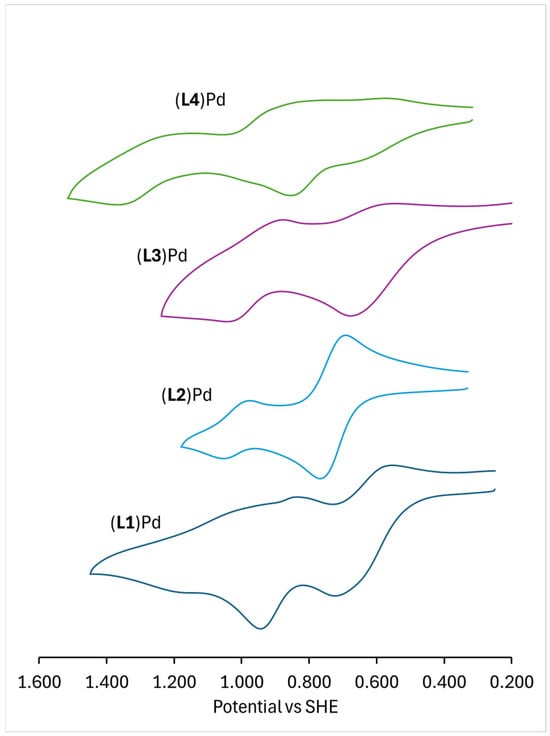
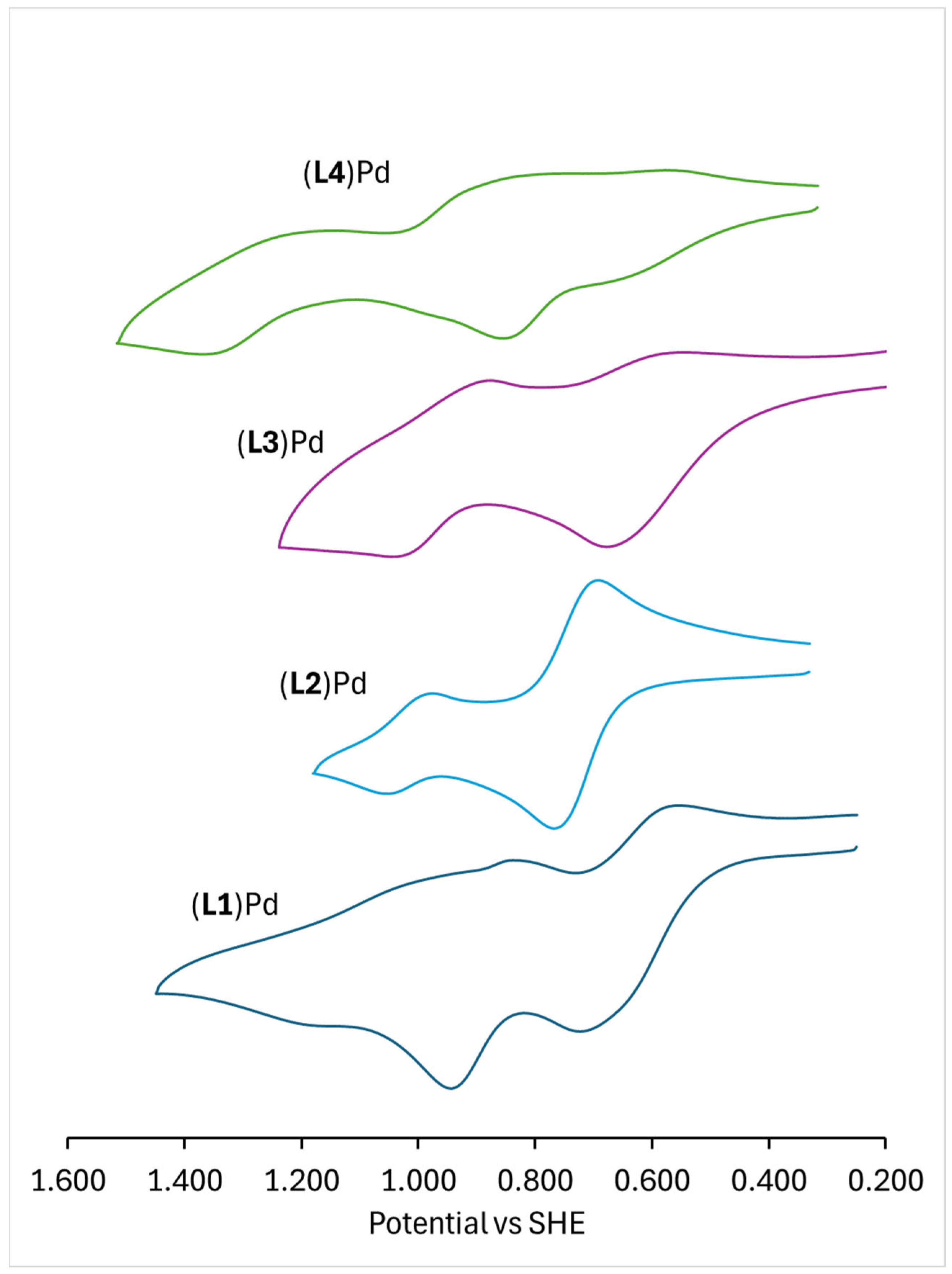
Mirica has shown that palladium(III) tetraazamacrocyle complexes are capable of catalyzing various reactions [35,36,37]. If our complexes of ligands 1–4 will potentially be similarly capable, they will need to be stable in the Pd3+ oxidation state, which is typically not the case, and disproportionation to Pd2+ and Pd4+ occurs. To probe the possibility of such future applications, we have carried out the cyclic voltammetry of acetonitrile solutions of these complexes (Figure 6).
Figure 6.
Cyclic voltammograms of [(L)PdCl]PF6 complexes, 0.001 M in MeCN, with 0.100 M TBAPF6 as supporting electrolyte and using a button Pt working electrode.
All four complexes demonstrate the ability to achieve the Pd3+ oxidation state, with quasi-reversible oxidations in the 0.600–0.825 V range. We have found a number of Pd(II) species that give reversible Pd2+/3+ waves as well as further reversible Pd3+/4+ waves. Our initial interpretation was that our CV’s showed reversible waves that were too close to one another (200–400 mV apart) to be Pd2+/3+ waves as well as further Pd3+/4+ waves, as typically, our metal complexes that achieve 3+ and then 4+ oxidation states have E1/2 separations closer to 0.75–1.00 V [28]. However, Mirica, in particular, has observed behavior similar to our complex CV’s with his Pd(II) complexes of pyclen and py2clen ligand systems [38], with similar E1/2 separations to ours. The justification for these closely spaced redox couples is the inherent instability of Pd3+, which easily oxidizes further to Pd4+, even at rather modest increases in potential [38]. Thus, our current interpretation of our CV results is that we are observing both Pd2+/3+ waves as well as further reversible Pd3+/4+ waves in all but the L4 complex, where the cathodic peaks of both processes are difficult to identify, and we list only the anodic Eox peaks in Table 3.
Table 3.
Redox potentials determined by cyclic voltammetry of [(L)PdCl]PF6 complexes.
The E1/2 values for the Pd2+/3+ potential processes vary somewhat, from 0.611 V for [(L3)PdCl]PF6 to 0.729 for [(L2)PdCl]PF6. The smaller ring sizes are generally easier to oxidize (lower E1/2), which may be explained simply on the basis of size, with the smaller rings better supporting the smaller Pd3+ and then Pd4+ metal cations. However, there does appear to be a “goldilocks effect” with ligand L3. This complex, with the 13-membered ligand L2, appears to favor the Pd2+ cation, with oxidation to Pd3+ approximately 100 mV more positive than the complexes of smaller ligand L1 and larger L3. The reversibility of the [(L2)PdCl]PF6 complex is also better than the other two dimethyl ligands, with only a 75 mV ΔE. Perhaps the 13-membered macrocycle ring is best suited for the transition between these two oxidation states. Interestingly, [(L4)PdCl]PF6, although with the same macrocycle as [(L3)PdCl]PF6, is considerably less reversible, with only the Eox values able to be determined. Even so, the potential for the oxidation of [(L4)PdCl]PF6 is clearly shifted in the positive direction, a phenomenon previously observed for the manganese complexes of cross-bridged tetraazamacrocycles when methyl substituents are replaced by benzyl groups [39].
2.4. Electronic Spectra of [(L)PdCl]PF6 Complexes
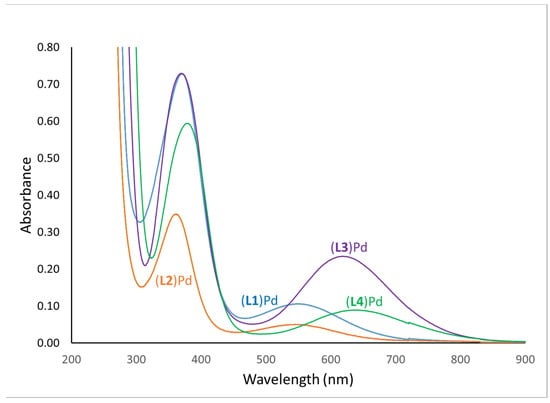
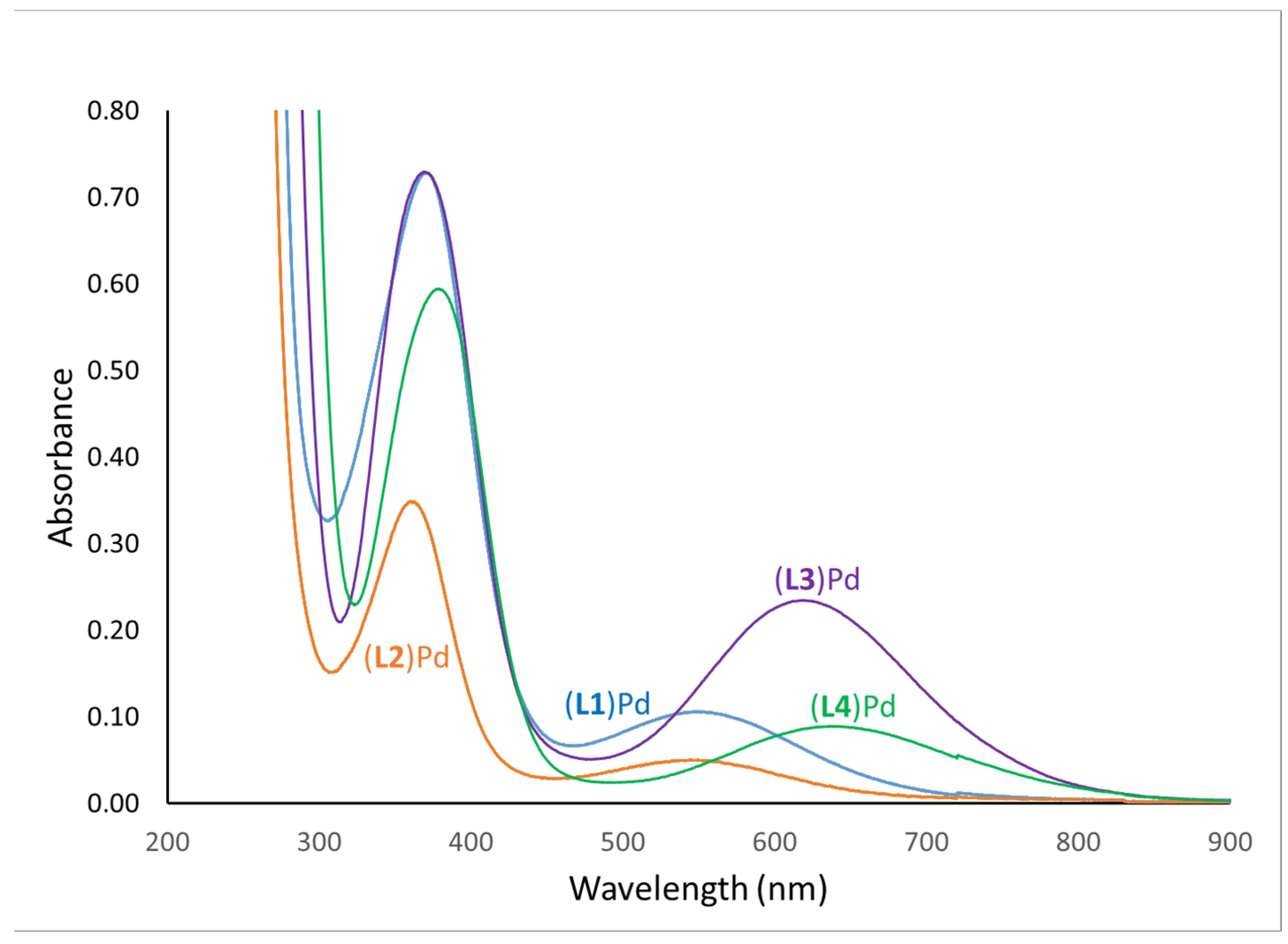
Square pyramidal palladium(II) complexes often have similar spectra as the more common square planar palladium(II) complexes as a result of their similar d-orbital splitting pattern [40]. In both cases, two d-d absorptions are evident in the 300 nm and 500 nm range. The electronic spectra for the four [(L)PdCl]PF6 complexes are shown in Figure 7, with numerical parameters given in Table 4.
Figure 7.
Electronic spectra of [(L)PdCl]PF6 complexes 0.001 M in MeCN.
Table 4.
Electronic spectroscopy parameters for complexes [(L)PdCl]PF6 in acetonitrile.
The spectra of the four Pd2+ complexes are all very similar. In each case, they have a slightly more intense absorption in the 360–380 nm range, with extinction coefficients ranging from 350 to 730 M−1cm−1. A second lower intensity absorption is found in the 545–638 nm range, with extinction coefficients ranging from 50 to 240 M−1cm−1. All four complexes are blue or purple, as absorptions in the UV and green bands would predict.
3. Experimental
3.1. General
All solvents were of reagent grade and were dried, when necessary, by accepted procedures. Ligands L1 [41], L2 [41], L3 [42], and L4 [42] were prepared according to literature procedures. Bis(acetonitrile)dichloropalladium(II) was purchased from Sigma-Aldrich (St. Louis, MO, USA) (CAS: 14592-56-4) as 99% pure and stored in a nitrogen glovebox. Other materials used in this study were purchased from ThermoFisher (Waltham, MA, USA), Sigma-Aldrich, and Ambeed (Buffalo Grove, IL, USA) and used as received.
The following instruments were used at Southwestern Oklahoma State University. Electrospray mass spectra were collected on a Shimadzu (Kyoto, Japan) LCMS 2020 Electrospray Mass Spectrometer. Elemental analyses were performed using Perkin-Elmer (Wellesley, MA, USA) Series II CHNS/O Analyzer. Electrochemical experiments were performed on a BASi (West Lafayette, IN, USA) Epsilon EC-USB electrochemical analyzer, with a working button platinum electrode, platinum wire counter electrode, and a silver wire pseudo-reference electrode. Samples consisted of 0.001 M complex and 0.100 M TBAPF6 dissolved in acetonitrile, with Ferrocene as an internal reference. All electrochemical measurements were carried out under N2. Electronic spectra were recorded using a Shimadzu (Kyoto, Japan) UV-240 UV-Vis Spectrometer. Conductance measurements were obtained with an Oakton (Pittsburgh, PN, USA) CON510 Bench Conductivity/TDS Meter on 0.001 M solutions at room temperature.
3.2. Crystal Structure Analysis
[(L3)PdCl]PF6: Intensity data were collected at 150 K on a D8 goniostat equipped with a Bruker (Billerica, MA, USA) PHOTON-II detector at Beamline 11.3.1 at the Advanced Light Source (Lawrence Berkeley National Laboratory), using synchrotron radiation tuned to λ = 0.7749 Å. For data collection, 1 s frames were measured at 0.5° intervals of ω. The data frames were collected using the program APEX3 [43] and processed using the program SAINT routine within APEX3. The data were corrected for absorption and beam corrections based on the multi-scan technique, as implemented in SADABS [44].
[(L1)PdCl]PF6, [(L2)PdCl]PF6, and [(L4)PdCl]PF6: Intensity data were collected at 150 K on a D8 goniostat equipped with a Bruker (Billerica, MA, USA) PHOTON100 CMOS detector at Beamline 11.3.1 at the Advanced Light Source (Lawrence Berkeley National Laboratory), using synchrotron radiation tuned to λ = 0.7749 Å. Data collection frames were measured for a duration of 1 s at 0.5° intervals of ω. The data frames were collected using the program APEX2 and processed using the program SAINT routine within APEX2. The data were corrected for absorption and beam corrections based on the multi-scan technique, as implemented in SADABS.
Crystal structures were solved using SHELXT [45] and refined using SHELXL-2018 implemented within the Olex2 package [46]. Disorder was modeled conservatively using standard procedures including restraints on similar atoms. Hydrogen atoms were fitted using riding models. Where justified from the data, the orientation of methyl groups was refined to fit the observed electron density.
3.3. Synthesis of [(L1-L4)PdCl]PF6
All reactions were carried out on a scale of 1 mmol of ligand and 1 mmol of bis(acetonitrile)dichloropalladium(II) in acetonitrile in an inert atmosphere glovebox. All reactions seemed to yield some reduction in PdII to Pd0, which was filtered and discarded. Similarly, all complexes were stabilized with 5× molar excess of ammonium hexafluorophosphate as a counter anion in methanol. Crystals of each were grown with an ether diffusion into acetonitrile or methylene chloride.
3.3.1. [(L1)PdCl]PF6
To 0.226 g (1.00 mmol) of L1 dissolved in 10 mL acetonitrile while stirring, 0.259 g (1.00 mmol) bis(acetonitrile)dichloropalladium(II) dissolved in 5 mL acetonitrile was added. The reaction was then left stirring for 2.5 h, then filtered to separate the amber solution and black powder. After drying in vacuo, the resulting solid was redissolved in minimal methanol, yielding an amber solution with an insoluble yellow/orange solid. The yellow/orange solid was filtered off, and to the stirring, methanolic filtrate was added to the ammonium hexafluorophosphate (0.815 g, 5 mmol) dissolved in minimal methanol. The solution was then placed at −15 °C for 15 h. After drying in vacuo, methylene chloride (40 mL) was then added and stirred for 30 min. The white/yellow solid that did not dissolve (excess NH4PF6) was filtered to yield a faint purple solution. Ether diffusion into the methylene chloride solution yielded the final product, a purple powder. Yield: 0.330 g (32%). Anal. Calcd for molecule: [Pd(C12H26N4)Cl]PF6: C 28.08%, H 5.11%, and N 10.92%; found: C 28.32%, H 5.30%, and N 10.73%. The ESMS+ mass spectrum exhibited strong peaks at m/z = 227 (1 + H+) and 367 [(L1)PdCl]+. X-ray quality crystals were grown from ether diffusion into methylene chloride.
3.3.2. [(L2)PdCl]PF6
To 0.240 g (1.00 mmol) of L2 dissolved in 10 mL stirring acetonitrile, 0.259 g (1.00 mmol) bis(acetonitrile)dichloropalladium(II) dissolved in 5 mL acetonitrile was added. After stirring for 2.5 h, the black powder was filtered and discarded. The solution was then dried in vacuo. Solids were redissolved in minimal methanol to yield a dark red/purple solution with an insoluble yellow/orange solid. The yellow/orange solid was filtered from solution. To the stirring, methanolic filtrate was added to the ammonium hexafluorophosphate (0.815 g, 5 mmol) dissolved in minimum methanol. The solution was then placed at −15 °C for 15 h, where a purple solid precipitate formed. This solid was collected as pure product. Yield: 0.146 g (55%). Anal. Calcd for molecule: [Pd(C13H28N4)Cl]PF6: C 29.62%, H 5.35%, and N 10.63%; found: C 29.34%, H 5.20%, and N 10.60%. The ESMS+ mass spectrum exhibited a strong peak at m/z = 241 (2 + H+) and 381 [(L2)PdCl]+. X-ray quality crystals were grown from ether diffusion into acetone.
3.3.3. [(L3)PdCl]PF6
To 0.254 g (1.00 mmol) of L3 dissolved in 10 mL acetonitrile while stirring, 0.259 g (1.00 mmol) of bis(acetonitrile)dichloropalladium(II) dissolved in 5 mL acetonitrile was added. The reaction was left stirring for 12 h at room temperature, then filtered to separate a green solution and fine, black powder. The solution was then dried in vacuo. The resulting green solid was redissolved in minimal methanol to yield a green solution with insoluble yellow/orange powder, which was filtered off. To the methanolic filtrate being stirred, ammonium hexafluorophosphate (0.815 g, 5 mmol) was added and dissolved in minimal methanol. After a brief mixing, the solution was placed at −15 °C for 15 h, then dried in vacuo. Methylene chloride (40 mL) was then added, and the solution was stirred for 30 min. A white/yellow solid was filtered off to yield a blue solution. Ether diffusion into this methylene chloride solution yielded the final product. Yield: 0.316 g (58%). Anal. Calcd for molecule: [Pd(C14H30N4)Cl]PF6·0.2H2O: C 30.86%, H 5.62%, and N 10.28%; found: C 30.65%, H 5.69%, and N 10.43%. The ESMS+ mass spectrum exhibited strong peaks at m/z = 255 (3 + H+) and 397 [(L3)PdCl]+. X-ray quality crystals were grown from ether diffusion into acetone.
3.3.4. [(L4)PdCl]PF6
To 0.406 g (1.00 mmol) of L4 dissolved in 10 mL acetonitrile while stirring, 0.259 g (1.00 mmol) bis(acetonitrile)dichloropalladium(II) dissolved in 5 mL acetonitrile was added. The reaction was then left stirring for 15 h. Black powder was filtered off to yield a green/blue solution, which was dried in vacuo. The resulting solid was redissolved in minimal methanol to yield a green solution with an insoluble yellow/orange solid. The yellow/orange solid was filtered from the solution, and to the methanolic filtrate being stirred, ammonium hexafluorophosphate (5 mmol, 0.815 g) dissolved in minimal methanol was added. This solution was placed at −15 °C for 15 h, and the solution was then dried in vacuo. Methylene chloride (40 mL) was added and stirred for 30 min, and the formed yellow solid was filtered off to yield a green solution. Ether diffusion into methylene chloride solution yielded blue/green crystals as the pure product [(L4)PdCl]PF6. Yield: 0.206 g (30%). Anal. Calcd for molecule: [Pd(C26H38N4)Cl]PF6: C 45.03%, H 5.52%, and N 8.08%; found: C 45.43%, H 5.38%, and N 8.35%. The ESMS+ mass spectrum exhibited strong peaks at m/z = 407 (4 + H+), 511 (Pd(L4)+), and 546 [(L4)PdCl]+. X-ray quality crystals were grown from ether diffusion into methylene chloride.
4. Conclusions
The synthesis of palladium(II) complexes of ethylene cross-bridged tetraazamacrocycles from Pd(MeCN)2Cl2 has been generalized to four different ligands, including three different ring sizes (12–14) and two different substituents (Me, Bn). The structural originality of square pyramidal, rather than the typical square planar geometry for palladium(II) complexes, is highlighted as a major finding. This unusual geometry is a result of the structural constraint imposed by the ethylene cross-bridged tetraazamacrocycles. Challenges related to disproportionation to Pd0 and possible ligand decomposition have been overcome with several filtration steps, as well as anion exchange to the PF6− salt. X-ray crystal structures of all four complexes show similar coordination of the ligand, with one of the nitrogens that are linked by the topologically constraining ethylene cross-bridge forced to occupy one corner of a square-based pyramid, while the other must occupy the axial peak of the pyramid. The other two nitrogen donors from the macrocycle, along with a chloride anion, form the rest of the square base in all cases. The smaller sized macrocycles form more distorted species, with the larger macrocycles better accommodating Pd2+ in this square pyramidal geometry. The electronic spectra of these blue and purple complexes confirm the Pd2+ square pyramidal structure seen in the solid state. Electrochemical oxidation to Pd3+ is observed for all complexes, with quasi-reversibility back to Pd2+. Such redox stability indicates that oxidative catalytic processes may be possible with these complexes, which will be explored in future work.
Supplementary Materials
The following supporting information can be downloaded at: https://www.mdpi.com/article/10.3390/inorganics14020042/s1, The X-ray crystallographic information for the structures reported have been deposited at the Cambridge Crystallographic Data Centre under deposition numbers CCDC 2520716-2520719.
Author Contributions
Conceptualization, T.J.H.; methodology, T.J.H. and M.-J.G.; formal analysis, T.J.H., T.J.P., A.G.O. and J.A.K.; investigation, M.-J.G., T.J.H., T.J.P., A.G.O. and J.A.K.; resources, T.J.H., A.G.O. and J.A.K.; data curation, T.J.H., T.J.P., A.G.O. and J.A.K.; writing—original draft preparation, T.J.H., T.J.P. and M.-J.G.; writing—review and editing, T.J.H., T.J.P., A.G.O. and J.A.K.; visualization, T.J.H., T.J.P. and M.-J.G.; supervision, T.J.H.; project administration, T.J.H.; funding acquisition, T.J.H., A.G.O. and J.A.K. All authors have read and agreed to the published version of the manuscript.
Funding
This research was funded by the Henry Dreyfus Teacher-Scholar Award Program (TJH).
Institutional Review Board Statement
The study did not require ethical approval.
Informed Consent Statement
Not applicable.
Data Availability Statement
The original contributions presented in this study are included in the article/Supplementary Material. Further inquiries can be directed to the corresponding author. The supplementary crystallographic data can be obtained free of charge from the Cambridge Crystallographic Data Centre via www.ccdc.cam.ac.uk/data_request/cif.
Acknowledgments
Crystallographic data were collected through the SCrALS (Service Crystallography at Advanced Light Source) program at the Small-Crystal Crystallography Beamline 11.3.1 at the Advanced Light Source (ALS), Lawrence Berkeley National Laboratory. The ALS is supported by the U.S. Department of Energy, Office of Energy Sciences Materials Sciences Division, under contract DE-AC02-05CH11231.
Conflicts of Interest
The authors declare no conflicts of interest.
References
- Sasmal, P.K.; Streu, C.N.; Meggers, E. Metal Complex Catalysis in Living Biological Systems. Chem. Commun. 2013, 49, 1581–1587. [Google Scholar] [CrossRef] [Scilit]
- Daniel, C. Photochemistry and Photophysics of Transition Metal Complexes: Quantum Chemistry. Coord. Chem. Rev. 2015, 282–283, 19–32. [Google Scholar] [CrossRef] [Scilit]
- Siegbahn, P.E.M.; Blomberg, M.R.A. Transition-Metal Systems in Biochemistry Studied by High-Accuracy Quantum Chemical Methods. Chem. Rev. 2000, 100, 421–438. [Google Scholar] [CrossRef] [Scilit]
- De Meijere, A.; Brase, S.; Oestreich, M. Metal Catalyzed Cross-Coupling Reactions and More; Wiley-VCH: Weinheim, Germany, 2014. [Google Scholar]
- Molander, G.A.; Larhed, M.; Wolfe, J. Cross-Coupling Reactions; Science of Synthesis Series; Thieme Chemistry: Stuttgart, Germany, 2013. [Google Scholar]
- Molnar, A. Palladium-Catalyzed Coupling Reactions: Practical Aspects and Future Developments; Wiley-VCH: Weinheim, Germany, 2013. [Google Scholar]
- Suzuki, A. Cross Coupling Reactions in Organic Synthesis Themed Issue. Chem. Soc. Rev. 2011, 40, 4877–5208. [Google Scholar]
- Julia, M.; Duteil, M. Condensation Des Halogénures Aromatiques Avec Les Oléfine Catalysées Par Le Palladium. Bull. Soc. Chim. Fr. 1973, 2, 2790. [Google Scholar]
- Wall, V.M.; Eisenstadt, A.; Ager, D.J.; Laneman, S.A. The Heck Reaction and Cinnamic Acid Synthesis by Heterogeneous Catalysis. Platin. Met. Rev. 1999, 43, 138–145. [Google Scholar] [CrossRef] [Scilit]
- Biffis, A.; Centomo, P.; Del Zotto, A.; Zecca, M. Pd Metal Catalysts for Cross-Couplings and Related Reactions in the 21st Century: A Critical Review. Chem. Rev. 2018, 118, 2249–2295. [Google Scholar] [CrossRef] [Scilit] [PubMed]
- Seki, M. Recent Advances in Pd/C-Catalyzed Coupling Reactions. Synthesis 2006, 2006, 2975–2992. [Google Scholar] [CrossRef] [Scilit]
- Mizoroki, T.; Ozaki, A. Arylation of Olefin with Aryl Iodide Catalyzed by Palladium. Bull. Chem. Soc. Jpn. 1971, 44, 581. [Google Scholar] [CrossRef] [Scilit]
- Heck, R.F.; Nolley, J.P., Jr. Palladium-Catalyzed Vinylic Hydrogen Substitution Reactions with Aryl, Benzyl, and Styryl Halides. J. Org. Chem. 1971, 37, 2320–2322. [Google Scholar]
- Phan, T.S.; Van Der Sluys, M.; Jones, C.W. On the Nature of the Active Species in Palladium Catalyzed Mizoroki−Heck and Suzuki−Miyaura Couplings—Homogeneous or Heterogeneous Catalysis, A Critical Review. Adv. Synth. Catal. 2006, 348, 609–679. [Google Scholar] [CrossRef] [Scilit]
- Johansson Seechurn, C.C.C.; Kitching, M.O.; Colacot, T.J.; Snieckus, V. Palladium-Catalyzed Cross-Coupling: A Historical Contextual Perspective to the 2010 Nobel Prize. Angew. Chem. Int. Ed. 2012, 51, 5062–5085. [Google Scholar] [CrossRef] [Scilit]
- Negishi, E. Handbook of Organopalladium Chemistry for Organic Synthesis; Wiley-Interscience: New York, NY, USA, 2002. [Google Scholar]
- Van Leeuwen, P.W.N.M. Homogeneous Catalysis: Understanding the Art; Springer: Dordrecht, The Netherlands, 2004; ISBN 978-1-4020-3176-2. [Google Scholar]
- Henry, P.M. Palladium Catalyzed Oxidation of Hydrocarbons; Springer: Boston, MA, USA, 1980. [Google Scholar]
- Deprez, N.R.; Sanford, M.S. Synthetic and Mechanistic Studies of Pd-Catalyzed C−H Arylation with Diaryliodonium Salts: Evidence for a Bimetallic High Oxidation State Pd Intermediate. J. Am. Chem. Soc. 2009, 131, 11234–11241. [Google Scholar] [CrossRef] [Scilit]
- Boisvert, L.; Denny, M.C.; Hanson, S.K.; Goldberg, K.I. Insertion of Molecular Oxygen into a Palladium(II) Methyl Bond: A Radical Chain Mechanism Involving Palladium(III) Intermediates. J. Am. Chem. Soc. 2009, 131, 15802–15814. [Google Scholar] [CrossRef] [Scilit]
- Lanci, M.P.; Remy, M.S.; Kaminsky, W.; Mayer, J.M.; Sanford, M.S. Oxidatively Induced Reductive Elimination from (tBu2bpy)Pd(Me)2: Palladium(IV) Intermediates in a One-Electron Oxidation Reaction. J. Am. Chem. Soc. 2009, 2009, 15618–15620. [Google Scholar] [CrossRef] [Scilit]
- Manolikakes, G.; Knochel, P. Radical Catalysis of Kumada Cross-Coupling Reactions Using Functionalized Grignard Reagents. Angew. Chem. Int. Ed. 2017, 48, 205–209. [Google Scholar] [CrossRef] [Scilit]
- Lin, L.; Schramm, T.K.; Kucheryavy, P.; Lalancette, R.A.; Hansen, A.; Prokopchuk, D.E. A 100,000-Fold Increase in C–H Bond Acidity Gives Palladium a Key Advantage in C(Sp3)–H Activation Compared to Nickel. J. Am. Chem. Soc. 2025, 147, 34395–34410. [Google Scholar] [CrossRef] [Scilit]
- Lyons, T.W.; Sanford, M.S. Palladium-Catalyzed Ligand-Directed C–H Functionalization Reactions. Chem. Rev. 2010, 110, 1147–1169. [Google Scholar] [CrossRef] [Scilit] [PubMed]
- Sigman, M.S.; Werner, E.W. Imparting Catalyst Control upon Classical Palladium-Catalyzed Alkenyl C–H Bond Functionalization Reactions. Acc. Chem. Res. 2012, 45, 874–884. [Google Scholar] [CrossRef] [Scilit] [PubMed]
- Ashiq, M.; Danish, M.; Mohsin, M.A.; Bari, S.; Mukhtar, F. Chemistry of Platinum and Palladium Metal Complexes in Homogeneous and Heterogeneous Catalysis: A Mini Review. Int. J. Sci. Basic Appl. Res. 2013, 7, 50–61. [Google Scholar]
- Pagliaro, M.; Pandarus, V.; Ciriminna, R.; Béland, F.; Demma Carà, P. Heterogeneous versus Homogeneous Palladium Catalysts for Cross-Coupling Reactions. ChemCatChem 2012, 4, 432–445. [Google Scholar] [CrossRef] [Scilit]
- Hubin, T.J.; McCormick, J.M.; Collinson, S.R.; Buchalova, M.; Perkins, C.M.; Alcock, N.W.; Kahol, P.K.; Raghunathan, A.; Busch, D.H. New Iron(II) and Manganese(II) Complexes of Two Ultra-Rigid, Cross-Bridged Tetraazamacrocycles for Catalysis and Biomimicry. J. Am. Chem. Soc. 2000, 122, 2512–2522. [Google Scholar] [CrossRef] [Scilit]
- Hubin, T.; Alcock, N.; Busch, D. The Square-Pyramidal PdII Complex of a Cross-Bridged Tetraazamacrocycle. ACTA Crystallogr. Sect. C-Struct. Chem. 1999, 55, 1404–1406. [Google Scholar] [CrossRef] [Scilit]
- Hubin, T.J. Transition Metal Complexes of Topologically Constrained Tetraazamacrocycles. Ph.D. Thesis, University of Kansas, Lawrence, KS, USA, 1999. [Google Scholar]
- Pratihar, S.; Marek, J.; Roy, S. Mono Cationic Palladium(II): Synthesis, Characterization and Catalytic Activity in Suzuki Coupling. Inorganica Chim. Acta 2011, 372, 362–366. [Google Scholar] [CrossRef] [Scilit]
- Khusnutdinova, J.R.; Rath, N.P.; Mirica, L.M. Dinuclear Palladium(III) Complexes with a Single Unsupported Bridging Halide Ligand: Reversible Formation from Mononuclear Palladium(II) or Palladium(IV) Precursors. Angew. Chem. Int. Ed. 2011, 50, 5532–5536. [Google Scholar] [CrossRef] [Scilit]
- Addison, A.W.; Rao, T.N.; Reedjik, J.; van Rijn, J.; Verschoor, G.C. Synthesis, Structure, and Spectroscopic Properties of Copper(11) Compounds Containing Nitrogen-Sulphur Donor Ligands; the Crystal and Molecular Structure of Aqua[l,7-Bis(N-Methylbenzimidazol-2′-Yl)-2,6-Dithiaheptane]Copper(Ii) Perchlorate. J. Chem. Soc. Dalton Trans. 1984, 1349–1356. [Google Scholar] [CrossRef] [Scilit]
- Angelici, R.J. Synthesis and Techniques in Inorganic Chemistry, 2nd ed.; University Science Books: Mill Valley, CA, USA, 1986. [Google Scholar]
- Khusnutdinova, J.R.; Rath, N.P.; Mirica, L.M. Stable Mononuclear Organometallic Pd(III) Complexes and Their C−C Bond Formation Reactivity. J. Am. Chem. Soc. 2010, 132, 7303–7305. [Google Scholar] [CrossRef] [Scilit]
- Khusnutdinova, J.R.; Rath, N.P.; Mirica, L.M. The Aerobic Oxidation of a Pd(II) Dimethyl Complex Leads to Selective Ethane Elimination from a Pd(III) Intermediate. J. Am. Chem. Soc. 2012, 134, 2414–2422. [Google Scholar] [CrossRef] [Scilit]
- Khusnutdinova, J.R.; Rath, N.P.; Mirica, L.M. The Conformational Flexibility of the Tetradentate LigandtBu N4 Is Essential for the Stabilization of (tBu N4)PdIII Complexes. Inorg. Chem. 2014, 53, 13112–13129. [Google Scholar] [CrossRef] [Scilit]
- Tang, F.; Qu, F.; Khusnutdinova, J.R.; Rath, N.P.; Mirica, L.M. Structural and Reactivity Comparison of Analogous Organometallic Pd(III) and Pd(IV) Complexes. Dalton Trans. 2012, 41, 14046–14050. [Google Scholar] [CrossRef] [Scilit]
- Hubin, T.; McCormick, J.; Collinson, S.; Alcock, N.; Clase, H.; Busch, D. Synthesis and X-Ray Crystal Structures of Iron(II) and Manganese(II) Complexes of Unsubstituted and Benzyl Substituted Cross-Bridged Tetraazamacrocycles. Inorganica Chim. Acta 2003, 346, 76–86. [Google Scholar] [CrossRef] [Scilit]
- Lever, A.B.P. Inorganic Electronic Spectroscopy. In Studies in Physical and Theoretical Chemistry, 2nd ed.; Elsevier: Amsterdam, The Netherlands, 1984. [Google Scholar]
- Matz, D.L.; Jones, D.G.; Roewe, K.D.; Gorbet, M.-J.; Zhang, Z.; Chen, Z.; Prior, T.J.; Archibald, S.J.; Yin, G.; Hubin, T.J. Synthesis, Structural Studies, Kinetic Stability, and Oxidation Catalysis of the Late First Row Transition Metal Complexes of 4,10-Dimethyl-1,4,7,10-Tetraazabicyclo [6.5.2]Pentadecane. Dalton Trans. 2015, 44, 12210–12224. [Google Scholar] [CrossRef] [Scilit] [PubMed]
- Weisman, G.R.; Wong, E.H.; Hill, D.C.; Rogers, M.E.; Reed, D.P.; Calabrese, J.C. Synthesis and Transition-Metal Complexes of New Cross-Bridged Tetraamine Ligands. Chem. Commun. 1996, 947–948. [Google Scholar] [CrossRef] [Scilit]
- Becker, J.T.; Auerbach, A.A.; Harris, R.S. APEX3—An Optimized Tool for Rapid and Unbiased Proximity Labeling. J. Mol. Biol. 2023, 435, 168145. [Google Scholar] [CrossRef] [Scilit]
- Sheldrick, G.M. SADABS, Program for Area Detector Adsorption Correction. Institute for Inorganic Chemistry; University of Gottingen: Gottingen, Germany, 1996. [Google Scholar]
- Sheldrick, G.M. Crystal Structure Refinement with SHELXL. Acta Crystallogr. Sect. C-Struct. Chem. 2015, C71, 3–8. [Google Scholar] [CrossRef] [Scilit]
- Dolomanov, O.V.; Bourhis, L.J.; Gildea, R.J.; Howard, J.A.K.; Puschmann, H. OLEX2: A Complete Structure Solution, Refinement and Analysis Program. J. Appl. Cryst. 2009, 42, 339–341. [Google Scholar] [CrossRef] [Scilit]

Disclaimer/Publisher’s Note: The statements, opinions and data contained in all publications are solely those of the individual author(s) and contributor(s) and not of MDPI and/or the editor(s). MDPI and/or the editor(s) disclaim responsibility for any injury to people or property resulting from any ideas, methods, instructions or products referred to in the content. |
© 2026 by the authors. Licensee MDPI, Basel, Switzerland. This article is an open access article distributed under the terms and conditions of the Creative Commons Attribution (CC BY) license.