
Review

Photocatalytic Antibacterial Mechanism and Biotoxicity Trade-Off of Metal-Doped M-ZIF-8 (M=Co, Cu): Progress and Challenges
1
Department of Pharmacy, Jiamusi University, Jiamusi 154007, China
2
Department of Biochemistry, College of Basic Medicine, Jiamusi University, Jiamusi 154007, China
3
State Key Laboratory for Structural Chemistry of Unstable and Stable Species, Center for Molecular Sciences, Institute of Chemistry, Chinese Academy of Sciences, Beijing 100045, China
4
School of Information Science and Technology, Beijing University of Chemical Technology, Beijing 100029, China
*
Authors to whom correspondence should be addressed.
Huili Ren and Chenxia Gao are co-lead authors.
Inorganics 2026, 14(2), 43; https://doi.org/10.3390/inorganics14020043
Submission received: 6 January 2026 / Revised: 25 January 2026 / Accepted: 27 January 2026 / Published: 30 January 2026

Abstract

The proliferation of antibiotic resistance urgently demands the development of novel non-antibiotic-dependent antimicrobial strategies. Metal–organic framework material ZIF-8, with its tunable structure and excellent biocompatibility, shows great promise in the field of photocatalytic antibacterial applications. However, pure ZIF-8 suffers from limitations such as a narrow light absorption range and high carrier recombination rates. Doping ZIF-8 with transition metals such as cobalt or copper, herein denoted as M-ZIF-8 (M=Co, Cu), can significantly broaden its photoresponsive spectrum, promote reactive oxygen species (ROS) generation, and enable controlled metal ion release, thereby enhancing antimicrobial performance. Nevertheless, the release of metal ions also introduces potential biotoxicity concerns, limiting practical applications. This paper systematically reviews the trade-off between the photocatalytic antibacterial mechanism and biotoxicity of metal-doped M-ZIF-8 (M=Co, Cu), focusing on material design principles, antibacterial pathways, toxicity manifestations and mechanisms, as well as optimization strategies for “enhancing efficacy while reducing toxicity.” It further proposes future research challenges and directions in mechanism elucidation, smart material development, standardization, and industrialization to advance the safe and efficient application of these materials in medical and environmental fields.

1. Introduction

Antibiotic resistance has become a strategic challenge threatening global public health security. According to the World Health Organization, if there are no effective interventions, the number of deaths from drug-resistant bacterial infections will exceed 10 million per year by 2050, far exceeding the current scale of cancer deaths [1,2,3]. The overuse and abuse of traditional antibiotics not only accelerated the evolution of “super bacteria”, but also induced bacteria to produce drug resistance through gene mutation or horizontal gene transfer due to the dependence of such drugs on specific targets, resulting in continuous attenuation of clinical treatment effects [4,5]. Meanwhile, the development cycle of novel antibiotics lags far behind the pace of antibiotic resistance evolution, compounded by high research costs and significant risks of side effects. This has made the development of broad-spectrum, low-resistance-risk, and environmentally friendly non-antibiotic-dependent antimicrobial technologies a core research focus in biomedicine and materials science. Photocatalytic antimicrobial technology, with its unique mechanism of action, has gradually entered the research spotlight.
Among numerous non-antibiotic-dependent antimicrobial technologies, photocatalytic antimicrobial technology stands out as a highly promising approach [6,7,8,9]. This is because it utilizes light energy to excite semiconductor materials, generating reactive oxygen species (ROS). The potent oxidative properties of ROS indiscriminately disrupt bacterial cell membranes and oxidize proteins and nucleic acids, fundamentally reducing the risk of developing drug resistance. The performance of such technologies heavily relies on the structure and activity of catalytic materials. Metal–organic frameworks (MOFs), porous crystalline materials composed of metal ions/clusters and organic ligands, offer an ideal platform for designing photocatalytic antibacterial materials due to their high specific surface area, tunable pore structures, and abundant metal active sites [10,11]. Among these, zeolite imidazolate framework 8 (ZIF-8) demonstrates significant advantages over traditional photocatalytic materials due to its excellent chemical stability, inherent weak antibacterial activity of zinc ions, visible-light responsiveness potential, and controllable synthesis process. However, pure ZIF-8 still has inherent limitations. Its bandgap width is approximately 3.4 eV, with light absorption primarily concentrated in the ultraviolet region. Furthermore, the photogenerated electron–hole pairs readily recombine, resulting in ROS production that struggles to meet the high-efficiency antibacterial demands of practical applications. This issue urgently requires resolution through material modification strategies [12].
To overcome the photocatalytic limitations of pure ZIF-8, metal doping strategies have been extensively explored. Among these, Co and Cu—as representative transition metals—have been proven to be effective doping elements for enhancing the photocatalytic antibacterial performance of ZIF-8. It is worth noting that Co(II), Cu(II) and Au(I) exhibit distinct redox behaviors during the photocatalytic process, which is closely related to their standard reduction potentials in aqueous solutions. For instance, the reduction potentials of Cu(II)/Cu(I) and Au(I)/Au(0) are +0.153 V and +1.69 V, respectively, indicating their strong electron accepting ability, while the potential of Co(III)/Co(II) is −0.28 V, suggesting that it is more inclined to act as an electron donor in photocatalysis. Although the actual photocatalytic system is solid and affected by crystal field effects, this electrochemical difference still provides an important reference for understanding the photocatalytic mechanism of different metals in ZIF-8. Moreover, although both are copper-based elements, silver (Ag) is not included in this review. This is mainly due to its faster ion release rate, higher cytotoxicity, and environmental accumulation risk. Current research tends to favor more controllable toxicity such as Co/Cu transition metals. On one hand, Co2+ and Cu2+ can introduce impurity levels into the ZIF-8 lattice, significantly broadening the material’s light absorption range into the visible spectrum and improving solar energy utilization efficiency; On the other hand, these metal ions synergize with Zn2+ in the ZIF-8 matrix to enhance the separation efficiency of photogenerated carriers, thereby increasing reactive oxygen species (ROS) production and ultimately boosting antibacterial activity. However, metal-doped ZIF-8 faces a core contradiction in application: the trade-off between high antibacterial efficiency and biological toxicity. During use, Co2+ and Cu2+ may undergo ion release. Excessively released metal ions not only disrupt mammalian cell membrane integrity, induce cellular oxidative stress, and damage DNA, but may also accumulate in the environment, inhibiting aquatic organism growth and disrupting soil microbial community structures. This tension between enhanced activity and potential toxicity risks represents a critical bottleneck for transitioning metal-doped ZIF-8 from laboratory research to practical applications. Addressing this challenge requires systematic elucidation of its mechanisms of action and the development of targeted optimization strategies to achieve a balance between antimicrobial performance and biosafety [13,14].
Addressing the core contradiction between activity and toxicity in metal-doped ZIF-8 (denoted as M-ZIF-8, where M=Co, Cu) for photocatalytic antibacterial applications, this paper aims to elucidate the relationship between material properties and antibacterial mechanisms; clarify toxicity mechanisms and safety dilemmas; summarize “enhance efficacy while reducing toxicity” optimization strategies; and identify application challenges and frontier directions. This provides support for translating materials from the laboratory to practical applications. To achieve this objective, the paper first examines the material properties and antibacterial mechanisms of M-ZIF-8 (M=Co, Cu), then systematically analyzes its biotoxicity mechanisms and safety dilemmas. It subsequently summarizes current material optimization pathways for “enhancing efficacy while reducing toxicity,” concluding with discussions on frontier challenges and directions such as mechanism decoupling, smart material development, and standardized industrialization. This paper aims to facilitate the translation of metal-doped MOF antimicrobial materials into medical and environmental remediation applications, offering researchers a concise and practically valuable reference.

2. Material Properties and Antibacterial Mechanism of M-ZIF-8 (M=Co, Cu)

Metal-doped ZIF-8, denoted as M-ZIF-8 (M=Co, Cu), enhances light absorption, facilitates carrier separation, controls reactive oxygen species (ROS) production, and enables gradual metal ion release through Co or Cu doping, leading to potent antibacterial properties. Nevertheless, the leaching of metal ions may pose biological risks, necessitating a delicate balance between antibacterial efficacy and biological safety. This section delves into the material’s characteristics and antibacterial mechanisms along two dimensions: design principles and action pathways. Design principles encompass light absorption, carrier separation, ROS regulation, and the synergistic antibacterial impact of sustained metal ion release. Action pathways involve ROS-induced microbial harm, disruption of metal ion metabolism, and interactions at the material–microbial interface.

2.1. Material Design Principles

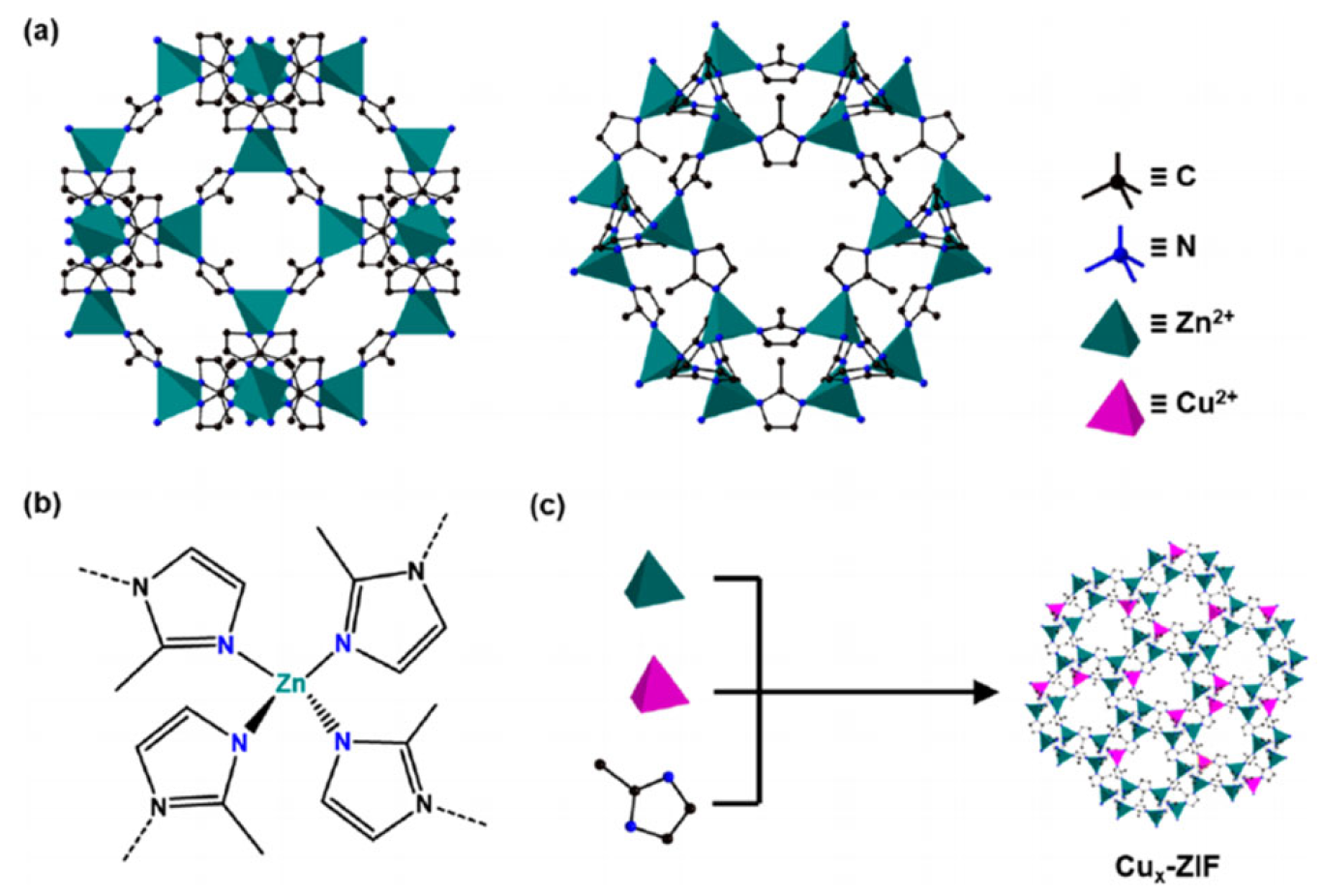
In the ZIF-8 material, the Zn2+ ions (Purchased from Sigma-Aldrich, St. Louis, MI, USA) coordinate with the 2-methylimidazole linker (Purchased from Aladdin Reagent Co., Ltd., Shanghai, China) to form tetrahedral nodes, thereby constructing a porous crystal framework with the sod topology. By partially substituting the Zn2+ sites with Co2+ or Cu2+ (Purchased from Maclean’s Reagent Co., Ltd., Shanghai, China), these ions can be incorporated into the framework, forming solid solution materials denoted as M-ZIF-8 (M=Co, Cu). However, the key challenge in achieving this substitution lies in the inherent electronic structure differences between Zn2+ and Cu2+/Co2+. Zn2+ has a closed-shell d10 electronic configuration and is distributed symmetrically in a spherical manner, tending to form ideal tetrahedral coordination, while Cu2+ (d9) is a typical Jahn–Teller ion, whose ground-state electron degeneracy makes it extremely unstable in the coordination field, inevitably undergoing Jahn–Teller distortion, resulting in the breaking of the ideal tetrahedral symmetry and the formation of elongated octahedral or tetragonal double-cone coordination geometries. This fundamental difference in electronic structure determines that when Cu2+ enters the ZIF-8 lattice, its local coordination environment will inevitably have a significant difference from the Zn2+ nodes. However, the inherent structural flexibility of the ZIF-8 framework and the mild synthesis conditions can accommodate a certain degree of lattice distortion, thereby enabling the effective doping of transition metal ions (Figure 1).
Figure 1. (a) Structure of ZIF-8 with the 4-membered ring viewed along the crystallographic a axis (left) and the 6-membered ring viewed along direction (right). (b) Coordination environment of tetrahedral Zn(II) atoms in ZIF-8. (c) Synthesis scheme for Cux-ZIF. Hydrogen atoms are omitted for clarity (Reprinted from Ref. [15]).
Inorganics 14 00043 g001
The key point is that confirming that the dopant ions have entered the lattice rather than simply undergoing physical adsorption or being encapsulated in the pores requires the construction of a multi-technology complementary evidence chain. This has been systematically verified through multi-scale and complementary characterization techniques.
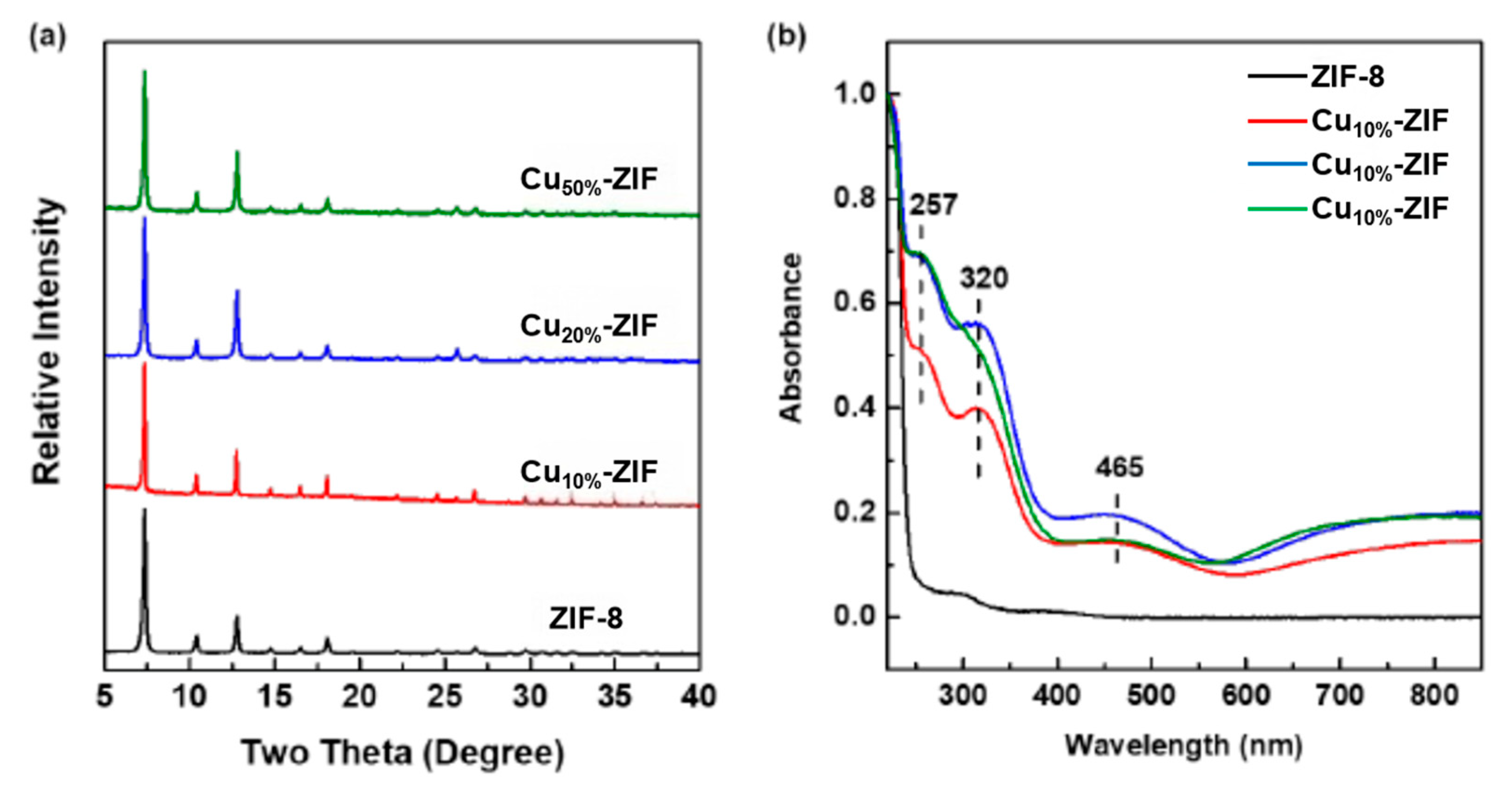
Yang et al.’s research found that the integrity of the crystal structure served as indirect evidence. The PXRD spectrum (PXRD, purchased from Bruker Corporation, Karlsruhe, Baden-Württemberg, Germany) indicated that the doped material maintained the characteristic feldspar topological structure of ZIF-8, but the diffraction peaks showed a systematic slight shift. This indirectly reflected the contraction of the unit cell parameters caused by the difference in ionic radii between the dopant ions and Zn2+ (Figure 2) [15].
Figure 2. (a) PXRD patterns and (b) DRUV-Vis spectra of as-synthesized Cu(II)-doped ZIF-8. UV–Vis signals were normalized at 220 nm (Reprinted from Ref. [15]).
Inorganics 14 00043 g002
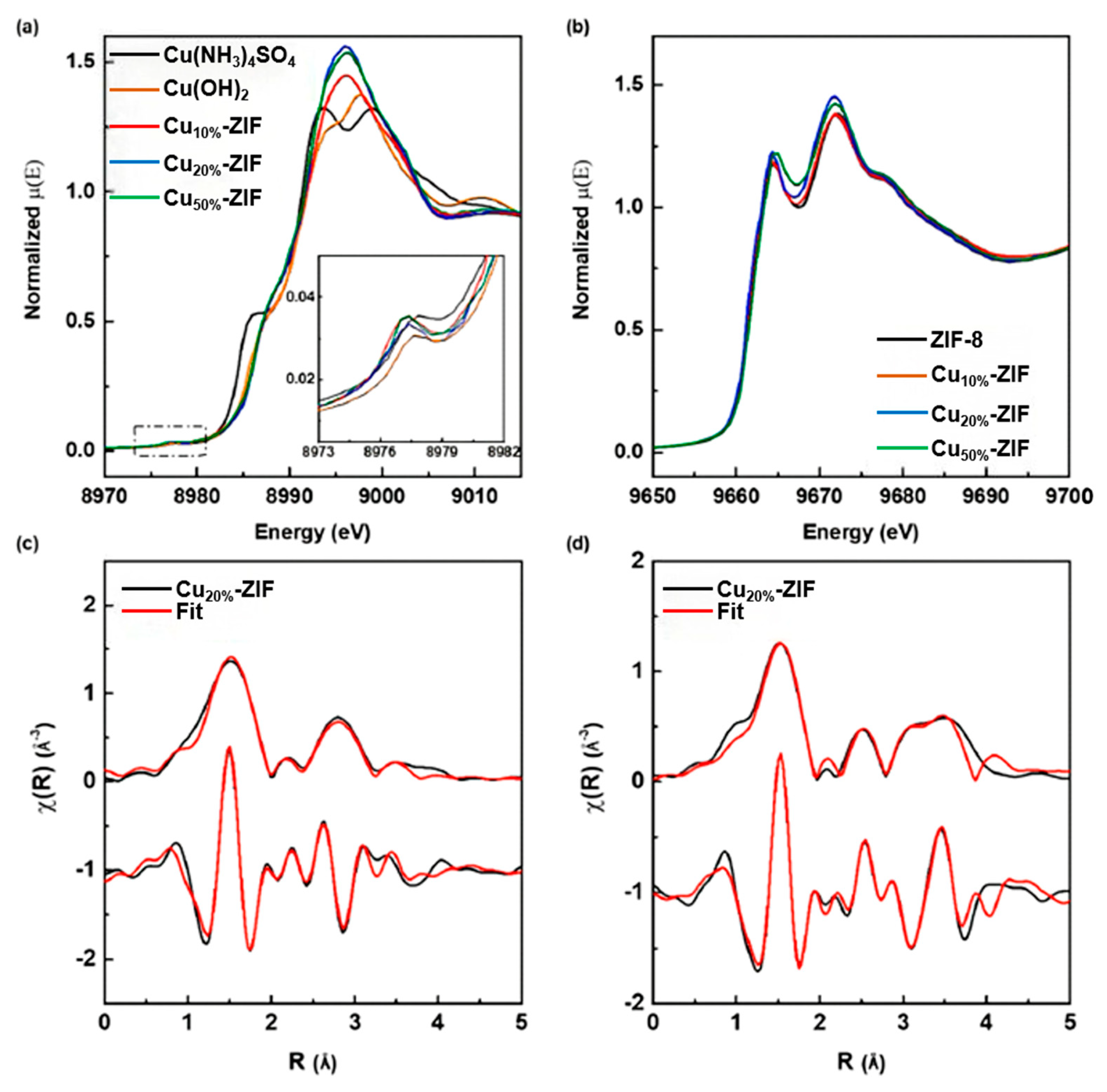
Direct and strong evidence for the local coordination environment and oxidation state is provided by X-ray absorption spectroscopy (XAS, purchased from Thermo Fisher Scientific, Waltham, M, USA). In the Cu K-edge XANES spectrum, the 1s→4p transition peak at 8986.2 eV, the 1s→3d pre-peak at 8977.2 eV, and the 1s→3d pre-peak at 8977.5 eV are consistent with the Cu2+ standard sample, confirming the +2 oxidation state of copper and its non-centrosymmetric coordination environment (Figure 3) [15].
Figure 3. (a,b) Normalized XANES spectra and (c,d) k2-weighted EXAFS χ(R) spectra of the as-prepared Cu20%-ZIF at the Cu K-edge (left) and Zn K-edge (right). The inset of (a) shows the pre-edge feature corresponding to the 1s-to-3d electronic transition of Cu(II) (Reprinted from Ref. [15]).
Inorganics 14 00043 g003
The quantitative fitting of EXAFS data further indicates that the first coordination shell of Cu atoms is composed of N/O atoms, with a coordination number of approximately 5.7 and an average bond length of 1.98 Å. There are also Cu-C scattering paths from the ZIF-8 framework (~3.11 Å) [15]. This coordination environment is similar to the tetrahedral coordination of Zn2+ nodes but distorted. This is direct evidence for the Jahn–Teller distortion that leads to the formation of elongated octahedral coordination fields [15,16,17]. At the same time, the Zn K-edge spectrum remains basically unchanged after doping, indicating that the doping process is selective and does not damage the structural integrity of the main framework; the presence of Cu-C scattering paths from the ZIF-8 organic framework in the spectrum strongly proves that Cu2+ is integrated into the metal nodes of the framework rather than simply physically adsorbed in the pores [15].
The details of the electronic structure and coordination geometry are revealed by the ultraviolet–visible diffuse reflectance spectroscopy (DRUV-Vis). The broad absorption band observed for Cu-ZIF-8 in the 600–850 nm region corresponds to the d-d transition of Cu2+ in the distorted octahedral or tetrahedral coordination field. This is consistent with the EXAFS conclusion, confirming that its Jahn–Teller distortion is accommodated by the flexible framework, forming a unique active site [15].
The element distribution and surface chemistry were confirmed by X-ray photoelectron spectroscopy (XPS). XPS showed that the binding energy of Cu 2p3/2 was around 934.5 eV, accompanied by characteristic satellite peaks, which is conclusive evidence of Cu2+. In-depth analysis indicated that the Cu signal was uniformly distributed in the material’s bulk phase, ruling out the possibility of surface segregation or simple physical adsorption [15].
Therefore, based on the comprehensive evidence chain consisting of PXRD, XAS (EXAFS/XANES), DRUV-Vis and XPS, it can be clearly demonstrated that Co2+ and Cu2+ have successfully been incorporated into the ZIF-8 lattice through isomeric substitution, forming M-ZIF-8 (M=Co, Cu) solid solution materials. It is necessary to critically point out that some published studies have merely relied on XRD and XPS data to draw the conclusion of “isomeric substitution”, and the rigor of such conclusions may be questionable. Future research should more widely adopt characterization methods such as EXAFS, which can provide local atomic-level structural information, to confirm this.
Ultimately, this unique distorted coordination environment induced by the Jahn–Teller effect is not only a distinctive structural feature of the M-ZIF-8 material, but also the core foundation for its functionalization. This distorted coordination field endows the Cu2+ center with higher reactivity, which is the structural origin for its variable valence state (Cu2+/Cu+) and efficient Fenton-like catalytic activity. This lays a crucial structure–activity relationship foundation for the subsequent in-depth discussion of its efficient antibacterial performance and potential biological effects.

2.1.1. Light Absorption and Carrier Separation (Co/Cu Doping Effect)

Light absorption and carrier separation are two critical indicators that influence the effectiveness of photocatalysis. Light absorption establishes the theoretical upper limit of the reaction by indicating the amount of available light energy, whereas carrier separation affects the actual efficiency of the reaction. The incorporation of metal dopants can extend the range of light absorption, facilitate carrier separation, and ultimately enhance the efficiency of photocatalysis.
ZIF-8 exhibits a relatively wide band gap of approximately 5 eV, primarily responding to ultraviolet light, which constrains its applicability in the visible light spectrum. The introduction of transition metal elements, such as Co or Cu, facilitates the formation of intermediate energy levels within their d orbitals, thereby significantly extending the light absorption range into the visible region (400–700 nm). For instance, Co2+ doping can generate new electronic states in ZIF-8, enhance the separation of photogenerated electron–hole pairs, and improve quantum efficiency. Similarly, Cu2+ doping not only increases the visible light absorption capacity of ZIF-8 but also promotes carrier migration through the Cu2+/Cu+ REDOX cycle. Furthermore, metal doping can optimize the band structure of the material, reduce electron–hole recombination, and consequently enhance photocatalytic activity.
Multiple studies have confirmed the beneficial effects of metal doping on optical properties. For instance, Alkallas et al. observed that increasing the cobalt doping concentration resulted in a decrease in the optical transmittance of CO-ZF-8 films, while the absorption coefficient and extinction coefficient increased. Additionally, the bandgap energy rose from 3.25 eV to 3.37 eV, and the Urbach energy decreased, indicating enhanced structural ordering of the material [18]. It should be noted that although the band gap has increased, this does not necessarily mean that the light absorption capacity has weakened. In the doped system, the slight increase in the band gap may be attributed to the crystal field effect and the adjustment of localized electronic states. Such changes help to suppress electron–hole recombination and increase carrier lifetime, thereby ultimately enhancing photocatalytic activity. Therefore, the optimization effect of Co doping mainly lies in the improvement of carrier separation efficiency rather than a simple reduction in the band gap. The Co/Zn composite ZIFs synthesized by Guan and Khang et al. exhibited an absorption redshift, a reduced band gap, and a significantly improved capacity for visible light absorption [19,20]. Regarding carrier separation, Ostad et al. demonstrated through photoluminescence (PL) spectroscopy that doping with Au and Cu effectively suppresses electron–hole recombination in ZF-8, prolongs the lifetime of photogenerated carriers, and further enhances photocatalytic performance [21].
In conclusion, while recent studies have validated the ability of metal-doped ZIF-8, to enhance light absorption and facilitate carrier separation, there remains a deficiency in directly and comprehensively characterizing and validating the underlying mechanism at the microscopic scale. Moreover, the optimization of the material lacks systematic and theoretical direction. Hence, forthcoming investigations should utilize advanced characterization techniques and theoretical computations to uncover the microscopic mechanisms, transition material development from “empirical design” to “rational design,” and improve performance assessment in practical application scenarios.

2.1.2. Regulatory Mechanisms of Reactive Oxygen Species (ROS) Generation

Reactive oxygen species (ROS) are key effectors in photocatalytic antibacterial processes, primarily comprising highly oxidative species such as hydroxyl radicals (·OH), superoxide anions (·O2), and singlet oxygen (1O2). Within M-ZIF-8 (M=Co, Cu) composite materials, these ROS exhibit distinct generation pathways and oxidative capacities, enabling efficient disruption of bacterial cell structures. For instance: ·OH possesses the strongest oxidation potential (E0 = 2.8 V) but an extremely short lifetime, primarily generated through the oxidation of water or hydroxide ions by photoexcited holes; ·O2 is generated by the reduction of oxygen via photoexcited electrons. Although its oxidation potential is relatively weak (E0 = 0.33 V), it can be further converted into H2O2 and ·OH; 1O2 is formed through energy transfer processes and exhibits specific destructive effects on bacterial membrane lipids.
Transition metal doping can promote ROS generation pathways and proportions. Studies indicate that Co doping tends to enhance ·O2 production due to its greater affinity for oxygen reduction processes, while Cu doping promotes water oxidation through its variable valence states (Cu2+/Cu+), thereby increasing ·OH yield. As shown in Figure 4, Wang et al. systematically characterized the types and yields of ROS generated by Cu-doped ZIF-8 under dark and light conditions using electron paramagnetic resonance (EPR) and fluorescent probe techniques. Scavenging experiments validated the crucial roles of ·O2, H2O2, and ·OH in the antibacterial process [22]. Additionally, although Zhang et al. did not employ ESR techniques, they successfully semi-quantified the ROS levels induced by Cu@ZIF-8 NPs within bacteria using DCFH-DA and TA fluorescent probes, confirming a positive correlation with antibacterial activity [23]. Similarly, Hu and Wang et al. employed EPR and DCFH-DA probes to achieve qualitative and semi-quantitative ROS analysis across different systems, providing experimental evidence for understanding the antibacterial mechanism of M-ZIF-8 (M=Co, Cu) [24,25].
Most current research primarily focuses on the qualitative or semi-quantitative detection of reactive oxygen species, lacking precise analysis of their spatio-temporal distribution, dynamic evolution, and interactions with bacteria. The specific contributions of different reactive oxygen species to the antibacterial process remain unclear. Future investigations should prioritize the development of in situ and real-time monitoring technologies, the analysis of synergistic antibacterial mechanisms among reactive oxygen species, and the exploration of methods to precisely regulate the generation spectrum of reactive oxygen species through material design to achieve more efficient and controllable antibacterial effects.

2.1.3. Synergistic Antibacterial Effects of Metal Ion Controlled-Release
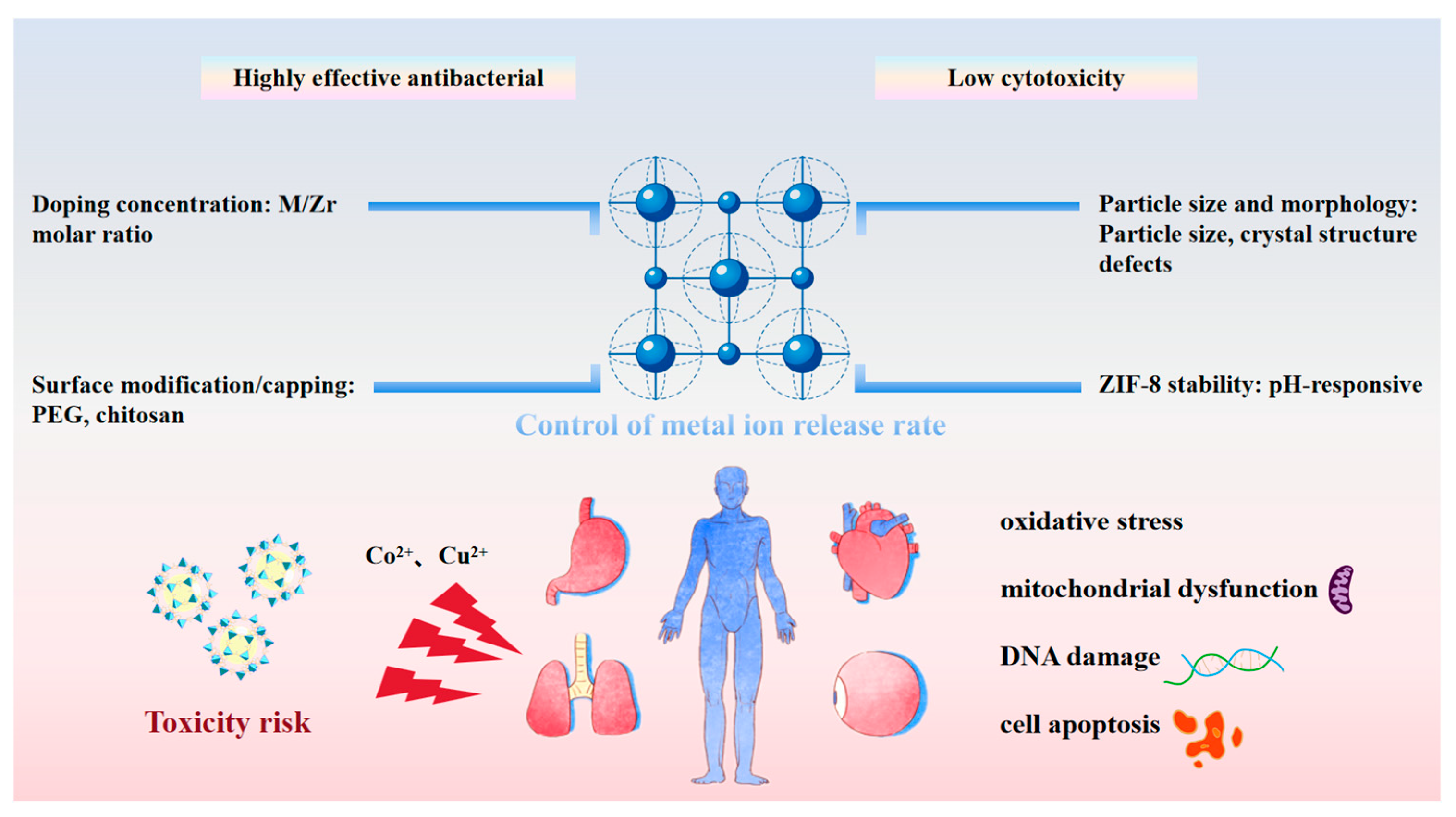
In addition to generating reactive oxygen species through photocatalysis, M-ZIF-8 (M=Co, Cu) gradually releases metal ions such as Zn2+, Co2+, and Cu2+ into solution, as illustrated in Figure 2. These ions collectively enhance the antibacterial efficacy of the material through various mechanisms [26,27]. For example, Zn2+ binds to phospholipid molecules on the bacterial cell membrane, thereby increasing membrane permeability. Cu2+ catalyzes lipid peroxidation within the membrane, which directly compromises membrane integrity [28]. Furthermore, Co2+ and Cu2+ can displace essential metal ions, such as Fe2+, in critical microbial enzymes, resulting in diminished enzyme activity and disruption of bacterial metabolism. Additionally, metal ions may function as electron traps on the surface or within the material, extending the lifetime of photogenerated carriers and indirectly facilitating the generation of ROS.
Controlling the release rate of metal ions is crucial as elevated concentrations can be toxic to mammalian cells. Hence, achieving a balance between antibacterial efficacy and biological safety is essential in material design (Figure 5) [27].
Figure 5. Metal ion controlled-release strategy: The key to balancing antibacterial efficacy and cytotoxicity.
Inorganics 14 00043 g005

2.1.4. Cobalt and Copper: Distinct Photocatalytic Roles

Cobalt and copper doping impart distinct photocatalytic functionalities to ZIF-8, rooted in their unique electronic structures and redox behaviors.
Cobalt doping introduces active redox centers that facilitate electron transfer to oxygen species adsorbed on the material surface, promoting the generation of superoxide and oxo radicals while reducing charge carrier recombination. In the MOF’s crystalline environment, cobalt adopts an approximate octahedral coordination where crystal field effects favor the stabilization of higher oxidation states. In this context, Co(II) can be oxidized to Co(III)—a particularly stable state from the perspective of crystal field stabilization energy—acting as an intermediary in electron transfer processes. The oxidation of Co(II) to Co(III) can couple with the reduction of adsorbed molecular oxygen, facilitating the formation of reactive species such as •O2. Moreover, Co(III) can capture photogenerated electrons and retain them temporarily, serving as an electron trap and prolonging carrier lifetime.
Copper doping, analogous to silver and gold, tends to favor hole-mediated oxidation processes, enhancing the generation of hydroxyl radicals (·OH). In an approximately octahedral coordination environment within the MOF lattice, Cu(II) can accept electrons and be reduced to Cu(I) or even Cu(0), consistent with its positive redox potentials in aqueous solution. This ability of copper to act as an electron trap promotes charge carrier separation, decreases electron–hole recombination, and increases the availability of photogenerated holes, thereby enhancing the oxidation of water or adsorbed hydroxyl species and the formation of ·OH radicals.

2.2. Antimicrobial Action Pathway

The antibacterial impact of ZIF-8-based composites (M-ZIF-8 (M=Co, Cu)) involves a multifaceted synergistic process, primarily hinging on oxidative harm induced by ROS, disruption of metabolism by metal ions, and physicochemical interactions occurring at the interface between the material and microorganisms. This section will comprehensively elucidate these fundamental mechanisms.

2.2.1. ROS-Mediated Microbial Damage

M-ZIF-8 (M=Co, Cu) materials can catalyze or induce the generation of multiple reactive oxygen species (ROS), inflicting lethal oxidative damage on microorganisms to achieve antibacterial effects. Damage mechanisms include attacking cell membrane lipids, oxidizing proteins and nucleic acids, and depleting intracellular antioxidants. The chemical generation pathways and antibacterial efficiencies of different ROS vary. This section primarily discusses: The generation of •OH (hydroxyl radical) and its highly efficient killing mechanism; The diffusivity and synergistic antibacterial effects between •O2 (superoxide anion) and 1O2 (singlet oxygen). Material design can regulate the types and yields of ROS produced.
•OH is one of the ROS with the strongest oxidizing capacity [29]. Wang et al. demonstrated that encapsulating Cu-doped AuNCs within ZIF-8 can more effectively stabilize •OH, thereby significantly enhancing its catalytic activity in decomposing hydrogen peroxide (H2O2) and improving its microbial killing efficacy [30]. Zhou et al. further clarified that under weakly acidic conditions, Cu2+ released from the ZIF-8 shell can be reduced to Cu+ by cysteine and H2O2, subsequently generating •OH through an efficient Fenton-like reaction (Cu(I) + H2O2 → Cu(II) + ·OH + OH) for chemotherapeutic applications [31]. Although •OH has an extremely short lifetime and limited range of action, its exceptionally high reactivity enables rapid and intense destruction near the site of action [32].
Compared to •OH, ROS such as •O2 exhibit greater diffusion distances, making them more suitable for combating deep-seated bacteria like biofilm-associated strains [31]. It was also discovered that Cu(II)Ce6, upon reduction under ultrasonic activation, can regain its ability to generate 1O2. This demonstrates that synergistic antibacterial effects can be achieved by designing multifunctional materials capable of simultaneously producing •OH and 1O2, leveraging the distinct properties of •OH for rapid killing and 1O2 for remote action. Furthermore, the ZIF-67-based material constructed by Xue et al. efficiently scavenges external ROS species such as •O2, H2O2, and •OH through Co2+/Co3+ state conversion to protect host cells. Simultaneously, released Zn2+ and Co2+ entering bacteria induce endogenous ROS production within the bacteria, leading to oxidative stress-induced death [33].
In summary, •OH is suitable for localized rapid killing due to its high reactivity, while •O2/1O2 is better suited for combating biofilms and deep infections owing to its superior diffusivity. In the future, M-ZIF-8 (M=Co, Cu) materials can be doped with metals or designed with core–shell structures similar to ZIF-67 to precisely regulate the generation types and balance of ROS, thereby achieving highly efficient and synergistic antibacterial effects.

2.2.2. Disruption of Metal Ion Metabolism

Apart from reactive oxygen species (ROS), metal ions leached from the M-ZIF-8 (M=Co, Cu) framework can induce metabolic toxicity by perturbing microbial metal homeostasis, impeding crucial enzyme function, and impeding DNA repair processes, consequently leading to antibacterial outcomes [34,35]. The antimicrobial properties of metal-doped ZIF-8 (denoted as M-ZIF-8, where M = Co, Cu) structures primarily stem from the release of Zn2+/Co2+/Cu2+.
The primary benefit of Cu ions stems from their REDOX activity. Cu ions not only facilitate the production of •OH, but also their valence state transition (Cu2+/Cu+) within the infected microenvironment serves as a persistent toxic source. Studies emphasize that Cu+ exhibits greater efficiency in Fenton-like reactions under slightly acidic conditions compared to Fe2+, rendering it well-suited for operation in pathological microenvironments. Wang et al. emphasized the distinctive role of Cu in enhancing catalytic activity by comparing it to the REDOX-inert Zn2+ [30]. Xue et al. provided a comprehensive analysis of the mechanisms associated with Zn2+ and Co2+. Zn2+ demonstrates broad-spectrum antibacterial activity, capable of disrupting bacterial zinc homeostasis and inhibiting metalloproteinase activity [33]. Upon release from the ZIF-8 shell in an acidic infection environment, Zn2+ can also augment the phagocytic and autophagic functions of macrophages. In addition to inducing reactive oxygen species (ROS) production in bacteria, Co2+ exhibits immunomodulatory functions that facilitate the transformation of macrophages from the pro-inflammatory M1 phenotype to the anti-inflammatory and restorative M2 phenotype. When administered together, Zn2+ and Co2+ display a significant synergistic antibacterial effect.
In conclusion, the release of metal ions often demonstrates intelligent responsiveness. In a pathological microenvironment characterized by acidity (pH 5.5–6.0), elevated levels of H2O2, or high concentrations of cysteine, the ZIF-8 skeleton facilitates accelerated degradation, resulting in the targeted and rapid release of metal ions. This process generates a high local concentration at the infection site, thereby enhancing the bactericidal effect while minimizing toxicity to normal tissues [31,33]. However, the dynamic behavior of metal ions within the body and the assessment of long-term safety remain inadequately addressed, and there is a notable lack of precise analysis regarding the synergistic mechanisms among ions. Future research should prioritize the precise regulation of ion release kinetics and the exploration of intracellular metabolic pathways to advance targeted antibacterial strategies.

2.2.3. Material–Microorganism Interface Interactions

The interaction between materials and microorganisms at the interface is essential for antibacterial effects, as it establishes a close-range environment conducive to chemical killing through precise anchoring and physical penetration. This process includes surface charge-mediated targeted adsorption, biological barrier penetration influenced by size and morphology, and the consequent increase in local concentrations of active substances, which enhances multi-mechanism synergy.
ZIF-8 material typically exhibits a positive charge at physiological pH, enabling it to effectively bind to negatively charged bacterial cell membranes via electrostatic adsorption, which results in physical damage to the membranes [36]. Furthermore, surface modification can impart active targeting capabilities to materials. For instance, Zhou et al. employed BSA-MnO2 to target inflammatory joints [31], while Xue et al. utilized maltodextrin as a bacterial targeting ligand. Both approaches significantly enhanced the enrichment concentration of the materials at the lesion site and improved contact efficiency with pathogens [33].
The size of the material significantly influences its diffusion and penetration capabilities. Wang et al. highlighted that the nanoconfinement effect of ZF-8 facilitates the formation of nanoclusters with a uniform size of approximately 2 nm and excellent dispersion, promoting efficient interactions with biomolecules [30]. The particle size of MZZ, as investigated by Xue et al., is around 93 nm, which is optimal for enrichment in inflammatory tissues and subsequent phagocytosis by cells. Nanoparticles smaller than 100 nm are anticipated to penetrate the biofilm matrix more effectively [33]. Additionally, Chen et al. documented the dynamic alterations in material morphology. The gradual collapse of the crystal structure of ZIF-8 into nanosheets on the surface of rice roots is expected to significantly influence its interactions with the biological interface [37].
The porous structure of ZIF-8 facilitates not only the adsorption of microorganisms but also their degradation on its surface. This process locally releases elevated concentrations of reactive oxygen species (ROS) and metal ions, creating a “micro-battlefield” that significantly enhances antibacterial efficacy. This combination of physical adsorption and chemical destruction is a critical factor contributing to the exceptional antibacterial properties of M-ZIF-8 (M=Co, Cu) materials [33].
Current research has established the significant role of material physicochemical properties in interfacial interactions; however, our understanding of the collaborative regulation mechanisms and dynamic behaviors involving multiple parameters in complex biological environments is still inadequate. Future efforts should focus on establishing quantitative structure–activity relationships and developing in situ characterization techniques. This progression aims to facilitate a functional transition from passive adsorption to active recognition and intelligent penetration of materials.

3. Biological Toxicity Mechanisms and Safety Challenges

Metal-doped ZIF-8 materials, known as M-ZIF-8 (M=Co, Cu), exhibit significant promise in photocatalytic antibacterial applications. However, their biosafety poses a critical barrier to their translation from the laboratory to real-world use. This chapter comprehensively examines the toxicity of M-ZIF-8 (M=Co, Cu) across various biological scales, delving into its adverse effects on target microorganisms, mammals, and ecosystems. Furthermore, it conducts a detailed analysis of the primary toxic mechanisms involved, shedding light on the inherent trade-off between optimal performance and safety considerations.

3.1. Toxicity Manifestation Dimension

3.1.1. Microbial Selectivity

The antibacterial mechanism of metal-doped ZIF-8 is not entirely specific. Although this property effectively eradicates pathogens, it also inflicts irreversible harm on beneficial microbial communities in the environment or within the host, thereby restricting its clinical application [38].
Research has verified that M-ZIF-8 (M=Co, Cu) demonstrates remarkable inhibitory efficacy against common pathogens like Escherichia coli and Staphylococcus aureus (with MIC levels reaching the μg/mL range), suggesting its significant potential for utilization as a highly effective broad-spectrum antibacterial agent [39]. Nevertheless, a critical concern arises from the non-specific assaults of reactive oxygen species (ROS) and the potential toxicity posed by the release of metal ions on probiotics [40]. For instance, despite the potent antibacterial properties exhibited by Cu/Zn-MOFs (IEF-23, IEF-24), their impact on probiotics remains unexplored, thereby leaving the associated risks undisclosed [41]. Such indiscriminate aggression could disrupt the microecosystem, culminating in subsequent infections or functional impairments. Hence, evaluating its selective toxicity index (MIC against pathogenic bacteria/MIC against probiotics) is imperative.
Selective toxicity can be attained through innovative material design [42]. The GG-Zn2+ @ZIF-8 hydrogel synthesized by Jin et al. selectively inhibits Gram-positive bacteria, such as Staphylococcus aureus, while remaining ineffective against Gram-negative bacteria, including Escherichia coli [43]. Ma et al. achieved targeted eradication of pathogenic Escherichia coli by modifying Zn-MOF with D-mannose. Notably, they employed the biofilm encapsulation material of Lactobacillus reuteri to construct a precise treatment system that integrates both “antibacterial” and “pro-growth” effects [44].
In conclusion, the confirmed highly efficient and broad-spectrum antibacterial activity of metal-doped ZIF-8 materials highlights the potential threat posed by their non-selective killing mechanism to the microecological balance and the limitations of their selective regulatory strategies. Future research should focus on establishing a comprehensive biosafety evaluation system, integrating the influence of probiotics into essential assessment indicators, and designing a precise antibacterial platform with pathogen recognition capabilities to attain an optimal balance between antibacterial effectiveness and ecological preservation.

3.1.2. Mammalian Cell Cytotoxicity

The biocompatibility of M-ZIF-8 (M=Co, Cu) in medical device coatings and wound dressings hinges on its interaction with human cells. This investigation primarily delves into assessing the biocompatibility of M-ZIF-8 (M=Co, Cu) by examining its dose and metal-dependent toxicity towards epithelial cells, as well as its impact on immune activation and macrophage disturbance.
Human embryonic kidney cells (HEK293) are a commonly used model for assessing basic cytotoxicity. Studies reveal that high concentrations (typically >50 μg/mL) of M-ZIF-8 (M=Co, Cu), particularly Cu-doped variants, induce substantial ROS production, mitochondrial damage, and apoptosis, ultimately reducing HEK293 cell viability [45]. Toxicity manifests primarily as cellular shrinkage, impaired adhesion, and elevated apoptosis/necrosis rates. The toxicity of M-ZIF-8 (M=Co, Cu) exhibits clear concentration and metal composition dependencies, a trend extended to bimetallic MOFs. For instance, in Cu-MOFs, Cu2+ typically demonstrates stronger cytotoxicity than Zn2+ due to its high redox activity, as evidenced by Cu-BTC exhibiting an IC50 as low as 3.49 mg/L for MCF7 cells [46].
As professional phagocytes, macrophages may activate inflammatory pathways upon uptake of M-ZIF-8 (M=Co, Cu), leading to massive release of proinflammatory factors such as IL-1β and TNF-α and triggering a “cytokine storm” [47]. However, material design can dictate immune outcomes. For instance, the ZIF-8 complex system developed by Cheng and Liu et al. demonstrated anti-inflammatory effects in vivo by reducing IL-1β, TNF-α, and IL-6 levels, proving that beneficial immune regulation can be achieved through rational design [48,49].
Numerous studies have also reported the excellent biocompatibility of M-ZIF-8 (M=Co, Cu) materials. The PQZG nanofiber membrane synthesized by Zou et al. underwent live/dead cell staining (Calcein-AM/PI) at concentrations up to 150 μg/mL to observe cell morphology and viability. Mouse fibroblast (L929) survival rates remained close to 90% with a slight increase in viability after 48 h, indicating the material supports cell proliferation without significant toxicity [50].
Table 1 demonstrates that while current research has established the dual impact of dose and metal dependence on the biocompatibility of M-ZIF-8 (M=Co, Cu), a definitive conclusion remains elusive due to an unclear mechanism, fragmented research, and lack of in vivo validation. Subsequent studies should comprehensively investigate crucial material parameters, including the structure–activity correlation of metal ion types and ratios, particle size, surface modifications, degradation kinetics, and biological responses. It is imperative to determine the safe concentration range of materials in diverse application contexts, such as coating for sustained-release and high-exposure dressings, and to validate their clinical safety and immune-modulating function in disease models.

3.1.3. Ecotoxicity

Ecotoxicity serves as an indicator of the detrimental effects that chemical substances exert on organisms and ecosystems within the natural environment. M-ZIF-8 (M=Co, Cu) inevitably releases into the environment during its production, use, and disposal. The impact of M-ZIF-8 (M=Co, Cu) on aquatic and soil ecosystems constitutes a critical factor in safety assessments, and its ecological toxicity may be mitigated through thoughtful material design.
Metal-doped MOF materials with similar structures, such as Cu2+- or Zn2+-doped MOFs, exhibit notable species-specific ecotoxicity variations and synergistic enhancement effects. For example, Cu-BDC MOF demonstrates no acute toxicity towards Daphnia magna, proving safer than CuSO4 [54]. Conversely, Cu-MOF displays significantly higher toxicity to Marine medaka embryos (≥2.0 mg/L) compared to Zn-MOF (≥80 mg/L) [55]. Particularly concerning is the observed synergistic effect. Li et al. discovered that the combined exposure to low concentrations of ZIF-8 and Cu2+ resulted in heightened toxicity to zebrafish beyond the sum of their individual effects, leading to reduced survival rates, abnormal behavior, and severe oxidative damage [56].
The toxicity mechanism mediated by metal ions poses a significant threat to soil ecosystems as it can directly inhibit metal-sensitive soil microorganisms, such as nitrogen-fixing bacteria, resulting in reduced community diversity and functional impairments. Li et al. demonstrated this phenomenon in the zebrafish intestine, where the combined exposure to ZIF-8 and Cu significantly increased the abundance of potentially pathogenic Proteobacteria to 92.2% while decreasing the population of beneficial thick-walled bacteria. This dysbiosis pattern observed in the intestine is likely to be replicated in soil, impacting nutrient cycling [56].
Reducing ecological toxicity through thoughtful material design, such as innovative packaging approaches, has emerged as a pivotal strategy to mitigate these risks. For example, encapsulating pesticides in Cu/Zn-Pec MOF resulted in a significant increase in the LC50 for zebrafish, rising from 2.27 mg/L (considered toxic) for free pesticides to 16.59 mg/L (classified as low-toxic), showcasing the environmentally sustainable advantages of controlled-release methods [57].
However, current understanding remains limited, particularly regarding the synergistic effects of compounds in real-world environments and the absence of long-term data on soil ecology. Consequently, future research should facilitate a paradigm shift from single toxicity assessments to comprehensive environmental risk evaluations, thereby advancing the environmentally sustainable design of new materials.

3.2. Key Toxicity Mechanisms

3.2.1. Dose–Response Relationship of Metal Ion Leaching

The ongoing liberation of metal ions plays a central role in the biological impacts and toxicity of M-ZIF-8 (M=Co, Cu) materials [58]. The concept of “metal ion-mediated” toxicity is prevalent in numerous MOF materials, exhibiting a intricate dose-dependent characteristic. The toxicity mechanism and threshold of effect differ according to the specific metal element.
Research indicates that the toxic outbreak’s underlying cause hinges on the ability of the cellular metal homeostasis maintenance mechanism to withstand the influence of exogenous ions. Cells regulate metal homeostasis by utilizing chelating proteins like metallothionein, which can mitigate the effects of metal ions at low levels [59]. Nevertheless, if the local ion release rate from M-ZIF-8 (M=Co, Cu) surpasses the cell’s intrinsic detoxification capabilities, it will surpass the “toxicity threshold concentration,” leading to a drastic reduction in cell viability.
Upon surpassing the threshold, distinct downstream molecular pathways are activated by various metal ions, leading to their distinct toxic properties. Zinc (Zn2+), an indispensable trace element, exhibits relatively moderate toxicity [60]. Nonetheless, according to Ding’s study, elevated levels of Zn2+ can nonspecifically impede the activity of Zn2+-dependent enzymes and competitively hinder the absorption of crucial cations like Fe2+ and Ca2+, thereby perturbing intracellular ionic balance and signaling processes. The mechanism of Co2+ is intricate, genotoxic, and capable of mimicking hypoxic conditions. Co2+ has the ability to stabilize hypoxia-inducible factor-1 α (HIF-1α), inhibit its degradation, cause anomalous accumulation of HIF-1α under normoxic conditions, trigger the activation of hypoxia response genes, and promote abnormal angiogenesis [61]. Research by Chen et al. suggests that the leakage of Co2+ can be reduced to 5 μg/L by employing carbon matrix confinement, offering a potential approach to mitigate its associated risks. Cu2+, due to its potent redox activity, is a major contributor to cytotoxicity. Its core mechanism involves catalyzing H2O2 to generate •OH through Fenton-like reactions, thereby inducing severe oxidative stress [62]. Studies by Su and Zhang et al. have corroborated the toxicity of Cu2+ to mammalian cells such as rBMSCs and HUVECs [63,64]. Furthermore, Cu2+ exhibits a classic biphasic dose response. At low concentrations (approximately 8 μg/mL), it activates TGF-β/BMP pathways to promote osteogenesis and angiogenesis; however, beyond a threshold (e.g., 90 μg/mL), oxidative toxicity dominates, leading to cell death [64].
The biological effects and toxicity of materials are influenced not only by the total amount of metal ions released but also by their release kinetics. Su’s research employs pH-responsive release mechanisms to specifically target pathogens within acidic biofilms. Zhang et al. demonstrated sustained release of Cu2+ using metal–organic framework (MOF) carriers embedded in sodium alginate, thereby avoiding acute toxicity and maintaining levels within the therapeutic window [63,64]. This finding suggests that engineering ion release behavior is crucial for achieving a balance between efficacy and safety.
Regulating ion release kinetics has emerged as a crucial strategy for balancing the efficacy and safety of materials. However, current research remains constrained by simplified biological test models and has not adequately elucidated the long-term and complex ecological effects in real-world environments. Moving forward, it is essential to develop a more systematic environmental risk assessment framework to facilitate the establishment of safety designs.

3.2.2. Physical Damage from Nanoparticles

Beyond chemical toxicity, the physical properties of M-ZIF-8 (M=Co, Cu) nanomaterials and their interactions with cells constitute another significant dimension of biological effects, often synergistically exacerbating damage alongside chemical toxicity.
Outside the cell, two-dimensional nanoplate or nanotablet materials with sharp edges may cause direct physical damage to the cell membrane. Such materials can puncture or cleave the phospholipid bilayer, leading to loss of membrane integrity, leakage of contents, and disruption of ionic homeostasis, triggering rapid necrosis. In contrast, most spherical M-ZIF-8 (M=Co, Cu) particles enter cells via endocytosis. As demonstrated by Liang’s research, submicron-sized ZIF-8 (≈100 nm) is internalized via energy-dependent receptor-mediated endocytosis and ultimately trapped within acidic lysosomes, initiating subsequent damage cascades [65]. Studies by Liang, Saif, and others observed that the ZIF-8 framework becomes unstable and rapidly degrades under acidic conditions. Subsequently, the imidazole groups of ZIF-8 undergo extensive protonation in acidic conditions. To maintain pH equilibrium, proton pumps continuously operate, drawing in water and ultimately causing lysosomal swelling, increased membrane permeability, and even rupture [66,67]. Lysosomal rupture triggers catastrophic consequences: accumulated high-concentration metal ions and hydrolytic enzymes are explosively released into the cytoplasm, inducing severe oxidative stress and enzymatic assault, typically resulting in cell apoptosis or necrosis [68].
This observation indicates that circumventing the “endocytosis–lysosomal” pathway is a crucial strategy for disrupting the damage chain and enhancing biocompatibility. Moreover, the precise design of nanoparticle size can effectively bypass this pathway. Liang’s research offers direct evidence that ultra-small ZIF-8 (utZIF-SOD, ≈8.8–11.6 nm) can enter the cytoplasm through passive diffusion, thereby completely evading the lysosomal trap. In comparison to sub-micron-sized ZIF-8, this approach not only enhances the efficiency of encapsulated enzyme therapy but also exhibits superior biocompatibility [65].
Although the ultra-small-size design offers a viable approach to circumventing lysosomal toxicity, current understanding of the physicochemical synergistic toxicity mechanisms among M-ZIF-8 (M=Co, Cu) particles with different morphologies remains insufficient. Future efforts should establish comprehensive design guidelines that elucidate the complete relationship from material size and shape to biological effects, thereby providing a basis for the precise design of low-toxicity, high-efficacy materials.

3.2.3. Long-Term Exposure to Genetic Toxicity

The assessment of M-ZIF-8 (M=Co, Cu)’s biological safety must extend beyond acute toxicity to address its potential genotoxicity under long-term or sublethal concentration exposure. Such direct DNA damage may pose latent risks for carcinogenesis.
The reactive oxygen species (ROS) generated by M-ZIF-8 (M=Co, Cu) photocatalysis, particularly hydroxyl radicals (•OH), serve as its primary genotoxic initiators [69]. Hydroxyl radicals can diffuse into the cell nucleus, indiscriminately attacking DNA molecules, primarily inducing two types of damage: base oxidation and DNA strand breaks [70]. In terms of base oxidation, •OH can oxidize guanine to the mutagenic 8-oxo-guanine (8-oxoG). If this damage is not promptly repaired, it can cause G:C to T:A transversion during DNA replication. Sykuła’s study employed an Endo III-modified comet assay to specifically detect Cu(II) complex-induced pyrimidine oxidation damage, providing direct evidence for this mechanism [71]. On the other hand, •OH radicals can directly cause DNA single-strand breaks and even more severe double-strand breaks. Wang et al. provided strong support for this mechanism. Their Cu1 complex induced significant DNA double-strand breaks in B16-F10 cells by stimulating ROS production. Comet assays revealed a dose-dependent increase in tail DNA percentage, further confirming this mechanism [72].
The genotoxicity risk associated with M-ZIF-8 (M=Co, Cu) arises not only from its capacity to cause DNA damage but also from its potential to impair cellular damage repair mechanisms. Research indicates that metal ions like Co2+ released from M-ZIF-8 (M=Co, Cu) can hinder the function of crucial DNA repair enzymes, leading to the accumulation of DNA damage caused by reactive oxygen species (ROS) due to the suppressed repair pathway. Jin et al.’s study on copper validates the connection between metal ions and the DNA repair system from a different angle. The maintenance of intracellular copper levels controls the response to damage repair with the assistance of partner proteins like ATOX1, indicating that the release of external metal ions could disrupt this intricate network [73].
The cumulative impact of the aforementioned mechanisms of damage induction and repair impediment indicates that prolonged exposure to sublethal concentrations can significantly elevate the risk of genetic mutations and carcinogenesis. Hence, the evaluation of genotoxicity for such materials necessitates the utilization of precise and dependable detection techniques. Among these, the comet assay stands out for its rapid and sensitive identification of DNA strand breaks, as demonstrated by Sykulea and Wang [71,72]. Additionally, γ-H2AX focus analysis, a specific approach for detecting DNA double-strand breaks, was employed in Jin’s investigation of copper homeostasis and repair networks to assess the dynamics of damage and repair [71].
In conclusion, existing studies on M-ZIF-8 (M=Co, Cu) encounter significant constraints, including inadequate comprehension of toxicity mechanisms, insufficient evaluation of environmental performance, and challenges in optimizing material stability and specificity. Subsequent investigations should emphasize elucidating the chronic toxicity mechanisms, establishing eco-friendly and precise synthesis methods, and advancing their strategic utilization in areas like comprehensive diagnostics and therapy.

3.2.4. Environmental Persistence and Ecological Accumulation Risk

The environmental risk associated with M-ZIF-8 (M=Co, Cu) materials arises not only from their inherent toxicity but also from their environmental fate. Their relatively stable chemical structure contributes to slow degradation under natural conditions. This persistence in the environment is a primary factor behind their long-term and extensive ecological impacts, which are directly linked to the potential risks of bioaccumulation and amplification within the food chain.
M-ZIF-8 (M=Co, Cu) materials, particularly those characterized by ZIF-8, demonstrate significant stability under neutral pH conditions found in natural water bodies. Research conducted by Tsang et al. indicates that Cu-ZIF-8 can preserve its structural integrity in water for several days. This slow degradation rate suggests that once released into the environment, these materials may persist in the soil or sediment of aquatic systems for extended periods, thereby creating a continuous source of pollution and imposing long-term toxic pressure on ecosystems [74]. Additionally, the studies by Xu and Chen et al. provide indirect support for this assertion. The ZIF-based composites they synthesized retain their structure and catalytic activity even after multiple usage cycles, underscoring their potential for prolonged environmental retention [75,76].
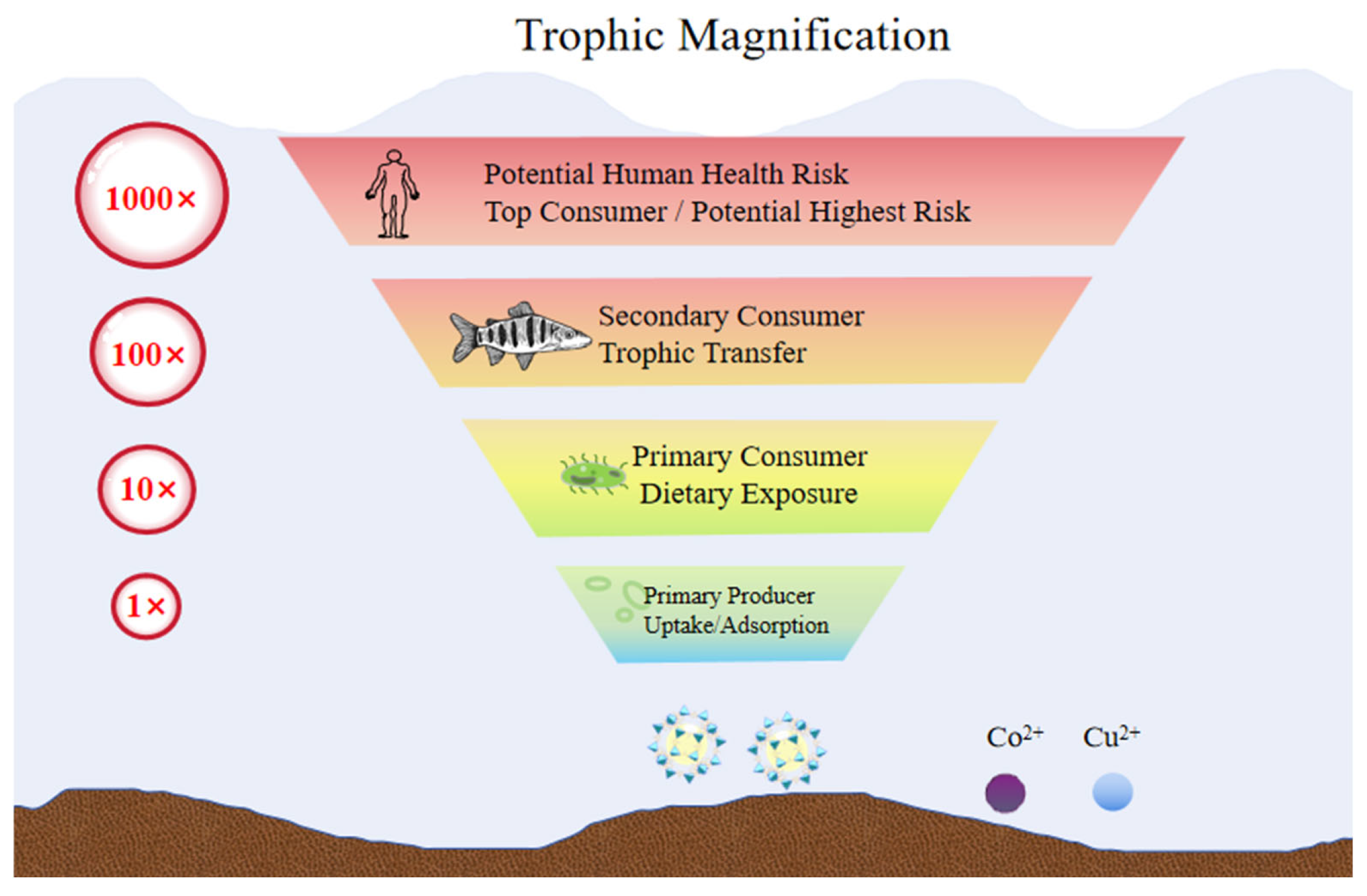
Even more concerning is the potential for persistent nanomaterials and the metal ions they release to enter the ecological chain, leading to bioaccumulation and amplification within the food web. The review by Zhang et al. systematically highlights that nanoparticles can be absorbed by low-trophic organisms, such as algae, and subsequently transferred to zooplankton through feeding, ultimately resulting in enrichment within higher organisms, including fish [77]. As illustrated in Figure 6, this transport pathway—”algae → zooplankton → fish”—suggests that low-concentration, seemingly innocuous environmental exposure may pose a significant threat to high-trophic organisms, including humans. Furthermore, Bose’s prediction regarding the toxicity of tetracycline degradation intermediates underscores the importance of monitoring potential bioaccumulation factors (BCFs) of transformation products, even after the parent contaminants have been removed [78].
The environmental medium is not passive but significantly influences the environmental behavior and toxicity of M-ZIF-8 (M=Co, Cu). Natural organic matter (NOM), such as humic acid and fulvic acid, serves a dual purpose. It can adsorb onto nanoparticles’ surfaces, forming an “environmental protein crown,” enhancing particle dispersibility, extending suspension time, and consequently increasing exposure risk [77]. Additionally, this coating can modify particle surface properties, impacting interactions with organisms, and sometimes mitigating short-term acute toxicity. Xu and Zhu, among others, have noted that inorganic anions and organic matter in aquatic environments can impact the effectiveness of ZIF-based catalysts, indirectly suggesting that environmental media significantly shape the fate and ecological impacts of materials [75,79].

3.2.5. Key Issues and Future Outlook

In the assessment of environmental and biological safety for M-ZIF-8 (M=Co, Cu) materials, three major challenges remain unresolved. First, there is a current lack of quantitative predictive models. A central future objective involves developing mathematical frameworks that correlate key material parameters with toxicity thresholds across various biological levels, ultimately generating a predictive “material parameter–toxicity threshold” map to guide rational material design [80]. Second, it is essential to enhance toxicity assessments in complex environments. This requires the development of an evaluation system that more accurately reflects real-world scenarios. In-depth research should focus on the regulatory effects of environmental organic matter, pH, and coexisting pollutants on toxic behavior. Particular attention must be given to how the “environmental protein corona” influences the bioavailability and ultimate toxicity of nanoparticles. Third, a fundamental solution lies in advanced material design. Drawing inspiration from nanomedicine, the development of biomimetic coatings represents a highly promising strategy. Although Zhou et al. employed proteins such as BSA to enhance targeting specificity [31], more sophisticated cell membrane-mimetic technologies remain to be explored. Such approaches could enable both “stealth” properties and targeted behavior, thereby minimizing ecological risks.
The enduring environmental presence of M-ZIF-8 (M=Co, Cu) materials underlies their enduring ecological hazards. To address these challenges, forthcoming studies must harmonize exceptional efficacy with elevated environmental security through the establishment of quantitative models, the advancement of intricate environmental assessment frameworks, and the exploration of novel biomimetic approaches.

4. Performance Optimization and Security Control Strategies

4.1. Current Material Optimization and Safety Regulation Strategies

To resolve the core contradiction between the photocatalytic antibacterial activity and biotoxicity of M-ZIF-8 (M=Co, Cu), and to advance the transition of materials from laboratory research to practical applications, current research centers on the core objective of “enhancing efficacy while reducing toxicity.” Systematic optimization is being conducted across three dimensions: material design, application scenario adaptation, and the establishment of a safety evaluation system, resulting in a multi-pathway synergistic regulation strategy.

4.1.1. Material Design Optimization

By precisely controlling the composition, structure, and surface properties of materials, we simultaneously enhance antimicrobial efficacy and reduce toxicity risks at the source, providing a structural foundation for achieving an optimal balance between efficacy and toxicity.
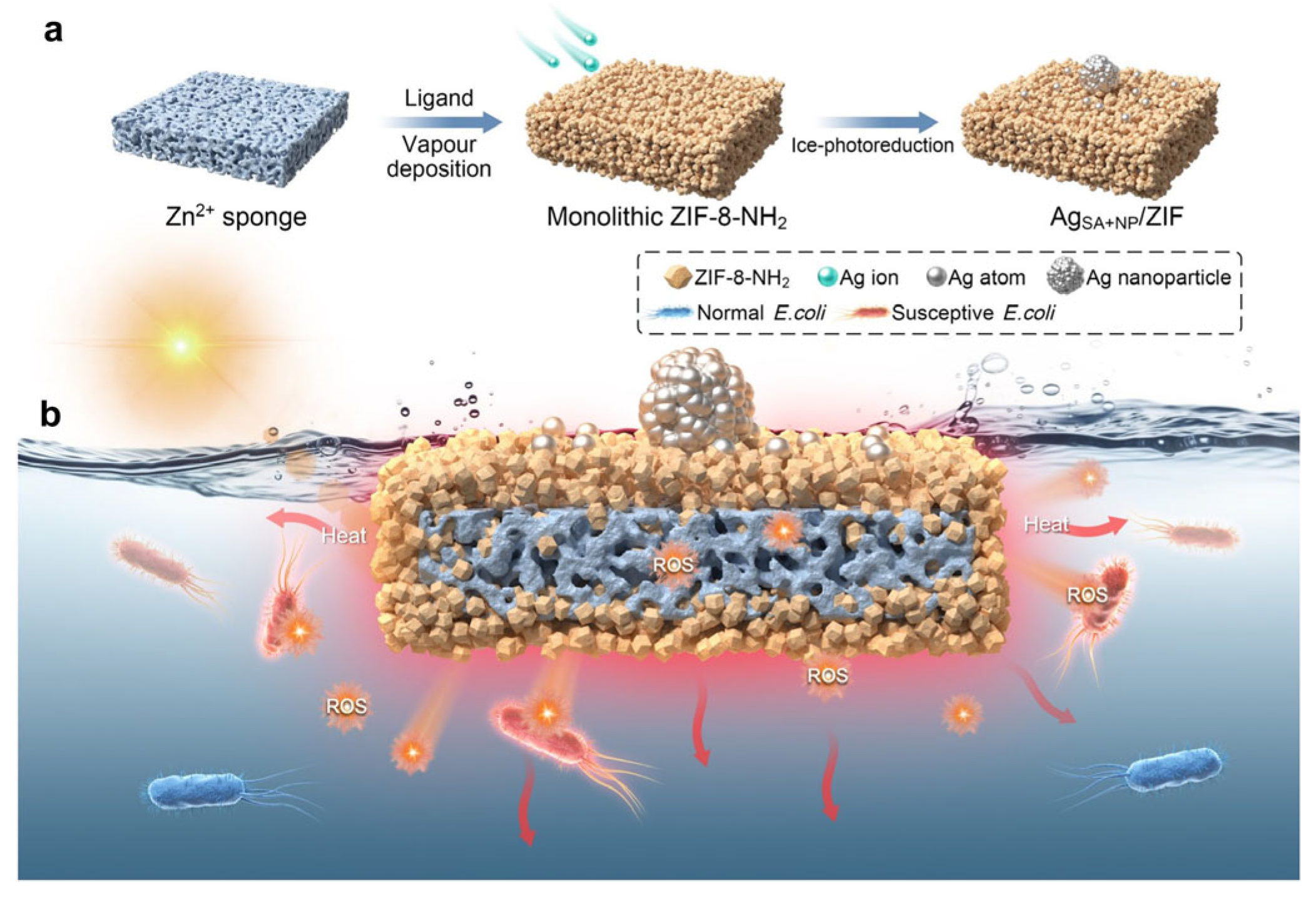
By leveraging the physical isolation and functional synergy of carrier materials, controlled release of toxic components and enhanced antibacterial activity are achieved. Composites of M-ZIF-8 (M=Co, Cu) with biocompatible materials such as cellulose, carboxymethyl cellulose (CMC), and gelatin form a “controlled-release barrier” through the matrix, thereby slowing the release rate of ions like Co2+ and Cu2+. Liu et al. [81] synthesized a novel MOF-based photocatalyst, AgBr/AgCl@ZIF-8, via a simple and rapid method. Its structure was confirmed by XRD and SEM characterization. This catalyst exhibits broad visible light absorption, achieving 98% RhB degradation within 60 min and efficiently inactivating multiple bacteria within 90 min. It demonstrates excellent stability and reusability, with O2 and h+ as its primary active species, offering new insights for developing high-performance photocatalytic antibacterial materials. Li et al. [82] used ZIF-8 as a template to prepare M/Zn-ZIFs catalysts by doping Co2+, Ni2+, and Cu2+ metal ions, systematically investigating their photocatalytic and photothermal sterilization properties. Results indicate that metal ion doping broadens the light absorption range, enhances charge separation efficiency, and improves photothermal conversion efficiency. Notably, the 5% Co1Zn19-ZIF-doped catalyst, which generates multiple reactive oxygen species while exhibiting enhanced photothermal effects, achieved a sterilization efficiency of 6.6 log10 CFU mL−1 against Escherichia coli within one hour under simulated sunlight. This finding provides valuable reference for the development of MOF-based sterilization materials (Figure 7).
Figure 7. Overview of the floatable monolithic photocatalyst. (a) Synthesis schematic of AgSA+NP/ZIF. (b) Disinfection operation schematic of AgSA+NP/ZIF. Note that Ag species are magnified in size (Reprinted from Ref. [83]).
Inorganics 14 00043 g007
By physically isolating toxic centers through core–shell design or promoting charge separation via heterojunctions, antibacterial selectivity is enhanced. Wang et al. [83] prepared a composite electrode material featuring porous g-C3N4 nanosheets encapsulating Ag3PO4 via a simple hydrothermal method. Phosphorus doping broadened the material’s visible light response range while improving electron–hole pair separation efficiency and specific surface area. The optimal APG-50 electrode (Ag3PO4/g-C3N4 ratio of 3:1) achieved a photoelectric conversion efficiency of 9.71%, significantly surpassing both pure g-C3N4 (1.89%) and Ag3PO4 (2.52%) electrodes. It also demonstrated high electron transfer efficiency and excellent stability, offering a novel pathway for developing high-efficiency dye-sensitized solar cell electrodes. As shown in Figure 8, ZIF-8 encapsulated within bacterial outer membrane vesicles (OMVs) forms a core–shell structure. The specific proteins on the OMV surface enable targeted recognition of Acinetobacter baumannii, achieving precise pathogen elimination while reducing toxicity to the probiotic Lactobacillus by 60% [84].
By regulating surface charge, introducing targeting molecules or biocompatible groups, non-specific interactions are reduced, enhancing biocompatibility and targeted antibacterial efficiency. For example, surface modification modulates the zeta potential to decrease non-specific adsorption between the material and normal cells. Pahlevani et al. [85] developed PEG-modified ciprofloxacin (CIP)-loaded ZIF-8 nanoenzymes (PEG-ZIF-8-CIP) for treating CIP-resistant Pseudomonas aeruginosa infections in burn wounds. These nanoenzymes exhibit uniform spherical morphology, 75% drug loading, excellent stability, sustained CIP release, and superoxide dismutase activity. As shown below, in vitro experiments demonstrated its excellent antibacterial and biofilm-clearing effects with low cytotoxicity. In vivo experiments accelerated wound healing, reduced inflammation, and achieved an 84% bacterial clearance rate, providing an effective strategy for treating wounds infected with drug-resistant bacteria. Liang et al. [86] developed zoledronic acid (ZOL)-modified, vancomycin (Van)-loaded bone-targeting ZIF-8 nanoparticles (VZZ-8 NPs) for treating MRSA-induced prosthetic joint infections (PJI). ZOL conferred bone targeting, while the acidic infection microenvironment triggered rapid degradation, synergistically releasing Van and Zn2+. In vitro experiments demonstrated a 93.84% MRSA killing rate and significantly inhibited biofilm formation. In vivo experiments efficiently cleared bacteria, reduced inflammation, and suppressed infectious osteolysis, providing a novel targeted strategy for PJI treatment. Concurrently, incorporating specific ligands enables precise pathogen recognition, reducing toxicity to non-target organisms. Hyaluronic acid (HA)-modified ZIF-8 accumulates at infection sites through HA’s specific binding to CD44 receptors on pathogen surfaces. This reduces the required antimicrobial concentration to one-third while significantly lowering hemolytic toxicity to red blood cells. Additionally, D-mannose-modified Zn-MOFs achieve targeted killing by recognizing the fimbrin protein of pathogenic E. coli, with negligible impact on beneficial gut bacteria. Nguyen et al. [87] synthesized hyaluronic acid (HA)-modified ZIF-8 nanoparticles (QT@ZIF-8/HA) for targeted delivery of quercetin (QT). These nanoparticles exhibited high drug loading capacity and sustained–controlled release of QT at physiological pH (7.4) while rapidly releasing QT in acidic tumor microenvironments (pH 5.5). HA-mediated targeting via CD44 reduced QT toxicity to normal cells (L929) while enhancing its cytotoxic effect on breast cancer cells (MCF-7), establishing a novel carrier for cancer-targeted therapy.
In the doping modification of ZIF-8 materials, precise control over dopant elements and their ratios can effectively reduce biotoxicity while maintaining high catalytic activity. Specific approaches include optimizing doping ratios and substituting with low-toxicity elements. Regarding doping ratio optimization, balancing ROS generation efficiency and ion release rates can be achieved by regulating Co and Cu doping levels. Studies indicate that at a Co doping level of 5%, the antibacterial activity of Co-ZIF-8 (MIC = 8 μg/mL) increases threefold compared to pure ZIF-8, while Co2+ release remains below the safety threshold (0.3 μg/mL) [18]. However, Cu-ZIF-8 exhibits exponentially increasing cytotoxicity when Cu doping exceeds 10%, indicating an optimal doping range of 3–8%. In terms of low-toxicity element substitution, biologically essential elements such as Zn and Fe are selected to replace highly toxic Co and Cu, thereby reducing toxicity at the source. As an essential trace element for the human body, Zn2+ exhibits significantly lower toxicity than Co2+/Cu2+. Zn-based ZIF-8 has been widely applied in biomedical scenarios such as bone repair scaffolds and wound dressings, maintaining an osteoblast survival rate of 88% even at a concentration of 100 μg/mL [88]; Fe-doped ZIF-8 exhibits outstanding activity in near-infrared photocatalytic antibacterial applications, and the Fe3+/Fe2+ cycle demonstrates significantly lower toxicity to mammalian cells compared to Co and Cu ions, offering a novel approach for replacing highly toxic dopant elements [89].

4.1.2. Application Scenario Adaptation

In the design of ZIF-8 materials for medical applications, tailored strategies focus on enhancing their biocompatibility, controllable degradation, and precise antimicrobial capabilities to meet the comprehensive requirements of clinical use. Specific approaches include biodegradability and clearance design, responsive activation mechanisms, and the construction of functional synergistic systems.
First, it focuses on biocompatibility, degradability, and targeting to meet clinical safety requirements. By integrating M-ZIF-8 (M=Co, Cu) into a degradable carrier, it achieves responsive degradation and metabolic clearance at the infection site. After loading ZIF-8 into gelatin/sodium alginate hydrogels, gradual degradation occurs within the acidic microenvironment (pH 4.5–6.0) at the infection site, achieving complete degradation and release of antimicrobial components within 7 days to prevent tissue toxicity from prolonged retention [90]. Ultra-small ZIF-8 particles (8.8–11.6 nm) are metabolically cleared via the kidneys, reducing in vivo accumulation by 75% compared to conventional-sized (100 nm) materials and significantly lowering organ toxicity. Second, to achieve responsive activation and on-demand antimicrobial action, specific signals from the infection microenvironment (pH, ROS, enzymes) intelligently activate antimicrobial activity, minimizing off-target toxicity. ZIF-8-modified gauze exhibits a 2.5-fold increase in Zn2+ release rate under acidic infection conditions (pH 5.0), achieving 99% bacterial eradication, while release slows in neutral physiological conditions (pH 7.4) to promote wound healing [91]. pH/temperature dual-responsive ZIF-8 hydrogels rapidly release Ag+/Zn2+ at infection sites (pH 5.5, 38.5 °C) while maintaining stability in normal tissue environments, reducing systemic toxicity [90,92]. Third, synergistic functionality is achieved by incorporating bioactive components. Combining bioactive elements enables coordinated antibacterial and tissue repair effects. Curcumin-loaded ZIF-8 hydrogels deliver antimicrobial activity while curcumin’s antioxidant properties scavenge excess ROS, mitigating oxidative stress damage to healthy tissues and accelerating wound healing by 40% compared to pure ZIF-8 [92]. A bone repair scaffold composed of ZIF-8 and hydroxyapatite not only exhibits potent antibacterial activity but also promotes osteoblast proliferation and differentiation, increasing bone regeneration efficiency by 50%.
In environmental remediation applications, the design of ZIF-8-based materials must balance recyclability, environmental stability, and ecological safety to mitigate potential risks to ecosystems. For immobilization and recyclability, M-ZIF-8 (M=Co, Cu) is loaded onto solid carriers to prevent direct release of nanoparticles and metal ions into the environment. Antimicrobial materials constructed by loading ZIF-8 onto cotton fabrics maintain over 90% antimicrobial activity after five reuses, with metal ion leaching below environmental safety standards (0.1 mg/L) [93]. Recyclable membrane materials formed by loading ZIF-8 onto polymer nanofiber membranes facilitate easy separation and recovery during water treatment, preventing secondary pollution [94]. Regarding environmental stability, structural optimization enhances material stability in complex environments, ensuring sustained antimicrobial performance. A photocatalytic antibacterial system built with Au/PCN-224/Cu(II)-modified fabric maintained 98% high antibacterial activity in simulated wastewater containing humic acid, demonstrating threefold greater stability compared to pure ZIF-8 [93]. Polysiloxane-modified ZIF-8 enhanced colloidal stability in water, reducing activity loss and ecological risks caused by agglomeration. Regarding ecological safety, low-toxicity elements and eco-friendly carriers were selected to minimize environmental exposure risks. Zn-based ZIF-8 loaded onto biochar formed an environmental antibacterial material with Zn2+ leaching below 0.05 mg/L and acute toxicity (LC50) to Daphnia magna exceeding 100 mg/L—significantly higher than Cu-based materials [93]. Encapsulating pesticides within Cu/Zn-pectin MOFs increased the LC50 for zebrafish from 2.27 mg/L for free pesticides to 16.59 mg/L, demonstrating significantly enhanced ecological safety.

4.1.3. Safety Evaluation System

Establishing a multi-tiered, dynamic safety evaluation system is crucial for comprehensively assessing the toxicity risks of ZIF-8-based materials across different biological levels and application scenarios, thereby optimizing their design. This system aims to overcome the limitations of traditional short-term, single-toxicity testing by integrating multidimensional data—ranging from acute to chronic, single to combined, and cellular to ecosystem levels—to systematically reveal the material’s potential risks in real-world environments. It provides reliable safety evidence for its biological and environmental applications.
Regarding the transition from acute to chronic toxicity assessment, it is essential to overcome the limitations of short-term toxicity evaluations and uncover the potential risks associated with prolonged exposure. For short-term toxicity screening, rapid identification of safe concentration ranges for materials can be achieved through 24/48 h cytotoxicity assays (e.g., the CCK-8 assay). Studies indicate that the acute toxicity threshold of M-ZIF-8 (M=Co, Cu) materials for mammalian cells typically ranges from 15 to 50 μg/mL, with concentrations exceeding this range inducing significant apoptosis [95,96]; Acute aquatic toxicity testing indicates a 48 h LC50 of 2.0 mg/L for Cu-ZIF-8 in zebrafish, whereas Zn-ZIF-8 exhibits an LC50 > 80 mg/L, providing reference for elemental selection. For long-term toxicity assessment, prolonged exposure models can be employed to evaluate cumulative toxicity and long-term effects. A 28-day subchronic toxicity study in mice revealed that low-dose (10 mg/kg) Zn-ZIF-8 caused no significant damage to major organs such as the heart, liver, and kidneys, whereas Co-ZIF-8 at the same dose induced marked abnormalities in hepatic oxidative stress markers (SOD, MDA) [97]. Long-term soil exposure experiments revealed that Cu-ZIF-8 reduced soil nitrogen-fixing bacteria by 30%, whereas Zn-ZIF-8 had no significant effect on soil microbial community structure.
Consider the influence of components such as proteins and humic substances in biological fluids (serum, tissue fluid) or environmental media (sewage, soil leachate). Research has revealed the interaction mechanism between graphene oxide (GO) and cadmium (Cd2+) and their combined toxicity to Chlorella. GO exhibits high Cd2+ adsorption capacity (120.6 mg/g), primarily through cation-π interactions. Cd2+ inhibits GO’s colloidal stability, and co-exposure to GO and Cd2+ significantly enhances toxicity, manifested as decreased chlorophyll b content, exacerbated mitochondrial damage, and increased Cd2+ uptake. Transcriptome and metabolome analyses indicate that enhanced toxicity is primarily driven by the regulation of photosynthesis-related genes and the inhibition of amino acid and fatty acid metabolic pathways [98]. Concurrently, attention should be paid to the interactions between M-ZIF-8 (M=Co, Cu) and co-pollutants such as antibiotics and heavy metals. Studies indicate that ZIF-8, when co-exposed with low-concentration antibiotics, enhances bacterial cell membrane permeability, thereby boosting antibiotic bactericidal effects, but may also accelerate the spread of antibiotic resistance genes [99]. A previous study examined the effects of low-concentration butyl benzyl phthalate (BBP) and titanium dioxide nanoparticles (nTiO2) on the gut of Lumbricus rubellus worms during separate and combined exposure. Transcriptomic analysis revealed that both individual and combined exposures may induce neurodegenerative lesions through mechanisms involving glutamate accumulation, protein dysfunction, and endoplasmic reticulum and mitochondrial oxidative stress. Concurrently, they disrupt amino acid and carbohydrate metabolism, leading to energy metabolism disorders, thereby providing a basis for risk assessment and management of such pollutants in soil [100].
Comprehensive analysis of toxicity mechanisms enables assessment of potential risks posed by materials across different biological levels. At the molecular level, technologies such as transcriptomics and metabolomics can be employed to reveal toxic pathways. Research indicates that black phosphorus quantum dot-modified ZIF-8 induces nephrotoxicity via the ferroptosis pathway, manifested as accumulation of lipid peroxidation products and iron metabolism disorders. When exposed to GO and Cd2+ simultaneously, ZIF-8 disrupts algal photosynthetic metabolic pathways and gene expression related to energy metabolism [98]. At the cellular and tissue levels, assessments can extend beyond cell viability testing to evaluate indicators such as apoptosis and inflammatory responses. At high concentrations, ZIF-8@Cu activates NLRP3 inflammasomes, leading to increased release of pro-inflammatory factors like IL-1β and TNF-α and triggering inflammatory responses. In contrast, PEG-modified ZIF-8@Cu significantly suppresses inflammatory factor release and enhances biocompatibility [85]. At the ecosystem level, assessments can be extended to aquatic and soil ecosystems to evaluate impacts on biological communities. Zn-ZIF-8-loaded cotton fabrics showed no significant effect on aquatic microbial community diversity, whereas Cu-ZIF-8 increased the abundance of pathogenic bacteria in aquatic microorganisms [94]. After degradation of ZIF-8 in soil, released metal ions can impair the function of microorganisms involved in soil nutrient cycling, potentially leading to reduced soil fertility with prolonged exposure.
This section systematically addresses the core contradiction between photocatalytic antibacterial activity and biotoxicity in M-ZIF-8 (M=Co, Cu). Centering on the goal of “enhancing efficacy while reducing toxicity,” it proposes multi-pathway synergistic regulation strategies across three dimensions: material design optimization, application scenario adaptation, and safety evaluation system construction. This provides both theoretical foundations and technical pathways for advancing these materials from laboratory research to practical applications.

5. Future Challenges and Research Directions

M-ZIF-8 (M=Co, Cu) materials demonstrate tremendous application potential in the antimicrobial field due to their outstanding photocatalytic activity, tunable pore structure, and excellent biocompatibility. However, transitioning from laboratory research to practical clinical applications and environmental remediation still faces three core challenges: insufficient understanding of the intrinsic mechanisms underlying the efficacy–toxicity trade-off, lack of intelligent and precise antibacterial strategies, and issues of standardization and sustainability in industrialization pathways. This section will systematically analyze these challenges and outline future research directions.

5.1. Challenges in In-Depth Mechanism Research

The current research bottleneck lies in the limited understanding of the intrinsic mechanism underlying the “same origin but different outcomes” phenomenon between the antibacterial effects and biological toxicity of M-ZIF-8 (M=Co, Cu) materials. This severely hampers the rational optimization of their safety and efficacy. Both the antibacterial activity and potential toxicity of M-ZIF-8 (M=Co, Cu) primarily stem from reactive oxygen species (ROS) generated by photocatalysis and the release of metal ions. The core to achieving “effect–toxicity separation” lies in the precise differentiation and quantification of these two factors. Different ROS species (e.g., hydroxyl radical ·OH, superoxide anion ·O2, singlet oxygen 1O2) exhibit distinct damage mechanisms and thresholds for bacteria and host cells. For instance, 1O2 selectively attacks specific biomolecules (such as guanine in DNA), whereas ·OH indiscriminately oxidizes nearly all biomolecules [101]. Currently, the lack of technologies capable of in situ, real-time tracking and differentiation of specific ROS within complex biological microenvironments hinders the precise delineation of the ROS “dose window” required for antibacterial activity versus toxicity at the molecular and atomic levels.
Co2+/Cu2+ ions serve as active centers in photocatalytic reactions and may also exert toxicity by disrupting microbial metabolism (e.g., via Fenton reactions) or disturbing host cell metal ion homeostasis [95,98]. Future research requires establishing analytical systems capable of quantifying the release of ions, their forms and valence states, and their dynamic interactions with key biomolecules. The transformation behavior and toxicity evolution in complex environments differ significantly from simplified laboratory conditions and real-world applications (e.g., infected wounds, aquatic systems, soil). Environmental transformation behavior is a critical variable influencing the ultimate safety and efficacy of materials. Studies indicate that nanomaterials undergo significant transformation in environmental media. For instance, ZnO nanoparticles can transform into ZnS in sulfur-containing water, shifting their toxicity mechanism from Zn2+ ion leaching dominance to physical shielding dominance [97]. Similarly, in complex biological or environmental media containing proteins, humic substances, and other components, how the structural stability, degradation pathways, and products of M-ZIF-8 (M=Co, Cu) (e.g., detachment of organic ligands, formation of novel metal clusters) regulate its photocatalytic activity and biotoxicity remains poorly understood [95,98]. Furthermore, in practical applications, M-ZIF-8 (M=Co, Cu) is likely to coexist with other pollutants such as antibiotics and heavy metals. Complex interactions between these substances—including synergistic (enhanced toxicity), additive, or antagonistic (reduced toxicity) effects—significantly complicate predictions of material environmental safety and ecological risks [98,101]. It is crucial to note that exposure to sublethal doses of ROS may select for tolerant strains possessing stronger antioxidant defense systems (e.g., high expression of SOD, CAT) or more efficient DNA repair mechanisms [101]. We must recognize that photocatalytic antibacterial action does not entirely circumvent the risk of resistance development. Prolonged exposure to sublethal doses may impose novel evolutionary pressures on microbial communities. Nanomaterial-induced oxidative stress has been demonstrated to potentially promote interbacterial conjugative transfer of plasmids, thereby accelerating the spread of antibiotic resistance genes (ARGs). At the environmental scale, assessing the potential promoting effect of long-term M-ZIF-8 (M=Co, Cu) exposure on ARG diffusion is a critical component of evaluating its environmental safety. However, relevant research in this area remains virtually non-existent [101].
In summary, future research must overcome bottlenecks in understanding mechanisms and develop multidisciplinary research strategies. By integrating multi-omics technologies such as transcriptomics and proteomics with advanced in situ characterization techniques, long-term dynamic observations can be conducted in complex systems that simulate real-world environments. This approach will enable the molecular-level decoupling of “effect–toxicity” mechanisms, elucidate environmental transformation pathways, and scientifically assess long-term ecological risks.

5.2. Development of Smart Materials

The development of smart materials is driving the evolution of antimicrobial strategies from “passive killing” to “intelligent precision antimicrobial action.” At its core, this approach fundamentally optimizes the efficacy–toxicity trade-off by endowing materials with environmental sensing, feedback regulation, and self-reporting capabilities. Future advancements will transcend current mainstream single-pH responses, focusing on developing multi-stimulus-responsive materials capable of simultaneously responding to multiple biological signals (e.g., specific pathogen enzymes, glutathione, ROS, temperature) while integrating external stimuli (e.g., near-infrared light). By constructing “AND/OR” logic-gated release systems, these materials enable precise spatiotemporal activation of antimicrobial activity, thereby minimizing off-target toxicity [85,87,88,102,103]. Concurrently, self-reporting diagnostic–therapeutic platforms combine ZIF-8 with upconversion nanoparticles or fluorescent molecules, leveraging their fluorescent signal changes to reflect local microenvironment states or material degradation in real time, enabling visual monitoring of therapeutic processes and real-time adjustment of drug delivery regimens [85,86]. To address complex, intractable infections like biofilms, multifunctional synergistic therapeutic platforms are required. Combining photocatalytic antibacterial effects with photothermal therapy, drug delivery, and immune modulation strategies can generate synergistic effects where “1 + 1 > 2.” For instance, Wang et al. reported that ZIF-8 hydrogel coatings simultaneously release Ca2+ to inhibit biofilm formation and vancomycin to eliminate free bacteria. Nguyen et al. demonstrated combining ZIF-8 with photothermal agents like SnFe2O4 and gold nanorods to enhance biofilm matrix permeability and drug release via photothermal effects, achieving synergistic physical removal and chemical eradication [85,86,87,88,103]. The ultimate goal for smart materials is to achieve closed-loop capabilities encompassing “sensing–decision–execution–feedback.” By integrating materials science, microelectronics, and artificial intelligence algorithms, developing next-generation “intelligent antibacterial robots” capable of autonomously adjusting antimicrobial intensity based on infection status represents a disruptive strategy for tackling the challenge of drug-resistant infections.

5.3. Pathways to Standardization and Industrialization
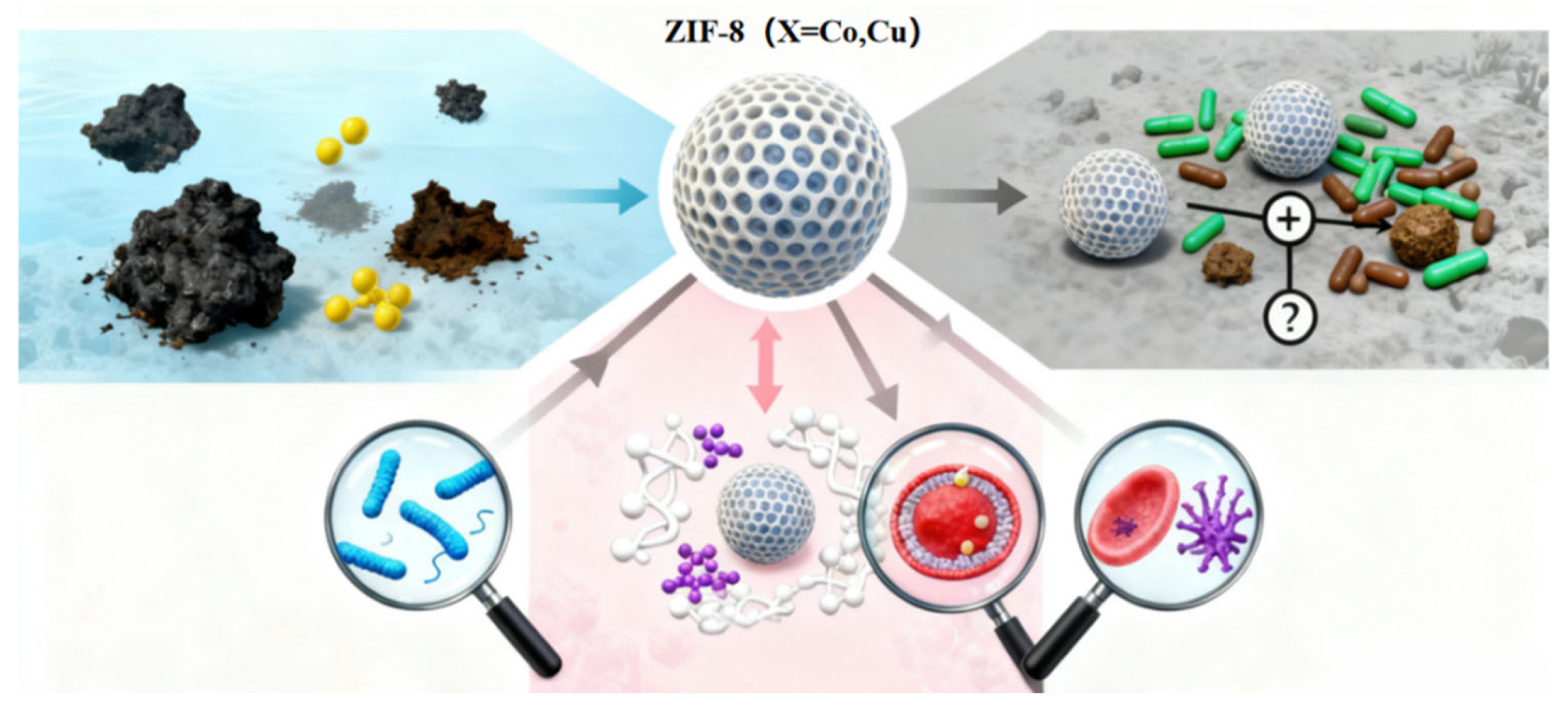
Transforming M-ZIF-8 (M=Co, Cu) materials from laboratory “curiosities” into market-ready “commodities” requires addressing three critical challenges: standardization, green-scale production, and full-cycle safety assessment. Currently, this field lacks unified testing standards for antimicrobial activity and biotoxicity—such as light source parameters, bacterial/cell concentrations, and exposure times—resulting in poor data comparability across studies. This severely hinders material performance optimization and regulatory approval. There is an urgent need to establish internationally recognized standardized testing protocols that standardize core test conditions and implement multi-tiered biosafety assessment methods covering acute toxicity, chronic toxicity, and genotoxicity. Traditional ZIF-8 synthesis often relies on toxic organic solvents and high-temperature/high-pressure conditions, posing challenges such as high costs, significant environmental pollution, and multiple safety hazards, making large-scale production difficult. Future green synthesis approaches include solvent replacement and reduction, process innovation, and precise process monitoring. Synthetic routes using water or low-toxicity alcohols as solvents should be actively developed. Green, continuous preparation techniques such as reaction extrusion [84,91], mechanochemical methods (Figure 9) [90], and room-temperature aqueous synthesis [90] should be vigorously advanced. These methods not only substantially reduce energy consumption and waste generation but also enable efficient production scaling. For instance, twin-screw reaction extrusion technology has achieved a ZIF-8 yield of 2.9 kg/day [91]. Real-time monitoring of the synthesis process using in situ characterization techniques (e.g., in situ Raman spectroscopy) allows precise control of reaction parameters, ensuring consistent product quality and structural stability across batches [91].
Implementing Life Cycle Assessment (LCA) Introducing life cycle assessment early in R&D is crucial for guiding sustainable technological pathways. It systematically quantifies resource consumption, energy expenditure, and environmental and health impacts throughout the entire lifecycle of materials—from raw material extraction and synthesis manufacturing to use and final disposal. LCA studies have clearly demonstrated that green synthesis processes (such as reactive extrusion) exhibit environmental impact indices several orders of magnitude lower than traditional solvothermal methods, providing scientific justification for selecting sustainable industrialization pathways [84,90]. Only by ensuring product quality and safety through standardized evaluation, achieving economic viability and environmental friendliness via green synthesis, and driving sustainable development through full-cycle assessment can M-ZIF-8 (M=Co, Cu) materials successfully bridge the “valley of death” from laboratory to market, offering a practical solution for the global fight against antibiotic resistance.
Figure 9. Schematic Diagram of the Mechanism of Action of M-ZIF-8 (M=Co, Cu), a Core Material in Water Pollution Treatment.
Inorganics 14 00043 g009

5.4. Summary and Outlook

Research on metal-doped ZIF-8 photocatalytic antibacterial materials stands at a critical crossroads, transitioning from fundamental understanding to practical application. As shown in Figure 6, we have preliminarily elucidated its highly efficient antibacterial mechanism through the synergistic action of ROS bursts and metal ion release, and have begun promising explorations in application scenarios such as wound dressings, water treatment, and bone repair. However, the path ahead remains fraught with both challenges and opportunities. Future progress will inevitably depend on deep multidisciplinary integration. Cross-disciplinary collaboration spanning materials science, environmental chemistry, microbiology, synthetic biology, clinical medicine, and even data science will serve as the fundamental driving force to overcome bottlenecks in this field.
Future materials will transcend basic antimicrobial properties to become intelligent antimicrobials capable of environmental sensing, information processing, and feedback execution. By integrating sensing, reporting, and logical operation functions, they will enable on-demand, localized, and controllable precision antimicrobial action. This approach maximizes protection for host tissues and symbiotic microbial communities, achieving truly selective antimicrobial effects.
The principles of “green and safe” must permeate the entire process from material design to industrialization. Green chemistry principles and life-cycle assessments should be incorporated from the earliest stages of R&D to minimize environmental footprints at the source. Concurrently, a standardized safety evaluation system spanning the entire “synthesis–application–disposal” chain must be established to ensure sustainable development. Utilizing advanced in situ/operational characterization techniques and multi-omics approaches, we map the complete “life cycle spectrum” of M-ZIF-8 (M=Co, Cu) materials from excitation to interaction and degradation at the molecular and atomic scales. This enables precise deconstruction of the “effect–toxicity homology” mystery, laying a solid theoretical foundation for rational design.
Looking ahead, metal-doped ZIF-8 materials hold promise to transcend their current applications and emerge as a powerful platform technology. Through precise functionalization design, they can serve not only as highly effective antimicrobial agents but also evolve into multifunctional “next-generation bio-environmental materials” capable of immune regulation, tissue regeneration, and environmental remediation. Ultimately, through deepening fundamental research, sustained technological innovation, and strategic industrialization planning, M-ZIF-8 (M=Co, Cu) materials hold promise as a powerful disruptive solution to address the global antibiotic resistance crisis and safeguard public health. This advancement will usher us into a new era of precise, efficient, and sustainable antimicrobial materials.

6. Conclusions

Research on metal-doped ZIF-8 materials in photocatalytic antibacterial applications has revealed the core challenge of “balancing efficacy and toxicity,” where achieving equilibrium between potent antibacterial activity and biological safety is crucial for advancing their practical use. Moving forward, it is imperative to establish a material design philosophy centered on “balancing efficacy and toxicity.” This involves integrating microscopic mechanism analysis with rational design to unify performance and safety at the source. Concurrently, establishing green evaluation standards that span the entire material lifecycle is essential to ensure sustainability. Ultimately, through deepening intelligent response and targeted design, these materials demonstrate immense potential in precision medicine and environmental remediation (e.g., as green, recyclable purifiers), promising to deliver next-generation solutions for combating antibiotic resistance crises and environmental pollution.

Author Contributions

Conceptualization, L.D., S.L. and Y.L.; Writing—original draft, H.R.; Writing—review and editing, C.G.; validation, S.H., Funding acquisition, X.C. All authors have read and agreed to the published version of the manuscript.

Funding

This research received no external funding.

Data Availability Statement

No new data were created or analyzed in this study. Data sharing is not applicable to this article.

Acknowledgments

This work has been supported by the Department of Scientific Research project in Heilongjiang province (no. LH2023H003), 2024 Heilongjiang Provincial Colleges and Universities Fundamental Scientific Research Business Funds Scientific Research Project (No: 2024-KYYWF-0583) and “Research and development team of northern unique medicinal resources”, Jiamusi University “East Pole” academic team (team no. DJXSTD202403).

Conflicts of Interest

The authors declare no conflicts of interest.

References

  1. Tiwana, G.; Cock, I.E.; Cheesman, M.J. Phytochemistry, antibacterial and toxicity properties of Phyllanthus emblica linn fruit extracts against gastrointestinal pathogens and their interactions with antibiotics. Pharmacol. Res.-Nat. Prod. 2025, 9, 100386. [Google Scholar] [CrossRef]
  2. Ghariani, B.; Zouari-Mechichi, H.; Alessa, A.H.; Alqahtani, H.; Alsaigh, A.A.; Mechichi, T. Biotransformation of Antibiotics by Coriolopsis gallica: Degradation of Compounds Does Not Always Eliminate Their Toxicity. Antibiotics 2025, 14, 897. [Google Scholar] [CrossRef]
  3. Cui, J.; Chen, Y.; Cheng, F.; Yang, H.; Qu, J.; Zhang, Y.-N.; Peijnenburg, W.J. Hydrophilicity-dependent photodegradation of antibiotics in ice: Freeze-concentration effects and dissolved organic matter interactions drive divergent kinetics, pathways and toxicity. Water Res. 2025, 286, 124277. [Google Scholar] [CrossRef]
  4. Tanveer, R.; Neale, P.A.; Melvin, S.D.; Leusch, F.D. Application of an extended bacterial toxicity assay to differentiate antibiotics from other contaminants in environmental mixtures. Environ. Res. 2025, 285, 122310. [Google Scholar] [CrossRef] [PubMed]
  5. Guleria, A.; Fatima, N.; Shukla, A.; Raj, R.; Sahu, C.; Prasad, N.; Pathak, A.; Kumar, D. Synergistic Potential of Curcumin–Vancomycin Therapy in Combating Methicillin-Resistant Staphylococcus aureus Infections: Exploring a Novel Approach to Address Antibiotic Resistance and Toxicity. Microb. Drug Resist. 2025, 31, 65–74. [Google Scholar] [CrossRef] [PubMed]
  6. Panah, Z.A.; Shahbazi, A.; Bijari, M.; Dehghan, R.; Nadi, A. Controlled atmosphere synthesis of g-C3N4 for enhanced antibacterial and photocatalytic removal of antibiotics and COD from real textile wastewater. J. Water Process. Eng. 2025, 79, 108921. [Google Scholar] [CrossRef]
  7. Vu, N.-N.; Van Tran, B.; Ladhari, S.; Saidi, A.; Assadi, A.A.; Nguyen-Tri, P. Phase transformation-induced intimate Ag deposition in Ag-TiO2 hybrids for enhanced photocatalytic antibacterial performance. Chem. Eng. J. 2025, 524, 169720. [Google Scholar] [CrossRef]
  8. Gálvez-Barbosa, S.; Bretado, L.A.; Salinas-Delgado, Y.; González, L.A. Photocatalytic performance and antibacterial activity of dumbbell-shaped ZnO with flower-like tips synthesized via the hydrothermal method. Solid State Commun. 2025, 406, 116191. [Google Scholar] [CrossRef]
  9. Mathew, S.; Xavier, S.; Thomas, S. Facile nanosynthesis of ZnCuTiO4: Dual performance in photocatalytic and antibacterial activity. Phys. Lett. A 2025, 563, 131049. [Google Scholar] [CrossRef]
  10. Shen, Y.; Pan, T.; Gu, Y.; Yan, P.; Hou, F.; Zhang, S.; Wei, W.; Li, X.; Lai, W.-Y. Redox-mediated stabilization of ultrasmall Au25 nanoclusters in amine-functionalized MOF for robust photocatalytic antibacterial applications. Sci. China Mater. 2025, 68, 2347–2357. [Google Scholar] [CrossRef]
  11. Doan, T.D.; Vu, N.-N.; Hoang, T.L.G.; Nguyen-Tri, P. Metal-organic framework (MOF)-based materials for photocatalytic antibacterial applications. Coord. Chem. Rev. 2024, 523, 216298. [Google Scholar] [CrossRef]
  12. Manivel, C.M.; Zheng, A.L.T.; Kannan, R.; Seenivasagam, S.; Hin, T.Y.Y.; Boonyuen, S.; Lease, J.; Andou, Y.; Tan, K.B. ZIF-8/graphene composite for photocatalytic degradation under low intensity UV irradiation and antibacterial applications. Sci. Rep. 2025, 15, 33875. [Google Scholar] [CrossRef]
  13. Wang, X.; Wang, H.; Zhang, J.; Han, N.; Ma, W.; Zhang, D.; Yao, M.; Wang, X.; Chen, Y. Peroxidase-like active Cu-ZIF-8 with rich copper(I)-nitrogen sites for excellent antibacterial performances toward drug-resistant bacteria. Nano Res. 2024, 17, 7427–7435. [Google Scholar] [CrossRef]
  14. Tao, Q.; Yao, H.; Wang, F.; Gu, Z.; Yang, X.; Zhao, Y.; Pang, H.; Wang, D.-A.; Chong, H. Curcumin-Encapsulated Co-ZIF-8 for Ulcerative Colitis Therapy: ROS Scavenging and Macrophage Modulation Effects. ACS Omega 2024, 9, 30571–30582. [Google Scholar] [CrossRef]
  15. Yang, Y.; Kanchanakungwankul, S.; Bhaumik, S.; Ma, Q.; Ahn, S.; Truhlar, D.G.; Hupp, J.T. Bioinspired Cu(II) Defect Sites in ZIF-8 for Selective Methane Oxidation. J. Am. Chem. Soc. 2023, 145, 22019–22030. [Google Scholar] [CrossRef]
  16. Ikuno, T.; Zheng, J.; Vjunov, A.; Sanchez-Sanchez, M.; Ortuño, M.A.; Pahls, D.R.; Fulton, J.L.; Camaioni, D.M.; Li, Z.; Ray, D.; et al. Methane Oxidation to Methanol Catalyzed by Cu-Oxo Clusters Stabilized in NU-1000 Metal–Organic Framework. J. Am. Chem. Soc. 2017, 139, 10294–10301. [Google Scholar] [CrossRef] [PubMed]
  17. Borfecchia, E.; Lomachenko, K.A.; Giordanino, F.; Falsig, H.; Beato, P.; Soldatov, A.V.; Bordiga, S.; Lamberti, C. Revisiting the nature of Cu sites in the activated Cu-SSZ-13 catalyst for SCR reaction. Chem. Sci. 2015, 6, 548–563. [Google Scholar] [CrossRef] [PubMed]
  18. Alkallas, F.H.; Trabelsi, A.B.G.; Alraddadi, S.; Hassan, A.; Ali, A.S.; Aboraia, A.M. Influence of cobalt doping on the structural, morphological, and optical properties of ZIF-8 thin films. Opt. Mater. 2025, 167, 117364. [Google Scholar] [CrossRef]
  19. Guan, B.; Chen, J.; Zhu, L.; Zhuang, Z.; Hu, X.; Zhu, C.; Zhao, S.; Shu, K.; Dang, H.; Gao, J.; et al. Tuning Co–Zn bimetallic synergy in ZIF-67@ZIF-8 catalysts for selective photothermal CO2 reduction: Mechanistic insights and performance optimization. Catal. Sci. Technol. 2025, 15, 4550–4566. [Google Scholar] [CrossRef]
  20. Khang, L.H.; Thao, N.N.P.; Hien, N.T.T.; To, T.C.; Diep, L.T.H.; Son, L.V.T.; Lien, P.; Nguyen, V.T.; Khieu, D.Q. Zinc/Cobalt-Based Zeolite Imidazolate Frameworks for Simultaneously Degrading Dye and Inhibiting Bacteria. J. Nanomater. 2022, 2022, 8630685. [Google Scholar] [CrossRef]
  21. Ostad, M.I.; Shahrak, M.N.; Galli, F. The effect of different reaction media on photocatalytic activity of Au- and Cu-decorated zeolitic imidazolate Framework-8 toward CO2 photoreduction to methanol. J. Solid State Chem. 2022, 315, 123514. [Google Scholar] [CrossRef]
  22. Wang, X.; Wang, H.; Cheng, J.; Li, H.; Wu, X.; Zhang, D.; Shi, X.; Zhang, J.; Han, N.; Chen, Y. Initiative ROS generation of Cu-doped ZIF-8 for excellent antibacterial performance. Chem. Eng. J. 2023, 466, 143201. [Google Scholar] [CrossRef]
  23. Zhang, C.; Shu, Z.; Sun, H.; Yan, L.; Peng, C.; Dai, Z.; Yang, L.; Fan, L.; Chu, Y. Cu(II)@ZIF-8 nanoparticles with dual enzyme-like activity bound to bacteria specifically for efficient and durable bacterial inhibition. Appl. Surf. Sci. 2022, 611, 155599. [Google Scholar] [CrossRef]
  24. Hu, J.; Zhu, J.; Wang, K.; Yan, X.; Xu, L.; Zhang, X.; Ding, H.; Yang, P.; Hu, S.; Xie, R. Engineered-Doping Strategy for Self-Sufficient Reactive Oxygen Species Blossom to Amplify Ferroptosis/Cuproptosis Sensibilization in Hepatocellular Carcinoma Treatment. Adv. Funct. Mater. 2024, 34, 2405383. [Google Scholar] [CrossRef]
  25. Wang, Y.; Li, S.; Zhang, X.; Jiang, F.; Guo, Q.; Jiang, P.; Liu, Y. “Multi-in-One” Yolk-Shell Structured Nanoplatform Inducing Pyroptosis and Antitumor Immune Response Through Cascade Reactions. Small 2024, 20, e2400254. [Google Scholar] [CrossRef] [PubMed]
  26. Liu, L.; Lai, D.; Cao, W.; Bao, Z.; Zhao, T.; Wang, C.; Liu, Y.; Yang, J. Easily Coating Zeolitic Imidazolate Framework (ZIF-8) with Basic Magnesium Hypochlorite (BMH) Achieves an Efficient Antibacterial Strategy. J. Inorg. Organomet. Polym. Mater. 2025, 35, 7060–7075. [Google Scholar] [CrossRef]
  27. Han, D.; Liu, X.; Wu, S. Metal organic framework-based antibacterial agents and their underlying mechanisms. Chem. Soc. Rev. 2022, 51, 7138–7169. [Google Scholar] [CrossRef]
  28. Shams, S.; Ahmad, W.; Memon, A.H.; Shams, S.; Wei, Y.; Yuan, Q.; Liang, H. Cu/H3BTC MOF as a potential antibacterial therapeutic agent against Staphylococcus aureus and Escherichia coli. New J. Chem. 2020, 44, 17671–17678. [Google Scholar] [CrossRef]
  29. Sun, J.; Zhang, Z.; Chen, X.; Huang, Q.; Bian, Z.; Zhang, W.; Su, B.; Zhang, H. Mechanistic Study on Orpiment Pigment Discoloration Induced by Reactive Oxygen Species. Molecules 2025, 30, 3318. [Google Scholar] [CrossRef]
  30. Wang, Y.-S.; Chen, Y.; Dong, C.; Wang, Z.-Y.; Cai, J.; Zhao, X.; Mo, H.-L.; Zang, S.-Q. Copper doping boosts the catalase-like activity of atomically precise gold nanoclusters for cascade reactions combined with urate oxidase in the ZIF-8 matrix. Inorg. Chem. Front. 2024, 11, 3465–3473. [Google Scholar] [CrossRef]
  31. Zhou, S.; Ma, M.-W.; Cai, S.-Z.; He, K.-L.; Tan, L.-F.; Cheng, K.; Fan, J.-X.; Dong, L.-L.; Liu, B. Inflammatory microenvironment-responsive “double-insurance” nanoreactors for accurate sonodynamic-chemodynamic therapy of rheumatoid arthritis. Chem. Eng. J. 2024, 498, 155436. [Google Scholar] [CrossRef]
  32. Li, Z.; Xie, C.; Ren, X.; Zhang, Q.; Ma, B. CuS nanoenzyme against bacterial infection by in situ hydroxyl radical generation on bacteria surface. Rare Met. 2023, 42, 1899–1911. [Google Scholar] [CrossRef]
  33. Xue, Y.; Zhang, L.; Chen, J.; Ma, D.; Zhang, Y.; Han, Y. An “all-in-one” therapeutic platform for programmed antibiosis, immunoregulation and neuroangiogenesis to accelerate diabetic wound healing. Biomaterials 2025, 321, 123293. [Google Scholar] [CrossRef] [PubMed]
  34. Wang, J.; Long, Y.; Yu, G.; Wang, G.; Zhou, Z.; Li, P.; Zhang, Y.; Yang, K.; Wang, S. A Review on Microorganisms in Constructed Wetlands for Typical Pollutant Removal: Species, Function, and Diversity. Front. Microbiol. 2022, 13, 845725. [Google Scholar] [CrossRef] [PubMed]
  35. Longhi, C.; Maurizi, L.; Conte, A.L.; Marazzato, M.; Comanducci, A.; Nicoletti, M.; Zagaglia, C. Extraintestinal Pathogenic Escherichia coli: Beta-Lactam Antibiotic and Heavy Metal Resistance. Antibiotics 2022, 11, 328. [Google Scholar] [CrossRef]
  36. Naik, G.A.R.R.; Roy, A.A.; Mutalik, S.; Dhas, N. Unleashing the power of polymeric nanoparticles—Creative triumph against antibiotic resistance: A review. Int. J. Biol. Macromol. 2024, 278, 134977. [Google Scholar] [CrossRef] [PubMed]
  37. Chen, H.; Wu, Q.; Ni, M.; Chen, C.; Han, C.; Yu, F. Transcriptome Analysis of Endogenous Hormone Response Mechanism in Roots of Styrax tonkinensis Under Waterlogging. Front. Plant Sci. 2022, 13, 896850. [Google Scholar] [CrossRef]
  38. Yu, T.; Cai, Z.; Chang, X.; Xing, C.; White, S.; Guo, X.; Jin, J. Research Progress of Nanomaterials in Chemotherapy of Osteosarcoma. Orthop. Surg. 2023, 15, 2244–2259. [Google Scholar] [CrossRef]
  39. Yuan, C.; Miao, Y.; Chai, Y.; Zhang, X.; Dong, X.; Zhao, Y. Highly Water-Stable Zinc Based Metal–Organic Framework: Antibacterial, Photocatalytic Degradation and Photoelectric Responses. Molecules 2023, 28, 6662. [Google Scholar] [CrossRef]
  40. Miron, A.; Giurcaneanu, C.; Mihai, M.M.; Beiu, C.; Voiculescu, V.M.; Popescu, M.N.; Soare, E.; Popa, L.G. Antimicrobial Biomaterials for Chronic Wound Care. Pharmaceutics 2023, 15, 1606. [Google Scholar] [CrossRef]
  41. Lelouche, S.N.K.; Albentosa-González, L.; Clemente-Casares, P.; Biglione, C.; Rodríguez-Diéguez, A.; Barrilero, J.T.; García-Martínez, J.C.; Horcajada, P. Antibacterial Cu or Zn-MOFs Based on the 1,3,5-Tris-(styryl)benzene Tricarboxylate. Nanomaterials 2023, 13, 2294. [Google Scholar] [CrossRef]
  42. Zhou, S.; Wu, C.; Shen, P.; Zhou, L.; Wang, W.; Lv, K.; Wei, C.; Li, G.; Ma, D.; Xue, W. Tumor microenvironment-responsive multifunctional nanoplatform with selective toxicity for MRI-guided photothermal/photodynamic/nitric oxide combined cancer therapy. Chem. Eng. J. 2024, 481, 148618. [Google Scholar] [CrossRef]
  43. Jin, X.; Wang, C.; Sun, Z.; Lian, Y.; Ji, Q.; Tang, J.; Ma, X. Biocompatible dually reinforced gellan gum hydrogels with selective antibacterial activity. Carbohydr. Polym. 2024, 351, 123071. [Google Scholar] [CrossRef]
  44. Ma, N.; Cai, K.; Zhao, J.; Liu, C.; Li, H.; Tan, P.; Li, Y.; Li, D.; Ma, X. Mannosylated MOF Encapsulated in Lactobacillus Biofilm for Dual-Targeting Intervention Against Mammalian Escherichia coli Infections. Adv. Mater. 2025, 37, e2503056. [Google Scholar] [CrossRef] [PubMed]
  45. Johari, S.A.; Sarkheil, M.; Veisi, S. Cytotoxicity, oxidative stress, and apoptosis in human embryonic kidney (HEK293) and colon cancer (SW480) cell lines exposed to nanoscale zeolitic imidazolate framework 8 (ZIF-8). Environ. Sci. Pollut. Res. 2021, 28, 56772–56781. [Google Scholar] [CrossRef] [PubMed]
  46. Faustino-Rocha, A.; Silva, A.; Gabriel, J.; Teixeira-Guedes, C.; Lopes, C.; Gil da Costa, R.; Gama, A.; Ferreira, R.; Oliveira, P.; Ginja, M. Ultrasonographic, thermographic and histologic evaluation of MNU-induced mammary tumors in female Sprague-Dawley rats. Biomed. Pharmacother. 2013, 67, 771–776. [Google Scholar] [CrossRef]
  47. Chen, Y.-C.; Lin, K.-Y.A.; Chen, Y.-C.; Hong, Y.-Y.; Hsu, Y.-F.; Lin, C.-H. Impact of photoaging on the chemical and cytotoxic properties of nanoscale zeolitic imidazolate framework-8. J. Hazard. Mater. 2024, 479, 135536. [Google Scholar] [CrossRef] [PubMed]
  48. Cheng, H.; Newton, A.A.; Rajib, M.; Zhang, Q.; Gao, W.; Lu, Z.; Zheng, Y.; Dai, Z.; Zhu, J. A ZIF-8-encapsulated interpenetrated hydrogel/nanofiber composite patch for chronic wound treatment. J. Mater. Chem. B 2024, 12, 2042–2053. [Google Scholar] [CrossRef]
  49. Liu, Z.; Yi, Y.; Wang, S.; Dou, H.; Fan, Y.; Tian, L.; Zhao, J.; Ren, L. Bio-Inspired Self-Adaptive Nanocomposite Array: From Non-antibiotic Antibacterial Actions to Cell Proliferation. ACS Nano 2022, 16, 16549–16562. [Google Scholar] [CrossRef]
  50. Zou, Y.; Weng, J.; Qin, Z.; Zhang, Y.; Ji, S.; Zhang, H. Metal–organic framework- and graphene quantum dot-incorporated nanofibers as dual stimuli-responsive platforms for day/night antibacterial bio-protection. Chem. Eng. J. 2023, 473, 145365. [Google Scholar] [CrossRef]
  51. Zhang, W.; Jiang, X.; Wu, Y.; Jiang, J.; Liu, X.; Liu, Y.; Wang, W.; Lai, J.; Wang, X. Zeolitic imidazolate framework-8 encapsulating gold nanoclusters and carbon dots for ratiometric fluorescent detection of adenosine triphosphate and cellular imaging. Talanta 2022, 255, 124226. [Google Scholar] [CrossRef]
  52. Joo, H.S.; Tayemeh, M.B.; Abaei, H.; Johari, S.A. On how zeolitic imidazolate framework-8 reduces silver ion release and affects cytotoxicity and antimicrobial properties of AgNPs@ZIF8 nanocomposite. Colloids Surf. A Physicochem. Eng. Asp. 2023, 668, 131411. [Google Scholar] [CrossRef]
  53. Lan, S.; Zhang, J.; Li, X.; Pan, L.; Li, J.; Wu, X.; Yang, S.-T. Low Toxicity of Metal-Organic Framework MOF-74(Co) Nano-Particles In Vitro and In Vivo. Nanomaterials 2022, 12, 3398. [Google Scholar] [CrossRef] [PubMed]
  54. Kim, Y.; Kalimuthu, P.; Nam, G.; Jung, J. Cyanobacteria control using Cu-based metal organic frameworks derived from waste PET bottles. Environ. Res. 2023, 224, 115532. [Google Scholar] [CrossRef]
  55. Nikzad, M.S.; Qiu, J.; Wang, G.; Wang, X.; Demo, N.S.; Li, A. Safety assessment of copper- and zinc-based metal-organic frameworks (MOFs) for embryonic development and adult fish of Oryzias melastigma. Aquat. Toxicol. 2025, 287, 107529. [Google Scholar] [CrossRef]
  56. Li, W.; Xiong, W.; He, S.; Li, F.; Chen, Y.; Li, Z.; Yang, Z.; Zeng, Z.; Song, B. Revealing the synergistic impacts of ZIF-8 and copper co-exposure on zebrafish behavior, tissue damage, and intestine microbial community. Environ. Res. 2025, 269, 120922. [Google Scholar] [CrossRef] [PubMed]
  57. Hu, J.; Jia, Y.; Liang, A.; Chen, J.; Zhao, Z.; Huang, Y.; Yu, L.; Yang, J.; Pu, J.; Sun, M.; et al. pH/pectinase dual-responsive metal–organic frameworks enhance the efficacy duration of Isoprothiolane and improve disease resistance in rice. Appl. Surf. Sci. 2025, 716, 164634. [Google Scholar] [CrossRef]
  58. Zhou, Q.; Li, D.; Zhang, S.; Wang, S.; Hu, X. Quantum dots bind nanosheet to promote nanomaterial stability and resist endotoxin-induced fibrosis and PM2.5-induced pneumonia. Ecotoxicol. Environ. Saf. 2022, 234, 113420. [Google Scholar] [CrossRef]
  59. Nie, G.; Huang, Y.; Wang, Y.; He, J.; Zhang, R.; Yan, L.; Huang, L.; Zhang, X. Physiological and comprehensive transcriptome analysis reveals distinct regulatory mechanisms for aluminum tolerance of Trifolium repens. Ecotoxicol. Environ. Saf. 2024, 284, 117001. [Google Scholar] [CrossRef]
  60. Zhang, C.; Miao, X.; Du, S.; Zhang, T.; Chen, L.; Liu, Y.; Zhang, L. Effects of Culinary Procedures on Concentrations and Bioaccessibility of Cu, Zn, and As in Different Food Ingredients. Foods 2023, 12, 1653. [Google Scholar] [CrossRef]
  61. Ding, A.; He, Y.; Chen, F.-F.; Yu, Y. Antibacterial Activity of M-MOF Nanomaterials (M = Fe, Co, Ni, Cu, and Zn): Impact of Metal Centers. ACS Appl. Nano Mater. 2024, 7, 24571–24580. [Google Scholar] [CrossRef]
  62. Chen, X.; Yang, X.; Yuan, T.; Ge, J.; Li, X.; Ma, M.; Ding, S. B, N-codoped carbon confined cobalt nanostructures derived from a single MOF precursor for rapid peroxymonosulfate activation in organic contaminant degradation. Sep. Purif. Technol. 2024, 354, 128842. [Google Scholar] [CrossRef]
  63. Su, Z.; Kong, L.; Mei, J.; Li, Q.; Qian, Z.; Ma, Y.; Chen, Y.; Ju, S.; Wang, J.; Jia, W.; et al. Enzymatic bionanocatalysts for combating peri-implant biofilm infections by specific heat-amplified chemodynamic therapy and innate immunomodulation. Drug Resist. Updat. 2023, 67, 100917. [Google Scholar] [CrossRef] [PubMed]
  64. Zhang, Y.; Wu, J.; Zhang, B.; Shi, A.; Pei, X.; Zhang, X.; Zhu, Z.; Chen, J.; Wang, J. Optimized fabrication of L-Asp-Cu(II) Bio-MOF for enhanced vascularized bone regeneration. Chem. Eng. J. 2025, 505, 159617. [Google Scholar] [CrossRef]
  65. Liang, S.; Chen, L.; Liu, C.; Guo, B.; Fan, Y.; Li, Z.; Liu, Y.; Luo, D. Ultrathin ZIF-8 Coating-Reinforced Enzyme Nanoformulation Avoids Lysosomal Degradation for Senile Osteoporosis Therapy. Adv. Funct. Mater. 2024, 34, 2410931. [Google Scholar] [CrossRef]
  66. Liang, J.; Zhang, W.; Wang, J.; Li, W.; Ge, F.; Jin, W.; Tao, Y. Development of the Cu/ZIF-8 MOF Acid-Sensitive Nanocatalytic Platform Capable of Chemo/Chemodynamic Therapy with Improved Anti-Tumor Efficacy. ACS Omega 2023, 8, 19402–19412. [Google Scholar] [CrossRef]
  67. Saif, M.S.; Waqas, M.; Hussain, R.; Ahmed, M.M.; Tariq, T.; Batool, S.; Liu, Q.; Mustafa, G.; Hasan, M. Potential of CME@ZIF-8 MOF Nanoformulation: Smart Delivery of Silymarin for Enhanced Performance and Mechanism in Albino Rats. ACS Appl. Bio Mater. 2024, 7, 6919–6931. [Google Scholar] [CrossRef]
  68. Hosohata, K. Role of Oxidative Stress in Drug-Induced Kidney Injury. Int. J. Mol. Sci. 2016, 17, 1826. [Google Scholar] [CrossRef]
  69. Morajkar, R.V.; Kumar, A.S.; Kunkalekar, R.K.; Vernekar, A.A. Advances in nanotechnology application in biosafety materials: A crucial response to COVID-19 pandemic. Biosaf. Heath 2022, 4, 347–363. [Google Scholar] [CrossRef]
  70. Zhang, W.; Zhong, R.; Qu, X.; Xiang, Y.; Ji, M. Effect of 8-Hydroxyguanine DNA Glycosylase 1 on the Function of Immune Cells. Antioxidants 2023, 12, 1300. [Google Scholar] [CrossRef]
  71. Sykuła, A.; Nowak, A.; Garribba, E.; Dzeikala, A.; Rowińska-Żyrek, M.; Czerwińska, J.; Maniukiewicz, W.; Łodyga-Chruścińska, E. Spectroscopic Characterization and Biological Activity of Hesperetin Schiff Bases and Their Cu(II) Complexes. Int. J. Mol. Sci. 2023, 24, 761. [Google Scholar] [CrossRef]
  72. Wang, B.; Zhong, H.; Huo, J.; Wang, T.; Wu, F.; Du, K.; Feng, T.; Wang, J.-Q. A copper complex with a thiazole-modified tridentate ligand: Synthesis, structural characterization, and anticancer activity in B16-F10 melanoma cells. Dalton Trans. 2025, 54, 14079–14092. [Google Scholar] [CrossRef]
  73. Jin, J.; Ma, M.; Shi, S.; Wang, J.; Xiao, P.; Yu, H.-F.; Zhang, C.; Guo, Q.; Yu, Z.; Lou, Z.; et al. Copper enhances genotoxic drug resistance via ATOX1 activated DNA damage repair. Cancer Lett. 2022, 536, 215651. [Google Scholar] [CrossRef]
  74. Tsang, C.Y.; Cheung, M.C.Y.; Beyer, S. Assessing the colloidal stability of copper doped ZIF-8 in water and serum. Colloids Surf. A Physicochem. Eng. Asp. 2022, 656, 130452. [Google Scholar] [CrossRef]
  75. Xu, J.; Yu, W.; Zhang, Z.; Deng, F.; Wang, S.; Zou, R.; Wang, Y.; Yuan, B. Rhombic dodecahedral ZIF-8-supported CuFe2O4 triggers sodium percarbonate activation for enhanced sulfonamide antibiotics degradation: Synergistic roles of heterostructure and photocatalytic mechanisms. Chem. Eng. J. 2024, 501, 157650. [Google Scholar] [CrossRef]
  76. Chen, H.; Sun, W.; Li, T.; Zhang, J.; Liu, S.; Liao, Y.; Younas, M.; Qiu, Z. Ultrafast degradation of tetracycline via peroxymonosulfate activation using ZIF-8 modified biochar-supported MgAl/LDH. J. Environ. Chem. Eng. 2025, 13, 116860. [Google Scholar] [CrossRef]
  77. Zhang, F.; Wang, Z.; Peijnenburg, W.J.G.M.; Vijver, M.G. Review and Prospects on the Ecotoxicity of Mixtures of Nanoparticles and Hybrid Nanomaterials. Environ. Sci. Technol. 2022, 56, 15238–15250. [Google Scholar] [CrossRef] [PubMed]
  78. Bose, S.; Kumar, M. Nickel-decorated ZIF-67 (Co) MOF derived bi-metallic catalyst for efficient degradation of tetracycline under microwave irradiation through persulfate activation route: Performance assessment and predictive intermediate toxicity profile. Sep. Purif. Technol. 2025, 364, 132371. [Google Scholar] [CrossRef]
  79. Zhu, Y.; Nie, X.; Liu, X. Preparation of Fe/Co bimetallic MOF photofenton catalysts and their performance in degrading tetracycline hydrochloride pollutants efficiently under visible light. J. Alloys Compd. 2024, 1010, 176967. [Google Scholar] [CrossRef]
  80. Rastin, H.; Dell’aNgelo, D.; Sayede, A.; Badawi, M.; Habibzadeh, S. Green and sustainable metal-organic frameworks (MOFs) in wastewater treatment: A review. Environ. Res. 2025, 282, 122087. [Google Scholar] [CrossRef]
  81. Liu, N.; Zhang, J.; Wang, Y.; Zhu, Q.; Zhang, X.; Duan, J.; Hou, B. Novel MOF-Based Photocatalyst AgBr/AgCl@ZIF-8 with Enhanced Photocatalytic Degradation and Antibacterial Properties. Nanomaterials 2022, 12, 1946. [Google Scholar] [CrossRef]
  82. Li, R.; Chen, T.; Lu, J.; Hu, H.; Zheng, H.; Zhu, P.; Pan, X. Metal–organic frameworks doped with metal ions for efficient sterilization: Enhanced photocatalytic activity and photothermal effect. Water Res. 2022, 229, 119366. [Google Scholar] [CrossRef]
  83. Wang, J.; Zhang, J.; Li, Y.; Xia, X.; Yang, H.; Kim, J.H.; Zhang, W. Silver single atoms and nanoparticles on floatable monolithic photocatalysts for synergistic solar water disinfection. Nat. Commun. 2025, 16, 981. [Google Scholar] [CrossRef]
  84. Wei, X.; Xue, B.; Ruan, S.; Guo, J.; Huang, Y.; Geng, X.; Wang, D.; Zhou, C.; Zheng, J.; Yuan, Z. Supercharged precision killers: Genetically engineered biomimetic drugs of screened metalloantibiotics against Acinetobacter baumanni. Sci. Adv. 2024, 10, eadk6331. [Google Scholar] [CrossRef]
  85. Pahlevani, M.; Beig, M.; Barzi, S.M.; Sadeghzadeh, M.; Shafiei, M.; Chiani, M.; Sohrabi, A.; Sholeh, M.; Nasr, S. Antibacterial and wound healing effects of PEG-coated ciprofloxacin-loaded ZIF-8 nanozymes against ciprofloxacin-resistant Pseudomonas aeruginosa taken from burn wounds. Front. Pharmacol. 2025, 16, 1556335. [Google Scholar] [CrossRef]
  86. Liang, S.; Pan, Y.; Wang, J.; Jiang, Z.; Ma, T.; Chen, S.; Chen, M.; Wu, Y.; Leng, Y.; Hu, Y.; et al. Bone-targeting ZIF-8 based nanoparticles loaded with vancomycin for the treatment of MRSA-induced periprosthetic joint infection. J. Control. Release 2025, 385, 113965. [Google Scholar] [CrossRef] [PubMed]
  87. Nguyen, H.-V.T.; Pham, S.N.; Mirzaei, A.; Mai, N.X.D.; Nguyen, C.C.; Nguyen, H.T.; Vong, L.B.; Nguyen, P.T.; Doan, T.L.H. Surface modification of ZIF-8 nanoparticles by hyaluronic acid for enhanced targeted delivery of quercetin. Colloids Surf. A Physicochem. Eng. Asp. 2024, 696, 134288. [Google Scholar] [CrossRef]
  88. Nasiri, K.; Masoumi, S.M.; Amini, S.; Goudarzi, M.; Tafreshi, S.M.; Bagheri, A.; Yasamineh, S.; Alwan, M.; Arellano, M.T.C.; Gholizadeh, O. Recent advances in metal nanoparticles to treat periodontitis. J. Nanobiotechnol. 2023, 21, 283. [Google Scholar] [CrossRef]
  89. Zhao, W.; Liang, Y.; Zhang, Y.; Deng, Y.; Fu, H.; Yuan, X.; Wang, Z.; Lu, X.; Lin, B. Active cellulose-based film with synergistic enhanced photothermal antibacterial effects by Fe-doped ZIF-8 and EGCG for efficient litchi preservation. Chem. Eng. J. 2025, 521, 166462. [Google Scholar] [CrossRef]
  90. Wang, H.; Lei, T.; Zhu, F.; Wang, M.; Yu, Z.; Liu, Y.; Deng, C.; Liu, C.; Xiao, H. Lignosulfonate-Decorated Boron Nitride/Cellulose Nanofibril Porous Foam: Multifunctional Phase Change Composites for Leakage-Free Thermal Energy Storage and Photothermal Conversion. Biomacromolecules 2025, 26, 5873–5887. [Google Scholar] [CrossRef]
  91. Xue, Y.; Shi, J.; Zhang, L.; Zhang, X.; Zhang, Y.; Han, Y. One-step engineered multifunctional gauze: On-demand antibiosis, accelerated hemostasis and angiogenesis for tissue regeneration. Int. J. Biol. Macromol. 2025, 322, 146866. [Google Scholar] [CrossRef]
  92. Li, L.; Zhu, Y.; Li, X.; Li, D.; Jia, K.; Liu, Y. Photo-Activated Cu-ZIF-8 Integrated Sprayable Hydrogels for Accelerated Wound Healing. ACS Appl. Bio Mater. 2025, 8, 8197–8217. [Google Scholar] [CrossRef]
  93. Zhang, A.; Qiao, Q.; Pei, Z.; Wang, Z.; Guo, J.; Li, Y.; Zhai, G.; Fei, P.; Lu, J.; Jia, H. Polyurethane-based T-ZIF-8 nanofibers as photocatalytic antibacterial materials. ACS Appl. Nano Mater. 2023, 6, 22173–22184. [Google Scholar] [CrossRef]
  94. Xue, J.; Zhang, J.; Yuan, M.; Lv, Y.; Chen, Z.; Wang, M. Visible-light-driven Au/PCN-224/Cu(II) modified fabric with enhanced photocatalytic antibacterial and degradation activity and mechanism insight. Sep. Purif. Technol. 2023, 333, 125863. [Google Scholar] [CrossRef]
  95. El-Mehalmey, W.A.; Latif, N.; Ibrahim, A.H.; Haikal, R.R.; Mierzejewska, P.; Smolenski, R.T.; Yacoub, M.H.; Alkordi, M.H. Nine days extended release of adenosine from biocompatible MOFs under biologically relevant conditions. Biomater. Sci. 2022, 10, 1342–1351. [Google Scholar] [CrossRef]
  96. Viana, R.S.; de Araújo, P.M.; da Silva, J.P.; de Santana, J.R.; Ferreira, E.G.A.; Barros, A.B.B.; Barbosa, C.D.A.D.E.S.; Puma, C.A.L.; Jesus, L.T.; Freire, R.O.; et al. Luminescent Nanocomposite SiO2/EuTTA/ZIF-8 Loaded with Uvaol: Synthesis, Characterization, Anti-Inflammatory Effects, and Molecular Docking Analysis. ACS Omega 2025, 10, 32391–32403. [Google Scholar] [CrossRef] [PubMed]
  97. Ruan, F.; Liu, C.; Zeng, J.; Zhang, F.; Jiang, Y.; Zuo, Z.; He, C. Multi-omics integration identifies ferroptosis involved in black phosphorus quantum dots-induced renal injury. Sci. Total Environ. 2024, 947, 174532. [Google Scholar] [CrossRef]
  98. Wu, K.; Li, Y.; Zhou, Q.; Hu, X.; Ouyang, S. Integrating FTIR 2D correlation analyses, regular and omics analyses studies on the interaction and algal toxicity mechanisms between graphene oxide and cadmium. J. Hazard. Mater. 2022, 443, 130298. [Google Scholar] [CrossRef]
  99. Meng, X.; Guan, J.; Lai, S.; Fang, L.; Su, J. pH-responsive curcumin-based nanoscale ZIF-8 combining chemophotodynamic therapy for excellent antibacterial activity. RSC Adv. 2022, 12, 10005–10013. [Google Scholar] [CrossRef] [PubMed]
  100. Yang, X.; Xu, J.; Chen, X.; Yao, M.; Pei, M.; Yang, Y.; Gao, P.; Zhang, C.; Wang, Z. Co-exposure of butyl benzyl phthalate and TiO2 nanomaterials (anatase) in Metaphire guillelmi: Gut health implications by transcriptomics. J. Environ. Manag. 2024, 354, 120429. [Google Scholar] [CrossRef]
  101. Zhao, J.; Liang, K.; Zhong, H.; Liu, S.; He, R.; Sun, P. A cold-water polysaccharide-protein complex from Grifola frondosa exhibited antiproliferative activity via mitochondrial apoptotic and Fas/FasL pathways in HepG2 cells. Int. J. Biol. Macromol. 2022, 218, 1021–1032. [Google Scholar] [CrossRef] [PubMed]
  102. Subhadarshini, A.; Subudhi, E.; Achary, P.G.R.; Behera, S.A.; Parwin, N.; Nanda, B. ZIF-8 supported Ag3PO4/g-C3N4 a Double Z-scheme heterojunction: An efficient photocatalytic, antibacterial and hemolytic nanomaterial. J. Water Process. Eng. 2024, 65, 105901. [Google Scholar] [CrossRef]
  103. Yu, L.; Wu, H.; Sathishkumar, G.; He, X.; Ran, R.; Zhang, K.; Rao, X.; Kang, E.T.; Xu, L. Chemo-photothermal therapy of bacterial infections using metal–organic framework-integrated polymeric network coatings. J. Mater. Chem. B 2024, 12, 9238–9248. [Google Scholar] [CrossRef] [PubMed]
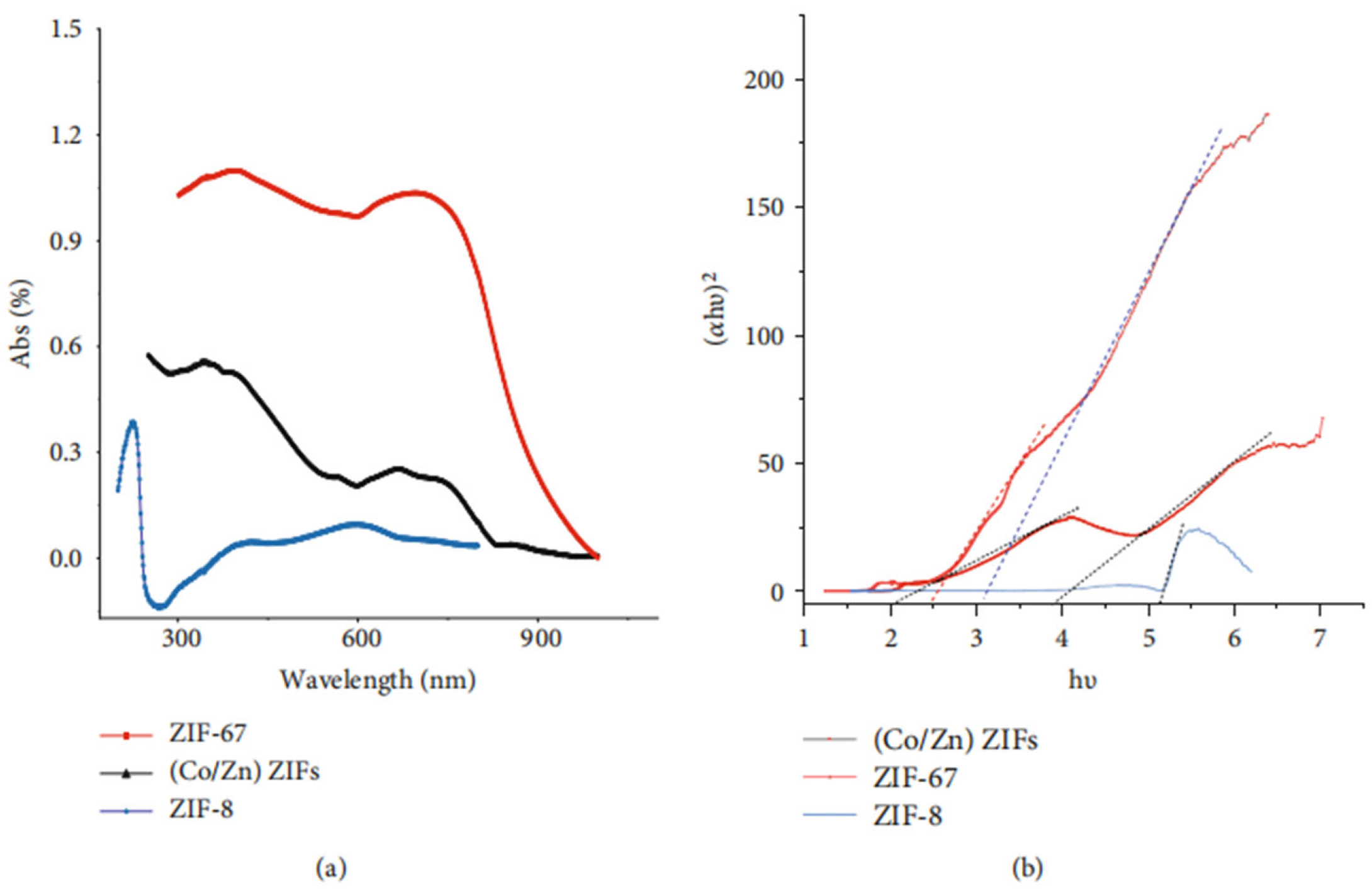
Figure 4. UV–Vis DRS spectra (a) and Tauc’s plots of (Co/Zn)ZIFs, ZIF-67, and ZIF-8 (b) (Reprinted from Ref. [20]).
Inorganics 14 00043 g004
Figure 6. Schematic illustration of the bioaccumulation and biomagnification of M-ZIF-8 (M=Co, Cu)-derived pollutants along an aquatic food chain.
Inorganics 14 00043 g006
Figure 8. Representative photos of bacterial colonies on agar plates after 2 h treatment with (i) phosphate-buffered saline (PBS), (ii) ZiF-8(40 μg/mL), (iii) Zn(Bq)2(1.1 μg/mL), (iv) ZnBq/Ce6@ZiF-8(40 μg/mL), and (v)ZnBq/Ce6@ZiF-8@OMv(40 μg/mL) (Reprinted from Ref. [84]).
Inorganics 14 00043 g008
Table 1. Summary of Cytotoxic Effects of M-ZIF-8 (M=Co, Cu) Materials on Different Mammalian Cells.
Material TypeTest Cell LineKey Toxicity Manifestations/MechanismsBiocompatibility ResultsReferences
nZIF-8BEAS-2B (lung epithelial)At high concentrations, ROS, mitochondrial damage, apoptosisConcentration-dependent toxicity[47]
ZIF-8 Composite Fiber MembraneL929 (fibrogenesis)-Low toxicity, survival rate > 80–90%[48,50]
CDs/AuNCs@ZIF-8HepG2 (Liver cancer)-Low toxicity[51]
AgNPs@ZIF-8HSF (Skin fibroblast)Ag+ release resulted in an IC50 of 31.4–39 μg/mL.Ion release dominates toxicity[52]
Cu-BTC (MOF-199)MCF7High toxicity, IC50 = 3.49 mg/LCu2+ is more toxic than Zn2+[53]
Disclaimer/Publisher’s Note: The statements, opinions and data contained in all publications are solely those of the individual author(s) and contributor(s) and not of MDPI and/or the editor(s). MDPI and/or the editor(s) disclaim responsibility for any injury to people or property resulting from any ideas, methods, instructions or products referred to in the content.