


Abstract
Green chemistry, achieved by using water as a reaction medium, has several potential applications. In this work, a number of water-soluble Rh(III)–THP complexes, [Rh(III)Cl3(OH)(THP)2]− (1), [Rh(III)Cl2(OH)(THP)3] (2), [Rh(III)Cl(OH)(THP)4]+ (3), [Rh(III)Cl(OH)(en)(THP)2]+ (4a), [Rh(I)(en)(THP)2]+ (4b) and [Rh(III)(en)2Cl2]Cl (5) (where THP = P(CH2OH)3), were generated in aqueous media by controlling the reaction at different molar ratios of RhCl3/THP/en (en: ethylenediamine). These complexes were fully characterized in situ by 31P NMR spectroscopy, base titration and by X-ray crystallography for the solid compound (4). The catalytic hydrogenation reactivities of freshly prepared complexes (1–5) were tested in situ with the selected substrate of 3,4-dimethoxystyrene under the same experimental conditions; the related catalytic reactivities are discussed in detail.
1. Introduction
Since the early milestone discovery of Wilkinson’s catalyst, [RhCl(PPh3)3], research efforts have focused on the coordination chemistry of rhodium and other metals to synthesize new metal compounds and to discover more efficient catalysts [1]. Meanwhile the use of aqueous or biphasic aqueous organic media for catalytic reactions by transition metal complexes has also garnered considerable interest because water is considered an environmentally benign solvent [2,3,4,5].
Tris(hydroxymethyl)phosphine, P(CH2OH)3 (THP), is a highly water-soluble phosphine chemical reagent or coordination ligand for transitional metals in coordination chemistry. Some transition metal complexes of THP have been synthesized [6,7,8,9,10,11,12,13], but, to the best of our knowledge, there are only two examples of applications as hydrogenation reaction catalysts on aldehyde or olefins using Ir–THP complexes of [Ir(cod){P(CH2OH)3}3]Cl [12]. Chatt et al. have shown an example of a THP–Rh complex as an in situ hydrogenation catalyst for the hydrogenation and isomerization of oct-1-ene [6]. However, when the olefin is entirely hydrogenated or isomerized to oct-2-ene, the rhodium metal begins to precipitate [6]. Recently, Raghuraman and co-workers isolated the fac-[Rh(P(CH2OH)3)3Cl3] complex and determined its crystal structure [9]. They found that the THP ligand stabilizes the rhodium in the +3 (or low-spin d6) oxidation state, which is critical for biomedical applications because such an electronic configuration confers both kinetic inertness and stability under in vivo conditions. Fukuoka and co-workers synthesized Rh–THP complexes and accidentally isolated the rhodium hydride complex of cis-[Rh(H)2{P(CH2OH)3}4]Cl without using any hydride reagents or hydrogen [12]. The structure of the hydride was confirmed by 1H NMR and IR, but the authors did not discuss the catalytic activity of the reported hydride complex [12]. Rh(III) monohydrides with ethylenediamine have previously been studied, but there are no reports on their potential as homogenous hydrogenation catalysts [14]. Silica-supported Rh(I)-amine (includes en) complexes are higher-activity catalysts for the hydrogenation of arenes under mild conditions [15]. Mixed N- and P-coordinated Ru(II) and Rh(I) complexes can both be higher-activity hydrogenation catalysts [16,17,18]. Developments in the chemistry of tris(hydroxymethyl)phosphine were reviewed very recently and a couple of water-soluble tris(hydroxymethyl)phosphine complexes of rhodium(I) were prepared, some structures of which have been characterized by X-ray crystallography [19]. Herein we report our efforts to develop H2O-soluble, homogeneous catalysts for the hydrogenation of lignin chromophores in aqueous media, as others have carried out previously [20]. We synthesized and characterized H2O-soluble Rh(III)/Rh(I) complexes with THP and ethylenediamine (en), and studied their catalytic hydrogenation of 3,4-dimethoxystyrene under hydrogen gas in comparison with other known Rh–THP complexes and the Rh–amine [Rh(en)2Cl2]Cl complex under identical conditions.
2. Results and Discussion
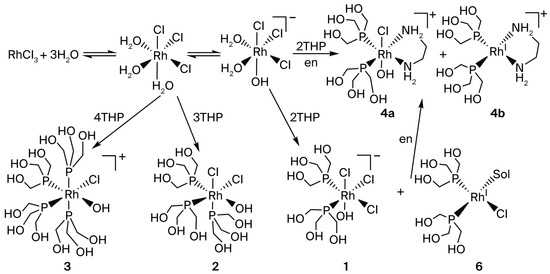
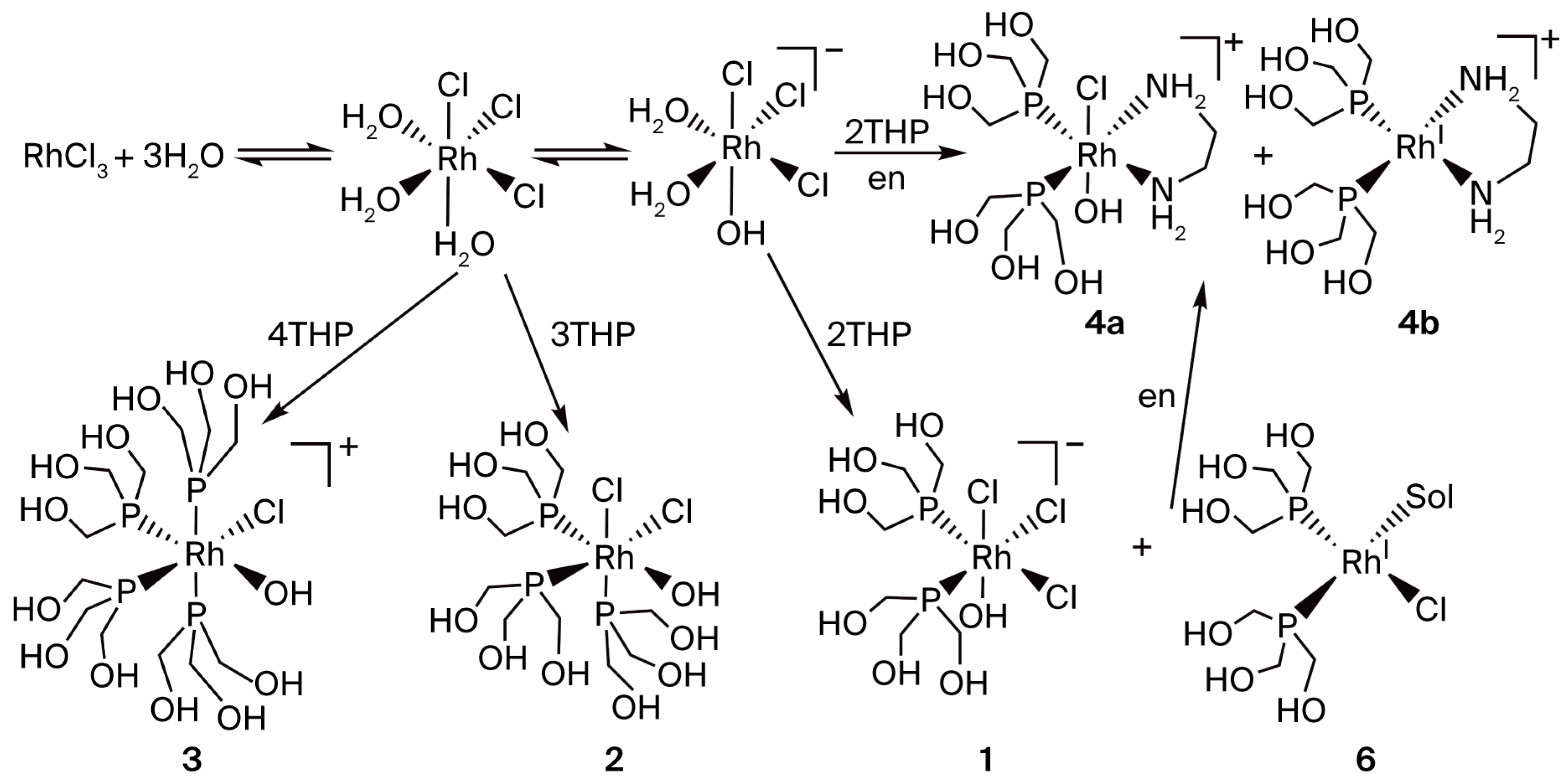
As mentioned above, although two Rh(III)–THP complexes of fac-[Rh{P(CH2OH)3}3Cl3] and cis-[Rh(H)2{P(CH2OH)3}4]Cl have already been studied [9,12], the solution data and catalytic activity of this system are rarely reported in the literature. The Rh(III)–THP complexes (1, 2 and 3) (Figure 1) were prepared by the reaction of RhCl3·3H2O with various molar equivalents of THP, as reported in the literature [9]. The three Rh(III) complexes of bis-, tris- and tetra-THP were detected by 31P{1H} NMR with the chemical shifts δ 47.1 (d, 1JRh-P = 115 Hz) (1) and δ 36. (d, 1JRh-P = 106 Hz) (2), and two doublets of triplets with equal intensity at δ 33.0 (d t, 1JRh-P = 98 Hz, 2JP-P = 22 Hz) and 20.3 (d t, 1JRh-P = 86 Hz, 2JP-P = 22 Hz) (cis-3), respectively, in aqueous solution. Unsymmetrical complex 3 (cis-[Rh(III)(OH)Cl{P(CH2OH)3}4]+ contains two types of P atoms, two located in equatorial position and the other two in axis directions, and they are all not identical; the 31P{1H} NMR spectrum shows a four spin AA’XX’ system that was previously characterized and simulated using the SpinWorks NMR program (see Figure S11) [21]. There is no indication from the NMR results of the formation of the Rh(III) mono-THP complex in an aqueous solution; rather, the Rh(I) bis–THP complex [Rh{P(CH2H)3}2Cl2]− (6) formed with δ 21.4 (d, 1JRh-P = 118 Hz). Even the addition of 1.0 M NaCl to the RhCl3 aqueous solution in advance was insufficient to inhibit the formation of the Rh(I)-THP species (for details of the assignments, see the Supporting Materials). Based on the pH measurements and base titrations for each dominating complex in the solution, the coordinated number of Cl− and OH− anions for complexes 1, 2 and 3 were determined and are shown in Figure 1 (for details, see the Supporting Materials). In addition, the Rh(III)–THP–en complex, complex 4a, was synthesized either by the addition of 1.0 molar equivalent of ethylenediamine to the complex 1 solution or by the direct reaction of RhCl3·3H2O with 2.0 M equivalents of THP and 1.0 M equivalent of en (Figure 1). It was characterized by 31P{1H}and 1H NMR in solution and X-ray analysis in the solid state (for these data, see the Supporting Materials). 31P{1H} NMR show one doublet signal at 26.0 ppm (with 1J(103Rh,31P) = 95 Hz) to [Rh(III){P(CH2OH)3}2(en)Cl(OH)]+Cl (4a). Meanwhile, one doublet signal at δ 21.4 (d, 1JRh-P = 118 Hz), corresponding to [Rh(I)(en){P(CH2OH)3}2]+ (4b), was also detected, which was very different from free THP 31P{1H} NMR chemical shift at δ −23.0 ppm. 31P{1H} NMR data (as summarized in Table 1, Experimental Section 3.2 and the Supporting Materials) in this range (21.0–22.5 ppm) are attributed to Rh(I) complexes formed in solution and are consistent with the Rh(I) species in the literature [19,20].
Figure 1.
Reaction synthesis of water-soluble rhodium complexes in aqueous solution.
Table 1.
Summary of the 31P NMR parameters for all detected Rh(III) and Rh(I) species with en and THP ligands in solution.
Removal of the water yielded yellow crystals of 4 suitable for X-ray crystallography (4a characterized as [Rh(III)(en){P(CH2OH)3}2Cl(OH)]Cl in aqueous solution and as [Rh(III)(en){P(CH2OH)3}2Cl2]Cl in the solid state, and thus labeled as 4, indicating an equilibrium between 4a and 4, depending on the conditions or packing interactions driving the formation of 4 in the crystal solid phase.)
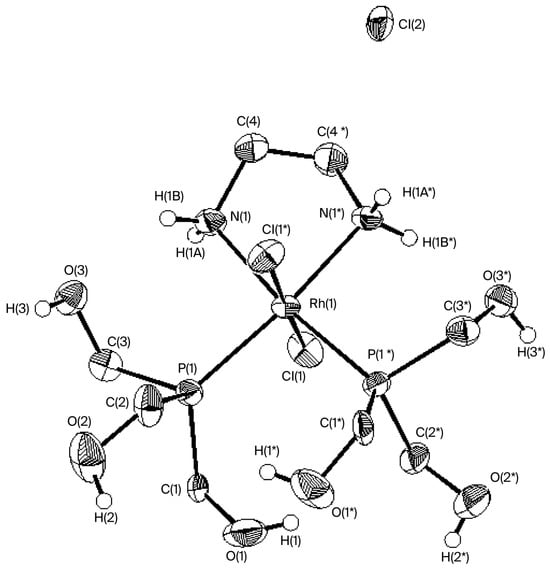
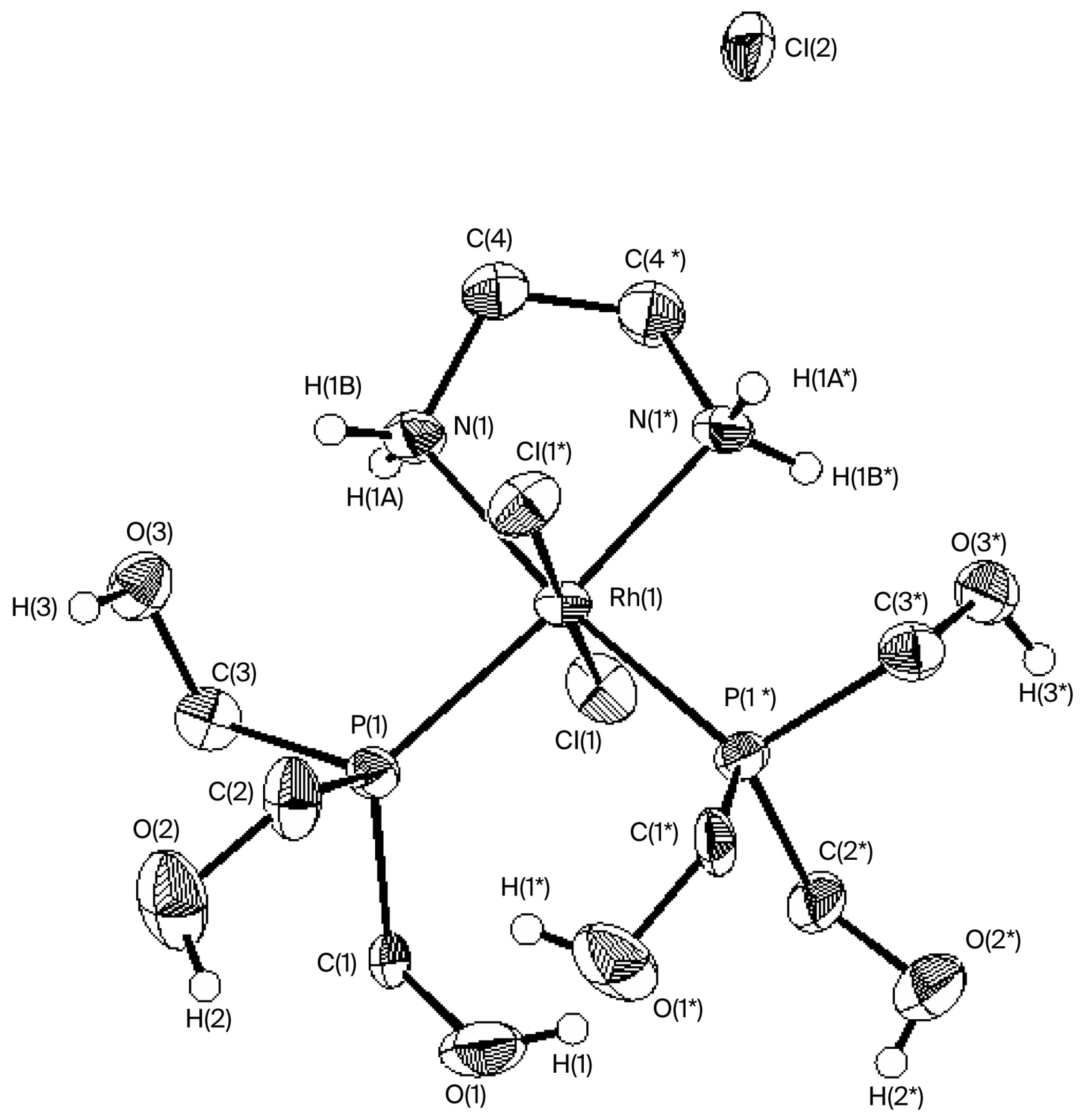
Complex 4 crystallized in the monoclinic space group P21/n. The P-Rh-P angle is 95.60(7)°, close to the 90° ideal for octahedral geometry. The Cl-Rh-Cl angle is 176.40(8)° and the N-Rh-P angles are on average 172.44(12)°. The mean Rh-P bond length is 2.2811(14) Å, slightly shorter than the previously reported value for a complex of fac-[Rh{P(CH2OH)3}3Cl3] (with mean Rh-P bond lengths of 2.293(2) Å) [9]. Meanwhile the mean Rh-Cl bond lengths of 2.3344(12) in complex 4 are also shorter than those of the previous crystal structure (mean Rh-Cl 2.436(2) Å). The crystal structure shows that 4 is an octahedral rhodium complex, [Rh(III)(en){P(CH2OH)3}2Cl2]Cl (Figure 2). It also shows that the two P(CH2OH)3 ligands are in the cis position and the two chlorides are in the trans position, while the binary en ligand and two phosphines, together with the Rh(III), form a plane. The bond lengths of the two coordinated N, P or Cl atoms to the rhodium sphere, Rh-N and Rh-N*, Rh-P and Rh-P*, or Rh-Cl and Rh-Cl*, are equal (Figure 2 caption). In the solid state, two chlorides are bonded to the Rh; the pH measurements suggest that one chloride is dissociated in aqueous solution, with its position occupied by an OH− to yield cis-[Rh(en){P(CH2OH)3}2(OH)Cl]+. This indicates that Cl−/OH− is in a dissociated equilibrium impacted by the Cl− concentration.
Figure 2.
Molecular structure of [Rh(en){P(CH2OH)3}2Cl2]Cl (4). Pertinent bond lengths (Å) and bond angles (deg) are as follows: Rh1-N1 = 2.144(4), Rh1-N1* = 2.144(4), Rh1-P1 = 2.2811(14), Rh1-P1* = 2.2811(14), Rh1-Cl1 = 2.3344(12), Rh1-Cl1* = 2.3344(12), N1-Rh1-N1* = 81.2(2), N1*-Rh1-P1* = 91.64(12), P1*-Rh1-P1 = 95.60(7), P1-Rh1-Cl1 = 88.56(5), and Cl1-Rh1-Cl1* = 176.40(8).
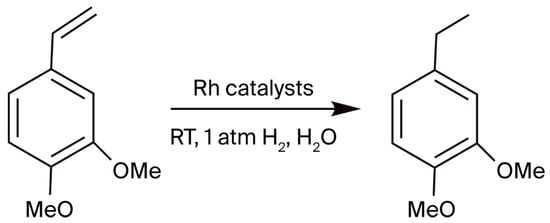
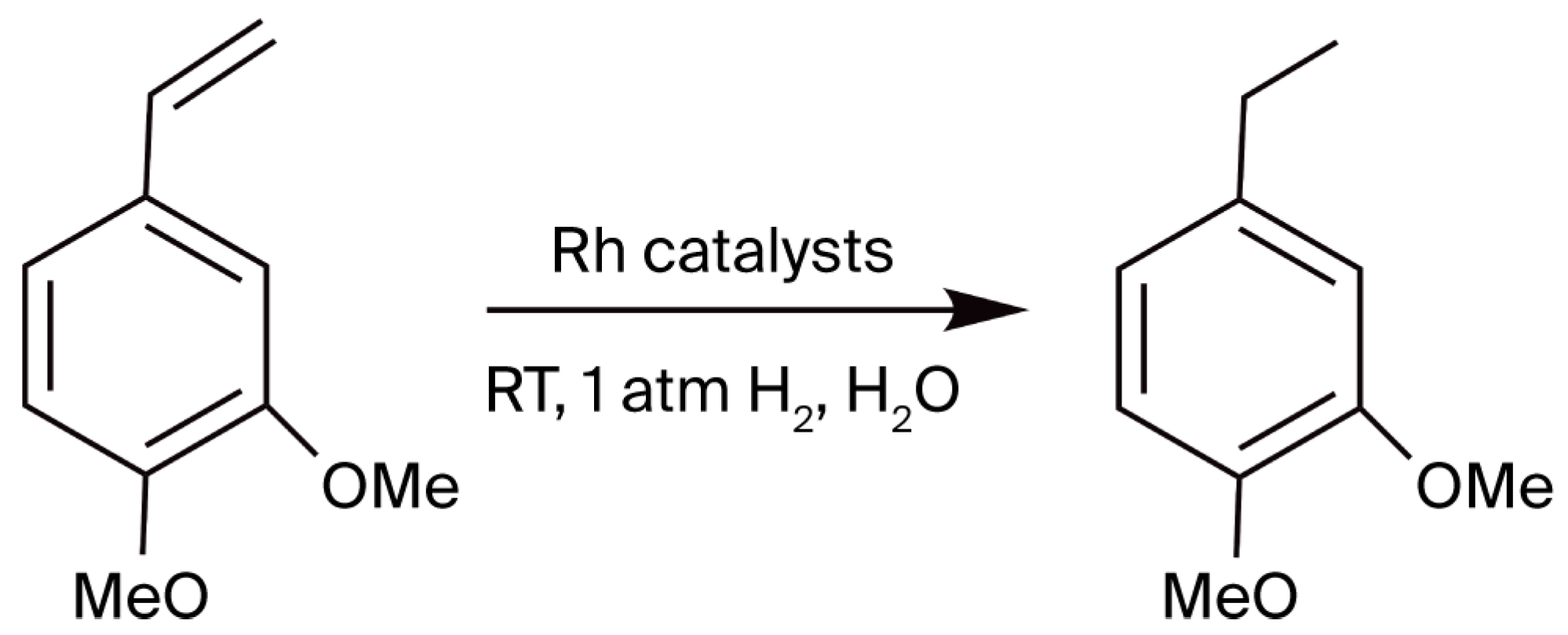
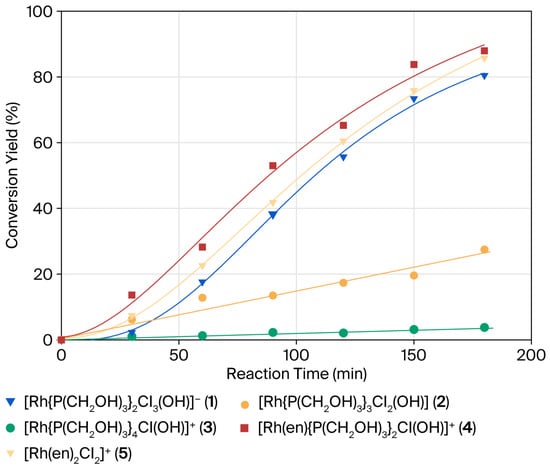
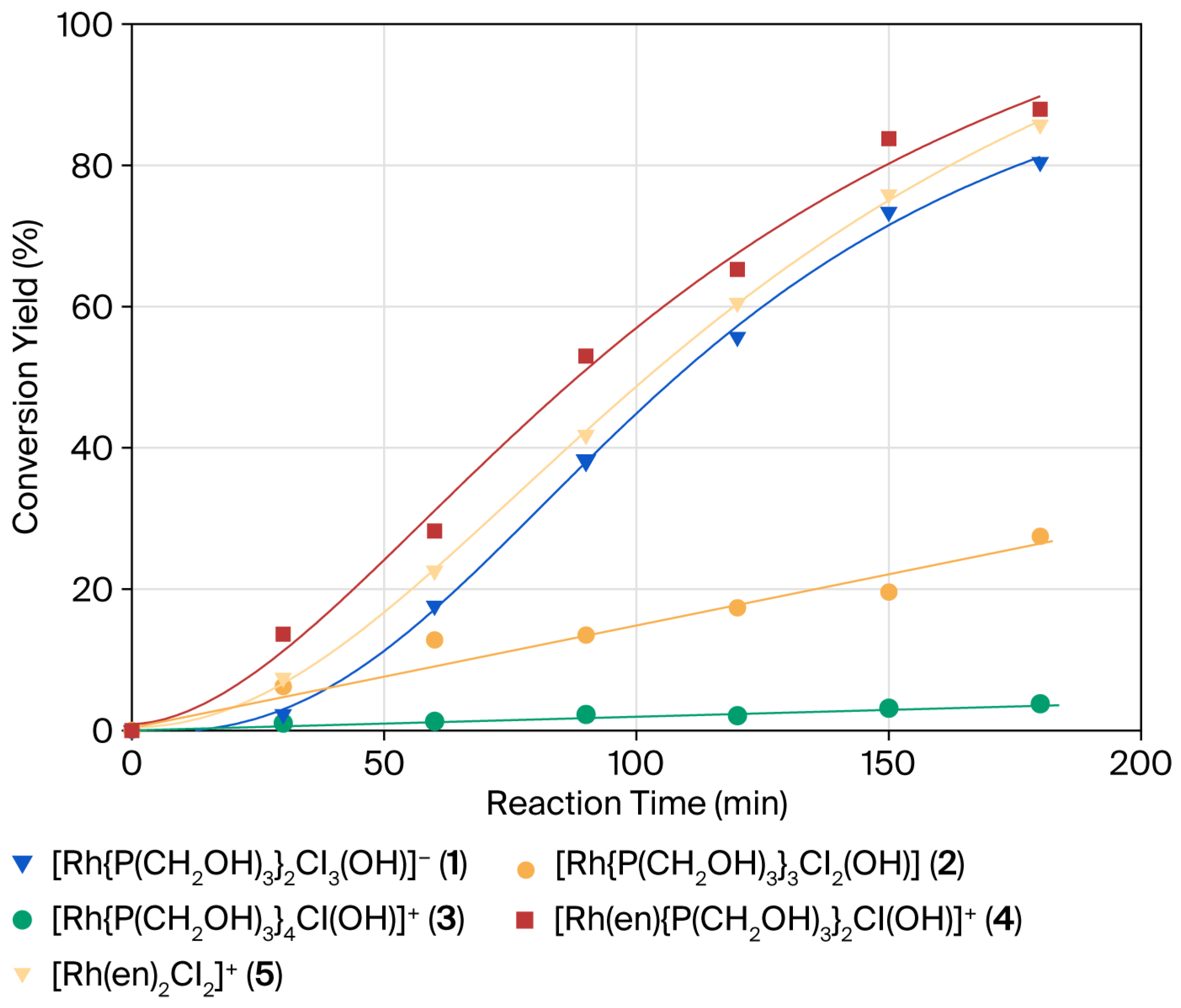
Aqueous catalytic hydrogenation of C=C, C=O or aromatic C=C bonds, or all of these, has been proposed as a potential method for the selective removal of lignin chromophore structures and the bleaching and photo-stabilization of wood pulps [22,23,24,25]. 3,4-dimethoxystyrene was previously used as a model structural compound for the lignin chromophore, as discussed in the literature [22,23,24,25]. The catalytic hydrogenation activity of the Rh(III)–THP–en complex 4a, the Rh(III)–THP complexes 1–3, and a Rh(III)–en complex, [Rh(III)(en)2Cl2]+ (5), prepared in an aqueous solution [26,27] was systematically evaluated in the biphasic water/organic (catalyst/substrate) medium with the lignin model chromophore, 3,4-dimethoxystyrene (Figure 3) under identical experimental conditions. In the experimental condition of 1 atm H2, 0.01 M catalyst and S/C = 7, the relative catalytic hydrogenation activities in situ followed the trend 4a > 5 > 1 >> 2 > 3 (Figure 4). Although complexes 1 and 5 show relatively high catalytical hydrogenation of 3,4-dimethoxystyrene, nearly as effective as that for complex 4a, they are not very stable, with rhodium metal precipitating after the substrate has been converted into the product; this has been discussed previously [9]. Complexes 2 and 3 were relatively stable in the reaction medium, but their catalytic hydrogenation activities were lower. Interestingly, the addition of en to the Rh(III)–THP system to form 4a showed both high catalytic activity and remarkable stability during the hydrogenation process in solution. No rhodium metal was formed after the total conversion of the substrate. In separate experiments, it was found that 4a was effective in the hydrogenation of 3,4-dimethoxystyrene at an S/C ratio of 80 (22% conversion after 27 h under 1 atm H2; 98% conversion after 3 h under 150 PSI H2). Furthermore, the addition of liquid mercury to the reaction media did not affect the hydrogenation, indicating that [Rh(III)(en){P(CH2OH)3}2(OH)Cl]+ was a homogeneous catalyst in the hydrogenation of 3,4-dimthoxystyrene. Hydrogenation of 1-decene and allyl alcohol by 4a was observed (S/C = 10, R.T., 1 atm H2 4 h, 100% conversion), but was very slow for crotonic acid (S/C = 20, R.T., 1 atm H2 4 h, conversion 9.2%); however, with the addition of the same amount of NaOH, the conversion improved (S/C = 20, pH = 14, R.T. 3 h, conversion 24.0%). Separation of the product from the catalyst was accomplished at the end of the hydrogenation process by solvent extraction with 4/1 (v/v) ethyl acetate/acetone, and the final formation products were proved.
Figure 3.
Catalytic hydrogenation of 3, 4-dimethoxystyrene in aqueous media.
Figure 4.
Catalytic hydrogenation of 3,4-dimethoxystyrene using various Rh(III) complexes in aqueous solution; 1 atm H2, room temperature, 0.01 M catalyst and S/C = 7. ▼ (1), ○ (2), ● (3), ■ (4), and ∇ (5).
The catalytic mechanism and the activity species are not fully known and need further investigation. The equilibrium of the rhodium chloro to the corresponding hydroxo species is commonly encountered in all reactions of RhCl3·3H2O performed in aqueous media [9,28,29]. In the previous publication, it was shown that the hydrophilic phosphine (PTA and TPPTS) is readily oxidized by Rh(III) via the hydroxydichlororhodium intermediate [Rh(III)(P-L)Cl2(OH)], and consequently the Rh(I) complexes are formed [28,29]. In our experiment, the ratio of Rh/THP was less than 4, and the O=P(CH2OH)3 (δ 50.12 ppm in D2O) was always detected by 31P{1H} NMR in the reaction solution, even in the presence of argon. The high catalytic activity of 1 and 4a/4b likely comes mainly from the Rh(I) species formed through the intermediate [Rh(III)(THP)Cl2(OH)] by the reaction between [Rh(III)Cl2(OH)] and THP (Figure 1). In complexes 2 and 3, the three and four phosphine ligands coordinate to Rh(III) and consequently stabilize the Rh(III) oxidation state or may restrict the reduction of Rh(III) to Rh(I) by H2, thus leading to low catalytic activity. Such stabilizing behavior has been observed in previous studies by others; the main purpose of these studies was to stabilize the Rh(III) oxidation state to form Rh(III)–THP species for biological applications [9]. The ability of the mixed P and N ligands to enable the reduction of Rh(III) to Rh(I), and stabilize the Rh(I) species, is normally necessary for catalytical hydrogenation [1,30,31]. With two THP phosphine ligands or only en N donor ligands, the Rh(III) in complexes 1 and 5 can be easily reduced to Rh(I), but such Rh(I) species may only be stable in the presence of the substrates. In complex 4a, Rh(III) is difficult to reduce to Rh(I) under H2 without substrates but can be reduced to the Rh(I) species in their presence after hydrogenation. After the total conversion of the substrates, 31P{1H} NMR shows that complex 4a in reaction solution is reduced to the Rh(I) species at δ 21.4, with no formation of Rh metals. The solution can be reused for hydrogenation, and the activity was observed to have increased by a factor of 3.8. The S-shape of the conversion curve (Figure 4) is probably due to the Rh(I) and Rh(III) species coexisting in the solution.
The mixed P and N(amine/imine) of ruthenium(II), the complexes in the formulation of [Ru(II)(P)2(N)2Cl2], were developed and were used as very efficient early homogeneous hydrogenation catalysts, with many applications in synthesis chemistry [32,33,34,35]. Herein, we first explored the rhodium(III)/rhodium(I) complex system with mixed P and N ligands, generating a stable and efficient homogeneous catalytic hydrogenation system, indicating that this concept is also suitable for rhodium metal.
Further evidence to demonstrate this activity is that Rh(I) comes from a separated hydrogenation reaction system. For Rh(I) species of 6 and 4b, prepared in EtOH with [Rh(NBD)Cl]2, the catalytic hydrogenation of 3,4-dimethoxystyrene, as shown in Figure S13, is much faster compared with that for the mixed oxidation state of Rh(III)/Rh(I) 4a + 4b and 1 + 6 (Figure 1) in aqueous solution, indicating that Rh(I) in the +1 oxidation state is the real activity catalyst.
3. Materials and Methods
All manipulations of oxygen-sensitive compounds were carried out using vacuum-line techniques (Schlenk line). All organic solvents and water used were distilled or degassed with argon and then stored under argon. The solvents d6-ethanol (Cambridge Isotope Laboratories, Tewksbury, MA, USA) was dried over 4 Å molecular sieves and degassed with argon. The d2 water was purchased from Apollo Scientific Ltd (Manchester, UK) and was also purged with argon. P(CH2OH)3 was purchased from Strem Chemicals Inc (Newburyport, MA, USA) and stored in a dried glove box. The rhodium metal salts RhCl3 hydrate and RhCl3, as well as [Rh(NBD)Cl], were purchased from Sigma-Aldrich (Ontario, ON, Canada) and used as received.
3.1. Preparation and 31P{1H} NMR Characterization of Rh(III)-THP and Rh(III)-THP-en Complexes of 1, 2, 3, 4a, 4b, 5 and 6 in Solution
Rh(III)-THP complexes 1–3 were prepared by the addition of RhCl3 solid to freshly prepared tris(hydroxymethyl)phosphine solutions at three different molar ratios in water [9]. Each step of the reactions was monitored by 31P{1H} NMR spectroscopy of the samples in solution, and the controlled synthesis for each complex was used in situ. 31P{1H} NMR (D2O, 121 MHz): δ 47.1 (d, 1JRh-P = 115 Hz) (1); δ 36.5 (d, 1JRh-P = 106 Hz) (2); and two doublets of triplets with equal intensity at δ 33.0 (d t, 1JRh-P = 98 Hz, 2JP-P = 22 Hz) and 20.3 (d t, 1JRh-P = 86 Hz, 2JP-P = 22 Hz) (cis-3). [Rh(III)(en){P(CH2OH)3}2Cl(OH)]Cl: (δ 26.0 (d, 1JRh-P = 95 Hz)) (4a). [Rh(I)(en){P(CH2OH)3}2]Cl: δ 21.4 (d, 1JRh-P = 118 Hz)) (4b). [Rh(I){P(CH2OH)3}2Cl] (6): δ 21.4 (d, 1JRh-P = 115 Hz).
1H NMR (D2O, 300 MHz): δ 3.2–4.1 ppm (m, P(CH2OH)3).
Complex [Rh(en)2Cl2]Cl (5) was prepared as reported in the literature [26,27].
3.2. 31P{1H} NMR Spectra and Assignment of Control Preparation to Each Complex in Solution (1–4, 6–9)
The concentrations of solution samples for 31P{1H} NMR measurements were all around 20.0 mmol/L and prepared using a Schlenk line under argon protection. At the molar ratio of Rh(III)/THP 1:2 in aqueous solution, molar ratios of almost 3:2 of complexes of 1 and 6 were formed in solution, and a very small signal of 2 was detectable (Figure S1). With the addition of 1 M NaCl to this solution, the equilibrium shifted to 2, with intensity ratios of 4:3:2 for the three signals due to 2, 1 and 6 (Figure S2). The complexes of the 1:1 molar ratio of 4a and 4b were formed in the solution with a Rh(III)/THP/en molar ratio of 1:2:1 (Figure S3). With the addition of 1.0 M NaCl to this solution, the equilibrium shifted to complex 2, with an intensity ratio of 2:3:2 for the three signals of 2, 4a and 4b (Figure S4). Increasing the chloride concentration of both the Rh(III)-THP and Rh(III)-THP-en solutions only changed the ratio of 1 to 4b slightly, but the ratio of 2 increased dramatically. This indicates that the chloride affected both the equilibrium and the Rh(III) hydrolysis. The Rh(I)-THP formation was still present in the solution. The signal of complex [Rh(I){P(CH2OH)3}2Cl] (6) was confirmed by the reaction between [Rh(NBD)Cl]2 and THP in ethanol under N2, in a 1:1 molar ratio of Rh(I)/THP, with only one main NMR signal at 21.2 (d, 1JRh-P = 165 Hz) being due to mono-THP [Rh(I){P(CH2OH)3}Cl] (7) and one small signal at 22.1 (d, 1JRh-P = 118 Hz) (6) (Figure S5). Increasing the Rh(I)/THP ratio to 1:2, the signal at 22.1 (6) became the dominant one, with that at 21.2 (7) being less significant (Figure S6). No 1H NMR signal of 2,5-norbornadiene (NBD) was detected (in the preparation process, after mixing the [Rh(NBD)Cl]2 and THP, a small amount of precipitate was noticed at bottom, probably due to dissociated NBD ligands and the precipitate’s insolubility in alcohol). Therefore, it was obvious that the two signals at 21.2 and 22.1 corresponded to the complexes [Rh{P(CH2OH)3}Cl] (7) and [Rh{P(CH2OH)3}2Cl] (6). With the addition of 1 molar of ethylenediamine to the solution of complex 7, the 31P{1H} spectrum was clearly that of complex [Rh(en){P(CH2OH)3}Cl] (22.20 (d, 1JRh-P = 115 Hz)) (8) (Figure S7). In the same way, the addition of 1 molar of ethylenediamine to the complex 6 solution led to the formation of the [Rh(en){P(CH2OH)3}2]Cl complex (22.2 (d, 1JRh-P = 118 Hz)) (4b) (Figure S8). Because of the similar spin–spin coupling constants (1JRh-P) and chemical shifts for 6, 8 and 4b, distinguishing between them via 31P{1H} NMR spectroscopy is challenging. The 1H NMR signals of 4b at 4.3 and 2.82 ppm for the coordinated ethylenediamine ligand were very broad with spin–spin coupling to Rh(I) of 42 and 56 Hz (probable due to the fast ligand exchange of ethylenediamine in complex 4b), as shown in Figure S9. Due to the redox reaction and strong hydrolysis of Rh(III) in aqueous solution, the formation of the Rh(III)-THP mono-complex has never been detected in aqueous solution. One reaction between RhCl3 and THP was carried out in dry and oxygen-free ethanol; the Rh(III) mono- THP complex was detected here with a 31P signal at δ 51.6 (d, 1JRh-P = 115 Hz) for [Rh{P(CH2OH)3}Cl3(S)2] (9) (Figure S10). At molar ratios of 1:3 and 1:4 for Rh(III)/THP, the main complex formed in the aqueous solution is 3 (Figures S11 and S12) with a slight indication of 2 in the 1:3 ratio solution (all 31P{1H} NMR spectra are shown in Supporting Materials).
A yellow precipitate formed for complex 4b was bubbled in EtOH with 1 atm H2. This was dissolved in D2O, after which the 1H NMR spectrum did not show any hydride signals in the high-field regime. For the Rh(I) species of 6 and 4b, prepared in EtOH with [Rh(NBD)Cl]2, the catalytic hydrogenation of 3,4-dimethoxystyrene is shown in Figure S13. It is much faster when compared with 4a and 1 in aqueous solution.
3.3. Synthesis of Solid [Rh(en){P(CH2OH)3}2Cl2]Cl (4)
Tris(hydroxymethyl)phosphine (0.124 g, 1.0 mmol) in water (2.5 mL) was added to freshly dissolved RhCl3 (0.110 g, 0.5 mmol) in water (2.5 mL) at room temperature. The reaction mixture was stirred for 5 min, and then 0.25 mL of a 2 M ethylenediamine aqueous solution was added. After further stirring for 10 min, the solvent was allowed to slowly evaporate to yield a crystalline solid of 4 at a yield of 65% (0.168 g).
31P{1H} NMR (D2O, 121 MHz): δ 26.0 ppm (d, 1JRh-P = 95 Hz).
1H NMR (D2O, 300 MHz): δ 5.0 (-NH2), 4.1 (P-CH2-), 2.87 (N-CH2-).
MS of [Rh(en){P(CH2OH)3}2Cl2]+ resulted in us finding the following: 481(100), 483(65), and 485(10). calculated as 481.0.
Elemental analysis resulted in us finding the following: C(19.06%), H(5.18%), N(5.08%); Calc. C(18.57%), H(5.41), and N(5.06%).
3.4. pH Measurements and Base Titrations in Solution
The pH measurement results were as follows: pH = 5.5 (degassed distilled water); pH = 5.9 (3.0 M NaClO4 ionic medium); pH = 6.5 (0.01 M P(CH2OH)3 dissolved in 3.0 M NaClO4 ionic medium water). The pH values were 2.1, 2.0, 2.0 and 2.5, respectively, for 0.01 M (1), 0.01 M (2), 0.01 M (3) and 0.0082 M (4a) in 3.0 M NaClO4 ionic-medium water. These pH results indicate that the hydrolysis of Rh(III) in aqueous solution and the Rh(III)-OH species proceeded in the solution. The pH values of 1, 2, and 3 were almost equal in a 0.01 M solution, indicating almost the same acidic concentrations in solution, and thus that only one coordinated water molecule hydrolyzed to form a hydroxyl OH− group in each species and release H+ in the solution (as shown in Figure 1). Then, in the acidic medium, this would have inhibited the continuing hydrolysis in the solution. According to 31P{1H} NMR spectra, complexes 1, 2, 3 and 4a were in equilibrium in the solution. Separately, the four solutions each contained one dominating species. The base titration shows that complex 1 has three chlorides and complex 2 has two, while complexes 3 and 4a have only one chloride anion; the four titration curves are shown in Figure S14. As shown in Figure S14(1), the experimental base titration plot for second coordinated chloride dissociation is not obvious. As expected, the second chloride appeared to have dissociated in the pH range between 4 and 7 (as marked in Figure S14(1)). The exact reason is not clear to us, but it is perhaps due to the pH being close to 7 and it changing so extensively/quickly in response to the addition of the base volume, making the slope not clear enough. It does, however, show a some flattening followed by a peak in the expected range. Based on both the pH and titration data for the in-solution conditions, the formulation of these complexes in aqueous media were clearly defined: each species contained one OH− group, as shown in Figure 1.
3.5. Hydrogenation
The hydrogenation catalysts were prepared in situ and directly used. A total of 5 mL of a 0.01 M catalyst was combined with the substrate in a rubber-capped tube, with magnetic stirring applied. H2 gas (1 atm) was allowed to bubble through the bottom of the solution. An aliquot of a 0.1 mL reaction mixture was withdrawn at different times and extracted with 1 mL of a 4/1 (v/v) mixture of ethyl acetate and acetone solvents. With hydrogenation under 150 PSI H2 pressure, the catalyst and the substrate were placed in a glass sleeve containing a magnetic stir bar. The glass sleeve was sealed and placed into a Parr autoclave. The autoclave was purged with H2 and then pressurized at 150 PSI H2. At the end of the reaction, the H2 pressure was released and the reaction mixture extracted with 1 mL of a 4/1 (v/v) mixture of ethyl acetate and acetone. The organic phase was analyzed by HP-5890 gas chromatography in an HP-17 capillary column (with precolumn), with a temperature range between 100 and 220 °C (10 °C/Min) and the injection and detector temperature set at 220 °C.
3.6. X-Ray Crystallography
An irregular needle-shaped yellow crystal, measuring approximately 0.50 × 0.10 × 0.10 mm, enclosed in a thin-walled glass capillary, was used for data collection. The data collection for 4 was performed on an Rigaku/ADSC area detector diffractometer using λ(Mo Kα 0.71073 Å) radiation with a graphite monochromator. The structure was solved by direct methods and refined using full-matrix least squares on F2 (SHELXL-2017) [36]. All the non-hydrogen atoms in compound 4 were refined with anisotropic displacement parameters. The selected crystal data, selected bond lengths and angles, atomic coordinates, and equivalent isotropic displacement parameters for 4 are listed in Tables S1–S3.
4. Conclusions
The reactivities among the water-soluble THP phosphine ligand, ethylenediamine and Rh(III)Cl3 in solution were investigated by 31P NMR spectroscopy. All possible formation species were identified from the 31P NMR spectra. It was shown that at a relatively low THP/Rh(III) molar ratio, both with and without en, the Rh(III) and Rh(I) species coexisted in solution. After systematically testing these synthesized pre-catalysts in situ under the same conditions, water-soluble, efficient catalytic homogenous activity and the H2-stable catalytic system of THP-Rh-en were discovered. According to the available literature, this is the first case study of rhodium hydrogenation catalysis with THP/en ligands in aqueous media. With hydrogenation to the selected lignin chromophores as a pulp model compound of 3,4-dimethoxystyrene, the developed water-soluble and stable homogenous Rh/THP/en catalysts have potential in pulp bleaching in the industry.
Supplementary Materials
The following supporting information can be downloaded at https://www.mdpi.com/article/10.3390/inorganics14020038/s1, 31P{1H} and 1H NMR solution characterization spectra (Figures S1–S12), hydrogenation data (Figure S13) and base titration plot details (Figure S14: (1), (2), (3) and (4)), together with crystal data, structure refinement, atomic coordinates, bond lengths and angles for 4 (Tables S1–S3).
Author Contributions
S.G.: conceptualization, investigation, characterization and writing original manuscript. Y.L.: investigation and data curation. M.S.: review of results, writing—review and editing of the final draft. All authors have read and agreed to the published version of the manuscript.
Funding
This work was mainly performed at the Institute of Carbon Materials Science of Shanxi Datong University and supported by the following: Shanxi Science Foundation for Youths (20210302124435) and Datong Application Basic Research Project (2024075).
Institutional Review Board Statement
Not applicable.
Informed Consent Statement
Not applicable.
Data Availability Statement
The original contributions presented in this study are included in the article/Supplementary Materials. Further inquiries can be directed to the corresponding author.
Conflicts of Interest
The authors declare that they have no known competing financial interests or personal relationships that could have appeared to influence the work reported in this paper.
References
- Housecroft, C.E. Rhodium. Coord. Chem. Rev. 1992, 115, 191–230. [Google Scholar] [CrossRef] [Scilit]
- Kobayashi, S. Editorial Commentary: Water is Beautiful. Adv. Synth. Catal. 2002, 344, 219. [Google Scholar] [CrossRef] [Scilit]
- Sinou, D. Asymmetric organometallic-catalyzed reactions in aqueous media. Adv. Synth. Catal. 2002, 344, 221–237. [Google Scholar] [CrossRef] [Scilit]
- RajanBabu, T.V.; Yan, Y.-Y.; Shin, S. Synthesis, Characterization, and Applicability of Neutral Polyhydroxy Phospholane Derivatives and Their Rhodium(I) Complexes for Reactions in Organic and Aqueous Media. J. Am. Chem. Soc. 2001, 123, 10207–10213. [Google Scholar] [CrossRef] [Scilit]
- Dwars, T.; Oehme, G. Complex-catalyzed hydrogenation reactions in aqueous media. Adv. Synth. Catal. 2002, 344, 239–260. [Google Scholar] [CrossRef] [Scilit]
- Chatt, J.; Leigh, G.J.; Slade, R.M. Rhodium(I), rhodium(III), palladium(II), and platinum(II) complexes containing ligands of the type PRnQ3–n (n= 0,1, or 2; R = Me, Et, But, or Ph; Q = CH2OCOMe or CH2OH). J. Chem. Soc. Dalton Trans. 1973, 2021–2028. [Google Scholar] [CrossRef] [Scilit]
- Higham, L.; Powell, A.K.; Whittlesey, M.K.; Wocadlo, S.; Wood, P.T. Formation and X-ray structure of a novel water-soluble tertiary–secondary phosphine complex of ruthenium(II): [Ru{P(CH2OH)3}2{P(CH2OH)2H}2Cl2]. Chem. Commun. 1998, 1107–1108. [Google Scholar] [CrossRef] [Scilit]
- Reddy, V.S.; Berning, D.E.; Katti, K.V.; Barnes, C.L.; Volkert, W.A.; Ketring, A.R. Chemistry in Environmentally Benign Media. 3.1 Synthesis and Characterization of Rhenium(V) Complexes Derived from Novel Water-Soluble (Hydroxymethyl)phosphines. Crystal Structures of [Re(O)2{(HOH2C)2PC6H4P(CH2OH)2}2]I and [Re(O)2{(HOH2C)2PCH2CH2P(CH2OH)2}2]Cl. Inorg. Chem. 1996, 35, 1753–1757. [Google Scholar] [CrossRef] [Scilit]
- Raghuraman, K.; Pillarsetty, N.; Volkert, W.A.; Barnes, C.; Jurisson, S.; Katti, K.V. Exceptional Kinetic Propensity of Hydroxymethyl Phosphanes toward Rh(III) Stabilization in Water. J. Am. Chem. Soc. 2002, 124, 7276–7277. [Google Scholar] [CrossRef] [Scilit] [PubMed]
- Ellis, J.W.; Harrison, K.N.; Hoye, P.A.T.; Orpen, A.G.; Pringle, P.G.; Smith, M.B. Water-soluble tris(hydroxymethyl)phosphine complexes with nickel, palladium, and platinum. Crystal structure of [Pd{P(CH2OH)3}4](cntdot)(CH3). Inorg. Chem. 1992, 31, 3026–3033. [Google Scholar] [CrossRef] [Scilit]
- DuBois, D.L.; Miedaner, A. Mediated electrochemical reduction of CO2. Preparation and comparison of an isoelectronic series of complexes. J. Am. Chem. Soc. 1987, 109, 113–117. [Google Scholar] [CrossRef] [Scilit]
- Fukuoka, A.; Kosugi, W.; Morishita, F.; Hirano, M.; McCaffrey, L.; Henderson, W.; Komiya, S. Water-soluble iridium and rhodium complexes with tris(hydroxymethyl)phosphine and their catalysis in biphasic hydrogenation and hydroformylation. Chem. Commun. 1999, 489–490. [Google Scholar] [CrossRef] [Scilit]
- Komiya, S.; Awata, H.; Ishimatsu, S.; Fukuoka, A. Synthesis of water-soluble (tri(hydroxymethyl)phosphine)gold(I) complexes containing a nucleoside ligand. Inorg. Chim. Acta 1994, 217, 201–202. [Google Scholar] [CrossRef] [Scilit]
- James, B.R. Homogeneous Hydrogenation; Wiley-Interscience: New York, NY, USA, 1973; p. 200. [Google Scholar]
- Gao, H.-R.; Angelici, R.J. Rhodium amine complexes tethered on silica-supported metal catalysts. Highly active catalysts for the hydrogenation of arenes. New J. Chem. 1999, 23, 633–640. [Google Scholar] [CrossRef] [Scilit]
- Ohkuma, T.; Koizumi, M.; Doucet, H.; Pham, T.; Kozawa, M.; Murata, K.; Katayama, E.; Yokozawa, T.; Ikariya, T.; Noyori, T. Asymmetric Hydrogenation of Alkenyl, Cyclopropyl, and Aryl Ketones. RuCl2(xylbinap)(1,2-diamine) as a Precatalyst Exhibiting a Wide Scope. J. Am. Chem. Soc. 1998, 120, 13529–13530. [Google Scholar] [CrossRef] [Scilit]
- Doucet, H.; Ohkuma, T.; Murata, K.; Yokozawa, T.; Kozawa, M.; Katayama, E.; England, A.F.; Ikariya, T.; Noyori, R. trans-[RuCl2(phosphane)2(1,2-diamine)] and Chiral trans-[RuCl2(diphosphane)(1,2-diamine)]: Shelf-Stable Precatalysts for the Rapid, Productive, and Stereoselective Hydrogenation of Ketones. Angew. Chem. Int. Ed. 1998, 37, 1703–1707. [Google Scholar] [CrossRef] [Scilit]
- Brauer, D.J.; Kottsieper, K.W.; Roßenbach, S.; Stelzer, O. Novel P, N Ligands Derived from (R)- and (S)-1-Phenylethylamine with (2R,5R)-2,5-Dimethylphospholanyl Groups (DuPHAMIN) for Asymmetric Catalysis. Eur. J. Inorg. Chem. 2003, 2003, 1748–1755. [Google Scholar] [CrossRef] [Scilit]
- James, B.R.; Lorenzine, F. Developments in the chemistry of tris(hydroxymethyl)phosphine. Coord. Chem. Rev. 2010, 254, 420–430. [Google Scholar] [CrossRef] [Scilit]
- Lorenzini, F.; Patrick, B.O.; James, B.R. Synthesis and X-ray structures of water-soluble tris(hydroxymethyl)phosphine complexes of rhodium(I). Dalton Trans. 2007, 30, 3224–3226. [Google Scholar] [CrossRef] [Scilit]
- Zhang, J.; Xing, B.; Zhao, J.; Ma, G.; McDonald, R.; Cavell, R.G. A rare P, C bridged bimetallic palladium complex. J. Organomet. Chem. 2018, 862, 1–6. [Google Scholar] [CrossRef] [Scilit]
- Hu, T.Q.; James, B.R. Chemical Modification, Properties and Usage of Lignin; Hu, T.Q., Ed.; Kluwer Academic Publishers: Dordrecht, The Netherlands; Plenum Publishers: New York, NY, USA, 2002; pp. 247–265. [Google Scholar]
- Wong, T.Y.H.; Pratt, R.; Leong, C.G.; James, B.R.; Hu, T.Q. Catalytic hydrogenation of lignin aromatics using Ru-arene complexes. Chem. Ind. 2000, 82, 255–266. [Google Scholar]
- Hu, T.Q.; James, B.R.; Wang, Y. Towards inhibition of yellowing of mechanical pulps. Part III. Hydrogenation of milled wood lignin. J. Pulp Paper Sci. 1999, 25, 312–317. [Google Scholar]
- James, B.R.; Wang, Y.; Alexander, C.S.; Hu, T.Q. Catalytic hydrogenation of aromatic rings of lignin. Chem. Ind. 1998, 75, 233–242. [Google Scholar]
- Anderson, S.; Basolo, F. Synthesis and characterization of cis and trans-dichlorobis(ethylenediamine)-Rhodium(III) salts. J. Am. Chem. Soc. 1960, 82, 4423–4424. [Google Scholar] [CrossRef] [Scilit]
- Johnson, S.A.; Basolo, F. Synthesis and Characterization of Some Diacidotetraamminerhodium(III) Compounds. Inorg. Chem. 1962, 1, 925–932. [Google Scholar] [CrossRef] [Scilit]
- Larpent, C.; Dabard, R.; Patin, H. Rhodium(I) production during the oxidation by water of a hydrosoluble phosphine. Inorg. Chem. 1987, 26, 2922–2924. [Google Scholar] [CrossRef] [Scilit]
- Darensbourg, D.J.; Joo, F.; Kannisto, M.; Katho, A.; Reibenspies, J.H. Water-soluble organometallic compounds. 2. Catalytic hydrogenation of aldehydes and olefins by new water-soluble 1,3,5-triaza-7-phosphaadamantane complexes of ruthenium and rhodium. Organometallics 1992, 11, 1990–1993. [Google Scholar] [CrossRef] [Scilit]
- Lautens, M.; Roy, A.; Fukuoka, K.; Fagnou, K.; Martin-Matute, B. Rhodium-Catalyzed Coupling Reactions of Arylboronic Acids to Olefins in Aqueous Media. J. Am. Chem. Soc. 2001, 123, 5358–5359. [Google Scholar] [CrossRef] [Scilit]
- Yonehara, K.; Ohe, K.; Uemura, S. Highly Enantioselective Hydrogenation of Enamides and Itaconic Acid in Water in the Presence of Water-Soluble Rhodium(I) Catalyst and Sodium Dodecyl Sulfate. J. Org. Chem. 1999, 64, 9381–9385. [Google Scholar] [CrossRef] [Scilit]
- Noyori, R.; Hashiguchi, S. Asymmetric transfer hydrogenation catalyzed by chiral ruthenium complexes. Acc. Chem. Res. 1997, 30, 97–102. [Google Scholar] [CrossRef] [Scilit]
- Ma, G.; McDonald, R.; Ferguson, M.; Cavell, R.G.; Patrick, B.O.; James, B.R.; Hu, T.Q. Ruthenium(II) Diphosphine/Diamine/Diimine Complexes and Catalyzed Hydrogen-Transfer to Ketones. Organometallics 2007, 26, 846–854. [Google Scholar] [CrossRef] [Scilit]
- Ge, S.; Zhang, J.; Zhao, J.; Ulhaq, I.; Ma, G.; McDonald, R. Ruthenium(II) diphosphine (phosphine)/imine/amine/CO complexes as efficient catalysts in transfer hydrogenation of ketones. J. Organomet. Chem. 2019, 879, 7–14. [Google Scholar] [CrossRef] [Scilit]
- Sun, M.; Ge, S.; Zhao, J.; McDonald, R.; Ma, G. Ruthenium(II) Phosphine/Picolylamine Dichloride Complexes Hydrogenation and DFT Calculations. Catalysts 2022, 12, 337. [Google Scholar] [CrossRef] [Scilit]
- Sheldrick, G.M. Crystal structure refinement with SHELXL. Acta Crystallogr. Sect. C 2015, 71, 3–8. [Google Scholar] [CrossRef] [Scilit] [PubMed]

Disclaimer/Publisher’s Note: The statements, opinions and data contained in all publications are solely those of the individual author(s) and contributor(s) and not of MDPI and/or the editor(s). MDPI and/or the editor(s) disclaim responsibility for any injury to people or property resulting from any ideas, methods, instructions or products referred to in the content. |
© 2026 by the authors. Licensee MDPI, Basel, Switzerland. This article is an open access article distributed under the terms and conditions of the Creative Commons Attribution (CC BY) license.