


Abstract
Volatile and mobile iodine species, which can occur in chemically distinct molecular forms, remain a persistent challenge in nuclear-fuel-cycle and reprocessing environments. Here, dispersion-corrected density functional theory compared the adsorption of I2, CH3I, HOI, and HIO3 on finite fragments of NPOP-1 (a piperazine-bridged nitrogen-rich porous network prepared by nucleophilic substitution polymerization of piperazine with 2,4,6-tris(bromomethyl)mesitylene, retaining pendant bromomethyl groups), POP-VDX (a porous 1-vinylimidazole-divinylbenzene copolymer; modeled member POP-VD2, porogen/monomer molar ratio = 2), and POP-VDF (its fluorinated ternary copolymer incorporating 2,2,3,4,4,4-hexafluorobutyl acrylate; modeled member POP-VDF2, crosslinking degree 20%), and amorphous graphene. Of 170 independent site/orientation families, 168 satisfied the ionic convergence criterion, and all 16 material–adsorbate combinations gave exothermic minima whose binding strengths and motifs varied markedly with speciation and local environment. CH3I was consistently the weakest adsorbate (−0.175 to −0.338 eV), undergoing little distortion and thus predominantly dispersive physisorption. HIO3 bound most strongly on the imidazole-based polymers (POP-VDX −1.362 eV; POP-VDF −1.260 eV with full proton transfer), POP-VDF offered the most favorable I2 minimum (−0.791 eV), and amorphous graphene was most favorable for HOI and CH3I. Broad site/orientation energy ranges imply that single starting configurations may miss favorable motifs. Grand canonical Monte Carlo simulations on the periodic crosslinked models over 298.15–473.15 K resolved temperature-dependent type-I uptake for the four preferred host–guest pairs, with simulated uptakes of 418–668 mg/g at 298.15 K and 100 kPa. POP-VDF and amorphous graphene achieve selective immobilization of different iodine species through complementary mechanisms—charge-transfer complexation and proton-transfer chemisorption at the imidazole N sites of POP-VDF, and dispersion-, polarization-, and confinement-driven capture at the defect sites of amorphous graphene—providing guidance for designing species-specific iodine-capture adsorbents.
1. Introduction
The control of volatile and mobile iodine-bearing species is a persistent materials challenge in the nuclear fuel cycle, particularly in fuel reprocessing and associated off-gas treatment, where radioiodine must be captured before environmental release and ultimately converted into a form suitable for long-term management [1,2,3,4]. Iodine chemistry in such systems cannot be represented by a single molecular adsorbate. Elemental I2 and organic iodides such as CH3I differ substantially in polarizability, bond polarity, molecular geometry, and chemical reactivity and therefore place different demands on sorbent surfaces. I2 is highly polarizable and can be stabilized by dispersion, polarization, and donor–acceptor interactions, whereas CH3I is comparatively difficult to retain by weak physisorption alone. Accordingly, a material that binds I2 strongly cannot automatically be expected to exhibit comparable affinity for other iodine-bearing molecules. In the present study, I2 and CH3I represent two central molecular classes for iodine capture, while HOI and HIO3 extend the comparison to oxygen-containing iodine species capable of directional hydrogen-bonding and acid–base interactions. This broader chemical set provides a controlled basis for examining how iodine speciation changes local adsorption mechanisms.
Porous organic polymers (POPs) and related organic porous frameworks are attractive candidates for iodine capture because pore architecture and local chemical functionality can be tuned over a broad chemical space. Conjugated, ionic, and nitrogen-rich networks have exhibited high iodine uptake in vapor or solution, and selected systems are also capable of retaining CH3I [5,6,7,8,9]. Their molecular-level appeal lies in the possibility of combining accessible free volume with chemically differentiated binding environments. Electron-rich heteroatoms and polar functional groups can provide directional interaction sites, whereas aromatic and conjugated regions can contribute dispersion and polarization stabilization. However, nominal heteroatom content alone does not define adsorption affinity: a potentially favorable functional group must also be sterically accessible and presented in an orientation that permits close adsorbate–framework contact. This distinction between chemical composition and site accessibility is particularly important for structurally heterogeneous porous solids.
Practical iodine retention nevertheless reflects more than the strength of an isolated local contact. Activated carbons, silver-exchanged zeolites and mordenites, and porous silicates illustrate how surface chemistry, impregnation, pore accessibility, and operating conditions collectively influence the capture of elemental and organic iodine [10,11,12,13,14,15]. Macroscopic uptake can additionally depend on transport, temperature, humidity, adsorbate concentration, competitive adsorption, and the population of accessible sites. Consequently, an experimentally measured capacity integrates several structural and kinetic contributions and does not by itself identify the specific chemical motif responsible for stabilizing a given iodine species. A site-resolved electronic-structure approach provides complementary information by isolating local adsorbate–adsorbent interactions.
Recent computational screening and targeted synthesis of covalent and porous organic frameworks, ionic cages, and heteroatom-rich polymers have emphasized the complementary roles of accessible porosity and local binding functionality in iodine capture [16,17,18,19,20,21,22,23]. These studies have substantially expanded the range of candidate sorbents and demonstrated the value of structure–property relationships in materials selection. For chemically heterogeneous adsorbents, however, multiple nonequivalent adsorption sites and molecular orientations can generate distinct local minima on the adsorption-energy landscape. Under such conditions, a single optimized starting configuration may provide an incomplete, and in some cases misleading, representation of molecular affinity. The remaining mechanistic question is therefore not simply whether a porous material can bind iodine, but how iodine speciation, local site chemistry, and molecular orientation act together to determine the strength and character of the interaction.
Carbonaceous adsorbents provide a useful complementary reference for separating heteroatom-driven effects from topology-driven stabilization. On ideal graphene, molecular I2 adsorption can be described through a balance of dispersion and electronic polarization [24]. Disordered carbon, in contrast, exposes edges, vacancies or holes, non-hexagonal rings, and hydrogen-terminated regions that create chemically and geometrically nonequivalent local environments. Such defect motifs can modify local polarizability, steric confinement, and the distance at which an adsorbate approaches the carbon framework. In functional porous materials, hydrogen bonding can provide an additional stabilization channel for iodine-containing guests [25]. Taken together, these interaction motifs suggest a continuum from weak dispersive adsorption, through more directional polarized contacts and hydrogen bonding, to stronger configurations involving substantial proton displacement when suitable acid–base partners are present.
In this work, we establish a common site-resolved density-functional-theory framework for comparing I2, CH3I, HOI, and HIO3 adsorption on a series of nitrogen-rich porous organic polymers (NPOPs: NPOP-1 (a piperazine-bridged network prepared from piperazine and 2,4,6-tris(bromomethyl)mesitylene), POP-VDX (a 1-vinylimidazole-divinylbenzene copolymer; modeled member POP-VD2, porogen/monomer molar ratio = 2), and POP-VDF (its fluorinated ternary copolymer incorporating 2,2,3,4,4,4-hexafluorobutyl acrylate; modeled member POP-VDF2, crosslinking degree 20%)) and a defect-rich amorphous graphene model. Rather than relying on one initial geometry per material–adsorbate pair, multiple chemically or topologically distinct sites and molecular orientations were screened across 170 independent site/orientation families. The resulting adsorption-energy distributions were analyzed together with molecular distortions and short intermolecular contacts. Rigid-separation profiles were further calculated for the preferred I2 configuration on each material to characterize the local interaction well, and representative minimum-energy structures were examined using the electron localization function (ELF) and orbital-projected density of states (PDOS). Grand canonical Monte Carlo adsorption isotherms were additionally evaluated for four preferred host–guest pairs to relate the local interaction motifs to fugacity-dependent molecular loading. The study is intentionally focused on local single-molecule affinity rather than macroscopic uptake. By connecting adsorption energies with site accessibility, structural response, and electronic descriptors, we aim to determine whether a universal adsorbent ranking exists across iodine species and to identify molecular-scale interaction motifs that can inform the rational design of iodine-capture materials for nuclear iodine-control applications.
2. Results and Discussion
2.1. Overall Adsorption-Energy Landscape
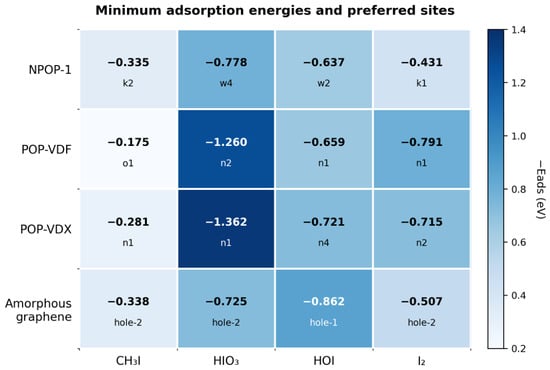
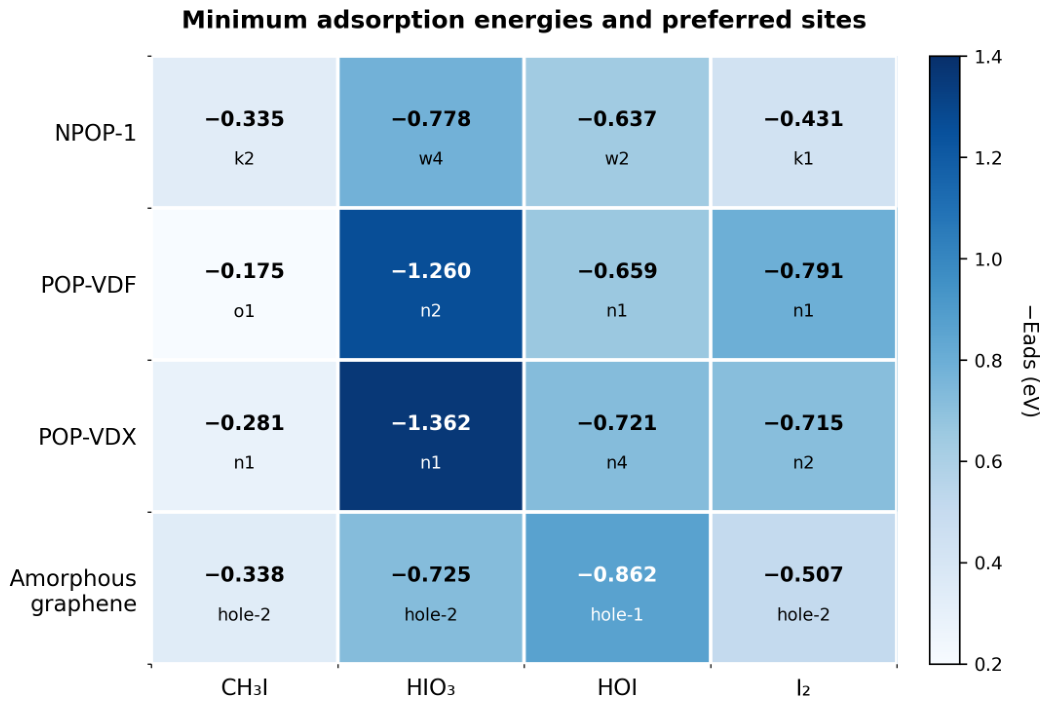
All 16 material–adsorbate combinations produced a negative minimum adsorption energy (Table 1 and Figure 1), showing that each adsorbent contains at least one locally favorable configuration for each iodine-bearing molecule within the present electronic-energy framework. The minimum energies nevertheless span 1.187 eV across the full matrix, from −0.175 eV for CH3I on POP-VDF to −1.362 eV for HIO3 on POP-VDX, demonstrating that exothermicity alone is insufficient to describe the large differences in local affinity. CH3I consistently occupies the weak-binding end of the matrix, whereas HIO3, HOI, and I2 access substantially more favorable minima. This systematic contrast already points to iodine speciation as a first-order determinant of adsorption: CH3I lacks the O–H functionality that enables directional hydrogen bonding or proton rearrangement, while highly polarizable I2 can gain additional stabilization at electron-rich or defect-rich local environments.
Table 1.
Strongest- and weakest-site retained adsorption energies for each material–adsorbate combination.
Figure 1.
Minimum adsorption-energy matrix under the final uniform protocol. Each cell reports Eads (eV) and the corresponding site label; darker shading indicates a larger magnitude of exothermic binding.
Figure 1 further resolves a pronounced adsorbate-dependent material ranking. The imidazole-based polymers are the clear outliers for HIO3 and I2. The deepest HIO3 minimum lies on POP-VDX (−1.362 eV), with the fully proton-transferred POP-VDF minimum (−1.260 eV) only 0.102 eV behind, and the I2 minimum on POP-VDF (−0.791 eV) leads the corresponding POP-VDX value (−0.715 eV) by 0.076 eV, indicating a substantial local-chemistry advantage of the imidazole N environments. Amorphous graphene gives the most favorable HOI and CH3I minima (−0.862 and −0.338 eV), 0.203 and 0.163 eV below the corresponding POP-VDF values, consistent with the defect-hole motifs that host these two species.
The sensitivity of the minimum energy to adsorbent identity is itself strongly species dependent. Across the four models, the minima span only 0.164 eV for CH3I and 0.225 eV for HOI, but increase to 0.360 eV for I2 and 0.636 eV for HIO3. Thus, local framework chemistry exerts particularly strong leverage over I2 and HIO3 adsorption. The origin of this behavior becomes clearer from the optimized structures discussed below: the exceptionally favorable HIO3 minima on the imidazole-based polymers are associated with pronounced O–H elongation and proton transfer toward a framework N site, whereas the stronger I2 minima on POP-VDF and POP-VDX coincide with short I···N contacts. Conversely, the competitive CH3I and HOI minima at defect-hole sites of amorphous graphene show that topological heterogeneity can generate favorable local environments even without the same N-containing binding motifs. The adsorption matrix therefore argues against interpreting heteroatom presence alone as a universal predictor of iodine affinity.
From the perspective of iodine control in nuclear-fuel-cycle-related environments, this species-dependent matrix has a broader implication: molecular I2 should not be treated as a universal proxy for the local binding behavior of all iodine-bearing species. A binding motif that is optimal for I2 does not necessarily maximize the affinity for CH3I or oxygen-containing iodine molecules, and the hydrogen-bonding and proton-transfer pathways available to HOI and HIO3 are absent from I2 and CH3I. The present finite-fragment electronic energies identify local interaction motifs and reveal their origin.
2.2. Adsorbate-Dependent Structures
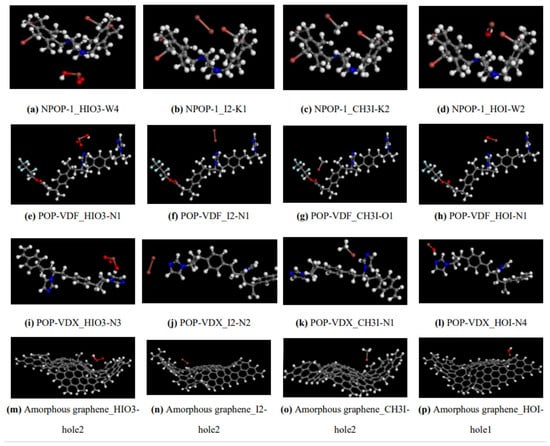
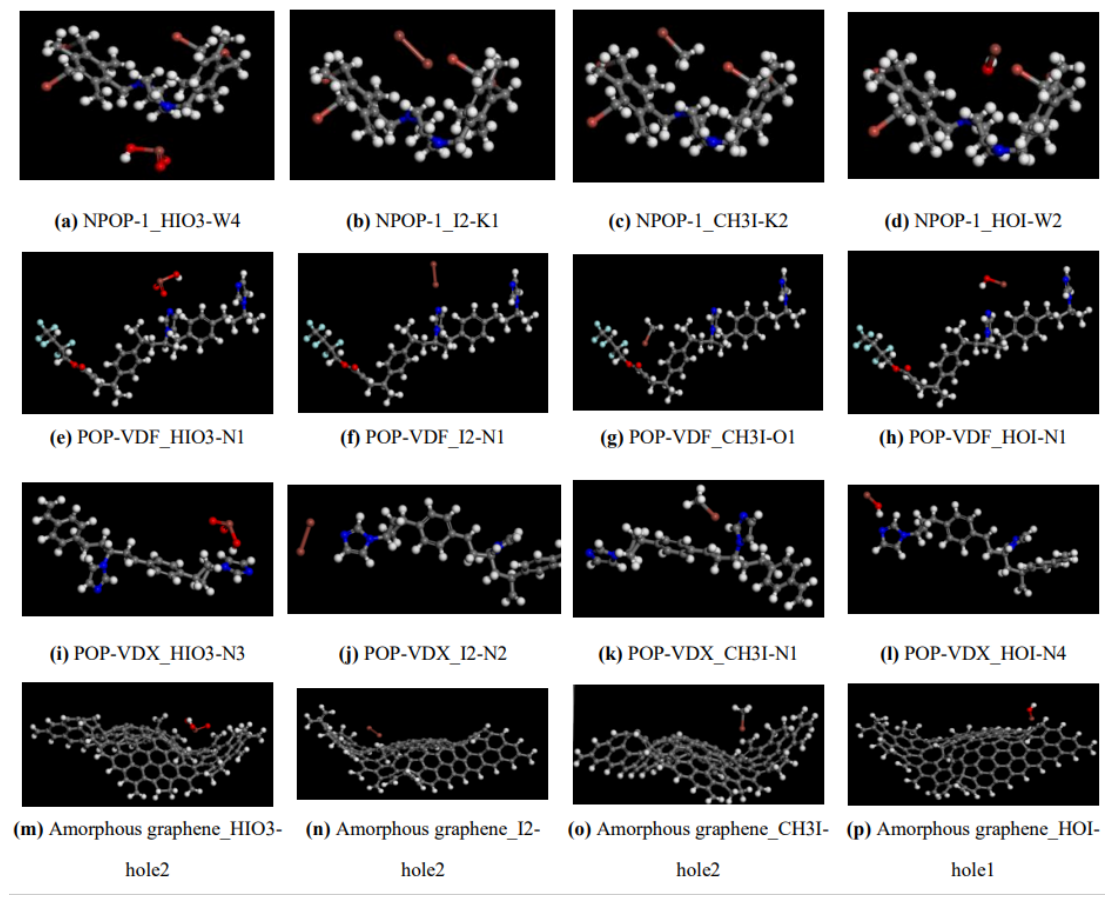
Different adsorption sites mentioned in the text and labeled in Table 1 are plotted presenting the structures in Figure 2. For each material-adsorbate pair, molecules were placed at chemically or topologically distinct local environments with several initial orientations. Amorphous graphene sites included basal, edge, hole, pentagonal, and heptagonal environments. The POP labels denote nearby framework, window, N-containing, O-containing, bridge, or related local motifs.
Figure 2.
Optimized adsorption configurations of NPOP-1 (a–d), POP-VDF (e–h), POP-VDX (i–l), and amorphous graphene (m–p). Rows: NPOP-1, POP-VDF, POP-VDX, and amorphous graphene; columns: HIO3, I2, CH3I, and HOI.
2.2.1. CH3I and I2
The CH3I minima were −0.335, −0.175, −0.281, and −0.338 eV on NPOP-1, POP-VDF, POP-VDX, and amorphous graphene, respectively. In all four preferred configurations, the C–I bond remained within 2.151–2.156 Å and the mean C–H distance stayed close to 1.092 Å. The C–I bond therefore varied by only 0.005 Å across chemically distinct adsorbents, and no C–I cleavage or appreciable intramolecular reconstruction was observed. Together with the comparatively weak adsorption energies, this structural invariance supports a physisorption-dominated picture in which CH3I is stabilized mainly through weak, non-destructive intermolecular interactions rather than through strong chemical reorganization. The relatively narrow spread of the CH3I minima across the four materials is also consistent with a weaker sensitivity to local site chemistry than is observed for the more polarizable or hydrogen-bond-capable iodine species.
I2 remained molecular in every preferred structure, with I–I distances of 2.738–2.789 Å, but its adsorption was more responsive to the local chemical environment than that of CH3I. POP-VDF/n1 gave the most favorable I2 minimum (−0.791 eV) together with a short I···N contact of 2.499 Å, while POP-VDX/n2 exhibited an I···N distance of 2.531 Å and an adsorption energy of −0.715 eV. By comparison, the NPOP-1/k1 and amorphous-graphene/hole-2 minima were −0.431 and −0.507 eV, respectively. The coincidence of the stronger POP minima with short, directional I···N contacts is consistent with an additional polarization or donor–acceptor contribution superimposed on dispersion, while the limited I–I bond-length change shows that this stabilization does not require dissociation of I2. At the same time, the defect-hole minimum of amorphous graphene is more favorable than that of NPOP-1 despite lacking the same N-directed motif, indicating that topological heterogeneity can also provide appreciable local stabilization. Thus, unlike CH3I, molecular I2 remains structurally intact but exhibits a much clearer response to the electronic and geometric character of the adsorption site; its retained molecular character is consistent with previous first-principles work on graphene [24].
2.2.2. HOI and HIO3
HOI occupies an intermediate interaction regime between the weakly perturbed CH3I complexes and the strongly reorganized HIO3/POP-VDF minimum. The preferred adsorption energies are −0.637, −0.659, −0.721, and −0.862 eV on NPOP-1, POP-VDF, POP-VDX, and amorphous graphene, respectively. The O–H distances remain within 0.977–1.021 Å and the O–I distances within 1.984–2.121 Å, confirming that HOI remains molecular in all four minima. Nevertheless, its local contact motif depends strongly on the adsorbent: POP-VDF/n1 and POP-VDX/n4 form H·N contacts of 1.685 and 1.711 Å, respectively, without complete proton transfer, whereas the amorphous-graphene/hole-1 minimum instead places iodine 2.440 Å from a defect carbon. The amorphous-graphene/hole-1 minimum (−0.862 eV) is the most favorable HOI minimum of the matrix even though it involves no H···N contact, whereas the two imidazole-bearing polymers, despite similar H···N distances, bind HOI more weakly (−0.659 eV on POP-VDF and −0.721 eV on POP-VDX), indicating that the contact distance alone is insufficient to rank HOI adsorption and that the surrounding topology and complete molecular orientation must also be considered.
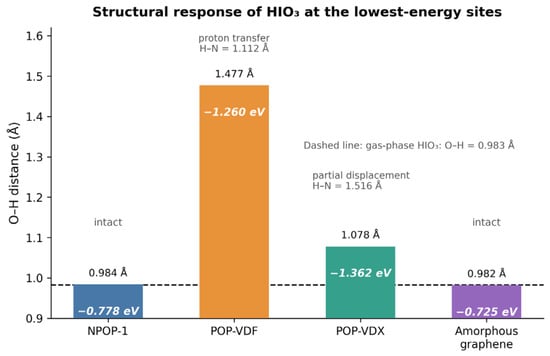
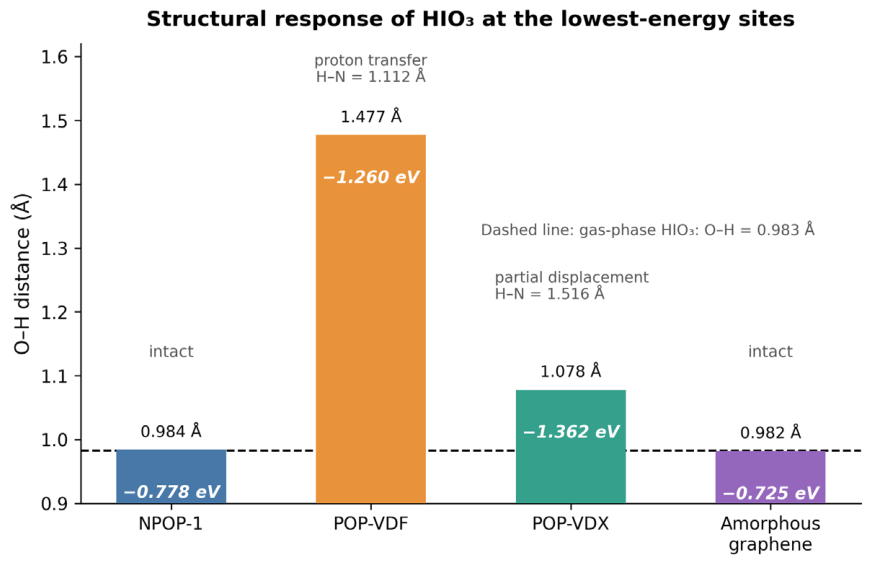
HIO3 exhibited the clearest coupling between structural reorganization and adsorption strength. NPOP-1/w4 and amorphous-graphene/hole-2 retain O–H distances of 0.984 and 0.982 Å, essentially identical to the isolated-molecule value of 0.983 Å, and their minimum adsorption energies are −0.778 and −0.725 eV, respectively. POP-VDX/n3 enters a stronger interaction regime: the O–H bond lengthens to 1.078 Å, 0.095 Å longer than in isolated HIO3, while H···N shortens to 1.517 Å, consistent with a strong hydrogen bond accompanied by partial proton displacement; under the final protocol this minimum re-optimizes into a deeper minimum at the neighbouring n1 site (−1.362 eV, Table 1), the deepest HIO3 entry of the matrix. POP-VDF/n1 is qualitatively different. Its O–H distance increases to 1.477 Å, whereas H–N contracts to 1.112 Å, and the corresponding adsorption energy reaches −1.260 eV under the final protocol. The 0.494 Å O–H elongation relative to the isolated molecule, together with formation of the short H–N contact, is consistent with transfer of the acidic proton to a framework nitrogen. Accordingly, the enhanced stability of HIO3/POP-VDF should not be interpreted simply as a stronger version of molecular physisorption; it corresponds to a different local proton configuration and is more appropriately described as proton-assisted, partly dissociative adsorption. This structural sequence—from essentially intact HIO3, through partial proton displacement, to a proton-transferred geometry—provides a direct molecular-scale explanation for the strong adsorbent dependence of HIO3 affinity. Under the final protocol of Section 3.2, the re-optimized HIO3/POP-VDF complex relaxes from the partially transferred minimum into the fully proton-transferred ion pair (proton on the framework N, IO3− paired with the protonated ring), and this ion-pair state provides the reported Table 1 value (−1.260 eV; Table S3).
Taken together, the bond metrics and the representative structures (Table 1 and Table 2 and Figure 2) establish a clear progression of adsorption motifs. CH3I undergoes minimal internal distortion and is characterized by a comparatively weak long-range contact; I2 remains molecular but approaches an accessible N site in the strongest POP configuration; HOI remains intact while forming either directional H···N interactions or a short defect-carbon contact; and HIO3 on POP-VDF undergoes pronounced O–H/N–H reorganization. The four configurations selected for ELF and PDOS analysis therefore represent not only the most favorable material for each adsorbate in the present screening, but also four chemically distinct interaction regimes. Figure 3 further isolates the HIO3 proton-coordinate response: the NPOP-1 and amorphous-graphene minima remain essentially at the isolated-HIO3 O–H distance, POP-VDX shows a moderate 0.095 Å elongation, and POP-VDF shows a much larger 0.494 Å elongation. This discontinuous structural change supports the interpretation that the POP-VDF minimum accesses a different proton configuration rather than merely a quantitatively stronger version of the same molecular adsorption motif.
Table 2.
Intramolecular bond lengths of the adsorbates and shortest adsorbate–framework N contacts in the strongest-site structures, together with the isolated-molecule reference values (Å). Distances are measured between the specified atom pair of the optimized adsorption complex.
2.3. Sensitivity to the Initial Site and Orientation
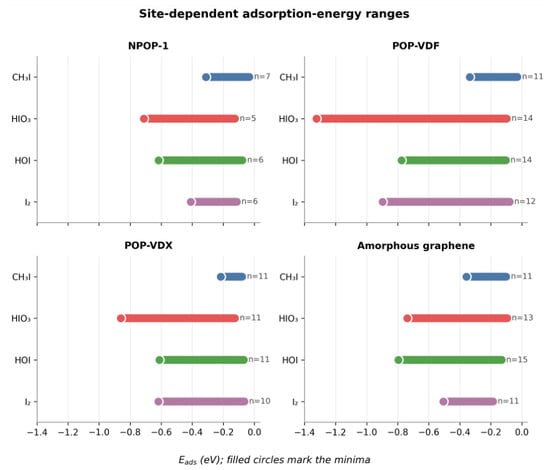
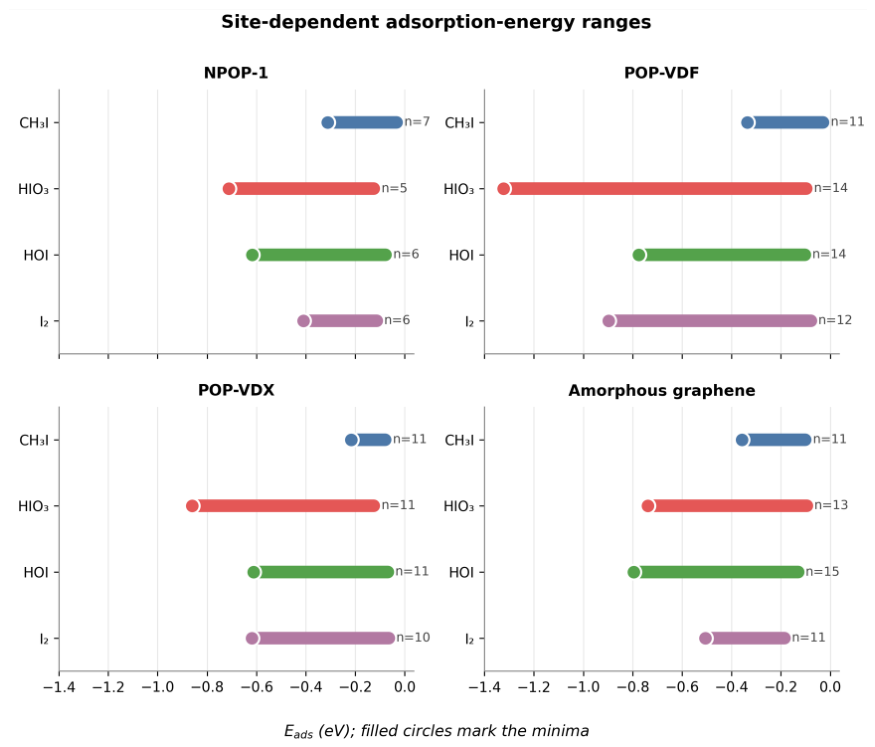
Macroscopic uptake can additionally depend on transport, temperature, humidity, adsorbate concentration, competitive adsorption, and the population of accessible sites. Figure 4 maps the sampled configurational sensitivity of the screening: the plotted ranges reflect the sites and orientations examined under the screening-stage settings, compared internally within each combination, and the number of converged families for each combination is listed in Table 5. POP-VDF/HIO3 covers −1.323 to −0.097 eV, a range of 1.226 eV, because only selected starting geometries access the proton-transferred minimum. POP-VDF/I2 and POP-VDF/HOI also show broad intervals of 0.820 and 0.672 eV, respectively, whereas POP-VDX/CH3I spans only 0.138 eV. The HIO3/POP-VDF interval is therefore almost nine times wider than the CH3I/POP-VDX interval, emphasizing that configurational sensitivity is strongly adsorbate dependent. This difference is physically consistent with the interaction motifs identified: species capable of directional hydrogen bonding, strong polarization, or proton rearrangement possess more geometrically selective stabilization pathways than CH3I, whose preferred minima involve weaker and less structurally specific contacts. Consequently, a single manually chosen starting structure can be particularly unreliable for the oxygen-containing species and for I2 at chemically heterogeneous sites. The present multi-start protocol therefore constitutes a systematic search across the chemically and topologically distinct local environments of each material. The complete set of 170 examined site/orientation families, with their optimized total energies, energy differences to the strongest family of each combination, and convergence outcomes, is tabulated in Table S2 of the ESI.
Figure 4.
Adsorption-energy ranges for the four adsorbates on each model. Filled circles mark the minima; n denotes the number of converged site/orientation families.
Defect-hole sites were preferred by all four adsorbates on the present amorphous-graphene model, while additional basal, edge, and pentagonal orientations broadened the HOI and HIO3 energy distributions without replacing the original minima. In the POP fragments, the preferred site label depends on adsorbate identity: HIO3, HOI, and I2 all select n1 as the strongest sampled environment on POP-VDF, whereas CH3I favors o1. The recurrence of n1 for the more polarizable or hydrogen-bond-capable adsorbates suggests that this site provides a favorable combination of chemical functionality, accessibility, and molecular orientation, while the different CH3I preference shows that the mere presence or number of heteroatoms is not sufficient to identify the optimal adsorption site. The contrast between narrow and broad ranges demonstrates that site selection matters most for systems with stronger directional chemistry and supports reporting both the best sampled adsorption energy and the spread among plausible local configurations when comparing heterogeneous sorbents.
2.4. I2 Rigid-Separation Interaction Profiles
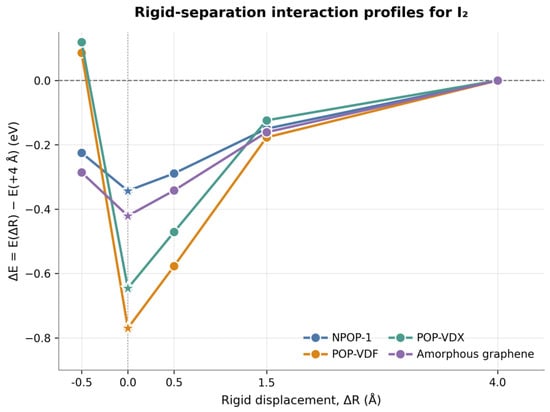
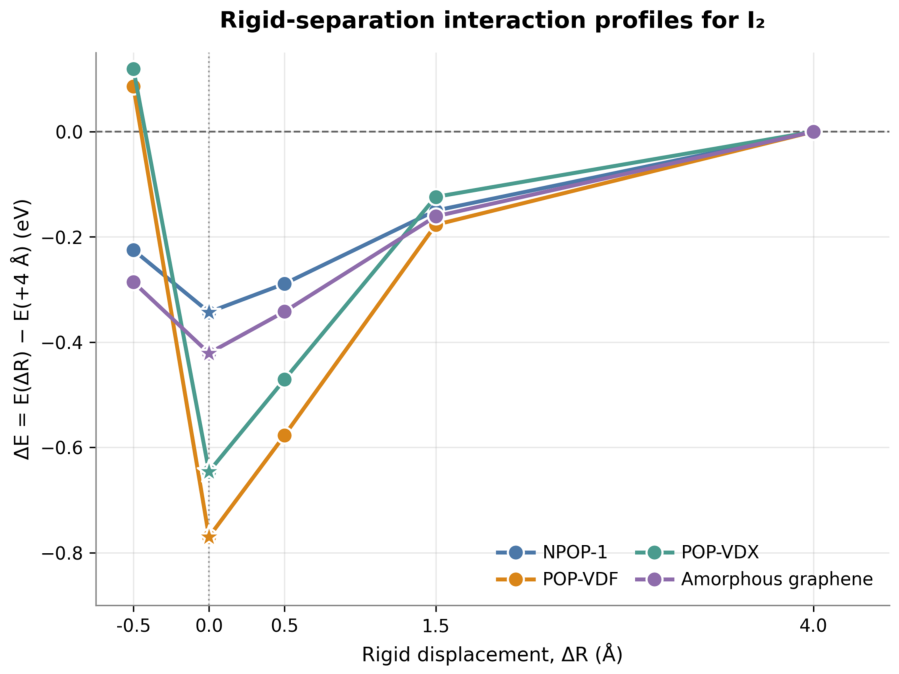
In contrast to the equilibrium minimum-energy matrix in Figure 1, Figure 5 characterizes the rigid-scan interaction potential exclusively for I2, illustrating the shape of the binding well and short/long-range interactions along the adsorption coordinate. The four normalized I2 profiles exhibit their lowest sampled energy at ΔR = 0, the optimized reference separation (Figure 5 and Table 3). Relative to the fixed +4.0 Å configuration, the corresponding well depths are 0.343 eV for NPOP-1, 0.770 eV for POP-VDF, 0.646 eV for POP-VDX, and 0.421 eV for amorphous graphene. This ordering broadly follows the optimized I2 adsorption energies and again identifies POP-VDF as the strongest sampled local I2 environment. The two deepest rigid-separation wells, for POP-VDF and POP-VDX, are also the two preferred configurations containing short I···N contacts, linking the structural motifs described in Section 2.2.1 with stronger local energetic stabilization around the equilibrium separation. The well depths in Figure 5 are referenced to the frozen +4.0 Å configuration of each specific complex, whereas the adsorption energies in Table 1 are referenced to separately optimized clean fragments and isolated molecules; the consistent material ranking between the two quantities links the local interaction well to the equilibrium adsorption strength.
Figure 5.
Rigid-separation interaction profiles of I2 on the four models. Energies are referenced to ΔR = +4.0 Å; stars mark the optimized geometries at ΔR = 0.
Table 3.
Relative energies ΔE(ΔR) for the I2 rigid-separation profiles (eV).
Compression by 0.5 Å raises the energy relative to the minimum for every material, confirming a rapidly increasing short-range repulsive response at separations smaller than the optimized contact distance. The compressed POP-VDF and POP-VDX points lie 0.086 and 0.119 eV above the +4.0 Å reference, respectively. NPOP-1 and amorphous graphene remain below the far-point reference at the sampled compression, but their energies are still 0.118 and 0.135 eV higher than their respective minima. This common upward shift is consistent with increasing electron-density overlap at excessively short separations, although the rigid scan does not decompose the repulsive contribution into individual physical terms. In the opposite direction, residual stabilization of −0.124 to −0.177 eV persists at ΔR = +1.5 Å, showing that attractive interactions remain appreciable beyond the equilibrium contact region and are consistent with the longer-range dispersion and polarization expected for molecular I2. Taken together, Figure 5 and Table 3 provide an internal local-stability check: ΔR = 0 is the lowest of the five sampled points for all four materials and is bounded by higher-energy points on both the compressed and extended sides.
2.5. Electron Localization and Electronic Structure
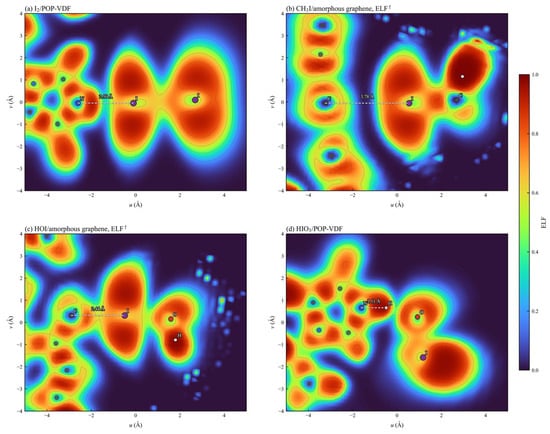
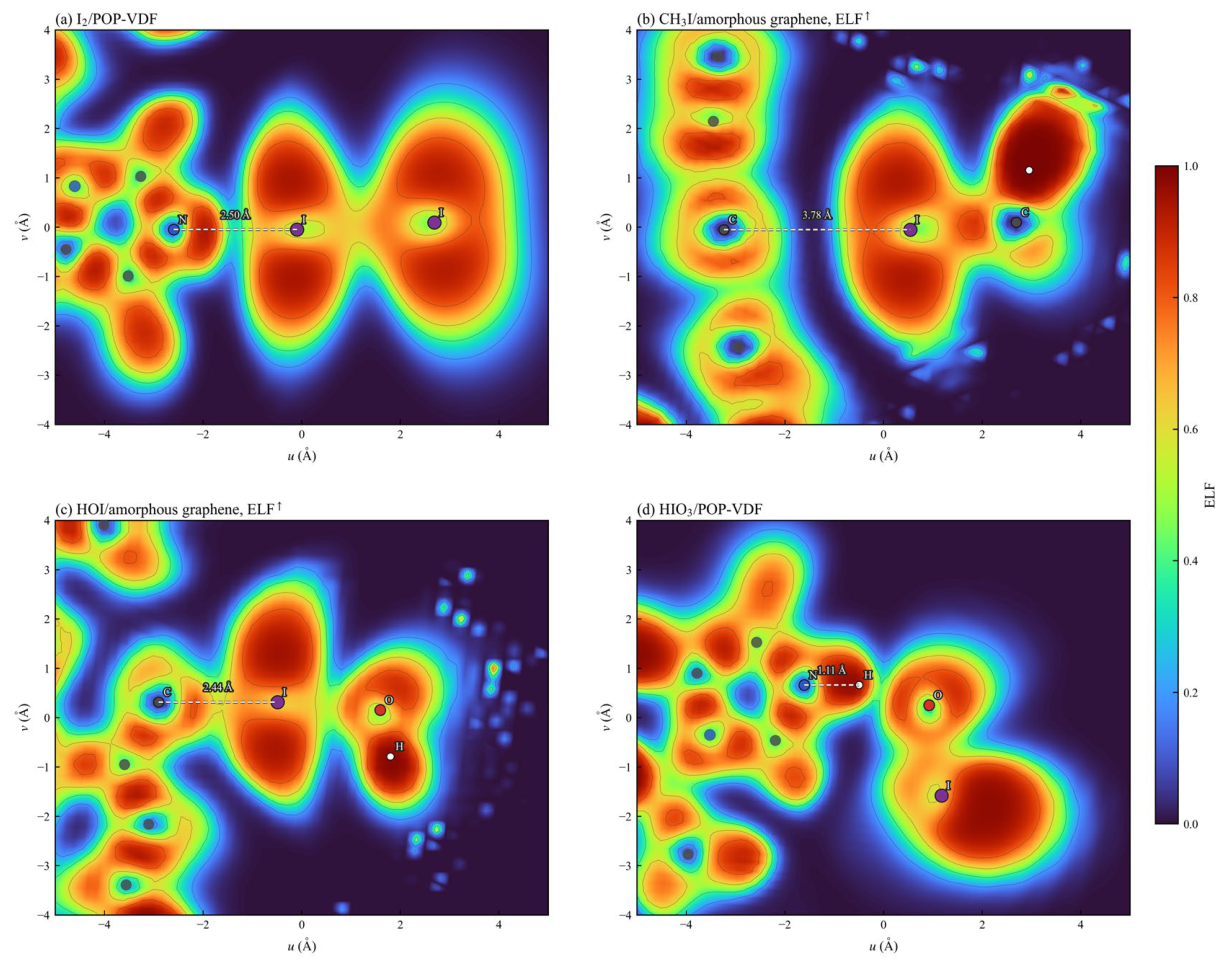
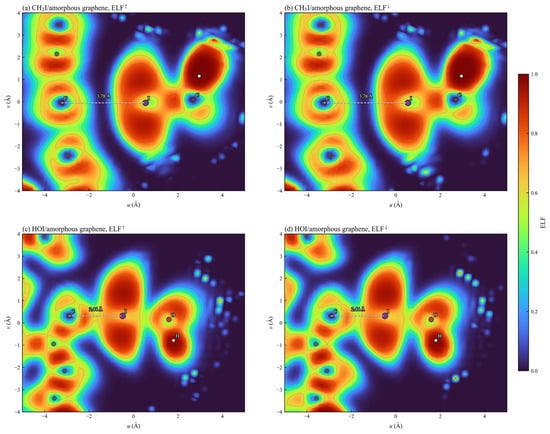
ELF sections through the adsorbate and nearest framework contact reveal distinct real-space electronic environments for the four representative minima (Figure 6). In I2/POP-VDF, localization remains pronounced around the I–I bond while the distribution is polarized toward the nearby framework nitrogen at the 2.499 Å I···N contact, consistent with intact molecular I2 coupled to a directional interfacial interaction. CH3I/amorphous graphene represents the weak-contact limit: the closest sampled C···I separation is 3.781 Å and the intervening region has low ELF, in agreement with the small adsorption energy and minimal structural perturbation. HOI/amorphous graphene exhibits a shorter 2.440 Å I···C contact and a more localized interfacial region while retaining the O–H bond, indicating stronger local polarization without proton rearrangement. HIO3/POP-VDF is qualitatively distinct, with a localized N–H region at the 1.112 Å H–N contact and a substantially elongated original O–H bond. Considered together with the 1.477 Å O–H distance and the −1.260 eV adsorption energy (Table 1), this localization pattern supports the assignment of a proton-transferred configuration. Thus, the ELF comparison follows the same qualitative progression inferred from the optimized geometries and adsorption energies, from weak long-range contact to increasingly localized and structurally reorganized interactions, while not by itself assigning formal charge transfer or bond order.
Figure 6.
Electron localization function (ELF) sections for (a) I2/POP-VDF, (b) CH3I/amorphous graphene, (c) HOI/amorphous graphene, and (d) HIO3/POP-VDF. Spin-up ELF is shown in (b,c).
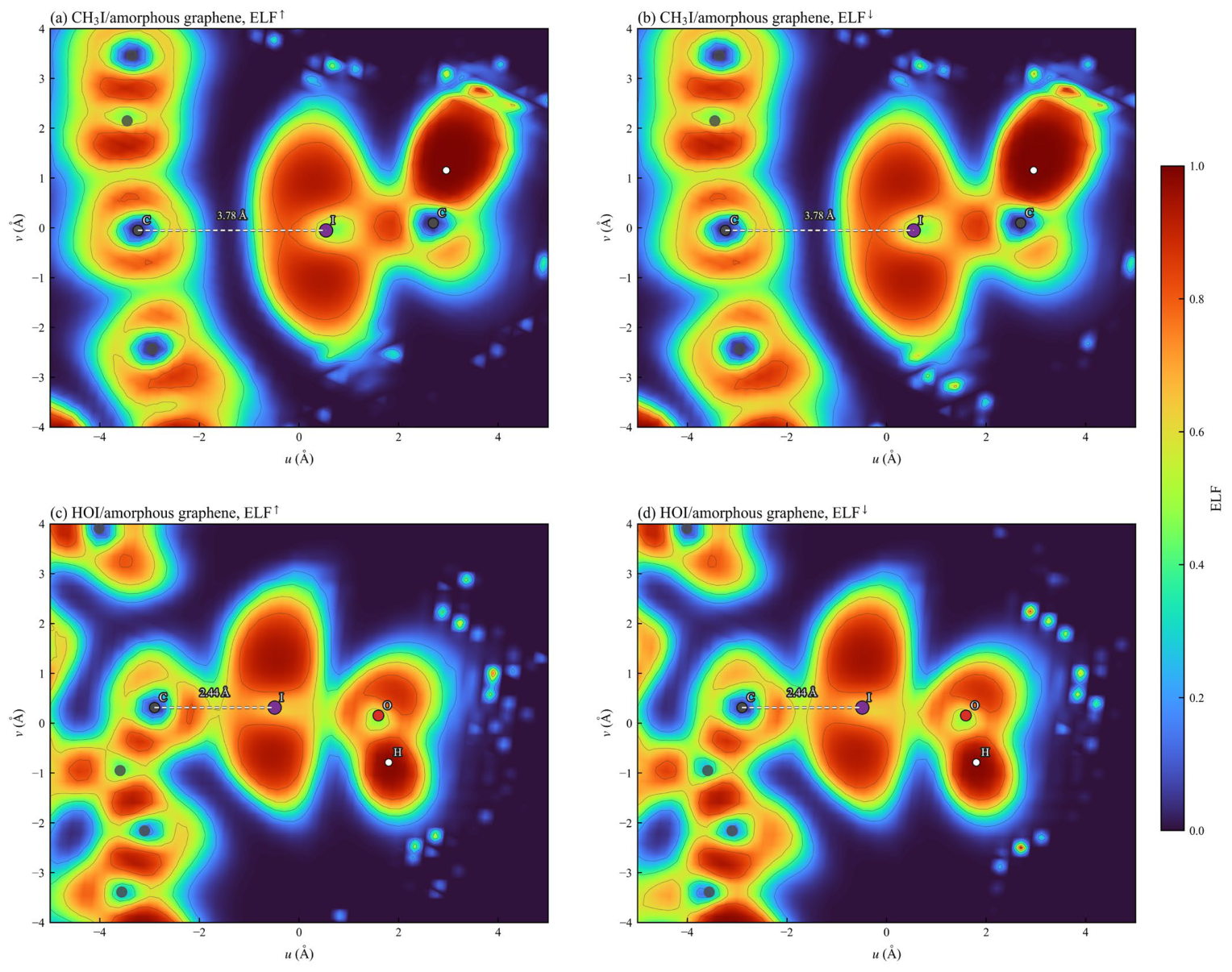
Because the amorphous-graphene calculations are spin polarized, the two ELFCAR blocks were not averaged. Figure 7 therefore compares ELF ↑ and ELF ↓ for CH3I and HOI using identical section definitions and color limits. Retaining the two channels separately avoids obscuring local spin-channel differences and, more importantly for the present adsorption analysis, shows that the qualitative contrast between the two adsorbates is reproduced in both channels: CH3I remains separated from the carbon framework by a long, weakly localized contact region, whereas HOI approaches the defect site more closely and exhibits stronger interfacial localization. These spin-resolved maps are used to represent the electronic structure of the amorphous-carbon systems faithfully; neither channel alone is interpreted as a total ELF, and the observed differences are not taken as evidence for spin-selective adsorption or as a quantitative measure of magnetic coupling. The unpaired-spin character of the clean C139H51 model—an odd number (607) of valence electrons giving a total magnetic moment of 9.0 μB carried by low-coordination edge and hole-region carbon atoms—is quantified per atom in Table S4 of the ESI.
Figure 7.
Spin-resolved ELF sections for (a,b) CH3I/amorphous graphene and (c,d) HOI/amorphous graphene.
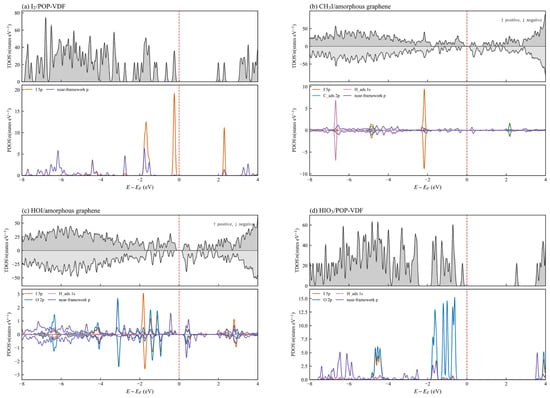
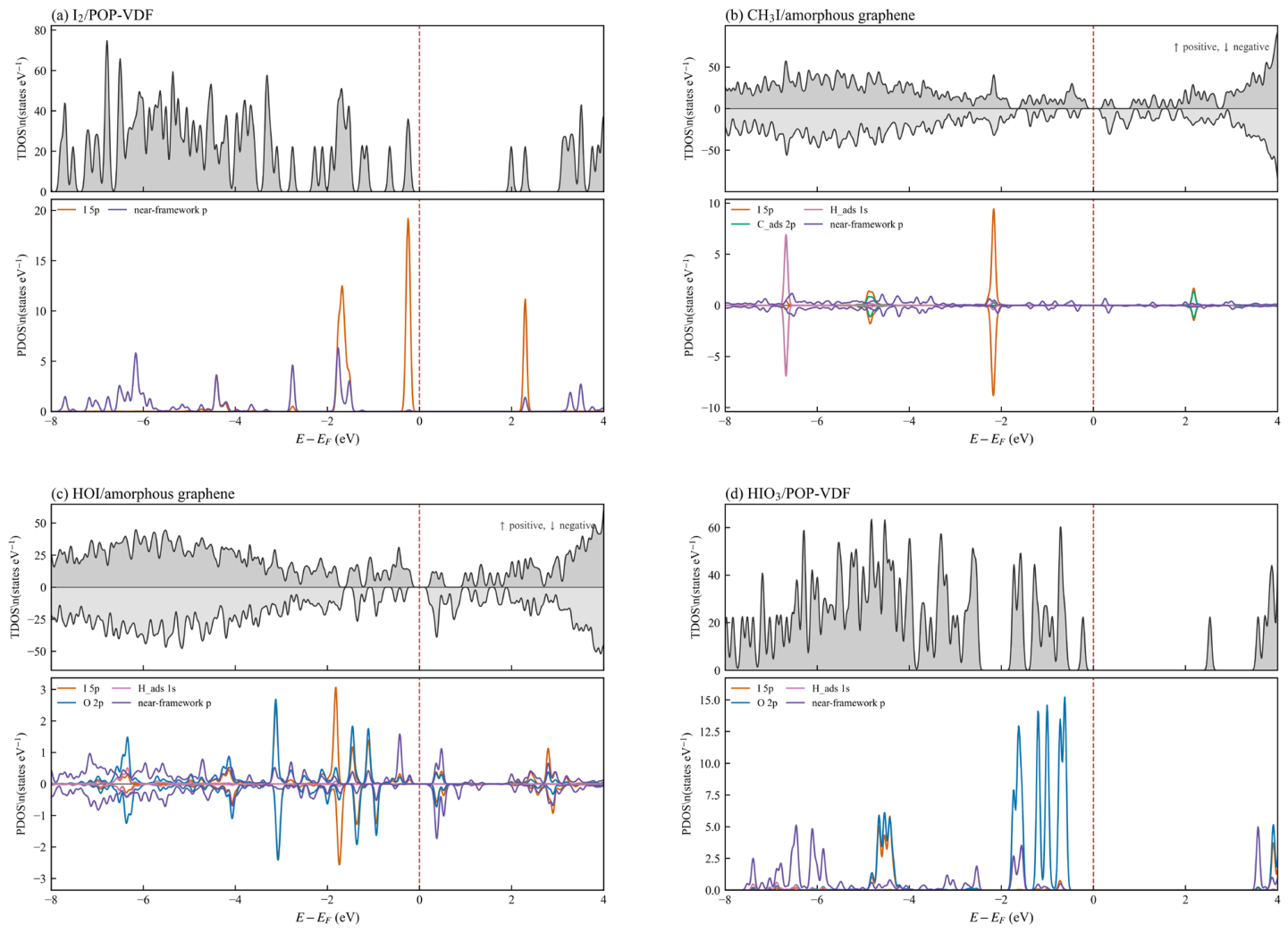
The total and projected densities of states provide a complementary energy-resolved comparison of the same representative minima (Figure 8). I2/POP-VDF exhibits sharp occupied I 5p features together with framework-p intensity over part of the same energy range. When considered alongside the short I···N distance and the polarized ELF distribution, this coincidence is consistent with enhanced electronic coupling and possible orbital mixing at the local contact. CH3I/amorphous graphene retains a comparatively localized I 5p feature centered near −2.2 eV, with only weak nearby framework-p intensity, matching its long adsorbate–framework distance, small adsorption energy, and low interfacial ELF. HOI/amorphous graphene shows more broadly distributed I 5p and O 2p weight across the occupied region, with framework-p contributions in several corresponding intervals. This broader coincidence is consistent with a more strongly perturbed adsorbate–framework interaction than in CH3I, while the preserved O–H bond indicates that the interaction remains molecular rather than proton transferred.
Figure 8.
Total (upper) and projected (lower) densities of states for (a) I2/POP-VDF, (b) CH3I/amorphous graphene, (c) HOI/amorphous graphene, and (d) HIO3/POP-VDF.
For HIO3/POP-VDF, intense O 2p contributions between approximately −1.8 and −0.6 eV and coincident I 5p/O 2p weight near −4.5 eV reflect the electronic structure of the internally bonded iodine–oxygen fragment, while framework-p contributions occur in parts of the same occupied-energy range. Such state coincidence alone would not establish proton transfer; in the present case, however, it occurs together with the 1.477 Å O–H elongation, the 1.112 Å H–N contact, and the localized N–H ELF region. The agreement among these independent descriptors is therefore consistent with a proton-assisted, partly dissociative minimum rather than a merely stronger physisorbed HIO3 molecule. More generally, the electronic analyses reinforce but do not overdetermine the structural interpretation: coincident PDOS features are treated as evidence of possible orbital mixing rather than as a quantitative measure of charge transfer, and ELF identifies spatial localization without defining a formal bond order. The combined Eads, geometry, ELF, and PDOS results provide a coherent multi-descriptor picture of how the dominant local interaction changes across the four iodine-bearing species. Bader analysis of the same optimized complexes corroborates this picture quantitatively (Table S5): the net charge transferred to the intact adsorbates remains within −0.063 to +0.201 e (species-averaged transfer −0.03 e for CH3I versus 0.09–0.15 e for HOI, HIO3 and I2), and it correlates with the adsorption energy across the fifteen non-proton-transfer complexes (Pearson coefficient 0.81), confirming charge-transfer contributions of physical magnitude; only the proton-transferred HIO3/POP-VDF complex exhibits large intramolecular charge separation, with the IO3 fragment gaining 0.69 e, as expected for the ion-pair character discussed in Section 2.2.2.
2.6. Grand Canonical Monte Carlo Adsorption Isotherms
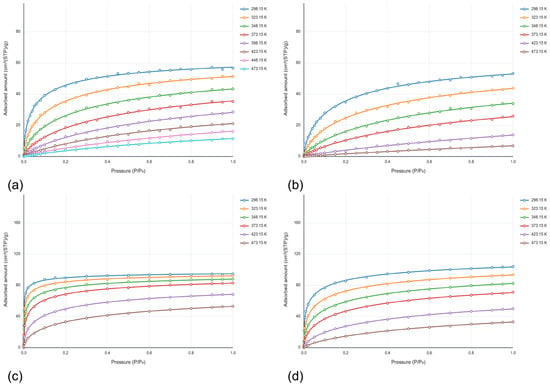
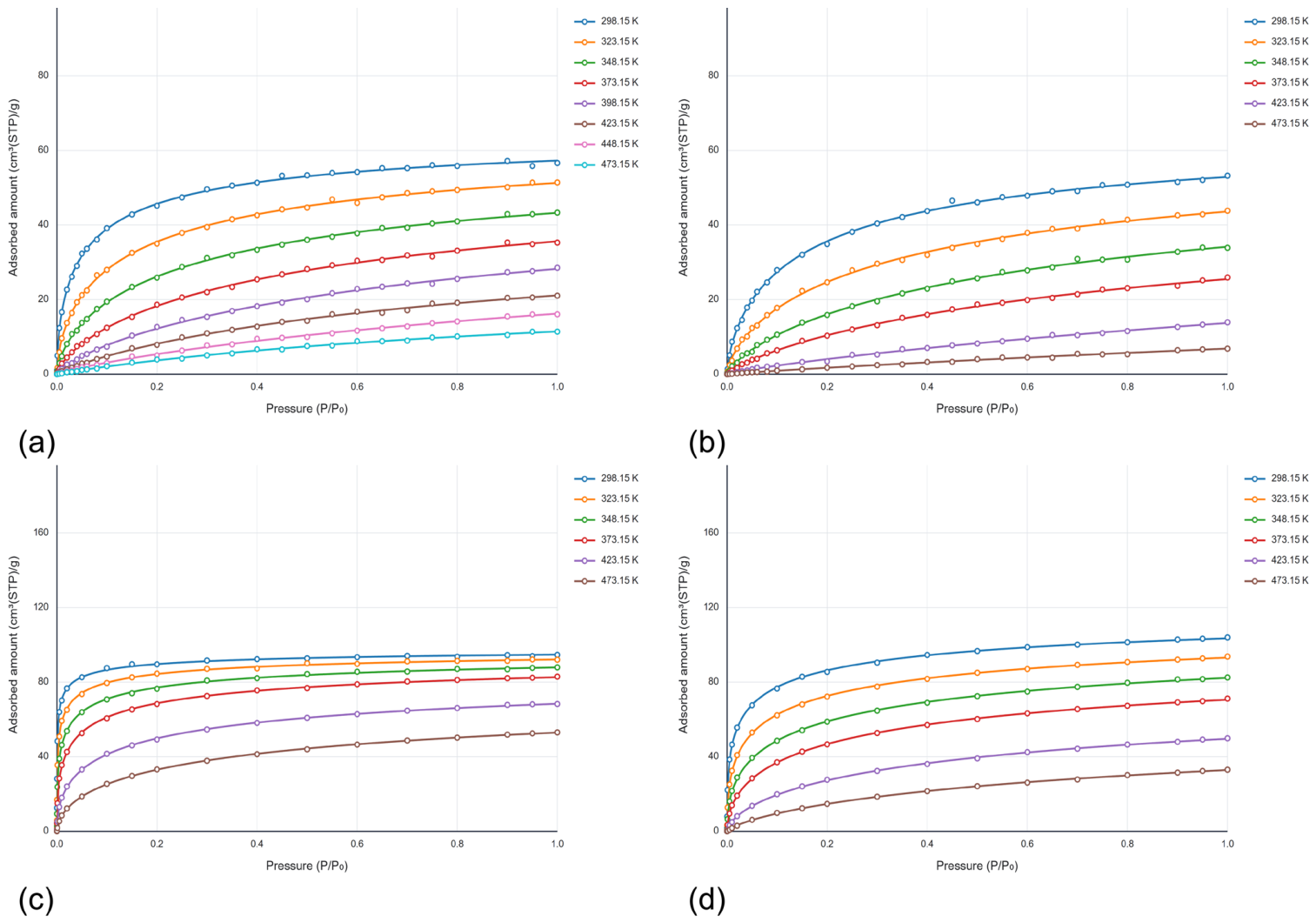
Figure 9 presents the simulated adsorption isotherms of the four preferred host–guest pairs on the periodic crosslinked models described in Section 2.7. All isotherms exhibit type-I (Langmuir-like) behaviour: the uptake rises steeply at low relative pressure and approaches a plateau, consistent with micropore filling, without hysteresis or multistep uptake. The uptake decreases monotonically with increasing temperature for every system, as expected for exothermic adsorption. At 298.15 K and 100 kPa, the simulated uptakes are 641.2 mg/g (I2) and 417.8 mg/g (HIO3) on POP-VDF, and 599.2 mg/g (CH3I) and 667.7 mg/g (HOI) on amorphous graphene. Within each host, the gravimetric uptake reflects the adsorption affinity together with the molecular mass and packing efficiency of the guest. The temperature dependence of the uptake provides an ensemble-level consistency check on the exothermic character of the local binding motifs identified from the optimized structures.
Figure 9.
Grand canonical Monte Carlo (GCMC) adsorption isotherms of the four preferred host–guest pairs on the periodic crosslinked models: (a) I2 and (b) HIO3 in POP-VDF; (c) CH3I and (d) HOI in amorphous graphene, at temperatures from 298.15 to 473.15 K. Uptake is expressed in cm3(STP)/g.
2.7. Implications and Limitations
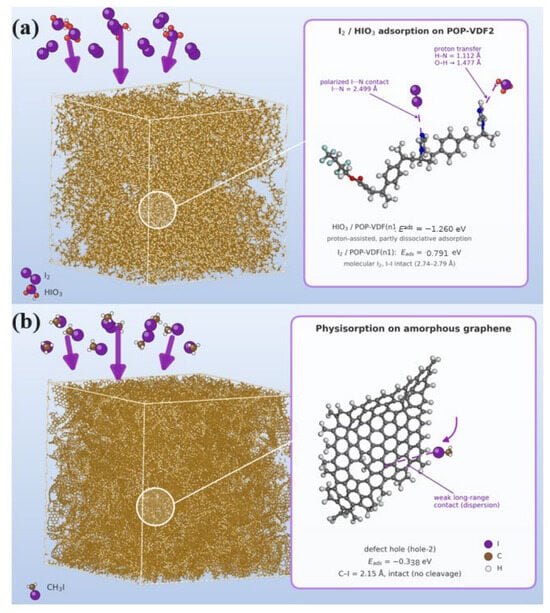
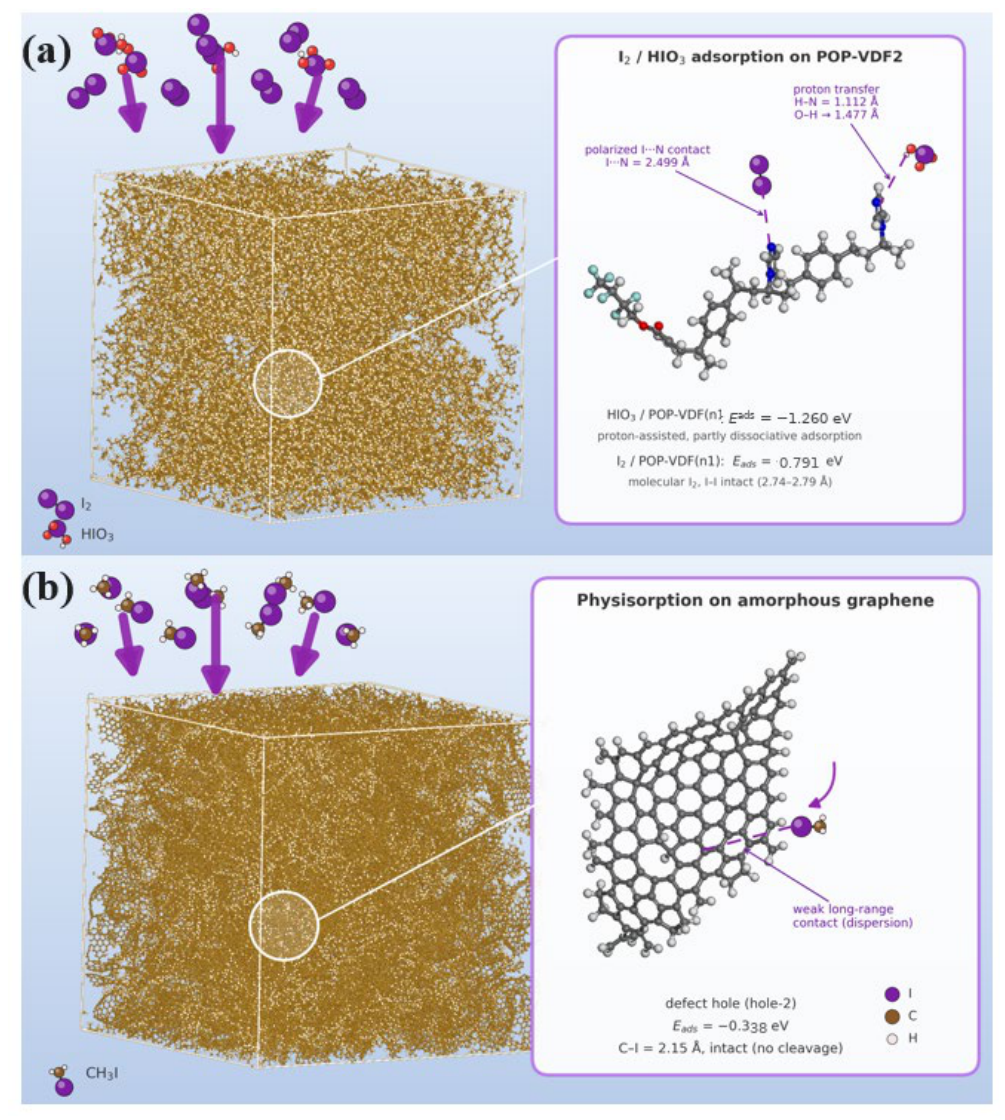
The three-dimensional porous models were constructed with LAMMPS [26] following established protocols for reactive force-field construction of amorphous and cross-linked models [27]. The amorphous-graphene model was built from 625 randomly packed copies of the DFT-optimized C139H51 flake (three packing seeds; initial 185 Å cubic cell; 118,750 atoms) using the AIREBO-M reactive potential [28] under periodic boundary conditions with a 0.25 fs timestep; the pipeline comprised energy minimization and 300 K thermalization, activation by removal of selected edge hydrogen atoms, compression at 1200 K, densification at 1800 K to the target density, two 1800 K annealing cycles with 100 ps cooling ramps to 300 K, a 100 ps NVT equilibration at 300 K, and a final energy minimization, yielding a periodic carbon framework with a cubic cell of ≈121 Å edge length. The POP-VDF model was described by GAFF2-bonded terms with Lennard-Jones nonbonded interactions [29]: an initial 0.80 g/cm3 packing was relaxed at 300 K and densified through three NVT deformation steps (0.83, 0.86 and 0.89 g/cm3), followed by a 125 ps NVT relaxation and a final energy minimization; the validated model is a single connected network without radicals, containing 53,341 atoms in a 90.5 Å cubic cell at 0.89 g/cm3. Quantitative pore characterization based on Voronoi analysis with an N2 probe (1.86 Å radius) reveals distinct porous structural features of the two materials. The compressed POP-VDF model possesses an accessible specific surface area of 1144 m2/g, a maximum cavity diameter of 18.39 Å, a percolation bottleneck size of 7.51 Å, and an accessible pore volume fraction of 13.1%. By comparison, amorphous graphene exhibits an accessible specific surface area of 1052 m2/g, a maximum cavity diameter of 13.20 Å and a percolation bottleneck size of 4.33 Å, with its pore topology consisting of one continuous three-dimensional pore channel and a small number of isolated pore pockets (closed surface area: ~7%). These geometric descriptors characterize the porosity of the constructed models and support the mechanistic analysis below. As illustrated in Figure 10a, POP-VDF immobilizes I2 and HIO3 through the combination of its imidazole-ring nitrogen sites and developed porous structure. The electron-donating imidazole N sites polarize the I–I bond through donor–acceptor interaction and orbital mixing (Section 2.2.1 and Section 2.5), and the basicity of the same N sites accepts the acidic proton of HIO3, giving the proton-transferred minimum of Section 2.2.2. The open pore structure further promotes the diffusion and enrichment of iodine species, ensuring full contact with the active sites for stable adsorption.
Figure 10.
Schematic illustration of the adsorption mechanisms of (a) I2 and HIO3 on POP-VDF and (b) CH3I on amorphous graphene.
In contrast, Figure 10b illustrates the adsorption mechanism of CH3I on amorphous graphene, which is dominated by physical confinement rather than chemical reaction: the preferred defect-hole sites provide enhanced dispersion and polarization contacts while the C–I bond remains intact (Section 2.2.1), and the highly connected three-dimensional pore network with negligible closed porosity facilitates the mass transfer, diffusion and enrichment of CH3I molecules within the porous framework. Chemical N-methylation capture of CH3I requires nitrogen functionalities and is a documented strength of nitrogen-rich sorbents such as amine-impregnated activated carbons [11,12], rather than of the present nitrogen-free amorphous-graphene model, whose CH3I minimum is physisorption-dominated. Overall, the two materials achieve selective immobilization of different iodine species through complementary mechanisms—charge-transfer complexation and proton-transfer chemisorption on POP-VDF, and defect-site confinement on amorphous graphene—assisted by structure-driven mass transfer behaviors.
3. Computational Methods
3.1. Adsorbent and Adsorbate Models
Finite, terminated fragments were used to represent NPOP-1, POP-VDF, and POP-VDX. The three polymers follow established synthetic protocols: NPOP-1 is formed by nucleophilic-substitution polymerization of piperazine (PZ) with 2,4,6-tris(bromomethyl)mesitylene (TBM) in DMF in the presence of DIPEA (PZ:TBM = 9:6 mmol, 60 °C), which converts the benzylic C-Br bonds of TBM into mesitylene-CH2-N(piperazine) linkages, while the remaining bromomethyl groups are retained as pendant substituents of the modeled fragment; POP-VDX was obtained by AIBN-initiated free-radical copolymerization of 1-vinylimidazole (VIm) and divinylbenzene (DVB) at 100 °C for 24 h with toluene as porogen, the modeled composition corresponding to the optimized series member POP-VD2 (porogen/monomer molar ratio = 2, crosslinking degree 20%); and POP-VDF is the fluorinated ternary copolymer incorporating 2,2,3,4,4,4-hexafluorobutyl acrylate (HFBA) as a third monomer (toluene/monomer molar ratio = 1:2), the modeled composition corresponding to the optimized series member POP-VDF2 (crosslinking degree 20%). Their compositions were C28N2H38Br4, C38F6O2H44N4, and C30H32N4, respectively. A C139H51 cluster containing basal regions, edges, holes, and non-hexagonal rings represented amorphous graphene. The fragments were placed in 35 × 35 × 35, 40 × 30 × 30, 24 × 35 × 24, and 35 × 40 × 30 Å3 cells, respectively. Isolated I2, CH3I, HOI, and HIO3 molecules were optimized in 15 × 15 × 15 Å3 cells. The fragments therefore resolve the local adsorption chemistry of the real polymers, while the periodic models carry the pore-scale information. We note that the abbreviation “NPOP-1” has also been used in the literature for triazine/triazole-based nitrogen-rich porous polymers prepared by CuAAC click chemistry [30], the NPOP-1 studied here is the piperazine–TBM network defined above and is chemically distinct from that material. For amorphous graphene, the finite cluster represents the local adsorption chemistry of defect-rich regions, and site populations of a real disordered sample are not inferred from it.
These fragments derive directly from the monomer units: C28N2H38Br4 = two TBM units bridged by one piperazine (two HBr formally eliminated; four bromomethyl groups retained); C30H32N4 = two VIm units linked through two DVB-derived crosslinking units; and C38F6O2H44N4 = two VIm units, DVB-derived crosslinking units, and one HFBA unit (the sole source of the six fluorine atoms and of the ester oxygen atoms). Free valences are saturated by hydrogen, and each fragment contains at least one intact imidazole or amine N site, so that the local linkage chemistry of the real polymers is preserved.
3.2. Density Functional Theory
Density functional theory (DFT) and molecular-dynamics (MD) calculations were performed using the Vienna ab initio simulation package (VASP version 6.4.2) [31]. Calculations were performed with the Vienna Ab initio Simulation Package using projector augmented-wave potentials [32]. Exchange and correlation were described by the Perdew–Burke–Ernzerhof functional [33], and dispersion was included using the D3 correction with Becke–Johnson damping [34]. The multi-start screening was conducted in stages under a force criterion of 0.05 eV/Å, with amorphous graphene initially treated with a plane-wave cutoff of 450 eV at the normal precision setting, an electronic self-consistency threshold of 10−4 eV, and spin polarization included. The preferred minimum of every material–adsorbate pair was then re-optimized under the final uniform protocol summarized in Table 4: the plane-wave energy cutoff is set to 520 eV for all models with the accurate precision setting, and all reported energies refer to this final protocol. According to the Monkhorst-Pack scheme [35], the Brillouin zone was sampled by 3× 3× 3 special mesh points in K-space for a cell of C28N2H38Br4, C38F6O2H44N4, and C30H32N4, respectively. The electronic self-consistent convergence threshold of the final protocol is 10−5 eV for each ionic step (10−6 eV for the amorphous-graphene complexes). A Γ-centered 1 × 1 × 1 k-point mesh was used for all finite clusters. Convergence of the molecular reference energies with respect to the plane-wave cutoff was verified explicitly: raising the molecular cutoff from 500 to 520 eV changes the total energies of isolated I2 and HOI by no more than 0.001 eV. The complete electronic-structure settings of every model are summarized in Table 4, and the per-family convergence records are provided in the ESI. Table S3 of the ESI records the re-optimization of every preferred minimum together with the comparison against the screening-stage energies: the differences are at most 0.067 eV for the amorphous-graphene systems and at most 0.161 eV for the other combinations, with one chemically interpretable exception—HIO3/POP-VDX, where the re-optimization recovers a deeper minimum at the neighbouring n1 site (−1.362 versus −0.861 eV)—and the species-level trends, namely weak CH3I binding on every material, strong I2 and HIO3 binding on the nitrogen-rich polymers, and the favourable HOI environment of amorphous graphene, are preserved. All electronic-structure analyses (ELF, PDOS, and Bader charges) were performed as single-point calculations on the preferred-minimum geometries: the plane-wave energy cutoff is likewise set to 520 eV with the accurate precision setting, which provides the finer fast-Fourier-transform grid used for the ELF maps, the electronic self-consistency threshold is 10−6 eV, and integration over the Brillouin zone is done at the Γ point.
Table 4.
Adsorbent models and principal electronic-structure and optimization settings.
3.3. Site Screening and Adsorption Energies
For each material–adsorbate pair, molecules were placed at chemically or topologically distinct local environments with several initial orientations. Amorphous graphene sites included basal, edge, hole, pentagonal, and heptagonal environments. The NPOP labels denote nearby framework, window, N-containing, O-containing, bridge, or related local motifs. Throughout this work, the site labels denote the local placement environment: k = framework (aromatic backbone) regions, w = window regions between framework units, n = sites adjacent to nitrogen heteroatoms (imidazyl/amine N), o = sites adjacent to oxygen atoms (ester O), and hole-1/hole-2 = defect-hole environments of amorphous graphene (pentagonal/heptagonal-ring termini). Retained converged site/orientation families relative to the number examined are listed in Table 5. Nested restart directories were treated as continuations of one initial family rather than independent observations. Only runs that ended normally and reached the specified ionic convergence criterion were retained. The adsorption energies of the four complexes were obtained using the equation: The full definitions of all site labels, including the anchor atoms of every start, are given in Table S1 of the Electronic Supplementary Information (ESI), and the complete inventory of the 170 examined families, their optimized total energies and convergence outcomes is listed in Table S2 of the ESI.
where Eads is the adsorption energy of an isolated I2, CH3I, HOI, and HIO3 molecules, C28N2H38Br4, C38F6O2H44N4, C30H32N4 and amorphous graphene of the four complexes atoms in the same cell, respectively. Negative Eads values denote exothermic binding relative to the separately optimized clean fragment and isolated molecule. A total of 168 of 170 site/orientation families were retained. One POP-VDX/I2 continuation and one added amorphous graphene/HIO3 orientation reached the ionic-step limit without satisfying the force criterion and were excluded without assigning an inferred energy.
Eads = Ecomplex − Eadsorbent − Emolecule
Table 5.
Retained converged site/orientation families relative to the number examined.
3.4. Grand Canonical Monte Carlo
To complement the site-resolved density-functional-theory calculations, pure-component adsorption isotherms were evaluated for I2/POP-VDF, HIO3/POP-VDF, CH3I/amorphous graphene, and HOI/amorphous graphene using grand canonical Monte Carlo (GCMC) sampling on the periodic crosslinked adsorbent models described in Section 2.7. Isotherms were computed at temperatures from 298.15 to 473.15 K over the relative-pressure range P/P0 = 0–1 (P0 = 100 kPa), with 20–30 pressure points per isotherm. The frameworks were held fixed, the adsorbate molecules were modelled as rigid all-atom interaction sites with Lennard-Jones parameters taken from the UFF [36] and combined by the Lorentz–Berthelot rules (12.0 Å cutoff), and no electrostatic terms were included. The simulations were performed with RASPA 3 (version 3.0.29) [37]; each state point consisted of 100 initialization cycles followed by 300 production cycles with block averaging. The equilibrium uptake was recorded in mass-normalized units (mg/g and cm3(STP)/g).
4. Conclusions
Dispersion-corrected first-principles calculations establish a species- and site-resolved picture of the local adsorption of I2, CH3I, HOI, and HIO3 on NPOP-1, POP-VDF, POP-VDX, and amorphous graphene fragments. Across 170 initial site/orientation families, 168 satisfied the ionic convergence criterion, and all 16 material–adsorbate combinations yielded exothermic minimum adsorption energies. CH3I consistently occupied the weak-binding end of the dataset and underwent little intramolecular distortion, supporting predominantly dispersive physisorption. I2 remained molecular but was more responsive to local chemistry, with POP-VDF/n1 providing the most favorable I2 minimum (−0.791 eV) through a short, polarized I···N contact. The oxygen-containing species exhibited stronger directional interactions. In particular, HIO3 showed a clear progression from intact molecular adsorption on NPOP-1 and amorphous graphene, through partial proton displacement on POP-VDX, to a fully proton-transferred minimum on POP-VDF (−1.260 eV), while the deepest HIO3 minimum of the matrix lies on the neighbouring imidazole polymer POP-VDX (−1.362 eV). The broad screening-stage site/orientation energy ranges, reaching 1.226 eV for POP-VDF/HIO3, further demonstrate that a single starting configuration can misrepresent the preferred local adsorption motif in chemically heterogeneous adsorbents. Overall, POP-VDF and amorphous graphene achieve selective immobilization of different iodine species through complementary mechanisms—charge-transfer complexation and proton-transfer chemisorption on POP-VDF, and defect-site confinement on amorphous graphene—providing guidance for the design of species-specific iodine-capture adsorbents. The combined calculations show that iodine adsorption reflects both local interaction chemistry and fugacity-dependent ensemble occupation. Integrating site-resolved electronic descriptors with loading behavior supports species-resolved design strategies for iodine-control materials relevant to nuclear-fuel-cycle applications.
Supplementary Materials
The following supporting information can be downloaded at: https://www.mdpi.com/article/10.3390/inorganics14110278/s1. Table S1: Definition of the adsorption-site labels used in Table 1; Table S2: Complete inventory of the 170 site/orientation families examined in the screening; Table S3: Re-optimization of the preferred minimum of every material–adsorbate pair under the final uniform protocol (plane-wave cutoff 520 eV, accurate precision) and comparison with the screening-stage energies; Table S4: Spin-polarized characterization of the amorphous-graphene model; Table S5: Bader charge-transfer analysis of the preferred adsorption complexes; Coordinates of the preferred adsorption minima and of the isolated adsorbate molecules are provided as a separate archive (ESI_coordinates.zip).
Author Contributions
Conceptualization, D.L. and J.W.; methodology, D.L.; software, D.L.; validation, D.L., Q.C. and Q.Z.; formal analysis, D.L.; investigation, D.L. and W.G.; resources, J.W.; data curation, D.L.; writing—original draft preparation, D.L.; writing—review and editing, J.W., Q.C., Q.Z. and W.G.; visualization, D.L.; supervision, J.W.; project administration, J.W.; funding acquisition, J.W. All authors have read and agreed to the published version of the manuscript.
Funding
This research received no external funding.
Institutional Review Board Statement
Not applicable.
Informed Consent Statement
Not applicable.
Data Availability Statement
The original contributions presented in this study are included in the article/Supplementary Material. Further inquiries can be directed to the corresponding author.
Acknowledgments
The authors sincerely thank Hu from Beijing University of Chemical Technology for his valuable technical support and provision of computing resources in the progress of this research.
Conflicts of Interest
The authors were employed by China National Nuclear Industry Corporation company. The authors declare that the research was conducted in the absence of any commercial or financial relationships that could be construed as a potential conflict of interest.
References
- Soelberg, N.R.; Garn, T.G.; Greenhalgh, M.R.; Law, J.D.; Jubin, R.; Strachan, D.M.; Thallapally, P.K. Radioactive iodine and krypton control for nuclear fuel reprocessing facilities. Sci. Technol. Nucl. Install. 2013, 2013, 702496. [Google Scholar] [CrossRef] [Scilit]
- Riley, B.J.; Vienna, J.D.; Strachan, D.M.; McCloy, J.S.; Jerden, J.L. Materials and processes for the effective capture and immobilization of radioiodine: A review. J. Nucl. Mater. 2016, 470, 307–326. [Google Scholar] [CrossRef] [Scilit]
- Huve, J.; Ryzhikov, A.; Nouali, H.; Lalia, V.; Augé, G.; Daou, T.J. Porous sorbents for the capture of radioactive iodine compounds: A review. RSC Adv. 2018, 8, 29248–29273. [Google Scholar] [CrossRef] [Scilit] [PubMed]
- Pan, T.; Yang, K.; Dong, X.; Han, Y. Adsorption-based capture of iodine and organic iodides: Status and challenges. J. Mater. Chem. A 2023, 11, 5460–5475. [Google Scholar] [CrossRef] [Scilit]
- Zhang, Y.; Li, Z.; Xia, H.; Xue, M.; Liu, X.; Mu, Y. Highly efficient and reversible iodine capture using a metalloporphyrin-based conjugated microporous polymer. Chem. Commun. 2014, 50, 8495–8498. [Google Scholar] [CrossRef] [Scilit] [PubMed]
- Wang, S.; Liu, Y.; Ye, Y.; Meng, X.; Du, J.; Song, X.; Liang, Z. Ultrahigh volatile iodine capture by conjugated microporous polymer based on N, N, N′, N′-tetraphenyl-1, 4-phenylenediamine. Polym. Chem. 2019, 10, 2608–2615. [Google Scholar] [CrossRef] [Scilit]
- Sen, A.; Sharma, S.; Dutta, S.; Shirolkar, M.M.; Dam, G.K.; Let, S.; Ghosh, S.K. Functionalized ionic porous organic polymers exhibiting high iodine uptake from both the vapor and aqueous medium. ACS Appl. Mater. Interfaces 2021, 13, 34188–34196. [Google Scholar] [CrossRef] [Scilit] [PubMed]
- Hassan, A.; Das, N. Chemically stable and heteroatom containing porous organic polymers for efficient iodine vapor capture and its storage. ACS Appl. Polym. Mater. 2023, 5, 5349–5359. [Google Scholar] [CrossRef] [Scilit]
- Yang, J.; Wang, S.; Yan, Q.; Hu, H.; Xu, H.; Ma, H.; Su, X.; Gao, Y. Novel nitrogen-rich conjugated microporous polymers for efficient capture of iodine and methyl iodide. Polym. Chem. 2024, 15, 2652–2661. [Google Scholar] [CrossRef] [Scilit]
- Juhola, A.J. Iodine adsorption and structure of activated carbons. Carbon 1975, 13, 437–442. [Google Scholar] [CrossRef] [Scilit]
- Lin, H.; Chebbi, M.; Monsanglant-Louvet, C.; Marcillaud, B.; Roynette, A.; Doizi, D.; Parent, P.; Laffon, C.; Grauby, O.; Ferry, D. KI and TEDA influences towards the retention of radiotoxic CH3I by activated carbons. J. Hazard. Mater. 2022, 431, 128548. [Google Scholar] [CrossRef] [Scilit] [PubMed]
- Chun, H.; Kang, J.; Han, B. First principles computational study on the adsorption mechanism of organic methyl iodide gas on triethylenediamine impregnated activated carbon. Phys. Chem. Chem. Phys. 2016, 18, 32050–32056. [Google Scholar] [CrossRef] [Scilit] [PubMed]
- Pham, T.C.T.; Docao, S.; Hwang, I.C.; Song, M.K.; Choi, D.Y.; Moon, D.; Oleynikov, P.; Yoon, K.B. Capture of iodine and organic iodides using silica zeolites and the semiconductor behaviour of iodine in a silica zeolite. Energy Environ. Sci. 2016, 9, 1050–1062. [Google Scholar] [CrossRef] [Scilit]
- Sava Gallis, D.F.; Ermanoski, I.; Greathouse, J.A.; Chapman, K.W.; Nenoff, T.M. Iodine gas adsorption in nanoporous materials: A combined experiment–modeling study. Ind. Eng. Chem. Res. 2017, 56, 2331–2338. [Google Scholar] [CrossRef] [Scilit]
- Bruffey, S.H.; Jubin, R.T.; Jordan, J.A. Capture of elemental and organic iodine from dilute gas streams by silver-exchanged mordenite. Procedia Chem. 2016, 21, 293–299. [Google Scholar] [CrossRef] [Scilit]
- Lan, Y.; Tong, M.; Yang, Q.; Zhong, C. Computational screening of covalent organic frameworks for the capture of radioactive iodine and methyl iodide. CrystEngComm 2017, 19, 4920–4926. [Google Scholar] [CrossRef] [Scilit]
- He, L.; Chen, L.; Dong, X.; Zhang, S.; Zhang, M.; Dai, X.; Liu, X.; Lin, P.; Li, K.; Chen, C.; et al. A nitrogen-rich covalent organic framework for simultaneous dynamic capture of iodine and methyl iodide. Chem 2021, 7, 699–714. [Google Scholar] [CrossRef] [Scilit]
- Niu, T.H.; Feng, C.C.; Yao, C.; Yang, W.-Y.; Xu, Y.-H. Bisimidazole-based conjugated polymers for excellent iodine capture. ACS Appl. Polym. Mater. 2021, 3, 354–361. [Google Scholar] [CrossRef] [Scilit]
- Yu, Y.N.; Yin, Z.; Cao, L.H.; Ma, Y.-M. Organic porous solid as promising iodine capture materials. J. Incl. Phenom. Macrocycl. Chem. 2022, 102, 395–427. [Google Scholar] [CrossRef] [Scilit]
- Yang, J.; Hu, S.J.; Cai, L.X.; Zhou, L.-P.; Sun, Q.-F. Counteranion-mediated efficient iodine capture in a hexacationic imidazolium organic cage enabled by multiple non-covalent interactions. Nat. Commun. 2023, 14, 6082. [Google Scholar] [CrossRef] [Scilit] [PubMed]
- Pei, C.; Ben, T.; Xu, S.; Qiu, S. Ultrahigh iodine adsorption in porous organic frameworks. J. Mater. Chem. A 2014, 2, 7179–7187. [Google Scholar] [CrossRef] [Scilit]
- Pan, X.; Ding, C.; Zhang, Z.; Ke, H.; Cheng, G. Functional porous organic polymer with high S and N for reversible iodine capture. Microporous Mesoporous Mater. 2020, 300, 110161. [Google Scholar] [CrossRef] [Scilit]
- Wu, J.; Ma, S.; Cui, J.; Yang, Z.; Zhang, J. Nitrogen-Rich Porous Organic Polymers with Supported Ag Nanoparticles for Efficient CO2 Conversion. Nanomaterials 2022, 12, 3088. [Google Scholar] [CrossRef] [Scilit] [PubMed]
- Tristant, D.; Puech, P.; Gerber, I.C. Theoretical study of graphene doping mechanism by iodine molecules. J. Phys. Chem. C 2015, 119, 12071–12078. [Google Scholar] [CrossRef] [Scilit][Green Version]
- Wang, J.; Li, Z.; Wang, Y.; Wei, C.; Ai, K.; Lu, L. Hydrogen bond-mediated strong adsorbent–I3− interactions enable high-efficiency radioiodine capture. Mater. Horiz. 2019, 6, 1517–1525. [Google Scholar] [CrossRef] [Scilit]
- Plimpton, S. Fast parallel algorithms for short-range molecular dynamics. J. Comput. Phys. 1995, 117, 1–19. [Google Scholar] [CrossRef] [Scilit]
- Gutiérrez Moreno, J.J.; Pan, K.; Wang, Y.; Li, W. Computational study of APTES surface functionalization of diatom-like amorphous SiO2 surfaces for heavy metal adsorption. Langmuir 2020, 36, 5680–5689. [Google Scholar] [CrossRef] [Scilit] [PubMed]
- O’Connor, T.C.; Andzelm, J.; Robbins, M.O. AIREBO-M: A reactive model for hydrocarbons. J. Chem. Phys. 2015, 142, 024903. [Google Scholar] [CrossRef] [Scilit] [PubMed]
- Wang, J.; Wolf, R.M.; Caldwell, J.W.; Kollman, P.A. Development and testing of a general amber force field. J. Comput. Chem. 2004, 25, 1157–1174. [Google Scholar] [CrossRef] [Scilit] [PubMed]
- Silvi, B.; Savin, A. Classification of chemical bonds based on topological analysis of electron localization functions. Nature 1994, 371, 683–686. [Google Scholar] [CrossRef] [Scilit]
- Kresse, G.; Furthmüller, J. Efficient iterative schemes for ab initio total-energy calculations using a plane-wave basis set. Phys. Rev. B 1996, 54, 11169. [Google Scholar] [CrossRef] [Scilit] [PubMed]
- Blöchl, P.E. Projector augmented-wave method. Phys. Rev. B 1994, 50, 17953. [Google Scholar] [CrossRef] [Scilit] [PubMed]
- Perdew, J.P.; Burke, K.; Ernzerhof, M. Generalized gradient approximation made simple. Phys. Rev. Lett. 1996, 77, 3865. [Google Scholar] [CrossRef] [Scilit] [PubMed]
- Grimme, S.; Antony, J.; Ehrlich, S.; Krieg, H. A consistent and accurate ab initio parametrization of density functional dispersion correction (DFT-D) for the 94 elements H-Pu. J. Chem. Phys. 2010, 132, 154104. [Google Scholar] [PubMed]
- Monkhorst, H.J.; Pack, J.D. Special points for Brillouin-zone integrations. Phys. Rev. B 1976, 13, 5188–5192. [Google Scholar] [CrossRef] [Scilit]
- Rappé, A.K.; Casewit, C.J.; Colwell, K.S.; Goddard, W.A.; Skiff, W.M. UFF, a full periodic table force field for molecular mechanics and molecular dynamics simulations. J. Am. Chem. Soc. 1992, 114, 10024–10035. [Google Scholar] [CrossRef] [Scilit]
- Dubbeldam, D.; Calero, S.; Ellis, D.E.; Snurr, R.Q. RASPA: Molecular simulation software for adsorption and diffusion in flexible nanoporous materials. Mol. Simul. 2016, 42, 81–101. [Google Scholar] [CrossRef] [Scilit]

Disclaimer/Publisher’s Note: The statements, opinions and data contained in all publications are solely those of the individual author(s) and contributor(s) and not of MDPI and/or the editor(s). MDPI and/or the editor(s) disclaim responsibility for any injury to people or property resulting from any ideas, methods, instructions or products referred to in the content. |
© 2026 by the authors. Licensee MDPI, Basel, Switzerland. This article is an open access article distributed under the terms and conditions of the Creative Commons Attribution (CC BY) license.