Article

Gamma Irradiation Effect on the Verdet Constant of Standard Single-Mode Ge-Doped Optical Fibre


1
SCK CEN Belgian Nuclear Research Centre, Boeretang 200, B-2400 Mol, Belgium
2
Physics and Engineering Bureau, B-2400 Mol, Belgium
3
Department of Materials, Textiles and Chemical Engineering, Ghent University, Technologiepark Zwijnaarde 46, B-9052 Ghent, Belgium
4
Department of Electromagnetism and Telecommunications, University of Mons, B-7000 Mons, Belgium
*
Author to whom correspondence should be addressed.
Photonics 2026, 13(3), 277; https://doi.org/10.3390/photonics13030277
Submission received: 23 February 2026 / Revised: 9 March 2026 / Accepted: 11 March 2026 / Published: 14 March 2026
(This article belongs to the Section Lasers, Light Sources and Sensors)

Abstract

Optical fibres are considered for applications in various nuclear environments in the presence of radiation exposure. Under irradiation, the properties of the optical fibres are modified. In the present paper we investigate the influence of gamma radiation on the magneto-optical properties of the Corning SMF-28e optical fibre. The stability of the Verdet constant is an important requirement for performing current measurements under radiation, for example, in magnetic fusion installations during nuclear (deuterium–tritium) plasma operation, where radiation at MGy dose levels can be accumulated. Our results demonstrate that radiation-induced changes in the Verdet constant are within its measurement accuracy (0.56%) for gamma radiation doses up to 770 kGy.

1. Introduction

Optical fibres are considered for applications in various environments imposing irradiation fields, such as space, nuclear medicine, high-energy physics, nuclear fusion and fission energy generation. Under irradiation, the properties of the exposed optical fibres are modified in a rather complex way [1]. The most studied effect is radiation-induced attenuation (RIA, a decrease in the fibre transmission capability) as it directly influences the signal intensity, creating obvious problems for intensity-based measurements [2]. The modification of other parameters is also worth considering. For example, refractive index changes can compromise the performance of fibre-Bragg-grating-based devices [3]. In the present paper we investigate the influence of gamma irradiation on the magneto-optical properties of standard single-mode Ge-doped optical fibres. The need for this study stems from the use of optical fibres for plasma current measurements in magnetic fusion devices. The fibre-optic current sensor (FOCS) is indeed used in present-day tokamaks [4,5,6], including in-vessel installation [7]. In the latter case the environment is much harsher than that for ex-vessel locations. In future nuclear operating installations, the sensing fibre will be exposed to a severe radiation environment. For example, in ITER the expected FOCS lifetime gamma radiation dose is in a 10 MGy range [8]. The FOCS operation is based on the magneto-optic Faraday effect, i.e., the generation of circular birefringence in an optical medium subjected to a magnetic field H [9]. The polarisation plane of a linearly polarised light propagating in a medium is rotated by an angle proportional to the axial magnetic field (the component of H aligned with the propagation axis) strength and the length of the interaction. In the case of FOCS, light propagates in an optical fibre, which makes a loop around a current. According to Ampere’s theorem, the total polarisation rotation angle θ is directly proportional to the enclosed current I, independently of the current distribution. In the case of an ideal fibre with no linear birefringence, the rotation angle is defined as [9]:
θ = V I
where V is the Verdet constant.
In the semi-classical approximation, the Verdet constant can be defined by an equation derived by H. Becquerel [10]. The quantum treatment of the problem shows that the result should also depend on the medium’s magnetic properties, i.e., whether it is diamagnetic, paramagnetic, etc. Considering the electronic structure properties results in the following form of the Becquerel’s equation [10]:
V λ = γ e 2 m c 2 λ d n d λ
where e and m are the charge and mass of the electron, c is the speed of light, n is the refraction index, and γ is a dimensionless constant describing the deviation of the Verdet constant from the value predicted by the original semi-classical theory. It may be noted that for standard optical glasses d n / d λ is negative. Since the refraction index of optical fibres is changed by ionising radiation [3], exposure to radiation will also change the value of the Verdet constant. The scale of the radiation-induced refraction index change strongly depends on the glass chemical composition [11].
From the point of view of the current measurements, a change in the Verdet constant results in a systematic error. Correction of this error may be rather complicated because the impact of radiation depends on various factors, for example, the dose rate, irradiation history, and temperature variations during the exposure.
To the best of our knowledge, there are only a few publications where radiation-induced changes in the Verdet constant of optical fibres are investigated in a systematic way. Y. Kim et al. [12] studied the influence of gamma irradiation on the Faraday effect in Cu-doped Germano-silicate optical fibres. Irradiation up to 1.2 kGy at a dose rate of 20 Gy/min from a Co60 source resulted in a 6.7% increase in the Verdet constant at 1310 nm. For the Corning SMF-28e, the increase was significantly lower: 1.3%. The measurements were performed for magnetic fields ranging from 0 to 0.14 T and a fibre length of 7.62 cm. In another publication, J. Wen et al. [13] reported a ~20% increase at 980 nm in the Corning SMF-28e+ after a 1 kGy dose at a dose rate of 720 Gy/h. The length of the fibre was 71 cm and the maximal magnetic field was 0.12 T. The radiation-induced Verdet constant increase can be scaled to 11% at 1310 nm assuming the standard λ−2 wavelength dependence [14]. The difference between these two results is essential. It is also important to note that even a 1.3% change at a 1.2 kGy dose is significant for a FOCS installed in a fusion reactor like ITER. During ITER D-T operation, such a dose can be accumulated during one plasma discharge, making the measurement essentially useless since the requirement for the plasma current measurement accuracy in ITER is less than 1% [15].
The long-term stability of the Verdet constant for fibres installed on the Tore Supra tokamak was discussed in [16]. Measurements were performed over a one-year period on three different types of fibres, including Corning SMF-28. Fluctuations of the Verdet constant, assessed as relatively low, were observed, with no systematic trend, which could be linked to radiation dose accumulation during plasma operation. The gamma radiation dose was not reported, but it should be in a range of 100 Gy [17]. More recently, an analysis of FOCS operation during nuclear D-T phase at JET was published [18]. No significant radiation-related performance degradation, which could be attributed to radiation-induced Verdet constant changes, was observed.
In the present work we assess radiation-induced changes in the Verdet constant of the Corning SMF-28e+ for doses up to 770 kGy, which are relevant for ITER operational conditions.

2. Materials and Methods

Gamma radiation exposure was performed in the Brigitte irradiation facility at SCK CEN, Mol, Belgium. This irradiation facility was already described in detail in Ref. [19]. The fibre samples were exposed in air at a dose rate of 5.75 kGy/h. The dose rate distribution at the location of the fibre samples was mapped using Harwell Red 4034 dyed PMMA dosimeters. The accuracy of the dosimetry is ~6% and the dose rate non-uniformity over the samples was ~8%. The temperature during irradiation was 27–29 °C. Corning SMF-28e+ fibre samples ~6 m long, cut from the same spool, were irradiated up to 1, 3, 10, 100, and 770 kGy doses. The fibres were loosely coiled with a 12 cm diameter and placed in the irradiation chamber with no supporting mandrel, so that no additional mechanical stress was applied to the fibre. The Verdet constant measurements were performed two months after gamma radiation exposure. During that period the samples were stored in an uncontrolled laboratory environment, in which the temperature remained between 20 and 25 °C.
The set-up used to measure the Verdet constant is shown in Figure 1. The fibre to be tested is inserted into a solenoid assembled by 16 small solenoids, so that the total length of the fibre in the magnetic field is L = 272 cm. The total number of wire turns is N = 19,680. The fibre makes a closed loop around the cascade of solenoids and it is terminated with a Faraday mirror. The laser source LS5-C-29B-20-NM (Thorlabs Inc., Newton, NJ, USA) operates at 1546.5 nm and 10 mW power. It sends light to the Deterministic Polarisation Controller DPC5500 (Thorlabs Inc.) which generates a stable state of polarisation (SOP), independent of the input laser polarisation. Then light from the polarisation controller enters the tested fibre. A polarisation-independent circulator is used to direct light reflected by the 90° Faraday mirror to the fast Inline Polarimeter IPM5300 (Thorlabs Inc.).
Due to ohmic heating, the temperature of the solenoid rises during the measurements. The temperature change can influence the polarisation rotation measurements because of the temperature dependence of the Verdet constant [20]. Therefore, the fibre is isolated from the direct contact with the solenoids. A plastic tube with flowing water is inserted in the solenoids and the fibre is placed inside this tube. The temperature of the water is controlled with an accuracy of ±0.1 °C, using a dedicated chiller/cooler unit. In the present case the measurements were performed at 21 °C.
According to Equation (1) the relative measurement error is defined as:
Δ V V = Δ θ θ + Δ I I
The current is measured by an HP34970A scanner and a shunt. The scanner measurement accuracy is 0.1% (or better) and the shunt is Class 0.1s.
The SOP measurement accuracy of the IPM5300 is ±0.25° on the Poincaré sphere. Taking into account that the rotation angle on the Poincaré sphere is defined with respect to an initial angle, the rotation angle uncertainty on the Poincaré sphere (the range between the minimum and maximum values of the exact rotation) is given by ±(0.25 + 0.25) = ±0.5°. As the polarisation rotation angle entering in Equation (1) is one half of the rotation on the Poincaré sphere, the uncertainty interval corresponds to ±0.125°.
The set-up can be powered by a stabilised DC or AC. In the present study we used an AC supply with 240 VAC RMS. For an AC with an RMS equal to U , the total voltage variation is 2 2 U . When the measurements are made with 16 solenoids connected sequentially, the total resistance is ~24 Ω . Therefore, for 240 VAC RMS, the corresponding RMS current is 10 A and the current variation is Ιv = 28.3 A. This corresponds to a 557 kA RMS variation in the enclosed current (=v) and a magnetic field RMS variation of 0.26 T (~μ0 v L−1). For a typical value of the Verdet constant (~0.7 rad/MA), the RMS variation in the polarisation rotation angle is equal to ~22.3° (=VNΙv) in transmission and ~44.6° (=2VNΙv) for the reflection scheme obtained with the Faraday mirror. The contribution of the polarisation rotation measurement accuracy to the Verdet constant measurement accuracy is therefore given by ±0.56% (= 0.25/44.6 × 100).

3. Results and Discussion

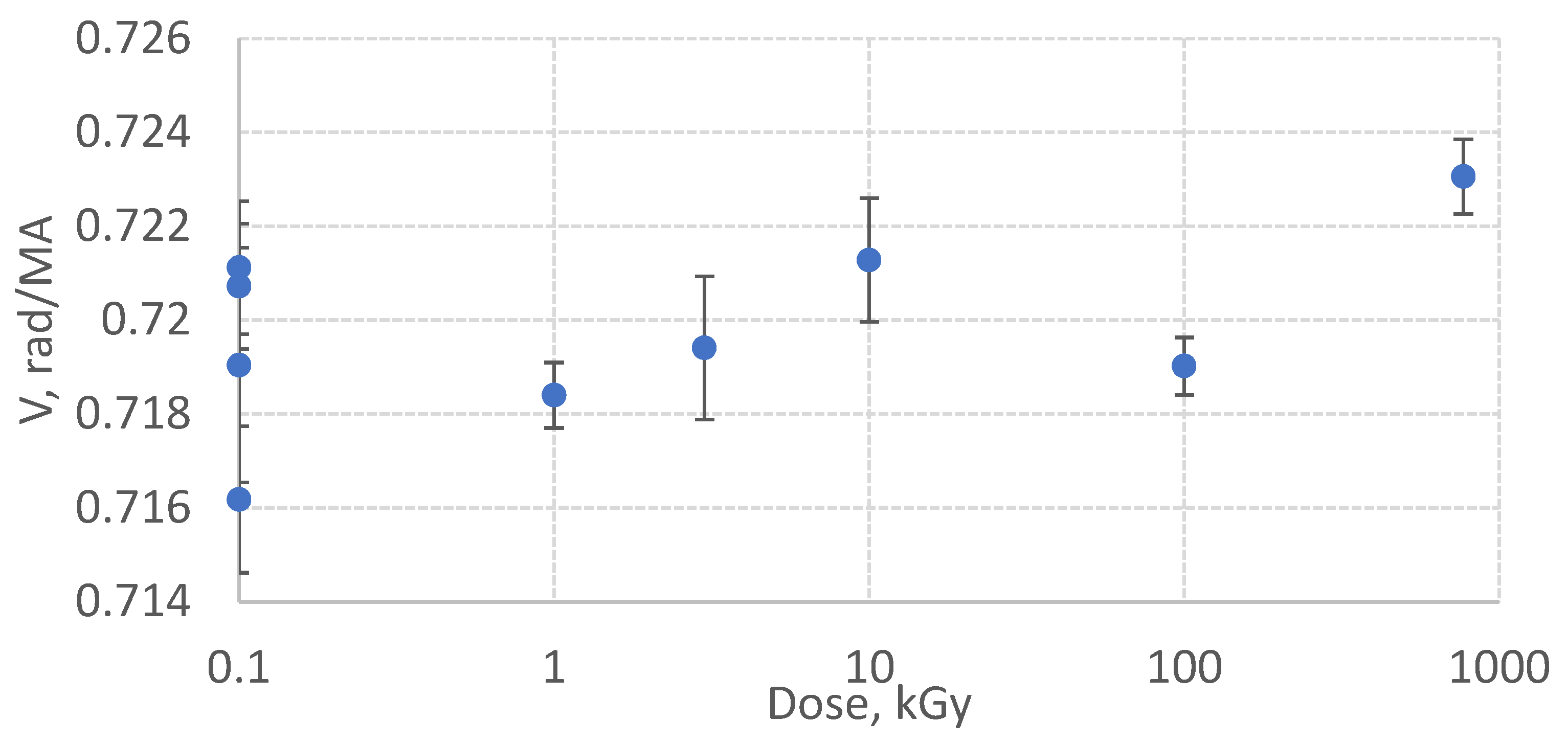
Verdet constant measurements were performed on both non-irradiated and irradiated samples. The results are summarised in Figure 2. Each point represents an average of five measurements performed at different input light polarisations. The experimental error bar is the standard deviation of those five measurements. Since the radiation dose spans three orders of magnitude, the results are shown using the logarithmic scale. To display the data for non-irradiated samples, they are conditionally placed at 0.1 kGy, which actually is 0 kGy. For the non-irradiated samples, several points are shown. These measurements were made on different days and the spreading demonstrates the long-term repeatability of the set-up, which is within 0.007 rad/MA, which corresponds to variation of about ±0.5%. For the measurements performed on a sample on the same day (therefore for a same dose), the worst-case standard deviation is 0.35%.
One sees that for gamma radiation doses up to 100 kGy, changes in the Verdet constant of the SMF-28e fibre are not detectable. For the 770 kGy dose, a small increase can be guessed, albeit being within the measurement uncertainty.
This result does not align with the publications mentioned earlier [12,13]. It was suggested in [13] that the changes are related to the generation of self-trapped hole centres (STH) and germanium electron centre (GEC). However, the suggested contribution of STH may be questioned because such defects in silica optical fibres are unstable at room temperature [21,22]. Also, in Corning SMF-28e fibres, the concentration of Ge-related defects, such as GEC, is not saturated even at doses of 100 kGy [2].
In [12] an increase in the Verdet constant in the SMF-28e at a dose of 1.2 kGy was also reported. When scaled to 1546.5 nm, the values were 0.694 and 0.703 rad/MA before and after the irradiation, respectively, which corresponds to a variation of 9 mrad/MA. The increase was attributed to generation of radiation defects, without specific details about the measurement uncertainty of the Verdet constant.
A summary of Verdet constant measurements for non-irradiated SMF-28 type fibres found in the literature is given in Table 1. The original values are scaled to 1546.5 nm wavelength, which is used in the present work, assuming λ−2 dependence. In the work by Rose et al. [23], the Verdet constant was measured for a fibre with 4.3% GeO2 and the cut-off wavelength of 1205 nm, which can be considered as a close analogue of SMF-28e. Our results agree well with the values given in [23], while the Verdet constant values in [12,13] are lower.
The scale of the effect of ionising radiation on the Verdet constant can be evaluated using Becquerel’s equation:
d d D V λ = d γ d D e 2 m c 2 λ d n d λ γ e 2 m c 2 λ d d λ d n d D  
where D is the radiation dose. For an MGy dose range, the diamagnetic nature of Ge-doped glass of SMF-28 is not changed and for the radiation doses discussed above, the first term in the last equation can be neglected. The second term can be evaluated using data on the radiation-induced refractive index changes in SMF-28 available from irradiation of fibre Bragg gratings (FBGs); for example, see [3]: d n / d D <   10 9 n   [ 1 / Gy ] . Therefore, the radiation-induced change in the Verdet constant can be evaluated as:
V / V < 10 9 n D  
where the radiation dose is in the units of Gy. According to this relation, even at the maximal dose of 770 kGy accumulated in the present study, radiation-induced changes in the Verdet constant should be within 0.1%, which agrees with the experimental results.
The effective Verdet constant in optical fibres decreases in the presence of linear birefringence [9]. The low values of the Verdet constant reported in [12,13] can be considered an indication that such a linear birefringence effect affected the measurements. Irradiation can increase this contribution by hardening the fibre coating. Results obtained on FBGs indicate that refractive index changes related to the coating effect are below 10−4 at a 100 kGy dose [24,25]. The worst-case scenario is therefore a refractive index change of 10−4 for one polarisation mode and a zero change for the second one, providing a birefringence variation of 10−4. According to [26], even much smaller birefringence induced by the standard coating of the SMF-28 fibre can make a significant contribution to temperature and external perturbation dependence of the Faraday effect. The scale of radiation-induced linear birefringence depends on the irradiation conditions. If the coating is hardened uniformly, irradiation will not produce additional linear birefringence. However, if the fibre is coiled to a small radius or wound on a mandrel under tension, the radiation-induced stresses on the inner and outer sides of the fibre loops can differ [27], creating stress-induced linear birefringence. In the present case the fibre was irradiated without additional tension applied so that the hardening of the coating did not result in additional linear birefringence.
In general, radiation-induced changes in optical fibres demonstrate partial recovery after irradiation. The extent of the recovery depends on ambient temperature and the type of radiation defects introduced, with long-term non-exponential kinetics [22,28,29,30]. The goal of the present study is to evaluate possible irradiation-induced degradation of the FOCS performance due to Verdet constant change. Ideally, to address the problem, changes in the Verdet constant should be measured in situ, under irradiation exposure. Unfortunately, this was not technically feasible and in the best case the measurements could be performed on the day after irradiation. The irradiation duration up to 1 kGy and up to 770 kGy differs by almost three orders of magnitude. Therefore, performing measurements one day after irradiation on fibres irradiated up to 1 kGy and up to 770 kGy would mean that the irradiation conditions are not directly comparable. It was decided to perform measurements two months after irradiation. In this case, only long-term recovery changes are present, which makes it possible to directly compare effects induced by significantly different doses without making assumptions on the contribution due to short-term recovery.
The practical reason for this choice is that for the present study FOCS at ITER is considered as the target implementation. During ITER nuclear (D-T) operation, MGy-level doses will be accumulated on a year time scale, with relatively long interruptions between plasma discharges. This makes this study of the permanent changes practically relevant. As for the transient effects related to the high-dose rate exposure, the measurements performed at JET during nuclear operation did not show significant effects [18].
It may be noted that a delay between the gamma radiation exposure and the start of the measurements was not reported in [12,13]. A shorter delay than the one in the present work may explain at least part of the observed difference.

4. Conclusions

The stability of the Verdet constant is an important requirement for performing current measurements under radiation, for example, in magnetic fusion installations during nuclear (deuterium–tritium) plasma operation. In this work, we investigated gamma radiation influence on the magneto-optical properties of the Corning SMF-28e optical fibre. The irradiation was performed at a dose rate of 5.75 kGy/h. Doses of 1, 3, 10, 100, and 770 kGy were accumulated. The samples were loosely coiled with a 12 cm diameter and placed in the irradiation chamber with no supporting mandrel. After exposure the samples were stored for two months. Verdet constant measurements were performed on both pristine and irradiated samples at 1546.5 nm wavelength with a magnetic field variation of 0.26 T. The length of the fibre exposed to the magnetic field was 2.72 m. During the measurements the temperature was maintained at 21.0 ± 0.1 °C.
The obtained results demonstrate that the radiation-induced change in the Verdet constant is within the measurement accuracy of ±0.56% for a gamma radiation dose up to 770 kGy. This is an encouraging result to consider the use of silica-based optical fibres in fibre-optic current sensors for applications in nuclear environments.

Author Contributions

Conceptualization, A.G.; methodology, A.G. and M.W.; formal analysis, M.W.; resources, D.T.; data curation, A.G. and M.W.; writing—original draft preparation, A.G.; writing—review and editing, A.G., D.T., and M.W.; supervision, D.T.; project administration, D.T.; funding acquisition, D.T. All authors have read and agreed to the published version of the manuscript.

Funding

The work by A.G. and D.T. received financial support from the Federal Public Service of Economy of the Belgian Federal Government. A.G. received financial support from the Physics and Engineering Bureau, Mol, Belgium.

Institutional Review Board Statement

Not applicable.

Informed Consent Statement

Not applicable.

Data Availability Statement

Data are contained within the article.

Conflicts of Interest

The authors declare no conflicts of interest.

Abbreviations

The following abbreviations are used in this manuscript:
FOCSFibre-Optic Current Sensor
FBGFibre Bragg Grating
JETJoint European Torus
RMSRoot-Mean Square
SOPState Of Polarisation
DC/ACDirect Current/Alternative Current

References

  1. Girard, S.; Kuhnhenn, J.; Gusarov, A.; Morana, A.; Paillet, P.; Robin, T.; Weninger, L.; Fricano, F.; Roche, M.; Campanella, C.; et al. Overview of radiation effects on silica-based optical fibers and fiber sensors. IEEE Trans. Nucl. Sci. 2025, 72, 982–1020. [Google Scholar] [CrossRef] [Scilit]
  2. Girard, S.; Kuhnhenn, J.; Gusarov, A.; Brichard, B.; Uffelen, M.V.; Ouerdane, Y.; Boukenter, A.; Marcandella, C. Radiation effects on silica-based optical fibers: Recent advances and future challenges. IEEE Trans. Nucl. Sci. 2013, 60, 2015–2036. [Google Scholar] [CrossRef] [Scilit]
  3. Gusarov, A.; Hoeffgen, S.K. Radiation effects on fiber gratings. IEEE Trans. Nucl. Sci. 2013, 60, 2037–2053. [Google Scholar] [CrossRef] [Scilit]
  4. Kozhevnikov, N.M.; Barmenkov, Y.; Belyakov, V.A.; Medvedev, A.; Razdobarin, G. Fiber-optic sensor for plasma current diagnostic in tokamaks. In Fiber Optic and Lasers Sensors IX; SPIE: Bellingham, WA, USA, 1991; pp. 138–144. [Google Scholar]
  5. Xue, M.M.; Chen, D.L.; Shen, B.; Wang, Y.; Shi, T.H.; Wang, H.H.; Sun, Y.W.; Qian, J.P.; Xiao, H.; Xiao, B.J. Upgrade of poloidal field coils current measurement system on Experimental Advanced Superconducting Tokamak. Fusion Eng. Des. 2019, 148, 111264. [Google Scholar] [CrossRef] [Scilit]
  6. Xue, M.M.; Shen, B.; Chen, D.L.; Wang, Y.; Shi, T.H.; Wang, H.H.; Sun, Y.W.; Qian, J.P.; Xiao, H.; Xiao, B.J. Fiber-optic current sensor for plasma current on experimental advanced superconducting tokamak. Fusion Eng. Des. 2019, 140, 11–15. [Google Scholar] [CrossRef] [Scilit]
  7. Li, J.; Guo, D.; Song, X.; Chang, X.; Liu, D.; Tao, R.; Wang, Z.; Chen, L.; Liu, S.; Shi, Y. Direct measurement of toroidal eddy current on the EXL-50U tokamak with a hardware-compensated fiber optic current sensor. Plasma Sci. Technol. 2026, 28, 014001. [Google Scholar] [CrossRef] [Scilit]
  8. Vayakis, G.; Arshad, S.; Delhom, D.; Encheva, A.; Giacomin, T.; Jones, L.; Patel, K.M.; Pérez-Lasala, M.; Portales, M.; Prieto, D.; et al. Development of the ITER magnetic diagnostic set and specification. Rev. Sci. Instrum. 2012, 83, 10D712. [Google Scholar] [CrossRef] [Scilit]
  9. Rogers, A. Optical-fibre current measurements. Int. J. Optoelectron. 1988, 3, 391–407. [Google Scholar]
  10. Darwin, C.G.; Watson, W.H. The constants of the magnetic dispersion of light. Proc. R. Soc. London. Ser. A 1927, 114, 474–490. [Google Scholar] [CrossRef] [Scilit]
  11. Gusarov, A.; Doyle, D.B. Radiation induced wavefront aberrations: A new approach. Appl. Opt. 1998, 37, 643–648. [Google Scholar] [CrossRef] [Scilit]
  12. Kim, Y.; Ju, S.; Jeong, S.; Jang, M.-J.; Kim, J.-Y.; Lee, N.-H.; Jung, H.-K.; Han, W.-T. Influence of gamma-ray irradiation on Faraday effect of Cu-doped germano-silicate optical fiber. Nucl. Instrum. Methods Phys. Res. Sect. B 2015, 344, 39–43. [Google Scholar] [CrossRef] [Scilit]
  13. Wen, J.; Che, Q.; Dong, Y.; Guo, Q.; Pang, F.; Chen, Z.; Wang, T. Irradiation effect on the magneto-optical properties of Bi-doped silica optical fiber based on valence state change. Opt. Mater. Express 2020, 10, 88–98. [Google Scholar] [CrossRef] [Scilit]
  14. Cruz, J.L.; Andres, M.V.; Hernandez, M.A. Faraday effect in standard optical fibers: Dispersion of the effective Verdet constant. Appl. Opt. 1996, 35, 922–927. [Google Scholar] [CrossRef] [Scilit]
  15. Gusarov, A.; Leysen, W.; Kim, S.M.; Dandu, P.; Wuilpart, M.; Danisi, A.; Soto, J.L.B.; Vayakis, G. Recent achievements in R&D on fibre optics current sensor for ITER. Fusion Eng. Des. 2023, 192, 113626. [Google Scholar] [CrossRef] [Scilit]
  16. Moreau, P.; Brichard, B.; Fil, A.; Malard, P.; Pastor, P.; Le-Luyer, A.; Samaille, F.; Massaut, V. Test of fiber optic based current sensors on the Tore Supra tokamak. Fusion Eng. Des. 2011, 86, 1222–1226. [Google Scholar] [CrossRef] [Scilit]
  17. Aymar, R.; Bareyt, B.; Bon Mardion, G. TORE SUPRA. Basic Design Tokamak System; Association Euratom-CEA sur la Fusion: Saint-Paul-lez-Durance, France, 1980; p. 400. [Google Scholar]
  18. Gusarov, A.; Beaumont, P.; JET Contributors. Assessment of neutron radiation effects on the Fiber Optics Current Sensor performance during JET DTE2 experimental campaign. Sensors 2025, 25, 6552. [Google Scholar] [CrossRef] [Scilit] [PubMed]
  19. Fernandez, A.F.; Ooms, H.; Brichard, B.; Coeck, M.; Coenen, S.; Berghmans, F.; Decréton, M. SCK-CEN gamma irradiation facilities for radiation tolerance assessment. In Proceedings of the 2002 IEEE Radiation Effects Data Workshop, Phoenix, AZ, USA, 15–19 July 2002; pp. 171–176. [Google Scholar]
  20. Williams, P.A.; Rose, A.H.; Day, G.W.; Milner, T.E.; Deeter, M.N. Temperature dependence of the Verdet constant in several diamagnetic glasses. Appl. Opt. 1991, 30, 1176–1178. [Google Scholar] [CrossRef] [Scilit] [PubMed]
  21. Griscom, D.L. Self-trapped holes in pure-silica glass: A history of their discovery and characterization and an example of their critical significance to industry. J. Non-Cryst. Solids 2006, 352, 2601–2617. [Google Scholar] [CrossRef] [Scilit]
  22. De Michele, V.; Marcandella, C.; Vidalot, J.; Paillet, P.; Morana, A.; Cannas, M.; Boukenter, A.; Marin, E.; Ouerdane, Y.; Girard, S. Origins of radiation-induced attenuation in pure-silica-core and Ge-doped optical fibers under pulsed x-ray irradiation. J. Appl. Phys. 2020, 128, 103101. [Google Scholar] [CrossRef] [Scilit]
  23. Rose, A.H.; Etzel, S.M.; Wang, C.M. Verdet constant dispersion in annealed optical fiber current sensors. J. Light. Technol. 1997, 15, 803–807. [Google Scholar] [CrossRef] [Scilit]
  24. Gusarov, A.; Chojetzki, C.; Mckenzie, I.; Berghmans, F. Influence of the coating type on the radiation sensitivity of FBGs. In Optical Sensors; SPIE: Bellingham, WA, USA, 2008; Volume 7003, pp. 81–87. [Google Scholar]
  25. Gusarov, A.; Chojetzki, C.; Mckenzie, I.; Thienpont, H.; Berghmans, F. Effect of the fiber coating on the radiation sensitivity of Type I FBGs. IEEE Photon. Technol. Lett. 2008, 20, 1802–1804. [Google Scholar] [CrossRef] [Scilit]
  26. Segura, M.; Vukovic, N.; White, N.; May-Smith, T.C.; Loh, W.H.; Poletti, F.; Zervas, M.N. Low birefringence measurement and temperature dependence in meter-long optical fibers. J. Light. Technol. 2015, 33, 2697–2702. [Google Scholar] [CrossRef] [Scilit]
  27. Azevedo, A.M.d.; da Silveira, P.H.P.M.; Lopes, T.J.; da Costa, O.L.B.; Monteiro, S.N.; Veiga-Júnior, V.F.; Silveira, P.C.R.; Cardoso, D.D.O.; Figueiredo, A.B.-H.d.S. Ionizing Radiation and Its Effects on Thermoplastic Polymers: An Overview. Polymers 2025, 17, 1110. [Google Scholar] [CrossRef] [Scilit] [PubMed]
  28. Griscom, D.L.; Gingerich, M.E.; Friebele, E.J. Model for the dose, dose-rate and temperature dependence of radiation-induced loss in optical fibers. IEEE Trans. Nucl. Sci. 1994, 41, 523–527. [Google Scholar] [CrossRef] [Scilit]
  29. Skuja, L. Optical properties of defects in silica. In Defects in SiO2 and Related Dielectrics: Science and Technology; Pacchioni, G., Skuja, L., Griscom, D.L., Eds.; NATO Science Series II; Kluwer Academic Publishers: Dordrecht, The Netherlands, 2000; Volume 2, pp. 73–116. [Google Scholar]
  30. Girard, S.; Alessi, A.; Richard, N.; Martin-Samos, L.; De Michele, V.; Giacomazzi, L.; Agnello, S.; Francesca, D.D.; Morana, A.; Winkler, B.; et al. Overview of radiation induced point defects in silica-based optical fibers. Rev. Phys. 2019, 4, 100032. [Google Scholar] [CrossRef] [Scilit]
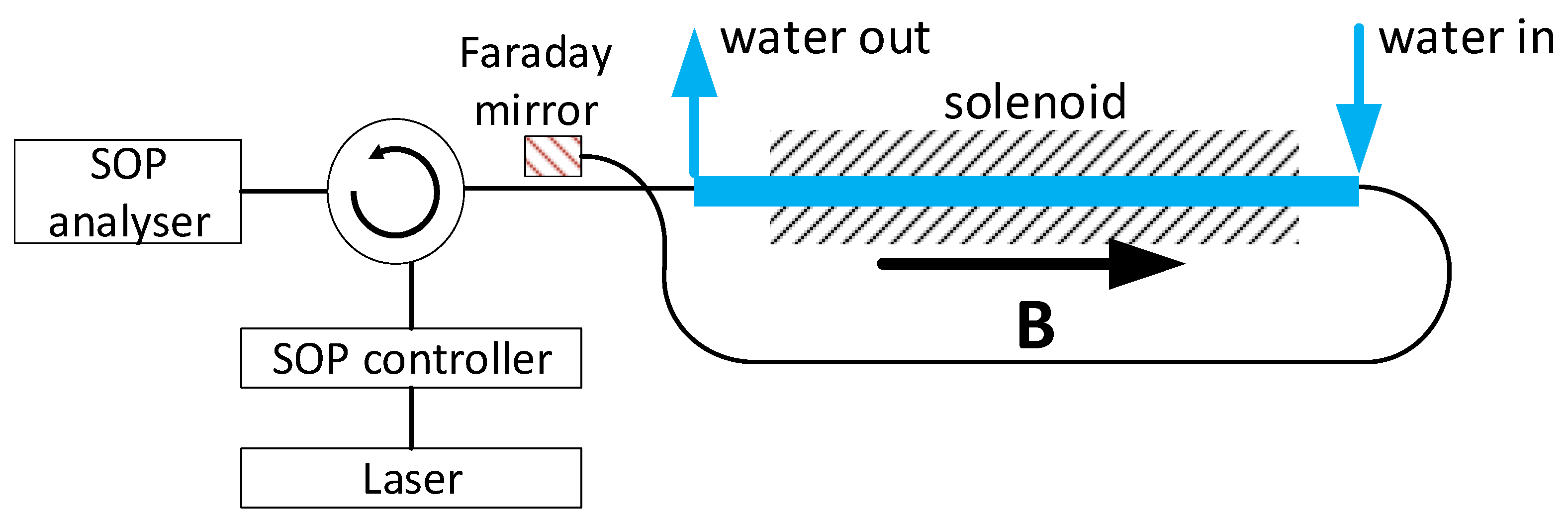
Figure 1. Set-up for Verdet constant measurements. The dashed area represents the solenoid. Laser—LS5-C-29B-20-NM; SOP controller—Deterministic Polarisation Controller DPC5500; SOP analyser—Inline Polarimeter IPM5300. The arrows indicate the direction of the water flow.
Photonics 13 00277 g001
Figure 2. Summary of Verdet constant measurements on Corning SMF-28e fibre.
Photonics 13 00277 g002
Table 1. Summary of data on the Verdet constant of non-irradiated SMF-28 fibre, scaled to 1546.5 nm.
ReferenceWen [13]Kim [12]Rose [23]Current Work
V, rad/MA 0.6510.6940.725 ± 0.0030.719 ± 0.003
Disclaimer/Publisher’s Note: The statements, opinions and data contained in all publications are solely those of the individual author(s) and contributor(s) and not of MDPI and/or the editor(s). MDPI and/or the editor(s) disclaim responsibility for any injury to people or property resulting from any ideas, methods, instructions or products referred to in the content.