


Abstract
Organic photovoltaic materials and nonlinear optical materials share inherent commonalities in molecular characteristics—such as strong light absorption, high charge carrier mobility, and tunable energy levels. Therefore, this study selects a bithiophene-fused ring system with photovoltaic application potential as the research subject. Using TTTTB6-2CHO (TB1) and IDTTB6-2CHO (TB2) as comparative molecules, their nonlinear optical properties in the near-infrared region were systematically investigated. Transient absorption spectroscopy results demonstrate that TB1 exhibits strong and persistent excited-state absorption within the spectral range of 650–900 nm, endowing it with excellent two-photon absorption performance (a cross-section of up to 5591 GM at 650 nm) and an ultralow optical limiting threshold (0.00147 J/cm2 under 800 nm femtosecond laser irradiation). The findings of this study not only confirm the feasibility of developing nonlinear optical materials from photovoltaic candidate molecules but also highlight the effectiveness of the “thiophene-for-benzene substitution” strategy in significantly enhancing optical nonlinearity. These results provide valuable design principles for the development of multifunctional organic optoelectronic materials, particularly for application scenarios such as laser protection.
1. Introduction
Nonlinear optical (NLO) materials play an indispensable role in fields such as laser protection, optical communication, and micro-nano processing [1,2,3,4]. Meanwhile, research on organic photovoltaic (OPV) materials provides crucial theoretical support for revealing light–matter interaction mechanisms and precisely regulating molecular energy levels [5,6]. It is noteworthy that the goals pursued by high-performance photovoltaic donor materials—broad spectral absorption, high carrier mobility, and precise energy level control—are highly aligned with the core requirements for achieving strong nonlinear optical responses [7], such as a high two-photon absorption cross-section and a low optical limiting threshold. This intrinsic correlation inspires us to introduce efficient molecular systems, already validated in the photovoltaic field, into the design of nonlinear optical materials.
Among the numerous building blocks of organic photovoltaic materials, bithiophene has emerged as a core structural unit for designing high-performance photovoltaic donor materials due to its excellent molecular planarity and strong electron-rich properties [8,9]. Its fused-ring skeleton not only endows the molecule with good structural stability and planarity but also enables precise modulation of the highest occupied molecular orbital (HOMO) energy levels and band structures through flexible fused-ring modifications and π-conjugation extension [10,11]. This provides a controllable structural foundation for the molecular design of nonlinear optical performance [12,13,14,15]. In recent years, this structural system has also demonstrated significant potential in the field of nonlinear optics, particularly in optical limiting applications [16,17,18]. Research indicates that introducing push-pull electron groups, constructing donor–acceptor (D-A) conjugated systems [19,20], or expanding the fused-ring structure within the bithiophene system can significantly enhance its third-order nonlinear optical response.
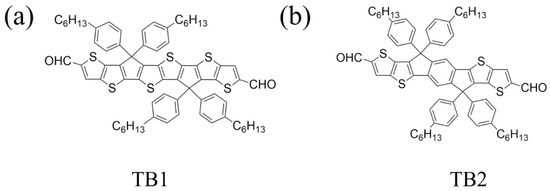
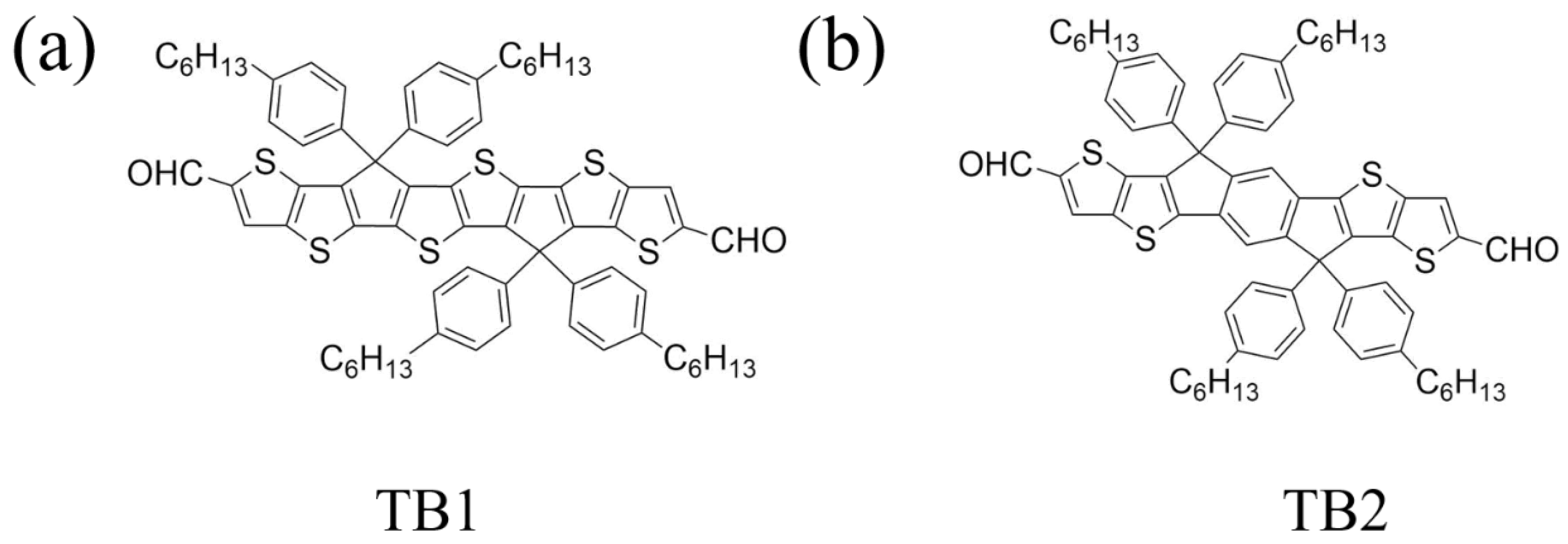
To systematically investigate the effect of fused-ring structural modulation on nonlinear optical properties, two structurally distinct thiophene-fused derivatives (TB1 and TB2), as shown in Figure 1 were selected as the target compounds. The key structural distinction lies in the architecture of the central fused core: in TB1, the core consists of three fused he core consists of three fused bithiophenes units, forming a six-ring conjugated system, whereas TB2 features a five-ring conjugated system formed by alternating connection of two bithiophenes units with a benzene ring. units, forming a six-ring conjugated system, whereas TB2 features a five-ring conjugated system formed by alternating connection of two bithiophene units with a benzene ring. Based on the well-established principle that extending the π-conjugated system enhances electron delocalization and thus strengthens the third-order nonlinear optical response [21,22], it is hypothesized that TB1—with its longer conjugation length and broader electron delocalization—should exhibit superior nonlinear optical performance compared to TB2.
Figure 1.
Molecular structures of TB1 (a) and TB2 (b).
To validate this hypothesis, an integrated experimental and theoretical approach was employed. Experimentally, the nonlinear absorption properties of both materials were characterized using the Z-scan technique. Under identical excitation conditions, TB1 exhibited a nonlinear absorption coefficient (β) of 1.7 × 10⁻¹² m/W, which is an order of magnitude greater than that of TB2 (β = 1.3 × 10⁻¹³ m/W), directly demonstrating the enhanced nonlinear optical response of TB1. Theoretically, density functional theory (DFT) calculations were conducted to analyze the frontier molecular orbitals and electron density distributions [23]. The results indicate that TB1 possesses a narrower HOMO–LUMO energy gap (2.542 eV) compared to that of TB2 (2.922 eV), along with more extensive electron delocalization, where π-electrons are uniformly distributed across the entire six-ring fused backbone. These electronic structure features provide a fundamental explanation for the superior performance of TB1.
2. Materials and Methods
2.1. Material Sources and Spectral Characterization
The powder samples of compounds TB1 and TB2 were obtained from Nanjing Zhiyan Technology Co., Ltd. (Nanjing, China) and characterized by 1H NMR spectroscopy (Figures S1 and S2) and high-resolution mass spectrometry (Figures S3 and S4). For optical measurements, the compounds were dissolved in chloroform to prepare solutions with a concentration of 1 × 10⁻⁶ mol/L. These solutions were placed in quartz cuvettes with an optical path length of 5 mm. UV-Vis absorption spectra were recorded on a Varian Cary-1 spectrophotometer, and fluorescence spectra were acquired using an FLS 980-steady-state/transient fluorescence spectrometer, with all measurements conducted at room temperature.
2.2. Nonlinear Optical Experiments
2.2.1. Z-Scan and Optical Limiting Experiments
For the femtosecond Z-scan measurements, the excitation wavelength was supplied by an optical parametric amplifier pumped by a mode-locked Yb:KGW fiber laser (PHAROS, Light Conversion, 1030 nm), producing pulses with a duration of 190 fs at a repetition rate of 20 Hz. The optical limiting behavior was characterized by measuring the intensity-dependent transmittance using the same laser source and detector as employed in the Z-scan experiments. In contrast to the Z-scan method, however, the sample was maintained at the focal point during the optical limiting tests. Sample solutions were prepared by dissolving the compounds in chloroform (TCM) at a concentration of 180 mM and were contained in 5 mm path length quartz cuvettes for measurement. A schematic illustration of the optical path is provided in Figure S5 [24].
2.2.2. Transient Absorption and Refraction Measurements
Transient absorption (TA) spectroscopy was performed to investigate the photodynamic evolution of the samples at various delay times. A detailed description of the experimental setup is provided in the Figure S6. The laser source employed was identical to that used in the femtosecond Z-scan measurements. The pump and probe beams consisted of a supercontinuum white light generated by focusing the 1030 nm fundamental beam onto a sapphire plate [24,25].
2.3. Quantum Chemical Calculations
To elucidate the electronic structures and optical properties of compounds TB1 and TB2, density functional theory (DFT) calculations were carried out using the Gaussian 09 software package. The ground-state geometries were optimized at the B3LYP/6-311G(d,p) level of theory [26], yielding the equilibrium molecular structures and the distributions of the frontier molecular orbitals. Subsequently, time-dependent DFT (TD-DFT) calculations were performed on the optimized structures to identify the principal electronic transitions involved in the excited states [26,27,28,29]. The Multiwfn program was employed to visualize intramolecular electron-hole distributions, quantify the extent of electron delocalization, and compute key parameters including the ground-state dipole moment (μ0), excited-state dipole moments (μ1, μ2), and transition dipole moments (μ01, μ12) [30].
3. Results and Discussion
3.1. UV-Vis Absorption and Fluorescence Spectra
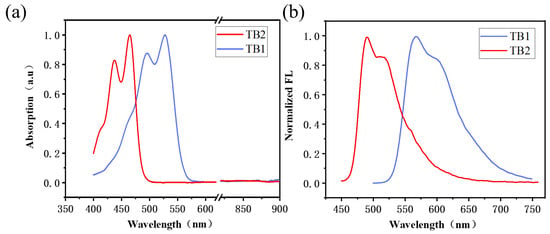
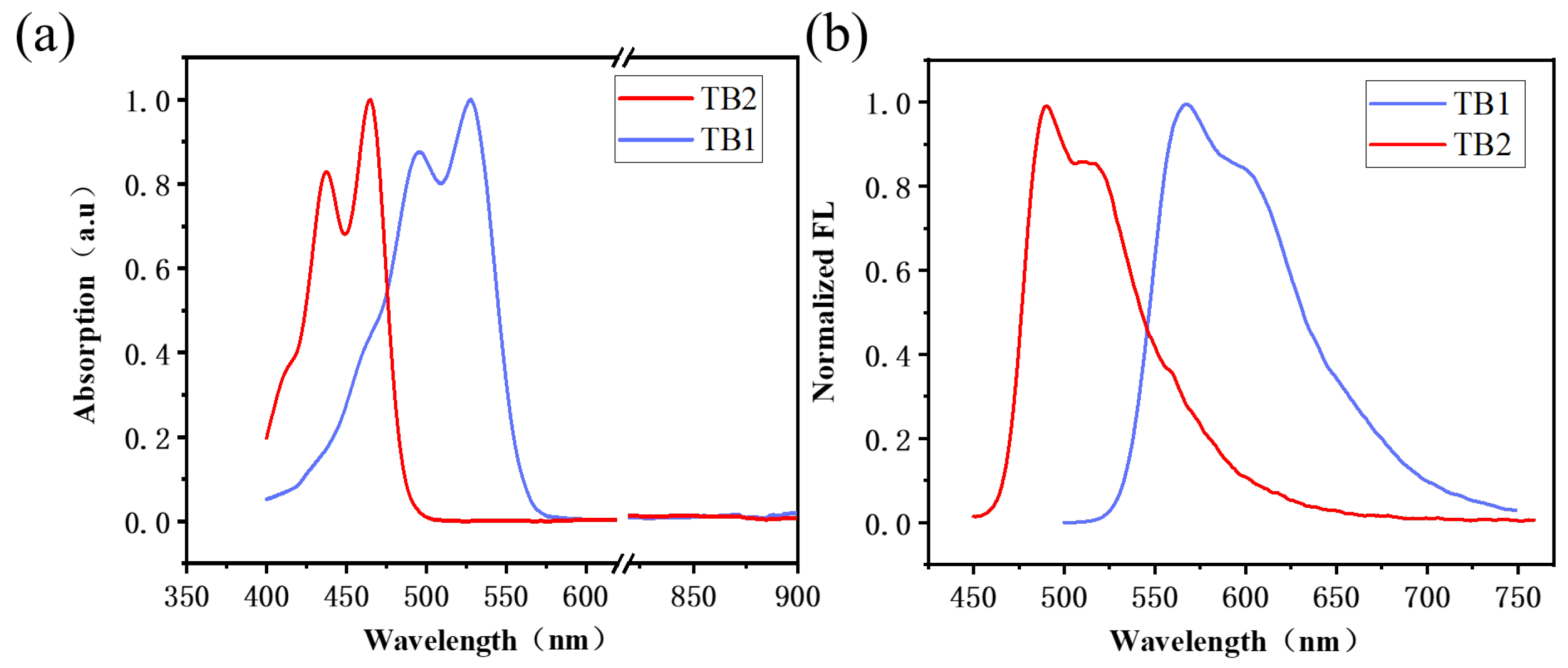
As shown in Figure 2, compounds TB1 and TB2 exhibit broadly similar absorption profiles. The principal UV absorption peak of TB1 appears at 528 nm, whereas that of TB2 is blue-shifted to 465 nm and displays a narrower spectral shape. These dominant absorption bands in both molecules can be assigned to π→π* electronic transitions within the conjugated backbone. In addition, each compound shows a distinct shoulder peak—observed at 495 nm for TB1 and at 435 nm for TB2—further characterizing their absorption features.
Figure 2.
(a) UV-Vis absorption spectra and (b) Fluorescence spectra of TB2 and TB1.
Photoluminescence measurements reveal that the fluorescence emission peaks of TB1 and TB2 are centered at 570 nm and 490 nm, respectively. Both compounds display fluorescence spectra that exhibit a distinct mirror-image relationship with their corresponding UV–Vis absorption spectra, suggesting only minor structural reorganization occurs between the ground and excited states.
3.2. Quantum Chemical Calculations
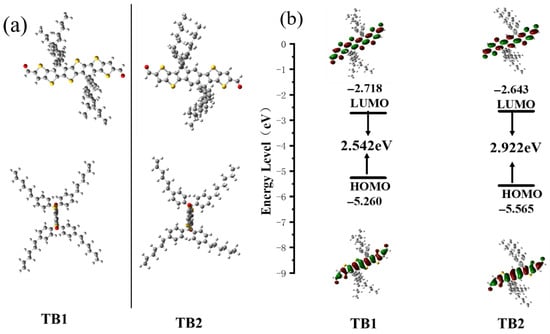
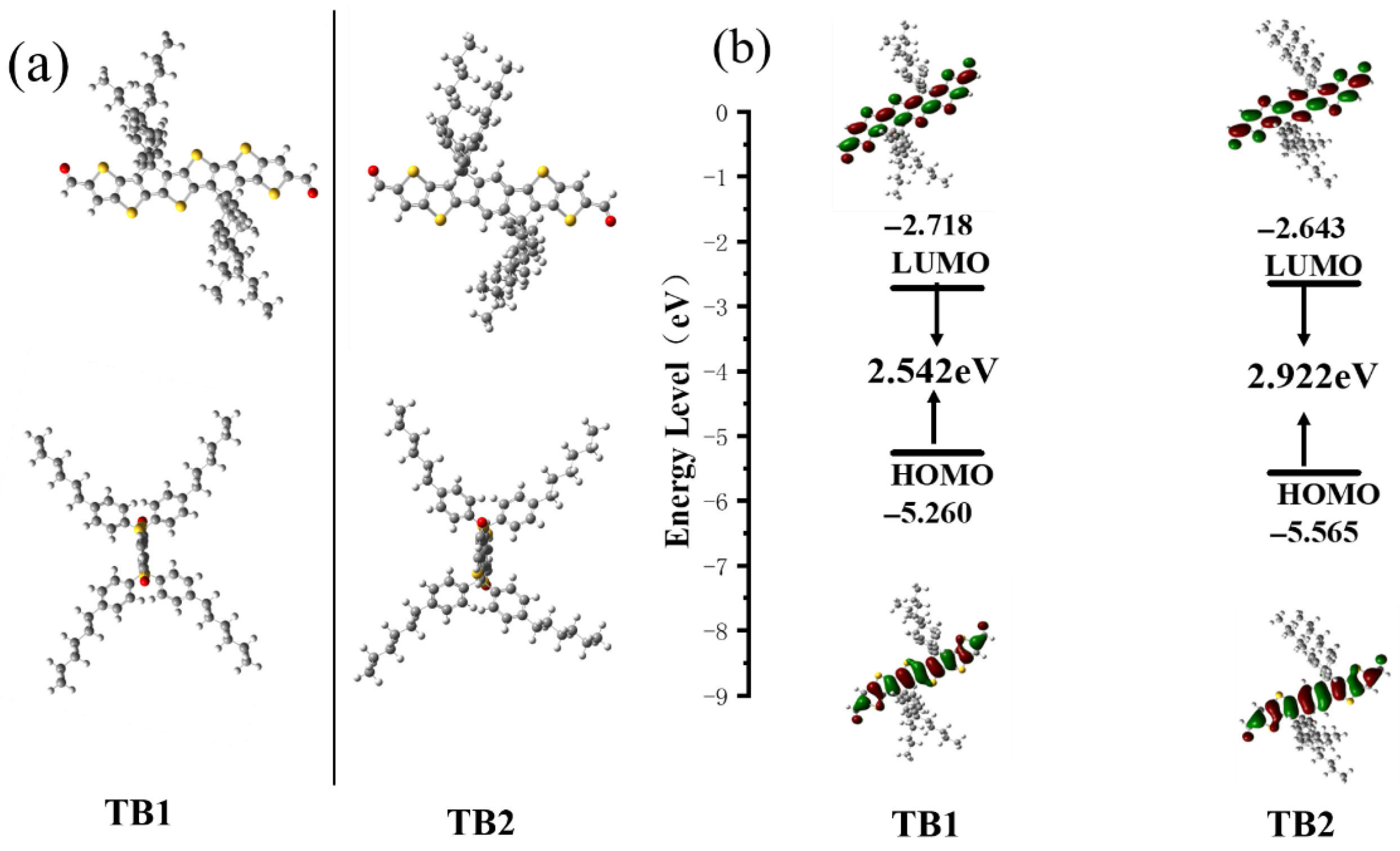
The optimized molecular structures of TB1 and TB2 are presented in Figure 3a. Both molecules exhibit planar configurations in their central conjugated frameworks. As shown in Figure 3b, the HOMO and LUMO are predominantly distributed over the central fused-ring region, indicating significant π-electron delocalization and confirming that this segment serves as the nonlinear optical-active unit. The calculated HOMO–LUMO energy gaps are 2.542 eV for TB1 and 2.922 eV for TB2. The narrower band gap of TB1 is consistent with the red-shifted absorption observed in the UV–Vis spectra (Figure 2), further corroborating the experimental findings.
Figure 3.
Optimized molecular structures (a) and frontier orbital calculation results (b) for TB1 and TB2.
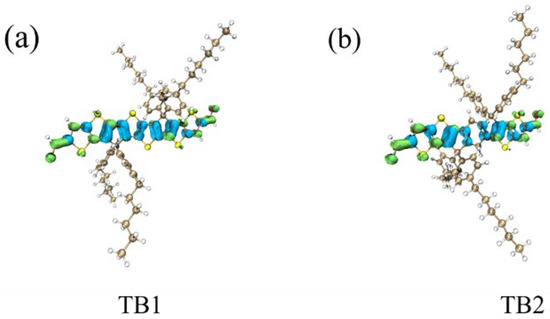
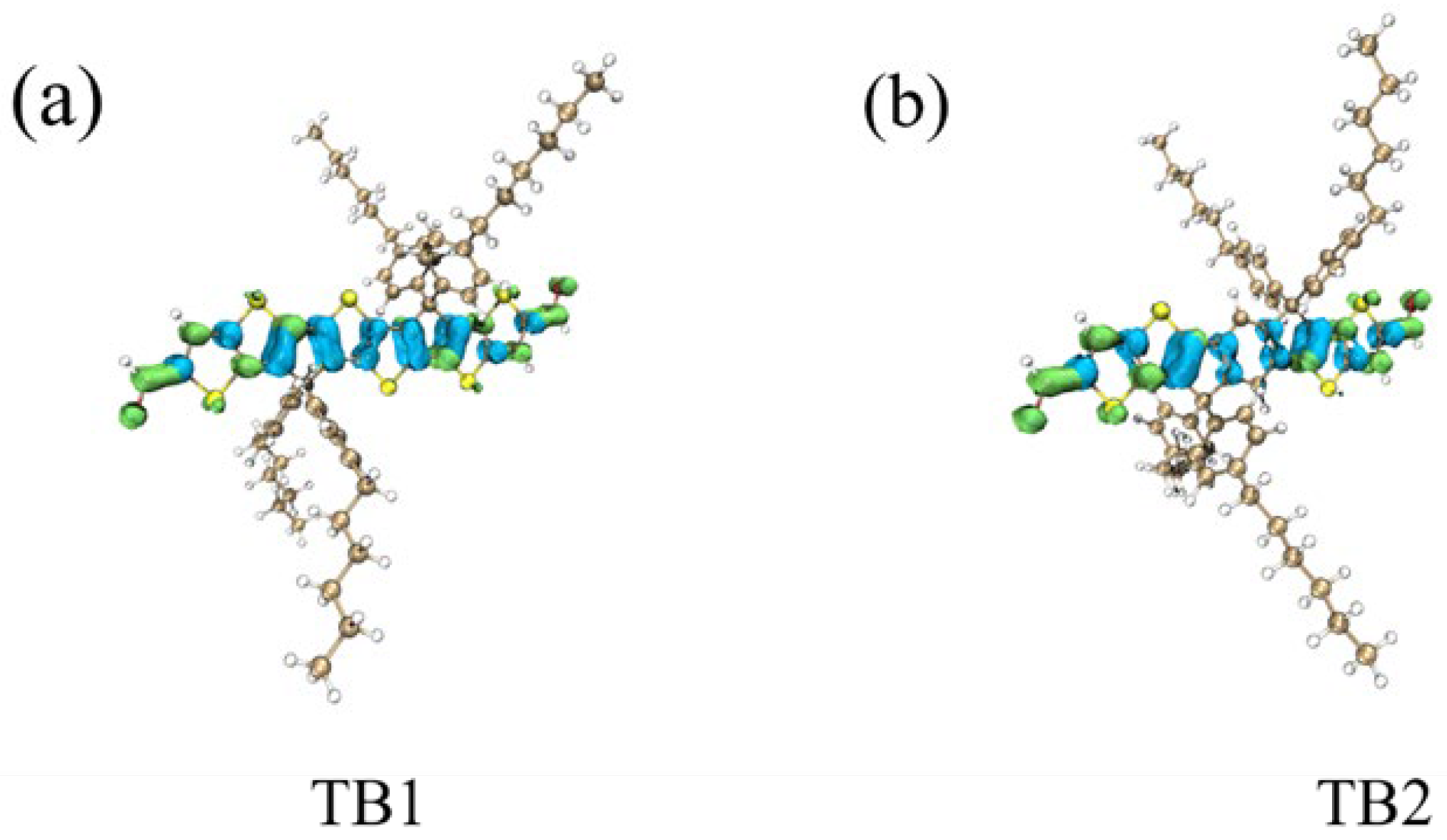
The electron-hole distribution analysis for the S0→S1 transition further corroborates these findings (Figure 4). In both TB1 and TB2, over 90% of the hole density is localized on the central thiophene-fused donor moiety (94.69% for TB1, 93.1% for TB2), accompanied by substantial electron density retention (87.53% for TB1, 85.07% for TB2). These results underscore the central fused-ring unit as the primary site governing the excited-state properties.
Figure 4.
Electron-hole distribution for the S0 to S1 transition of the molecules. (a) Optimized ground-state structure of the molecule; (b) Frontier orbital distribution of the molecule.
A comparison of the electron distribution characteristics reveals that TB1 exhibits more extensive linear electron delocalization than TB2, demonstrating its broader π-conjugation framework. Furthermore, as listed in Table 1, the transition dipole moments (μ01 and μ12) of TB1 are consistently larger than those of TB2 for the S0→S1 transition, indicating enhanced π-electron delocalization in the excited state. Previous studies have established that extending π-conjugation, strengthening electron delocalization, and increasing transition dipole moments are effective strategies for boosting third-order nonlinear optical performance. Thus, it can be reasonably inferred that TB1 possesses superior nonlinear optical properties compared to TB2.
Table 1.
Ground state dipole moment μ0, first excited state dipole moment μ1, second excited state dipole moment μ2, and transition dipole moments μ01 and μ12 for TB1 and TB2 (Units: A.U.).
3.3. Transient Absorption Spectroscopy
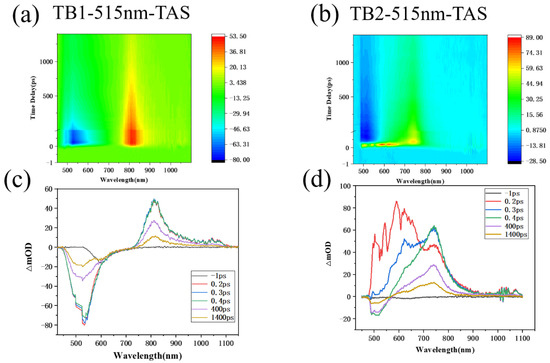
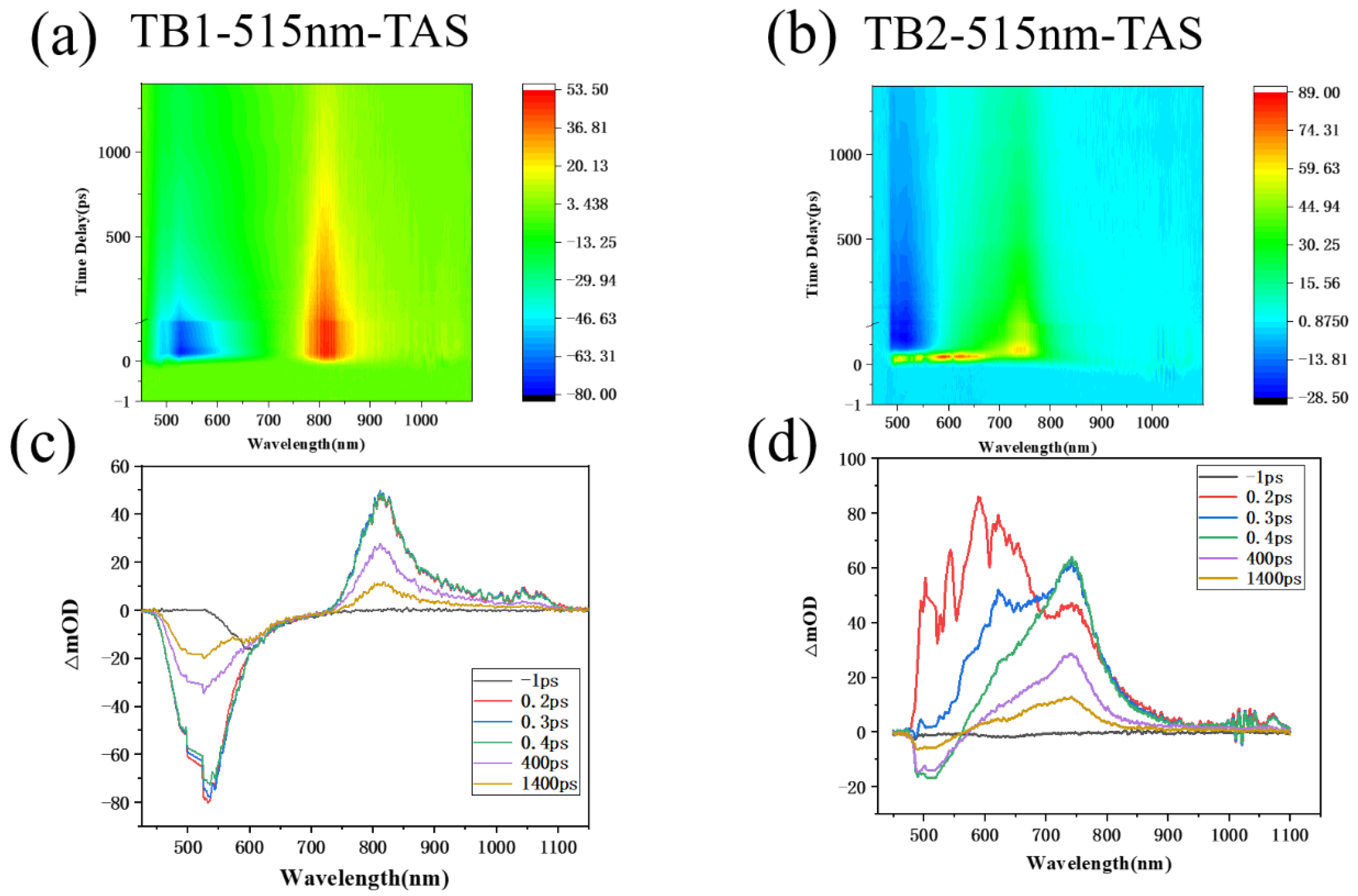
Under 515 nm excitation, the transient absorption (TA) spectra and kinetic evolution of the two compounds are shown in Figure 5. In the spectra, positive signals (red, yellow, and green regions) correspond to excited-state absorption (ESA), while negative signals (blue regions) originate from saturated absorption (SA). As seen in Figure 5a, compound TB1 exhibits a broad saturated absorption signal. Based on Figure 2, in the 480–650 nm range, the strong linear absorption of the molecule leads to significant ground-state bleaching (GSB), indicating that the negative signal in this region can be attributed to GSB. In contrast, in the 560–650 nm range, the linear absorption is very weak, ruling out the possibility of GSB. Since this region overlaps with the fluorescence emission spectrum of the molecule, the negative signal here is considered to arise primarily from stimulated emission. Furthermore, TB1 exhibits a strong and long-lived ESA band in the 700–900 nm near-infrared region.
Figure 5.
TAS spectra (a,b) and spectral evolution (c,d) for TB1 and TB2 under 515 nm excitation.
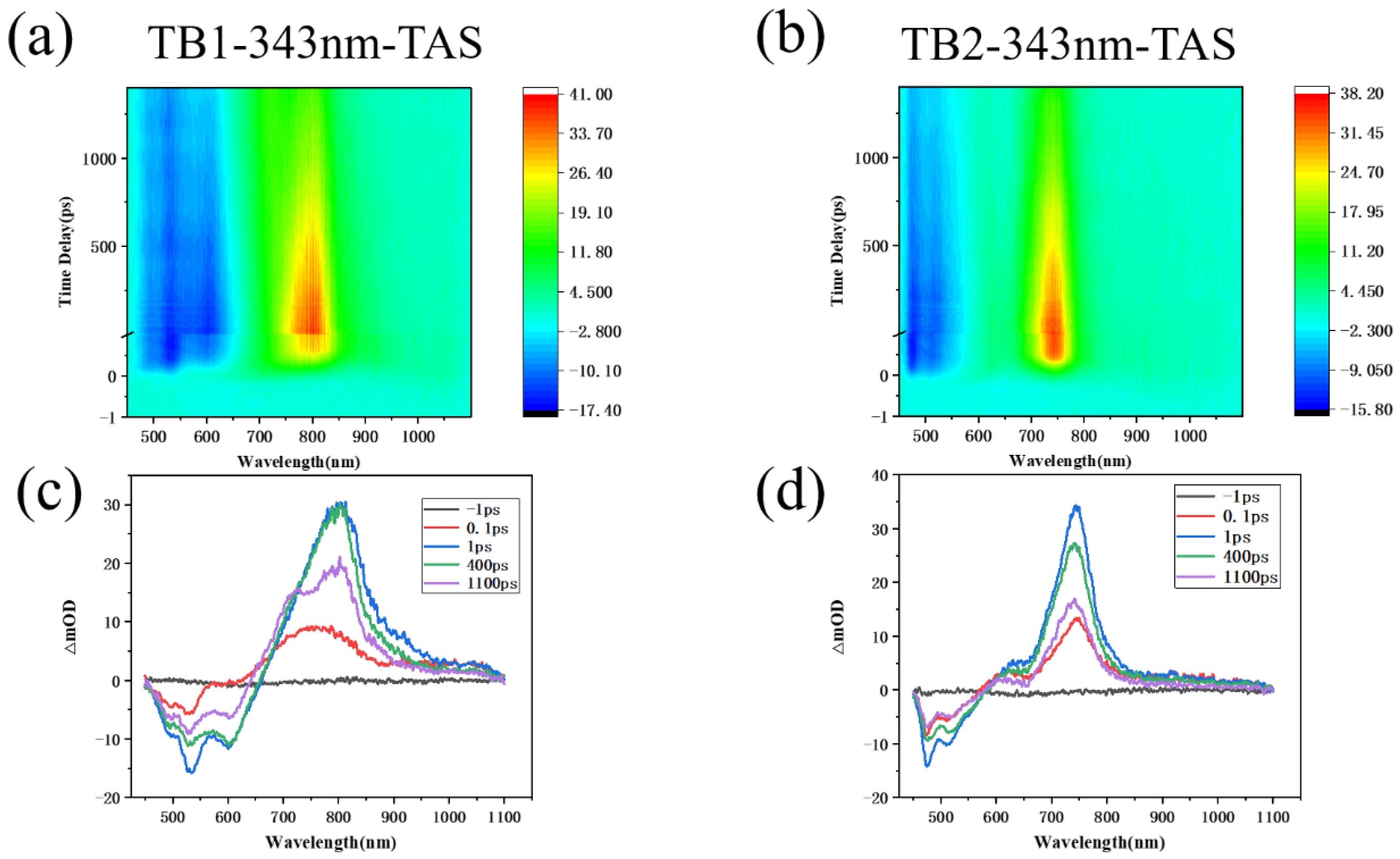
The transient absorption kinetics of compound TB2 under 515 nm excitation display typical localized excitation characteristics, as shown in Figure 5b. Combined with Figure 2, TB2 exhibits no significant linear absorption beyond 500 nm, thereby ruling out the possibility of ground-state bleaching (GSB). Furthermore, this wavelength range corresponds to the fluorescence emission spectrum in Figure 2, allowing us to determine that the saturated absorption (SA) signal observed under 515 nm excitation is a stimulated emission signal. it can be inferred that in the 540–680 nm range, TB2 shows competition between ESA and stimulated emission signals. Further comparison with the linear absorption profile in Figure 2 suggests that this phenomenon results from a band-edge excitation-induced transient absorption process. To verify this hypothesis, we performed additional TA measurements at 343 nm (a wavelength far from the absorption band edge), as shown in Figure 6. At this excitation wavelength, no significant competition between ESA and stimulated emission was observed, confirming that the competitive process is specific to band-edge excitation at 515 nm. In contrast, the structural differences between TB1 and TB2 endow TB1 with a distinct broadband response advantage and exert notable regulatory effects on its transient absorption properties.
Figure 6.
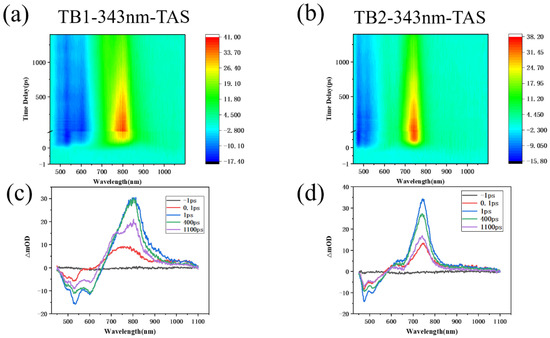
TAS spectra (a,b) and spectral evolution (c,d) for TB1 and TB2 under 343 nm excitation.
From the characteristic spectra at different delay times under 515 nm and 343 nm excitations (Figure 5 and Figure 6, panels (c) and (d)), it can be seen that the spectral features of TB1 show no significant variation with excitation wavelength. For TB2, under 343 nm excitation, the spectral shape remains largely unchanged throughout the delay time, suggesting that the molecular relaxation proceeds via a single excited state without the formation of new states. However, under 515 nm band-edge excitation, new spectral features emerge in the TA spectrum of TB2, indicating the generation of a new state under such excitation conditions.
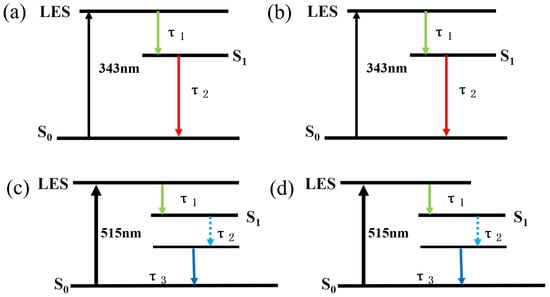
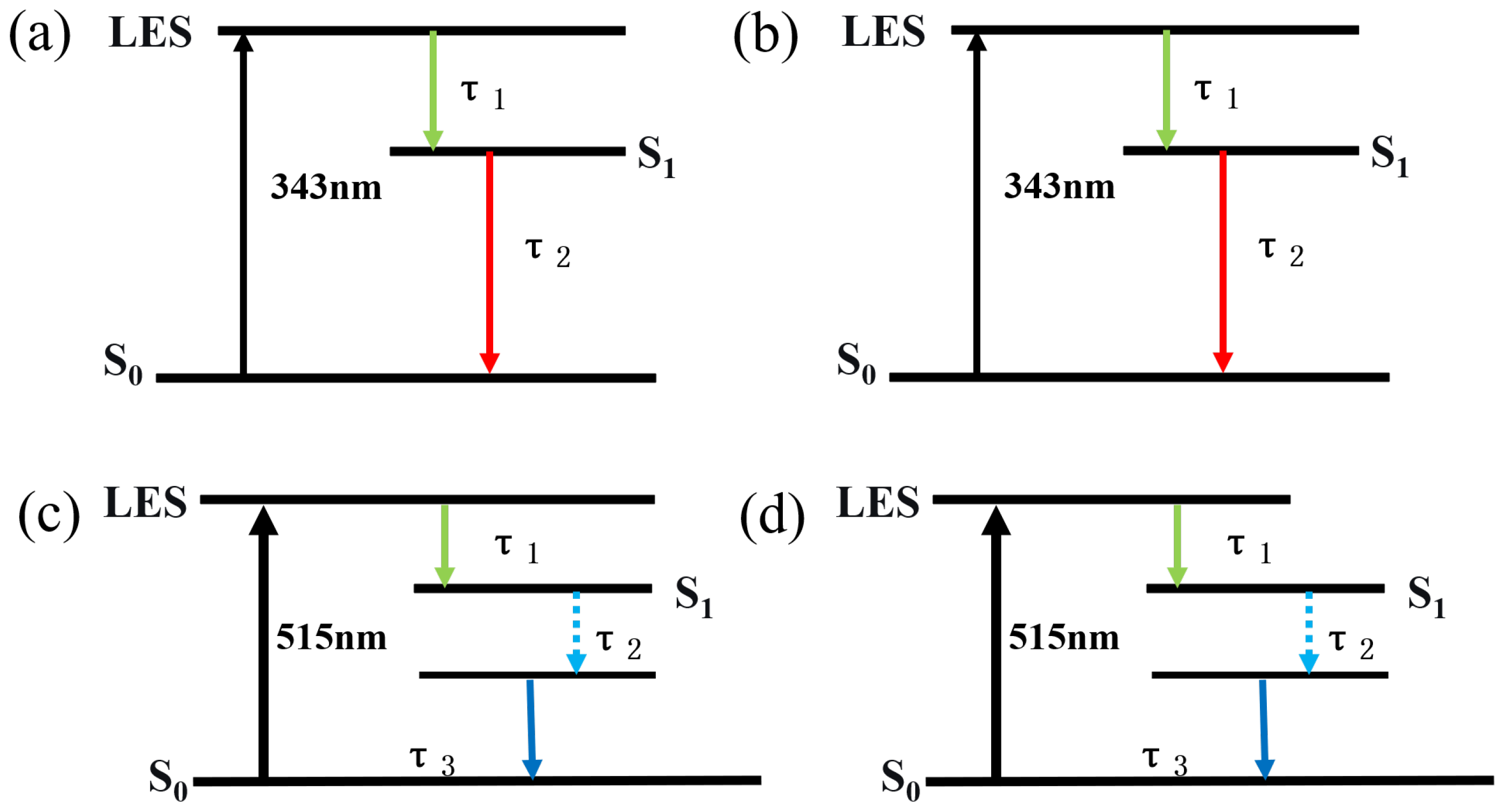
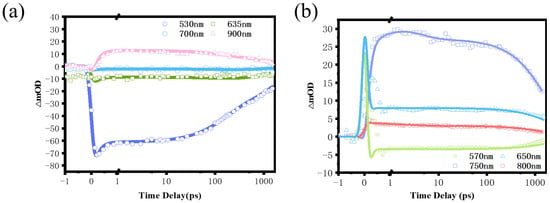
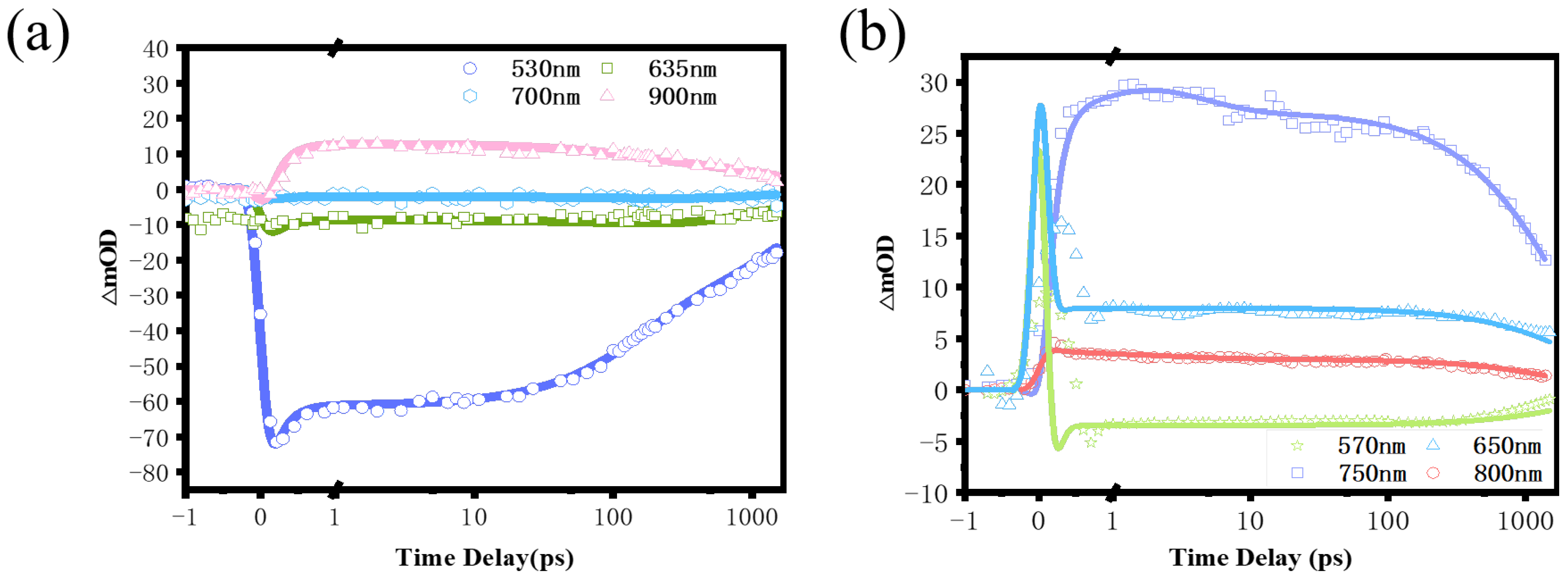
To gain deeper insight into the evolution of the transient absorption (TA) spectra, we identified the relevant kinetic processes through global fitting and target analysis and established simplified energy level models, as shown in Figure 7a–d, with the corresponding parameters listed in Table 2. Considering the distinctive characteristics under 515 nm excitation, we further analyzed the excited-state kinetic curves obtained from the fitting, with the results presented in Figure 8a,b.
Figure 7.
Molecular energy level models of TB1 and TB2. (a) Energy level diagram of TB1 at 343 nm; (b) Energy level diagram of TB2 at 343 nm; (c) Energy level diagram of TB1 at 515 nm; (d) Energy level diagram of TB2 at 515 nm.
Table 2.
Excited state lifetime parameters for TB1 and TB2, all parameters obtained from global fitting.
Figure 8.
Molecular energy level models of TB1 and TB2. (a) Transient absorption kinetic process of TB1; (b) Transient absorption kinetic process of TB2.
As shown in Figure 7a,b, under excitation with 343 nm light, for the compounds TB1 and TB2, the ground-state population is excited to the LE state within the time delay of a single pulse, after which the spectral profile stays stable. The signal drops rapidly on an extremely short time scale (corresponding to τ1), which is regarded as the transition from the LES state to S1. This is followed by the S1 → S0 transition, which reaches the nanosecond range and exceeds the detection window of the instrument. Its lifetime is given as τ2 [31,32].
As shown in Figure 7c,d, under excitation with 515 nm light, the ground-state population of TB1 and TB2 is excited to the LES state at the initial time delay of a pulse cycle. During the subsequent long time delay, the signal shows a slow decaying behavior. This process is considered as internal relaxation from the S1 state (corresponding to τ2). Eventually, back to the ground state (S0) with a lifetime τ3. which reaches the nanosecond range and exceeds the detection window of the instrument.
3.4. Z-Scan Experiments
Based on steady-state spectral and quantum chemical analyses, and to elucidate the nonlinear optical (NLO) properties of TB2 and TB1, both compounds were dissolved in chloroform (TCM) for solution-phase measurements. To ensure comparability across experiments, all measurements were performed under conditions where the linear transmittance of the solutions exceeded 90%. The solvent background signal was subtracted from the raw data, and the concentration of each solution was uniformly maintained at 1 mM.
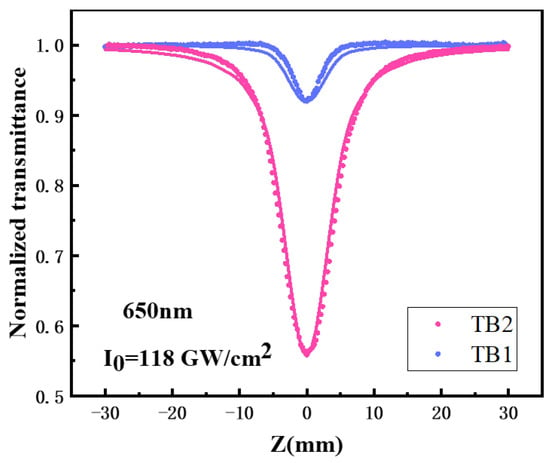
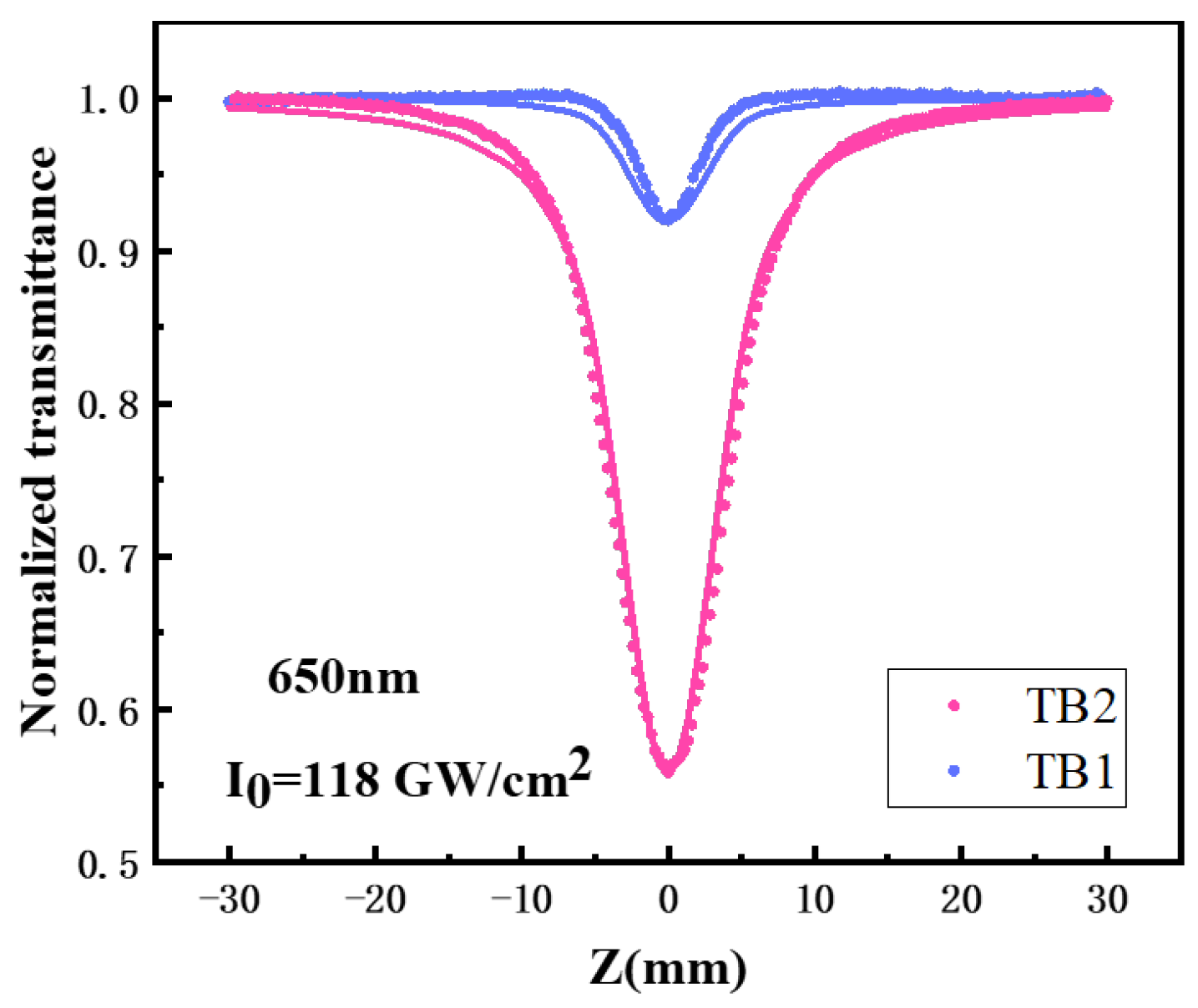
As shown by the experimental data in Figure 9, at 650 nm, under identical incident light intensity, the normalized transmittance at the valley reaches 0.55 for TB1, significantly lower than that of TB2 (0.92), confirming a stronger nonlinear absorption effect in TB1. This result aligns with predictions from quantum chemical calculations. Z-scan data and fitting parameters obtained at other wavelengths are provided in the Supplementary Materials (Figure S7).
Figure 9.
Experimental results of open-aperture Z-scan at 650 nm with femtosecond laser pulses; solid lines are numerical fits.
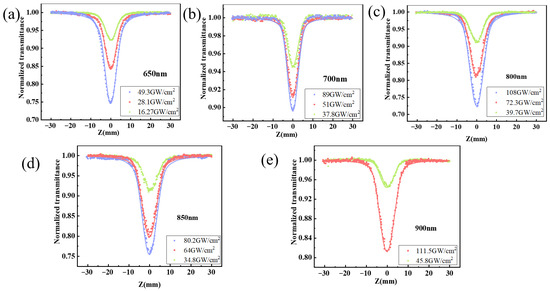
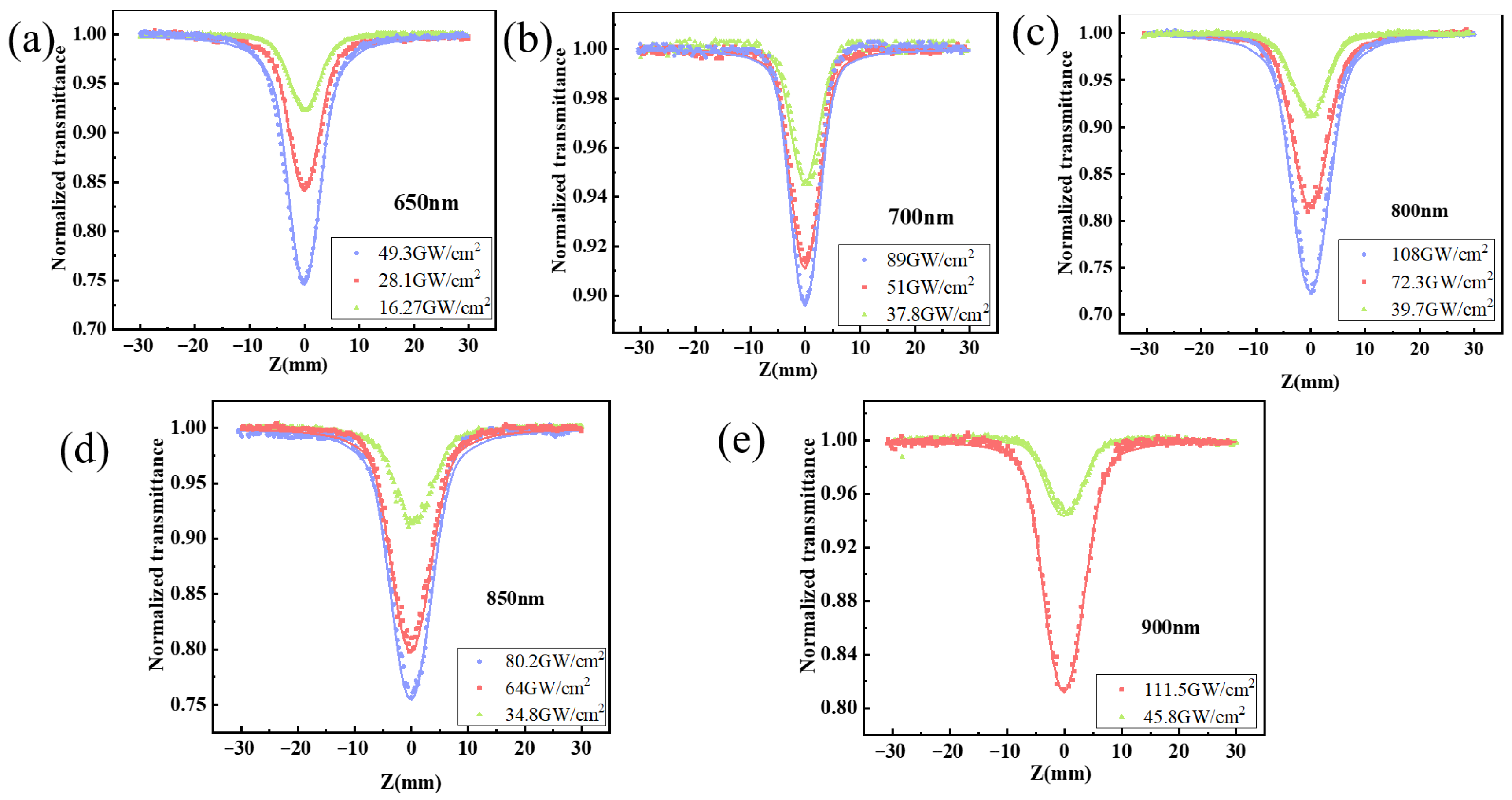
To further elucidate the nonlinear behavior of TB1, intensity-dependent Z-scan measurements were performed. The results indicate a pronounced enhancement of its reverse saturable absorption (RSA) with increasing incident laser energy. As the excitation wavelengths employed fall outside the principal absorption band (Figure 2) and the sample maintains high linear transmittance across this region, the observed nonlinear absorption (NLA) cannot be ascribed to one-photon excited-state absorption. Instead, two-photon absorption (TPA) is identified as the dominant mechanism governing light absorption in this spectral range. Furthermore, the effective third-order nonlinear absorption coefficient, derived from the experimental data, exhibits a distinct rise with increasing laser intensity, implying the involvement of higher-order nonlinearities—such as fifth-order nonlinear absorption—likely resulting from two-photon-induced excited-state absorption (TPA-ESA).
Based on the Sheik-Bahae theory [24], the relationship between the absorption coefficient α and the incident light intensity I can be expressed as [33]:
Here, denotes the linear absorption coefficient, which is independent of the incident light intensity. The coefficients and correspond to the third-order and fifth-order nonlinear absorption coefficients, respectively. describes the nonlinear process of two-photon absorption (TPA), while characterizes the fifth-order nonlinear absorption. Figure 10 presents the Z-scan experimental results for TB1 at different wavelengths under varying incident light intensities, with the fitting curves shown as solid lines. Detailed fitting parameters for the Z-scan data are summarized in Table 3.
Figure 10.
Experimental results of open-aperture Z-scan with femtosecond laser pulses; solid lines are numerical fits. (a) 650 nm, (b) 700 nm, (c) 800 nm, (d) 850 nm, (e) 900 nm.
Table 3.
Fitting parameters for open-aperture Z-scan with femtosecond laser pulses.
To further evaluate the two-photon absorption (TPA) capability at the molecular level, the TPA cross-section was calculated using the relation . The obtained values are 5591 GM at 650 nm, 2171 GM at 700 nm, 1858.5 GM at 800 nm, 1671.4 GM at 850 nm, and 551 GM at 900 nm. A comparison with literature data (Table 4) confirms the outstanding TPA performance of the material, further supporting that enhancing π-electron delocalization and increasing the transition dipole moments (μ01 and μ12) are effective strategies for improving third-order nonlinear optical response.
Table 4.
Comparison of for TB1 with other reported materials.
3.5. Optical Limiting Experiment
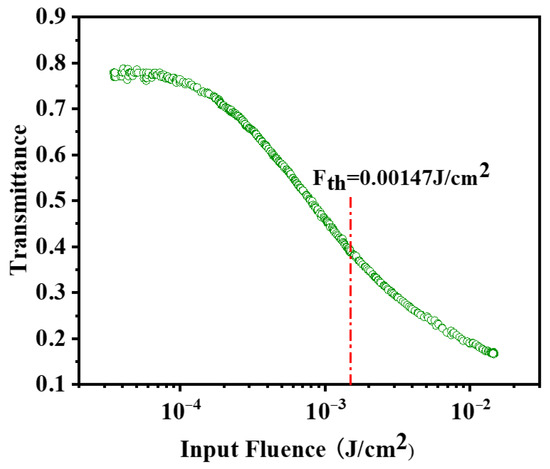
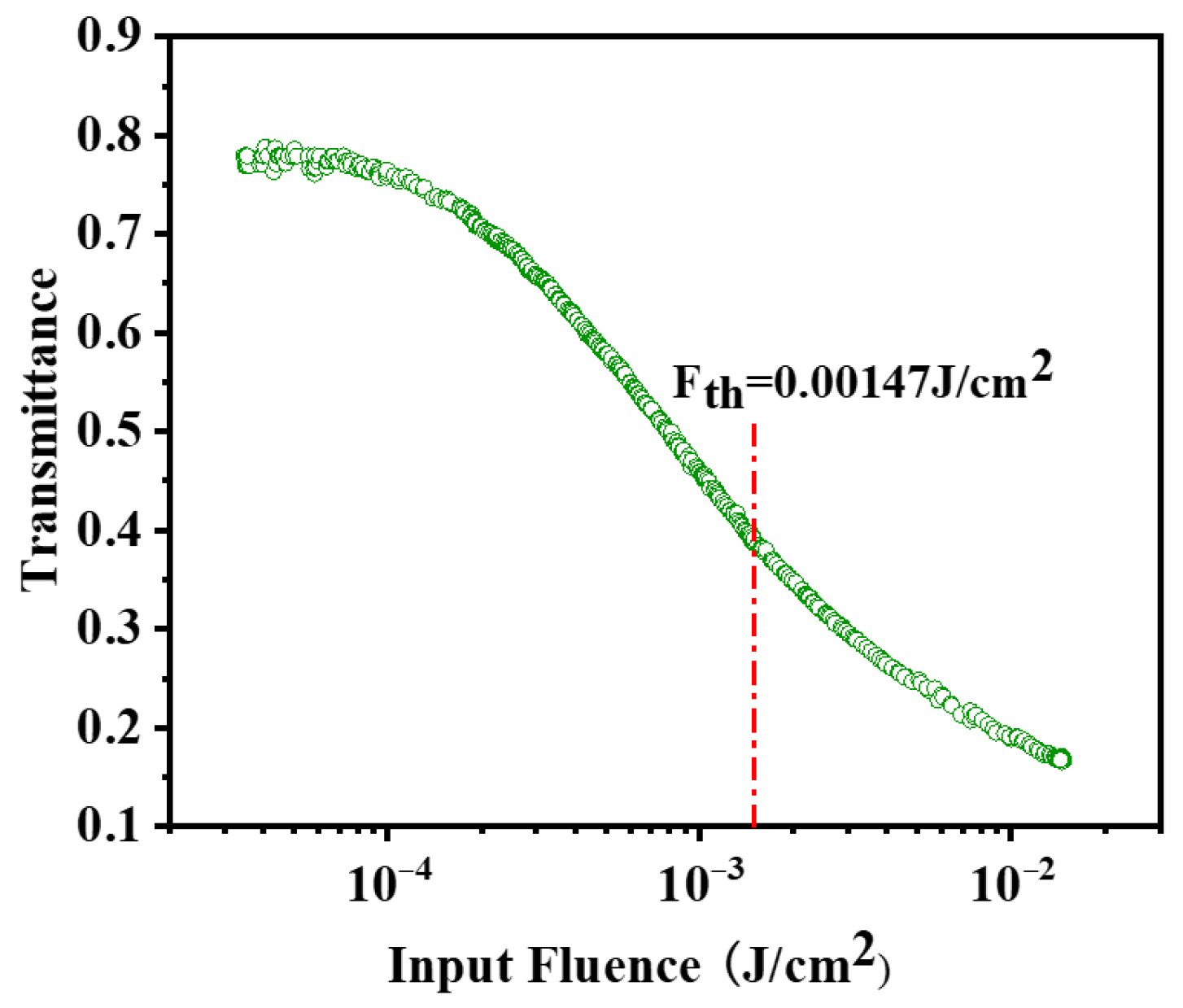
Building on the excellent multiphoton absorption capability of TB1 in the near-infrared region, its optical limiting performance was evaluated at 800 nm. To optimize the measurement conditions, the sample was dissolved at a concentration of 180 mM and placed in a 5 mm path length cuvette. The optical limiting threshold (Fth), defined as the input fluence at which the transmittance decreases to 50% of the linear transmittance [38], was determined to be 0.00147 J/cm2. A material is considered effective for optical limiting if it achieves such a threshold, with lower values corresponding to superior performance. As illustrated in Figure 11, TB1 exhibits promising optical limiting behavior with a threshold of 0.00147 J/cm2. A comparison with reported organic limiting materials (Table 5) confirms that TB1 is a highly promising candidate for laser protection applications.
Figure 11.
Relationship between transmittance and input intensity for TB1 at 800 nm.
Table 5.
Comparison of OL threshold for TB1 with other reported materials.
4. Conclusions
This study systematically investigates the nonlinear optical properties of two fused-ring thiophene derivatives. The results indicate that TB1, with its extended π-conjugation achieved through thiophene ring fusion, exhibits enhanced π-electron delocalization and larger transition dipole moments, which collectively contribute to its superior third-order nonlinear optical performance. Z-scan measurements reveal that both compounds display reverse saturable absorption behavior, with TB1 outperforming TB2—evidenced by a two-photon absorption cross-section as high as 5591 GM. Furthermore, TB1 demonstrates excellent optical limiting capability at 800 nm, showing a low threshold of 0.00147 J/cm2, which underscores its potential for laser protection applications. These findings confirm that enhancing π-electron delocalization and transition dipole moments via fused-ring molecular design represents an effective strategy for developing high-performance third-order nonlinear optical materials, offering valuable insights for the structural design and performance optimization of organic nonlinear optical systems.
Supplementary Materials
The following supporting information can be downloaded at: https://www.mdpi.com/article/10.3390/photonics13020136/s1, Figure S1. 1H NMR spectrum of 1121. Figure S2. 1H NMR spectrum of 0515. Figure S3. HR-MS spectrum of 1121. Figure S4. HR-MS spectrum of 0515. Figure S5. Schematic illustration of z-scan system. Figure S6. Schematic illustration of transient absorption system. Figure S7. Femtosecond laser pulse open aperture Z-scan experiment data of 1121 and 0515 (a) 700 nm, (b) 800 nm, (c) 850 nm, (d) 900 nm.
Author Contributions
S.L.: Writing—review and editing, Writing—original draft, Investigation, Data curation. Y.C.: Investigation, Formal analysis. T.D.: Investigation, Formal analysis. W.Z.: Investigation, Formal analysis. X.W.: Methodology, Conceptualization. L.J.: Investigation, Formal analysis. J.J.: Software, Resources. J.Y.: Funding acquisition. Z.L.: Methodology, Conceptualization. Y.S.: Supervision, Resources, Funding acquisition. All authors have read and agreed to the published version of the manuscript.
Funding
This research was funded by National Natural Science Foundation of China (Grant No. 62575202), Key Project of the Natural Science Foundation of Hebei Province (Grant No. B2021201043). Science and Technology Innova-tion Team of Guizhou Education Department (Grant No. [2023]094), Jiangsu Key Disciplines of the Fourteenth Five-Year Plan (Grant No. 2021135). The APC was funded by Yinglin Song.
Data Availability Statement
The relevant experimental and characterization data are available in the article and Supplementary Materials.
Conflicts of Interest
Author Xingzhi Wu was employed by the company Suzhou Micro-Nano Laser Photonics Technology Co., Ltd. The remaining authors declare that the research was conducted in the absence of any commercial or financial relationships that could be construed as a potential conflict of interest.
References
- Guo, Q.; Qi, X.Z.; Zhang, L.; Gao, M.; Hu, S.; Zhou, W.; Zang, W.; Zhao, X.; Wang, J.; Yan, B.; et al. Ultrathin quantum light source with van der Waals NbOCl2 crystal. Nature 2023, 613, 53–59. [Google Scholar] [CrossRef] [Scilit]
- Hou, J.; Situ, G. Image encryption using spatial nonlinear optics. eLight 2022, 2, 3. [Google Scholar] [CrossRef] [Scilit]
- Hani, S.U.; Ahmed, S.; Alam, T.I.; Saleque, A.M.; Ivan, M.N.A.S.; Saha, S.; Xu, L.; Tsang, Y.H. Germanium-based ternary chalcogenide: An emerging low-dimensional material for nonlinear optics and ultrafast photonics. Appl. Mater. Today 2025, 42, 102555. [Google Scholar] [CrossRef] [Scilit]
- Biswal, B.P.; Valligatla, S.; Wang, M.; Banerjee, T.; Saad, N.A.; Mariserla, B.M.K.; Chandrasekhar, N.; Becker, D.; Addicoat, M.; Senkovska, I.; et al. Nonlinear optical switching in regioregular porphyrin covalent organic frameworks. Angew. Chem. Int. Ed. 2019, 58, 6896–6900. [Google Scholar] [CrossRef] [Scilit]
- Zhou, W.; Shen, X.; Yan, X.; Chai, D.; Wu, F.; Li, H.; Zhao, X.; Cheng, P. Wide bandgap polymer donors based on highly twisted biphenyl imide for efficient organic photovoltaics. Chin. J. Chem. 2025, 43, 2951–2956. [Google Scholar] [CrossRef] [Scilit]
- Bednarz, M.; Lapin, J.; McGillicuddy, R.; Pelzer, K.M.; Engel, G.S.; Griffin, G.B. Modeling ultrafast exciton migration within the electron donor domains of bulk heterojunction organic photovoltaics. J. Phys. Chem. C 2017, 121, 5467–5479. [Google Scholar] [CrossRef] [Scilit]
- Zhou, B.J.; Dai, T.T.; Zhou, J.L.; Chen, Y.; Geng, Y.F.; Lei, P.; Zheng, G.Q.; Zeng, Q.D.; Zhou, E.R. Conjugated d-π-a photovoltaic polymers containing thieno[3,2-b]thiophene π-bridge. Mater. Chem. Front. 2024, 8, 1563–1590. [Google Scholar] [CrossRef] [Scilit]
- Jeong, Y.H.; Jeon, J.M.; Kim, J.Y.; Kim, Y.-H. New bithiophene extended IDIC-based non-fullerene acceptors and organic photovoltaics thereof. Molecules 2022, 27, 1113. [Google Scholar] [CrossRef] [Scilit]
- Agbolaghi, S. Polymer/quantum dot nanostructures in remarkably stabilized photovoltaics based on polymers having benzodithiophene/naphthothiadiazole constituents. Int. J. Energy Res. 2021, 45, 13284–13297. [Google Scholar] [CrossRef] [Scilit]
- Xia, C.C.; Wu, H.; Yue, Q.H.; Chen, S.S.; Shui, L.L.; Fan, H.J.; Zhu, X.Z. Oxygen heterocycle-fused indacenodithiophenebithiophene enables an efficient non-fullerene molecular acceptor. J. Mater. Chem. C 2019, 7, 15344–15349. [Google Scholar] [CrossRef] [Scilit]
- Lee, S.; Song, C.E.; Ryu, D.H.; Kim, J.; Kim, J.; Kang, I.-N. Single and double alkoxybenzothiadiazole–dithienosilole-based nonfused ring electron acceptors for organic solar cells. ACS Appl. Energy Mater. 2023, 6, 12503–12514. [Google Scholar] [CrossRef] [Scilit]
- Podlesny, J.; Pytela, O.; Klikar, M.; Jelínková, V.; Kityk, I.V.; Ozga, K.; Jedryka, J.; Rudysh, M.; Bures, F. Small isomeric push-pull chromophores based on thienothiophenes with tunable optical (non)linearities. Org. Biomol. Chem. 2019, 17, 3623–3634. [Google Scholar] [CrossRef] [Scilit]
- Shokr, E.K.; Kamel, M.S.; Abdel-Ghany, H.; El-Remaily, M.A.E.A.A.A.; Abdou, A. Synthesis, characterization, and dft study of linear and non-linear optical properties of some novel thieno[2,3-b]thiophene azo dye derivatives. Mater. Chem. Phys. 2022, 290, 126646. [Google Scholar] [CrossRef] [Scilit]
- Kukkonen, E.; Lahtinen, E.; Myllyperkiö, P.; Haukka, M.; Konu, J. Nonlinear optical properties of diaromatic stilbene, butadiene and thiophene derivatives. New J. Chem. 2021, 45, 6640–6650. [Google Scholar] [CrossRef] [Scilit]
- Wong, Q.A.; Quah, C.K.; Wong, X.A.; Win, Y.F.; Kwong, H.C.; Patil, P.S.; Gummagol, N.B.; Rao, S.V. A comprehensive study on the photophysical and non-linear optical properties of thienyl-chalcone derivatives. Phys. Chem. Chem. Phys. 2022, 24, 21927–21953. [Google Scholar] [CrossRef] [Scilit]
- Li, J.; Jia, J.; Zhou, W.; Wu, X.; Yang, J.; Song, Y. Study of excited-state dynamics of d-π-a thiophene derivatives: Enhanced excited-state absorption and refraction. J. Photochem. Photobiol. A Chem. 2024, 449, 115395. [Google Scholar] [CrossRef] [Scilit]
- Wang, J.; Zhao, J.; Han, S.; Li, Y.; Zeng, W.; Sun, J.; Zhou, S. Significant enhancement of reverse saturable absorption ability via pt(ii) incorporation into the conjugated backbone of benzo[1,2-b:4,5-b′]dithiophene-based donor–acceptor copolymers. Macromolecules 2024, 57, 1030–1037. [Google Scholar] [CrossRef] [Scilit]
- Anandan, S.; Manoharan, S.; Narendran, N.K.S.; Girisun, T.C.S.; Asiri, A.M. Donor-acceptor substituted thiophene dyes for enhanced nonlinear optical limiting. Opt. Mater. 2018, 85, 18–25. [Google Scholar] [CrossRef] [Scilit]
- Davanagere, H.; Arasalike, J.; Quah, C.K.; Kwong, H.C.; Patil, P.S. Investigation of structural, physical, linear, and nonlinear optical properties of two novel thiophene centred d-π-a type push-pull organic derivatives for nonlinear optical applications. J. Mol. Struct. 2020, 1220, 128763. [Google Scholar] [CrossRef] [Scilit]
- Shafiq, I.; Khalid, M.; Braga, A.A.C.; Tariq, Z.; Alhokbany, N.; Chen, K. Exploration the effect of selenophene moiety and benzothiophene based acceptors on optical nonlinearity of d–π–a based heterocyclic organic compounds in chloroform solvent: A DFT approach. J. Mol. Liq. 2024, 393, 123569. [Google Scholar] [CrossRef] [Scilit]
- Jia, J.D.; Li, J.; Zhang, T.W.; Lu, Y.L.; Song, Y.L. Study of two-photon absorption and excited-state dynamics of coumarin derivatives: The effect of monomeric and dimeric structures. Phys. Chem. Chem. Phys. 2024, 26, 11064–11072. [Google Scholar] [CrossRef] [Scilit]
- Shi, S.-T.; Fang, Y.; Yang, J.-Y.; Han, Y.-B.; Song, Y.-L. The remarkable enhancement of two-photon absorption in pyrene based chalcone derivatives. Opt. Mater. 2018, 86, 331–337. [Google Scholar] [CrossRef] [Scilit]
- Houk, K.N. Frontier molecular orbital theory of cycloaddition reactions. Acc. Chem. Res. 1975, 8, 361–369. [Google Scholar] [CrossRef] [Scilit]
- Sheik-Bahae, M.; Said, A.A.; Wei, T.H.; Hagan, D.J.; Stryland, E.W.V. Sensitive measurement of optical nonlinearities using a single beam. IEEE J. Quantum Electron. 1990, 26, 760–769. [Google Scholar] [CrossRef] [Scilit]
- Berera, R.; van Grondelle, R.; Kennis, J.T. Ultrafast transient absorption spectroscopy: Principles and application to photosynthetic systems. Photosynth. Res. 2009, 101, 105–118. [Google Scholar] [CrossRef] [Scilit]
- Kohn, W.; Sham, L.J. Self-consistent equations including exchange and correlation effects. Phys. Rev. 1965, 140, A1133–A1138. [Google Scholar] [CrossRef] [Scilit]
- Woon, D.E.; Dunning, T.H., Jr. Gaussian basis sets for use in correlated molecular calculations. III. The atoms aluminum through argon. J. Chem. Phys. 1993, 98, 1358–1371. [Google Scholar] [CrossRef] [Scilit]
- Krishnan, R.; Binkley, J.S.; Seeger, R.; Pople, J.A. Self-consistent molecular orbital methods. XX. A basis set for correlated wave functions. J. Chem. Phys. 1980, 72, 650–654. [Google Scholar] [CrossRef] [Scilit]
- Furche, F.; Ahlrichs, R. Adiabatic time-dependent density functional methods for excited state properties. J. Chem. Phys. 2002, 117, 7433–7447. [Google Scholar] [CrossRef] [Scilit]
- Lu, T.; Chen, F. Multiwfn: A multifunctional wavefunction analyzer. J. Comput. Chem. 2012, 33, 580–592. [Google Scholar] [CrossRef] [Scilit]
- Kiba, T.; Sato, S.-I.; Akimoto, S.; Kasajima, T.; Yamazaki, I. Solvent-assisted intramolecular vibrational energy redistribution of S1 perylene in ketone solvents. J. Photochem. Photobiol. A Chem. 2006, 178, 201–207. [Google Scholar] [CrossRef] [Scilit]
- Stannard, P.R.; Gelbart, W.M. Intramolecular vibrational energy redistribution. J. Phys. Chem. 1981, 85, 3592–3599. [Google Scholar] [CrossRef] [Scilit]
- Gu, B.; Ji, W.; Patil, P.S.; Dharmaprakash, S.M.; Wang, H.-T. Two-photon-induced excited-state absorption: Theory and experiment. Appl. Phys. Lett. 2008, 92, 091118. [Google Scholar] [CrossRef] [Scilit]
- Han, Y.; Xiao, J.; Wu, X.; Wang, Y.; Zhang, X.; Song, Y. Synthesis and ultrafast broadband optical limiting properties of a two-branched twistacene. Molecules 2022, 27, 3564. [Google Scholar] [CrossRef] [Scilit] [PubMed]
- Wei, J.; Yang, J.; Yang, L.; Li, Y.; Song, Y. Nonlinear absorption and optical limiting performance of broad-band multi-branched aniline derivatives in the near-infrared region. Dye. Pigment. 2024, 222, 111876. [Google Scholar] [CrossRef] [Scilit]
- Shang, H.; Song, G.; Wu, X.; Zhou, W.; Zhang, X.; Wang, Y.; Xiao, J.; Song, Y. Realizing excellent nonlinear optical performance in near-infrared region of helicene-functionalized arenes. Adv. Opt. Mater. 2025, 13, 2500047. [Google Scholar] [CrossRef] [Scilit]
- Biswas, C.; Gangadhar, P.S.; Giribabu, L.; Chetti, P.; Banerjee, D.; Soma, V.R.; Raavi, S.S.K. Ultrafast intramolecular charge transfer dynamics and nonlinear optical properties of phenothiazine-based push–pull zinc porphyrin. J. Photochem. Photobiol. A Chem. 2022, 433, 114141. [Google Scholar] [CrossRef] [Scilit]
- Xie, Q.; Shao, Z.; Zhao, Y.; Yang, L.; Wu, Q.; Xu, W.; Li, K.; Song, Y.; Hou, H. Novel photo-controllable third-order nonlinear optical (NLO) switches based on azobenzene derivatives. Dye. Pigment. 2019, 170, 107599. [Google Scholar] [CrossRef] [Scilit]
- Du, J.; Wang, L.; Xie, N.; Sun, L.; Wang, X.; Zhao, Y.; Wu, F. Optical limiting property of a liquid malononitrile derivative on 800 nm laser pulses. Opt. Mater. 2016, 58, 164–170. [Google Scholar] [CrossRef] [Scilit]
- Jia, J.; Wu, X.; Fang, Y.; Yang, J.; Guo, X.; Xu, Q.; Han, Y.; Song, Y. Ultrafast broad-band optical limiting in simple hydrazone derivatives with a π-conjugated system: Effect of two-photon-induced singlet-state absorption. J. Phys. Chem. C 2018, 122, 16234–16241. [Google Scholar] [CrossRef] [Scilit]

Disclaimer/Publisher’s Note: The statements, opinions and data contained in all publications are solely those of the individual author(s) and contributor(s) and not of MDPI and/or the editor(s). MDPI and/or the editor(s) disclaim responsibility for any injury to people or property resulting from any ideas, methods, instructions or products referred to in the content. |
© 2026 by the authors. Licensee MDPI, Basel, Switzerland. This article is an open access article distributed under the terms and conditions of the Creative Commons Attribution (CC BY) license.