Article

Dependence of Poynting Vector on State of Polarization


Department of Physics, Shanghai University, 99 Shangda Road, Shanghai 200444, China
*
Author to whom correspondence should be addressed.
Photonics 2026, 13(2), 137; https://doi.org/10.3390/photonics13020137
Submission received: 5 December 2025 / Revised: 6 January 2026 / Accepted: 29 January 2026 / Published: 31 January 2026
(This article belongs to the Section Lasers, Light Sources and Sensors)

Abstract

It is known that the Poynting vector in a plane electromagnetic field is always along its propagation direction irrespective of its polarization state. Here we show, by making use of a superposition of four linearly-polarized plane waves, that the Poynting vector in a non-paraxial field is dependent on its polarization state. This is theoretically explained by resorting to the so-called Stratton vector. An expression for the Poynting vector in terms of generalized polarization bases as well as polarization ellipticity is given, which is further extended to a non-paraxial field of continuously-distributed angular spectrum. The expression is the same as what was given very recently by Fernandez-Guasti for electromagnetic fields constructed on the basis of Heaviside–Larmor symmetry.

1. Introduction

The Poynting vector is the density of energy flow in the electromagnetic field. The cycle-averaged value of the Poynting vector in a monochromatic field takes the form [1],
g = 1 2 Re ( E × H * ) ,
where E and H are the electric and magnetic fields, respectively. It is well known that the Poynting vector in a plane monochromatic wave is always in the propagation direction irrespective of its polarization state. About three decades ago, Katsenelenbaum [2] studied the direction of the Poynting vector in an electromagnetic field that is formed by the superposition of four plane monochromatic waves of linear polarization. The four waves propagate in the directions that make the same acute angle with the z axis so that the non-paraxial superposition field propagates along the positive z axis. But he found that in the transverse plane, the z-component of the Poynting vector in some domains is unexpectedly negative, especially when the plane waves are highly non-paraxial. Such a phenomenon was recently utilized [3] to explain the reverse energy flow in a sharp focus, known as energy backflow.
The energy backflow in the longitudinal direction was known as early as in 1919 [4]. This counterintuitive phenomenon was subsequently reported in papers by Richards and Wolf [5], Berry [6], and Volyar [7]. It was recently shown that, in agreement with the observation by Katsenelenbaum, non-paraxiality enhances the energy backflow in other different types of optical fields, including Bessel beams [8,9], Laguerre-Gaussian beams [10], Airy beams [11], annular beams [12], Lissajous beams [13], and polarization-singular and phase-singular beams [3]. Thus, the energy backflow of tightly focused laser beams has attracted plenty of interest in connection with applications in microparticle manipulation (see Ref. [14] for a review).
However, this does not mean that non-paraxiality is a sufficient condition for the energy backflow to occur [15]. Indeed, our investigations show that the phenomenon observed by Katsenelenbaum lies with the choice of the concrete direction of the polarization vector of the constituent plane wave. We find that the direction of the polarization vector can be so adjusted that the z-component of the resultant Poynting vector is not negative. Since adjusting the direction of the polarization vector of the constituent plane wave will lead to a change of the superposition field in polarization, it follows that changing the polarization of the superposition field in such a way will have a substantial effect on its Poynting vector.
The purpose of this paper is to address how the Poynting vector in a non-paraxial field depends on its polarization state by making use of the four-plane-wave model. Two different kinds of superposition fields are constructed. One is similar to what Katsenelenbaum discussed in Ref. [2] in the sense that the z-component of its Poynting vector is negative in some domains. The other does not show any negative value in the z-component of the Poynting vector. This phenomenon is theoretically explained as the change of the so-called Stratton vector [1]. An expression for the Poynting vector in terms of generalized polarization bases is obtained. Such an expression is finally extended to a non-paraxial monochromatic field of continuously-distributed angular spectrum.

2. Poynting Vectors in Two Different Situations

Let us start with a situation that is similar to what was discussed in Ref. [2]. The wavevectors of the four plane waves in free space are as follows,
k 1 = k ( z ^ cos ϑ + x ^ sin ϑ ) , k 2 = k ( z ^ cos ϑ + y ^ sin ϑ ) , k 3 = k ( z ^ cos ϑ x ^ sin ϑ ) , k 4 = k ( z ^ cos ϑ y ^ sin ϑ ) ,
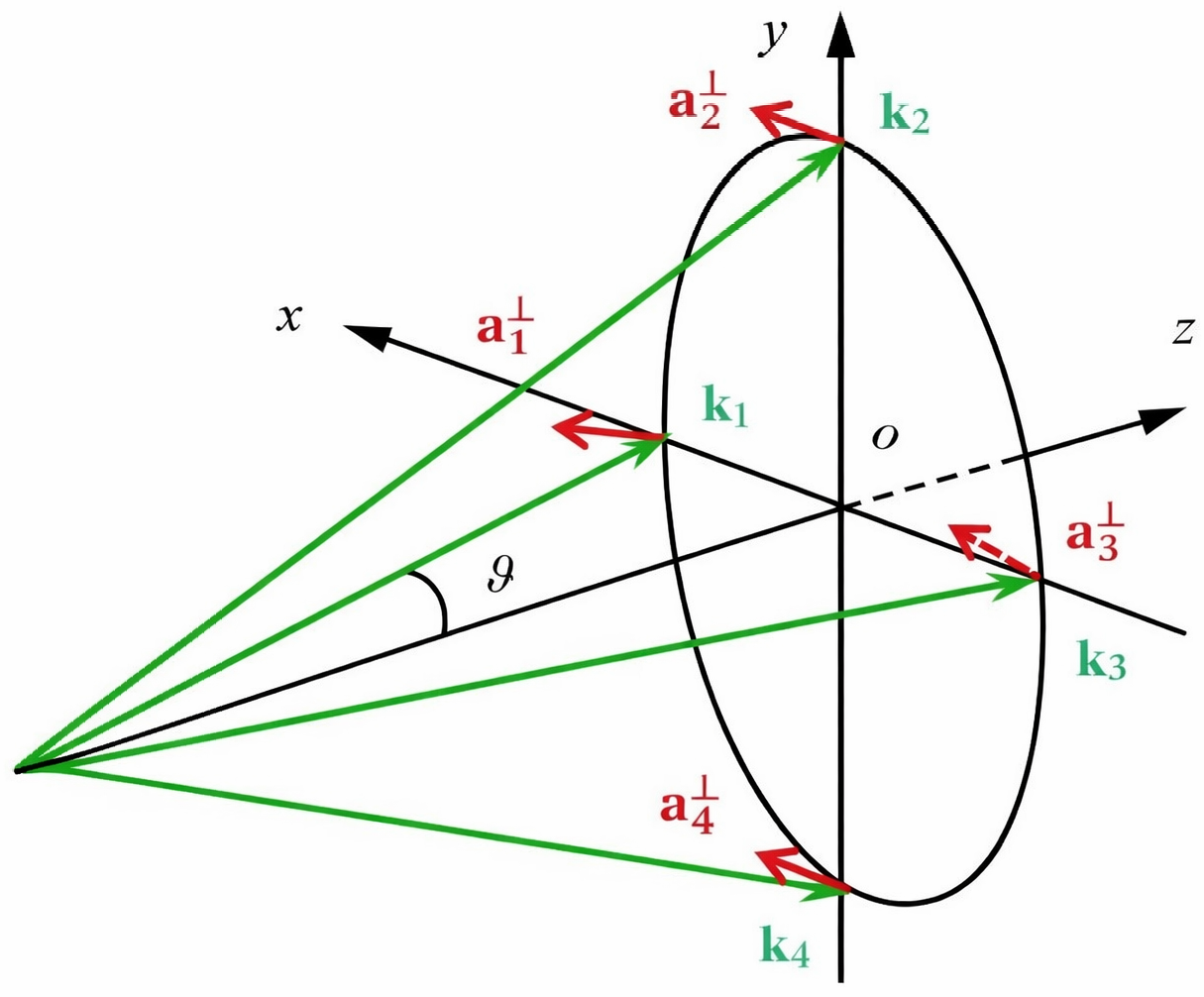
which are schematically indicated in Figure 1 by the green arrows, where k is the wavenumber, x ^ , y ^ , and z ^ denote the unit vectors along the corresponding axes, and ϑ is the acute angle that the wavevectors make with the z axis. Their electric fields are chosen to be
E i = a i 2 ε 0 exp ( i k i · x ) , i = 1 , 2 , 3 , 4 ,
where the time dependence is assumed to be exp ( i ω t ) , the real unit vectors
a 1 = x ^ cos ϑ z ^ sin ϑ , a 2 = x ^ , a 3 = x ^ cos ϑ + z ^ sin ϑ , a 4 = x ^ ,
are the polarization vectors of the respective electric fields which are linearly-polarized and are schematically indicated in Figure 1 by the red arrows, the meaning of the superscript ⊥ will be clear in the next section, and the factor 1 2 ε 0 is introduced for convenience. The electric field of the superposition of the four plane waves is given by
E = 2 ε 0 [ x ^ ( cos ϑ cos k x + cos k y ) i z ^ sin ϑ sin k x ] exp ( i k z ) ,
the transverse component of which is polarized only in the x direction, where k = k sin ϑ and k = k cos ϑ . According to Maxwell’s equations, the corresponding magnetic field assumes
H = 2 μ 0 [ y ^ ( cos ϑ cos k y + cos k x ) i z ^ sin ϑ sin k y ] exp ( i k z ) .
Its transverse component is polarized only in the y direction. Both electric field (3) and magnetic field (4) have z-polarized longitudinal components.
According to expression (1) for the Poynting vector, it is straightforward to make use of electric and magnetic fields (3) and (4) to calculate the z-component of the Poynting vector, which reads
g z = c [ cos ϑ ( cos k x + cos k y ) 2 + ( 1 cos ϑ ) 2 cos k x cos k y ] ,
where c = 1 / ε 0 μ 0 . The first term is non-negative, but the second one can be. As a result, there are domains in which g z is less than zero. After all, there always exist such points at which one has cos ( k x ) = cos ( k y ) 0 and therefore g z < 0 . It is seen that the first non-negative term is proportional to cos ϑ . So under the extremely non-paraxial condition in which ϑ = π / 2 , Equation (5) reduces to g z = c cos k x cos k y . The maximum of its negative value is equal to the maximum of its positive value. In this case, electric field (3) and magnetic field (4) reduce to
E = 2 ε 0 ( x ^ cos k y i z ^ sin k x ) , H = 2 μ 0 ( y ^ cos k x i z ^ sin k y ) ,
respectively. The amplitude of their “longitudinal” components is the same as that of their “transverse” components. On the other hand, in the zeroth-order paraxial approximation in which sin ϑ 0 , one has g z 4 c , which is positive. This is because in such an approximation, expressions (3) and (4) tend to the electric and magnetic fields of a linearly-polarized plane wave,
E 2 2 ε 0 x ^ exp ( i k z ) , H 2 2 μ 0 y ^ exp ( i k z ) ,
respectively. Their longitudinal components all vanish. As a matter of fact, in the first-order paraxial approximation in which sin ϑ ϑ and cos ϑ 1 , one has g z c ( cos k ϑ x + cos k ϑ y ) 2 , which is non-negative. This indicates that the negative value of g z comes from higher-order terms. Therefore, the larger the acute angle ϑ is, the bigger the maximum of the negative value of g z is. Expression (5) can also be written as
g z = c [ cos ϑ ( cos k x cos k y ) 2   + ( 1 + cos ϑ ) 2 cos k x cos k y ] ,
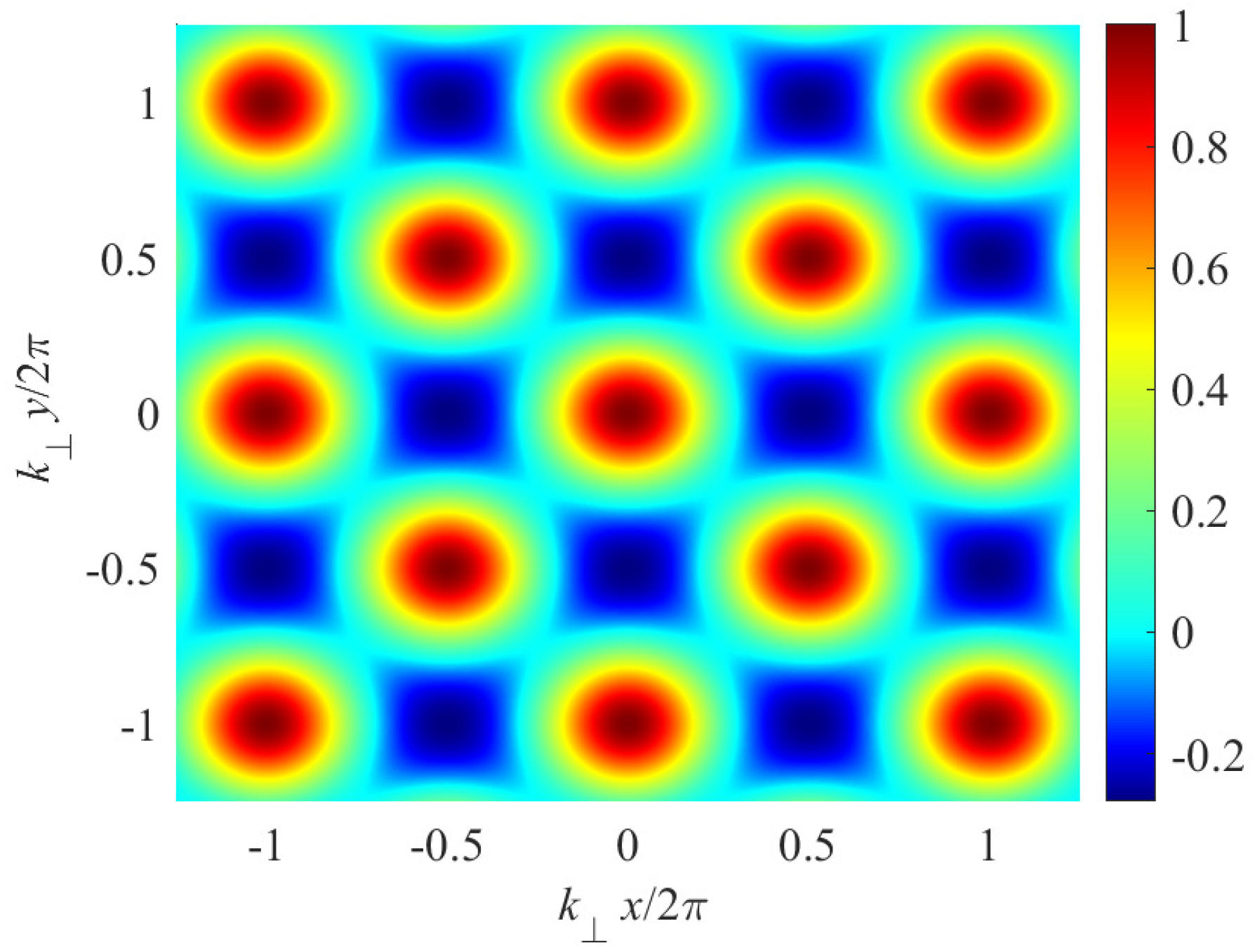
showing that g z 0 on the bisectrices x = ± y . A typical distribution of normalized g z in the transverse plane is illustrated in Figure 2, where ϑ = 2 π / 5 .
The g z in (5) being negative in some domains is similar to what Katsenelenbaum found in Ref. [2]. To demonstrate that this phenomenon lies with the specific directions of polarization vectors (2), we only adjust the directions of the polarization vectors of the four plane waves and write their electric fields as follows,
E i = a i 2 ε 0 exp ( i k i · x ) ,
where the polarization vectors a i after adjustment are given by
a 1 = x ^ cos ϑ z ^ sin ϑ , a 2 = y ^ cos ϑ z ^ sin ϑ , a 3 = x ^ cos ϑ z ^ sin ϑ , a 4 = y ^ cos ϑ z ^ sin ϑ ,
and the meaning of the superscript ‖ will be clear in the next section. It is stressed that, as with polarization vectors (2), all the polarization vectors in (6) stand for linear polarization. In this situation, the electric field of the superposition of the four plane waves becomes
E = 2 ε 0 i [ ( x ^ sin k x + y ^ sin k y ) cos ϑ + i z ^ ( cos k x + cos k y ) sin ϑ ] exp ( i k z ) ,
which has a y-polarized transverse component in addition to the x-polarized one. Accordingly, the corresponding magnetic field becomes
H = 2 μ 0 i ( y ^ sin k x x ^ sin k y ) exp ( i k z ) .
The same as electric field (7), it has both x- and y-polarized transverse components. But its longitudinal component disappears. As a consequence, the z-component of the Poynting vector takes the form,
g z = c cos ϑ ( sin 2 k x + sin 2 k y ) .
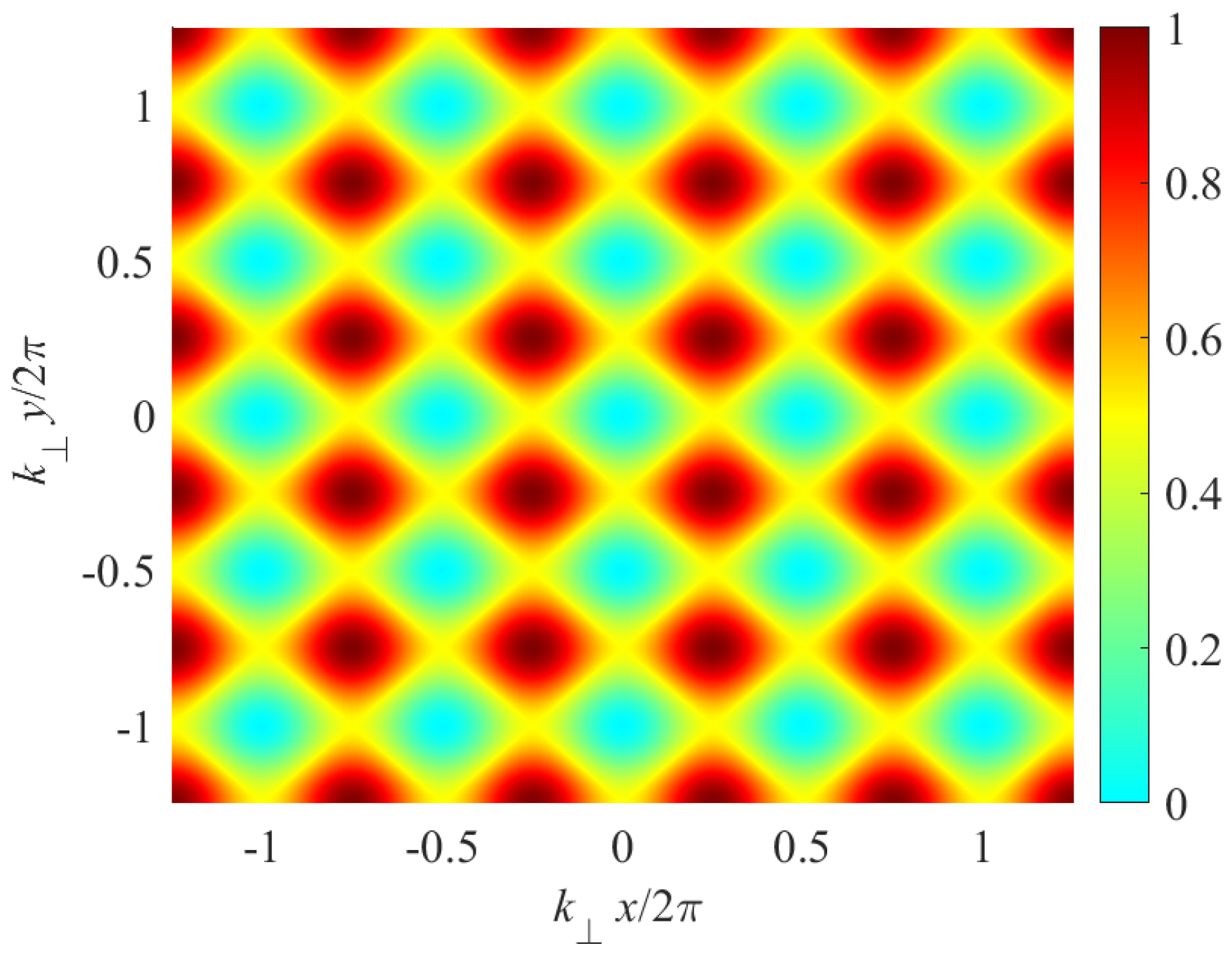
In contrast with g z , g z is non-negative. It vanishes at points k x = m π and k y = n π , where m and n are integers. It is maximum at points k x = ( m + 1 / 2 ) π and k y = ( n + 1 / 2 ) π . A typical distribution of normalized g z in the transverse plane is illustrated in Figure 3, where the value of ϑ is the same as in Figure 2. It is interesting to note that whether under the extremely non-paraxial condition or under the zeroth-order paraxial condition, g z completely vanishes. In the former case, ϑ = π / 2 , electric field (7) has only a z-polarized component,
E = 2 ε 0 z ^ ( cos k x + cos k y ) ;
and magnetic field (8) reduces to
H = 2 μ 0 i ( y ^ sin k x x ^ sin k y ) .
So certainly the z-component of the Poynting vector in such a field is equal to zero by virtue of Equation (1). Whereas in the latter case, sin ϑ = 0 , both the electric and magnetic fields vanish.

3. Theoretical Explanation in Terms of Stratton Vector

3.1. Introduction of Stratton Vector

We have seen that non-paraxial field (3) in the first situation and non-paraxial field (7) in the second situation are different in polarization. So the difference between Poynting vectors (5) and (9) indicates that the polarization of a non-paraxial field has an impact on its Poynting vector. To understand how the polarization affects the Poynting vector, it is required to figure out a way to characterize the difference in polarization between these two superposition fields. We will see that even though each of the constituent plane waves in the two superposition fields is linearly polarized, their polarization states can be distinguished by the constant unit vector that was first introduced by Stratton [1] and later used by others [7,16,17,18] in discussing the representation of vector electromagnetic fields, called the Stratton vector.
Remembering that the polarization of a plane electromagnetic wave can be described by the Jones vector, one should first take the notion of the Jones vector into account. It is well-known that the two elements of the Jones vector are the projections of the polarization vector of the plane wave onto two polarization bases. The two polarization bases must be perpendicular to its propagation direction. Usually, the plane wave is assumed to propagate along the z axis and hence the unit vectors along the transverse x and y axes are taken as the polarization bases. But here, all the four plane waves in the superposition fields propagate in different directions. In order to use the Jones vector to describe polarization vectors (2) or (6), the polarization bases of each of the plane waves have to be determined individually. Of course, this can be done by choosing a pair of real unit vectors, denoted by u i and v i , that form a right-handed Cartesian triad with the relevant wavevector k i ,
u i · v i = 0 , u i × v i = k i k .
The problem is that the unit vectors u i and v i satisfying these two equations are arbitrary to the extent that a rotation about the wavevector k i can be performed. Fortunately, according to Ref. [19], one can make use of the Stratton vector, denoted by I , to completely specify the polarization bases of different plane waves in a consistent way,
u i = v i × k i k , v i = I × k i | I × k i | .
In terms of the specified polarization bases, whether polarization vectors (2) or (6) can be expanded as follows,
a i = α 1 u i + α 2 v i .
The expansion coefficients α 1 and α 2 make up the Jones vector, α α 1 α 2 , which satisfies the normalization condition α α = 1 . It is stressed [20] that only when u i and v i are orthogonal to each other can α 1 and α 2 make up a Jones vector. Taking Equation (11) into consideration, whether electric field (3) or (7) can be written as
E ( x ) = i = 1 4 a i 2 ε 0 exp ( i k i · x ) .
It is pointed out [19] that the Stratton vector specifying the polarization bases via Equation (10) can in principle be any constant unit vector. It is also observed that for an arbitrary Stratton vector, the superposition field expressed by Equation (12) satisfies Maxwell’s divergence equation · E = 0 no matter what the Jones vector of the constituent plane wave is. After all, polarization bases (10) make the polarization vector (11) perpendicular to the relevant wavevector k i irrespective of the Jones vector. Therefore, one is always possible to construct a superposition field in such a way that given a Stratton vector, all the constituent plane waves share a common Jones vector. This is the superposition field that we are only concerned with in the present paper. As a matter of fact, whether superposition field (3) or (7) is so constructed. In particular, the common Jones vectors in both situations are the same. They are only different in the Stratton vector. This is why we do not label the Jones vector in (11) with i.
It is readily checked that the common Jones vector of the constituent plane waves in the first situation is α = 1 0 if their polarization bases are specified by the Stratton vector I = x ^ , which is perpendicular to the z axis. The common Jones vector in the second situation is the same as in the first situation. But the polarization bases in this situation have to be specified by the Stratton vector I = z ^ , which is parallel to the z axis. After explaining the difference in polarization between the two superposition fields by resorting to the Stratton vector, we are faced with the issue of how the Stratton vector accounts for the negative value of the z-component of the Poynting vector in the first situation.

3.2. Poynting Vector Expressed in Terms of Generalized Polarization Bases

To address this issue, we make use of expression (11) to rewrite electric field (12) as
E ( x ) = α 1 U + α 2 V ,
where
U = 1 2 ε 0 i = 1 4 u i exp ( i k i · x ) , V = 1 2 ε 0 i = 1 4 v i exp ( i k i · x ) ,
and u i and v i are given by Equation (10). Substituting it and the corresponding magnetic field
H ( x ) = ε 0 μ 0 ( α 1 V α 2 U )
into Equation (1), we get
g = ε 0 c 2 Re ( U × V * ) + i 2 σ ( U × U * + V × V * ) ,
where σ = i ( α 1 * α 2 α 2 * α 1 ) is the polarization ellipticity. It shows that the Poynting vector in non-paraxial superposition field (13) does not depend on the two elements of the common Jones vector individually. Instead, it depends on the common Jones vector through σ . For example, when I = I , U and V are given by
U = 2 ε 0 [ x ^ ( cos ϑ cos k x + cos k y ) i z ^ sin ϑ sin k x ] exp ( i k z ) , V = 2 ε 0 [ y ^ ( cos ϑ cos k y + cos k x ) i z ^ sin ϑ sin k y ] exp ( i k z ) ,
respectively, and the Poynting vector (15) assumes
g = z ^ g z σ c [ x ^ ( cos k x + cos ϑ cos k y ) sin k y y ^ ( cos k y + cos ϑ cos k x ) sin k x ] sin ϑ ,
where g z is given by Equation (5). In this case, the z-component of the Poynting vector does not depend on σ . Only the transverse components do.
As just observed, Poynting vector (15) depends on the common Jones vector of the constituent plane waves through the common polarization ellipticity. This phenomenon reflects such a fact that the common Jones vector of the constituent plane waves shows up as the Jones vector of the entire superposition field (13). That is to say, the vector functions U and V in expression (13) act as the polarization bases for the entire electric field E . In fact, it is easy to make use of Equation (10) to show that U and V are orthogonal to each other in the following sense,
U * · V d x d y = V * · U d x d y = 0 .
In addition, they are equal in “magnitude”,
U * · U d x d y = V * · V d x d y W .
With the help of these properties, it is straightforward to obtain from Equation (13)
α 1 = 1 W U * · E d x d y , α 2 = 1 W V * · E d x d y ,
meaning that the two elements α 1 and α 2 of the common Jones vector are essentially the projections of the entire electric field E onto the polarization bases U and V , respectively. According to Equation (10), the polarization bases for non-paraxial field (13) have to be specified by the Stratton vector. But they are different from the polarization bases for a plane wave. Firstly, they are dependent on the position x . Secondly, for this reason, they usually do not obey U * · V = 0 as can be easily checked with expressions (16). For the sake of clarity, we will call U and V the generalized polarization bases for electric field (13).
We have expressed via Equation (15) the Poynting vector in superposition field (13) and (14) in terms of its generalized polarization bases and its polarization ellipticity. Now we are ready to explain why the z-component of the Poynting vector in the first situation can be negative in some domains. When the Jones vector is α = 1 0 , we have σ = 0 . Poynting vector (15) in this case reads
g = ε 0 c 2 Re ( U × V * ) .
Furthermore, if the Stratton vector is chosen to be I , it reduces to
g = z ^ g z ,
as can be seen from Equation (17). It is thus seen that the negative value of the z-component of the Poynting vector in the first situation just reflects the concrete position-dependence of generalized polarization bases (16).

3.3. Extension to Non-Paraxial Fields of Continuously-Distributed Angular Spectrum

As mentioned above, Equation (15) is the expression for the Poynting vector in superposition field (13) and (14) in terms of its generalized polarization bases and its polarization ellipticity. Here we note that this result can be conveniently extended to a non-paraxial monochromatic field of continuously-distributed angular spectrum. Specifically, the generalized polarization bases U and V in Equations (13) and (14) can be extended to [19]
U = 1 2 ε 0 e ( k ) 2 π u ( k ) exp ( i k · x ) d k x d k y , V = 1 2 ε 0 e ( k ) 2 π v ( k ) exp ( i k · x ) d k x d k y ,
where e ( k ) is the scalar angular spectrum, unit-vector functions u ( k ) and v ( k ) denote the polarization bases of the constituent plane wave, which are specified by the Stratton vector as follows,
u = v × k k , v = I × k | I × k | .
When I = I , Equations (13) and (14) together with (19) give electromagnetic fields that tend to be uniformly polarized in the zeroth-order paraxial approximation [17]. Whereas when I = I , they give TM or TE modes [18] if α = 1 0 or α = 0 1 . Generalized polarization bases (19) satisfy orthogonality condition (18) by virtue of Equation (20). Moreover, they are equal in “magnitude”,
U * · U d x d y = V * · V d x d y = 1 2 ε 0 | e ( k ) | 2 d k x d k y .
In particular, expression (15) for the Poynting vector is still valid for the resultant non-paraxial field.

4. Conclusions and Discussions

In conclusion, we showed that both superposition fields (3) and (7) can be expressed by Equation (13). In particular, they have the same Jones vector α = 1 0 . Their Poynting vectors are all given by Equation (15). They are only different in the Stratton vector that specifies their generalized polarization bases. In the former situation, the generalized polarization bases are specified by I . Whereas in the latter, they are specified by I . The negative value of the z-component of the Poynting vector in the former field reflects the concrete position-dependence of generalized polarization bases (16). We also showed that expression (15) for the Poynting vector in terms of the generalized polarization bases and the polarization ellipticity can be extended to non-paraxial monochromatic fields of continuously-distributed angular spectrum.
As mentioned in Section 3, the Stratton vector was originally introduced as a mathematical means to construct a representation for solutions to Maxwell’s equations in free space. Its physical significance received little attention. Here, it is seen from Equation (19) that once the Stratton vector is given, the generalized polarization bases are completely determined by the scalar angular spectrum e ( k ) . That is, the scalar angular spectrum serves as the final factor that, in combination with the Stratton vector and the Jones vector, fully determines the polarization, or the vectorial structure, of the electromagnetic field described by Equations (13) and (14). Taking this into account, it may be concluded from the discussions in Section 2 that the Stratton vector has an observable effect in the sense that the z-component of the Poynting vector is converted from (5) into (9) by changing only the Stratton vector from I into I . Such an effect is analogous to the so-called spin Hall effect of light [21] in which the Stratton vector of the incident beam is changed by the refraction at the interface of two dielectric media [22].
In addition, Equation (15) represents a natural separation of the Poynting vector into two parts. The first part is independent of the polarization ellipticity σ , or the spin; the second one is dependent on the spin. Interestingly, this representation for the Poynting vector is the same as what was given very recently by Fernandez-Guasti [23] for electromagnetic fields that were constructed on the basis of Heaviside–Larmor symmetry [24]. As Fernandez-Guasti pointed out, the separation of the Poynting vector represented by Equation (15) differs greatly from the one that was introduced by Bekshaev and Soskin [25] for paraxial beams and generalized by Berry [26] to non-paraxial beams, which reads g B = g s p B + g o r B according to [26], where
g s p B = c 2 ε 0 4 ω × Im ( E * ×   E ) , g o r B = c 2 ε 0 2 ω Im ( E * ·   E )
are called the spin and orbital flux densities, respectively. This is indeed the case. It is seen that the two superposition fields discussed in Section 2 are all linearly polarized in the sense that they all have vanishing polarization ellipticity, σ = 0 . That is to say, they do not have spin angular momentum. In agreement with this fact, Equation (15) tells that the spin-dependent part of the Poynting vector vanishes in such a case. Whereas according to Equation (21), the “spin flux density” in both of the two fields is not equal to zero. In the first field (3), it is found to be
g s p B , = c 2 k ω sin θ ( cos k x cos k y + cos θ cos 2 k x ) z ^ .
In the second field (7), it takes the form of
g s p B , = c 2 k 2 ω sin 2 θ [ sin 2 k x + sin 2 k y ( cos k x + cos k y ) 2 ] z ^ .
The fact that the Poynting vector (15) for non-paraxial fields described by (13) and (14) is the same as the one given in Ref. [23] may imply that the Stratton vector determining the generalized polarization bases via Equations (19) and (20) is related to the Heaviside–Larmor symmetry somehow. As a matter of fact, it can be seen from Equations (13) and (14) that the two components of the generalized polarization basis, U and V , are connected with each other by the Heaviside–Larmor duality transformation [23].
However, it should be emphasized that since polarization bases (10) make polarization vector (11) perpendicular to the wavevector k i , superposition field (12) satisfies · E = 0 whether the Jones vector of the constituent plane wave is the same or not. In fact, due to the linearity property of Maxwell’s equations, all the plane waves that make up a superposition field and therefore their polarization states are independent of one another. By this, it is meant that an arbitrarily given non-paraxial electromagnetic field is in general a linear combination of multiple parts. Although the generalized polarization bases of different parts can always be specified by the same Stratton vector, their Jones vectors may be different. The situation discussed by Katsenelenbaum in Ref. [2] is just one such example. Letting Katsenelenbaum’s electric field be expressed by Equation (12), the polarization vectors of its constituent plane waves assume
a 1 = y ^ , a 2 = y ^ cos ϑ + z ^ sin ϑ , a 3 = y ^ , a 4 = y ^ cos ϑ + z ^ sin ϑ .
(The minus sign in front of y ^ in a 2 was omitted in Ref. [2].) They can be divided into two parts. One consists of a 1 and a 3 . Another consists of a 2 and a 4 . It is not difficult to check that if the polarization bases in both parts are specified by the same Stratton vector I = z ^ , the Jones vector in the former is 0 1 and the Jones vector in the latter is 1 0 . The description of the polarization of a more general non-paraxial electromagnetic field in terms of the Stratton vector needs further discussions, which is beyond the scope of this paper and will be presented elsewhere.

Author Contributions

Conceptualization, X.-L.Y. and C.-F.L.; methodology, X.-L.Y. and C.-F.L.; software, X.-L.Y.; validation, X.-L.Y., M.S. and C.-F.L.; formal analysis, X.-L.Y., M.S. and C.-F.L.; investigation, X.-L.Y.; resources, M.S.; writing—original draft preparation, X.-L.Y.; writing—review and editing, X.-L.Y., M.S. and C.-F.L.; visualization, X.-L.Y.; supervision, M.S. All authors have read and agreed to the published version of the manuscript.

Funding

This research received no external funding.

Data Availability Statement

The original contributions presented in this study are included in the article. Further inquiries can be directed to the corresponding author.

Conflicts of Interest

The authors declare no conflicts of interest.

References

  1. Stratton, J.A. Electromagnetic Theory; McGraw-Hill: New York, NY, USA, 1941. [Google Scholar]
  2. Katsenelenbaum, B.Z. What is the direction of the Poynting vector? J. Commun. Technol. Electron. 1997, 42, 119–120. [Google Scholar]
  3. Kotlyar, V.V.; Stafeev, S.S.; Nalimov, A.G.; Kovalev, A.A.; Porfirev, A.P. Mechanism of formation of an inverse energy flow in a sharp focus. Phys. Rev. A 2020, 101, 033811. [Google Scholar] [CrossRef]
  4. Ignatowsky, V.S. Diffraction by a lens of arbitrary aperture. Trans. Opt. Inst. Petrograd 1919, 1, 1–36. [Google Scholar]
  5. Richards, B.; Wolf, E. Electromagnetic diffraction in optical systems, II. Structure of the image field in an aplanatic system. Proc. R. Soc. Lond. A 1959, 253, 358–379. [Google Scholar] [CrossRef]
  6. Berry, M.V. Wave dislocation reactions in non-paraxial gaussian beams. J. Mod. Opt. 1998, 45, 1845–1858. [Google Scholar] [CrossRef]
  7. Volyar, A. Nonparaxial gaussian beams: 1. Vector fields. Tech. Phys. Lett. 2000, 26, 573–575. [Google Scholar] [CrossRef]
  8. Novitsky, A.V.; Novitsky, D.V. Negative propagation of vector Bessel beams. J. Opt. Soc. Am. A 2007, 24, 2844–2849. [Google Scholar] [CrossRef]
  9. Mitri, F.G. Reverse propagation and negative angular momentum density flux of an optical nondiffracting nonparaxial fractional Bessel vortex beam of progressive waves. J. Opt. Soc. Am. A 2016, 33, 1661–1667. [Google Scholar] [CrossRef] [PubMed]
  10. Monteiro, P.B.; Neto, P.A.M.; Nussenzveig, H.M. Angular momentum of focused beams: Beyond the paraxial approximation. Phys. Rev. A 2009, 79, 033830. [Google Scholar] [CrossRef]
  11. Vaveliuk, P.; Martinez-Matos, O. Negative propagation effect in nonparaxial Airy beams. Opt. Express 2012, 20, 26913–26921. [Google Scholar] [CrossRef]
  12. Khonina, S.N.; Ustinov, A.V. Increased reverse energy flux area when focusing a linearly polarized annular beam with binary plates. Opt. Lett. 2019, 44, 2008–2011. [Google Scholar] [CrossRef]
  13. Khonina, S.N.; Porfirev, A.P.; Ustinov, A.V.; Kirilenko, M.S.; Kazanskiy, N.L. Tailoring of Inverse Energy Flow Profiles with Vector Lissajous Beams. Photonics 2022, 9, 121. [Google Scholar] [CrossRef]
  14. Li, H.; Cao, Y.; Zhou, L.M.; Xu, X.; Zhu, T.; Shi, Y.; Qiu, C.W.; Ding, W. Optical pulling forces and their applications. Adv. Opt. Photon. 2020, 12, 288–366. [Google Scholar] [CrossRef]
  15. Saari, P.; Besieris, I.M. Energy Backflow in Unidirectional Monochromatic and Space–Time Waves. Photonics 2024, 11, 1129. [Google Scholar] [CrossRef]
  16. Green, H.S.; Wolf, E. A scalar representation of electromagnetic fields. Proc. Phys. Soc. A 1953, 66, 1129–1137. [Google Scholar] [CrossRef]
  17. Pattanayak, D.N.; Agrawal, G.P. Representation of vector electromagnetic beams. Phys. Rev. A 1980, 22, 1159–1164. [Google Scholar] [CrossRef]
  18. Davis, L.W.; Patsakos, G. Comment on “representation of vector electromagnetic beams”. Phys. Rev. A 1982, 26, 3702–3703. [Google Scholar] [CrossRef]
  19. Li, C.F. Representation theory for vector electromagnetic beams. Phys. Rev. A 2008, 78, 063831. [Google Scholar] [CrossRef]
  20. Li, C.F.; Wang, T.T.; Yang, S.Y. Comment on “Orbital angular momentum and nonparaxial light beams”. Opt. Commun. 2010, 283, 2787–2788. [Google Scholar] [CrossRef]
  21. Hosten, O.; Kwiat, P. Observation of the Spin Hall Effect of Light via Weak Measurements. Science 2008, 319, 787–790. [Google Scholar] [CrossRef]
  22. Li, C.F. Physical evidence for a new symmetry axis of electromagnetic beams. Phys. Rev. A 2009, 79, 053819. [Google Scholar] [CrossRef]
  23. Fernandez-Guasti, M. The Poynting energy content and decomposition of structured EM waves. J. Phys. A 2025, 58, 455701. [Google Scholar] [CrossRef]
  24. Fushchich, W.I.; Nikitin, A.G. On the new symmetries of Maxwell equations. Czech. J. Phys. 1982, 32, 476–480. [Google Scholar] [CrossRef]
  25. Bekshaev, A.; Soskin, M. Transverse energy flows in vectorial fields of paraxial beams with singularities. Opt. Commun. 2007, 271, 332–348. [Google Scholar] [CrossRef]
  26. Berry, M.V. Optical currents. J. Opt. A 2009, 11, 094001. [Google Scholar] [CrossRef]
Figure 1. (Colour online) Illustration for the wavevectors and polarization vectors of the four plane waves in the first situation.
Photonics 13 00137 g001
Figure 2. (Colour online) Distribution of normalized g z in the transverse plane, where ϑ = 2 π / 5 , | k x | 2.5 π , and | k y | 2.5 π .
Photonics 13 00137 g002
Figure 3. (Colour online) Distribution of normalized g z in the transverse plane, where the value of ϑ is the same as in Figure 2, | k x | 2.5 π , and | k y | 2.5 π .
Photonics 13 00137 g003
Disclaimer/Publisher’s Note: The statements, opinions and data contained in all publications are solely those of the individual author(s) and contributor(s) and not of MDPI and/or the editor(s). MDPI and/or the editor(s) disclaim responsibility for any injury to people or property resulting from any ideas, methods, instructions or products referred to in the content.