1. Introduction
Atom interferometers utilize the wave-particle duality of atoms to achieve high-precision measurements, with important applications in gravity measurement, inertial navigation, and fundamental physics research [
1,
2,
3,
4,
5]. Among them, atom interferometers based on Bose–Einstein condensates (BECs) have become an important direction in atom interferometry technology due to their long coherence times [
6,
7]. However, traditional atom interferometers employ spatial separation [
8,
9,
10], using pulses to achieve momentum splitting and form spatially separated interference paths, requiring precise optical systems and long free evolution times.
Spinor BECs possess spin degrees of freedom, allowing precise manipulation of internal spin states through magnetic or radio-frequency fields [
11,
12,
13], providing a new pathway for constructing internal-state-based atom interferometers. Unlike spatially separated interferometers, internal-state interferometers utilize the internal energy levels of atoms as interference paths [
14,
15], avoiding the complexity of spatial separation and offering advantages such as simple apparatus and high stability. In recent years, researchers have implemented internal-state interferometers in various atomic systems, but most employ Ramsey sequences or SU(1,1)-type interferometers [
16].
Mach–Zehnder interferometers achieve beam splitting, reflection, and recombination through a three-pulse sequence (
–
–
), offering higher phase sensitivity compared to Ramsey interferometry (
–
T–
double-pulse sequence) [
17,
18]. In atom interferometers, MZ-type sequences are primarily used in spatially separated interferometers, such as the linear MZ atom interferometer based on optical waveguides implemented by McDonald et al. [
19]. In contrast, in internal-state interferometry, existing studies have mainly employed Ramsey sequences or SU(1,1)-type interferometers [
20], such as the SU(1,1) interferometer implemented by Wrubel et al. [
21] in spinor BECs. However, experimental studies on implementing MZ-type internal-state interferometers in sodium F = 1 spinor BECs have not been reported, which limits the application potential of internal-state interferometers in precision measurements. Meanwhile, recent theoretical advances in quantum interference have provided deeper insights into coherence dynamics and decoherence mechanisms in atom interferometry [
22,
23], including the Caldeira–Leggett framework for describing system–environment coupling and its effects on interference visibility, as well as the dynamics of quantum coherence in atom-field interaction systems with disorder effects.
This study demonstrates an MZ-type internal-state interferometer in a sodium F = 1 spinor BEC. Radio-frequency pulses are employed to achieve quantum state manipulation from to , constructing an MZ-type internal-state interferometer through a three-pulse sequence (––). On this basis, through phase scan and hold-time scan experiments, the phase evolution and visibility evolution over time of the interferometer are investigated.
2. Experimental Setup and Energy-Level System
The experiment is performed on a previously reported sodium spinor Bose–Einstein condensate platform [
24,
25,
26]. First, a Zeeman slower is used to pre-cool the sodium atomic beam and load it into a magneto-optical trap (MOT). The MOT parameters were optimized to maximize the loading rate: the trapping beam is detuned by −20 MHz from the D2 line resonance with a beam diameter of approximately 3 cm, the repumping beam is detuned by −5 MHz with a power of 2.2 mW, and the magnetic field gradient is set to 10.2 G/cm. After 8 s of MOT loading, approximately
–
atoms are captured at a temperature of about 100
K. To increase the atomic cloud density, a compressed MOT (CMOT) stage is employed for 3 ms, where the trapping beam detuning is reduced to −15 MHz and the power is increased to 15 mW, while maintaining the magnetic field gradient at 10.2 G/cm. Subsequently, optical molasses cooling is applied for 17 ms with the trapping beam detuned to −53 MHz and the magnetic field gradient linearly reduced to 0.5 G/cm, resulting in a temperature of approximately 42
K with about
atoms. The atoms are then loaded into a crossed dipole trap formed by two intersecting 1064 nm laser beams. The dipole trap is kept on at 7 W during the entire laser cooling sequence, and the power is linearly ramped to 14 W during loading to maximize the transfer efficiency, yielding approximately
atoms at a temperature of about 70
K with a phase-space density (PSD) of 0.03. Evaporative cooling is performed in two stages: 500 ms of free evaporation followed by 4 s of forced evaporation, where the trap depth is reduced exponentially according to
. The time constant
is optimized to achieve BEC transition while maintaining sufficient atom number for interferometry experiments. The optimized evaporation process successfully produces a pure F = 1 spinor BEC of approximately
sodium atoms at a temperature of about 70 nK.
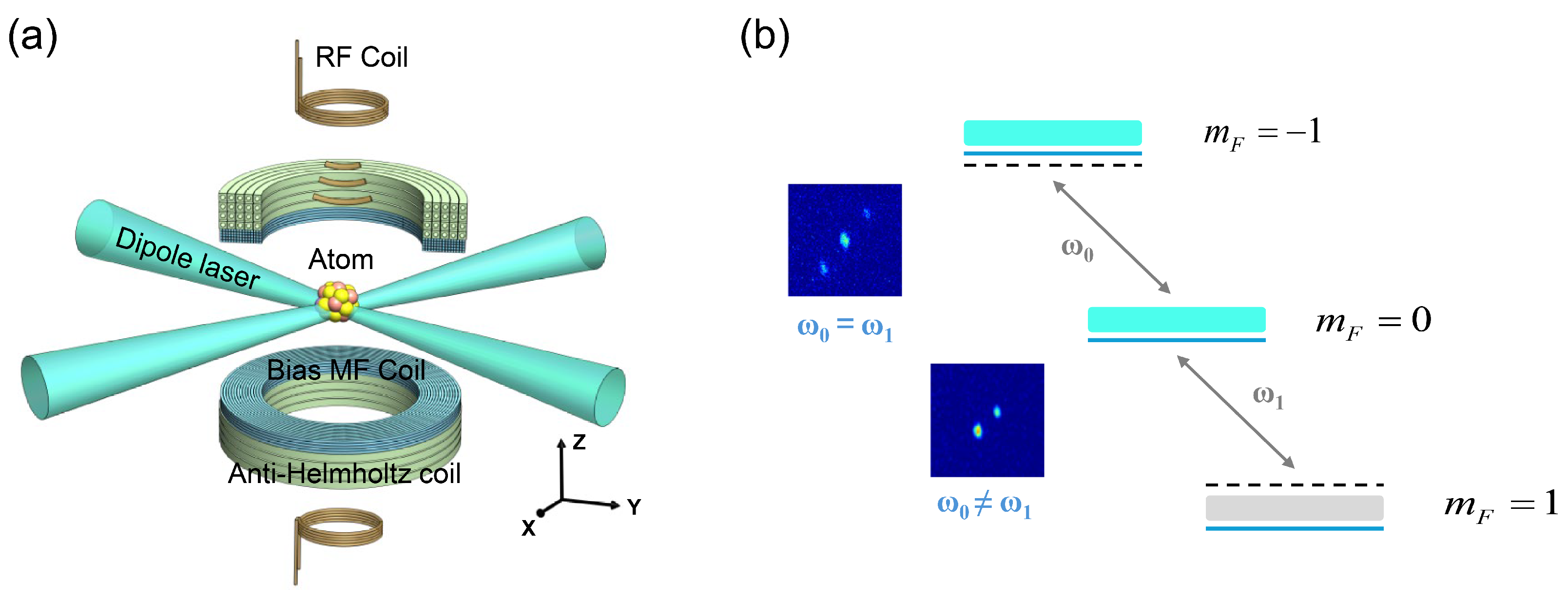
The experimental setup is shown in
Figure 1a, consisting mainly of magnetic field coils distributed above and below, radio frequency (RF) coils, a central atomic cloud, and a dipole trap. The bias magnetic field is generated by the magnetic field coils with an operating point of approximately 11 G. The RF coils are wound from circular enameled copper wire with a diameter of about 5 cm. The imaging system employs horizontal absorption imaging with a time-of-flight (TOF) of 6 ms. The RF field required for the experiment is generated by a function generator (AFG31000, Tektronix Inc., Beaverton, OR, USA), amplified through an RF switch (ZASWA-2-50DR+, Mini-Circuits, Brooklyn, NY, USA) and a power amplifier (AMPA-B-30, AA Opto-Electronic, Orsay, France), and then loaded onto the RF coils. The coils are connected in series with a 50
load to ensure impedance matching and protect the amplifier, while the switch ensures complete shutoff when not needed. The function generator features dual-channel output capability, enabling simultaneous generation of two RF signals with controllable phase differences, providing the technical foundation for subsequent phase-scanning interferometry experiments at fixed hold times.
The three magnetic sublevels of the sodium
hyperfine structure are shown in
Figure 1b [
27], corresponding to
,
, and
. When the bias magnetic field is small, a single RF pulse can simultaneously couple all three magnetic sublevels (
), and absorption imaging shows atomic population in all three magnetic sublevels. In contrast, when the bias magnetic field is large (approximately 11 G), applying an RF pulse couples only the
and
two magnetic sublevels (
), and absorption imaging shows atomic population only in the
and
states, indicating the realization of an independently controllable two-level system. The RF pulse frequency is 7.902 MHz with an amplitude of 2 Vpp. At this RF intensity, the measured Rabi oscillation
period is approximately 0.08 ms.
3. Atom Interferometer Principle and Implementation
The atom interferometer constructed in this experiment is based on the Mach–Zehnder interferometer principle [
1,
2,
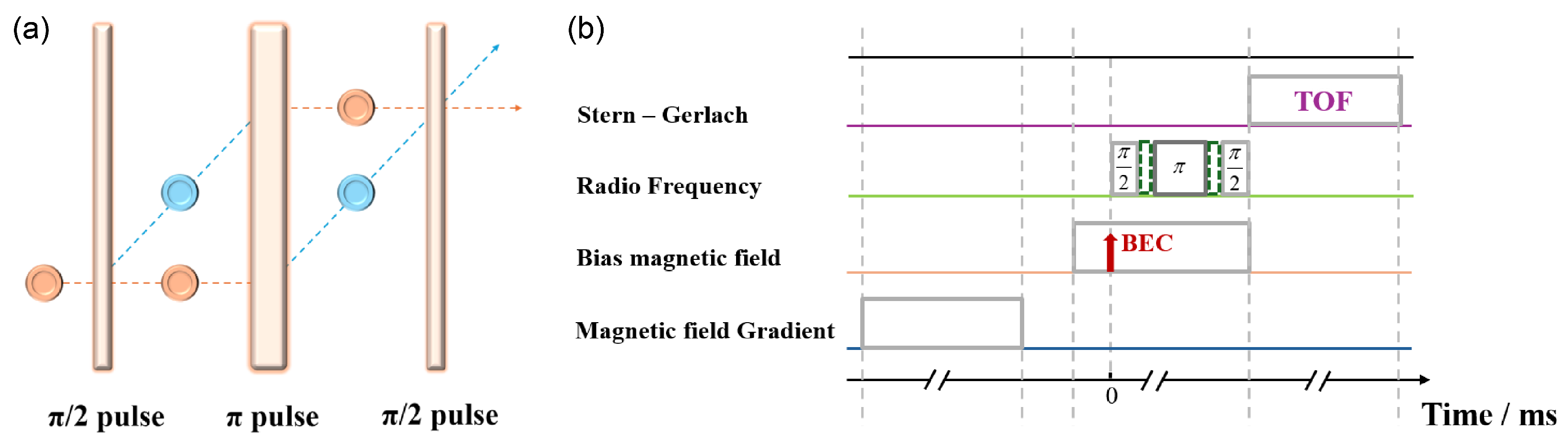
28], as shown in
Figure 2a. Analogous to optical MZ interferometers, the atom interferometer achieves beam splitting, reflection, and recombination through three RF pulses: the first
pulse acts as a beam splitter, preparing atoms from the initial state
into a superposition of two internal states; the free evolution time (hold time) allows the two branches to accumulate phase differences; the
pulse acts as a mirror, exchanging the states of the two branches; after another free evolution, the second
pulse acts as a recombiner, recombining the two branches and generating interference. The atomic internal state paths form superposition and interference between
and
. By measuring the atomic population distribution at the output ports, interference patterns can be obtained, thereby extracting the wave-like information of atoms.
The timing diagram of the atom interferometer is shown in
Figure 2b. First, a gradient magnetic field is used to prepare the initial atomic state. By adjusting the magnetic field strength and duration, atoms can be selectively prepared to the
state. Then, the bias magnetic field is activated, causing Zeeman splitting and constructing a two-level system. Within the time range covered by the bias magnetic field, a three-pulse RF sequence is employed:
–
–
. The free evolution time
T (hold time) between the two pulses is adjustable. Controllable phase differences (
,
,
) can be introduced at any pulse stage to induce interference between the atomic wave functions of the two branches. In this experiment, the phase scanning range is from
to
with a step size of
. After the sequence ends, absorption imaging is performed following a 6 ms time-of-flight, and atomic population is observed to obtain interference patterns.
4. Results and Discussion
The experiment first calibrates and measures Rabi oscillations of the two energy levels to determine the RF pulse durations. Based on the measured Rabi oscillation period (0.08 ms corresponding to a pulse), the durations of the first pulse, second pulse, and third pulse are 0.02 ms, 0.04 ms, and 0.02 ms, respectively. On this basis, with a fixed hold time, phase scanning is applied to the three pulse stages separately, measuring the atomic population fraction of the state.
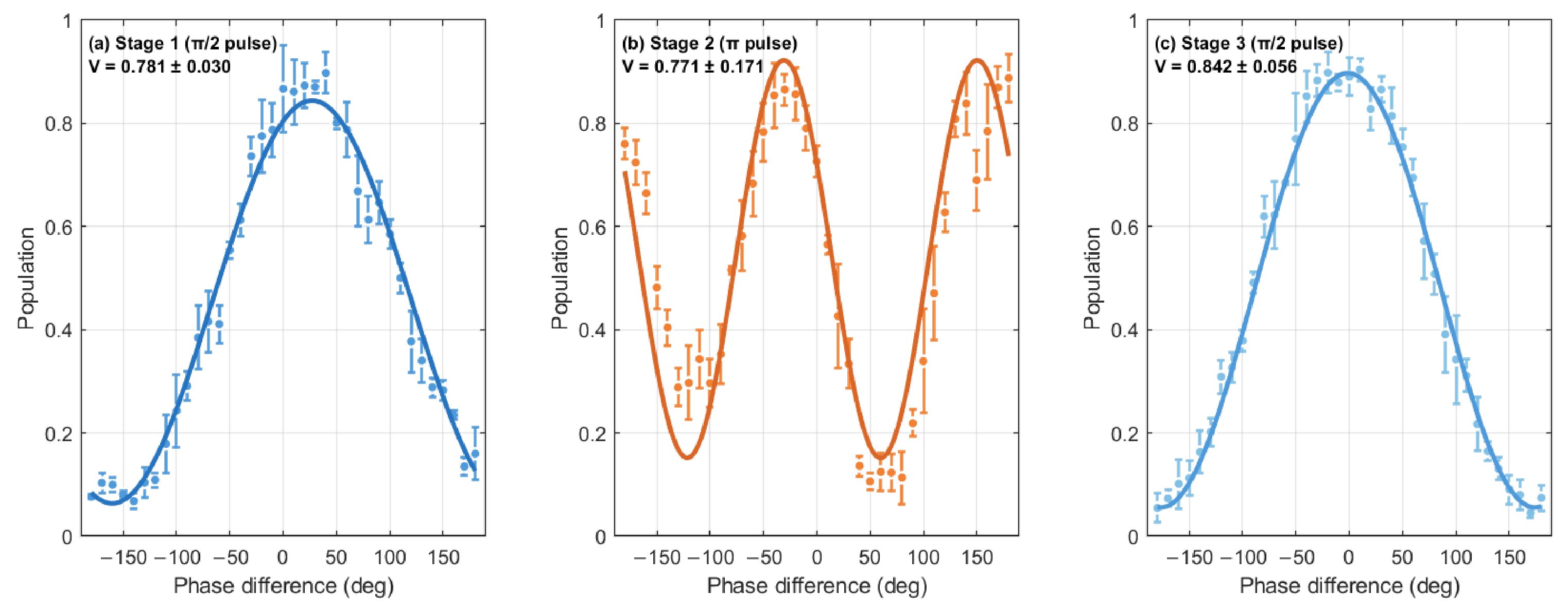
The phase-scanning interference results for the three pulse stages are shown in
Figure 3 (drawn using MATLAB R2024a), with the horizontal axis representing the applied phase difference
and the vertical axis representing the atomic population fraction of the
state. From
Figure 3, it can be observed that the
pulse phase scanning at the first and third stages exhibits one complete period, while the
pulse phase scanning at the second stage exhibits two complete periods. Theoretical analysis shows that for
pulse phase scanning, the phase change
causes the output population to vary according to
or
, with one complete period corresponding to a
phase change. For
pulse phase scanning, the
pulse exchanges the two branches, and the phase change
causes the output population to vary according to
. Since the period of
is
, two complete periods appear within the scanning range from
to
. The error bars in
Figure 3 represent the standard deviation of three repeated measurements under the same experimental conditions. The main sources of uncertainty include magnetic field noise, noise from absorption imaging (such as fluctuations in the absorption beam intensity), and statistical fluctuations in the atomic population measurements. The relatively small error bars indicate good reproducibility of the phase-scanning experiments.
Nonlinear least squares fitting is applied to the experimental data using the formula:
where
is the baseline offset,
A is the amplitude,
is the phase center, and
w is the period width. Based on the standard theory of atom interferometers, the population variation with phase can typically be expressed in the form
, where
V is the visibility [
29]. This standard form can be rewritten as
, where
is the baseline offset. Equation (
1) is mathematically equivalent to this standard form through trigonometric identities. For
pulse phase scanning, where
, the expression
in Equation (
1) can be transformed to the cosine form in the standard expression. The key parameter correspondence is: the relationship between amplitude
A and visibility is
; the baseline offset
in Equation (
1) corresponds to
in the standard form; the phase center
in Equation (
1) directly corresponds to the phase offset
in the standard form. The period width
w reflects the periodic characteristics of the interference fringes. The fitting results show that for
pulse phase scanning (first and third stages), the
w values are
and
, close to the theoretical value of
; for
pulse phase scanning (second stage),
w is
, close to the theoretical value of
.
Through fitting with Equation (
1), the visibilities for the first, second, and third stages are
,
, and
, respectively, all maintained at relatively high levels (
), indicating good coherence of the system.
To study the phase evolution over time, the experiment employs a fixed pulse phase approach, scanning the free evolution time T (hold time) between pulses. For each hold time T, the phase difference is scanned (from to with a step size of ), measuring the atomic population fraction of the state to obtain an interference fringe. The experiment measured data for hold times from 1 to 12 s.
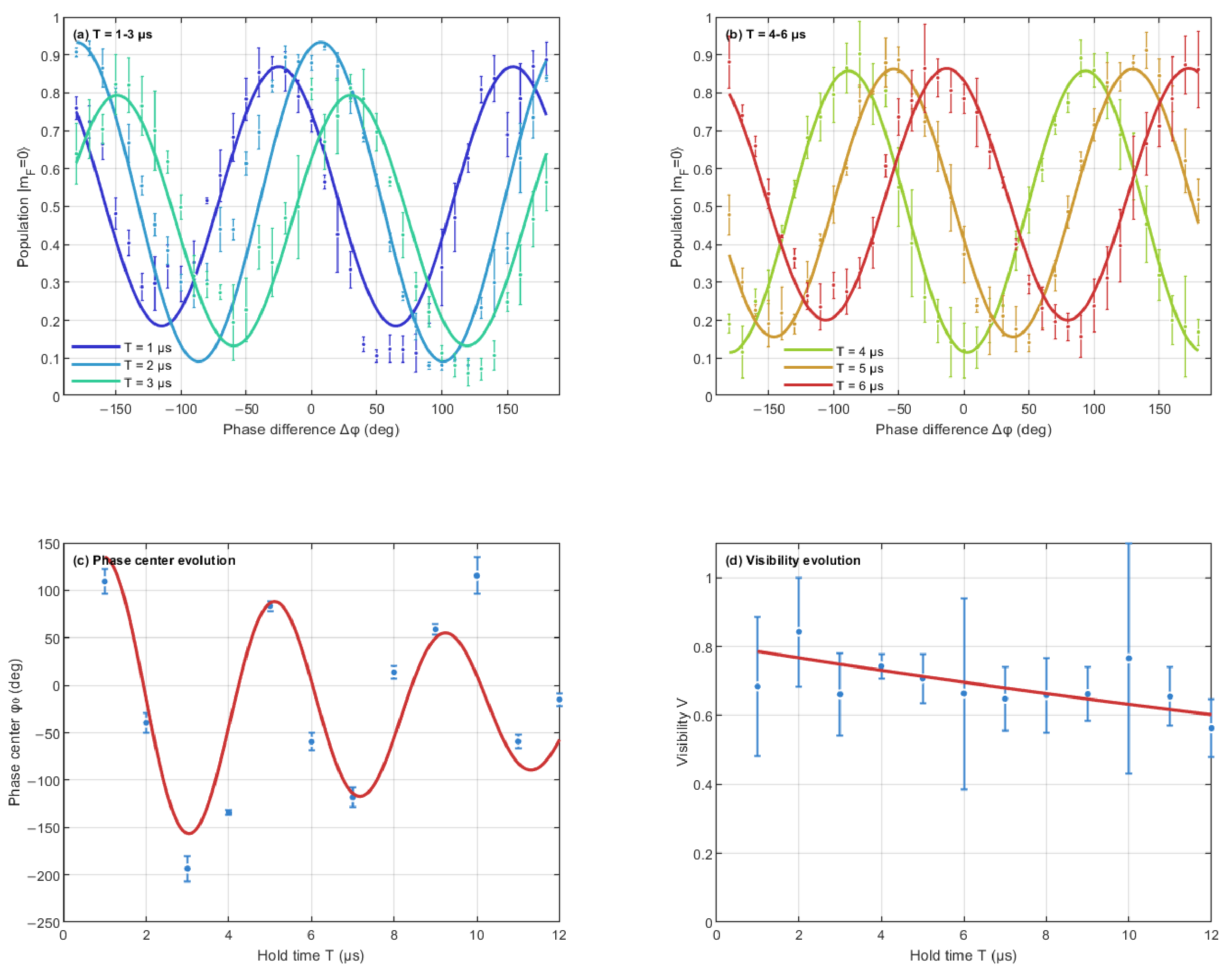
The phase-scanning interference results at different hold times are shown in
Figure 4 (drawn using MATLAB R2024a).
Figure 4a,b show the phase-scanning interference fringes for hold times of 1–3
s and 4–6
s, respectively (due to space limitations, only the first 6 hold time results are shown, but all results are used for subsequent analysis). It can be observed that clear interference fringes are formed at all hold times, but the position of the interference fringes (phase center) shifts with hold time, reflecting the phase accumulation effect caused by the energy difference between the two energy levels. In addition, the visibility at all hold times remains at relatively high levels, indicating good coherence of the system. The error bars in
Figure 4a,b represent the standard deviation of three repeated measurements, with the same error sources as in
Figure 3.
Figure 4c shows the variation in phase center
with hold time
T. In a Mach–Zehnder-type atom interferometer, the phase of the interference fringes is determined by the total phase difference between the two paths. For an ideal symmetric MZ sequence (
–
T–
–
T–
), when
, the
pulse exchanges the two branch states, making
and
have opposite signs, so the net phase difference contributed by the internal state energy difference
is zero. However, the experiment observes periodic variation of the phase center, indicating the existence of a non-zero net phase difference, possibly originating from sequence asymmetry (
), external potential field effects (magnetic field gradients, gravity, etc.), or mean-field effects and other nonlinear terms. The error bars in
Figure 4c represent the fitting uncertainty of the phase center extracted from the phase-scanning data for each hold time using Equation (
1).
The amplitude of the periodic variation in the phase center decays with hold time, reflecting decoherence or stability degradation of the system. A damped sine formula (SineDamp) is used for fitting:
where
is the baseline offset,
is the initial amplitude,
is the decay time constant, and
is the period width (actual period
). The sine term describes the periodic evolution of the phase center, while the decay term reflects amplitude attenuation due to decoherence, system stability degradation, or environmental noise accumulation.
Figure 4d shows the variation in visibility
V with hold time
T. An exponential decay formula is used for fitting:
where
is the initial visibility and
is the coherence time. The fitting yields
,
s,
. Within the range of 1–12
s, the visibility decays from approximately 0.80 to 0.60, with a decay amplitude of about 25%, indicating the existence of decoherence effects in the system. The error bars in
Figure 4d represent the uncertainty in the visibility calculated from the fitting procedure, where
and
is the standard error of the amplitude parameter
A in Equation (
1).
Decoherence mainly originates from magnetic field noise and drift, atomic interactions (particularly mean-field effects), and environmental noise. The total decoherence rate is estimated as kHz from the observed coherence time s. For spinor BEC systems, mean-field interactions from spin-exchange collisions are expected to contribute to decoherence, given the high atomic density (atom numbers ∼105) and intrinsic mean-field effects. The periodic variation of the phase center (period s, frequency MHz) suggests magnetic field-related effects, indicating that magnetic field noise may also contribute. Together, mean-field interactions and magnetic field effects are likely significant contributors. Despite these effects, the system maintains relatively good coherence within the measurement time scale (1–12 s). Experimental studies reporting coherence time and visibility for spinor BEC-based internal-state interferometers are limited. Our MZ-type interferometer demonstrates good performance for this type of interferometer. Future improvements include optimizing the magnetic field environment and system stability, as well as atomic density to minimize mean-field effects, to extend the coherence time and enhance measurement sensitivity.



 ,
,