


Abstract
This paper provides a comprehensive study of the nonlocality-influenced radiative modes above the light line in the plasmonic nonlocal flat surface, including the plasmonic/dielectric interface, ultrathin plasmonic slab, and plasmonic/dielectric multilayer. We demonstrate that material nonlocality arising from the longitudinal plasmon wave excited in plasmonic material dramatically alters the radiative mode above the light line, leading to the splitting of the Brewster mode in the dispersion relation diagram of the plasmonic slab. And material nonlocality together with structural nonlocality reveals novel discrete radiative modes in the high-frequency regime in the plasmonic/dielectric multilayer at subwavelength scales. Our results highlight the impact of material nonlocality and structural nonlocality on radiative modes in plasmonic flat structures and might contribute to new ideas in optical device design.
1. Introduction
Nonlocal flat optics [1,2,3] are now widely investigated, especially in nonlocal metasurfaces, to control the electromagnetic field with greater degrees of freedom. Nonlocality exploits spatial dispersion, where the optical response depends on the input field over an extended region, thus enabling momentum-dependent control in k space. This can be achieved through engineered structures like multilayer films and photonic crystals, which support guided-mode resonances for strong nonlocality. The concept of nonlocality in optical materials has evolved significantly since its early foundations in quantum mechanics and many-body physics. Historically, it traces back to Madelung’s hydrodynamic formulation [4] and Bloch’s work on electron dynamics [5], with key developments including Landau’s plasma oscillations [6] and Lindhard’s electron gas response. In recent decades, nonlocality has become crucial in nanophotonics, particularly as feature sizes approach the nanoscale, rendering local response approximations inadequate. Current research employs advanced models like the hydrodynamic Drude model [7], generalized nonlocal optical response [8], and quantum hydrodynamic theory [9] to capture effects such as electron spill-out, quantum tunneling, and size-dependent plasmon resonances. These are validated through time-dependent density functional theory [10] and experimental techniques like electron energy loss spectroscopy [11].
In free-electron metals and plasmonic nanostructures, nonlocality manifests as blueshifts of plasmon resonances [12], enhanced damping due to surface scattering [8], and regularization of field enhancements at atomic scales [13]. For instance, in noble metal nanoparticles, nonlocal models prevent unphysical field singularities and account for electron spill-out across interfaces [9]. The Feibelman parameters provide a mesoscopic description of surface response [14], enabling accurate predictions of optical properties in systems like nanogaps and dimers [15]. Challenges include integrating nonlocality with quantum emitter interactions [16] and handling material-specific effects in metals like gold and silver [17]. Engineered nonlocal responses in metamaterials and metasurfaces leverage subwavelength structuring to achieve tailored momentum-space control of light [18]. Nonlocal metasurfaces exhibit high-Q resonances and angle-frequency selectivity [19], enabling applications like spatial differentiation [20], optical computing [21], and space compression [22]. For example, hyperbolic metamaterials support ultra-confined modes with nonlinear enhancements [23], while metalenses with nonlocal designs achieve multifunctional operations across multiple wavelengths [19]. Future directions focus on dynamic tunability [24], integration with machine learning for optimization [25], and extending principles to acoustics and thermal management [26]. These advances highlight nonlocality as a key degree of freedom for next-generation photonic devices.
As the simplest cases of a nonlocal flat surface, the plasmonic ultrathin slab reveals strong material nonlocality, which supports a strong longitudinal plasmon wave inside the slab [27,28,29]. The manifestation of structural nonlocality is feasible through the implementation of artificially engineered periodic slab structures, which support the longitudinal Bloch wave [30,31,32]. And these are two kinds of nonlocality that can be simultaneously included when periodic slab structures possess plasmonic materials, even in the subwavelength length scale. Previous studies have primarily focused on bound modes, such as surface plasmon polaritons (SPPs), in plasmonic structures with relatively flat surfaces like interfaces, slabs, or multilayer structures at subwavelength scales. There is limited discussion on radiative modes that exchange energy with free space above the light line in plasmonic interfaces or thin-film structures. The radiative modes above the light line significantly influence the reflection and transmission properties of incident electromagnetic waves on a flat surface, thereby affecting the manipulation of wave fronts. For instance, it was demonstrated that the polarization structure of a C-point singular beam undergoes a transformation during reflection at a flat interface [33]. A basic radiative mode above the light line in a plasmonic flat structure is the Brewster mode, which is described in the textbook [34] but has received little attention. The Brewster mode corresponds to the Brewster effect, which is one of the fundamentals of optics indicating the disappearance of reflection at dielectric interfaces. Originally, the Brewster effect was determined solely by the permittivity of two media. Recently, with the rise of metamaterials that go beyond natural materials in many aspects, a lot of effort has been devoted to the reexamination of the Brewster effect [34,35,36,37,38,39]. However, to the best of our knowledge, no systematic discussion has yet been conducted on the nonlocal effects on these radiative modes in plasmonic flat surface structures. Consequently, this paper systematically investigates the impact of material nonlocality and structural nonlocality on radiative modes—particularly Brewster modes above the light line in flat surface structures, including plasmonic interfaces, slabs, and multilayer thin films—in order to highlight the importance of the excitation of longitudinal modes in plasmonic flat structures.
The next sections will be organized as follows: we will divide the content into three subsections to discuss the radiation patterns at a plasmonic/dielectric interface, in an ultrathin plasmonic slab, and in a plasmonic/dielectric multilayer, respectively, in the Methods, Results, and Discussion section. In each subsection, the methods employed, the results obtained, and the corresponding discussions for each type of flat structure will be described. Finally, we will present the overall conclusions of the entire work in the Conclusions section.
2. Methods, Results, and Discussion
2.1. Plasmonic/Dielectric Interface
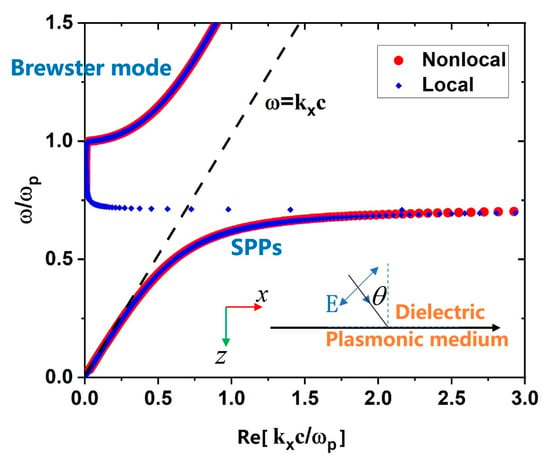
First of all, we consider the p-polarized incident plane wave, i.e., the magnetic field is perpendicular to the incident plane, on the interface between free space and the plasmonic medium with an incident angle as shown in the insert of Figure 1. The permittivity of the transverse and longitudinal waves is and , respectively, where is the plasma frequency, is a phenomenological damping rate accounting for the aforementioned collisions, and is the background permittivity indicating the contribution from bound electrons or other mechanisms. The hydrodynamic parameter is proportional to the Fermi velocity and it takes the value in the high-frequency limit () for a three-dimensional electron gas. is the wavevector of the transverse (or longitudinal) wave in the plasmonic medium, which is determined by [or ]. and are the wave vectors in the directions along and perpendicular to the interface, respectively.
Figure 1.
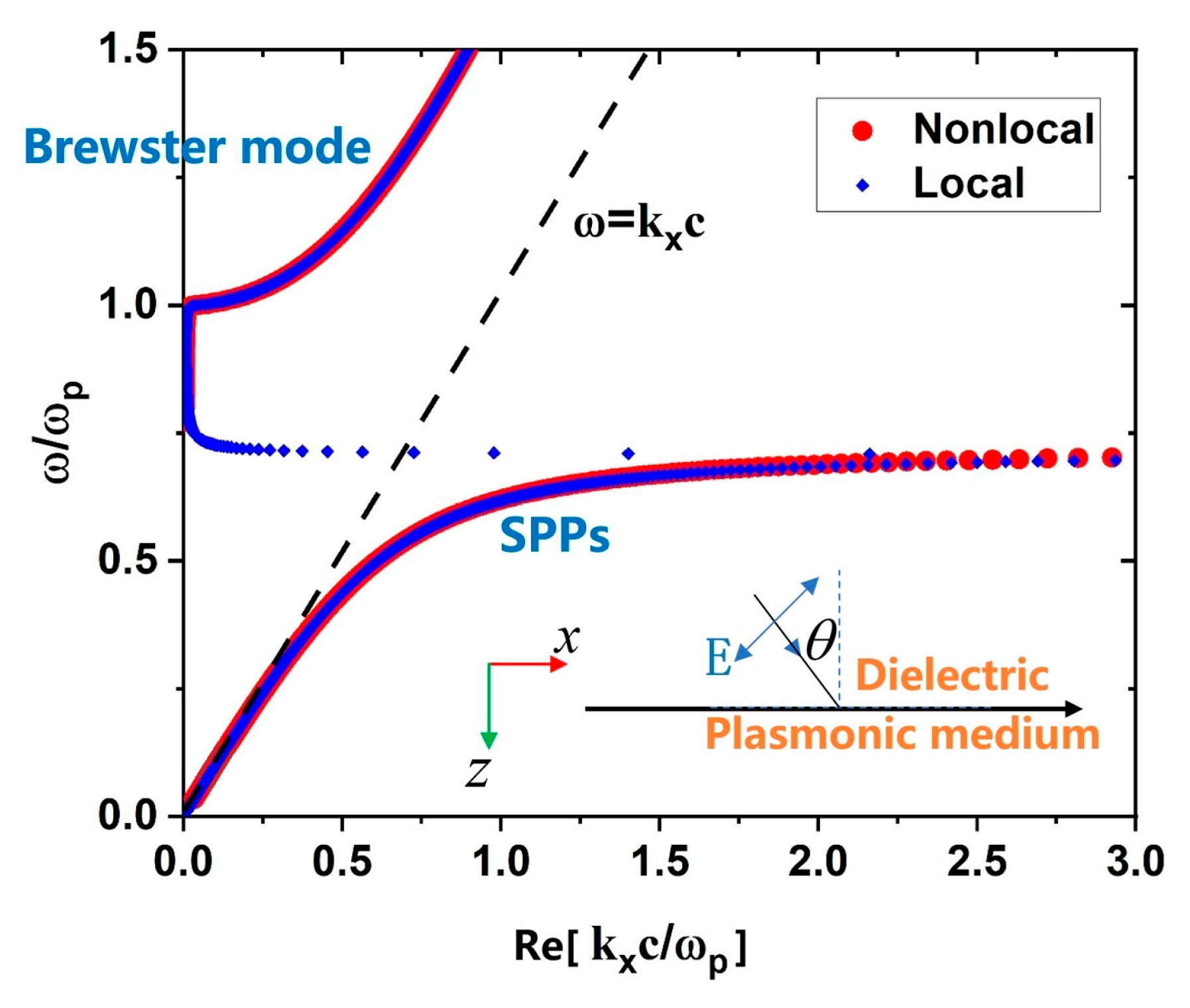
Dispersion relation versus real part of with their normalized version. The red and blue dotted lines indicate the dispersion relations with and without material nonlocality, respectively. The insert is a schematic diagram of the interface.
The surface plasmon polaritons (SPPs) supported at the interface between the dielectric–plasmonic media represent a fundamental and extensively investigated physical phenomenon in the fields of condensed matter physics and nanophotonics, whose dispersion relation is shown below the light in Figure 1. Both the nonlocal and local cases are illustrated with different colors, and the dispersion relation lines and are obtained for nonlocal and local cases, where and . Here, we adopt the derivations from refs. [27,28,29,40] with the additional boundary conditions of the vanishing normal component of the exciton part of the polarization vector [41,42,43,44].
Since we account for losses in the plasmonic material, the dispersive equation has a complex number; therefore, it cannot be solved using real and real . It is necessary to consider a complex frequency or a complex wave vector to find the roots of the dispersive equation. Here, we first choose real and find the complex root of accordingly, then denote the real part of in Figure 1. The other choice is to choose a real and find a complex according to the dispersive equation, then plot the real part of complex versus real for visualization. These two kinds of visual representations were demonstrated to reveal the same conclusion [35]. Note that the Fresnel reflection coefficient of the interface under the local description has the form ; the characteristic equation for solving the dispersion relation is also the condition making the Fresnel reflection coefficient go to infinity or, in other words, it is the condition for a pole of . Additionally, the complex solution for the pole of is simultaneously the condition for which defines a zero of the reflection factor. Thus, there is another branch of the dispersion line with high energy above the light line despite the SPP mode below the light line. This high-energy mode is called Brewster mode [34,35]; it determines the Brewster’s angle of the interface, but does not describe true surface waves, since the wavevector into the plasmonic medium is no longer purely imaginary. It corresponds to wave propagation in the metal.
The impact of nonlocality on the SPPs is very small due to the small propagation constant [27]. The situation is the same for the Brewster mode, where nonlocality plays a less import role. However, we will see that for an ultrathin plasmonic slab with a thickness of less than 10 nm, the impact of nonlocality on the Brewster mode is much more important because a longer can be reached and a propagating longitudinal plasmon wave is excited in the slab, which alters the dispersion relation, especially when .
2.2. Ultrathin Plasmonic Slab
Next, we will consider the case of an ultrathin plasmonic slab under the p-polarized incidence. The nonlocal description of the dispersion relation satisfies the following equation:
where with being the permittivity of the surrounding medium, and the thickness of the slab. If we neglect the nonlocality, i.e., , then and ; consequently the above equation will reduce to the local case as follows:
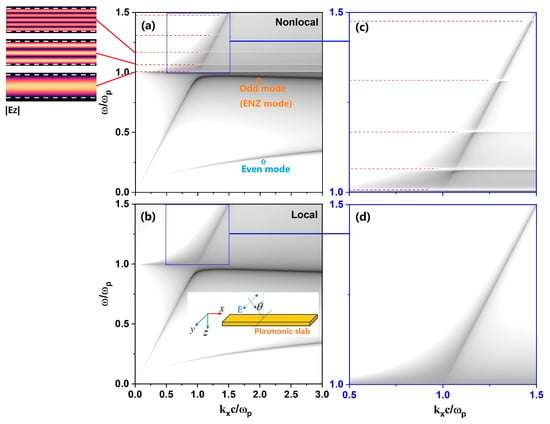
Figure 2 illustrates the dispersion relations of an ultrathin plasmonic slab described by Equation (1). It indicates two branches of SPP modes, i.e., odd and even modes [29,32]. They arise from the coupling of SPPs in the two interfaces of the slab. The upper odd mode is referred to as the ENZ mode [45] if the thickness of the plasmonic slab is ultrasmall, as in our case ().
Figure 2.
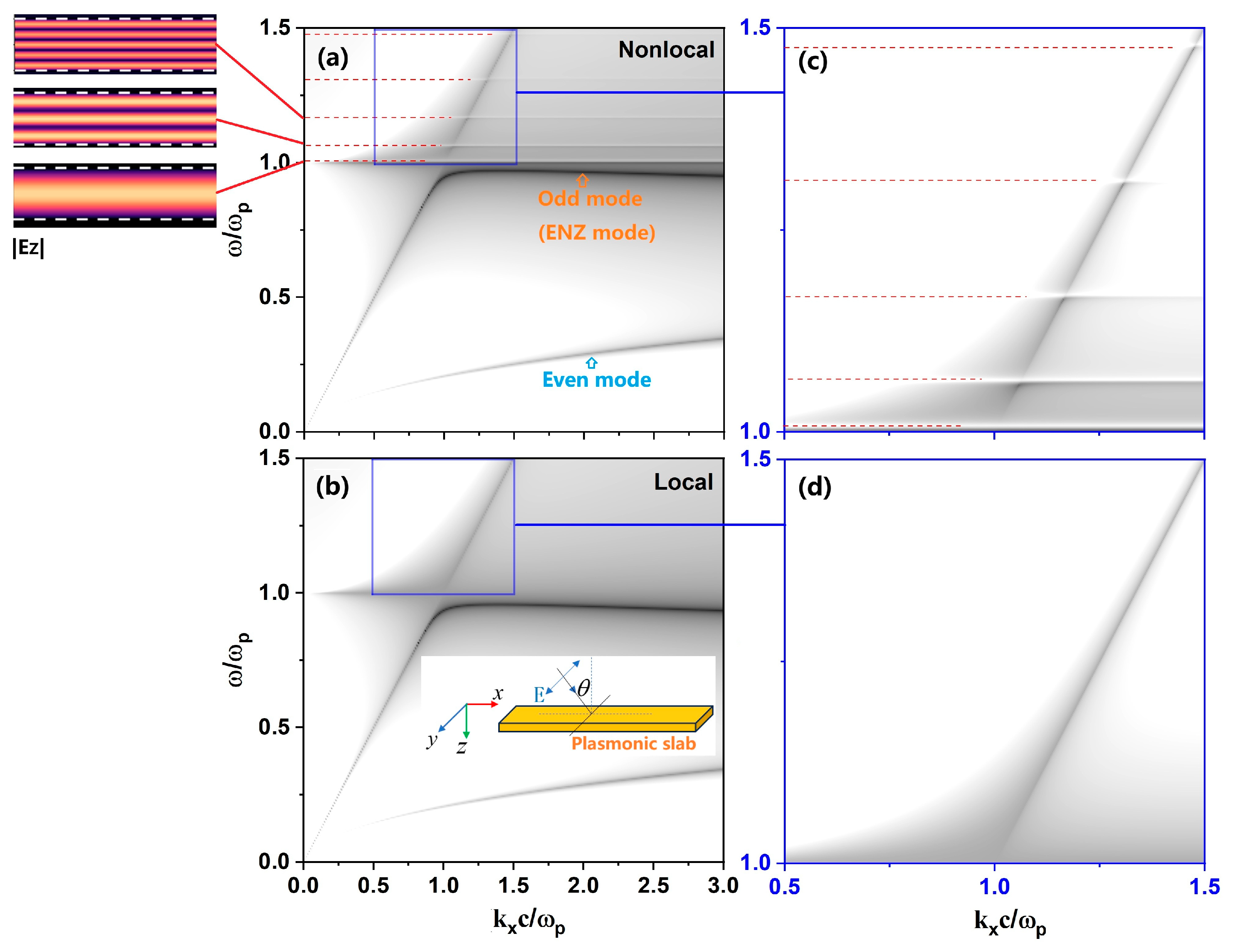
Dispersion relation diagram for a plasmonic slab with (a) and without (b) material non-locality. The dashed red lines indicate the location of the discrete longitudinal plasmon modes above the light line. The inserts in (a) illustrate the distributions inside the plasmonic slab at different frequencies. The insert in (b) is a schematic diagram of the plasmonic structure. (c,d) are the partial enlarged views of the areas marked by the blue rectangles in (a,b), respectively. The thickness of the plasmonic slab .
Note that Equations (1) and (2) are transcendental equations with complex independent variables. For the sake of simplicity, we substitute the real frequency and real wavevector into the corresponding dispersive function , which denotes the left-hand side of Equation (1) or (2), and plot in functions of real frequency and real wavevector in Figure 2, where the black color indicates a large value of , providing an approximation of the dispersion relation curves. Similar to the case of the interface, there exist unbound radiation modes above the light line besides the widely investigated SPPs mode below the light line, as shown in Figure 2. One branch of the radiation mode is located at with a flat profile, and another branch exists directly above and adjacent to the light line. These two branches of radiation mode collectively form the Brewster mode of the ultrathin plasmonic slab.
The factors and in Equation (1) indicate the nonlocal effects on the dispersion relation, where the wavevector of the longitudinal wave plays the leading role. Especially in the regime , the standing propagating longitudinal mode is excited in the slab arising from the longitudinal bulk plasmon [32,46], as shown in the insert of Figure 2a. They occur at discrete frequencies with , where is an odd integer. The first three frequencies are , , and . Note that is sufficiently small relative to the other terms in Equation (1) for the given parameters, and the propagating longitudinal plasmon modes are not pronounced in Figure 2. However, they cover the whole regime where and are independent of . Moreover, these discrete flat modes “cut” the Brewster mode curve into “pieces” like “blades”, leading to the discrete Brewster modes in the dispersion relation diagram. On the other hand, nonlocality shows less influence on SPP modes in the regime , where only a slight shift of curves occurs, due to the fact that the longitudinal plasmon wave is in the form of an evanescent wave in this regime.
To further illustrate, we give the Fresnel coefficients of the slab with p-polarized incidence as follows:
Equation (3) is reduced to the local version when .
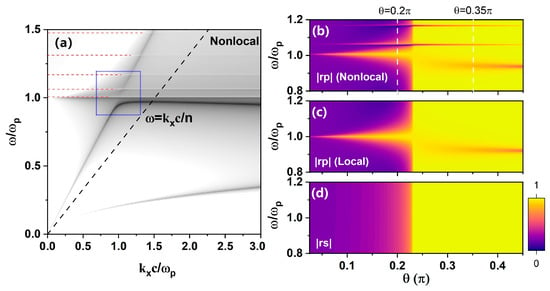
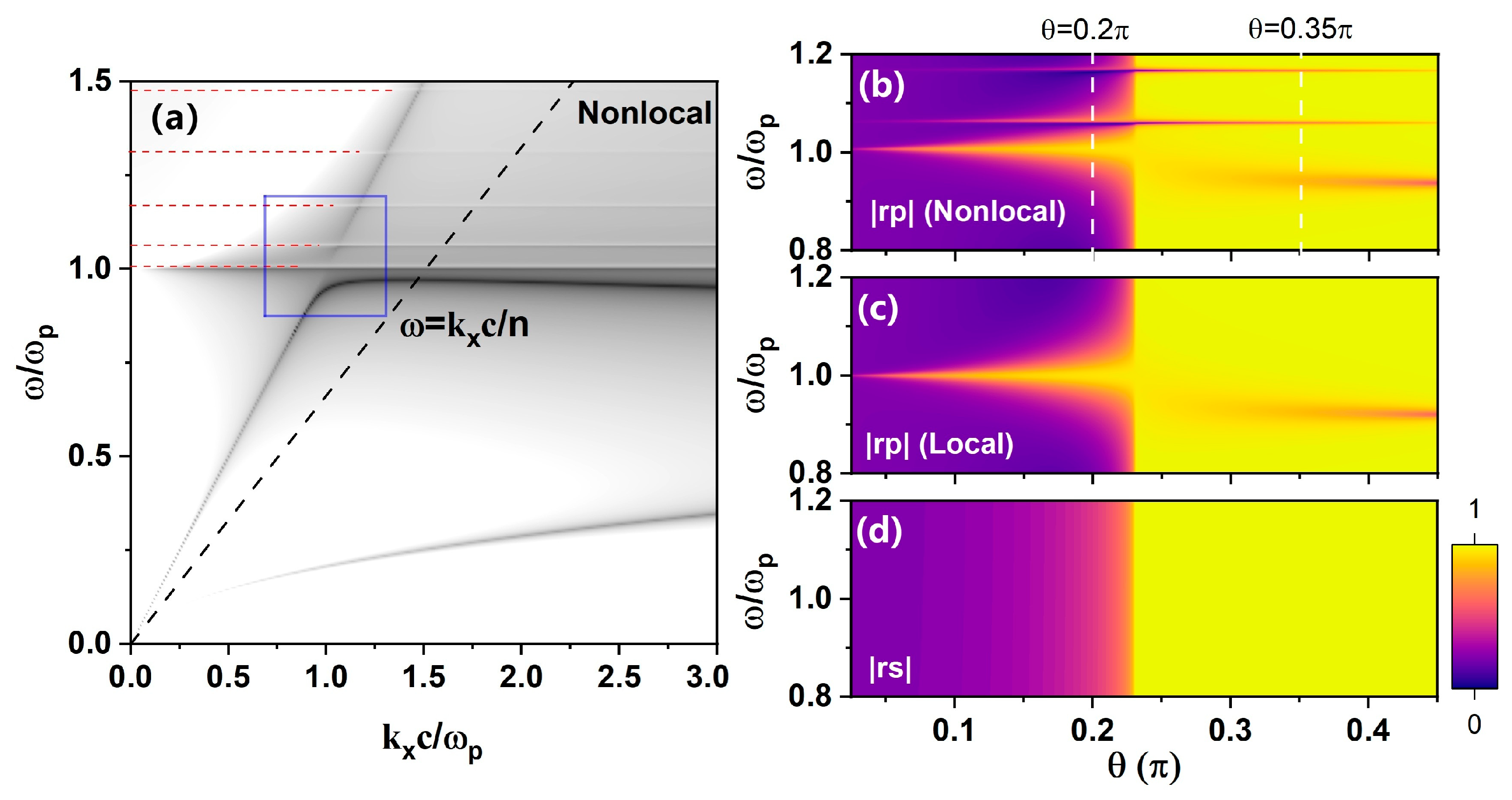
As is well known, radiative modes above the light line can directly couple with incident waves from free space, whereas SPP modes below the light line are not easily excited directly. To simultaneously manifest both radiative and SPP modes in the reflection spectrum, the refractive index of the surrounding medium is set as , so that some parts of the SPP curve can be located above the modified light line (), as shown in Figure 3a. Figure 3b–d illustrate the absolute values of the Fresnel coefficient as a function of frequency and incident angle , where the parameters are chosen from the blue rectangle in Figure 3a. There exists a critical boundary around , with the left and right regions exhibiting markedly different properties due to the fact that the SPPs can be excited on the condition . In the regime , the external wave could propagate into the slab with less reflection except when , but the external wave could not couple into the slab with total reflection in the regime , except for the SPP mode below (ENZ modes here) and longitudinal plasmon mode above .
Figure 3.
(a) Dispersion relation diagram for a plasmonic slab with material nonlocality; (b–d) illustrate the absolute Fresnel coefficients as functions of frequency and incident angle, where the parameters are chosen from the blue rectangle in (a). The red and black dotted lines indicate the location of discrete longitudinal plasmon modes and the modified light line, respectively.
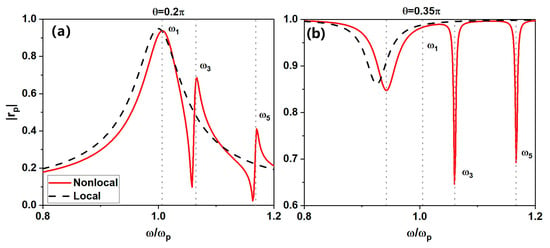
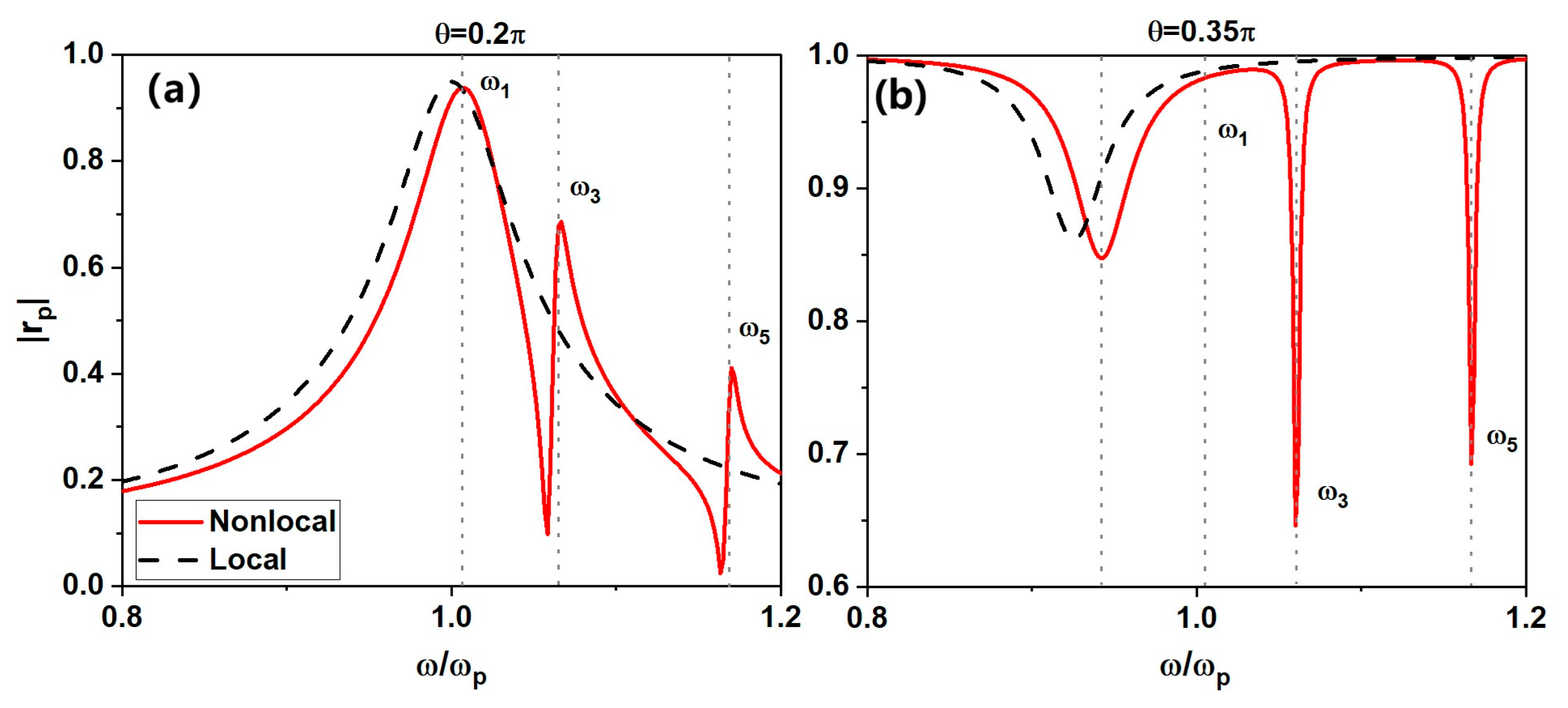
We select two incident angles ( and ) on either side of the critical value () and plot the absolute reflection coefficient versus frequency in Figure 4. At the incident angle , the resonance peaks above occur at the frequencies aligned with the discrete ones of the propagating longitudinal plasmon wave, i.e., , and . These frequencies are independent of the surrounding medium, so they are the same as the case in free space. Figure 4a indicates sharp Fano-like dips of around and , while showing a broad peak at . It should be noted that, like the ENZ mode in regime [see the broad dip in Figure 4b], occurs above the light line, indicating a transverse radiative ENZ mode when in both nonlocal and local cases. And the nearfield distribution inside the slab demonstrates that the longitudinal wave does not play an important role compared to the local case. Consequently, the standing longitudinal plasmon mode at merely slightly shifts the resonant frequency in the reflection spectrum. In the case of , the longitudinal plasmon wave is evanescent below , resulting in a slight shift of the resonant dip compared to the local case, as shown in Figure 4b. The reflection spectrum above exhibits dramatic, sharp dips due to the excitation of the standing longitudinal plasmon modes at and at . However, the longitudinal plasmon mode at does not dominate the reflection for the same reason as the one when .
Figure 4.
Reflection spectrum at different incident angles: (a) and (b) with (red) and without (black dashed) material nonlocality.
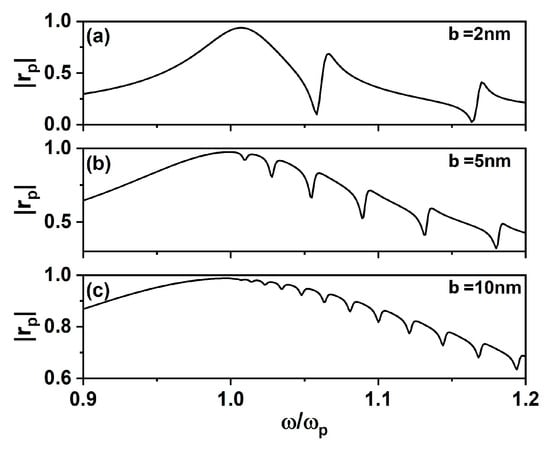
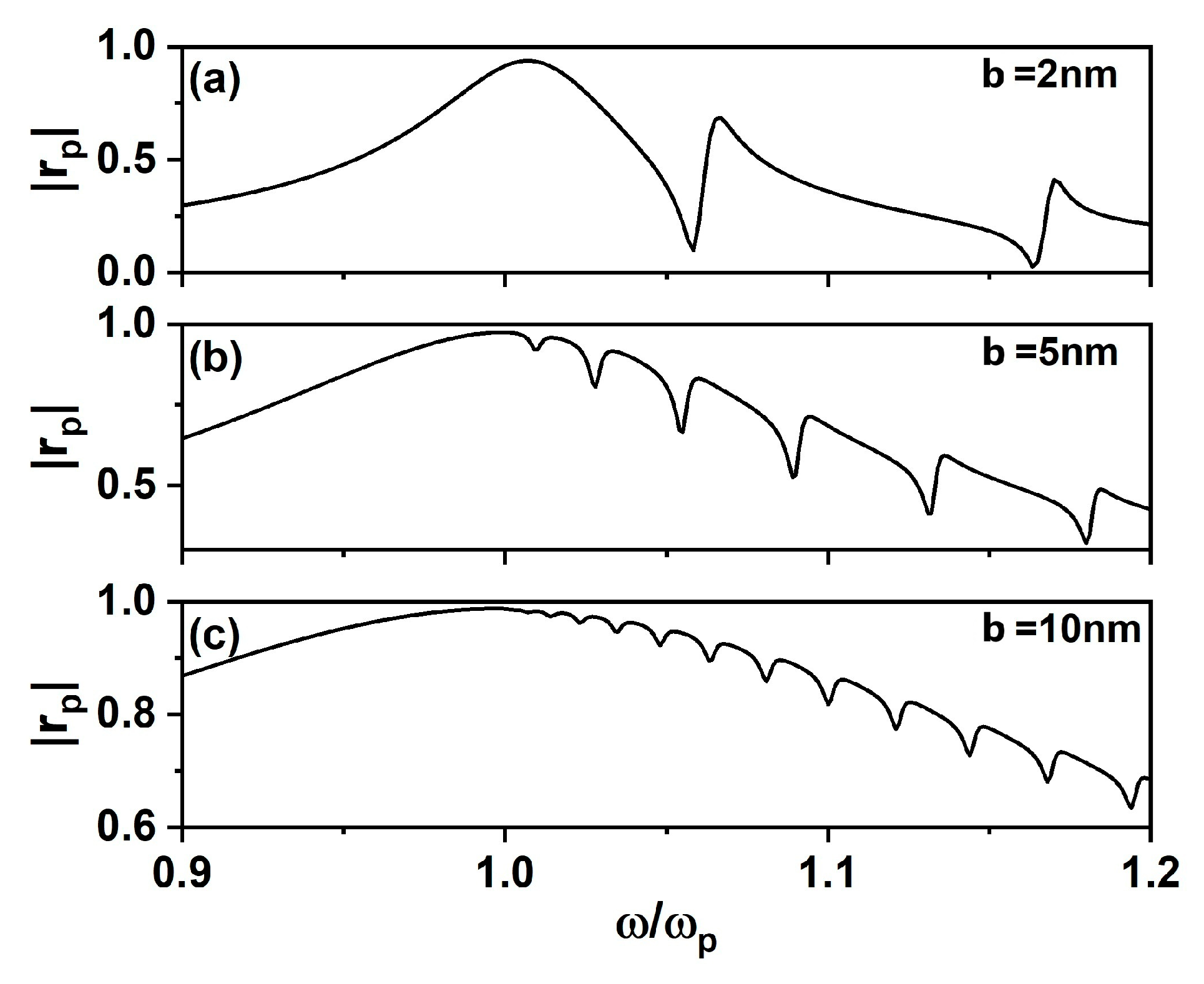
Generally, nonlocal effects become more pronounced as the thickness decreases. However, at excessively small scales, significant electron quantum effects may emerge, which are not captured by the present semiclassical method. To further illustrate and to strengthen the conclusions obtained before, we plot the nonlocal reflection spectra of the plasmonic slab with different thicknesses, as shown in Figure 5. Excitation of the standing longitudinal plasmon wave is a key mechanism by which material nonlocality influences the radiative profile of the plasmonic slab, and the discrete frequencies where they occur satisfy the governing equation with , as we discussed before. From the governing equation, it can be observed that a larger results in a denser numerical discretization of , yielding more discrete frequency points within the same frequency interval. Figure 5 clearly illustrates this trend, where the positions of the resonant Fano-like profile in the reflection spectra correspond to the frequencies of the standing longitudinal plasmon wave. Compared to the 2 nm case, the 5 nm and 10 nm configurations exhibit more discrete longitudinal modes within the same frequency interval. Furthermore, the influence of the discrete peaks on the reflection spectra diminishes as the size increases, indicating weakening nonlocality.
Figure 5.
Nonlocal reflection spectrum of plasmonic slabs with different thickness: (a) , (b) , and (c) at incident angle .
2.3. Plasmonic/Dielectric Multilayer
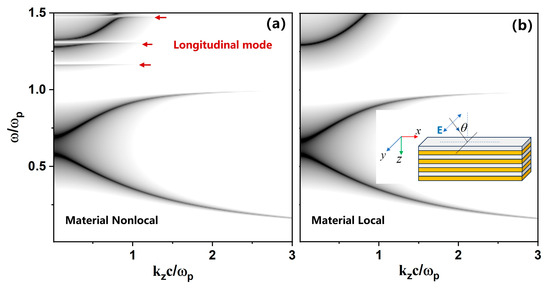
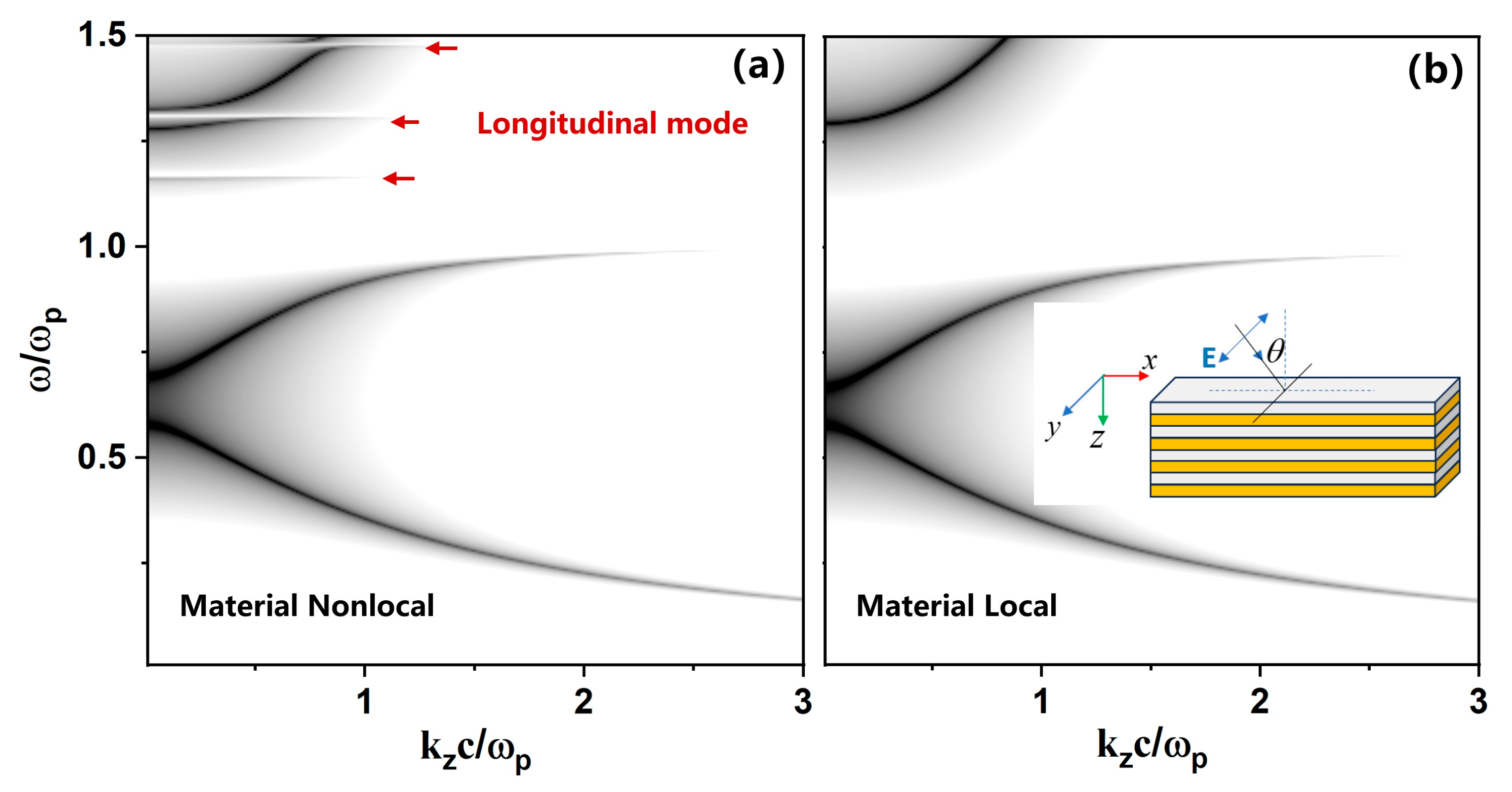
The single plasmonic slab merely possesses material nonlocality arising from the excitation of longitudinal plasmon waves. The plasmonic/dielectric layered structure could, however, support the longitudinal Bloch wave induced by structural nonlocality, in addition to material nonlocality [30,31]. To further investigate the nonlocality of the radiative mode, we consider the plasmonic/dielectric periodic layered structure, with the thickness of the dielectric slab being and the thickness of the plasmonic slab being , and the unit cell of the layered structure having a pitch of , as shown in the insert of Figure 6b. We set and , with which the material nonlocality is strong, and the number of unit cells satisfies the condition that the total thickness of the layered structure be less than the wavelength of plasmon , where structure nonlocality is dramatic and the total layered structure is still subwavelength.
Figure 6.
Dispersion relation diagram for the periodic layered structure with (a) and without (b) material nonlocality. The insert in (b) is a schematic diagram of the structure. The other parameter is .
Firstly, the transfer matrix of the single plasmonic slab can be written as
where
Similarly, the transfer matrix of the single dielectric slab is
Combining these two matrices yields a total transfer matrix for the unit cell of the plasmonic/dielectric layered structure as follows:
For the periodic layered structure, considering the structure nonlocality and material nonlocality, the eigenmode equation is determined by
where and are two elements on the diagonal of the two-dimensional matrix shown in Equation (6). The local version of the transfer matrix, i.e., neglecting the material nonlocality, can be obtained in the limit . For the layered structure with periodic , the transfer matrix would be
and we can achieve the reflection coefficient by the following relation:
where , with being the permittivity of the sounding medium where the layered structure is embedded in, and , , and are the four elements of the transfer matrix in Equation (8).
It can be seen that the dispersion relations for the periodic layered structure shown in Figure 6a,b are very similar to each other, except for a series of weak modes with respect to the propagating longitudinal plasmon modes in the regime . These modes are located at the frequency determined by , as we discussed previously in the case of a single plasmonic slab. These modes, on the one hand, open propagation channels in the gap where no propagation exists according to the local dispersion relation; on the other hand, they interfere with the propagation modes above, resulting in a split in the dispersion relation curve. These propagation modes consist of propagating transverse waves in the dielectric coupled through either propagating or evanescent transverse waves in plasmonic slabs, and they are radiative modes that can be coupled with external waves. And like the Brewster mode in the case of an interface and single slab, they are above the light cone.
Two branches of the dispersion relation curve in the lower frequency regime () correspond to the hybridization of the SPPs localized on each interface interacting among themselves through the tails of their evanescent fields, thus giving rise to the bulk Bloch mode of the whole periodic layered structure. The upper branch indicates asymmetric coupling with a larger frequency, while the lower one indicates symmetric coupling with a smaller frequency. Here, the influence of material nonlocality arising from the evanescent longitudinal plasmon wave is not significant, only shifting the curve slightly. It has been demonstrated that the longitudinal Bloch mode can be excited when considering the effective in-plane permittivity in the framework of effective medium theory for this hyperbolic layered metamaterial [30,47]. Within the present parameters, the longitudinal Bloch mode would occur in regime with an extremely large wavevector, which could not be easily excited by an external incident wave.
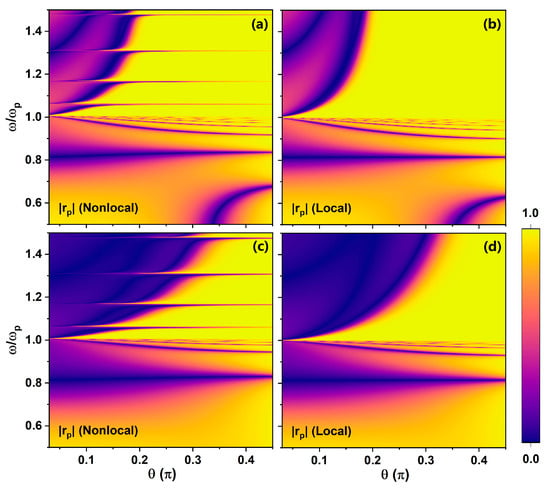
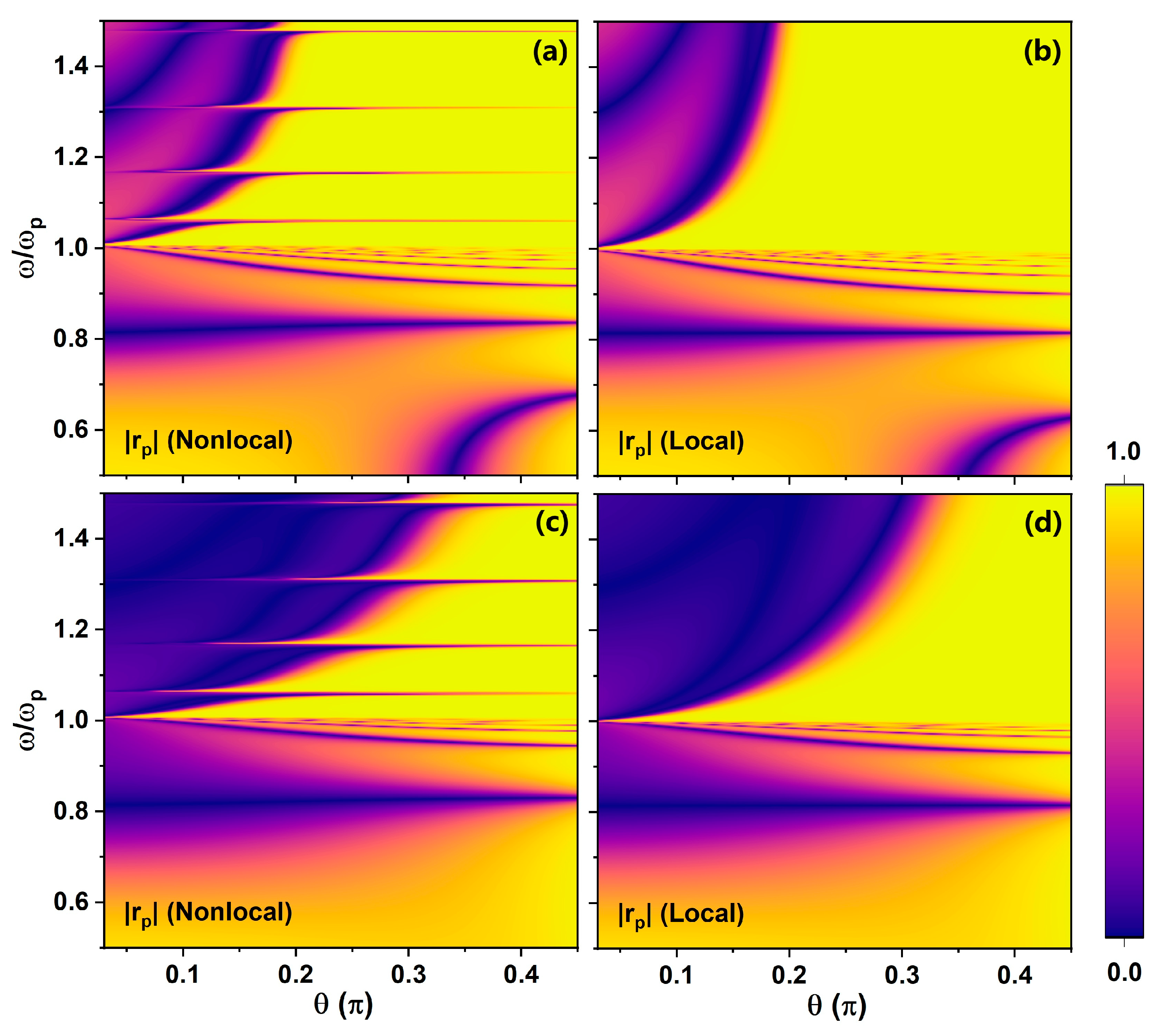
Finally, we check the Fresnel coefficient of the layered structure in Figure 7. The lower panel of Figure 7 illustrates the case of an incident wave coming from free space, i.e., in Equation (9), and the upper panel is for the condition , which is the permittivity of glass. The dark areas in Figure 7 show low reflection, and those below indicate the coupled SPP mode, as discussed in Figure 6. A higher value of the refractive index of the surrounding medium can provide a larger in-plane k to excite the propagation modes with high k in the layered structure. Consequently, we achieve one more branch of coupled SPP mode at a regime of high incident angle, as shown in Figure 7a compared with Figure 7d. The radiation modes corresponding to the Brewster modes are located at , and interference with the propagating longitudinal plasmon wave leads to discrete radiation modes [see Figure 7a].
Figure 7.
Absolute Fresnel coefficients as a function of frequency and incident angle. (a,b) ; (c,d) .
We should remark that the specific choice of is made because this thickness is sufficient to capture the material nonlocality inherent to plasmonic phenomena, while simultaneously avoiding the emergence of too many quantum effects, such as the electron tunneling effect at excessively small scales, which are not captured by the semiclassical theory adopted here and fall outside the scope of the present discussion. Altering this parameter is anticipated to shift the frequency at which the standing longitudinal plasmon wave occurs, similarly in the case of the ultrathin slab we discussed before. Concurrently, such an alteration in the multilayer structure, whether to the periodic parameter or the parameter ratio, will lead to a modification in its dispersion relation. Nevertheless, the fundamental conclusion that dispersion and reflection characteristics arise from the combination of material and structure nonlocality remains valid.
3. Conclusions
In conclusion, we made a comprehensive study of the nonlocality-influenced radiative modes above the light line in the plasmonic nonlocal flat surface, including the plasmonic/dielectric interface, ultrathin plasmonic slab, and plasmonic/dielectric multilayer, by considering the material nonlocality of the plasmonic material and the structure nonlocality of the multilayer structure. Our results highlight the impact of material nonlocality and structural nonlocality on radiative modes in plasmonic flat structures. The material nonlocality arising from spatial dispersion of the plasmonic material itself gives rise to the excitation of longitudinal plasmon waves in a plasmonic material, and it alters the Brewster mode above the light line and leads to additional discrete radiative modes in the high-frequency regime () in the ultrathin plasmonic slab. The frequencies of the discrete radiative modes merely depend on the thickness of the slab, which is relative to the length of the standing longitudinal plasmon wave. Unlike the plasmonic slab with finite boundaries, material nonlocality has less influence on the Brewster mode in the case of an interface because a propagating longitudinal plasmon wave cannot exist in the form of a standing wave with an infinite boundary. As for the plasmonic/dielectric multilayer structure, structural nonlocality-induced Bloch waves give rise to a variable radiative mode coupled to the incident wave from free space, and material nonlocality and structural nonlocality interfere with each other in a high-frequency regime () where a propagating longitudinal plasmon wave can exist.
Some comments should be remarked on in the final part of the conclusion. We only perform analytical analyses in this work, and no computational full-wave simulations are employed. We believe that, for the discussed flat structures with high symmetry, analytical solutions are consistent with simulation results. And more importantly, known commercial simulation software does not incorporate the nonlocal properties of the plasmonic materials inside. Some researchers [48], based on the hydrodynamic model used in this work, modified the weak forms in COMSOL software (version 4.1) to enable the simulation of material nonlocality and found the same results as the analytical solutions for structures for which analytical methods are available. Due to the lack of effective simulation tools for material nonlocal effects, the authors employed the present analytical approach to study the nonlocal response of simple structures. It is worth noting that the experimental observation of nonlocal effects is inherently very challenging. Within the existing theoretical framework, this paper provides some theoretical predictions whose validity requires subsequent experimental verification.
Author Contributions
Conceptualization, Y.H. and L.G.; methodology, L.G. and Y.H.; formal analysis, A.D., C.W., G.S., F.C. and Y.H.; investigation, A.D., C.W., G.S., F.C., P.Z. and Z.Z.; writing—original draft preparation, A.D. and Y.H.; writing—review and editing, C.W., P.M., Y.H. and L.G. All authors have read and agreed to the published version of the manuscript.
Funding
This research was funded by the National Natural Science Foundation of China (No. 11704158, No. 12274314, and No. 12474313), Jiangsu Key Laboratory of Biophotonics Open Projects Fund (No. 2025BPT006), and Suzhou Basic Research Project (No. SJC2023003).
Data Availability Statement
The raw data supporting the conclusions of this article will be made available by the authors on request.
Conflicts of Interest
The authors declare no conflicts of interest.
References
- Shastri, K.; Monticone, F. Nonlocal Flat Optics. Nat. Photonics 2023, 17, 36–47. [Google Scholar] [CrossRef] [Scilit]
- Chen, Y.; Fleury, R.; Seppecher, P.; Hu, G.; Wegener, M. Nonlocal Metamaterials and Metasurfaces. Nat. Rev. Phys. 2025, 7, 299–312. [Google Scholar] [CrossRef] [Scilit]
- Overvig, A.; Alù, A. Diffractive Nonlocal Metasurfaces. Laser Photonics Rev. 2022, 16, 2100633. [Google Scholar] [CrossRef] [Scilit]
- Madelung, E. Quantentheorie in hydrodynamischer Form. Z. Phys. 1927, 40, 322–326. [Google Scholar] [CrossRef] [Scilit]
- Bloch, F. Bremsvermgen von Atomen mit mehreren Elektronen. Z. Phys. 1933, 81, 363–376. [Google Scholar] [CrossRef] [Scilit]
- Landau, L.D. On the Vibrations of the Electronic Plasma. In Collected Papers of L.D. Landau; Elsevier: Amsterdam, The Netherlands, 1965; pp. 445–460. ISBN 978-0-08-010586-4. [Google Scholar]
- Wubs, M.; Mortensen, N.A. Nonlocal Response in Plasmonic Nanostructures. In Quantum Plasmonics; Bozhevolnyi, S.I., Martin-Moreno, L., Garcia-Vidal, F., Eds.; Springer Series in Solid-State Sciences; Springer International Publishing: Cham, Switzerland, 2017; Volume 185, pp. 279–302. ISBN 978-3-319-45819-9. [Google Scholar]
- Mortensen, N.A.; Raza, S.; Wubs, M.; Søndergaard, T.; Bozhevolnyi, S.I. A Generalized Non-Local Optical Response Theory for Plasmonic Nanostructures. Nat. Commun. 2014, 5, 3809. [Google Scholar] [CrossRef] [Scilit] [PubMed]
- Ciracì, C.; Della Sala, F. Quantum Hydrodynamic Theory for Plasmonics: Impact of the Electron Density Tail. Phys. Rev. B 2016, 93, 205405. [Google Scholar] [CrossRef] [Scilit]
- Varas, A.; García-González, P.; Feist, J.; García-Vidal, F.J.; Rubio, A. Quantum Plasmonics: From Jellium Models to Ab Initio Calculations. Nanophotonics 2016, 5, 409–426. [Google Scholar] [CrossRef] [Scilit]
- Raza, S.; Esfandyarpour, M.; Koh, A.L.; Mortensen, N.A.; Brongersma, M.L.; Bozhevolnyi, S.I. Electron Energy-Loss Spectroscopy of Branched Gap Plasmon Resonators. Nat. Commun. 2016, 7, 13790. [Google Scholar] [CrossRef] [Scilit]
- Raza, S.; Toscano, G.; Jauho, A.-P.; Wubs, M.; Mortensen, N.A. Unusual Resonances in Nanoplasmonic Structures Due to Nonlocal Response. Phys. Rev. B 2011, 84, 121412. [Google Scholar] [CrossRef] [Scilit]
- Teperik, T.V.; Nordlander, P.; Aizpurua, J.; Borisov, A.G. Robust Subnanometric Plasmon Ruler by Rescaling of the Nonlocal Optical Response. Phys. Rev. Lett. 2013, 110, 263901. [Google Scholar] [CrossRef] [Scilit] [PubMed]
- Mortensen, N.A. Mesoscopic Electrodynamics at Metal Surfaces: —From Quantum-Corrected Hydrodynamics to Microscopic Surface-Response Formalism. Nanophotonics 2021, 10, 2563–2616. [Google Scholar] [CrossRef] [Scilit]
- Fernández-Domínguez, A.I. Transformation-Optics Description of Nonlocal Effects in Plasmonic Nanostructures. Phys. Rev. Lett. 2012, 108, 106802. [Google Scholar] [CrossRef] [Scilit]
- Gonçalves, P.A.D.; Christensen, T.; Rivera, N.; Jauho, A.-P.; Mortensen, N.A.; Soljačić, M. Plasmon–Emitter Interactions at the Nanoscale. Nat. Commun. 2020, 11, 366. [Google Scholar] [CrossRef] [Scilit] [PubMed]
- Mortensen, N.A. Nonlocal Formalism for Nanoplasmonics: Phenomenological and Semi-Classical Considerations. Photonics Nanostruct.-Fundam. Appl. 2013, 11, 303–309. [Google Scholar] [CrossRef] [Scilit]
- Kwon, H.; Sounas, D.; Cordaro, A.; Polman, A.; Alù, A. Nonlocal Metasurfaces for Optical Signal Processing. Phys. Rev. Lett. 2018, 121, 173004. [Google Scholar] [CrossRef] [Scilit]
- Malek, S.C.; Overvig, A.C.; Alù, A.; Yu, N. Multifunctional Resonant Wavefront-Shaping Meta-Optics Based on Multilayer and Multi-Perturbation Nonlocal Metasurfaces. Light Sci. Appl. 2022, 11, 246. [Google Scholar] [CrossRef] [Scilit]
- Wang, H.; Jin, W.; Guo, C.; Zhao, N.; Rodrigues, S.P.; Fan, S. Design of Compact Meta-Crystal Slab for General Optical Convolution. ACS Photonics 2022, 9, 1358–1365. [Google Scholar] [CrossRef] [Scilit]
- Zhou, Y.; Zheng, H.; Kravchenko, I.I.; Valentine, J. Flat Optics for Image Differentiation. Nat. Photonics 2020, 14, 316–323. [Google Scholar] [CrossRef] [Scilit]
- Chen, A.; Monticone, F. Dielectric Nonlocal Metasurfaces for Fully Solid-State Ultrathin Optical Systems. ACS Photonics 2021, 8, 1439–1447. [Google Scholar] [CrossRef] [Scilit]
- Lobet, M.; Kinsey, N.; Liberal, I.; Caglayan, H.; Huidobro, P.A.; Galiffi, E.; Mejía-Salazar, J.R.; Palermo, G.; Jacob, Z.; Maccaferri, N. New Horizons in Near-Zero Refractive Index Photonics and Hyperbolic Metamaterials. ACS Photonics 2023, 10, 3805–3820. [Google Scholar] [CrossRef] [Scilit]
- Shaltout, A.M.; Shalaev, V.M.; Brongersma, M.L. Spatiotemporal Light Control with Active Metasurfaces. Science 2019, 364, eaat3100. [Google Scholar] [CrossRef] [Scilit]
- Jensen, J.S.; Sigmund, O. Topology Optimization for Nano-photonics. Laser Photonics Rev. 2011, 5, 308–321. [Google Scholar] [CrossRef] [Scilit]
- Siegel, J.; Kim, S.; Fortman, M.; Wan, C.; Kats, M.A.; Hon, P.W.C.; Sweatlock, L.; Jang, M.S.; Brar, V.W. Electrostatic Steering of Thermal Emission with Active Metasurface Control of Delocalized Modes. Nat. Commun. 2024, 15, 3376. [Google Scholar] [CrossRef] [Scilit]
- Moreau, A.; Ciracì, C.; Smith, D.R. Impact of Nonlocal Response on Metallodielectric Multilayers and Optical Patch Antennas. Phys. Rev. B 2013, 87, 045401. [Google Scholar] [CrossRef] [Scilit]
- Luo, Y.; Fernandez-Dominguez, A.I.; Wiener, A.; Maier, S.A.; Pendry, J.B. Surface Plasmons and Nonlocality: A Simple Model. Phys. Rev. Lett. 2013, 111, 093901. [Google Scholar] [CrossRef] [Scilit]
- Raza, S.; Christensen, T.; Wubs, M.; Bozhevolnyi, S.I.; Mortensen, N.A. Nonlocal Response in Thin-Film Waveguides: Loss versus Nonlocality and Breaking of Complementarity. Phys. Rev. B 2013, 88, 115401. [Google Scholar] [CrossRef] [Scilit]
- Hu, H.; Lin, X.; Zhang, J.; Liu, D.; Genevet, P.; Zhang, B.; Luo, Y. Nonlocality Induced Cherenkov Threshold. Laser Photonics Rev. 2020, 14, 2000149. [Google Scholar] [CrossRef] [Scilit]
- Hu, H.; Gao, D.; Lin, X.; Hou, S.; Zhang, B.; Wang, Q.J.; Luo, Y. Directing Cherenkov Photons with Spatial Nonlocality. Nanophotonics 2020, 9, 3435–3442. [Google Scholar] [CrossRef] [Scilit]
- Mochán, W.L.; Del Castillo-Mussot, M.; Barrera, R.G. Effect of Plasma Waves on the Optical Properties of Metal-Insulator Superlattices. Phys. Rev. B 1987, 35, 1088–1098. [Google Scholar] [CrossRef] [Scilit] [PubMed]
- Zhen, W.; Ren, Z.-C.; Wang, X.-L.; Ding, J.; Wang, H.-T. Polarization Structure Transition of C-Point Singularities upon Reflection. Sci. China Phys. Mech. Astron. 2025, 68, 244211. [Google Scholar] [CrossRef] [Scilit]
- Novotny, L. Principles of Nano-Optics, 2nd ed.; Cambridge University Press: Cambridge, UK, 2012; ISBN 978-1-107-00546-4. [Google Scholar]
- Archambault, A.; Teperik, T.V.; Marquier, F.; Greffet, J.J. Surface Plasmon Fourier Optics. Phys. Rev. B 2009, 79, 195414. [Google Scholar] [CrossRef] [Scilit]
- Luo, J.; Chu, H.; Peng, R.; Wang, M.; Li, J.; Lai, Y. Ultra-Broadband Reflectionless Brewster Absorber Protected by Reciprocity. Light Sci. Appl. 2021, 10, 89. [Google Scholar] [CrossRef] [Scilit]
- Luo, H.; Luo, J.; Zhang, Z.; Wu, C.; Li, Q.; Liu, W.; Peng, R.; Wang, M.; Li, H.; Lai, Y. Dielectric Metamaterials with Effective Self-Duality and Full-Polarization Omnidirectional Brewster Effect. Light Sci. Appl. 2024, 13, 262. [Google Scholar] [CrossRef] [Scilit] [PubMed]
- Gan, M.; Hanafusa, H.; Kadoya, Y. Experimental Investigation on Generalized Brewster Effect for S-Polarized Terahertz Waves at Planar Si-Air Interfaces with a Thin Doped Layer. Opt. Express 2025, 33, 9306. [Google Scholar] [CrossRef] [Scilit] [PubMed]
- Zhang, X.; Cui, X.; Cai, T.; Cai, W.; Low, T.; Chen, H.; Lin, X. Scattering-Free Plasmonic Brewster Effect via Metasurfaces. ACS Photonics 2025, 12, 1865–1872. [Google Scholar] [CrossRef] [Scilit]
- Yan, W.; Wubs, M.; Mortensen, N.A. Hyperbolic Metamaterials: Nonlocal Response Regularizes Broadband Supersingularity. Phys. Rev. B 2012, 86, 205429. [Google Scholar] [CrossRef] [Scilit]
- Dasgupta, B.B.; Fuchs, R. Polarizability of a Small Sphere Including Nonlocal Effects. Phys. Rev. B 1981, 24, 554–561. [Google Scholar] [CrossRef] [Scilit]
- Huang, Y.; Gao, L. Equivalent Permittivity and Permeability and Multiple Fano Resonances for Nonlocal Metallic Nanowires. J. Phys. Chem. C 2013, 117, 19203–19211. [Google Scholar] [CrossRef] [Scilit]
- Huang, Y.; Bian, X.; Ni, Y.X.; Miroshnichenko, A.E.; Gao, L. Nonlocal Surface Plasmon Amplification by Stimulated Emission of Radiation. Phys. Rev. A 2014, 89, 053824. [Google Scholar] [CrossRef] [Scilit]
- Huang, Y.; Gao, L. Broadened Region for Robust Optical Bistability in a Nonlocal Core and Kerr Shell Nanoparticle. Opt. Lett. 2018, 43, 2836. [Google Scholar] [CrossRef] [Scilit] [PubMed]
- Campione, S.; Brener, I.; Marquier, F. Theory of Epsilon-near-Zero Modes in Ultrathin Films. Phys. Rev. B 2015, 91, 121408. [Google Scholar] [CrossRef] [Scilit]
- De Ceglia, D.; Scalora, M.; Vincenti, M.A.; Campione, S.; Kelley, K.; Runnerstrom, E.L.; Maria, J.-P.; Keeler, G.A.; Luk, T.S. Viscoelastic Optical Nonlocality of Low-Loss Epsilon-near-Zero Nanofilms. Sci. Rep. 2018, 8, 9335. [Google Scholar] [CrossRef] [Scilit] [PubMed]
- Orlov, A.A.; Voroshilov, P.M.; Belov, P.A.; Kivshar, Y.S. Engineered Optical Nonlocality in Nanostructured Metamaterials. Phys. Rev. B 2011, 84, 045424. [Google Scholar] [CrossRef] [Scilit]
- Toscano, G.; Raza, S.; Jauho, A.-P.; Mortensen, N.A.; Wubs, M. Modified Field Enhancement and Extinction by Plasmonic Nanowire Dimers Due to Nonlocal Response. Opt. Express 2012, 20, 4176–4188. [Google Scholar] [CrossRef] [Scilit]
Disclaimer/Publisher’s Note: The statements, opinions and data contained in all publications are solely those of the individual author(s) and contributor(s) and not of MDPI and/or the editor(s). MDPI and/or the editor(s) disclaim responsibility for any injury to people or property resulting from any ideas, methods, instructions or products referred to in the content. |
© 2025 by the authors. Licensee MDPI, Basel, Switzerland. This article is an open access article distributed under the terms and conditions of the Creative Commons Attribution (CC BY) license.