



Math. Comput. Appl., Volume 30, Issue 6 (December 2025) – 24 articles
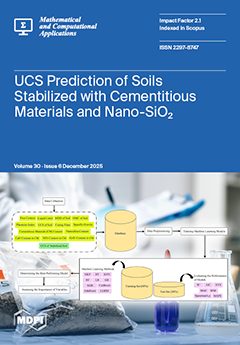
Cover Story (view full-size image):
This study presents a comprehensive machine learning framework for predicting the unconfined compressive strength (UCS) of fine-grained soils stabilized with various cementitious materials and nano-SiO2. A database compiled from published experimental studies was used to train and evaluate ten prediction models. Among them, the CatBoost showed superior predictive accuracy compared with other methods. Interpretation techniques were employed to identify the most influential parameters, showing that curing time, soil liquid limit, and additive content were the top influential factors on the UCS of soil stabilized with nano-SiO2. The proposed approach offers a cost-effective and reliable alternative to extensive laboratory testing and provides valuable insight into the nonlinear mechanisms controlling the performance of nano-stabilized soils. View this paper
- Issues are regarded as officially published after their release is announced to the table of contents alert mailing list.
- You may sign up for e-mail alerts to receive table of contents of newly released issues.
- PDF is the official format for papers published in both, html and pdf forms. To view the papers in pdf format, click on the "PDF Full-text" link, and use the free Adobe Reader to open them.
Previous Issue
Next Issue
