1. Introduction
The algebraic theory of operator and matrix polynomials has emerged as a central tool in both pure mathematics and control engineering, providing systematic approaches for modeling, analysis, and synthesis of large-scale multivariable systems. Recent progress has shown its versatility in problems ranging from recursive inversion algorithms for matrix polynomials [
1], matrix fraction descriptions in large-scale descriptor systems [
2], and spectrum assignment via static output feedback [
3], to block-pole placement strategies [
4,
5] and generalized spectrum assignment for bilinear and time-delay systems [
6,
7]. These advances build on the foundational contributions of Vardulakis [
8], Vayssettes [
9], Sugimoto [
10], Kurbatov [
11], Cohen [
12], Hariche and Denman [
13], Pereira [
14], Chen [
15], and Bekhiti [
16,
17], who developed λ-matrix formulations and algebraic strategies for MIMO system design. Classic works on singular systems [
18], matrix polynomials [
19], matrix functions [
20], and linear system theory [
21] established the mathematical background for these developments, later consolidated in doctoral and postdoctoral contributions on λ-matrices and block decomposition [
22]. Recent applications further extend into neural adaptive control [
23], block-companion forms [
24], matrix theory [
25], interpolation [
26], spectral operator pencils [
27,
28], and Newton-based algorithms for polynomial equations [
29].
Parallel to these algebraic advances, control of aeroelastic and aeroservoelastic systems has attracted significant attention. Neural-network-based identification of nonlinear aeroelastic models [
30], robust flutter suppression by
control [
31], fault-tolerant wing control [
32], eigenstructure-based aircraft control [
33], and integral LQR schemes for micro aerial vehicles [
34] demonstrate the practical relevance of advanced control methods in flight dynamics. Yet, despite extensive theoretical foundations and application-driven advances, a clear gap remains: there is still a lack of unified algebraic frameworks that translate operator polynomial theory into numerically conditioned, practically implementable controllers for aeroelastic systems, while also addressing robustness, nonlinearities, and disturbance rejection in realistic flight scenarios.
This work aims to fill this gap by presenting a rigorous algebraic framework for operator matrix polynomials and applying it to the control of aeroelastic systems in flight dynamics. The main contributions are as follows:
- (i)
Development of constructive tools for spectral factorization, companion forms, and block-pole assignment within an operator-theoretic setting.
- (ii)
Proposal of an adaptive block-pole placement strategy enhanced with a compact neural compensator to account for nonlinearities/uncertainties.
- (iii)
Demonstration of the method’s effectiveness on a nonlinear aeroelastic wing section model, where it outperforms benchmark strategies such as eigenstructure assignment, LQR, and -control in terms of robustness, transient performance, and control effort.
The remainder of the paper is structured as follows.
Section 2 recalls the fundamentals of matrix algebra and linear vector spaces that underpin the subsequent developments.
Section 3 addresses matrix polynomials (λ-matrices) and spectral divisors, while
Section 4 presents their standard structures and realization forms.
Section 5 is devoted to the determination of operator roots (spectral factors), followed by
Section 6, which discusses transformations between solvents and spectral factors.
Section 7 introduces matrix fraction description (MFD) realizations and transformations between canonical forms.
Section 8 develops the proposed control-design strategies, and
Section 9 demonstrates their application to aeroelastic systems in flight dynamics. Finally,
Section 10 concludes the paper and outlines perspectives for future research.
2. Fundamentals of Matrix Algebra and Linear Vector Spaces
Let
denote the field of complex numbers,
represent the field of real numbers,
denote the set
matrices over
, and
is the set of matrices with real entries. Unless stated otherwise, all matrices will be in
. The column vector in the vector space
will be denoted as
If
, we use
for the conjugate transpose of
. For vectors
we employ the usual
inner product ; the norm of vector
is the
Euclidean norm,
. For matrices
, we use the operator norm
. A subspace
of
is called the
invariant subspace or
-invariant if
for every
. If
is a
subspace of
,
denotes the
dimension of
. If
, the
range (
column space) of
is denoted by
, and the
null space of
, by
. Recall that
and
. Let
be subspaces of
, the sum of these subspaces
is the subspace. If
for
, the subspaces are said to be independent, and the sum is then called a
direct sum and we write
. Recall that
and if
, then there exists a unique
such that
. A
projection is a matrix
such that
. It is easily seen that
. Conversely, if
there exists a unique
, such that
and
; we denote this projection by
, the projection onto
along
. If
is a subspace of
, the orthogonal complement of
is
.
is a subspace and
.
is denoted by
. If
, there exists a unique matrix
which satisfies:
and also
. The matrix
is the Moore–Penrose (
Generalized) inverse of
. If
is consistent, then
is a solution (in fact, min-norm solutions) and all solutions are given by
, where
is arbitrary. Also, the Moore–Penrose inverse (or the
pseudoinverse) can be defined as follows:
. We shall often make use of block matrices. In particular, if
is block-diagonal, that is,
has blocks
along the main diagonal and zero blocks elsewhere, we write
or
. The
eigenvalues of
are the roots of the polynomial
. The
spectrum of
is the set of eigenvalues of
and is denoted by
. The
spectrum radius of a square matrix
is
. If
is a root of multiplicity
of
, we say that
is an eigenvalue of
of
algebraic multiplicity . The
geometric multiplicity of
is the number of associated independent eigenvectors
. If
has algebraic multiplicity
, then
. Thus, if we denote the geometric multiplicity of
by
, then we must have
. A matrix
is said to be
defective if it has an eigenvalue whose geometric multiplicity is not equal to (i.e., less than) its algebraic multiplicity. Equivalently,
is said to be defective if it does not have
linearly independent (right or left) eigenvectors [
18,
20,
25].
If
we say that
is
similar to
in the case that there exists a nonsingular matrix
such that
. Similar matrices represent the same
linear operator on
but with respect to different bases. We shall also make use of the fact that every
is similar to a matrix in Jordan canonical form, that is,
is similar to
and
with
, and
are the standard basis matrices (matrix unit). There may be more than one such block corresponding to the eigenvalue
. The
numerical range of
is
, and the
numerical radius of
is
.
is a compact convex set which contains
. In general,
may be larger than the convex hull of
. However, it is possible to find an invertible matrix
, such that
is as close as desired to the convex hull of
. A Hermitian matrix
is
positive semi-definite if
for all
. If
is a positive semi-definite, then it has a unique positive semi-definite square root, which we denote as
, that is,
. If
is a complex matrix, then the
of
, denoted by
, is the smallest nonnegative integer
such that
. For nonsingular matrices,
. For singular matrices,
is the smallest
positive integer
, such that either of the following two statements is true:
and
. The matrix
is said to be
nilpotent whenever
for some positive integer
.
is the smallest positive integer, such that
(some authors refer to
as the
index of nilpotency). If
is an
singular matrix of index
, such that
, then there exists a nonsingular matrix
such that
in which
is nonsingular, and
is nilpotent of index
k. This last block-diagonal matrix is called a
core-nilpotent decomposition of
. When
is nonsingular,
and
, such that
is not present, and then we can set
and
[
15]. Inverting the nonsingular core
and neglecting the nilpotent part
in the core-nilpotent decomposition produces a natural generalization of matrix inversion. More precisely, if we have, as follows:
, then
defines the
Drazin inverse of
. Even though the components in a core-nilpotent decomposition are not uniquely defined by
, it can be proven that
is unique and has the properties:
, when is nonsingular (the nilpotent part is not present).
, where ;
If in which then is the unique solution;
is the projector onto along ;
is the complementary projector onto along ;
and ;
, with .
Theorem 1 ([
18])
. If and is an eigenvalue of of multiplicity , then is an eigenvalue of of multiplicity .
If is an eigenvalue of of multiplicity , then is an eigenvalue of of multiplicity .
If , then the Drazin inverse is a polynomial in of degree or less. Function of Matrix: Now, we use the following notations: for a matrix
, let its characteristic polynomial be
where the eigenvalues
are repeated
and
. Let
and
. We know that
is an invariant subspace for
and
. We also know that
is a projection on
. Since
and
are polynomials in
, we have
[
27]. Other properties of
and
are given by Theorem 2.
Theorem 2 ([
20])
. Let and then (1) ; (2) and (3) , are true. The concept of a matrix function generalizes the evaluation of scalar analytic functions at matrices and is standard in the theory of matrix analysis. Theorem 3 summarizes the fundamental results of such a theory (see Higham [
20]).
Theorem 3 ([
18,
20])
. For any with spectrum , let denote the class of all functions f: which are analytic in some open set containing .
For any scalar function , the corresponding matrix function f(A) is defined by The Drazin inverse is a matrix function corresponding to the reciprocal
, defined on nonzero eigenvalues. The analogous result for Drazin inverse is, as follows:
Theorem 4 ([
22])
. For any with spectrum , let be an analytic functions in some open set containing , then if and only if , for and . In particular, If is a polynomial, such that , for and then Lemma 1 ([
19,
20,
25])
. Let be any arbitrary complex matrix with spectrum and let , and be analytic at , , then- (i)
if , then ;
- (ii)
if , then and ;
- (iii)
if , then ;
- (iv)
if , then ;
- (v)
if is analytic at , and , then ;
- (vi)
, where ⊗ is the Kronecker product;
- (vii)
, .
In many engineering applications, it becomes advantageous to express matrix functions through contour-integral representations. Recall that if
is analytic in and on a simple closed contour
, then
. Furthermore, if
lies inside
, then
A similar approach can be applied to the functions of matrices. For
, the matrix
is referred to as the
resolvent of
; it is analytic for
. If the characteristic polynomial of
is
, with distinct eigenvalues
and
, then the resolvent has the spectral form:
where
is a projection.
Theorem 5 ([
18])
. If and is analytic function for and , then the matrix Cauchy integral formula:
where is a contour lying in the disk and enclosing all the eigenvalues of .
Consider a matrix with spectra where . If a scalar function is analytic at then the matrix function is generated by where is a simple closed contour which encloses . The matrix function described by contour integral has the properties:
Corollary 1 ([
18,
25])
. If we let where are disjoint sets of eigenvalues and is a contour enclosingwhile leaving outside, then It should be noted that if
and
, then
. If
and
, where
are square matrices, then Drazin matrix is
. If
, then
. Finally, we deduce that
where
encloses all the nonzero eigenvalues of
[
18]. Also, the following statements hold:
- (i)
.
- (ii)
.
- (iii)
.
- (iv)
.
- (v)
is the idempotent matrix onto along .
- (vi)
if and only if is nilpotent.
- (vii)
.
3. Matrix Polynomials (λ-Matrices) and Spectral Divisors
By a
matrix polynomial , we mean a matrix of the form
, where all elements
are polynomials in
(i.e., the ring of polynomials in the variable
with coefficients from
, typically
or
). The set of these matrices will be designated by
, or symbolized directly by
(resp.
), and their subsets containing the constant matrices
, are denoted by
(
or
, respectively). The matrices in
and
are called real matrices. Then, scalar multiplication, addition, and multiplication of matrix polynomials are the same operations as for general matrices with entries in a commutative ring. An alternative formulation of
(
-matrices) is, as follows:
where the coefficients
are constant matrices in
. The matrix
is named the highest coefficient or leading matrix coefficient of the matrix polynomial
. If
(where
is the
zero matrix) is true, then the number
is called the degree of the matrix polynomial
, and it is designated by
, and the number
is called the order of the matrix polynomial
where
is a complex variable. The matrix polynomial
is called
monic if leading matrix coefficient
is the identity matrix;
comonic if the trailing matrix coefficient
is the identity matrix;
regular if
is not identically zero;
unimodular if
is a nonzero constant;
co-regular if the trailing matrix coefficient
is also nonsingular;
non-monic if the leading matrix coefficient satisfies
. If
, the polynomial has a singular leading coefficient, which implies the existence of infinite eigenvalues [
14,
22].
Suppose
is a matrix polynomial of degree
with invertible leading coefficient. If there exist matrix polynomials
and
, with
or
, such that
, then
is the right quotient of
on division by
, and
is the corresponding right remainder. Similarly, if we have the following decomposition
, with
or
, then
and
are the left quotient and left remainder, respectively. If the right remainder is zero, then
is a right divisor of
; an analogous definition holds for left divisors [
12]. Both quotients and remainders are uniquely determined.
Theorem 6 ([
25])
. Let . The right and left remainders of upon division by are denoted by and , respectively: , . An matrix is called a right solvent of if , and a left solvent if .
Corollary 2 ([
22])
. The matrix polynomial is divisible on the right (respectively, left) by with zero remainder if and only if is a right (respectively, left) solvent of .
Let
be a matrix polynomial. An
matrix
is called a
right solvent of
with multiplicity
if
divides
exactly on the right. Similarly, a matrix
is a
left solvent of multiplicity
if
divides
on the left. In these cases,
,
, where
and
denote the right and left functional evaluations of
. Moreover,
or
if and only if
or
is a right or left solvent of
[
13].
Definition 1 [
14,
26])
. Let be an matrix polynomial. A constant matrix is a right solvent of if and a matrixis called a (left) solvent for if .
An equivalent representation for
(or
) that uses the contour integral is as follows:
for any closed contour
enclosing the spectrum of
(or
) in its interior. An interesting consequence of matrix complex analysis is the existence of spectral right and spectral left solvent, which can be stated as the following theorem:
Theorem 7 ([
19,
27])
. Suppose that is an operator root (right or left) of the polynomial operator , with , and is closed. If is a closed curve separating from , then is a spectral root (right or left) of if, and only if More generally, let
be a monic matrix polynomial and let
be a contour consisting of regular points of
that enclose exactly
eigenvalues of
, counted with multiplicities. Then
possesses both a Γ-spectral right divisor and a Γ-spectral left divisor if and only if the following
matrix
is defined by
is nonsingular. In case that
is nonsingular, the
Γ-spectral right divisor
(or the
Γ-spectral left divisor
) is given by the formula [
12,
19,
25]:
Now we are going to introduce some definitions, which are results related to the concept of
linearization,
companion forms of a matrix polynomial. Let
(for
) be square matrices (called
right block roots or
solvents), such that the right functional evaluation of
by
is identically zero, that is, as follows:
In a compact form (i.e.,
) we have
where
and
is the first companion matrix. If we define
then
with
. The matrix
is a block eigenvalue of order
of a matrix
with
if there exists a block eigenvector
of full rank, such that
. Moreover, if
, with
of full rank, then all the eigenvalues of
are eigenvalues of
. A matrix
has the property that any similar block is also a block eigenvalue, and it is clear that a block eigenvector
spans an invariant subspace of
, since being of full rank is equivalent to having linearly independent columns [
20].
The word “Linearization” to a matrix polynomial, in fact, comes from the linearization of differential equations. Consider the following system of differential equation with constant coefficients
where
is a given forcing function and
is an unknown vector function called state. We can reduce (12) to a first-order differential equation
where
and
. This operation of reducing the
degree differential equation to a first-order equation is called a linearization. (That is, we increased the dimension of the unknown function, which becomes
.)
We know that so , if we define the following matrices and we obtain . Since and have the same spectrum as therefore they are equivalent.
Definition 2. Let be an degree monic matrix polynomial (i.e., with nonsingular leading coefficient). A linear matrix polynomial,is known as a linearization (or a matrix pencil) ofif there exist a two unimodular matrix polynomialsandsuch thator we say that they are equivalent and we write.
An matrix polynomial is said to be similar to a second matrix polynomial of the same order if there exists a unimodular matrix polynomial such that .
Theorem 8 ([
25])
. Two matrix polynomials and , are called similar if and only if the matrix polynomials and are equivalent (i.e., ). Any matrix is a linearization of if and only if is similar to the first companion matrix of , that is, .
What role do the solvents play in contributing to the solution of the diff-equation?
If we let
and
then
, equivalently.
From the above similarity transformation, it is well-known that
and
Means that
where
and
. Using the inverse Laplace transform, we obtain:
. We also know that the homogeneous solution of the differential equation
is
[
17].
The
standard triples corresponding to
will be used extensively throughout the remainder of this paper [
12]:
The following equality is verified by direct multiplication:
or
Lemma 2 ([
19,
27])
. If are operator roots of the polynomial operator then, withis the companion form matrix corresponding to the pencil If the Vandermonde operator is invertible, then the operators and are similar. If is invertible, then .
Theorem 9 ([
25])
. If is complete set of operator roots of, then- ▪
is left-invertible ⟺⟺ .
- ▪
is right-invertible ⟺⟺.
- ▪
exist ⟺⟺ .
What forms can the block Vandermonde matrix take when we have some repeated solvents (block roots)?
Proposition 1 ([
13,
22])
. An square matrix is a right solvent of with multiplicity if and only if it is a right solvent of each derivative for . Similarly, an matrix is a left solvent of multiplicity if and only if it is a left solvent of for , where denotes the derivative of with respect to .
Let
be an
degree matrix polynomial, then a matrix polynomial
(
) is called the
right divisor of
if there exists a
such that
. In addition, if
, then
is called
spectral divisor of
[
27]. If the linear pencil
is a (spectral) right divisor of
, then the matrix
is called (
spectral)
right root of
and satisfies
. Therefore, if
then
Definition 3 ([
12,
13,
14])
. Let be a matrix, and let be a set of block eigenvalues of with . We say that this set of block eigenvalues is a complete set, if- ▪
The union of the eigenvalues of all together equal those of (i.e., ).
- ▪
Each eigenvalue appears with the same partial multiplicities in the as it does in .
The set is complete if these blocks capture the entire spectral data of without distortion.
Theorem 10 ([
26])
. A set of block eigenvalues of a matrix , is a complete set if and only if there is a set of corresponding block eigenvectors , such that the matrix is of full rank, and . Moreover, if is a complete set of solvents of a companion matrix then the respective block Vandermonde matrix: is nonsingular. In addition, if is a complete set of solvents of the matrix with multiplicities, (i.e., is a right divisor of and is not), then and the generalized block matrices are given by A problem closely related to that of finding solvents of a matrix polynomial is finding a scalar , such that the lambda-matrix is singular. Such a scalar is called a latent root of and vectors and are right and left latent vectors, respectively, if for a latent root , and .
Definition 4 ([
5,
22])
. Let be matrix polynomial, then we define the zeroes of to be the latent roots (eigenvalues) of , and the set of latent roots of is called the spectrum of denoted by . And if a nonzero is such that , then we say that is a right latent (or eigen) vector of , and if a nonzero is such that or , then is a left latent (or eigen) vector of .
The relationship between solvents and latent vectors/roots is given by
If we define then . Solvents of can be constructed as where the matrix and the pairs are chosen among the pairs of .
Theorem 11 ([
14,
17])
. If is the latent root of with and as the right and left latent vectors, respectively, then is an eigenvalue of with as the right eigenvector of and is the left eigenvector of .
Now, we are going to explore the relationship between latent vectors of
and eigenvectors of an arbitrary linearization matrix
. Given a matrix
whose eigenvectors are denoted by
let
be its companion form, that is,
where
and
. We know this from the above theorem
. From the theory of control systems, the matrix transformation
is given by
and
where
is chosen so that
is nonsingular.
4. Standard Structures of Matrix Polynomials and Realization
We extend the spectral analysis of matrix polynomials by introducing
standard triples (
canonical triples) of matrices, which encode all eigenvalues, eigenvectors, and Jordan chains. These triples not only generalize the Jordan normal form to monic matrix polynomials on finite-dimensional spaces but also enable the inverse problem: reconstructing polynomial coefficients from spectral data [
2,
25].
In the previous development, we have seen that
and
therefore,
which is equivalent to
with
and
. Now, if we let
where
are latent vectors corresponding to the solvent
with
therefore,
then this leads to
where
. Notice that
which implies that
. Based on this information, we can define the Jordan triple by taking the following similarity transformation
.
where
and
implies that
.
However, in this situation, we are asked to check that
. Now, observe that the set of all solvents can be gathered in compact form:
Now, we can explicitly write
; where
are appropriate matrices, this means that
, and therefore,
, which can be written as
Also, we have .
4.1. Triples of Matrix Polynomials (λ-Matrices)
A triple of matrices
with
,
and
is called a
Jordan triple of the monic matrix polynomial
of degree
and order
if
. Here,
is a block-diagonal matrix formed from Jordan blocks, each corresponding to a particular eigenvalue. Each column of
belongs to a Jordan chain associated with the corresponding Jordan block in
, and
is a matrix of left latent vectors, which can be computed via:
, [
19].
The coefficients of the monic matrix polynomial can be recovered from either the right or left latent structure:
and
which leads to
Definition 5 (standard triple [
8])
. A set of matrices is called a standard triple of the monic matrix polynomial if it is obtained from a Jordan triple by the following similarity transformation: , , and that is standard form. Now, if we let be any linearization of the operator polynomial with invertible leading coefficient, then there exists an invertible matrix , such that . We then deduce from the structure of and the relation that must have the form for some operator , and that .
Theorem 12 ([
19])
. Let be a monic matrix polynomial of degree and order with standard triple , then and has the representations: Proof. Notice that , and previously, we have seen that if is any linearization of the monic operator polynomial , then there exist some linear operator such that which can be written as and define then, we obtain . Following the same procedure, we can prove the rest. □
Theorem 13 ([
2,
25])
. If are monic matrix polynomials with standard triple for , then has the following standard triple. Proof. From the theory of standard triples.
If
is a particular factorization of the monic matrix polynomial
, such that
, then
and
are called spectral divisors of
. It follows that, whenever a matrix polynomial has spectral divisors, there exists a similarity transformation that converts its block-companion matrix
into a block-diagonal form [
13,
26]. □
Remark 1. If the set of matrices is a standard (or Jordan) triple, then we call the set a standard (or Jordan) pair.
4.2. Pairs of Matrix Polynomials (λ-Matrices)
A monic matrix polynomial
is fully characterized by its
invariant pairs , which generalize eigenpairs through Jordan chains. Since Jordan chains are numerically unstable, invariant pairs provide a more robust framework for spectral analysis and computation. Let
be an eigenvalue of the regular
matrix polynomial
of multiplicity
. Then, we can construct from the spectral data of
a pair of matrices
with the following properties:
,
and
is a Jordan matrix with
as its only eigenvalue,
and
. We shall say that any pair of matrices
with these properties is a local Jordan pair of
at
. If
are all the eigenvalues of
in this way, we obtain
local Jordan pairs
,
[
2].
If the spectrum of a matrix polynomial contains infinity as an eigenvalue, the corresponding Jordan pair is naturally split into two components: the finite Jordan pair and the infinite Jordan pair .
Definition 6. If is a finite local Jordan pairs of then the pair of the form and is called a finite Jordan pair for . Now, we define a Jordan pair of order for as pair with the following properties:
- (1)
;
- (2)
is a finite Jordan pair for ;
- (3)
is a local Jordan pair for at .
It can be easily verified that
means that
with
.
The pair will be called a standard pair of order if the condition is satisfied. Its main property is summarized in the following: The admissible pair is standard if and only if the is maximal for all (also, is sometimes called controllable matrix).
Lemma 3 ([
2,
25])
. If , denote the sums of the degrees of the finite and infinite elementary divisors of a general matrix polynomial , respectively, then .
The finite Jordan pair of
, associated with the zero structure at
corresponds to the infinite Jordan pair
of
. Consequently, the finite and infinite Jordan pairs of
satisfy the following properties:
Moreover, the structure of the infinite Jordan pair of
is closely connected (see Vardulakis in [
8]) to its Smith–McMillan form at
. In particular,
Theorem 14 ([
8,
19])
. Let and be the finite and infinite Jordan pairs of , with , , , and . These pairs satisfy the following properties: and has a zero at with multiplicity ;
.
In addition, a realization of is given by A pair of matrices
is called a right admissible pair of order
if
and
. Similarly, a pair
with
and
is a left admissible pair of order
. Here and elsewhere, mmm is fixed, and unless specified otherwise, admissible pairs are assumed to be right admissible. All notions defined below for right admissible pairs can be naturally reformulated for left admissible pairs. Two right admissible pairs
and
of the same order
are called similar if there exists an invertible
matrix
, such that
and
[
25]. Let
,
be admissible pairs of orders
, and
with
. The pair
is said to be an extension of
(equivalently,
is a restriction of
) if there exists a full-rank
matrix
, such that
and
. A pair
is called a common restriction of a family of admissible pairs
, if each
is an extension of
. A common restriction
is called the greatest common restriction if it is an extension of every other common restriction in the family. For a matrix polynomial
, if
and
are right and left admissible pairs, respectively, then it is evident that
and
.
Next, we recall some basic facts from the spectral theory of matrix polynomials. If
is an
monic matrix polynomial of degree
, a right standard pair
is an admissible pair of order
, such that the matrix
is nonsingular and
. Similarly, a left admissible pair
of order
with
is called a standard pair of
if
[
2,
19,
25].
Another equivalent definition of standard pair is given in the following result:
Lemma 4 ([
12,
19])
. The admissible pair is standard of order for iff is standard of order and the equation: holds, where is the companion linearization of the matrix polynomial ,
, and
.
A resolvent form for the regular matrix polynomial is a representation where is a linear matrix polynomial and are matrices of appropriate size. As a consequence, any two regular matrix polynomials, and have the same standard pair if and only if there exists a (constant) invertible matrix , such that .
Theorem 15 ([
2,
8])
. Let the matrices be a standard pair (finite–infinite) of order for the regular matrix polynomial . Then, where the matrices , and are given by Proof. We know that
; therefore,
□
The next theorem gives the explicit solutions of basic linear systems of differential (and/or difference) equations, using a given standard pair of the characteristic polynomial . We shall assume throughout that , is a given regular matrix polynomial () with a given standard pair . It is also assumed that is a nilpotent matrix, i.e., for some . This is equivalent to stating that where . This condition can always be achieved by transforming our given standard pair to a Jordan pair, via simple operations. In most applications, however, is a Jordan pair to begin with, so that this condition holds.
Theorem 16 ([
19])
. The general solution of the differential equation with and for a given smooth differentiable function is, as follows:For a given sequence of vectors , the general solution of the difference equation is where is an arbitrary vector, and .
4.3. Characterization of Solvents by Invariant Pairs
We now examine the matrix solvent problem as a special case of the invariant pair problem, applying to solvents some of the results previously established for invariant pairs. Let be a monic matrix polynomial. The associated right and left matrix difference equations are given by , where , ,
Theorem 17 ([
19,
25])
. Given a matrix polynomial having as a standard triple, the general solution of is, as follows: where and the general solution of is, as follows: where .
Proof. By using the definition of a standard pair, the following identity is satisfied: . If we multiply on the right by we obtain and thus, verifies the equation . From the other side, the proof of can be derived by using the fact that the standard triple of is . □
Corollary 3 ([
22])
. The solution of the difference equation with the initial conditions: , is given by . The solution of the difference equation with the initial conditions: , and is given by .
Proof. Using , we obtain the set of equations . □
Thus, for these initial conditions, the right and left difference equations yield the same solution.
Corollary 4 ([
22])
. If the matrix polynomial has a complete set of right solvents, then the solution of the matrix sequence , subject to the initial conditions and , , is given by with .
Proof. We know that admits the standard triple where , and . Replacing in we obtain . □
Theorem 18 ([
25])
. Let be an degree monic λ-matrix and consider an invariant pair of (λ) (sometimes called admissible pairs). If the matrix has size , i.e., , and is invertible, then satisfies , i.e., is a matrix solvent of .
Proof. As is an invariant pair of , we have, as follows: . Since is invertible, we can multiply by and obtain which is equivalent to . Therefore, is a matrix solvent of , with . □
Theorem 19 ([
19])
. Let be an degree monic λ-matrix, if has a complete spectral factorization: then the pencile is a linearization of , that is, as follows: 5. Determination of Operator Roots (Spectral Factors)
We next review several existing algorithms for factoring a linear term from a given matrix polynomial
. As will be shown later, the
Q.D. algorithm can be interpreted as a generalization of these approaches. Following this, we introduce a new optimization-based algorithm [
35,
36,
37].
A. Bernoulli’s Method is sufficient to find only the dominant linear spectral factor at each iteration, and in order to find all of them, we use synthetic long division. To convert spectral factors to solvents, we use some algorithmic conversion methods.
Theorem 20 ([
19,
22])
. Let A(
λ)
be a monic matrix polynomial of degreeand order. Assume thathas a dominant right solventand a dominant left solvent. Let the sequence , be the solution of subject to the initial conditions , and . Then, the matrix is not singular for or large enough, and and .
Proof. We have seen that , where is a dominant right solvent , and converge toward zero. Thus, for large enough , is nonsingular and we can write:
If there is some nonsingular
then the Bernoulli method will breakdown. □
Now, consider the generalized Bernoulli’s method (Algorithm 1) with the matrix polynomial as follows:
.
| Algorithm 1. Generalized Bernoulli’s Method |
1 Enter the number of iterations ,
2 % Initialization
3 For
4 %
5 % Update and evaluate
6 End, |
Theorem 21 ([
22])
. Let be a monic matrix polynomial of degree and order . We can associate this by the recursive equation . The Bernoulli’s iteration can be written as with . The general solution of this matrix difference equation is with . The dominant right solvent .
C. Matrix Horner’s Method efficiently evaluates an
-degree polynomial using only
multiplications and
additions, by expressing it in nested form via synthetic division. We now give an extended version of this nested scheme to matrix polynomials [
28].
Theorem 22. Let us define the functional to be the matrix polynomial of degree and order over the complex field where the matrices are some constant matrix coefficients and is a complex variable, with . Let , be the right functional evaluation of by the sequence of square matrices . The solution of matrix polynomial converges iteratively to the exact solution if Proof. Divide
on the right by
we obtain
(i.e., remainder theorem), which means that
. If we set
, and we expand this last formula of the functional
we obtain:
. By identifying the coefficients of different powers, we obtain:
. Since
is a right operator root of
, this means that
and from this last equation of
, we can deduce that
; in other words,
. If we iterate these, we arrive at
with
Based on the iterative Horner’s sachem (Algorithm 2), we can redo the process many more times to obtain a solution
, and the theorem is proved. □
| Algorithm 2. Block Horner’s Method |
1 Specify the number of iterations
2 For
3 Input the degree and the order and the coefficients
4 is the initial guess; and let
5 For , ; End
6 ;
7 End |
Now, we introduce a new version of the block Horner’s method, which is an efficient algorithm for the convergence study; after back substitution of the sequence we obtain the following: , so, by using the last theorem and substituting into the equation of we obtain: . The following corollary is an immediate consequence of the above theorem.
Corollary 5 ([
22])
. Let the functionbe a monic matrix polynomial of degree. Assume thathas an operator root, let the sequenceandbe the right functional evaluation of, which means thatforIf the square matrix is invertible for each given value of , then the sequence ofmatricesconverges linearly to the operator root (i.e., ) under the condition: where is any arbitrary initial guess. Here is the extended block Horner’s method (Algorithm 3) for any monic matrix polynomial as follows:
.
| Algorithm 3. Extended Block Horner’s Method |
1 Specify the degree and the order
2 Input the matrix polynomial coefficients
3 Provide an initial guess ;
4 Set a small threshold (initial tolerance) and initialize
5 While
6
7
8
9 ;
10 End |
D. Matrix Broyden’s Method: In the iterative form of Newton’s method, we know that
, and from the other side, we know that
so
or equivalently
The computation of
occupies a space in memory and this can be avoided if we calculate it iteratively at each step by using the Sherman–Morrison–Woodbury formula
with
. Define the variables:
,
,
, and
then it can be verified that
This method converges without any conditions (i.e., symmetry positive-definiteness dominance, etc.). There are no constraints on the values that
can take. Algorithm 4 begins at an initial estimate for the optimal value
and proceeds iteratively to obtain a better estimate at each stage.
| Algorithm 4. Extended Broyden’s Method |
1 Data: , , and
2 Result:
3 Begin:
4
5
6
7 End |
Determine the solution of
where
where
is the variable matrix to be determined and
are constant matrices. The solution to such a problem is given by the program in
Table 1.
E. Matrix Newton’s Method: The matrix is the right evaluation of at , and is a nonlinear operator that maps the space of square matrices onto itself. Since the space of complex square matrices is a Banach space under any matrix norm, we can use powerful results from functional analysis. This space is also a finite-dimensional space, and as such, the equation is a set of nonlinear equations with unknowns. Let with as a matrix polynomial. We present a Newton method to solve the equation , and we prove that the algorithm converges quadratically near simple solvents.
Theorem 23 ([
29])
. Letin an arbitrary monic -matrix. If is a simple solvent of and if the starting matrix is sufficiently near , then the iteration: for converges quadratically to . More precisely: if , and for sufficiently small and , then we have, as follows:- ▪
and with for
- ▪
for
Let us now consider the generalized Newton’s algorithm (Algorithm 5). The considered matrix polynomial is, as follows:
.
| Algorithm 5. Generalized Newton’s Method |
1 Enter the number of iterations and let be an arbitrary initial guess.
2 For
3 ; ; ;
4 ;
5
6 ;
7 ;
8 ; ;
9 End, |
F. Matrix Quotient–Difference Method: The matrix quotient–difference (
Q.D.) algorithm extends the scalar method originally proposed by Henrici in 1958. Its use for matrix polynomials was first suggested by Hariche in 1987 and later formalized by Bekhiti in 2018 through recurrence relations defining the
Q.D tableau, initialized as follows:
. These equations yield the first two rows of the
Q.D. tableau—one row for the
Q’s and one for the
’s. Using the rhombus rules, the bottom element (referred to as the south element by Henrici [
22]) can be computed. This leads to the row generation procedure of the
Q.D. algorithm:
Here, the
represent the spectral factors of
. Notably, the Q.D. algorithm computes all spectral factors simultaneously and in dominance order. The row generation variant is chosen here due to its superior numerical stability. Consider a matrix polynomial of second-order and third-degree
. We now apply the generalized row generation
Q.D. scheme (Algorithm 6) to compute its spectral factors.
| Algorithm 6. Generalized Quotient–Difference Method |
1 Specify the degree and the order of :
2 Input the number of iterations
3 Give the matrix polynomial coefficients
4 Let ; % initialization
5 For ,
6 For , End,
7 For End
8
9 End, |
It is noteworthy that, since a matrix polynomial admits both left and right evaluations, there are two corresponding
Q.D. algorithms: one for right factorization and one for left factorization. Accordingly, we provide two subroutines—
QDRF and
QDLF—for right and left factorization, respectively. These subroutines (
Table 2) are direct implementations of the corresponding formulas.
G. Spectral Factors by Optimization Algorithms: Spectral factorization of matrix polynomials can be formulated as a nonlinear optimization problem. Given a monic polynomial the objective is to determine a factor such that or . This is achieved by minimizing the Frobenius-based cost functional which is convex in the least-squares sense. Algorithm 7 initializes with the coefficient matrices and iteratively updates using a gradient-based solver (e.g., fminunc), yielding numerical spectral factors without explicit algebraic decomposition.
| Algorithm 7. Spectral Factors by Optimization |
1 Function solvepoly
2 ; ;
3 For , ; End % Make some random matrices
4
5 Function
6 ;
7 For , ; End, ;
8 End
9 End |
7. MFD Realization and Transformation Between Canonical Forms
A rational matrix function
is the quotient of two matrix polynomials in
. A strictly proper left form is
where
and
. Similarly, the right form is
where
and
. The function
can also be expressed as follows:
. For an irreducible
, the denominators are coprime with the numerators, and the roots of
or roots of
are called the poles of
. Furthermore,
and
[
21,
22,
38].
- ▪
State-Space from Left MFD: A state-space realization of a proper rational left
-matrix
is given by
where
A is the transition matrix with
dim = n ×
n.
B is the input matrix with
dim = n ×
m. C is the observation matrix with
dim = m ×
n.
D is the direct term matrix with
dim = m ×
m.
An alternative way of determining the matrix coefficients of the LMF is
- ▪
Left MFD from State-Space: A minimal realization of the state-space system, described by {
A,
B,
C,
D}, can be represented by a proper rational left
-matrix as follows:
, if the state-space realization fulfills the dimensional requirement that the state dimension
n, divided by the number of channels
, equals an integral value
k. The matrix coefficients of the rational left
-matrix, which all have the dimensions
m ×
m, are then given by
An alternative way of determining the matrix coefficients of the LMF is
- ▪
State-Space from Right MFD: The controllable state-space representation of the system described by
is
- ▪
Right MFD from State-Space: The matrix coefficients of the RMF can be obtained directly from the general state-space equations. Given the general state-space matrices {
A,
B,
C,
D} and let
with
we can then determine the matrix coefficients of
- ▪
Realization by General State-Space: For the general case, the Laplace transform of
and
under the zero conditions results in the generalized function
with the characteristic equation of the form
. It can be shown that, in certain cases, the
of linear singular systems cannot be derived. This depends entirely on the solvability of the system: only regular singular systems admit such a description. If the system is irregular and thus lacks a transfer function, it may still be represented in a generalized form,
R(
s)
Y(
s)=
Q(
s)
U(
s), where
Y(
s) and
U(
s) are the Laplace transforms of the output and input, respectively (Campbell, 1980 [
18]). Since
irregular systems may admit multiple or no solutions, the question of whether they are encountered in practice arises. To address this, Tsai in 1992 [
39] proposed a constructive algorithm for deriving generalized state-space models from column-/row-pseudoproper or proper matrix fraction descriptions (MFDs). The resulting model, expressed in a special coordinate system, is guaranteed to be controllable-observable in the Rosenbrock–Cobb sense, with order equal to the determinantal degree of the MFD. For coprime MFDs, the algorithm ensures minimal realization, preserving both controllability and observability [
15,
21].
Definition 7 ([
5])
. Consider a nonsingular polynomial matrix, and let be the highest degree of the column of andbe the highest degree of the row of. If , then is column-reduced. If, thenis row-reduced. Definition 8 ([
21,
39])
. Assume that the given right matrix fraction description (RMFD)is in column-based form. It is called column-pseudoproper if , , where and are the generalized column degrees of and , respectively. This notion can be similarly extended to define a row-pseudoproper case. The realization of a column-
(or column-proper) rational transfer matrix in the right MFD is constructed as follows. Define
,
, and
, where
denotes the transpose. Then,
, with
representing the highest-column-degree coefficient matrix,
the lowest-column-degree coefficient matrix, and
a constant matrix. Next, we define the core realization:
In the above core realization,
denotes the
dimensional identity matrix. If the given right MFD is column-proper, then
, , and
. However, if the MFD is column-pseudoproper, then
, while
and
can be chosen arbitrarily based on
and
. Using the definitions from the core realization above, a generalized realization for the system can then be obtained as follows:
where
, .
, and
is defined as
.
Next, the realization of a row- (or row-proper) rational transfer matrix in the left MFD is constructed as follows: Let and , . Then, , , where is the highest-row-degree coefficient matrix, is the lowest-row-degree coefficient matrix, and is a constant matrix.
Firstly, we define the core realization as follows:
In the above core realization,
denotes the
identity matrix. If the given left MFD is row-proper, then
, , and
In contrast, if the MFD is row-pseudoproper, then
,
and
can be chosen arbitrarily based on
and
. Using these definitions from the core realization, a generalized realization for the system can be obtained as follows:
where
, .
, and
is defined as
.
8. The Proposed Control-Design Strategies
Building upon the algebraic theory of operator matrix polynomials, spectral divisors, and matrix fraction descriptions presented in the previous sections, we now focus on the development of a constructive feedback control strategy. The aim is to exploit the operator matrix polynomials framework to achieve block-pole placement in large-scale MIMO processes. Unlike conventional methods that rely on simple eigenstructure assignment, the proposed approach integrates realization theory and matrix polynomial techniques to ensure global block roots relocation. This section introduces the formulation of feedback control laws and establishes its mathematical foundations.
- ▪
Relocation of Block Poles via State Feedback: Pole placement through state feedback is a well-established method for closed-loop control design. For MIMO systems, the block-controllable canonical form offers a suitable framework for implementing block-pole placement. When the number of inputs divides the system order (), the feedback gain matrix is chosen so that the closed-loop matrix attains the prescribed right characteristic polynomial .
Theorem 26. Let a linear time-invariant state model be given by (or the discrete-time analog ) with ,. Assume
for some integer.
The pair is block-controllable of index (i.e., is nonsingular).
A desired right characteristic polynomial is prescribed (from a set of block roots ) and its block-companion matrix is formed in the controllable space.
Define the companion coordinates, and assumehas the standard companion form. Letdenote a left-inverse of, satisfying. Letbe the block-controllability matrix and define the companion transform.
A state-feedback gain that places the closed-loop block poles so that the matrix is given by the explicit, computable formula Proof. The closed-loop matrix is given by
, that is,
. From the knowledge of
and
, we can write
or
, but
with
,
and
; therefore, we obtain the following relation
. From the other side, we know that
, so the feedback gain matrix is given by the formula
with
. □
The above illustrations can be summarized into Algorithm 12.
| Algorithm 12. Relocation of Block Poles via State Feedback |
- 1.
Model setup: Start with the LTI system , , , where . - 2.
Compute the block-controllability matrix - 3.
Check controllability: Verify that is block-controllable of index , i.e., is nonsingular. - 4.
Construct desired right characteristic polynomial from . - 5.
Compute to obtain , , where . - 6.
Form the block-companion matrix: Construct corresponding to the desired polynomial . - 7.
Compute: and - 8.
Closed-loop system: Apply . The closed-loop matrix becomes , whose block poles match the prescribed set .
|
- ▪
Implementation and Checking: The formula is constructive: one first computes and inverts it to form , then constructs from the desired polynomial (or from ), and finally computes directly. Numerical stability requires careful formation of and and the use of numerically stable solvers for and . Under coprimeness or block-controllability assumptions, the resulting is the unique state feedback that produces the specified in the chosen companion coordinates. In terms of computational complexity, spectral factorization requires , block-companion transformations , and feedback gain extraction , while the memory footprint is , due to the storage of structured block Vandermonde matrices.
An alternative approach for constructing the linear state-feedback control law is developed using algebraic methods and subspace theory, serving as the counterpart to eigenstructure assignment in MIMO system design (see [
40,
41,
42]). To complete the derivation, we consider control of the form
and focus on the case
, with the development divided into open- and closed-loop parameterizations.
Theorem 27. Consider the observable MIMO linear LTI systemandwith matrix transfer functionwhereis a right numerator polynomial. Let the closed-loop dynamics be governed byor. If the desired block roots, then the state-feedback gain matrixis uniquely determined by. Here, the coefficients ofandare computed fromandis an upper-triangular block matrix formed by the coefficients of.
Proof. The first part: in open loop, we have
. Assume that there exists a special factorization of the right numerator matrix polynomial
, such that
, which is equivalent to
. More precisely,
The second part: in closed loop, we have
, where
is the closed-loop matrix and
is the new denominator. By following the same proposition, we obtain
The set of desired block roots is given by
, such that
. Now, the right evaluation of the solvent
in open and closed-loop equations gives
If we perform a subtraction, we obtain
. Now the feedback gain matrix can be written in terms of
and
by
where the matrix coefficient of
and
are obtained using
The above illustrations can be summarized into the following Algorithm 13.
| Algorithm 13. Algebraic Construction of State Feedback via Subspace Methods |
- 1.
System model: Consider the observable MIMO LTI system , with transfer function , where . - 2.
Check controllability/observability: Ensure that is controllable and is observable. - 3.
Open-loop factorization: form the right matrix polynomial relation . - 4.
Closed-loop formulation: For , write . - 5.
Coefficient evaluation: Compute the coefficients of and from the following relation , where and is the upper-triangular block matrix constructed from the coefficients of . - 6.
Desired block roots: Prescribe block roots , such that . - 7.
Gain computation: Evaluate at : , . Collecting all terms yields the explicit feedback law: .
|
- ▪
Relocation of Standard Structure via State Feedback: Consider a MIMO linear time-invariant (LTI) system with characteristic λ-matrix . The objective of this section is to design a state-feedback control law , by determining a gain matrix that relocates an admissible pair to a desired location.
Theorem 28. Let the MIMO LTI system be with characteristic λ-matrix , where. Suppose is an admissible pair of with . Then, implies that . Assume that the state-feedback control law is given by and with . Then, the explicit gain matrix is given constructively by Proof. If we assume that
is an admissible pair of
with
, then we have
so
Let the state-feedback control law be
, where
is the reference input, and the feedback gain matrix is
and
; then, the explicit formula of
becomes
An alternative method for constructing the linear state-feedback control law based on an admissible pair is as follows. Let
denote the target matrix polynomial. Form the difference
and from the definition, the desired admissible pair satisfies
. Hence, using the admissible pair relation, we may write
. Hence, the gain matrix can be expressed as
. Finally, the state-feedback gain matrix is
□
- ▪
Decoupling via Block Poles Assignment: The proposed procedure aims to decouple the MIMO dynamic system by placing spectral factors. First, the numerator matrix polynomial is factorized into a complete set of spectral factors using a standard algorithm. Then, block zeros are enforced by relocating them into the denominator through state feedback, thereby achieving decoupling. Consider the matrix function: with is an identity matrix, , , , , . Assume that can be factorized into block zeros and into block roots, where .
In addition, we know that
Now, via the use of state feedback, the control law becomes state-dependent and can be rewritten as
. Hence, we obtain the following closed-loop system:
where
,
and
: are the desired spectral factors to be placed
Choose:
,…,
,
,…,
with
and
. Now, by assigning those prescribed block roots, the system is decoupled and the closed-loop matrix transfer function becomes
, where
,
. Let us summarize this in the next algorithmic version (Algorithm 14) to be more understandable and efficient for use in the linear MIMO control system.
| Algorithm 14. Decoupling via Spectral Factors Assignment |
1 Assume that all system states are available and measurable.
2 Verify the block controllability and observability of the given square dynamic system.
3 Construct the matrix polynomials and .
4 Factorize the into a complete set of block spectral factors.
5 Assign spectral factors of as block roots of , and set the remaining in diagonal form.
6 Construct the desired matrix polynomial form those obtained block spectral data.
7 Design the state-feedback gain matrix in controller form and then transform it to the original base.
Here, we are ready to design SISO tracking regulators for each input–output pairs, (i.e., the system is decoupled). |
Alternatively, we can assign
block roots of
as block roots of
. Now, let
be the block zeros of
; then, the desired block poles are given directly by
, for
and
for
. Knowing that
and
are a block roots to
means that
Some algebraic manipulations give
These illustrations can be summarized into an algorithmic steps (Algorithm 15).
| Algorithm 15. Decoupling via Block Poles Assignment |
1 Assume that all states are available and measurable.
2 Check the block observability/controllability of the given square dynamic system.
3 Construct the right numerator and right denominator matrix polynomials.
4 Compute a complete set of block roots for the numerator matrix polynomial .
5 Assign the k solvents of as block roots to and force the rest ones to zeros.
6 Design the state-feedback gain matrix to assign the complete set of block structures.
Here, we are ready to design SISO tracking regulators for each input–output pairs, (i.e., the system is decoupled). |
9. Applications in Control System Engineering
9.1. Aeroelasticity in Flight Dynamics
Aeroelasticity, particularly flutter, has shaped aircraft development since the earliest days of flight. In modern high-speed aircraft, aeroelastic effects strongly influence structural and aerodynamic design due to the combined action of aerodynamic, inertial, and elastic forces. During maneuvers, lifting surfaces may experience flutter—self-excited oscillations that extract energy from the airflow, causing large, often destructive vibrations [
31]. Suppressing flutter is therefore essential to prevent excessive deformation and potential structural failure of wings. In modern aviation, flight control system dynamics are included in the analysis, since closed-loop interactions can couple with aeroelastic effects. This integrated study, known as aeroservoelasticity, aims to analyze control systems under aeroelastic interactions. Accurate multivariable state-space models are thus essential to enable control law synthesis using advanced methods such as block-pole placement and compensator design [
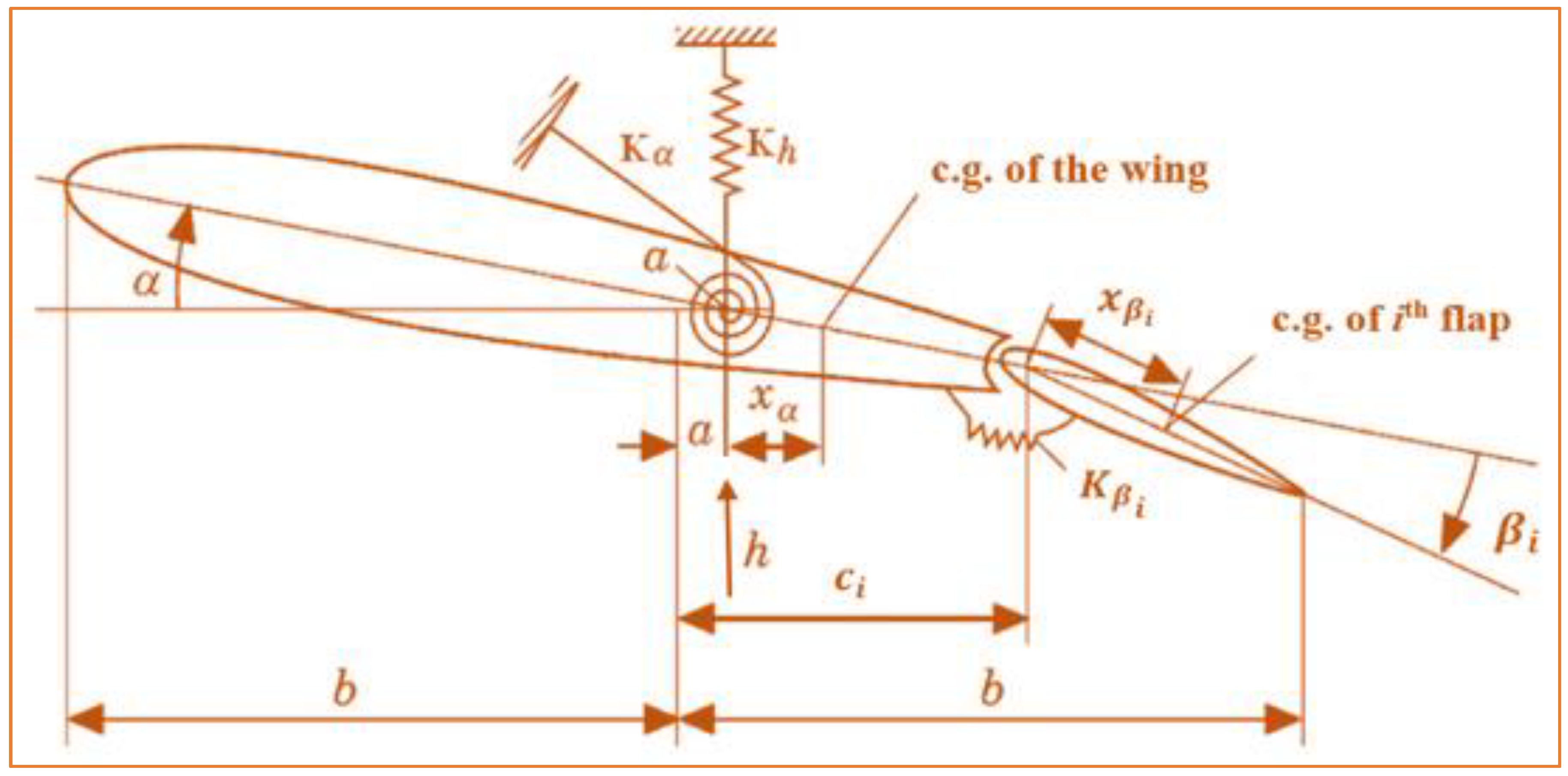
30]. Consider the typical section illustrated in
Figure 1, where the wing is mounted on a flexible support consisting of a translational spring of stiffness
and a torsional spring of stiffness
, both attached at the airfoil’s shear center. The system thus exhibits two degrees of freedom, with
denoting the plunge displacement and
is the pitch angle and
is the control-surface flap deflection.
The governing equations of motion for the structure of the nonlinear aeroelastic system can be written as follows [
31]:
, where
and
maps actuator commands generalized forces/torques.
models the aerodynamic generalized force vector with one aerodynamic lag state vector
. The lag dynamics (Roger form) are
. Combining and isolating accelerations:
If we choose
, we obtain a first-order state equation,
, that is, as follows:
where
,
, and the outputs may be any measured signals
. In the example below, we choose
and
, which are two actuator commands (radians). The terms
represent two control-surface deflections whose effect on generalized forces/torques is given by
, which converts
(plunge) and
(pitch) [
30].
Parameters used (illustrative)
, , , , .
, .
Aerodynamic fit (Roger, 1 lag) and the control-effectiveness (two actuators):
The numeric results below were computed exactly from those parameter values.
A disturbance model is introduced to capture un-modeled dynamics, nonlinear flexibility, and hard nonlinearities. The disturbance vector includes filtered noise for broadband uncertainties, harmonic terms for periodic effects, and impulsive loads for sudden nonlinear events. These signals enter through a disturbance input matrix, providing a realistic framework for robustness and controller evaluation.
where
is the disturbance term, with components:
, such that
,
,
and
with
and each
represents an external disturbance channel. Define disturbance input matrix
mapping three disturbance channels
.
The parameters of the disturbance model are given by , , (), , applied to plunge for (exponential decay). We use oscillator states and a filter state .
To enhance robustness against un-modeled dynamics and nonlinear disturbances, the block-pole state-feedback law is augmented with a neural-network compensator. The nominal gain
is obtained via block-pole placement to ensure desired closed-loop poles, while the neural network generates an adaptive correction
. The combined control law
preserves the nominal stability structure and provides adaptive capability to reject uncertainties and nonlinear effects [
23,
32].
Compute a nominal state feedback
using the block-pole placement algorithm so that the linearized model has the desired characteristic matrix polynomial. Next, augment this nominal law with a small, state-dependent correction
produced by a neural network. Finally, train/adapt
offline (robustification) and/or online with an adaptation law (Lyapunov-/MRAC-style) to guarantee stability/performance and limit how much
can move the poles [
23]. The combined control law is written in the structured additive form
, where
is the neural-network output or, equivalently, when a state-dependent gain correction is required,
, where
. We parameterize the NN as a single hidden layer with parameters
:
is nominal block-pole gain,
is a chosen feature vector (e.g., ),
, ,
is elementwise nonlinear basis (sigmoid/ReLU/Gaussian),
, , .
We used bounded activations (e.g.,
) or an explicit final scaling to enforce
, which limits perturbation of closed-loop poles. This yields linear + NN additive action; it is easier to analyze and to bound influence on closed-loop poles. Algorithm 16 illustrates in detail how to implement this neural network.
| Algorithm 16. Practical implementation recipe (pseudo-algorithm) |
- 1.
Compute nominal with block-pole algorithm (offline). % Nominal stability is guaranteed before - 2.
NN architecture: Use a single hidden layer with neurons. Output dimension = (for direct increment ). % The network is designed to respect stability margins by construction. - 3.
Training: simulate many uncertainty scenarios and train NN to minimize . % The penalty term explicitly enforces stability by penalizing deviations of the closed-loop eigenvalues from the desired region. - 4.
Online control loop at each step:
- ○
measure state and compute (or ), - ○
apply the control , then compute error signal (e.g., or measured errors), - ○
update by adaptive law with projection: , with the compact Jacobian and .
- 5.
Enforce bounds: clip or project into a convex compact set to ensure poles remain inside target region, preserving stability under uncertainties.
|
9.2. Comparative Study
Let us construct the desired block poles with a target latent values and vectors:
To convert into eigenstructure, we use , where are latent vectors, and are eigenvectors of , where .
The corresponding block roots to be assigned are given by
Note 1. The optimal selection of these roots can be achieved by using optimization algorithms such as particle swarm optimization (PSO) method or others, which are a sensitive point as they increase the strength and effectiveness of the proposed method.
The coefficients of the desired closed-loop matrix polynomial that need to be assigned are given by the following expression
, that is, as follows:
Since the block-controllability matrix
is full-rank, our model is transformable to the control space via the similarity operator
with
. The nominal control is given by
so that the closed-loop system is given by the equation
, where
,
, with a state-feedback gain matrix,
, and with the following Vandermond matrix,
. The nominal state-feedback gain matrix is
The DC gain matrix can be obtained by minimizing .
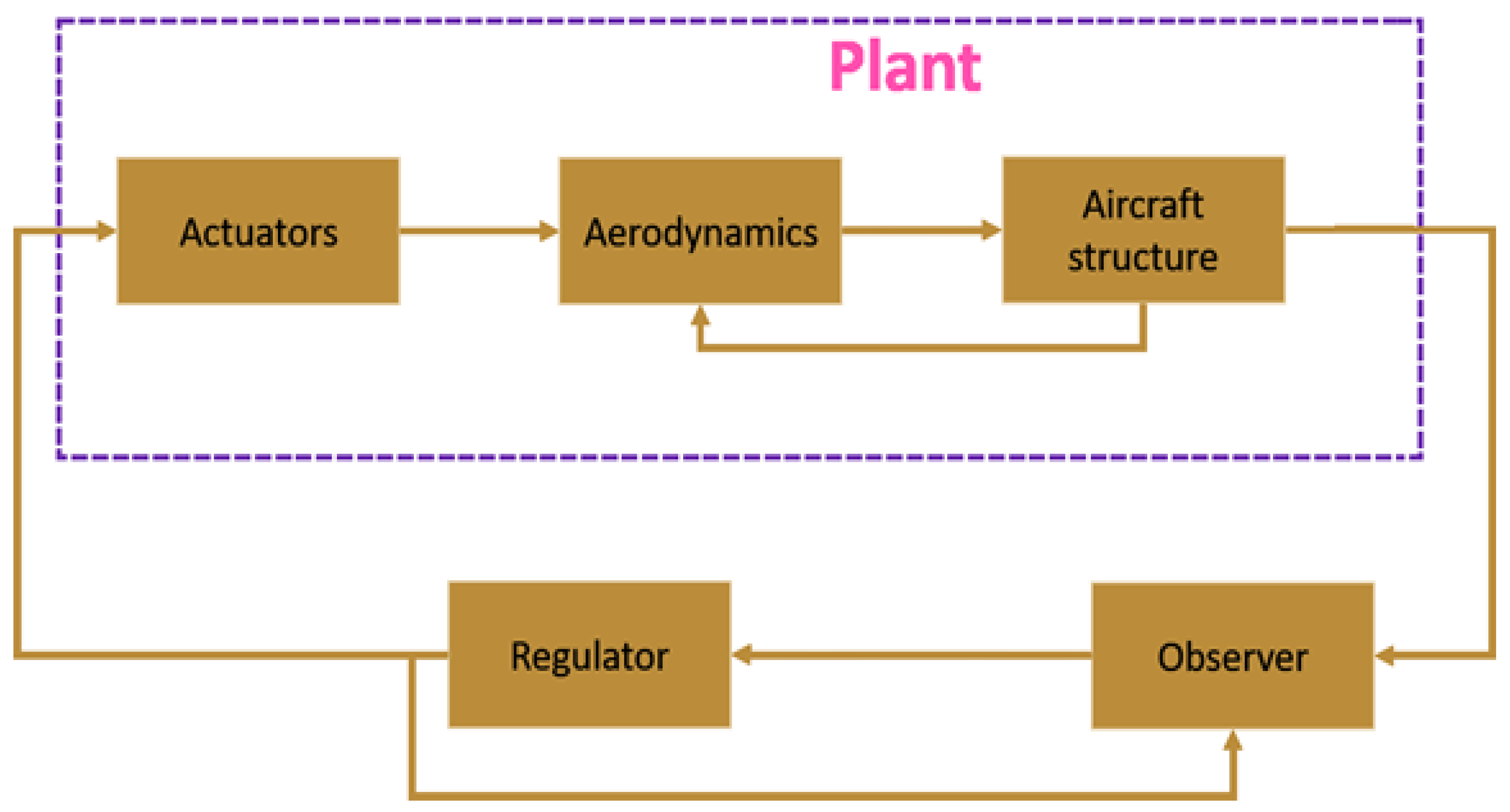
The proposed control law ensures stabilization of the state-space model. It requires only measurable outputs and the system’s nominal model. Its Laplace-domain analysis and practical implementation for the aeroelastic airfoil system are illustrated through the schematic block diagram shown in
Figure 2.
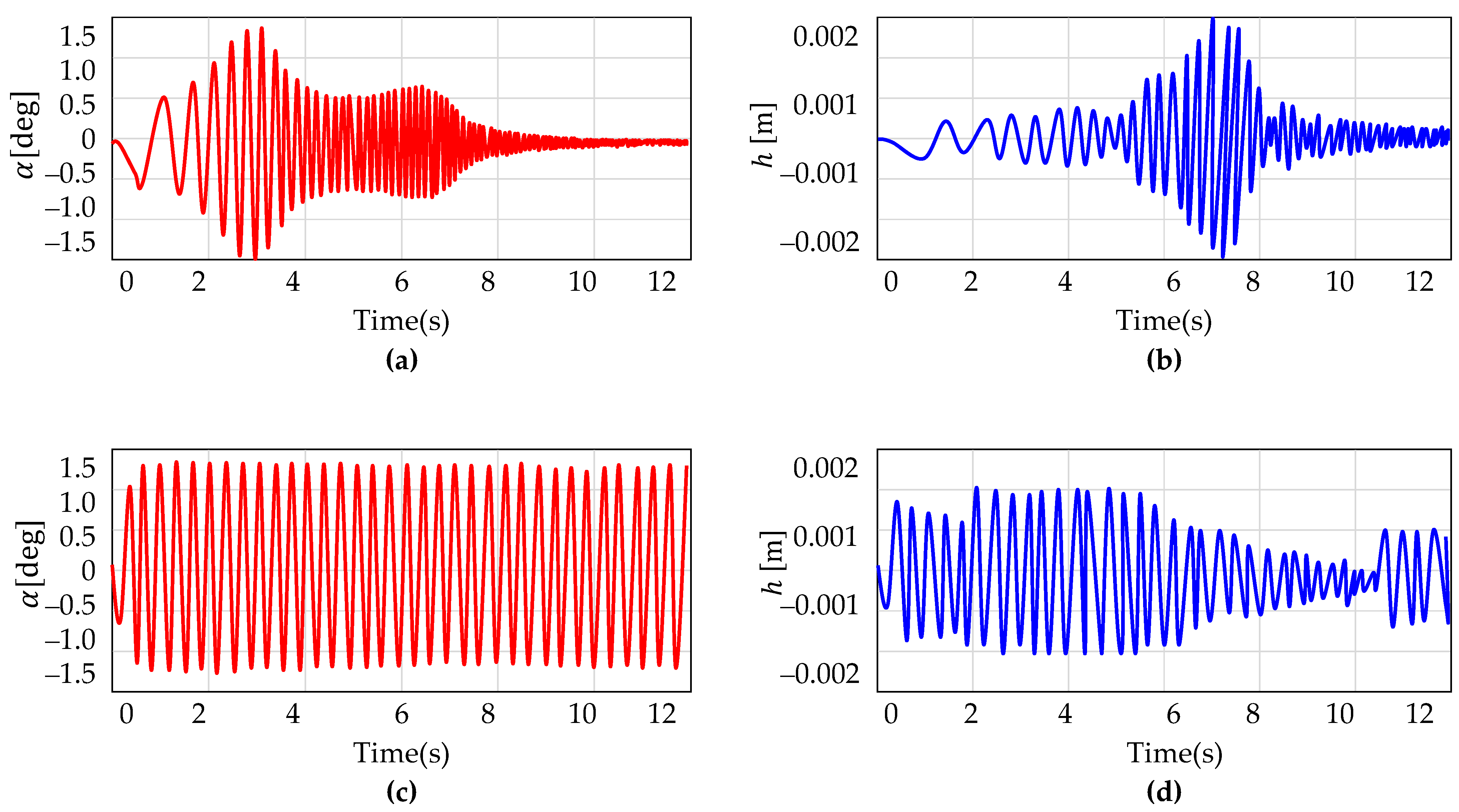
In the open-loop system, we verified two case studies by employing the chirp and sine signals. Responses of the system are calculated by fourth-order Runge–Kutta algorithm with MATLAB R2023a on a Windows 10 (64-bit) platform with an Intel Core i7-1165G7 CPU (2.80 GHz) and 16 GB RAM. The open-loop results are shown in
Figure 3.
Figure 3a,b shows the output response of the aeroelastic system with cubic-spring nonlinearity under a chirp excitation signal, while
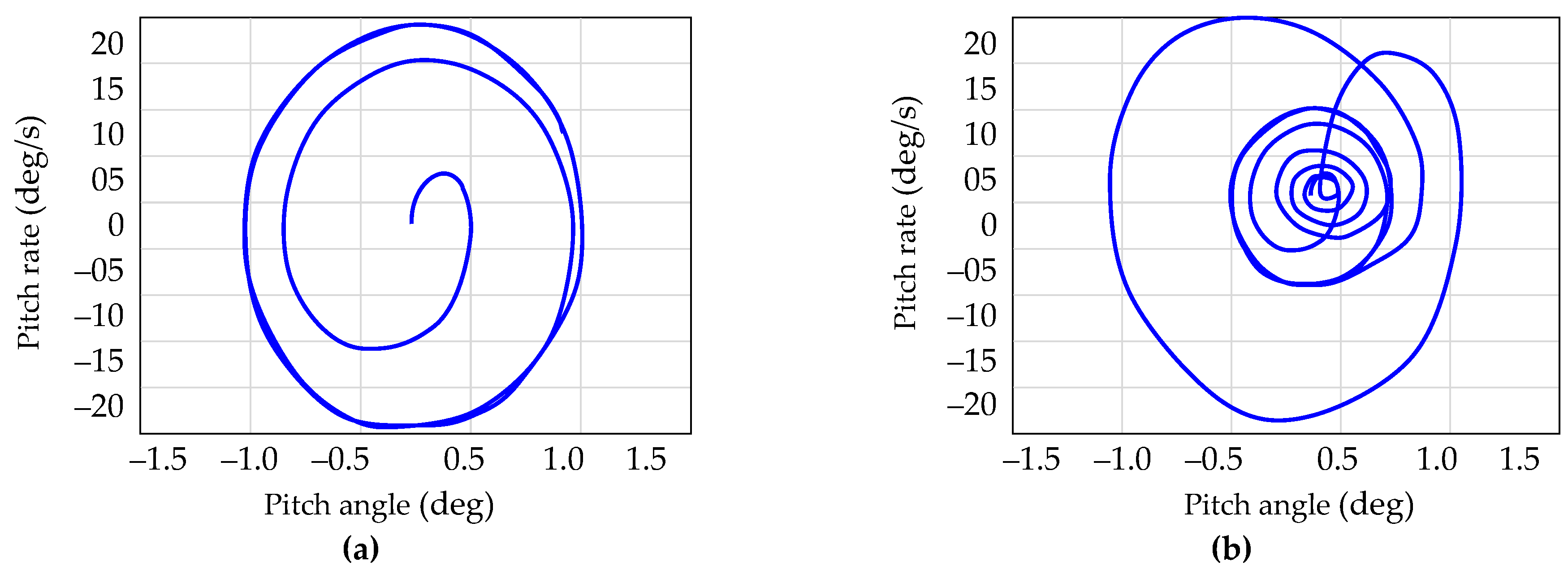
Figure 3c,d depicts the system’s response to a sinusoidal excitation applied to both actuators. In the absence of control, the system exhibits periodic oscillations of equal amplitude, known as limit cycle oscillations (LCOs), in both plunge and pitch. The dominant response occurs in the pitch direction, driven by stiffness nonlinearity. With the proposed controller, these oscillations gradually decay, demonstrating effective suppression of the LCO.
Figure 4 illustrates this behavior: (a) the pitch-direction phase diagram without control shows a sustained LCO, while (b) with the proposed controller, the trajectory converges, confirming oscillation suppression.
Simulations were conducted using the dynamic model of the aeroelastic wing implemented in MATLAB R2023a. Intelligent neural block-pole placement controllers were deployed to mitigate the vibrational motions. Disturbances were introduced into the system through the input/output channel, and the controller performance was evaluated accordingly. For the given wing, under a prescribed flight condition (2° angle of attack and 0° pitch angle), the required closed-loop performance specifications were defined as follows: settling time less than 1.10 s, peak overshoot below 6.2%, and steady-state error equal to zero. A disturbance of 5° was applied at 2 s. The control constraints were set to remain below 15° for actuator-1 deflection and 10° for actuator-2 deflection. The closed-loop control system was expected to exhibit strong disturbance-rejection capability.
Figure 5 illustrates the response of the aeroelastic system under these conditions.
To highlight the advantages of the proposed adaptive block-pole placement strategy, we compare it with well-known classical techniques such as eigenstructure assignment, LQR, and -control. The comparison is carried out in terms of robustness, decoupling capability, sensitivity to noise/disturbances, transient response, and steady-state performance.
- ▪
Performance Metrics: The following indices are used.
,
: smallest/largest singular values of the closed-loop transfer function (robustness and conditioning).
where is the
Gram matrix:
.
: condition number of the closed-loop system (robust stability).
Here is a MATLAB code (
Table 3) for the computation of measures
and
.
: the
norm of the transfer function measures the average energy amplification from input disturbances to outputs in the closed-loop system
The matrices
and
are the solution of Lyapunov equations
and
, or more explicitly, they are given by the formulas
and
.
Table 4 gives a code for the computation of such measures.
: peak sensitivity norm (disturbance rejection).
where
.
Table 5 gives a code for the computation of such measures.
: structured singular value (robustness against uncertainty). In robust control analysis, we evaluate the structured singular value frequency-wise: for each ω, then the system is robustly stable against all uncertainties with .
Table 6 provides the comparative study of the above robustness metrics.
The proposed adaptive block-pole placement method balances robustness and efficiency by keeping the maximum singular value low and the condition number minimal , yielding a well-conditioned closed loop. Although its minimum singular value is lower than those of LQR and -control, this trade-off leads to the smallest norm and thus, minimal energy amplification. Moreover, it requires the lowest control gains , reducing actuator effort. The sensitivity peak and structured singular value confirm superior disturbance rejection and robustness against structured uncertainty. The method further maintains stable performance under parameter variations up to 10% and disturbance noise levels of 12%, while achieving near-complete decoupling (<5% cross-interaction). In contrast, eigenstructure assignment exhibits poor conditioning and high effort , while LQR and -control improve robustness relative to eigenstructure, but remain more sensitive to modeling errors and disturbances due to their reliance on fixed quadratic cost functions and stochastic assumptions.
To further illustrate the benefits of the proposed method, we compare transient response and steady-state regulation under reference tracking and disturbance-rejection scenarios. The following performance indices are considered.
Rise Time (): time to reach 90% of the final value.
Settling Time (): time to remain within ±2% of final value.
Overshoot (OS): maximum deviation beyond the steady-state value (%).
Steady-State Error (SSE): final tracking error (% of reference).
Disturbance Rejection (DR): percentage attenuation of a step disturbance.
Table 7 provides a comparative study of the transient and steady-state metrics.
The proposed method achieves the fastest rise and settling times while maintaining overshoot below 7%. The steady-state error is nearly eliminated (<1%), clearly outperforming LQR and -control, which depend on cost-function tuning. Disturbance rejection is also significantly enhanced, with more than 90% attenuation compared to 62–81% for classical methods. Overall, the results confirm that the adaptive block-pole approach not only guarantees robustness but also delivers superior transient performance and regulation accuracy.
In addition to robustness and transient metrics, further insight can be gained through classical and integral performance indices. These include gain and phase margins (stability robustness), closed-loop bandwidth (tracking capability), integral error measures such as IAE and ISE (overall regulation quality), and peak control effort (actuator demand). These indices provide a complementary evaluation of the controllers under practical operating conditions.
Gain Margin (GM) and Phase Margin (PM): classical robustness margins.
Bandwidth (): The range over which the closed-loop tracks reference well.
(with ): robustness to measurement noise.
norm (): energy gain from disturbance to output (performance).
Integral of Absolute Error (IAE): .
Integral of Square Error (ISE): .
Integral of Time-weighted Absolute Error (ITAE): penalizes long errors.
Peak Control Effort (): actuator demand (saturation risk).
Table 8 provides the comparative study of some additional performance indices.
The results demonstrate that the proposed method provides the largest gain and phase margins, ensuring superior robustness to model uncertainty. Its higher bandwidth enables faster response without sacrificing stability. Integral error (IAE) is minimized, confirming excellent tracking and regulation, while the required control effort remains the lowest among all methods, reducing actuator stress. Finally, both the norm ) and the norm () are significantly reduced, indicating improved overall performance and stronger noise attenuation. In contrast, eigenstructure assignment suffers from poor robustness and higher effort, while LQR and -control improve robustness but remain less efficient than the proposed approach.
Final note: Noise can perturb contour integration and spectral factor computation by distorting the resolvent and generating spurious factors. To mitigate these effects, we applied regularized resolvent evaluation, low-order noise filtering, and companion-matrix preconditioning, which stabilize the computation without altering the underlying method. For numerical experiments, the grid and solver configurations are specified as follows: RK4 integration with a step size of 1 × 10⁻⁴, an adaptive tolerance of 1 × 10⁻⁷, and Tikhonov regularization of 1 × 10⁻⁶ applied in matrix inversion to ensure numerical stability.
10. Conclusions
This study has established a rigorous algebraic framework for operator matrix polynomials and demonstrated its relevance to control system engineering, with a particular focus on aeroelasticity in flight dynamics. By unifying spectral factorization, companion forms, and block-pole assignment within a constructive operator-theoretic setting, the work provides both theoretical depth and practical utility.
The proposed adaptive block-pole placement scheme, enhanced with a neural compensator, successfully addresses the dual challenges of robustness and numerical conditioning, while maintaining modest control effort. The aeroelastic wing application confirmed that the method not only stabilizes nonlinear dynamics but also ensures rapid transients, precise regulation, and effective disturbance rejection when compared against established benchmarks such as eigenstructure assignment, LQR, and -control.
Beyond its immediate results, this work underscores the potential of algebraic operator methods as a unifying bridge between abstract mathematical structures and applied control synthesis. Future research should focus on experimental validation through hardware-in-the-loop and wind-tunnel testing, extension to higher-order and distributed aeroelastic models, and automated optimization-based block-root selection (e.g., PSO or similar solvers) to further improve robustness and performance. Additionally, integrating real-time adaptation schemes to tune the neural compensator under time-varying operating points and actuator nonlinearities will consolidate the framework’s practical value for robust aeroservoelastic control.




 ,
,