Article

Efficient Biomedical Image Recognition Using Radial Basis Function Neural Networks and Quaternion Legendre Moments


1
LSEM Laboratory, EST, Sidi Mohamed Ben Abdellah University, Fez 30000, Morocco
2
LISAC Laboratory, Dhar El Mahrez Faculty of Science, Sidi Mohamed Ben Abdellah University, Fez 30000, Morocco
3
Laboratory of Sustainable Agriculture Management (LSAM), Higher School of Technology of Sidi Bennour, Chouaib Doukkali University, El Jadida 24000, Morocco
4
Laboratory of Mathematics and Data Science, FPT of Taza, Sidi Mohamed Ben Abdellah University, Fez 30000, Morocco
*
Author to whom correspondence should be addressed.
Math. Comput. Appl. 2025, 30(6), 121; https://doi.org/10.3390/mca30060121
Submission received: 31 August 2025 / Revised: 30 October 2025 / Accepted: 3 November 2025 / Published: 6 November 2025

Abstract

Biomedical images, whether acquired by techniques such as magnetic resonance imaging (MRI), computed tomography (CT), ultrasound, X-ray, or other methods, are commonly obtained and permanently stored for diagnostic purposes. Therefore, leveraging this large number of images has become essential for the development of intelligent medical diagnostic systems. In this work, we propose a new biomedical image recognition in two stages: the first stage is to introduce a new image feature extraction technique using quaternion Legendre orthogonal moments (QLOMs) to extract features from biomedical images. The second stage is to use radial basis function (RBF) neural networks for image classification to know the type of disease. To evaluate our computer-aided medical diagnosis system, we present a series of experiments were conducted. Based on the results of a comparative study with recent approaches, we conclude that our method is very promising for the detection and recognition of dangerous diseases.

1. Introduction

A biomedical image-based computer-aided medical diagnosis system is an expert tool designed to assist physicians and healthcare professionals in diagnosing potentially serious diseases using images obtained from various biomedical imaging techniques such as MRI, CT, and ultrasound, among others. These systems use image analysis, machine learning, and artificial intelligence to interpret medical images, extracting relevant and essential information for the diagnostic process. Their essential role lies in disease detection, monitoring disease progression, predicting clinical outcomes, and formulating recommendations for patient management. In practice, efficient biomedical image recognition can be used for a variety of tasks, ranging from early disease detection to pathological classification, lesion severity assessment, and surgical planning. These systems aim to improve the efficiency and accuracy of medical diagnosis by providing healthcare professionals with additional tools to quickly and reliably interpret imaging data. The effectiveness of any computer-aided medical diagnosis system based on biomedical images largely depends on its ability to extract features from these images and the classification algorithm used. The extracted features play a vital role in enabling the classification algorithm to predict the type of disease from the input biomedical image. Various techniques have been employed to extract features from images. In this work, we use the theory of orthogonal invariant moments. Indeed, these moments have become the most used in various fields of biomedical image processing. In this regard, we note, for example, that orthogonal moments have been used for biomedical image retrieval [1], zero-watermarking for medical images [2], construction of a robust feature descriptor for biomedical image retrieval, digital encryption of medical images [3,4], biomedical image reconstruction [5], texture analysis of liver CT images [6], brain magnetic resonance image segmentation [7], compression of medical images [8], representation and retrieval of color biomedical images [9], reconstruction of tomographic images [10], MRI whole brain segmentation [11], content-based retrieval of biomedical images [12], tumor detection [13], CT-scan image classification for automated screening of COVID-19 [14], breast cancer detection [15], and computer-aided diagnosis of malignant mammograms [16].
RBF neural networks offer an attractive alternative to standard architectures by unifying function approximation, regularization, noisy interpolation, classification, and density estimation. They typically train faster than multilayer perceptrons, since learning is divided into an unsupervised step (setting Gaussian centers and widths) and a supervised linear step (solving for output weights). RBFNNs were originally proposed by Powell [17] to address interpolation in multidimensional spaces, with the initial formulation requiring one center per data point. Broomhead and Lowe [18] later relaxed this constraint by demonstrating that effective networks can be built with far fewer centers than samples, which opened the door to many practical applications when datasets are large. A key advantage of RBFNNs is that they combine the ability to represent complex nonlinear mappings with a fast, linear learning algorithm. Nevertheless, enhancing the generalization performance of RBFNNs remains an important research objective [19,20,21].
In this work, we propose a new computer-aided medical diagnosis system, denoted QLOM-RBF, through two steps: in the first step, we use quaternion Legendre orthogonal moments to extract image features, and, in the second step, we use a radial basis function (RBF) neural network for disease classification and recognition. To evaluate the proposed QLOM-RBF based on quaternion Legendre orthogonal moments and the RBF model, we conduct experimental tests on biomedical image sets using three biomedical image databases. The results obtained from all the experiments conducted in this work demonstrate that our approach opens new promising horizons in the field of computer-aided medical diagnosis and the recognition of cancerous diseases or other serious pathologies.
The report of this work is presented as follows. In Section 2, we present the different steps of extracting features from biomedical images using quaternion Legendre orthogonal moments (QLOMs). In Section 3, we present and detail the different steps of our QLOM-RBF computer-aided diagnosis system based on QLOMs and the RBF neural network. A series of experimental tests is presented in Section 4 to evaluate the proposed approaches.

2. Quaternion Legendre Orthogonal Moments

2.1. Quaternion Algebra

The set of quaternions H is a generalization of the set of complex numbers C [22] defined as
H = q = a + b i + c j + d k ; a , b , c , d R ,
where a, b, c are real numbers, and i, j, k are imaginary such that
i 2 = j 2 = k 2 = i j k = 1 , i j = j i = k , j k = k j = i , k i = i k = j .
The module |q| and the conjugate q* of q = a + b i + c j + d k are defined as follows:
q = a 2 + b 2 + c 2 ,
q * = a b i c j d k .
The color image f(r,θ) is expressed by the pure quaternion as follows:
f r , θ = f R r , θ i + f G r , θ j + f B r , θ
where f R ( r , θ ) , f G ( r , θ ) and f B ( r , θ ) are, respectively, red, green, and blue components.

2.2. Legendre Orthogonal Moments

The Legendre polynomials are the polynomials defined on [−1, 1] by [23]:
L n ( x ) = 1 2 n n ! x 2 1 n ( n )
The polynomial L n ( X ) , being the n-th derivative of a polynomial of degree 2n, is therefore of degree n. The first terms are as follows [24]:
L 0 ( x ) = 1 L 1 ( x ) = x L 2 ( x ) = 1 2 3 x 2 1 L 3 ( x ) = 1 2 5 x 3 3 x L 4 ( x ) = 1 8 35 x 4 30 x 2 + 3 L 5 ( x ) = 1 8 63 x 5 70 x 3 + 15 x
Legendre polynomials are orthogonal, and
1 1 L n ( x ) L m ( x ) d x = 2 2 n + 1 δ n m
Like any family of orthogonal polynomials, the Legendre polynomials verify the following recurrence relation of order 2:
( n + 1 ) L n + 1 ( 2 n + 1 ) x L n + n L n 1 = 0
The shifted Legendre polynomials are defined on [0, 1] by
L ^ n x = L n ( 2 x 1 )
which are orthogonal on the interval [0, 1] and
0 1   L ^ n ( x ) L ^ m ( x ) d x = 1 2 n + 1 δ n m
We can define the shifted Legendre polynomials by the following explicit expression:
L ~ n ( x ) = ( 1 ) n k = 0 n   n k n + k k ( x ) k
The first four shifted Legendre polynomials are defined as follows:
L ~ 0 x = 1 ; L ~ 1 x = 2 x 1 ; L ~ 2 x = 6 x 2 6 x + 1 ; L ~ 3 x = 20 x 3 30 x 2 + 12 x 1
We then define the normalized shifted Legendre polynomials as follows:
S n r = 2 n + 1 r L ~ n r
From (11) and (14), we deduce that the polynomials S n r are orthonormal on [0, 1] and
0 1   S n r S m r r d r = δ n m

2.3. Descriptor Vector Based on QLOMs

The quaternion Legendre orthogonal moment (QLOM) of order ( n , m ) of the color image f ( r , θ ) is presented as follows [25]:
Q O L M n m f = 1 2 π 0 2 π 0 1 f r , θ S n r e μ m θ r d r d θ µ = 1 2 π 0 2 π 0 1 f R r ,   θ i + f G r ,   θ j + f B r ,   θ k S n r e μ m θ r d r d θ
where n 0 , m Z , μ = i + j + k / 3 and S n r is the normalized shifted Legendre polynomials defined in (17).
Q O L M n m f = 1 2 π 0 2 π 0 1 f R r ,   θ i + f G r ,   θ j + f B r ,   θ k S n r e μ m θ r d r d θ = A n m + i B n m + j C n m + k D n m
For development of A n m , B n m , C n m and D n m defined in (18):
A n m = 1 3 [ Im ( Q O L M n m ( f R ) ) + Im ( Q O L M n m ( f G ) ) + Im ( Q O L M n m ( f B ) ) ] B n m = Re ( Q O L M n m ( f R ) ) + 1 3 [ Im ( Q O L M n m ( f G ) ) Im ( Q O L M n m ( f B ) ) ] C n m = Re ( Q O L M n m ( f G ) ) + 1 3 [ Im ( Q O L M n m ( f B ) ) Im ( Q O L M n m ( f G ) ) ] D n m = Re ( Q O L M n m ( f B ) ) + 1 3 [ Im ( Q O L M n m ( f R ) ) Im ( Q O L M n m ( f G ) ) ]
where Re ( s ) denotes the real part of a complex number s ; Im ( s ) denotes any imaginary part of the complex number s ; f R , f G and f B are the R, G, and B components of the color image; and Q O L M n m ( f R ) , Q O L M n m ( f G ) and Q O L M n m ( f B ) are the RJMs of the R, G, and B components of the color image, respectively.
The process of image color reconstruction with QOLMs is as follows [25]:
f ( r , θ ) = n = 0 n m a x   m = 0 m m a x   S n r e μ m θ Q O L M n m = n = 0 n m a x   m = 0 m m a x   A n m + i B n m + j C n m + k D n m S n r e μ m θ = f A * ( r , θ ) + i f B * ( r , θ ) + j f C * ( r , θ ) + k f D * ( r , θ )
For development of f A * ( r , θ ) , f B * ( r , θ ) , f C * ( r , θ ) and f D * ( r , θ ) is as follows:
f A * ( r , θ ) = Re ( A n m * ) 1 3 [ Im ( B n m * ) + Im ( C n m * ) + Im ( D n m * ) ] f B * ( r , θ ) = Re ( A n m * ) + 1 3 [ Im ( B n m * ) + Im ( C n m * ) Im ( D n m * ) ] f C * ( r , θ ) = Re ( A n m * ) + 1 3 [ Im ( B n m * ) Im ( C n m * ) + Im ( D n m * ) ] f D * ( r , θ ) = Re ( A n m * ) + 1 3 [ Im ( B n m * ) + Im ( C n m * ) Im ( D n m * ) ]
where f A * ( r , θ ) is a matrix approaching, f B * ( r , θ ) , f C * ( r , θ ) and f D * ( r , θ ) , respectively, correspond to the R, G, and B components of the color image to be reconstructed, and A n m * , B n m * , C n m * and D n m * are the gray-scale reconstruction matrices of A n m , B n m , C n m and D n m .
A n m * = n = 0 n m a x   m = 0 m m a x   A n m S n r e μ m θ B n m * = n = 0 n m a x   m = 0 m m a x   B n m S n r e μ m θ C n m * = n = 0 n m a x   m = 0 m m a x   C n m S n r e μ m θ D n m * = n = 0 m m a x   m = 0 m m a x   D n m S n r e μ m θ
Assuming that image f ( r , θ + ϕ ) is the image obtained by rotating image f ( r , θ )   ϕ degrees, then its QRLM is as follows:
Q L M n m R o t = 1 2 π 0 2 π   0 1   f ( r , θ + ϕ ) S n r e μ m θ r d r d θ = 1 2 π 0 2 π   0 1   f ( r , θ ) S n r e μ m θ r d r d θ e j m ϕ = Q R L M n m R o t e j m ϕ
where Q L M n m R o t and Q R L M n m are the QRLM of image f ( r , θ + ϕ ) and image f ( r , θ ) , respectively. The modulus operation is performed on both sides of the formula above:
Q L M n m R o t = Q L M n m R o t e j m ϕ = Q R L M n m R o t
It can be known from the formula above that, after a rotation attack is applied to the original image, the modulus for the QRLM of the attacked image is equal to that for the original image, and, thus, it can be further proved that the QRLM is invariant to rotation.
From these orthogonal moments QRLMs presented in Equation (16), we can construct a feature vector of a color image f r , θ as follows:
V f = φ 0 , q ( f ) . φ 0 , 1 ( f ) φ 00 ( f ) φ 01 ( f ) . φ 0 q ( f ) φ 1 , q ( f ) . φ 1 , 1 ( f ) φ 10 ( f ) φ 11 ( f ) . φ 1 q ( f )                                     φ p , q ( f ) . φ p , 1 ( f ) φ P 0 ( f ) φ P 1 ( f ) . φ p q ( f )
where φ n m f = Q L M n m f .
We have shown that it is invariant to the three geometric transformations, translation, rotation and scaling. Then the descriptor vector V f is invariant to the three geometric transformations.

2.4. Comparison with the Work of Hosny et al.

Our contribution fundamentally differs from the approach proposed by Hosny et al. [25]. While their work primarily focuses on developing a fast and numerically stable algorithm for computing QLFMs and applies these features to the task of invariant color image watermarking, the objective of our study is distinct. In contrast, we propose a novel framework that integrates QLFMs with an RBF network for biomedical image recognition. This integration enables efficient feature representation and robust classification performance, thereby extending the applicability of QLFMs from watermarking to the domain of computer-aided medical diagnosis.
A detailed comparison between our proposed method and that of Hosny et al. is presented below. Our contribution differs fundamentally from their work in several key aspects, as summarized and discussed in the following sections.
  • Objective and Application:
    -
    Hosny et al.: Focus on fast computation of QLFMs with ensured numerical stability and applied these features to invariant color image watermarking. The primary goal is robust watermarking rather than biomedical diagnosis.
    -
    Proposed QLOM-RBF: Focus on combining QLOMs with RBF neural networks to construct a computer-aided biomedical image recognition system. The main goal is disease classification and recognition.
  • Feature Representation:
    -
    Hosny et al.: Use QLFMs as features representing color images directly; these features are mainly intended for robust embedding and extraction in watermarking tasks.
    -
    Proposed method: Use QLOMs to generate a compact descriptor vector that captures the essential features of biomedical images. This reduces dimensionality and improves recognition accuracy and invariance to geometric transformations.
  • Processing Pipeline:
    -
    Hosny et al.: Feature extraction → watermark embedding → robustness testing.
    -
    QLOM-RBF: Image acquisition → preprocessing → QLOM feature extraction → RBF neural network classification → disease prediction.
  • Algorithmic Complexity:
    -
    Hosny et al.: (a) Complexity is dominated by the moment computation (QLFM), which is optimized for numerical stability and (b) they target computational efficiency in high-order moment calculations.
    -
    QLOMs-RBF: (a) Complexity involves two main parts: (a.1) Feature extraction via QLOMs: Slightly higher due to quaternion-based orthogonal moments and calculation of descriptor vectors of order (p,q) and (a.2) RBF classification: Depends on the number of neurons N, training samples M, and hidden layer centers. (b) Overall complexity is roughly O(p × q × N × M + N3) for training (unsupervised determination of RBF centers plus linear output weight solving), whereas Hosny et al.’s complexity is mostly O(p × q) for feature computation only.
  • Evaluation Metrics:
    -
    Hosny et al.: Evaluate robustness using watermarking metrics like imperceptibility, capacity, and robustness to attacks.
    -
    QLOM-RBF: Evaluate recognition performance using image reconstruction error (MSE), invariance to rotation/translation/scaling, and classification accuracy on BreaKHis and ISIC-2018 biomedical image datasets.
  • Innovation:
    -
    Hosny et al.: Innovation lies in fast and stable computation of QLFMs for color watermarking.
    -
    QLOM-RBF: Innovation lies in integrating QLOMs as a feature descriptor with a deep learning RBF model, creating a novel computer-aided medical diagnosis system. This combination allows robust, invariant, and accurate biomedical image classification.

3. Proposed Methodology Based on QLOMs and RBF Neural Networks

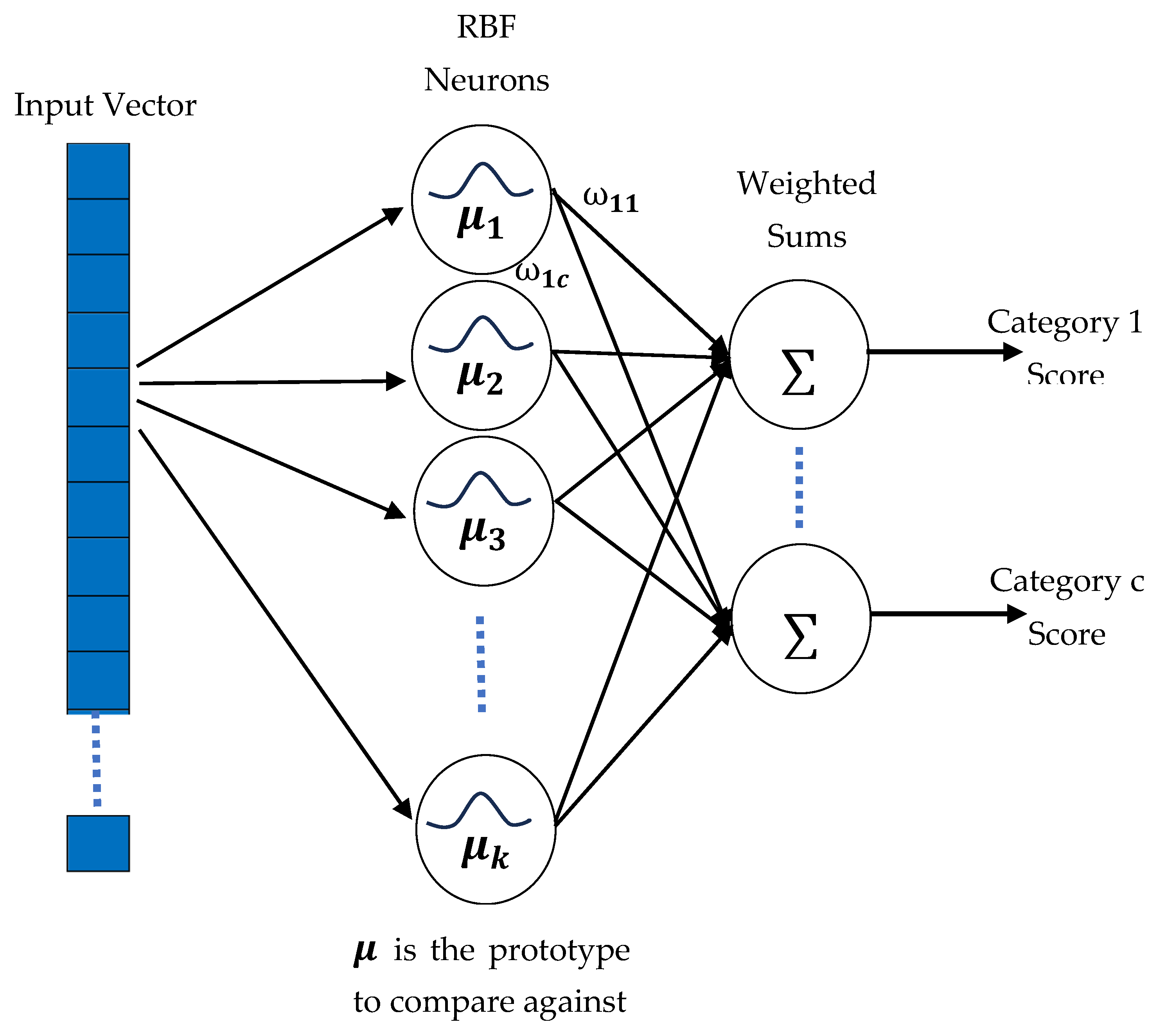
Radial Basis Function Network Algorithm (RBF) is a type of neural network. It is a single layer of hidden unit of feed-forward network. It is used as activation function. The activation function is exactly a Gaussian function. It accomplishes classification process based on the input’s match to samples from the training step. For classifying the inputs, the neurons calculate the Euclidean distance among inputs and prototypes [26] as shown in Figure 1.
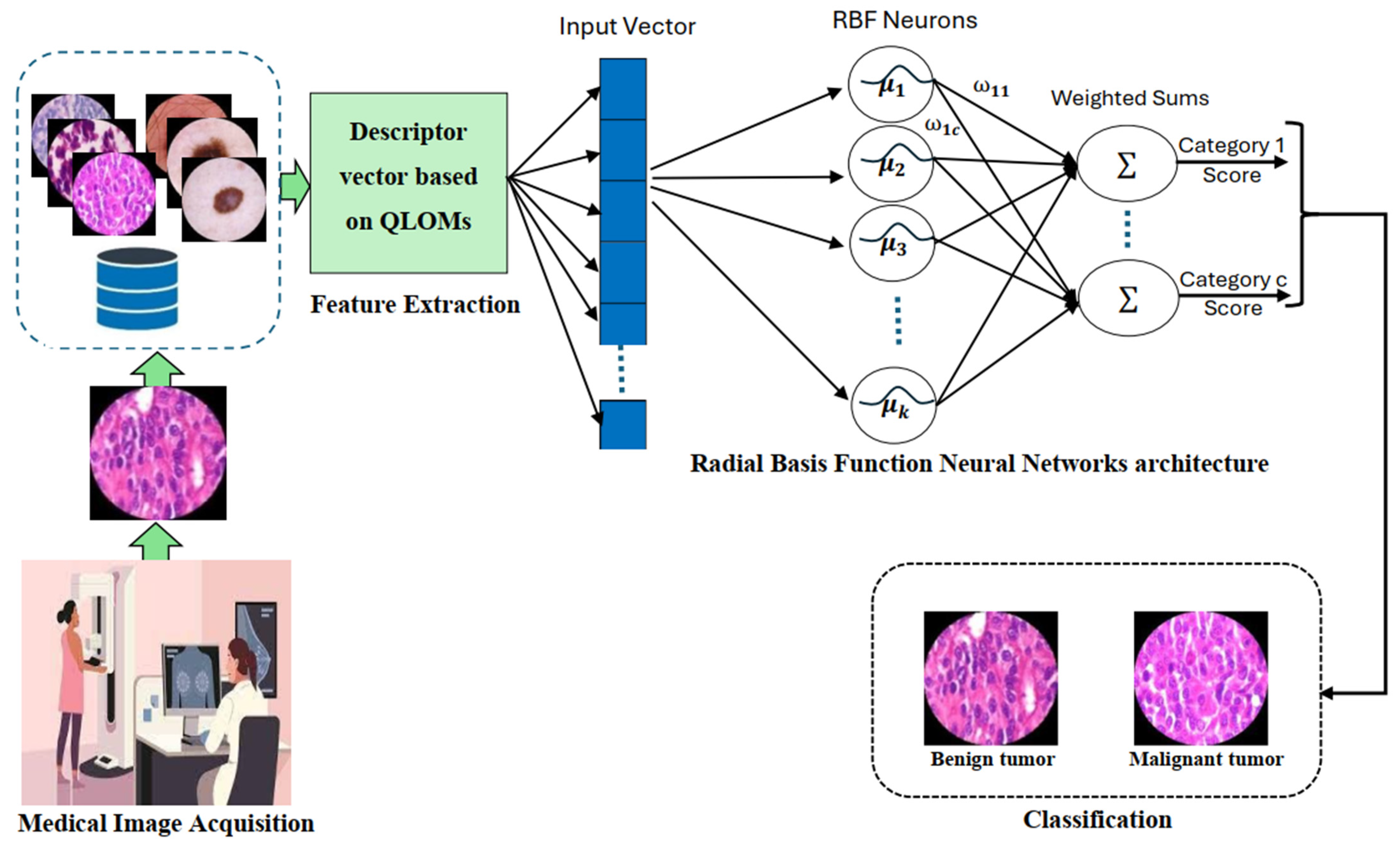
As shown in Figure 2, our biomedical image recognition system involves four steps:
  • Image Acquisition: The first step is to acquire biomedical images f like X-rays, CT scans, MRI images, ultrasound images, etc. These images are obtained using specialized medical imaging equipment.
  • Image Preprocessing: Preprocessing techniques are applied to the acquired images to enhance their quality and remove noise. This may involve filtering, contrast enhancement, resizing, and other techniques to improve the clarity of the images.
  • Feature Extraction: In this step, we use our QLOMs to construct the descriptor vector of order ( p , q ) of the image f presented in (17).
  • Classification/Decision Making: Once the features are extracted, the RBF classification algorithm is applied to classify images into different categories or to make diagnostic predictions.
Figure 2. Block diagram of our biomedical image recognition system.
Mca 30 00121 g002

4. Experiment Setting

4.1. Image Reconstruction

The reconstruction of the original image from its moments is essential to measure the capability of the suggested method to represent the color image. In this study, we specified the reconstruction capability of the proposed method QLOM and the compared methods [27] through the normalized image reconstruction error (MSE) and human eye examination as quantitative and qualitative measures, respectively. The MSE is defined as
M S E = 1 N M x = 0 N 1 y = 0 M 1 f ( x , y ) f ^ ( x , y ) 2
where f ( x , y ) and f ^ ( x , y ) are the original and the reconstructed images, respectively. For the proposed method QLOM, to be more accurate, the values of MSE must continuously decrease and tend to zero as the moments increase.
In the reconstruction test, we used the medical color image of size 256 × 256 from the benchmark dataset biomedical image [28]. We reconstructed the medical color image by the proposed QLOM approach and compared the approaches at different moments in order from 10 to 200. We computed the MSE values for the image at every moment order. Table 1 specifies the reconstructed images and the corresponding MSE values.

4.2. Invariance Using QLOMs

We emphasize the importance of invariance to affine transformations such as rotation and noise in the fields of object classification and shape identification, because, in reality, the vast majority of color image collections contain modified objects that are appropriately recognized for each geometric condition.
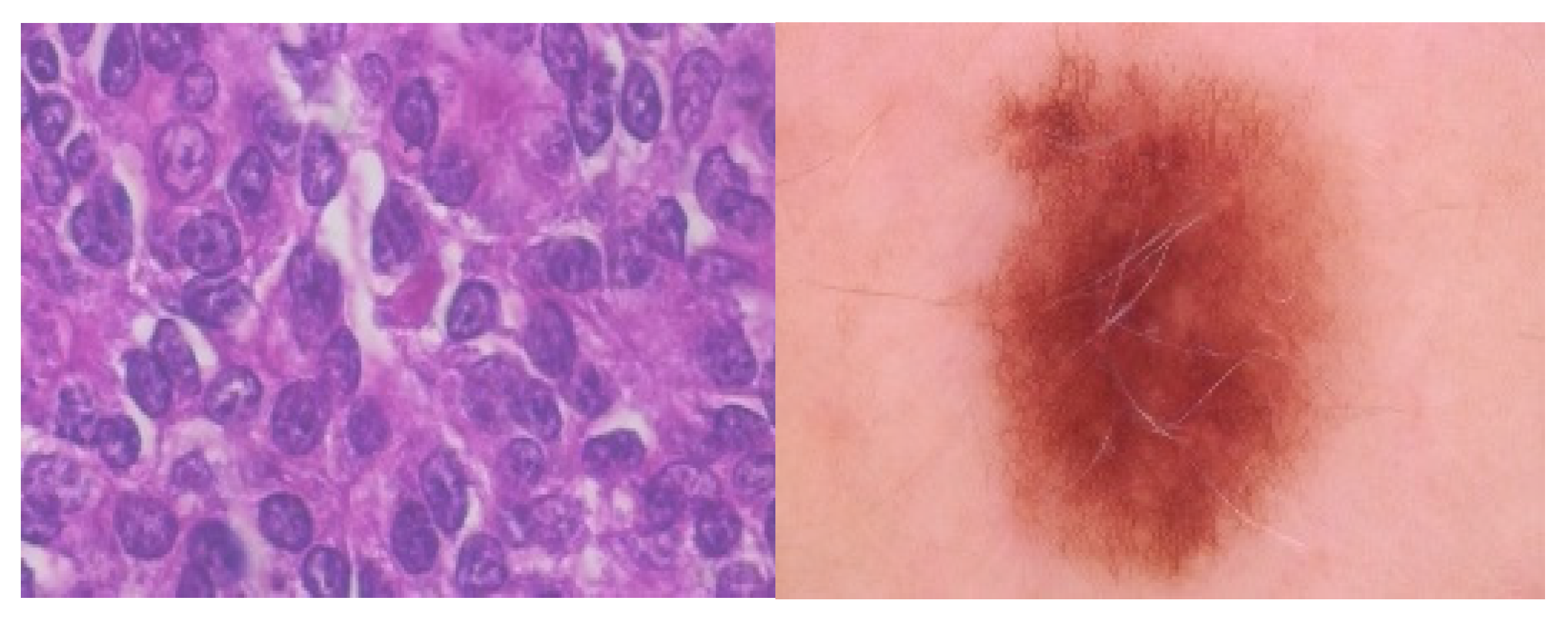
Invariance to the three affine transformations is used in pattern recognition and object classification; rotation and noise are required because many image databases encapsulate modified objects that need to be truly recognized regardless of their geometric condition. In other words, if the image is modified, the invariants produced from QLOMs must remain unchanged [30]. We will use the color images in Figure 3 of size 128 × 128 .
We employed the mean square error RE   ( f , f d ) between the original image’s orthogonal invariant moments and those of the changed image, which is defined as follows:
RE   f , f d =   QLOMs ( f ) QLOMs ( f d ) QLOMs ( f )
where ‖ ‖, f and f d , respectively, denote the Euclidean norm, the original images, and the distorted images. It must be noted that a very small relative error causes a great invariance.
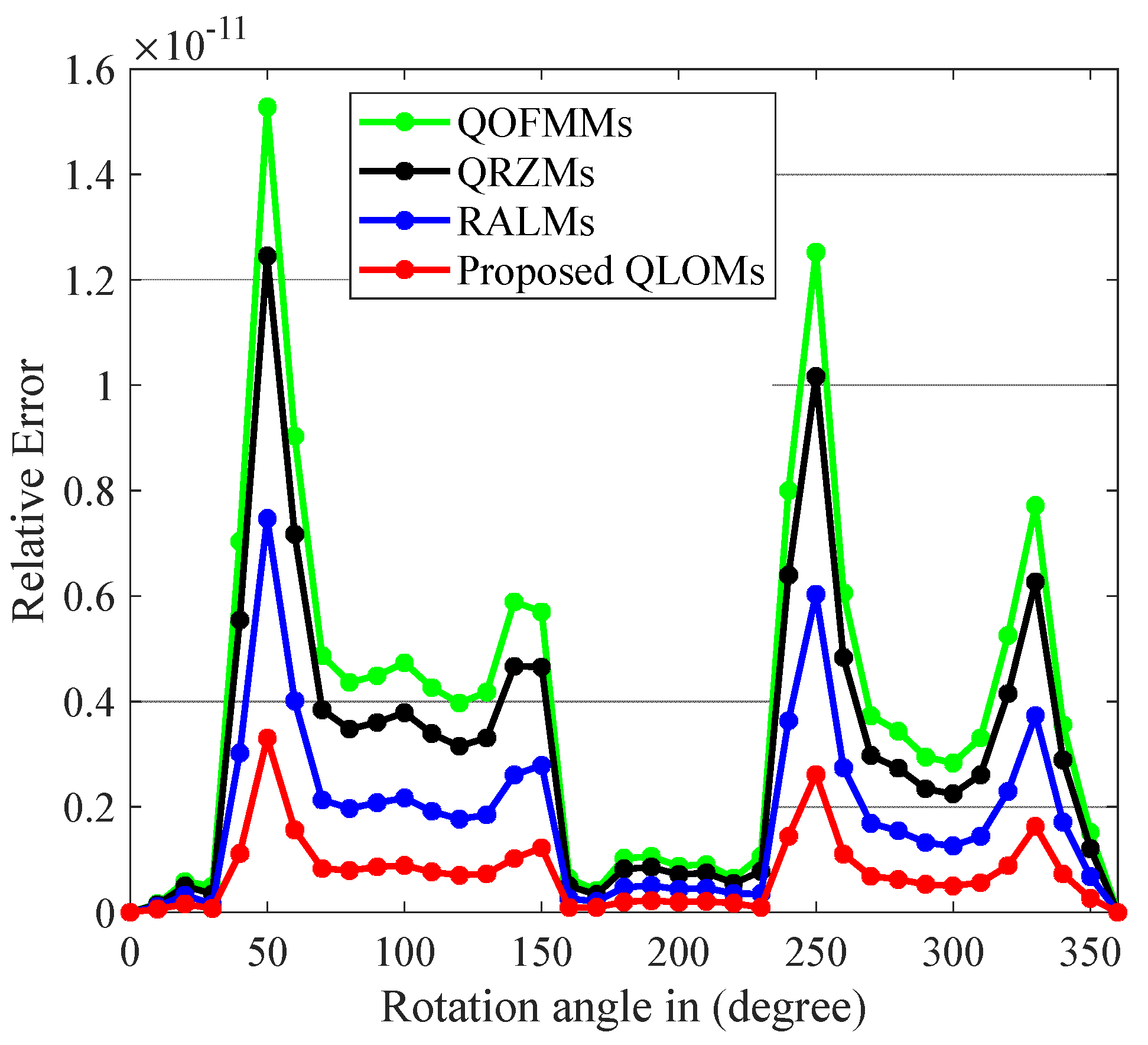
The suggested QLOMs were calculated for each image, original and rotated, using a maximum moment order of 360. The QLOM values were discarded due to poor performance. Figure 4 shows that the RE   ( f , f d ) values of the existing methods, QOFMMs [29], QRZMs [27], and RALMs [26], are greater than the RE   ( f , f d ) values of the suggested QLOMs. In comparison, our moment in use, on the other hand, has very low RE   ( f , f d ) values and the greatest performance according to rotation invariance.
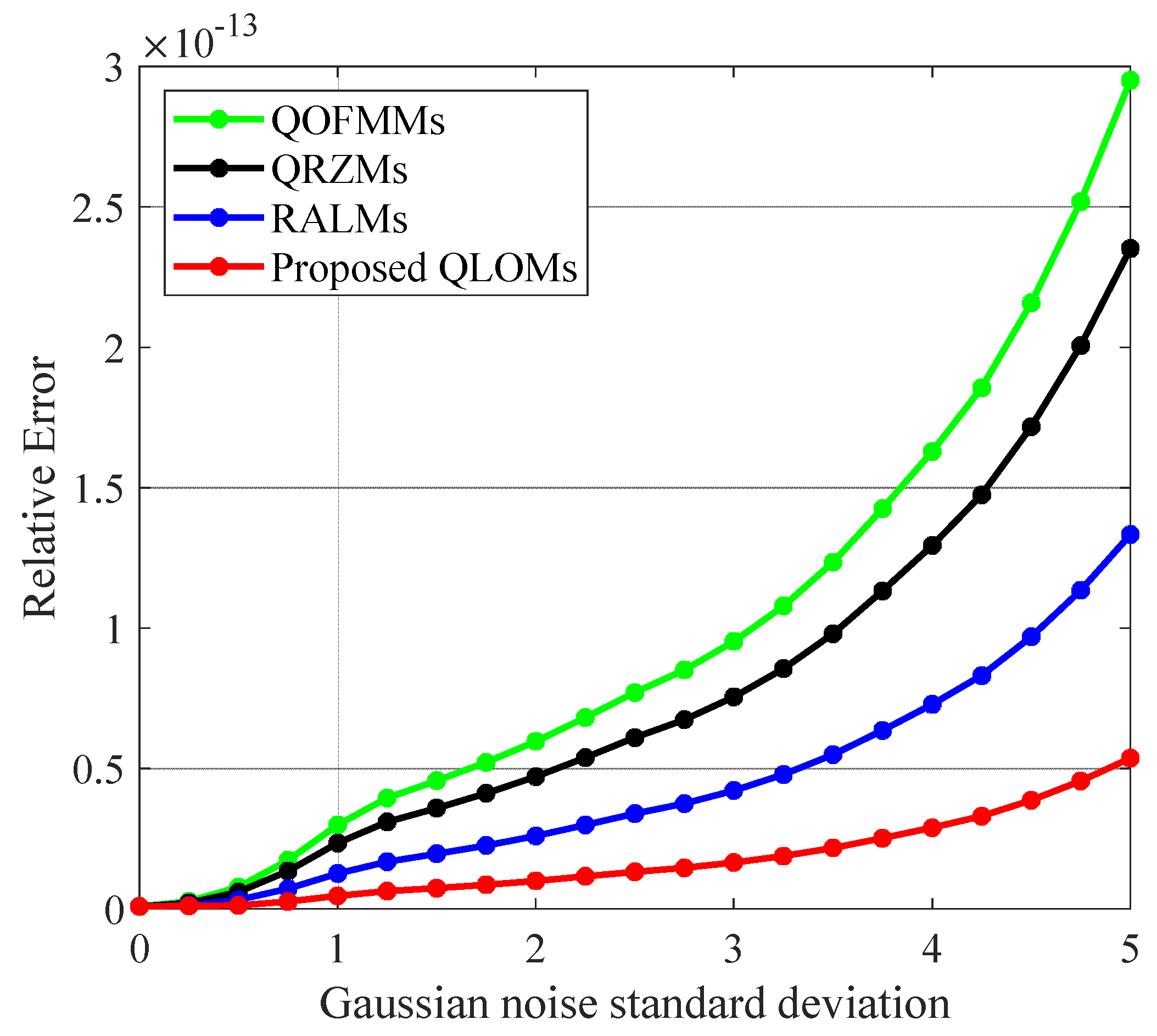
To examine the effect of Gaussian noise on QLOMs, we used the biomedical image shown in Figure 3, corrupted by various noise densities. For white Gaussian noise, the RE   ( f , f d ) values are computed for different noise levels and are graphically presented in Figure 5. The RE   ( f , f d ) curves indicate that the existing methods QOFMMs [29], QRZMs [27], and RALMs [26] are highly sensitive to white Gaussian noise, whereas the proposed QLOMs demonstrate strong robustness against it. Furthermore, the proposed QLOMs significantly outperform the existing methods reported in [26,27,29].

4.3. Biomedical Image Classification

In this subsection, we present a report on the experiments performed to evaluate the performance of our medical diagnostic system QLOM-RBF. We performed this evaluation using two databases: BreaKHis and the ISIC 2018 database. To show the effectiveness and superiority of our WQROM-RBF system, we compared it with recent methods [21] based on existing orthogonal moments, QROJMs [1], FrLFMs [31], QGCFMs [7], and QFrWGLFMs [32], using the comparison criterion defined in Equation (27).
ϵ = N u m b e r   o f   c o r r e c t l y   c l a s s i f i e d   i m a g e s N u m b e r   o f   i m a g e s   u s e d   i n   t h e   t e s t × 100 %
This evaluation criterion is called “image recognition accuracy”, which allows us to evaluate the different aspects of the performance of computer-aided medical diagnostic system, such as precision, sensitivity, specificity, robustness to noise, and invariance to translation, rotation, and scaling. In this context, we perform two experiments.

4.3.1. Dataset

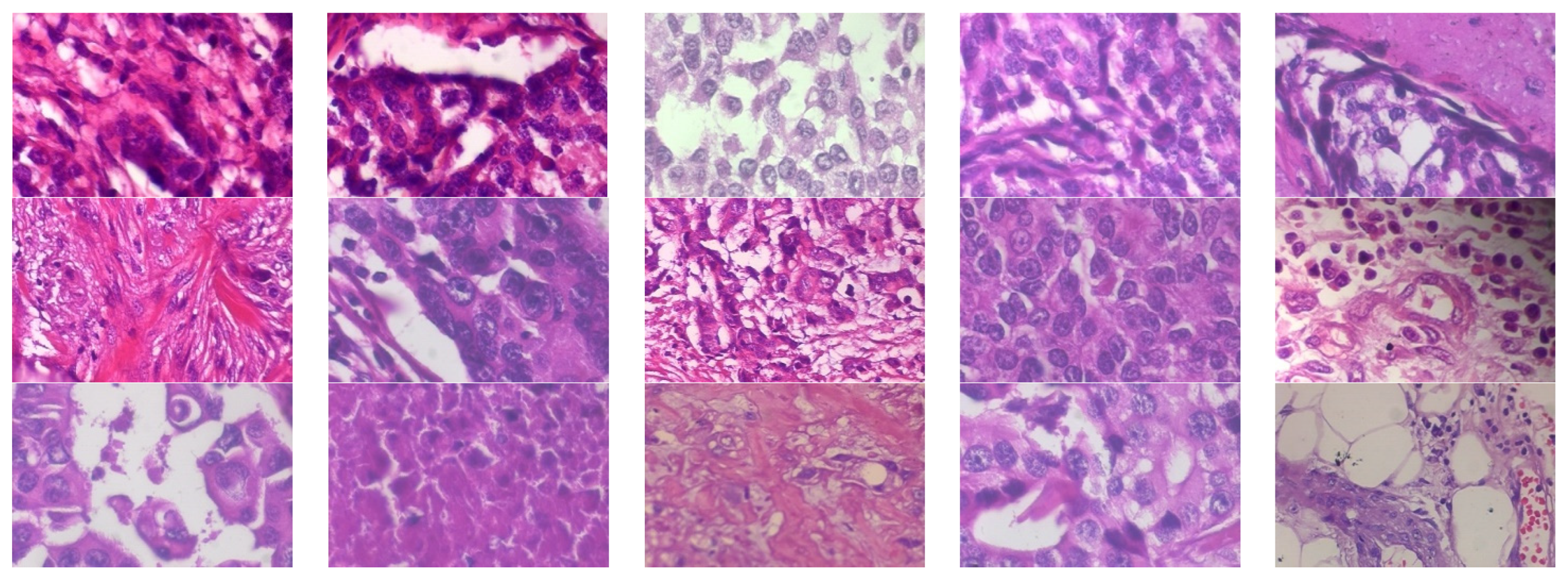
BreaKHis dataset [33]: A collection of histopathological images of breast tumor biopsies created in Brazil by the Research and Development Laboratory of Pathological Anatomy and Cytopathology of Paraná. This dataset comprises 7909 images, including 2480 benign tumor images and 5429 malignant tumor images obtained from 82 different patients and captured at various magnification levels (40×, 100×, 200×, and 400×). After cropping to remove black borders, images are stored in three-channel RGB format with a depth of 8 bits per channel in PNG format. This set is divided into four types of benign tumors (phyllodes tumor (PT), tubular adenoma (TA), fibroadenomas (F), adenosis (A)) and four categories of malignant tumors (papillary carcinoma (PC), mucinous carcinoma (MC), lobular carcinoma (LC), ductal carcinoma (DC)). We note that this dataset is publicly available. Figure 6 shows some histopathological images of selected breast cancer categories from this dataset.
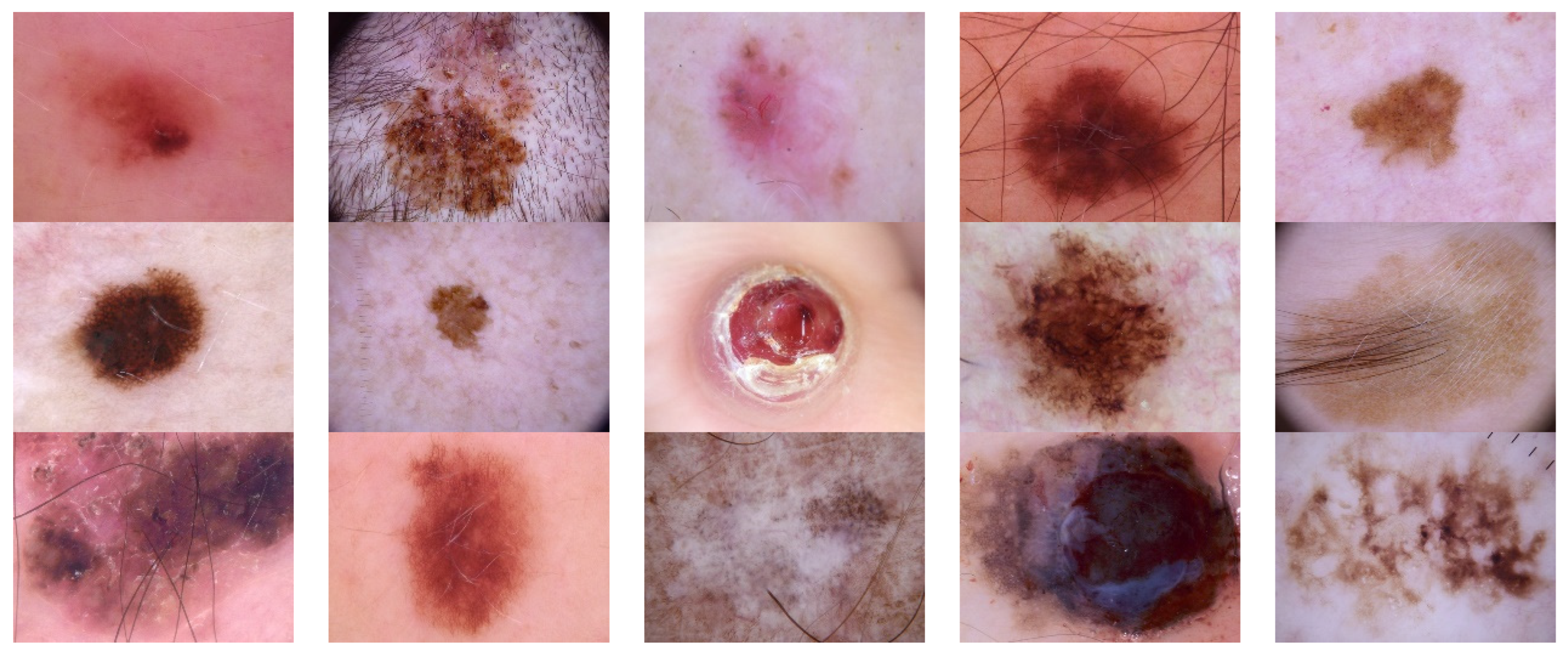
The ISIC 2018 database [34]: This dataset comprises 10,015 skin images categorized into seven classes. These classes include the following: melanoma (MEL) with 1113 images, melanocytic nevus (MNV) with 6705 images, basal cell carcinoma (BCC) with 514 images, actinic keratosis/pigmented Bowen’s (AKIEC) with 327 images, pigmented benign keratosis (BK) with 1099 images, dermatofibroma (DF) with 115 images, and vascular lesion (VASC) with 142 images. Figure 7 shows a set of images selected from the ISIC-2018 database.

4.3.2. Biomedical Image Recognition Using QLOMs

In first experiment, we extracted 28 images from the BreaKhis database. The distribution of these images is shown in Table 2.
Each chosen image was translated, respectively, with the vectors T 0 = 0 , 0 ,   T 1 = 8 , 5 ,   T 2 = 2 , 7 ,   T 3 = 2 , 3 ,     T 4 = 5 , 3 ,   T 5 = 3 , 7 ,   T 6 = 0 , 5 and T 7 = 5 , 0 rotated with rotation angles ω 0 = 0 ° ,   ω 1 = 30 ° , ω 2 = 60 ° , ω 3 = 90 ° , ω 4 = 120 ° , ω 5 = 150 ° , ω 6 = 180 ° , ω 7 = 210 ° , ω 8 = 24 0 ° , ω 9 = 270 ° , ω 10 = 300 ° and ω 11 = 330 ° and scaled with scaling factors α 0 = 0 ,   α 1 = 0.5 ,   α 2 = 0.75 ,   α 3 = 1 ,   α 4 = 1.25 ,   α 5 = 1.5 , α 6 = 1.75 ,   α 7 = 2 and α 8 = 2.25 . Then we formed a set of 38,016 color images. Furthermore, in order to evaluate the robustness to noise of our invariant descriptor vector, we gradually added salt and pepper type noise with densities of {1%, 2%, 3%, 4%, 5%} to this set of images to constitute noisy datasets. We use the RBF classifier based on the proposed orthogonal moment invariant QLOMs. We made a comparison with the existing moments. The obtained results are shown in Table 3.
According to the results shown in this table, the recognition rates for the BreaKHis dataset decrease with increasing noise. The recognition accuracy value starts from 100% for noise-free color images and decreases to 80.57% for 5% noise amount. Although our orthogonal moment invariant QLOMs are affected by the increase in the amount of noise, they remain the best compared to the existing moments. In 2nd experiment, we took a set of 35 images from the ISIC-2018 dataset. This set included 5 images randomly chosen from each of the seven classes included in the database. These images undergo the same geometric transformations as the two previous experiments. Then, we built a new dataset of 30,240 color images. Thus, we gradually added the same noise densities {1%, 2%, 3%, 4%, 5%} to construct a noisy test set. We tested our QLOM-RBF classification approach on the trained dataset and on the different noisy datasets, and we carried out a comparative study with the invariant moments QROJMs [1], FrLFMs [31], QGCFMs [7], and QFrWGLFMs [32]. The classification accuracies are calculated and presented in Table 4.
Here again, we can observe that the image classification accuracies by our QLOMs are higher than those obtained by the other invariant moments tested. In general, the results of the comparative studies carried out clearly show that the proposed descriptor vectors could be useful as a new feature descriptor for the classification of dangerous diseases.

5. Conclusions

The successful performance of a computer-aided medical diagnosis system based on biomedical images highly depends on the classification algorithm and technique used to construct the feature vector of the biomedical image. In this work, we used the theory of orthogonal moments to extract these vectors. In this context, we proposed a new set of orthogonal moments, called quaternion Legendre orthogonal moments. From this set of orthogonal moments, we derived a good feature vector of the biomedical image. We used our QLOM-based descriptor vectors and the RBF classification algorithm to create a new, high-performance biomedical image recognition system based on QLOM descriptor vectors and the RBF model. The experimental results and comparative study presented in this work have shown that this diagnostic system can be used by doctors and professionals in the healthcare sector.

Author Contributions

Conceptualization, K.O. and A.H.; methodology, A.H.; software, O.E.O.; validation, J.E.-M., K.E.M. and M.B.; formal analysis, A.B.; investigation, K.O. and A.H.; resources, O.E.O. All authors have read and agreed to the published version of the manuscript.

Funding

This research received no external funding.

Data Availability Statement

The data supporting the findings of this study are available from the corresponding author upon reasonable request.

Conflicts of Interest

The authors declare no conflict of interest.

References

  1. Janati Idrissi, B.; El Ogri, O.; El-Mekkaoui, J. A new retrieval system based on quaternion radial orthogonal Jacobi moments for biomedical color images. Multimed. Tools Appl. 2024, 83, 65289–65313. [Google Scholar] [CrossRef]
  2. Magdy, M.; Ghali, N.I.; Ghoniemy, S.; Hosny, K.M. Multiple zero-watermarking of medical images for internet of medical things. IEEE Access 2022, 10, 38821–38831. [Google Scholar] [CrossRef]
  3. El Ogri, O.; Karmouni, H.; Sayyouri, M.; Qjidaa, H. A new image/video encryption scheme based on fractional discrete Tchebichef transform and singular value decomposition. Multimed. Tools Appl. 2023, 82, 33465–33497. [Google Scholar] [CrossRef]
  4. El Ogri, O.; Karmouni, H.; Sayyouri, M.; Qjidaa, H. A novel image encryption method based on fractional discrete Meixner moments. Opt. Lasers Eng. 2021, 137, 106346. [Google Scholar] [CrossRef]
  5. Papakostas, G.A.; Mertzios, B.G.; Karras, D.A. Performance of the orthogonal moments in reconstructing biomedical images. In Proceedings of the 2009 16th International Conference on Systems, Signals and Image Processing, Chalkida, Greece, 18–20 June 2009; pp. 1–4. [Google Scholar]
  6. Bharathi, V.S.; Ganesan, L. Orthogonal moments based texture analysis of CT liver images. Pattern Recognit. Lett. 2008, 29, 1868–1872. [Google Scholar] [CrossRef]
  7. Singh, S.; Singh, B.K.; Kumar, A. Magnetic resonance imaging image-based segmentation of brain tumor using the modified transfer learning method. J. Med. Phys. 2022, 47, 315–321. [Google Scholar] [CrossRef] [PubMed]
  8. El Ogri, O.; El-Mekkaoui, J.; Benslimane, M. A novel medical image security and compression based on multiple-order fractional quaternion Hahn moments and 2D-chaotic map. Neural Comput. Appl. 2025, 37, 20663–20690. [Google Scholar] [CrossRef]
  9. Kumar, Y.; Aggarwal, A.; Tiwari, S.; Singh, K. An efficient and robust approach for biomedical image retrieval using Zernike moments. Biomed. Signal Process. Control 2018, 39, 459–473. [Google Scholar] [CrossRef]
  10. Dai, X.; Shu, H.; Luo, L.; Han, G.; Coatrieux, J. Reconstruction of tomographic images from limited range projections using discrete Radon transform and Tchebichef moments. Pattern Recognit. 2010, 43, 1152–1164. [Google Scholar] [CrossRef][Green Version]
  11. Zhou, X.; Ma, Y.; Zhang, Q.; Mohammed, M.A.; Damaševičius, R. A reversible watermarking system for medical color images: Balancing capacity, imperceptibility, and robustness. Electronics 2021, 10, 1024. [Google Scholar] [CrossRef]
  12. Sharma, S.; Aggarwal, A. Content-based retrieval of biomedical images using orthogonal Fourier-Mellin moments. Comput. Methods Biomech. Biomed. Eng. Imaging Vis. 2018, 7, 286–296. [Google Scholar] [CrossRef]
  13. Iscan, Z.; Dokur, Z.; Ölmez, T. Tumor detection by using Zernike moments on segmented magnetic resonance brain images. Expert Syst. Appl. 2010, 37, 2540–2549. [Google Scholar] [CrossRef]
  14. Gupta, K.; Bajaj, V. Deep learning models-based CT-scan image classification for automated screening of COVID-19. Biomed. Signal Process. Control 2023, 80, 104268. [Google Scholar] [CrossRef]
  15. Cheng, X.; Mao, J.-M.; Bush, R.; Kopans, D.B.; Moore, R.H.; Chorlton, M. Breast cancer detection by mapping haemoglobin concentration and oxygen saturation. Appl. Opt. 2003, 42, 6412–6421. [Google Scholar] [CrossRef]
  16. Sharma, S.; Khanna, P. Computer-aided diagnosis of malignant mammograms using Zernike moments and SVM. J. Digit. Imaging 2015, 28, 77–90. [Google Scholar] [CrossRef] [PubMed]
  17. Powell, M.J.D. Radial Basis Functions for Multivariable Interpolation: A Review. In Algorithms for the Approximation; Mason, J.C., Cox, M.G., Eds.; Clarendon Press: Oxford, UK, 1987; pp. 143–167. [Google Scholar]
  18. Broomhead, D.S.; Lowe, D. Multi-variable Functional Interpolation and Adaptive Networks. Complex Syst. 1988, 2, 321–355. [Google Scholar]
  19. Gyor, L.; Kohler, M.; Krzyzak, A.; Walk, H. A Distribution Free Theory of Non-Parametric Regression; Springer: Berlin/Heidelberg, Germany, 2002. [Google Scholar]
  20. Broomhead, D.S.; Lowe, D. Radial Basis Functions, Multi-Variable Functional Interpolation and Adaptive Networks (No. RSRE-MEMO-4148); Royal Signals and Radar Establishment: Worcestershire, UK, 1988. [Google Scholar]
  21. El Ogri, O.; El-Mekkaoui, J.; Benslimane, M.; Hjouji, A. Automatic lip-reading classification using deep learning approaches and optimized quaternion meixner moments by GWO algorithm. Knowl.-Based Syst. 2024, 304, 112430. [Google Scholar] [CrossRef]
  22. Hamilton, W.R. Elements of Quaternions; Longmans, Green, & Company: London, UK, 1866. [Google Scholar]
  23. El Ogri, O.; Karmouni, H.; Sayyouri, M.; Qjidaa, H. 3D image recognition using new set of fractional-order Legendre moments and deep neural networks. Signal Process. Image Commun. 2021, 98, 116410. [Google Scholar] [CrossRef]
  24. Xiao, B.; Wang, G.Y.; Li, W.S. Radial shifted Legendre moments for image analysis and invariant image recognition. Image Vis. Comput. 2014, 32, 994–1006. [Google Scholar] [CrossRef]
  25. Hosny, K.M.; Darwish, M.M. Robust color image watermarking using invariant quaternion Legendre-Fourier moments. Multimed. Tools Appl. 2018, 77, 24727–24750. [Google Scholar] [CrossRef]
  26. Hassan, G.; Hosny, K.M.; Farouk, R.M.; Alzohairy, A.M. An efficient retrieval system for biomedical images based on Radial Associated Laguerre Moments. IEEE Access 2020, 8, 175669–175687. [Google Scholar] [CrossRef]
  27. Chen, B.; Yu, M.; Su, Q.; Shim, H.J.; Shi, Y.-Q. Fractional quaternion Zernike moments for robust color image copy-move forgery detection. IEEE Access 2018, 6, 56637–56646. [Google Scholar] [CrossRef]
  28. El Ogri, O.; Daoui, A.; Yamni, M.; Karmouni, H.; Sayyouri, M.; Qjidaa, H. 2D and 3D medical image analysis by discrete orthogonal moments. Procedia Comput. Sci. 2019, 148, 428–437. [Google Scholar] [CrossRef]
  29. Wang, X.-Y.; Wang, L.; Tian, J.-L.; Niu, P.-P.; Yang, H.-Y. Color image zero-watermarking using accurate quaternion generalized orthogonal Fourier–Mellin moments. J. Math. Imaging Vis. 2021, 63, 708–734. [Google Scholar] [CrossRef]
  30. Hosny, K.M.; Darwish, M.M. Invariant color images representation using accurate quaternion Legendre–Fourier moments. Pattern Anal. Appl. 2019, 22, 1105–1122. [Google Scholar]
  31. Hosny, K.M.; Khalid, A.M.; Mohamed, E.R. Efficient compression of volumetric medical images using Legendre moments and differential evolution. Soft Comput. 2020, 24, 409–427. [Google Scholar] [CrossRef]
  32. He, B.; Liu, J.; Lin, G.; Peng, C.; Xi, W. Quaternion fractional-order weighted generalized Laguerre–Fourier moments and moment invariants for color image analysis. Signal Process. Image Commun. 2023, 114, 116941. [Google Scholar] [CrossRef]
  33. Spanhol, F.A.; Oliveira, L.S.; Petitjean, C.; Heutte, L. A Dataset for Breast Cancer Histopathological Image Classification. IEEE Trans. Biomed. Eng. 2016, 63, 1455–1462. [Google Scholar] [CrossRef]
  34. Al-Masni, M.A.; Al-Antari, M.A.; Choi, M.-T.; Han, S.-M.; Kim, T.-S. Skin lesion segmentation in dermoscopy images via deep full resolution convolutional networks. Comput. Methods Programs Biomed. 2018, 162, 221–231. [Google Scholar] [CrossRef]
Figure 1. Generic structure of RBF network architecture.
Mca 30 00121 g001
Figure 3. Biomedical images.
Mca 30 00121 g003
Figure 4. Relative error values of the rotation of biomedical images for QLOMs and the existing methods [26,27,29].
Mca 30 00121 g004
Figure 5. Relative error values of the noisy biomedical images for QLOMs and the existing methods [26,27,29].
Mca 30 00121 g005
Figure 6. Images selected from BreaKHis database [33].
Mca 30 00121 g006
Figure 7. A set of images from the ISIC-2018 dataset [34].
Mca 30 00121 g007
Table 1. The reconstructed biomedical image using the proposed method QLOMs and the existing methods.
Reconstructed ImageMaximum Order
(10, 10)(20, 20)(30, 30)(50, 50)(60, 60)(80, 80)(100, 100)(200, 200)
QOFMMs [29]Mca 30 00121 i001Mca 30 00121 i002Mca 30 00121 i003
MSE0.10320.21153.01 × 1012
QRZMs [27]Mca 30 00121 i004Mca 30 00121 i005Mca 30 00121 i006Mca 30 00121 i007Mca 30 00121 i008
MSE0.14440.10720.08631.132 × 1063.524 × 1019
RALMs [26]Mca 30 00121 i009Mca 30 00121 i010Mca 30 00121 i011Mca 30 00121 i012Mca 30 00121 i013Mca 30 00121 i014Mca 30 00121 i015Mca 30 00121 i016
MSE0.04060.02080.01570.01140.01030.00890.00760.0049
Proposed QLOMsMca 30 00121 i017Mca 30 00121 i018Mca 30 00121 i019Mca 30 00121 i020Mca 30 00121 i021Mca 30 00121 i022Mca 30 00121 i023Mca 30 00121 i024
MSE0.03590.02060.01550.01070.00940.00760.00620.0032
Table 2. The distribution of the 28 images selected from the BreaKHis database.
Benign ImagesMalignant Images
PTTAFAPCMCLCDC
5 images6 images6 images5 images6 images5 images5 images6 images
Table 3. Comparison results of image recognition accuracy (%) on the BreaKHis dataset, using our QLOMI orthogonal moments and existing orthogonal moments.
Orthogonal
Moments
Noise-FreeSalt and Pepper NoiseAverage
1%2%3%4%5%
Proposed QLOMs100.0094.7391.9284.6382.9380.5789.13
QFrWGLFMs [32]99.2872.2469.6856.8750.9248.6366.27
QGCFMs [7]99.3792.3485.1480.1682.9379.7186.61
QFrLFMs [31]98.8391.4188.5379.9578.0873.1785.00
QROJMs [1]99.0786.4978.8870.5759.1956.9575.19
Table 4. Comparison results of image recognition accuracy (%) on the ISIC 2018 dataset, using our QLOM orthogonal moments and existing orthogonal moments.
Orthogonal
Moments
Noise-FreeSalt and Pepper NoiseAverage
1%2%3%4%5%
Proposed QLOMs100.0099.7096.5786.6782.8080.9791.12
QFrWGLFMs [32]97.9382.8569.3460.4346.7548.4867.63
QGCFMs [7]98.8470.2959.4355.8952.3247.5664.06
QFrLFMs [31]99.4778.3572.9469.4860.6357.9673.14
QROJMs [1]99.4791.3685.7571.3562.9560.9778.64
Disclaimer/Publisher’s Note: The statements, opinions and data contained in all publications are solely those of the individual author(s) and contributor(s) and not of MDPI and/or the editor(s). MDPI and/or the editor(s) disclaim responsibility for any injury to people or property resulting from any ideas, methods, instructions or products referred to in the content.