


Abstract
To improve regeneration performance and shorten desorption time in amine-based CO2 capture, this study proposes an integrated “blended-amine solvent and microwave regeneration” process. Triethylenetetramine (TETA) was used as the primary absorbent and blended with diethanolamine (DEA) and 2-amino-2-methyl-1-propanol (AMP). Response Surface Methodology (RSM, Box–Behnken design) was employed to establish formulation–performance relationships, and an entropy-weighted TOPSIS method was further applied for multi-objective evaluation and optimization. The optimal formulation consisted of TETA, DEA, and AMP at a mass ratio of 6:1:2. Under the optimized conditions (20 wt% aqueous solvent, 30 °C absorption, 95 °C microwave regeneration), the solvent achieved an absorption capacity of 1.0 mol CO2·mol−1 amine with a CO2 recovery of 93.56%. Compared with conventional heating, microwave regeneration markedly accelerated CO2 desorption, reducing regeneration time from 30 min to 4 min. The estimated total regeneration energy was approximately 2.4 GJ·t−1 CO2 under microwave heating for the optimized blend. In addition, among the water/n-butanol formulations tested, the fully aqueous system showed the best overall absorption–regeneration performance. Overall, the data-driven solvent design coupled with microwave regeneration offers a practical route toward more efficient CO2 capture processes.
1. Introduction
Amine-based absorption remains one of the most mature and widely applied technologies for post-combustion CO2 capture [1,2,3]. Despite widespread industrial adoption, conventional alkanolamine-based absorbents (e.g., monoethanolamine (MEA) and N-methyldiethanolamine (MDEA)) exhibit significant limitations [4]. Their aqueous solutions display inherent thermodynamic challenges, including elevated heat capacities, reduced boiling points, and volatility. These characteristics contribute to operational inefficiencies such as solvent degradation, excessive energy consumption during regeneration cycles, and accelerated corrosion of process equipment [5,6,7]. These challenges motivate ongoing efforts to develop improved solvent systems that balance absorption capacity, regeneration performance, and operational stability. Blended amine solvents have been widely investigated as an effective strategy to overcome the trade-offs associated with single-amine systems [8,9]. By combining amines with different chemical characteristics, blended systems can potentially integrate high CO2 absorption capacity, favorable regeneration behavior, and improved solvent stability [10,11]. Studies have shown that blended-amine composition can influence CO2 absorption behavior, molecular speciation, regeneration energy, and bulk properties such as viscosity, density, effective basicity, and dielectric response [12,13,14]. Nevertheless, the performance of a blended amine system is highly sensitive to solvent composition, and inappropriate ratios may lead to suboptimal or even deteriorated performance [15]. Therefore, rational optimization of solvent composition is essential, rather than empirical trial-and-error approaches. Statistical and mathematical optimization methods provide a systematic framework for solvent formulation design [16]. Among them, Response Surface Methodology (RSM) has been extensively applied to chemical process optimization by establishing quantitative relationships between multiple variables and response indicators [17,18]. In the context of CO2 capture, RSM enables the identification of optimal solvent compositions and operating conditions while minimizing experimental effort [19]. In practical solvent design, multiple performance indicators, such as CO2 absorption capacity and desorption efficiency, must be considered simultaneously. Multi-objective decision-making tools, including entropy-weighted ranking and related methods, offer an effective means to balance competing performance criteria [20]. Integrating RSM with multi-objective evaluation therefore provides a data-driven approach for rational solvent optimization.
In parallel with solvent development, alternative regeneration techniques have been explored to reduce the limitations of conventional thermal stripping [21]. Microwave-assisted regeneration has attracted increasing attention due to its volumetric heating characteristics, which can enhance heat transfer and accelerate desorption kinetics [22]. Previous studies have demonstrated the feasibility of microwave regeneration for single amine solvents, such as MEA, as well as for certain high-concentration or non-aqueous amine systems. Despite these advances, existing microwave-assisted regeneration studies primarily focus on single-solvent systems or specific non-aqueous formulations. Systematic investigations that combine solvent formulation optimization with microwave-assisted regeneration, particularly for aqueous blended amine systems, remain limited [23]. Moreover, many studies emphasize regeneration kinetics without explicitly integrating solvent composition optimization and multi-objective performance evaluation [24,25].
Building on previous microwave-regeneration studies [26,27,28], the present study evaluates an aqueous TETA/DEA/AMP system by integrating solvent-composition optimization with microwave-assisted regeneration. Specifically, triethylenetetramine (TETA) is employed as the primary absorbent due to its high CO2 capacity [29,30], while diethanolamine (DEA) and 2-amino-2-methyl-1-propanol (AMP) are introduced as auxiliary components to balance regeneration behavior and solvent stability [31]. By coupling Response Surface Methodology with multi-objective performance evaluation, this work provides a data-driven strategy to optimize blended amine composition and systematically investigate the effects of absorption temperature, desorption temperature, and solvent concentration. The study further examines the role of microwave-assisted regeneration in enhancing desorption kinetics under relatively low-temperature conditions, thereby offering new insight into the coordinated design of solvent formulation and regeneration strategy.
2. Materials and Methods
2.1. Materials and Instruments
Monoethanolamine (MEA: ≥99.0%), diethanolamine (DEA: ≥99.0%), and n-butanol (analytical grade), as well as triethylenetetramine (TETA: ≥99.0%) and 2-amino-2-methyl-1-propanol (AMP: ≥99.0%) (chemical grade), were purchased from Sinopharm Chemical Reagent Co., Ltd. (Shanghai, China). Deionized water was prepared in the laboratory. High-purity CO2 gas (≥99.99%) was supplied by Karmay Zhongke Gases Industry Co., Ltd. (Karamay, China).
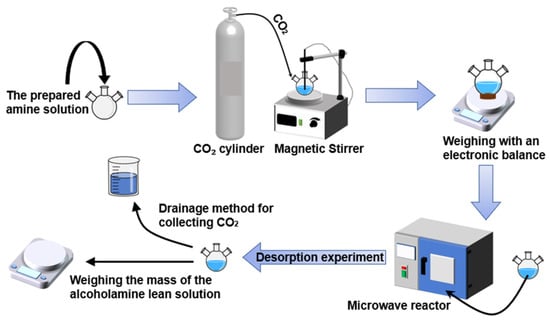
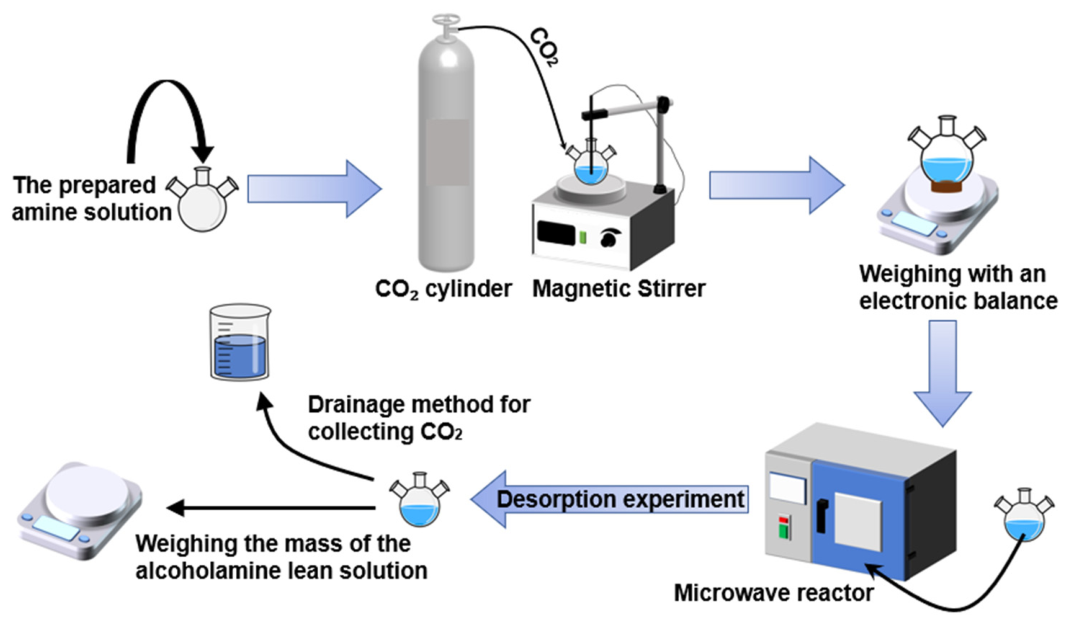
The following diagram (Figure 1) shows the experimental setup and experimental procedure for the absorption–desorption experiments conducted in this paper.
Figure 1.
Experimental setup and procedure diagram. The arrows indicate the direction of the experimental workflow.
Mass measurements during CO2 absorption and desorption were performed using an analytical balance (MS304TS-02, Mettler-Toledo International Inc., Greifensee, Switzerland; readability: 0.1 mg). Conventional thermal desorption experiments were conducted using an intelligent electric heating mantle for round-bottom flasks (model ZNHW-500 mL, Shanghai Yuezhong Instrument Co., Ltd., Shanghai, China). Microwave-assisted desorption was carried out using a laboratory microwave heating furnace (model XH-100B, Xianghu Technology Development Co., Ltd., Beijing, China) with an output power of 850 W. The CO2 gas flow rate during absorption was controlled using a glass rotameter (model LZB-2, Beijing Silian Yinhuan Flow Instrument Co., Ltd., Beijing, China). Detailed metrological specifications relevant to these measurements are summarized in Table S1.
2.2. Single Alkanolamine Reagent Absorption and Desorption Experiments
This work aims to develop a blended amine formulation with triethylenetetramine (TETA) as the primary component and supplementary amines as additives. Based on a literature review, diethanolamine (DEA) and 2-amino-2-methyl-1-propanol (AMP) were selected as the auxiliary absorbents. To characterize the intrinsic CO2 absorption behavior of individual amines, aqueous solutions of TETA, DEA, and AMP were prepared separately with a mass fraction of 20 wt% and a total solution mass of 40 g. CO2 absorption experiments were conducted at 30 °C and atmospheric pressure. The absorption vessel was placed in a constant-temperature water bath and continuously stirred at 60 rpm. High-purity CO2 was introduced at a fixed flow rate of 1000 mL·min−1. CO2 uptake was monitored using the gravimetric method by recording the mass increase of the absorption vessel at regular intervals. Absorption was considered complete when the mass difference between two consecutive measurements was less than 5 mg. Mass readings were taken at 3 min intervals. Each experiment was repeated three times, and the experimental uncertainty was within ±3%. No dispersant, surfactant, or additional solubilizer was used during absorption; gas-liquid contact was provided by CO2 bubbling and mechanical stirring.
According to reaction pathways reported for aqueous amine-CO2 systems [5,32], CO2 absorption in these solutions is dominated by chemical reaction, with a smaller contribution from physical solubility. The following reversible reactions are used to describe carbamate formation and subsequent bicarbonate formation in primary, secondary, and sterically hindered amines:
In the first two reactions, primary and secondary amines form carbamate species; B denotes a proton-accepting base. The third reaction represents carbamate hydrolysis toward bicarbonate formation, which is particularly relevant for sterically hindered amines such as AMP. These reactions provide a literature-based framework for discussing the absorption–desorption behavior of the blended system.
2.3. Determination of Optimal Formulation Using Response Surface Methodology
Response Surface Methodology (RSM), a statistical technique for process optimization through experimental design and model fitting, was utilized in this work. The objective was to optimize the CO2 absorption capacity and recovery rate of the amine-based absorbent. Three formulation variables were defined as the relative mass parts of TETA (A), DEA (B) and AMP (C). For each run, the total amine mass was fixed at 8.0 g, corresponding to a total amine concentration of 20 wt% in a 40 g solution, while the relative proportions of TETA, DEA, and AMP were varied according to Table 1. For example, the 6:1:2 formulation corresponded to 5.33 g TETA, 0.89 g DEA, and 1.78 g AMP.
Table 1.
Independent Variables and Their Levels for the Box-Behnken Design (BBD).
To systematically evaluate the effects and interactions of TETA (A), DEA (B), and AMP (C) on CO2 capture performance, a three-factor, three-level Box-Behnken Design (BBD) was employed [33]. Compared to full factorial designs, BBD is more efficient as it requires fewer experimental runs to construct a second-order polynomial model. Design-Expert software (v13, Stat-Ease Inc., Minneapolis, MN, USA) was used for experimental design and statistical analysis. The relationship between the independent variables and response variables was fitted using the following quadratic model:
where Y is the predicted response, β represents the regression coefficient. xi and xj are coded independent variables; ε is the random error; and k is the number of factors (k = 3).
The coded values for the BBD variables are listed in Table 1. Model significance was evaluated by analysis of variance (ANOVA), with p < 0.05 considered statistically significant. Model adequacy was assessed using the coefficient of determination (R2) and adjusted R2. Lack-of-fit was also considered, and additional fit statistics and residual diagnostics are provided in the Supplementary Information. The interactions among variables and the optimal conditions for CO2 absorption capacity and CO2 recovery were determined by analyzing two-dimensional contour and three-dimensional response-surface plots.
2.4. Multi-Objective Optimization via Entropy-Weighted TOPSIS
Considering the potential trade-off between absorption capacity and CO2 recovery, a multi-objective optimization framework was established. The Entropy Weight Method was first applied to determine the objective weights of indicators by calculating their information entropy, thereby mitigating subjective bias in decision-making. Subsequently, the Technique for Order of Preference by Similarity to Ideal Solution (TOPSIS) was utilized to rank the formulations [34]. This method calculates the geometric distance of each candidate to the positive-ideal solution (SP+) and negative-ideal solution (SP−). The closeness coefficient (R Ci) was used as the final score to identify the optimal amine blending ratio.
2.5. Effect of Absorption Temperature on CO2 Absorption Performance
Absorption experiments were conducted using the optimally formulated blended amine solution. The absorption vessel was placed in a constant-temperature water bath, with absorption temperatures set at 20 °C, 25 °C, 30 °C, 35 °C, and 40 °C. After reaching saturation, the mass of the CO2-rich solution was measured using the analytical balance. Each experiment was conducted in triplicate and the average value was used to evaluate the influence of absorption temperature on CO2 uptake.
2.6. Effect of Microwave Heating Desorption Temperature on CO2 Desorption from Alkanolamine-Rich Solution
After CO2 absorption to saturation, the mass of the CO2-rich solution was recorded. The rich solution (20 wt%) was then subjected to microwave-assisted desorption at preset temperatures of 85, 90, 95, 100, and 105 °C using the microwave furnace. The liquid temperature was monitored continuously using the built-in thermocouple of the XH-100B microwave reactor (Xiangtu Technology Development Co., Ltd., Beijing, China), with the probe positioned near the vessel center. The released gas volume was recorded every 2 min by water displacement. The wet collected-gas pressure was corrected for saturated water-vapor pressure at the gas-collection temperature before the desorbed CO2 amount was calculated using the ideal-gas equation and converted to mass. Desorption was terminated after 10 min. CO2 recovery was calculated according to Equation (3a–e).
Here, mlean and mrich are the solution masses before and after CO2 absorption; ptotal is the wet collected-gas pressure; pH2O(T) is the saturated water-vapor pressure at the gas-collection temperature; V is the displaced gas volume; Tk is the absolute gas temperature; R is the gas constant; and MCO2 = 44.01 g·mol−1. Desorption was terminated after 10 min. Detailed instrument specifications and uncertainty analysis are provided in the Supplementary Information.
2.7. Effect of Alkanolamine Solution Concentration on CO2 Capture Performance
With the optimal compounded alkanolamine solution as the absorbent, solutions with mass fractions of 10 wt%, 20 wt%, 30 wt%, and 40 wt% were prepared. Absorption and desorption experiments were conducted at 30 °C and 95 °C, respectively, following the same procedures described in Section 2.5 and Section 2.6. Each experiment was performed in triplicate to evaluate the influence of solution concentration on CO2 absorption and desorption behavior.
3. Results and Discussion
3.1. Comparison of Absorption and Desorption Performance of Single Alkanolamine Reagents
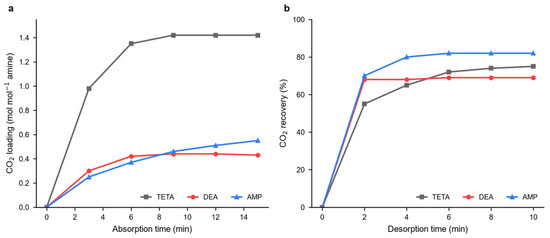
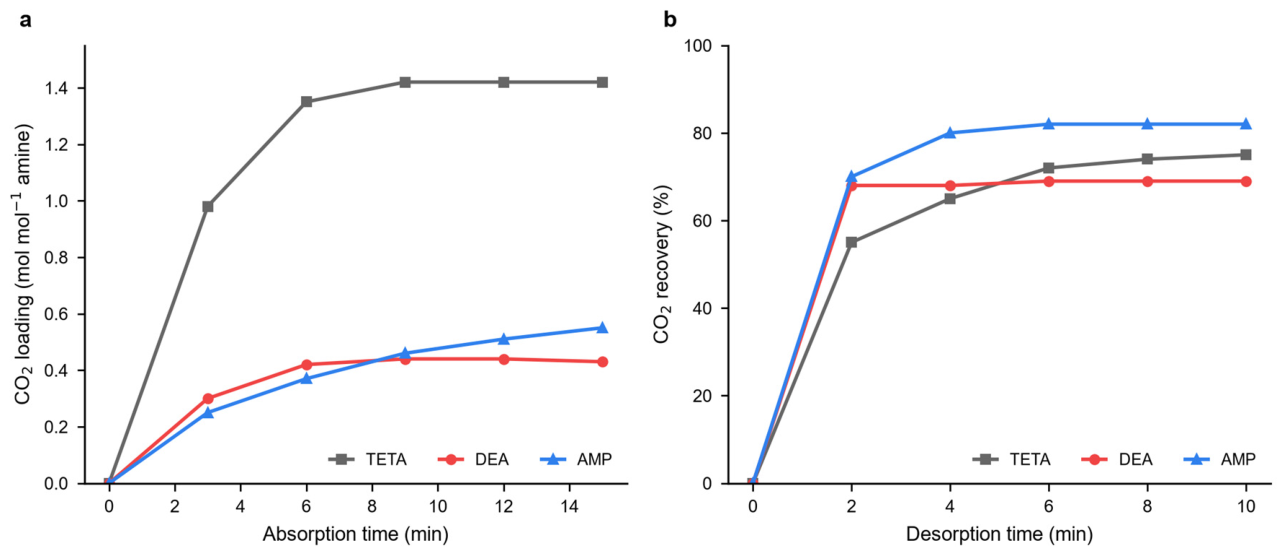
40 g alkanolamine solutions of TETA, DEA, and AMP with a mass concentration of 20 wt% were prepared. The absorption kinetics experiments were conducted at 30 °C for 15 min, and the desorption kinetics experiments were conducted at 95 °C for 10 min. The results are shown in Figure 2. As can be seen from Figure 2a, TETA reached a maximum absorption capacity of 1.42 mol CO2·mol−1 amine after approximately 9 min of absorption, while DEA and AMP reached maximum absorption capacities of 0.44 and 0.47 mol CO2·mol−1 amine, respectively. In terms of absorption capacity, TETA therefore performed better than DEA and AMP under the present conditions. From Figure 2b, CO2 recovery followed the order AMP (81.9%) > TETA (75.5%) > DEA (68.4%). Thus, TETA showed the highest absorption capacity, whereas AMP showed the highest CO2 recovery; this difference provides the experimental basis for considering both responses in the subsequent formulation optimization.
Figure 2.
20 wt% single-alkanolamine absorption (a) and desorption (b) kinetics for TETA, DEA, and AMP at 30 °C. The absorption data were recorded at 3-min intervals, while the desorption data were recorded at 2-min intervals.
3.2. Selection of Compounded Alkanolamine Solution Formulations
3.2.1. RSM Analysis of Absorbed CO2 Mass and CO2 Recovery
Response Surface Methodology (RSM) based on a Box-Behnken Design (BBD) was employed to systematically investigate the effects of amine composition and their interactions on CO2 absorption capacity and CO2 recovery. Three formulation variables were considered, namely the relative amounts of triethylenetetramine (TETA), diethanolamine (DEA), and 2-amino-2-methyl-1-propanol (AMP). The detailed experimental matrix and corresponding responses are provided in the Supplementary Information (Table S2).
Quadratic regression models were developed for both absorbed CO2 mass and CO2 recovery. The key model-quality parameters are summarized in Table 2.
Table 2.
Key model-quality parameters for the RSM models.
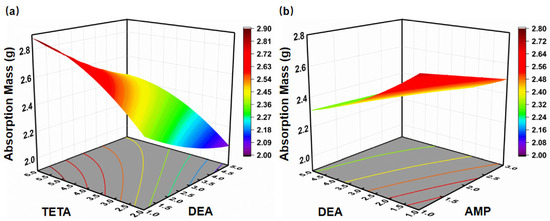
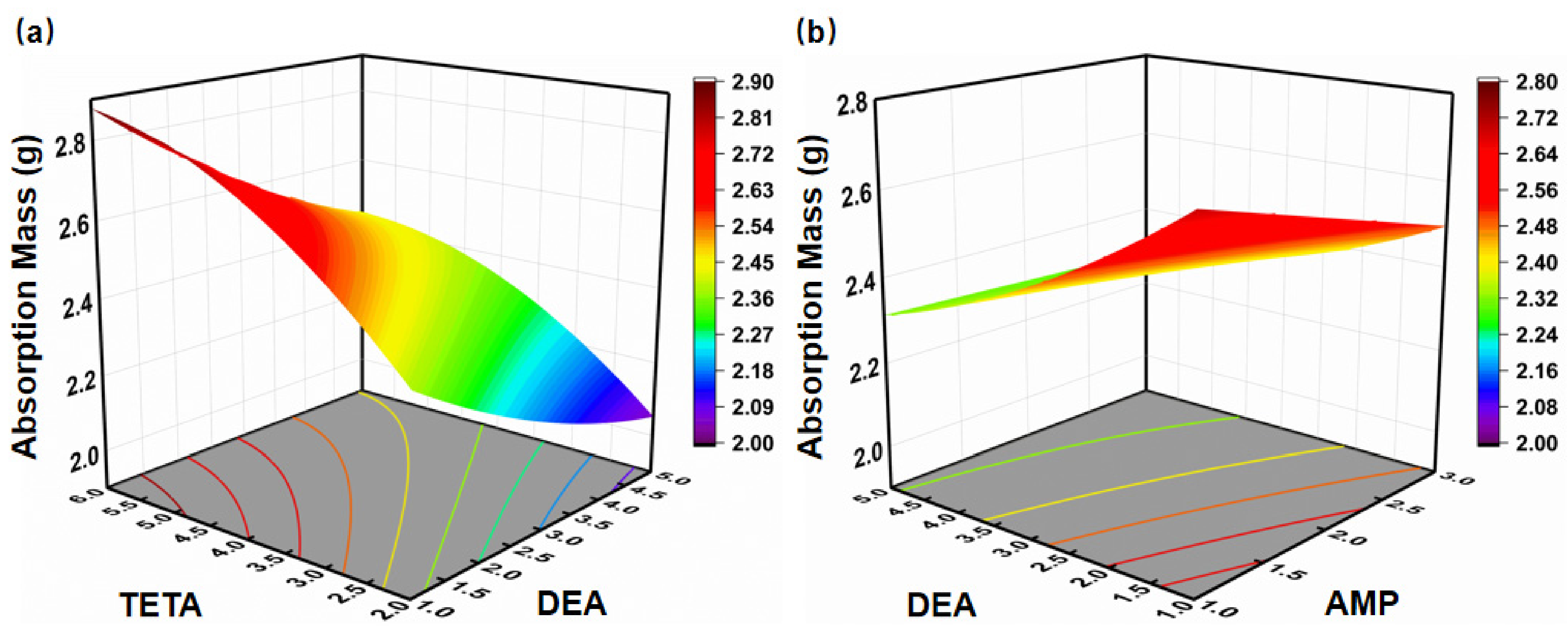
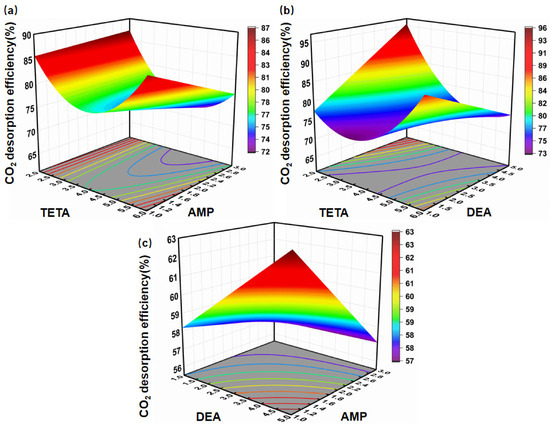
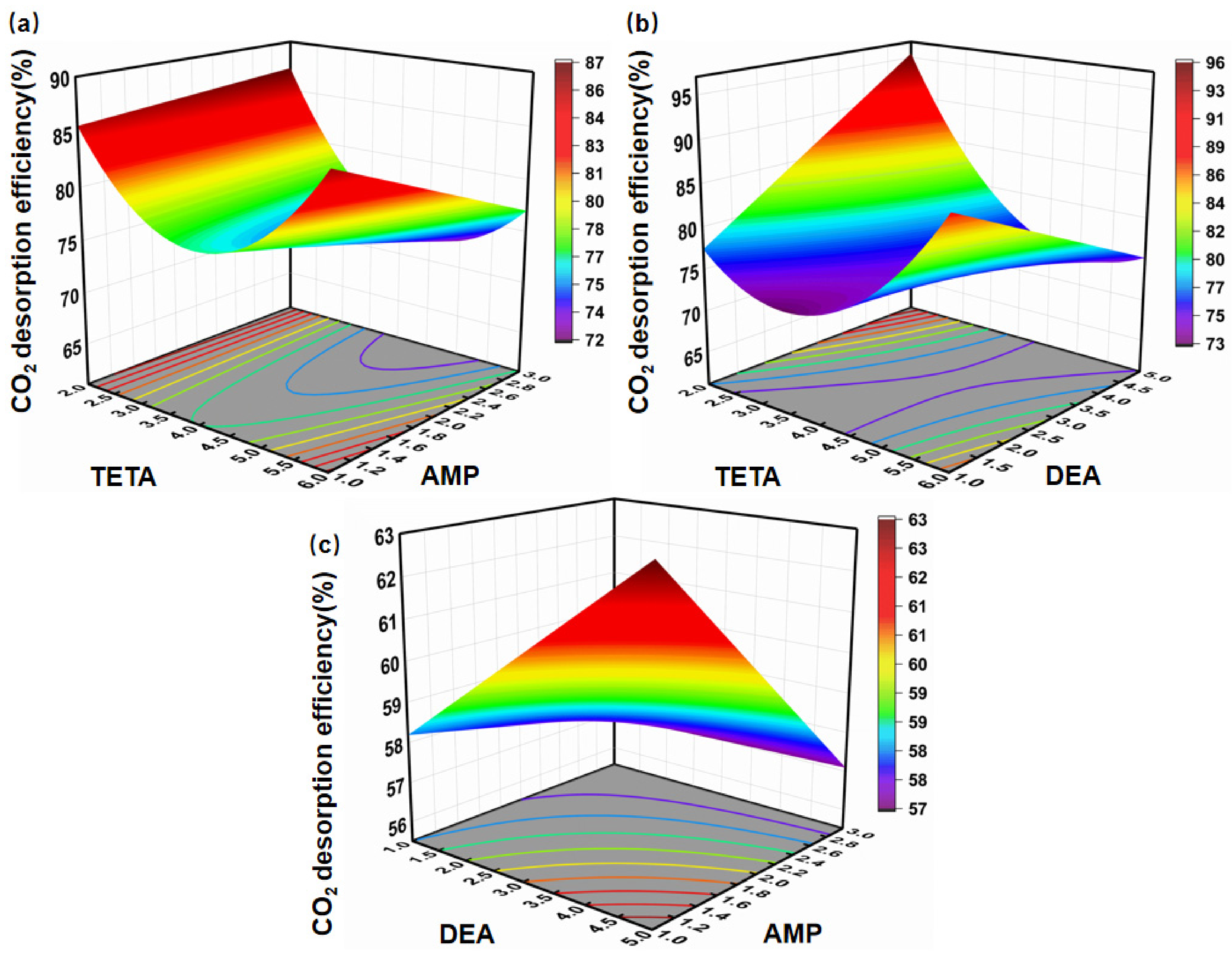
Analysis of variance (ANOVA) confirmed that the absorbed CO2 mass model was highly significant (p = 0.0003), while the CO2-recovery model was also statistically significant (p = 0.0135). The absorption-capacity model showed good fit within the investigated design space. For the CO2-recovery model, the lack-of-fit was non-significant (p = 0.2862), but its predicted R2 was 0.6079, indicating limited predictive capability for new observations; this model was therefore used mainly for screening and trend analysis within the experimental design space. Complete ANOVA results and fit statistics are provided in Supplementary Information Tables S3–S5, and residual diagnostics are shown in Figures S1–S3. The interaction effects of formulation variables on absorption capacity are illustrated in Figure 3. The response surface and contour plots reveal that different combinations of TETA, DEA, and AMP favor absorption performance under specific constraints, resulting in multiple local optima. Similarly, Figure 4 presents the interaction effects on CO2 recovery, showing that formulations achieving high absorption capacity do not necessarily exhibit favorable regeneration performance. These observations highlight the trade-off between absorption and regeneration performance and indicate that optimization based on a single response is insufficient.
Figure 3.
Interaction effects of TETA, DEA, and AMP on absorption capacity: (a) TETA vs. DEA, (b) DEA vs. AMP.
Figure 4.
Interaction effects of TETA, DEA, and AMP on CO2 recovery: (a) TETA vs. DEA, (b) TETA vs. AMP, (c) DEA vs. AMP.
3.2.2. Multi-Objective Optimization via Entropy–TOPSIS
To identify a balanced formulation considering both absorption capacity and CO2 recovery, a multi-objective optimization strategy combining the Entropy Weight Method and the TOPSIS approach was applied. Based on the RSM results, seven representative experimental points covering high- and intermediate-performance regions were selected for multi-objective evaluation. The corresponding data set is summarized in Table 3.
Table 3.
Experimental data for Entropy-TOPSIS analysis.
The Entropy Weight Method was used to determine the relative importance of each response based on data dispersion, thereby avoiding subjective weighting. The resulting weights emphasize CO2 recovery relative to absorption capacity, reflecting the importance of regeneration performance in amine-based CO2 capture. Details of the data normalization procedure and entropy-weight calculations are provided in the Supplementary Information (Tables S6 and S7).
Subsequently, the TOPSIS method was applied to rank the candidate formulations according to their relative closeness to the ideal solution. The results are presented in Table 4. Among the evaluated formulations, the formulation with a TETA/DEA/AMP mass ratio of 6/1/2 exhibited the highest relative closeness, identifying it as the optimal compromise solution within the studied formulation space.
Table 4.
Comprehensive ranking results from the TOPSIS method.
3.2.3. Experimental Validation of the Optimal Formulation
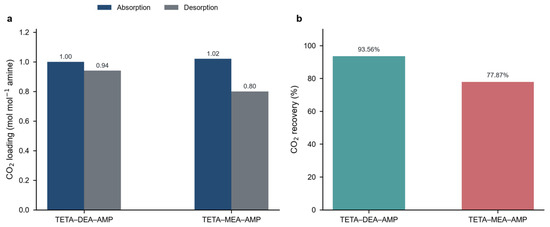
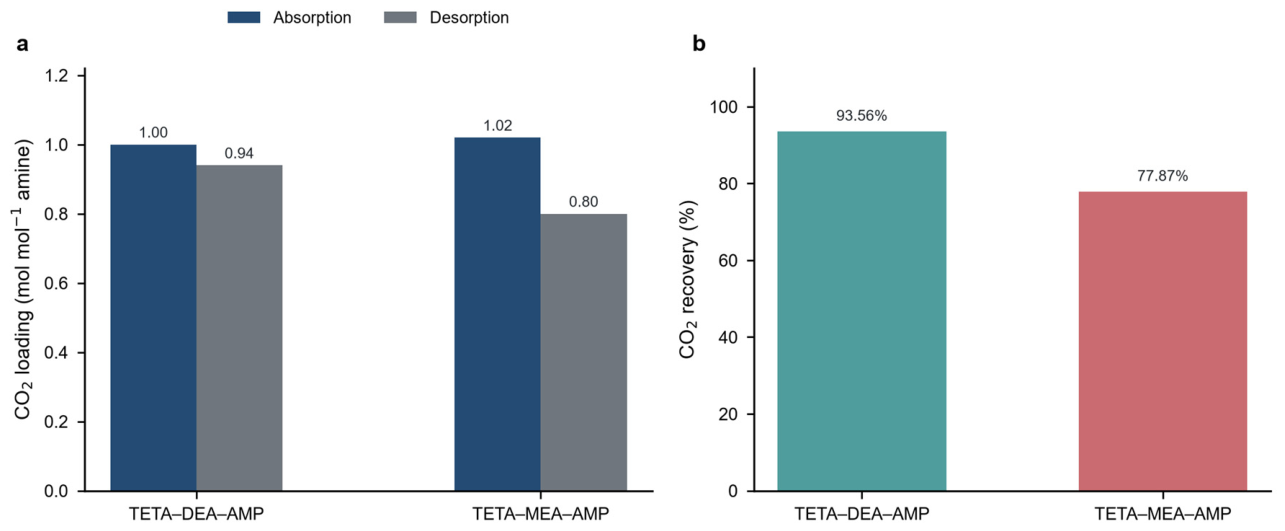
To further validate the rationality of the optimized formulation, a comparative experimental study was conducted by substituting DEA with monoethanolamine (MEA) while maintaining the same component ratios and operating conditions. The absorption and desorption performances of the TETA-DEA-AMP system and the TETA–MEA–AMP system are compared in Figure 5.
Figure 5.
Comparison with an MEA-substituted Formulation: (a) CO2 loading during absorption and desorption; (b) CO2 recovery.
Although the MEA-containing formulation exhibited a slightly higher absorption capacity, the DEA-containing system demonstrated a substantially higher CO2 recovery (93.56% versus 77.87%). These results further support the suitability of the optimized TETA-DEA-AMP formulation in achieving a balanced absorption– and desorption performance under the investigated laboratory-scale conditions.
3.3. Exploration of Experimental Conditions for CO2 Absorption and Desorption Using Compounded Alkanolamine Solutions
3.3.1. The Effect of Absorption Temperature on CO2 Absorption Capacity
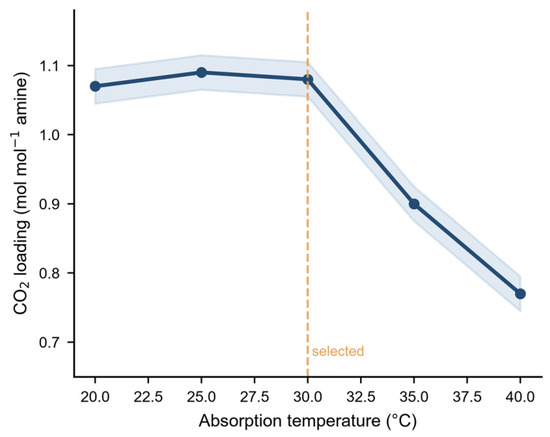
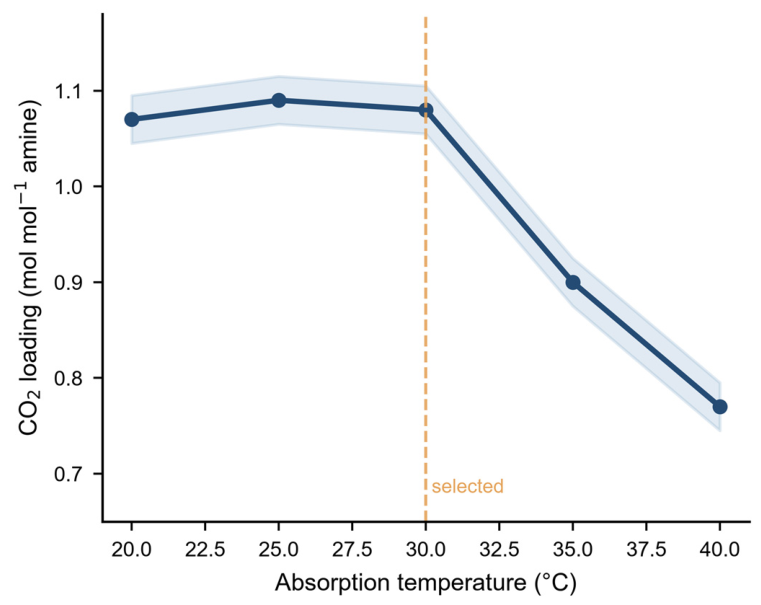
Experiments on CO2 absorption using compounded alkanolamine solutions were conducted at 20, 25, 30, 35, and 40 °C to explore the effect of temperature on CO2 absorption capacity, with the results shown in Figure 6. Since the absorption of CO2 by alkanolamines is exothermic, lower temperatures are theoretically more favorable for absorption. As can be seen from Figure 6, the CO2 absorption capacity of the mixed amine formulation generally decreased as temperature increased. At 25 °C and 30 °C, the absorption capacity was similar, at approximately 1.1 mol CO2·mol−1 amine; it decreased to 0.9 mol CO2·mol−1 amine at 35 °C; and reached the 0.77 mol CO2·mol−1 amine at 40 °C.
Figure 6.
Influence of absorption temperature on the CO2 capture performance of compounded alkanolamine solutions. The shaded region represents the standard deviation of triplicate measurements.
Although the variation in absorption capacity at different set temperatures aligns with theoretical expectations, practical application considerations such as the reliance on refrigeration equipment to maintain low temperatures (e.g., 20 °C) would significantly increase operational energy consumption and costs. Therefore, a balance must be struck between absorption performance and cost-effectiveness. Taking into account factors that ensure stable system operation, energy consumption, and absorption performance, 30 °C has been determined as the optimized temperature condition for subsequent experiments with the mixed amine absorbents.
3.3.2. Effect of Desorption Temperature on CO2 Capture by Compounded Alkanolamine Solutions
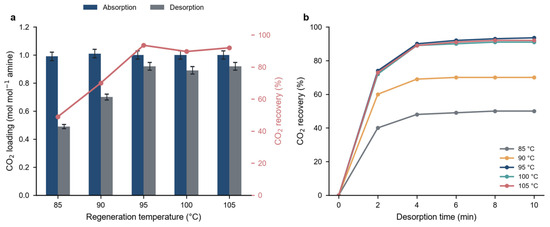
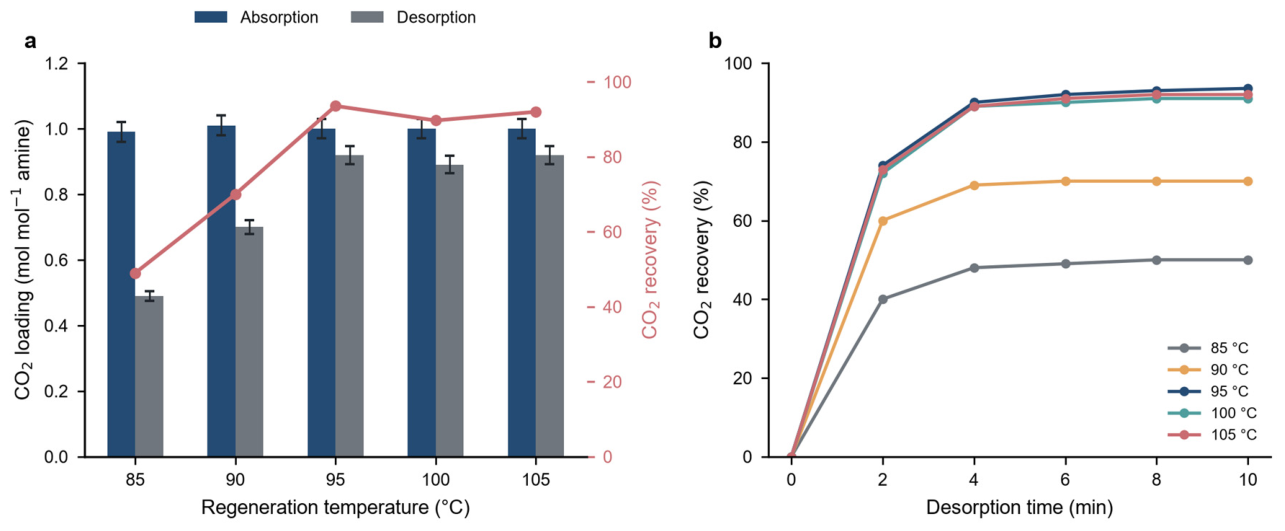
The influence of desorption temperatures at 85, 90, 95, 100, and 105 °C on the desorption performance of the optimized compounded alkanolamine solutions was investigated. The experimental results are shown in Figure 7.
Figure 7.
Influence of desorption temperature on the CO2 desorption performance of compounded alkanolamine solutions: (a) CO2 loading and recovery at different desorption temperatures; (b) CO2 recovery profiles during desorption at different regeneration temperatures. Error bars in panel (a) represent mean ± standard deviation (SD) from three independent measurements (n = 3); relative SD values were within approximately 3%.
As revealed in Figure 7, with similar absorption capacities, the desorbed amount and CO2 recovery increased as the desorption temperature rose from 85 to 95 °C. At a desorption temperature of 95 °C, the system achieved the highest CO2 recovery of 93.56%. Further increases to 100 and 105 °C resulted in recoveries of 89.68% and 91.99%, respectively, so increasing the temperature above 95 °C did not further improve the measured recovery. For long-term operation, prolonged exposure at elevated temperature may also increase the degradation risk of amine solvents [35,36].
Considering the measured CO2 recovery, operating temperature, energy consumption, and cyclic operation, 95 °C was selected as the regeneration temperature for subsequent experiments.
3.3.3. Effect of Compounded Alkanolamine Solution Concentration on CO2 Absorption and Desorption Performance
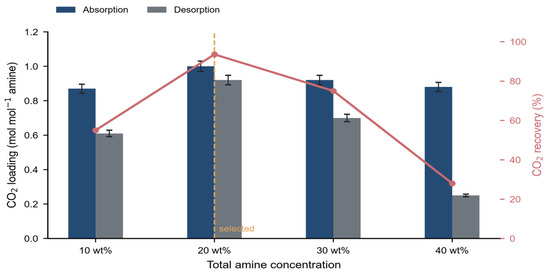
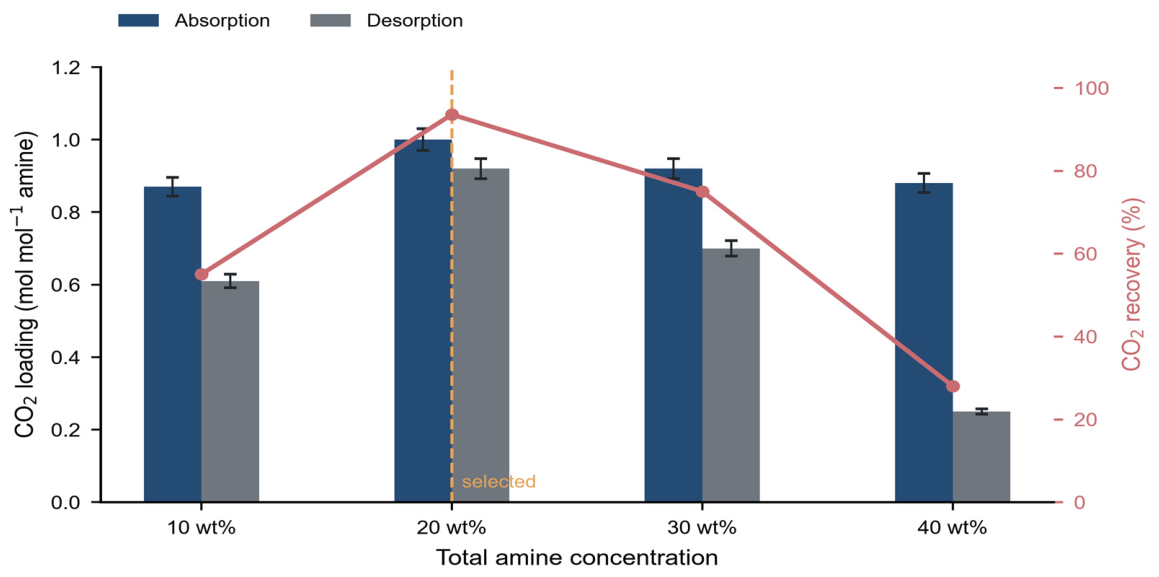
Based on the selected absorption temperature (30 °C) and desorption temperature (95 °C), CO2 absorption and desorption experiments were conducted using composite amine solutions with mass fractions of 10%, 20%, 30%, and 40 wt%. The effect of solution concentration on CO2 absorption capacity and desorption performance is shown in Figure 8. The 20 wt% solution gave the highest absorption capacity, reaching 1.0 mol CO2·mol−1 amine at the end of the reaction. The absorption loadings of the 10, 30, and 40 wt% solutions were similar but lower. Therefore, 20 wt% was selected as the optimal absorption concentration.
Figure 8.
Influence of compounded alkanolamine solution concentration on CO2 capture performance.
For desorption, the highest CO2 recovery was also obtained at 20 wt%, reaching 93.56%, whereas the other concentrations showed lower recoveries and desorbed loadings. At 10 wt%, the lower total amine inventory may contribute to the lower effective absorption/desorption performance. At 30 and 40 wt%, the decrease in performance may be associated with concentration-dependent changes in viscosity, CO2 diffusivity, and species equilibrium. Concentration-dependent increases in viscosity and associated mass-transfer limitations have been reported for other CO2-capture solvents [37]. Because viscosity was not measured for the present blended system, it is considered only as a possible contributor rather than a demonstrated cause. Considering both absorption capacity and CO2 recovery, subsequent experiments used a 20 wt% solution.
Synthesizing the above investigations, the final selected formulation was the TETA/DEA/AMP blended amine with a mass ratio of 6/1/2. The corresponding experimental conditions were a total amine concentration of 20 wt%, an absorption temperature of 30 °C, and a desorption temperature of 95 °C.
3.3.4. Comparison of Microwave Heating and Conventional Heating for CO2 Desorption Performance
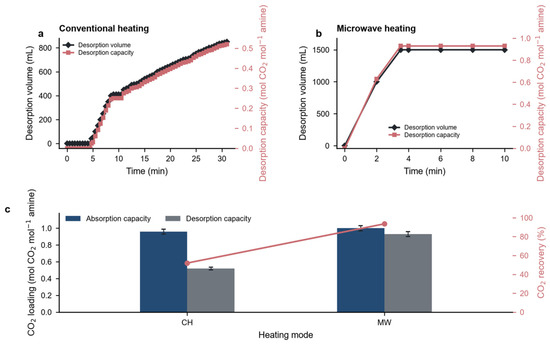
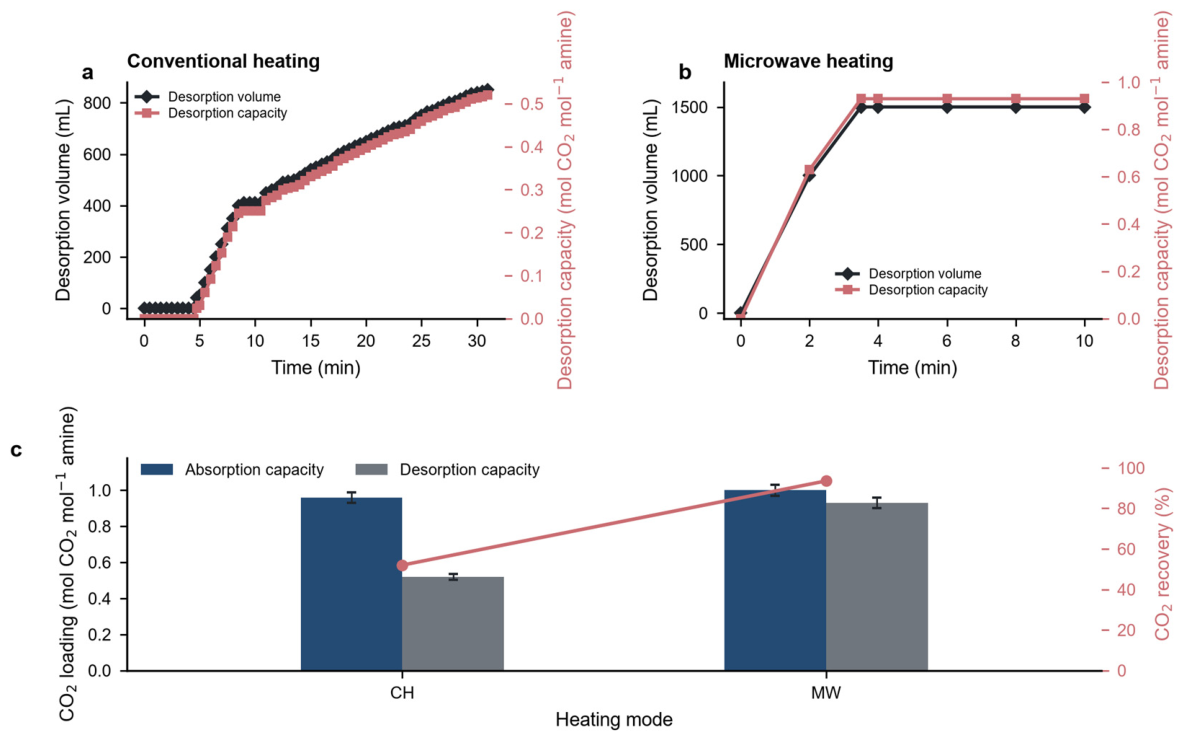
The comparison between microwave (MW) heating desorption and conventional heating (CH) desorption performance is shown in Figure 9. As illustrated in Figure 9a,b, microwave-assisted desorption was completed within approximately 4 min, whereas conventional thermal desorption required about 30 min to reach completion under the same target-temperature conditions. Figure 9c further indicates that, at comparable CO2 absorption loadings, the desorbed CO2 amount and corresponding CO2 recovery obtained under microwave heating were higher than those achieved by conventional heating over the same time scale. This difference indicates that microwave irradiation markedly accelerates the desorption process.
Figure 9.
Comparison of CO2 desorption kinetics and absorption–desorption performance under conventional and microwave heating: (a) desorption volume and desorption capacity profiles during conventional heating; (b) desorption volume and desorption capacity profiles during microwave heating; (c) comparison of absorption/desorption capacities and CO2 recovery between conventional and microwave heating.
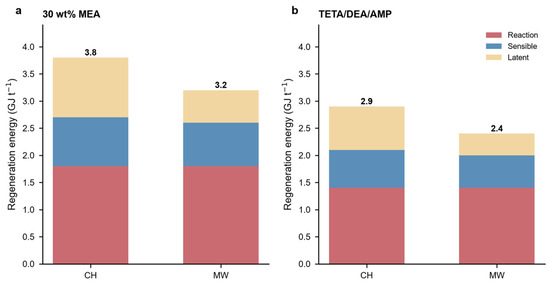
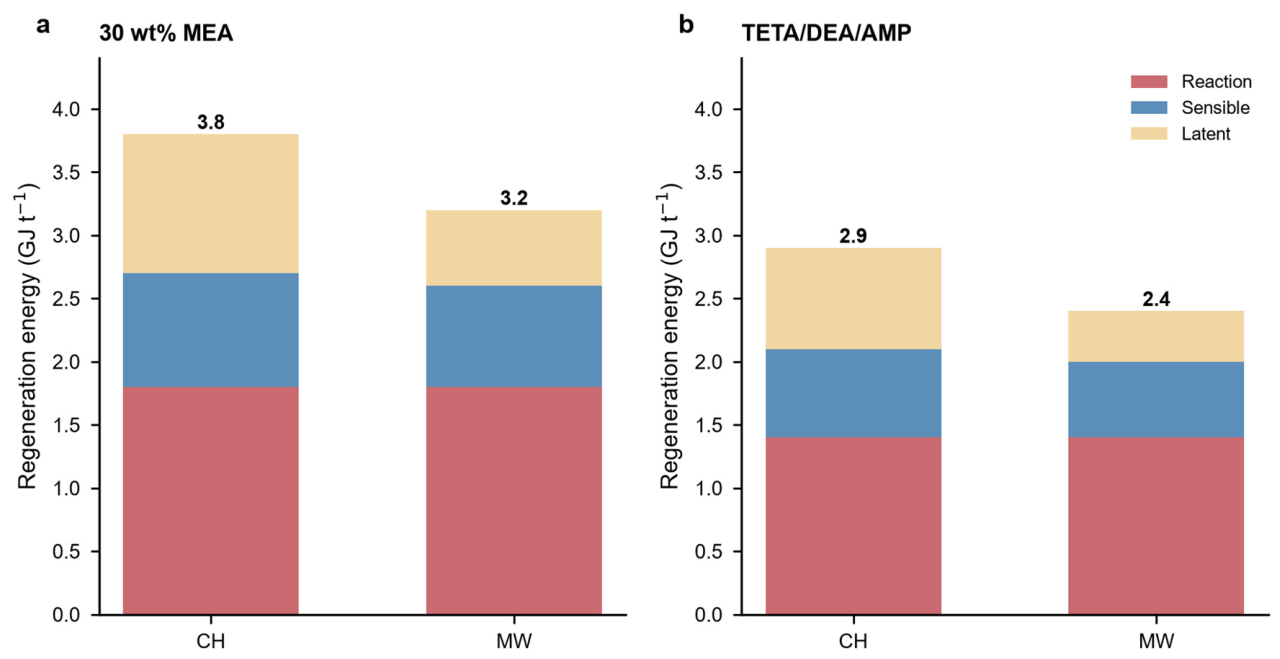
For practical benchmarking, 30 wt% MEA was compared with the optimized TETA/DEA/AMP solvent at its selected concentration of 20 wt%, as shown in Figure 10. The two solvents were therefore evaluated at their respective selected concentrations, and the comparison reflects practical regeneration performance under the corresponding operating conditions. Using the shortcut calculation method in Reference [38], the estimated total regeneration energy for 30 wt% MEA decreased from approximately 3.8 GJ·t−1 CO2 under conventional heating to 3.2 GJ·t−1 CO2 under microwave heating. The sensible-heat contribution decreased from 0.9 to 0.8 GJ·t−1 CO2 and the latent-heat contribution from 1.1 to 0.6 GJ·t−1 CO2, whereas the reaction-heat contribution remained approximately 1.8 GJ·t−1 CO2. For the optimized TETA/DEA/AMP system, the corresponding estimated total decreased from approximately 2.9 to 2.4 GJ·t−1 CO2 (approximately 17.2%); reaction heat remained approximately 1.4 GJ·t−1 CO2, while sensible and latent heat decreased from approximately 0.7 and 0.8 to 0.6 and 0.4 GJ·t−1 CO2, respectively.
Figure 10.
Comparison of CO2 regeneration energy consumption between 30 wt% MEA (a) and the optimized TETA/DEA/AMP (b) ternary absorbent under conventional and microwave-assisted heating.
3.3.5. Cyclic Performance of the Optimized TETA/DEA/AMP Blend
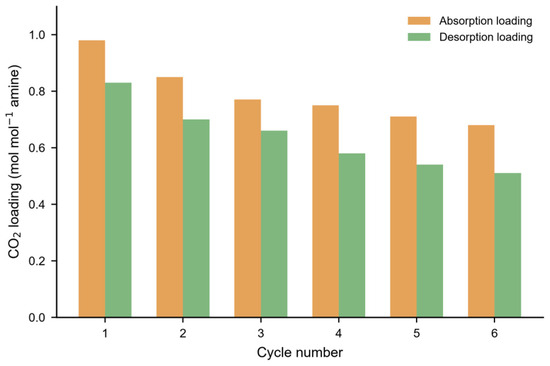
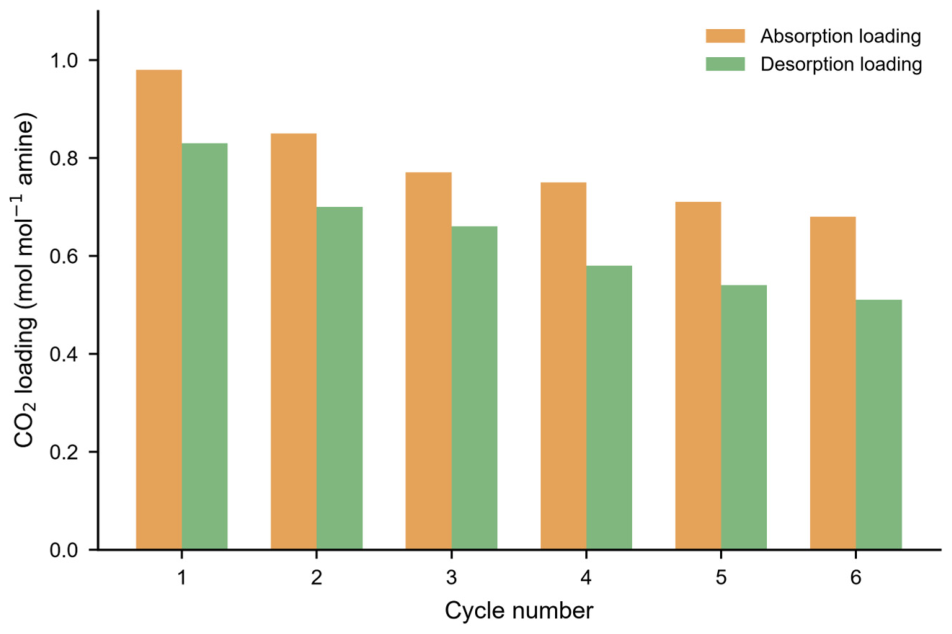
To evaluate the cyclic performance of the optimized blend, six consecutive absorption–desorption cycles were conducted under the selected operating conditions. As shown in Figure 11, the blend retained measurable capture and regeneration capacity throughout the six-cycle test. The absorption loading decreased from approximately 0.98 mol CO2·mol−1 amine in the first cycle to 0.68 mol CO2·mol−1 amine in the sixth cycle, while the corresponding desorption loading decreased from approximately 0.83 to 0.51 mol CO2·mol−1 amine. Thus, the sixth-cycle absorption and desorption loadings remained at approximately 69% and 61% of their first-cycle values, respectively. The gradual decline may be associated with solvent or water loss by volatilization or entrainment, composition drift, incomplete regeneration, changes in absorbed-species stability, or possible thermal/oxidative degradation under longer or more severe exposure [32,35,36]. Because no post-cycle composition or degradation-product analysis was performed, the relative contributions of these effects cannot be distinguished from the present six-cycle test.
Figure 11.
CO2 loading and desorption amounts over 6 consecutive MW-assisted absorption– and desorption cycles.
3.4. Effect of Water Content on CO2 Capture by the Optimal Formulation
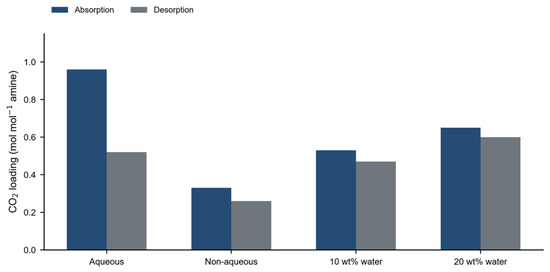
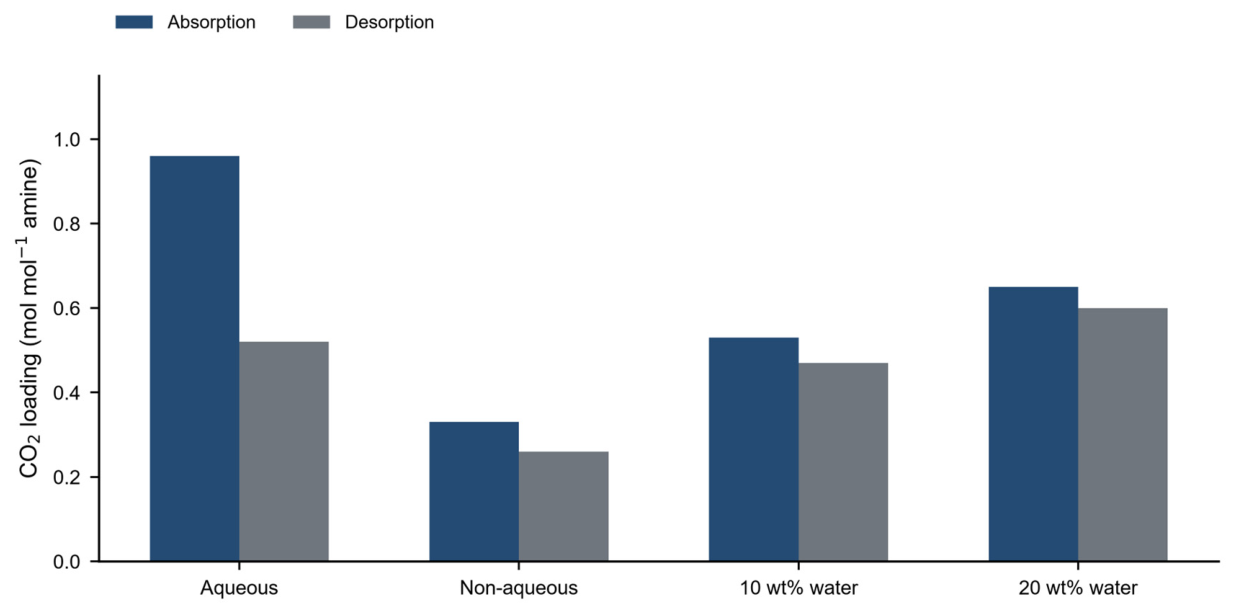
This subsection explores whether reducing water content (using n-butanol as a representative organic diluent) could improve regeneration characteristics. For comparison, non-aqueous, low-water (10 wt% and 20 wt%), and fully aqueous systems were investigated under identical experimental conditions. The experimental results are presented in Figure 12. The exact compositions of the tested formulations are provided in Table S8.
Figure 12.
Impact of different water contents on CO2 capture performance of the optimal compounded system.
As shown in Figure 12, the non-aqueous system exhibited relatively low CO2 absorption and desorption performance, with an absorption capacity of 0.33 mol CO2·mol−1 amine and a desorbed amount of 0.26 mol CO2·mol−1 amine. When the water content was increased to 10 and 20 wt%, the CO2 absorption capacities increased to 0.53 and 0.65 mol CO2·mol−1 amine, respectively, while the corresponding desorbed amounts reached 0.47 and 0.60 mol CO2·mol−1 amine. These differences may reflect combined effects of viscosity, CO2 diffusivity, solvent polarity, water activity, and absorbed-species equilibrium [37]. Because viscosity and dielectric properties were not measured in this work, no single property is identified as the demonstrated cause. Under the experimental conditions examined in this work, the fully aqueous system exhibited the highest CO2 absorption capacity, desorbed amount, and CO2 recovery among the tested formulations. This conclusion is specific to the tested TETA/DEA/AMP-water-n-butanol formulations and laboratory-scale conditions.
4. Conclusions
This study developed an optimized TETA/DEA/AMP blended amine solvent (mass ratio 6:1:2) for microwave-assisted regeneration by integrating Response Surface Methodology with entropy-weighted TOPSIS analysis. Under the optimized conditions (20 wt%, 30 °C absorption, and 95 °C microwave regeneration), the solvent achieved an absorption capacity of 1.0 mol CO2·mol−1 amine and a CO2 recovery of 93.56%. Microwave-assisted desorption was completed in approximately 4 min compared with about 30 min under conventional heating, and the estimated total regeneration energy of the optimized blend was approximately 2.4 GJ·t−1 CO2 under microwave heating. Within the tested water/n-butanol formulations, the fully aqueous system provided the best overall absorption–-regeneration performance.
It is important to note that these findings were obtained under idealized laboratory conditions. Consequently, the critical next step involves pilot-scale validation to assess the process’s techno-economic feasibility and long-term stability under real flue gas conditions, which is essential for advancing this technology toward practical industrial application. This work provides a promising integrated solution for developing efficient and low-energy carbon capture technologies.
Supplementary Materials
The following supporting information can be downloaded at: https://www.mdpi.com/article/10.3390/separations13090242/s1, Figure S1: Perturbation plots for (a) absorbed CO2 mass, (b) CO2 recovery, and predicted versus actual values for (c) absorption capacity and (d) CO2 recovery; Figure S2: Normal probability plots for (a) absorbed CO2 mass and (b) CO2 recovery; Figure S3: Diagnostic plots for the BBD models based on all 17 runs, including predicted versus actual values, studentized residuals versus predicted values, and studentized residuals versus run order for absorbed CO2 mass and CO2 recovery; Table S1: Instrument specifications and metrological inputs used in the uncertainty analysis; Table S2: BBD experimental design and measured absorbed CO2 mass, desorbed CO2 mass, and CO2 recovery; Table S3: ANOVA for the reduced quadratic regression model of absorbed CO2 mass; Table S4: ANOVA for the quadratic regression model of CO2 recovery; Table S5: Fit statistics for the RSM models; Table S6: Normalized values for absorbed CO2 mass and CO2 recovery in the seven-point TOPSIS decision matrix; Table S7: Entropy-method weight calculation for the seven-point TOPSIS decision matrix; Table S8: Exact compositions used in the water/n-butanol comparison; Table S9: Validation of the XH-100B built-in thermocouple using atmospheric boiling points of aqueous MEA solutions.
Author Contributions
Methodology, X.W., Z.Z. and J.H.; Software, X.W., J.W. and Z.Z.; Formal analysis, Z.Z.; Resources, R.R., Q.L., Y.L. and J.H.; Data curation, R.R. and Q.L.; Writing—original draft, R.R., Q.L. and J.W.; Writing—review and editing, X.W., J.W., Z.Z., Y.L. and J.H.; Visualization, Z.Z. All authors have read and agreed to the published version of the manuscript.
Funding
This work was financially supported by the Xinjiang Uygur Region “One Case, One Policy” Strategic Talent Introduction Project (No. XQZX20240054), the Innovative Talents specific project Foundation of Karamay (No. XQZX20240089), and the “Tianshan Talents” Foundation (2023TSYCJC0065) of Xinjiang Uygur Autonomous Region and the National Natural Science Foundation of China (52360003).
Data Availability Statement
The original contributions presented in this study are included in the article/Supplementary Material. Further inquiries can be directed to the corresponding authors.
Acknowledgments
The authors thank the State Key Laboratory of Heavy Oil Processing for providing the experimental platform and technical support for this work.
Conflicts of Interest
The authors declare no conflicts of interest.
References
- Rochelle, G.T. Amine scrubbing for CO2 capture. Science 2009, 325, 1652–1654. [Google Scholar] [CrossRef] [Scilit]
- Bui, M.; Adjiman, C.S.; Bardow, A.; Anthony, E.J.; Boston, A.; Brown, S.; Fennell, P.S.; Fuss, S.; Galindo, A.; Hackett, L.A.; et al. Carbon capture and storage (CCS): The way forward. Energy Environ. Sci. 2018, 11, 1062–1176. [Google Scholar] [CrossRef] [Scilit]
- MacDowell, N.; Florin, N.; Buchard, A.; Hallett, J.; Galindo, A.; Jackson, G.; Adjiman, C.S.; Williams, C.K.; Shah, N.; Fennell, P. An overview of CO2 capture technologies. Energy Environ. Sci. 2010, 3, 1645–1669. [Google Scholar] [CrossRef] [Scilit]
- Ochedi, F.O.; Yu, J.; Yu, H.; Liu, Y.; Hussain, A. Carbon dioxide capture using liquid absorption methods: A review. Environ. Chem. Lett. 2021, 19, 77–109. [Google Scholar] [CrossRef] [Scilit]
- Guo, C.; Chen, S.; Chen, S.; Zhang, Y. 13C NMR quantification of the absorption and desorption characteristics of monoethanolamine (MEA) with CO2. Chem. Ind. Eng. Prog. 2014, 33, 3101–3106. [Google Scholar]
- Zhang, R.; Zhang, X.; Yang, Q.; Yu, H.; Liang, Z.; Luo, X. Analysis of the reduction of energy cost by using MEA-MDEA-PZ solvent for post-combustion carbon dioxide capture (PCC). Appl. Energy 2017, 205, 1002–1011. [Google Scholar] [CrossRef] [Scilit]
- Shunji, K.; Shen, X.; Yang, W. Investigation of CO2 desorption kinetics in MDEA and MDEA+ DEA rich amine solutions with thermo-gravimetric analysis method. Int. J. Greenh. Gas Control 2020, 95, 102947. [Google Scholar] [CrossRef] [Scilit]
- Rongwong, W.; Jiraratananon, R.; Atchariyawut, S. Experimental study on membrane wetting in gas-liquid membrane contacting process for CO2 absorption by single and mixed absorbents. Sep. Purif. Technol. 2009, 69, 118–125. [Google Scholar] [CrossRef] [Scilit]
- Mandal, B.; Guha, M.; Biswas, A.; Bandyopadhyay, S. Removal of carbon dioxide by absorption in mixed amines: Modelling of absorption in aqueous MDEA/MEA and AMP/MEA solutions. Chem. Eng. Sci. 2001, 56, 6217–6224. [Google Scholar] [CrossRef] [Scilit]
- Du, J.; Yang, W.; Xu, L.; Bei, L.; Lei, S.; Li, W.; Liu, H.; Wang, B.; Sun, L. Review on post-combustion CO2 capture by amine blended solvents and aqueous ammonia. Chem. Eng. J. 2024, 488, 150954. [Google Scholar] [CrossRef] [Scilit]
- Fischer, C.D.; Mussati, M.C.; Morosuk, T.; Mussati, S. Optimization of hybrid CO2 capture processes. Energy 2025, 330, 136724. [Google Scholar] [CrossRef] [Scilit]
- Liu, H.; Liu, R.; Bhatti, A.H.; Waris, M.; Zhang, Q.; Niu, Y.; Barzagli, F.; Xiao, R.; Li, C.; Zhang, R. CO2 absorption behavior in dual-amine blends of primary and tertiary amine: Machine learning, NMR analysis, and performance evaluation. Chem. Eng. Sci. 2025, 316, 121947. [Google Scholar] [CrossRef] [Scilit]
- He, X.; He, H.; Barzagli, F.; Amer, M.W.; Li, C.; Zhang, R. Analysis of the energy consumption in solvent regeneration processes using binary amine blends for CO2 capture. Energy 2023, 270, 126903. [Google Scholar] [CrossRef] [Scilit]
- Conway, W.; Bruggink, S.; Beyad, Y.; Luo, W.; Melián-Cabrera, I.; Puxty, G.; Feron, P. CO2 absorption into aqueous amine blended solutions containing monoethanolamine (MEA), N,N-dimethylethanolamine (DMEA), N,N-diethylethanolamine (DEEA) and 2-amino-2-methyl-1-propanol (AMP) for post-combustion capture processes. Chem. Eng. Sci. 2015, 126, 446–454. [Google Scholar] [CrossRef] [Scilit]
- Chen, P.-C.; Jhuang, J.-H.; Wu, T.-W.; Yang, C.-Y.; Wang, K.-Y.; Chen, C.-M. Capture of CO2 Using Mixed Amines and Solvent Regeneration in a Lab-Scale Continuous Bubble-Column Scrubber. Appl. Sci. 2023, 13, 7321. [Google Scholar] [CrossRef] [Scilit]
- Jensen, W.A. Response Surface Methodology: Process and Product Optimization Using Designed Experiments 4th edition. J. Qual. Technol. 2017, 49, 186–188. [Google Scholar] [CrossRef] [Scilit]
- Gunst, R.F. Response Surface Methodology: Process and Product Optimization Using Designed Experiments. Technometrics 1996, 38, 284–286. [Google Scholar] [CrossRef] [Scilit]
- Hamze, H.; Akia, M.; Yazdani, F. Optimization of biodiesel production from the waste cooking oil using response surface methodology. Process Saf. Environ. Prot. 2015, 94, 1–10. [Google Scholar] [CrossRef] [Scilit]
- Helene, L.; Dominique, P.; Pierre-Louis, C. New Amines for CO2 Capture. II. Oxidative Degradation Mechanisms. Ind. Eng. Chem. Res. 2009, 48, 9068–9075. [Google Scholar] [CrossRef] [Scilit]
- Pietrogrande, M.C.; Bacco, D. GC-MS analysis of water-soluble organics in atmospheric aerosol: Response surface methodology for optimizing silyl-derivatization for simultaneous analysis of carboxylic acids and sugars. Anal. Chim. Acta 2011, 689, 257–264. [Google Scholar] [CrossRef] [Scilit]
- Barzagli, F.; Lai, S.; Mani, F. CO2 Capture by Liquid Solvents and their Regeneration by Thermal Decomposition of the Solid Carbonated Derivatives. Chem. Eng. Technol. 2013, 36, 1847–1852. [Google Scholar] [CrossRef] [Scilit]
- Ramamoorthy, S.V.; Balraj, A. Development of an empirical model for microwave assisted CO2 stripping/solvent recovery. In Chemical Product and Process Modeling; De gruyter: Berlin, Germany, 2025. [Google Scholar] [CrossRef] [Scilit]
- Rehemituli, R.; Zhang, Z.; Yang, X.; Yang, F.; Liu, Y.; Hou, J. Research on CO2 Desorption Using Microwave-Assisted Novel Blended Alkanolamine Formulations. Processes 2024, 12, 2547. [Google Scholar] [CrossRef] [Scilit]
- Pu, Z.; Yuan, J.; Gao, J. Microwave-assisted carbon capture and conversion: Materials synthesis, CO2 regeneration and catalysis. J. Environ. Chem. Eng. 2025, 13, 119884. [Google Scholar] [CrossRef] [Scilit]
- Strobel, M.; Erguvan, M.; Amini, S. Microwave-assisted CO2 capture: Adsorption and regeneration performance in monolithic and fluidized bed reactors with zeolite 13X. J. Environ. Chem. Eng. 2025, 13, 117395. [Google Scholar] [CrossRef] [Scilit]
- Bougie, F.; Pokras, D.; Fan, X. Novel non-aqueous MEA solutions for CO2 capture. Int. J. Greenh. Gas Control 2019, 86, 34–42. [Google Scholar] [CrossRef] [Scilit]
- Chowdhury, F.A.; Yamada, H.; Higashii, T.; Goto, K.; Onoda, M. CO2 Capture by Tertiary Amine Absorbents: A Performance Comparison Study. Ind. Eng. Chem. Res. 2013, 52, 8323–8331. [Google Scholar] [CrossRef] [Scilit]
- Pandey, M.; Mondal, M.K. CO2 Absorption–Desorption in Triamines Blend: Equilibrium Studies, 13CNMR Speciation, and Regeneration Energy Profiling. Energy Fuels 2025, 39, 22543–22562. [Google Scholar] [CrossRef] [Scilit]
- Puxty, G.; Rowland, R.; Allport, A.; Yang, Q.; Bown, M.; Burns, R.; Maeder, M.; Attalla, M. Carbon dioxide postcombustion capture: A novel screening study of the carbon dioxide absorption performance of 76 amines. Environ. Sci. Technol. 2009, 43, 6427–6433. [Google Scholar] [CrossRef] [Scilit]
- Schäffer, A.; Brechtel, K.; Scheffknecht, G. Comparative study on differently concentrated aqueous solutions of MEA and TETA for CO2 capture from flue gases. Fuel 2012, 101, 148–153. [Google Scholar] [CrossRef] [Scilit]
- Wang, R.; Li, D.F.; Liang, D.T. Modeling of CO2 capture by three typical amine solutions in hollow fiber membrane contactors. Chem. Eng. Process. Process Intensif. 2004, 43, 849–856. [Google Scholar] [CrossRef] [Scilit]
- Liu, F.; Jing, G.; Zhou, X.; Lv, B.; Zhou, Z. Performance and Mechanisms of Triethylene Tetramine (TETA) and 2-Amino-2-methyl-1-propanol (AMP) in Aqueous and Nonaqueous Solutions for CO2 Capture. ACS Sustain. Chem. Eng. 2018, 6, 1352–1361. [Google Scholar] [CrossRef] [Scilit]
- Box, G.E.P.; Behnken, D.W. Some New Three Level Designs for the Study of Quantitative Variables. Technometrics 1960, 2, 455–475. [Google Scholar] [CrossRef]
- Hwang, C.-L.; Yoon, K. Multiple Attribute Decision Making: Methods and Applications A State-of-the-Art Survey; Springer: Berlin, Germany, 1981. [Google Scholar] [CrossRef] [Scilit]
- Saeed, I.M.; Si Ali, B.; Jan, B.M.; Basirun, W.J.; Mazari, S.A.; Birima, I.A.O. Thermal degradation of diethanolamine at stripper condition for CO2 capture: Product types and reaction mechanisms. Chin. J. Chem. Eng. 2019, 27, 2900–2908. [Google Scholar] [CrossRef] [Scilit]
- Wang, T.; Jens, K.-J. A study of oxidative degradation of AMP for post-combustion CO2 capture. Energy Procedia 2012, 23, 102–110. [Google Scholar] [CrossRef] [Scilit]
- Tataru-Farmus, R.E.; Harja, M.; Tonucci, L.; Coccia, F.; Ciulla, M.; Lazar, L.; Soreanu, G.; Cretescu, I. Green CO2 Capture from Flue Gas Using Potassium Carbonate Solutions Promoted with Amino Acid Salts. Clean Technol. 2025, 7, 99. [Google Scholar] [CrossRef] [Scilit]
- Kim, H.; Hwang, S.J.; Lee, K.S. Novel Shortcut Estimation Method for Regeneration Energy of Amine Solvents in an Absorption-Based Carbon Capture Process. Environ. Sci. Technol. 2015, 49, 1478–1485. [Google Scholar] [CrossRef] [Scilit]

Disclaimer/Publisher’s Note: The statements, opinions and data contained in all publications are solely those of the individual author(s) and contributor(s) and not of MDPI and/or the editor(s). MDPI and/or the editor(s) disclaim responsibility for any injury to people or property resulting from any ideas, methods, instructions or products referred to in the content. |
© 2026 by the authors. Licensee MDPI, Basel, Switzerland. This article is an open access article distributed under the terms and conditions of the Creative Commons Attribution (CC BY) license.