


Abstract
An analytical method was established for the rapid determination of 45 pigments and preservatives in edible ink by ultra-high performance liquid chromatography coupled with triple quadrupole tandem mass spectrometry (UHPLC-MS/MS), which provides technical support for the composition analysis and industrial development of edible ink. The samples were easily extracted with 75% aqueous methanol solution and purified with a Captiva EMR-Lipid HF solid-phase extraction cartridge. After filtration through a polytetrafluoroethylene (PTFE) membrane, the analytes were determined by UHPLC-MS/MS under multiple reaction monitoring (MRM) mode in both positive and negative ion modes. Poroshell 120 AQ-C18 was selected as the analytical column, and valve switching timing control was adopted during the gradient elution process. The external standard method was used for quantitative analysis. In the established method, the 45 pigments and preservatives exhibited good linear relationships within the mass concentration range of 0.0002–200.0 μg/mL. The limits of detection (LOD) and limits of quantification (LOQ) were 0.0004–8.00 mg/kg and 0.001–20.00 mg/kg, respectively. Using 25% aqueous glycerol solution as the blank matrix, the recoveries of analytes at different spiked levels met the detection requirements. The established method is simple and rapid, and can be applied to the qualitative and quantitative detection of typical pigments and preservatives in edible ink.
1. Introduction
Ink is a viscous liquid or paste applied for printing and imaging, which functions to efficiently transfer texts and patterns onto the surface of substrates such as paper, fabric and plastics. Commercially available inks are generally divided into two categories: inks for direct food contact and inks for indirect food contact [1,2]. Inks for indirect food contact are usually applied to the outer layer of food packaging with a wide safety application range. In contrast, inks for direct food contact are special compound food additives developed to meet food safety standards, and are also known as edible ink [3,4,5,6,7]. With the application of food-grade inkjet printers, edible ink can realize the functions of food pattern printing, text marking, brand identification, traceability information recording and personalized decoration [8,9]. Owing to its advantages of edibility, high printing precision, stable color performance and adaptability to industrial production, edible ink has been rapidly popularized in major global food consumption markets including Europe, America, China and Southeast Asia, with its application scenarios continuously expanding. At present, edible ink has been widely used in cake decorating, frosting decoration, chocolate surface printing, candy coating, cookies and biscuits, ice cream surface decoration, milk foam of beverages, health food, infant complementary food, pharmaceutical sugar coating, ready-to-eat meal packages and other directly consumed foods [10,11,12]. It has become a key carrier for improving product added value, strengthening brand recognition, realizing information traceability, and cultural empowerment. With the digital customization and functional innovation of the global food industry, direct printing technology on food surfaces has become an important symbol of the modernization of the food industry [13,14,15].
Typically, edible printing inks are formulated via compounding colorants, antimicrobial agents, humectants, dispersants, solvents and auxiliary functional additives. The conformity of ink formulations, purity of constituent ingredients and control efficiency of residual substances exert a direct bearing on the physical health of consumers across the globe, rendering them a central research and regulatory priority in international food safety governance, cross-border regulatory equivalence schemes, and the advancement of high-end industrial systems for edible printing materials [16,17]. Pigments and preservatives are two core functional components of edible ink with the widest application, the most prominent safety risks and the strictest international supervision [18]. Synthetic food pigments are widely used in high-appearance foods such as chocolate, candy and baked goods due to their stable color fastness, light and heat resistance, and low cost [19,20,21]. Preservatives are used to inhibit the proliferation of molds, yeasts, bacteria and other microorganisms during the production, storage, transportation and application of ink, so as to prevent product deterioration under high temperature, high humidity and long shelf-life conditions [22,23]. Notably, with the gradual extension of edible ink application scenarios to high-sensitivity fields such as infant food, special dietary food and functional food, the safety risk is increasingly prominent. International toxicological data have confirmed that non-edible industrial pigments including Rhodamine B, Basic Flavine O, Acid Orange II, Direct Red 28 and Erythrosine possess potential carcinogenic, mutagenic and sensitizing properties, and have been listed as prohibited substances in food by the European Food Safety Authority (EFSA), the U.S. Food and Drug Administration (FDA) and the Codex Alimentarius Commission (CAC). Petroleum-based synthetic pigments such as Tartrazine, Sunset Yellow FCF, Allura Red AC, Quinoline Yellow WS and Brilliant Blue FCF may affect children’s cognitive and behavioral development, and European and American countries have continuously tightened their maximum permitted usage limits. In terms of preservatives, long-term excessive intake of benzoic acid, sorbic acid, dehydroacetic acid, natamycin and parabens may interfere with endocrine function and affect the homeostasis of intestinal flora. EFSA and FDA have continuously reduced the permissible exposure levels based on the latest toxicological assessments. To support the development of the global edible ink market and protect consumer safety, it is necessary to carry out risk monitoring on the main components of edible ink [24,25,26,27].
Globally, a sound industrialized supply chain for edible printing inks has been well established. Major overseas manufacturers include Sun Chemical, Toyochem, Wilton and Linx. Their ink formulations are primarily composed of food-grade glycerol, malt syrup and plant-derived colorants, which have passed international food safety certification criteria issued by the U.S. FDA and European EFSA. Such edible inks are widely deployed in industrial manufacturing processes, including pattern printing on bakery products, high-speed marking of candies and chocolates, traceability coding for fresh agricultural commodities, and surface identification printing of pharmaceutical tablets. We will first take representative products from Sun Chemical as a case study. The SensiJet FSE series is a low-viscosity synthetic edible ink compatible with piezoelectric and thermal inkjet printheads, enabling direct printing onto substrates such as fondant, edible rice sheets and cookies. By contrast, the FSR-8 series is engineered for medium-viscosity industrial piezoelectric printheads, characterized by high color saturation and superior long-run continuous printing stability. This product line is primarily utilized for mass inline printing on bakery production lines, and also satisfies the marking demands of pharmaceutical formulations including tablets and hard capsules. Although the detection technologies for food additives have become increasingly mature, dedicated detection methods targeting the special matrix of edible ink are still imperfect [28,29,30,31]. The EU EN standards, U.S. AOAC standards, Chinese national standard series and Japanese Ministry of Health, Labour and Welfare methods are all applicable to conventional foods such as beverages, meat products, pastries and condiments, with HPLC-UV/Vis as the mainstream technology, which can only determine a limited range of target analytes. The current conventional pretreatment methods generally suffer from cumbersome operation, low throughput and weak anti-matrix interference capability. Although some studies have reported the application of UHPLC-MS/MS, GC-MS, capillary electrophoresis, rapid immunoassay and other technologies for multi-component screening, there is no available method that can simultaneously cover multiple synthetic pigments, illegal dyes, preservatives and bacteriostatic agents.
2. Materials and Methods
Organic solvents used in this method, including methanol, acetonitrile and ammonium acetate, were of chromatographic grade; glycerol (glycerin) was of analytical grade with purity ≥ 99% (ANPEL Laboratory Technologies, Shanghai, China). The names and corresponding CAS numbers of the 45 analytes are shown in Table S1 in Supporting Material (SM). Six kinds of edible inks were adopted in the experiment. Among them, four were compound food colorants (black, red, yellow and blue) produced in Italy, and the other two were quick-drying compound food colorant and CIS INK compound food colorant, both produced in China. These six commercially available compound colorants are named sequentially as Colorant A to F.
The instruments and consumables used in this work are as follows. Chromatographic separation was performed on a Poroshell 120 AQ-C18 column (3.0 × 50 mm, 2.7 μm). The analytical platform consisted of an 1290 Infinity III UHPLC (Agilent, Santa Clara, CA, USA) system coupled with an AB SCIEX Triple Quad™ 5500+ (Danaher, Washington, DC, USA) triple quadrupole mass spectrometer. Other supporting equipment included a Sartorius BSA423S analytical balance (Florenz Sartorius, Göttingen, Germany), Vortex 1 mixer (IKA, Staufen, Germany), Turbo Vap LV nitrogen evaporator (Biotage, Uppsala, Sweden), and 0.45 μm SF130-45-PTFE-HL syringe filters.
Nine varieties of solid-phase extraction cartridges were selected for comparative tests, namely CNW BOND HLB (divinylbenzene-N-vinylpyrrolidone copolymer), PS-DVB (polystyrene-divinylbenzene), WAX (weak anion exchange), neutral alumina (ALN), polyamide (PA), MAX (strong anion exchange), C18 (octadecylsilane-bonded silica), amino-bonded silica (NH2), and Captiva EMR-Lipid HF cartridges. Three types of filter membranes were applied in sample pretreatment, including polyvinylidene fluoride (PVDF), polyamide (nylon), and polytetrafluoroethylene (PTFE) membranes.
2.1. Preparation of Standard Solutions, Blank Matrix and Sample Pretreatment
(a) Single standard stock solution (1000 mg/L). An equivalent amount of 50 mg (accurate to 0.1 mg) of each pigment standard was accurately weighed, dissolved and transferred into a 50 mL volumetric flask, diluted to the mark with methanol, and stored at −18 °C under dark conditions.
(b) Mixed standard working solution. The single standard solutions were diluted with 75% aqueous methanol solution to prepare the required mixed standard working solution, which was freshly prepared before use.
(c) Procedures for blank matrix and spiked recovery experiments. Weigh 0.5 g of 25% glycerol aqueous solution as the blank matrix. Add 50 μL, 100 μL and 500 μL of the previously prepared mixed standard working solution to separate portions of the blank matrix, and dilute each to 1 mL with 75% aqueous methanol. Follow the detailed procedures for low-concentration samples described in the subsequent section (d) to prepare spiked recovery samples at three concentration levels with six replicates per level.
(d) For samples with low analyte contents: Accurately weigh 0.5 g (precision to 1 mg) of sample into a 15 mL centrifuge tube, dilute to 1 mL with 75% aqueous methanol, and vortex at 3000 r/min for 1 min. Transfer the sample solution to a Captiva EMR-Lipid HF cartridge, then elute with 5 mL of 80% aqueous acetonitrile. Collect the eluate and dry it under nitrogen at 50 °C down to 150–200 μL then reconstitute to 1 mL with 80% aqueous acetonitrile. Vortex for uniform mixing and filter via a PTFE membrane prior to instrumental analysis.
(e) For high-concentration samples: Accurately weigh 0.5 g compound food colorant (accurate to 1 mg) into a 25 mL volumetric flask and make up to the mark with 75% aqueous methanol. Dilute the resulting solution 10 times with 75% aqueous methanol. Prepare extra serial dilution gradients for samples with excessively high analyte concentrations. Load 1 mL of diluted sample solution onto a Captiva EMR-Lipid HF cartridge and elute with 5 mL 80% aqueous acetonitrile. Collect the eluate and concentrate under nitrogen at 50 °C to 150–200 μL. Reconstitute to 1 mL with 80% aqueous acetonitrile, vortex thoroughly and filter through a PTFE membrane prior to instrumental analysis.
2.2. Instrumental Conditions
Chromatographic conditions: Poroshell 120 AQ-C18 chromatographic column was used with a column temperature of 40 °C. Mobile phase A was 5 mmol/L ammonium acetate aqueous solution, and mobile phase B was acetonitrile. The flow rate and injection volume were 0.350 mL/min and 5 μL, respectively. The detailed gradient elution procedure is shown in Table 1.
Table 1.
Gradient elution procedure.
Mass spectrometric parameters were set as follows: the capillary voltage was 4.5 kV, the nebulizer gas pressure was adjusted to 35 PSI with a corresponding flow rate of 9 L/min, the heater gas was supplied at a flow rate of 9 L/min and a temperature of 350 °C, the ion transfer tube temperature was maintained at 250 °C, and the ion source temperature was kept at 300 °C. Electrospray ionization (ESI) source was operated in both positive and negative ion modes with the multiple reaction monitoring mode. The mixed standard solution at the concentration of 10 μg/mL was determined by instrumental analysis. Based on the molecular formula and structural characteristics of each compound, the quantitative and qualitative ions of each analyte were determined by full-scan of precursor ions. The ionization information of each compound is listed in Table S2.
3. Results
3.1. Selection of Chromatographic Column
To select an optimal chromatographic stationary phase for the simultaneous determination of the target analytes, two columns commonly employed in the analysis of colorants and preservatives were evaluated, including the Agilent ZORBAX RRHD Eclipse Plus C18 column (3.0 × 100 mm, 1.8 μm) and the Poroshell 120 AQ-C18 column (3.0 × 150 mm, 2.7 μm). Comparative experimental results revealed that one of the target analytes, Direct Red 28, displayed negligible retention on the Agilent ZORBAX RRHD Eclipse Plus C18 column. The stationary phase of the Agilent ZORBAX RRHD Eclipse Plus C18 column consists of fully porous particles bonded with C18 groups, allowing analytes to diffuse throughout the interior of the particles. Owing to the strong inherent polarity of Direct Red 28, this dye shows negligible retention on the column and produces an extremely low detector response. Meanwhile, the majority of target analytes exhibited broadened peak profiles on the Agilent ZORBAX RRHD Eclipse Plus C18 column, which partially accounts for the inferior response intensities observed relative to the Poroshell 120 AQ-C18 column (Figure S1). Therefore, the Poroshell 120 AQ-C18 column was more conducive to the detection and quantification of the corresponding target analytes.
3.2. Optimization of Valve Switching Timing Control
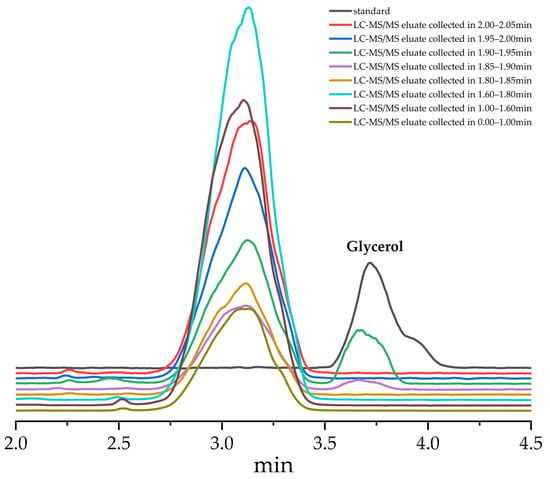
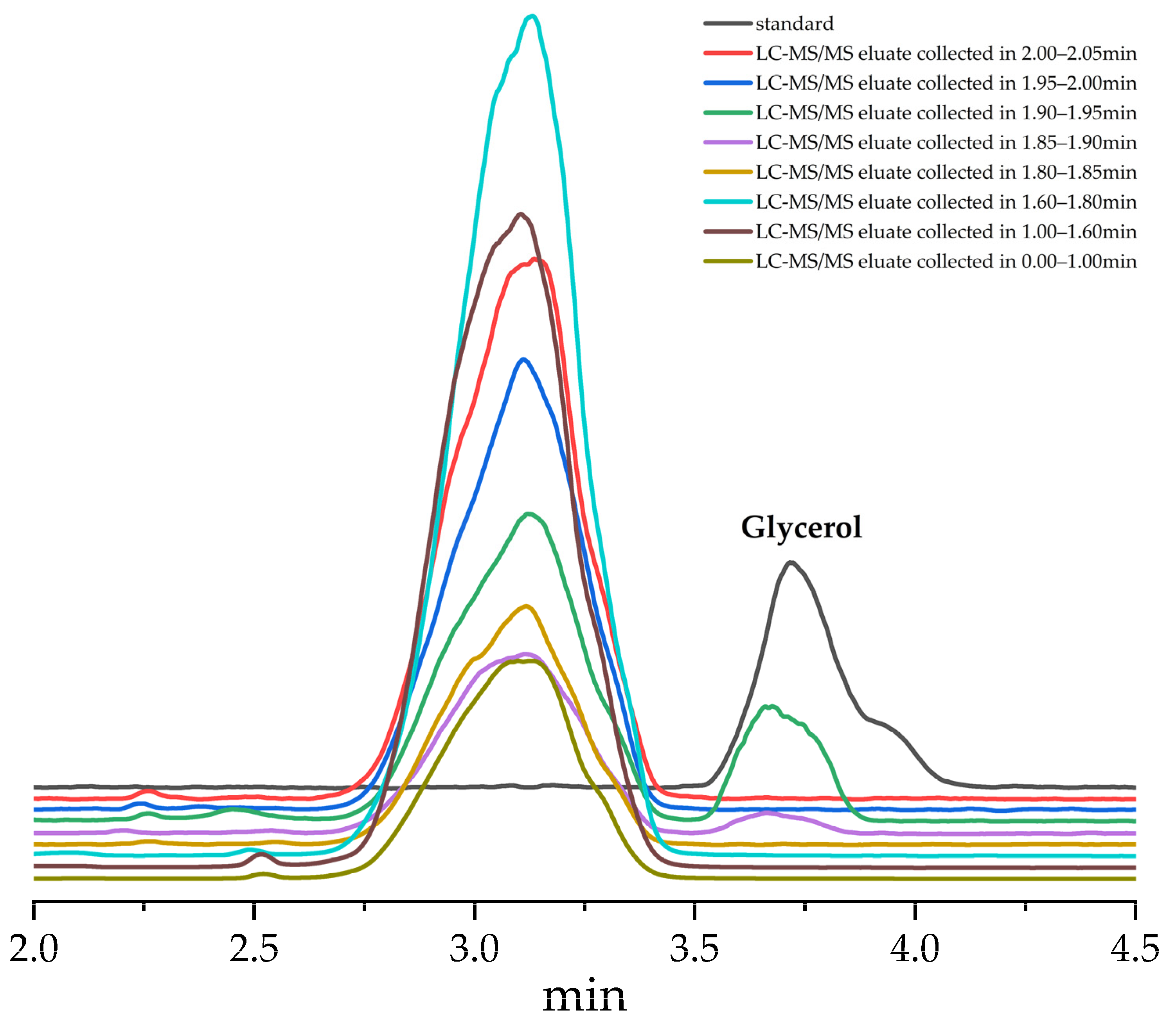
Glycerol is the main component of edible ink, accounting for 20–30% of the total formula. Glycerol is a strongly polar and high-viscosity substance with a boiling point up to 290 °C, which is difficult to volatilize completely in the ion source. The deposition of glycerol on the spray needle, cone hole and ion lens surface will cause instrument pollution in long-term operation, accompanied by increased background noise and signal drift. Glycerol is insoluble in conventional degreasing reagents such as n-hexane, and it is difficult to effectively remove glycerol using existing pretreatment methods without loss of target analytes. Herein, this study collected effluents from the chromatographic column at different time intervals on LC-MS/MS and determined glycerol content via liquid chromatography-evaporative light scattering detection (LC-ELSD). The timing control parameters of the switching valve were optimized to address this problem. Ultrapure water was selected as the extraction solvent, and ultrasonic-assisted extraction was implemented to achieve complete recovery of target analytes. The resulting extract was subjected to cleanup using a CNW BOND HLB solid-phase extraction cartridge, and all eluate fractions were pooled prior to subsequent treatment. The combined eluate was concentrated to dryness under a nitrogen stream, and the obtained residue was reconstituted with 89% acetonitrile aqueous solution. Quantitative analysis was performed on a VC-HILIC hydrophilic chromatographic column under isocratic elution conditions with an acetonitrile–water mobile phase ratio of 60:40, in conjunction with the ELSD. A set of serial glycerol standard working solutions was prepared for calibration curve establishment, and analyte quantification was accomplished via the external standard method to calculate glycerol contents in actual samples. As illustrated in Figure 1, the chromatographic effluent from the LC-MS/MS was collected in fractions for glycerol quantification. Fractions corresponding to the time windows of 0.00–1.00 min, 1.00–1.60 min and 1.60–1.80 min were collected at the initial stage, whereas effluent fractions were harvested at 0.05 min intervals within the range of 1.80–2.05 min. The results indicated that glycerol was only detected in the time periods of 1.85–1.90 min and 1.90–1.95 min. Therefore, the eluent within the first 1.00 min was directly diverted to waste liquid; the valve was switched to the mass spectrometer at 1.00–1.80 min to ensure that the target analytes entered the detection channel; subsequently, the flow was diverted to waste liquid again at 1.80–2.00 min to completely remove residual glycerol. The valve was stably connected to the mass spectrometer after 2.0 min for spectrum collection and analysis. The valve switching timing control strategy can effectively prevent glycerol molecules from entering the mass spectrometer without affecting the detection of two target analytes including citric acid and Tartrazine.
Figure 1.
Chromatogram acquired via LC-ELSD. The peak at 2.7–3.5 min is the solvent peak from acetonitrile and ammonium acetate mixture, and the eluate components were identified by matching peak times with glycerol standard.
3.3. Purification Performance of Different Solid-Phase Extraction Cartridges for 45 Pigments and Preservatives
The solid-phase extraction cartridge is a sample pretreatment device prepared with silica gel or polymer as the substrate, which realizes the separation and purification of target compounds through selective adsorption and elution. To investigate the purification performance of different solid-phase extraction cartridges for 45 pigments and preservatives, nine cartridges with different packing materials were selected in this study, and the results are shown in Table 2. The purification results under different modes showed that PS-DVB, C18 and MAX cartridges presented extremely low recoveries for the 45 pigments and preservatives, and some analytes were completely adsorbed by the cartridges. ALN, WAX, PA, HLB and NH2 cartridges showed large fluctuation in recoveries for the target analytes. For instance, the recoveries of citric acid on WAX and PA cartridges were 94.0% and 100.0%, respectively, while the other three cartridges showed no effective retention for this compound. It was found that the recoveries of the 45 pigments and preservatives on Captiva EMR-Lipid HF cartridge ranged from 72% to 109%. Although the recovery of Tartrazine was 72%, the recoveries of the remaining compounds were all above 80%, showing satisfactory elution performance. Furthermore, aqueous acetonitrile solutions with volume fractions of 80%, 85%, 90% and 95% were used for elution (Figure S2). As the proportion of acetonitrile in the eluent increases, the interaction between target analytes and column sorbent strengthens. Finally, 80% aqueous acetonitrile solution was selected as the eluent for Captiva EMR-Lipid HF cartridge due to its stable pore structure and adsorption performance.
Table 2.
Column recovery of 45 pigments and preservatives using different solid-phase extraction columns.
3.4. Effects of Different Membranes on Recoveries of 45 Pigments and Preservatives
Given the risk of target analytes undergoing membrane adsorption, the adsorptive capacities of filter membranes with diverse brands and substrates, including polyvinylidene fluoride (PVDF), polyamide (PA) and polytetrafluoroethylene (PTFE), were further evaluated for 45 preservatives and colorants. Matrix-fortified blank matrix assays were implemented, and the resultant data summarized in Table S3 elucidate the material-dependent adsorption discrepancies among the tested filters.
For all 45 target compounds, PTFE membranes yielded recoveries spanning 86–125%, with the majority of analytes exhibiting recovery efficiencies above 90%. While PVDF and PA filters exerted marginal interferences on most analytes, PVDF presented a mere 59.2% recovery for Acid Yellow 36. In addition, six compounds (paeonol, butylparaben, honokiol, magnolol, rhodamine) were nearly quantitatively retained by PVDF substrates, leading to severely depressed recoveries. PA membranes also generated inferior recoveries for Acid Red 73, Ponceau and Direct Red 28, registering only 63.0%, 22.0% and 4.1%, respectively. Collectively, PTFE filter membranes satisfy the analytical criteria and exhibit optimal filtration compatibility for the simultaneous quantitation of the 45 preservatives and colorants.
3.5. Methodological Validation
The calibration curves were established with the concentration of analytes as the abscissa and the peak area as the ordinate. For the majority of target analytes, six calibration levels were preferentially established to span low, medium and high concentration ranges. Such a configuration adequately constrains both extremities of the linear dynamic range and substantially enhances the robustness of linear regression fitting. In contrast, only five calibration points were designated for a subset of analytes. This practice stems from the pronounced peak broadening and ion saturation phenomena observed for these compounds at elevated concentrations, whereby their detector responses deviate significantly from linearity once concentrations exceed a critical threshold. The limits of detection (LOD) and limits of quantification (LOQ) were calculated based on signal-to-noise ratios of 3 and 10, respectively. The ranges of the LOD, LOQ and correlation coefficient were 0.0004–8.00 mg/kg, 0.001–20.00 mg/kg and 0.98241–0.99968, respectively, as shown in Table 3. Using 25% aqueous glycerol solution as the blank matrix, six-replicate spiked recovery experiments were conducted for each pigment and preservative at three spiking levels corresponding to 1-fold, 2-fold and 10-fold of the LOQ. The recoveries of the 45 pigments and preservatives were 63.08–116.38% with relative standard deviations (RSD) of 0.00–19.30%. The method exhibited satisfactory recovery and repeatability, which can meet the requirements of routine detection. The total ion chromatogram of the 45 pigments and preservatives is shown in Figure S3.
Table 3.
Linear ranges, correlation coefficients, limits of detection, limits of quantification, recoveries, and precision of 45 pigments and preservatives.
3.6. Verification of Actual Samples
To further verify the universal applicability of the established analytical method toward various edible printing inks (compound food colorants), six commercially available edible printing ink products were selected for quantitative determination of colorant contents. As listed in Table 4, almost no preservatives were detected in all six ink samples, which was consistent with the labeled nominal compositions. Trace amounts of citric acid were only identified in Sample Colorant B and Colorant C, with concentrations ranging from 0.024 to 0.032 g/kg. The target colorants, including Brilliant Blue, Acid Red 73, Tartrazine, Sunset Yellow, Azorubine, Ponceau and Allura Red, were all detectable in the remaining samples, whose contents varied from 0.024 to 47.0 g/kg. For samples with high analyte concentrations, appropriate dilution procedures were implemented throughout the experiment, as illustrated in Step (e) of Part 2.1. The detected analytes were consistent with the colorants and preservatives declared on product labels, and the measured concentrations matched the nominal values after dilution. Collectively, the proposed method exhibits favorable analytical performance and is applicable to the routine analysis of practical real-world samples.
Table 4.
Contents of target colorants in six compound food colorants, with nominal values provided in parentheses.
4. Conclusions
In this study, a sample pretreatment method was established by extraction with 75% aqueous methanol solution via vortex mixing and purification with Captiva EMR-Lipid HF solid-phase extraction cartridge. A UHPLC-MS/MS method was developed for the simultaneous determination of 45 pigments and preservatives in edible ink, solving the problem that it is difficult to analyze multiple pigments and preservatives simultaneously using conventional detection methods. Methodological validation results demonstrated that the established method satisfied the technical detection requirements in terms of linearity, recovery, repeatability, LOQ and LOD. The method is simple, rapid and suitable for high-throughput simultaneous detection of 45 pigments and preservatives, which greatly saves detection time and reduces detection cost with low environmental pollution. The established analytical method possesses extensive applicability for the qualitative and quantitative detection of preservatives and colorants in edible ink, which can provide a robust technical basis for the practical application and industrialized development of edible ink products.
Supplementary Materials
The following supporting information can be downloaded at: https://www.mdpi.com/article/10.3390/separations13070197/s1, Figure S1: Top: Total ion chromatograms obtained with two different chromatographic columns; Bottom: The extraction results of one target analyte (number 26, CAS:573-58-0) showed undetected and detected status respectively; Figure S2: Elution performance of Captiva EMR-Lipid HF purification column with different concentration eluents; Figure S3 Total ion current chromatogram of 45 pigments and preservatives; Table S1: The test numbers, compound names and corresponding CAS numbers of the 45 analytes; Table S2: Ionization status of each detected compound; Table S3: Effect of three different filter membranes on the recovery rates of 45 pigments and preservatives.
Author Contributions
Conceptualization, S.R. and A.Y.; methodology, Z.F. and J.W.; software, T.H., L.P. and J.W.; validation, L.P. and T.H.; formal analysis, Y.C. and Y.Z.; investigation, Y.Z.; resources, Y.Z. and S.R.; data curation, T.H. and Y.C.; writing—original draft preparation, A.Y. and S.R.; writing—review and editing, S.R. and J.W.; visualization, Y.Z. and T.H.; supervision, A.Y. and Z.F.; project administration, A.Y.; funding acquisition, S.R. and Y.Z.; All authors have read and agreed to the published version of the manuscript.
Funding
This research was funded by the Scientific Research Project on Smart Customs of Gongbei Customs District (2025GK013, 2025GK008) and the Scientific Research Program of the Chinese General Administration of the Customs (2025HK150).
Data Availability Statement
Data are included within the article and Supplementary Materials.
Acknowledgments
The authors thank the assistance from the Shiyanjia Lab (www.shiyanjia.com, accessed on 2 June 2026) for the data analysis.
Conflicts of Interest
The authors declare no conflicts of interest.
References
- Sapkal, L.; Tripathi, S.; Mhaske, S.T.; Gaikwad, K. Recent Development in Edible Inks for Food Printing and Packaging Applications: A Review. Curr. Food Sci. Technol. Rep. 2024, 2, 421–433. [Google Scholar] [CrossRef] [Scilit]
- Liu, S.; Han, Z.; Luo, X. A Comprehensive Review on Inkjet-Printed Intelligent Food Packaging Materials: Principle, Ink Formulation, Functional Inks, and Potential Applications. Food Front. 2025, 6, 1715–1741. [Google Scholar] [CrossRef] [Scilit]
- Hakim, L.; Deshmukh, R.K.; Lee, Y.S.; Gaikwad, K.K. Edible ink for food printing and packaging applications: A review. Sustain. Food Technol. 2024, 2, 876–892. [Google Scholar] [CrossRef] [Scilit]
- Jain, P.; Gupta, D.; Kaur, H.; Singh, S.; Gaikwad, K.K. Advanced anti-counterfeit inks in food packaging: A comprehensive review focusing on functional materials to digital integration. Trends Food Sci. Technol. 2025, 164, 105229. [Google Scholar] [CrossRef] [Scilit]
- Domżalska, Z.; Jakubczyk, E. Characteristics of Food Printing Inks and Their Impact on Selected Product Properties. Foods 2025, 14, 393. [Google Scholar] [CrossRef] [Scilit] [PubMed]
- Pallottino, F.; Hakola, L.; Costa, C.; Antonucci, F.; Figorilli, S.; Seisto, A.; Menesatti, P. Printing on Food or Food Printing: A Review. Food Bioprocess Technol. 2016, 9, 725–733. [Google Scholar] [CrossRef] [Scilit]
- Ozcan, A.; Arman Kandirmaz, E. Natural ink production and printability studies for smart food packaging. Color Res. Appl. 2020, 45, 495–502. [Google Scholar] [CrossRef] [Scilit]
- Ritota, M.; Melloni, S.; Cianfrini, G.; Narducci, V.; Ruggeri, S.; Turfani, V. Recent Advances in Inks for 3D Food Printing: A Review. Appl. Sci. 2025, 15, 11891. [Google Scholar] [CrossRef] [Scilit]
- Dave, S.; Das, J.; Varshney, B.; Sharma, V.P. Dyes and Pigments: Interventions and How Safe and Sustainable Are Colors of Life!!! In Trends and Contemporary Technologies for Photocatalytic Degradation of Dyes; Dave, S., Das, J., Eds.; Springer International Publishing: Cham, Switzerland, 2022; pp. 1–20. [Google Scholar]
- Aparicio, J.L.; Elizalde, M. Migration of Photoinitiators in Food Packaging: A Review. Packag. Technol. Sci. 2015, 28, 181–203. [Google Scholar] [CrossRef] [Scilit]
- Clemente, I.; Aznar, M.; Nerín, C.; Bosetti, O. Migration from printing inks in multilayer food packaging materials by GC-MS analysis and pattern recognition with chemometrics. Food Addit. Contam. Part A 2016, 33, 703–714. [Google Scholar] [CrossRef] [Scilit] [PubMed]
- Domeño, C.; Aznar, M.; Nerín, C.; Isella, F.; Fedeli, M.; Bosetti, O. Safety by design of printed multilayer materials intended for food packaging. Food Addit. Contam. Part A 2017, 34, 1239–1250. [Google Scholar] [CrossRef] [Scilit] [PubMed]
- Ridgway, K.; Lalljie, S.P.D.; Smith, R.M. Analysis of food taints and off-flavours: A review. Food Addit. Contam. Part A 2010, 27, 146–168. [Google Scholar] [CrossRef] [Scilit] [PubMed]
- Oktavianty, O.; Haruyama, S.; Ishii, Y. Enhancing Droplet Quality of Edible Ink in Single and Multi-Drop Methods by Optimization the Waveform Design of DoD Inkjet Printer. Processes 2022, 10, 91. [Google Scholar] [CrossRef] [Scilit]
- Mirsane, S.; Gharanjig, K.; Ataeefard, M.; Jalili, M. Eco-friendly ink production based on natural raw materials: Printability and characterization for food printing. Pigment Resin Technol. 2025, 54, 1016–1026. [Google Scholar] [CrossRef] [Scilit]
- Serb, A.F.; Georgescu, M.; Onulov, R.; Novaconi, C.R.; Sisu, E.; Bolocan, A.; Sandu, R.E. Mass-Spectrometry-Based Research of Cosmetic Ingredients. Molecules 2024, 29, 1336. [Google Scholar] [CrossRef] [Scilit] [PubMed]
- Tighrine, A.; Amir, Y.; Alfaro, P.; Mamou, M.; Nerín, C. Simultaneous extraction and analysis of preservatives and artificial sweeteners in juices by salting out liquid-liquid extraction method prior to ultra-high performance liquid chromatography. Food Chem. 2019, 277, 586–594. [Google Scholar] [CrossRef] [Scilit] [PubMed]
- Klavins, L.; Zommere, A.; Gricenko, T.; Klavins, M. The multifunctionality of plant pigments: Roles, recovery from by-products and stability challenges. J. Agric. Food Res. 2026, 26, 102748. [Google Scholar] [CrossRef] [Scilit]
- Dey, S.; Nagababu, B.H. Applications of food color and bio-preservatives in the food and its effect on the human health. Food Chem. Adv. 2022, 1, 100019. [Google Scholar] [CrossRef] [Scilit]
- Arnold, L.E.; Lofthouse, N.; Hurt, E. Artificial Food Colors and Attention-Deficit/Hyperactivity Symptoms: Conclusions to Dye for. Neurotherapeutics 2012, 9, 599–609. [Google Scholar] [CrossRef] [Scilit] [PubMed]
- Schab, D.W.; Trinh, N.-H.T. Do Artificial Food Colors Promote Hyperactivity in Children with Hyperactive Syndromes? A Meta-Analysis of Double-Blind Placebo-Controlled Trials. J. Dev. Behav. Pediatr. 2004, 25, 423–434. [Google Scholar] [CrossRef] [Scilit] [PubMed]
- Amchova, P.; Siska, F.; Ruda-Kucerova, J. Food Safety and Health Concerns of Synthetic Food Colors: An Update. Toxics 2024, 12, 466. [Google Scholar] [CrossRef] [Scilit] [PubMed]
- Li, P.; Qu, R.; Li, M.; Sheng, P.; Jin, L.; Huang, X.; Xu, Z.Z. Impacts of food additives on gut microbiota and host health. Food Res. Int. 2024, 196, 114998. [Google Scholar] [CrossRef] [Scilit] [PubMed]
- McCann, D.; Barrett, A.; Cooper, A.; Crumpler, D.; Dalen, L.; Grimshaw, K.; Kitchin, E.; Lok, K.; Porteous, L.; Prince, E.; et al. Food additives and hyperactive behaviour in 3-year-old and 8/9-year-old children in the community: A randomised, double-blinded, placebo-controlled trial. Lancet 2007, 370, 1560–1567. [Google Scholar] [CrossRef] [Scilit] [PubMed]
- Vieira Rubio, F.T.; Maciel, G.M.; Bortolini, D.G.; de Andrade Arruda Fernandes, I.; Pedro, A.C.; Ribeiro, I.S.; Fávaro-Trindade, C.S.; Peralta, R.M.; Isidoro Haminiuk, C.W. Artificial dyes: Health risks, environmental concerns, and the rise of natural alternatives. Trends Food Sci. Technol. 2025, 162, 105085. [Google Scholar] [CrossRef] [Scilit]
- Kharbach, M.; Mansouri, M.A.; Taabouz, M.; Zhang, T.; Yu, H. Current advances in LC-MS/MS and GC-MS/MS coupled with chemometrics for integrated food analysis and quality control. Food Chem. 2026, 506, 147854. [Google Scholar] [CrossRef] [Scilit] [PubMed]
- Wang, Y.; McClements, D.J.; Bai, C.; Xu, X.; Sun, Q.; Jiao, B.; Miao, S.; Wang, Q.; Dai, L. Application of proteins in edible inks for 3D food printing: A review. Trends Food Sci. Technol. 2024, 153, 104691. [Google Scholar] [CrossRef] [Scilit]
- Hao-yang, L.I.; Gong-yuan, L.I.U.; Yun-song, L.I.; Ke-qiang, S.U.N.; Xing, X. Determination of Thirteen Chemical Elements in Edible Ink by ICP-MS. Phys. Test. Chem. Anal. Part B Chem. Anal. 2017, 53, 284–288. [Google Scholar]
- Shi, J.; Huang, M.; Yang, Q.; Xu, Y.; Wu, J.; Liu, H.; Zhang, J.; Zheng, F.; Dong, W. Relatively reliable and rapid identification of colorant compounds in food matrices by HPLC-DAD-QTOF-MS combined with theoretical calculation. Food Chem. 2025, 463, 141133. [Google Scholar] [CrossRef] [Scilit] [PubMed]
- Ghoreishi, S.M.; Behpour, M.; Golestaneh, M. Simultaneous determination of Sunset yellow and Tartrazine in soft drinks using gold nanoparticles carbon paste electrode. Food Chem. 2012, 132, 637–641. [Google Scholar] [CrossRef] [Scilit] [PubMed]
- Mohamed, M.E.B.; Sebaei, A.S.; Mahmoud, N.M.; Mohammed, N.A.; Hassan, H.A.; Abdel-aal, R.R. Electrochemical and chromatographic methods for the determination of some natural food preservatives–A review. Food Chem. 2025, 468, 142491. [Google Scholar] [CrossRef] [Scilit] [PubMed]

Disclaimer/Publisher’s Note: The statements, opinions and data contained in all publications are solely those of the individual author(s) and contributor(s) and not of MDPI and/or the editor(s). MDPI and/or the editor(s) disclaim responsibility for any injury to people or property resulting from any ideas, methods, instructions or products referred to in the content. |
© 2026 by the authors. Licensee MDPI, Basel, Switzerland. This article is an open access article distributed under the terms and conditions of the Creative Commons Attribution (CC BY) license.