
Advancing Iron Recovery from Red Mud: Green Pathways, Synergistic Valorization, and High-Value Total Component Utilization

 ,
,  ,
,
Abstract
1. Introduction
2. Green Low-Carbon Reduction Technologies
2.1. Biomass Reduction
2.2. Hydrogen Metallurgy
2.3. Selective Flocculation
2.4. Process Intensification
3. Synergistic Valorization and the “Waste-Treating-Waste” Paradigm
3.1. Organic Solid Wastes
3.2. Phosphogypsum
3.3. Iron-Rich Industrial Wastes
3.4. Coal-Based Solid Wastes
4. Integrated Strategies for High-Value Cascading Utilization
4.1. Efficient Iron Separation and Recovery
4.2. Sequential Extraction of Aluminum, Titanium, and Scandium
4.3. Valorization of Final Residues into Construction Materials and Functional By-Products
5. Quantitative Evaluation Framework for Green and Low-Carbon Iron Extraction Pathways from Red Mud
6. Conclusions and Outlook
Author Contributions
Funding
Data Availability Statement
Conflicts of Interest
References
- Li, G.; Liu, J.; Yi, L.; Luo, J.; Jiang, T. Bauxite residue (red mud) treatment: Current situation and promising solution. Sci. Total Environ. 2024, 948, 174757. [Google Scholar] [CrossRef] [PubMed]
- Akinci, A.; Artir, R. Characterization of trace elements and radionuclides and their risk assessment in red mud. Mater. Charact. 2008, 59, 417–421. [Google Scholar] [CrossRef]
- Evans, K. The History, Challenges, and New Developments in the Management and Use of Bauxite Residue. J. Sustain. Metall. 2016, 2, 316–331. [Google Scholar] [CrossRef]
- Khanna, R.; Konyukhov, Y.; Zinoveev, D.; Jayasankar, K.; Burmistrov, I.; Kravchenko, M.; Mukherjee, P.S. Red Mud as a Secondary Resource of Low-Grade Iron: A Global Perspective. Sustainability 2022, 14, 1258. [Google Scholar] [CrossRef]
- Yu, X.; Zhang, W.; Wang, H.; Ye, X.; Lin, Z. Transformation of iron-bearing minerals and iron resource cycling. Resour. Conserv. Recycl. 2025, 220, 108353. [Google Scholar] [CrossRef]
- De Souza, P.H.C.; Engvall, K.; Penha, F.M.; Kantarelis, E.; Nazir, S.M. Sustainable pathway towards red mud valorization through biomass thermochemical conversion and metals recovery. Bioresour. Technol. 2025, 434, 132847. [Google Scholar] [CrossRef] [PubMed]
- Yang, J.; Zhou, W.; Yu, X.; Qin, Y.; Ma, S.; Wang, D. New technology of microwave fluidization roasting for enhancing iron recovery from red mud: Mineral phase transformation mechanism. Sep. Purif. Technol. 2025, 367, 132932. [Google Scholar] [CrossRef]
- Wang, S.; Jin, H.; Deng, Y.; Xiao, Y. Comprehensive utilization status of red mud in China: A critical review. J. Clean. Prod. 2021, 289, 125136. [Google Scholar] [CrossRef]
- Li, Z. Toward Low-Carbon Construction: A Review of Red Mud Utilization in Cementitious Materials and Geopolymers for Sustainability and Cost Benefits. Buildings 2026, 16, 362. [Google Scholar] [CrossRef]
- Aslam, M.M.A.; Sun, T.; Dai, M.; Xu, W.; Ye, Y.; Ali, I.; Gao, F.; Peng, C. Technologies for recovery of iron from red mud: Processes, challenges and opportunities. Sustain. Mater. Technol. 2024, 41, e01053. [Google Scholar] [CrossRef]
- Liu, W.; Chen, X.; Li, W.; Yu, Y.; Yan, K. Environmental assessment, management and utilization of red mud in China. J. Clean. Prod. 2014, 84, 606–610. [Google Scholar] [CrossRef]
- Service, R.F. Red alert. Science 2020, 369, 910–911. [Google Scholar] [CrossRef] [PubMed]
- Enserink, M. After Red Mud Flood, Scientists Try to Halt Wave of Fear and Rumors. Science 2010, 330, 432–433. [Google Scholar] [CrossRef] [PubMed]
- Yuan, S.; Wang, R.; Zhang, H.; Li, Y.; Liu, L.; Fu, Y. Investigation of Mineral Phase Transformation Technology Followed by Magnetic Separation for Recovery of Iron Values from Red Mud. Sustainability 2022, 14, 13787. [Google Scholar] [CrossRef]
- Li, Q.; Lv, G.; Wang, S.; Li, X.; He, X.; Zhang, T. Summary of Research Progress on the Separation and Extraction of Iron from Bayer Red Mud. J. Sustain. Metall. 2025, 11, 186–213. [Google Scholar] [CrossRef]
- Li, G.; Liu, M.; Rao, M.; Jiang, T.; Zhuang, J.; Zhang, Y. Stepwise extraction of valuable components from red mud based on reductive roasting with sodium salts. J. Hazard. Mater. 2014, 280, 774–780. [Google Scholar] [CrossRef] [PubMed]
- Swain, B.; Akcil, A.; Lee, J. Red mud valorization an industrial waste circular economy challenge; review over processes and their chemistry. Crit. Rev. Environ. Sci. Technol. 2022, 52, 520–570. [Google Scholar] [CrossRef]
- Khairul, M.A.; Zanganeh, J.; Moghtaderi, B. The composition, recycling and utilisation of Bayer red mud. Resour. Conserv. Recycl. 2019, 141, 483–498. [Google Scholar] [CrossRef]
- Khanna, R.; Konyukhov, Y.V.; Ikram-ul-haq, M.; Burmistrov, I.; Cayumil, R.; Belov, V.A.; Rogachev, S.O.; Leybo, D.V.; Mukherjee, P.S. An innovative route for valorising iron and aluminium oxide rich industrial wastes: Recovery of multiple metals. J. Environ. Manag. 2021, 295, 113035. [Google Scholar] [CrossRef] [PubMed]
- Khanna, R.; Zinoveev, D.; Konyukhov, Y.; Li, K.; Maslennikov, N.; Burmistrov, I.; Kargin, J.; Kravchenko, M.; Mukherjee, P.S. Extraction of alumina and alumina-based cermets from iron-lean red muds using carbothermic reduction of silica and iron oxides. Sustainability 2025, 17, 6802. [Google Scholar] [CrossRef]
- Agrawal, S.; Dhawan, N. Evaluation of red mud as a polymetallic source—A review. Miner. Eng. 2021, 171, 107084. [Google Scholar] [CrossRef]
- Wang, K.; Dou, Z.; Liu, Y.; Li, X.; Lv, G.; Zhang, T. Summary of research progress on separation and extraction of valuable metals from Bayer red mud. Environ. Sci. Pollut. Res. 2022, 29, 89834–89852. [Google Scholar] [CrossRef] [PubMed]
- Liu, X.; Han, Y.; He, F.; Gao, P.; Yuan, S. Characteristic, hazard and iron recovery technology of red mud—A critical review. J. Hazard. Mater. 2021, 420, 126542. [Google Scholar] [CrossRef] [PubMed]
- Han, Z.; Zhang, Y.; Shen, X.; Sun, H.; Zhang, C.; Yu, L. Efficient extraction and recovery techniques of valuable metals and alumina with high added value from red mud: A comprehensive review. Results Eng. 2025, 28, 108428. [Google Scholar] [CrossRef]
- Yi, L.; Hao, H.; Xu, L.; Luo, J.; Shen, X.; Liu, J.; Li, G.; Jiang, T. Integrated Recycling of Red Mud for Iron Ore Sinter Manufacturing: Interfacial Bonding Regulation of the Sintering Process. ACS Sustain. Chem. Eng. 2024, 12, 17531–17544. [Google Scholar] [CrossRef]
- Kong, H.; Zhou, T.; Yang, X.; Gong, Y.; Zhang, M.; Yang, H. Iron Recovery Technology of Red Mud—A review. Energies 2022, 15, 3830. [Google Scholar] [CrossRef]
- Yuan, S.; Liu, X.; Gao, P.; Han, Y. A semi-industrial experiment of suspension magnetization roasting technology for separation of iron minerals from red mud. J. Hazard. Mater. 2020, 394, 122579. [Google Scholar] [CrossRef] [PubMed]
- Ning, G.; Zhang, B.; Liu, C.; Li, S.; Ye, Y.; Jiang, M. Large-Scale Consumption and Zero-Waste Recycling Method of Red Mud in Steel Making Process. Minerals 2018, 8, 102. [Google Scholar] [CrossRef]
- Wang, Y.; Zhang, T.-a.; Lyu, G.; Guo, F.; Zhang, W.; Zhang, Y. Recovery of alkali and alumina from bauxite residue (red mud) and complete reuse of the treated residue. J. Clean. Prod. 2018, 188, 456–465. [Google Scholar] [CrossRef]
- Archambo, M.; Kawatra, S.K. Red Mud: Fundamentals and New Avenues for Utilization. Miner. Process. Extr. Metall. Rev. 2020, 42, 427–450. [Google Scholar] [CrossRef]
- Yang, X.; Chen, X.; Zhang, T.; Ye, J.; Lv, G.; Zhang, J. Study on Reductive Smelting of High-Iron Red Mud for Iron Recovery. Metals 2022, 12, 639. [Google Scholar] [CrossRef]
- Soto-Montandon, F.; Gillane, R.; Marcellin, E.; Harrison, S.T.L.; Villa-Gomez, D. Bioleaching for critical metal recovery from bauxite residue- unlocking waste valorization. Front. Bioeng. Biotechnol. 2025, 13, 1685819. [Google Scholar] [CrossRef] [PubMed]
- Kapelari, S.; Gamaletsos, P.N.; Pilla, G.; Pontikes, Y.; Blanpain, B. Developing a Low-Temperature, Carbon-Lean Hybrid Valorisation Process for Bauxite Residue (Red Mud) Towards Metallic Fe and Al Recovery. J. Sustain. Metall. 2023, 9, 578–587. [Google Scholar] [CrossRef]
- Wang, G.; Fan, B.; Chen, H.; Li, Y. Understanding the pyrolysis behavior of agriculture, forest and aquatic biomass: Products distribution and characterization. J. Energy Inst. 2020, 93, 1892–1900. [Google Scholar] [CrossRef]
- Tanweer, A.; Taqvi, S.A.A.; Kazmi, B.; Khatoon, S.; Taha, M.; Nadir, M.; Ahmad, F.; Ahmad, N. Advancing algae-based Bioenergy: Techno-Economic assessment of hydrogen and biochar production from algal biomass. Biomass Bioenergy 2025, 200, 108039. [Google Scholar] [CrossRef]
- Wang, J.; Fu, J.; Zhao, Z.; Bing, L.; Xi, F.; Wang, F.; Dong, J.; Wang, S.; Lin, G.; Yin, Y.; et al. Benefit analysis of multi-approach biomass energy utilization toward carbon neutrality. Innovation 2023, 4, 100423. [Google Scholar] [CrossRef] [PubMed]
- Jaiswal, R.K.; Soren, S.; Jha, G. A novel approach of utilizing the waste biomass in the magnetizing roasting for recovery of iron from goethitic iron ore. Environ. Technol. Innov. 2023, 31, 103184. [Google Scholar] [CrossRef]
- Ashokkumar, V.; Chen, W.-H.; Kamyab, H.; Kumar, G.; Al-Muhtaseb, A.a.H.; Ngamcharussrivichai, C. Cultivation of microalgae Chlorella sp. in municipal sewage for biofuel production and utilization of biochar derived from residue for the conversion of hematite iron ore (Fe2O3) to iron (Fe)–Integrated algal biorefinery. Energy 2019, 189, 116128. [Google Scholar] [CrossRef]
- Ashokkumar, V.; Chen, W.-H.; Kumar, G.; Satjarak, A.; Chanthapatchot, W.; Ngamcharussrivichai, C. A biorefinery approach for high value-added bioproduct (astaxanthin) from alga Haematococcus sp. and residue pyrolysis for biochar synthesis and metallic iron production from hematite (Fe2O3). Fuel 2021, 304, 121150. [Google Scholar] [CrossRef]
- Fu, Y.; Wang, Y.; Ning, Z.; Wang, X.; Chai, Q.; Zhang, R. One-Step Calcification–Biomaterialization Transformation Process for Treating High-Iron Bauxite Ore. JOM 2025, 77, 6711–6726. [Google Scholar] [CrossRef]
- Sun, T.; Aslam, M.M.A.; Chen, G.; Peng, C. Low-temperature biomass pyrolytic reduction and recovery of iron oxides from red mud. Miner. Eng. 2025, 222, 109155. [Google Scholar] [CrossRef]
- Aslam, M.M.A.; Sun, T.; Dai, M.; Rong, R.; Gao, F.; Chen, G.; Peng, C. Recovery of iron from low-iron red mud via biomass and conventional carbon-based pyrolytic reduction. J. Environ. Chem. Eng. 2026, 14, 120604. [Google Scholar] [CrossRef]
- Xu, R.; Lu, C.; Zhang, M.; Tian, C.; Luo, D.; Yang, L.; Xie, W.; Zhong, Z.; Wen, J. Synergistic recovering Fe, Al and biochar through biomass-reduction alkali roasting and wet magnetic separation for red mud (RM): Behavior and mechanism. Miner. Eng. 2026, 237, 110029. [Google Scholar] [CrossRef]
- Samouhos, M.; Taxiarchou, M.; Pilatos, G.; Tsakiridis, P.E.; Devlin, E.; Pissas, M. Controlled reduction of red mud by H2 followed by magnetic separation. Miner. Eng. 2017, 105, 36–43. [Google Scholar] [CrossRef]
- Pilla, G.; Hertel, T.; Blanpain, B.; Pontikes, Y. Sustainable recovery of metallic Fe and oxides from bauxite residue via H2 reduction: Enhancing purity and recovery rates. Sustain. Mater. Technol. 2025, 43, e01289. [Google Scholar] [CrossRef]
- Pilla, G.; Hertel, T.; Blanpain, B.; Pontikes, Y. A sustainable approach for concurrent recovery of metals from H2 reduced bauxite residue (“red mud”): Process optimization. Resour. Conserv. Recycl. 2025, 215, 108051. [Google Scholar] [CrossRef]
- Jovičević-Klug, M.; Souza Filho, I.R.; Springer, H.; Adam, C.; Raabe, D. Green steel from red mud through climate-neutral hydrogen plasma reduction. Nature 2024, 625, 703–709. [Google Scholar] [CrossRef] [PubMed]
- Jayasankar, K.; Ray, P.K.; Chaubey, A.K.; Padhi, A.; Satapathy, B.K.; Mukherjee, P.S. Production of pig iron from red mud waste fines using thermal plasma technology. Int. J. Miner. Metall. Mater. 2012, 19, 679–684. [Google Scholar] [CrossRef]
- Liang, W.L.; Zhang, Y.C.; Li, Y.C.; Chang, Y.Q.; Gao, M.R. Hydrogen-Based Reduction Boosts Sustainable Iron Production from Red Mud. J. Am. Chem. Soc. 2025, 147, 37223–37230. [Google Scholar] [CrossRef] [PubMed]
- Ellis, D.S.; Pachchigar, V.; Rebollar, J.; Abuyazid, N.H.; Üner, N.B.; Krogstad, J.A.; Sankaran, R.M. Understanding the Contribution of Surface Temperature and Hydrogen Radicals to Hydrogen Plasma Reduction of Iron Oxide. ACS Sustain. Chem. Eng. 2025, 13, 7760–7768. [Google Scholar] [CrossRef]
- Niu, F.; Chen, Y.; Zhang, J.; Liu, F.; Wang, Z. Selective flocculation-flotation of ultrafine hematite from clay minerals under asynchronous flocculation regulation. Int. J. Min. Sci. Technol. 2024, 34, 1563–1574. [Google Scholar] [CrossRef]
- Huang, Y.; Han, G.; Liu, J.; Wang, W. A facile disposal of Bayer red mud based on selective flocculation desliming with organic humics. J. Hazard. Mater. 2016, 301, 46–55. [Google Scholar] [CrossRef] [PubMed]
- Jeremy, E.; Sanwani, E.; Chaerun, S.K.; Mubarok, M.Z. Enhancing selective bioflocculation of iron from red Mud: An Eco-Friendly approach through pH optimization for bacterial growth. Miner. Eng. 2025, 233, 109549. [Google Scholar] [CrossRef]
- Liu, X.; Yang, J.; Ma, S.; Wang, D.; Zhou, W. From hazardous solid waste to resource utilization: A technical review of efficient iron resource recovery from red mud. Rev. Chem. Eng. 2026, 42, 113–133. [Google Scholar] [CrossRef]
- Kim, J.-S.; Rha, S.; Goo, J.-Y.; Lee, J.H.; Lee, S.-H.; Jo, H.Y. Microwave pretreatment followed by acid-free solid-chloride leaching of red mud for multi-element recovery. Miner. Eng. 2026, 236, 109961. [Google Scholar] [CrossRef]
- Huang, Y.; Mo, W.; Feng, J.; He, C.; Yang, J.; Ma, S.; Su, X. Microwave-enhanced Fe/Al recovery from red mud: Mechanistic role of carbothermal reduction and alkali activation in mineral transformation. Process Saf. Environ. Prot. 2025, 198, 107150. [Google Scholar] [CrossRef]
- Deng, B.; Eddy, L.; Wyss, K.M.; Tiwary, C.S.; Tour, J.M. Flash Joule heating for synthesis, upcycling and remediation. Nat. Rev. Clean Technol. 2025, 1, 32–54. [Google Scholar] [CrossRef]
- Liu, Q.; Xu, S.; Scotland, P.; Sharp, J.; Cheng, Y.; Shin, J.; Viscomi, N.L.; Eddy, L.; Chen, S.; Li, B.; et al. Iron and Heavy Metal Removal from Bauxite Residues by Flash Joule Heating with Chlorination. ACS Appl. Mater. Interfaces 2025, 17, 53576–53586. [Google Scholar] [CrossRef] [PubMed]
- Zhang, T.; Yan, J.; Li, Z.; Wang, H.; Han, P.; Ye, S. Utilization of red mud: Recovery of iron and aluminum by enhanced separation based on a new combined roasting process. J. Environ. Manag. 2025, 377, 124669. [Google Scholar] [CrossRef] [PubMed]
- Borra, C.R.; Blanpain, B.; Pontikes, Y.; Binnemans, K.; Van Gerven, T. Smelting of Bauxite Residue (Red Mud) in View of Iron and Selective Rare Earths Recovery. J. Sustain. Metall. 2016, 2, 28–37. [Google Scholar] [CrossRef]
- Valeev, D.; Zinoveev, D.; Kondratiev, A.; Lubyanoi, D.; Pankratov, D. Reductive Smelting of Neutralized Red Mud for Iron Recovery and Produced Pig Iron for Heat-Resistant Castings. Metals 2020, 10, 32. [Google Scholar] [CrossRef]
- Qiu, G.; Ning, X.; Shen, J.; Wang, Y.; Zhang, D.; Deng, J. Recovery of iron from iron tailings by suspension magnetization roasting with biomass-derived pyrolytic gas. Waste Manag. 2023, 156, 255–263. [Google Scholar] [CrossRef] [PubMed]
- Zhang, Y.; Wang, Y.; Cui, H.; Wang, F.; Li, Z.; Sun, C.; Jia, Y.; Xie, Y.; Song, F.; Wang, J.; et al. Co-pyrolysis of biomass with Red Mud: An efficient approach to improving bio-oil quality and resourceful utilization of the iron in Red Mud. Fuel 2024, 355, 129482. [Google Scholar] [CrossRef]
- Liu, X.; Rong, R.; Dai, M.; Bian, H.; Peng, C. Preparation of red mud-based zero-valent iron materials by biomass pyrolysis reduction: Reduction mechanism and application study. Sci. Total Environ. 2023, 864, 160907. [Google Scholar] [CrossRef] [PubMed]
- Wang, D.; Huang, Y.; Li, H.; Yang, J.; Wang, G.; Ma, S. Synergistic preparation of biomass-derived activated carbon and recycling of red mud: Biomass conversion, hydrogen-rich reduction, and carbon–hydrogen cycling. Sep. Purif. Technol. 2025, 379, 134979. [Google Scholar] [CrossRef]
- Lin, F.; Zheng, F.; Li, J.; Sun, B.; Che, L.; Yan, B.; Chen, G. Catalytic pyrolysis of oily sludge with iron-containing waste for production of high-quality oil and H2-rich gas. Fuel 2022, 326, 124995. [Google Scholar] [CrossRef]
- Yu, H.; Liu, L.; Liu, M.; Zhang, H.; Mao, R. Waste control by waste: Recovering iron from red mud with the effect of Phosphogypsum-included additive. Resour. Conserv. Recycl. 2024, 206, 107641. [Google Scholar] [CrossRef]
- Xiao, Y.D.; Jin, H.X.; Wang, M.L.; Guo, Y.L. Recycling of Iron and Alumina from Red Mud After Co-Sintering with Phosphogypsum. J. Sustain. Metall. 2023, 9, 408–422. [Google Scholar] [CrossRef]
- Liu, M.; Zeng, A.; Mao, R.; Yu, H.; Zhou, F.; Zhang, H. Performance and Mechanism Study on Co-reduction of Two Industrial Solid Wastes for Iron Recovering. J. Sustain. Metall. 2025, 11, 1453–1464. [Google Scholar] [CrossRef]
- Tayibi, H.; Choura, M.; López, F.A.; Alguacil, F.J.; López-Delgado, A. Environmental impact and management of phosphogypsum. J. Environ. Manag. 2009, 90, 2377–2386. [Google Scholar] [CrossRef] [PubMed]
- Guan, Q.; Wang, Z.; Zhou, F.; Yu, W.; Yin, Z.; Zhang, Z.; Chi, R.; Zhou, J. The Impurity Removal and Comprehensive Utilization of Phosphogypsum: A Review. Materials 2024, 17, 2067. [Google Scholar] [CrossRef] [PubMed]
- Rychkov, V.N.; Kirillov, E.V.; Kirillov, S.V.; Semenishchev, V.S.; Bunkov, G.M.; Botalov, M.S.; Smyshlyaev, D.V.; Malyshev, A.S. Recovery of rare earth elements from phosphogypsum. J. Clean. Prod. 2018, 196, 674–681. [Google Scholar] [CrossRef]
- Khanna, R.; Konyukhov, Y.; Li, K.; Zinoveev, D.; Liang, Z.; Maslennikov, N.; Burmistrov, I.; Kargin, J.; Kravchenko, M.; Mukherjee, P.S.; et al. A Novel Strategy for Extracting Iron Values from Iron-Lean Red Muds Toward Enhanced Resource Recovery and Recycling of Industrial Wastes. J. Sustain. Metall. 2025, 11, 3201–3219. [Google Scholar] [CrossRef]
- Liu, Z.; Zhang, F.; Zheng, G. Recovery of iron from iron tailings by co-pyrolysis with coal gangue: Process optimization and economic evaluation. Sci. Rep. 2026, 16, 2754. [Google Scholar] [CrossRef] [PubMed]
- Yuan, S.; Huang, C.; Bai, Z.; Wang, R.; Ding, H. A novel utilization of high-Fe bauxite through co-roasting with coal gangue to separate iron and aluminum minerals. J. Cent. South Univ. 2023, 30, 2166–2178. [Google Scholar] [CrossRef]
- Bai, Z.; Chang, H.; Shuai, Y.; Xinyu, L. Separate recycling of iron and aluminum from iron-rich red mud by coal gangue reduction to realize solid waste utilization. Adv. Powder Technol. 2024, 35, 104506. [Google Scholar] [CrossRef]
- Wei, P.; Yu, W.; Chen, H.; Jiang, W.; Emmanuel, N.-A.J.; Chen, W. A New Strategy for Collaborative Utilization of Red Mud and Coal Fly Ash via Vacuum Reduction Technology. J. Sustain. Metall. 2022, 8, 1370–1380. [Google Scholar] [CrossRef]
- Zhao, Y.; Luan, H.; Yang, B.; Li, Z.; Song, M.; Li, B.; Tang, X. Adsorption of Pb, Cu and Cd from Water on Coal Fly Ash-Red Mud Modified Composite Material: Characterization and Mechanism. Water 2023, 15, 767. [Google Scholar] [CrossRef]
- Liu, W.; Sun, S.; Zhang, L.; Jahanshahi, S.; Yang, J. Experimental and simulative study on phase transformation in Bayer red mud soda-lime roasting system and recovery of Al, Na and Fe. Miner. Eng. 2012, 39, 213–218. [Google Scholar] [CrossRef]
- Zinoveev, D.; Pasechnik, L.; Fedotov, M.; Dyubanov, V.; Grudinsky, P.; Alpatov, A. Extraction of Valuable Elements from Red Mud with a Focus on Using Liquid Media—A Review. Recycling 2021, 6, 38. [Google Scholar] [CrossRef]
- Mi, H.; Yi, L.; Wu, Q.; Xia, J.; Zhang, B. A review of comprehensive utilization of red mud. Waste Manag. Res. J. A Sustain. Circ. Econ. 2022, 40, 1594–1607. [Google Scholar] [CrossRef] [PubMed]
- Yu, J.; Li, Y.; Lv, Y.; Han, Y.; Gao, P. Recovery of iron from high-iron red mud using suspension magnetization roasting and magnetic separation. Miner. Eng. 2022, 178, 107394. [Google Scholar] [CrossRef]
- Yang, D.; Shi, M.; Zhang, J.; Sasaki, A.; Endo, M. Reductive roasting of arsenic-contaminated red mud for Fe resources recovery driven by johnbaumite-based arsenic thermostabilization strategy. J. Hazard. Mater. 2023, 452, 131255. [Google Scholar] [CrossRef] [PubMed]
- Li, S.; Pan, J.; Zhu, D.; Guo, Z.; Shi, Y.; Dong, T.; Lu, S.; Tian, H. A new route for separation and recovery of Fe, Al and Ti from red mud. Resour. Conserv. Recycl. 2021, 168, 105314. [Google Scholar] [CrossRef]
- Xiao, J.; Zhong, N.; Gao, D.; Zou, K.; Wang, Z.; Huang, W.; Xiong, W. An Efficient Process to Recover Iron from Bayer Red Mud. JOM 2022, 74, 3172–3180. [Google Scholar] [CrossRef]
- Zinoveev, D.; Grudinsky, P.; Zhiltsova, E.; Grigoreva, D.; Volkov, A.; Dyubanov, V.; Petelin, A. Research on High-Pressure Hydrochloric Acid Leaching of Scandium, Aluminum and Other Valuable Components from the Non-Magnetic Tailings Obtained from Red Mud after Iron Removal. Metals 2021, 11, 469. [Google Scholar] [CrossRef]
- Gladyshev, S.; Akhmadiyeva, N.; Abdulvaliyev, R.; Imangaliyeva, L.; Smailov, K.; Abikak, Y.; Kasymzhanova, A.; Amanzholova, L. Utilization of Red Mud from Processing of Low-Quality Bauxites. Processes 2025, 13, 1958. [Google Scholar] [CrossRef]
- Qi, Y.; Pan, X.; Zheng, H.; Zhang, Z.; Yu, H. Efficient recovery of iron and alumina from red mud by alkali-enhanced magnetization reduction. Sep. Purif. Technol. 2025, 369, 133146. [Google Scholar] [CrossRef]
- Wen, J.; Yu, W.; Yuan, H.; Chen, H.; Xiong, T.; Yang, F. A new strategy for extracting aluminum and iron from red mud via vacuum thermal reduction, alkali-leaching and magnetic separation. J. Clean. Prod. 2024, 485, 144409. [Google Scholar] [CrossRef]
- Ding, W.; Xiao, J.; Peng, Y.; Sheng, S.; Chen, T.; Zou, K.; Wang, Z. Extraction of Scandium and Iron from Red Mud. Miner. Process. Extr. Metall. Rev. 2020, 43, 61–68. [Google Scholar] [CrossRef]
- Wu, P.; Liu, X.; Zhang, Z.; Wei, C.; Wang, J.; Gu, J. The harmless and value-added utilization of red mud: Recovering iron from red mud by pyrometallurgy and preparing cementitious materials with its tailings. J. Ind. Eng. Chem. 2024, 132, 50–65. [Google Scholar] [CrossRef]
- Wang, Y.; Li, D.; Liu, X.; Zhang, W.; Li, Z.; Li, Y.; Ren, Y.; Li, H. Mechanism of magnetizing the Bayer red mud and meanwhile improving the cementitious activity of its tailings by using biomass. J. Clean. Prod. 2021, 287, 125016. [Google Scholar] [CrossRef]
- Silveira, N.C.G.; Martins, M.L.F.; Bezerra, A.C.S.; Araújo, F.G.S. Red Mud from the Aluminium Industry: Production, Characteristics, and Alternative Applications in Construction Materials—A Review. Sustainability 2021, 13, 12741. [Google Scholar] [CrossRef]
- Zhang, T.; Gao, P.; Gao, P.; Wei, J.; Yu, Q. Effectiveness of novel and traditional methods to incorporate industrial wastes in cementitious materials—An overview. Resour. Conserv. Recycl. 2013, 74, 134–143. [Google Scholar] [CrossRef]
- Li, Y.; Liu, X.; Li, Z.; Ren, Y.; Wang, Y.; Zhang, W. Preparation, characterization and application of red mud, fly ash and desulfurized gypsum based eco-friendly road base materials. J. Clean. Prod. 2021, 284, 124777. [Google Scholar] [CrossRef]
- Mukiza, E.; Zhang, L.; Liu, X.; Zhang, N. Utilization of red mud in road base and subgrade materials: A review. Resour. Conserv. Recycl. 2019, 141, 187–199. [Google Scholar] [CrossRef]
- Wang, K.; Zhang, T.; Dou, Z.; Liu, Y.; Lv, G. Cleaner Production of Metallurgical-Grade Iron from High-Iron Bauxite Residue via Smelting Reduction: Thermodynamic Control, Industrial Application Potential, and Slag Utilization Strategy. Materials 2025, 18, 3288. [Google Scholar] [CrossRef] [PubMed]
- Li, X.; Zhang, T.; Lv, G.; Wang, K.; Wang, S. Summary of Research Progress on Metallurgical Utilization Technology of Red Mud. Minerals 2023, 13, 737. [Google Scholar] [CrossRef]
- Kuzin, E.; Kruchinina, N.E.; Kostyleva, E.V. A Concept Scheme for the Joint Processing of Red Sludge and Large-tonnage Waste from the Oil and Petrochemical Industries. Ecol. Ind. Russ. 2023, 27, 26–31. [Google Scholar] [CrossRef]
- Poulin, É.; Blais, J.-F.; Mercier, G. Transformation of red mud from aluminium industry into a coagulant for wastewater treatment. Hydrometallurgy 2008, 92, 16–25. [Google Scholar] [CrossRef]
- Li, W.; Zhang, P.; Zhu, X. Preparation and Application of Polyaluminum Ferric Sulfate from Red Mud: Behaviors of Leaching, Polymerizing, and Coagulation. ACS Omega 2024, 9, 2468–2479. [Google Scholar] [CrossRef] [PubMed]
- Karimi, Z.; Rahbar-Kelishami, A. Efficient utilization of red mud waste via stepwise leaching to obtain α-hematite and mesoporous γ-alumina. Sci. Rep. 2023, 13, 8527. [Google Scholar] [CrossRef] [PubMed]



| Technical Category | Red Mud Characteristics | Reaction Medium | Key Operating Parameters | Iron Grade/Iron Recovery | Representative Case | References |
|---|---|---|---|---|---|---|
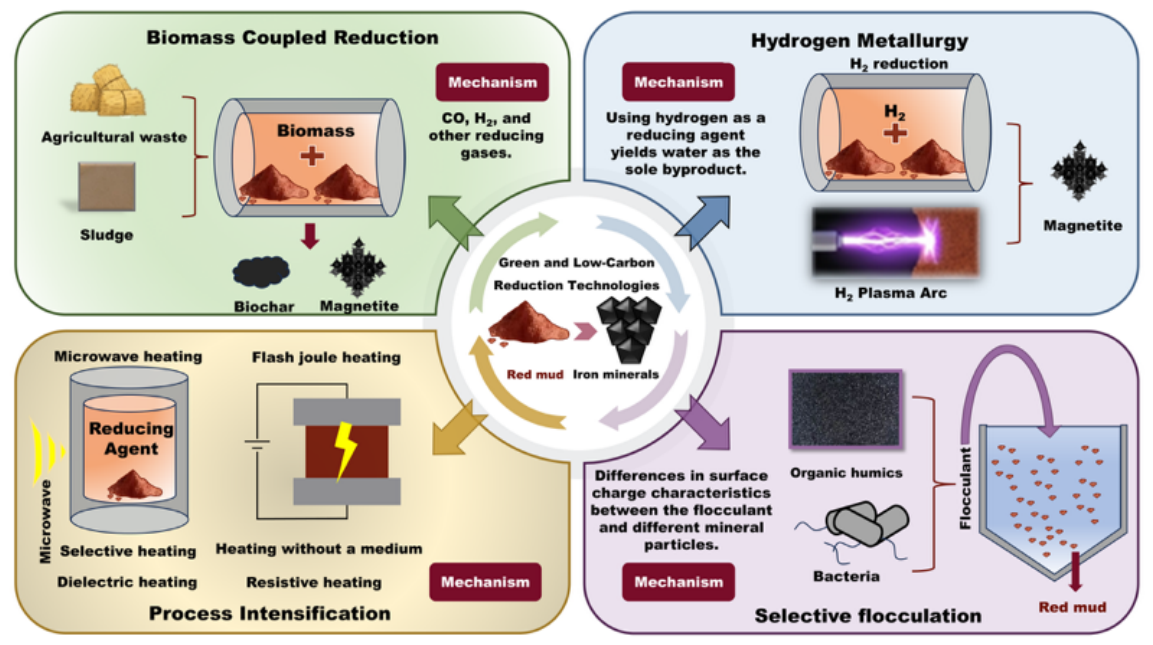
| Biomass Reduction | TFe 28.69–32.54%, Fe2O3 40.09–46.49%, Al2O3 13.1–26.67%, SiO2 7.80–15.1%, CaO 1.27–5.70%, TiO2 5.05–6.80%, PS 0.034–6.5 μm | Biomass includes banana peel, forest litter, rice husk, tea residue, wheat straw, corn stalk, etc. as reductant, with pulverized coal as a supplementary reductant in some studies | Red mud and biomass are mixed at a preset mass ratio, subjected to reduction roasting at 550–1000 °C for 40–60 min, followed by wet magnetic separation (0.07–0.3 T) | Iron grade approx. 42.0–77.0%, iron recovery approx. 72.0–90.9% | Ref. [42]: TFe 28.69%, RM/wheat straw mass ratio: 1:2.5, 1000 °C, 40 min, 0.15 T, 77% iron grade and 72% iron recovery | [37,42,43] |
| Hydrogen Metallurgy (Thermal Hydrogen Reduction) | TFe 26.65–30.51%, Fe2O3 38.10–43.59%, Al2O3 18.45–23.60%, SiO2 6.00–7.80%, CaO 7.90–11.38%, TiO2 5.10–5.54%, PS 2.1–400 μm | H2 (5–100%) as reductant | Reduction roasting is performed at 480–900 °C for 30–120 min under a H2 atmosphere of preset concentration, followed by water leaching and filtration, or wet magnetic separation (0.2–0.3 T) | Iron grade approx. 54.65–69.1%, iron recovery approx. 74.4–88.1% | Ref. [44]: TFe 26.65%, 100% H2, 900 °C, 120 min, 0.29 T, 69.1% iron grade and 88.4% iron recovery | [44,45,46] |
| Hydrogen Metallurgy (Plasma Reduction) | TFe 27.80–44.60%, Fe2O3 38.4–63.7%, Al2O3 10.80–11.18%, SiO2 12.90–15.43%, CaO 6.52%, TiO2 10.96%, PS < 2 μm | H2 plasma (10% H2, 90% Ar) as reductant | Plasma excitation and reduction roasting are conducted at 900–1850 °C for 10–120 min under an atmosphere of 10% H2 and 90% Ar, followed by wet magnetic separation (0.6 T) | Iron grade approx. 71.0–95.0%, iron recovery approx. 62.4–88.1% | Ref. [49]: TFe 44.60%, 10% H2, 90% Ar plasma, 900 °C, 120 min, 0.6 T, 71% iron grade and 88.1% iron recovery | [47,49] |
| Selective Flocculation (Chemical Flocculation/Bio-flocculation) | TFe 30.90–34.43%, Fe2O3 45.60–49.22%, Al2O3 17.6–31.2%, SiO2 11.5–45.7%, CaO 13.2–28.8%, TiO2 1.5–5.8%, PS 14.8–45 μm | Organic humics, bacterial suspension as flocculant, no reductant input | Red mud slurry with low solid content is prepared, an appropriate amount of flocculant is added under suitable pH, stirring and settling conditions, followed by sedimentation separation | Iron grade approx. 60.06–61.12%, iron recovery approx. 69.34–86.25% | Ref. [52]: TFe 30.90%, 2% solid concentration, 30 mg/L Humics II, pH 10.0, 1000 rpm, 61.12% iron grade and 86.25% iron recovery | [52,53] |
| Process Intensification (Microwave Heating) | TFe 22.05–24.26%, Fe2O3 31.50–34.68%, Al2O3 19.40–22.26%, SiO2 4.48–13.10%, CaO 5.69–16.70%, TiO2 4.23–7.80%, PS < 74 μm | Activated carbon or rice husk (biomass) as reductant | Red mud and reducing agent are mixed at a preset mass ratio, subjected to microwave reduction roasting at 900–1000 °C for 10–20 min, followed by acid leaching and separation or wet magnetic separation | Iron grade approx. 60.1%, iron recovery approx. 86.3–92.1% | Ref. [56]: TFe 24.26%, rice RM/husk mass ratio: 1:3, 1000 °C, 20 min, iron grade of 60.1% and iron recovery of 86.3% | [54,56] |
| Process Intensification (Flash Joule Heating) | TFe 32.0%, Fe2O3 45.70%, Al2O3 18.7 wt%, SiO2 8.8%, CaO 10.1%, TiO2 6.5%, PS 1–5 μm | Cl2 as chlorination medium, no reductant input | The reaction is performed at 1000 °C for 1 min via flash Joule heating in a Cl2 atmosphere. After chlorination treatment, iron in red mud is efficiently removed in the form of volatile FeCl3 | Iron is efficiently removed as volatile FeCl3 (recovery > 96%), with iron content in the volatiles reaching 88% | Ref. [58]: TFe 32.00%, FJH-Cl2 process, 1000 °C, 1 min, 96.0% iron recovery | [58] |
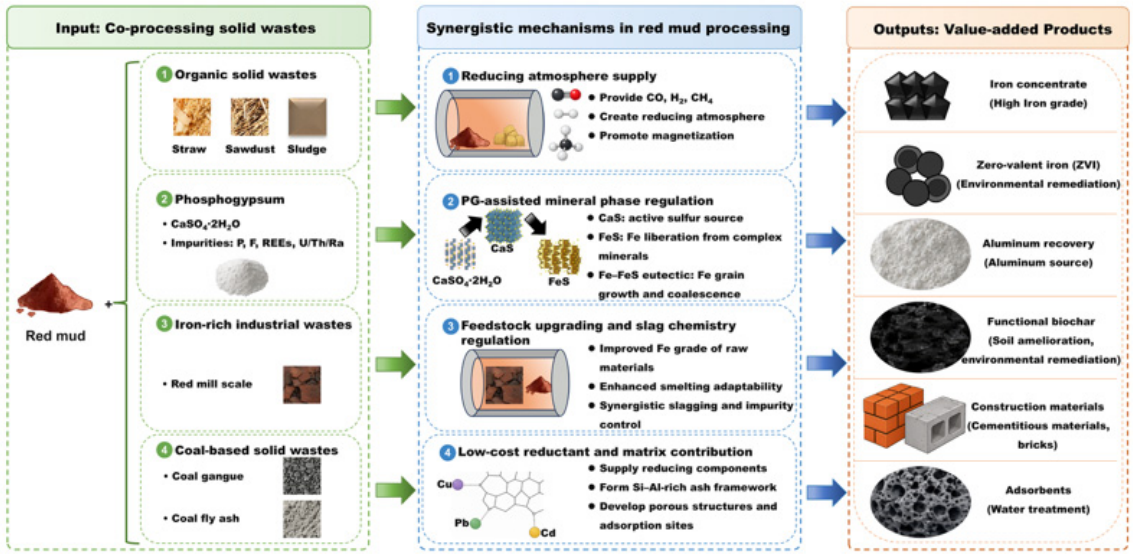
| Organic Solid Waste Synergistic Reduction Roasting | TFe 24.20–36.36%, Fe2O3 34.57–51.94%, Al2O3 19.20–39.29%, SiO2 5.89–15.50%, TiO2 4.17–5.10%, PS 10–150 μm | Organic solid waste such as pine sawdust, bamboo, corn cob and other biomass, oily sludge or activated sludge as reductant | Red mud and organic solid waste are mixed at a preset mass ratio, subjected to reduction roasting at 550–1050 °C, synchronous reduction and gasification (SRG) at 900 °C, or catalytic pyrolysis at 600 °C, followed by wet magnetic separation, with co-production of high-value bio-oil, activated carbon and syngas | Iron grade approx. 52.59–66.12%, iron recovery approx. 92.25%, formation of zero-valent iron (ZVI) confirmed in some studies | Ref. [65]: TFe 36.36%, RM/coal mass ratio: 1:0.35, RM pellet/bamboo mass ratio: 1:0.5, 1050 °C, 90 min, 52.59% iron grade and 84.55% iron metallization degree | [6,64,65,66] |
| Phosphogypsum Synergistic Reduction Roasting | TFe 21.97–35.56%, Fe2O3 31.40–50.80%, Al2O3 18.23–19.51%, SiO2 7.13–18.10%, CaO 2.66–13.30%, TiO2 4.80–6.31%, PS < 75 μm | Pulverized coal or coke as reductant; phosphogypsum promotes iron mineral decomposition, with Na2SO4 as supplementary synergist for iron reduction and separation in some studies | Red mud and phosphogypsum are mixed at a preset mass ratio, subjected to reduction roasting at 1000–1100 °C for 30–75 min, followed by wet magnetic separation (0.1 T) | Iron grade approx. 75.27–89.02%, iron recovery approx. 78.00–89.88% | Ref. [67]: TFe 35.56%, 6% PG, 50% pulverized coal, 1100 °C, 75 min, 0.1 T, 89.02% iron grade and 87.46% iron recovery | [67,68,69] |
| Iron-Containing Waste Synergistic Reduction Roasting | TFe 20.49–34.97%, Fe2O3 29.30–50.00%, Al2O3 22.2%, SiO2 20.0%, CaO 1.2%, TiO2 3.4%, PS < 75 μm | Red mill scale to increase total iron content, graphite as reductant | Red mud and red mill scale are mixed at a preset mass ratio, subjected to reduction roasting at 1600–1650 °C for 30 min with graphite as reductant | Iron-rich aggregate with iron grade of 77.2–98.2% | Ref. [73]: TFe 20.49–34.97%, blended with red mill scale, 1600–1650 °C, 30 min, 77.2–98.2% iron grade | [73] |
| Coal-Based Solid Waste Synergistic Reduction Roasting | TFe 37.85–47.79%, Fe2O3 54.07–68.27%, Al2O3 11.18–14.90%, SiO2 1.85–10.58%, CaO 0.31–2.45%, TiO2 0.78–4.36% | Coal gangue as reductant | Red mud and coal gangue are mixed at a preset mass ratio, subjected to reduction roasting at 750–850 °C for 30–50 min, followed by wet magnetic separation (0.17 T) | Iron grade approx. 55.09–59.77%, iron recovery approx. 70.14–82.73% | Ref. [76]: TFe 47.79%, 30% coal gangue, 850 °C, 30 min, 0.17 T, 59.77% iron grade and 70.14% iron recovery | [75,76] |
| Technical Category | Key Performance Indicators | System Boundary Definition | Sensitive Parameters/Cost Drivers | Major Data Gaps and Scale-Up Barriers | Indicative TRL and Maturity Assessment | Low-Carbon Advantages | References |
|---|---|---|---|---|---|---|---|
| Biomass Reduction | Iron grade, iron recovery, specific biomass consumption, pyrolysis gas utilization rate, off-gas emissions | Biomass collection and transportation, pretreatment energy consumption, off-gas treatment, and biochar by-product utilization should be clearly defined | Biomass price (0–100 USD/t), transportation radius (50–500 km), pyrolysis temperature (300–800 °C), moisture content, ash composition | Lack of standardized comparison data for different biomass feedstocks, pyrolysis gas recycling rates, tar control, and continuous roasting data | TRL 4–5. Biomass thermochemical conversion also has certain engineering bases. Compared with other technologies, this route is closer to scale-up validation | Replaces coal-based reductants with renewable biomass, reaction temperature generally lower than traditional coal-based roasting | [34,35,36,37,38,39,40,41,42,43] |
| Hydrogen Metallurgy (Thermal Hydrogen Reduction) | Iron grade, iron recovery, unit energy consumption, H2 utilization rate, H2 recycling rate, waste heat recovery efficiency | H2 production, compression, storage and transportation, tail gas dehydration and purification, H2 recycling, and waste heat recovery should be clearly defined | H2 source (gray hydrogen/blue hydrogen/green hydrogen), H2 price (1–8 USD/kg), H2 concentration (5–100%), reaction temperature, electricity carbon emission factor (0.1–0.6 kg CO2/kWh) | Lack of continuous gas–solid reaction data, as well as energy consumption, carbon emission, and recycling efficiency data under different hydrogen sources | TRL 3–4. Hydrogen metallurgy has a relatively solid foundation in the iron and steel industry, RM systems are mainly at the laboratory validation stage | Avoids direct CO2 emissions at the reactor end, possesses deep decarbonization potential | [44,45,46] |
| Hydrogen Metallurgy (Plasma Reduction) | Iron grade, iron recovery, unit power consumption, specific hydrogen consumption, hydrogen plasma utilization efficiency, effective reaction-zone volume | In addition to H2 supply and tail gas recycling, plasma excitation energy consumption, electrode lifetime, hydrogen-embrittlement-resistant material costs, and corrosion protection measures should be clearly defined | Plasma power (200–800 A), pressure conditions, reaction-zone size, grid structure, electricity carbon emission factor (0.1–0.6 kg CO2/kWh) | Lack of data on plasma-zone scale-up, continuous feeding, long-term hydrogen/corrosion-resistant operation, and energy consumption accounting | TRL 2–3. This route has strong potential in process intensification, RM systems are still at the early laboratory validation stage | Bypasses intermediate phases, reduces activation energy by approximately. 45%, and increases reaction rate by 1–2 orders of magnitude | [47,48,49,50] |
| Selective Flocculation | Iron grade, iron recovery, specific reagent consumption, water consumption for slurry dilution, COD/BOD in tailwater, settling/filtration performance | Flocculant preparation, pH adjustment, water reuse, tailwater treatment, and tailing disposal should be clearly defined | Slurry pH (9–11), ionic strength, slurry concentration (2–10 g/L), flocculant stability, tailwater treatment cost | Lack of data on flocculant regeneration and recycling, EPS stability in high-salinity environments, and degradation of organic residues in tailings | TRL 3–4. Selective flocculation has a pilot-scale foundation in fine iron ore separation, RM systems remains mainly at the laboratory validation stage | Avoids high-temperature phase transition and reductant input, giving the theoretically lowest process energy demand | [51,52,53] |
| Microwave Heating | Iron grade, iron recovery, unit power consumption, microwave-to-heat conversion efficiency, treatment time | Upstream electricity supply chain, microwave source efficiency, reductant type, off-gas treatment, and equipment lifetime should be clearly defined | Microwave system efficiency (70–85%), dielectric properties of materials, thermal-field uniformity, grid structure, grid carbon emission factor (0.1–0.6 kg CO2/kWh) | Lack of data on thermal-field uniformity after scale-up, continuous processing, and long-term equipment stability | TRL 3–4. Microwave heating equipment has an application basis in mineral processing, RM systems remains at the laboratory validation stage | Selective volume heating directly acts on material, significantly shortened treatment time and improving energy efficiency | [54,56] |
| Flash Joule Heating | Iron removal rate, iron recovery, unit power consumption, pulse energy consumption, Cl2 recycling rate, FeCl3 capture rate | Upstream electricity supply chain, Cl2 production and recycling, FeCl3 condensation and recovery, off-gas alkaline washing, and corrosion protection measures should be clearly defined | Cl2 recycling rate, pulse power supply efficiency, grid structure, Grid carbon emission factor (0.1–0.6 kg CO2/kWh) | Lack of data on closed-loop chlorine circulation, corrosion management, and formation and detection of halogenated by-products in off-gas | TRL 2–3. FJH has undergone scale-up exploration in certain carbon material preparation processes, RM systems remains at an early laboratory validation stage | Ultra-fast temperature rise of approximately 200 °C/s enables selective chlorination, with total heat consumption reduced by approximately 80% compared with conventional processes | [57,58] |
Disclaimer/Publisher’s Note: The statements, opinions and data contained in all publications are solely those of the individual author(s) and contributor(s) and not of MDPI and/or the editor(s). MDPI and/or the editor(s) disclaim responsibility for any injury to people or property resulting from any ideas, methods, instructions or products referred to in the content. |
© 2026 by the authors. Licensee MDPI, Basel, Switzerland. This article is an open access article distributed under the terms and conditions of the Creative Commons Attribution (CC BY) license.
Share and Cite
Liang, G.; Wang, C.; Ji, Q.; Zhang, X.; Zhao, L.; Liu, X.; Yu, Z.; Zhang, H.; Zhuang, G.; Zheng, J.; et al. Advancing Iron Recovery from Red Mud: Green Pathways, Synergistic Valorization, and High-Value Total Component Utilization. Separations 2026, 13, 196. https://doi.org/10.3390/separations13070196
Liang G, Wang C, Ji Q, Zhang X, Zhao L, Liu X, Yu Z, Zhang H, Zhuang G, Zheng J, et al. Advancing Iron Recovery from Red Mud: Green Pathways, Synergistic Valorization, and High-Value Total Component Utilization. Separations. 2026; 13(7):196. https://doi.org/10.3390/separations13070196
Chicago/Turabian StyleLiang, Guoqiang, Chenpeng Wang, Qianwei Ji, Xusheng Zhang, Liang Zhao, Xinchun Liu, Zhisheng Yu, Hongxun Zhang, Guoqiang Zhuang, Jianzhong Zheng, and et al. 2026. "Advancing Iron Recovery from Red Mud: Green Pathways, Synergistic Valorization, and High-Value Total Component Utilization" Separations 13, no. 7: 196. https://doi.org/10.3390/separations13070196
APA StyleLiang, G., Wang, C., Ji, Q., Zhang, X., Zhao, L., Liu, X., Yu, Z., Zhang, H., Zhuang, G., Zheng, J., & Liu, R. (2026). Advancing Iron Recovery from Red Mud: Green Pathways, Synergistic Valorization, and High-Value Total Component Utilization. Separations, 13(7), 196. https://doi.org/10.3390/separations13070196