


Abstract
Peptide purification by preparative reversed-phase liquid chromatography remains one of the most resource-intensive stages in synthetic peptide manufacturing. Production processes commonly rely on acetonitrile/trifluoroacetic acid (ACN/TFA) mobile phases mainly because of their high chromatographic resolution. However, both components raise significant environmental and safety concerns related to toxicity, flammability, waste generation, and, in the case of TFA, environmental persistence as a per- and polyfluoroalkyl substance (PFAS, known as a “forever chemical”). Green alternatives based on ethanol, dimethyl carbonate, and sustainable acidic additives such as acetic acid have been proposed, but their industrial adoption remains limited due to reduced chromatographic performance, often resulting in lower yield and productivity under conventional batch operation. In this work, multi-column counter-current solvent gradient purification (MCSGP) was investigated as a strategy to integrate the use of green eluent systems without compromising process performance. Two therapeutic peptides, Tirzepatide and Tetracosactide, were selected as representative case studies with different structural complexity. Using ethanol/acetic acid for Tirzepatide and dimethyl carbonate/acetic acid for Tetracosactide, the MCSGP process achieved purity levels equivalent to those obtained with conventional ACN/TFA batch chromatography, with 88.1% yield at 89.0% purity for Tirzepatide and 93.8% yield at 94.0% purity for Tetracosactide. Productivity for Tirzepatide was improved, reaching 6.3 g/Lresin/h. These results demonstrate that MCSGP can compensate for the reduced separation efficiency typically associated with green eluent systems, enabling sustainable peptide purification without compromising process performance. By combining green solvents with the MCSGP process, this work paves the way for more sustainable peptide purification processes while maintaining high yield and productivity.
1. Introduction
Peptides have been employed as a versatile modality capable of replicating the biological activity of hormones, enzymes and proteins within physiological environments. Characterized by a size range of 50–5000 Da, they bridge small molecules and biologics, linking programmable structural diversity [1] with versatile interactions at biological interfaces [2,3,4] and enabling modulation of targets often inaccessible to conventional drug modalities [4,5]. Since 2023, over 80 peptide drugs have received global regulatory approval, with more than 200 candidates in clinical development across diverse indications, including metabolic disorders, cancer, autoimmune diseases, and infections [1]. Peptide therapeutics account for ~8% of FDA-approved drugs over the past decade and reached a market value of ~USD 43 billion in 2023 [6]. GLP-1 receptor agonists, including Semaglutide and Tirzepatide, have emerged as the dominant drug class in the pharmaceutical market [7], with projections estimating the global anti-obesity drug market to exceed $100 billion by 2030 [8]. The unprecedented demand has exposed critical manufacturing bottlenecks, particularly in large-scale peptide synthesis, purification, and aseptic fill-finish operations, driving substantial investment in expanded production capacity and next-generation manufacturing technologies [9]. These include integrated continuous manufacturing approaches, which are attracting increasing attention [10].
Peptide manufacturing typically comprises synthesis, consecutive purification steps, and final isolation/formulation stages [11]. The main synthetic platforms for peptide therapeutics are solid-phase peptide synthesis (SPPS) and liquid-phase peptide synthesis (LPPS), valued for their reproducibility [12,13] and scalability from laboratory to industrial production [14]. This platform, however, is intrinsically resource-intensive and associated with high waste generation [15]. The SPPS process mass intensity (PMI, i.e., mass input of materials per mass of product) typically ranges from 3000 to 15 000 kg per kg of active pharmaceutical ingredient for peptides in the 1000–5000 Da range [16]. Its ecological footprint is further strained by a reliance on hazardous solvents (e.g., dimethylformamide, N-methyl-2-pyrrolidone, and dichloromethane), which are now subject to increasing regulatory restrictions [17]. Moreover, the structural similarity between the synthesized target peptides and the related impurities complicates downstream processing, requiring high-resolution separations to meet stringent purity standards [18]. The final purity standards for therapeutic peptides can range from 99.0% to 99.9% [19]. As a consequence, downstream purification—mainly carried out via preparative liquid chromatography—represents one of the most resource-intensive stages in peptide manufacturing [20]. Intermediate chromatographic steps are typically performed under less stringent purity requirements, as subsequent purification stages further enhance product purity to meet final release specifications [20]. Chromatographic protocols typically require several hundred or even thousand liters of eluent per kg of purified peptide. Out of this volume, 10–40% consists of organic modifiers, generating substantial waste, increasing environmental impact [21], and limiting process throughput [17,22].
Among the chromatographic processes adopted in the purification of peptides, reversed-phase high-performance liquid chromatography (RP-HPLC) remains the most widely used technique. To achieve high chromatographic resolution, mobile phases containing acetonitrile (ACN) and/or trifluoroacetic acid (TFA) are often employed and suitable for both analytical and preparative applications [23,24]. Although highly effective in achieving the purity required for pharmaceutical applications, this eluent system presents significant environmental and safety drawbacks: ACN is flammable and toxic; TFA is highly persistent in the environment, belonging to the class of per- and polyfluoroalkyl substances (PFAS), and poses potential toxicity risks [25]. Driven by these concerns, increasing efforts have focused on investigating chromatographic strategies using “green” solvents, particularly through the replacement of these conventional mobile phase components in reversed-phase liquid chromatography [26]. In this work “green” solvent is defined as a solvent that presents reduced hazards to human health and the environment, is preferably derived from renewable resources, and demonstrates favorable biodegradability and a minimal environmental footprint across its production, use, and disposal lifecycle, as assessed by established multi-criteria frameworks such as the CHEM21 [27] solvent selection guide or GSK solvent sustainability tool [28]. Among the proposed alternatives, methanol, ethanol, acetone, and other bio-based solvents have emerged as more sustainable options [29]. In particular, despite its higher viscosity, ethanol offers the advantages of low toxicity and reduced environmental impact. However, its chromatographic performance is generally lower than that of ACN [30]. Nevertheless, its extensive application in RP-HPLC over the past decades confirms its viability as a green alternative [31] alongside other emerging bio-derived solvents such as dimethyl carbonate [32,33,34]. In parallel, replacing the hazardous TFA is also crucial, and alternatives such as acetic acid and formic acid are typical candidates for green counterions [30].
While green eluent systems have been extensively studied [30,31,32,33,34,35,36], peptide purification is still hindered by a trade-off between sustainability and process performance. In industrial RP-HPLC, replacing ACN/TFA with green alternatives remains challenging, as it often leads to lower resolution and hence yield and productivity. To date, an industrially scalable purification process capable of integrating high purity and yield with a low environmental footprint remains elusive.
To address this gap, this study employs the multi-column counter-current solvent gradient purification (MCSGP) process operated with environmentally friendly eluent systems to overcome their lower resolving power and hence retain high yield and productivity in the peptide purification. As a baseline for comparison, a conventional batch process using an ACN/TFA eluent system is developed and optimized, followed by its systematic replacement with more sustainable organic modifiers, including ethanol and dimethyl carbonate, in combination with alternative green counterions such as acetic acid. Both batch processes are refined through a common gradient optimization approach. Subsequently, the MCSGP process is implemented using the green eluent systems to improve process productivity and recovery. In MCSGP, this is obtained by recycling unresolved fractions between interconnected columns under gradient conditions, allowing simultaneous improvements in yield and productivity within a single integrated operation and under the given purity constraint [22,37,38]. This strategy aims to maintain purity at the same level reached with the conventional eluent system, improving yield and productivity, enabling the green process to match or surpass the performance of the traditional system, and supporting integrated continuous peptide manufacturing.
To demonstrate the applicability of this approach within the expanding field of peptide therapeutics, the platform was evaluated using two clinically relevant molecules, Tirzepatide and Tetracosactide, selected as representative case studies of structurally diverse peptides. Tirzepatide, recently introduced for the treatment of type 2 diabetes and obesity, exemplifies the increasing molecular complexity of next-generation peptide drugs [39]. It is a 39-amino-acid synthetic peptide incorporating non-natural residues and a C20 fatty diacid moiety and has dual activity on glucose-dependent insulinotropic polypeptide (GIP) and glucagon-like peptide-1 (GLP-1) receptors [40]. This structural complexity results in significant challenges in both synthesis [41] and downstream purification, as commonly observed for GLP-1 receptor agonists, for which preparative RP-HPLC remains the dominant purification strategy [42]. In contrast, Tetracosactide is a synthetic 24-amino-acid analog of adrenocorticotropic hormone (ACTH), a peptide hormone that regulates cortisol production in the adrenal cortex and is widely used for clinical assessment of adrenal function [43]. Compared to Tirzepatide, it is structurally simpler, without non-natural modifications or lipid conjugation. Nevertheless, its manufacturing still relies on conventional synthesis and purification workflows, including RP-HPLC with ACN and TFA [44]. These two molecules illustrate the broad spectrum of peptide therapeutics, from highly engineered modern constructs to well-established sequences, sharing common challenges related to impurity profiles, standard chromatographic eluents, and system scale-up capability. This study presents a direct comparison of MCSGP operating with green eluent systems against conventional ACN/TFA-based preparative chromatography for structurally diverse therapeutic peptides.
2. Materials and Methods
2.1. Materials
Crude Tirzepatide (Yuli Biotechnology Co., Ltd., Shanghai, China) with a purity of 67.5% and crude Tetracosactide (Bachem AG, Bubendorf, Switzerland) with a purity of 55.1% were used as received (lyophilized TFA-salt crude). Deionized water (analytical grade, VWR, 23595.328), acetonitrile (ACN, Merck Supelco, Darmstadt, Germany, 1.00030), ethanol (EtOH, Merck Supelco, 1.00983), and dimethyl carbonate (DMC, Thermo Scientific, Waltham, MA, USA A13104) were used as solvents. Trifluoroacetic acid (TFA, VWR, Radnor, DE, USA, 85903), acetic acid (AcOH, Merck Supelco, Darmstadt, Germany, 1.00063), ammonium acetate (Merck Supelco, Darmstadt, Germany, 5.43834), and ammonia solution (Merck Supelco, Darmstadt, Germany, 5.43830) were used for solvent preparation and pH adjustment. All solutions were filtered using 0.22 µm PVDF membrane filters (Merck, Darmstadt, Germany, Millex-GV, SLGVX13NL) or cellulose acetate Whatman Puradisc 30 filters (WHA10462200), as specified.
2.2. Feed Preparation
2.2.1. Tirzepatide
Lyophilized crude peptide of Tirzepatide was dissolved in a 20 mM ammonium acetate solution, containing 1% of ACN or EtOH, depending on the eluent system under investigation, and adjusted to pH 9.0 with ammonia (hereafter referred to as the Feed Solvent). A standard solution at 5 g/L was obtained by stirring for at least 15 min, followed by filtration through a 0.22 µm Whatman Puradisc syringe filter.
2.2.2. Tetracosactide
Lyophilized crude peptide of Tetracosactide for the ACN/TFA batch was dissolved in 0.1% TFA solution and decarboxylated at 45 °C for 40 min. Acetonitrile was added to the decarboxylated feed to a final concentration of 1%. The final crude concentration was 10 g/L. The feed solution was filtered using a Whatman Puradisc 30 disk filter.
Lyophilized crude peptide for the DMC/AcOH runs was dissolved in 1 M acetic acid solution and decarboxylated at 45 °C for 40 min. DMC was added to the decarboxylated feed to a final concentration of 0.1%. The final crude concentration was 10 g/L. The feed solution was filtered using a 0.22 µm Merck disk filter.
2.3. Analytics
Samples were analyzed by analytical HPLC using YMC-Triart Bio C18 columns (150 × 2.1 mm, 1.9 µm particle size, 30 nm pore size; YMC, Kyoto, Japan) connected to Agilent 1290 Infinity II liquid chromatography systems (Agilent, Santa Clara, CA, USA).
2.3.1. Tirzepatide
Mobile phase A was formulated with analytical-grade water containing 20 mM ammonium acetate at 95% v/v (pH 6.6) and 5% v/v acetonitrile. Mobile phase B consisted of 95% v/v acetonitrile and 5% v/v 20 mM ammonium acetate solution (pH 6.6). The linear gradient was applied from 34.4 to 43.3% B over 24 min, followed by a step at 100% B from 24 to 30 min. The system was then re-equilibrated at 34.4% B for 6 min. The flow rate was set to 0.2 mL/min, the column temperature to 60 °C, and UV detection was performed at 220 nm. All signals were post-processed with blank subtraction. Quantification was performed using a calibration curve obtained from 5 injections of 5 g/L Tirzepatide standard solution at different injection volumes (0.5, 1, 2, 3, and 4 μL). Purity was obtained from area percentage.
2.3.2. Tetracosactide
Mobile phase A consisted of analytical-grade water with 0.1% TFA (pH 1.8). Mobile phase B consisted of 60% acetonitrile in analytical-grade water, with 0.1% TFA (pH 1.8). Depending on the sample, 0.5 µL or 2 µL of the sample was injected and separated using a linear gradient from 5% B to 100% B within 10 min, using a flow rate of 0.4 mL/min. Column cleaning and re-equilibration were carried out for 4 min each at 100% B and 5% B, respectively. The column thermostat was set to 50 °C, and the UV signal was recorded at 214 nm. All signals were post-processed by a blank subtraction. The concentrations of weak and strong impurities, as well as the product, were calculated using a linear standard curve, which was generated by injection of 5 different volumes of a 2.5 g/L crude standard solution, ranging from 0.1 to 3 µL. Purity was obtained from area percentage.
2.4. Preparative Chromatography
Preparative chromatography experiments were carried out using Contichrom CUBE 30 systems (YMC ChromaCon AG, Zurich, Switzerland) equipped with YMC-Triart C18-S HPLC columns (150 × 4.6 mm ID, 10 µm particle size, 12 nm pore size; YMC Co., Ltd., Kyoto, Japan).
For Tirzepatide experiments, the UV signal was recorded at the outlet of each column at 285 nm (Azura UVD 2.1S detectors, 0.5 mm path length, Knauer, Berlin, Germany). A P2 Inline Adjustment Valve (YMC ChromaCon AG, Zurich, Switzerland) was integrated into the system during MCSGP operation, providing inline dilution of the product collection and recycling streams as well as purging capability for the recycling line after each MCSGP switch.
For Tetracosactide experiments, the UV signal was recorded at the outlet of each column at 280 nm (TOY18DAD 600 H detectors, 0.5 mm path length, ECOM, Prague, Czech Republic). Chromatographic processes were controlled using ChromIQ software (v9.0, YMC ChromaCon AG), including dynamic process control through the AutoPeak® technology (YMC ChromaCon AG, Zurich, Switzerland) [45].
For both molecules and all eluent systems, a systematic batch process development was performed. The results of this development are the individual batch processes described in the following sections. Briefly, method development was carried out using fixed chromatographic parameters, including YMC-Triart C18-S HPLC columns, an elution velocity of 300 cm/h, a gradient volume of 10 column volumes (CV), and a total loading of 10 g/Lresin. The preparative chromatography was carried out at room temperature. Then, optimal gradient operation conditions were established. Starting from a gradient ranging from 10 to 90% B, the gradient starting percentage of B was increased gradually and, if possible, the final percentage of B in the gradient was decreased. The final starting value was evaluated using an isocratic wash step at the initial gradient conditions to confirm that it still provided strong retention of the main product. For Tirzepatide the purity specification was set to 89.0%, and for Tetracosactide it was set to 92.0%. These specifications represent intermediate purity targets.
2.4.1. Tirzepatide: ACN/TFA Reference Batch
The ACN/TFA reference batch process employed solvent A (0.1% TFA, 1% ACN, pH 1.8), Solvent B (0.1% TFA, 60% ACN, pH 1.8), a Stripping Solvent (0.1% TFA, 90% ACN), and the previously described Feed Solvent reported in Section 2.2.1. The column was initially equilibrated with 100% Solvent A for 3 CV at 300 cm/h. The loading protocol consisted of a pre-equilibration step with 1 CV of the Feed Solvent at 600 cm/h, followed by a loading of 2 CV of feed solution at 300 cm/h, corresponding to a total column loading of 10 g/Lresin. This was followed by a post-loading wash with 1 CV of the Feed Solvent and 2 CV of Solvent A, both at 600 cm/h. Elution was performed using a 10 CV linear gradient from 55% to 90% Solvent B, followed by a stripping step of 1.5 CV at 100% B and 600 cm/h. Finally, the column was re-equilibrated with 100% Solvent A for 2 CV at 600 cm/h. The eluate was fractionated in 0.25 CV intervals for analysis. The detailed method is reported in Table S1 in the Supporting Information Section.
2.4.2. Tirzepatide: EtOH/AcOH Batch and MCSGP
The ethanol-based batch process employed Solvent A (20 mM acetic acid, 1% EtOH), Solvent B (20 mM acetic acid, 90% EtOH), and the previously described Feed Solvent. The column was equilibrated with 100% Solvent A for 3 CV at 300 cm/h, followed by the same loading protocol described for the ACN/TFA reference case, using the solvents defined here. Elution was then carried out over 10 CV using a linear gradient from 55% to 85% Solvent B. Finally, the column was re-equilibrated with 100% Solvent A for 2 CV at 600 cm/h. The eluate was fractionated in 0.25 CV intervals for analysis. The detailed method is reported in Table S2 in the Supporting Information Section.
The corresponding EtOH/AcOH MCSGP process was then developed. Batch chromatograms, together with the analytical characterization of the collected fractions, were imported into the MCSGP Wizard software (Version 9.0.4.11) to define the operating process parameters. Both front-side (weak) and back-side (strong) recycling were implemented to maximize product recovery while maintaining target purity above 89.0%. AutoPeak process control based on UV monitoring was applied as follows. The first UV threshold (15 mAU) was used to trigger the onset of the weak-side recycling phase, corresponding to the recycling of product contaminated with weakly adsorbing impurities. The second UV threshold (200 mAU) was used to initiate product collection. This phase lasted until the UV absorbance decreased to 75% of the maximum intensity of the elution peak. Together with an additional 20 s delay, it was used to initiate the strong recycling phase, during which product co-eluting with strong impurities was recycled. Since the loading step required a longer operating time, the column completing the elution phase was temporarily excluded from the primary flow path by valve-switching and subsequently connected in series to the downstream column to enable recycling of strongly adsorbing impurities. To prevent precipitation or gelation during the product collection and recycling phases, a 4-fold inline dilution using the Feed Solvent was applied by the P2 Inline Adjustment Valve. To ensure efficient re-adsorption of the recycled material onto the downstream column, the acid wash step included in the loading procedure was postponed until completion of the strong-side recycling phase. The complete optimized operating strategy is visualized in Figure S1, where the chromatographic sequence is integrated into a continuous cyclic process represented in terms of column volumes and volumetric linear velocities, and the detailed MCSGP operating parameters are reported in Table 1.
Table 1.
MCSGP method for continuous Tirzepatide purification using EtOH/AcOH. The start of weak recycling, of product collection, and of strong recycling are controlled by UV triggers. Therefore, volumes of phases marked with an asterisk slightly change from cycle to cycle according to the chromatogram recorded inline. The values displayed are those recorded in the 5th MCSGP cycle, as being most representative of the steady-state process.
2.4.3. Tetracosactide: ACN/TFA Reference Batch
The column was equilibrated using 1% ACN, 0.1% TFA for 3 CV with a velocity of 600 cm/h. A total of 1 CV of feed was loaded onto the column at 300 cm/h, resulting in a final loading density of 10 g/Lresin. Subsequently, the loading process was finished by pushing the remaining feed in the fluid path on the column using equilibration solvent at 300 cm/h. Elution was carried out by a linear gradient from 30 to 85% B over 10 CV with a velocity of 300 cm/h. For solvent B 35% ACN, 0.1% TFA was used. The eluate was fractionated in 0.3 CV fractions for analysis. Stripping (60% ACN, 0.1% TFA) and re-equilibration were performed for 3 CV each at 600 cm/h. A method table is provided in the Supplementary Information (Table S3).
2.4.4. Tetracosactide: DMC/AcOH Batch and MCSGP
The batch process started with 3 CV equilibration at 600 cm/h using equilibration solvent (0.1% DMC, 20 mM AcOH, pH 3.2). A total of 1 CV of feed was loaded onto the column at 300 cm/h, resulting in a final loading density of 10 g/Lresin. Subsequently, the loading process was finished by pushing the remaining feed in the fluid path on the column using wash solvent (1 M acetic acid, 0.1% DMC, pH 2.4) at 300 cm/h. TFA counterions of the peptides were exchanged to acetate ions by 8 additional CVs of wash solvent at 600 cm/h. Subsequently, the washing process was finished by pushing the remaining wash solvent in the fluid path on the column using equilibration solvent at 600 cm/h. Ion exchange from TFA ions to acetate is needed to ensure a consistent ion form of the peptide, equal to the ion of the eluent system [46]. Elution was carried out by a linear gradient from 10 to 90% B (5% DMC, 20 mM AcOH, pH 3.2) over 10 CV at 300 cm/h. The eluate was fractionated in 0.3 CV fractions for analysis. Stripping (30% ethanol, 20 mM AcOH) and re-equilibration were performed for 3 CV each at 500 cm/h. A method table for the batch process is provided in the Supplementary Information (Table S4).
The MCSGP process was designed based on the batch process described above. The the batch chromatogram and the analytical results of the fractions collected were loaded into the MCSGP Wizard software. An MCSGP process without strong recycling was designed in order to maximize the yield within the given purity specification of ≥92.0%. AutoPeak process control was implemented for controlling the start of the weak recycling phase by a UV threshold. To ensure complete re-adsorption of the recycled material on the downstream column a 4.5-fold inline dilution with equilibration solvent was carried out. The start and the end of the product collection phase were based on time relative to the start of the respective previous phase. The MCSGP Wizard automatically created startup, main cyclical, and shutdown methods, including all process control commands and inline dilution flowrates. Method details are displayed in Table 2. The scheduling of the different process phases was optimized to minimize column idle time after loading (Figure S2). Therefore, the elution flow rate during the product collection phase was reduced compared to the batch process. The flow rate was also reduced for the upstream column during the weak recycling, to keep the combined flowrate of recycling and inline dilution within the maximum pressure and flow rate limits of the column and system. The detailed scheduling is displayed in the Supplementary Information (Figure S2). All used solvents correspond to the solvents mentioned in the batch procedure.
Table 2.
MCSGP run parameters for Tetracosactide purification. The start of weak recycling (marked with asterisk) is controlled by a UV trigger. Therefore, the volume may change slightly under the action of the dynamic controller. In the table, the value displayed refers to the one recorded in the 5th MCSGP cycle, as being most representative of the steady-state process.
3. Results
3.1. Batch and Continuous Purification of Tirzepatide
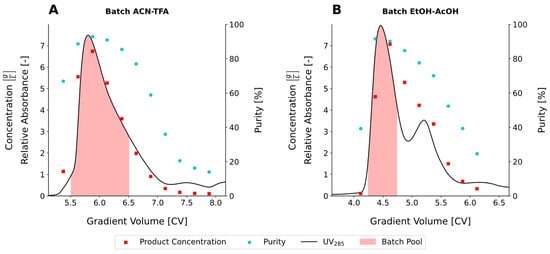
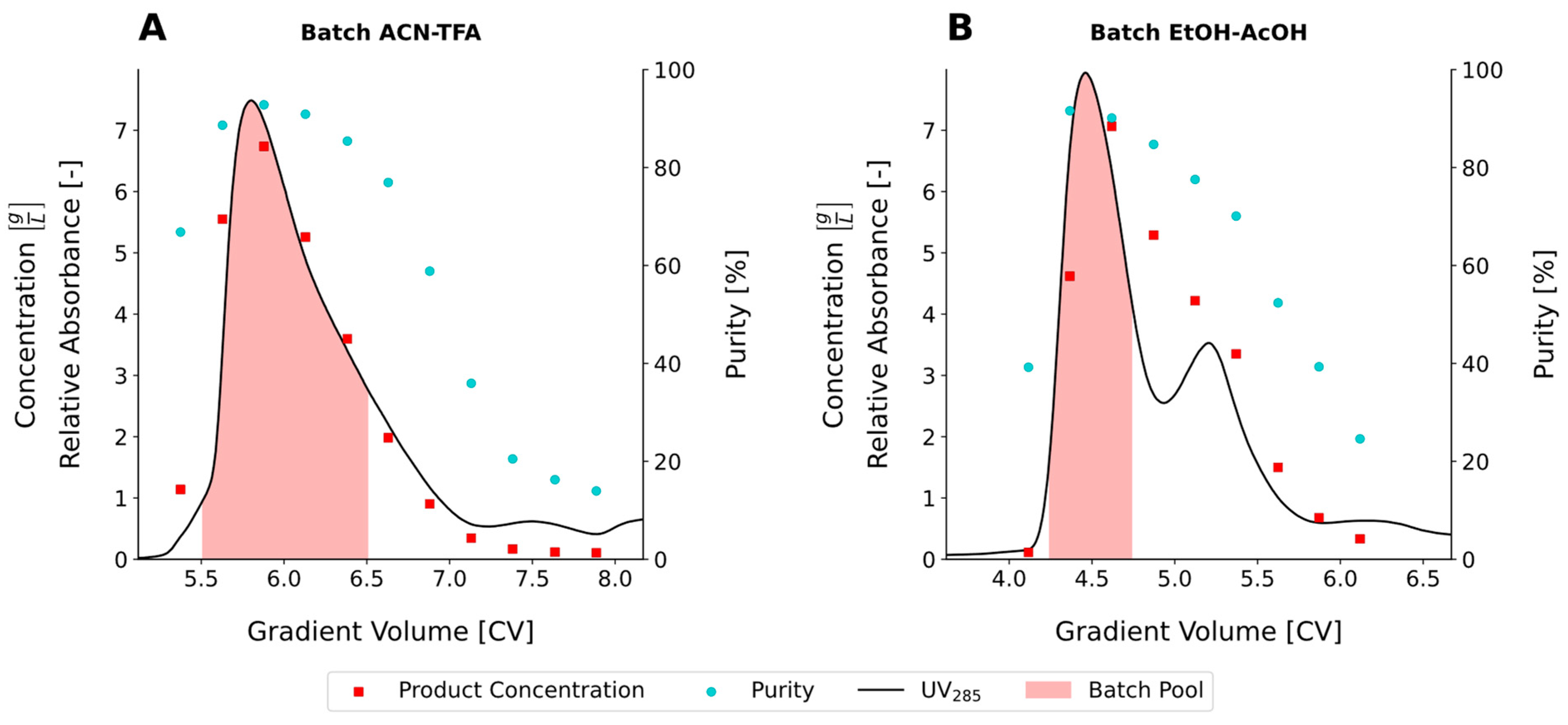
The batch chromatographic methods based on the conventional ACN/TFA and the green EtOH/AcOH eluent systems were systematically optimized to achieve a sufficiently broad collection window while preserving process robustness. For the standard ACN/TFA system, the optimized operating conditions, described in the previous section and reported in Table S1, resulted in a chromatographic profile (Figure 1A) in which the highest Tirzepatide purity was observed along the tail of the main peak. The process performance parameters—yield, purity, productivity, and eluent consumption—are reported in Table 3.
Figure 1.
Optimized batch purification of Tirzepatide using conventional and green eluent systems. (A) Chromatographic profile obtained with the ACN/TFA mobile phase under optimized operating conditions. (B) Chromatographic profile obtained using the green EtOH/AcOH eluent system. The red-highlighted regions indicate the maximum collection windows complying with the purity specification of 89%.
Table 3.
Process comparison of batch and MCSGP for the purification of Tirzepatide and Tetracosactide using conventional (ACN/TFA) and alternative green eluent systems (EtOH/AcOH, DMC/AcOH). For batch processes the maximum possible yield for the corresponding purity specification is reported. For MCSGP processes, the reported performance metrics correspond to the average values obtained from cycles under cyclic steady-state conditions (cycles 4 and 5).
As shown in Figure 1A, the maximum collection window (highlighted in red) complying with the purity constraint of 89.0% resulted in the recovery of 81.9% of the loaded Tirzepatide, while maintaining stable process performance. Under these conditions, the productivity reached 5.3 g/Lresin/h.
In contrast, the EtOH/AcOH eluent system exhibited a more challenging separation behavior. Tirzepatide eluted in the front of the chromatographic peak (Figure 1B), where maximum purity was also detected, followed by progressive coelution with closely related impurities. Due to a double-peak shape with only the first peak displaying high purity, the maximum collection window conforming to the purity specification of 89.0% was significantly narrower (Figure 1B). Consequently, the process yield decreased to 43.2%, with a corresponding reduction in productivity to 2.9 g/Lresin/h.
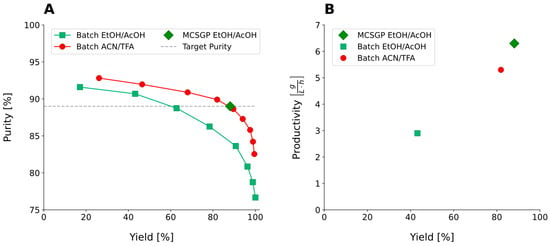
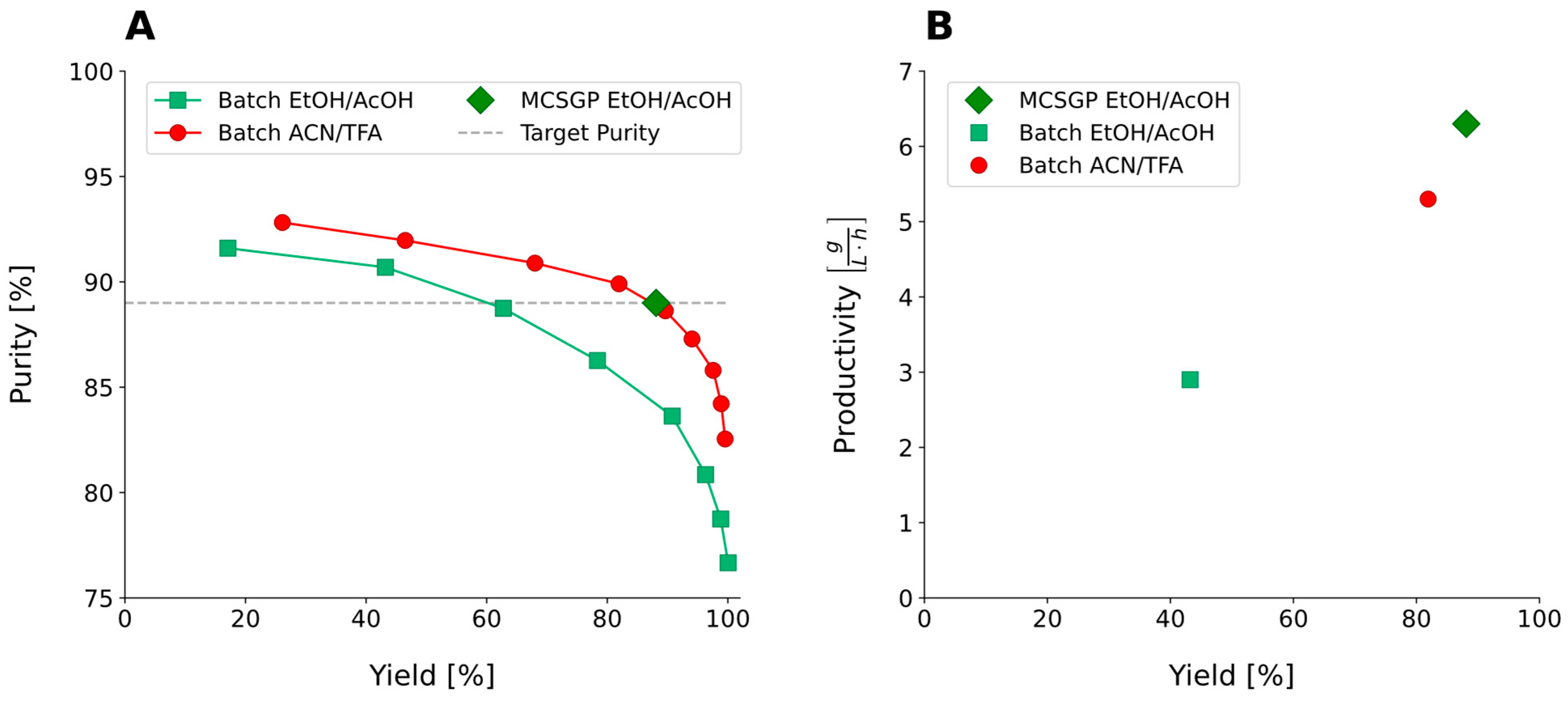
The differences between the two eluent systems are further highlighted by the Pareto front reported in Figure 2A. As often observed, the green eluent system fails to achieve the same chromatographic resolution as the ACN/TFA, which is translated into lower maximum purity as well as a lower yield at equivalent purity. This systematic downward shift in the EtOH/AcOH Pareto curve indicates the reduced separation performance. As a consequence, the standard batch process occupies a region characterized by both higher productivity and higher yield compared to the EtOH/AcOH system (Figure 2B).
Figure 2.
(A) Pareto analysis comparing performance of ACN/TFA and EtOH/AcOH eluent systems in terms of yield and purity across the operating conditions investigated. (B) Productivity–yield comparison between batch and continuous MCSGP operation for ACN/TFA and EtOH/AcOH systems.
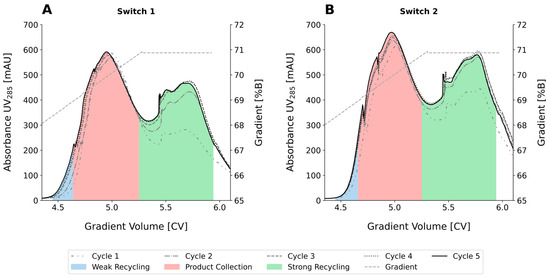
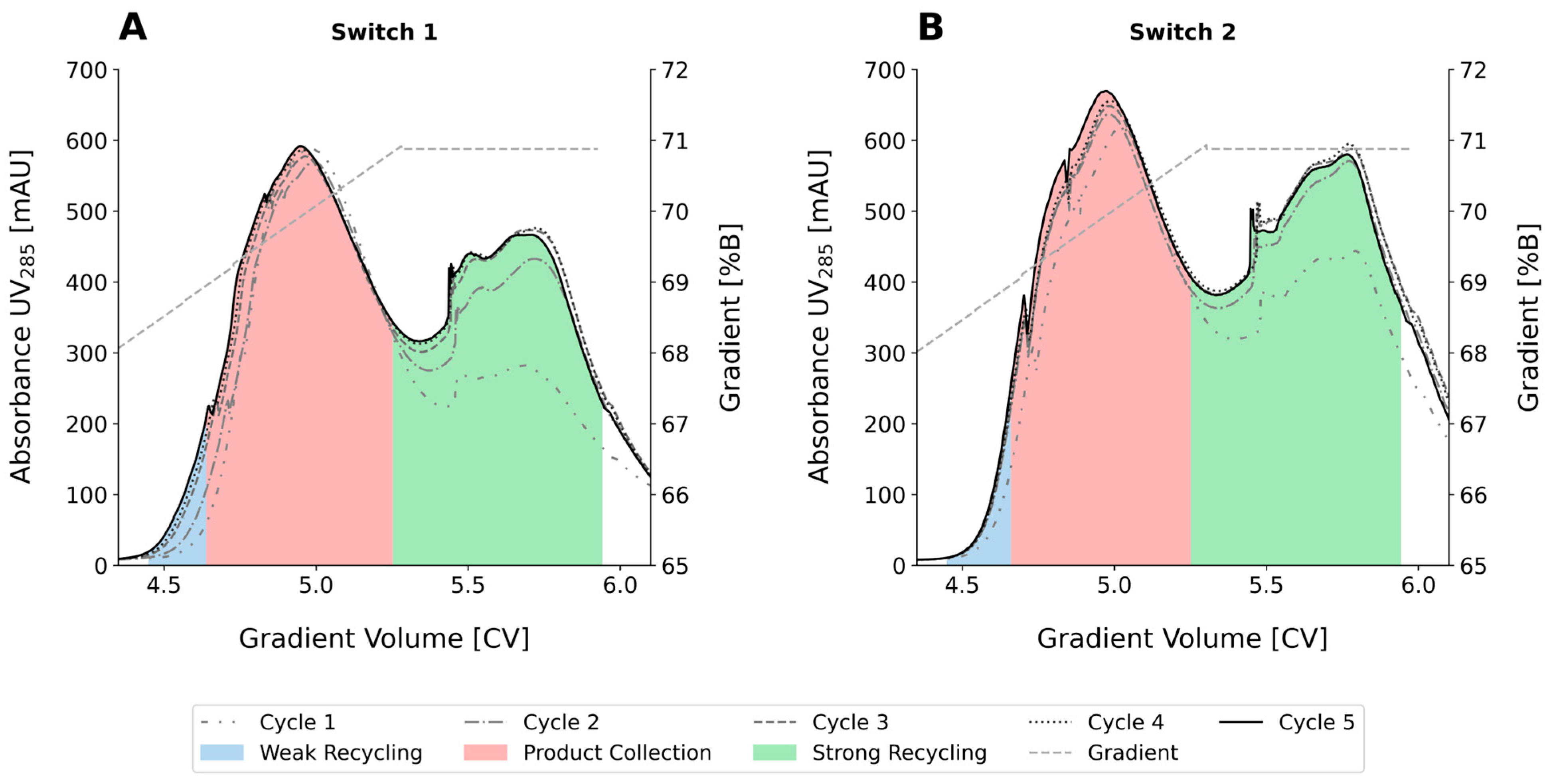
To compensate for the limited separation performance observed with the corresponding batch process, the MCSGP process was subsequently developed and optimized for the green eluent system composed of acetic acid and ethanol. The chromatographic profiles recorded over five consecutive cycles, shown for Switch 1 and Switch 2 in Figure 3A,B, display convergence and hence cyclic steady state after the three initial cycles. The near-complete overlap of elution profiles and the absence of significant drift in the performance parameters obtained from offline analytics, reported in Table S5, indicate that steady-state operation is achieved and maintained, confirming the robustness of the MCSGP setpoint. Process robustness is ensured by the UV-based control strategy (AutoPeak) dynamically switching between product collection and recycling. This maintains reproducible cyclic steady-state operation despite variations in the elution profiles. The well-defined and reproducible separation of weakly adsorbing impurities, product fraction, and strongly adsorbing species further demonstrates the stability of both the gradient design and the switching logic. Under these optimized conditions, the EtOH/AcOH-based MCSGP process achieved a yield of 88.1% while meeting the purity specification of 89.0%. These values are comparable to those obtained with the conventional ACN/TFA batch process (Figure 2A). Notably, this performance was obtained alongside a marked improvement in process efficiency, with productivity reaching 6.3 g/Lresin/h. As shown in Figure 2B, the continuous MCSGP operation shifts the EtOH/AcOH process toward a significantly more favorable productivity–yield region compared to batch conditions. The improved performance of the MCSGP process compared to batch chromatography can be attributed to its multi-column counter-current operation and recycling of partially resolved fractions, which enables recovery of product that would otherwise be discarded within the batch collection window. This alleviates the yield–purity trade-off. In addition, solvent consumption was reduced from 4.3 L/g for the conventional ACN/TFA batch process to 3.4 L/g for the EtOH/AcOH-based MCSGP process, further intensifying the sustainability of the purification. These results demonstrate that for Tirzepatide the continuous MCSGP approach maintains product quality comparable to the ACN/TFA batch process while significantly enhancing process productivity and recovery under greener operating conditions.
Figure 3.
Overlaid UV chromatographic profiles recorded over five consecutive MCSGP switching cycles, shown for Switch 1 (A) and Switch 2 (B), respectively.
3.2. Batch and Continuous Purification of Tetracosactide
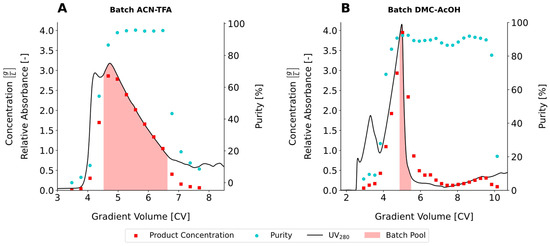
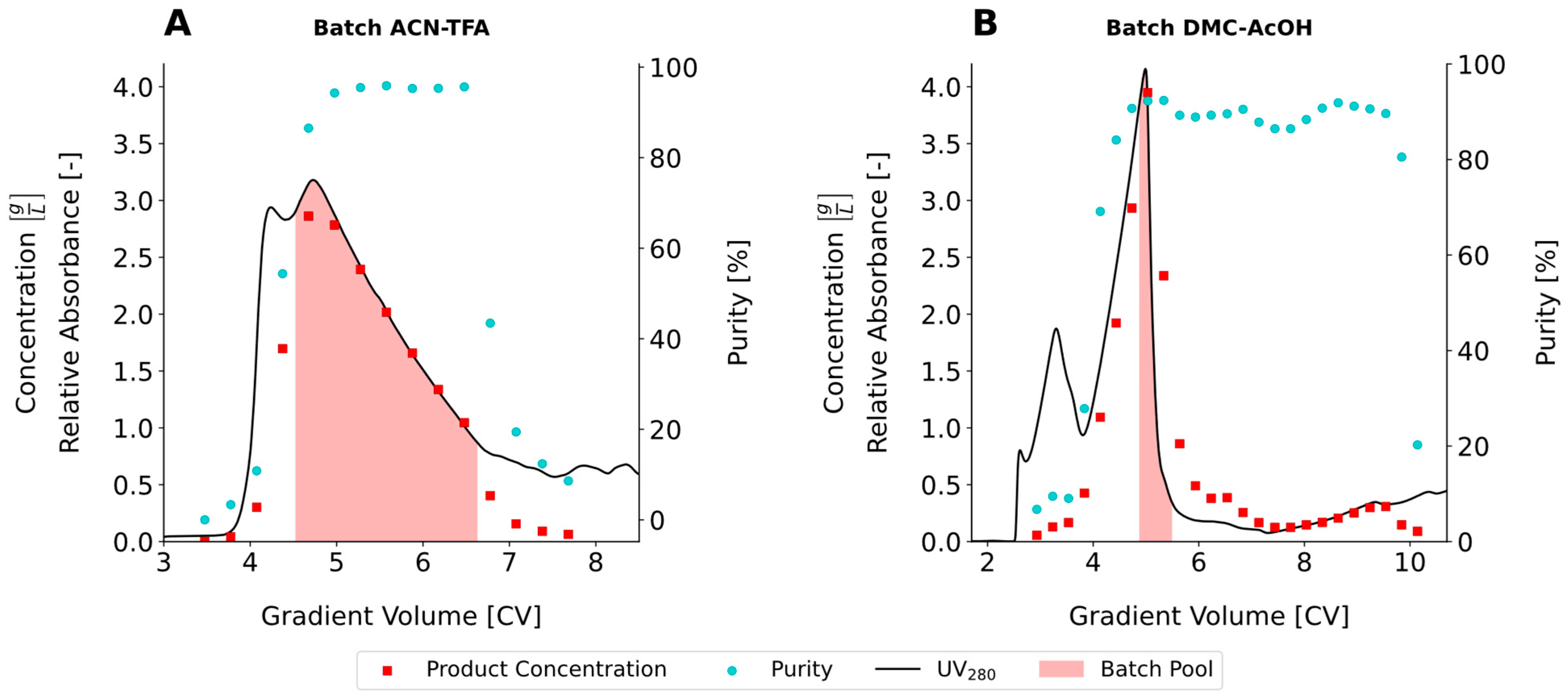
For the purification of Tetracosactide, ACN/TFA also served as the eluent system representing the current state of the art. DMC/AcOH was instead used as a green alternative. Both batch gradients were optimized using the approach described above. The resulting batch elutions for ACN/TFA and DMC/AcOH are displayed in Figure 4. Both processes were able to generate fractions with purity within the ≥92.0% specification. For maximum yield, fractions with purity below the specification were included in the product pool as long as the calculated purity of the pool remained within the specification. ACN/TFA batch purification resulted in a sharp product peak with fractions exceeding 95.0% purity. Including a fraction with lower purity before the peak maximum, the pool purity was 93.2%. The product pool starts before the main peak and includes the decreasing flank. Overall, the maximum yield within the purity specification was 82.8%.
Figure 4.
The elution phase of the conventional ACN/TFA batch Panel (A) and the elution phase of the batch using the green DMC/AcOH eluent system Panel (B). The normalized UV signal is shown as a black line. The purity of the collected fractions is shown as blue circles and the respective product concentration as red squares. According to the purity specification of ≥92.0%, the theoretical pool of the fractions was calculated and is displayed as red area under the curve.
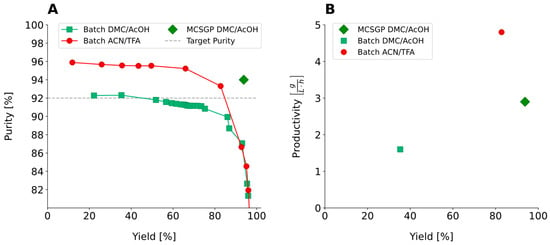
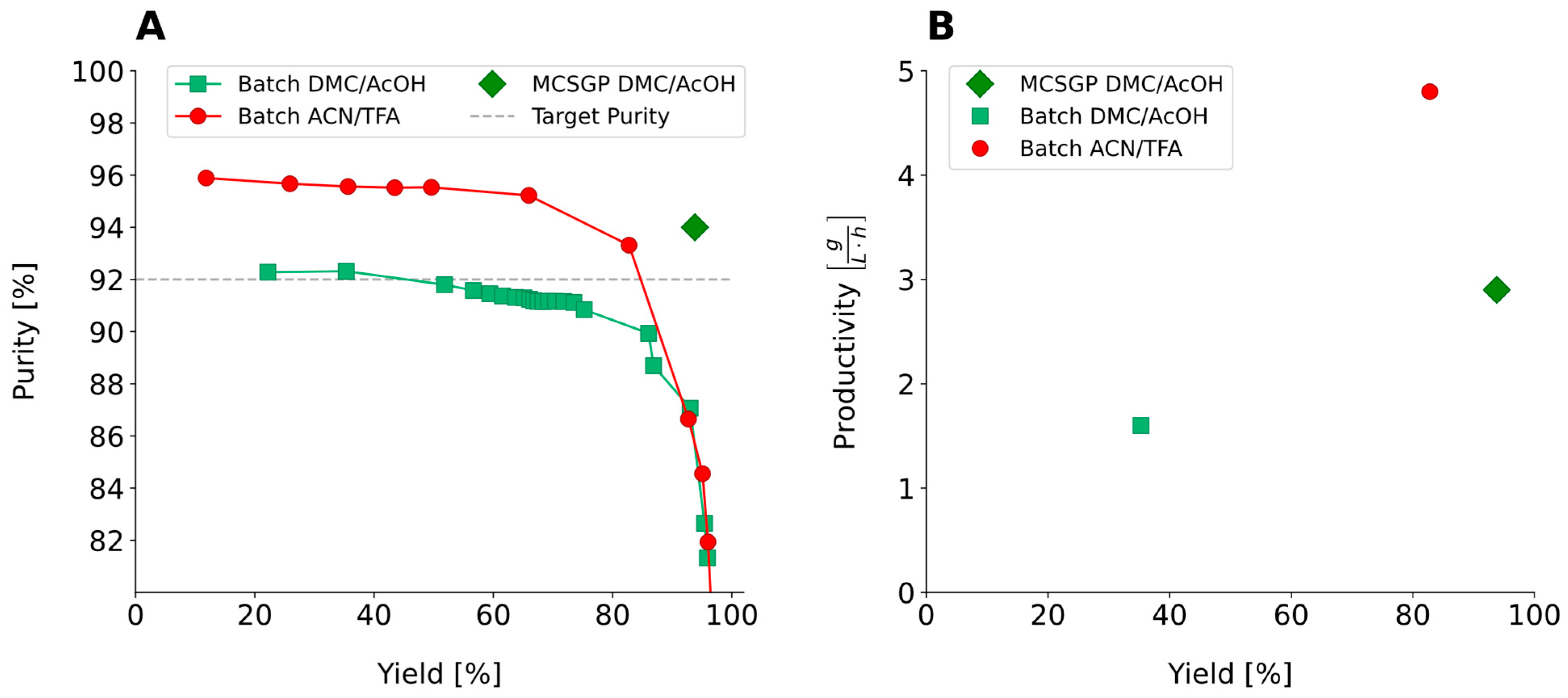
DMC/AcOH batch purification was able to generate a pool consisting of two fractions, resulting in a pool purity of 92.3% at 35.3% yield. In contrast to the ACN/TFA system, the DMC/AcOH system only allowed for a very narrow product collection window, as a result of the lower chromatographic resolution. After the main product peak with the highest purity, a long tail with high purity but low product concentration was eluted (Figure 4B). The green eluent system delivered a 2.3-fold lower yield compared to the conventional ACN/TFA batch, proving its inferior separation performance (Figure 5A). As the green DMC/AcOH system used acetic acid as an additive and the Tetracosactide crude comes as a TFA salt, an ion exchange step was necessary to prevent the co-presence of different peptide-counterion species. This additional step is responsible for additional solvent consumption and longer processing times. The prolonged time in combination with a lower product yield leads to a three-fold lower productivity of 1.6 g/Lresin/h compared to the 4.8 g/Lresin/h productivity of the ACN/TFA batch. The overall solvent consumption increased from 5.0 L/g for the ACN/TFA batch to 17 L/g for the green DMC/AcOH batch. The differences between the two eluent systems are further highlighted by the process performance comparisons in Figure 5. In Panel A, the yield and the purity of the single batch fractions are shown as a Pareto curve, visualizing the poorer process separation efficiency of the green eluent system.
Figure 5.
Process results comparing conventional and green batch as well as green MCSGP. Panel (A) shows the Pareto curves of the batch processes using ACN/TFA and using DMC/AcOH, respectively. The steady-state performance of the DMC/AcOH MCSGP outperforms both batch processes in terms of yield at the purity specification. Panel (B) shows the comparison of yield and productivity considering the purity specification of ≥92.0%. For the batches, the pool with the highest possible yield and productivity was selected, and for the MCSGP data cycles in steady state were used.
Based on the DMC/AcOH batch process, an MCSGP process was developed to assess its potential to overcome the performance gap between conventional and green eluent systems. The continuous purification was performed over five consecutive cycles. An overlay of the elution phases of the cycles is provided in the Supplementary Information (Figure S3). After three cycles, the process entered a stable steady state; consequently, cycles 4 and 5 were used for performance calculations. The MCSGP process resulted in a product pool purity of 94.0% and a yield of 93.8% (Table 3). As shown in Figure 5A, the achieved purity and yield of the MCSGP clearly surpassed those of the green batch. The MCSGP process even shows better purity and yield compared to the batch with ACN/TFA. This shows that the MCSGP not only improved the yield but also led to a purity boost, reaching a higher purity than the maximum purity of the green batch. In Figure 5B, yield and productivity of the three processes are compared under the purity constraint of ≥92.0%. The performance of the green DMC/AcOH batch is notably worse than the conventional ACN/TFA batch in terms of productivity and yield. Using the green DMC/AcOH MCSGP, the yield was recovered, even surpassing the ACN/TFA batch. Productivity was also increased by almost two-fold compared to the DMC/AcOH batch. However, in comparison with the ACN/TFA batch, the productivity is still significantly lower and the solvent consumption is higher. This can be explained by the increase in time and solvent needed to complete the counterion exchange from TFA to acetate, a step which is in any case required for the final product, which is administered in its acetate form [47,48]. An equivalent counterion exchange step would ultimately be required following the ACN/TFA process, whereas it is already integrated within the DMC/AcOH MCSGP workflow.
4. Discussion
The results obtained in this study confirmed the strong separation performance of the traditional ACN/TFA eluent system and the intrinsic trade-off between sustainability and chromatographic performance in preparative peptide purification. In fact, while the conventional ACN/TFA system provided advantageous separation efficiency under batch conditions, the green eluent systems based on EtOH/AcOH and DMC/AcOH showed significantly reduced chromatographic resolution, leading to narrower collection windows respecting the purity specification and hence lower recoveries and reduced productivity. Table 3 summarizes these results and underlines the substantial performance gap between conventional and green eluent systems under batch operation. Replacing ACN/TFA with greener eluents resulted in a pronounced reduction in recovery, with yield decreasing by nearly 50% for Tirzepatide and by more than 50% for Tetracosactide. Hence, productivity is also significantly reduced by a factor of 2 for Tirzepatide and a factor of 3 for Tetracosactide. At the same time, eluent consumption is significantly increased, approximately doubled for Tirzepatide and increased more than three-fold for Tetracosactide, further emphasizing the operational penalties associated with green eluent systems under conventional batch conditions. The eluent consumption is directly associated with the overall waste amount of the peptide purification process, as the strong dilution of organic solvents prevents solvent recycling [22]. Although lower loading densities would enhance yield, this approach would be accompanied by reduced productivity and greater solvent consumption. Hence, batch processing does not allow for high-yielding, productive purification using green eluent systems for the investigated peptides and conditions.
Despite these limitations, the results also showed that the green eluent performance gap is not associated with insufficient product purity, as the required purity specifications were consistently met in all cases, but rather by the inability of the batch process to utilize the partially resolved fractions. Therefore, through the recycling of product-containing side fractions, MCSGP allows the recovery of material that would otherwise be discarded or require re-chromatography in batch operation. Thus, MCSGP improves yield while satisfying the required purity constraints and high loading density, which is translated into high productivity. Moreover, for Tirzepatide the green MCSGP was able to reduce eluent consumption compared to the conventional batch, whereas for Tetracosactide the eluent consumption was higher for this scenario. As described above, this is associated with the ion exchange step.
5. Conclusions
MCSGP enables the use of green eluent systems for high-yielding, productive purification processes, allowing us to decouple process performance from sustainability and safety considerations. These findings are particularly valuable in the context of the rapidly growing demand for therapeutic peptides [7], as well as increasing regulatory and environmental pressure to minimize the use of hazardous chemicals in pharmaceutical manufacturing, especially PFAS [29]. Moreover, the scalability and operational robustness of MCSGP with AutoPeak [49] further support its implementation at manufacturing scale, as previously demonstrated for complex biopharmaceutical products such as oligonucleotides [50]. In this context, the use of green eluents mainly requires consideration of solvent viscosity and the associated pressure drop. Beyond its high degree of automation and significant reduction in required in-process controls, as shown in this study, MCSGP with AutoPeak allows us to establish the environmental and safety benefits. The scale-up of green MCSGP can enable the replacement of toxic and persistent chemicals at industrial scale and would be a subsequent step towards more environmentally friendly peptide production.
Supplementary Materials
The following supporting information can be downloaded at https://www.mdpi.com/article/10.3390/separations13070195/s1, Table S1: Method table for ACN-TFA batch purification of Tirzepatide, Table S2: Method table for EtOH-AcOH batch purification of Tirzepatide, Table S3: Method table for ACN-TFA batch purification of Tetracosactide, Table S4: Method table for DMC-AcOH batch purification of Tetracosactide, Table S5: Evolution of chromatographic performance parameters over the consecutive MCSGP cycles for Tirzepatide and Tetracosactide. For both molecules steady state was reached after cycle three, Figure S1: Gantt chart of MCSGP process for the Tirzepatide purification, Figure S2: Gantt chart of MCSGP process for the Tetracosactide purification, Figure S3: Display of the elution phase of the MCSGP process for the continuous purification of Tetracosactide.
Author Contributions
R.P.—Investigation, Data Curation, Writing—Original Draft; D.H.—Investigation, Data Curation, Writing—Original Draft; M.S.—Writing—Review and Editing; S.V.—Supervision, Funding Acquisition, Project Administration, Writing—Review and Editing; T.M.-S.—Funding Acquisition, Project Administration, Writing—Review and Editing. All authors have read and agreed to the published version of the manuscript.
Funding
This research received no external funding.
Data Availability Statement
The original contributions presented in this study are included in the article or supplementary material. Further inquiries can be directed to the corresponding author.
Acknowledgments
The supply of Tetracosactide by Bachem AG (Bubendorf, Switzerland) is greatly appreciated.
Conflicts of Interest
The authors D.H., S.V., T.M.-S., and—for the duration of the work—R.P. are employees of ChromaCon AG, which commercializes the technology described in this paper.
References
- Zheng, B.; Wang, X.; Guo, M.; Tzeng, C.M. Therapeutic Peptides: Recent Advances in Discovery, Synthesis, and Clinical Translation. Int. J. Mol. Sci. 2025, 26, 5131. [Google Scholar] [CrossRef] [Scilit] [PubMed]
- Monti, A.; Vitagliano, L.; Caporale, A.; Ruvo, M.; Doti, N. Targeting Protein–Protein Interfaces with Peptides: The Contribution of Chemical Combinatorial Peptide Library Approaches. Int. J. Mol. Sci. 2023, 24, 7842. [Google Scholar] [CrossRef] [Scilit] [PubMed]
- Juretić, D. Designed Multifunctional Peptides for Intracellular Targets. Antibiotics 2022, 11, 1196. [Google Scholar] [CrossRef] [Scilit] [PubMed]
- Atangcho, L.; Navaratna, T.; Thurber, G.M. Hitting Undruggable Targets: Viewing Stabilized Peptide Development through the Lens of Quantitative Systems Pharmacology. Trends Biochem. Sci. 2019, 44, 241–257. [Google Scholar] [CrossRef] [Scilit] [PubMed]
- Lee, A.C.-L.; Harris, J.L.; Khanna, K.K.; Hong, J.-H. A Comprehensive Review on Current Advances in Peptide Drug Development and Design. Int. J. Mol. Sci. 2019, 20, 2383. [Google Scholar] [CrossRef] [Scilit] [PubMed]
- Gare, C.L.; White, A.M.; Malins, L.R. From lead to market: Chemical approaches to transform peptides into therapeutics. Trends Biochem. Sci. 2025, 50, 467–480. [Google Scholar] [CrossRef] [Scilit] [PubMed]
- Wang, L.; Wang, N.; Zhang, W.; Cheng, X.; Yan, Z.; Shao, G.; Wang, X.; Wang, R.; Fu, C. Therapeutic peptides: Current applications and future directions. Signal Transduct. Target. Ther. 2022, 7, 48. [Google Scholar] [CrossRef] [Scilit] [PubMed]
- Abdelrahman, R.M.; Musa, T.H.; Arbab, I.A.; Suliman, M.H.; Ahmed, E.O.; Mohamed, A.N.; Musa, H.H.; Jalal, M.; Gasmallah, S.I. Harnessing GLP-1 Receptor Agonists for Obesity Treatment: Prospects and Obstacles on the Horizon. J. Obes. 2025, 2025, 9919810. [Google Scholar] [CrossRef] [Scilit] [PubMed]
- Chandrashekar, C.; Lin, F.; Nishiuchi, Y.; Mohammed, S.F.; White, B.F.; Arsenakis, Y.; Yuliantie, E.; Zhao, P.; van Dun, S.; Koijen, A.; et al. Engineering of a Biologically Active Glycosylated Glucagon-Like Peptide-1 Analogue. J. Med. Chem. 2024, 67, 7276–7282. [Google Scholar] [CrossRef] [Scilit] [PubMed]
- Domokos, A.; Nagy, B.; Szilágyi, B.; Marosi, G.; Nagy, Z.K. Integrated Continuous Pharmaceutical Technologies—A Review. Org. Process Res. Dev. 2021, 25, 721–739. [Google Scholar] [CrossRef] [Scilit]
- Isidro-Llobet, A.; Kenworthy, M.N.; Mukherjee, S.; Kopach, M.E.; Wegner, K.; Gallou, F.; Smith, A.G.; Roschangar, F. Sustainability Challenges in Peptide Synthesis and Purification: From R&D to Production. J. Org. Chem. 2019, 84, 4615–4628. [Google Scholar] [CrossRef] [Scilit] [PubMed]
- Zero, J.; Tyler, T.J.; Cronin, L. Universal peptide synthesis via solid-phase methods fused with chemputation. Nat. Commun. 2025, 16, 7322. [Google Scholar] [CrossRef] [Scilit] [PubMed]
- Freiburghaus, V.; Jeandin, A.; Frankiewicz, Ł.; Yang, J.; Hartrampf, N. Development of ArgTag for Scalable Solid-Phase Synthesis of Aggregating Peptides. ACS Chem. Biol. 2025, 20, 2733–2740. [Google Scholar] [CrossRef] [Scilit] [PubMed]
- Stager, M.A.; Peroza, C.; Villaumie, J.; Bilham, C.; Desmond, C.; Harris, M.; Sambasivan, R.; Rowe, G.; Chen, L.; Tucker, C. Optimizing Industrial Solid-Phase Peptide Synthesis: Integration of Raman Spectroscopy as Process Analytical Technology. Org. Process Res. Dev. 2024, 28, 4501–4512. [Google Scholar] [CrossRef] [Scilit]
- Lawrenson, S.B.; Arav, R.; North, M. The greening of peptide synthesis. Green Chem. 2017, 19, 1685–1691. [Google Scholar] [CrossRef] [Scilit]
- Ferrazzano, L.; Catani, M.; Cavazzini, A.; Martelli, G.; Corbisiero, D.; Cantelmi, P.; Fantoni, T.; Mattellone, A.; De Luca, C.; Felletti, S.; et al. Sustainability in peptide chemistry: Current synthesis and purification technologies and future challenges. Green Chem. 2022, 24, 975–1020. [Google Scholar] [CrossRef] [Scilit]
- Jad, Y.E.; Kumar, A.; El-Faham, A.; de la Torre, B.G.; Albericio, F. Green Transformation of Solid-Phase Peptide Synthesis. ACS Sustain. Chem. Eng. 2019, 7, 3671–3683. [Google Scholar] [CrossRef] [Scilit]
- Mathieu Verbeken, S.V.D. Purity profiling of Peptide Drugs. J. Bioanal. Biomed. 2012, s6, 3. [Google Scholar] [CrossRef]
- Vergote, V.; Burvenich, C.; Van de Wiele, C.; De Spiegeleer, B. Quality specifications for peptide drugs: A regulatory-pharmaceutical approach. J. Pept. Sci. 2009, 15, 697–710. [Google Scholar] [CrossRef] [Scilit] [PubMed]
- De Luca, C.; Lievore, G.; Bozza, D.; Buratti, A.; Cavazzini, A.; Ricci, A.; Macis, M.; Cabri, W.; Felletti, S.; Catani, M. Downstream Processing of Therapeutic Peptides by Means of Preparative Liquid Chromatography. Molecules 2021, 26, 4688. [Google Scholar] [CrossRef] [Scilit] [PubMed]
- De Luca, C.; Nosengo, C.; Spedicato, M.; Magagnato, L.; Fogli, G.; Carraro, M.; Cabri, W.; Macis, M.; Cavazzini, A.; Felletti, S.; et al. Replace, reduce, and reuse organic solvents in peptide downstream processing: The benefits of dimethyl carbonate over acetonitrile. Green Chem. 2025, 27, 12727–12737. [Google Scholar] [CrossRef] [Scilit]
- Kekessie, I.; Wegner, K.; Martinez, I.; Kopach, M.E.; White, T.D.; Tom, J.K.; Kenworthy, M.N.; Gallou, F.; Lopez, J.; Koenig, S.G.; et al. Process Mass Intensity (PMI): A Holistic Analysis of Current Peptide Manufacturing Processes Informs Sustainability in Peptide Synthesis. J. Org. Chem. 2024, 89, 4261–4282. [Google Scholar] [CrossRef] [Scilit] [PubMed]
- Mant, C.T.; Chen, Y.; Yan, Z.; Popa, T.V.; Kovacs, J.M.; Mills, J.B.; Tripet, B.P.; Hodges, R.S. HPLC Analysis and Purification of Peptides; Humana Press: Totowa, NJ, USA, 2007; pp. 3–55. [Google Scholar] [CrossRef] [Scilit] [PubMed]
- de Souza, G.L.R.; Oliveira, A.D.P.; Neto, P.S.; de Oliveira, J.B.; Costa, C.L.D.S.; de Souza, P.P.; Silveira, M.B.; Binatti, I. Strategies for the development and optimization of green acetonitrile-free HPLC methods for application in pharmaceutical analysis. Microchem. J. 2025, 213, 113659. [Google Scholar] [CrossRef] [Scilit]
- Arp, H.P.H.; Gredelj, A.; Glüge, J.; Scheringer, M.; Cousins, I.T. The Global Threat from the Irreversible Accumulation of Trifluoroacetic Acid (TFA). Environ. Sci. Technol. 2024, 58, 19925–19935. [Google Scholar] [CrossRef] [Scilit] [PubMed]
- Płotka, J.; Tobiszewski, M.; Sulej, A.M.; Kupska, M.; Górecki, T.; Namieśnik, J. Green chromatography. J. Chromatogr. A 2013, 1307, 1–20. [Google Scholar] [CrossRef] [Scilit] [PubMed]
- Prat, D.; Wells, A.; Hayler, J.; Sneddon, H.; McElroy, C.R.; Abou-Shehada, S.; Dunn, P.J. CHEM21 selection guide of classical- and less classical-solvents. Green Chem. 2016, 18, 288–296. [Google Scholar] [CrossRef] [Scilit]
- Alder, C.M.; Hayler, J.D.; Henderson, R.K.; Redman, A.M.; Shukla, L.; Shuster, L.E.; Sneddon, H.F. Updating and further expanding GSK’s solvent sustainability guide. Green Chem. 2016, 18, 3879–3890. [Google Scholar] [CrossRef] [Scilit]
- Bocian, S.; Studzińska, S. Solvents for green pharmaceutical liquid chromatography—Possibilities and limitations. J. Pharm. Biomed. Anal. 2026, 269, 117238. [Google Scholar] [CrossRef] [Scilit] [PubMed]
- Bozza, D. Greening the Downstream of Biopharmaceuticals Through Process Intensification in the Research on Innovative Eco-compatible Solvent. Università degli Studi di Ferrara. 2024. Available online: https://hdl.handle.net/20.500.14242/73987 (accessed on 18 June 2026).
- Gaudin, K. Potential of green solvents as mobile phases in liquid chromatography. J. Chromatogr. A 2025, 1750, 465810. [Google Scholar] [CrossRef] [Scilit] [PubMed]
- Boes, P.D.; Elleman, S.R.; Danielson, N.D. Dimethyl Carbonate as a Mobile-Phase Modifier for Normal-Phase and Hydrophilic Interaction Liquid Chromatography. Separations 2023, 10, 70. [Google Scholar] [CrossRef] [Scilit]
- Bozza, D.; De Luca, C.; Felletti, S.; Spedicato, M.; Presini, F.; Giovannini, P.P.; Carraro, M.; Macis, M.; Cavazzini, A.; Catani, M.; et al. Dimethyl carbonate as a green alternative to acetonitrile in reversed-phase liquid chromatography. Part II: Purification of a therapeutic peptide. J. Chromatogr. A 2024, 1713, 464530. [Google Scholar] [CrossRef] [Scilit] [PubMed]
- Felletti, S.; Spedicato, M.; Bozza, D.; De Luca, C.; Presini, F.; Giovannini, P.P.; Carraro, M.; Macis, M.; Cavazzini, A.; Catani, M.; et al. Dimethyl carbonate as a green alternative to acetonitrile in reversed-phase liquid chromatography. Part I: Separation of small molecules. J. Chromatogr. A 2023, 1712, 464477. [Google Scholar] [CrossRef] [Scilit] [PubMed]
- Olives, A.I.; González-Ruiz, V.; Martín, M.A. Sustainable and Eco-Friendly Alternatives for Liquid Chromatographic Analysis. ACS Sustain. Chem. Eng. 2017, 5, 5618–5634. [Google Scholar] [CrossRef] [Scilit]
- Shen, Y.; Chen, B.; van Beek, T.A. Alternative solvents can make preparative liquid chromatography greener. Green Chem. 2015, 17, 4073–4081. [Google Scholar] [CrossRef] [Scilit]
- Weldon, R.; Vandermeersch, T.; Müller-Späth, T. Continuous Purification of a Conjugated Short Interfering RNA Therapeutic Using Anion Exchange Twin-Column Chromatography (MCSGP). Org. Process Res. Dev. 2025, 29, 1400–1410. [Google Scholar] [CrossRef] [Scilit]
- De Luca, C.; Felletti, S.; Lievore, G.; Buratti, A.; Vogg, S.; Morbidelli, M.; Cavazzini, A.; Catani, M.; Macis, M.; Ricci, A.; et al. From batch to continuous chromatographic purification of a therapeutic peptide through multicolumn countercurrent solvent gradient purification. J. Chromatogr. A 2020, 1625, 461304. [Google Scholar] [CrossRef] [Scilit] [PubMed]
- Patel, S.; Niazi, S.K. Emerging Frontiers in GLP-1 Therapeutics: A Comprehensive Evidence Base (2025). Pharmaceutics 2025, 17, 1036. [Google Scholar] [CrossRef] [Scilit] [PubMed]
- Chavda, V.P.; Ajabiya, J.; Teli, D.; Bojarska, J.; Apostolopoulos, V. Tirzepatide, a New Era of Dual-Targeted Treatment for Diabetes and Obesity: A Mini-Review. Molecules 2022, 27, 4315. [Google Scholar] [CrossRef] [Scilit] [PubMed]
- Frederick, M.O.; Boyse, R.A.; Braden, T.M.; Calvin, J.R.; Campbell, B.M.; Changi, S.M.; Coffin, S.R.; Condon, C.; Gowran, O.; Groh, J.M.; et al. Kilogram-Scale GMP Manufacture of Tirzepatide Using a Hybrid SPPS/LPPS Approach with Continuous Manufacturing. Org. Process Res. Dev. 2021, 25, 1628–1636. [Google Scholar] [CrossRef] [Scilit]
- Ding, Z.; Jin, G.; Wu, Y.; Sang, J.; Wei, F. Peptide Drug Purification by Spatial Solvent Gradient Twin-Column Recycling Chromatography Coupled with Complementary Stationary-Phase Selectivity: A Case Study of Tirzepatide Analogues. Ind. Eng. Chem. Res. 2026, 65, 9036–9050. [Google Scholar] [CrossRef] [Scilit]
- Taichrib, A.; Scriba, G.K.E.; Neusüß, C. Identification and characterization of impurities of tetracosactide by capillary electrophoresis and liquid chromatography coupled to time-of-flight mass spectrometry. Anal. Bioanal. Chem. 2011, 401, 1365–1375. [Google Scholar] [CrossRef] [Scilit] [PubMed]
- Purification Method of Tetracosactide Acetate. 2016. Available online: https://patents.google.com/patent/CN106519017A/en (accessed on 30 April 2026).
- Fioretti, I.; Müller-Späth, T.; Aumann, L.; Sponchioni, M. UV-based dynamic control improves the robustness of multicolumn countercurrent solvent gradient purification of oligonucleotides. Biotechnol. J. 2024, 19, 2400170. [Google Scholar] [CrossRef] [Scilit] [PubMed]
- Tarafder, A.; Aumann, L.; Morbidelli, M. The role of ion-pairing in peak deformations in overloaded reversed-phase chromatography of peptides. J. Chromatogr. A 2010, 1217, 7065–7073. [Google Scholar] [CrossRef] [Scilit] [PubMed]
- UK Electronic Medicines Compendium. Available online: https://www.medicines.org.uk/emc/product/10822/smpc (accessed on 21 May 2026).
- Drugbank—Tetracosactide Acetate. Available online: https://go.drugbank.com/salts/DBSALT001959 (accessed on 21 May 2026).
- Eisenhuth, R.; Müller-Späth, T. Process Characterization and Performance Qualification of MCSGP. Processes 2025, 13, 3950. [Google Scholar] [CrossRef] [Scilit]
- Catani, M.; De Luca, C.; Alcântara, J.M.G.; Manfredini, N.; Perrone, D.; Marchesi, E.; Weldon, R.; Müller-Späth, T.; Cavazzini, A.; Morbidelli, M.; et al. Oligonucleotides: Current Trends and Innovative Applications in the Synthesis, Characterization, and Purification. Biotechnol. J. 2020, 15, 201900226. [Google Scholar] [CrossRef] [Scilit] [PubMed]

Disclaimer/Publisher’s Note: The statements, opinions and data contained in all publications are solely those of the individual author(s) and contributor(s) and not of MDPI and/or the editor(s). MDPI and/or the editor(s) disclaim responsibility for any injury to people or property resulting from any ideas, methods, instructions or products referred to in the content. |
© 2026 by the authors. Licensee MDPI, Basel, Switzerland. This article is an open access article distributed under the terms and conditions of the Creative Commons Attribution (CC BY) license.