


Abstract
Surface-modified waste scallop shells were investigated as a solid flocculant for removing suspended particles, and a light transmission method was examined as a simple approach for evaluating flocculation behavior. Kaolin suspensions (3, 5, 10 g/L, pH 6.95–7.05) were used as model wastewater. Temporal changes in transmitted light intensity were monitored using a white LED–sensor optical system after agitation of the suspension was stopped. The transmitted light intensity, I, was normalized by the intensity measured for particle-free water (I0), and an optical extinction index, A = −log10(I/I0), was used to describe the attenuation of light in the suspension. An apparent clarification rate (rate of change in optical extinction), v, was defined from the initial decrease in the optical extinction index and used as an operational kinetic parameter for comparing flocculation behavior under identical conditions. The results showed that the surface-modified scallop shell particles exhibited measurable flocculation activity toward kaolin suspensions, although the performance was lower than that of commercial polymer flocculants. The optical transmission method enabled continuous monitoring of the flocculation process and provided a practical index for comparing the flocculation performance of different materials.
1. Introduction
The removal of suspended solids (SSs) is an essential separation process in industrial wastewater treatment, such as food wastewater [1,2] and refinery wastewater [3,4]. The removal of suspended solids (SSs) in wastewater is usually performed in two stages, that is, flocculation–sedimentation and filtration [5,6]. SS particles smaller than a few micrometers cannot be separated by filtration [7]. Therefore, a flocculation–sedimentation method is used as a pretreatment to improve the efficiency of filtration, in which flocculants are added to SS-containing wastewater to flocculate fine SS particles into larger flocs for sedimentation.
Inorganic and organic SSs have been generated in large-scale construction and quarrying/mining fields [8,9] and in food industries and sewage treatment processes, respectively [10,11]. In flocculation–separation processes, in general, flocculants are added to suspensions to cause the small SS particles to form larger aggregates that filter out of the liquid phase.
Flocculants used in flocculation–separation can be categorized into two kinds of flocculants. First, inorganic flocculants have been used for flocculation, such as polyaluminum chloride and ferric chloride [12,13]. Second, synthetic organic polymer flocculants have also been used for flocculation, such as polyacrylamide [14,15] and poly(dimethylaminoethyl methacrylate) [16,17].
In general, synthetic polymer flocculants are more effective than inorganic flocculants; however, they are resistant to degradation and can persist in the natural environment for long periods of time. In addition, acrylamide degraded from polyacrylamide has been associated with carcinogenic and neurotoxic effects [18,19,20,21,22,23]. As a result, Japan strictly regulates the concentration of these substances under the “Ministerial Ordinance on Technical Standards for Waterworks Facilities” [24]. According to this regulation, the maximum allowable concentration for substances introduced into drinking water by treatment chemicals is 50 mg/L. This strict regulatory requirement has motivated the search for alternative flocculants derived from environmentally benign materials.
Judging from this background, the development of safer flocculants has been actively improved. Flocculants made from bio-resources, such as starch [25,26,27], cellulose [28,29], chitosan [30,31], protein [32,33], and tannin [34,35,36,37], have been developed and reported as environmentally friendly flocculants.
In our laboratory, we have been studying the development of flocculants using practical and non-expensive bio-resources, such as soybean protein [38], hen egg white albumin [39], milk casein [40,41], and alginate–protamine complex [42].
On the other hand, scallop shells are an important fishery product in Hokkaido prefecture, Japan; however, waste seashells have also been produced. For example, in 2021, about 130,000 tons of waste seashells were produced in Hokkaido prefecture [43]. Waste seashells are used in various applications, such as catalysts [44,45], adsorbents for phosphate and heavy metal ion adsorption [46,47], antimicrobial materials [48], and concrete materials [49,50].
In our laboratory, we have successfully developed a method to use seashell particles as metal ion adsorbents through mechanochemical reactions using a ball mill with the addition of dicarboxylic acids [51]. This utilization of seashell particles led to the idea that they can potentially be used as a flocculant, just like surface-modified seashell-based adsorbents. There have been few reports about the application of solid particles to flocculants. We attempted to develop surface-modified seashell particles as a flocculant to create a new function for waste seashells.
A reactive surface was generated by grinding the particles together with a solution containing a substance with two or more ionizable dissociative groups using a ball mill. It is thought that the surface of these shells can stably attach to coexisting substances in a chemically stable state. The adsorption performance and flocculation performance of the modified scallop shell particles were tested.
On the other hand, as to the estimation method of flocculation efficiency, turbidimetry or the relative turbidity has been employed by many researchers in the literature [39,42,52,53].
In turbidimetry, in general, turbidity is determined based on the absorbance of the sampling suspension, which is collected from a certain position under the suspension surface at a certain time after adding a flocculant. This estimation method is relatively effective for abrupt flocculation systems, although the sampling position and time affect the estimation profiles. In addition, this turbidimetry is not considered effective for slow flocculation systems due to the necessity of a long period of estimation.
In a past study, a light transmission method was employed for the analysis of aggregation phenomena of small particles suspended in the liquid phase [54]. We think that the utilization of light transmission is effective for the estimation of relatively slow and gradual flocculation systems. This light transmission method could be considered to have advantages such as successive measurement and no need for sampling.
In conventional water treatment studies, turbidity measurements are widely used to evaluate clarification performance. However, turbidity measurements mainly reflect the final degree of particle removal and provide limited information about the temporal dynamics of the flocculation process. In contrast, monitoring the change in transmitted light intensity during the settling process enables the observation of the temporal evolution of suspension clarity. This approach allows for the estimation of flocculation kinetics and provides additional insight into the aggregation behavior of suspended particles.
The flocculation mechanism of solid particles, such as modified shell powders, is expected to differ from that of conventional polymer flocculants. Possible mechanisms include hetero-aggregation between kaolin particles and shell particles, particle bridging effects, and partial surface charge neutralization. In the present study, the influence of these mechanisms is evaluated indirectly through the temporal behavior of optical transmission during the flocculation process.
In this study, we developed a new surface-modified waste seashell-based solid particle flocculant. In addition, we applied light transmission to the estimation of clarification efficiency. We conducted flocculation experiments using two commercial organic flocculants and the seashell particle flocculant. The flocculation efficiencies were also estimated via turbidimetry for comparison with the estimation results obtained by the light transmission method. The purpose of this study was to develop a flocculant using waste shells and to evaluate its performance. This research is a highly incipient and nascent step, albeit an innovative one.
2. Materials and Methods
2.1. Waste Scallop Seashells
Scallop shells were mostly obtained from markets in Hakodate City, Japan. They were mainly captured in Funka Bay (Hokkaido Prefecture, Japan).
2.2. Reagents
Phenylalanine, kaolin, and hydrochloric acid were purchased from Kanto Chemical Co. Inc. (Tokyo, Japan). Sodium hydroxide was purchased from Fujifilm Wako Pure Chemical Co. Inc. (Osaka, Japan). Kuriflock PA-362 (polyacrylic acid type) and Kuriflock PN-161 (polyacrylamide type) were supplied by Kurita Water Industries Ltd. (Tokyo, Japan). According to the information from the supplier, the molecular weight of both is 12,000 × 103 g/mol.
2.3. Experimental Procedure
2.3.1. Preparation of Seashell Flocculant
After washing, the shells were dried and mechanically ground. The obtained powder was sieved to obtain a specific particle size fraction. The shell particles were then subjected to surface modification using the reagent described above. The modification treatment was conducted under controlled conditions regarding reagent concentration and treatment time. After the modification process, the particles were washed with distilled water to remove residual reagents and then dried before use. The shells were crushed into pieces approximately 2–3 cm in size using a hammer and then used for ball milling. In total, 5 g of shell fragments (this amount corresponds to 0.046 mol of calcium), 3.8 g of phenylalanine, and 150 g of water were placed in the ball mill. These amounts of shell and phenylalanine corresponded to a molar calcium-and-phenylalanine ratio of 1:0.5. Alumina balls (2 cm) were added, and grinding was carried out at 120 rpm for 24 h. The pod used for grinding was 500 mL in volume (outer diameter: 10 cm, height: 10.5 cm, made of alumina; Takishin Co., Seto, Japan), and the ball mill stand was used as an AV-1 (ASAHI-RIKA SEISAKUSHO Co., Ltd., Chiba, Japan). After milling, the contents of the pods were transferred to a 1000 mL beaker, and the suspension solution was separated by centrifugation (3000 rpm, 10 min). Then, the particles were suspended in distilled water and washed, and then, the suspension solution was separated by centrifugation (3000 rpm, 10 min) again. This operation was repeated three times. The particles were then collected by centrifugation and dried in a dryer (60 °C). After drying, the particles were dispersed using an agate mortar and placed in polystyrene containers. These particles were used as a seashell flocculant (SF).
The particle size distribution was measured using a laser particle size analyzer (HORIBA LA-300, HORIBA, Ltd., Kyoto, Japan). IR spectra of adsorbents were measured using a Fourier transform infrared spectrometer (FT/IR-4600AC, JASCO Co., Tokyo, Japan). Samples for the measurements were prepared by the tablet method using KBr. The particle morphology was observed using a scanning electron microscope (SEM, JSM6010LA, JEOL Ltd., Tokyo, Japan).
2.3.2. Clarification Method
In total, 100 mL of kaolin at a specified concentration was poured into a 100 mL volumetric flask. The volumetric flask was placed on top of the stirrer. A flocculant prepared at the specified concentration was added to the volumetric flask containing kaolin. After stirring for 1 min at 500 rpm, the mixture was allowed to stand for 1 min, and a sample was taken using a pipette from 2 cm below the surface of the water. The absorbance of the sample at 700 nm was measured using a spectrophotometer (JASCO V-630, JASCO Corporation, Tokyo, Japan). The clarification efficiency was evaluated using the relative optical extinction, 1 − A/A0, where A represents the absorbance of the suspension after the addition of the flocculant, and A0 represents the absorbance of the suspension in the absence of the flocculant. All clarification experiments were conducted within a pH range of 6.95–7.05. The amount of flocculant added to the suspension was expressed as the mass ratio of flocculant to kaolin (g-flocculant/g-kaolin). The required volume of the flocculant suspension was calculated based on the solid concentration of the flocculant dispersion.
2.3.3. Light Transmission Experiment
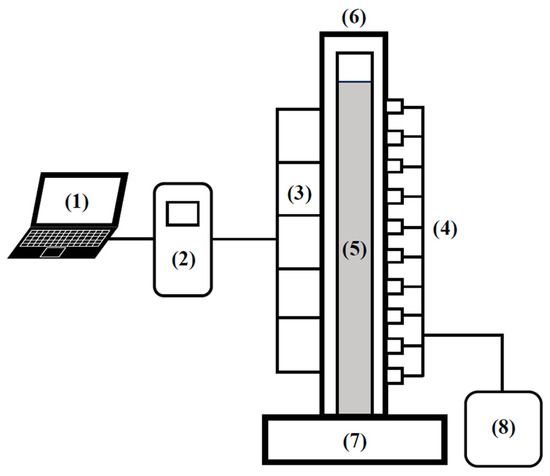
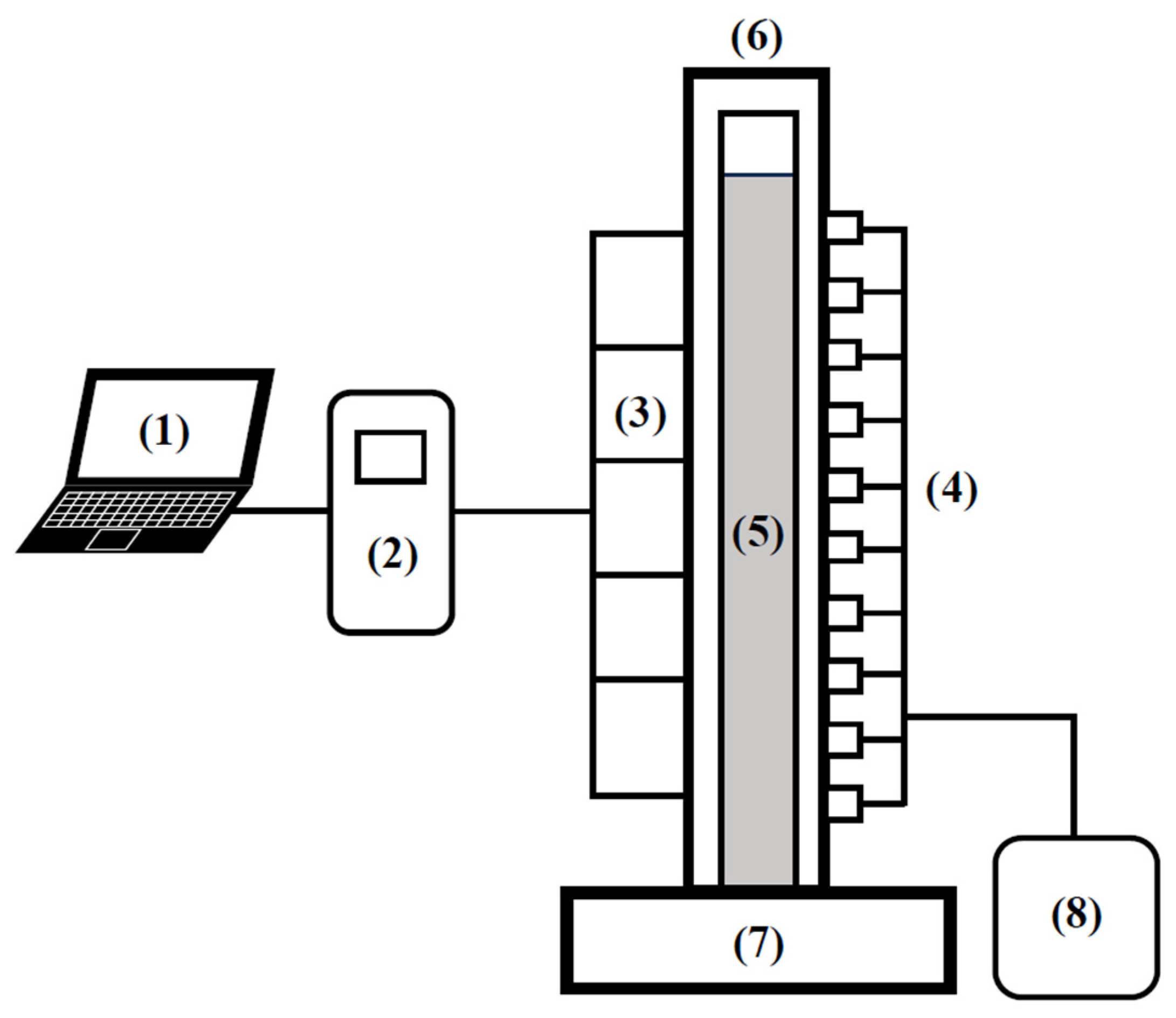
A schematic drawing of the experimental setup is shown in Figure 1. A light-emitting/receiving apparatus was made of cylindrical paper, 24 cm in height, 4 cm in outside diameter, and 1.5 mm in thickness. Ten white LED lights (emitting part) were vertically installed at 16 mm intervals (at 14.5 cm), and six optical fibers were vertically installed at 20 mm intervals (at 10 cm) on the opposite side of the emitting part. The top of the light-emitting/receiving apparatus was covered with vinyl chloride tape to prevent natural light from entering. The six optical fibers were connected to an illuminometer, and the illuminometer was connected to a personal computer to record signals at time intervals of two seconds. The optical system was enclosed to minimize the influence of external light, and measurements were conducted under controlled laboratory illumination conditions in order to suppress stray light effects. The kaolin suspension used in the flocculation experiments was prepared at a concentration of 1.0 g/L. The pH of the suspension during the optical measurements was approximately neutral (pH 6.9–7.0). The transmitted light intensity (I) was normalized by the intensity measured for particle-free water (I0), which was used as the reference light intensity in the optical measurements. This light-emitting/receiving apparatus was used to cover a glass graduated flocculation cylinder to detect changes in light intensity.
Figure 1.
Schematic diagram of the experimental setup for measurement of changes in the intensity of illuminance. (1) Personal computer, (2) illuminometer, (3) optical fiber, (4) LED light, (5) glass graduated cylinder, (6) light-emitting/receiving apparatus, (7) magnetic stirrer, (8) power supply.
In the experiment using SF, a certain amount of SF and distilled water was placed in a 100 mL beaker. The SF suspension was stirred with a magnetic stirrer and irradiated with an ultrasonic wave using an ultrasonic disperser (20 kHz, 25 W, Powersonic Model 50, POWERSONICS, Inc., Ridgefield, CT, USA) to disperse SF particles. The concentration of the SF was set to 10 g/L. The preparation method for the kaolin suspension was mostly the same as the method described in Section 2.3.2. Then, a certain amount of flocculant was added to the kaolin suspension using a macro-pipette. Within 1 min after adding the flocculant, the light-emitting/receiving apparatus was covered with the cylinder. Then, 1 min after adding the flocculant, the stirring was stopped, and the recording signals were started.
In this study, the moment at which stirring was stopped was defined operationally as the initial time (time zero) of the measurement. The recording of the illuminance signal started immediately after stopping agitation. Although the operations were conducted manually, repeated measurements confirmed that the overall temporal trends were reproducible within small variations. Each flocculation experiment was repeated twice under identical conditions, and the reproducibility of the measured optical signals was confirmed.
3. Results and Discussion
3.1. Characterization of Surface-Modified Waste Scallop Shell Particles
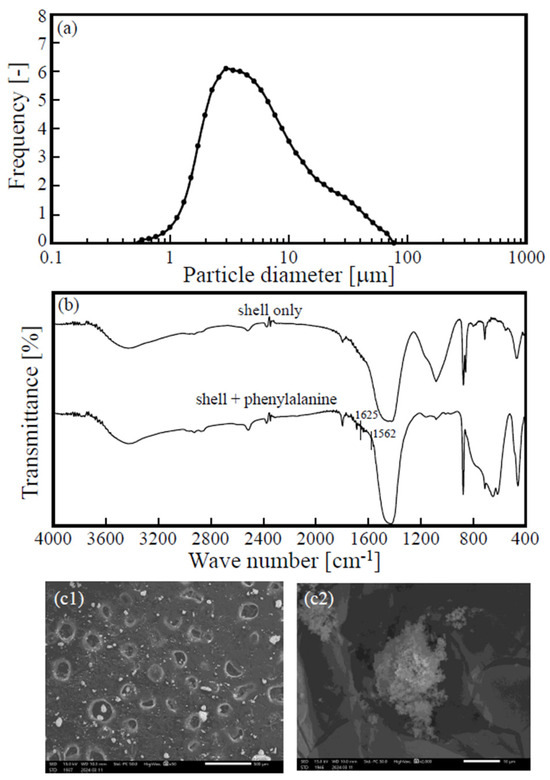
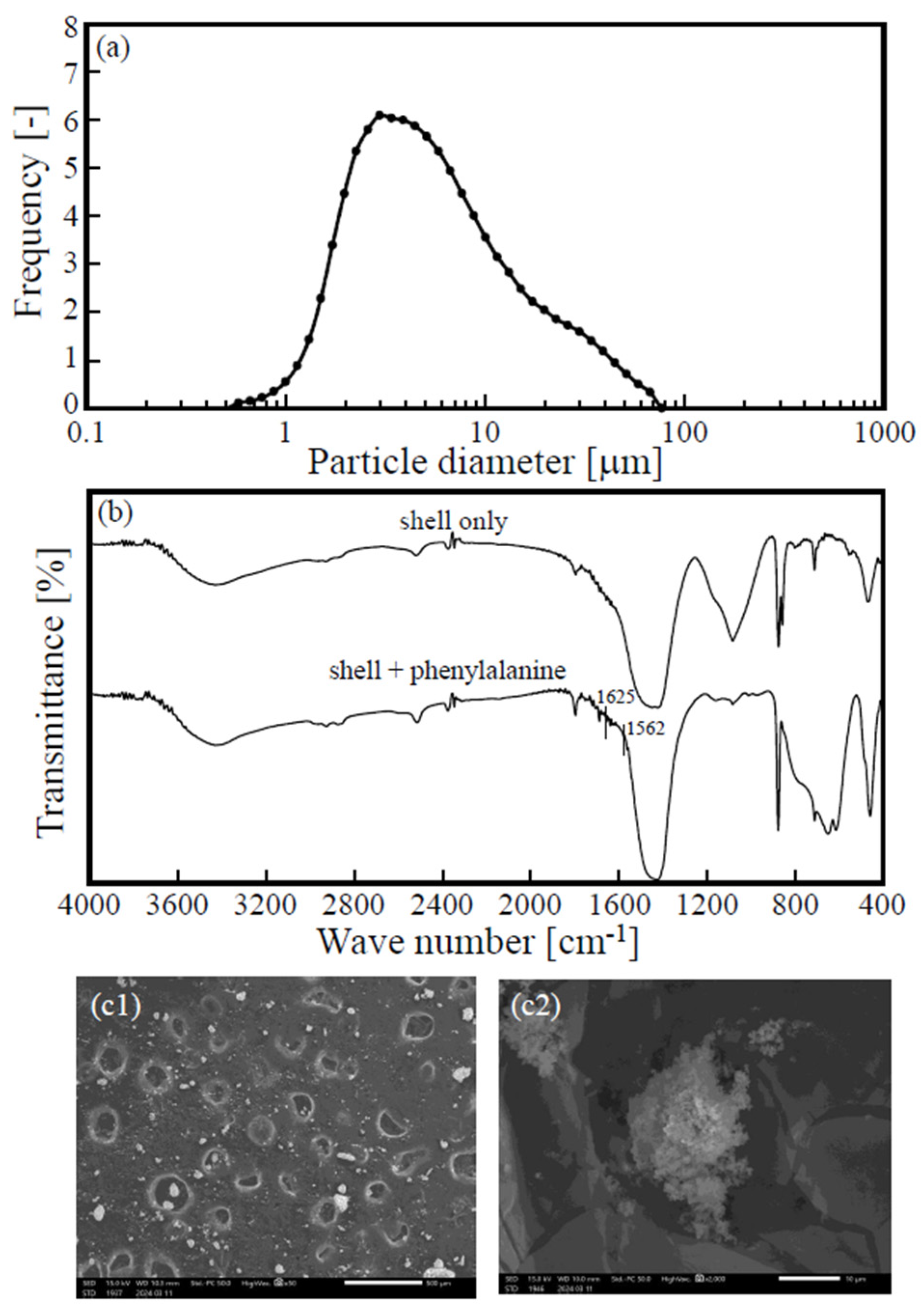
Figure 2 shows the measurement results for the particle size distribution (Figure 2a), the FI-IR spectra (Figure 2b), and the SEM images (Figure 2(c1,c2)). The particle size distribution ranged from approximately 0.6 μm to 80 μm, and the average particle diameter was 8.3 μm. As seen in Figure 2(c1,c2), a porous structure was not observed on the surface of the particles. These results were mostly the same as those of our previous observations, reported in a previous paper [51].
Figure 2.
Results of measurements concerning the characterization of the modified shell particles: particle size distribution (a), FT-IR spectra (b), and SEM images ((c1) (×50) and (c2) (×2000)).
Li et al. reported electrochemical and FTIR studies of L-phenylalanine adsorption on a Au(III) electrode, and they described how the transmission peaks at 1562 cm−1 and 1625 cm−1 originated from the NH3+ symmetric deformation vibrations and NH3+ asymmetric deformation vibrations of phenylalanine [55]. Although the peaks were very small in our measurements, we were able to confirm the presence of three peaks. Based on this finding, we hypothesize that the observed spectral change may be related to the presence of phenylalanine associated with the shell particle surface. However, the peaks were relatively weak, and therefore, the FTIR results provide only qualitative evidence suggesting possible surface modification.
3.2. Influence of Flocculant Dosage on Time Course of Light Intensity and Clarification Efficiency
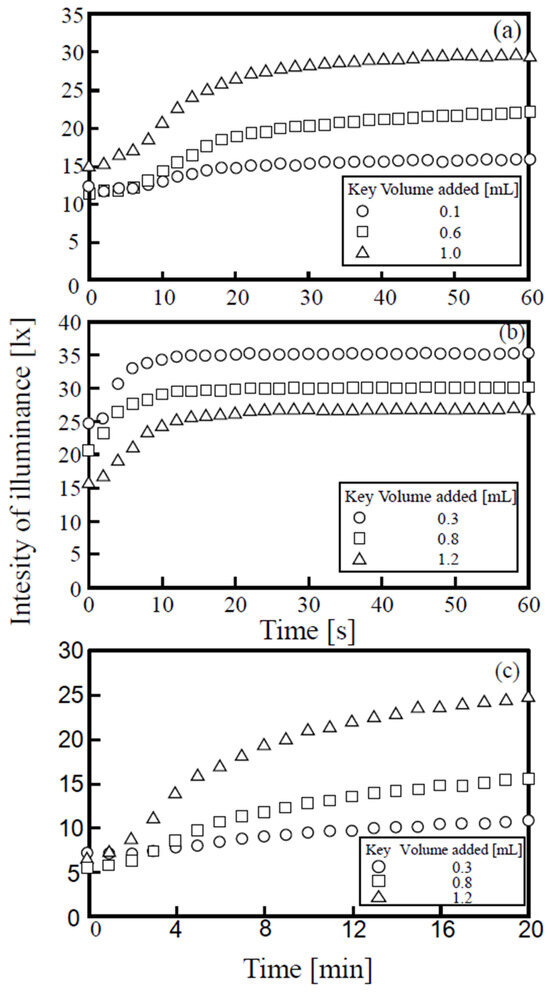
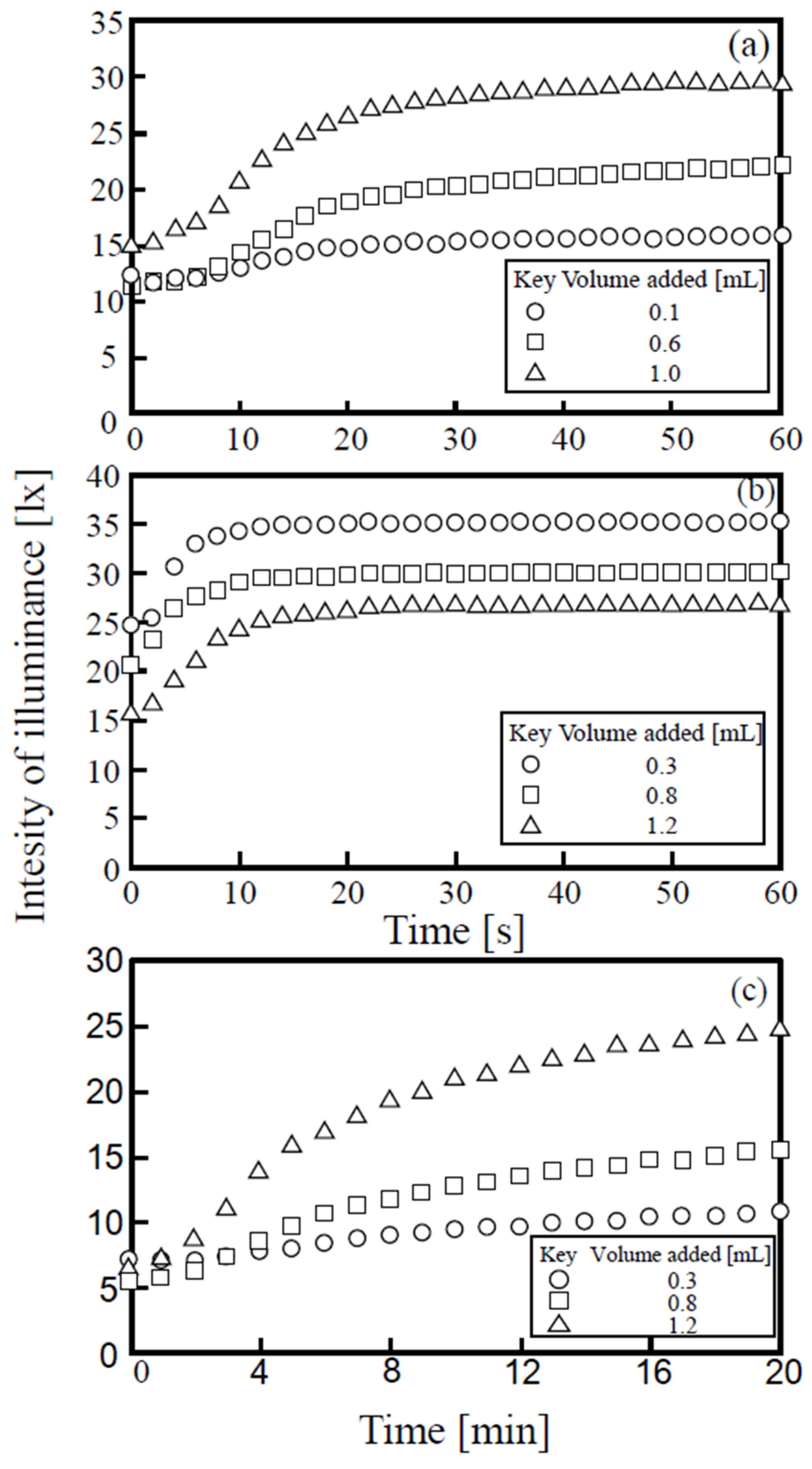
The experimental results for the time course of change in illuminance are shown in Figure 3. In the present experiments, time zero was operationally defined as the moment when agitation of the suspension was stopped, and the illuminance measurement was initiated.
Figure 3.
Influence of flocculant dosage on the time course of change in the intensity of illuminance through the flocculation cylinder using 0.04 g/L of PA362 (a), 3 g/L of PN161 (b), and 10 g/L of SF (c). The concentration of the kaolin suspension was 3 g/L.
The ordinate represents the intensity of the illuminance [lx]. A rapid increase in illuminance indicates clarification of the suspension caused by floc formation and the sedimentation of the particles.
When adding organic flocculants PA362 (polyacrylic acid type) and PN161 (polyacrylamide type), increases in intensity were observed in ranges of 0 to 30 s and 0 to 10 s, respectively.
On the other hand, when using SF, the increase in intensity was gentler than that of PA362 and PN161. The increase in intensity was observed in a range of 0 to ca. 15 min. As for the SF, it took a very long time to increase the intensity of the illuminance in comparison with the organic polymer flocculants PA362 and PN161. When using FS, an abrupt change in the intensity of the illuminance was observed between 120 and 480 s, which was 4–16 times longer than when using PA362 and PN161. However, it was confirmed that the SF and kaolin particles had definitely formed and settled in the cylinder. When the kaolin suspension was allowed to stand without adding a flocculant or stirring, the intensity of the illuminance changed almost linearly from 8.61 lx to 15.5 lx in 7 h for the 3 g/L kaolin suspension. This can be converted into a change of 0.0164 lx per minute. This fact, together with the results shown in Figure 3c, clearly indicates that the surface-modified shell particles proposed in this study have flocculation capabilities.
In the case of PA362 and SF, the increase in dosage increased the intensity. On the other hand, when adding PN161, the increase in dosage lowered intensity. This may be because the dosage of 0.3 mL was much closer in value to the optimum dosage than adding 0.8 or 1.2 mL. The detailed reason for this is explained in Section 3.3. When we measured the intensity of the illuminance, the operation to stop the stirring in the cylinder, the operation to start the measurement with the illuminometer, and the operation to start recording the signal on the PC were all performed manually, resulting in a slight difference in the intensity of the illuminance at time zero. Specifically, when PN161 was used, it had the highest coagulation ability, and rapid sedimentation occurred as soon as the stirring was stopped, such that a slight time delay (1 or 2 s) in starting the recording greatly affected the value of the intensity of the illuminance. PN362 and the SF did not show a significant difference in irradiance intensity at time zero because the settling was not as rapid as for PN161.
Based on the Lambert–Beer law [56], the following equation was obtained.
where A represents the apparent optical density (optical extinction) derived from the illuminance ratio, and I and I0 represent the transmitted and incident light intensities, respectively.
A = −log10(I/I0)
Adopting this relationship in our experimental system, I corresponds to the intensity of the illuminance through the suspension, and I0 corresponds to the intensity of the illuminance through water without particles. In the present system, using a white LED source, the attenuation of transmitted light mainly reflects optical extinction caused by scattering and absorption by suspended particles. Therefore, the value calculated using Equation (1) should be regarded as an approximate optical density parameter rather than a strict spectroscopic absorbance.
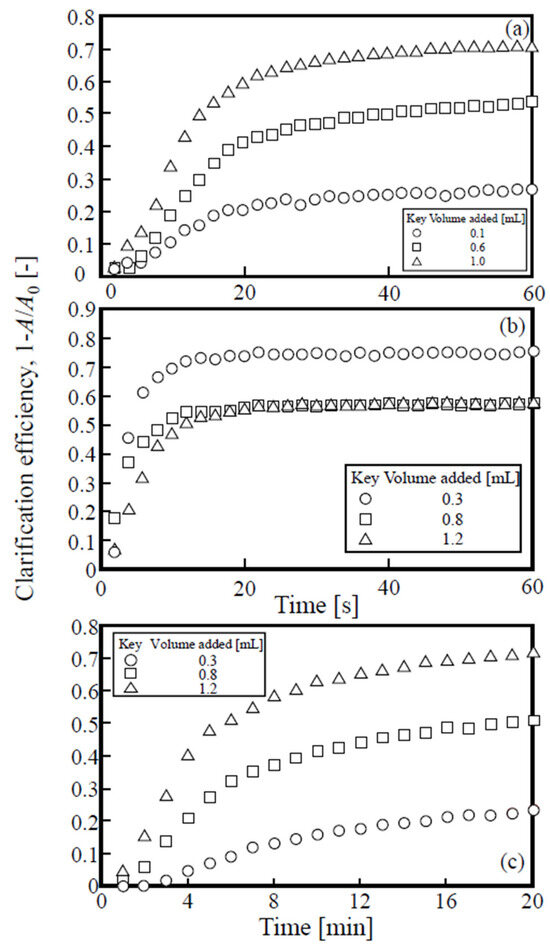
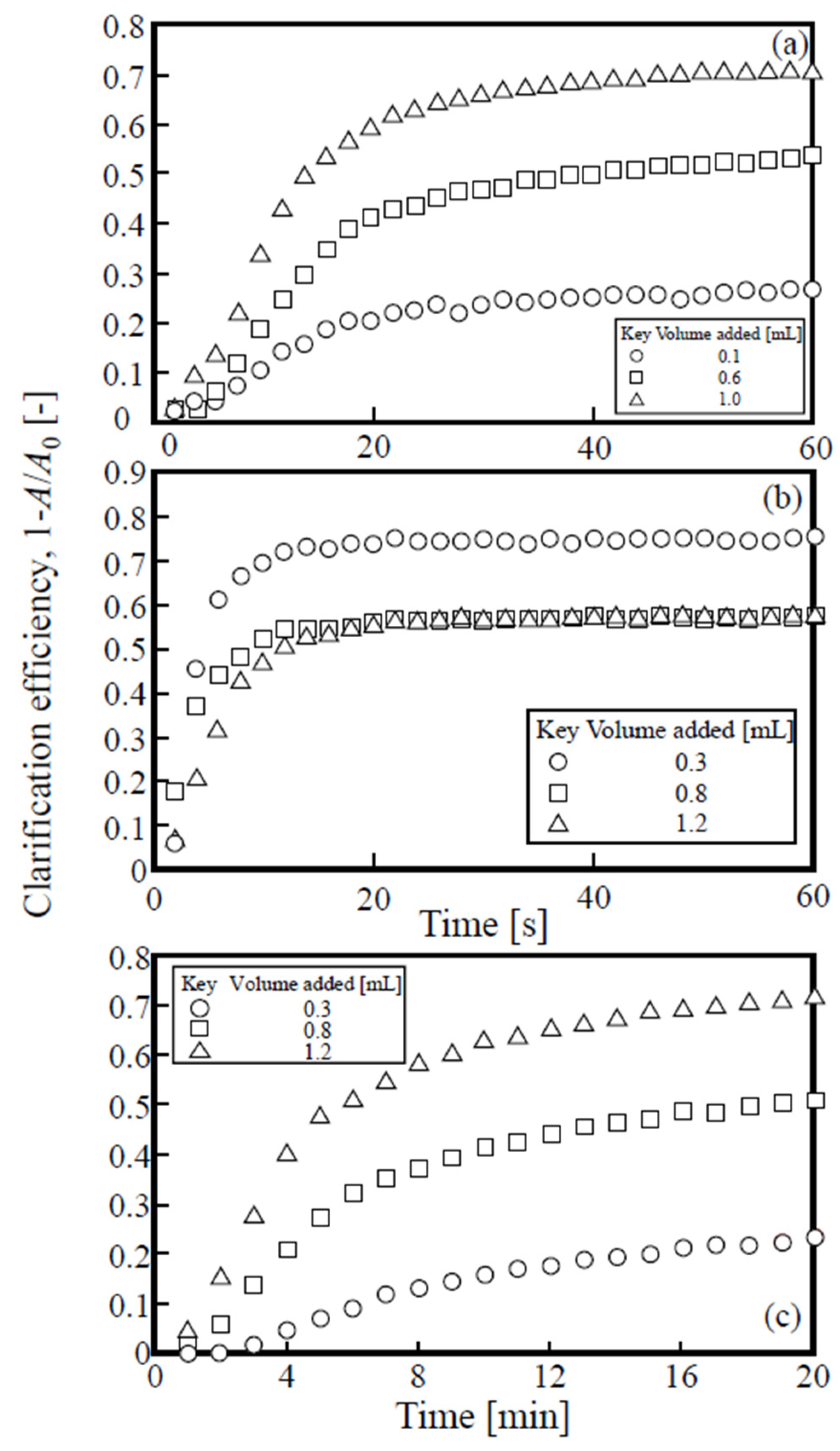
The clarification efficiency results, 1 – A/A0, are shown in Figure 4. The values of the clarification efficiency (1 – A/A0) of the ordinate in Figure 4 were obtained by converting the intensity of the illuminance data shown in Figure 3. The influence of the dosage of each flocculant could be considered to be more clearly expressed when converted for the purposes of clarification efficiency.
Figure 4.
Influence of flocculant dosage on the time course of change in clarification efficiency using PA362 (a), PN161 (b), and SF (c). The experimental conditions are the same as those in Figure 3.
3.3. Influence of Flocculation Dosage and Concentration of Kaolin Suspension on Rate of Change in Absorbance and Clarification Efficiency
Based on a plot similar to Figure 3, we determined the rate of change for the optical extinction value with time, v, as an indicator of the apparent clarification rate (rate of change in optical extinction). The method is as follows. We identified the datapoint showing the maximum value of the difference between the previous and following points. The data range for determination of the slope value was defined as a five-datapoint series, including the two previous and the two following datapoints. The slope value of the five datapoint series was determined by the least squares method. The slope value was defined as the time rate of change in optical extinction.
In conventional flocculation studies, the performance of flocculants is generally evaluated by turbidity measurements or sedimentation tests, which mainly provide information on the final clarification state after a certain settling period. In contrast, the method proposed in the present study evaluates the temporal changes in transmitted light intensity immediately after the cessation of stirring. Therefore, the method enables evaluation of the kinetic behavior of flocculation during the initial stage of particle aggregation.
The rate of change in optical extinction, v, defined in this study represents the apparent rate of change in optical attenuation associated with particle aggregation and subsequent settling. Although the optical signal is influenced by scattering effects and the geometry of the optical system, the temporal variation in transmitted light intensity provides a practical indicator for comparing the relative flocculation behavior among different flocculants under identical experimental conditions.
Compared with conventional turbidity measurements, which often provide only discrete values before and after sedimentation, the present optical monitoring method allows for continuous observation of the flocculation process. This characteristic is useful for distinguishing differences in the kinetics of flocculation among different types of flocculants.
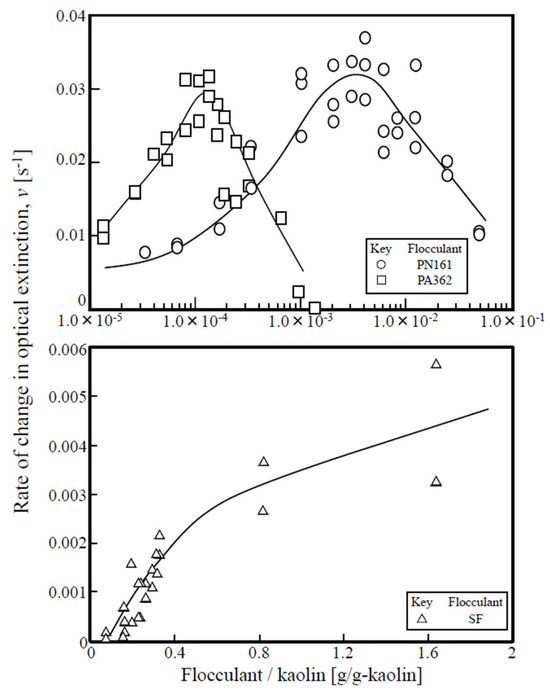
The results for the relationship between the rate of change in the optical extinction value (A) with time, v, and the flocculant dosage per unit of mass of kaolin particles are shown in Figure 5. In many previous studies on water treatment, polymeric flocculants have been widely used to enhance the aggregation of suspended particles through mechanisms such as charge neutralization and polymer bridging. These flocculants generally produce large flocs rapidly, which leads to a rapid decrease in turbidity or the optical attenuation of the suspension.
Figure 5.
The relationship between the rate of the change in optical extinction, v, and the dosage of the flocculants per unit of mass of kaolin particles for PA362 (open square), PN161 (open circle), and SF (open triangle). The experimental conditions are the same as those in Figure 3.
In the present study, the commercial polymer flocculants PA362 and PN161 showed rapid increases in transmitted light intensity, indicating fast flocculation kinetics. In contrast, the surface-modified scallop shell particles (SF) exhibited a slower change in transmitted light intensity. This difference can be attributed to the different flocculation mechanisms. For polymeric flocculants, particle aggregation occurs mainly through polymer bridging between suspended particles, whereas for SF particles, the aggregation is considered to occur mainly through heteroaggregation and collision between kaolin particles and the modified shell particles. Although the aggregation kinetics of SF particles were slower than those of polymer flocculants, the results demonstrate that the proposed optical monitoring method can clearly distinguish differences in flocculation behavior among different types of flocculants. The abscissa unit in Figure 5 represents the mass (grams) of flocculant dose per unit of mass (grams) of kaolin particles. The ordinate of Figure 5 is the time rate of change in A, v. The concentration of the kaolin suspension was 4 g/L. When using organic polymer flocculants (PA362 (0.04 g/L) and PN161 (3 g/L) in Figure 5), the maximum points of v were confirmed at ca. 1 × 10⁻⁴ g-flocculant/g-kaolin and ca. 2 × 10⁻³ g-flocculant/g-kaolin for PA362 and PN161, respectively. The dosage that gives the maximum value of v may be considered the optimal dosage. The value of v increases toward the maximum value as the dosage increases until the dosage gives the maximum value of v. Conversely, in the region of dosages higher than the dosage that gives the maximum value of v, the value of v decreases. Dosing flocculants in excess of the optimal dosage is thought to reduce the bare surface of the kaolin particles, which are not adsorbed with the flocculant necessary for flocculation, making it more difficult for flocculation to occur. Liu et al. (2024) reported flocculation experiments using gallic acid-grafted cationic chitosan as a flocculant and test solid particles made of kaolin [52]. Borchert et al. (2021) reported flocculation experiments using polydiallyldimethylammonium chloride, polyacrylamide with trimethylammonium chloride, and chitosan as flocculants and silica and china clay particles as test solid particles [57]. Their report described a similar flocculation phenomenon with unique optimal dosages. Similar phenomena have been observed in our previous studies [38,42,57,58]. On the other hand, when using SF (10 g/L in Figure 5), there was no maximum value of v, indicating that the optimum addition was identified. The optimum dosage was not reached within the range of this experiment. Further improvement of the flocculation performance of the SF may be achieved by controlling the particle size distribution, improving the dispersion of the particles via pre-wetting or stronger mixing, and exploring higher effective collision frequencies between particles. It was difficult to adjust the SF suspension to a high concentration, and further SF addition was not practical.
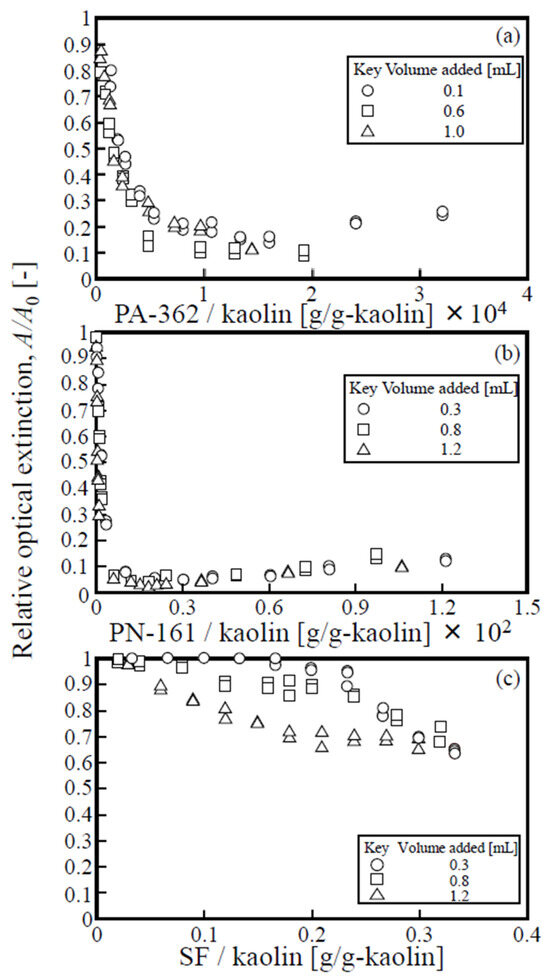
The results of the clarification experiments are shown in Figure 6 as the relationship between the relative optical extinction, A/A0, and the dosage (grams) of flocculant per unit of mass (grams) of kaolin particles. The clarification experiments were conducted by varying the concentration of the kaolin suspension to 3, 5, and 10 g/L for PN362 (Figure 6a), PN161 (Figure 6b), and SF (Figure 6c), respectively. The relative optical extinction, A/A0, reflects the residual rate of kaolin particles at a certain depth from the surface of the suspension. The lower the value of A/A0, the better the clarification efficiency. In the case of PA362 and PN161, Figure 6a,b show that there is no significant difference in the effect of flocculant dosage per unit of mass of kaolin on A/A0, regardless of the concentration of the kaolin suspension. There were also minimum values of A/A0, which were ca. 1 × 10⁻⁴ g-flocculant/g-kaolin and ca. 1.5 × 10⁻³ g-flocculant/g-kaolin for PA362 and PN161, respectively. These minimum values are almost identical to the dosage of the flocculant per unit of mass of kaolin particles that provided the maximum value of v seen in Figure 5.
Figure 6.
The relationship between relative optical extinction, A/A0, and the dosage of the flocculants per unit of mass of kaolin particles for PA362 (a), PN161 (b), and SF (c). The experiments were conducted using 3, 5, and 10 g/L kaolin suspension concentrations.
When using SF, the dosage of the flocculant per unit of mass of kaolin particles that provided the maximum value of v cannot be observed in Figure 5. SF is a solid particle and, unlike the dissolved molecules of PA362 and PN161, requires an increase in the frequency of particle collisions. However, as described above, for physical reasons, it was quite difficult to achieve a flocculant dosage higher than 1.7 g-flocculant/g-kaolin per unit of mass of kaolin particles in the present experimental system. The results obtained by using SF in Figure 6c show that the A/A0 values are much higher than those of PA362 and PN161. The reason for this high A/A0 value could be largely due to the fact that, in the clarification experiment, after the addition of the flocculant, the sample was stirred (500 rpm) for 1 min, allowed to stand for 1 min, and then collected from 2 cm below the water surface. Therefore, the decrease in A/A0 in this method was about 0.6 at the lowest in the range where the experiment was conducted. When using the SF, the trend was different for the kaolin suspension concentration of 10 g/L and the lower concentrations of 3 g/L and 5 g/L. In the case of the 10 g/L kaolin suspension concentration, a decrease in A/A0 was observed up to a dosage of ca. 0.2 g-flocculant/g-kaolin of flocculant per unit of mass of kaolin particles, but the value of A/A0 remained constant at about 0.7 at a dosage of ca. 0.2 g-flocculant/g-kaolin or higher. On the other hand, in the case of kaolin suspension concentrations of 3 and 5 g/L, there was almost no decrease in A/A0 up to a dosage of approximately 0.24 g-flocculant/g-kaolin, but a decrease in A/A0 values was observed at doses of 0.24 g-flocculant/g-kaolin or higher. The flocculant is compared to a common polymer flocculant, polyacrylamide, combined with aluminum hydroxide [59]. In this experiment, flocculants were dosed against 2.5 g/L of kaolin suspension. The clarification efficiency in this study was about 90%. This issue will be considered in future studies.
3.4. Relationship Between the Rate of Change in Optical Extinction and Clarification Efficiency
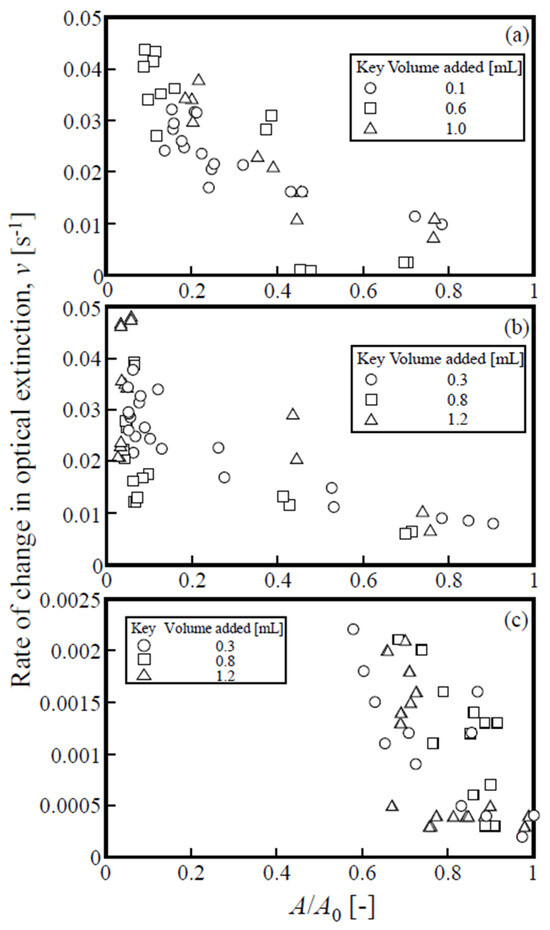
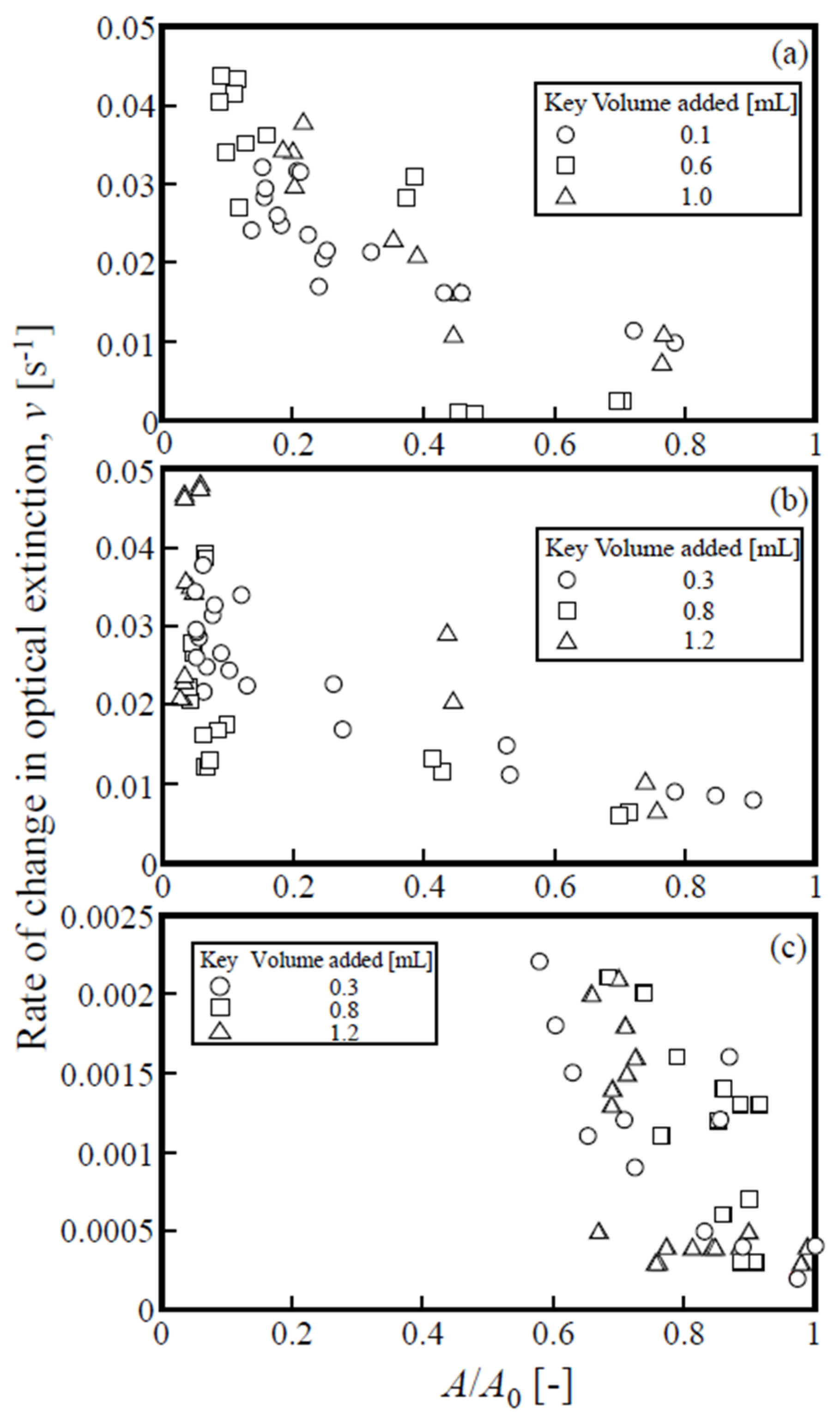
Based on what is shown in Figure 5 and Figure 6, the relationships between the rate of change in optical extinction, v, and the relative optical extinction, A/A0, are shown in Figure 7. The abscissa is the relative optical extinction, A/A0, and the ordinate is the rate of change in the optical extinction, v. In the case of PA362, a value of ca. 0.2 for A/A0 corresponds to the flocculant dosage of ca. 1 × 10⁻⁴ g-flocculant/g-kaolin per unit of mass of kaolin particles. In the case of PN161, a value of ca. 0.04–0.1 for A/A0 corresponds to a flocculant dosage of ca. 1–2 × 10⁻³ g-flocculant/g-kaolin per unit of mass of kaolin particles. Moreover, in the case of SF, a value of ca. 0.6 for A/A0 corresponds to a flocculant dosage of ca. 0.2 g-flocculant/g-kaolin per unit of mass of kaolin particles. In addition, it can be seen that v also clearly reflects the difference in the degree of flocculation speed in the value of A/A0 in the range of 0.1–0.2 for PA362 and 0.04–0.1 for PN161, where rapid flocculation occurred. In the case of SF, where flocculation occurred more slowly than in the cases of PA362 and PN161, the degree of faster or slower flocculation can also be expressed by a v value. The use of the v value as the indicator can express small differences in the degree of the apparent clarification rate.
Figure 7.
The relationship between the rate of the change in optical extinction, v, and the relative optical extinction, A/A0, for PA362 (a), PN161 (b), and SF (c). The experiments were conducted using kaolin suspensions of 3, 5, and 10 g/L.
The turbidimetric method (the clarification experiment in this study) is an easy and available evaluation method of flocculation. However, the sample cannot be correctly evaluated unless the appropriate sampling position and sampling time are set, which requires trial and error in advance. On the other hand, the measurement of the apparent clarification rate using the optical transmission method takes time, depending on the state of flocculation. However, considerations of the sample collection position and time in the turbidimetric method are not necessary. The method shown in this study is effective in that it can be used as an indicator of the degree of flocculation by evaluating the apparent clarification rate based on changes in the illuminance of the entire system in which flocculation and sedimentation occur.
4. Conclusions
In this study, we developed a surface-modified particle flocculant derived from waste scallop shells (SF). The flocculation performance was compared with that of typical polymer organic flocculants. The flocculation performance was evaluated using the relative optical extinction value based on the most commonly used clarification method and the rate of change in optical extinction obtained from measurements of the time change in illuminance. Although the flocculation performance of the SF was inferior to that of typical organic polymer flocculants, flocculation–sedimentation with kaolin particles was observed in the system, and it was confirmed that the SF has flocculation abilities even with solid particles. However, since the SF is not dissolved, a fairly high SF particle suspension concentration was required. Evaluation via relative optical extinction values requires time to set the appropriate sampling time and sampling position, but it is widely used because it is a simple method. Although the measurements of time change in illuminance proposed in this study require the use of special equipment, they are an excellent method for sensing the aggregation state of the entire system. Comparison of the two evaluation methods indicates that the method using the rate of change in optical extinction can quantify more detailed evaluation indices. In further studies, the author is going to prepare more effective solid particles for flocculation by using solid- or soft-material particles.
Funding
Part of this study was financially supported by the South Hokkaido Science Promotion Foundation.
Institutional Review Board Statement
Ethical review and approval were waived for this study, due to the scallop shells under investigation were obtained from markets.
Data Availability Statement
The original contributions presented in this study are included in the article. Further inquiries can be directed to the corresponding author.
Acknowledgments
The author gratefully acknowledges Dr. Shiro Takahashi and Dr. Tomoaki Sugawara, Hokkaido Industrial Technology Center, for their technical support regarding the SEM instrument. The author also acknowledges Dr. Harumi Matsui, National Institute of Technology, Hakodate College, for her technical guidance on measurements with the FT-IR instrument. The author also acknowledges Shotaro Ishiguri, a former student of the Department of Bioresources Chemistry, Faculty of Fisheries, Hokkaido University, for his experimental efforts.
Conflicts of Interest
The author declares no conflicts of interest.
References
- Tenca, A.; Cusick, R.D.; Schievano, A.; Oberti, R.; Logan, B.E. Evaluation of low cost cathode materials for treatment of industrial and food processing wastewater using microbial electrolysis cells. Int. J. Hydrogen Energy 2013, 38, 1859–1865. [Google Scholar] [CrossRef] [Scilit]
- Leifeld, V.; Takashina, T.A.; Zeni, J.C.; Ribeiro, M.A.; Igarashi-Mafra, L. Sequential coagulation treatment and processes based on ozone (O3, O3 /UV, O3 / UV/H2O2) for remediation of agro-food industrial wastewater. Desalin. Water Treat. 2018, 106, 80–89. [Google Scholar] [CrossRef] [Scilit]
- Sun, Y.; Liu, Y.; Chen, J.; Huang, Y.; Lu, H.; Yuan, W.; Yang, Q.; Hu, J.; Yu, B.; Wang, D.; et al. Physical pretreatment of petroleum refinery wastewater instead of chemicals addition for collaborative removal of oil and suspended solids. J. Clear. Prod. 2021, 278, 123821. [Google Scholar] [CrossRef] [Scilit]
- Santo, C.E.; Vilar, V.J.P.; Bhatnagar, A.; Kumar, E.; Botelho, C.M.S.; Boaventura, R.A.R. Biological treatment by activated sludge of petroleum refinery wastewaters. Desalin. Water Treat. 2013, 51, 6641–6654. [Google Scholar] [CrossRef] [Scilit]
- Alam, N.; Ozdemir, O.; Hampton, M.; Nguyen, A. Dewatering of coal plant tailings: Flocculation followed by filtration. Fuel 2011, 90, 26–35. [Google Scholar] [CrossRef] [Scilit]
- Nakazawa, Y.; Abe, T.; Matsui, Y.; Shinno, K.; Kobayashi, S.; Shirasaki, N.; Matsushita, T. Differences in removal rates of virgin/decayed microplastics, viruses, activated carbon, and kaolin/montmorillonite clay particles by coagulation, flocculation, sedimentation, and rapid sand filtration during water treatment. Water Res. 2021, 203, 117550. [Google Scholar] [CrossRef] [Scilit]
- Samuel, O.; Othman, M.H.D.; Kamaludin, R.; Sinsamphanh, O.; Abdullah, H.; Puteh, M.H.; Kurniawan, T.A.; Li, T.; Ismail, A.F.; Rahman, M.A.; et al. Oilfield-produced water treatment using conventional and membrane-based technologies for beneficial reuse: A critical review. J. Environ. Manag. 2022, 308, 114556. [Google Scholar] [CrossRef] [Scilit]
- Ekama, G.A.; Wentzel, M.C.; Sotemann, S.W. Tracking the inorganic suspended solids through biological treatment units of wastewater treatment plants. Water Res. 2006, 40, 3587–3595. [Google Scholar] [CrossRef] [Scilit]
- He, L.; Ji, F.; He, X.; Zhou, W.; Xu, X.; Lai, M. Validation of accumulation models for inorganic suspended solids of different particle size in an activated sludge system. Bioresour. Technol. 2013, 149, 51–57. [Google Scholar] [CrossRef] [Scilit] [PubMed]
- Ratanatamskul, C.; Siritiewsri, T. A compact on-site UASBeEGSB system for organic and suspended solid digestion and biogas recovery from department store wastewater. Int. Biodeterior. Biodegrad. 2015, 102, 24–30. [Google Scholar] [CrossRef] [Scilit]
- Rosenwinkel, K.H.; Weichgrebe, D.; Meyer, H.; Wendler, D. Suspended Solids from Industrial and Municipal Origins. Ecotoxicol. Environ. Saf. 2001, 50, 135–142. [Google Scholar] [CrossRef] [Scilit]
- Wang, D.; Sun, W.; Xu, Y.; Tang, H.; Gregory, J. Speciation stability of inorganic polymer flocculant–PACl. Colloids Surf. A Physicochem. Eng. Asp. 2004, 243, 1–10. [Google Scholar] [CrossRef] [Scilit]
- Wang, D.; Tang, H. Modified inorganic polymer flocculant-PFSi: Its preparation. characterization and coagulation behavior. Water Res. 2001, 35, 3418–3428. [Google Scholar] [CrossRef] [Scilit] [PubMed]
- Wang, Q.; Wang, W.; Zhang, K.; Wang, Z.; Su, K. Molecular simulation of polyacrylamide types on flocculation performance in oily wastewater. Chem. Phys. Lett. 2025, 867, 142023. [Google Scholar] [CrossRef] [Scilit]
- Castillo, C.; Fawell, P.; Costine, A. Optimising the activity of acrylamide-based polymer solutions used to flocculate mineral processing tailings suspensions—A review. Chem. Eng. Res. Des. 2023, 199, 214–237. [Google Scholar] [CrossRef] [Scilit]
- Beyer, V.P.; Blockx, J.; Maciel, A.P.; Tyagi, S.; Demir-Yilmaz, I.; Formosa-Dague, C.; Muylaert, K.; Thielemans, W. Use of PDMAEMA as a non-toxic synthetic flocculant for harvesting microalgae and evaluation of the influence of polymer size on flocculation behaviour. J. Environ. Chem. Eng. 2023, 11, 111094. [Google Scholar] [CrossRef] [Scilit]
- Rao, N.R.H.; Beyer, V.; Thielemans, W.; Muylaert, K. Techno-economic comparison of flocculation combined with dissolved air flotation versus sedimentation for microalgae harvesting. Algal Res. 2024, 81, 1038581. [Google Scholar] [CrossRef] [Scilit]
- Arryanto, Y.; Bark, L.S. Reineckate ions as a precipitant for the determination of trace amounts of polyacrylamides in potable waters. Anal. Chim. Acta 1992, 263, 119–129. [Google Scholar] [CrossRef] [Scilit]
- Bolto, B.; Gregory, J. Organic polyelectrolytes in water treatment. Water Res. 2007, 41, 2301–2324. [Google Scholar] [CrossRef] [Scilit]
- Dearfield, K.L.; Abernathy, C.O.; Ottley, M.S.; Brantner, J.H.; Hayes, P.F. Acrylamide: Its metabolism, developmental and reproductive effects, genotoxicity, and carcinogenicity. Mutat. Res. 1988, 195, 45–77. [Google Scholar] [CrossRef] [Scilit]
- Hasegawa, R.; Naitoh, K.; Kawasaki, Y.; Aida, Y.; Momma, J.; Saitoh, M.; Nakaji, Y.; Kurokawa, Y. Acute and subacute toxicity studies on 2,3-dichloropropionic acid and chlorinated polyacrylamide in rats. Water Res. 1990, 24, 661–666. [Google Scholar] [CrossRef] [Scilit]
- Lattemann, S.; Hopner, T. Environmental impact and impact assessment of seawater desalination. Desalination 2008, 220, 1–15. [Google Scholar] [CrossRef] [Scilit]
- Ruden, C. Acrylamide and cancer risk—Expert risk assessments and the public debate. Food Chem. Toxicol. 2004, 42, 335–349. [Google Scholar] [CrossRef] [Scilit]
- The Ministry of Health, Labour and Welfare (Tokyo, Japan). Ministerial Ordinance Establishing Technical Standards for Water Supply Facilities. 2000. Available online: https://www.mhlw.go.jp/web/t_doc?dataId=79aa0299&dataType=0&pageNo=1 (accessed on 13 December 2025).
- Shogren, R. Flocculation of kaolin by waxy maize starch phosphates. Carbohydr. Polym. 2009, 76, 639–644. [Google Scholar] [CrossRef] [Scilit]
- Du, Q.; Wei, H.; Li, A.; Yang, H. Evaluation of the starch-based flocculants on flocculation of hairwork wastewater. Sci. Total Environ. 2017, 601–602, 1628–1637. [Google Scholar] [CrossRef] [Scilit]
- Sun, D.; Zeng, J.; Yang, D.; Qiu, X.; Liu, W. Full biomass-based multifunctional flocculant from lignin and cationic starch. Int. J. Biol. Macromol. 2023, 253, 127287. [Google Scholar] [CrossRef] [Scilit]
- Kemppainen, K.; Suopajarvi, T.; Laitinen, O.; Ammala, A.; Liimatainen, H.; Illkainen, M. Flocculation of fine hematite and quartz suspentions with anionic cellulose nanofibers. Chem. Eng. Sci. 2016, 148, 256–266. [Google Scholar] [CrossRef] [Scilit]
- Yudong, N.; Tao, Z.; Haihua, W.; Haixing, C. Upcycling harmful algal blooms into short-chain organic matters assisted with cellulose-based flocculant. Bioresour. Technol. 2024, 397, 130425. [Google Scholar] [CrossRef] [Scilit] [PubMed]
- Rojas-Reyna, R.; Schwarz, S.; Heinrich, G.; Retzold, G.; Schutze, S.; Bohrisch, J. flocculation efficiency of modified water soluble chitosan versuscommonly used commercial polyelectrolytes. Carbohydr. Polym. 2010, 81, 317–322. [Google Scholar] [CrossRef] [Scilit]
- Zheng, J.; Chw, X.; Zhang, S.; Huang, T.; Zheng, H.; Sun, B. Relationship between the structure of chitosan-based flocculants and their performances in the treatment of model azo dyeing wastewater. Chemosphere 2020, 247, 125920. [Google Scholar] [CrossRef] [Scilit]
- Amaly, N.; Harrison, S.; Tumuluru, J.S.; Sun, G.; Pandey, P.K. Development and application of a polycationic soybean protein-based f locculant for enhanced flocculation and dewatering of dairy manure. Chemosphere 2025, 371, 144050. [Google Scholar] [CrossRef] [Scilit]
- Aryan, A.; Pal, P.; Singh, S.; Bhoutika, T.; George, S.K.; Sinha, S.; Pandey, J.P.; Sen, G. Development of grafted pea protein (PP-g-PAM): An innovative derivative as flocculant towards mineral suspensions. Ind. Crops Prod. 2024, 222, 119685. [Google Scholar] [CrossRef] [Scilit]
- Liao, W.; Bian, Y.; Liu, C.; Liu, M.; Liang, W.; Gao, Z.; Gao, Y.; Xie, J. A new flocculant tannic acid for improving separation efficiency and lowering gas emissions from liquid and solid fractions of dairy slurry. J. Clean. Prod. 2025, 494, 145040. [Google Scholar] [CrossRef] [Scilit]
- Hameed, Y.T.; Idris, A.; Hussain, S.A.; Abdullah, N.; Man, H.C. Effect of pre-treatment with a tannin-based coagulant and flocculant on a biofilm bacterial community and the nitrification process in a municipal wastewater biofilm treatment unit. J. Environ. Chem. Eng. 2020, 8, 103679. [Google Scholar] [CrossRef] [Scilit]
- Sánchez-Martín, J.; González-Velasco, M.; Beltrán-Heredia, J. Surface water treatment with tannin-based coagulants from Quebracho (Schinopsis balansae). Chem. Eng. J. 2010, 165, 851–858. [Google Scholar] [CrossRef] [Scilit]
- Singh, R.; Kumar, S.; Garg, M. Domestic wastewater treatment using tanfloc: A tannin based coagulant. In Geostatistical and Geospatial Approaches for the Characterization of Natural Resources in the Environment; Springer: Cham, Switzerland, 2016. [Google Scholar] [CrossRef] [Scilit]
- Seki, H.; Maruyama, H.; Shoji, Y. Flocculation of diatomite by a soy protein-based bioflocculant. Biochem. Eng. J. 2010, 51, 14–18. [Google Scholar] [CrossRef] [Scilit]
- Seki, H.; Suzuki, A. Flocculation of diatomite by methylated egg albumin. J. Colloid Interface Sci. 2003, 263, 42–46. [Google Scholar] [CrossRef] [Scilit] [PubMed]
- Seki, H.; Suzuki, A.; Shinguh, M.; Maruyama, H. Flocculation of diatomite by methylated milk casein in seawater. J. Colloid Interface Sci. 2004, 270, 359–363. [Google Scholar] [CrossRef] [Scilit] [PubMed]
- Maruyama, H.; Seki, H.; Satoh, Y. Removal kinetic model of oil droplet from o/w emulsion by adding methylated milk casein in flotation. Water Res. 2012, 46, 3094–3100. [Google Scholar] [CrossRef] [Scilit]
- Maruyama, H.; Seki, H.; Igi, A. Flocculation of quartz and kaolin by alginate-protamine complex. Biochem. Eng. J. 2020, 162, 107713. [Google Scholar] [CrossRef] [Scilit]
- Hokkaido Government. Survey on the Generation of Fisheries-Related Waste and Its Amount; Hokkaido Government: Sapporo, Japan, 2021.
- Chaihad, N.; Kurnia, I.; Yoshida, A.; Watanabe, C.; Tei, K.; Reubroycharoen, P.; Kasai, Y.; Abudula, A.; Guan, G. Catalytic pyrolysis of wasted fishing net over calcined scallop shells: Analytical Py-GC/MS study. J. Anal. Appl. Pyrolysis 2019, 146, 104750. [Google Scholar] [CrossRef] [Scilit]
- Sirisomboonchai, S.; Abuduwayiti, M.; Guan, G.; Samart, C.; Abliz, S.; Hao, X.; Kusakabe, K.; Abudula, A. Biodiesel production from waste cooking oil using calcined scallop shell as catalyst. Energy Convers. Manag. 2015, 95, 242–247. [Google Scholar] [CrossRef] [Scilit]
- Yeom, S.H.; Jung, K. Recycling wasted scallop shell as an adsorbent for the removal of phosphate. J. Ind. Eng. Chem. 2009, 15, 40–44. [Google Scholar] [CrossRef] [Scilit]
- Chenet, T.; Schwarz, G.; Neff, C.; Hattendorf, B.; Günther, D.; Martucci, A.; Cescon, M.; Baldi, A.; Pasti, L. Scallop shells as biosorbents for water remediation from heavy metals: Contributions and mechanism of shell components in the adsorption of cadmium from aqueous matrix. Heliyon 2024, 10, e29296. [Google Scholar] [CrossRef] [Scilit]
- Tsuruma, A.; Nomoto, Y.; Nishio, M.; Ishikawa, M.; Sawai, J. Efficacy of sorbitol-coated heated scallop-shell powder for the antimicrobial treatment of fresh vegetables. Food Control 2020, 110, 106972. [Google Scholar] [CrossRef] [Scilit]
- Shetty, P.P.; Rao, A.U.; Pai, B.H.V.; Kamath, M.V. Performance of High-Strength Concrete with the Effects of Seashell Powder as Binder Replacement and Waste Glass Powder as Fine Aggregate. J. Compos. Sci. 2023, 7, 92. [Google Scholar] [CrossRef] [Scilit]
- Deng, Z.; Lin, J.; Li, N. A review on recycling seashells as aggregates and binders for mortar and concrete in China: Production, engineering properties and new applications. Sustain. Mater. Technol. 2025, 43, e01242. [Google Scholar] [CrossRef] [Scilit]
- Maruyama, H. Preparation of Adsorbent from Mechanochemical Reaction-Based Waste Seashell with Sodium Oxalate and Its Application in Pb Ion Adsorption. Surfaces 2024, 7, 208–224. [Google Scholar] [CrossRef] [Scilit]
- Liu, J.; Zhao, H.; Wang, M.; Ban, W.; Lu, X.; Yan, B. The preparation of gallic acid-grafted cationic chitosan as effective salt-tolerant flocculants. RSC Adv. 2024, 14, 15021–15030. [Google Scholar] [CrossRef] [Scilit]
- Pandey, S.; Kumar, A.; Kumar, K.; Krishnamoorthi, S.; Tungala, K. Fabrication, characterization and flocculation properties of starch, chitosan or cellulose based graft copolymers: A review. Bioresour. Technol. Rep. 2025, 29, 102023. [Google Scholar] [CrossRef] [Scilit]
- Gregory, J. Monitoring particle aggregation processes. Adv. Colloid Interface Sci. 2009, 147–148, 109–123. [Google Scholar] [CrossRef] [Scilit]
- Li, H.Q.; Chen, A.; Roscoe, S.G.; Lipkowski, J. Electrochemical and FTIR studies of L-phenylalanine adsorption at the Au(III) electrode. J. Electroanal. Chem. 2001, 500, 299–310. [Google Scholar] [CrossRef] [Scilit]
- Su, G.; Deng, F.; Sun, C.; Su, M. A study on hybrid light extinction model and inversion based on Lambert-Beer Law. Opt. Commun. 2025, 577, 131342. [Google Scholar] [CrossRef] [Scilit]
- Borchert, K.B.L.; Steinbach, C.; Schwarz, S.; Schwarz, D. A Comparative Study on the Flocculation of Silica and China Clay with Chitosan and Synthetic Polyelectrolytes. Mar. Drugs 2021, 19, 102. [Google Scholar] [CrossRef] [Scilit] [PubMed]
- Maruyama, H.; Seki, H. Influence of methylated milk casein flocculant dosage on removal rate of oil droplet removal from o/w in flotation. Biochem. Eng. J. 2020, 159, 107584. [Google Scholar] [CrossRef] [Scilit]
- Yang, W.Y.; Qian, J.W.; Shen, Z.Q. A novel flocculant of Al(OH)3–polyacrylamide ionic hybrid. J. Colloid Interface Sci. 2004, 273, 400–405. [Google Scholar] [CrossRef] [Scilit]
Disclaimer/Publisher’s Note: The statements, opinions and data contained in all publications are solely those of the individual author(s) and contributor(s) and not of MDPI and/or the editor(s). MDPI and/or the editor(s) disclaim responsibility for any injury to people or property resulting from any ideas, methods, instructions or products referred to in the content. |
© 2026 by the author. Licensee MDPI, Basel, Switzerland. This article is an open access article distributed under the terms and conditions of the Creative Commons Attribution (CC BY) license.