


Abstract
Although numerous baseline correction methods exist, most are confined to static post-elution processing and fail to meet real-time analysis requirements. To address this, we propose a real-time baseline estimation method based on the Informer time-series prediction model that performs correction during data acquisition without waiting for complete elution. Our work focuses on three key aspects: chromatographic dataset construction, model training, and baseline prediction. Simulation experiments demonstrate that the proposed method achieves comparable accuracy to conventional static processing approaches while exhibiting significant real-time advantages. In processing real chromatographic data, the model achieves a 98.3% chromatographic peak retention rate, with a single computation time of approximately 35 ms—substantially shorter than typical chromatographic sampling cycles (600–900 ms), thus fully satisfying the quantitative analysis requirements for real-time background subtraction.
1. Introduction
Liquid chromatography (LC) systems are analytical instruments based on chromatographic separation principles, widely employed for the separation and purification of chemically synthesized compounds. Their superior separation capability has led to their widespread adoption as industrial purification equipment in manufacturing processes. A conventional LC system comprises four principal components: a high-pressure solvent delivery pump, a chromatographic separation column, a detection module, and a data acquisition system. During operation, a mobile phase of precisely controlled composition is continuously pumped through the column containing the sample mixture. Differential molecular interactions between sample components and the stationary/mobile phases result in distinct retention characteristics, thereby achieving separation. The detection system monitors characteristic signals (e.g., UV absorbance) of eluting components in real-time. The recorded absorbance variations at fixed intervals constitute the fundamental chromatographic data.
The chromatographic baseline is defined as the detector response when only the mobile phase passes through the system, representing the instrumental “background” in the absence of analytes. In practice, baseline disturbances typically manifest as low-frequency drift, high-frequency noise, and sporadic anomalies. These anomalies can severely compromise analytical accuracy, particularly in trace analysis at the parts-per-billion level, where minor baseline variations may elevate detection limits or introduce significant quantitative errors [1].
Therefore, accurate background subtraction is critical in chromatographic data processing. Researchers primarily employ two strategies: experimental optimization and computational correction. While experimental optimization can yield reliable results, it often requires substantial investment in specialized equipment and labor-intensive procedures, coupled with complex operational procedures, limiting its broad applicability [2]. In contrast, numerical computation methods demonstrate considerable potential due to their cost-effectiveness and operational efficiency. These computational techniques can be readily implemented using standard computing infrastructure, featuring streamlined workflows that substantially enhance analytical throughput.
Baseline correction aims to separate the true signal components from baseline components in observed signals, with its core challenge lying in accurately estimating and removing the baseline while preserving useful signal information. Traditional baseline correction methods typically employ simulation tools to model baseline drift phenomena, with representative approaches including curve fitting [3,4], asymmetric least squares [5,6], wavelet decomposition [7], Fourier decomposition [8], and empirical mode decomposition [9], among others.
With advances in artificial intelligence, deep learning has shown significant promise for processing chromatographic data, particularly for baseline correction and noise removal. Numerous models, including artificial neural networks (ANNs) [10,11], convolutional neural networks (CNNs) [12], and generative adversarial networks (GANs) [13], have been applied to these tasks. Real-time monitoring during chromatographic runs is crucial for ensuring data quality and process control [14]. However, existing methods, including many deep learning approaches, are predominantly designed for and evaluated on static, complete datasets. These models typically learn features from the entire dataset. When applied to real-time, dynamic data streams, such global processing strategies are ineffective for immediate background correction because they cannot incorporate future, unseen data points.
This study makes three key contributions to the field of chromatographic analysis:
- We have pioneered the incorporation of time-series forecasting models into background subtraction algorithms, achieving breakthroughs in three critical technical aspects: a deep learning-based background prediction training methodology, high-efficiency model loading and prediction mechanisms, and advanced data normalization processing. This integrated approach enables accurate chromatographic background prediction through sophisticated multi-feature fusion techniques.
- To address the challenges of dynamic data, we develop an innovative baseline estimation framework capable of real-time computation on high-throughput data streams. This solution overcomes the fundamental limitation of conventional methods in dynamic scenarios.
- We demonstrate, for the first time, the successful implementation and validation of a real-time background subtraction algorithm for liquid chromatography. Our comprehensive experiments establish the method’s practical feasibility, providing a new technical foundation for modern chromatographic analysis.
2. Proposed Approach
The determination of chromatographic background poses fundamentally different challenges for static versus dynamic data systems. In static data analysis, where complete datasets are available prior to processing, traditional baseline fitting techniques—such as polynomial regression and morphological operations—can reliably produce accurate baseline estimates. However, these methods prove inadequate for dynamic chromatographic applications, such as real-time process monitoring or flow analysis systems, because future data points are inherently unpredictable. To address this, we propose a real-time background subtraction technique based on Informer time-series [15] prediction. This technique aims to dynamically and immediately estimate and remove background components from signals during chromatographic data acquisition. Unlike conventional methods that rely on complete static datasets, it employs a sliding-window mechanism, using only limited historical data to predict upcoming background signals in real time, thereby achieving real-time separation of signal from background to meet the needs of process monitoring and rapid analysis. This advanced method constructs adaptive prediction models through comprehensive analysis of the characteristics of acquired data, thereby providing precise baseline estimation for subsequent unknown chromatographic data segments. The algorithm’s implementation is divided into three key phases: designing the model architecture, generating training data, and conducting training and performance testing.
2.1. Model Architecture and Mathematical Foundation
Let be a chromatographic sequence comprising M observations, where each observation has N dimensions. The objective of chromatographic background prediction is to forecast the subsequent h background chromatographic sequences within a lookback window of length l ending at time i. The goal is to construct a network model capable of learning this mapping, where the lookback window length l and prediction horizon h may differ in duration.
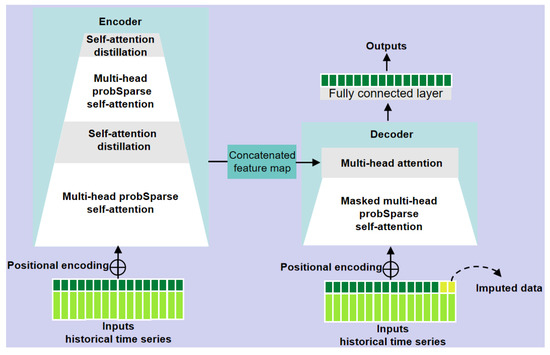
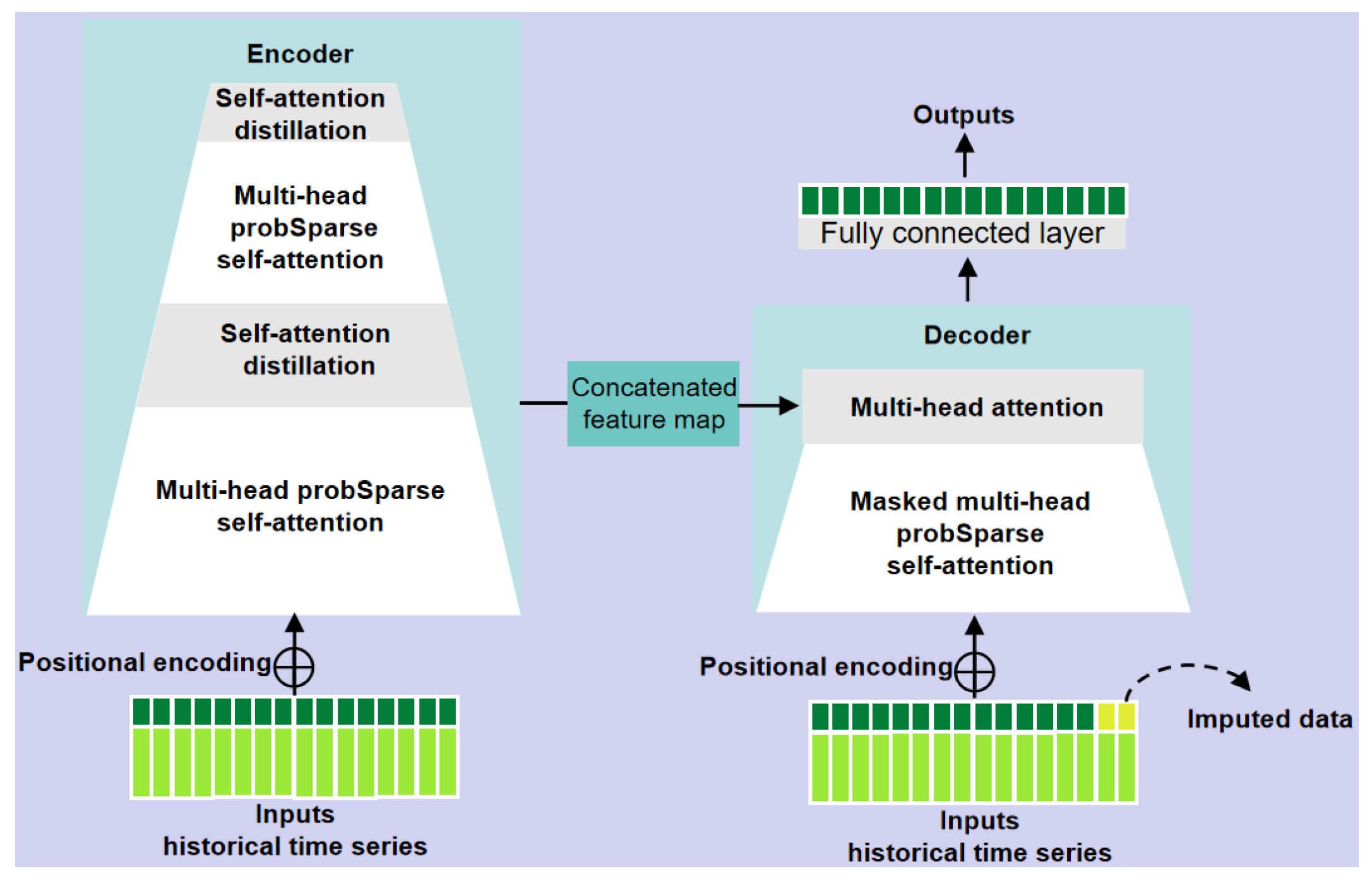
To achieve accurate and efficient multi-step prediction under the constraints of real-time processing, we employ the Informer model, which is specifically designed for Long-Sequence Time-series Forecasting (LSTF) [16]. The Informer model enhances the efficiency and accuracy of multi-step prediction for chromatographic sequences by incorporating mechanisms such as ProbSparse self-attention, self-attention distillation, and a generative decoder. The model consists of two main components, namely an encoder and a decoder, as illustrated in Figure 1. The encoder extracts high-level features from the historical input sequence through stacked ProbSparse self-attention layers and distillation operations, while the decoder generates future multi-step predictions directly based on these features.
Figure 1.
Network architecture of the Informer model. Arrows indicate the direction of information flow; the light green and dark green blocks correspond to the attention modules in the encoder and decoder, respectively.
2.2. Chromatographic Background Prediction Model
The key efficiency improvement of the Informer lies in its ProbSparse self-attention mechanism, which addresses the quadratic complexity of standard self-attention (where and are the lengths of queries and keys). Traditional self-attention computes an output as a weighted sum of all values:
The ProbSparse attention proposes that the attention distribution for each query is often dominated by only a few key pairs. It defines a sparsity measurement:
which approximates the Kullback–Leibler divergence between the query’s attention distribution and the uniform distribution. By selectively processing only the top-u queries with the largest M values (where ), the complexity is reduced to . This allows our model to efficiently process long chromatographic sequences (input length ) and capture the long-range temporal dependencies crucial for accurate baseline drift prediction.
To further enhance efficiency for deep encoder architectures, the model employs self-attention distillation. Between consecutive layers, it reduces the feature map dimension by half using a 1D convolutional operation followed by a max-pooling layer. This process, from the j-th to the -th layer, can be denoted as:
where represents the output of the attention block. This progressive down-sampling sharpens the focus on the most prominent features in the chromatographic history, reduces memory usage, and helps combat overfitting.
For efficient multi-step (h) prediction, the decoder adopts a generative style. Its input is a concatenated sequence composed of two parts: a placeholder (e.g., zeros) representing the target sequence to be predicted, and the known historical features from the encoder’s output. This design enables the generation of the entire predicted background sequence in a single forward pass, mathematically expressed as:
where is the start token, is the known historical data segment, and are the encoded features from the historical window . This non-autoregressive approach avoids error accumulation common in step-by-step prediction models and is essential for fast, real-time inference.
In summary, the Informer’s architecture, underpinned by these mathematical innovations, is exceptionally suited for our application. The ProbSparse attention efficiently models long-range correlations in baseline drift, the distillation mechanism manages computational load to meet real-time requirements, and the generative decoder enables the fast, simultaneous prediction of future background points required for immediate subtraction in streaming chromatographic analysis.
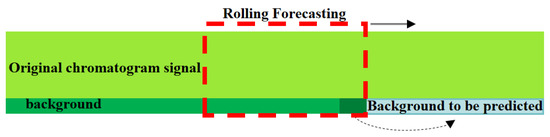
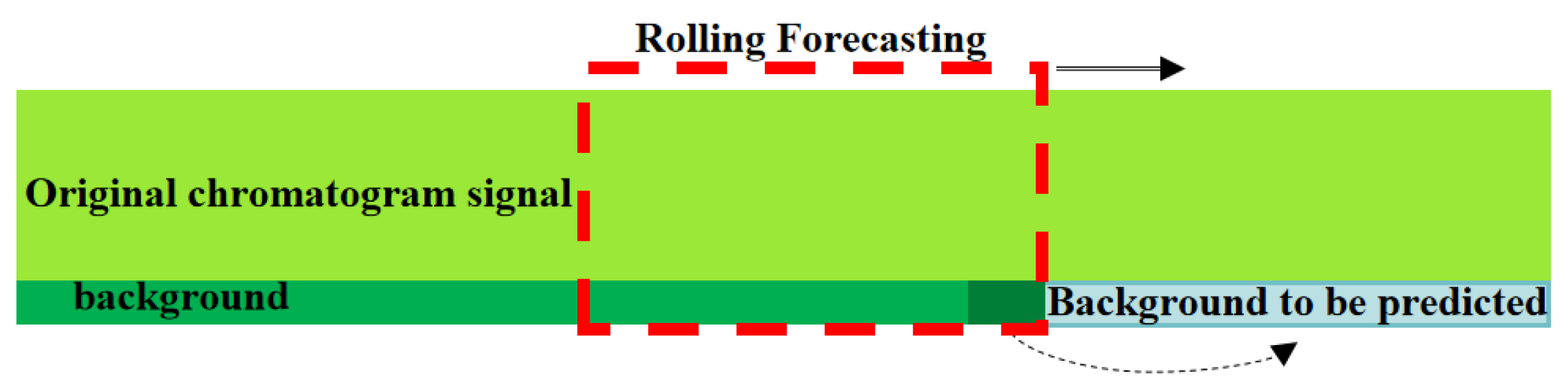
Figure 2 illustrates the background subtraction process employing the Informer model for real-time chromatographic analysis. The light green curve displays the original chromatographic signal acquired by the HPLC system, while the green and dark green regions represent the predicted background signals and subsequent signals awaiting prediction, respectively. The dashed rectangular frame indicates the input data window (length = 48) of the Informer prediction model. This window dynamically advances with newly acquired data to enable continuous real-time background prediction and subtraction. The implemented sliding-window mechanism effectively facilitates online chromatographic signal processing, offering a reliable background subtraction solution for complex chromatographic analyses.
Figure 2.
Schematic diagram of real-time chromatographic background subtraction with the Informer model, where solid and dashed arrows represent the data flow and its dependencies for prediction, respectively.
2.3. Training/Testing Datasets
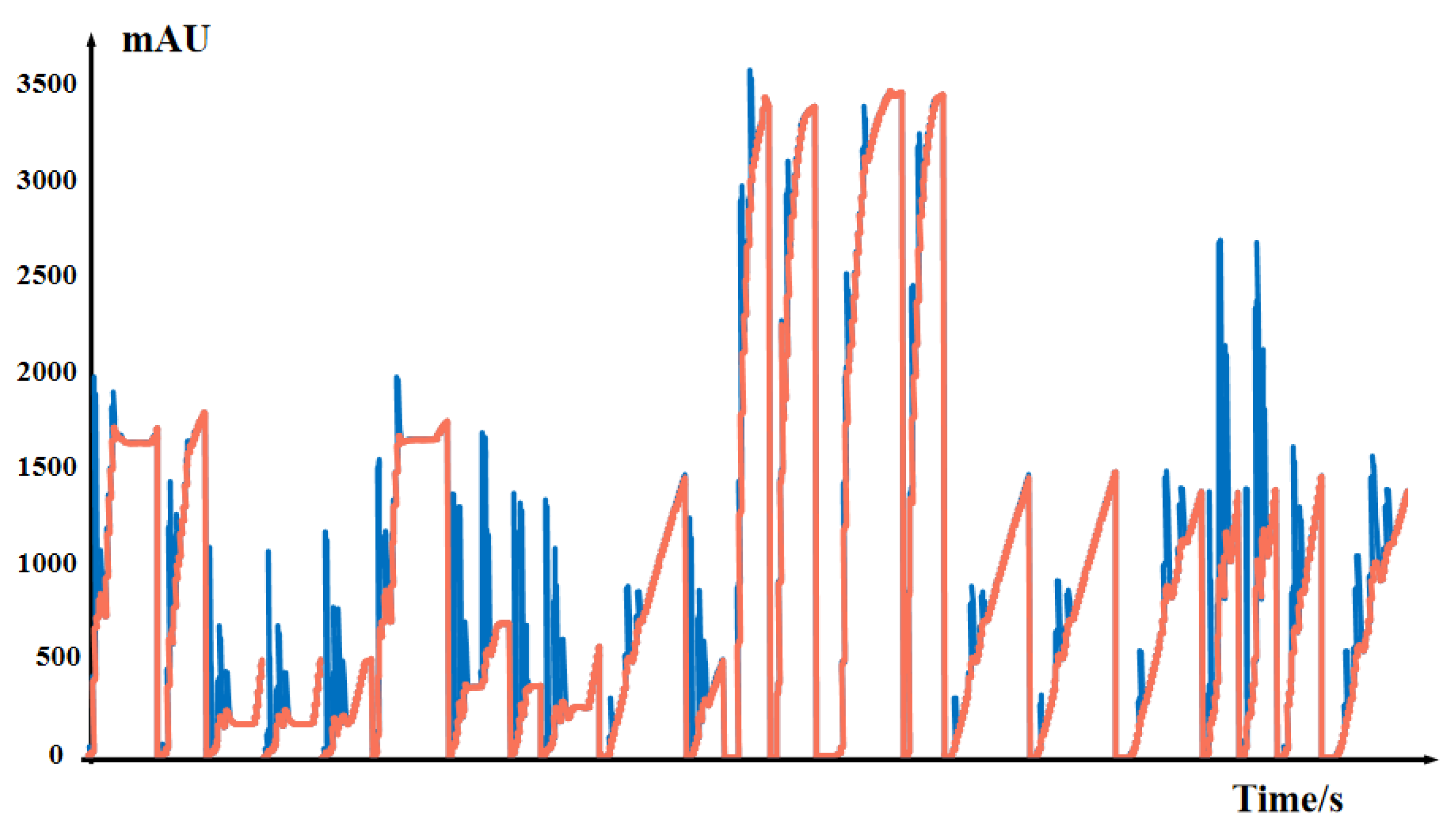
In model training, two distinct data loading strategies were adopted. The first is the batch training mode. In this approach, multiple chromatographic datasets are consolidated into a single Excel file to form a complete training set. The input data comprises multi-dimensional features such as chromatographic signals, concentration, pressure, and flow rate, with simulated background signals serving as the training target. This dataset is used for centralized one-time training of the model, which undergoes multiple iterations to learn global data patterns. Figure 3 illustrates an example of the merged dataset, containing both the raw chromatographic signals and their corresponding backgrounds.
Figure 3.
A sample of the chromatographic mixed dataset in batch training mode is shown above. The figure displays the chromatographic signals (depicted in blue) and their corresponding baseline signals (shown in orange) for a subset of samples in the dataset, while other chromatographic attributes are not illustrated. The dataset consists of multiple chromatographic samples, in which the baseline signals serve as target labels for prediction.
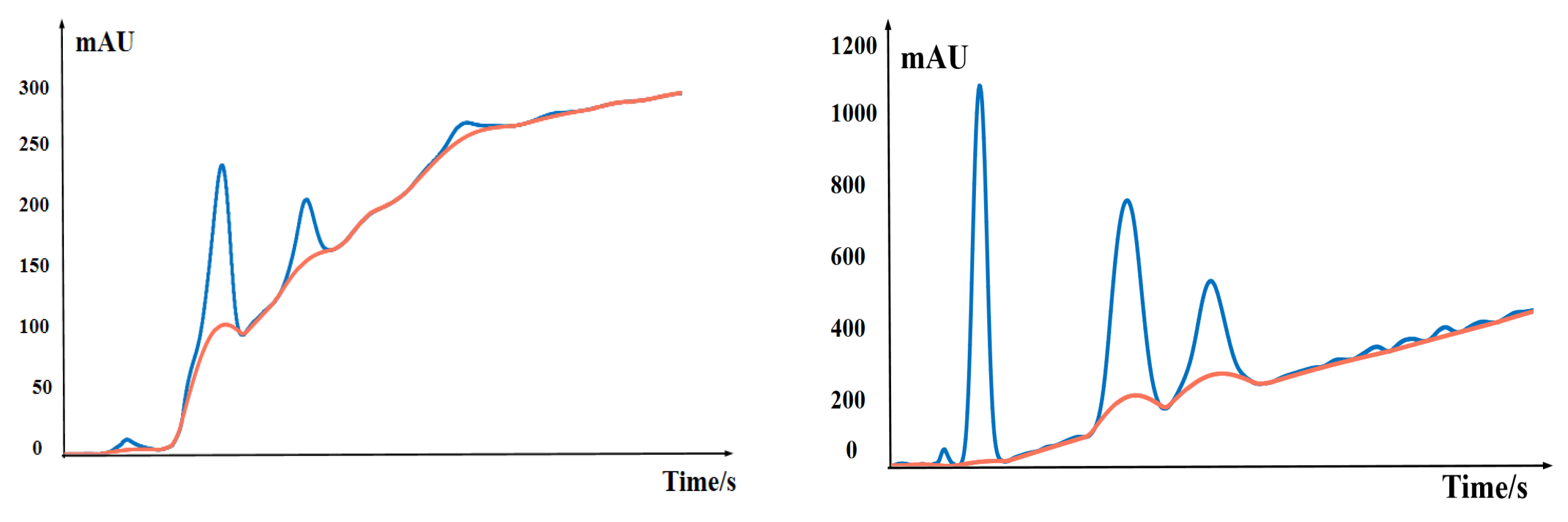
The second strategy is the iterative training mode. Under this scheme, each chromatographic sample is stored independently as a separate Excel file, and a step-by-step, sequential training method is employed. Specifically, the system loads individual data files in sequence for training; upon completion of training on the current sample, the model parameters are updated immediately. Before loading the next sample, the system loads the previously updated model parameters as the initial state and continues the optimization process. This procedure is repeated over multiple training cycles to progressively enhance model performance. This sample-wise iterative update mechanism shares similarities with parameter-update strategies used in incremental learning and certain online object-detection models. The construction of the training and test datasets is shown in Figure 4.
Figure 4.
Chromatographic mixed dataset in iterative training mode (only two sample examples are shown). The orange and blue lines represent the original chromatogram signal and the predicted background, respectively.
The two strategies each have their own emphasis: the batch mode facilitates learning of the overall data distribution and offers high training efficiency, while the iterative mode simulates an online learning scenario, enabling gradual adaptation to data variations and potentially improving the model’s generalization and memory capabilities on sequential data.
3. Experiments and Analysis
Our study comprises two distinct experimental components: simulation experiments employing synthetic chromatographic data, wherein the proposed algorithm’s theoretical superiority is systematically validated through comparative analysis with state-of-the-art baseline correction methods, including morphological operations (SCC) [4], sparse representation (SBL) [17], asymmetric weighted least squares (airPLS) [18], density-guided clustering (DCA) [19], and convolutional neural networks (CNN) [20] etc., and real-data experiments which utilize chromatographic signals acquired from specific instrument models/experimental conditions, with a particular emphasis on evaluating the algorithm’s background elimination performance and engineering applicability in practical scenarios. This dual “theoretical validation–practical application” experimental framework simultaneously ensures both the methodological innovation’s theoretical significance and its practical implementation value.
3.1. Equipment and Model Parameters
All experiments in this study were implemented on the Windows 10 operating system using the PyTorch2.0 deep learning framework, with hardware configurations consisting of an Intel Core R7 3.60 GHz processor and an NVIDIA RTX 4070 graphics card (12 GB GDDR6 VRAM).
We employ the Informer model to achieve real-time background subtraction in liquid chromatography. The experimental parameters are configured as follows: the input sequence length is set to 48, the prediction length is 2, and the model embedding dimension is 512. In the ProbSparse self-attention mechanism, the sparse factor is set to 5. The training process runs for 300 epochs, with early stopping applied to prevent overfitting.
3.2. Simulation-Based Verification
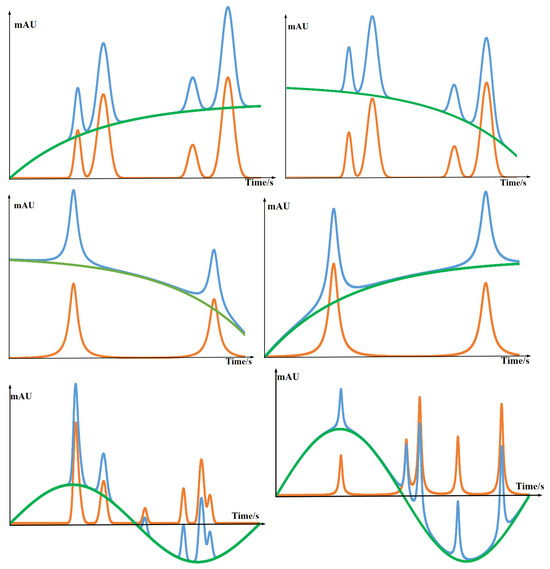
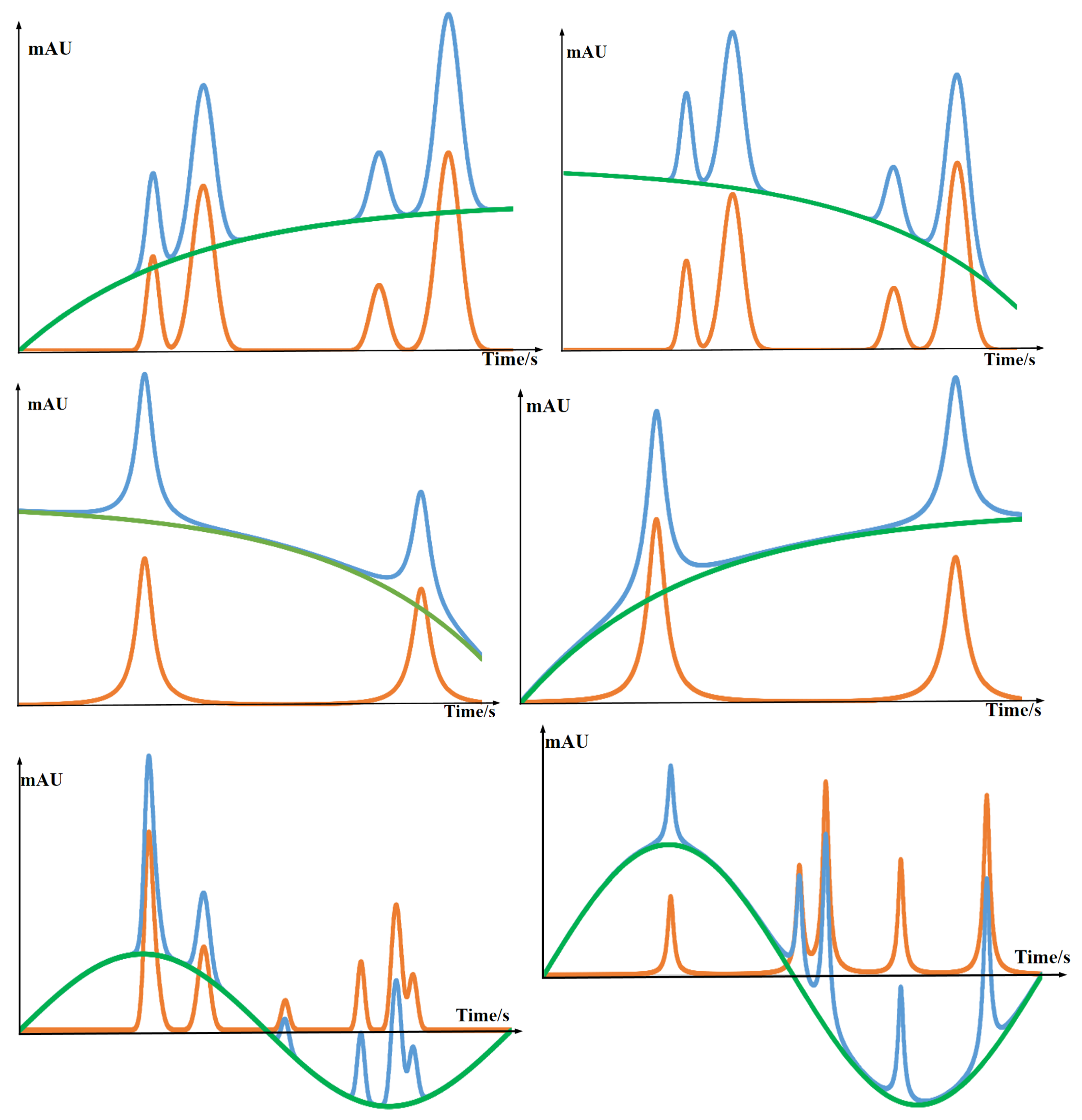
To evaluate the performance of the proposed method, we conducted simulation experiments using synthetic chromatographic data. During data generation, the system randomly introduced Gaussian peaks and Lorentzian peaks to simulate characteristic chromatographic peaks. Furthermore, to replicate common baseline drift phenomena observed in real chromatograms, we constructed three typical exponential baseline profiles: left-upward drift, represented by left-sided exponential decay, right-upward drift, represented by right-sided exponential growth, and sinusoidal baseline drift. Based on this design, three sets of simulated datasets were generated, with representative examples illustrated in Figure 5. To ensure the reliability of model validation, a total of 1000 simulated datasets were generated and divided into training, validation, and test sets at an 8:1:1 ratio.
Figure 5.
Examples of randomly generated model data. The left panels show exponential drift with four prominent peaks; the central panels illustrate exponential drift with two Lorentzian peaks; and the right panels display sinusoidal drift accompanied by Lorentzian peaks. The blue line represents the original signal, the green line indicates the true background, and the orange line denotes the predicted background.
For evaluating algorithm performance on simulated datasets, the ground truth baseline and peak retention rate(Prr/%) can serve as reference standards. The normalized mean square error (NMSE) between the fitted baseline and ground truth baseline provides a quantitative metric for comparing baseline correction algorithms, with the NMSE formula given as follows:
where is the simulated baseline signal, represents the reconstructed baseline of the test signal obtained by the baseline correction algorithm, and N denotes the length of the signal data.
During the experiments, we evaluated 100 sets of model data and performed comparative analysis of their NMSE values, calculating the mean, maximum, and minimum values. The experimental results (Table 1) demonstrate that under ideal noise-free simulation conditions, our proposed real-time background subtraction algorithm, while not optimal, shows competitive performance compared to excellent static baseline correction methods. The algorithm incorporates an Informer model whose background prediction mechanism strictly relies on temporal correlations in historical input data. This introduces inherent latency when responding to dynamic background variations, while simultaneously ensuring high Prr. Our algorithm achieves an outstanding Prr of up to 98.5%. In the construction of the predicted background, the use of historical data for modeling introduces a certain degree of lag in the prediction results. As shown in Figure 6, this lag effect manifests as the retention of some peak signals in the background, along with a slight rightward shift.
Table 1.
Comparative study of NMSE metrics across different modeling approaches.
Figure 6.
Rendering of partial simulation experiment results. The solid red line represents the subtraction result, and the dashed blue line represents the original chromatogram data.
In the simulation experiments, we implemented the following experimental protocol to evaluate algorithm performance: first, we deliberately introduced additive white Gaussian noise into pristine spectral signals to construct test datasets with varying signal-to-noise ratios (SNR, signal-to-noise ratio, expressed in decibels (dB), ranging from 5 to 30 dB), enabling systematic investigation of the real-time processing algorithm’s robustness against noise interference. We conducted quantitative analysis of the correlation between spectral signal SNR and reconstruction error (assessed via the root mean square error, RMSE). The mathematical formulation of RMSE is defined as
Quantitative analysis of the experimental data (as shown Table 2) demonstrates that the real-time background subtraction algorithm proposed in this study exhibits an average increase of 51.8% in RMSE values compared to reference methods under equivalent signal-to-noise ratio conditions (5–30 dB); while this difference is statistically significant (), it remains within acceptable engineering tolerance limits.
Table 2.
SNR–RMSE correlation in algorithm processing.
3.3. Chromatographic Subtraction Experiment
During liquid chromatography data acquisition, although blank experiments can determine the background baseline of chromatographic signals, significant systematic deviations occur between this reference baseline and the true background signal during actual sample elution experiments. Since the true background baseline cannot be precisely obtained in principle, directly calculating the root mean square error (RMSE) between the actual baseline and its fitted baseline presents particular challenges. For real-time detection data lacking reliable reference standards, the assessment incorporated both chromatographic Prr and computational efficiency metrics.
When applying the Informer model for data prediction, the input data must undergo normalization and denormalization processes. However, in actual device experiments, using preliminary experimental data directly for normalization would inevitably compromise prediction accuracy. Research indicates that prediction precision improves with smaller data value ranges [21]. To address this, we optimized the data processing pipeline as follows: during model training, chromatographic absorbance spectra are pre-normalized to the range; during physical device testing, we first conducted blank control experiments with the same solvent type, then used the maximum absorbance value as the baseline for experimental data normalization, with subsequent denormalization applied to the final prediction results.
This study employed a fast liquid preparative chromatography system for experimental data acquisition. The chromatographic separation was performed using two mixed solvent systems as the mobile phase: dichloromethane–methanol and n-hexane–ethyl acetate. A comprehensive collection of 4560 chromatographic datasets was gathered from diverse sample types, including environmental water samples, pharmaceutical products, and agricultural samples. The separation was monitored at wavelengths between 200 and 800 mAU, with a mobile phase flow rate maintained at approximately 30–250 mL/min. Data were recorded at a sampling interval of 0.8 s, yielding data lengths ranging from 400 to 1600 sampling points per run. Each dataset comprised six-dimensional parameters, including absorbance spectra, concentration ratios, system pressure, mobile phase flow rate, and other critical chromatographic variables.
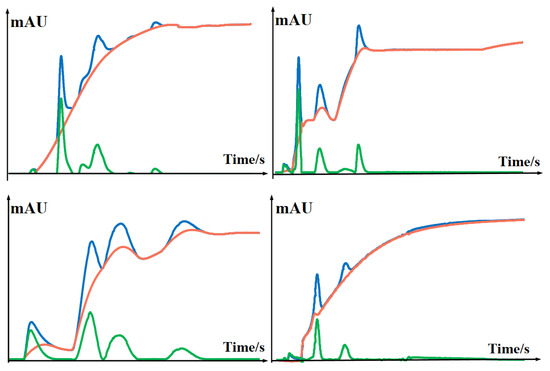
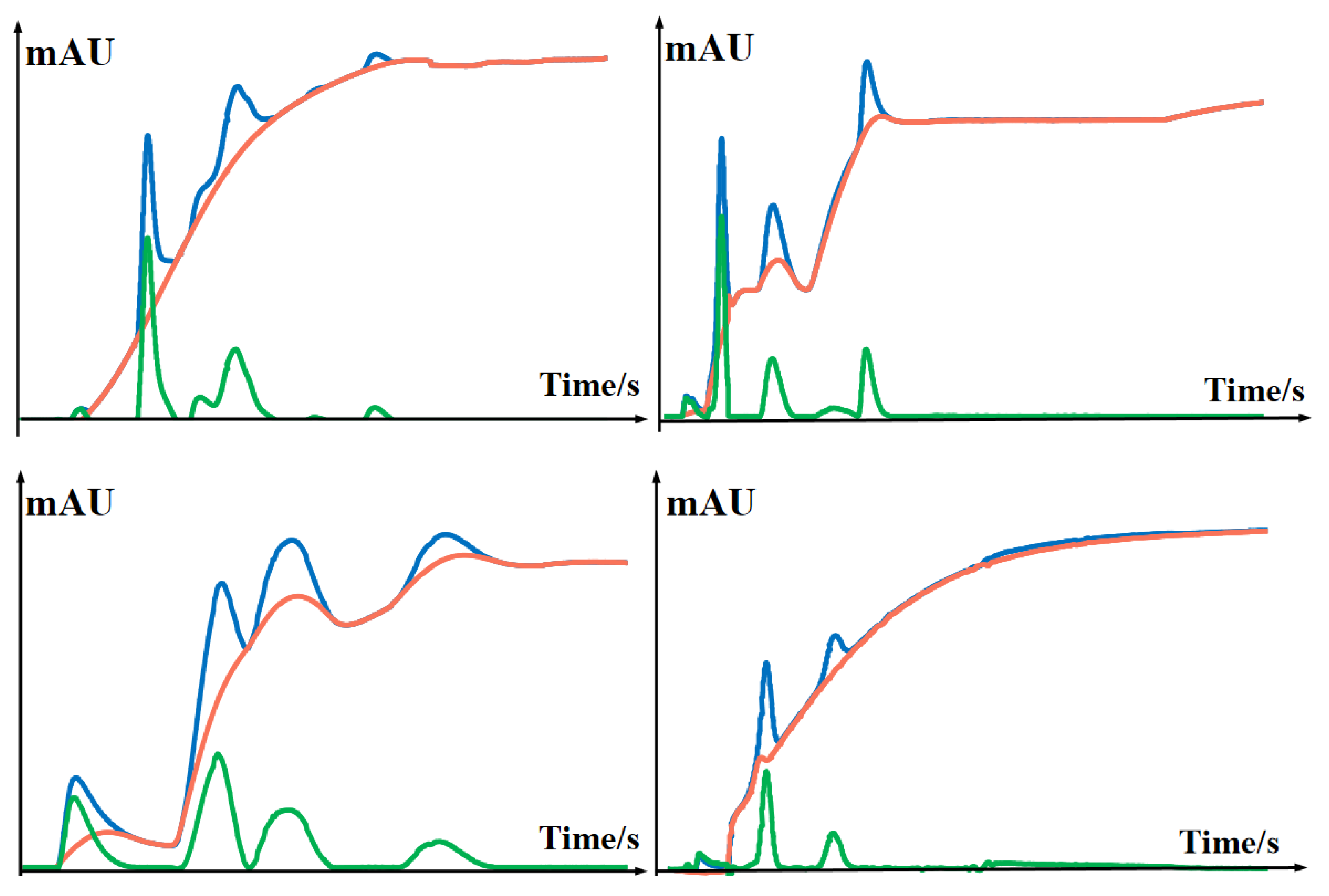
To verify the superiority of the Informer model in chromatographic background subtraction, this study selected several advanced time-series prediction models for comparative experiments. These include the classic Long Short-Term Memory (LSTM) network [22], which is effective for capturing short-term dependencies; Neural Hierarchical Interpolation for Time Series Forecasting (N-HiTS) [23], known for its multi-rate sampling and hierarchical interpolation; the Temporal Transformers Module (TTM) [24], which utilizes transformer architecture for temporal modeling; and the Time Series Extrapolator (TimeXer) [25], designed for long-horizon forecasting. The selection covers a range of modern architectures to ensure a comprehensive comparison. As shown in Table 3, although the subtraction algorithm based on the Informer model does not offer advantages in terms of model parameter size (64.2 M) and computation time (35 ms), it achieves an outstanding chromatographic Prr of 98.3%, significantly outperforming comparative methods. This conclusively demonstrates the algorithm’s superiority in chromatographic background subtraction. Notably, the algorithm’s computation time (approximately 35 ms) is significantly shorter than typical chromatographic sampling cycles (600–900 ms), fully meeting real-time processing requirements. Figure 7 presents partial experimental results of our method, where it can be observed that even relatively small peaks are well preserved. These results indicate that the Prob sparse self-attention mechanism unique to Informer can more effectively capture long-range dependency features in chromatographic baselines, thereby achieving more accurate background signal prediction.
Table 3.
Comparison of model performance in background subtraction with varying parameter sizes.
Figure 7.
Performance evaluation of our algorithm in real-world experiments. The blue curve represents the acquired chromatogram, the green curve depicts the estimated background signal, and the orange curve shows the background-subtracted result obtained using our method.
To further verify the core goal of background subtraction (improving the accuracy of peak area measurement and quantification), Table 4 compares the results of four typical real samples (covering environmental, pharmaceutical, agricultural, and mixed standard samples) with and without Informer background subtraction. For the lettuce extract (imidacloprid, small peak) that is easily interfered by baseline noise, the standard deviation of peak area after subtraction is reduced by 88.6% (from 0.35 to 0.04), and the quantification error is reduced from ±0.07 mg/L to ±0.01 mg/L. For other samples, the stability of peak area and quantification results is also significantly improved (standard deviation reduced by 75–85%), indicating that the proposed method effectively eliminates baseline drift and noise interference, and enhances the reliability of chromatographic quantitative analysis.
Table 4.
Comparison of chromatographic peak area and quantitative results with/without informed background subtraction. The samples in the table are as follows: 1. urban sewage (phenol); 2. aspirin enteric coated tablet solution (aspirin); 3. lettuce extract (imidacloprid); 4. phenol aspirin mixed standard (bimodal).
4. Conclusions
This study proposes a novel deep learning-based real-time chromatographic background subtraction algorithm, which employs the Informer model as its core architecture to achieve efficient and accurate chromatographic signal processing. The algorithm processes input chromatographic data sequences of length 48 to predict background signals of length 2, thereby enabling real-time background subtraction. Compared with conventional methods, our algorithm demonstrates superior temporal modeling capability and computational efficiency, fully meeting the stringent requirements for real-time performance and high precision in industrial chromatographic analysis. It should be noted, however, that the current method is primarily optimized for the detection of chromatographic peaks, and may introduce minor inaccuracies in the precise preservation of peak areas during baseline subtraction. The algorithm development process systematically addressed three key aspects: model construction, data preparation, and training/testing. Firstly, the attention mechanism of the Informer model was effectively utilized to capture dynamic features in chromatographic data. Secondly, a scientific data construction approach was adopted to enhance model generalization, ensuring stable performance under complex chromatographic conditions. Finally, a phased training and testing strategy was implemented, significantly improving the model’s convergence speed and prediction accuracy.
Comprehensive validation was conducted through comparative simulation experiments and actual instrument testing. Simulation results demonstrate that our algorithm outperforms traditional methods in both background subtraction accuracy and computational speed, fully confirming its theoretical feasibility. Tests on actual chromatographic instruments show that the algorithm can effectively eliminate background noise, significantly improve signal-to-noise ratio, and operate stably and reliably, completely meeting real-time processing requirements. These research achievements not only validate the algorithm’s practical value but also provide strong support for its commercial applications.
Author Contributions
Writing—original draft, J.C.; Formal analysis, J.C.; Methodology, J.C.; Investigation, J.C.; Project administration, J.C.; Software, J.C.; Supervision, J.C.; Funding acquisition, Y.W.; Resources, Y.W.; Supervision, Y.W.; Writing—review & editing, Y.W.; Data curation, X.X.; Investigation, X.X.; Validation, X.X. All authors have read and agreed to the published version of the manuscript.
Funding
This research was supported by the National Natural Science Foundation of China (Grant No. 61573183).
Data Availability Statement
The datasets and code used in this study are available from the corresponding author upon reasonable request. Simulated chromatographic data were generated using the provided MATLAB scripts, and experimental chromatograms are available under restricted access due to proprietary constraints. Derived data supporting the findings of this study are available within the article.
Conflicts of Interest
Author Xinmei Xu was employed by the company Changzhou Santai Technology Co., Ltd. The remaining authors declare that the research was conducted in the absence of any commercial or financial relationships that could be construed as a potential conflict of interest.
References
- Kaur, P.; Harnal, S.; Gautam, V.; Singh, M.P.; Singh, S.P. An approach for characterization of infected area in tomato leaf disease based on deep learning and object detection technique. Eng. Appl. Artif. Intell. 2022, 115, 105210. [Google Scholar] [CrossRef] [Scilit]
- Niezen, L.E.; Schoenmakers, P.J.; Pirok, B.W. Critical comparison of background correction algorithms used in chromatography. Anal. Chim. Acta 2022, 1201, 339605. [Google Scholar] [CrossRef] [Scilit]
- Zhang, X.; Jia, Y.; Yang, Z.; Sheng, L.; Yuan, L.; Zhang, Q.; Yang, D. Spectral intensity drift correction of Spark Mapping Analysis for large-size metal materials. Anal. Chim. Acta 2024, 1322, 343075. [Google Scholar] [CrossRef] [Scilit]
- Chen, J.; Wu, Y.; Yuan, Y. Chromatographic signal baseline correction based on piecewise cubic curve and data updating. Acta Metrol. Sin. 2024, 45, 964–973. [Google Scholar]
- Zhang, Z.; Chen, S.; Liang, Y. Baseline correction using adaptive iteratively reweighted penalized least squares. Analyst 2010, 135, 1138. [Google Scholar] [CrossRef] [Scilit] [PubMed]
- Baek, S.J.; Park, A.; Ahn, Y.J.; Choo, J. Baseline correction using asymmetrically reweighted penalized least squares smoothing. Analyst 2015, 140, 250–257. [Google Scholar] [CrossRef] [Scilit] [PubMed]
- Qian, F.; Wu, Y.; Hao, P. A fully automated algorithm of baseline correction based on wavelet feature points and segment interpolation. Opt. Laser Technol. 2017, 96, 202–207. [Google Scholar] [CrossRef] [Scilit]
- Singhal, A.; Singh, P.; Fatimah, B.; Pachori, R.B. An efficient removal of power-line interference and baseline wander from ECG signals by employing Fourier decomposition technique. Biomed. Signal Process. Control 2020, 57, 101741. [Google Scholar] [CrossRef] [Scilit]
- Agrawal, S.; Gupta, A. Fractal and EMD based removal of baseline wander and powerline interference from ECG signals. Comput. Biol. Med. 2013, 43, 1889–1899. [Google Scholar] [CrossRef] [Scilit] [PubMed]
- Rossi, F.; Velázquez, D.; Monedero, I.; Biscarri, F. Artificial neural networks and physical modeling for determination of baseline consumption of CHP plants. Expert Syst. Appl. 2014, 41, 4658–4669. [Google Scholar] [CrossRef] [Scilit]
- Mani-Varnosfaderani, A.; Kanginejad, A.; Gilany, K.; Valadkhani, A. Estimating complicated baselines in analytical signals using the iterative training of Bayesian regularized artificial neural networks. Anal. Chim. Acta 2016, 940, 56–64. [Google Scholar] [CrossRef] [Scilit]
- Jiao, Q.; Guo, X.; Liu, M.; Kong, L.; Hui, M.; Dong, L.; Zhao, Y. Deep learning baseline correction method via multi-scale analysis and regression. Chemom. Intell. Lab. Syst. 2023, 235, 104779. [Google Scholar] [CrossRef] [Scilit]
- Liu, Y. Adversarial nets for baseline correction in spectra processing. Chemom. Intell. Lab. Syst. 2021, 213, 104317. [Google Scholar] [CrossRef] [Scilit]
- Skoog, D.A.; Holler, F.J.; Crouch, S.R. Principles of Instrumental Analysis, 7th ed.; Cengage Learning: Boston, MA, USA, 2017. [Google Scholar]
- Ye, H.; Tang, P.; Wen, H.; Li, S. PSO-VMD-Informer: A New Edge Load Prediction Method. IEEE Access 2024, 12, 174983–174995. [Google Scholar] [CrossRef] [Scilit]
- Zhou, H.; Zhang, S.; Peng, J.; Zhang, S.; Li, J.; Xiong, H.; Zhang, W. Informer: Beyond Efficient Transformer for Long Sequence Time-Series Forecasting. arXiv 2020, arXiv:2012.07436. [Google Scholar] [CrossRef] [Scilit]
- Li, H.; Dai, J.; Pan, T.; Chang, C.; So, H.C. Sparse Bayesian learning approach for baseline correction. Chemom. Intell. Lab. Syst. 2020, 204, 104088. [Google Scholar] [CrossRef] [Scilit]
- Ren, M.; Zhao, S.; Wang, M.; Zhu, X. Robust optimal subsampling based on weighted asymmetric least squares. Stat. Pap. 2024, 65, 2221–2251. [Google Scholar] [CrossRef] [Scilit]
- Kensert, A.; Collaerts, G.; Efthymiadis, K.; Van Broeck, P.; Desmet, G.; Cabooter, D. Deep convolutional autoencoder for the simultaneous removal of baseline noise and baseline drift in chromatograms. J. Chromatogr. A 2021, 1646, 462093. [Google Scholar] [CrossRef] [Scilit] [PubMed]
- Kung, B.H.; Huang, C.C.; Hu, P.Y.; Lo, S.Y.; Lee, C.C.; Yao, C.Y.; Kuan, C.H. Baseline Correction and Denoising of Raman Spectra by Deep Residual CNN. In Proceedings of the 2020 Conference on Lasers and Electro-Optics (CLEO), San Jose, CA, USA, 10–15 May 2020. [Google Scholar]
- Mishra, M.; Singh, J.G. A comprehensive review on deep learning techniques in power system protection: Trends, challenges, applications and future directions. Results Eng. 2025, 25, 103884. [Google Scholar] [CrossRef] [Scilit]
- Tan, M.; Xiang, B.; Zhou, B. LSTM-based Deep Learning Models for non-factoid answer selection. arXiv 2015, arXiv:1511.04108. [Google Scholar]
- Challu, C.; Olivares, K.G.; Oreshkin, B.N.; Garza, F.; Mergenthaler-Canseco, M.; Dubrawski, A.W. N-HiTS: Neural Hierarchical Interpolation for Time Series Forecasting. arXiv 2022, arXiv:2201.12886. [Google Scholar]
- Ekambaram, V.; Jati, A.; Dayama, P.; Mukherjee, S.; Nguyen, N.H.; Gifford, W.M.; Reddy, C.; Kalagnanam, J. Tiny Time Mixers (TTMs): Fast Pre-trained Models for Enhanced Zero/Few-Shot Forecasting of Multivariate Time Series. arXiv 2024, arXiv:2401.03955. [Google Scholar]
- Wang, Y.; Wu, H.; Dong, J.; Liu, Y.; Qiu, Y.; Zhang, H.; Wang, J.; Long, M. TimeXer: Empowering Transformers for Time Series Forecasting with Exogenous Variables. arXiv 2024, arXiv:2402.19072. [Google Scholar] [CrossRef] [Scilit]



Disclaimer/Publisher’s Note: The statements, opinions and data contained in all publications are solely those of the individual author(s) and contributor(s) and not of MDPI and/or the editor(s). MDPI and/or the editor(s) disclaim responsibility for any injury to people or property resulting from any ideas, methods, instructions or products referred to in the content. |
© 2026 by the authors. Licensee MDPI, Basel, Switzerland. This article is an open access article distributed under the terms and conditions of the Creative Commons Attribution (CC BY) license.