
Fluid Domain Characteristics and Separation Performance of an Eccentric Pipe Separator Handling a Crude Oil-Water Mixture


Abstract
1. Introduction
2. EPS Configuration and Dimension Analysis
2.1. EPS Configuration
2.2. Dimensional Analysis
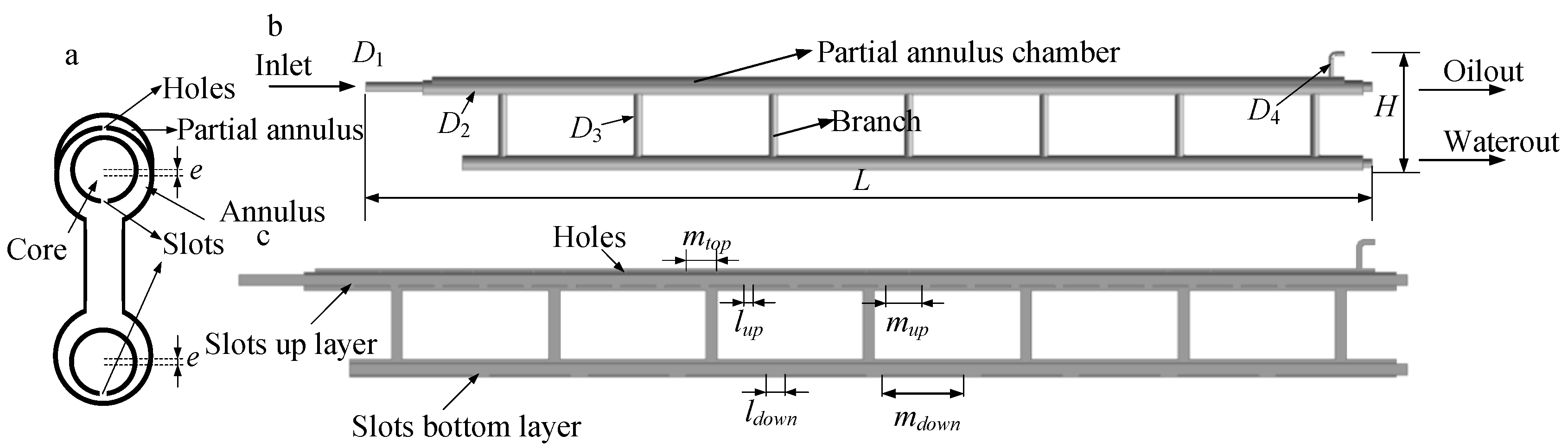
- Inner pipe diameter, D1[L] = 50 mm;
- Outer pipe diameter, D2[L] = 80 mm;
- Branch diameter, D3[L] = 50 mm;
- Upper outer diameter, D4[L] = 15 mm;
- Length, L[L] = 5 m;
- Height, H[L] = 0.62 m;
- Eccentricity, e[L] = 10 mm;
- Volume of fluid domain, V[L3].
- The flow variables are as follows:
- Inlet mixture velocity, Um[L.T−1];
- Water density, ρw[L.M−3];
- Water apparent viscosity, μw[M.L−1T−1];
- Oil density, ρo[L.M−3];
- Oil apparent viscosity, μo[M.L−1T−1];
- Entrance oil volume fraction, αo[-];
- Oil droplet diameter, do[L];
- Oil outlet split ratio, β[-];
- Up-outlet split ratio, γ[-];
- Oil droplet residence time, trd[T−1];
- Outlet oil volume fraction, φj (where j = 1, 2, 3 with correspondence of up-outlet, oil outlet, and water outlet) [-];
- Pressure, p[M.L.T−2];
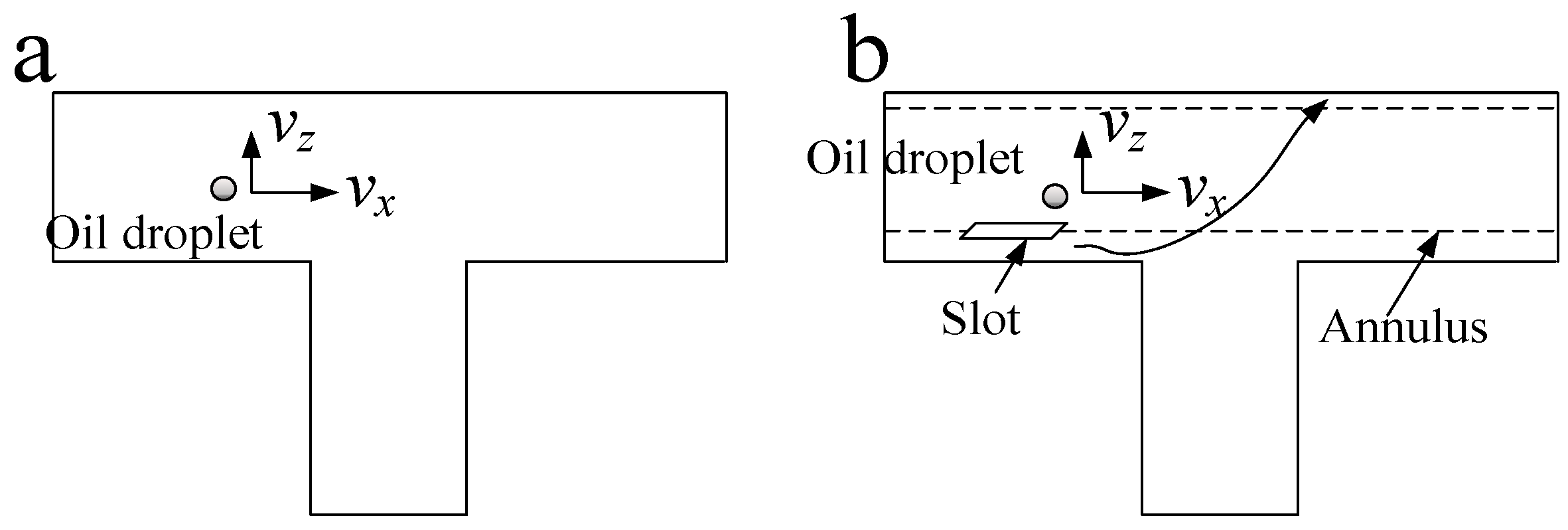
- Coordinate system, x[L], y[L], z[L];
- Separation efficiency η, defined as Equation (3), η[-].
3. Experimental Methods
3.1. Testing Flow Loop
3.2. Working Fluids
3.3. Measurement Method and Systematic Errors
3.4. Operating Conditions
4. Numerical Methods
4.1. CFD Model
4.2. Geometry Model and Mesh Scheme
4.3. Solution Settings and Boundary Conditions
5. Results and Discussion
5.1. CFD Validation
5.2. Fluid Domain Properties
5.3. Influence of the Oil Outlet Split Ratio β
5.4. Influence of Up-Outlet Split Ratio γ
5.5. Influence of the Entrance Condition on the Separation Performance
5.6. Influences of Crude Oil Properties
5.7. Feasibility of EPS Scalability
6. Conclusions
- (1)
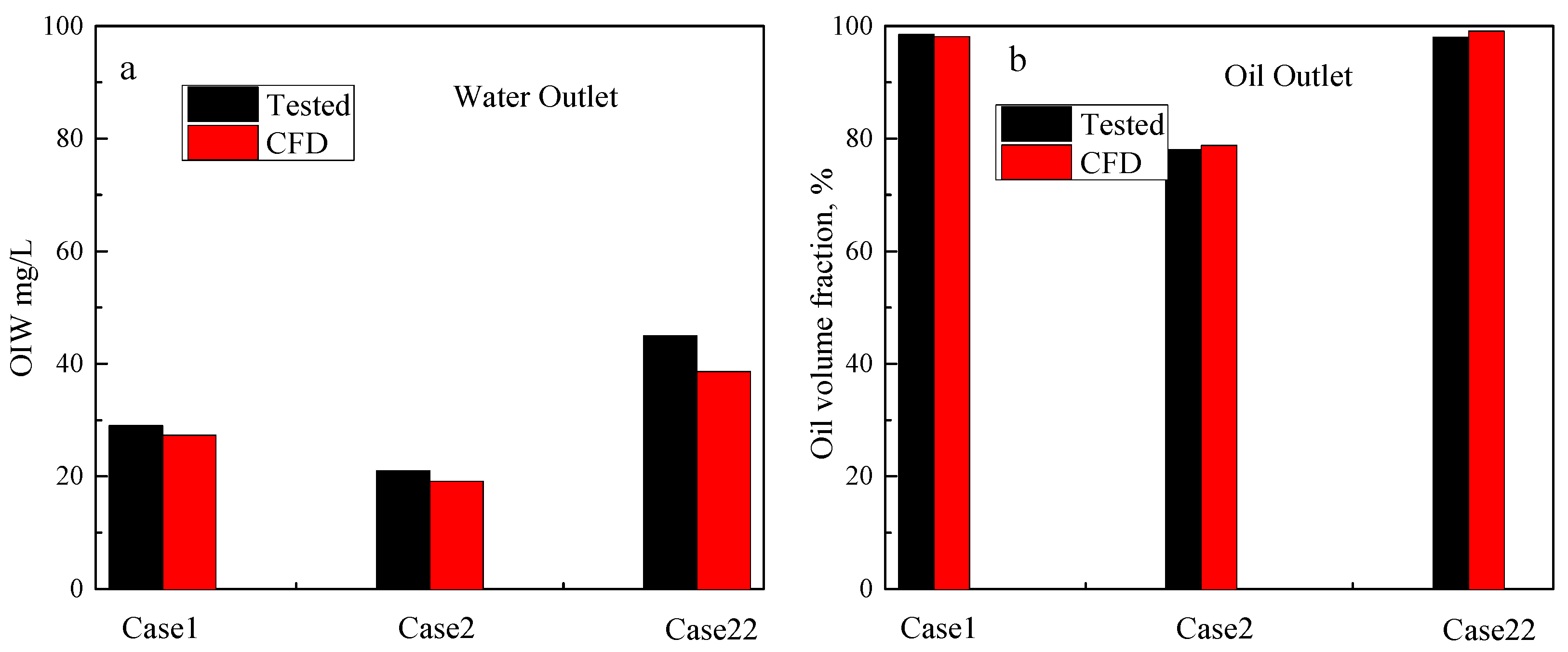
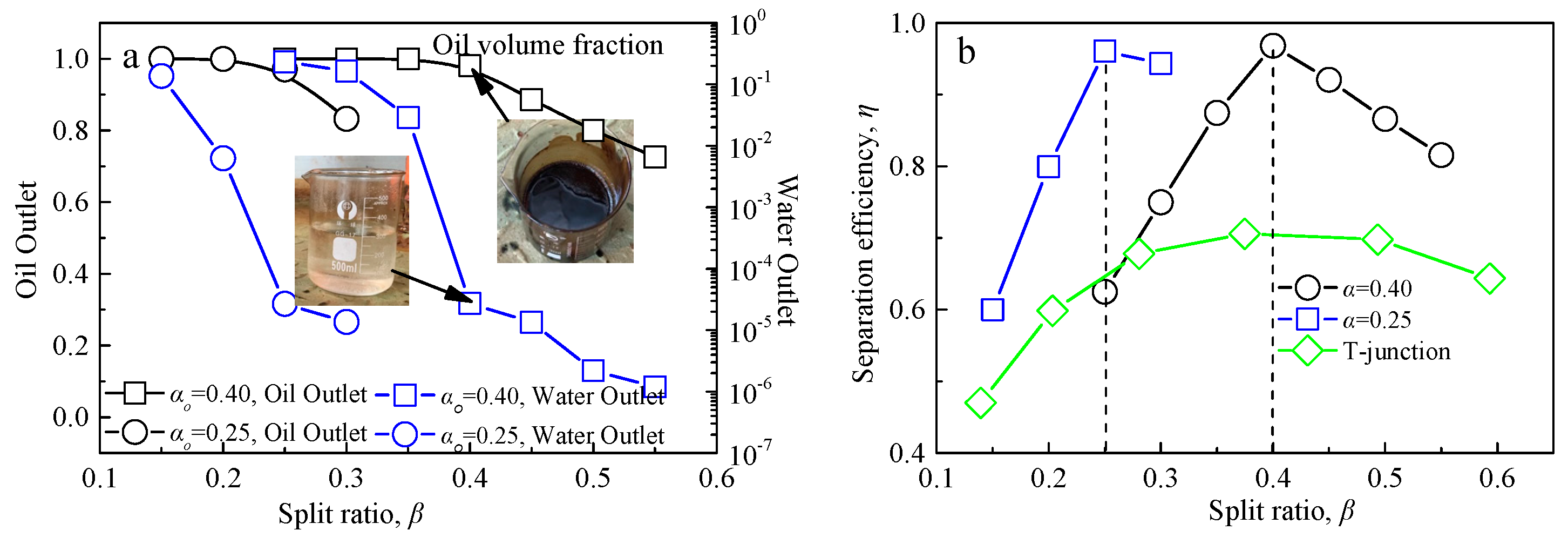
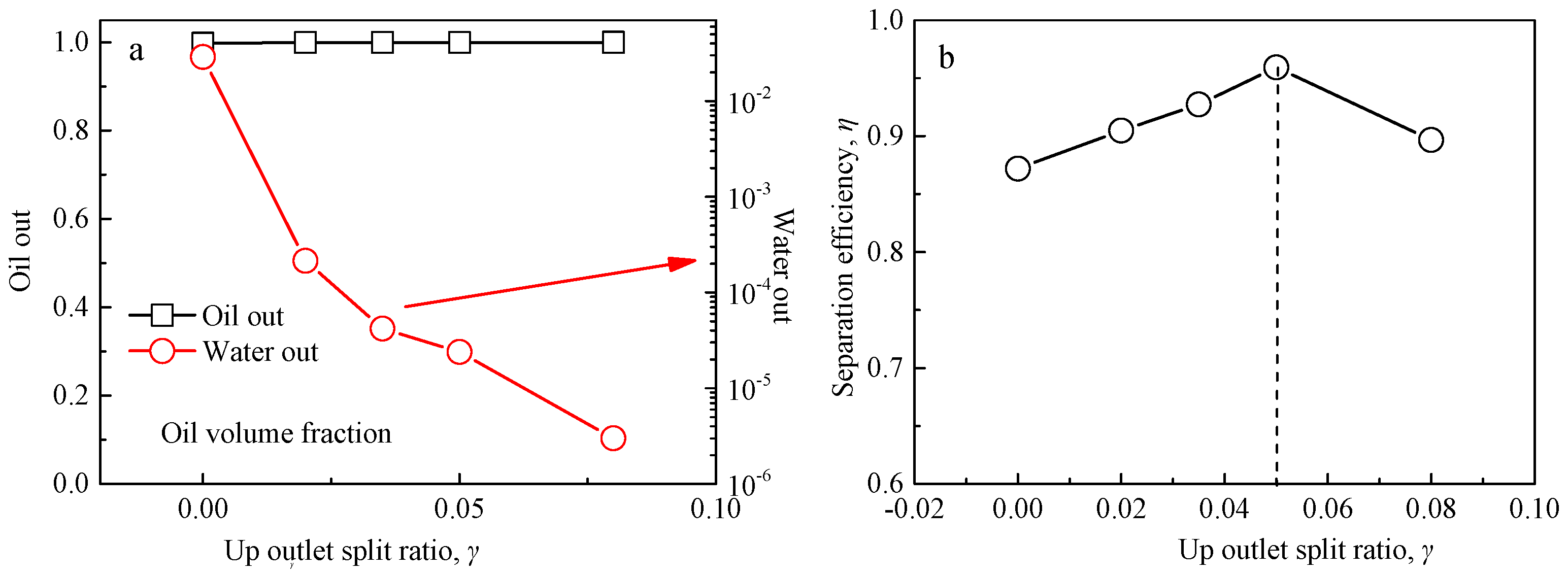
- High separation performance achievable: With appropriate split ratio settings, the oil volume fraction at the water outlet can be reduced to below 50 mg/L, while the oil volume fraction at the oil outlet can reach 98% simultaneously.
- (2)
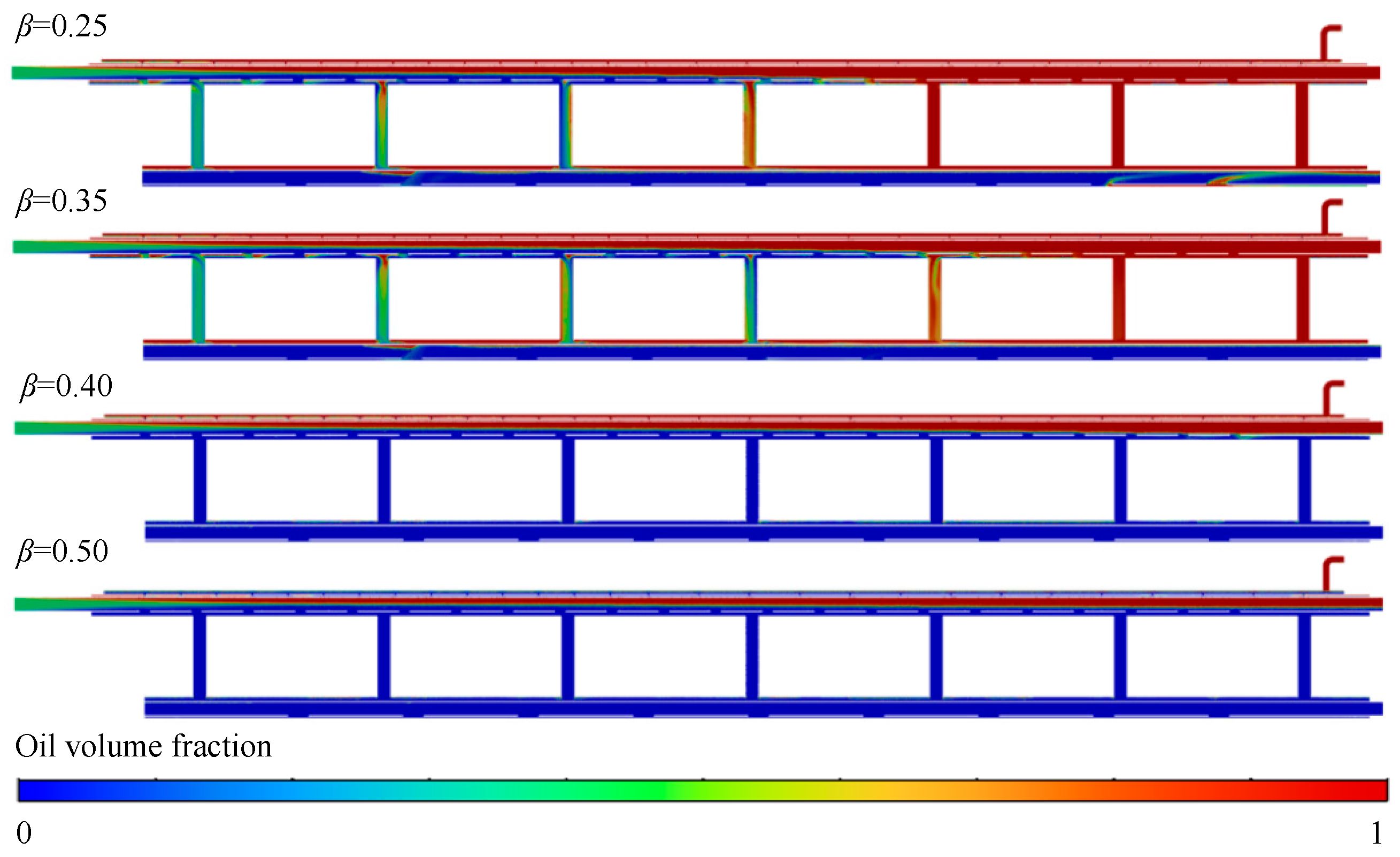
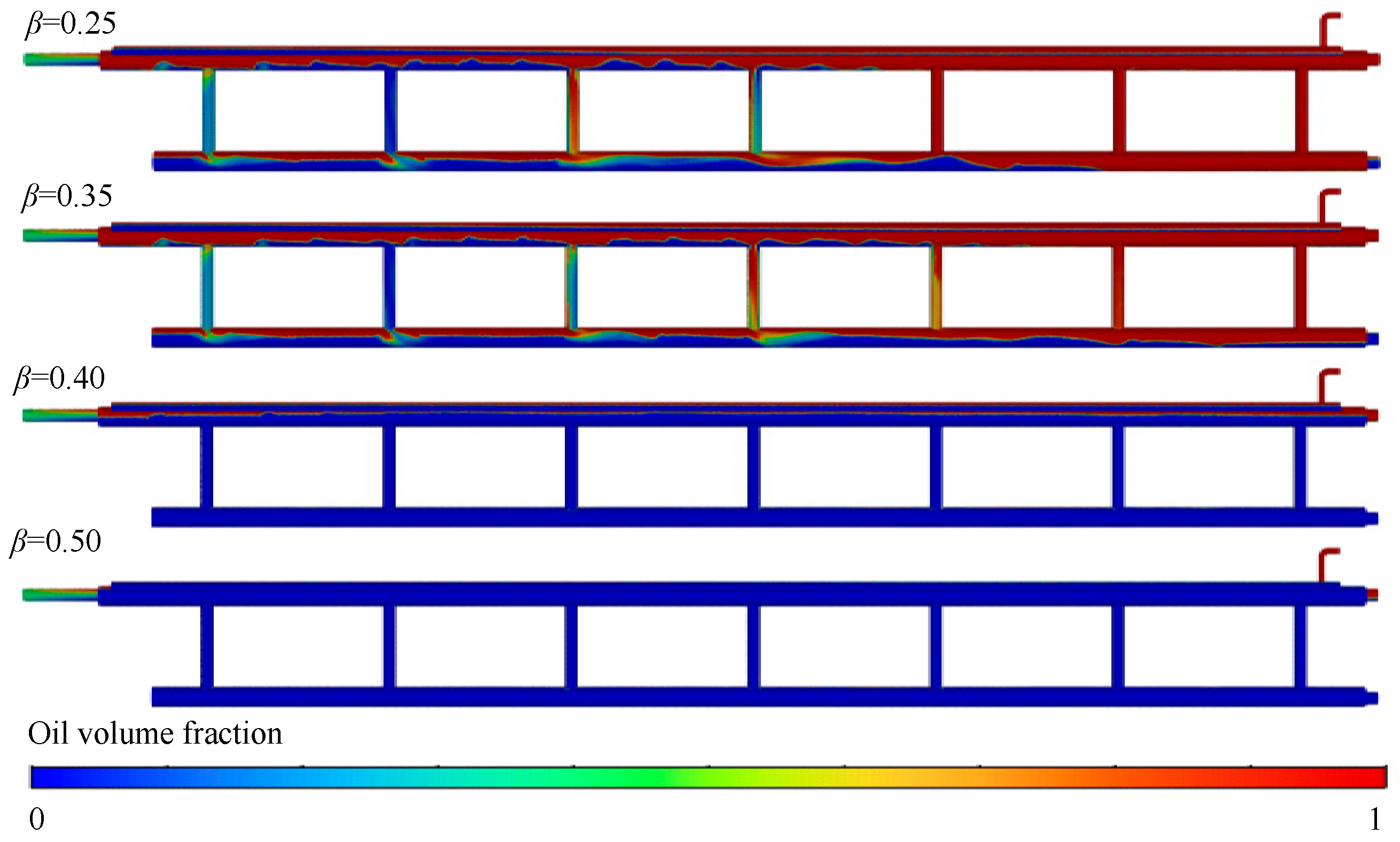
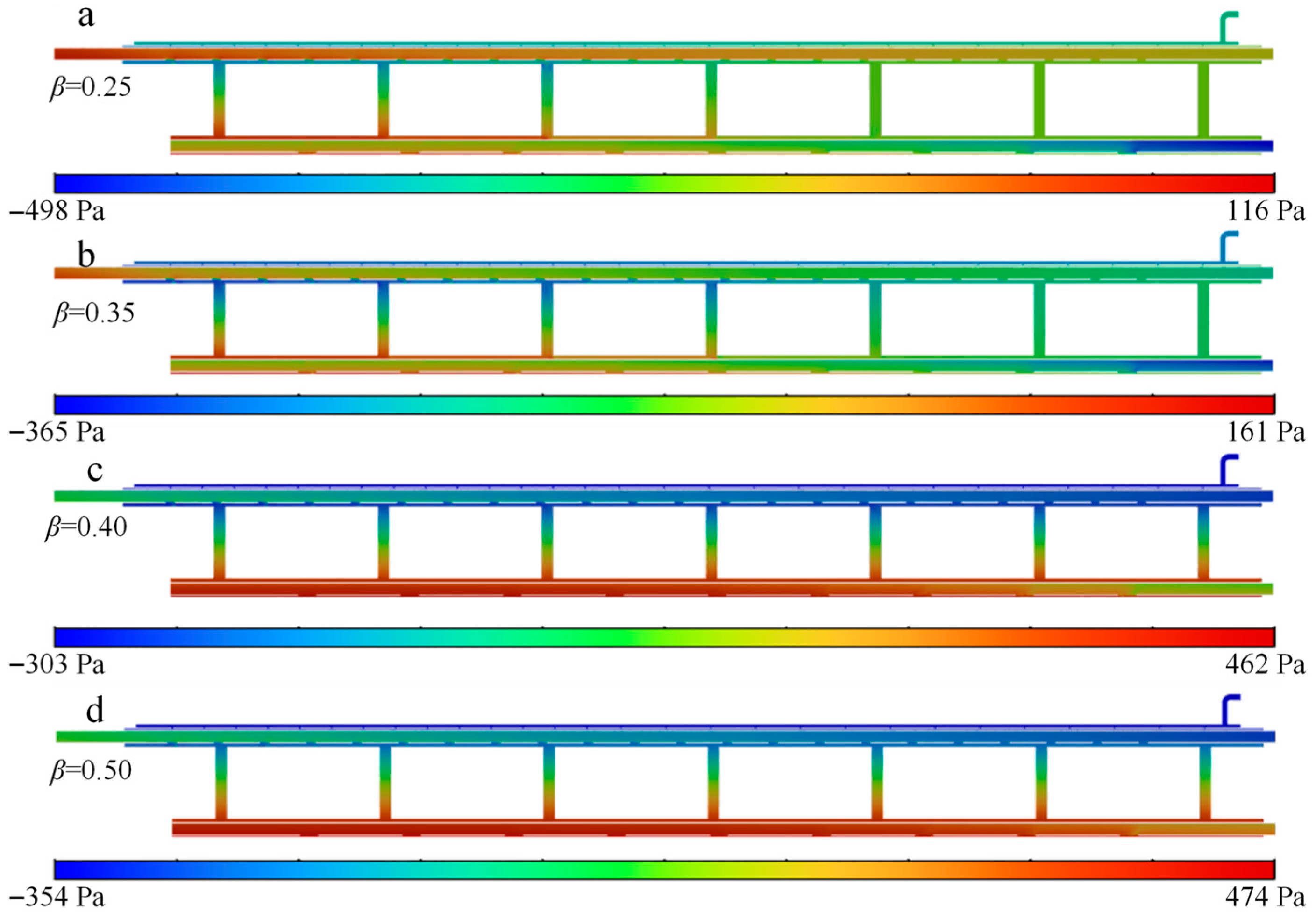
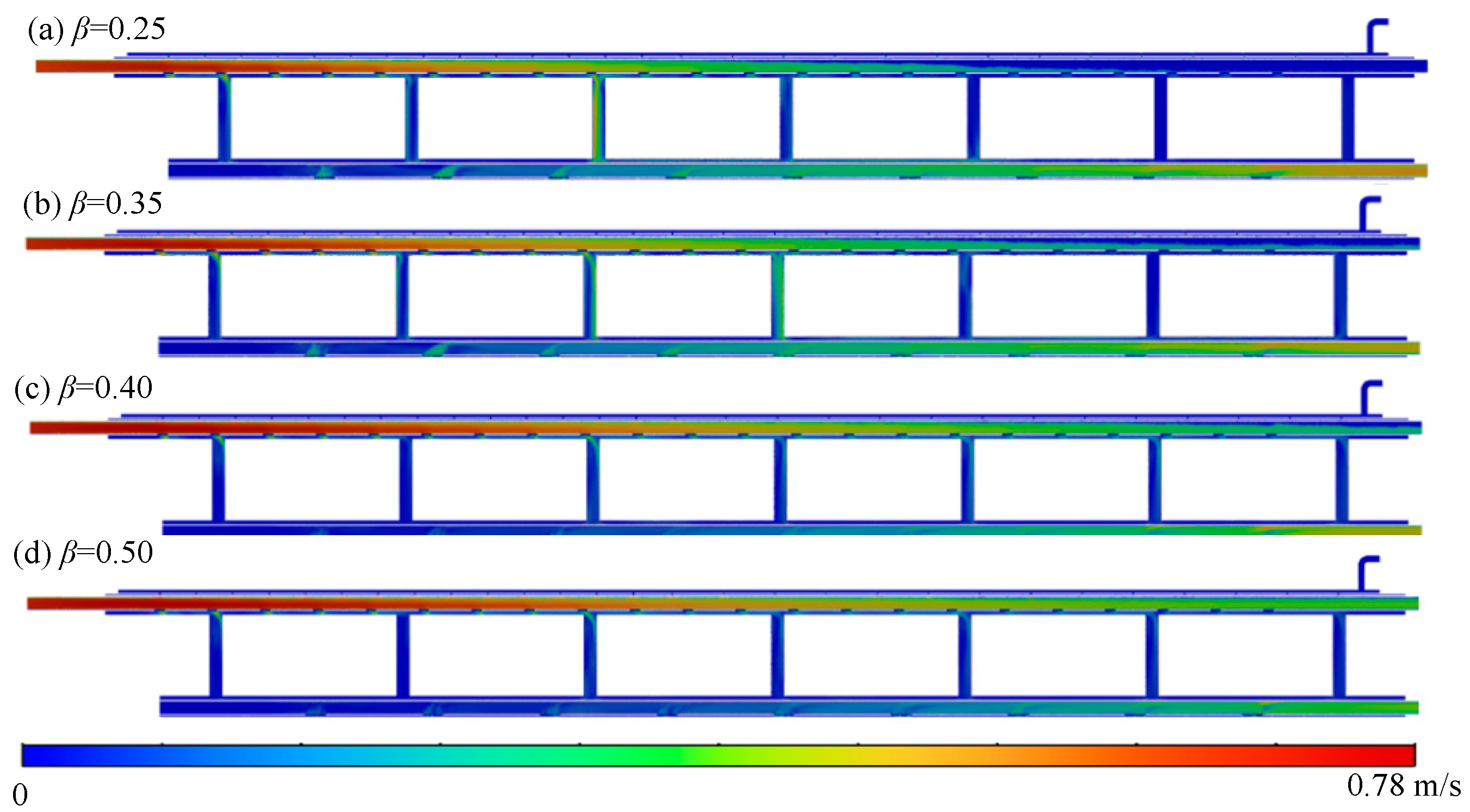
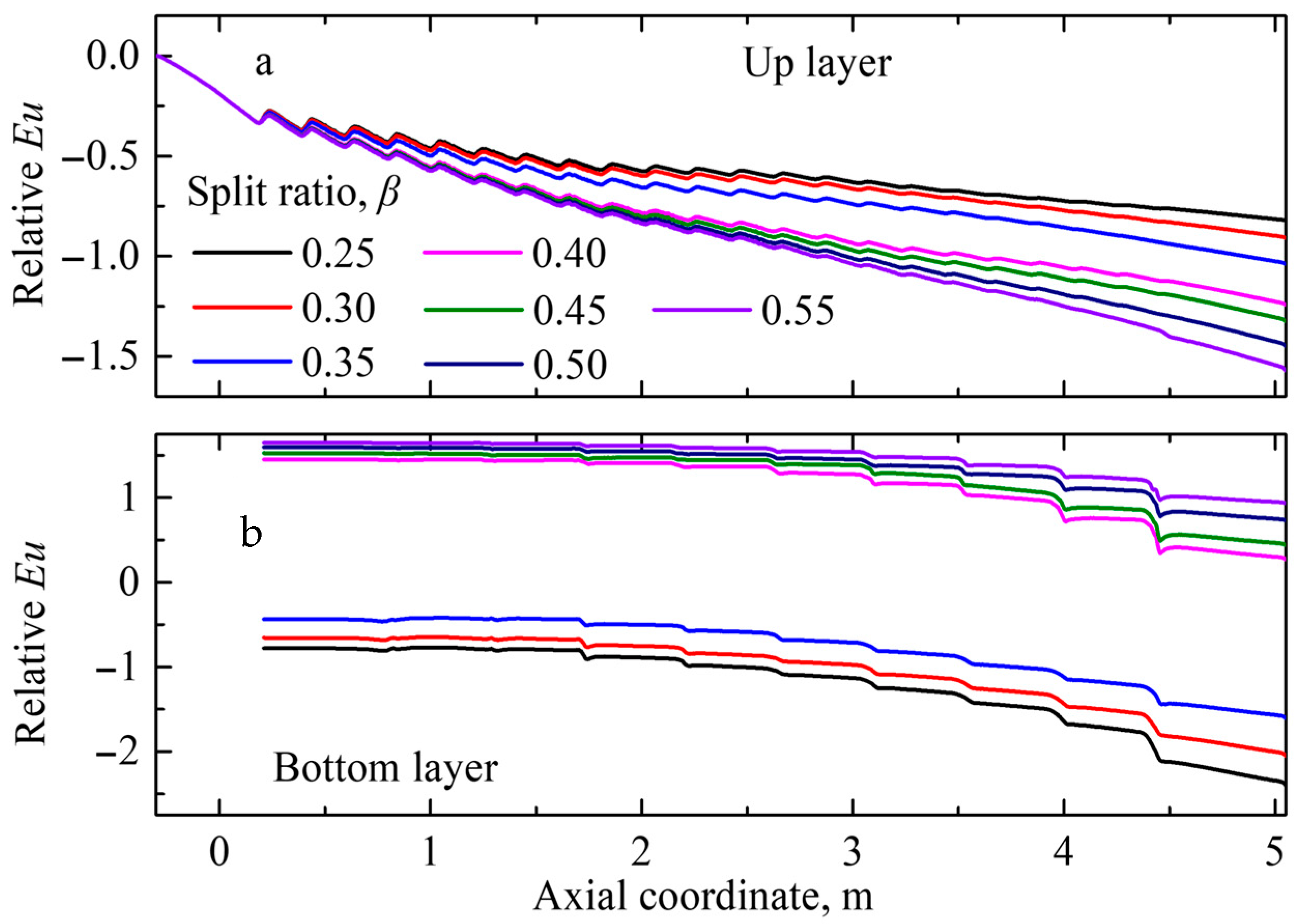
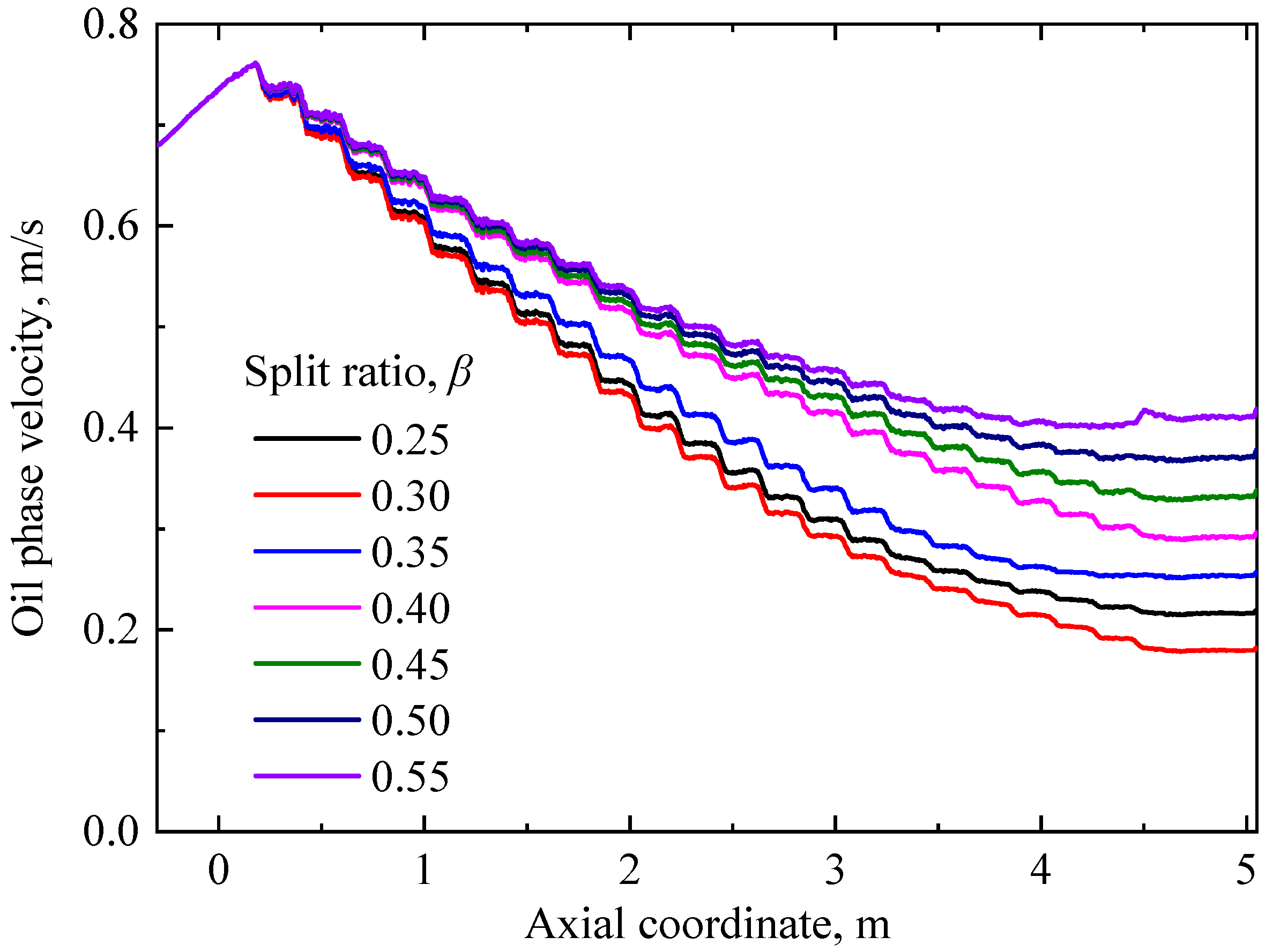
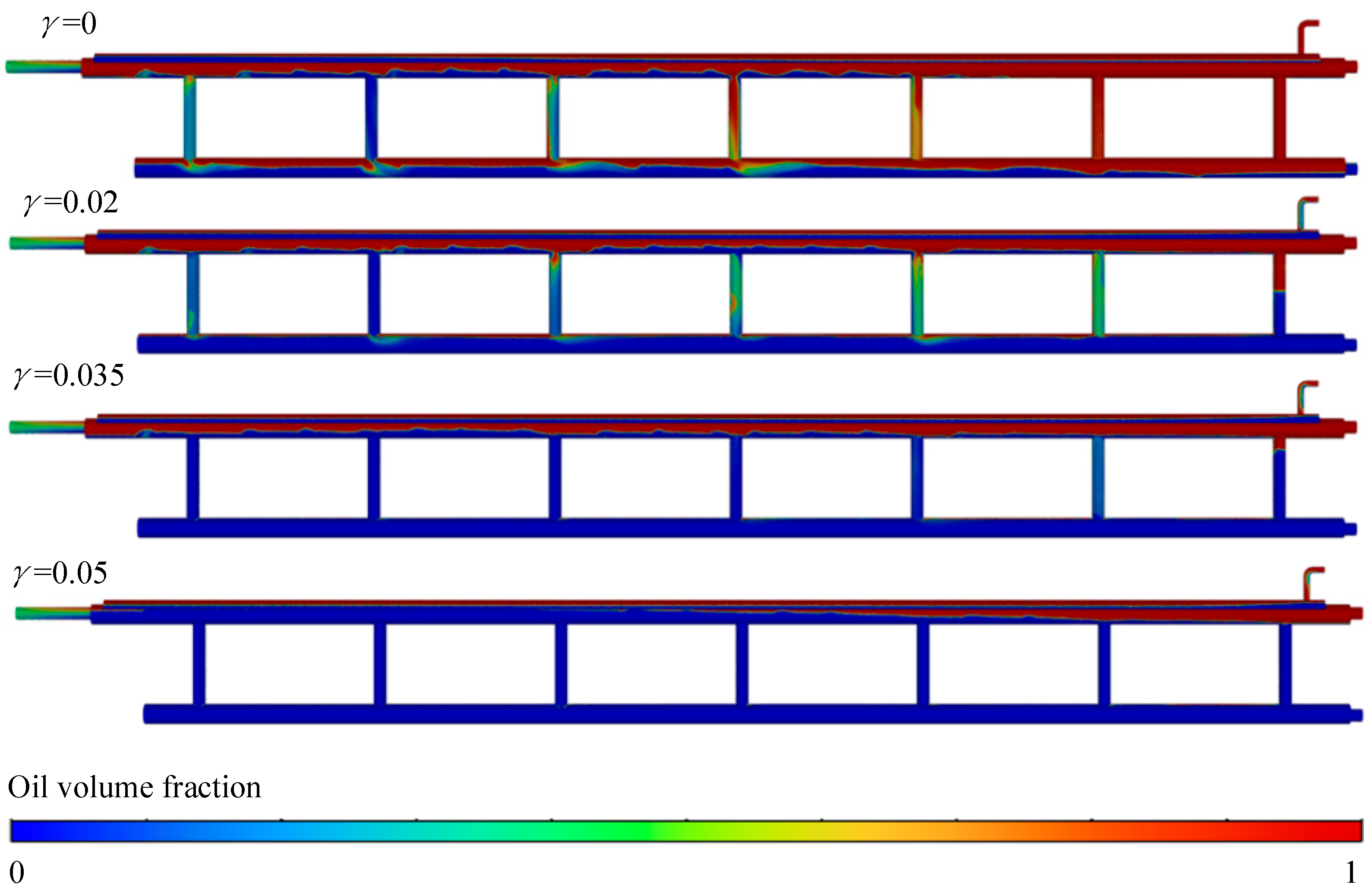
- Split ratio as a critical control parameter: The split ratios of the oil and upper outlets strongly influence the phase distribution, velocity field, and pressure distribution within the EPS. Higher split ratios lead to increased crude oil concentration in the upper-layer core and annulus regions. The presence of slots induces localized pressure and velocity fluctuations along the flow path. For a given inlet oil volume fraction (αₒ), optimal separation efficiency occurs when the sum of the oil outlet split ratio (β) and the upper outlet split ratio (γ) equals αₒ. When β + γ < αₒ, the separated water contains excessive oil; when β + γ > αₒ, the separated oil contains excessive water.
- (3)
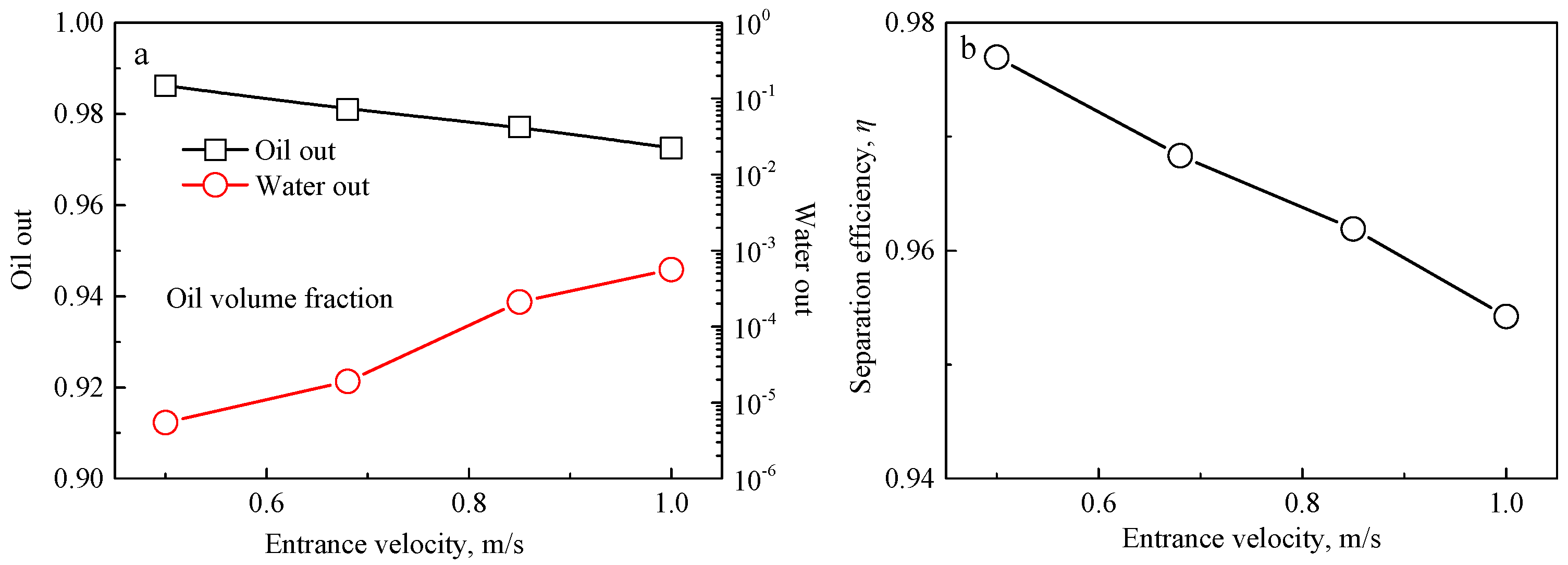
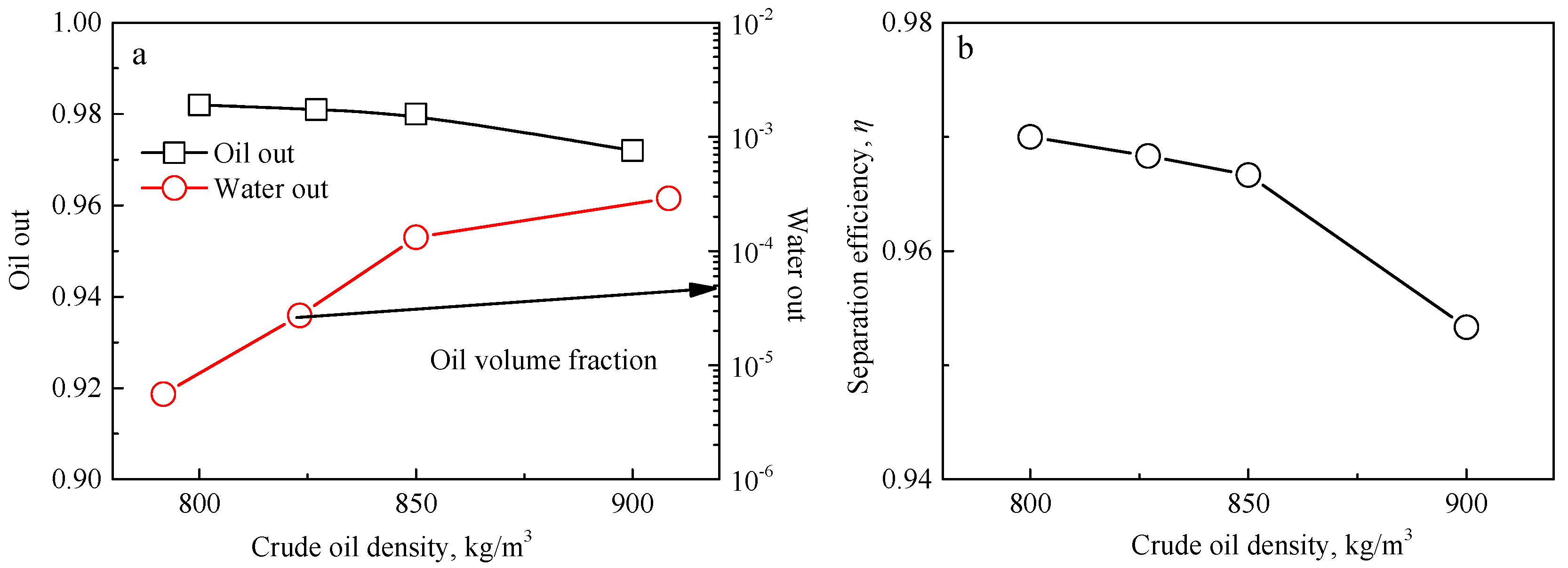
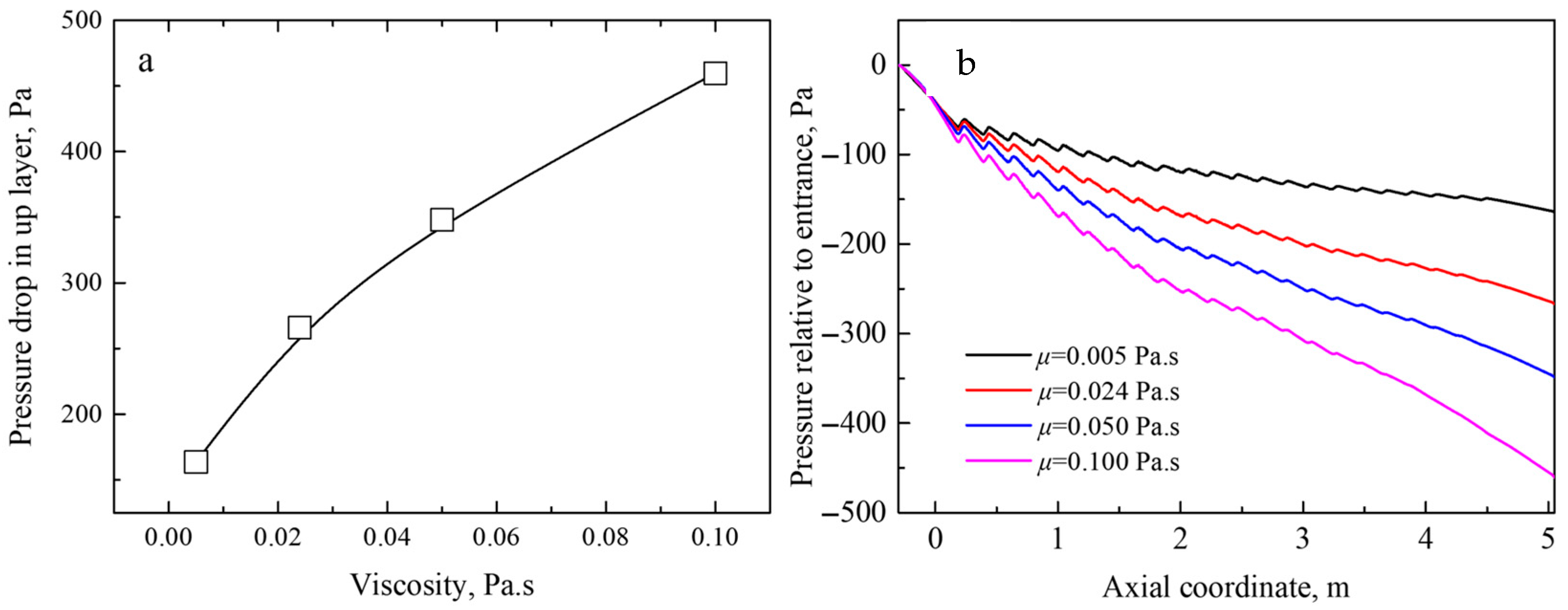
- Influence of inlet velocity and crude oil density: Higher inlet velocity and crude oil density hinder oil droplet settling, reducing separation efficiency. Conversely, lower inlet velocity and density enhance droplet settling, improving separation. Crude oil viscosity shows a positive correlation with the pressure drop between the inlet and oil outlet.
- (4)
- Recommendations for future work: future work could shed light on aspects such as (1) breakup and coalescence behavior inside the EPS fluid domain, especially near slots; (2) influence of short-term fluctuations and startup/shutdown conditions; and (3) how emulsion stability and crude components influence EPS separation.
Author Contributions
Funding
Data Availability Statement
Conflicts of Interest
Abbreviations
| CFD | Computational Fluid Dynamics |
| RNG | Renormalization Group |
| EPS | Eccentric Pipe Separator |
| QUICK | Quadratic Upstream Interpolation for Convective Kinetics |
References
- Lakkimsetty, N.R.; Gaddala, B.R.; Doddamani, D.; Thandlam, A.K.; Karu, C.V.; Namdeti, R.; Al Habsi, S. Experimental study on reducing the base sediment and water in crude oil separation. Fuel 2025, 397, 135478. [Google Scholar] [CrossRef]
- Wu, Y.; Xu, J. Oil and water separation technology. Adv. Mech. 2015, 45, 201506. [Google Scholar] [CrossRef]
- Zhang, H.; Liang, Y.; Yan, X.; Wang, B.; Wang, N. Simulation on water and sand separation from crude oil in settling tanks based on the particle model. J. Pet. Sci. Eng. 2017, 156, 366–372. [Google Scholar] [CrossRef]
- Han, L.; Hou, Y.; Wang, Y.; Liu, X.; Han, J.; Xie, R.; Mu, H.; Fu, C. Measurement of velocity of sand-containing oil-water two-phase flow with super high water holdup in horizontal small pipe based on thermal tracers. Flow Meas. Instrum. 2019, 69, 101622. [Google Scholar]
- Liu, S.; Zhang, D.; Yang, L.L.; Xu, J.Y. Breakup and coalescence regularity of non-dilute oil drops in a vane-type swirling flow field. Chem. Eng. Res. Des. 2018, 129, 35–54. [Google Scholar] [CrossRef]
- Liu, S.; Zhang, J.; Hou, L.T.; Xu, J.Y. Investigation on the variation regularity of the characteristic droplet diameters in the swirling flow field. Chem. Eng. Sci. 2021, 229, 116153. [Google Scholar] [CrossRef]
- Kitoh, O. Experimental study of turbulent swirling flow in a straight pipe. J. Fluid Mech. 1991, 225, 445–479. [Google Scholar] [CrossRef]
- Slot, J.J. Development of a Centrifugal In-Line Separator for Oil-Water Flows. Ph.D. Thesis, University of Twente, Enschede, The Netherlands, 2013. [Google Scholar] [CrossRef]
- Kurimoto, R.; Kimura, T.; Hayashi, K.; Takimoto, H. Separation of particle-laden oil-in-water emulsion using swirling flows formed by an in-line separator. Chem. Eng. Res. Des. 2025, 225, 321–327. [Google Scholar] [CrossRef]
- Azzopardi, B.J. T junctions as phase separators for gas liquid flows, Possibilities and problems. Chem. Eng. Res. Des. 1993, 71, 273–281. [Google Scholar]
- Yang, L.; Azzopardi, B.J.; Belghazi, A.; Nakanishi, S. Phase separation of liquid-liquid two-phase flows at T-junctions. AIChE J. 2006, 52, 141–149. [Google Scholar] [CrossRef]
- Fallah, K.; Fattahi, E. Splitting of droplet with different sizes inside a symmetric T-junction microchannel using an electric field. Sci. Rep. 2022, 12, 3226. [Google Scholar] [CrossRef]
- He, K.; Lin, Y.; Hu, Y.; Huang, S.M. Phase separation features of oil-water parallel flow at hydrophobic and hydrophilic micro-T-junctions. Chem. Eng. Sci. 2022, 253, 117520. [Google Scholar] [CrossRef]
- Zhang, M.; Cui, Y.; An, W.; Wang, H.; Wang, L.; Liu, S. Investigation of the effect of side arm orientation of the T-junction on gas-liquid stratified flow. Processes 2023, 11, 2949. [Google Scholar] [CrossRef]
- Fu, J.; Liu, Z.; Yang, X.; Jin, S.; Ye, J. Experimental research on the separation performance of a compound T-junction for two-phase zeotropic mixtures. Exp. Therm. Fluid Sci. 2023, 147, 110951. [Google Scholar] [CrossRef]
- Zhang, J.; Wu, Q.L.; Liu, S.; Xu, J.Y. Investigation of the gas-liquid two-phase flow and separation behaviors at inclined T-junction pipelines. ACS Omega 2020, 5, 21443–21450. [Google Scholar] [CrossRef]
- Pandey, S.; Gupta, A.; Chakrabarti, D.P.; Das, G.; Ray, S. Liquid-liquid two phase flow through a horizontal T-junction. Chem. Eng. Res. Des. 2006, 84, 895–904. [Google Scholar] [CrossRef]
- Wang, L.; Wu, Y.X.; Zheng, Z.C.; Guo, J.; Zhang, J.; Tang, C. Oil-water two-phase flow inside T-junction. J. Hydrodyn. Ser. B 2008, 20, 147–153. [Google Scholar] [CrossRef][Green Version]
- Wei, C.D.; Xu, J.Y.; Wang, L.Y.; Liu, H.F.; Wu, Y.X. The law of oil-water two-phase flow in T-shaped pipeline and its application. Oil Gas Storage Transp. 2012, 31, 923–926. [Google Scholar]
- Wu, D.; Li, R.; Zhang, H.; Zheng, R.; Song, H.; Li, Y.; Wang, Y.; Du, W.; Liu, W.; Cai, X.; et al. Demulsification of o/w emulsion produced by polymer flooding injecting anionic polymeric surfactant. Geoenergy Sci. Eng. 2023, 229, 212040. [Google Scholar] [CrossRef]
- Liu, Y.; Lu, H.; Li, Y.; Xu, H.; Pan, Z.; Dai, P.; Wang, H.; Yang, Q. A review of treatment technologies for produced water in offshore oil and gas fields. Sci. Total Environ. 2021, 775, 145485. [Google Scholar] [CrossRef] [PubMed]
- Yang, M.; Liu, S.; Hou, L.; Xu, J. Motion and separation characteristics of oil droplets in high-pressure oil-water separation processes. Phys. Fluids. 2025, 37, 043331. [Google Scholar] [CrossRef]
- Grimes, B.A. Population balance model for batch gravity separation of crude oil and water emulsions. Part I, Model formulation. J. Dispers. Sci. Technol. 2012, 33, 578–590. [Google Scholar] [CrossRef]
- Ogunbiyi, O.; Al-Rewaily, R.; Saththasivam, J.; Lawler, J.; Liu, Z. Oil spill management to prevent desalination plant shutdown from the perspectives of offshore cleanup, seawater intake and onshore pretreatment. Desalination 2023, 564, 116780. [Google Scholar] [CrossRef]
- Dianita, C.; Piemjaiswang, R.; Chalermsinsuwan, B. CFD simulation and statistical experimental design analysis of core annular flow in T-junction and Y-junction for oil-water system. Chem. Eng. Res. Des. 2021, 176, 279–295. [Google Scholar] [CrossRef]
- Zhou, K.; Sharma, S.; Sontti, S.G.; Zhang, X. Experimental and numerical study of microbubble-enhanced separation of aged microplastics in a slurry flow. Sep. Purif. Technol. 2025, 359, 130298. [Google Scholar] [CrossRef]
- Liu, S.; Zhang, J.; Wang, L.S.; Xu, J.Y. Separation mechanism and influential factor study on vane-type-associated petroleum gas separator. Sep. Purif. Technol. 2020, 250, 117274. [Google Scholar] [CrossRef]
- Jia, L.; Zeng, Y.; Liu, X.; Huang, W.; Xiao, W. Testing and Numerical Analysis of Abnormal Pressure Pulsations in Francis Turbines. Energies 2024, 17, 237. [Google Scholar] [CrossRef]
- Babanezhad, M.; Pishnamazi, M.; Marjani, A.; Shirazian, S. Bubbly flow prediction with randomized neural cells artificial learning and fuzzy systems based on k-ε turbulence and Eulerian model data set. Sci. Rep. 2020, 10, 13837. [Google Scholar] [CrossRef]
- Bennia, I.; Elbouchikhi, E.; Harrag, A.; Daili, Y.; Saim, A.; Bouzid, A.E.M.; Kanouni, B. Design, modeling, and validation of grid-forming inverters for frequency synchronization and restoration. Energies 2023, 17, 59. [Google Scholar] [CrossRef]
- Motin, A. Theoretical and Numerical Study of Swirling Flow Separation Devices for Oil-Water Mixtures. Ph.D. Dissertation, Michigan State University, Lansing, MI, USA, 2015. [Google Scholar]
- Dahmani, S.; Benali, N.; Romdhane, M.; Mouffak, A.; Bellil, M. Mathematical modeling and experimental validation of oily water separation in horizontal tubes and gravity separators, A comparative analysis. Desalin. Water Treat. 2025, 323, 101281. [Google Scholar] [CrossRef]
- Hinze, J.O. Fundamentals of the hydrodynamic mechanism of splitting in dispersion processes. AIChE J. 1955, 1, 289–295. [Google Scholar] [CrossRef]
- Simmons, M.; Azzopardi, B.J. Drop size distributions in dispersed liquid-liquid pipe flow. Int. J. Multiph. Flow. 2001, 27, 843–859. [Google Scholar] [CrossRef]
- Tian, J.; Ni, L.; Song, T.; Olson, J.; Zhao, J. An overview of operating parameters and conditions in hydrocyclones for enhanced separations. Sep. Purif. Technol. 2018, 206, 268–285. [Google Scholar] [CrossRef]



| Case No. | Inlet Velocity, m/s | Oil Density, kg/m3 | Oil Viscosity, mPa·s | αo | β | γ |
|---|---|---|---|---|---|---|
| 1 | 0.68 | 827 | 24 | 0.40 | 0.25 | 0 |
| 2 | 0.68 | 827 | 24 | 0.70 | 0.89 | 0 |
| 3 | 0.68 | 827 | 24 | 0.40 | 0.30 | 0 |
| 4 | 0.68 | 827 | 24 | 0.40 | 0.35 | 0 |
| 5 | 0.68 | 827 | 24 | 0.40 | 0.40 | 0 |
| 6 | 0.68 | 827 | 24 | 0.40 | 0.45 | 0 |
| 7 | 0.68 | 827 | 24 | 0.40 | 0.30 | 0 |
| 8 | 0.68 | 827 | 24 | 0.40 | 0.55 | 0 |
| 9 | 0.68 | 827 | 24 | 0.25 | 0.15 | 0 |
| 10 | 0.68 | 827 | 24 | 0.25 | 0.20 | 0 |
| 11 | 0.68 | 827 | 24 | 0.25 | 0.25 | 0 |
| 12 | 0.68 | 827 | 24 | 0.25 | 0.30 | 0 |
| 13 | 0.68 | 827 | 5 | 0.40 | 0.40 | 0 |
| 14 | 0.68 | 827 | 50 | 0.40 | 0.40 | 0 |
| 15 | 0.68 | 827 | 100 | 0.40 | 0.40 | 0 |
| 16 | 0.68 | 800 | 24 | 0.40 | 0.40 | 0 |
| 17 | 0.68 | 850 | 24 | 0.40 | 0.40 | 0 |
| 18 | 0.68 | 900 | 24 | 0.40 | 0.40 | 0 |
| 19 | 0.50 | 827 | 24 | 0.40 | 0.40 | 0 |
| 20 | 0.85 | 827 | 24 | 0.40 | 0.40 | 0 |
| 21 | 1.00 | 827 | 24 | 0.40 | 0.40 | 0 |
| 22 | 0.68 | 827 | 24 | 0.40 | 0.35 | 0.02 |
| 23 | 0.68 | 827 | 24 | 0.40 | 0.35 | 0.035 |
| 24 | 0.68 | 827 | 24 | 0.40 | 0.35 | 0.05 |
| 25 | 0.68 | 827 | 24 | 0.40 | 0.35 | 0.08 |
Disclaimer/Publisher’s Note: The statements, opinions and data contained in all publications are solely those of the individual author(s) and contributor(s) and not of MDPI and/or the editor(s). MDPI and/or the editor(s) disclaim responsibility for any injury to people or property resulting from any ideas, methods, instructions or products referred to in the content. |
© 2026 by the authors. Licensee MDPI, Basel, Switzerland. This article is an open access article distributed under the terms and conditions of the Creative Commons Attribution (CC BY) license.
Share and Cite
Wu, Q.-L.; Ou, Z.-J.; Liu, Y.; Liu, S.; Yang, M.; Xu, J.-Y. Fluid Domain Characteristics and Separation Performance of an Eccentric Pipe Separator Handling a Crude Oil-Water Mixture. Separations 2026, 13, 33. https://doi.org/10.3390/separations13010033
Wu Q-L, Ou Z-J, Liu Y, Liu S, Yang M, Xu J-Y. Fluid Domain Characteristics and Separation Performance of an Eccentric Pipe Separator Handling a Crude Oil-Water Mixture. Separations. 2026; 13(1):33. https://doi.org/10.3390/separations13010033
Chicago/Turabian StyleWu, Qi-Lin, Zheng-Jia Ou, Ye Liu, Shuo Liu, Meng Yang, and Jing-Yu Xu. 2026. "Fluid Domain Characteristics and Separation Performance of an Eccentric Pipe Separator Handling a Crude Oil-Water Mixture" Separations 13, no. 1: 33. https://doi.org/10.3390/separations13010033
APA StyleWu, Q.-L., Ou, Z.-J., Liu, Y., Liu, S., Yang, M., & Xu, J.-Y. (2026). Fluid Domain Characteristics and Separation Performance of an Eccentric Pipe Separator Handling a Crude Oil-Water Mixture. Separations, 13(1), 33. https://doi.org/10.3390/separations13010033