



Next Issue
Volume 15, December
Previous Issue
Volume 15, October


Eur. J. Investig. Health Psychol. Educ., Volume 15, Issue 11 (November 2025) – 21 articles
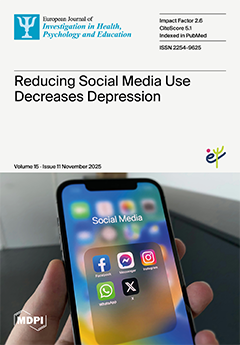
Cover Story (view full-size image): Experimental interventions have been used to evaluate whether reducing or eliminating social media use decreases depression. This meta-analysis synthesised the results of 10 randomized controlled trials (total number of participants = 1491) to assess the effect of limiting or refraining from social media use on the severity of depressive symptoms. The results indicate that reducing social media use significantly decreases depressive symptoms. Although interventions aimed at reducing use of social media had twice the depression-reduction effect of interventions aimed at abstinence from social media, the difference was not statistically significant. Overall, the results of this meta-analysis suggest that limiting social media use is an effective way to reduce symptoms of depression. View this paper
  • Issues are regarded as officially published after their release is announced to the table of contents alert mailing list.
  • You may sign up for e-mail alerts to receive table of contents of newly released issues.
  • PDF is the official format for papers published in both, html and pdf forms. To view the papers in pdf format, click on the "PDF Full-text" link, and use the free Adobe Reader to open them.
Order results
Result details
Select all
Export citation of selected articles as:
21 pages, 739 KB  
Article
Future Time Perspective and Locomotion Jointly Predict Anticipatory Pleasure in Adolescence: An Integrative Hierarchical Model
by Stefania Mancone, Alessandra Zanon, Adele Gentile, Giulio Marotta, Francesco Di Siena, Lavinia Falese and Pierluigi Diotaiuti
Eur. J. Investig. Health Psychol. Educ. 2025, 15(11), 238; https://doi.org/10.3390/ejihpe15110238 - 19 Nov 2025
Viewed by 414
Abstract
Objectives: Grounded in Zimbardo’s Time Perspective theory and Regulatory Mode theory, together with developmental accounts of adolescent prospection and value-based choice, this study tests a unified model in which Locomotion (primary) and Future time perspective (secondary) jointly predict Anticipatory Pleasure in adolescence, while [...] Read more.
Objectives: Grounded in Zimbardo’s Time Perspective theory and Regulatory Mode theory, together with developmental accounts of adolescent prospection and value-based choice, this study tests a unified model in which Locomotion (primary) and Future time perspective (secondary) jointly predict Anticipatory Pleasure in adolescence, while considering Assessment, gender, age, and sensation seeking. The goal is to understand how adolescents’ temporal orientation and self-regulation contribute to their motivational and hedonic functioning. Methods: A total of 1540 adolescents (aged 14–19 years) completed validated self-report measures assessing time perspective, regulatory mode (assessment and locomotion), anticipatory and consummatory pleasure, and sensation seeking. Gender differences were examined with independent-samples t-tests, while associations among variables were tested using Pearson correlations and hierarchical regression analyses. Results: Female adolescents reported significantly higher levels of future orientation and anticipatory pleasure, while males showed greater sensation seeking. Future time perspective and locomotion were positively correlated with anticipatory pleasure. In the regression analysis, locomotion emerged as the strongest predictor of anticipatory pleasure, followed by future orientation. Sensation seeking was not a significant predictor. Conclusions: The findings underscore the importance of future-oriented thinking and action-driven self-regulation in sustaining adolescents’ capacity to anticipate and derive motivation from future experiences. Gender-based motivational pathways are also highlighted, suggesting the need for differentiated developmental interventions. The study provides new insights into the interplay between time-based cognition and motivational dynamics during adolescence. Full article
(This article belongs to the Collection Variables Related to Well-Being in Adolescence)
Show Figures

Figure 1

17 pages, 294 KB  
Article
A Relational Turbulence Theory Perspective on Interpersonal Conflict During the Transition to Parenthood
by Roi Estlein, Jennifer A. Theiss, Kirsten M. Weber and Hannah E. Jones
Eur. J. Investig. Health Psychol. Educ. 2025, 15(11), 237; https://doi.org/10.3390/ejihpe15110237 - 18 Nov 2025
Viewed by 402
Abstract
This study applied relational turbulence theory to examine how relationship characteristics in the form of relational uncertainty and partner interdependence during the transition to parenthood are associated with more severe appraisals of irritations, features of communication during couple conflict, and perceptions of increased [...] Read more.
This study applied relational turbulence theory to examine how relationship characteristics in the form of relational uncertainty and partner interdependence during the transition to parenthood are associated with more severe appraisals of irritations, features of communication during couple conflict, and perceptions of increased turbulence in the relationship. We conducted a longitudinal study of 78 couples who were surveyed three times during the transition to parenthood from pregnancy to six months after birth. Data were analyzed using multilevel modeling and examined both actor and partner effects. Results point to between-person and within-person actor effects, with actors’ relational uncertainty and facets of interdependence predicting perceived severity of irritations and features of conflict episodes. In addition, actors’ severity of irritations predicted conflict features and perceived relational turbulence. Partner effects emerged for relational uncertainty predicting communicative openness, conflict management, and relational turbulence, and facets of interdependence predicting most outcomes. The results are discussed in terms of their theoretical contributions and practical implications for first-time parents. Full article
17 pages, 353 KB  
Article
Exploring Psychological Factors and Metacognitive Beliefs in Cardiac Rehabilitation: A Single-Group Pre–Post Study
by Giada Pietrabissa, Giada Rapelli, Denise Bruno, Clarissa Volpi, Lia Crotti and Gianluca Castelnuovo
Eur. J. Investig. Health Psychol. Educ. 2025, 15(11), 236; https://doi.org/10.3390/ejihpe15110236 - 18 Nov 2025
Viewed by 251
Abstract
Background: Psychosocial and metacognitive factors play a critical role in cardiovascular health, influencing clinical outcomes and adherence to treatment after Cardiac Rehabilitation (CR). This study investigated the effects of an outpatient CR program on anxiety, depression, and Health-Related Quality of Life (HRQoL) in [...] Read more.
Background: Psychosocial and metacognitive factors play a critical role in cardiovascular health, influencing clinical outcomes and adherence to treatment after Cardiac Rehabilitation (CR). This study investigated the effects of an outpatient CR program on anxiety, depression, and Health-Related Quality of Life (HRQoL) in patients with established Cardiovascular Disease (CVD). Furthermore, it examined the contribution of depressive symptoms, anxiety, and dysfunctional metacognitions to patients’ perceived HRQoL. Methods: Data on demographic, psychological, and biomedical variables were obtained from 89 patients with CVD at baseline and upon completion of the CR program. Results: Participation in CR was associated with significant reductions in depressive symptoms and improvements in perceived HRQoL. Importantly, reductions in dysfunctional metacognitive beliefs emerged as the strongest predictor of post-intervention HRQoL, outweighing the predictive contribution of changes in depression and anxiety. Discussion: The results highlight the close interrelationship between psychological distress and maladaptive metacognitions, both of which are strongly associated with patients’ perceived HRQoL during CR. Conclusions: Addressing maladaptive metacognitive processes may represent a promising therapeutic target to optimize psychological adjustment and improve HRQoL in individuals undergoing CR. Full article
15 pages, 1011 KB  
Article
Psychometric Network Model Recovery: The Effect of Sample Size, Number of Items, and Number of Nodes
by Marcelo Ávalos-Tejeda and Carlos Calderón
Eur. J. Investig. Health Psychol. Educ. 2025, 15(11), 235; https://doi.org/10.3390/ejihpe15110235 - 18 Nov 2025
Viewed by 473
Abstract
In recent years, network psychometrics has emerged as an alternative to the reflective latent variable model. This model conceptualizes traits as complex systems of behaviors mutually interacting with each other. Although this model offers important advantages compared to the reflective model, questions remain [...] Read more.
In recent years, network psychometrics has emerged as an alternative to the reflective latent variable model. This model conceptualizes traits as complex systems of behaviors mutually interacting with each other. Although this model offers important advantages compared to the reflective model, questions remain regarding the necessary sample size and the influence of factors such as the number of nodes and edges. This study aims to evaluate the psychometric network model performance under different conditions of sample size, number of nodes, and number of edges. The methodology involved a simulation with 1000 replicates for each combination of sample size, number of nodes, and the value of gamma parameter, which is used to determine the magnitude of the edges considered significant. The effect of these conditions on the accuracy of edge estimations and centrality indices (strength and expected influence) was assessed using sensitivity, specificity, and bias indicators. Results suggest that sample size and network complexity have a more significant impact than γ, methodological guidelines being proposed to support decision-making in applied research. In summary, this study provides empirically grounded recommendations that can guide applied researchers in designing robust psychometric network analyses and ensuring reliable estimation of model parameters. Full article
Show Figures

Figure 1

13 pages, 496 KB  
Article
Understanding Well-Being in the Classroom: A Study on Italian Primary School Teachers Using the JD-R Model
by Maria Francesca Trocino, Giovanni Schettino and Vincenza Capone
Eur. J. Investig. Health Psychol. Educ. 2025, 15(11), 234; https://doi.org/10.3390/ejihpe15110234 - 15 Nov 2025
Viewed by 325
Abstract
Teaching has always been recognized as one of the professions with the highest risk of burnout, thus highlighting the need to take into account how organizations could promote a “healthier” work life. Accordingly, literature has gone beyond the conceptualization of well-being as merely [...] Read more.
Teaching has always been recognized as one of the professions with the highest risk of burnout, thus highlighting the need to take into account how organizations could promote a “healthier” work life. Accordingly, literature has gone beyond the conceptualization of well-being as merely the “absence of illness” to concluding that it must be regarded as a state of complete health. The current study adopts this theoretical approach to address the limited literature on factors affecting the well-being of Italian primary school teachers. Specifically, responses to a self-report questionnaire completed by 142 Italian primary school teachers showed that work self-efficacy was positively associated with job satisfaction, which in turn was positively related to well-being. Consequently, job satisfaction fully mediated the relationship between self-efficacy and well-being. Furthermore, both work overload and work autonomy were found to be negatively associated with teacher well-being. These findings can inform the design of targeted interventions aimed at enhancing the performance and psychological health of primary school teachers by managing demands and fostering effective resources. Full article
Show Figures

Figure 1

14 pages, 781 KB  
Article
Digital Play Addiction Tendency and Aggressive Behaviors Among Turkish Preschoolers: Evidence from Parent Reports
by Selahattin Semiz, Yüksel Büşra Yüksel Aykanat, Büşra Somuncu Çoksağır, Amira Mohammed Ali, Carlos Laranjeira and Murat Yıldırım
Eur. J. Investig. Health Psychol. Educ. 2025, 15(11), 233; https://doi.org/10.3390/ejihpe15110233 - 14 Nov 2025
Viewed by 468
Abstract
The escalating exposure of young children to digital gaming necessitates a critical examination of its behavioral impacts. However, evidence regarding its influence on aggressive behavior remains limited. This study investigated the relationship between digital play addiction tendency and our dimensions of aggression: physical [...] Read more.
The escalating exposure of young children to digital gaming necessitates a critical examination of its behavioral impacts. However, evidence regarding its influence on aggressive behavior remains limited. This study investigated the relationship between digital play addiction tendency and our dimensions of aggression: physical aggression, relational aggression, self-directed aggression, and aggression against objects. This study employed a cross-sectional design, gathering data through parent assessments. The sample consisted of 744 children aged 4 to 6 years. The average age of the participants was 33.5, with 82% of the sample being female. The participants came from a lower (27%), middle (37%), and high (36%) socioeconomic background. The data were analyzed using a Structural Equation Modeling (SEM) approach to test the hypothesized relationships. The main findings from the SEM analysis indicated that a higher digital play addiction tendency was a significant positive predictor of all four dimensions of aggression. These results highlight the potential adverse effects of digital play addiction tendency on the development of maladaptive behaviors in early childhood. This study underscores the urgent need to develop strategies that foster healthier digital media consumption and mitigate the adverse effects of digital gaming on children’s developmental outcomes. Full article
Show Figures

Figure 1

15 pages, 566 KB  
Article
Mental Health in the Shadow of Conflict: Psychological Profiles and Pathways to Suicidal Ideation in Conflict-Affected Students
by Sami Hamdan and Eyad Hallaq
Eur. J. Investig. Health Psychol. Educ. 2025, 15(11), 232; https://doi.org/10.3390/ejihpe15110232 - 13 Nov 2025
Viewed by 639
Abstract
Objective: This study aimed to identify psychological characteristics associated with suicidal ideation among Palestinian university students in the West Bank during a period of escalating regional violence (October 2023), with data collected prior to the end of the war, a period marked by [...] Read more.
Objective: This study aimed to identify psychological characteristics associated with suicidal ideation among Palestinian university students in the West Bank during a period of escalating regional violence (October 2023), with data collected prior to the end of the war, a period marked by intensified political violence and collective trauma. The goal was to identify empirically derived psychological profiles of distress and coping using Latent Profile Analysis. Method: A cross-sectional survey of 900 students assessed depression, anxiety, self-efficacy, resilience, help-seeking attitudes, and suicidal ideation during the past 12 months. Latent Profile Analysis (LPA), logistic regression, and moderated mediation analysis were employed to investigate the relationships between distress, self-efficacy, resilience, and suicidal ideation. Results: Results indicate that depression and anxiety are associated with increased 12-month suicidal ideation, but greater self-efficacy appears to reduce this risk. The mediation analysis revealed that self-efficacy partially explains the relationship between distress and suicidal ideation; however, resilience did not have a significant moderating effect. The LPA identified three distinct psychological profiles, with the highest-risk group exhibiting significant distress and low self-efficacy. Conclusions: These results highlight the significant mental health burden faced by Palestinian youth and underscore the importance of internal psychological resources, particularly self-efficacy, that are associated with lower levels of suicidal ideation. Enhancing self-efficacy may offer a culturally relevant approach for prevention efforts in politically unstable environments. Full article
Show Figures

Figure 1

22 pages, 1186 KB  
Review
Anxiety, Academic Performance, and Physical Activity in University Students: A Scoping Review
by Israel Vinueza-Fernández, Wilmer Esparza, Alexandra Martín-Rodríguez and Evelyn Sánchez-Cajas
Eur. J. Investig. Health Psychol. Educ. 2025, 15(11), 231; https://doi.org/10.3390/ejihpe15110231 - 13 Nov 2025
Viewed by 1294
Abstract
Anxiety disorders affect over 280 million people globally and are associated with cognitive impairment. University students show a particularly high susceptibility, with studies reporting prevalent daily anxiety in this population. Physical activity (PA) has demonstrated efficacy in reducing stress and anxiety, potentially enhancing [...] Read more.
Anxiety disorders affect over 280 million people globally and are associated with cognitive impairment. University students show a particularly high susceptibility, with studies reporting prevalent daily anxiety in this population. Physical activity (PA) has demonstrated efficacy in reducing stress and anxiety, potentially enhancing cognitive function. This scoping review examines existing evidence on the relationship between PA, anxiety symptoms, and academic performance in university students while identifying research gaps. Following PRISMA-ScR guidelines and Arksey and O’Malley’s framework, we analyzed observational and experimental studies from PubMed, Cochrane, Web of Science, and Scopus. A descriptive–analytical approach assessed the effects of exercise on anxiety and academic outcomes. Out of 362 records screened, 27 met the inclusion criteria. Evidence suggests PA interventions across intensity levels may alleviate anxiety symptoms and improve academic performance. However, experimental studies specifically targeting this population remain scarce. Current findings indicate PA interventions may reduce anxiety and potentially enhance academic performance in university students. Further experimental research is required to establish causality and elucidate underlying mechanisms. Full article
Show Figures

Figure 1

17 pages, 635 KB  
Article
Spanish Adaptation and Validation of the General Attitudes Towards Artificial Intelligence Scale (GAAIS)
by Zeinab Arees, Sergio Guntín, Francisca Fariña and Mercedes Novo
Eur. J. Investig. Health Psychol. Educ. 2025, 15(11), 230; https://doi.org/10.3390/ejihpe15110230 - 11 Nov 2025
Viewed by 834
Abstract
Artificial intelligence (AI) is generating a profound and quick transformation in several areas of knowledge, as well as in industry and society on a global scale, and is considered one of the most significant technological advances of the present era. Understanding citizens’ attitudes [...] Read more.
Artificial intelligence (AI) is generating a profound and quick transformation in several areas of knowledge, as well as in industry and society on a global scale, and is considered one of the most significant technological advances of the present era. Understanding citizens’ attitudes toward AI is essential forguiding its development and implementation. To achieve this, valid and reliable instruments are needed to assess attitudesin different sociocultural contexts. With this objective, the General Attitudes towards Artificial Intelligence Scale (GAAIS) was adapted to Spanish. The sample comprised 644 participants: 327 men and 316 women, aged between 18 and 78 years (M = 33.06, SD = 14.91). The original two-factor structure (Positive GAAIS and Negative GAAIS) was validated using Confirmatory Factor Analysis (CFA). Both the fit indices and the internal consistency of the scale were adequate. Furthermore, the validity of the measure (i.e., convergent and discriminant) and the invariance of the model were confirmed. The analyses performed support the adequacy of the model and, therefore, the usefulness of the instrument, considering the ambivalence that people often experience regarding AI. The limitations of the study and the implications for the design of public policies and intervention strategies that promote the ethical, equitable, and socially responsible use of AI are discussed in this study. Full article
(This article belongs to the Special Issue Mind–Technology Interaction in the New Digital Era)
Show Figures

Figure 1

17 pages, 485 KB  
Article
Sleep Disturbance as a Mediator Between Problematic Social Media Use and Depressive Symptoms Among Mexican Undergraduate Nursing Students: A Multicenter Study
by José Ángel Hernández-Mariano, Ana Cristina Castañeda-Márquez, Gledy Manuela Olmos-Rivera, Rocío Castillo-Díaz, Fani Villa-Rivas, Edith Araceli Cano-Estrada, Yaneth Citlalli Orbe-Orihuela, Miguel Trujillo-Martínez and Monica Alethia Cureño-Díaz
Eur. J. Investig. Health Psychol. Educ. 2025, 15(11), 229; https://doi.org/10.3390/ejihpe15110229 - 11 Nov 2025
Viewed by 953
Abstract
Background: Social media addiction is a growing concern among undergraduates, with nursing students particularly vulnerable as their stressful academic and clinical context may promote excessive use, impaired sleep, and higher depression risk. Therefore, we aimed to evaluate whether sleep disturbance mediates the association [...] Read more.
Background: Social media addiction is a growing concern among undergraduates, with nursing students particularly vulnerable as their stressful academic and clinical context may promote excessive use, impaired sleep, and higher depression risk. Therefore, we aimed to evaluate whether sleep disturbance mediates the association between problematic social media use and symptoms of depression among nursing students in Mexico. Methods: We conducted a multicenter, cross-sectional, analytical study using a random sample of 638 nursing students from three Mexican public universities. Between August and December 2024, participants completed validated scales for social media addiction, sleep quality, and depression. Counterfactual causal mediation analysis was performed using logistic regression with robust errors. Results: Sleep disturbance affected 51.7% of students, and 27.5% reported depression. Social media addiction showed a dose–response association with both outcomes. Mediation analysis revealed a total effect on depression (OR = 2.19; 95% CI = 1.45–3.30) and an indirect effect via sleep disturbance (OR = 1.22; 95% CI = 1.01–1.38), explaining 31.4% of the effect. Conclusions: Sleep disturbance partially mediates this association. Interventions addressing digital behavior and sleep hygiene may improve mental health in nursing students. Full article
(This article belongs to the Special Issue The Impact of Social Media on Public Health and Education)
Show Figures

Figure 1

17 pages, 629 KB  
Article
Attitudes, Roles, and Competencies of Clinical Psychologists Regarding Euthanasia Due to Unbearable Mental Suffering
by Dennis Demedts, Wouter Drijkoningen and Johan Bilsen
Eur. J. Investig. Health Psychol. Educ. 2025, 15(11), 228; https://doi.org/10.3390/ejihpe15110228 - 5 Nov 2025
Viewed by 644
Abstract
Since the enactment of Belgium’s euthanasia law in 2002, clinical psychologists have played an increasingly significant role in the multidisciplinary approach to euthanasia, particularly regarding cases involving unbearable mental suffering (UMS euthanasia). This cross-sectional study examined the attitudes, roles, and competencies of clinical [...] Read more.
Since the enactment of Belgium’s euthanasia law in 2002, clinical psychologists have played an increasingly significant role in the multidisciplinary approach to euthanasia, particularly regarding cases involving unbearable mental suffering (UMS euthanasia). This cross-sectional study examined the attitudes, roles, and competencies of clinical psychologists in Flanders concerning UMS euthanasia using an online questionnaire (n = 242). The survey explored attitudes towards UMS euthanasia, as well as self-perceived competencies and involvement. Results indicate that most psychologists hold a generally positive stance towards UMS euthanasia and believe in supporting patient requests under appropriate conditions. Their roles are seen as essential in decision-making, exploring alternatives, and providing aftercare for families, though opinions vary about their involvement during the actual procedure. Demographic factors such as age, gender, work setting, and prior involvement in euthanasia showed no significant influence on attitudes; however, greater knowledge and skills were reported among those in specialized settings, palliative care, or with prior euthanasia involvement. A pronounced lack of training and education in this area was reported, highlighting the need for targeted measures. The findings underscore the necessity of clarifying psychologists’ roles, expanding legal guidelines, and improving training to enhance care quality in the context of UMS euthanasia. Full article
Show Figures

Figure 1

14 pages, 478 KB  
Article
Protective or Pressuring? Multi-Group Structural Path Analysis of Family–School Support and Mental Health Among Postgraduates
by Ying Zhou, Jinbo Hou, Chenling Liu, Chunyan Zhou, Jingjing Song and Lin Li
Eur. J. Investig. Health Psychol. Educ. 2025, 15(11), 227; https://doi.org/10.3390/ejihpe15110227 - 5 Nov 2025
Viewed by 555
Abstract
(1) Background: With the continuous expansion of graduate education, the mental health of postgraduates has become a growing concern for both academia and society. Understanding how family and institutional resources influence psychological outcomes is critical for developing effective support strategies; (2) Methods: A [...] Read more.
(1) Background: With the continuous expansion of graduate education, the mental health of postgraduates has become a growing concern for both academia and society. Understanding how family and institutional resources influence psychological outcomes is critical for developing effective support strategies; (2) Methods: A cross-sectional survey was conducted among 3998 postgraduate students across China, including 3393 master’s students (51.78% female, M = 24.21, SD = 1.521) and 605 doctoral students (37.19% female, M = 27.77, SD = 2.841). Multi-group structural equation modeling was employed to examine how family functioning and supervisor–postgraduate relationships influenced mental health, research self-efficacy, and suicidal tendencies; (3) Results: The findings showed that although most structural relationships were consistent across groups, two critical pathways were nonsignificant at the doctoral stage, providing evidence of partial structural invariance; (4) Conclusions: The study suggests that while family and school support generally play a protective role, their influence varies across educational stages. Tailoring psychological interventions to the distinct needs of master’s and doctoral students is essential, offering both theoretical insights into the dual role of contextual resources and practical guidance for targeted mental health support in graduate education. Full article
Show Figures

Figure 1

27 pages, 1889 KB  
Systematic Review
Clinical Effectiveness of Treatments for Mild Cognitive Impairment in Adults: A Systematic Review
by Daniel Cepeda-Pineda, Gabriela Sequeda, Sandra-Milena Carrillo-Sierra, Kevin Silvera-Cruz, Johanna Redondo-Chamorro, Astrid Rozo-Sánchez, Valmore Bermúdez, Julio César Contreras-Velásquez, Yulineth Gómez-Charris and Diego Rivera-Porras
Eur. J. Investig. Health Psychol. Educ. 2025, 15(11), 226; https://doi.org/10.3390/ejihpe15110226 - 3 Nov 2025
Viewed by 1088
Abstract
Background/Objectives: Mild cognitive impairment (MCI) represents an intermediate stage between normal ageing and dementia, with a high annual progression rate. Despite its clinical relevance, no pharmacological treatment has been definitively approved for this condition; however, multiple pharmacological and non-pharmacological strategies have been [...] Read more.
Background/Objectives: Mild cognitive impairment (MCI) represents an intermediate stage between normal ageing and dementia, with a high annual progression rate. Despite its clinical relevance, no pharmacological treatment has been definitively approved for this condition; however, multiple pharmacological and non-pharmacological strategies have been investigated for their potential benefits. This systematic review assessed the effectiveness of both types of interventions in adults with MCI, aiming to identify effective strategies to preserve cognitive function. Methods: A systematic search (2017–2025) was conducted in PubMed, Scopus, ScienceDirect, SpringerLink, and WOS, following PRISMA guidelines. Randomised controlled trials and quasi-experimental studies involving adults aged ≥ 50 years with a diagnosis of MCI were included. Outcomes were evaluated in terms of cognitive, functional, behavioural, and quality-of-life improvements. Risk of bias was assessed using the RoB 2 and ROBINS-I tools. Results: Of 108,700 records screened, 40 studies were included. Non-pharmacological interventions, such as cognitive training (conventional, computerised, or virtual reality-based), consistently improved memory, attention, and executive functions (e.g., MoCA: +3.84 points; p < 0.001). Transcranial magnetic stimulation combined with physical exercise also demonstrated significant benefits (p = 0.025). Among pharmacological treatments, only vortioxetine and choline alfoscerate showed modest improvements; cholinesterase inhibitors had limited effects and frequent adverse events. Complementary therapies (yoga, probiotics, and acupuncture) yielded promising outcomes but require further validation. Conclusions: Non-pharmacological strategies, particularly cognitive training and physical exercise, emerge as the most effective and safe approaches for managing MCI. The inclusion of pharmacological interventions with preliminary evidence of benefit should be considered within a personalised, multimodal approach, while recognising the current absence of approved drug treatments for MCI. Further research is needed in underrepresented populations, such as those in Latin America. Full article
Show Figures

Figure 1

18 pages, 1057 KB  
Article
Network Structure of Post-Traumatic Stress and Social/Emotional/Behavioral Difficulties in a Post-Earthquake Child and Adolescent Sample
by Alberto Misitano, Febe Geddo, Annalisa Oppo, Alice Barbieri, Elena Righi, Ernesto Caffo and Barbara Forresi
Eur. J. Investig. Health Psychol. Educ. 2025, 15(11), 225; https://doi.org/10.3390/ejihpe15110225 - 31 Oct 2025
Viewed by 697
Abstract
Following natural disasters, children and adolescents are particularly vulnerable to the onset and persistence of post-traumatic stress symptoms, which can significantly affect developmental trajectories and mental health. Although PTSD networks have been extensively studied in adults, less is known about youth, and no [...] Read more.
Following natural disasters, children and adolescents are particularly vulnerable to the onset and persistence of post-traumatic stress symptoms, which can significantly affect developmental trajectories and mental health. Although PTSD networks have been extensively studied in adults, less is known about youth, and no previous studies have examined how PTSD clusters relate to social, emotional, and behavioral difficulties (SEBD). This study applied network analysis to examine how PTSD clusters relate to psychosocial problems in a large sample of trauma-exposed youth. A total of 635 Italian children and adolescents (Mage = 11.19 years, SD = 1.43; 51.5% male), exposed to the 2012 Emilia-Romagna earthquake, completed the UCLA PTSD-RI and the Strengths and Difficulties Questionnaire. Network estimation and centrality indices were computed for the overall sample. Network Comparison Tests assessed differences by gender, age group, and proximity to the epicenter. Emotional problems and Increased Arousal emerged as the most central nodes, whereas Peer Problems were consistently peripheral. Gender differences were significant, whereas no differences were detected by age; moreover, youth living closer to the epicenter exhibited a more densely connected network. Despite its limitations, the study identifies co-occurrence patterns between PTSD clusters and specific SEBD, outlining clinical implications that warrant further investigation. Full article
Show Figures

Figure 1

15 pages, 1280 KB  
Article
Public Transportation Use, Sexual Harassment, and Mental Health in Adults from the General Population: A Bayesian Network Analysis
by Jonatan Baños-Chaparro, Diego Valencia-Pecho, Tomás Caycho-Rodríguez, Esteban Sarmiento-Suarez, Dulce Bernabel-Tarazona, Gabriela Rivera-Álvarez and Julio Torales
Eur. J. Investig. Health Psychol. Educ. 2025, 15(11), 224; https://doi.org/10.3390/ejihpe15110224 - 29 Oct 2025
Viewed by 1091
Abstract
Background: Public transportation is one of the primary modes of mobility in urban environments, but it has also become a setting where sexual harassment frequently occurs. This situation not only compromises users’ safety but also has a significant impact on mental health. [...] Read more.
Background: Public transportation is one of the primary modes of mobility in urban environments, but it has also become a setting where sexual harassment frequently occurs. This situation not only compromises users’ safety but also has a significant impact on mental health. The objective of the study is to analyze the relationship between public transportation use, sexual harassment, and mental health through directed and undirected network analyses. Methods: This was an associative, basic, quantitative, and cross-sectional study. A total of 507 Peruvian adults (66.7% women) participated by completing a sociodemographic questionnaire and using psychological instruments. A Gaussian graphical model and a directed acyclic graph were used to estimate the networks, including assessments of precision and stability. Results: Results indicated that in the undirected network, public transportation use was associated with sexual harassment and anger. The central symptoms were generalized anxiety and depression. In the directed network, public transportation use influenced both sexual harassment and generalized anxiety. Furthermore, distress and sexual harassment emerged as conditionally dependent on multiple psychological factors. Conclusions: The findings suggest that implementing preventive and psychosocial intervention strategies in the context of public transportation may reduce experiences of sexual harassment and the manifestation of other mental health problems among adults in the general population, thereby promoting safer and healthier public environments. Full article
Show Figures

Figure 1

20 pages, 752 KB  
Article
SERES: La Paz Empieza en Casa—Evaluation of an Intervention Program to Reduce Corporal Punishment and Parenting Stress, and to Enhance Positive Parenting Among Colombian Parents
by Angela Trujillo, Martha Rocío González and José David Amorocho
Eur. J. Investig. Health Psychol. Educ. 2025, 15(11), 223; https://doi.org/10.3390/ejihpe15110223 - 29 Oct 2025
Viewed by 498
Abstract
Background: Corporal punishment (CP) remains a common disciplinary practice in many countries, despite evidence of its negative consequences for children’s development. Objective: This study examined the effectiveness of a culturally adapted intervention aimed at reducing parents’ use of CP. Method: Using a 12-month [...] Read more.
Background: Corporal punishment (CP) remains a common disciplinary practice in many countries, despite evidence of its negative consequences for children’s development. Objective: This study examined the effectiveness of a culturally adapted intervention aimed at reducing parents’ use of CP. Method: Using a 12-month quasi-experimental longitudinal design, the study included an intervention group (n = 21) and a control group (n = 17). We administered standardized instruments at pretest and posttest to assess changes in parenting behavior, emotional regulation, and perceptions of child behavior. Artificial neural networks (ANNs) were used to model nonlinear relationships and classify group membership. Results: The intervention group showed significant improvements in parenting practices and emotion regulation. The ANN model classified participants with 74.6% accuracy. Key predictive variables included emotional suppression, physical punishment, and parental support and acceptance. Conclusions: These findings provide evidence for the effectiveness of the SERES program in reducing harmful parenting behaviors and promoting positive practices. Additionally, the use of AI models proved to be valuable for understanding complex behavioral changes, offering a promising approach for optimizing future interventions aimed at strengthening parenting and preventing family violence. Full article
Show Figures

Figure 1

16 pages, 2065 KB  
Review
Reducing Social Media Use Decreases Depression Symptoms: A Meta-Analysis of Randomised Controlled Trials
by Willem May, John M. Malouff and Jai Meynadier
Eur. J. Investig. Health Psychol. Educ. 2025, 15(11), 222; https://doi.org/10.3390/ejihpe15110222 - 27 Oct 2025
Viewed by 3623
Abstract
The association between social media use and depression found in correlational research has prompted widespread concern regarding the consequences of social media use. In response to this evidence, experimental interventions have been used to evaluate whether lowering social media use affects depression. This [...] Read more.
The association between social media use and depression found in correlational research has prompted widespread concern regarding the consequences of social media use. In response to this evidence, experimental interventions have been used to evaluate whether lowering social media use affects depression. This meta-analysis synthesised results of 10 randomized controlled trials (N = 1491) to assess the effect of limiting or refraining from social media use on severity of depressive symptoms. Studies were included if they were randomized control trials involving reducing or eliminating use of social media for a period of time. The results indicate that reducing social media use significantly decreases depressive symptoms, with an effect size of g = 0.25, 95% CI [0.10, 0.41], p < 0.001, after adjusting for publication bias. Significant heterogeneity was found between studies, with I2 indicating that 47% of the variability in effect sizes across studies was due to heterogeneity of true effect size rather than random error. Although interventions aimed at reducing use of social media had twice the depression effect size of interventions aimed at abstinence from social media, the difference was not significant. Two other potential moderators of effect size, intervention length and number of social networks included, were also nonsignificant. Overall, this meta-analysis suggests that limiting social media use is an effective way to reduce symptoms of depression. However, more studies with good research methods are needed to evaluate this conclusion. Also, further research is needed to evaluate long-term effects of limiting or refraining from social media use. Full article
Show Figures

Figure 1

19 pages, 627 KB  
Article
The Dual Impact of Smartphone App Usage Diversity on Quality of Life: The Moderating Roles of Age and Digital Literacy
by Chiho Ok
Eur. J. Investig. Health Psychol. Educ. 2025, 15(11), 221; https://doi.org/10.3390/ejihpe15110221 - 27 Oct 2025
Viewed by 648
Abstract
This study investigates how smartphone app usage diversity (SAUD)—defined as the breadth of applications individuals actively engage with—relates to quality of life, and how these effects are conditioned by age and digital literacy. Drawing on Uses and Gratifications Theory and Cognitive Load Theory, [...] Read more.
This study investigates how smartphone app usage diversity (SAUD)—defined as the breadth of applications individuals actively engage with—relates to quality of life, and how these effects are conditioned by age and digital literacy. Drawing on Uses and Gratifications Theory and Cognitive Load Theory, we conceptualize SAUD as having both beneficial and detrimental potential, depending on users’ cognitive and demographic characteristics. Using cross-sectional, self-reported data from the annual nationwide surveys on smartphone overdependence in South Korea, we analyzed a final sample of 20,967 adults (48.4% male, 51.6% female; M_age = 46.0, SD = 13.7; age range 20–69). Results demonstrate that SAUD is positively associated with quality of life among younger and digitally literate users, but negatively associated among older adults and those with lower digital literacy, suggesting the presence of conditional effects. The hypothesized three-way interaction between SAUD, age, and digital literacy was not supported. These findings extend the literature by moving beyond simplistic time-based metrics of smartphone use, offering a more differentiated understanding of mobile technology’s impact on well-being. Practically, the study highlights the need for tailored digital literacy programs and policy interventions that recognize demographic and cognitive diversity in technology engagement. Future research should incorporate longitudinal designs and objective behavioral data to further validate these insights. Full article
Show Figures

Figure 1

14 pages, 1473 KB  
Article
Spanish Translation and Psychometric Evidence of the Nightmare Disorder Index (NDI) in Adults from the General Population
by Jonatan Baños-Chaparro, Andrei Franco-Jimenez, Tomás Caycho-Rodríguez, Diego Valencia-Pecho, Esteban Sarmiento-Suarez, Dulce Bernabel-Tarazona and Gabriela Rivera-Álvarez
Eur. J. Investig. Health Psychol. Educ. 2025, 15(11), 220; https://doi.org/10.3390/ejihpe15110220 - 27 Oct 2025
Viewed by 505
Abstract
Background: Nightmares are a type of sleep disorder characterised by vivid and distressing dreams that cause abrupt awakenings, leading to significant discomfort. In adults, recurrent nightmares can negatively impact quality of life, daytime functioning, and overall mental health. In this context, it is [...] Read more.
Background: Nightmares are a type of sleep disorder characterised by vivid and distressing dreams that cause abrupt awakenings, leading to significant discomfort. In adults, recurrent nightmares can negatively impact quality of life, daytime functioning, and overall mental health. In this context, it is essential to have valid, reliable, and culturally appropriate psychological instruments that allow for an accurate assessment of this phenomenon. The aim of the present study was to translate and validate the Nightmare Disorder Index (NDI) into Spanish for use with Peruvian adults. Methods: A total of 507 adults (66.7% women) participated by completing a sociodemographic questionnaire and psychological instruments. Statistical analyses were conducted using structural equation modelling and item response theory. Results: The NDI demonstrated adequate content validity (V > 0.70), a unidimensional structure (CFI = 0.99, RMSEA = 0.06 [90% CI: 0.030, 0.102], SRMR = 0.03), and reliability (ω = 0.84, H = 0.94, rxx = 0.79). In addition, invariance was observed across sex, and significant associations were found with depressive symptoms, generalised anxiety, and suicidal ideation. Item 3 showed the highest discrimination and information, and the scale proved to be accurate at higher levels of nightmare severity. Conclusions: The NDI presents adequate psychometric properties for the inference and interpretation of scores in the assessment of nightmares. Its use is recommended in both professional practice and research with the adult general population. Full article
Show Figures

Figure 1

17 pages, 1222 KB  
Article
Key Competencies for Adolescent Well-Being: An Intervention Program in Secondary Education
by Pablo Molina Moreno, María del Mar Simón Márquez, María del Carmen Pérez-Fuentes and María del Mar Molero Jurado
Eur. J. Investig. Health Psychol. Educ. 2025, 15(11), 219; https://doi.org/10.3390/ejihpe15110219 - 25 Oct 2025
Viewed by 1234
Abstract
This study examines the effects of an intervention program aimed at enhancing personal competencies in secondary education students, focusing on resilience, emotional intelligence, self-esteem and assertiveness. A descriptive, quasi-experimental design with pre- and post-intervention assessments was employed. A total of 36 first-year secondary [...] Read more.
This study examines the effects of an intervention program aimed at enhancing personal competencies in secondary education students, focusing on resilience, emotional intelligence, self-esteem and assertiveness. A descriptive, quasi-experimental design with pre- and post-intervention assessments was employed. A total of 36 first-year secondary education students participated and completed the Resilience Scale, Wong-Law Emotional Intelligence Scale, Rosenberg Self-Esteem Scale and Rathus Assertiveness Scale. Positive associations were observed among resilience, emotional intelligence, self-esteem, and assertiveness at both time points, with the exception of a post-intervention negative correlation between self-esteem and the appraisal of others’ emotions. While emotion use increased significantly following the intervention, no significant changes were observed in the other variables, indicating a limited impact on these specific aspects of mental and emotional health. These findings highlight the relevance of training and promoting personal competencies in secondary school students, since they serve as protective factors against social exclusion, mood disorders (e.g., anxiety and depression), and behavioral problems. Although the program improved the use of emotions, its lack of significant effects in other domains highlights the need for more programs to support adolescents’ holistic development in the academic context. Full article
Show Figures

Figure 1

19 pages, 484 KB  
Article
Measuring Cyber Interpersonal Violence in Adolescents: Development and Validation of the CyIVIA Instrument
by Bárbara Machado, Isabel Araújo, Rui Ferreira Jesus, Estela Vilhena, Ricardo Castro, Paula Lobato de Faria and Sónia Caridade
Eur. J. Investig. Health Psychol. Educ. 2025, 15(11), 218; https://doi.org/10.3390/ejihpe15110218 - 25 Oct 2025
Viewed by 639
Abstract
Background: The growing prevalence of cyber interpersonal violence (CIV) among adolescents necessitates tools to assess its dimensions: victimization, perpetration, and bystander roles. This study develops and validates the “Cyber Interpersonal Violence Instrument for Adolescents” (CyIVIA). Method: CyIVIA’s development involved 253 adolescents, comprising 146 [...] Read more.
Background: The growing prevalence of cyber interpersonal violence (CIV) among adolescents necessitates tools to assess its dimensions: victimization, perpetration, and bystander roles. This study develops and validates the “Cyber Interpersonal Violence Instrument for Adolescents” (CyIVIA). Method: CyIVIA’s development involved 253 adolescents, comprising 146 boys and 107 girls, aged between 11 and 16 years, from northern Portugal. The 40-item Likert-scale tool assesses direct (victimization and perpetration) and indirect (bystander roles) CIV. Analyses included exploratory and confirmatory factor testing for reliability and validity. Results: CyIVIA demonstrated internal consistency (α = 0.743–0.851) and a robust multidimensional structure. 56.5% reported CIV involvement, with gender differences: girls showed higher victimization, and boys, higher perpetration. The 8th grade emerged as a key intervention period. Conclusions: CyIVIA is a reliable tool for assessing CIV among adolescents. Interventions should focus on prevention, empower active bystanders, and promote safer digital environments. Full article
(This article belongs to the Special Issue Risky Behaviors Among Youth: Assessment, Prevention, and Intervention)
Show Figures

Figure 1

Previous Issue
Next Issue
Back to TopTop