


Abstract
This study optimized the extraction, purification, and structural chemical characterization of polysaccharides from fruitless wolfberry bud tea (FWP), and evaluated their antioxidant activities against H2O2-induced oxidative damage in SH-SY5Y cells. Crude FWP was obtained by ultrasonic-assisted water extraction followed by ethanol precipitation. An orthogonal experiment was conducted to optimize decolorization using D301G macroporous resin, achieving a decolorization rate of 74%, a polysaccharide retention rate of 85%, and a protein removal rate of 61%. Two main purified polysaccharide fractions, FWP-1 (52.3 kDa) and FWP-2 (9.95 kDa), were isolated by DEAE-52 and Sephadex G-150 chromatography. Structural analysis revealed that FWP-1 was a neutral heteropolysaccharide rich in glucose and galactose, while FWP-2 was an acidic polysaccharide with a high content of galacturonic acid. In H2O2-induced SH-SY5Y cells, both polysaccharides significantly enhanced cell viability, increased superoxide dismutase (SOD), catalase (CAT), and glutathione (GSH) levels, reduced lactate dehydrogenase (LDH) leakage and malondialdehyde (MDA) content, scavenged excessive reactive oxygen species (ROS), and maintained mitochondrial membrane potential. FWP-2 exhibited stronger ROS-scavenging capacity than FWP-1. This study established reliable methods for the purification and characterization of FWP, and verified their potential as natural antioxidants against neuronal oxidative injury.
1. Introduction
With the enhancement of people’s health awareness, tea has become an integral part of daily life due to its abundant natural bioactive compounds and associated health benefits [1]. Tea contains a variety of bioactive components such as polyphenols, polysaccharides, caffeine, and theanine. Among them, tea polysaccharides represent crucial macromolecules composed of ten or more monosaccharide units linked by glycosidic bonds [2]. These polysaccharides have a wide range of pharmacological properties, such as antioxidant, antibacterial, hypoglycemic, and neuroprotective effects [2,3,4]. Recent studies have further confirmed that tea polysaccharides stabilize mast cells and alleviate inflammatory responses [4], as well as exhibit antioxidant and metabolic regulatory functions [3]. Notably, tea polysaccharides have been shown to protect neurons by regulating neurotransmitter levels and enhancing antioxidant defense systems, making them promising candidates for neurodegenerative disease intervention [5]. These findings underscore the potential of tea polysaccharides as promising candidates for functional foods and natural pharmaceuticals, highlighting the importance of further exploration into polysaccharides from underutilized tea varieties to expand their application scope.
Lycium barbarum L. (Solanaceae family), a traditional Chinese herbal medicine with a 2000-year history of medicinal use, has been extensively investigated for its bioactive components (e.g., carotenoids, flavonoids, polysaccharides) and health-promoting properties, including anti-aging, cytoprotection, oxidative stress alleviation, and neuroprotection [6,7]. A landmark collaborative study by Ningxia Wolfberry Industry Co., Ltd. (Yinchuan, China) and the U.S. Sunshine Biological Research Institute revealed that L. barbarum polysaccharides with molecular weights ranging from 1 to 100 kDa exhibit exceptional antioxidant activity and neuroprotective effects. To expand the L. barbarum industry, Fruitless Wolfberry (FW), a clonally propagated hybrid of wild Lycium species and Ningxia L. barbarum, has emerged as a novel economic crop in Ningxia, China. Distinct from fruiting L. barbarum, FW exhibits minimal flowering and no fruit set, leading to the accumulation of nutrients (e.g., polysaccharides, polyphenols) in its buds. Following the harvesting standard of “one terminal bud with two adjacent leaves”, these buds are processed into FW bud tea through sequential steps including sorting, cleaning, fixation, rolling, initial roasting, and stir-frying, and this product has shown promising biological potential. Previous studies indicated that water extracts of FW bud tea possess antioxidant, lipid metabolism-regulating, anti-aging, and hypoglycemic activities [6]. Our previous study demonstrated that FWE significantly inhibited Aβ fibrillation and disaggregated preformed Aβ fibrils, reduced Aβ oligomer levels and Aβ-induced neurotoxicity, and alleviated oxidative stress in vitro. Furthermore, oral administration of FWE effectively improved cognitive function, diminished Aβ burden, suppressed gliosis and inflammatory cytokine release, and ameliorated oxidative stress in the brains of APP/PS1 transgenic mice [8]. However, current research on FWPs has predominantly focused on crude extracts, and systematic studies on the purification, basic structural features and in vitro antioxidant and cytoprotective effects of purified FWPs remain limited.
In this study, the study aimed to systematically optimize the extraction, purification, and basic chemical characterization of polysaccharides from FW bud tea, and further evaluate their protective effects against H2O2-induced oxidative injury in SH-SY5Y cells. Crude FWPs were extracted using an ultrasonic-assisted water extraction and ethanol precipitation, and macroporous adsorbent resin was utilized to optimize the purification process of crude FWPs based on an orthogonal experiment. DEAE-52 cellulose and Sephadex G-150 chromatography were used to isolate two homogeneous fractions (FWP-1 and FWP-2), and their structural features were characterized, including molecular weights and monosaccharide compositions. Additionally, the antioxidant and cytoprotective activities of FWP-1 and FWP-2 were evaluated using an H2O2-induced SH-SY5Y cell oxidative damage model. Ultimately, this study aimed to provide a scientific basis for developing FWPs as natural neuroprotective agents and to lay the foundation for subsequent in vivo investigations into their efficacy against AD and structural modification strategies to enhance bioavailability.
2. Materials and Methods
2.1. Materials and Chemicals
Fruitless Wolfberry bud tea was obtained from Qiya Food Technology Co., Ltd. (Ningxia, China). Dextran was purchased from TCI (Shanghai) Development Co., Ltd. (Shanghai, China) Sixteen monosaccharide standards (rhamnose, fucose, arabinose, galactose, glucose, xylose, mannose, fructose, ribose, glucuronic acid, galacturonic acid, guluronic acid, mannuronic acid, galactosamine hydrochloride, glucosamine hydrochloride, and N-acetyl-D glucosamine) were provided by Borui Sugar Biotechnology Co., Ltd. (Yangzhou, China). Molecular weight standards were purchased from Sigma Chemical Co., Ltd. (Shanghai, China). DEAE cellulose (DE-52) was purchased from Solarbio technology Co., Ltd. (Beijing, China), and Sephadex G-150 was supplied by GE Healthcare Bio-Sciences AB (Uppsala, Sweden). Dialysis Membranes (3500 Da) were obtained from Biotopped Technology Co., Ltd. (Beijing, China), and macroporous resins (D301G, AB-8, X-5, D900, HPD600) were all purchased from Nankai University Chemical Plant (Tianjin, China). Total superoxide dismutase (SOD), malondialdehyde (MDA), total antioxidant capacity (T-AOC), total glutathione peroxidase (GSH-Px), and the BCA protein assay kit were purchased from Beyotime Biotechnology (Shanghai, China). Trifluoroacetic acid (TFA) and sodium acetate were supplied by Thermo Fisher Scientific Co. (Waltham, MA, USA). Anthrone and sulfuric acid (guaranteed reagent, GR) were offered by Sinopharm Chemical Reagent Co., Ltd. (Shanghai, China). Iodomethane and dimethyl sulfoxide were purchased from Adamas-beta Co., Ltd. (Shanghai, China). All other reagents used in the experiments were of analytical grade and obtained from local chemical suppliers in China.
2.2. Extraction of Crude Polysaccharide
FW bud tea was dried in an oven at 60 °C, then pulverized and sieved through a 40-mesh sieve before extraction. An accurately weighed powder was soaked in ultrapure water at a solid-to-liquid ratio of 1:30 (W/V) and incubated at 100 °C for 1 h. The mixture was subjected to ultrasonic-assisted extraction in an ultrasonic water bath (Shanghai Kedao Ultrasonic Instrument Co., Ltd., Shanghai, China) at 35 kHz. The extraction was performed at 65 °C for 60 min, with a total extraction time of 75 min.
After extraction, the mixture was filtered, and the insoluble residue was re-extracted under the same conditions. All filtrates were combined and concentrated using a rotary evaporator under reduced pressure at 45 °C. The concentrated extract was precipitated by adding a 4-fold volume of absolute ethanol, vigorously stirred, and then stored at 4 °C overnight. After centrifugation at 4000 rpm for 15 min, the resulting precipitate was collected and lyophilized to obtain the crude polysaccharide of FW bud tea (FWP).
2.3. Determination of Polysaccharide and Protein Contents
The polysaccharide content was determined by the anthrone-sulfuric acid method using dextran as the standard reference substance with minor modifications [9]. 1 mL of sample solution was added into a test tube, which was then placed in an ice bath. 2 mL of anthrone-sulfuric acid solution (2.0 mg/mL) was rapidly added, and the mixture was thoroughly vortexed and incubated in a boiling water bath for 10 min to initiate the reaction. After the reaction, the test tube was immediately transferred to an ice bath for 5 min to terminate the reaction. The absorbance of the resulting solution was measured at 625 nm using a UV-visible spectrophotometer (Hitachi Ltd., Tokyo, Japan), with 1 mL of ultrapure water as the blank. The protein content was quantified using the Bradford’s method with bovine serum albumin (BSA) as the standard, and absorbance was measured at 595 nm [10].
2.4. Decolorization and Deproteinization Experiments
2.4.1. Screening of Optimal Adsorbents by Static Adsorption Experiment
To evaluate the decolorization and deproteinization efficiency of different macroporous resins, 2.0 g of each pretreated resin (D301G, AB-8, X-5, D900, and HPD600) was separately added into 100 mL conical flasks. The FWP solution (2 mg/mL) was added to each flask to a total volume of 20 mL. The flasks were then placed in a 35 °C constant-temperature water bath shaker and continuously shaken at 200 rpm for 3 h [11]. After adsorption, the resins were separated from the sample solutions by filtration. The polysaccharide decolorization rate, polysaccharide retention rate, and protein removal rate were calculated using Equations (1), (2), and (3), respectively [12]. The optimal resin was preliminarily selected through a comprehensive comparison of these three indicators [11].
where A0 and A1 are the absorbance values of the sample solution at 420 nm before and after decolorization, respectively; M0 and M1 represent the total polysaccharide mass in the solution before and after decolorization, respectively; Y0 and Y1 are the total protein content in the FWP solution before and after decolorization, respectively.
2.4.2. Optimization of Adsorption Parameters
The key adsorption parameters of the selected optimal resin, including initial sample concentration, solid–liquid ratio, adsorption temperature, and adsorption time, were systematically optimized using a combination of single-factor experiments and orthogonal array design. All experiments were performed in triplicate.
2.5. Purification of FWP
The decolorized crude polysaccharide was dissolved in distilled water and filtered with a 0.45 μm membrane filter, and then fractionated by anion-exchange chromatography using a DEAE-52 cellulose column (2.6 cm × 40 cm). Elution was performed sequentially with ultrapure water and NaCl solution (0.1, 0.3, 0.5 mol/L) at a constant flow rate of 1.0 mL/min. Eluates were collected at 7 mL/tube with a fraction collector, and the absorbance at 625 nm was measured by the anthrone-sulfuric acid method to determine polysaccharide content. The eluted fractions containing the same component were collected. The major fractions were concentrated, dialyzed for 48 h, and lyophilized. These partially purified fractions were further purified by gel permeation chromatography on a Sephadex G-150 column (1.5 × 50.0 cm) using ultrapure water as the eluent at a flow rate of 0.5 mL/min. Eluates were continuously collected into 5 mL test tubes, and two major purified fractions (FWP-1 and FWP-2) were concentrated and lyophilized for subsequent analysis.
2.6. Structural Analysis
2.6.1. Determination of Polysaccharide Molecular Weight
The molecular weight distributions of FWP-1 and FWP-2 were analyzed using a Shimadzu LC-10A HPLC system (Shimadzu Corporation, Kyoto, Japan) equipped with a BRT 105-104-102 tandem gel column (300 mm × 8 mm) and an RI-10A refractive index detector (RID) [13]. The column temperature was set at 40 °C, the flow rate was set at 0.6 mL/min, and 0.2 mol/L NaCl solution was used as the mobile phase. 20 μL of sample solution was injected after being filtered through a 0.22 μm membrane filter. The calibration curve was plotted using various dextran standards with known molecular weights (5.2, 48, 148 and 410 kDa). The molecular weights (MW) of FWP-1 and FWP-2 were calculated based on this calibration curve.
2.6.2. Monosaccharide Composition Analysis
The monosaccharide composition was determined by high performance anion exchange chromatography equipped with a pulsed amperometric detector (HPAEC-PAD) [14]. Sixteen monosaccharide standards were used to determine the retention time for each monosaccharide. The monosaccharide composition of FWP-1 and FWP-2 was calculated based on the corresponding peak areas and response factors of the standard monosaccharides. Polysaccharide fractions FWP-1 and FWP-2 (5.0 mg each) were accurately weighed into ampoules, respectively. 2 mL of trifluoroacetic acid (TFA, 3 M) was added and hydrolyzed under nitrogen protection at 120 °C for 3 h. After hydrolysis, the hydrolysate was concentrated and dried under a stream of nitrogen to remove residual TFA, and then redissolved in deionized water. The resulting solution was filtered through a 0.22 μm membrane filter. Chromatographic separation was performed using a DIONEX-ICS-5000 system (Thermo Fisher Scientific, Waltham, MA, USA) equipped with a Dionex CarbopacTM PA20 column (3.0 mm × 150 mm) and a pulsed amperometric detector (PAD). The column temperature was maintained at 30 °C. The mobile phases consisted of ultrapure water (A) and a mixed solution (B) of 1.5 mM sodium hydroxide (NaOH) and 100 mM sodium acetate (NaOAC), with a constant flow rate of 0.3 mL/min.
2.6.3. UV-Visible Absorption Spectra Analysis
Polysaccharide samples (FWP-1 and FWP-2) were dissolved in distilled water to a final concentration of 0.3 mg/mL, respectively. Using ultrapure water as the blank control, UV-visible absorption spectra of the sample solutions were recorded over a wavelength range of 200–500 nm using a Hitachi UV-visible spectrophotometer (Hitachi Limited, Tokyo, Japan).
2.7. Protective Effect of FWP-1 and FWP-2 on SH-SY5Y Cells Against H2O2-Induced Oxidative Stress
2.7.1. Cell Culture
Human neuroblastoma SH-SY5Y cells were kindly gifted by Professor Liu Ruitian from the Institute of Engineering, Chinese Academy of Sciences. The cells were cultured in Dulbecco’s Modified Eagle Medium (DMEM) supplemented with 10% fetal bovine serum (FBS) and 1% penicillin-streptomycin solution (100 U/mL penicillin,100 μg/mL streptomycin). Cultivation was performed at 37 °C in a 5% CO2 humidified incubator. Cells in the logarithmic growth phase were selected for subsequent experiments.
2.7.2. Cell Viability Assay
Cell viability was evaluated using the Cell Counting Kit-8 (CCK-8) assay (GlpBio Technology, Wuhan, China). Briefly, SH-SY5Y cells were seeded into a 96-well culture plate and incubated for 24 h for adhesion. The intervention concentrations (10 and 100 μg/mL) of FWP-1 and FWP-2 were selected based on our pre-experimental concentration gradient screening (5, 10, 50, 100, 200, 300 μg/mL), which avoided obvious cytotoxicity and presented significant antioxidant effects.
The cells were pretreated with FWP-1 or FWP-2 at final concentrations of 10 and 100 μg/mL for 12 h, followed by exposure to 700 μM H2O2 for another 12 h to induce oxidative stress. 10 μL of CCK-8 reagent (10% of the total well volume) was added to each well, and the plate was incubated for 45 min at 37 °C. Cell viability was measured according to the CCK-8 kit instructions using a microplate reader. Cells without H2O2 exposure and sample treatment were used as the blank control group after treatment for 24 h, and the viability was defined as 100%.
2.7.3. Lactate Dehydrogenase (LDH) Assay
Logarithmically growing SH-SY5Y cells were seeded into 6-well plates and incubated until complete adherence. The cells were pretreated with FWP-1 or FWP-2 at final concentrations of 10 and 100 μg/mL for 12 h, followed by exposure to 700 μM H2O2 for another 12 h. After treatment, the activity of LDH released into the culture supernatant was measured strictly according to the manufacturer’s instructions for the LDH assay kit.
2.7.4. Determination of Oxidative Parameters and Enzyme Activities
The SH-SY5Y cells were seeded into 6-well plates and pretreated with FWP-1 and FWP-2 (10 and 100 μg/mL, final concentration) for 12 h, followed by co-incubation with 700 μM H2O2 for an additional 12 h. The cells were then collected and lysed using a cell lysis solution kit (Solarbio, Beijing, China). The activities of total superoxide dismutase (T-SOD) and catalase (CAT), as well as the levels of malondialdehyde (MDA) and glutathione (GSH), were quantified using commercial assay kits (Nanjing Jiancheng Biological Engineering Research Institute, Nanjing, China).
2.7.5. Measurement of Reactive Oxygen Species (ROS)
The ROS levels were detected using the 2′,7′-dichlorodihydrofluorescein diacetate (DCFH-DA) fluorescent probe method [15]. Briefly, SH-SY5Y cells were pretreated with FWP-1/FWP-2, and then exposed to H2O2. The culture medium was replaced with 100 μL of 10 μM DCFH-DA (diluted in serum-free DMEM), and the cells were incubated in the dark at 37 °C for 35 min. After incubation, the cells were washed twice with pre-warmed phosphate-buffered saline (PBS) to remove unbound probe. The fluorescence intensity was measured using a multi-function fluorescence microplate reader with an excitation wavelength of 488 nm and an emission wavelength of 525 nm.
2.7.6. Measurement of Mitochondrial Membrane Potential (MMP)
MMP was assessed using the JC-1 fluorescent probe. The culture medium was removed, and the cells were collected by trypsinization. The cells were resuspended in 1 mL of JC-1 staining working solution and incubated at 37 °C in the dark for 20 min. After incubation, the cells were centrifuged at 1000 rpm for 5 min, and the supernatant was discarded. The cells were washed twice with JC-1 staining buffer, and then resuspended gently in 1 mL of JC-1 staining buffer by pipetting. The cell concentration was adjusted, and the fluorescence intensity (red/green ratio) was detected using a CyFlow Counter flow cytometer (Sysmex, Kobe, Japan).
2.8. Statistical Analysis
All data are presented as mean ± standard deviation (SD). All experiments were performed in three independent replicates. Data were analyzed with SPSS 25.0 software. Prior to applying the one-way ANOVA with Tukey’s post hoc test for difference analysis, the normality of data distribution was verified using the Shapiro–Wilk test, and the homogeneity of variance was verified using Levene’s test. Graphs were generated using GraphPad Prism software (version 9.0, GraphPad Software Inc., San Diego, CA, USA). p < 0.05 was considered to indicate a statistically significant difference.
3. Results and Discussion
3.1. Determination of Polysaccharide and Protein Contents in FWP
Crude polysaccharides from fruitless Wolfberry bud tea (FWP) were extracted by ultrasonic-assisted water extraction followed by alcohol precipitation, and then lyophilized. The polysaccharide content was determined by the anthrone-sulfuric acid method [9]. A standard curve was plotted with dextran concentration as the abscissa and absorbance value at 625 nm as the ordinate, yielding a regression equation of y = 16.758x − 0.0015 with a coefficient of determination (R2) of 0.9982, indicating excellent linearity and high reliability of the quantification method. Based on the standard curve, the polysaccharide content in FWP was calculated as 18.4%, indicating that ultrasonic treatment effectively disrupted cell walls and promoted polysaccharide dissolution [16]. The protein content was determined by the Coomassie Brilliant Blue method. Using bovine serum albumin (BSA) as the standard, a standard curve was generated with the regression equation y = 1.5337x + 0.0051 (R2 = 0.9985). The protein content in FWP was determined to be 6.1%, exceeding the accepted threshold of <3% for purified plant polysaccharides in structural and functional research [17]. The result indicated that deproteinization using macroporous resins was required prior to further analysis.
3.2. Decolorization and Deproteinization of Crude Polysaccharide by Macroporous Adsorption Resin
3.2.1. Screening of Optimal Adsorption Resin
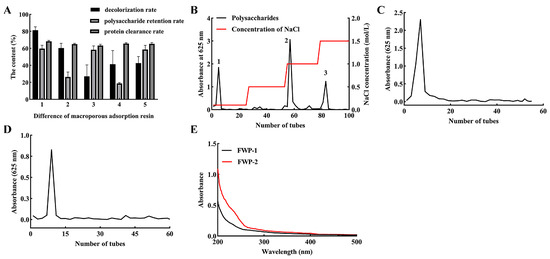
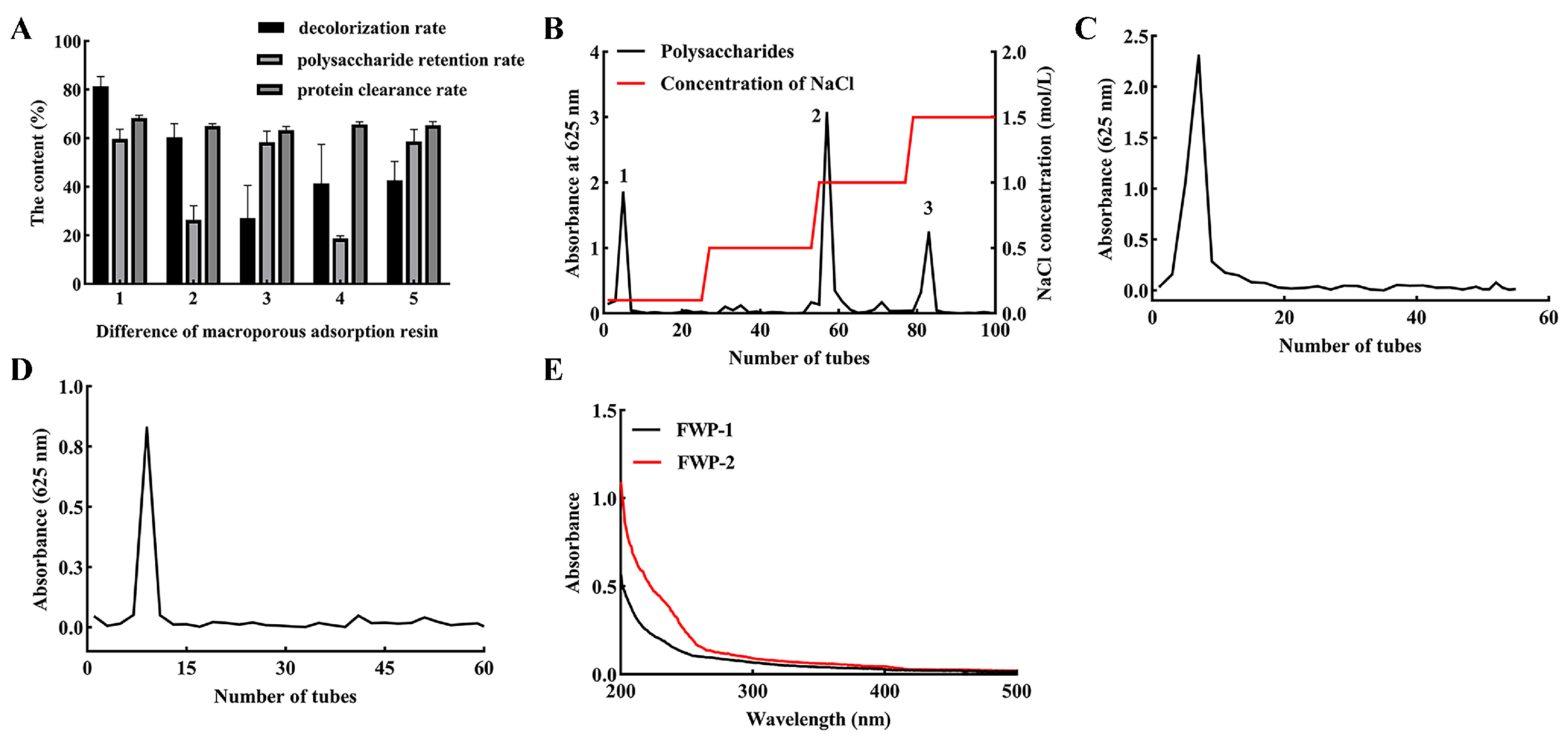
The decolorization and deproteinization efficiencies of five macroporous resins for FWP crude polysaccharide were evaluated via static adsorption (Figure 1A). The protein removal rate for the five tested resins exceeded 60%, indicating their effective capacity to eliminate proteins from FWP [18]. However, significant differences were observed in decolorization rate and polysaccharide retention rate among the resins. Resins D301G, AB-8, and HPD600 exhibited significantly higher polysaccharide retention rates compared with D900 and X-5, while AB-8 and HPD600 showed relatively low decolorization rates, with AB-8 displaying the lowest among all resins. D301G resin demonstrated the optimal decolorization performance while preserving a high polysaccharide retention rate, aligning with previously reported results for Lentinus edodes polysaccharides with 72% decolorization and 85% retention by D301G [19]. Thus, the D301G resin was selected as the optimal resin for FWP pretreatment.
Figure 1.
Isolation, purification, and characterization of FWPs. (A) Effects of macroporous adsorption resin on the decolorization rate, polysaccharide retention rate, and protein removal rate. (B) Elution profile of FWPs from a DEAE-52 column. (C,D) Elution profiles of FWP-1 (C) and FWP-2 (D) on a Sephadex G-150 gel filtration column. (E) UV absorption spectra of the purified FWPs.
3.2.2. Selection of the Optimal Adsorption Parameters
To enhance the efficiency and effectiveness of the FWP purification process, the adsorption parameters of the selected D301G resin required further optimization. The single-factor experiments were preliminarily conducted to investigate the effects of four key parameters, including crude polysaccharide concentration (1.0, 2.0, 3.0, 4.0, and 5.0 mg/mL), solid–liquid ratio (1:5, 1:10, 1:15, 1:20, and 1:25 g/mL), adsorption time (1, 2, 3, 4, and 5 h) and adsorption temperature (30, 35, 40, 45, and 50 °C). Based on the single-factor results, an L9(3)4 orthogonal array design was adopted for four-factor, three-level experiments. The factors selected were crude polysaccharide concentration (1.0, 2.0, and 3.0 mg/mL), solid–liquid ratio (1:5, 1:10, and 1:15 g/mL), adsorption time (2, 3, and 4 h), and adsorption temperature (30, 35, and 40 °C), with polysaccharide retention rate, decolorization rate, and protein removal rate as evaluation indicators. Statistical analysis was performed using the comprehensive evaluation index, and orthogonal test results with range analysis are presented in Table 1. Range (R) value analysis revealed that the four factors exhibited varying effects on the indicators: for decolorization rate, the order of influence significance was crude polysaccharide concentration > adsorption time > solid–liquid ratio > adsorption temperature; for polysaccharide retention rate, it was solid–liquid ratio > adsorption temperature > crude polysaccharide concentration > adsorption time; and for protein removal rate, it was solid–liquid ratio > adsorption temperature > adsorption time > crude polysaccharide concentration. Multiple comparisons of different levels initially identified two candidate protocols, including Protocol A (1.0 mg/mL crude polysaccharide concentration, 1:5 g/mL solid–liquid ratio, 4 h adsorption time, 40 °C adsorption temperature) and Protocol B (1.0 mg/mL crude polysaccharide concentration, 1:15 g/mL solid–liquid ratio, 4 h adsorption time, 40 °C adsorption temperature).
Table 1.
Results of orthogonal test range analysis.
Based on the orthogonal experimental results, two protocols were further compared via verification experiments (Table S1). The protocol A was ultimately established as the optimal purification process, with a decolorization rate of 74%, a polysaccharide retention rate of 85%, and a protein removal rate of 61%. Thus, the optimal adsorption parameters for D301G resin were finalized as 1.0 mg/mL initial sample concentration, 1:5 solid–liquid ratio, 40 °C adsorption temperature, and 4 h adsorption time, which were used to pretreat FWP for removing protein and pigment impurities from the crude polysaccharide.
3.3. Purification of Polysaccharides
After decolorization, the crude polysaccharides were first subjected to DEAE-52 cellulose ion-exchange chromatography. As shown in Figure 1B, the crude polysaccharides were sequentially eluted with ultrapure water, 0.3 M NaCl, and 0.5 M NaCl solutions, yielding three distinct peaks (peaks 1, 2, and 3). Peaks 1 and 2 exhibited higher polysaccharide content, and they were collected, concentrated, and lyophilized. The two collected fractions were subjected to further purification via Sephadex G-150 gel permeation chromatography with distilled water as the eluent. There was only one main peak in each elution curve, confirming the isolation of high-purity polysaccharides, which were designated FWP-1 and FWP-2, respectively (Figure 1C,D). These purified polysaccharides were concentrated, lyophilized, and appeared as white flocculent powders.
3.4. Physicochemical and Basic Structural Characterization
3.4.1. Physicochemical Characterization
After decolorization and column chromatography purification, FWP-1 and FWP-2 had polysaccharide contents of 93.5% and 91.2%, respectively, with protein contents below 0.6% (Table 2). As shown in Figure 1E, FWP-1 and FWP-2 exhibited no significant UV-visible absorption peaks at 260 nm (nucleic acids) and 280 nm (aromatic amino acids in proteins), confirming the effective removal of these impurities [20]. Notably, distinct differences were observed in the UV spectra of the two fractions. FWP-2 exhibited a weak convex peak at 220 nm, attributed to the n → π* transition of carboxyl groups (-COOH) in galacturonic acid (GalA)—a characteristic of acidic polysaccharides [21]. This observation was later validated by monosaccharide composition analysis.
Table 2.
Determination of sugar content and protein content.
3.4.2. Molecular Weight Distribution
The molecular weight (MW) distributions of FWP-1 and FWP-2 were determined by high performance gel permeation chromatography-differential refractive index detector method (HPGPC-RID), using dextran standards. FWP-1 primarily consisted of three polysaccharide fractions with different molecular weights of 52.3 kDa, 32.5 kDa, and 10.2 kDa. Among these, the 52.3 kDa fraction had the highest relative abundance, making it the dominant component of FWP-1. FWP-2 was primarily composed of two fractions with molecular weights of 43.1 kDa and 9.95 kDa, and the 9.95 kDa fraction accounted for 73.24% of the total, serving as the primary constituent of FWP-2.
3.4.3. Monosaccharide Compositions of FWP-1 and FWP-2
The monosaccharide compositions of FWP-1 and FWP-2 were analyzed using high-performance anion-exchange chromatography with pulsed amperometric detection (HPAEC-PAD), and the monosaccharide compositions and molar ratios are summarized in Table 3, revealing different monosaccharide compositions between FWP-1 and FWP-2. FWP-1 was composed of nine monosaccharides with a molar ratio of glucose (Glc): galactose (Gal): rhamnose (Rha): mannose (Man): arabinose (Ara): fucose (Fuc): glucosamine (GluN): xylose (Xyl): galactosamine (GalN) = 13.2: 6.70: 4.11: 4.07: 3.74: 2.48: 1.40: 1.00: 0.30. Among these, Glc (35.7 mol%) and Gal (18.1 mol%) were the dominant components, accounting for 53.8 mol% of total monosaccharides. FWP-1 was identified as a neutral heteropolysaccharide. By contrast, FWP-2 consisted of six monosaccharides which were galacturonic acid (GalA), Rha, Gal, Ara, Glu, and GluN with a molar ratio of 18.12: 3.42: 3.42: 3.03: 1: 0.15. The GalA (62.2 mol%) dominated the composition, indicating that FWP-2 was an acidic polysaccharide.
Table 3.
Monosaccharide composition and molar ratio of FWP-1 and FWP-2.
3.5. Protective Effects of FWP-1 and FWP-2 on H2O2-Induced Injury in SH-SY5Y Cells
3.5.1. Protective Effect on Cell Viability
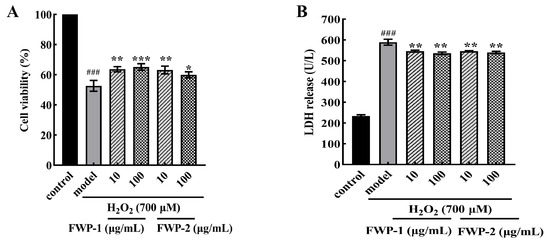
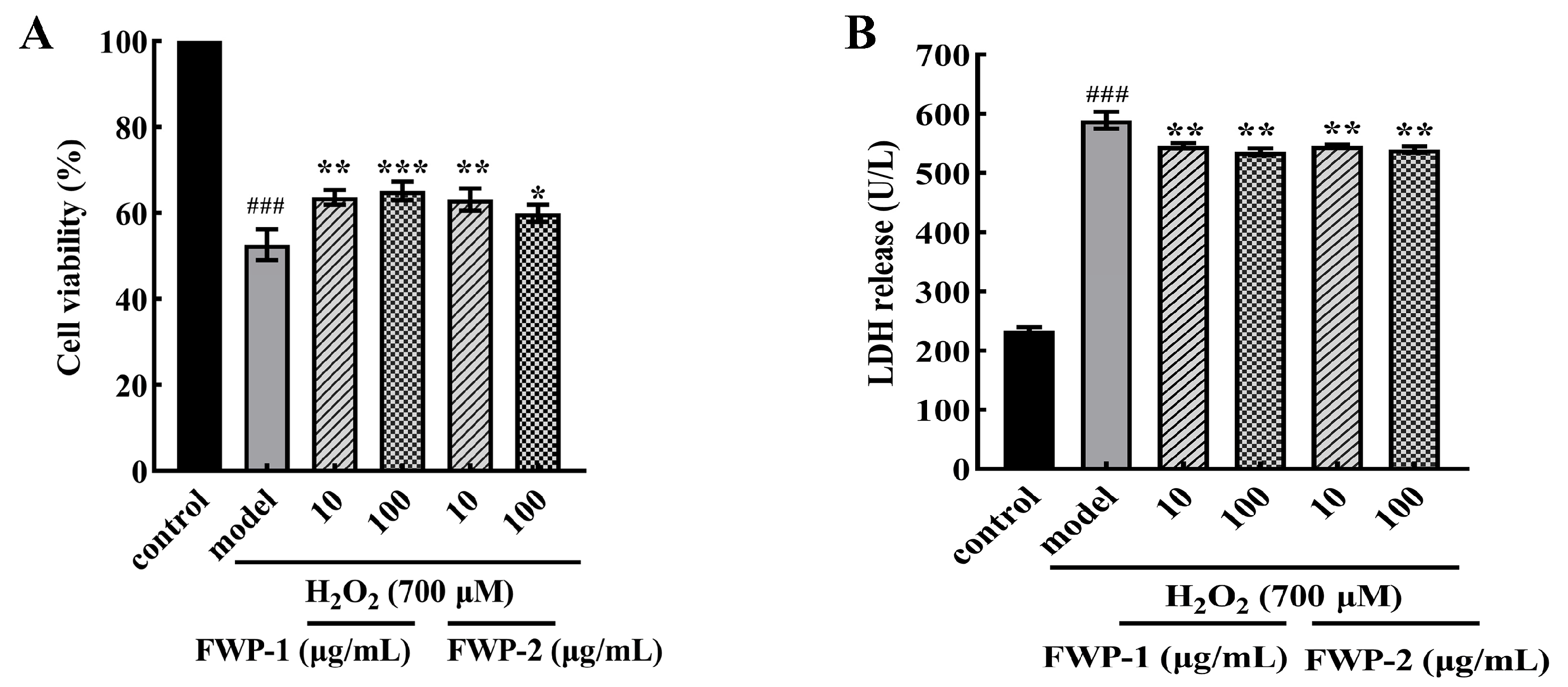
The H2O2-induced SH-SY5Y cell model is widely utilized to simulate neuronal oxidative damage and screen bioactive components with cytoprotective properties [22,23]. Cell viability was assessed by the CCK-8 assay, which was a sensitive method for quantifying neuronal survival [24]. The potential of FWP-1 and FWP-2 to mitigate H2O2-induced oxidative damage was assessed by pretreating SH-SY5Y cells with these two polysaccharides prior to exposure to 700 μM H2O2. As shown in Figure 2A, the cell viability of H2O2 model group decreased significantly (p < 0.001) compared with the control group, while pretreatment with FWP-1 and FWP-2 could significantly enhance the cell viability (p < 0.05). These findings indicated that FWP-1 and FWP exhibited protective effects against SH-SY5Y cell viability at a concentration of 10 and 100 μM. The different chemical compositions of the two polysaccharides may partially contribute to their biological differences [14,25].
Figure 2.
FWPs alleviated H2O2-induced damage in SH-SY5Y cell. (A) Cell viability. (B) Lactate dehydrogenase (LDH) release. Data are presented as mean ± SD. ### p < 0.001 vs. control group; * p < 0.05, ** p < 0.01, *** p < 0.001 vs. model (H2O2-treated) group.
3.5.2. Effect on Lactate Dehydrogenase (LDH) Release
The lactate dehydrogenase (LDH) release assay is widely recognized as a key indicator for evaluating cellular membrane integrity and assessing cytotoxicity [26]. As shown in Figure 2B, the LDH activity in the H2O2-treated group increased by 152.01% compared with the control group (p < 0.001). Pretreatment with FWP-1 at concentrations of 10 μg/mL and 100 μg/mL reduced LDH activity by 7.32% and 9.05%, respectively. Similarly, FWP-2 pretreatment at the same concentrations resulted in reductions of 7.32% and 8.39%, respectively (p < 0.001). The results confirmed that FWPs mitigated H2O2-induced membrane permeability, consistent with the cell viability data. The modest reduction in LDH activity (7–10%) might reflect the partial protective effect of polysaccharides [26].
3.5.3. Effect of FWP on Antioxidant Indices
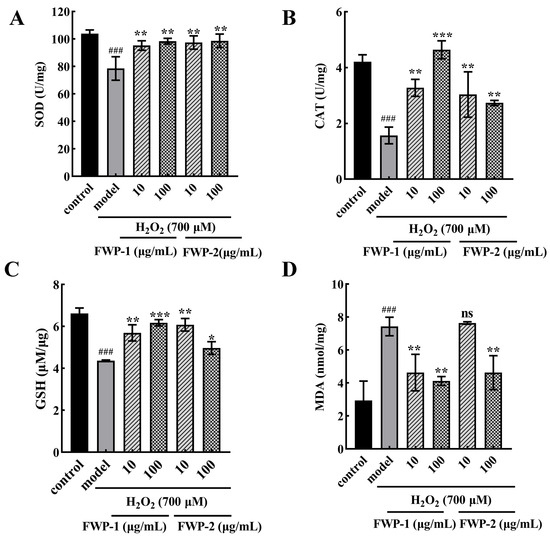
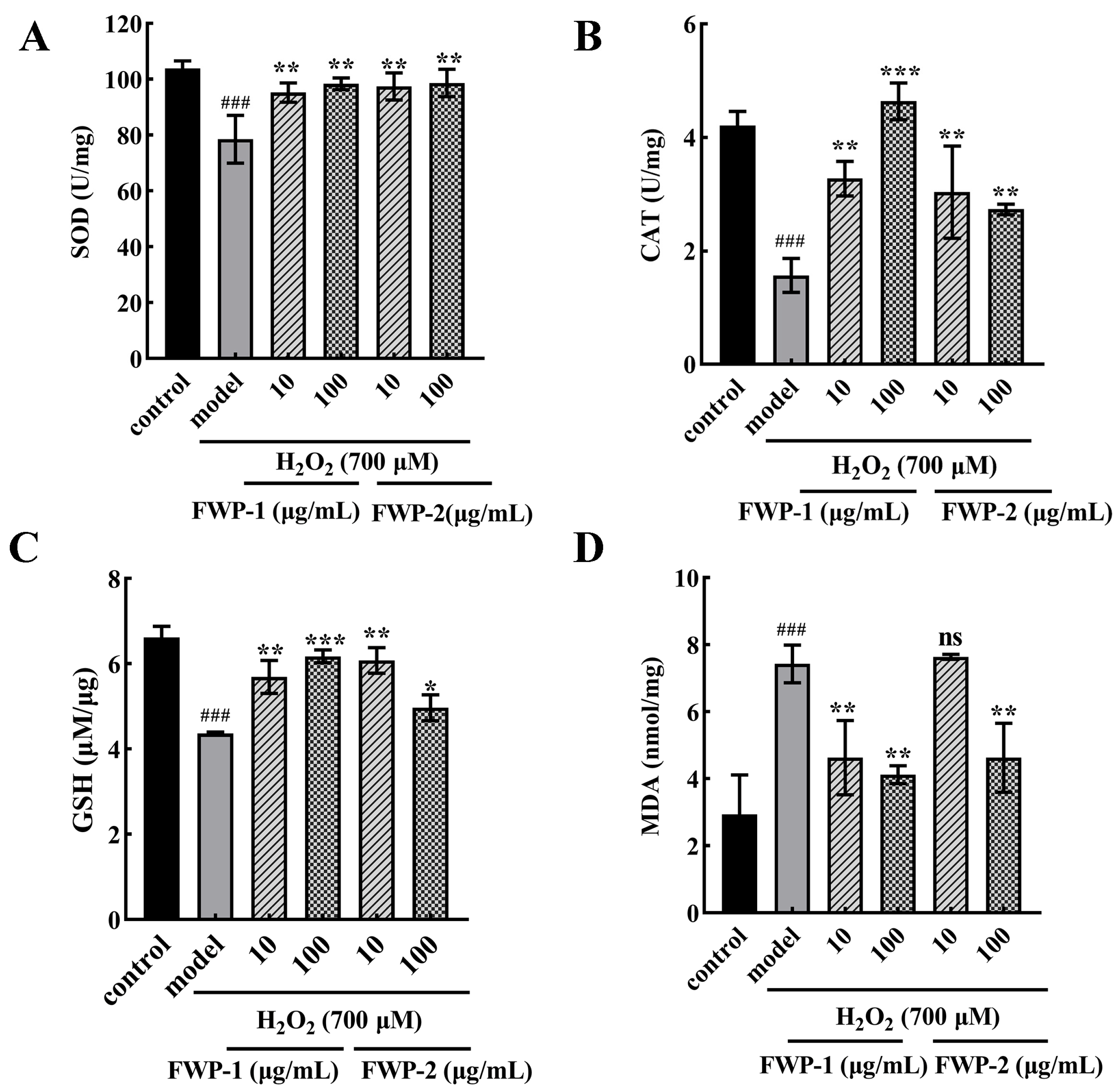
Numerous studies have demonstrated that an imbalance between free radical production and antioxidant defense systems in the brain is closely associated with the progression of neurodegenerative diseases [27,28]. The mechanism underlying H2O2-induced cellular damage involves the generation of reactive hydroxyl radicals by Fenton’s reaction which further interacted directly with cellular components (e.g., proteins, lipids, and DNA) to cause structural and functional damage. To assess the protective effect of FWP-1 and FWP-2 against H2O2-induced damage in SH-SY5Y cells, key antioxidant indices were measured, including the activities of superoxide dismutase (SOD) and catalase (CAT), as well as the levels of glutathione (GSH) and malondialdehyde (MDA) [22,29].
As shown in Figure 3, compared with the control group, the levels of intracellular SOD and CAT activities, and GSH level in the H2O2-induced injury model group exhibited a significant reduction (p < 0.001), while the MDA level increased significantly (p < 0.001). Compared with the model group, pretreatment with FWP-1 and FWP-2 increased the levels of SOD, CAT, and GSH. Notably, pretreatment with FWP-1 at 100 μg/mL resulted in a significant increase in CAT and GSH levels (p < 0.001). Additionally, pretreatment with FWP-1 (10 μg/mL and 100 μg/mL) and FWP-2 (100 μg/mL) significantly lowered MDA levels (p < 0.01). The results indicated that pretreatment with FWP-1 and FWP-2 could alleviate H2O2-induced oxidative damage in SH-SY5Y cells. Furthermore, FWP-1 (10 μg/mL and 100 μg/mL) showed a significantly stronger effect on mitigating H2O2-induced oxidative stress than FWP-2.
Figure 3.
FWPs reduced H2O2-induced oxidative stress in SH-SY5Y cells. Effects on (A) superoxide dismutase (SOD) activity, (B) catalase (CAT) activity, (C) glutathione (GSH) level, and (D) malondialdehyde (MDA) content. Data are presented as mean ± SD. ### p < 0.001 vs. control group; * p < 0.05, ** p < 0.01, *** p < 0.001 vs. model (H2O2-treated) group, ns, not significant.
3.5.4. Effects of FWP on ROS Levels and Mitochondrial Membrane Potential (MMP) in H2O2-Induced SH-SY5Y Cells
The mitochondrial respiratory chain is a major source of intracellular reactive oxygen species (ROS) and participates in various cellular processes, including energy production, metabolism, redox control, and programmed cell death [30]. Excessive ROS accumulation can trigger oxidative stress, which results in a series of biochemical and pathological reactions that ultimately lead to widespread neuronal degeneration and even apoptosis [31]. Notably, ROS overproduction has also been identified as a key destructive byproduct linked to aging and neurotoxicity, and it plays a critical role in the pathogenesis of neurodegenerative diseases [32].
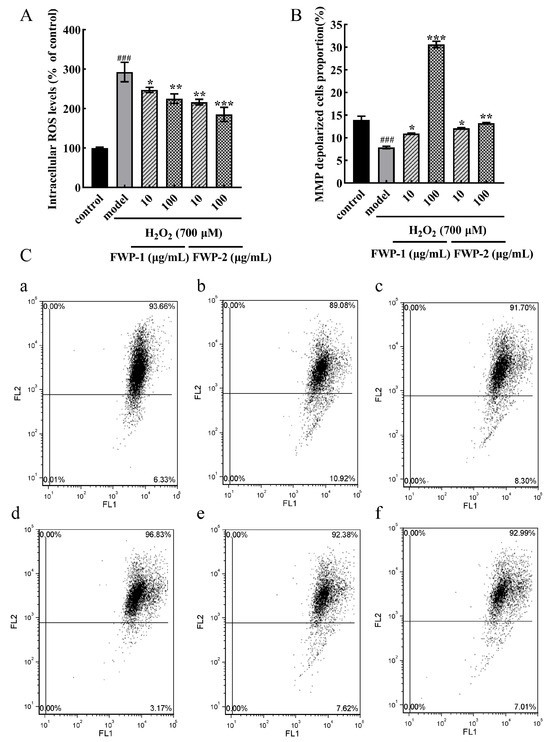
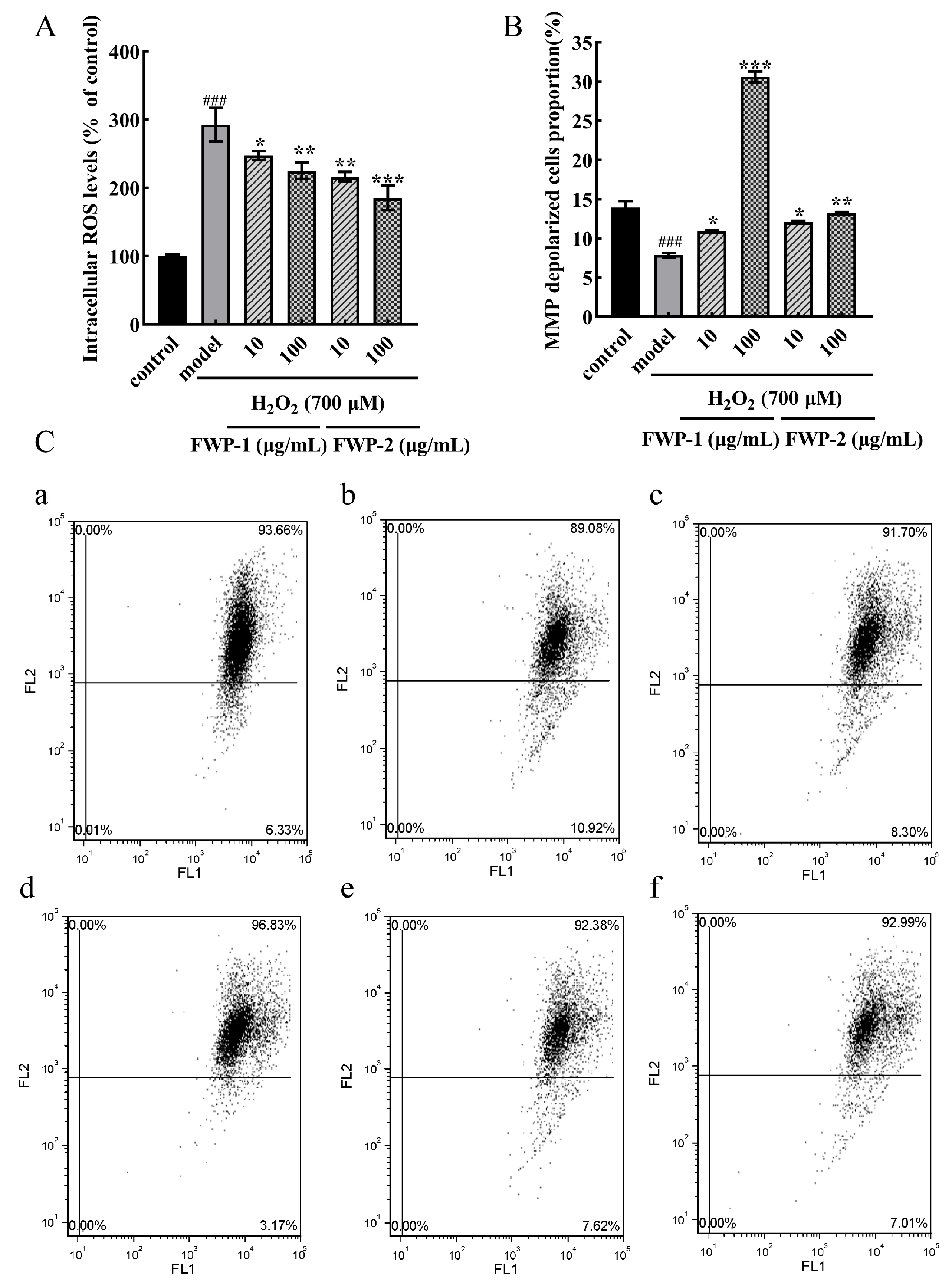
As shown in Figure 4A, compared with the control group, the ROS levels significantly increased by 192.85% in the H2O2-induced damage model group (p < 0.001). By contrast, compared with the model group, pretreatment with FWP-1 and FWP-2 significantly reduced ROS levels (p < 0.05 or p < 0.001), and the reduction rates were 15.53% (FWP-1, 10 μg/mL), 23.1% (FWP-1, 100 μg/mL), 26.05% (FWP-2, 10 μg/mL), and 36.72% (FWP-2, 100 μg/mL), respectively. FWP-2 presented a better ROS scavenging effect, which may be related to its unique sugar composition and structural characteristics [33].
Figure 4.
Effects of FWPs on ROS level and mitochondrial membrane potential (MMP) in H2O2-induced SH-SY5Y cells. (A) Intracellular ROS production. (B) Representative flow cytometry histograms of MMP and (C) its quantitative analysis. (a) Control, (b) 700 μM H2O2, (c) 700 μM H2O2+10 μg/mL FWP-1, (d) 700 μM H2O2+100 μg/mL FWP-1, (e) 700 μM H2O2+10 μg/mL FWP-2, (f) 700 μM H2O2+100 μg/mL FWP-2. Data are presented as mean ± SD. ### p < 0.001vs. control group; * p < 0.05, ** p < 0.01, *** p < 0.001 vs. model group.
Mitochondrial membrane potential (MMP) depolarization is a hallmark of mitochondrial dysfunction. Flow cytometry was used to quantify the percentage of decreased MMP in each cell group. As shown in Figure 4B,C, compared with the control group, the H2O2-induced model group showed a significant reduction in MMP (p < 0.001), indicating severe H2O2-induced mitochondrial impairment. However, compared with the model group, pretreatment with FWP-1 or FWP-2 showed a significant increase in MMP (p < 0.001), suggesting a protective effect on mitochondrial integrity. These results demonstrated that FWP-1 and FWP-2 not only suppressed H2O2-induced ROS overproduction but also ameliorated H2O2-mediated MMP depolarization in SH-SY5Y cells. The protective effect of FWP on MMP may be attributed to its capacity to sustain antioxidant enzyme activity. Specifically, SOD and CAT could reduce ROS levels, thereby mitigating ROS-induced damage to mitochondrial respiratory chain complexes [32]. The results indicated that FWP-1 and FWP-2 exhibited obvious cytoprotective activity against oxidative injury in neuronal cells.
4. Conclusions
In this study, the extraction, purification, and basic structural and chemical characterization of polysaccharides from fruitless wolfberry (FW) bud tea were systematically optimized, and their antioxidant and cytoprotective effects were further evaluated. The crude FWP was obtained using ultrasonic-assisted water extraction and ethanol precipitation. The purification process was optimized via orthogonal design using D301G macroporous resin, resulting in a decolorization rate of 74%, a polysaccharide retention rate of 85%, and a protein removal rate of 61%. Two purified polysaccharide fractions (FWP-1 and FWP-2) were successfully separated and identified as a neutral heteropolysaccharide and an acidic galacturonic acid-rich polysaccharide, respectively. The cytoprotective and antioxidant activities of FWP-1 and FWP-2 were assessed against H2O2-induced oxidative damage in SH-SY5Y cells. Both FWP-1 and FWP-2 significantly improved cell viability, reduced LDH release, enhanced antioxidant enzyme activities (SOD, CAT), increased GSH levels, decreased MDA content, scavenged excessive ROS, and maintained mitochondrial membrane potential. FWP-2 exhibited stronger ROS-scavenging activity, which may be attributed to its high galacturonic acid content. These results indicate that FWPs protected nerve cells from oxidative damage mainly through enhancing antioxidant capacity and maintaining mitochondrial function. This study provides a scientific basis for the development and utilization of FW bud tea polysaccharides as natural antioxidants or cytoprotective candidates.
Supplementary Materials
The following supporting information can be downloaded at: https://www.mdpi.com/article/10.3390/pr14091481/s1, Table S1. Comparative verification of two decolorization combination.
Author Contributions
Y.L.: Investigation, Supervision, Writing—original draft. T.W.: Investigation, Methodology, Data curation. H.L.: Investigation, Methodology, Validation. N.Z.: Data curation. Z.Z.: Project administration, Supervision, Writing—review and editing. All authors have read and agreed to the published version of the manuscript.
Funding
This research was supported by the Ningxia natural Science Foundation [2022AAC03030], the National Natural Science Foundation of China [32060103], the Excellent Young Scholars Project of Ningxia Natural Science Foundation [2024AAC05052], the Talent Introduction Special Project of the Key Research and Development Program of Ningxia Hui Autonomous Region [2025BEH04050], and the Science and Technology Support Project of Yinchuan Municipal Bureau of Science and Technology [2024NYZD002].
Data Availability Statement
The original contributions presented in this study are included in the article. Further inquiries may be directed to the corresponding author.
Conflicts of Interest
The authors declare no conflicts of interest.
References
- Ge, Q.; Xiao, G.-M.; Wang, L.-Y.; Xu, J.-P.; Hou, C.-L.; Liao, T.-X.; Rao, X.-H.; Mao, J.-W.; Chen, L.-C. Effect of steam explosion pretreatment on the fermentation characteristics of polysaccharides from tea residue. Int. J. Biol. Macromol. 2024, 279, 134920. [Google Scholar] [CrossRef] [Scilit]
- Li, Y.; Lin, Y.-F.; Wang, S.-H.; Cheng, Z.; Liu, W.-M.; Zou, Z.-H.; Liu, G.-M.; Liu, Q.-M. Purified components of red-edge tea polysaccharide alleviate food allergy in mice by regulating intestinal homeostasis. Int. J. Biol. Macromol. 2025, 288, 138671. [Google Scholar] [CrossRef] [Scilit]
- Abubakar, A.S.; Ahmad, B.; Ahmad, N.; Liu, L.; Liu, B.; Qu, Y.; Chen, J.; Chen, P.; Zhao, H.; Chen, J.; et al. Physicochemical evaluation, structural characterization, in vitro and in vivo bioactivities of water-soluble polysaccharides from Luobuma (Apocynum L.) tea. Food Chem. 2024, 460, 140453. [Google Scholar] [CrossRef] [Scilit] [PubMed]
- Li, Y.; Pang, J.; Lin, Y.; Liu, W.; Zou, Z.; Liu, G.; Liu, Q. Structural characterization and mast cell stabilizing activity of Red-edge tea polysaccharide. Food Chem. X 2024, 23, 101613. [Google Scholar] [CrossRef] [Scilit]
- Chen, S.-Q.; Wang, Z.-S.; Ma, Y.-X.; Zhang, W.; Lu, J.-L.; Liang, Y.-R.; Zheng, X.-Q. Neuroprotective Effects and Mechanisms of Tea Bioactive Components in Neurodegenerative Diseases. Molecules 2018, 23, 512. [Google Scholar] [CrossRef] [Scilit]
- Benchennouf, A.; Grigorakis, S.; Loupassaki, S.; Kokkalou, E. Phytochemical analysis and antioxidant activity of Lycium barbarum (Goji) cultivated in Greece. Pharm. Biol. 2016, 55, 596–602. [Google Scholar] [CrossRef] [Scilit] [PubMed]
- Wang, J.; Li, S.; Zhang, H.; Zhang, X. A review of Lycium barbarum polysaccharides: Extraction, purification, structural-property relationships, and bioactive molecular mechanisms. Carbohydr. Res. 2024, 544, 109230. [Google Scholar] [CrossRef] [Scilit]
- Liu, S.-Y.; Lu, S.; Yu, X.-L.; Yang, S.-G.; Liu, W.; Liu, X.-M.; Wang, S.-W.; Zhu, J.; Ji, M.; Liu, D.-Q.; et al. Fruitless Wolfberry-Sprout Extract Rescued Cognitive Deficits and Attenuated Neuropathology in Alzheimer’s Disease Transgenic Mice. Curr. Alzheimer Res. 2018, 15, 856–868. [Google Scholar] [CrossRef] [Scilit] [PubMed]
- Liu, J.Y.; Hao, W.R.; Qi, X.; Xu, J.F.; Zhao, F.Y.; Han, X.L. Improved Method for Rapid Determination and Method Validation of Soluble Sugar Content in Plants. Bot. Res. 2024, 13, 93–102. [Google Scholar] [CrossRef]
- Gao, L.; Wang, Y.; Zhang, F.; Li, S.; Zhao, J.; Zhang, Q.; Ye, J.; Ma, Y.; Wang, Z.; Chen, W. A standardized method for the quantification of polysaccharides: An example of polysaccharides from Tremella fuciformis. LWT 2022, 167, 113860. [Google Scholar] [CrossRef] [Scilit]
- Tao, L.; Zhang, J.; Lan, W.; Yu, L.; Bi, Y.; Song, S.; Xiong, B.; Wang, H. Polysaccharide decolorization: Methods, principles of action, structural and functional characterization, and limitations of current research. Trends Food Sci. Technol. 2023, 138, 284–296. [Google Scholar] [CrossRef] [Scilit]
- Li, D.; Xu, X.-Y.; Yang, Y.; Wu, N.; Ma, Z.-Q.; Zuo, F.; Zhang, N. Separation and purification of antioxidant peptides from purple speckled kidney bean by macroporous adsorption resin and analysis of amino acid composition. Front. Nutr. 2022, 9, 1001456. [Google Scholar] [CrossRef] [Scilit] [PubMed]
- Li, H.; Li, C.; Xu, Y.; Cao, H.; Wang, X.; He, J. Ultrasonic-assisted alkali extraction of quinoa polysaccharides: Yield and structural characterization. J. Cereal Sci. 2025, 122, 104108. [Google Scholar] [CrossRef] [Scilit]
- Wu, J.; Chen, T.; Wan, F.; Wang, J.; Li, X.; Li, W.; Ma, L. Structural characterization of a polysaccharide from Lycium barbarum and its neuroprotective effect against β-amyloid peptide neurotoxicity. Int. J. Biol. Macromol. 2021, 176, 352–363. [Google Scholar] [CrossRef] [Scilit]
- Wolf, P.; Schoeniger, A.; Edlich, F. Pro-apoptotic complexes of BAX and BAK on the outer mitochondrial membrane. Biochim. Biophys. Acta (BBA) Mol. Cell Res. 2022, 1869, 119317. [Google Scholar] [CrossRef] [Scilit]
- Wei, Q.; Zhang, Y.-H. Ultrasound-assisted polysaccharide extraction from Cercis chinensis and properites, antioxidant activity of polysaccharide. Ultrason. Sonochem. 2023, 96, 106422. [Google Scholar] [CrossRef] [Scilit] [PubMed]
- Zhang, X.; Li, L.; Fung, H.; Chen, N.; Shan, P.; Zhou, Y.; Han, Q. Critical review of the criterion of polysaccharide purity. Carbohydr. Polym. 2025, 352, 123187. [Google Scholar] [CrossRef] [Scilit]
- Hu, Z.; Zhou, H.; Li, Y.; Wu, M.; Yu, M.; Sun, X. Optimized purification process of polysaccharides from Carex meyeriana Kunth by macroporous resin, its characterization and immunomodulatory activity. Int. J. Biol. Macromol. 2019, 132, 76–86. [Google Scholar] [CrossRef] [Scilit]
- Gong, H.; Tan, X.; Hou, J.; Gong, Z.; Qin, X.; Nie, J.; Zhu, H.; Zhong, S. Separation, purification, structure characterization, and immune activity of a polysaccharide from Alocasia cucullata obtained by freeze-thaw treatment. Int. J. Biol. Macromol. 2024, 282, 137232. [Google Scholar] [CrossRef] [Scilit]
- Yang, R.; Meng, D.; Song, Y.; Li, J.; Zhang, Y.; Hu, X.; Ni, Y.; Li, Q. Simultaneous Decoloration and Deproteinization of Crude Polysaccharide from Pumpkin Residues by Cross-Linked Polystyrene Macroporous Resin. J. Agric. Food Chem. 2012, 60, 8450–8456. [Google Scholar] [CrossRef] [Scilit]
- Ma, S.; Zhang, R.; Li, L.; Wang, J.; Zheng, M.; Guo, X.; Miao, S.; Quan, W.; Liu, W.; Shi, X. Structural characterization of an apple polysaccharide and its anti-inflammatory effect through suppressing TLR4/NF-κB signaling. Int. J. Biol. Macromol. 2025, 296, 139760. [Google Scholar] [CrossRef] [Scilit]
- Bai, R.; Guo, J.; Ye, X.-Y.; Xie, Y.; Xie, T. Oxidative stress: The core pathogenesis and mechanism of Alzheimer’s disease. Ageing Res. Rev. 2022, 77, 101619. [Google Scholar] [CrossRef] [Scilit]
- D’aloia, A.; Pastori, V.; Blasa, S.; Campioni, G.; Peri, F.; Sacco, E.; Ceriani, M.; Lecchi, M.; Costa, B. A new advanced cellular model of functional cholinergic-like neurons developed by reprogramming the human SH-SY5Y neuroblastoma cell line. Cell. Death Discov. 2024, 10, 24. [Google Scholar] [CrossRef] [Scilit]
- Fan, J.; Schiemer, T.; Vaska, A.; Jahed, V.; Klavins, K. Cell via Cell Viability Assay Changes Cellular Metabolic Characteristics by Intervening with Glycolysis and Pentose Phosphate Pathway. Chem. Res. Toxicol. 2024, 37, 208–211. [Google Scholar] [CrossRef] [Scilit] [PubMed]
- Tang, B.; Jin, C.; Li, M.; Liu, S.; Zhang, X.; Li, J.; Ding, K.; Zang, Y. A novel pectin-like polysaccharide from Crocus sativus targets Galectin-3 to inhibit hepatic stellate cells activation and liver fibrosis. Carbohydr. Polym. 2025, 348, 122826. [Google Scholar] [CrossRef] [Scilit]
- Jayashree, G.; Rachitha, P.; Raghavendra, V.B.; Kandikattu, H.K. Patulin induced neuronal cell damage in human neuroblastoma SH-SY5Y cells. Toxicol. Rep. 2025, 14, 101886. [Google Scholar] [CrossRef] [Scilit] [PubMed]
- Ayed-Boussema, I.; Hamdi, H.; Chaabani, H.; M’nAssri, A.; Mokni, M.; Abid, S. Fenpyroximate induced cytotoxicity and genotoxicity in Wistar rat brain and in human neuroblastoma (SH-SY5Y) cells: Involvement of oxidative stress and apoptosis. NeuroToxicology 2022, 91, 177–187. [Google Scholar] [CrossRef] [Scilit]
- Yu, S.; Xiong, W.; Xu, W.; Chen, Y.F. Heliox Protects SH-SY5Y Cells from Oxygen-Glucose Deprivation/Reperfusion-Induced Ferroptosis. J. Integr. Neurosci. 2024, 23, 14. [Google Scholar] [CrossRef] [Scilit] [PubMed]
- Tian, X.; Liang, T.; Liu, Y.; Ding, G.; Zhang, F.; Ma, Z. Extraction, Structural Characterization, and Biological Functions of Lycium Barbarum Polysaccharides: A Review. Biomolecules 2019, 9, 389. [Google Scholar] [CrossRef] [Scilit]
- Zhang, L.; Fang, Y.; Zhao, X.; Zheng, Y.; Ma, Y.; Li, S.; Huang, Z.; Li, L. miR-204 silencing reduces mitochondrial autophagy and ROS production in a murine AD model via the TRPML1-activated STAT3 pathway. Mol. Ther. Nucleic Acids 2021, 24, 822–831. [Google Scholar] [CrossRef] [Scilit]
- Sun, Y.; Lu, Y.; Saredy, J.; Wang, X.; Iv, C.D.; Shao, Y.; Saaoud, F.; Xu, K.; Liu, M.; Yang, W.Y.; et al. ROS systems are a new integrated network for sensing homeostasis and alarming stresses in organelle metabolic processes. Redox Biol. 2020, 37, 101696. [Google Scholar] [CrossRef] [Scilit] [PubMed]
- Johnson, J.; Mercado-Ayon, E.; Mercado-Ayon, Y.; Na Dong, Y.; Halawani, S.; Ngaba, L.; Lynch, D.R. Mitochondrial dysfunction in the development and progression of neurodegenerative diseases. Arch. Biochem. Biophys. 2021, 702, 108698. [Google Scholar] [CrossRef] [Scilit] [PubMed]
- Wang, Z.; Zheng, Y.; Lai, Z.; Hu, X.; Wang, L.; Wang, X.; Li, Z.; Gao, M.; Yang, Y.; Wang, Q.; et al. Effect of monosaccharide composition and proportion on the bioactivity of polysaccharides: A review. Int. J. Biol. Macromol. 2024, 254, 127955. [Google Scholar] [CrossRef] [Scilit] [PubMed]

Disclaimer/Publisher’s Note: The statements, opinions and data contained in all publications are solely those of the individual author(s) and contributor(s) and not of MDPI and/or the editor(s). MDPI and/or the editor(s) disclaim responsibility for any injury to people or property resulting from any ideas, methods, instructions or products referred to in the content. |
© 2026 by the authors. Licensee MDPI, Basel, Switzerland. This article is an open access article distributed under the terms and conditions of the Creative Commons Attribution (CC BY) license.