Article

Thermal-Mismatch-Related Residual Stress Analysis and Reliability-Oriented Curing Process Improvement of Encapsulated Windings for Dry-Type Transformers

1
Electric Power Research Institute, China Southern Power Grid Ultra-High Voltage Power Transmission Company, Guangzhou 510663, China
2
Pearl Electric Co., Ltd., Guangzhou 511466, China
*
Authors to whom correspondence should be addressed.
Processes 2026, 14(9), 1483; https://doi.org/10.3390/pr14091483
Submission received: 3 March 2026 / Revised: 21 April 2026 / Accepted: 30 April 2026 / Published: 4 May 2026

Abstract

Epoxy encapsulation is widely used in dry-type transformer windings to improve insulation performance and mechanical robustness. However, significant thermo-mechanical residual stresses can be introduced during curing and cooling due to material property mismatch, leading to cracking and reliability concerns. This study aims to quantitatively analyze the evolution of thermal-mismatch-related residual stress in epoxy-encapsulated windings and to develop a reliability-oriented improved curing process. A representative encapsulated winding structure and a conventional industrial curing schedule are first modeled, and the evolution of the epoxy degree of cure is calculated based on curing kinetics. The obtained cure history is then coupled with a transient thermo-mechanical finite-element model that incorporates cure-dependent material properties to evaluate the residual stress distribution. The simulation results indicate pronounced stress concentration in specific regions of the encapsulation, which corresponds well with typical cracking locations observed in practice, demonstrating the validity of the proposed approach. Based on this model, several modified curing temperature profiles are further investigated to clarify the effects of temperature levels and dwell times on the development of residual stress. Finally, a reliability-oriented curing process improvement is identified, which effectively reduces stress concentration and mitigates cracking while maintaining adequate curing reliability.

1. Introduction

Dry-type transformers are increasingly adopted in power transmission and distribution systems owing to their inherent fire safety, low environmental impact, and reduced maintenance requirements, where epoxy-encapsulated windings serve as a key structural and insulation component [1,2]. By casting windings with epoxy resin, the mechanical integrity and environmental adaptability of the insulation system can be significantly enhanced, making solid-cast windings particularly suitable for compact installations and demanding operating conditions [3,4,5]. As a result, epoxy encapsulation has become a standard manufacturing practice for dry-type transformer windings.
However, the encapsulation process also introduces inherent thermo-mechanical challenges. During manufacturing, the epoxy resin undergoes a multi-stage curing process involving temperature elevation, chemical reaction, and subsequent cooling [6,7]. Throughout this process, curing shrinkage and thermal contraction occur simultaneously, while pronounced mismatches in thermophysical and mechanical properties exist between copper conductors and epoxy materials [8,9]. These effects jointly contribute to residual-stress development within the encapsulation, which may cause cracking of the epoxy body, local debonding at material interfaces, and gradual deterioration of insulation reliability during service [10,11,12]. In the present study, the emphasis is placed on the thermal-mismatch-related component of the residual stress, which is strongly influenced by the cooling temperature drop, material-property mismatch, and geometric constraint. Recent studies have further shown that residual-stress development in epoxy systems is strongly affected by interface conditions, conductor–insulator mismatch, and local curing-induced strain evolution, especially in electrically insulating structures with constrained multi-material interfaces [13,14,15].
To address these issues, extensive research has been devoted to thermal and mechanical analyses of epoxy-encapsulated electrical components [16,17,18,19]. Existing studies have investigated the temperature distribution and stress behavior in solid-cast windings under various loading and environmental conditions, providing valuable insights into structural safety and thermal management [16,17]. However, in many of these models, the curing process is simplified by assuming a fully cured epoxy with constant material properties. In practical industrial curing schedules, the evolution of the degree of cure and its influence on stiffness development and stress accumulation cannot be neglected, as they are crucial for accurately analyzing residual stress [12,18,19]. In recent years, both numerical and experimental studies have advanced the understanding of curing-related residual-stress generation in epoxy systems, including general residual-stress prediction during curing, stress evolution at epoxy-epoxy interfaces, and conductor-insulator interfacial stress during the curing process [20,21,22]. Nevertheless, these studies are mostly concerned with general resin components or other insulation structures, while the curing-schedule-dependent residual-stress behavior of epoxy-encapsulated dry-type transformer windings still requires further clarification. Moreover, the design of the curing process for solid-cast windings is commonly guided by empirical experience, with the primary objective of ensuring sufficient curing completeness [23,24]. The potential of curing-profile improvement as a reliability-oriented measure to mitigate residual stress and cracking has not yet been systematically explored.
This paper establishes an analysis framework for thermal-mismatch-related residual stress in epoxy-encapsulated dry-type transformer windings by incorporating curing-kinetics-based degree-of-cure evolution and cure-related process effects. A representative winding structure with a practical tap-connection-induced geometric discontinuity is modeled to evaluate residual stress evolution and identify critical stress concentration regions. Compared with existing studies on general epoxy encapsulation and curing-induced stress analysis, the contribution of this work lies in three aspects. First, it focuses on a practically relevant dry-type transformer winding structure that is directly associated with crack-prone regions in engineering manufacture. Second, the influence of different industrial curing schedules on residual stress development is comparatively evaluated within a unified thermo-mechanical framework. Third, based on several industrially relevant curing profiles and supported by model-coil validation, a reliability-oriented curing process improvement is identified for mitigating residual stress concentration and improving structural reliability.

2. Structure of Epoxy-Encapsulated Windings and Its Initial Curing Process

Epoxy-encapsulated windings constitute the core structural and insulation unit of dry-type transformers. A typical encapsulated winding consists of copper conductors arranged in multiple turns and layers, which are fully embedded within an epoxy resin body after casting and curing. The epoxy encapsulation not only provides electrical insulation but also serves as a mechanical support structure that constrains winding deformation under thermal and electromagnetic loads.
In both the simulation and the trial manufacture, the encapsulation material was an epoxy casting resin system used for dry-type transformer windings, and the conductor material was copper. The experimental specimen was an encapsulated model coil fabricated using the same material system and manufacturing route as those considered in the numerical analysis. This ensures the consistency between the simulation and the experimental validation.
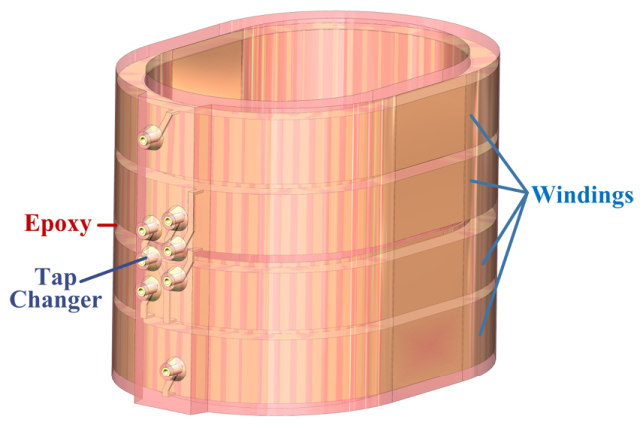
Figure 1 illustrates the epoxy-encapsulated winding studied in this paper. The copper winding is centrally located and surrounded by the epoxy casting material, forming a solid-cast structure with well-defined interfaces between dissimilar materials. Due to the significant differences in thermophysical and mechanical properties between copper and epoxy, during the curing and cooling processes, thermo-mechanical residual stresses can generate and accumulate. In this study, these stresses are evaluated numerically by combining curing-kinetics-based degree-of-cure calculation with a coupled thermo-mechanical finite-element analysis under the equivalent stress-free temperature approach.
The encapsulation process involves a multi-stage thermal curing cycle, designed to ensure sufficient polymerization of the epoxy resin while avoiding excessive thermal gradients. In industrial practice, the curing schedule is typically specified as a sequence of temperature ramps and dwell stages.
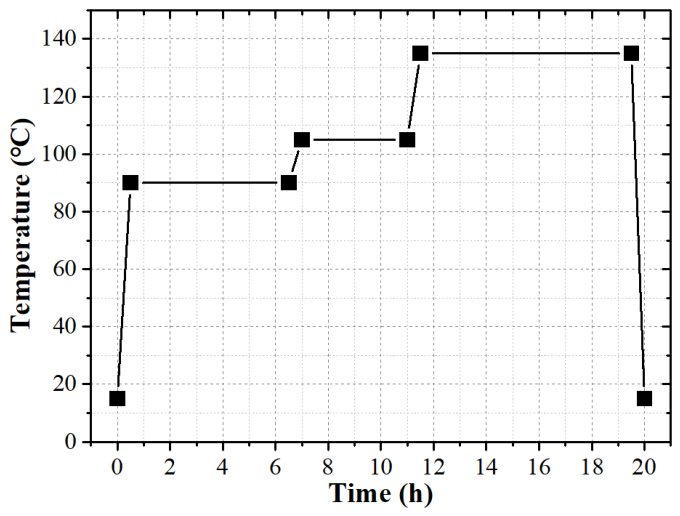
Figure 2 presents the initial curing temperature profile investigated in this work. It begins at ambient temperature, followed by a controlled heating stage to an intermediate temperature level, where the epoxy resin gradually transitions from a low-viscosity state to a gelled state. Subsequent higher-temperature dwell stages are applied to promote further curing reactions and to achieve a high degree of cure. After completion of the curing reaction, the encapsulated winding is cooled to ambient temperature, during which both epoxy and copper are thermally contracted.
Although such curing schedules are effective in achieving adequate curing completeness, they inherently introduce thermo-mechanical effects, among which thermal expansion mismatch plays a decisive role in the formation of residual stresses. To quantitatively analyze these effects, the initial curing process shown in Figure 2 is adopted as the baseline condition in this study. The corresponding evolution of the epoxy degree of cure is first evaluated based on curing kinetics, and the resulting cure history is then incorporated into a coupled thermo-mechanical finite-element model to assess residual stress development.

3. Residual Stress Simulation Under the Initial Curing Process

3.1. Cure Modeling and Degree-of-Cure Evolution Under the Initial Curing Schedule

The thermo-physical and mechanical properties of the epoxy encapsulation and copper conductor used in the present simulations are summarized in Table 1. As illustrated in Figure 2, the initial curing schedule considered in this study follows a multi-stage temperature profile: 15 °C → 90 °C (0.5 h ramp) + 6 h hold; 90 °C → 105 °C (0.5 h ramp) + 4 h hold; 105 °C → 135 °C (0.5 h ramp) + 8 h hold; 135 °C → 15 °C (0.5 h ramp). The initial temperature of 15 °C corresponds to the factory-standard starting condition adopted in the manufacturing process, and it should be controlled to ensure process consistency. Variations in the starting temperature may affect the curing process and the subsequent development of residual stress.
To describe the curing reaction of the epoxy resin, the degree of cure α(t) is introduced as a scalar internal variable:
0 α ( t ) 1
where α(t) is the degree of cure (dimensionless). When α(t) = 0, the epoxy is in an uncured state, and when α(t) = 1, the epoxy is fully cured.
The curing setup considered in this study was defined according to the industrial curing schedules used for encapsulated winding manufacture, as shown in Figure 2. In the present work, the degree-of-cure evolution was evaluated using a simplified kinetic model informed by the available gel-time data of the adopted epoxy system. This treatment provides an engineering-oriented description of the curing progression under different prescribed temperature profiles and is mainly intended for comparative analysis of curing schedules at the process level. Therefore, a simplified autocatalytic kinetic model is adopted for process-level evaluation [25,26].
d α d t = k ( T ) α ( 1 α )
where T is the curing temperature, 1 − α represents the remaining uncured fraction of the epoxy system, and K(T) is the temperature-dependent reaction rate constant, which can be described by the Arrhenius relation [8,27,28]:
k ( T ) = A × e E R T
where A is the pre-exponential factor, E is the apparent activation energy, and R is the universal gas constant. The kinetic parameters adopted in the present gel-time-data-informed simulation are summarized in Table 2.
Under isothermal conditions, the analytical solution of Equation (2) can be formulated as:
α ( t ) = 1 1 + 1 α 0 α 0 e K ( T ) t
where α0 is the initial degree of cure at the beginning of the isothermal stage.
The available gel-time data of the adopted epoxy system were used to determine the kinetic parameters for the present process-level analysis. Gelation corresponds to a characteristic conversion αg. In the absence of directly measured gel conversion, αg = 0.5 is adopted as a practical engineering approximation. Substituting α(tg) = αg into Equation (4), where tg denotes the gel time at the corresponding isothermal temperature. Thus, the rate constant at each temperature can be obtained as
k ( T ) = 1 t g ln α g 1 α 0 α 0 1 α g
It should be noted that, compared with DSC-based kinetic identification, gel-time data provide only limited curing information at discrete temperatures and cannot fully characterize the non-isothermal curing behavior, reaction enthalpy evolution, or detailed reaction mechanism of the epoxy system. Therefore, the present model should be regarded as an engineering-oriented comparative approach for evaluating the relative influence of different curing profiles, rather than a fully calibrated cure-kinetics model.
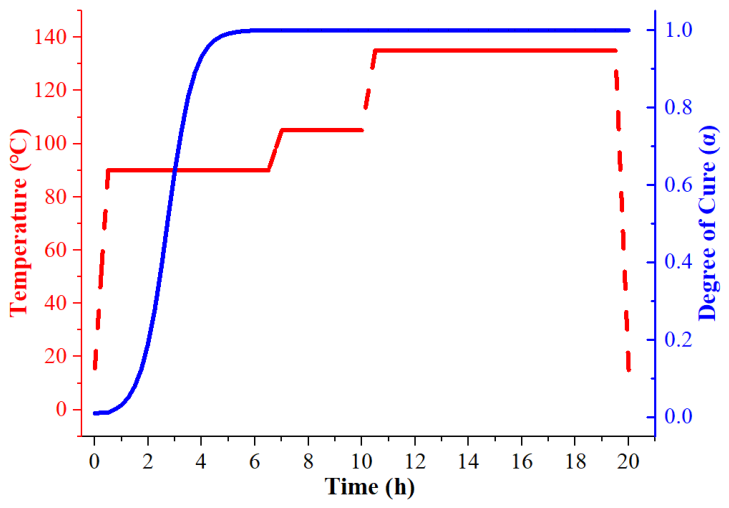
The degree-of-cure evolution is obtained by integrating Equation (2) along the prescribed non-isothermal curing profile. During the ramp stages, the temperature is assumed to vary linearly with time, and the governing equation is solved using a numerical time-stepping scheme. Figure 3 presents the curing temperature history together with the corresponding evolution of the degree of cure. Once the temperature reaches 90 °C, the curing reaction accelerates significantly, and the degree of cure increases steeply during the 6 h dwell, approaching unity by the end of this stage. The subsequent dwell stages at 105 °C and 135 °C lead to only marginal increases in conversion and mainly ensure curing completeness and stabilization of material properties.
From a thermo-mechanical viewpoint, these higher-temperature dwell stages do not primarily serve to increase the degree of cure but may influence residual stress development through competing mechanisms. Elevated temperature can promote stress relaxation if sufficient molecular mobility exists, whereas the higher peak temperature also increases the subsequent cooling temperature drop, potentially intensifying thermal mismatch-induced stresses between copper and epoxy. Therefore, although the initial schedule provides a considerable safety margin for achieving full cure, its influence on residual stress formation requires further thermo-mechanical evaluation.

3.2. Thermo-Mechanical Analysis of Thermal-Mismatch-Related Residual Stress Under the Initial Curing Schedule

To evaluate the thermal-mismatch-related residual stress associated with the curing process, a thermo-mechanical finite element analysis (FEA) was performed based on the equivalent stress-free temperature approach described previously. The degree-of-cure evolution obtained in Figure 3 was used to determine the curing completion stage, and the encapsulated winding was assumed to be stress-free at the selected reference temperature prior to cooling to room temperature (15 °C). A three-dimensional full-domain model, as illustrated in Figure 1, was employed in the simulations.
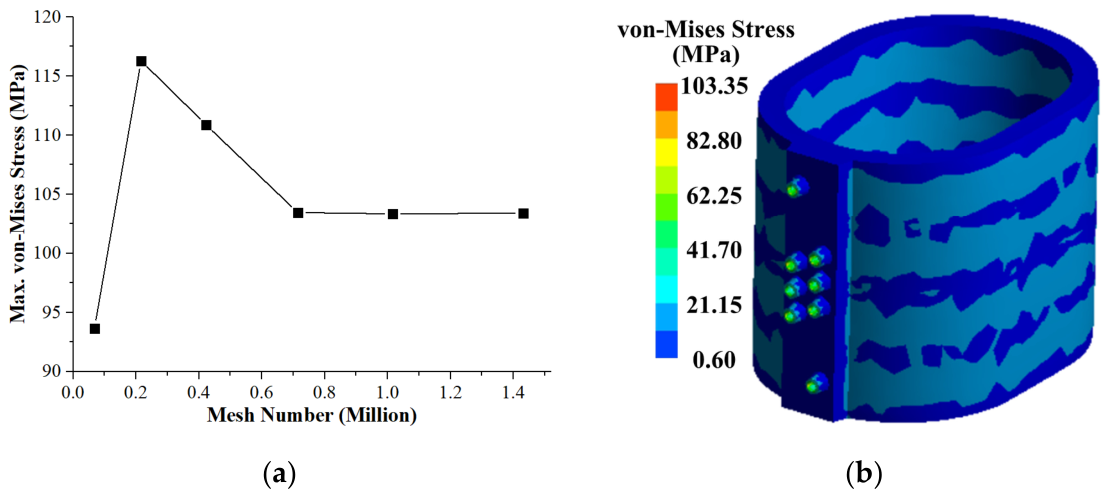
The computational model was discretized using tetrahedral elements, and local mesh refinement was applied in the protruded encapsulation region near the tap connection, where pronounced stress concentration was expected. A mesh-independence study was conducted using the maximum principal stress in the critical protruded encapsulation region as the evaluation index. The meshes contained approximately 0.068, 0.216, 0.423, 0.714, 1.016, and 1.432 million tetrahedral elements, yielding corresponding maximum principal stresses of 93.66, 116.30, 110.88, 103.46, 103.35, and 103.41 MPa, respectively, as shown in Figure 4a. The difference between the results obtained with 1.016 million and 1.432 million elements was negligible. Therefore, the mesh with 1.016 million tetrahedral elements was adopted in the subsequent simulations as a compromise between computational accuracy and efficiency. The subsequent thermo-mechanical simulations were carried out in the same commercial finite-element platform under the same quasi-static analysis settings.
The calculated residual stress distribution in the epoxy encapsulation based on the mesh with 1.016 million tetrahedral elements is presented in Figure 4b. The results reveal pronounced stress concentration near the protruded region of the encapsulation adjacent to the tap connection. The maximum principal stress reaches approximately 103 MPa at this location. This localized stress concentration is mainly attributed to the combined effects of thermal expansion mismatch between copper and epoxy, the effective cooling temperature drop associated with the curing schedule, and geometric discontinuity in the encapsulated structure. It should also be recognized that curing shrinkage is an important contributor to residual-stress development in epoxy systems. However, the present simplified framework mainly focuses on the thermal-mismatch-related component of the residual stress, and the shrinkage effect is therefore discussed here as an important accompanying mechanism rather than being explicitly resolved.
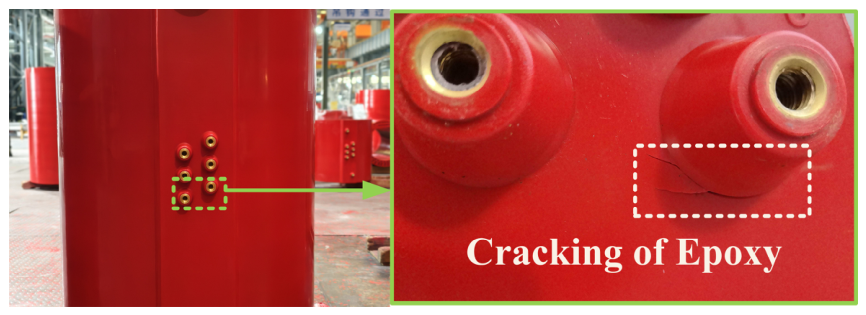
To verify the numerical prediction, a transformer model coil prototype was fabricated using the same curing process, as shown in Figure 5. Visible cracking was observed in the protruded encapsulation region near the tap connection, which corresponds well with the predicted stress concentration zone. The agreement between the simulation and the experimental observation indicates that the adopted modeling approach captures the primary mechanism of residual-stress formation under the initial curing schedule.

4. Curing Process Improvement for Reducing Thermal-Mismatch-Related Residual Stress

4.1. Alternative Curing Temperature Profiles

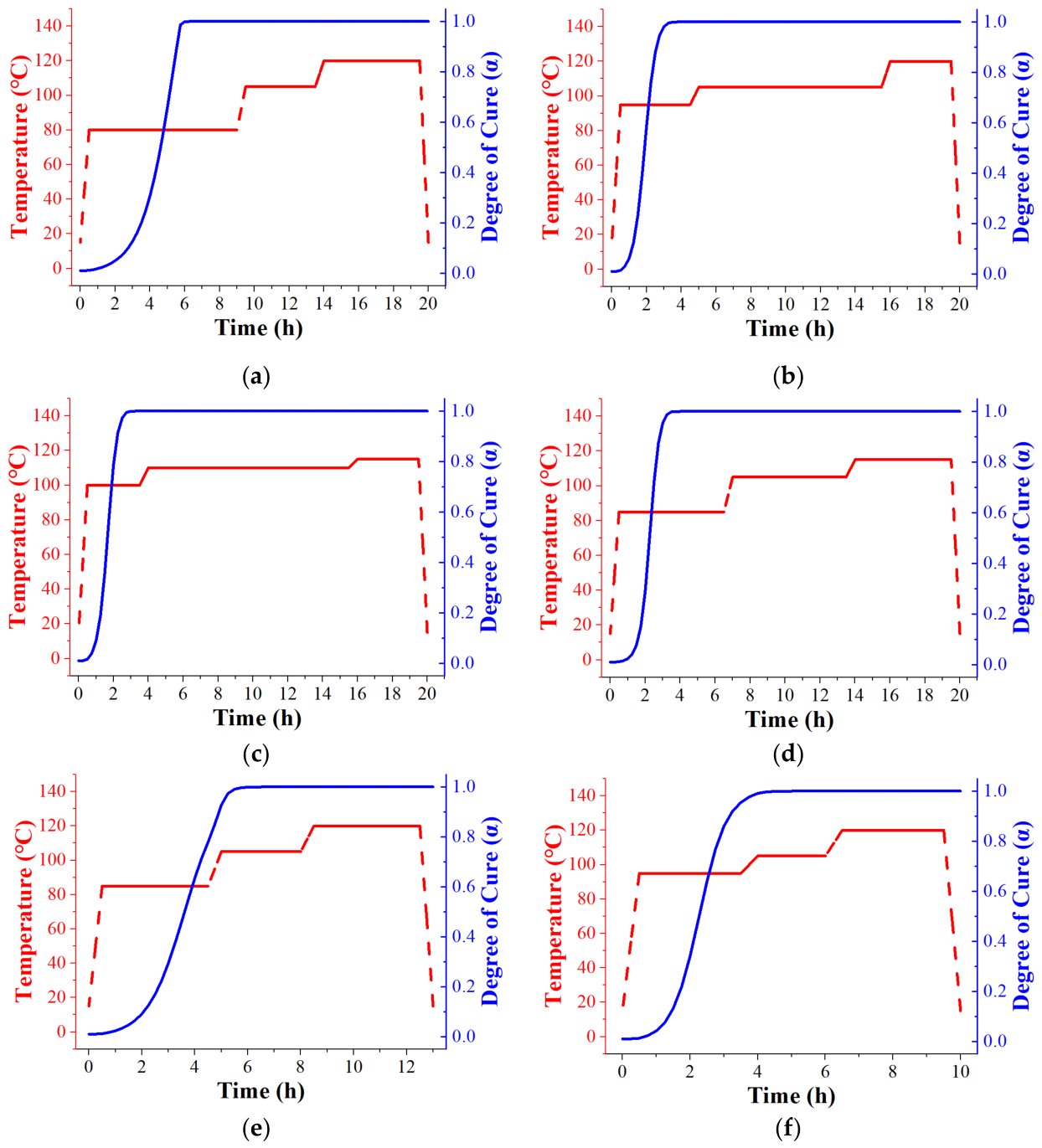
To reduce thermal-mismatch-related residual stress while maintaining curing reliability and acceptable manufacturing efficiency, six alternative curing temperature profiles are considered in this study. These profiles are designed by adjusting the early-stage dwell temperature and, in some cases, the dwell duration, so as to generate distinguishable cure-evolution histories and different total process durations. In this way, the effects of curing strategy on degree of cure, residual stress development, and manufacturing time can be comparatively evaluated within a reliability-oriented process-improvement framework.
The six profiles include relatively lower first-stage temperatures, relatively higher first-stage temperatures, and shortened schedules intended to improve production efficiency. Specifically, Profiles A and D adopt lower first-stage temperatures to slow down the initial curing rate, Profiles B and C adopt higher first-stage temperatures to accelerate early curing, and Profiles E and F are further introduced as shortened schedules to examine the trade-off between residual stress mitigation and total manufacturing time. All profiles are designed to maintain a final degree of cure close to unity while providing different curing trajectories and processing durations for comparison.
The detailed curing schedules (as illustrated in Figure 6) are defined as follows:
Profile A: 15 °C → 80 °C (0.5 h ramp) + 6 h hold; 80 °C → 105 °C (0.5 h ramp) + 4 h hold; 105 °C → 135 °C (0.5 h ramp) + 8 h hold; 135 °C → 15 °C (0.5 h ramp).
Profile B: 15 °C → 95 °C (0.5 h ramp) + 6 h hold; 95 °C → 105 °C (0.5 h ramp) + 4 h hold; 105 °C → 135 °C (0.5 h ramp) + 8 h hold; 135 °C → 15 °C (0.5 h ramp).
Profile C: 15 °C → 100 °C (0.5 h ramp) + 6 h hold; 100 °C → 105 °C (0.5 h ramp) + 4 h hold; 105 °C → 135 °C (0.5 h ramp) + 8 h hold; 135 °C → 15 °C (0.5 h ramp).
Profile D: 15 °C → 85 °C (0.5 h ramp) + 6 h hold; 85 °C → 105 °C (0.5 h ramp) + 4 h hold; 105 °C → 135 °C (0.5 h ramp) + 8 h hold; 135 °C → 15 °C (0.5 h ramp).
Profile E: 15 °C → 85 °C (0.5 h ramp) + 4 h hold; 85 °C → 105 °C (0.5 h ramp) + 3 h hold; 105 °C → 135 °C (0.5 h ramp) + 4 h hold; 135 °C → 15 °C (0.5 h ramp).
Profile F: 15 °C → 95 °C (0.5 h ramp) + 3 h hold; 95 °C → 105 °C (0.5 h ramp) + 2 h hold; 105 °C → 135 °C (0.5 h ramp) + 3 h hold; 135 °C → 15 °C (0.5 h ramp).
As shown in Figure 6, Profiles A–D mainly differ in the early-stage curing temperature while maintaining the original overall process duration, whereas Profiles E and F are introduced as shortened schedules for evaluating manufacturing efficiency. Profile A represents the lowest-temperature strategy among the six cases, and Profile D adopts a moderately reduced first-stage temperature. By contrast, Profiles B and C use elevated first-stage temperatures to accelerate the initial curing reaction. Profiles E and F further reduce the total process time by shortening the dwell durations, thereby providing additional comparison cases for assessing the trade-off between curing reliability, residual stress reduction, and manufacturing efficiency.

4.2. Thermo-Mechanical Evaluation of Improved Curing Profiles

Based on the six curing temperature profiles and the corresponding degree-of-cure evolution presented in Figure 6, thermo-mechanical finite element analyses were performed to evaluate the residual stress distribution under each curing strategy. The same modeling assumptions and boundary conditions as described in Section 3.2 were adopted, while the equivalent stress-free reference temperature was adjusted according to each profile.
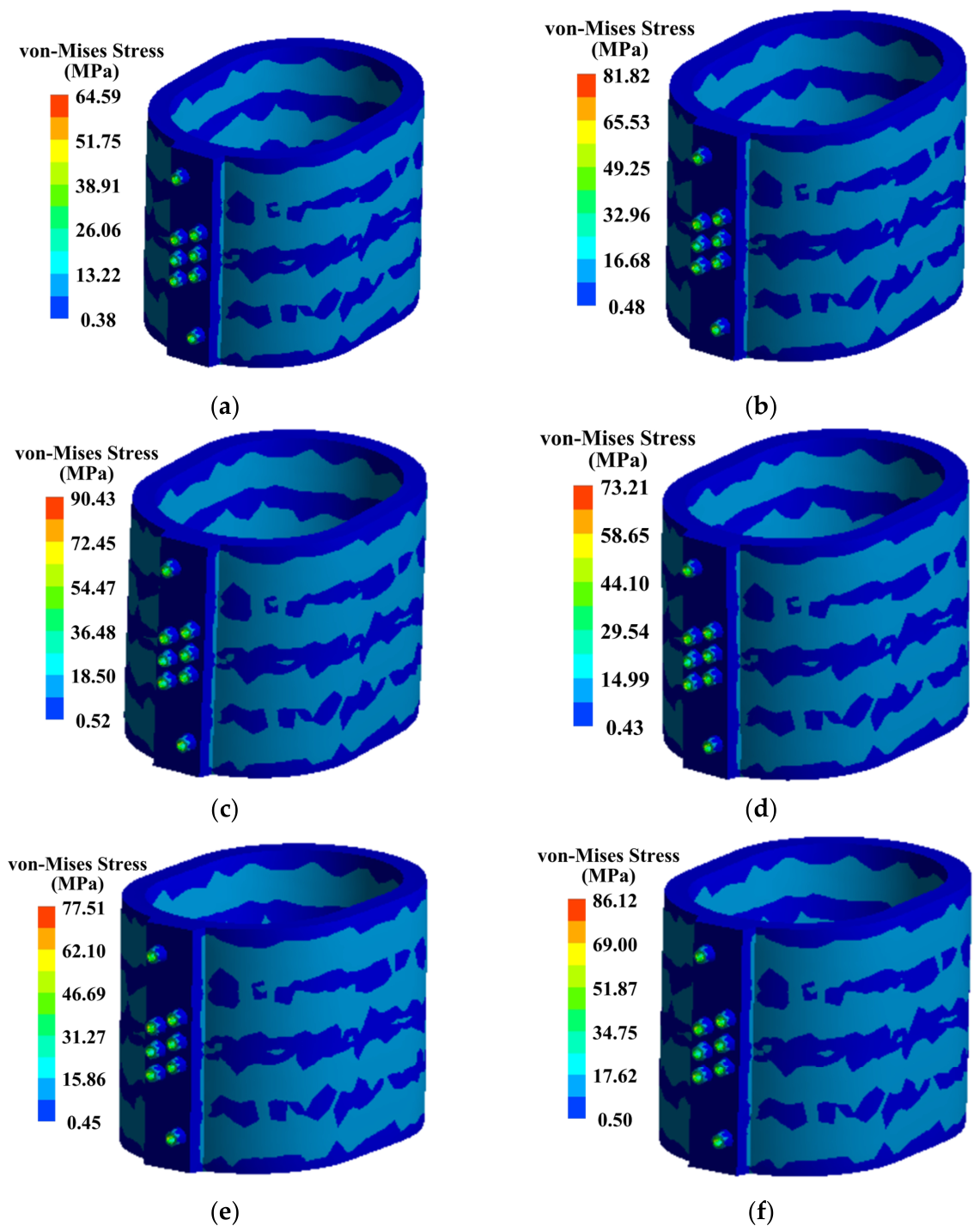
The results, as illustrated in Figure 7a–f, show that all six alternative curing profiles can reduce the thermal-mismatch-related residual stress to different extents compared with the initial curing schedule. The overall stress concentration pattern remains similar, with peak stresses located near the protruded encapsulation region adjacent to the tap connection. However, the magnitude of the maximum principal stress, the final degree of cure, and the total manufacturing time vary noticeably among the six profiles.
Among the investigated profiles, Profile A exhibits the lowest residual stress level, with a peak maximum principal stress of approximately 64.59 MPa, representing a substantial reduction compared with the initial schedule. Although Profile A does not correspond to the shortest curing cycle, the corresponding cure evolution indicates that the epoxy still achieves a degree of cure close to unity, ensuring sufficient encapsulation integrity. Therefore, Profile A provides the most favorable overall performance in this study.
Therefore, although maintaining a moderate curing temperature with adequate dwell time may require a relatively longer manufacturing time, this lower-temperature full-cure strategy is more effective in reducing thermal-mismatch-related residual stress than excessively high-temperature exposure. From a physical viewpoint, this improvement is mainly reflected in the reduction in the effective thermal-mismatch-related stress level associated with the curing schedule. Meanwhile, curing shrinkage should also be recognized as an important contributor to overall residual-stress development in epoxy systems, although it is not explicitly incorporated in the present simplified comparative framework.
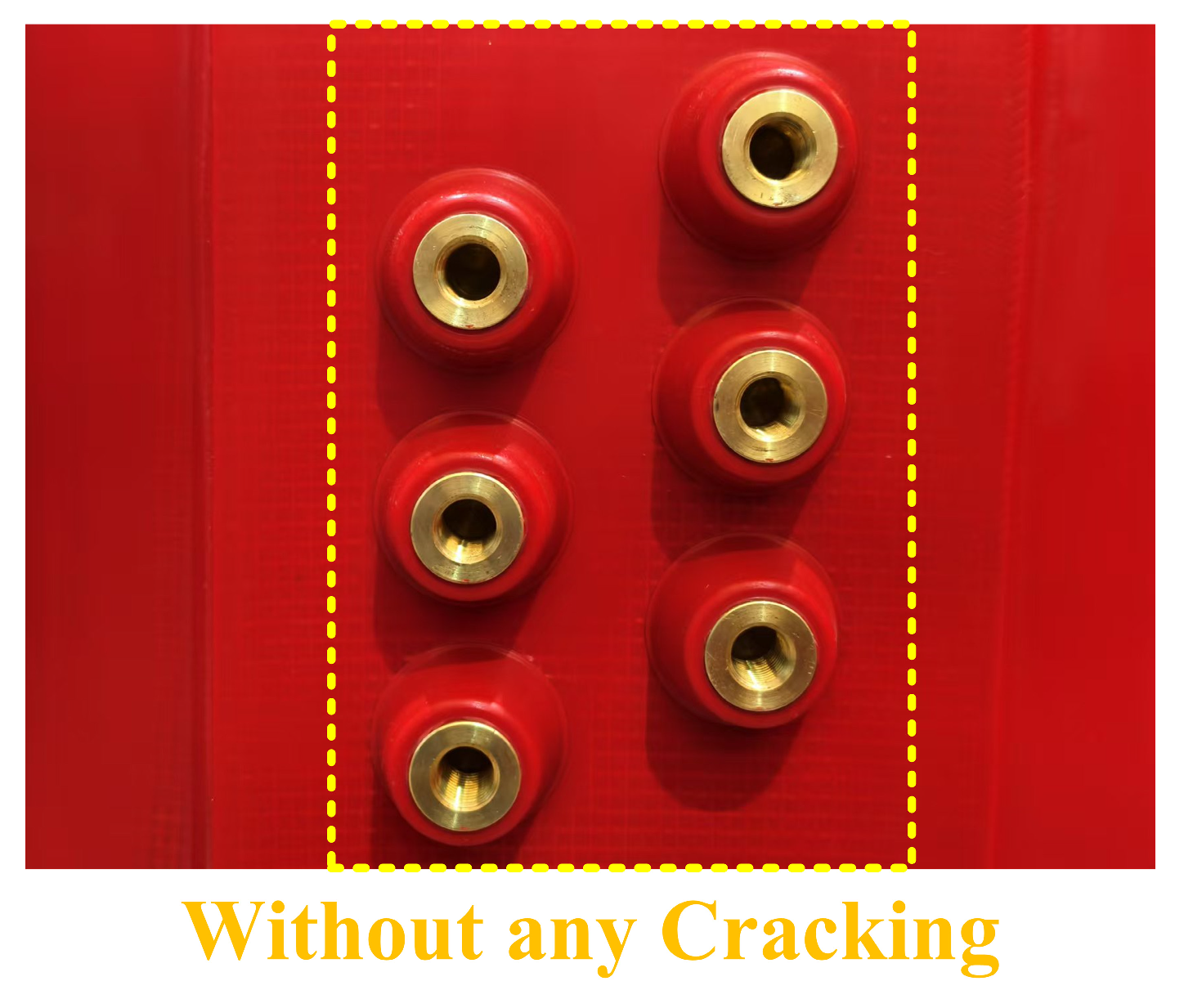
To further validate the numerical prediction, an encapsulated transformer model coil was fabricated using the same epoxy encapsulation system and manufacturing route as those adopted in the simulation, with Profile A applied as the curing schedule, as shown in Figure 8. In contrast to the initial curing case, no visible cracking was observed in the protruded encapsulation region near the tap connection. This experimental result is consistent with the numerical prediction, further indicating that Profile A can effectively mitigate residual-stress concentration and improve the structural reliability of the encapsulated winding.

5. Conclusions

This paper investigates the thermal-mismatch-related residual-stress characteristics of epoxy-encapsulated windings for dry-type transformers and proposes a reliability-oriented improved curing process based on comparative evaluation of several practically relevant curing profiles. A curing kinetics-based degree-of-cure model is first established to describe the evolution of epoxy conversion under practical industrial schedules, and an equivalent stress-free temperature approach is adopted to evaluate thermal-mismatch-induced residual stress using finite element analysis. The results show that under the initial curing process, excessively high-temperature exposure significantly increases the effective cooling temperature drop, leading to pronounced stress concentration near the protruded encapsulation region adjacent to the tap connection, which correlates well with experimentally observed cracking. By modifying the early-stage curing temperature and reducing the effective stress-locking temperature, substantial reductions in maximum principal stress can be achieved while maintaining near-complete curing of the epoxy. Among the investigated profiles, Profile A demonstrates the best performance in terms of residual stress reduction while still ensuring near-complete curing of the epoxy. Although such a lower-temperature full-cure strategy may require a relatively longer manufacturing time, the experimental validation confirms that no visible cracking occurs in the critical region. Therefore, Profile A provides a practical and reliable curing process for epoxy-encapsulated windings. The high stress level predicted under the initial curing schedule is consistent with the experimentally observed cracking, whereas the significantly reduced stress under Profile A is consistent with the absence of visible cracking after process improvement. The study highlights that appropriate adjustment of curing temperature profiles provides a practical and effective approach for mitigating thermal-mismatch-related residual-stress concentration in epoxy-encapsulated transformer windings, thereby improving long-term operational reliability. The present work provides a curing-kinetics-informed thermo-mechanical analysis framework and a reliability-oriented process-improvement route for reducing residual-stress concentration in epoxy-encapsulated dry-type transformer windings.
It should also be noted that curing shrinkage is an important contributor to residual-stress development in epoxy systems, and its more explicit incorporation deserves further study in future work. In addition, future work will explore more direct methods for quantitatively validating the internal residual-stress state of the encapsulated winding.

Author Contributions

Conceptualization, H.Z., G.Z. and D.C.; methodology, G.Z. and D.C.; software, H.Z., J.D. and G.Z.; validation, X.Y., X.L. and G.Z.; formal analysis, Z.X. and H.W.; investigation, H.Z., G.Z. and D.C.; data curation, H.Z. and J.D.; writing—original draft preparation, H.Z. and G.Z.; writing—review and editing, J.D. and D.C.; supervision, H.Z. and D.C.; project administration, H.Z. and D.C.; funding acquisition, H.Z. and D.C. All authors have read and agreed to the published version of the manuscript.

Funding

This research was funded by the National Key Research and Development Program of China, grant number 2024YFE0108300; and the China Postdoctoral Science Foundation, grant number 2024M761259.

Data Availability Statement

Data is contained within the article.

Conflicts of Interest

The authors confirm that there are no commercial interests that could be construed as a potential conflict of interest.

References

  1. Erdogan, M.; Eker, M.K. A Comparative Analysis of Partial Discharge in 13 Combined Insulation Structures of 11 Materials Used in Cast-Resin Dry-Type Transformers. IEEE Trans. Dielectr. Electr. Insul. 2022, 29, 2330–2339. [Google Scholar] [CrossRef] [Scilit]
  2. Chen, B.Q.; Chen, S.X.; Xia, Y.Y. A Study on Mechanical Durability of Insulating Materials for Dry-Type Transformers. In Proceedings of the 2023 IEEE/IAS Industrial and Commercial Power System Asia (I&CPS Asia), Chongqing, China, 7–9 July 2023. [Google Scholar]
  3. Xiao, M.; Du, B.X. Effects of high thermal conductivity on temperature rise of epoxy cast winding for power transformer. IEEE Trans. Dielectr. Electr. Insul. 2016, 23, 2413–2420. [Google Scholar] [CrossRef] [Scilit]
  4. Huang, J.; Chen, B.F.; Li, W.Y. Optimization of Mechanical Properties of Insulation Materials for Dry-Type Transformers. In Proceedings of the 2023 IEEE/IAS Industrial and Commercial Power System Asia (I&CPS Asia), Chongqing, China, 7–9 July 2023. [Google Scholar]
  5. Li, W.Y.; Zhou, L.J.; Qian, Y.Y.; Lei, Q.; Xia, Y.Y.; Wang, D.Y. Modification of Silicone Rubber Insulation Materials for Dry-Type Transformers. In Proceedings of the 2025 7th Asia Energy and Electrical Engineering Symposium (AEEES), Chengdu, China, 28–31 March 2025. [Google Scholar]
  6. Cai, M.M.; Liu, L.L. Mold-Free in Situ Formation of Encapsulating Lens with Controllable Viewing Angle for LEDs by Photosensitive Polymerization Process. IEEE Trans. Compon. Packag. Manuf. Technol. 2012, 2, 793–798. [Google Scholar] [CrossRef] [Scilit]
  7. Hu, L.; Huang, Y.R.; Lin, H.S.; Chen, D.L. Effect of Effective Curing Shrinkage of EMC on Strip Warpage During IC Encapsulation Process. IEEE Trans. Compon. Packag. Manuf. Technol. 2024, 14, 2088–2097. [Google Scholar] [CrossRef] [Scilit]
  8. Hosseini, S.M.; Akbari, S.; Shokrieh, M.M. Numerical and Experimental Studies of Fabrication-Induced Thermal Residual Stresses in Microelectronic Packages. IEEE Trans. Compon. Packag. Manuf. Technol. 2021, 11, 755–764. [Google Scholar] [CrossRef] [Scilit]
  9. Guo, Y.H.; Chen, K.; Jiang, W.T.; Li, L.N.; Zhu, G.J. A Multi-Step Topological Optimization Approach for Spacer Shape Design in Double-Sided SiC MOSFET Power Modules Considering Thermo-Mechanical Effects. Energies 2025, 18, 3850. [Google Scholar] [CrossRef] [Scilit]
  10. Sui, H.R.; An, D.X.; Yang, K.; Zhang, Z.L.; Zhang, X.T.; Zhou, F.S.; Li, J.Y.; Wu, K.N. Anomalous Residual Stress Behavior and Corresponding Dielectric Properties of Epoxy Resin Induced by Physical Aging. IEEE Trans. Dielectr. Electr. Insul. 2023, 30, 1787–1794. [Google Scholar] [CrossRef] [Scilit]
  11. Wang, C.; Lei, K.; Sun, Q.; Li, H.; Zhang, J.W.; Zhao, L.; Peng, Z.R. Stress Concentration Effect in Interface Between Conductor and Epoxy Resin in Coaxial Components of Power Equipment. CSEE J. Power Energy Syst. 2024, 10, 412–420. [Google Scholar]
  12. Yang, D.G.; Jansen, K.M.B.; Wang, L.G.; Ernst, L.J.; Zhang, G.Q.; Bressers, H.J.L.; Fan, X.J. Micromechanical modeling of stress evolution induced during cure in a particle-filled electronic packaging polymer. IEEE Trans. Compon. Packag. Manuf. Technol. 2004, 27, 676–683. [Google Scholar] [CrossRef]
  13. Wu, J.; Chen, F.; Liu, J.; Chen, R.; Liu, P.; Zhao, H.; Zhao, Z. Analysis of Residual Stress at the Interface of Epoxy-Resin/Silicon-Wafer Composites During Thermal Aging. Polymers 2025, 17, 50. [Google Scholar] [CrossRef] [Scilit]
  14. Wang, C.; Zhu, W.; Zhou, G.; Wang, Y.; Chen, C.; Li, X.; Zhang, Z. Mechanism of Stress Generation at the Epoxy-Epoxy Interface. Colloids Surf. A Physicochem. Eng. Asp. 2024, 685, 133209. [Google Scholar] [CrossRef] [Scilit]
  15. Ma, M.; Gan, H.; Shang, X.; Song, L.; Zhang, Y.; Liu, J.; Liu, C.; Hao, Y.; Zhang, X. Residual Stress Analysis at the Conductor–Insulator Interface During the Curing Process of Hair-Pin Motors. Polymers 2024, 16, 3514. [Google Scholar] [CrossRef] [Scilit] [PubMed]
  16. Zhao, Y.S.; Zhao, Y.; Shen, H.; Huan, X.H.; Du, B.; Chen, Q.L.; Zheng, Y. Construction of Multilevel Molecular Chain Epoxy Crosslinking Network for Synergistic Improvement of Insulation and Mechanical Properties of Materials. IEEE Trans. Dielectr. Electr. Insul. 2025, 32, 3244–3252. [Google Scholar] [CrossRef] [Scilit]
  17. Kuczynski, J.; Sinha, A.K. Strain measurement and numerical analysis of an epoxy adhesive subjected to thermal loads. IBM J. Res. Dev. 2001, 45, 783–788. [Google Scholar] [CrossRef] [Scilit]
  18. Burks, B.; Armentrout, D.L.; Kumosa, M. Failure prediction analysis of an ACCC conductor subjected to thermal and mechanical stresses. IEEE Trans. Dielectr. Electr. Insul. 2010, 17, 588–596. [Google Scholar] [CrossRef] [Scilit]
  19. Lopez, I.; Leung, P.S.; Inam, F.; Till, C.; Paulsen, A. Mechanical characterization of protective coatings for offshore wind turbine towers and transition pieces. In Proceedings of the 2016 International Conference for Students on Applied Engineering (ICSAE), Newcastle, UK, 20–21 October 2016. [Google Scholar]
  20. Verde, R.; D’Amore, A.; Grassia, L. A Numerical Model to Predict the Relaxation Phenomena in Thermoset Polymers and Their Effects on Residual Stress during Curing, Part II: Numerical Evaluation of Residual Stress. Polymers 2024, 16, 1541. [Google Scholar] [CrossRef] [Scilit]
  21. Verde, R.; D’Amore, A.; Grassia, L. A Numerical Model to Predict the Relaxation Phenomena in Thermoset Polymers and Their Effects on Residual Stress during Curing, Part I: A Theoretical Formulation and Numerical Evaluation of Relaxation Phenomena. Polymers 2024, 16, 1433. [Google Scholar] [CrossRef] [Scilit]
  22. Yang, L.; Ding, A.; Xu, M.; Li, Y.; Zhao, X.; Peng, J.; Li, X. Characterization of Potting Epoxy Resins Performance Parameters Based on a Viscoelastic Constitutive Model. Polymers 2024, 16, 930. [Google Scholar] [CrossRef] [Scilit]
  23. Tang, W.Y.; Xu, Y.J.; Hui, X.Y.; Zhang, W.C. Multi-Objective Optimization of Curing Profile for Autoclave Processed Composites: Simultaneous Control of Curing Time and Process-Induced Defects. Polymers 2022, 14, 2815. [Google Scholar] [CrossRef] [Scilit] [PubMed]
  24. Gopal, A.K.; Adali, S.; Verijenko, V.E. Optimal temperature profiles for minimum residual stress in the cure process of polymer composites. Compos. Struct. 2000, 48, 99–106. [Google Scholar] [CrossRef] [Scilit]
  25. Verde, R.; D’Amore, A.; Grassia, L. Numerical Modeling of Micro-Mechanical Residual Stresses in Carbon–Epoxy Composites During the Curing Process. Polymers 2025, 17, 1674. [Google Scholar] [CrossRef] [Scilit] [PubMed]
  26. Liu, Z.; Wang, H.; Chen, Y.; Kang, G.; Hua, L.; Feng, J. Study on Curing Kinetics and the Mechanism of Ultrasonic Curing of an Epoxy Adhesive. Polymers 2022, 14, 512. [Google Scholar] [CrossRef] [Scilit] [PubMed]
  27. Wang, L.; Xu, P.; Peng, X.; Zhao, K.; Wei, R. Characterization of inter-ply slipping behaviors in hot diaphragm preforming: Experiments and modelling. Compos. Part A Appl. Sci. Manuf. 2019, 121, 28–35. [Google Scholar] [CrossRef] [Scilit]
  28. Tsai, M.Y.; Wang, C.T.; Hsu, C.H. The Effect of Epoxy Molding Compound on Thermal/Residual Deformations and Stresses in IC Packages During Manufacturing Process. IEEE Trans. Compon. Packag. Technol. 2006, 29, 625–635. [Google Scholar] [CrossRef] [Scilit]
Figure 1. Epoxy-encapsulated transformer winding.
Processes 14 01483 g001
Figure 2. Temperature evolution of the initial curing process.
Processes 14 01483 g002
Figure 3. Temperature and the corresponding degree-of-cure evolution under the initial curing schedule, calculated using the gel-time-data-informed kinetic model defined by Equations (2)–(5), with A = 7.0 × 10³ s−1, E = 5.5 × 10⁴ J/mol, α0 = 0, and αg = 0.5.
Processes 14 01483 g003
Figure 4. Residual stress distribution with initial curing process: (a) Mesh-independence analysis; (b) Residual stress distribution under the initial curing process using 1.016 million tetrahedral elements.
Processes 14 01483 g004
Figure 5. Model-coil prototype manufactured with the initial curing process.
Processes 14 01483 g005
Figure 6. Temperature and the corresponding degree-of-cure evolution under the improved curing processes, calculated using the gel-time-data-informed kinetic model defined by Equations (2)–(5), with A = 7.0 × 10³ s−1, E = 5.5 × 10⁴ J/mol, α0 = 0, and αg = 0.5: (a) Profile A; (b) Profile B; (c) Profile C; (d) Profile D; (e) Profile E; (f) Profile F.
Processes 14 01483 g006
Figure 7. Residual-stress distributions under the improved curing processes: (a) Profile A; (b) Profile B; (c) Profile C; (d) Profile D; (e) Profile E; (f) Profile F.
Processes 14 01483 g007
Figure 8. Model-coil prototype manufactured with the improved curing process under Profile A.
Processes 14 01483 g008
Table 1. Thermo-physical and mechanical properties of the epoxy encapsulation and copper conductor used in the simulation.
MaterialDensity
(kg/m3)
Young’s Modulus
(GPa)
Poisson’s RatioCoefficient of Thermal Expansion (CTE)
(106/K)
Thermal Conductivity
(W/(m·K))
Specific Heat
(J/(kg·K))
Epoxy
(RHT716S1 by RAYITEC, Shenzhen, China)
2180160.424.891.15900
Copper
(Windings)
89601100.3417398385
Table 2. Kinetic parameters adopted in the gel-time-data-informed simulation.
ParameterMeaningValue
APre-exponential factor7.0 × 103 s−1
EActivation energy5.5 × 104 J/mol
α0Initial degree of cure0
αgGel conversion used in calculation0.5
Disclaimer/Publisher’s Note: The statements, opinions and data contained in all publications are solely those of the individual author(s) and contributor(s) and not of MDPI and/or the editor(s). MDPI and/or the editor(s) disclaim responsibility for any injury to people or property resulting from any ideas, methods, instructions or products referred to in the content.