


Abstract
Compound sugars (Cs) and creatine (Cr) have the potential to enhance exercise endurance; however, the mechanisms underlying their effects and the stability of their formulations still require further investigation. This study investigated the effects of Cs and Cr supplementation on exercise performance in C57BL/6 mice, as well as the processing properties of Cs and Cr powder. The exhaustion time, serum fatigue indices, creatine contents, the morphology of muscle tissue in mice were determined. The results demonstrated that combined supplementation of sugar and creatine (Cs-Cr, Cs 6.2 mg/g + Cr 1.0 mg/g) could significantly increase exhaustion time and forelimb grip strength and reduce the levels of lactate and blood urea nitrogen by 22.3% and 25.86%, respectively. In addition, Cs-Cr supplementation increased muscle mass and muscle fiber density in exercise-trained mice and thus alleviated muscle damage caused by exercise. However, Cs-Cr powder exhibits poor stability during processing. Xanthan gum and locust bean gum (m/m = 6:4) has been demonstrated to increase the stability and viscosity of Cs-Cr beverages. Moreover, the addition of 1.5% CaSiO3 also reduced the caking of the powder and increased the stability of the product. This study provides a theoretical basis for the application of Cs-Cr in a functional solid beverage.
1. Introduction
Sports nutrition supplements are precisely formulated products designed for athletes, providing targeted nutrients to mitigate the adverse effects of exercise and enhance athletic performance. Studies have shown that nutrients such as carbohydrates and creatine (Cr) can increase energy storage and utilization in the body [1,2]. In exercise, supplementing Cr can improve muscle endurance and strength, reduce muscle damage, decrease the risk of sports injuries, and also have the significant effect of promoting post-exercise recovery [3]. In addition, the combination of some nutrient supplements can have a synergistic effect on improving exercise ability. Previous studies have shown that the combined supplementation of Cr and glucose can effectively increase the retention of Cr and glycogen content in the body, so as to enhance exercise endurance [4].
Carbohydrates are the main energy source for muscles during exercise; proper supplementation is crucial for maintaining blood sugar levels, increasing glycogen reserves, and optimizing athletic performance. The speed of digestion and absorption of sugars have a significant impact on the effect of improving exercise ability. During the early stages of exercise, carbohydrates such as glucose and maltodextrin are rapidly digested and absorbed, providing an immediate source of energy for muscular activity [5]. In the latter half of exercise, as endogenous glycogen stores gradually decline, slowly digesting carbohydrates can still consistently supply glucose, ensuring a sustained energy provision for athletes [6,7]. Previous studies have shown that sucrose, glucose, and isomaltose are sugars with different digestion rates and can alleviate fatigue in sport mice [7]. However, there is still a lack of studies on the effects of combined supplementation of Cr and sugars on exercise endurance in mice. Further investigation is required to elucidate its effects and mechanisms.
Cr exhibits poor solubility in cold water, resulting in an unfavorable appearance and taste. Thus, the assessment and selection of suitable suspending agents is critical. In the development of beverages containing insoluble solid particles, food hydrocolloids are commonly added as suspending agents to increase the viscosity of the beverage, thereby improving the stability of the product [8]. Xanthan gum (XG) and locust bean gum (LBG) exhibit synergistic effects and can be employed as effective suspending agents in medium-acidic milk beverages, protein beverages, etc. [9]. In sports nutrition drinks, XG and LBG may also have an impact on product stability. We speculate that XG and LBG may alter the stability and rheological properties of the solution containing Cr and sugars.
When Cr is combined with sugars, the low-molecular-weight sugars are hygroscopic and can hinder rapid dispersion and long-term storage. Therefore, it is necessary to add anti-caking agents to enhance the stability of the product. Commonly used anti-caking agents include calcium silicate (CaSiO3), magnesium stearate (CHMgO4), microcrystalline cellulose (MCC), silicon dioxide (SiO2), etc. These suspending and anti-caking agents exhibit significant potential for enhancing the stability of sugar and creatine (Cs-Cr) solid beverages, and further research is needed to evaluate their specific effects in application.
Previous studies have focused on the screening and optimization of compound sugars (Cs). In order to further elucidate the effect of Cr within the Cs-Cr, additional research is warranted to design experiments that investigate its functional role [10]. In this study, the dosage of Cr was increased and a mouse exercise model is constructed to investigate the mechanism of Cs-Cr from three perspectives: exercise capacity, energy metabolism, and muscle damage. The exhaustion time, serum fatigue indices, creatine contents, and morphology of muscle tissue in mice were determined. In addition, to improve product stability, the effects of suspension and anti-caking agents were investigated in the Cs-Cr beverages. The suspension stability, rheological properties, powder caking rate, and dispersibility of the solid beverage were analyzed. This study provides the scientific basis for the combined supplementation of Cs and Cr to improve exercise performance and increase the use of exercise nutrition supplements in beverages.
2. Materials and Methods
2.1. Reagents and Animals
The glucose, maltose, maltodextrin (DE = 16–20), sucrose, and isomaltose were purchased from Xiwang Sugar Company Limited, Binzhou, Shandong, China; the Cr monohydrate (purity ≥ 99%), Cr standard, and Cr phosphate disodium salt were purchased from Sigma; the glucose assay kit (glucose oxidase–peroxidase method), lactate (LA) kit, blood urea nitrogen (BUN) kit, Cr kinase (CK) kit, glycogen kit, succinate dehydrogenase (SDH) kit, pyruvate kinase (PK) kit, and lactate dehydrogenase (LDH) kit were purchased from Nanjing Jiancheng Bioengineering Institute. The xanthan gum (XG) and locust bean gum (LBG) were purchased from Ordos. The silicon dioxide (SiO2), calcium silicate (CaSiO3), magnesium stearate (CHMgO4), and microcrystalline cellulose (MCC) were purchased from Shandong Kuoquan Biotechnology Co., Ltd., Jinan, Shandong, China.
Animals: 6-week-old male C57BL/6 mice (body weight 20 ± 2 g) were purchased from Beijing Specific Bio-Technology Co., Ltd., Beijing, China.
2.2. Mice Grouping and Training Program
According to the standard weight of 60 kg, the recommended daily intake of carbohydrates and Cr for the exercise population before training is 30 g and 5 g, respectively. Based on the human equivalent dose conversion coefficient provided by the US Food and Drug Administration (12.3 for mice), the oral dose for mice is calculated as 6.2 mg/g of CS and 1.0 mg/g of Cr. The Cs powder comprises glucose: sucrose: isomaltulose: maltodextrin = 4:6:15:5 [10].
Fifty mice were randomly divided into five groups (n = 10): (1) control group: administered physiological saline (0.1 mL/10 g) without exercise training; (2) exercise control group: administered physiological saline (0.1 mL/10 g) for exercise training; (3) Cs exercise group (CS): administered Cs (6.2 mg/g, 0.1 mL/10 g) for exercise training; (4) Cr exercise group (Cr): administered Cr (1.0 mg/g, 0.1 mL/10 g) for exercise training; (5) Cs-Cr exercise group (Cs-Cr): administered Cs-Cr (Cs 6.2 mg/g + Cr 1.0 mg/g, 0.1 mL/10 g) for exercise training. Each experiment has been approved by the Ethics Committee of the Experimental Animal Center of Jiangnan University (license number: JN. No20230915i0501115 [386]).
The intervention was carried out over a 30-day period, with mice receiving oral gavage once daily at 9:00 a.m. Two hours after the first intragastric administration, the exercise-trained mice (group 2–5) were subjected to unloaded swimming for 20 min six times a week for four weeks; the swimming pool was 20 cm in depth and the water temperature was 28 ± 1 °C. To minimize environmental variability, all sessions were performed under consistent conditions, and a randomized double-blind design was applied during the training period. The mice were weighed weekly; food and water intake were recorded every two days. After 4 weeks, the grip strength of the forelimbs was measured, and the mice were subjected to weight-bearing swimming to record their exhaustion time. On the 30th day, the mice were anesthetized and the blood was centrifuged at 5000 r/min for 15 min to collect serum. The liver, kidney and gastrocnemius muscle tissues were washed and weighed with saline; muscle tissues were placed in a 4% paraformaldehyde solution for fixation.
2.3. Exhaustion Time
Each mouse was tied to a 5%-body weight lead block by the tail and placed into the swimming pool for weight-bearing swimming after gavage. The exhaustion time was recorded when the mouse did not return to the water surface after sinking for 5 s; the duration of floating and struggling phenomena was considered to be the duration of the swimming [11]. To minimize environmental variability, all sessions were performed under consistent conditions.
2.4. Forelimb Grip Strength Test
The forelimb grip force was detected with a grip tester (BIOSEB Corporation, Vitrolles, Provence-Alpes-Côte d’Azur, France) and the data was recorded by taking the maximum value three times in a row. The relative grip force was calculated using the following formula:
2.5. Determination of Biochemical Parameters
The glycogen contents as well as LA, BUN, SDH, PK, LDH and CK activity were detected in serum using ELISA kits (Beyotime Biotechnology, Shanghai, China). The experimental steps were carried out according to the instructions of the reagent kit. Briefly, specific antibodies were immobilized on a microplate to capture the target molecules from the samples. After incubation, an enzyme-conjugated secondary antibody and substrate were added to produce a colorimetric signal proportional to the analyte concentration. Following washing steps to remove unbound reagents, the absorbance was measured using a microplate reader (BioTek Instruments, Winooski, VT, USA; Model: ELx800), and sample concentrations were calculated based on a standard curve.
2.6. Determination of Cr and Phosphocreatine
The determination of Cr and phosphocreatine was analyzed by a previously reported method with some modifications [12]. A Waters Sunfire C18 column (250 mm × 4.6 mm, 5 μm) was selected as the analytical column and ethyl ether: KH2PO4 (29.4 mmol/L) = 2:98 as the mobile phase. The column and detector were maintained at 25 °C, with a flow rate of 1 mL/min. A 20 μL aliquot of each sample was injected and detection was carried out at 210 nm. Creatine monohydrate and disodium phosphocreatine were employed as reference standards.
2.7. Morphological Observation of Muscle Tissue
Mice were rapidly dissected after execution; gastrocnemius muscle tissues from the hind limbs were fixed in 4% paraformaldehyde for 12 h. The tissues were then embedded in paraffin and stained using the hematoxylin–eosin staining solution. Analysis was performed using Image J software (Version 1.53t, National Institutes of Health, Bethesda, MD, USA) to calculate the myofiber density; at least 100 fibers were examined in three different photographs to calculate the average cross-sectional area of myofibers for each sample [13].
2.8. Preparation of the Beverage
Based on animal experiments, the formulation of the solid beverage was preliminarily determined to contain 4 g of glucose, 5 g of creatine monohydrate, 6 g of sucrose, 15 g of isomaltulose, and 5 g of maltodextrin per serving. The Cs-Cr beverage was prepared by pulverizing creatine monohydrate, glucose, sucrose, isomaltose, and maltodextrin through a 100-mesh sieve and then mixing them well with the suspending agent [14].
2.9. Determination of Dispersion Time
The beaker was filled with 60 mL of deionized water at 25 °C, 14 g of Cs-Cr solution supplemented with different proportions of XG (0.1%, 0.2%, 0.3%, 0.4%,) and LBG (0.2%, 0.4%, 0.8%, 1.2%) was then added and stirred using a magnetic stirrer at 100 r/min. The time was recorded from the beginning to the time when the powder was completely dispersed and dissolved.
2.10. Determination of Suspension Stability
The Cs-Cr beverage (20 mL) supplemented with different proportions of XG (0.1%, 0.2%, 0.3%, 0.4%,) and LBG (0.2%, 0.4%, 0.8%, 1.2%) was placed at room temperature for 1 h to observe the stabilization of the solution. The absorbance was measured at 660 nm; deionized water was used as the blank. The suspension stability index of the Cs-Cr solid beverages was calculated using the following equation [15]:
Note: At is the absorbance after 1 h and A0 is the absorbance before resting.
The Cs-Cr beverage was centrifuged at 3000 r/min for 5 min. The absorbance of the supernatant was measured at 660 nm; deionized water was used as the blank. The centrifugal sedimentation rate of the Cs-Cr solid beverages was calculated using the following formula [16]:
Note: At is the absorbance after centrifugation and A0 is the absorbance before centrifugation.
2.11. Measurement of Viscosity and Rheological Properties
The viscosity of the solution was measured using a Brookfield DV2T viscometer (Broadcom Inc., Melbourne, VIC, Australia) under the following conditions: 25 °C with a rotation speed of 40 r/min and a SC4-18 rotor. The measurement duration was 1 min, with the average value calculated from the last 10 s of testing [17,18].
The rheological properties of different suspending agent solutions were determined using a DHR-2 rheometer (TA Company, New Castle, DE, USA). Parameters such as the yield stress (τ0), consistency coefficient (K), and rheological index (n) were obtained according to the fitting of the Herschel–Bulkley model [19].
2.12. Measurement of Powder Stability
SiO2 (1.5%), CaSiO3 (1.5%), CHMgO4 (1.5%), and microcrystalline cellulose (MCC, 1.5%) were individually added to the powder samples, and the moisture absorption behavior, angle of repose, and agglomeration rate were determined following previously reported methods [20].
2.13. Statistical Analysis
All experiments were replicated three times in parallel, and the results were expressed as arithmetic mean ± standard deviation and plotted using Origin 2019. One-way ANOVA was performed on the experimental data using SPSS 20 (SPSS Inc.; Chicago, IL, USA) to find differences between the samples (p < 0.05).
3. Results and Discussion
3.1. Exercise Performance of Mice
3.1.1. Exhaustion Time and Forelimb Grip
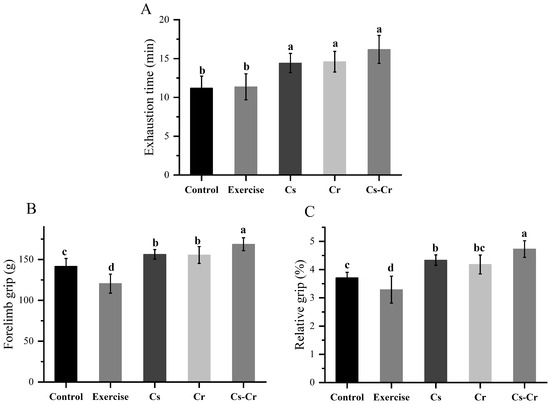
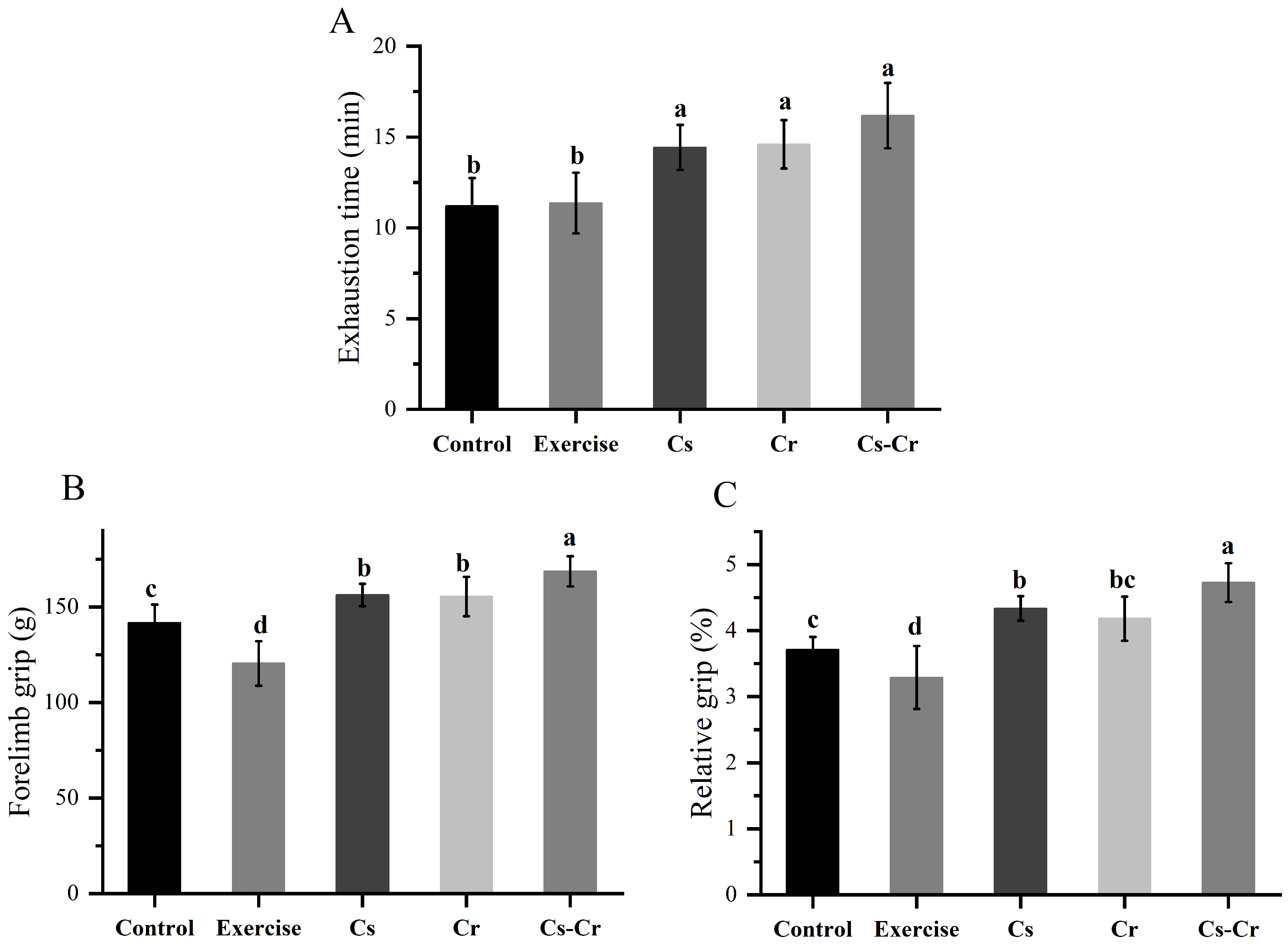
No mice died and no abnormalities were observed during the experiment, indicating the safety of Cs, Cr and Cs-Cr supplementation (Figure S1). The exercise capacity of mice was assessed by determining the weight-bearing swimming exhaustion time and forelimb grip strength, and the results are shown in Figure 1. Compared with the control group, Cs and Cr supplementation significantly prolonged the time to exhaustion, with prolongation rates of 26.95% and 28.44%, respectively. The effect of Cs-Cr supplementation was even more obvious, with a prolongation rate as high as 42.42%, indicating that the supplementation of Cs-Cr was able to improve the endurance of mice significantly. In Figure 1B,C, both the forelimb grasping force and relative grasping force of the exercise-trained mice were smaller than that of the control group, suggesting that the 4-week exercise training may have reduced the muscle mass of the mice. In contrast, supplementation with Cs and Cr significantly increased forelimb grip strength and relative grip strength compared to the exercise group, with a relative grip strength increase of 31.77% and 27.06%, respectively. Compared with Cs or Cr supplementation alone, the combined supplementation of Cs-Cr had a more significant effect on the improvement of forelimb grasping strength and relative grasping strength. The relative grasping strength improvement rate was 43.66%. A previous study showed a positive correlation between muscle mass and grip strength performance [21], which indicates that Cs-Cr supplementation was more effective and it could have improved the muscle mass of the exercise-trained mice.
Figure 1.
Exercise capacity of mice. (A) Exhaustion time. (B) Forelimb grip. (C) Relative grip. Note: Different lowercase letters mean significant differences among the same sample of different times (p < 0.05). n = 10. Cs-Cr: Combined supplementation of sugar and creatine; Cs: compound sugars; Cr: creatine.
3.1.2. Serum Fatigue Indices
Fatigue plays an important role in exercise; LA and BUN levels are biomarkers of fatigue [22]. During anaerobic exercise, LA is the main gluconeogenesis precursor [23]. With strenuous exercise, glucose is broken down to pyruvate. Some of the pyruvate is reduced to LA by lactate dehydrogenase (LDH) due to hypoxia, and the excessive LA accumulation will damage cells and cause fatigue [24]. BUN is a commonly used indicator for clinical evaluation of kidney function. Moreover, during high-intensity exercise, the body metabolizes proteins, which will increase BUN levels due to the lack of energy from fats and sugars.
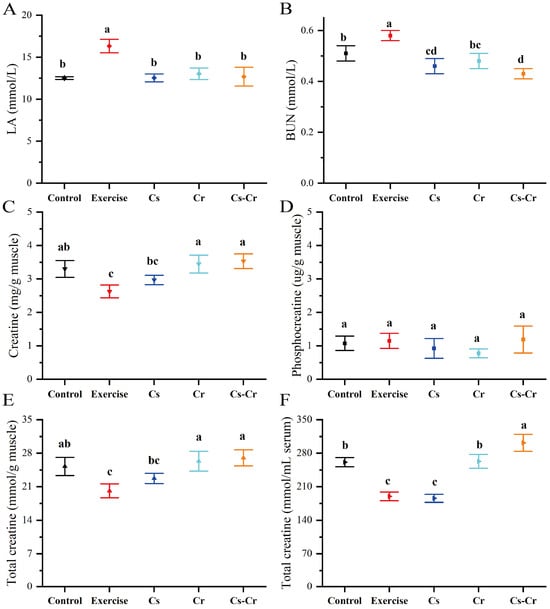
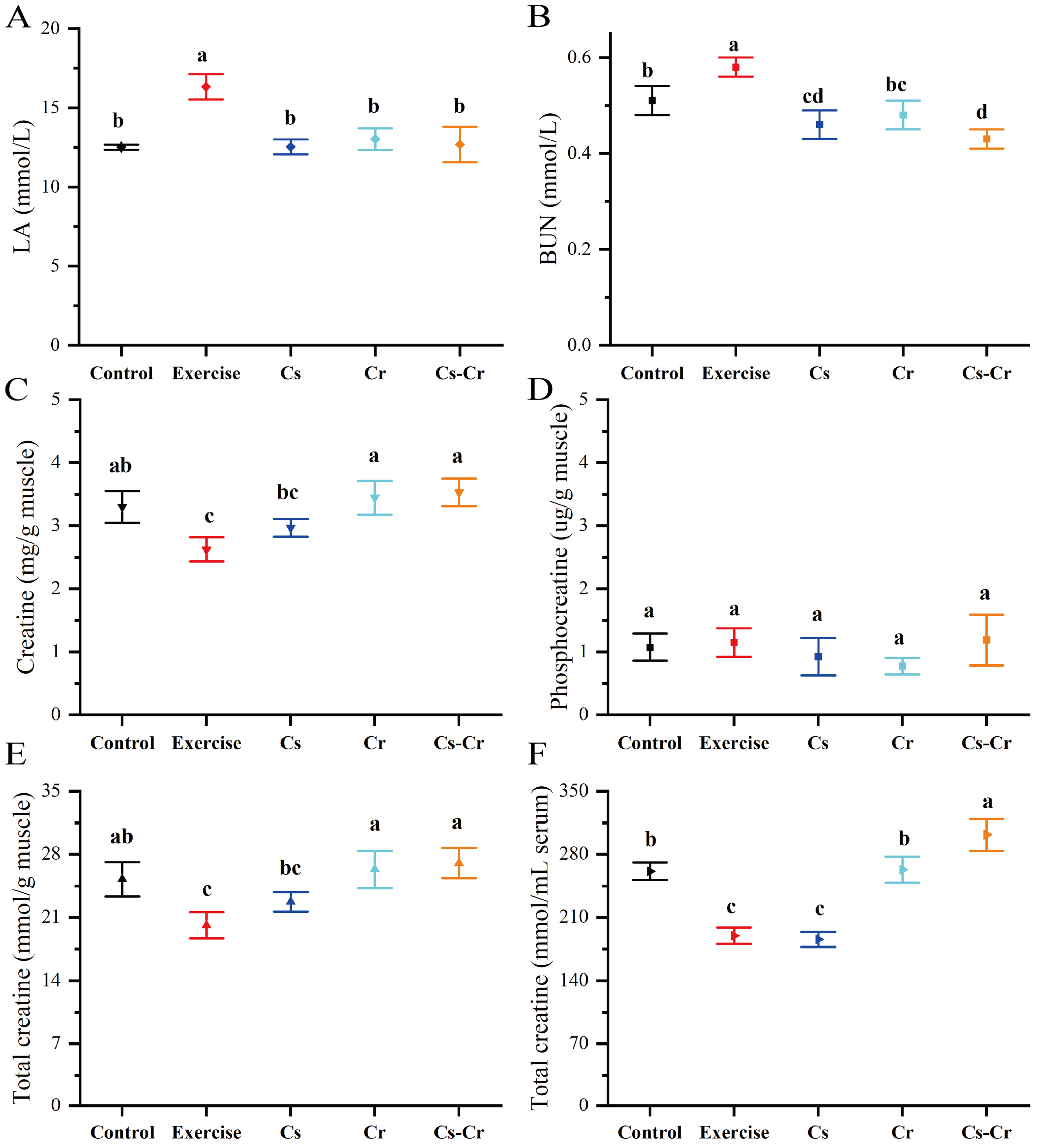
The results of LA and BUN in the serum of mice are shown in Figure 2A,B. After exercise, LA levels were increased. Supplementation with Cs, Cr and Cs-Cr reduced LA levels significantly, with a reduction of 23.22%, 20.22% and 22.30%, respectively. Ceddia et al. found that supplementation of Cr could reduce the production of LA, which is consistent with our experiment [25]. The BUN content of mice was also significantly elevated after exercise. Supplementation with Cs and Cr reduced the BUN content by 20.69% and 17.24%, respectively. Moreover, Cs-Cr supplementation reduced the BUN content more significantly than in the single-supplementation conditions, with a reduction of 25.86% (compared with control group). Taken together, these results suggest that combined supplementation with Cs-Cr could further reduce exercise-induced fatigue and improve exercise performance in mice.
Figure 2.
Serum fatigue indices and creatine contents of mice after exercise. (A) LA. (B) BUN. (C) Creatine. (D) Phosphocreatine. (E) Total creatine. (F) Serum creatine. Note: Different lowercase letters mean significant differences among the same sample of different times (p < 0.05). n = 10. Cs-Cr: Combined supplementation of sugar and creatine; Cs: compound sugars; Cr: creatine.
3.2. Energy Metabolism of Mice
3.2.1. Creatine Contents
During exercise, energy expenditure is a significant factor that contributes to muscle fatigue [26]. Cr facilitates the synthesis of ATP in the body, which is the sole fuel for muscle fiber contraction [27,28]. In addition, Cr promotes the translocation of energy-related products from the mitochondria to the cytoplasm [29].
The intramuscular Cr, phosphocreatine, total Cr contents, as well as the serum total Cr content in each group are shown in Figure 2C–E. In the exercise group, the content of Cr in the muscles was significantly lower than that of the control group, indicating that exercise leads to the loss of Cr in mice, which is similar to the findings of previous studies [30,31]. Compared with the control and Cs groups, the Cr and Cs-Cr groups had a significantly increased content of total Cr in their muscles and serum Figure 2E,F. This indicates that Cr supplementation enhanced Cr levels in mouse muscles, allowing cells to better meet energy demands [32]. At the same time, supplementation of Cs-Cr further increased the serum Cr content when compared with the Cr group. There was no significant difference in phosphocreatine levels between the groups. Compared with previous studies, an increased Cr dosage led to a significantly higher creatine content in the Cs-Cr group than in the Cs group, indicating that the synergistic effect of Cs-Cr was markedly enhanced with the elevated Cs dosage [10]. Creatine is known to enhance exercise endurance by increasing intramuscular phosphocreatine stores, thereby accelerating ATP resynthesis and maintaining energy supply during high-intensity exercise. In addition, it improves muscle strength and contractile efficiency, delays fatigue, and supports prolonged exercise performance. The above results indicated that the combined supplementation of Cs-Cr could increase the Cr content in vivo and provide the timely supply of ATP required by muscles during exercise.
3.2.2. Glycogen Contents
Glycogen and glucose are the main fuel for muscles during exercise; glycogen can be synthesized from glucose or trisaccharides [33]. During higher-intensity exercise, glycogen is considered to be a key factor affecting energy availability [34].
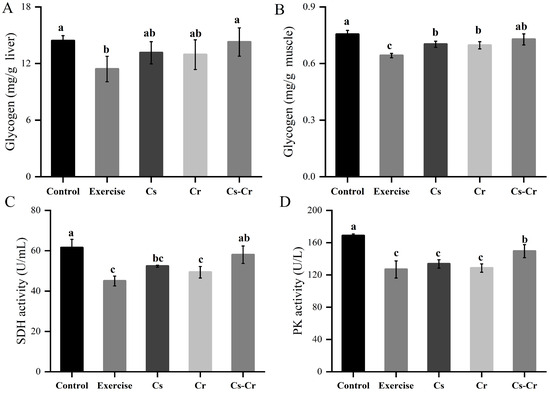
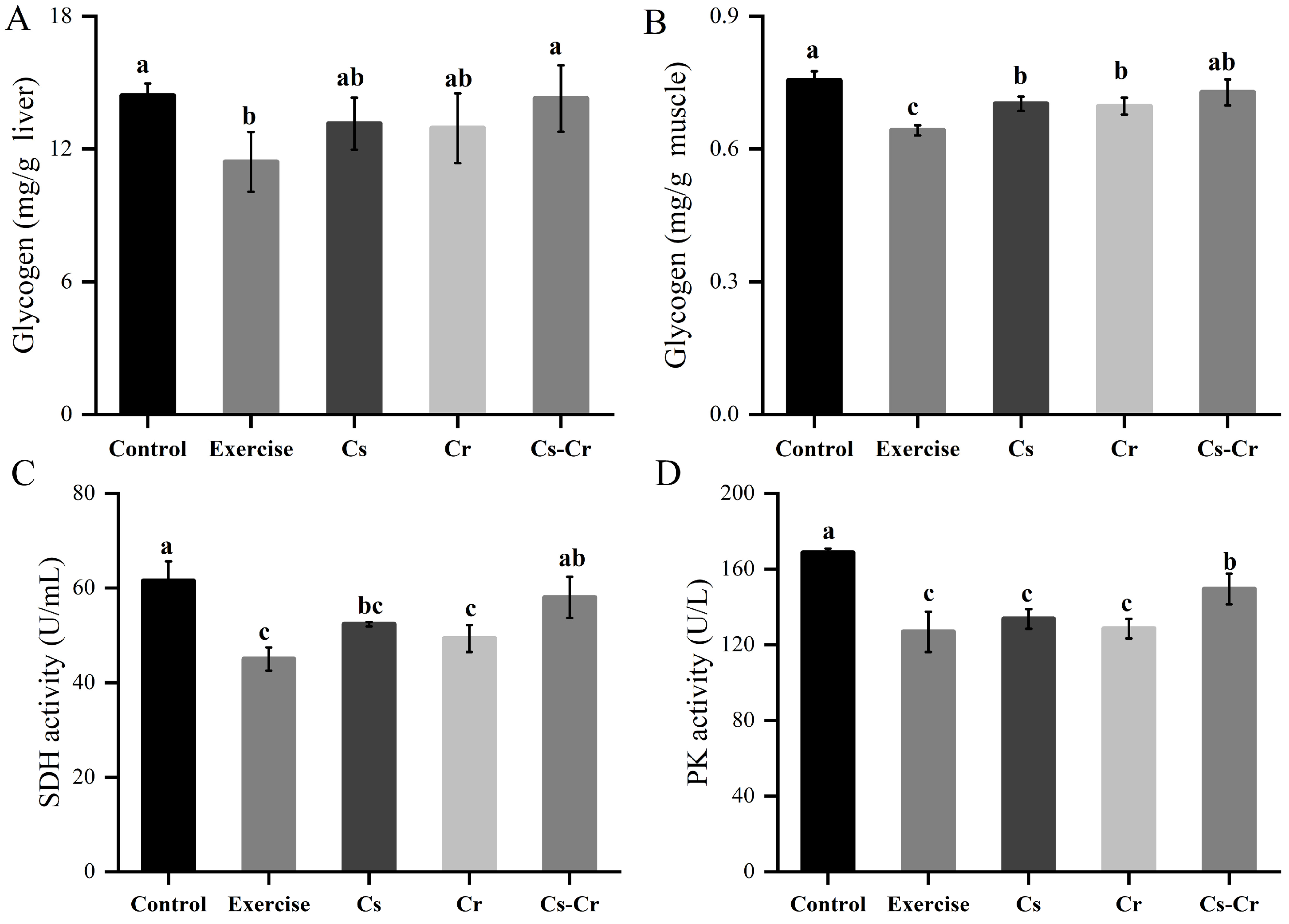
The content of glycogen in mouse liver and muscle is shown in Figure 3. In the exercise group, glycogen content in both the liver and muscle was significantly lower than that of the control group, indicating that exercise depleted glycogen content in mice. Post-exercise supplementation with Cs or Cr slightly increased liver glycogen levels in mice. In contrast, compared with the exercise group, supplementation with Cs-Cr significantly enhanced liver glycogen content by 25.04%. Moreover, Cs-Cr also increased muscle glycogen content dramatically as compared to the individual supplement, which was consistent with the findings of Roberts et al. [35]. Roberts et al. showed that creatine ingestion combined with a high-carbohydrate diet augmented post-exercise muscle glycogen storage compared with carbohydrate alone during the first 24 h of recovery in healthy volunteers. Previous research also indicated that Cr regulated cellular osmotic pressure and stimulated glycogen synthesis in muscle and liver tissues [3]. In this study, Cs and Cr provided the substrate for glycogen synthesis and facilitated glucose uptake by cells, thereby Cs-Cr could significantly increase the glycogen content in the body.
Figure 3.
Glycogen content and SDH and PK activity after weight-bearing swimming in mice. (A) Liver glycogen. (B) Muscle glycogen. (C) SDH activity. (D) PK activity. Note: Different lowercase letters mean significant differences among the same sample of different times (p < 0.05). n = 10. Cs-Cr: Combined supplementation of sugar and creatine; Cs: compound sugars; Cr: creatine.
3.3. SDH and PK Activities
SDH and PK are two key enzymes involved in the cellular synthesis of ATP. SDH plays a dual role in cellular energy production. In the tricarboxylic acid cycle, succinate is oxidized to fumarate under the action of SDH. Additionally, in the oxidative phosphorylation pathway, SDH facilitates ATP synthesis. The activity and concentration of SDH significantly influence energy metabolism [36]. PK is an enzyme that regulates metabolic pathways in glycolysis and is one of the primary rate-limiting enzymes affecting ATP production. It catalyzes the transfer of phosphate from phosphoenolpyruvate to ADP, resulting in the formation of ATP. This process is irreversible, so the activity of PK plays a significant role in the regulation of energy metabolism within the organism [37].
SDH and PK activity were measured in mice and the results are shown in Figure 3C,D. Compared with the control group, both the SDH and PK activity of the exercise group were significantly decreased. Cs or Cr supplementation alone slightly enhanced SDH and PK activity in exercise-trained mice, and the difference was not significant. However, the administration of Cs-Cr significantly increased SDH and PK activity in mice. Taken together, the supplementation of Cs-Cr upgraded the aerobic metabolism of glucose in mice, thereby enhancing the efficiency of energy supply and favoring the improvement of exercise performance.
3.4. Muscle Damage in Mice
3.4.1. Muscle Tissue Weight and LDH and CK Activity
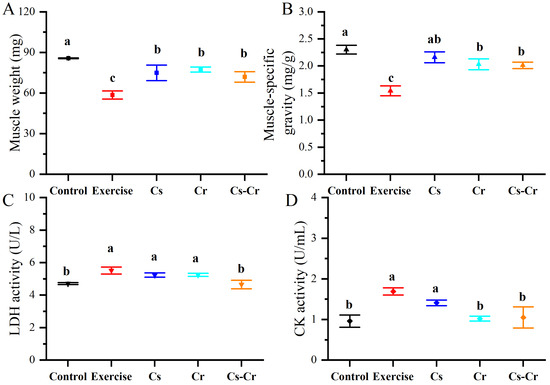
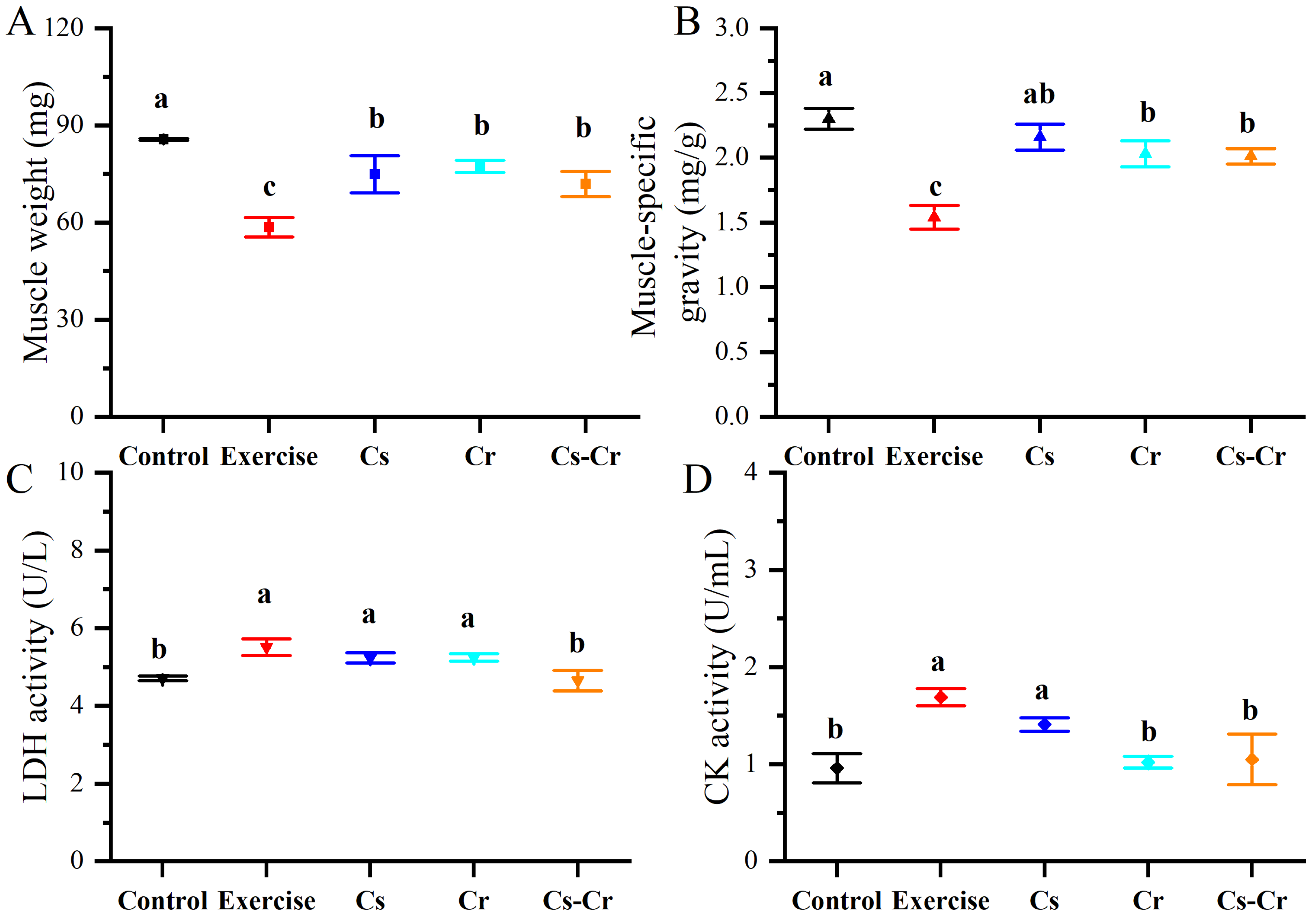
To evaluate the effects of Cs and Cr on the muscle tissue of exercise-trained mice, the mass of the gastrocnemius muscle in the right hind limb was measured. The results are shown in Figure 4. The muscle mass and muscle-specific gravity of the mice decreased significantly after exercise. Cs, Cr and Cs-Cr supplementation significantly increased the muscle mass of mice by 27.74%, 31.91%, and 33.86%, respectively. Which suggested that Cs and Cr were able to reduce exercise-induced muscle loss and improve muscle strength.
Figure 4.
Muscle damage in mice after exercise. (A) Muscle weight. (B) Muscle-specific gravity. (C) LDH activity. (D) CK activity. Note: Different lowercase letters mean significant differences among the same sample of different times (p < 0.05). n = 10. Cs-Cr: Combined supplementation of sugar and creatine; Cs: compound sugars; Cr: creatine.
The serum levels of LDH and CK are recognized as reliable biomarkers for the evaluation of muscle injury. LDH is a key enzyme that breaks down the anaerobic metabolite LA in the human body. Under normal physiological conditions, LDH mainly exists in muscle cells, but exercise can easily cause muscle damage, leading LDH to flow into the serum [38]. CK is a key kinase directly related to intracellular energy transfer, muscle contraction, and ATP regeneration. CK is usually present in large quantities in muscle tissue. When muscle cell membranes are damaged by strenuous exercise, the permeability of the membranes increases, leading to an increased activity of CK in the blood.
The LDH and CK activities in the serum of each group are shown in Figure 4C,D. Compared with the control group, the LDH and CK activities in the serum were significantly increased after exercise, indicating that the exercise intensity caused damage to muscle cells. The effect of individual supplementation with Cs or Cr on serum LDH activity was not significant. However, the LDH activity was significantly reduced by 15.53% in the Cs-Cr group. In addition, the activity of CK in the Cs-Cr group was also reduced by 37.87%. These results indicated that supplementation of Cs-Cr could better reduce the loss of LDH and CK in muscles and alleviate the damage of muscle cells.
3.4.2. Muscle Tissue Morphology
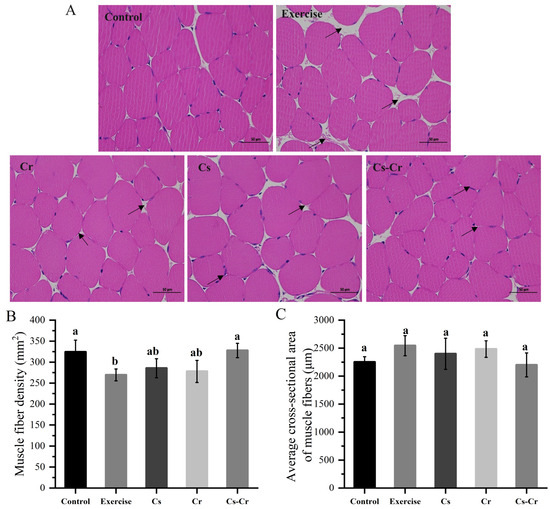
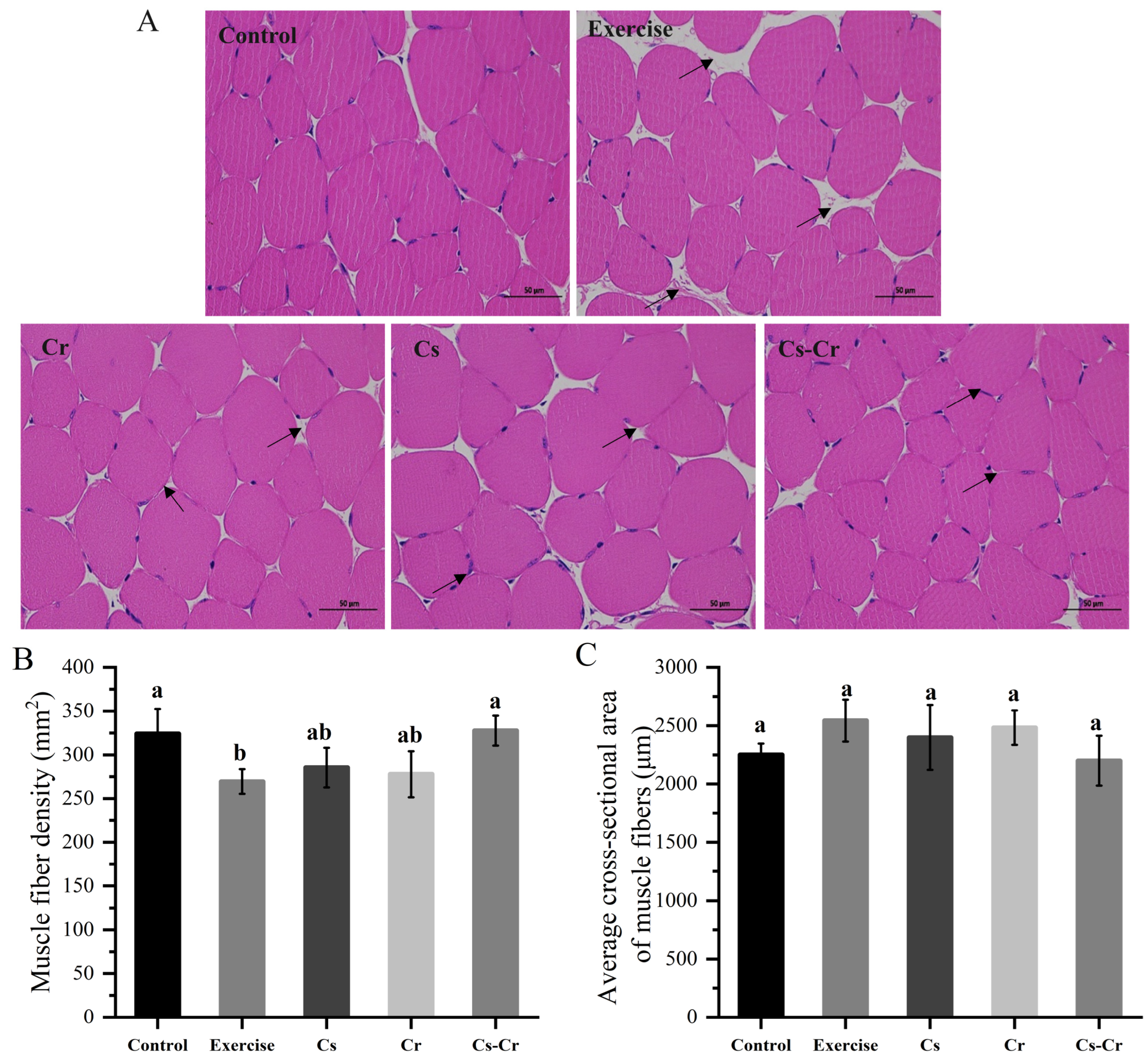
The muscle tissue was sliced, and the visualization of myofiber alterations is presented in Figure 5A. The myofibrils of control mice were polygonal fusiform, regularly arranged, and there were multiple nuclei distributed around the myofibrils. Compared to the control group, the muscle fibers of exercise-trained mice exhibited a more rounded morphology, displayed size variability, and were surrounded by infiltrating inflammatory cells. These observations are consistent with previous studies showing that high-intensity or prolonged exercise induces muscle fiber injury, characterized by reduced fiber density, increased interstitial space, and altered fiber morphology [39]. In the Cr and Cs groups, the incidence of inflammation was significantly reduced. This phenomenon indicated that supplementation with Cs and Cr reduced skeletal muscle damage effectively. The results of quantifying muscle fibers using Image J software are shown in Figure 5B,C. There was no significant difference in the average cross-sectional area of muscle fibers in each group of mice. Compared with the exercise group, supplementation of Cs-Cr significantly increased the myofiber density of mice by 21.60%, which was close to that of the control group. These findings are in line with previous reports showing that creatine supplementation can enhance muscle energy buffering capacity, reduce muscle damage, and promote recovery following exercise [40]. Therefore, combined supplementation of Cs and Cr may enhance the overall strength of muscles and mitigate muscle damage induced by four weeks of training.
Figure 5.
Morphology of muscle tissue in mice. (A) Muscle tissue morphology. (B) Muscle fiber density. (C) Average cross-sectional area of muscle fibers. Note: Different lowercase letters mean significant differences among the same sample of different times (p < 0.05). n = 10. Cs-Cr: Combined supplementation of sugar and creatine; Cs: compound sugars; Cr: creatine.
3.5. Stability of Cs-Cr in Solid Beverages
3.5.1. Effect of Suspension Agents on Suspension Stability
Based on the above research, it has been demonstrated that Cs-Cr supplementation exhibits a synergistic effect in enhancing athletic performance in mice, indicating its viability as a primary formulation for sports nutrition products. However, limited by the poor solubility of Cr, the undissolved Cr results in a very poor appearance and taste in the product [41]. Therefore, further research is needed to investigate the suspension stability and rheological properties of Cs-Cr by adding suspension agents. The effect of a single suspending agent (XG, LBG) on the suspension stability, dispersion time and rheological properties can be seen in Table 1 and Table 2. XG easily maintained a stable suspension of particles, with a high viscosity and yield stress. LBG had a lower viscosity, but the suspension stability was poor.
Table 1.
Effect of single additions of XG and LBG on suspension stability and dispersion time.
Table 2.
Rheological parameters of XG and LBG.
XG and LBG have been reported to have strong interactions [42]. Different concentrations of XG and LBG (total concentration of 0.2%) were added to the Cs-Cr beverage to study the rheological characterization parameters. As can be seen in Table 3, the fluid property indices of the Cs-Cr solutions were all less than 1, which represents the shear-thinning system. When the ratio of XG to LBG was between 5:5 and 8:2, both the yield stress and consistency coefficient values were enhanced, demonstrating a significant synergistic effect. The stability indices of Cs-Cr beverages with different proportions of XG and LBG are shown in Table 4. When the proportion of XG was 30–80%, the solution could be stabilized for at least 1 h, and the dispersion time was 1.2–1.5 min.
Table 3.
Rheological parameters of the compound system of XG and LBG.
Table 4.
Effect of compound stabilizer of XG and LBG on suspension stability.
To further ascertain the optimal ratio of the two suspending agents, the centrifugal sedimentation rates of the beverages were measured. The results are illustrated in Table 4. When the ratio of XG to LBG was 6:4, the centrifugal precipitation rate was the lowest. This is similar to the result wherein the strongest intermolecular interaction was found when the ratio of XG was greater than that of LBG [43]. At this time, the dispersion time of the solution was 82.13 s and the viscosity was 8.08 mPa-s; this result was significantly lower than that of 0.3% XG (23.18 mPa-s). Furthermore, a viscosity of 8.08 mPa-s is considered suitable for achieving an acceptable sensory perception and palatability in sports beverages [44]. XG possesses a cellulose-like backbone with charged trisaccharide side chains, whereas LBG is a galactomannan with a relatively unsubstituted mannose backbone. This structural complementarity enables LBG to associate with the ordered regions of XG, forming a weakly cross-linked network through intermolecular entanglement and specific interactions, thereby significantly enhancing the consistency coefficient and yield stress of the system [45,46].
3.5.2. Effect of Anti-Caking Agents on Powder Stability
The large number of small molecular sugars in the Cs-Cr powder mean it is easy for it to absorb moisture, resulting in particle adhesion to reduce the quality of the product. The initial solid beverage formulation identified in this study contained 85.7 g of low-molecular-weight sugars per 100 g, which were recognized as hygroscopic substances [47]. Therefore, it is essential to enhance the stability of the product powder by incorporating various anti-caking agents.
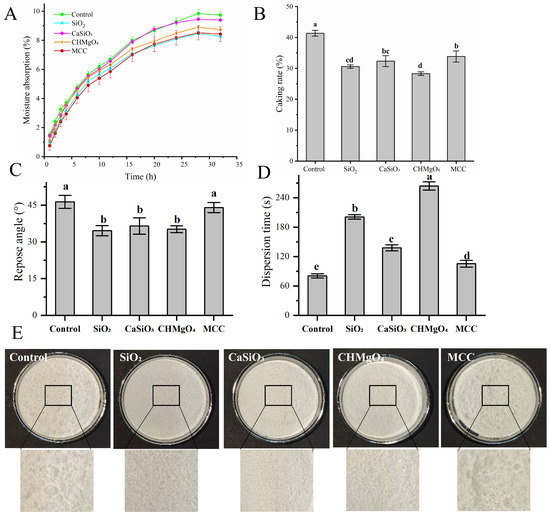
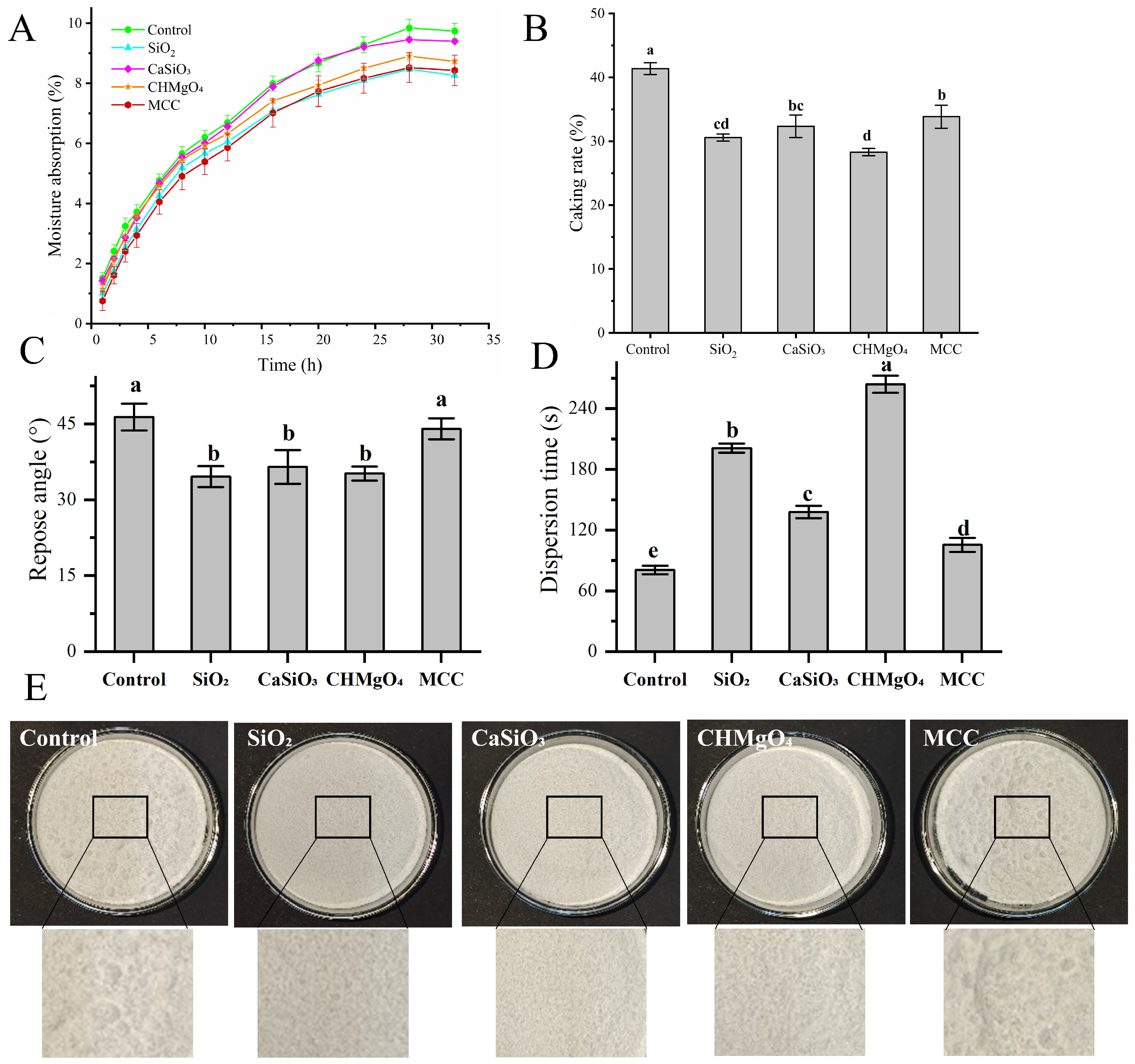
The powders produced with different anti-caking agents were placed in moisture absorption equilibrium at room temperature and 81% relative humidity. The moisture absorption curves at different times are shown in Figure 6A. The results showed that the moisture absorption rate of each mixed powder increased rapidly in the initial stage, and then the growth rate slowed down and tended to equilibrize. The equilibrium moisture content of each powder mixture from high to low was control > CaSiO3 > CHMgO4 > MCC > SiO2. All of the anti-caking agents were able to reduce the moisture absorption of the solid powders. Among them, SiO2 was the most effective anti-caking agent. The reason may be that SiO2 could adhere to the surface of the sample particles to form a physical barrier. At the same time, the hydrophobicity of SiO2 also positively affects the inhibition of moisture absorption [48].
Figure 6.
Effect of anti-caking agents on powder stability. (A) Moisture absorption of product powder. (B) Caking rate. (C) Powder repose angle. (D) Dispersion time. (E) Apparent morphology. Note: Different lowercase letters mean significant differences among the same sample of different times (p < 0.05). n = 3.
The caking rates and states of different powders are shown in Figure 6B,E. The addition of all anti-caking agents significantly reduced the agglomeration, and the agglomeration rate from high to low was MCC, CaSiO3, SiO2 and CHMgO4. Meanwhile, it can be inferred that the raw powder and MCC exhibited significant particle aggregation. Powders with the addition of the three other anti-caking agents demonstrated a fine and smooth surface, free from particle aggregation.
Hygroscopicity could cause the powder to become viscous, leading to a lack of flow. Concurrently, it increases the Van der Waals forces between particles and the cohesive forces within the molecules, consequently reducing flowability [49]. Powder repose angle is a common means of quantifying powder flowability. Lower repose angle indicates lower agglomeration and better flowability, the repose angle of a powder with a good flowability should be lower than 40° [50,51]. After hygroscopicity testing, the repose angles of the control and the MCC group were 46° and 44°, respectively. These results indicated that they do not meet the criteria for good powder flowability (Figure 6C). In contrast, the addition of CaSiO3, CHMgO4, SiO2 all improved the flowability of the hygroscopic solid beverage powders, and the repose angle of the powders significantly reduced to below 40°. The dispersion time for each solid powder is shown in Figure 6D. The addition of anti-caking agents significantly increased the dispersion time. CaSiO3 showed anti-caking activity by reducing the affinity between particles and water. CHMgO4 and SiO2 served as water-repellent agents, establishing a barrier between water and particles to prevent powder agglomeration. However, they also impede the dispersion rate of the powder in water [52]. In summary, the addition of 1.5% CaSiO3 could effectively reduce both powder agglomeration and dispersion time.
4. Conclusions
In this study, the effects of combined supplementation of Cs-Cr (4 g of glucose, 5 g of creatine monohydrate, 6 g of sucrose, 15 g of isomaltulose, and 5 g of maltodextrin per serving) on the athletic performance of mice were investigated. The results indicated that Cs-Cr prolonged the time to exhaustion, enhanced forelimb grip strength, and enhanced relative grip strength. Muscle Cr and serum total Cr levels were significantly increased in the Cs-Cr supplementation group. Furthermore, Cs-Cr reduced LDH loss from myocytes by increasing SDH and PK viability and resulted in a significant elevation of myofibril density in exercise-trained mice. The combined use of xanthan gum (XG) and locust bean gum (LBG) (6:4) had a synergistic effect, and leading to an increase in the stability and viscosity of the Cs-Cr beverages. The addition of 1.5% CaSiO3 reduced the caking of the powder and elevated the stability of the product, so as to meet the market demand. These results provide scientific evidence for the rational design of functional sports drinks, highlighting both the performance-enhancing potential of Cr-Cs supplementation and the practical considerations for product formulation. This work not only advances our understanding of nutritional strategies to improve athletic performance but also offers guidance for the development of stable and effective sports nutrition products.
Supplementary Materials
The following supporting information can be downloaded at https://www.mdpi.com/article/10.3390/pr14081196/s1, Figure S1: Effects of co-ingestion on fasting blood glucose (A), body weight (B), kidney index (C), liver index (D), food intake (E), and water intake (F) of mice. Note: Different lowercase letters mean significant differences among the same sample of different times (p < 0.05). n = 10. Cs-Cr: combined supplementation of sugar and creatine; Cs: compound sugars; Cr: creatine.
Author Contributions
Y.Z. (Yue Zhang): Investigation, Data curation, Writing—original draft. H.L.: Supervision, Data curation, Investigation. S.Z.: Formal analysis, Visualization, Writing—review and editing, Funding acquisition. Y.Z. (Yanting Zhao): Software, Methodology. F.L.: Supervision, Investigation. X.L.: Methodology. Y.L.: Supervision, Methodology, Funding acquisition. All authors have read and agreed to the published version of the manuscript.
Funding
The research was supported by the National Natural Science Foundation of China (No. 32272314, 32172197), 111 project (B0719028), the National first-class discipline program of Food Science and Technology (JUFSTR20180204), and the program “Collaborative Innovation Center of Food Safety and Quality Control in Jiangsu Province”, China.
Data Availability Statement
The original contributions presented in this study are included in the article/Supplementary Materials. Further inquiries can be directed to the corresponding author.
Conflicts of Interest
The authors declare no conflicts of interest.
References
- Mills, S.; Candow, D.G.; Forbes, S.C.; Neary, J.P.; Ormsbee, M.J.; Antonio, J. Effects of creatine supplementation during resistance training sessions in physically active young adults. Nutrients 2020, 12, 1880. [Google Scholar] [CrossRef] [Scilit] [PubMed]
- Wax, B.; Kerksick, C.M.; Jagim, A.R.; Mayo, J.J.; Lyons, B.C.; Kreider, R.B. Creatine for Exercise and Sports Performance, with Recovery Considerations for Healthy Populations. Nutrients 2021, 13, 1915. [Google Scholar] [CrossRef] [Scilit] [PubMed]
- Forbes, S.C.; Candow, D.G.; Neto, J.H.F.; Kennedy, M.D.; Forbes, J.L.; Machado, M.; Bustillo, E.; Gomez-Lopez, J.; Zapata, A.; Antonio, J. Creatine supplementation and endurance performance: Surges and sprints to win the race. J. Int. Soc. Sports Nutr. 2023, 20, 2204071. [Google Scholar] [CrossRef] [Scilit] [PubMed]
- Green, A.L.; Hultman, E.; Macdonald, I.A.; Sewell, D.A.; Greenhaff, P.L. Carbohydrate ingestion augments skeletal muscle creatine accumulation during creatine supplementation in humans. Am. J. Physiol. 1996, 271, 821–826. [Google Scholar] [CrossRef] [Scilit]
- Kuipers, H.; Fransen, E.J.; Keizer, H.A. Pre-exercise ingestion of carbohydrate and transient hypoglycemia during exercise. Int. J. Sports Med. 1999, 20, 227–231. [Google Scholar] [CrossRef] [Scilit]
- Burdon, C.A.; Spronk, I.; Cheng, H.L.; O’Connor, H.T. Effect of glycemic index of a pre-exercise meal on endurance exercise performance: A systematic review and meta-analysis. Sports Med. 2017, 47, 1087–1101. [Google Scholar] [CrossRef] [Scilit]
- Yoshizawa, K.; Kurono, R.; Sato, H.; Ishijima, E.; Nasu, H.; Ferdaos, N. Effect of sucrose on cisplatin-induced fatigue-like behavior in mice: Comparison with fructose and glucose. Cancer Diagn. Progn. 2021, 1, 95–102. [Google Scholar] [CrossRef] [Scilit]
- Manzoor, M.; Singh, J.; Bandral, J.D.; Gani, A.; Shams, R. Food hydrocolloids: Functional, nutraceutical and novel applications for delivery of bioactive compounds. Int. J. Biol. Macromol. 2020, 165, 554–567. [Google Scholar] [CrossRef] [Scilit]
- Zhang, H.; Yan, Z.; Xie, F.; Tian, Y.; Ai, L. Rheological Properties and Kinetics of Gelation of Binary Polymers between Xanthan Gum and Locust Bean Gum. Polymers 2023, 15, 4604. [Google Scholar] [CrossRef] [Scilit]
- Liao, H.; Zhu, S.; Li, Y.; Huang, D. The synergistic effect of compound sugar with different glycemic indices combined with creatine on exercise-related fatigue in mice. Foods 2024, 13, 489. [Google Scholar] [CrossRef] [Scilit]
- Bian, X.; Wang, Y.; Yang, R.; Ma, Y.; Dong, W.; Guo, C.; Gao, W. Anti-fatigue properties of the ethanol extract of Moringa oleifera leaves in mice. J. Sci. Food Agric. 2023, 103, 5500–5510. [Google Scholar] [CrossRef] [Scilit]
- Zhang, L.; Zhu, X.D.; Wang, X.F.; Li, J.L.; Gao, F.; Zhou, G.H. Individual and combined effects of in-ovo injection of creatine monohydrate and glucose on somatic characteristics, energy status, and posthatch performance of broiler embryos and hatchlings. Poult. Sci. 2016, 95, 2352–2359. [Google Scholar] [CrossRef] [Scilit] [PubMed]
- Kilic-Erkek, O.; Caner, V.; Abban-Mete, G.; Baris, I.C.; Bor-Kucukatay, M. Determination of the pathways of potential muscle damage and regeneration in response to acute and long-term swimming exercise in mice. Life Sci. 2021, 272, 119265. [Google Scholar] [CrossRef] [Scilit] [PubMed]
- Lipasek, R.A.; Taylor, L.S.; Mauer, L.J. Effects of anticaking agents and relative humidity on the physical and chemical stability of powdered vitamin C. J. Food Sci. 2011, 76, 1062–1074. [Google Scholar] [CrossRef] [Scilit] [PubMed]
- Silva, R.; Rocha, R.S.; Ferreira, M.V.S.; Ramos, G.L.P.A.; Arruda, H.S.; Borsoi, F.T. Evaluating the galactooligosaccharide stability in chocolate milk beverage submitted to ohmic heating. Food Res. Int. 2024, 188, 114429. [Google Scholar] [CrossRef] [Scilit]
- Li, Y.; Fan, L. Comparative studies on the stabilization of Flos Sophorae Immaturus beverages by various hydrocolloids. LWT-Food Sci. Technol. 2020, 123, 109117. [Google Scholar] [CrossRef] [Scilit]
- Zhang, S.; Zhu, S.; Zhong, F.; Huang, D.J.; Li, Y. Fish collagen peptides, an effective starch gelatinization regulator, modify the processing properties and improve the nutritional value of wheat starch. Food Hydrocoll. 2024, 149, 109612. [Google Scholar] [CrossRef] [Scilit]
- Panchanadikar, N.T.; Sivasubramanian, A.; Muthu, M.S.; Swaminathan, K.; Vignesh, K.C.; Nagalakshmi, S.; Seetharaman, S. Comparison of viscosities of human breast milk versus infant milk formulae with and without addition of sweetening agents. J. Indian Soc. Pedod. Prev. Dent. 2022, 40, 437–444. [Google Scholar] [CrossRef] [Scilit]
- Choo, K.Y.; Bai, K. Effects of bentonite concentration and solution pH on the rheological properties and long-term stabilities of bentonite suspensions. Appl. Clay Sci. 2015, 108, 182–190. [Google Scholar] [CrossRef] [Scilit]
- Suppakul, P.; Chalernsook, B.; Ratisuthawat, B.; Prapasitthi, S.; Munchukangwan, N. Empirical modeling of moisture sorption characteristics and mechanical andbarrier properties of cassava flour film and their relation to plasticizing-antiplasticizing effects. LWT-Food Sci. Technol. 2013, 50, 2334–2401. [Google Scholar] [CrossRef] [Scilit]
- Confortin, S.C.; Aristizábal, L.Y.G.; Bragança, M.L.B.M.; Cavalcante, L.C.; Alves, J.D.A.; Batista, R.F.L. Are fat mass and lean mass associated with grip strength in adolescents? Nutrients 2022, 14, 3259. [Google Scholar] [CrossRef] [Scilit] [PubMed]
- Hu, N.; Sun, J.; Cao, Y.; Zhao, H.; Sun, M.; Li, G.; Liu, X.; Cong, S. Anti-Fatigue Activity of Corn Protein Hydrolysate Fermented by Lactic Acid Bacteria. Nutrients 2025, 17, 199. [Google Scholar] [CrossRef] [Scilit] [PubMed]
- San-Millán, I.; Brooks, G.A. Reexamining cancer metabolism: Lactate production for carcinogenesis could be the purpose and explanation of the warburg effect. Carcinogenesis 2017, 38, 119–133. [Google Scholar] [CrossRef] [Scilit] [PubMed]
- Proia, P.; Liegro, C.M.; Schiera, G.; Fricano, A.; Liegro, I. Lactate as a metabolite and a regulator in the central nervous system. Int. J. Mol. Sci. 2016, 17, 1450. [Google Scholar] [CrossRef] [Scilit]
- Ceddia, R.B.; Sweeney, G. Creatine supplementation increases glucose oxidation and AMPK phosphorylation and reduces lactate production in L6 rat skeletal muscle cells. J. Physiol. 2004, 555, 409–421. [Google Scholar] [CrossRef] [Scilit]
- Sahlin, K.; Tonkonogi, M.; Söderlund, K. Energy supply and muscle fatigue in humans. Acta Physiol. Scand. 1998, 162, 261–266. [Google Scholar] [CrossRef] [Scilit]
- Kreider, R.B.; Stout, J.R. Creatine in health and disease. Nutrients 2021, 13, 447. [Google Scholar] [CrossRef] [Scilit]
- Murray, B.; Rosenbloom, C. Fundamentals of glycogen metabolism for coaches and athletes. Nutr. Rev. 2018, 76, 243–259. [Google Scholar] [CrossRef] [Scilit]
- Bonilla, D.A.; Kreider, R.B.; Stout, J.R.; Forero, D.A.; Kerksick, C.M.; Roberts, M.D.; Rawson, E.S. Metabolic basis of creatine in health and disease: A bioinformatics-assisted review. Nutrients 2021, 13, 1238. [Google Scholar] [CrossRef] [Scilit]
- Brosnan, M.E.; Brosnan, J.T. The role of dietary creatine. Amino Acids 2016, 48, 1785–1791. [Google Scholar] [CrossRef] [Scilit]
- Kreider, R.B.; Melton, C.; Rasmussen, C.J.; Greenwood, M.; Lancaster, S.; Cantler, E.C. Long-term creatine supplementation does not significantly affect clinical markers of health in athletes. Mol. Cell. Biochem. 2003, 244, 95–104. [Google Scholar] [CrossRef] [Scilit]
- Persky, A.M.; Brazeau, G.A.; Hochhaus, G. Pharmacokinetics of the dietary supplement creatine. Clin. Pharmacokinet. 2003, 42, 557–574. [Google Scholar] [CrossRef] [Scilit] [PubMed]
- Kurland, I.J.; Pilkis, S.J. Indirect versus direct routes of hepatic glycogen synthesis. FASEB J. 1989, 3, 2277–2281. [Google Scholar] [CrossRef] [Scilit]
- Gonzalez, J.T.; Fuchs, C.J.; Betts, J.A.; van Loon, L.J.C. Liver glycogen metabolism during and after prolonged endurance-type exercise. Am. J. Physiol. Endocrinol. Metab. 2016, 311, 543–553. [Google Scholar] [CrossRef] [Scilit] [PubMed]
- Roberts, P.A.; Fox, J.; Peirce, N.; Jones, S.W.; Casey, A.; Greenhaff, P.L. Creatine ingestion augments dietary carbohydrate mediated muscle glycogen supercompensation during the initial 24 h of recovery following prolonged exhaustive exercise in humans. Amino Acids 2016, 48, 1831–1842. [Google Scholar] [CrossRef] [Scilit]
- Moosavi, B.; Berry, E.A.; Zhu, X.L.; Yang, W.C.; Yang, G.F. The assembly of succinate dehydrogenase: A key enzyme in bioenergetics. Cell. Mol. Life Sci. 2019, 76, 4023–4042. [Google Scholar] [CrossRef] [Scilit]
- Schormann, N.; Hayden, K.L.; Lee, P.; Banerjee, S.; Chattopadhyay, D. An overview of structure, function, and regulation of pyruvate kinases. Protein Sci. A Publ. Protein Soc. 2019, 28, 1771–1784. [Google Scholar] [CrossRef] [Scilit]
- Young, A.; Oldford, C.; Mailloux, R.J. Lactate dehydrogenase supports lactate oxidation in mitochondria isolated from different mouse tissues. Redox Biol. 2020, 28, 101339. [Google Scholar] [CrossRef] [Scilit]
- Stožer, A.; Vodopivc, P.; Bombek, L.K. Pathophysiology of exercise-induced muscle damage and its structural, functional, metabolic, and clinical consequences. Physiol. Res. 2020, 69, 565–598. [Google Scholar] [CrossRef] [Scilit]
- Kim, J.; Lee, J.; Kim, S.; Yoon, D.; Kim, J.; Sung, D.J. Role of creatine supplementation in exercise-induced muscle damage: A mini review. J. Exerc. Rehabil. 2015, 11, 244–250. [Google Scholar] [CrossRef] [Scilit]
- Edgar, G.; Shiver, H.E. The equilibrium between creatine and creatine, in aqueous solution, the effect of hydroden ion. J. Am. Chem. Soc. 1925, 47, 1179–1188. [Google Scholar] [CrossRef] [Scilit]
- Ram, J.A.; Barrera, M.; Morales, O.G.; Vázquez, M. Effect of xanthan and locust bean gums on the gelling properties of myofibrillar protein. Food Hydrocoll. 2002, 16, 11–16. [Google Scholar] [CrossRef] [Scilit]
- Moghaddam, T.M.; Razavi, S.M.A.; Emadzadeh, B. Rheological interactions between Lallemantia royleana seed extract and selected food hydrocolloids. J. Sci. Food Agric. 2011, 91, 1083–1088. [Google Scholar] [CrossRef] [Scilit] [PubMed]
- Wagoner, T.B.; Çakır-Fuller, E.; Shingleton, R.; Drake, M.; Foegeding, E.A. Viscosity drives texture perception of protein beverages more than hydrocolloid type. J. Texture Stud. 2020, 51, 78–91. [Google Scholar] [CrossRef] [Scilit]
- Wang, L.; Tian, H.; Zhang, W.; Li, C.; Xiang, D. Insights into interaction mechanism between xanthan gum and galactomannan based on density functional theory and rheological properties. Food Chem. 2023, 418, 135990. [Google Scholar] [CrossRef] [Scilit]
- Petitjean, M.; Isasi, J.R. Locust Bean Gum, a Vegetable Hydrocolloid with Industrial and Biopharmaceutical Applications. Molecules 2022, 27, 8265. [Google Scholar] [CrossRef] [Scilit]
- Nadali, N.; Pahlevanlo, A.; Sarabi-Jamab, M.; Balandari, A. Effect of maltodextrin with different dextrose equivalents on the physicochemical properties of spray-dried barberry juice (Berberis vulgaris L.). J. Food Sci. Technol. 2021, 59, 2855–2866. [Google Scholar] [CrossRef] [Scilit]
- Fu, Y.; Luo, F.; Ma, L.; Dai, H.; Wang, H.; Chen, H. The moisture adsorption, caking, and flowability of silkworm pupae peptide powders: The impacts of anticaking agents. Food Chem. 2023, 419, 135989. [Google Scholar] [CrossRef] [Scilit]
- Chen, Y.; Jallo, L.; Quintanilla, M.A.S.; Dave, R. Characterization of particle and bulk level cohesion reduction of surface modified fine aluminum powders. Colloids Surf. A Physicochem. Eng. Asp. 2010, 361, 66–80. [Google Scholar] [CrossRef] [Scilit]
- Aguilera, R.J.; Jose, D.V.; Karel, M. Caking phenomena in amorphous food powders. Trends Food Sci. Technol. 1995, 6, 149–155. [Google Scholar] [CrossRef] [Scilit]
- Rautenberg, A.; Lamprecht, A. Spray-freeze-dried lyospheres: Solid content and the impact on flowability and mechanical stability. Powder Technol. Int. J. Sci. Technol. Wet Dry Part. Syst. 2022, 411, 1956–1963. [Google Scholar] [CrossRef] [Scilit]
- Nurhadi, B.; Roos, Y.H. Influence of anti-caking agent on the water sorption isotherm and flow-ability properties of vacuum dried honey powder. J. Food Eng. 2017, 210, 76–82. [Google Scholar] [CrossRef] [Scilit]

Disclaimer/Publisher’s Note: The statements, opinions and data contained in all publications are solely those of the individual author(s) and contributor(s) and not of MDPI and/or the editor(s). MDPI and/or the editor(s) disclaim responsibility for any injury to people or property resulting from any ideas, methods, instructions or products referred to in the content. |
© 2026 by the authors. Licensee MDPI, Basel, Switzerland. This article is an open access article distributed under the terms and conditions of the Creative Commons Attribution (CC BY) license.