Article

Geoelectric Response Characteristics of Leakage in Earth-Rock Dams Considering Reservoir Water Level Fluctuations: Numerical Simulation and In Situ Validation
1
Zhejiang Guangchuan Engineering Consulting Co., Ltd., Hangzhou 310020, China
2
School of Earth and Environment, Anhui University of Science and Technology, Huainan 232001, China
*
Author to whom correspondence should be addressed.
Processes 2026, 14(8), 1198; https://doi.org/10.3390/pr14081198
Submission received: 6 March 2026 / Revised: 7 April 2026 / Accepted: 8 April 2026 / Published: 9 April 2026

Abstract

Reservoir water level fluctuations alter the saturation line in earth-rock dams, thereby affecting the accuracy of electrical leakage detection. To quantitatively investigate this influence, a three-dimensional (3D) geoelectric model of a concentrated leakage pathway was constructed using COMSOL Multiphysics based on parameters from a reservoir in Zhejiang Province. Numerical simulations were performed under unsaturated, partially saturated, and fully saturated conditions with respect to the leakage zone, and a fixed-electrode monitoring system was deployed for in situ validation. The results show that 3D resistivity slices can approximately delineate the leakage hazard center. Under fully saturated conditions, the low-resistivity anomaly center shifts upward by 0.7 m. Under unsaturated conditions, the high-resistivity anomaly center shifts upward by 1.7 m. Under partially saturated conditions, the high-resistivity anomaly center exhibits the most pronounced upward shift (3.0 m). Notably, under partially saturated conditions, the boundary point between the high- and low-resistivity anomalies is located close to the central depth of the leakage pathway (deviation of approximately 0.7 m above the center), serving as a useful diagnostic indicator. In situ tests corroborate these findings, with identified anomaly zones matching the actual leakage points. This study provides a quantitative framework for interpreting geoelectrical data in earth-rock dams under fluctuating reservoir levels.

1. Introduction

Of the approximately 98,000 reservoir dams in China, 89.9% are earth-rock dams [1]. With the intensification of global seasonal climate change, the hydrogeological environment of reservoir areas is undergoing significant alterations. Periodic rises and falls in water level expose dam slopes to cyclic saturation-drying-rewetting processes, leading to deterioration of the mechanical properties and seepage field of the dam body, resulting in decreased stability and increased seepage [2,3,4]. Concurrently, reservoir water level fluctuations can significantly interfere with the detection of hidden leakage pathways, posing potential threats to the safe operation and maintenance of reservoir dams [5,6,7].
Reservoir water level fluctuations affect the seepage stability of earth-rock dams, primarily through changes in saturation line elevation, soil strength, and effective stress, all of which significantly influence dam seepage and stability. Current methods for detecting leakage hazards in earth-rock dams are broadly classified as non-destructive and destructive techniques. Non-destructive methods primarily employ geophysical approaches, whereas destructive techniques include pit excavation, trenching, drilling, and shaft exploration. Dai et al. used an integrated approach combining flow-field fitting, resistivity logging, and seismic tomography to evaluate the structure and stability of dams in the Dadu River basin [8]. Zhao et al. employed a combination of parallel electrical and transient electromagnetic methods to detect leakage hazards in dams, verifying the accuracy of the integrated geophysical results through borehole television and other means [9]. Jiang et al. established a time-lapse electrical monitoring system for dam seepage fields to dynamically monitor and diagnose leakage hazards, providing a technical reference for seepage evaluation and disaster early warning [10]. Cai et al. revealed the dynamic response mechanism of the geoelectric field during the seepage process in earth-rock dams based on the time-lapse resistivity method [11]. Gong et al. compared and analyzed the electromagnetic field diffusion patterns of leakage zones under different electrical characteristics and burial depths using finite element simulation of transient electromagnetic fields, addressing the limitations of electrical methods in accurate positioning [12]. Huang et al. conducted comprehensive detection of earth-rock dam leakage using high-density electrical methods, drilling, and pressure water tests, quantitatively analyzing the permeability coefficient [13]. Tan et al. proposed a surface-to-borehole resistivity detection method for dam leakage, analyzing the distribution characteristics of surface-to-borehole resistivity during lateral and vertical changes in the leakage zone [14]. To overcome the inability of a single geophysical technique to precisely locate localized leakage in earth-rock dams, Xu et al. combined the surface wave method and the high-density electrical method, proposing an integrated geophysical information fusion technique based on principal component analysis, achieving accurate localization of leakage hazards [15]. Xu et al., based on discrete random modeling of earth-rock dam media with varying water content, investigated the seismic response characteristics of leakage areas and identified effective attributes for leakage wavefield identification [16]. Li et al., using an unmanned aerial vehicle equipped with infrared thermal imagers, proposed a dual-loop PID intelligent control inspection method combined with adaptive region growth threshold segmentation, and constructed an intelligent leakage area identification approach, which was validated through practical engineering application in a reservoir in Heihe City, China [17]. Wang et al., based on field tests combined with advanced geological exploration instruments and survey technologies, proposed a vertical curtain grouting scheme for comprehensive seepage prevention in a super-intense karst area, introduced the double curtain grouting method to address construction challenges, and validated the effectiveness of the proposed treatment scheme through the Yundong Reservoir project [18].
However, a common limitation of these studies is the assumption of a constant reservoir water level, an oversimplification that neglects the dynamic evolution of the geoelectric field under periodic water level fluctuations. In practice, reservoir water levels undergo significant seasonal variations, and the interpretation of geophysical data acquired during different periods remains ambiguous, directly compromising the accuracy of hazard localization. This challenge is compounded by the fact that fluctuating water levels alter the saturation state, analogous to how changes in confining pressure affect permeability in coal seams [19] or how hydrological conditions influence slope stability [20]. Specifically, the transition from unsaturated to saturated states within a leakage pathway can drastically change its resistivity signature, a phenomenon that has not been systematically quantified in three dimensions.
To address this issue, this study employs a combined approach of numerical simulation and in situ testing based on actual geological and geophysical parameters from a reservoir in Zhejiang Province. It systematically investigates the three-dimensional geoelectric response characteristics of concentrated leakage pathways in earth-rock dams under reservoir water level fluctuations, focusing on analyzing the shift patterns of anomaly centers under different saturation states. The aim is to provide theoretical guidance and technical support for leakage detection under fluctuating water level conditions.

2. Research Methodology

2.1. Principle of the Parallel Electrical Method

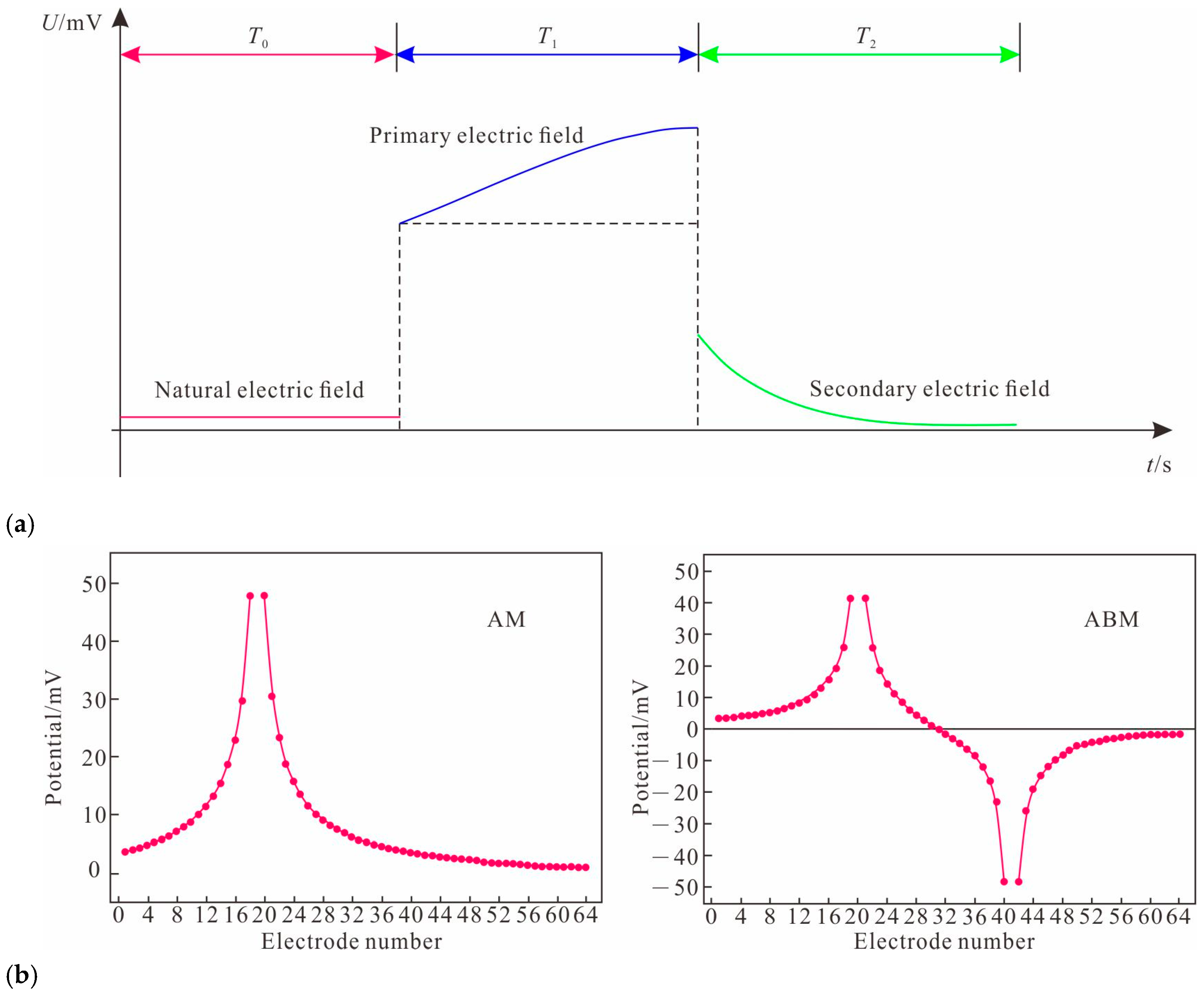
The parallel electrical method is a high-efficiency data acquisition technique based on real-time electric field tracking, with “parallel acquisition” as its core feature. When a transmitting electrode is energized, all other electrodes on the survey line simultaneously participate in detecting potential difference signals, excluding the energizing electrode itself. This operational mode resembles the data acquisition pattern in seismic exploration; hence, it is also termed the “pseudo-seismic DC electrical method.” During data acquisition, all electrodes remain active, ensuring extremely high acquisition efficiency and enabling the synchronous acquisition of massive potential data. As shown in Figure 1a, this method can simultaneously record self-potential, primary field, and secondary field information in a single measurement and calculate apparent resistivity based on the extracted potential difference data. Currently, two main acquisition modes are employed: the unipolar full potential acquisition method (AM) and the bipolar full potential acquisition method (ABM), as illustrated in Figure 1b [21,22].
Research indicates that when the total number of electrodes is *s*, the data acquisition volume of the AM within the same time frame is approximately (s − 1)(s + 1)/3 times that of the traditional serial high-density electrical method (for s ≥ 3), while the acquisition volume of the ABM is (s − 2)(s − 3)/2 times that of the serial method (for s ≥ 4). Data acquisition with this method is simultaneous and instantaneous; during energization, all potential variation curves along the survey line can be obtained, making the inversion results more realistic and reliable. In practical applications, a true three-dimensional observation system can be constructed by deploying two or more survey lines. Potential information between the energized electrode and any two measuring electrodes can be extracted. When combined with three-dimensional inversion techniques, the subsurface electrical property distribution can be obtained, achieving high-precision three-dimensional electrical structure imaging [23,24].

2.2. COMSOL Numerical Simulation

Given the complex structure and heterogeneous electrical property distribution of reservoirs, the COMSOL 6.3 version Multiphysics finite element simulation software was employed for modeling analysis in this study to ensure the constructed geophysical model closely resembles reality [25,26]. The AC/DC module within this software is specifically designed for numerical simulation in electromagnetics, offering advantages such as user-friendly operation, support for multiphysics coupling, and an intelligent interface, making it widely used in engineering, manufacturing, and scientific research. The numerical simulation process follows a three-stage architecture: modeling preprocessing, numerical solution, and data analysis. The electromagnetic distribution characteristics can be quantitatively analyzed through customizable visualization modules, providing effective means for studying the spatial distribution patterns of electrical field parameters.
To verify the simulation accuracy of the COMSOL software, a homogeneous cubic model space of 300 m × 300 m × 200 m was defined. An infinite element domain with a thickness of 20 m was set on the model surface, approximating the model as a half-space homogeneous geoelectric medium with a resistivity of 200 Ω·m. A survey line comprising 64 electrodes with an electrode spacing of 1 m was arranged on the model surface. The excitation source was a steady current with a current intensity of 1 A. The center point of the model surface served as the current electrode, and the remaining electrodes served as measuring electrodes.
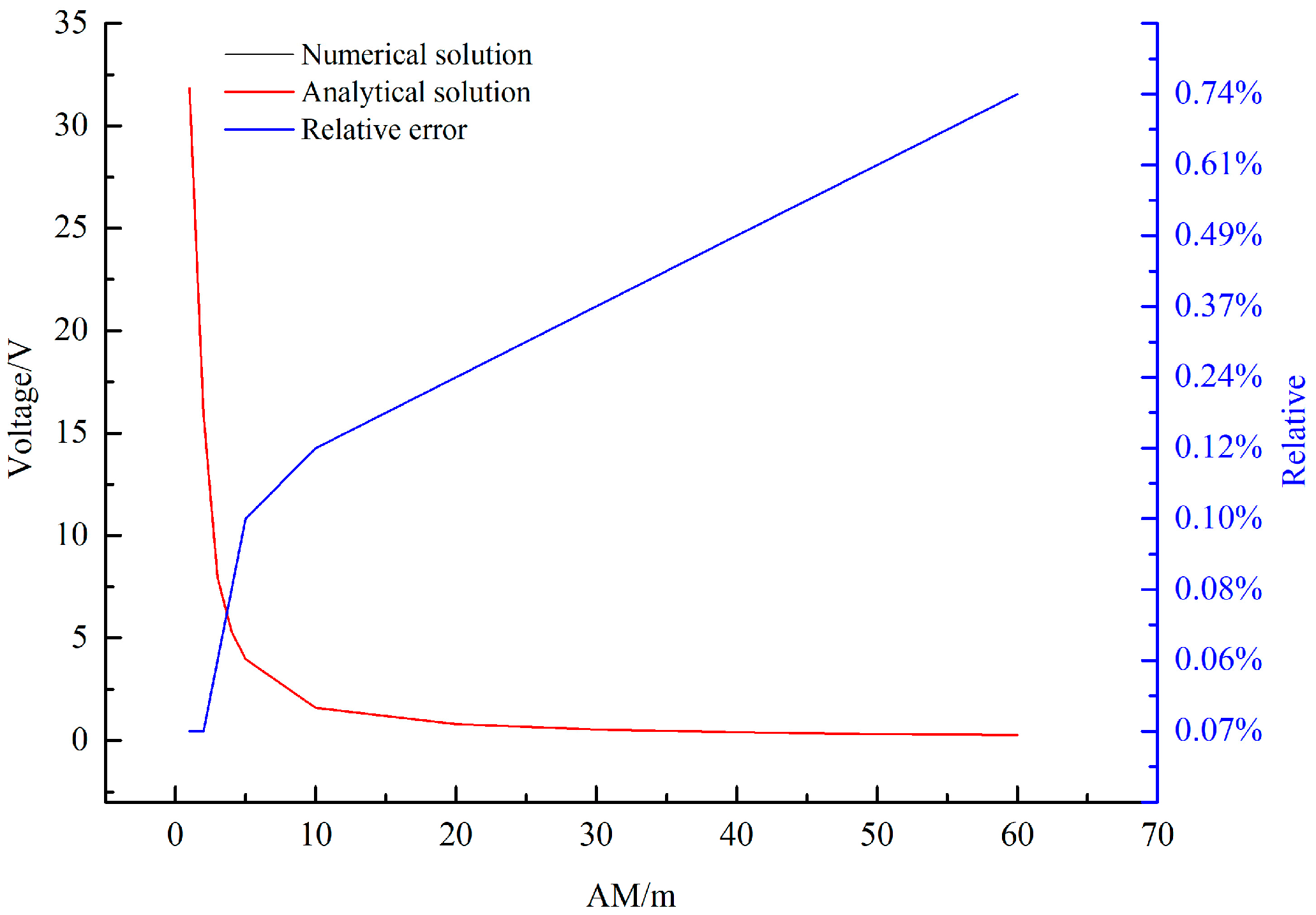
Figure 2 presents a comparison between the analytical solution and the numerical solution for the half-space model. The half-space numerical simulation results are in good agreement with the analytical solution, with the relative error of the voltage below 0.8%. This confirms the reliability of the three-dimensional finite element program.

3. Construction of a Three-Dimensional Geoelectric Model for Earth-Rock Dam Leakage

3.1. Testing and Analysis of Modeling Parameters

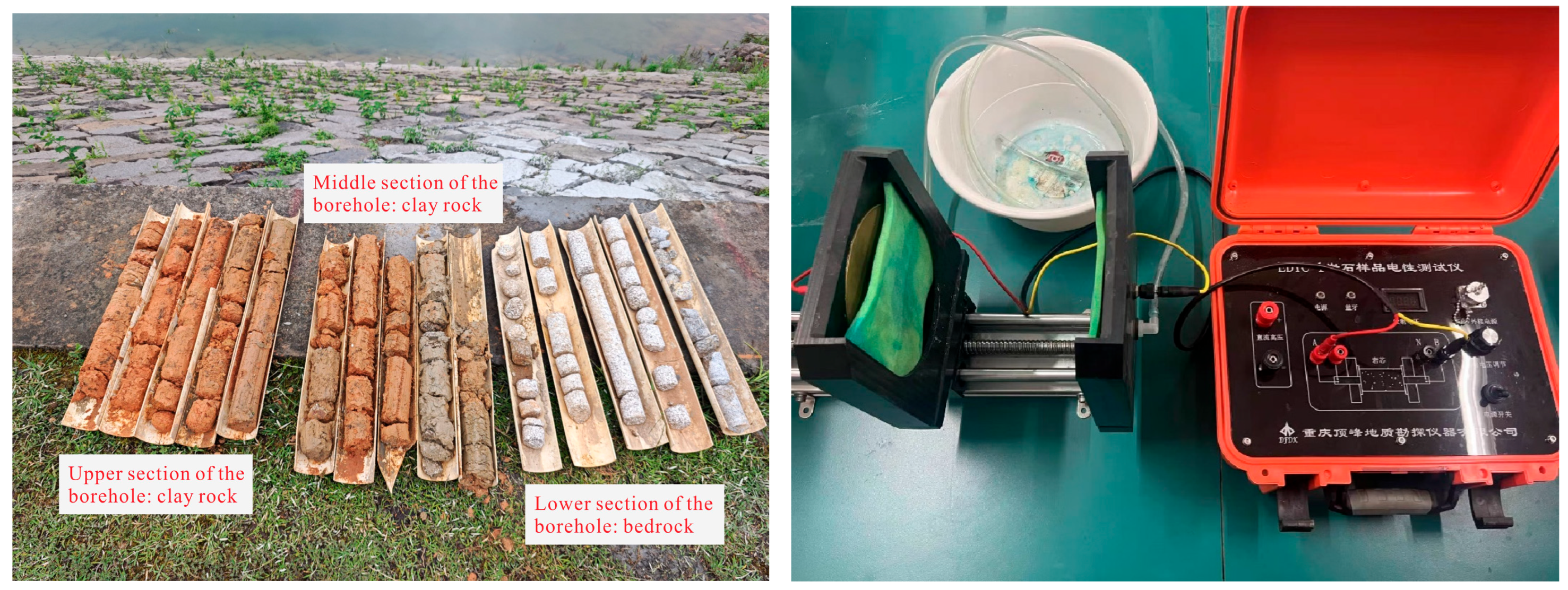
To accurately simulate the geoelectric response characteristics of the in situ earth-rock dam leakage scenario, drilling and sampling were conducted at a leakage remediation project site of a reservoir in Zhejiang Province. The samples were processed into standard specimens in the laboratory, and parameters such as the resistivity of rock and soil materials were tested using the EDYC-1 Rock Sample Electrical Property Tester (shown in Figure 3).
Based on the laboratory electrical property test results of the undisturbed soil and rock samples obtained from the site, the resistivities of the dam body above the saturation line, below the saturation line, and the dam foundation were set to 600 Ω·m, 400 Ω·m, and 1000 Ω·m, respectively. The resistivity of water was set to 120 Ω·m. The regions on both sides of the dam in the X-direction were set as “mountain bodies”, with a resistivity of 2000 Ω·m.

3.2. Construction of the Earth-Rock Dam Leakage Model

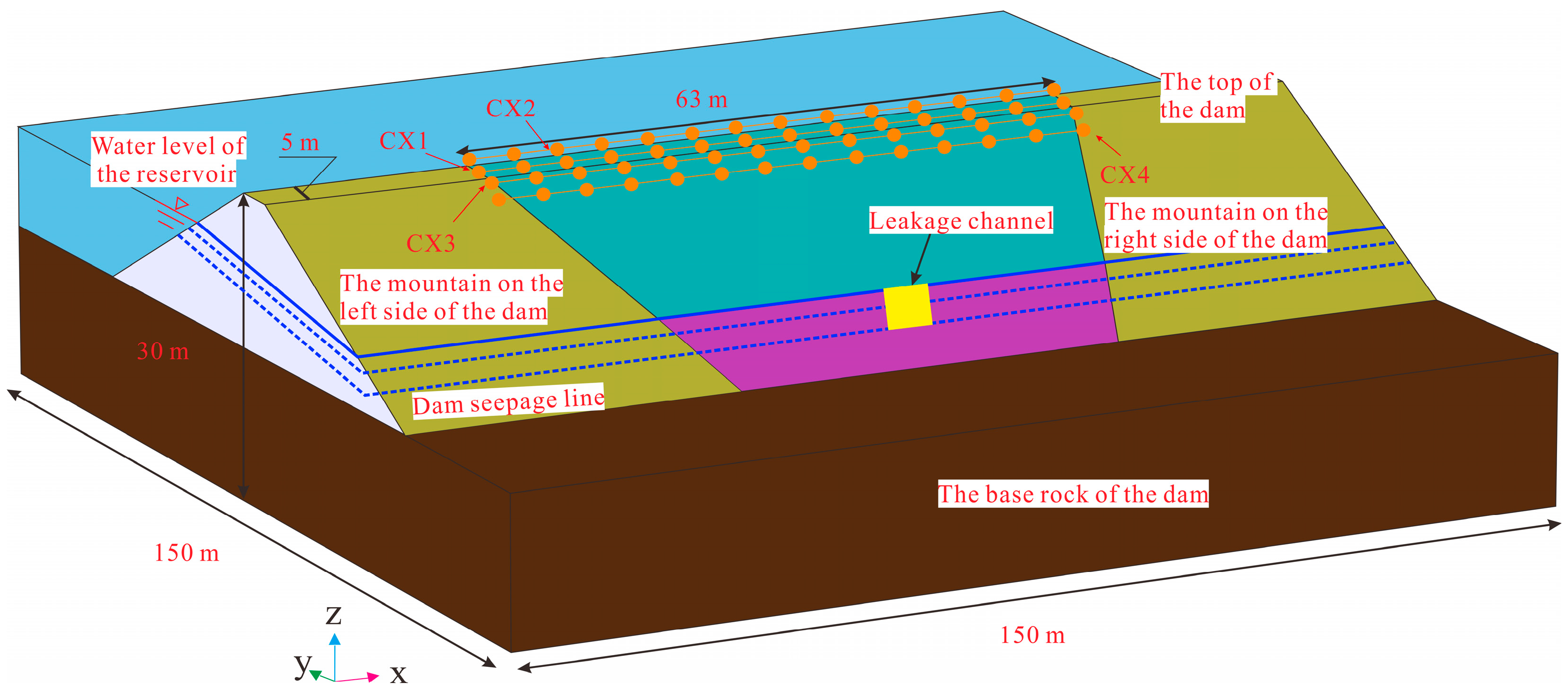
Earth-rock dam leakage is a process where soil and rock materials below the saturation line are gradually eroded by water, forming a leakage pathway. As the leakage pathway transitions from unsaturated through partially saturated to fully saturated states, its geoelectric field exhibits significantly lower resistivity compared to the surrounding rock. This forms the physical property basis for detection using the three-dimensional resistivity method [27]. To simulate the actual engineering scenario, a three-dimensional geoelectric model was constructed as shown in Figure 4. The model dimensions are 150 m (length) × 150 m (width) × 30 m (height). Infinite element domains with a thickness of 15 m at the bottom and 20 m on the left, right, front, and back sides were applied. The dam crest dimensions are 5 m × 63 m, the dam base dimensions are 65 m × 40 m, and the dam height is 15 m. The upstream side of the dam is impounded, with the saturation line located 5 m below the dam crest.
To simulate the actual exploration scenario, the first survey line (designated CX1) was arranged along the central axis of the dam crest from the left abutment to the right, with an electrode spacing of 1 m, totaling 64 electrodes. The second survey line (CX2) was deployed along the upstream slope, 2.5 m away from CX1. The third and fourth survey lines (CX3 and CX4) were deployed along the downstream slope, 2.5 m and 5 m away from CX1, respectively. A steady-state current field was added as the physics field. The current conservation region was the entire model space. The insulating region was the top plane of the cuboid model. Point current sources were assigned to the electrodes on the deployed survey lines. The grounding regions were the bottom, left, right, front, and back planes of the cuboid model. The excitation source was a steady current of 1 A. The model was discretized using tetrahedral elements with a minimum element size of 0.2 m near the leakage pathway and a maximum size of 5 m in the far field. The relative tolerance for the iterative solver was set to 1 × 10⁻⁶.

3.3. Design of Geoelectric Models for Typical Leakage Under Reservoir Water Level Fluctuations

Based on the manifestation of leakage hazards, typical leakage hazards in dam bodies can be mainly categorized into three types: concentrated leakage, horizontal leakage, and vertical leakage [28]. This study primarily constructs a model of a concentrated leakage pathway, with the hazard center located 31.5 m from the left abutment. According to reservoir water level variations, three scenarios are considered: the saturation line elevation is above, at, or below the leakage hazard. Three different geoelectric models were established. Forward resistivity modeling and inversion imaging were conducted to analyze the geoelectric response characteristics and variation patterns of the models. For ease of observation and analysis, three different saturation line height conditions (high, medium, and low) were incorporated into the model design based on the principle of controlled variables, and were designated as A-1, A-2, and A-3. The parameter settings for the geoelectric leakage models are shown in Table 1.

3.4. Model Assumptions and Limitations

To isolate and systematically investigate the primary effect of saturation line position on the geoelectric response of a concentrated leakage pathway, the current model incorporates necessary simplifications. First, the dam body is modeled as a simplified geometry with homogeneous resistivity zones above and below the saturation line. The stratified structure and anisotropy of rock and soil media are not considered [29]. Second, the leakage pathway is represented as a regular prismatic body with a fixed shape and resistivity, ignoring the irregular, tortuous morphology and potential evolution of seepage channels over time. Third, the complex seepage characteristics at the contact zones between the dam body, foundation, and abutments are simplified. These simplifications imply that the model does not perfectly replicate any specific engineering scenario. However, as a mechanistic study, this approach allows for a controlled analysis of the causal relationship between saturation state and geoelectric field distortion, free from the confounding effects of other geological complexities. The findings, particularly the diagnostic boundary point under partially saturated conditions, provide fundamental theoretical insights that can inform the interpretation of data from more complex real-world scenarios. Future work will focus on incorporating these complexities through more sophisticated multiphysics models.

4. Geoelectric Response Simulation Results of Concentrated Leakage Pathways Under Reservoir Water Level Fluctuations

4.1. Three-Dimensional Spatial Distribution Characteristics of the Geoelectric Field

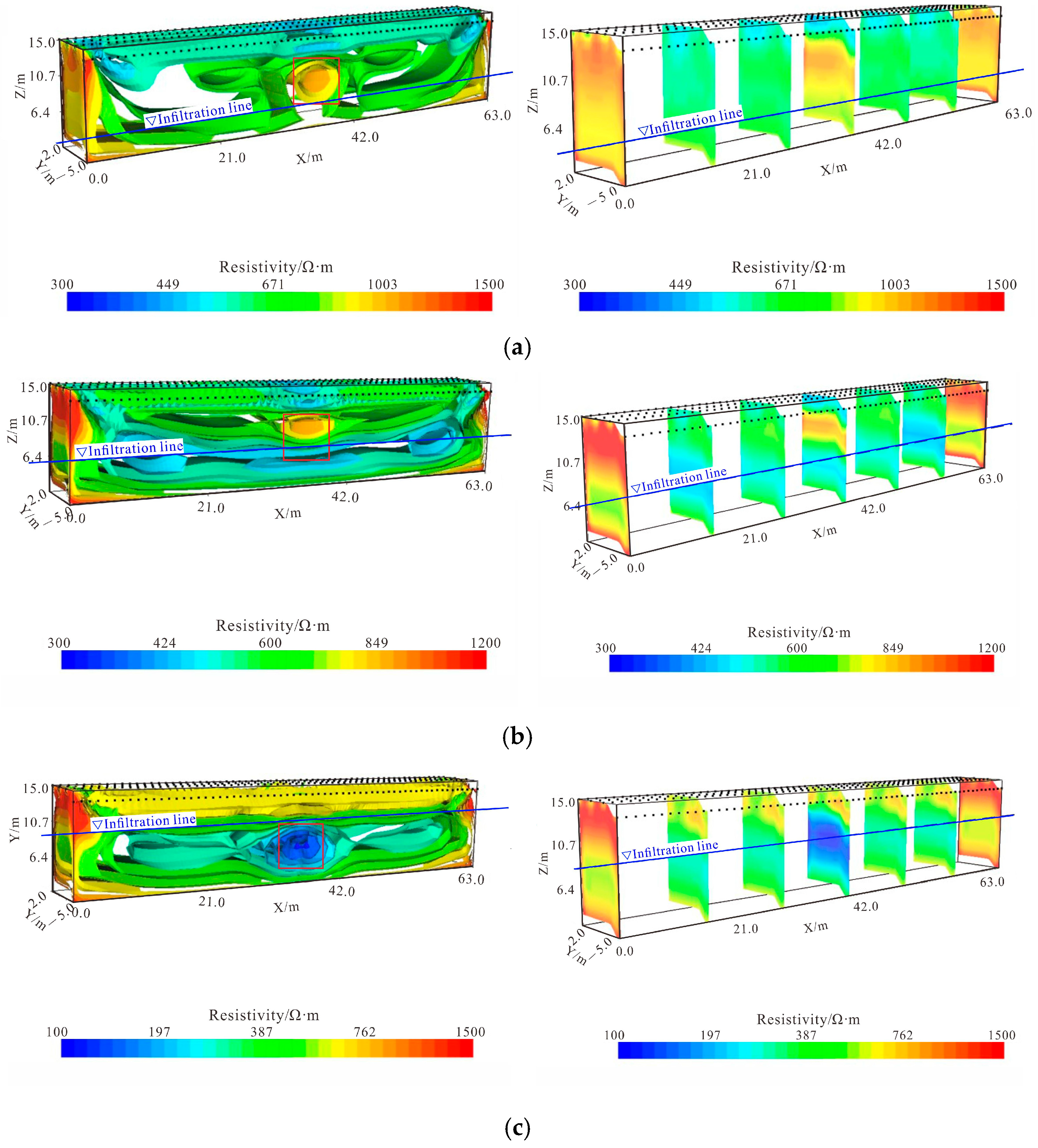
Geometric models under different reservoir water level conditions were constructed based on the modeling parameters for Group A in Table 1. Electrical survey lines were deployed, and the models were meshed. Inversion was performed on the forward-calculated data to obtain three-dimensional resistivity inversion results for the concentrated leakage pathway models under the three different saturation line height conditions. To observe the spatial morphology of the leakage anomaly more intuitively, the displayed resistivity range was adjusted, and three-dimensional resistivity isosurfaces and equidistant slices along the X-axis were extracted for the three concentrated leakage pathway models, as shown in Figure 5. The burial depth of the leakage pathway center is 6.5 m (corresponding to an elevation of 8.5 m). Under reservoir water level fluctuations, the distribution areas of anomalous bodies in the three models correspond well with the preset model positions. When the reservoir water level is below or above the leakage pathway, the resistivity values of the anomalous body and the surrounding rock differ significantly, providing a clear contrast, and the geoelectric response intensity of the concentrated leakage pathway is relatively high. However, when the reservoir water level is located at the center of the leakage pathway, the resistivity difference compared to the intact dam body is relatively small, and the geoelectric response intensity of the concentrated leakage pathway is relatively weak. In summary, the three-dimensional spatial distribution pattern of the geoelectric field provides good localization of the concentrated leakage pathway.

4.2. Planar Distribution Characteristics of the Geoelectric Field

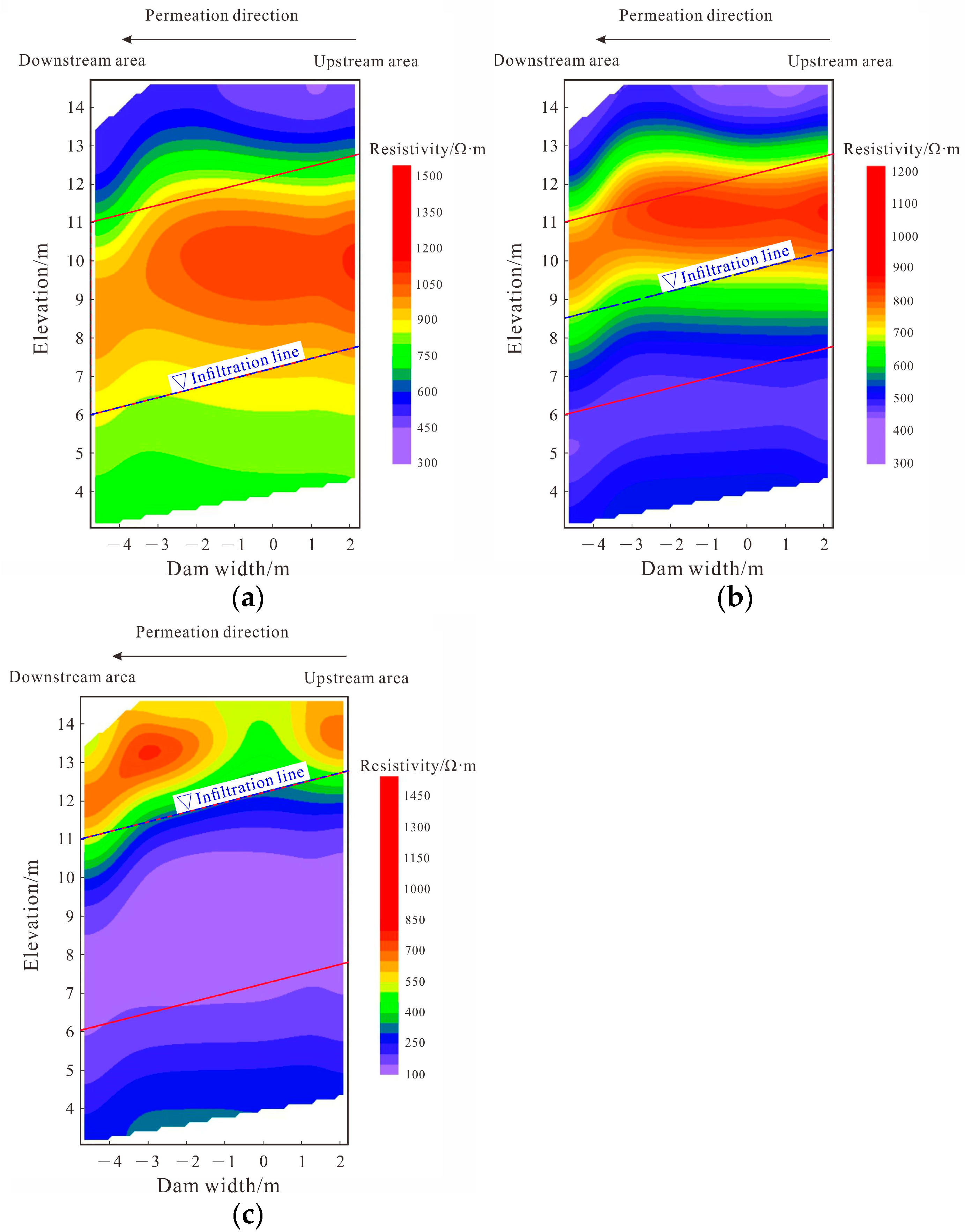
To further analyze the distribution pattern of the geoelectric field in the leakage pathway area, YZ two-dimensional slices were extracted at the X-axis position of 31.5 m, as shown in Figure 6. Under different reservoir water level (saturation line) conditions, affected by the topographic settings, a distortion with opposite resistivity signs appears above the leakage anomaly area, but the area of the distorted zone is relatively small. In the slices of models A-1 and A-3, the area of the leakage hazard corresponds well with the preset model range (indicated by the red dashed box). In the slice of model A-2, the leakage hazard area is slightly larger than the preset model range, indicating a greater influence of the volume effect. This is mainly because the anomalous body in model A-2 is a combination of high-resistivity and low-resistivity zones. After calculation using the smoothed model inversion algorithm, the anomalous region expands longitudinally. As the water level (saturation line) rises, the area of the high-resistivity zone in the model is gradually replaced by the low-resistivity leakage zone, and the seepage direction from the upstream to the downstream area is consistent with the preset model, conforming to the model’s geoelectric variation patterns.
Compared to three-dimensional cross-sectional detection data, vertical electrical sounding results have spatial limitations, reflecting only the electrical characteristics along a single survey line. However, they offer higher vertical resolution, effectively characterizing local electrical anomaly variations. Therefore, comprehensive analysis of multidimensional data enables accurate identification of anomalous bodies. In particular, quantitative assessment of the spatial shift in electrical anomalies requires vertical electrical sounding inversion analysis.
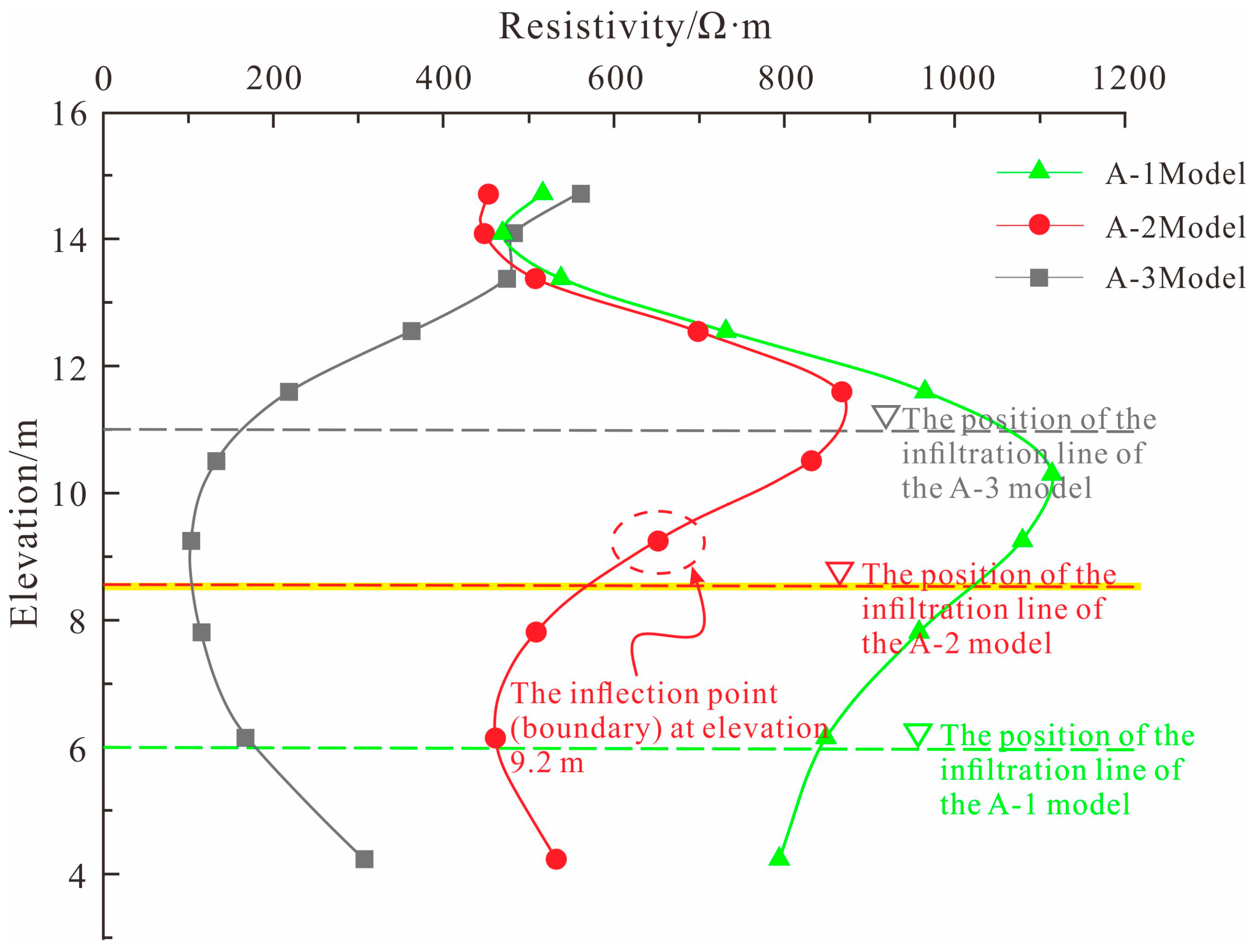
To systematically analyze the simulation results of the concentrated leakage pathway geoelectric model and to facilitate longitudinal analysis of geoelectric response characteristics along the Z-axis using two-dimensional profiles, one-dimensional sounding data at the center of the anomalous body were extracted. The resulting one-dimensional sounding curves for the three models are shown in Figure 7.
When the reservoir water level (saturation line) is below the leakage pathway (indicated by the yellow highlighted area in the figure; same below), the one-dimensional sounding curve of model A-1 exhibits the greatest curvature. The maximum resistivity reaches 1100 Ω·m at an elevation of 10.2 m. This deviates from the actual center of the anomalous body (elevation 8.5 m), being slightly higher than the actual anomaly, with an upward shift of 1.7 m.
In the partially saturated state, the upper part of the leakage pathway is high-resistivity (air or unsaturated zone) and the lower part is low-resistivity (saturated zone). Due to the volume effect and smoothing constraints in resistivity inversion, this high-low resistivity combination leads to longitudinal stretching of the inversion result, with the high-resistivity anomaly center shifting upward by 3 m relative to the actual anomaly center. Notably, despite the shift in the high-resistivity center, the boundary point between the high- and low-resistivity anomalies (at elevation 9.2 m) is relatively close to the central depth of the leakage pathway (elevation 8.5 m); see the inflection point of the A-2 curve in Figure 7. This characteristic can serve as an important criterion for identifying partially saturated leakage in practice.
In contrast, under fully saturated conditions, the leakage pathway is a single low-resistivity body, and the inversion results align most closely with the model settings. Under unsaturated conditions, it is a single high-resistivity body, and the anomaly center also shifts upward, but the shift magnitude is smaller than in the partially saturated state. This indicates that the partially saturated state presents the greatest detection difficulty and is the most prone to misinterpretation.
When the reservoir water level is above the leakage pathway—i.e., when the leakage pathway is fully saturated—the morphology of the one-dimensional sounding curve is opposite to that of A-1 and A-2, exhibiting the smallest curvature. The minimum resistivity is 100 Ω·m, and its location is generally consistent with the actual central depth of the leakage pathway in the model, with an offset of 0.7 m. This demonstrates that geoelectric detection of the leakage pathway is optimal when it is completely below the saturation line.
To further quantitatively analyze the simulation results, the center coordinates and extreme resistivity values of the anomalous bodies were extracted from the three-dimensional inversion models. The quantitative characteristics of the anomalous bodies under different saturation states are summarized in Table 2. In the fully saturated model (A-3), the center of the low-resistivity anomaly is located at (X = 31.5 m, Z = 9.2 m), deviating by only 0.7 m from the preset leakage center depth (Z = 8.5 m). In contrast, in the unsaturated model (A-1), the high-resistivity anomaly center shifts upward to Z = 10.2 m, with a vertical offset of 1.7 m. This offset is more pronounced in the partially saturated model (A-2), where the high-resistivity anomaly center is located at Z = 11.5 m, exhibiting an upward shift of 3.0 m. Furthermore, the low-resistivity anomaly in model A-2 is attenuated, with a minimum resistivity of 450 Ω·m compared to 100 Ω·m in the fully saturated model, indicating reduced contrast.

4.3. Comprehensive Analysis of Simulations

In the three-dimensional inversion models and two-dimensional slices, the hazardous zones exhibit layered distributions, indicating that the geoelectric stratification effect is relatively pronounced for the concentrated leakage pathway models under different saturation line conditions. The sounding curves (Figure 7) show significant variations in resistivity values at different burial depths, with the curve trends displaying distinct lateral bulges. The high-resistivity anomalous bodies above the leakage zones in models A-1 and A-2 have a shielding effect on the low-resistivity bodies below them. The one-dimensional sounding curves show relatively small curvature changes below the depth of the high-resistivity anomaly, deviating considerably from the preset resistivity values, thereby increasing the difficulty of detecting dam leakage hazards.
Furthermore, the volume effect is not pronounced in models where the reservoir water level is above the leakage pathway (fully saturated) or below it (unsaturated), but it is significant in the partially saturated model (where the water level is within the seepage pathway). In the unsaturated and partially saturated models, the detected high-resistivity zone of the seepage pathway exhibits an upward shift, which is more pronounced in the partially saturated model. The one-dimensional sounding curve for the partially saturated model exhibits a boundary between high and low resistivities, and this boundary point is located precisely at the center of the leakage pathway.

5. In Situ Testing of the Dam Body’s Geoelectric Field Under Water Level Fluctuations

5.1. Project Overview

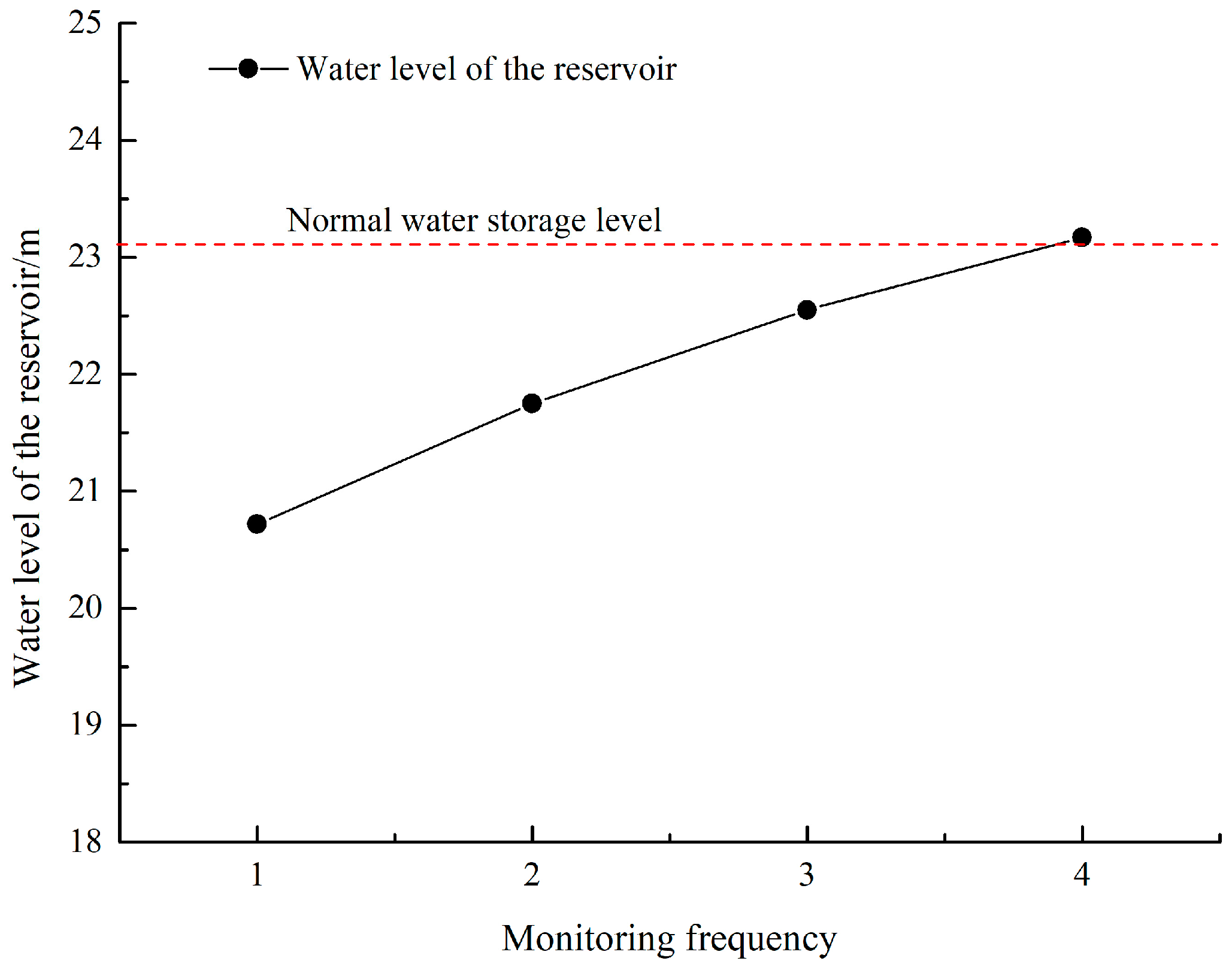
The main dam of a reservoir in Zhejiang Province is 1150 m long, with a crest elevation of 27.65 m and a height generally below 13.75 m. The normal maximum storage water level elevation is 23.16 m. Preliminary safety assessments indicated the presence of a leakage hazard near station K0+860 of the main dam. Observing the water level changes during the flood season (Figure 8), the reservoir water level showed a gradual increasing trend throughout the monitoring period. To effectively evaluate the characteristics of the dam’s leakage hazards under reservoir water level fluctuations, it is necessary to study the spatiotemporal distribution patterns of the geological and geophysical fields within the dam body under different saturation states. This facilitates further analysis of dam stability and effective assessment of the development trend of leakage hazards.

5.2. In Situ Geoelectric Field Testing and Analysis

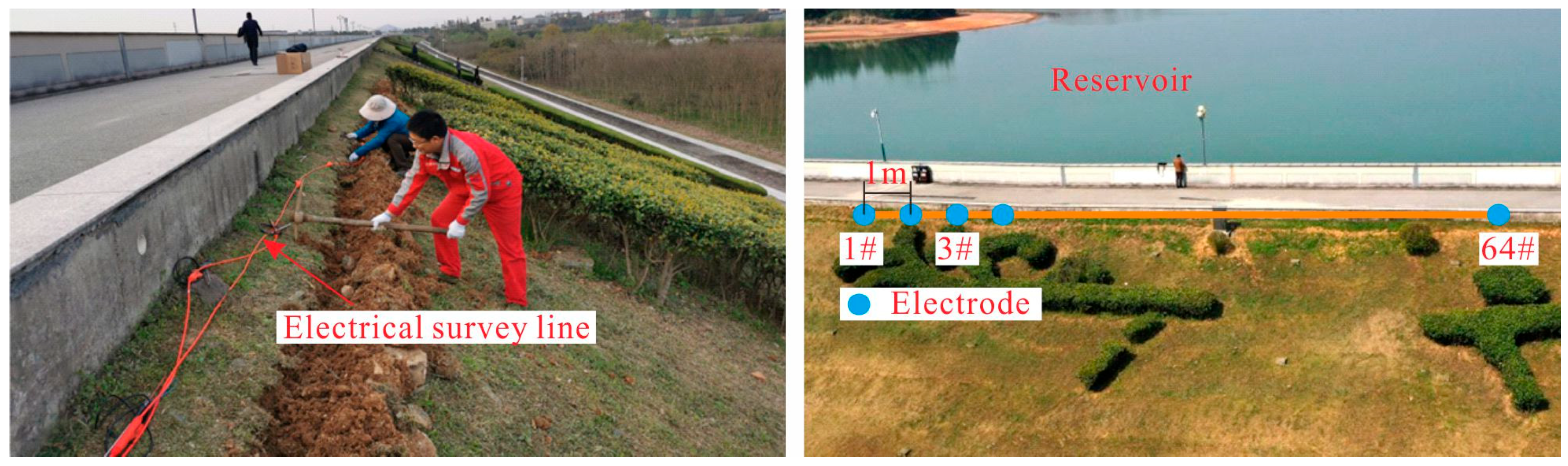
Given the extensive length of the main dam, detection focused on the key hazardous zone identified in the preliminary assessment. An electrical testing system was deployed centered on station K0+860. The survey line starting point (electrode #1) was at station K0+828, with an electrode spacing of 1 m, for a total of 64 electrodes and a total survey line length of 63 m. To avoid errors caused by inconsistent measurement point locations across multiple surveys, the survey line was buried at a certain depth below the ground surface using a fixed-electrode deployment scheme. The survey line layout is shown in Figure 9.
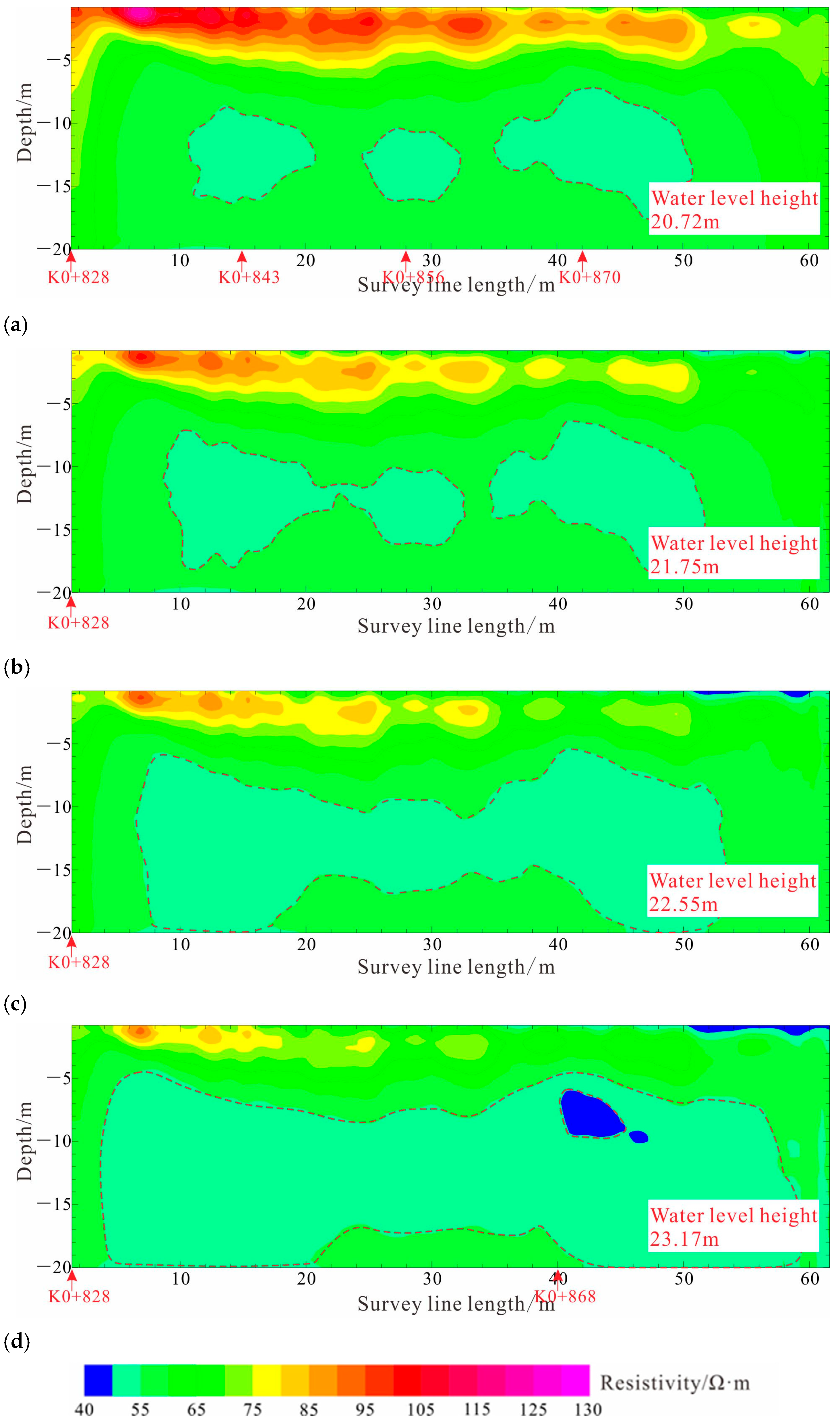
Four detection surveys were conducted in the critical area of the main dam during this flood season. The apparent resistivity cross-sections for different water level periods are shown in Figure 10. When the reservoir water level was relatively low (Figure 10a), the geoelectrical cross-section results revealed three low-resistivity anomalies at survey line positions 15 m, 28 m, and 42 m (corresponding to sections K0+843, K0+856, and K0+870). As the reservoir water level continued to rise, the extent of the low-resistivity zones continuously expanded, and the apparent resistivity values of the dam body decreased accordingly. By the third detection, with the reservoir water level at 22.55 m, the three low-resistivity zones had interconnected. According to geological exploration results, the upper part of this dam body exhibits moderate permeability. Therefore, as the water level increased, the moisture content of the rock and soil materials inside the dam body increased, leading to the interconnection of the previously separate low-resistivity zones. When the reservoir water level reached the normal maximum storage level, as shown in Figure 10d, an extremely low-resistivity zone was detected within the survey line length of 40–46 m, corresponding to section K0+868–K0+874, with a vertical burial depth of approximately 8–12 m. This aligns well with the area near K0+860 previously identified as having a leakage hazard during preliminary exploration.
In summary, as the reservoir water level rises, the geoelectric field response within the dam body is highly sensitive, with resistivity values undergoing dynamic changes, particularly the continuous expansion of low-resistivity zones. Under high water level conditions, the response of low-resistivity zones inside the dam body is more pronounced, and the localization results of closed low-resistivity zones are relatively close to the positions identified in the preliminary exploration. The delineation of relatively low-resistivity zones in the in situ tests provides a basis for subsequent detection of potential dam safety hazards and sealing of leakage points.

6. Discussion

This study systematically investigated the three-dimensional geoelectric response characteristics of concentrated leakage pathways in earth-rock dams under reservoir water level fluctuations through a combined approach of numerical simulation and in situ testing. The results indicate that the detection accuracy of leakage hazards is significantly influenced by the saturation line position (i.e., the saturation state of the leakage pathway), with the spatial distribution of anomalous bodies and resistivity patterns exhibiting regular differences under different saturation states. Below, the main findings are discussed in depth, considering mechanistic analysis and previous research.

6.1. Influence Mechanism of Saturation State on Leakage Anomaly Identification

The simulation results reveal a systematic upward shift in the high-resistivity anomaly center under unsaturated and partially saturated conditions, with the most pronounced shift occurring in the latter. This phenomenon can be mechanistically explained by the combined effect of the volume effect in DC resistivity methods and the smoothing constraints inherent in inversion algorithms. In a partially saturated pathway, the sharp vertical resistivity gradient—from a high-resistivity unsaturated zone to a low-resistivity saturated zone—poses a challenge for the inversion, which tends to favor smooth, continuous models. To minimize the data misfit while satisfying smoothness constraints, the algorithm distributes the high-resistivity anomaly upward and the low-resistivity anomaly downward, creating a vertically stretched, transitional boundary. This is analogous to the “smearing” effect observed in other geophysical inversion problems [30]. The significantly smaller offset in the unsaturated model (single high-resistivity body) further supports this interpretation, as the absence of a sharp gradient reduces the need for such a smearing artifact.

6.2. Comparison with Existing Findings and Engineering Significance

The findings extend previous qualitative observations of geoelectric field changes during seepage by providing a quantitative, mechanism-based understanding [10,11]. While earlier studies have noted that water level fluctuations can interfere with detection [5,6,7], the present work identifies and validates the high-low resistivity boundary point as a robust diagnostic indicator for the center of a partially saturated leakage pathway. This indicator is of significant practical value. It offers a clear, objective criterion for interpreting ambiguous resistivity data, a situation commonly encountered when monitoring during reservoir filling or after a rapid drawdown. The in situ validation (Section 5) supports this, as the anomaly zones identified during rising water levels correspond to the depths predicted by this diagnostic criterion.

6.3. Limitations of the Current Approach and Future Perspectives

Despite the novel insights, the limitations discussed in Section 3.4 must be considered when applying these results. The idealized model geometry and homogeneous resistivity assumptions may not fully capture the complexity of real-world scenarios, such as the influence of anisotropic permeability or the presence of multiple, interconnected leakage pathways [19,27]. Future research should focus on developing more sophisticated models that incorporate these complexities, coupled with advanced time-lapse inversion algorithms to better resolve dynamic seepage processes [31]. Furthermore, expanding the in situ monitoring network to include multiple dams with diverse geological settings and leakage types is crucial for establishing the generalizability of the findings presented here.

7. Conclusions

This study was motivated by the critical need to accurately detect leakage hazards in earth-rock dams, a task complicated by seasonal reservoir water level fluctuations. Through a combination of three-dimensional numerical modeling and in situ validation, the geoelectric response of a concentrated leakage pathway was systematically investigated under varying saturation conditions. The main findings are summarized as follows:
(1) The three-dimensional resistivity method effectively delineates the spatial position of the leakage hazard. Based on three-dimensional resistivity slices, the hazard center can be accurately located, overcoming the limitations of two-dimensional resistivity imaging.
(2) The saturation state of the leakage pathway critically governs detection accuracy. Under fully saturated conditions, the low-resistivity anomaly center is located approximately 0.7 m above the preset center. Under unsaturated and partially saturated conditions, the high-resistivity anomaly center shifts upward, with the most pronounced offset (up to 3.0 m) occurring in the partially saturated state.
(3) A diagnostic indicator is identified: under partially saturated conditions, the boundary point (inflection point) between the high- and low-resistivity anomalies is located close to the central depth of the leakage pathway, with a deviation of approximately 0.7 m. This feature can serve as a useful criterion for identifying partially saturated leakage in practical engineering, particularly when combined with other geological and geophysical information.
(4) In situ tests corroborate the simulation findings, revealing a more pronounced low-resistivity response at high water levels. The delineated anomaly zones correspond closely to the actual leakage point locations, validating the reliability of the numerical simulation results.
Despite these contributions, the numerical model involves simplifications in dam structure and resistivity homogeneity, and the in situ validation is limited to a single reservoir site. Future research should therefore focus on developing refined coupled hydrogeophysical models incorporating realistic dam structures and complex leakage types, while expanding the in situ monitoring network across diverse geological settings to establish broader applicability. The integration of time-lapse inversion techniques with dynamic monitoring systems also represents a promising avenue for real-time leakage early warning and risk assessment.

Author Contributions

Conceptualization, X.J. and B.S.; methodology, B.S.; software, Q.L. and H.X.; validation, S.J.; formal analysis, B.S. and Q.L.; investigation, S.J. and L.T.; resources, X.J.; data curation, B.S.; writing—original draft preparation, X.J.; writing—review and editing, B.S.; visualization, X.J.; supervision, X.J.; project administration, X.J.; funding acquisition, X.J., L.T. and H.X. All authors have read and agreed to the published version of the manuscript.

Funding

This research was funded by the Science and Technology Project of the Department of Water Resources of Zhejiang Province (No. RC2428); the President Science Fund Project of Zhejiang Institute of Hydraulics & Estuary (No. ZIHE23Q014, NO. ZIHE21Y006); Zhejiang Provincial Basic Public Welfare Research Program (No. LTGG24D040001).

Data Availability Statement

This study involves field observation data, numerical simulation data, and theoretical calculation data. The data used to support the findings of this study are available from the corresponding author upon request.

Acknowledgments

The authors have reviewed and edited the output and take full responsibility for the content of this publication.

Conflicts of Interest

Authors Xiaoyi Jiang, Lei Tan and Hu Xu were employed by the company Zhejiang Guangchuan Engineering Consulting Co., Ltd. The remaining authors declare that the research was conducted in the absence of any commercial or financial relationships that could be construed as a potential conflict of interest. The Zhejiang Guangchuan Engineering Consulting Co., Ltd. had no role in the design of the study; in the collection, analyses, or interpretation of data; in the writing of the manuscript, or in the decision to publish the results.

References

  1. Tan, L.; Peng, Y.; Zhang, P.S.; Xu, H.; Jiang, X.; Hu, X. Research progress on integrated geophysical exploration technology for termite nests in embankments and dams. Adv. Sci. Technol. Water Resour. 2024, 44, 7–15. [Google Scholar]
  2. Meng, Y.Y.; Jing, H.W.; Sun, S.H.; Chen, M.; Huang, K. Experimental and numerical studies on the anisotropic mechanical characteristics of rock-like material with bedding planes and voids. Rock Mech. Rock Eng. 2022, 55, 7171–7189. [Google Scholar] [CrossRef]
  3. Huang, H.B.; Zhu, J.C.; Wu, Z.Y.; Chen, J.; Tian, J. System reliability analysis of slope stability of earth rock dams based on finite element strength reduction method. Appl. Sci. 2025, 15, 4672. [Google Scholar] [CrossRef]
  4. Meng, Y.Y.; Yu, L.Y.; Yuan, L.; Hua, X.; Ma, Y.; Zhuang, J.; Jing, H.; Liu, X. Effects of bedding angle and confining pressure on the mechanical behavior, energy dissipation and micro damage evolution mechanism of layered rock mass under triaxial compression conditions. J. Mater. Res. Technol. 2025, 36, 1259–1272. [Google Scholar] [CrossRef]
  5. Gao, C.S.; Hu, J. Impact of climate change on safety of water infrastructures and response measures. China Water Resour. 2024, 60–67. [Google Scholar]
  6. Weng, P.; Tong, X.W.; Zhao, C.; Chen, Y. Study on national management system of small hazardous reservoirs reinforcement. J. China Inst. Water Resour. Hydropower Res. 2016, 14, 334–339. [Google Scholar] [CrossRef]
  7. Sun, W.W.; Long, Z.F.; Zhou, K.F. Study on performance assessment index system for risk-elimination and strengthening of small scale reservoir. Water Resour. Hydropower Eng. 2018, 49, 126–133. [Google Scholar]
  8. Dai, Q.W.; Lin, F.P.; Wang, X.P.; Feng, D.; Bayless, R.C. Detection of concrete dam leakage using an integrated geophysical technique based on flow-field fitting method. J. Appl. Geophys. 2017, 140, 168–176. [Google Scholar] [CrossRef]
  9. Zhao, H.J.; Jiang, X.Y.; Han, J.L.; Tan, L. Experimental study on integrated geophysical prospecting method for joint diagnosing leakage in embankment dam. Prog. Geophys. 2021, 36, 1341–1348. [Google Scholar]
  10. Jiang, X.Y.; Tan, L.; Yu, J.Q. Experimental study on monitoring hidden danger of dam leakage by time shift electrical method. Zhejiang Hydrotech. 2023, 51, 93–98. [Google Scholar]
  11. Cai, Z.G.; Yang, M.S.; Wang, J.J.; Xu, Y.-H. Mechanism and application of dynamic monitoring for seepage processes in earth-rock dams using the time-lapse electrical resistivity method. Appl. Geophys. 2025, 22, 1464–1474. [Google Scholar] [CrossRef]
  12. Gong, D.H.; Xu, H.; Hu, X.W.; Jiang, X.Y.; Tan, L. Leakage detection in earth-rock dams based on transient electromagnetic field finite element simulation. Yangtze River 2024, 55, 2013–219+236. [Google Scholar] [CrossRef]
  13. Huang, Y.J.; Xin, Y.W.; Gan, J.J.; Xu, J. Cascade investigation method for leakage of earth and rock dams based on high-density electrical method. Water Resour. Plan. Des. 2025, 137–142+149. [Google Scholar] [CrossRef]
  14. Tan, L.; Hu, X.W.; Zhang, P.S.; Jiang, X.; Dong, Y.; Liu, F.; Xu, H. Leakage detection in earth-rock dams using surface-to-borehole resistivity tomography. Coal Geol. Explor. 2026, 1–9. [Google Scholar] [CrossRef]
  15. Xu, L.Q.; He, Y.M.; Li, D.Z.; Zhang, G.C.; Ma, Z.K.; Shen, Z.Z. Application of integrated geophysical information fusion technology in leakage hazard detection for earth-rock dams. Adv. Sci. Technol. Water Resour. 2025, 45, 86–92. [Google Scholar]
  16. Xu, H.; Liu, J.P.; Xiong, X.; Zong, Y.; Ma, Y. Analysis of leakage seismic attribute characteristics considering the discrete random properties of earth-rock dam media. Bull. Eng. Geol. Environ. 2025, 84, 193. [Google Scholar] [CrossRef]
  17. Li, P.; Tang, L.; Zhang, S.H.; Luan, P. Earth-rock dam leakage inspection and identification based on an unmanned aerial vehicle equipped with infrared thermal imagers. Insight 2025, 67, 464–471. [Google Scholar] [CrossRef]
  18. Wang, M.M.; Shen, C.Y.; Duan, J.H.; Ye, M.; Xu, Q. Study on antiseepage measures for earth-rock dam reservoir in super-intense karst area: Research on curtain grouting scheme for comprehensive seepage prevention. Struct. Control Health Monit. 2025, 2025, 1319986. [Google Scholar] [CrossRef]
  19. Teng, T.; Wang, Y.M.; Chen, Y.L.; Li, Y.; Liu, X. Permeability and energy evolution of coal under unloading confining pressure. Int. J. Geomech. 2026, 26, 04025341. [Google Scholar] [CrossRef]
  20. Yang, P.S.; Xu, F.G.; Li, F.L.; Xu, X.; Wu, Y.; Ouyang, L. Experimental study on the mechanism of overtopping failure and breach development in homogeneous earth dams. Water 2025, 17, 3352. [Google Scholar] [CrossRef]
  21. Liu, S.D.; Wu, R.X.; Zhang, P.S.; Cao, Y. Three-dimensional parallel electrical surveying and its applications in water disaster exploration in coal mines. J. China Coal Soc. 2009, 34, 927–932. [Google Scholar]
  22. Zhou, G.Q.; Wang, Y.F.; Chen, X.H.; Yue, M.; Zhai, F.; Yang, X.; Cui, Y. Research on forward modeling of “triangular cone” type direct current method for heading detection. J. China Coal Soc. 2022, 47, 3015–3023. [Google Scholar]
  23. Yao, L.F.; Zhang, S.Z.; Chen, X.H.; Pan, Y.X.; Tang, L.S. Application of three-dimensional direct current parallel high density electricity method and transient electromagnetic method in the survey of a planned glass tube site. Sci. Technol. Eng. 2020, 20, 13983–13989. [Google Scholar]
  24. Zhou, G.Q.; Cui, Y.; Liang, X.K.; Chen, X.H.; Yue, M.X.; Wang, Y.F.; Wu, X.P.; Cao, Y.; Liu, Y.H. Application of 3D parallel high density electrical method in site investigation of Liuguo chemical phosphogypsum stack. Sci. Technol. Eng. 2024, 24, 495–505. [Google Scholar]
  25. Ma, Z.Y.; Ren, J.; Zhang, L.; Li, H.; Yang, S.; Nan, S. Monitoring heat transfer for seepage in earth-rock dams with clay cores considering damaged areas: Laboratory experiments and numerical modeling. Comput. Geotech. 2023, 164, 105833. [Google Scholar] [CrossRef]
  26. Zhou, C.C.; Shen, Z.Z.; Xu, L.Q.; Gan, L.; Ma, Z.; Xiong, H.; Xu, W. Durability analysis method for plastic concrete cutoff walls considering the coupling effects of dissolution-seepage-stress. Constr. Build. Mater. 2025, 477, 141318. [Google Scholar] [CrossRef]
  27. Tan, L.; Jiang, X.Y.; Li, H.W.; Pi, L.; Jiang, S.H. Application of seepage detection for reservoir dam and directional treatment technology. Water Resour. Power 2019, 37, 63–66+124. [Google Scholar]
  28. Ma, Z.Y.; Ren, J.; Nan, S.H.; Xu, S. Development and initial application of test devices for leakage of earth-rockfill dams. Chin. J. Geotech. Eng. 2023, 45, 2268–2277. [Google Scholar]
  29. Cao, T.T.; Li, S.P.; Hu, Z.G.; Zhang, B.; Zheng, J.; Liu, Z.; Xu, X.; Tang, H. Sedimaging-based analysis of granular soil compressibility for building foundation design and earth-rock dam infrastructure. Buildings 2026, 16, 223. [Google Scholar] [CrossRef]
  30. Loke, M.H.; Chambers, J.E.; Rucker, D.F.; Kuras, O.; Wilkinson, P.B. Recent developments in the direct-current geoelectrical imaging method. J. Appl. Geophys. 2013, 95, 135–156. [Google Scholar] [CrossRef]
  31. Zhu, D.P.; Ma, H.; Yang, Y.X. Three-dimensional time-lapse joint inversion of resistivity and time-domain induced polarization methods. Appl. Sci. 2025, 15, 10016. [Google Scholar] [CrossRef]
Figure 1. Operating principle of the parallel electrical method: (a) Time-series diagram of single electrode potential; (b) potential diagram acquired by parallel electrical method.
Processes 14 01198 g001
Figure 2. Error analysis diagram of numerical solution versus analytical solution.
Processes 14 01198 g002
Figure 3. Rock core and electrical property testing equipment.
Processes 14 01198 g003
Figure 4. Three-dimensional geoelectric model of the earth-rock dam under reservoir water level fluctuations.
Processes 14 01198 g004
Figure 5. Three-dimensional distribution characteristics of the geoelectric field for concentrated leakage pathways under different saturation line conditions: (a) A-1 Inversion model: 3D isosurface and slices; (b) A-2 Inversion model: 3D isosurface and slices; (c) A-3 Inversion model: 3D isosurface and slices.
Processes 14 01198 g005
Figure 6. YZ cross-sections of concentrated leakage pathway models under different saturation line conditions: (a) A-1 Model Slice; (b) A-2 Model Slice; (c) A-3 Model Slice.
Processes 14 01198 g006
Figure 7. One-dimensional sounding curves for the concentrated dam leakage model.
Processes 14 01198 g007
Figure 8. Reservoir water level fluctuation curve during the flood season.
Processes 14 01198 g008
Figure 9. Survey line deployment scheme. (1# represents the first electrode).
Processes 14 01198 g009
Figure 10. Variation in dam resistivity under reservoir water level fluctuations: (a) First detection; (b) Second detection; (c) Third detection; (d) Fourth detection.
Processes 14 01198 g010
Table 1. Parameter settings for geoelectric models with different leakage pathways.
TypeIDHazard Center Depth (m)Hazard Size (m × m)Saturation Line Elevation
Concentrated LeakageA-16.55 × 5Below the leakage hazard (unsaturated)
A-2Within the leakage hazard (partially saturated)
A-3Above the leakage hazard (fully saturated)
Table 2. Quantitative analysis of anomalous body characteristics under different saturation states.
Model IDSaturation StateAnomaly TypeCenter X (m)Center Z (m)Offset (m)Extreme Resistivity (Ω·m)
A-1UnsaturatedHigh-resistivity31.510.2+1.71100
A-2Partially saturatedHigh-resistivity31.511.5+3.0900
A-2Partially saturatedLow-resistivity31.56.2−2.3450
A-3Fully saturatedLow-resistivity31.59.2+0.7100
Note: “+” indicates an upward shift, and “−” indicates a downward shift. The boundary point in model A-2 is located at Z = 9.2 m, close to the actual leakage center.
Disclaimer/Publisher’s Note: The statements, opinions and data contained in all publications are solely those of the individual author(s) and contributor(s) and not of MDPI and/or the editor(s). MDPI and/or the editor(s) disclaim responsibility for any injury to people or property resulting from any ideas, methods, instructions or products referred to in the content.