


Abstract
Hyperspectral imaging (HSI) combined with chemometrics has emerged as a rapid and non-destructive technique for fruit quality evaluation, enabling efficient monitoring of biochemical changes during postharvest storage. Among quality indicators, antioxidant activity is closely associated with nutritional value and physiological stability. This study aimed to develop an HSI-based approach for assessing the antioxidant capacity of strawberries subjected to different pre-cooling treatments during storage. Strawberries were treated with five pre-cooling methods and stored for up to 41 days. Antioxidant activity was measured using the 2,2-diphenyl-1-picrylhydrazyl (DPPH) radical-scavenging assay. Hyperspectral data were collected and preprocessed using multiplicative scatter correction (MSC), followed by partial least squares regression (PLSR) to construct predictive models. Among the treatments, immersion vacuum cooling combined with one-cycle pulsing (IVCWP1) exhibited significantly higher DPPH scavenging activity (61.17 ± 12.31%) than immersion vacuum cooling with water (IVCW, 52.89 ± 18.30%) (p < 0.05). The PLSR model developed using MSC-corrected average reflectance spectra showed superior predictive performance and a higher coefficient of determination (R2) than models based on raw spectra. The results demonstrate that HSI coupled with chemometrics is an effective and practical tool for non-destructive evaluation of antioxidant activity and comparison of pre-cooling strategies in strawberries.
1. Introduction
Strawberries (Fragaria × ananassa) are highly valued for their rich content of natural antioxidants, including vitamin C (ascorbic acid), anthocyanins, flavonoids, phenolic acids, and ellagitannins [1,2]. These compounds play a crucial role in protecting the fruit from oxidative damage, delaying senescence, and maintaining nutritional and sensory quality during storage [1]. The key quality attributes of strawberries include color, size, firmness, flavor, and shelf life [3,4]. Among these, consumers are particularly concerned with external color (red) and mild flavor [3]. Nevertheless, strawberries are highly perishable fruits with a limited shelf life [5]. Owing to their soft texture and thin skin, they are extremely vulnerable to mechanical damage during postharvest handling, often leading to considerable economic losses and increased food waste [6]. Vitamin C is the predominant antioxidant in strawberries, accounting for a significant portion of their total antioxidant activity [1]. However, it is highly sensitive to temperature, oxygen, and light, and thus declines rapidly during storage. Anthocyanins, primarily pelargonidin-3-glucoside, contribute to both the red color and antioxidant potential of the fruit [6]. Phenolic compounds, including ellagic acid [7] and catechin, show relatively better stability than vitamin C but still degrade gradually with prolonged storage.
To address the challenges encountered in the strawberry industry, it is crucial to develop preservation technologies that are safe, eco-friendly, and efficient. Numerous approaches have been investigated to enhance strawberry quality, such as the application of polysaccharide-based edible coatings [3,8,9], the use of plasma technology for freshness maintenance [2], cultivation practices involving potassium sulfate fertilizer [6], the incorporation of beneficial microorganisms to improve storability [10], and the development of advanced packaging systems combined with ultraviolet-C irradiation [5]. However, little information is shown on the antioxidant capability evolution of (immersion) vacuum-cooled strawberries by using hyperspectral imaging.
Cooling is one of the most widely utilized techniques for maintaining the quality and stability of agricultural and food products [11]. As the initial and critical stage in the cold chain, pre-cooling effectively reduces post-harvest respiration, suppresses microbial proliferation, decreases enzyme activity, and promptly removes field heat from freshly harvested commodities [12]. However, conventional cooling approaches—such as air blast cooling (AB) and immersion cooling (IC)—are often limited by low cooling rates and potential contamination, thereby increasing the likelihood of product spoilage [13]. To address these limitations, vacuum cooling (VC), a rapid cooling technology based on the principle of water evaporation under low pressure, has gained increasing attention in recent years [14,15]. This method is recognized for its high efficiency, hygienic operation, and energy-saving characteristics, making it particularly suitable for the post-harvest pretreatment of porous foods [14,16]. Among various cooling techniques, immersion vacuum cooling (IVC) has emerged as an innovative advancement, achieving significantly higher cooling rates compared with conventional methods such as AB and IC [16]. Moreover, IVC markedly reduces cooling losses relative to traditional vacuum cooling [13,16,17,18,19,20,21,22]. Extensive research has been conducted to simulate the cooling process of strawberries using computational modeling [23,24,25,26,27], evaluate the effects of package designs on cooling performance [28], and assess the survival of Salmonella on inoculated intact strawberries under different cooling methods [29]. Nevertheless, studies investigating the influence of different vacuum cooling conditions on the antioxidant capability characteristics of IVC-cooled strawberries using hyperspectral imaging remain scarce.
Chemometrics is the application of multivariate statistical and mathematical techniques to extract relevant chemical and physical information from complex spectral datasets [30]. In hyperspectral imaging, large numbers of highly correlated wavelength variables are generated, which often contain noise and redundant information [31]. Chemometric methods, including spectral preprocessing, feature extraction, and multivariate modeling, are therefore employed to enhance signal quality, reduce dimensionality, and establish quantitative relationships between spectral responses and quality attributes [32]. Partial least squares regression (PLSR) was employed to establish quantitative relationships between hyperspectral reflectance spectra and the measured quality parameters. PLSR is particularly suitable for spectral analysis because it can effectively handle high-dimensional and collinear variables commonly observed in hyperspectral data. The method projects the original spectral variables into a reduced number of latent variables that maximize the covariance between the predictor matrix (X) and the response matrix (Y), thereby improving model stability and predictive performance. By simultaneously performing dimensionality reduction and regression, PLSR minimizes overfitting while retaining the most relevant chemical information for prediction. In recent years, the integration of hyperspectral imaging (HSI) with chemometrics has attracted significant attention due to its potential to evaluate the quality of fruits, vegetables, raw meat, and processed meat products. Conventional spectroscopic techniques provide only point-based spectral measurements, which represent the average information from a limited sampling area. However, quality deterioration in strawberries often occurs heterogeneously across the fruit surface due to mechanical damage, moisture migration, and localized biochemical changes. HSI combines spectroscopy with imaging, enabling the acquisition of both spectral and spatial information simultaneously. This feature allows pixel-wise analysis and visualization of quality attributes, providing a more comprehensive understanding of quality variations than conventional spectroscopy. Therefore, HSI has considerable potential as a non-destructive tool for monitoring postharvest quality and supporting the development of intelligent sorting systems. Because of its speed, accuracy, and reliability, hyperspectral imaging has proven highly effective in assessing the quality attributes of various fruits. For instance, total soluble solids (TSS) and titratable acidity (TA) in strawberries were evaluated by Fan et al. [33], while soluble solids content (SSC) and firmness in strawberries were analyzed by Su et al. [34]. Although hyperspectral imaging has been widely applied to fruit maturity and defect detection, its integration with chemometric modeling to dynamically monitor quality evolution under different pre-cooling treatments remains underexplored. Pre-cooling is a critical early-stage postharvest intervention that directly influences respiration kinetics, cellular integrity, and subsequent deterioration patterns in strawberries. However, the lack of non-destructive, spatially resolved monitoring tools limits our mechanistic understanding of cooling-induced quality variations.
The present study aims to utilize hyperspectral imaging to detect the antioxidant capacity of strawberries subjected to different cooling conditions during storage at 4 °C for up to 41 days. This study not only evaluates the predictive performance of hyperspectral imaging but also elucidates the physiological relationships between spectral characteristics and antioxidant capacity associated with different cooling strategies. The findings provide a scientific basis for intelligent postharvest quality monitoring and precision cold-chain management.
2. Materials and Methods
2.1. Sample Preparation
Suzukakane strawberries (Japan Agricultural Cooperative (JA), Hakodate, Japan) were procured, and a total of 240 fruits were subsequently assigned to five pre-cooling treatment groups:
- (1)
- Five strawberries were placed in a 500 mL glass beaker containing 300 mL of distilled water at 20 °C and subjected to immersion vacuum cooling (IVCW; 30 fruits).
- (2)
- The same procedure described for Treatment 1 was followed, except that an additional pulse cycle returning the system to atmospheric pressure (atmosphere–vacuum–atmosphere) was introduced when the water temperature reached 4 °C (IVCWP1; 30 fruits).
- (3)
- Five strawberries were immersed in 300 mL of distilled water containing 5% NaCl and then vacuum cooled (IVCS; 60 fruits).
- (4)
- Strawberries were vacuum-cooled (VC; 60 fruits).
- (5)
- Strawberries with no pre-cooling treatment served as the control (60 fruits).
The average cooling times required to reduce the sample temperature from 13 °C to 4 °C using vacuum cooling and IVCWP1 were 251 ± 22 s and 607 ± 33 s, respectively. The pressure reduction rate was approximately 431.17 Pa/s and automatically controlled by the vacuum cooling system. Following pre-cooling, all samples were stored under refrigerated conditions (4 °C) for up to 41 days for post-analysis.
2.2. Data Acquisition and Processing
The strawberries were positioned with both their front and back surfaces exposed and oriented perpendicular to the hyperspectral camera to ensure optimal imaging within the measurement range. Hyperspectral imaging was conducted using a camera system (NH-4-KIT, EBA Japan, Tokyo, Japan) operating in a push-broom line-scanning mode, which acquired 151 contiguous spectral bands with an exposure time of 11.09 ms. The spectral range was 350–1100 nm, and the scanning speed was set at 90 lines per second. A white sheet was placed in the setup to provide uniform illumination and minimize shadow formation, while three halogen lamps were arranged around the imaging area to enhance lighting conditions. To create a clear contrast between the samples and the background, a black sheet was positioned beneath the strawberries, with ice packs placed underneath to maintain a stable temperature. Additionally, two fans were positioned near the halogen lamps to reduce excessive heat accumulation.
The imaging calibration was carried out using the following equation:
where O1 represents the original reflectance image, while R1 and D1 denote the reflectance images of the white and dark references, respectively. The white reference was obtained from a 100% reflectance white tile, while the dark reference was acquired by covering the camera lens in a dark environment. The spectra were extracted by HSAnalyzer (1.2 version, EBA Japan, Tokyo, Japan). During the extraction process, regions of interest (ROIs) corresponding to the strawberries were manually selected, and background pixels such as the holding tray and shadow areas were excluded before averaging the spectra. Only pixels belonging to the sample region were used to calculate the mean spectrum for each sample. The detailed data acquisition and processing procedures can be found in Feng et al. [35].
2.3. Establishment and Evaluation of the Regression Model
A partial least squares regression model was constructed by utilizing regression coefficients and weight values associated with specific wavelengths. Several pre-processing methods—including normalization, standard normal variate (SNV), multiplicative scatter correction (MSC), the first derivative, the combined SNV + first derivative, and the combined SNV + second derivative—were applied to reflectance spectra prior to multivariate analysis. In this study, the PLSR models were employed to determine the relationship between the spectral data of the samples and their respective scavenging activity (the value of the DPPH assay). The dataset was divided into calibration and prediction groups, where two-thirds of the samples were used for model calibration and the remaining one-third for the prediction.
Model performance was assessed using the determination coefficients for calibration (Rc2), prediction (Rp2), and full cross-validation (Rcv2), as well as the root mean square errors of calibration (RMSEC), and prediction (RMSEP). Typically, a reliable PLSR model is characterized by a high R2 value and a low RMSE, with only minor differences observed between RMSEC and RMSECV [5]. Cross-validation served as an internal validation approach to assess the residuals of each sample. Multivariate analyses were conducted using Vektor Direktor software (version 1.1, KAX Group, Sydney, Australia).
2.4. Antioxidant Activity Evaluation
The antioxidant activity was determined according to the methods described by Ma et al. [36], Pineli et al., [37], Huang et al. [38] and Feng et al. [39], with slight modifications. Ten grams of strawberry samples were homogenized and extracted with 20 mL of 100% methanol followed by centrifugation (MX-301, Tomy, Tokyo, Japan) at 10,000× g for 10 min at 25 °C. The resulting extract (50 μL) was then mixed with 150 μL of 60 μM DPPH (2,2-Diphenyl-1-picrylhydrazyl, ≥95% purity, lot number STBH7297, Aldrich, Laramie, WY, USA) in a 96 well-plate. The mixture was then incubated in the dark at room temperature for approximately 30 min. The absorbance was measured at 517 nm using a microplate photometer (Multiskan FC, Thermo Scientific, Singapore). Methanol mixed with DPPH was used as a blank. The scavenging activity was calculated based on the percentage inhibition of DPPH using the following formula:
The measurement was carried out in triplicates.
2.5. Statistical Analysis
The effects of different pre-cooling treatments as well as storage days on antioxidant activity were analyzed by the Tukey method via Minitab (version 21.1, Kozo Keikaku Engineering Inc., Tokyo, Japan; one-way ANOVA).
3. Results and Discussion
3.1. Spectra Overview
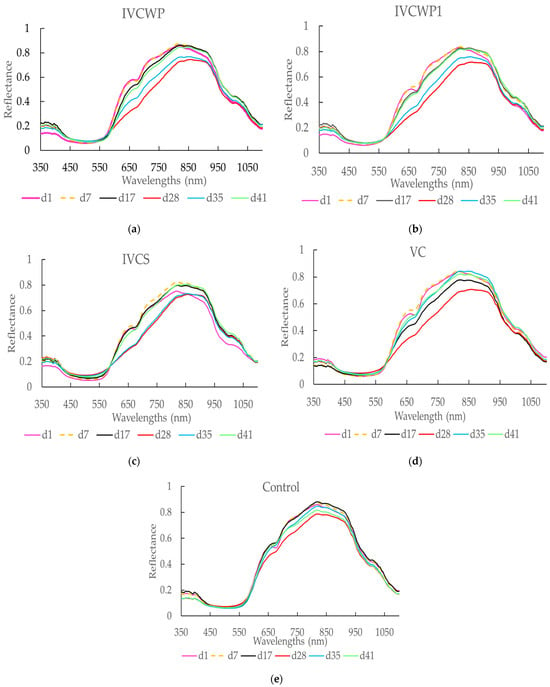
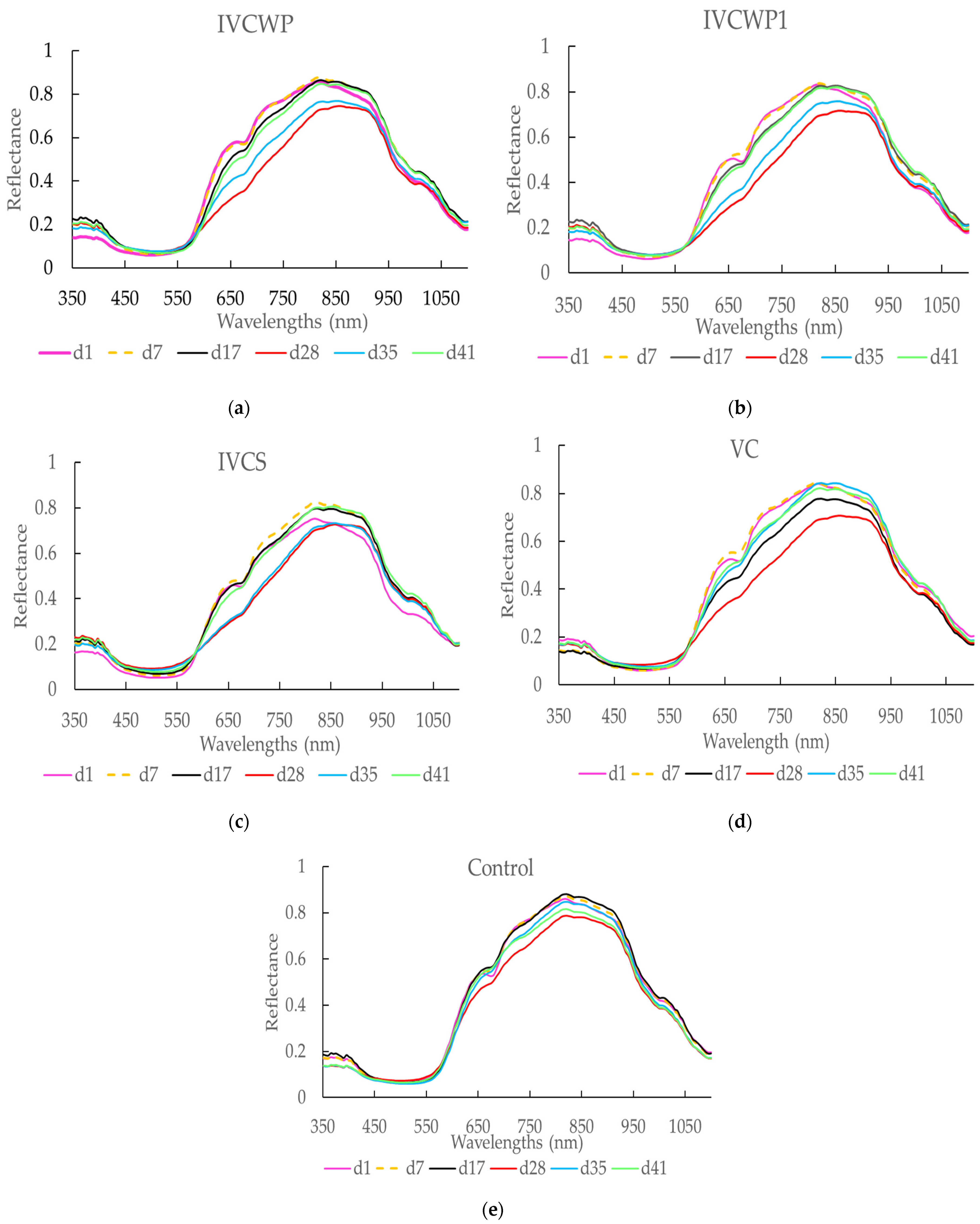
Figure 1 illustrates the reflectance spectra of strawberries subjected to different cooling treatments across various storage periods. Overall, reflectance tended to decrease from day 1 to day 28, followed by an increase after day 35. The decrease in reflectance is generally associated with the darkening of strawberry tissues during storage, which may result from pigment accumulation, enzymatic browning, and structural changes in the fruit surface. The increase observed at 35 days may be attributed to severe senescence, during which cellular degradation, tissue softening, and moisture loss can alter the optical properties of the fruit surface, thereby affecting light scattering and reflectance characteristics [40]. For the control samples, the spectra obtained on different storage days appeared condensed and closely aligned [Figure 1e]. In contrast, greater spectral variation was observed in samples cooled by IVCWP, IVCWP1, IVCS, and VC. This phenomenon may be attributed to moisture loss occurring during vacuum-based cooling processes. The vacuum cooling behavior of strawberries was previously examined by Dai et al. [41]. It was reported that, during the initial stage of VC, the evaporation rate is relatively uniform throughout the product. When VC reaches approximately 80 s, the evaporation rate increases rapidly and subsequently approaches a peak. As VC progresses, the evaporation rate gradient at the product surface rises sharply. This gradient is driven by the difference between the local vapor pressure and the internal equilibrium vapor pressure, along with the influence of water saturation [42]. Evaporation initiates at the strawberry surface, and as the moisture content near the boundary decreases, the evaporation rate declines correspondingly, causing the evaporation front to migrate toward the fruit’s center. Changes in water loss and internal structure make strawberries more susceptible during extended storage. For samples subjected to immersion vacuum cooling with distilled water, no substantial differences were observed regardless of the pulse treatment. Cheng and Sun investigated the IVC of large pork hams (2.2 ± 0.2 kg) using different pulsed cycles [43]. Their results demonstrated that applying four pulsed cycles during IVC significantly reduced cooling losses, decreasing them from 7.0% (one cycle) to 4.9% (p < 0.05) [43]. In contrast, small pieces of pork cutlet (0.3 ± 0.1 kg) and beef sirloin (0.9 ± 0.1 kg) were also subjected to IVC with varying pulsed cycles; however, no significant differences in cooling losses were detected (p > 0.05) [44]. The authors attributed this outcome to differences in the viscosity of water and applied sauce, as well as to variations in sample size. Similarly, no substantial spectral differences were observed for small products such as strawberries, which had an average weight of 10.277 g.
Figure 1.
Reflectance of the strawberries with different storage days and pre-cooling treatments: (a) IVCW: immersion vacuum cooling with distilled water; (b) IVCWP1: immersion vacuum cooling with one pulse cycle (atmosphere–vacuum–atmosphere); (c) IVCS: immersion vacuum cooling with 5% saline solution; (d) VC: vacuum cooling; (e) control. Note: d1, d7, d17, d28, d35, and d41 correspond to samples analyzed on days 1, 7, 17, 28, 35, and 41, respectively.
From an industrial perspective, the observed quality differences among cooling treatments can be interpreted in light of the operational characteristics of each cooling method. VC relies on rapid pressure reduction to induce water evaporation from the product surface, thereby removing latent heat and resulting in extremely rapid cooling; however, this process may also cause moisture loss from the product surface [42]. This mechanism has been widely reported to contribute to increased weight loss in VC-treated strawberries. In contrast, IVC can reduce dehydration or moisture content compared with conventional VC [16]. However, the direct contact between the fruit surface and the cooling solution may lead to limited solute transfer, which could potentially influence fruit taste or surface composition. Conventional cooling methods, such as forced-air cooling, operate with slower heat transfer rates but avoid the risks of excessive moisture loss or solute uptake. Therefore, each cooling technology involves a trade-off between cooling efficiency, moisture retention, and potential compositional changes. Understanding these trade-offs is essential for selecting appropriate pre-cooling strategies in industrial strawberry handling systems. Due to the complexity of organic matrices, absorption bands in the near-infrared (NIR) region are typically broad and exhibit substantial spectral overlap. A pronounced gap is observed at approximately 680 nm and again between 750 and 850 nm, which may be related to chlorophyll absorption [40]. In the NIR region, absorptions primarily originate from overtones and combination vibrations of functional groups, including C–H, N–H, and O–H, which are fundamental structural constituents of food molecules. Only two subtle absorption bands were detected within this region [45]. The spectrum on day 35 closely resembled that on day 28 in samples cooled by IVCS, likely due to surface dehydration and internal water migration influenced by salt.
Water behavior during immersion vacuum cooling has been documented by Houska et al. (2003), who reported that the surrounding solution infiltrates food materials when the vacuum is released [46]. Consequently, saline solution remained within the strawberry tissues. Salt-induced osmotic effects evolved over time: initially, salt drew water outward, resulting in water loss that became detectable on day 35. By day 41, however, cellular membranes had ruptured as a result of senescence and microbial degradation. The transition of bound water to free water increased measurable moisture content, even though the total mass did not increase.
3.2. Performance of PLSR Model
Chemometrics is a discipline that applies mathematical and statistical methods to chemical data, particularly data generated from analytical techniques such as spectroscopy, chromatography, and mass spectrometry. Among chemometric approaches, PLSR is a widely used multivariate statistical method for modeling relationships between a set of predictor variables (X) and one or more response variables (Y), especially in cases where predictors exhibit strong collinearity. In this study, PLSR was employed to predict the DPPH assay values (Y) from the spectral data (X). The method is particularly advantageous when dealing with large numbers of independent variables, multicollinearity, or situations where the number of predictors exceeds the number of observations [47]. The primary objective of PLSR is to identify latent variables that capture the maximum covariance between the predictor and response matrices. These latent variables are constructed as linear combinations of the original variables [35].
Table 1 summarizes the statistical parameters of the PLSR models developed using different spectral preprocessing methods for evaluating DPPH assay values. Application of the MSC preprocessing technique resulted in a slight increase in the predictive performance of the reflectance model, increasing the Rp2 value from 0.324 (raw, untreated data) to 0.331 and reducing the RMSEP from 10.841% to 10.788%. The difference between RMSECV and RMSEC for MSC and raw data was 0.003% and 0.086%, respectively. This enhancement is likely due to the ability of MSC to reduce unwanted physical variations in the spectra while preserving chemically relevant information. MSC treatment has been reported to compensate for both additive and multiplicative effects [48], thereby improving the robustness of spectroscopic models.
Table 1.
Hyperspectral data analyzed by chemometrics.
The firmness, soluble solids content, acidity, and anthocyanin levels of strawberry fruit at different cultivation stages were evaluated using hyperspectral imaging combined with machine-learning techniques [47]. A complementary analytical approach integrating PCA with K-means clustering, along with averaging and interpolation procedures, was reported to effectively utilize limited and noisy datasets. This integrated framework enabled reliable classification of harvest time and prediction of internal fruit quality through parameter extraction [47].
The relatively low predictive performance of the PLSR model for DPPH shown in Table 1 may be attributed to the indirect nature of the DPPH assay. This assay reflects the overall antioxidant capacity resulting from the combined effects of multiple compounds, such as phenolics, flavonoids, anthocyanins, and vitamin C, rather than a single chemical constituent with a distinct spectral signature. Hyperspectral imaging in the VIS–NIR region primarily detects overtones and combination bands of O–H, C–H, and N–H bonds [45,49]. However, antioxidant compounds in strawberries are present at relatively low concentrations, and their spectral features are often masked by dominant components such as water and sugars. In addition, the relatively narrow variation range of DPPH values (47.82–71.5% shown in Table 2) among the samples in this study may further limit the establishment of strong correlations between spectral information and antioxidant activity [50]. These factors collectively contribute to the limited predictive ability of the PLSR model.
Table 2.
Antioxidant activity of strawberries with different pre-cooling treatments and storage days.
HSI combines conventional spectroscopy and imaging techniques to simultaneously obtain spatial and spectral information from a sample. Unlike traditional UV–Vis–NIR spectroscopy, which provides only a single averaged spectrum from the measured area, HSI acquires a full spectrum for each pixel in the image, generating a three-dimensional data cube [1,31]. This enables pixel-wise analysis and visualization of the spatial distribution of chemical or physical properties within a sample [49]. Such capability is particularly valuable for heterogeneous food systems, where compositional variations, defects, or contamination may occur locally and cannot be detected by bulk spectroscopic measurements. Therefore, HSI has been increasingly applied for non-destructive evaluation of food quality and safety.
3.3. Effects of Different Cooling Treatments and Storage Duration on Antioxidant Activity of Strawberries
The antioxidant activity of strawberries subjected to different precooling treatments and storage durations is presented in Table 2. The DPPH scavenging activity decreased significantly from Day 1 (71.50 ± 4.81%) to Day 41 (47.82 ± 14.51%) (p < 0.05). Strawberries are rich in phenolic compounds—including anthocyanins, flavonoids, and phenolic acids—that contribute strongly to their free radical scavenging capacity [51]. However, during storage, oxidation, enzymatic degradation, and polymerization progressively diminish the concentration of these phenolics. As the levels of antioxidant constituents decline, the measured DPPH scavenging activity correspondingly decreases. Enzymatic activity also plays a key role in this reduction. With prolonged storage, enzymes such as polyphenol oxidase (PPO) and peroxidase (POD) become more active. It was observed that the PPO activity of “Madame Moutot” strawberry fruits slightly increased from the start of storage to the 10th day [52]. PPO promotes the oxidation of phenolic compounds to quinones, thereby reducing the pool of available antioxidants, while POD consumes phenolic substrates during oxidative reactions [52]. These processes collectively lead to a lower detectable antioxidant capacity in DPPH assays.
Regarding the effects of precooling treatments, strawberries cooled by immersion vacuum cooling with continuous water exposure (IVCW) exhibited significantly lower DPPH values (52.89 ± 18.30%) than the untreated control (62.44 ± 10.01%) (p < 0.05). Continuous water–fruit contact during IVCW likely promotes greater leaching and oxidative degradation of phenolic antioxidants, which is further enhanced by mass transfer under vacuum and increased tissue disruption. These combined effects reduce the internal antioxidant content of the fruit, resulting in the lowest DPPH values among the evaluated treatments.
3.4. Visual Representation of Strawberries Under Different Pre-Cooling Treatments
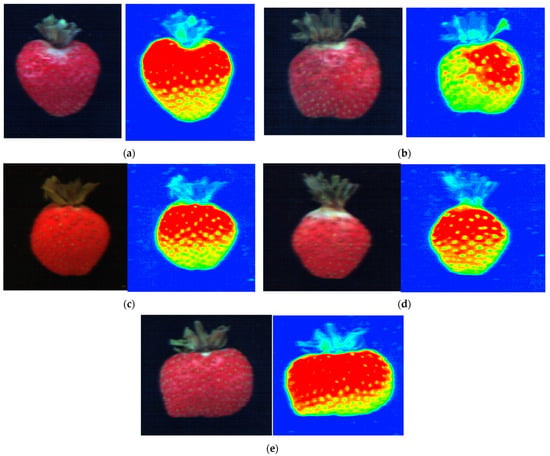
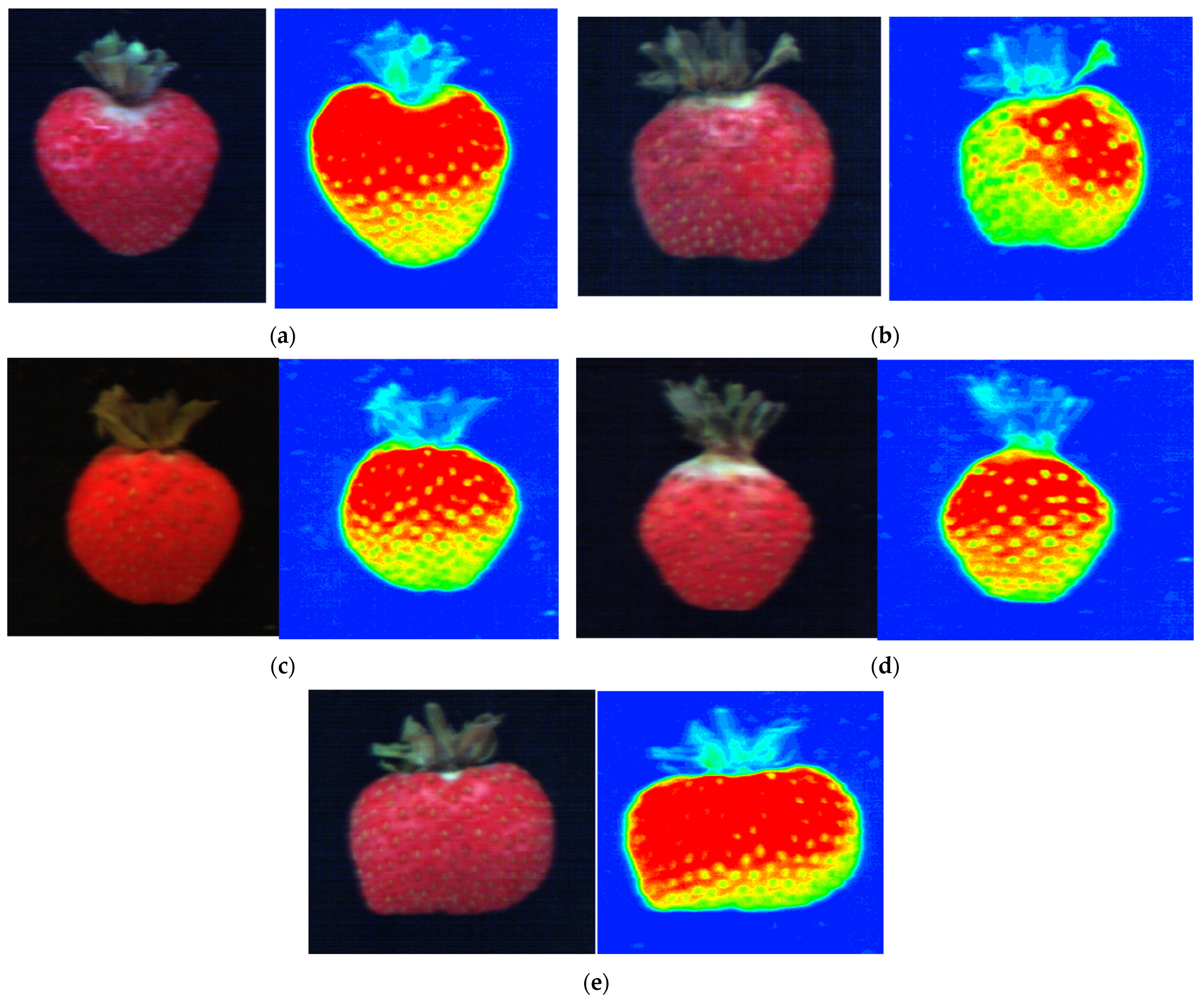
Figure 2 presents the RGB and reflectance-scaled images of strawberries subjected to different precooling treatments on Day 41 of storage at 680 nm. The samples treated with IVCS displayed a distinct darkened region on the left side of the fruit (corresponding to the green region in the reflectance-scaled images), indicating more pronounced deterioration compared with the other treatments. This deterioration is likely attributable to salt-induced osmotic and physiological stress. Because a 5% NaCl solution is strongly hypertonic, brief immersion causes rapid water efflux from strawberry tissues, resulting in loss of cellular turgor. Such osmotic stress weakens cellular structure and increases vulnerability to mechanical and physiological damage during prolonged storage [53].
Figure 2.
RGB (left) and reflectance-scaled images (right) of the strawberries with different pre-cooling treatments on the 41st storage day at 680 nm. (a) Control sample; (b) samples treated by IVCS; (c) samples treated by IVCW; (d) sample treated by IVCWP1; (e) sample treated by VC. Note: IVCW: immersion vacuum cooling with distilled water; IVCWP1: immersion vacuum cooling with one pulse cycle (atmosphere–vacuum–atmosphere); IVCS: immersion vacuum cooling with 5% saline solution; VC: vacuum cooling.
Furthermore, exposure to high salt concentrations compromises membrane integrity, leading to increased permeability and leakage of intracellular constituents, including sugars, organic acids, and phenolic compounds. These leaked substrates not only facilitate microbial proliferation but also intensify oxidative reactions. Membrane disruption additionally enhances the contact between phenolic substrates and oxidative enzymes such as PPO and POD, thereby accelerating enzymatic browning and oxidative degradation.
Taken together, osmotic stress, membrane damage, enhanced enzymatic oxidation, reduced antioxidant levels, and increased microbial susceptibility provide a plausible mechanistic explanation for the markedly accelerated deterioration observed in strawberries treated with the 5% saline IVCS method.
The changes in DPPH assay values of strawberries subjected to different pre-cooling treatments and storage durations were investigated, a topic that has not been previously evaluated. This analysis enhances the understanding of the interaction between strawberry antioxidant activity and spectral characteristics, providing valuable insights for future research. Furthermore, the relationship between DPPH assay values and spectral data obtained from strawberries exposed to various pre-cooling treatments was established for the first time using PLSR. Although spatial information was averaged in the current modeling process, HSI inherently retains spatial resolution, allowing future development of pixel-wise quality mapping and detection of heterogeneity or localized deterioration—capabilities that conventional spectroscopy cannot provide. Furthermore, HSI systems are increasingly being adapted for industrial sorting and online inspection, making this approach relevant for practical postharvest quality control applications.
4. Conclusions
This study evaluated the capability of hyperspectral imaging combined with chemometric analysis to monitor the antioxidant activity of strawberries subjected to different pre-cooling treatments during cold storage (4 °C). The results demonstrated that antioxidant activity exhibited distinct responses depending on the pre-cooling method applied, indicating that the choice of pre-cooling strategy significantly influences the preservation of antioxidant-related quality attributes during storage. In particular, strawberries subjected to vacuum cooling showed improved retention of antioxidant activity compared with other pre-cooling approaches, suggesting its potential as an effective postharvest technology for maintaining fruit quality. Furthermore, the multivariate calibration models were developed from hyperspectral data. Although the technique shows potential, it failed to provide a robust prediction of antioxidant activity in this specific study. Nevertheless, further investigations incorporating microbial, textural, sensorial, and physicochemical analyses are necessary to comprehensively evaluate the overall effects of different pre-cooling treatments.
Funding
This research was funded by the Kieikai Research Foundation (FY 2025); the President’s Discretionary Grants of CAFFE, funded by the Kitami Institute of Technology (FY 2024); supported from the Japan Society for the Promotion of Science Grant-in-Aid for Scientific Research (C) (25K00189); the Leading Initiative for Excellent Young Researchers (LEADER) of the Government of Japan Ministry of Education, Culture, Sports, Science and Technology (MEXT) (2020L0277); the Mishima Kaiun Memorial Foundation (FY 2022); (20K15477); Grants-in-Aid for Regional R&D Proposal-Based Program from Northern Advancement Centre for Science & Technology of Hokkaido Japan (T-2-4); Sasakawa Scientific Research Grant from The Japan Science Society (2022-3005).
Data Availability Statement
Data are contained within this article.
Acknowledgments
The author would also like to thank the anonymous reviewers for their constructive comments.
Conflicts of Interest
The author declares no conflicts of interest.
References
- Sun, M.; Jiang, F.; Wang, C.; Zhang, A.; Tian, Y. Development of a comprehensive quality index for strawberry and its non-destructive prediction using hyperspectral imaging. Food Control 2026, 181, 111754. [Google Scholar] [CrossRef] [Scilit]
- Qian, J.; Zhao, Y.; Yan, W.; Zhang, J.; Wang, J. Improvement of antioxidant capacity and gray mold resistance of strawberries by combined plasma technology. Postharvest Biol. Technol. 2025, 223, 113426. [Google Scholar] [CrossRef] [Scilit]
- Van, T.T.; Tanaka, F.; Wardak, M.H.; Jothi, J.S.; Phuong, N.T.H.; Yan, X.; Zdunek, A.; Tanaka, F. Effect of coatings containing 1-methylcyclopropane or mandarin peel extract on the freshness and metabolic profiles of cold stored strawberry. Food Chem. 2024, 461, 140819. [Google Scholar] [CrossRef] [Scilit]
- Mendoza-Enano, M.; Stanley, R.; Frank, D. Linking consumer sensory acceptability to volatile composition for improved shelf-life: A case study of fresh-cut watermelon (Citrullus lanatus). Postharvest Biol. Technol. 2019, 154, 137–147. [Google Scholar] [CrossRef] [Scilit]
- Rasouli, M.; Koushesh Saba, M. Prolonging shelf-life and preserving quality of strawberry fruit through nano-biodegradable polyethylene films packaging and ultraviolet-C irradiation. Sci. Hortic. 2025, 352, 114441. [Google Scholar] [CrossRef] [Scilit]
- Zhang, Z.; Guan, Y.; Zhang, Z.; Zhang, Z.; Li, H. Metabolomic combined with transcriptome analysis revealed the improvement of strawberry fruit quality after potassium sulfate treatment. Plant Physiol. Biochem. 2025, 221, 109658. [Google Scholar] [CrossRef] [Scilit] [PubMed]
- Ziena, A.H. Evaluation of quality attributes, antioxidant activity, and phytochemical content of functional canned whole strawberries (Fragaria × ananassa) as influenced by sweetening medium, heat treatment, and storage. Appl. Food Res. 2025, 5, 101006. [Google Scholar] [CrossRef] [Scilit]
- Bertolo, M.R.V.; de Oliveira Filho, J.G.; Lamonica, G.C.; de Oliveira Nobre Bezerra, C.C.; da Conceição Amaro Martins, V.; Ferreira, M.D.; de Guzzi Plepis, A.M.; Bogusz Junior, S. Improvement of the physical-chemical, microbiological, volatiles and sensory quality of strawberries covered with chitosan/gelatin/pomegranate peel extract-based coatings. Food Chem. 2025, 471, 142755. [Google Scholar] [CrossRef] [Scilit]
- Phuong, N.T.H.; Koga, A.; Nkede, F.N.; Tanaka, F.; Tanaka, F. Application of edible coatings composed of chitosan and tea seed oil for quality improvement of strawberries and visualization of internal structure changes using X-ray computed tomography. Prog. Org. Coat. 2023, 183, 107730. [Google Scholar] [CrossRef] [Scilit]
- Chen, M.; Xu, Z.; Yang, R.; Yue, Y.; Cai, Z.; Xiao, H. Preharvest application of Bacillus velezensis 12Y improves strawberry fruit quality and storability. Food Chem. 2025, 495, 146423. [Google Scholar] [CrossRef] [Scilit]
- Atci, S.; Bilbao-Sainz, C.; McGraw, V.S.; Williams, T.; Wood, D.; McHugh, T.; Rubinsky, B. Impact of storage temperature on the physicochemical properties and stability of oil-in-water emulsions under subzero isochoric cooling and conventional isobaric freezing. Innov. Food Sci. Emerg. Technol. 2025, 104, 104129. [Google Scholar] [CrossRef] [Scilit]
- Dai, O.; Wang, Y.; Li, M.; Hong, W.; Lei, X.; Ye, Z.; Pang, J.; Sun, Y. Post-harvest precooling technology and fresh-keeping mechanism of fruits and vegetables: A review. Postharvest Biol. Technol. 2025, 227, 113623. [Google Scholar] [CrossRef] [Scilit]
- Feng, C.-H.; Wang, W.; Makino, Y.; García-Martín, J.F.; Alvarez-Mateos, P.; Song, X.-Y. Evaluation of storage time and temperature on physicochemical properties of immersion vacuum cooled sausages stuffed in the innovative casings modified by surfactants and lactic acid. J. Food Eng. 2019, 257, 34–43. [Google Scholar] [CrossRef] [Scilit]
- Huang, M.; Wang, L.; Kong, F.; Tian, C.; Shao, W.; Zhao, J.; Zou, H. Vacuum Cooling of Leafy Vegetables: Model, Validation and Optimization. J. Food Eng. 2026, 413, 113022. [Google Scholar] [CrossRef] [Scilit]
- Zhu, Z.; Geng, Y.; Sun, D.-W. Effects of operation processes and conditions on enhancing performances of vacuum cooling of foods: A review. Trends Food Sci. Technol. 2019, 85, 67–77. [Google Scholar] [CrossRef] [Scilit]
- Feng, C.-H.; Li, C. Immersion Vacuum-Cooling as a Novel Technique for Cooling Meat Products: Research Advances and Current State-of-the Art. Compr. Rev. Food Sci. Food Saf. 2015, 14, 785–795. [Google Scholar] [CrossRef] [Scilit]
- Drummond, L.; Sun, D.-W. Temperature evolution and mass losses during immersion vacuum cooling of cooked beef joints—A finite difference model. Meat Sci. 2008, 80, 885–891. [Google Scholar] [CrossRef] [Scilit]
- Schmidt, F.C.; Aragao, G.M.F.; Laurindo, J.B. Integrated cooking and vacuum cooling of chicken breast cuts in a single vessel. J. Food Eng. 2010, 100, 219–224. [Google Scholar] [CrossRef] [Scilit]
- Feng, C.-H.; Sun, D.-W. Optimisation of immersion vacuum cooling operation and quality of Irish cooked sausages by using response surface methodology. Int. J. Food Sci. Technol. 2014, 49, 1850–1858. [Google Scholar] [CrossRef] [Scilit]
- Feng, C.-H.; Drummond, L.; Zhang, Z.-H.; Sun, D.-W. Evaluation of innovative immersion vacuum cooling with different pressure reduction rates and agitation for cooked sausages stuffed in natural or artificial casing. LWT-Food Sci. Technol. 2014, 59, 77–85. [Google Scholar] [CrossRef] [Scilit]
- Feng, C.-H.; Drummond, L.; Zhang, Z.-H.; Sun, D.-W. Effects of processing parameters on immersion vacuum cooling time and physico-chemical properties of pork hams. Meat Sci. 2013, 95, 425–432. [Google Scholar] [CrossRef] [Scilit]
- Feng, C.; Drummond, L.; Zhang, Z.; Sun, D.-W.; Wang, Q. Vacuum Cooling of Meat Products: Current State-of-the-Art Research Advances. Crit. Rev. Food Sci. Nutr. 2012, 52, 1024–1038. [Google Scholar] [CrossRef] [Scilit] [PubMed]
- Ferrua, M.J.; Singh, R.P. Improving the design and efficiency of the forced-air cooling process of fresh strawberries using computational modeling. Procedia Food Sci. 2011, 1, 1239–1246. [Google Scholar] [CrossRef] [Scilit]
- Ferrua, M.J.; Singh, R.P. Design guidelines for the forced-air cooling process of strawberries. Int. J. Refrig. 2009, 32, 1932–1943. [Google Scholar] [CrossRef] [Scilit]
- Ferrua, M.J.; Singh, R.P. Modeling the forced-air cooling process of fresh strawberry packages, Part I: Numerical model. Int. J. Refrig. 2009, 32, 335–348. [Google Scholar] [CrossRef] [Scilit]
- Ferrua, M.J.; Singh, R.P. Modeling the forced-air cooling process of fresh strawberry packages, Part II: Experimental validation of the flow model. Int. J. Refrig. 2009, 32, 349–358. [Google Scholar] [CrossRef] [Scilit]
- Ferrua, M.J.; Singh, R.P. Modeling the forced-air cooling process of fresh strawberry packages, Part III: Experimental validation of the energy model. Int. J. Refrig. 2009, 32, 359–368. [Google Scholar] [CrossRef] [Scilit]
- Nasser eddine, A.; Duret, S.; Flick, D.; Laguerre, O.; Sdiri, I.; Moureh, J. Heat transfer within a multi-package: Assessing the impact of package design on the cooling of strawberries. J. Food Eng. 2024, 382, 112190. [Google Scholar] [CrossRef] [Scilit]
- Sreedharan, A.; Tokarskyy, O.; Sargent, S.; Schneider, K.R. Survival of Salmonella spp. on surface-inoculated forced-air cooled and hydrocooled intact strawberries, and in strawberry puree. Food Control 2015, 51, 244–250. [Google Scholar] [CrossRef] [Scilit]
- Wang, D.; Zhang, T.; Ding, K.; Tang, H.; Li, H. Near-infrared spectroscopy for energetic materials: Instruments, chemometrics, and process analytics (2001–2025). TrAC Trends Anal. Chem. 2026, 196, 118631. [Google Scholar] [CrossRef] [Scilit]
- Feng, C.H.; Makino, Y.; Yoshimura, M.; Rodríguez-Pulido, F.J. Real-time prediction of pre-cooked Japanese sausage color with different storage days using hyperspectral imaging. J. Sci. Food Agric. 2018, 98, 2564–2572. [Google Scholar] [CrossRef] [Scilit]
- Wang, S.; Bai, R.; Long, W.; Wan, X.; Zhao, Z.; Fu, H.; Yang, J. Rapid qualitative and quantitative detection for adulteration of Atractylodis Rhizoma using hyperspectral imaging combined with chemometric methods. Spectrochim. Acta Part A Mol. Biomol. Spectrosc. 2025, 327, 125426. [Google Scholar] [CrossRef] [Scilit] [PubMed]
- Fan, L.; Yu, J.; Zhang, P.; Xie, M. Prediction of Strawberry Quality during Maturity Based on Hyperspectral Technology. Agronomy 2024, 14, 1450. [Google Scholar] [CrossRef] [Scilit]
- Su, Z.; Zhang, C.; Yan, T.; Zhu, J.; Zeng, Y.; Lu, X.; Gao, P.; Feng, L.; He, L.; Fan, L. Application of Hyperspectral Imaging for Maturity and Soluble Solids Content Determination of Strawberry With Deep Learning Approaches. Front. Plant Sci. 2021, 12, 736334. [Google Scholar] [CrossRef] [Scilit]
- Feng, C.-H.; Arai, H.; Rodríguez-Pulido, F.J. Assessment of adenosine triphosphate content in sausages stuffed in different modified casing treatments added with orange extracts, utilising hyperspectral imaging combined with multivariate analysis. Front. Nutr. 2024, 11, 1370339. [Google Scholar] [CrossRef] [Scilit]
- Ma, H.; Johnson, S.L.; Liu, W.; DaSilva, N.A.; Meschwitz, S.; Dain, J.A.; Seeram, N.P. Evaluation of Polyphenol Anthocyanin-Enriched Extracts of Blackberry, Black Raspberry, Blueberry, Cranberry, Red Raspberry, and Strawberry for Free Radical Scavenging, Reactive Carbonyl Species Trapping, Anti-Glycation, Anti-β-Amyloid Aggregation, and Microglial Neuroprotective Effects. Int. J. Mol. Sci. 2018, 19, 461. [Google Scholar] [CrossRef] [Scilit]
- Pineli, L.d.L.d.O.; Moretti, C.L.; dos Santos, M.S.; Campos, A.B.; Brasileiro, A.V.; Córdova, A.C.; Chiarello, M.D. Antioxidants and other chemical and physical characteristics of two strawberry cultivars at different ripeness stages. J. Food Compos. Anal. 2011, 24, 11–16. [Google Scholar] [CrossRef] [Scilit]
- Huang, W.-Y.; Zhang, H.-C.; Liu, W.-X.; Li, C.-Y. Survey of antioxidant capacity and phenolic composition of blueberry, blackberry, and strawberry in Nanjing. J. Zhejiang Univ. Sci. B 2012, 13, 94–102. [Google Scholar] [CrossRef] [Scilit]
- Feng, C.-H. Vacuum-Packed Pork Sausages with Modified Casing Added with Orange Peel Extracts: Evaluating In Vitro Antioxidant Activity via Hyperspectral Imaging Coupled with Chemometrics. Processes 2023, 11, 2583. [Google Scholar] [CrossRef] [Scilit]
- Garriga, M.; Retamales, J.B.; Romero-Bravo, S.; Caligari, P.D.S.; Lobos, G.A. Chlorophyll, anthocyanin, and gas exchange changes assessed by spectroradiometry in Fragaria chiloensis under salt stress. J. Integr. Plant Biol. 2014, 56, 505–515. [Google Scholar] [CrossRef] [Scilit]
- Dai, B.; Kan, A.; Yi, B. An improved mathematical model bidirectional coupling of heat-water and mechanics during vacuum pre-cooling. Innov. Food Sci. Emerg. Technol. 2022, 81, 103137. [Google Scholar] [CrossRef] [Scilit]
- Ranjbaran, M.; Datta, A.K. Pressure-driven infiltration of water and bacteria into plant leaves during vacuum cooling: A mechanistic model. J. Food Eng. 2019, 246, 209–223. [Google Scholar] [CrossRef] [Scilit]
- Cheng, Q.; Sun, D.W. Improving the quality of pork ham by pulsed vacuum cooling in water. J. Food Process Eng. 2006, 29, 119–133. [Google Scholar] [CrossRef] [Scilit]
- Houska, M.; Landfeld, A.; Sun, D.-W. Eating quality enhancement of cooked pork and beef by ripening in brine and vacuum cooling. J. Food Eng. 2005, 68, 357–362. [Google Scholar] [CrossRef] [Scilit]
- Liu, D.; Pu, H.; Sun, D.-W.; Wang, L.; Zeng, X.-A. Combination of spectra and texture data of hyperspectral imaging for prediction of pH in salted meat. Food Chem. 2014, 160, 330–337. [Google Scholar] [CrossRef] [Scilit] [PubMed]
- Houska, M.; Sun, D.-W.; Landfeld, A.; Zhang, Z. Experimental study of vacuum cooling of cooked beef in soup. J. Food Eng. 2003, 59, 105–110. [Google Scholar] [CrossRef] [Scilit]
- Lee, S.-D.; Gil, C.-S.; Lee, J.-H.; Jeong, H.-B.; Kim, J.-H.; Jang, Y.-A.; Kim, D.-Y.; Lee, W.-M.; Moon, J.-H. Internal quality prediction technology for ‘Sulhyang’ strawberry fruit using organic analysis and hyperspectral imaging. Spectrochim. Acta Part A Mol. Biomol. Spectrosc. 2024, 323, 124912. [Google Scholar] [CrossRef] [Scilit]
- Helland, I.S.; Næs, T.; Isaksson, T. Related versions of the multiplicative scatter correction method for preprocessing spectroscopic data. Chemom. Intell. Lab. Syst. 1995, 29, 233–241. [Google Scholar] [CrossRef]
- Esquerre, C.A.; Achata, E.M.; García-Vaquero, M.; Zhang, Z.; Tiwari, B.K.; O’Donnell, C.P. Use of an NIR MEMS spectrophotometer and visible/NIR hyperspectral imaging systems to predict quality parameters of treated ground peppercorns. LWT 2020, 131, 109761. [Google Scholar] [CrossRef] [Scilit]
- Rodrigues, J.; Alves, A.; Pereira, H.; da Silva Perez, D.; Chantre, G.; Schwanninger, M. NIR PLSR results obtained by calibration with noisy, low-precision reference values: Are the results acceptable? Holzforschung 2006, 60, 402–408. [Google Scholar] [CrossRef] [Scilit]
- Aaby, K.; Ekeberg, D.; Skrede, G. Characterization of Phenolic Compounds in Strawberry (Fragaria × ananassa) Fruits by Different HPLC Detectors and Contribution of Individual Compounds to Total Antioxidant Capacity. J. Agric. Food Chem. 2007, 55, 4395–4406. [Google Scholar] [CrossRef] [Scilit] [PubMed]
- Chisari, M.; Barbagallo, R.N.; Spagna, G. Characterization of Polyphenol Oxidase and Peroxidase and Influence on Browning of Cold Stored Strawberry Fruit. J. Agric. Food Chem. 2007, 55, 3469–3476. [Google Scholar] [CrossRef] [Scilit] [PubMed]
- Finan, J.D.; Guilak, F. The effects of osmotic stress on the structure and function of the cell nucleus. J. Cell. Biochem. 2010, 109, 460–467. [Google Scholar] [CrossRef] [Scilit] [PubMed]

Disclaimer/Publisher’s Note: The statements, opinions and data contained in all publications are solely those of the individual author(s) and contributor(s) and not of MDPI and/or the editor(s). MDPI and/or the editor(s) disclaim responsibility for any injury to people or property resulting from any ideas, methods, instructions or products referred to in the content. |
© 2026 by the author. Licensee MDPI, Basel, Switzerland. This article is an open access article distributed under the terms and conditions of the Creative Commons Attribution (CC BY) license.