


Abstract
To achieve high-precision and real-time quantitative evaluation of gas production in underground gas storage (UGS), this study focused on 11 typical injection-production wells in the Sudong UGS group. To address the common challenges posed by deviated well structures and complex wellbore temperature field distributions, a gas flow-rate calculation method based on Distributed Temperature-Sensing (DTS) data was developed. By standardizing the processing of multi-well temperature data, deviated wellbore trajectories were straightened to convert measured depth (MD) to true vertical depth (TVD). By incorporating a geothermal correction mechanism, temperature anomalies closely related to fluid flow were extracted, and a spatially unified temperature field model was constructed. On this basis, a “Dual-Point Temperature Difference Method” is proposed as a novel approach for single-well production evaluation. Based on thermodynamic phenomena such as the Joule–Thomson effect and expansion cooling, two critical sensing points, upstream and downstream of the production layer, were selected, with their temperature anomaly difference (∆T) serving as a sensitive indicator of flow rate variations. Combined with downhole pressure parameters and synchronized wellhead metering data, a nonlinear quantitative relationship model between ∆T and gas production rate Q was established, enabling accurate conversion of wellbore thermal response to macroscopic flow parameters. The results indicated that the gas production rates calculated by this method align well with traditional wellhead metering data, with errors maintained within engineering tolerances. Notably, the method demonstrates higher reliability and corrective capabilities in wells with drifting or faulty meters. This achievement breaks the reliance of traditional methods on specific layers or mechanical meters. It enables the effective application of multi-well, full-section, and non-contact temperature data in gas volume assessment. This research provides new technical support for dynamic monitoring, efficient operation, and remaining gas evaluation of UGS, offering significant prospects for engineering applications.
1. Introduction
Underground Gas Storage (UGS), as a critical infrastructure for ensuring national energy security and enhancing the peak-shaving and emergency supply capabilities of natural gas systems, has gained increasing strategic importance amidst the global energy transition. Developed countries in Europe and North America have established highly intelligent and automated UGS operation systems. These systems commonly utilize permanent downhole-monitoring technologies, such as distributed fiber-optic sensing (DTS/DAS) and downhole pressure gauge arrays, to achieve real-time perception and closed-loop control of injection-production dynamics. This enables single-well metering accuracy within ±1% and supports multi-well collaborative optimization and dynamic inventory assessment. In contrast, while UGS construction in China started late, it has developed rapidly, with the national working gas capacity exceeding 20 billion cubic meters by 2025. However, most domestic UGS facilities still rely on surface wellhead meters for single-point measurement, which cannot characterize internal wellbore flow processes and fail to meet the requirements for precise management under high-frequency switching and high-intensity injection-production conditions.
The Sudong UGS, a major peak-shaving hub in eastern China, targets the Ma-5 Member of the Ordovician Majiagou Formation, characterized by deep burial, high injection-production intensity, and stringent control requirements. Under such complex conditions, traditional surface metering methods face severe challenges. On one hand, conventional flowmeters (e.g., orifice, turbine, and ultrasonic meters) are susceptible to probe contamination and signal attenuation caused by frequent pressure pulsations and trace solid impurities; field calibrations showed that the metering error in some wells exceeded ±5%. On the other hand, surface metering provides only a single total output, failing to identify abnormal wellbore flow phenomena (e.g., gas channeling and throttling-induced cooling) or to capture the thermodynamic responses triggered by the Joule–Thomson effect during transients. This significantly limits dynamic production optimization and early risk warning. In this context, advanced downhole real-time-monitoring technologies have emerged, particularly Distributed Temperature-Sensing (DTS). With its full-length, continuous, and high spatio-temporal resolution-monitoring capabilities, DTS provides a rich information source for the inversion of wellbore fluid flow states. Although DTS has been preliminarily applied in wellbore integrity diagnosis and leak detection, existing research has primarily focused on qualitative identification or vertical well scenarios. Critical challenges—such as spatial distortion of the temperature field caused by deviated trajectories, inconsistent geothermal baselines, and the extraction of weak flow-induced temperature signals—remain unresolved for deep lithologic UGS facilities. Specifically, for harsh conditions where fibers are not deployed to the production layer and only annular temperature data above the packer is available, a significant research gap exists regarding how to achieve high-precision evaluation using only non-reservoir DTS information.
Numerous studies have been conducted globally on intelligent monitoring and risk management for UGS. Zhang et al. [1] proposed a risk management framework based on multi-physical field data fusion; Luo et al. [2] demonstrated the feasibility of using DTS and Distributed Strain Sensing (DSS) for real-time wellbore integrity monitoring through field demonstrations. These studies indicate that leveraging fiber-optic data to mine wellbore flow information is a key direction for the intelligent development of UGS.
The core of flow rate inversion using wellbore temperature data lies in establishing accurate heat transfer models. The wellbore temperature field results from the coupling of fluid flow, thermal convection, heat conduction, and heat exchange with the formation. The classic studies by Hasan et al. [3,4] systematically expounded the theory of wellbore heat transfer, confirmed the dominant role of mass flow rate in the temperature profile, and discussed coupling mechanisms under transient flow. Hasan [5] proposed an analytical model for transient gas well testing, revealing temperature responses under non-steady-state flow. With the widespread adoption of DTS, models have evolved. Nakamoto et al. [6] developed a transient heat transfer model validated by DTS, enhancing prediction accuracy, while Shi et al. [7] established a semi-analytical heat transport model to resolve temperature field analysis under multi-step flow rates. These theories provide a solid foundation for quantitative inversion. For gas wells, the Joule–Thomson (J-T) effect is a key thermodynamic mechanism. Gas undergoes significant changes in temperature during expansion. Yang et al. [8] investigated the impact of the J-T effect on bottomhole temperature in ultra-high-temperature/pressure wells, while Farzaneh-Gord [9] analyzed the effect of gas composition on J-T coefficients, which are vital for accurate temperature-response calculations.
Regarding engineering applications, DTS has been widely used in wellbore integrity diagnosis. UGS wells are prone to casing or cement sheath damage due to cyclic loading. Lipus et al. [10] discussed the application of DSS for integrity monitoring. For leak detection, Zou et al. [11] confirmed through physical simulations that DTS can accurately capture local temperature variations caused by gas leaks. To improve identification efficiency, AI algorithms were introduced; Cherubini et al. [12] utilized Convolutional Recurrent Neural Networks (CRNN) for leak detection, and Zou et al. [11] combined DAS and DTS to enhance accuracy. These qualitative diagnostic methods provide valuable references for the quantitative flow calculation in this study. Meanwhile, interpreting flow-injection profiles using DTS has become a hot topic. Luo et al. [13] researched DTS-based injection profile interpretation; Kabir et al. [14] proposed flow profile inversion methods for multistage fractured horizontal wells; and Liu et al. [15] attempted to estimate total flow rates. In other fields, DTS was applied to geothermal well monitoring (Khankishiyev et al. [16]; Jiang et al. [17]) and to fracture characterization, combined with machine learning (Yang et al. [18,19]) or numerical simulation (Han et al. [20]). These efforts confirm that fluid flow superimposes thermal anomalies on the geothermal background, providing a basis for inferring fluid properties.
However, applying DTS to the Sudong UGS faces two critical challenges: the large burial depth and the prevalence of deviated wells. First, the complexity of temperature field correction in deviated wells is significant. The relationship between deviated trajectories and vertical formation sequences alters flow patterns and heat transfer efficiency; thus, directly applying vertical well models results in substantial errors (Liu et al. [15,21]; Zhao et al. [22]). Furthermore, while obtaining an accurate geothermal gradient is a prerequisite (Ramazanov et al. [23]; Maurer et al. [24]; Yang et al. [18]), existing inversion methods are highly sensitive to formation parameters and lack standardized correction workflows for MD-TVD mismatches. Second, extracting temperature signals for micro-flow rates is difficult, as current models rely on complex iterative solvers that struggle to adapt to the frequent operating condition switching of UGS.
In summary, the 11 injection-production wells in the Sudong UGS are all deviated wells, and traditional wellhead meters exhibit significant errors after long-term operation. This study addresses the bottlenecks of “deviated wellbore temperature correction” and “weak flow-induced signal extraction” by developing a gas flow rate calculation method based on temperature data. Standardized DTS temperature fields were established using deviated wellbore straightening and geothermal correction techniques to eliminate the interference of well trajectories and geothermal backgrounds. On this basis, a “Dual-Point Temperature Difference Method” is proposed based on the J-T effect principle. This method directly captures the most sensitive temperature difference signals upstream and downstream of the production zone to construct a quantitative relationship between temperature and flow rate. The ultimate goal is to enable the effective application of multi-well, non-reservoir-temperature data for production evaluation, providing a robust means to calibrate traditional metering results and supporting dynamic monitoring and efficient operation of the Sudong UGS.
2. Field Overview
The Sudong Underground Gas Storage (UGS) is strategically located as a core hub for peak-shaving and supply security within the regional natural gas pipeline network. The target development horizon is the fifth member of the Ordovician Majiagou Formation (hereinafter, the “Ma-5” reservoir). From a structural geology perspective, the Ma-5 reservoir is characterized by a monocline with extremely gentle structural relief, lacking typical large-scale anticlines or fault-block features. The formation of effective traps primarily depends on lateral lithological variations. Specifically, the reservoir lithology is dominated by dense, hard dolomite, which developed intercrystalline and dissolution pores during diagenesis, providing favorable storage space. Toward the boundaries, the dolomite transitions into tight strata or undergoes lithological pinch-out. This natural lithological barrier effectively seals lateral migration pathways, forming a typical lithological pinch-out trap.
The burial depth of the reservoir ranges from 3110 m to 3150 m, categorizing it as a deep carbonate gas reservoir. Such deep burial implies that the reservoir rocks endure immense overburden pressure, posing rigorous challenges to the structural integrity of injection-production wells and the pressure resistance of downhole tools. Regional geological surveys indicate a relatively stable geothermal gradient of approximately 3 °C/100 m. This stable thermal environment provides a consistent thermodynamic background field for the subsequent inversion of downhole flow states using temperature data. Table 1 summarizes the basic temperature and pressure data of the reservoir.
Table 1.
Basic parameters of wells in Sudong UGS.
Eleven key injection-production wells are deployed within the study area. To increase the drainage area and accommodate surface site constraints, all 11 wells are designed as deviated wells. The complex trajectories of these wells—including kickoff points, build-up sections, and tangent sections—mean that fluid flow within the wellbore no longer follows simple vertical pipe flow patterns. Slippage effects under gravity and non-axisymmetric heat transfer paths introduce additional complexities to flow measurement.
Monitoring optical fibers are deployed alongside the production tubing and fixed within the A-annulus between the outer wall of the tubing and the inner wall of the casing. Due to completion constraints and the packer’s temperature/pressure limits, fiber deployment depth terminates at the production packer. Consequently, the fibers do not penetrate the packer to reach the lower reservoir (perforated) section. This means that the acquired Distributed Temperature-Sensing (DTS) data covers only the interval from the wellhead to the top of the packer, precluding direct observation of temperature changes within the reservoir. Currently, the surface metering system for these 11 wells relies primarily on ultrasonic flowmeters installed downstream of the Christmas trees.
However, during actual operations, the frequent switching between injection and production modes (averaging dozens of times per year) results in intense pressure pulsations in the pipelines. Furthermore, the wellhead effluent may carry trace amounts of cuttings, dust, or formation water. These factors lead to contamination of the ultrasonic transducer probes or signal attenuation, subsequently causing measurement drift.
To evaluate the accuracy of the existing metering system, the management team organized field online calibration and comparison tests for the single-well flowmeters in March 2025, utilizing the UGS equilibrium period when operations were suspended, and wellhead pressure was relatively stable. The calibration report showed that, while most flowmeters performed acceptably, the readings for wells ZC6, ZC9, and ZCH3 exhibited significant deviations from the standard meter. The relative errors exceeded the allowable range defined by national standards (typically ±1.0% or ±1.5%).
These calibration results revealed a critical reality: the injection-production data for several primary wells risked distortion. Relying solely on erroneous instrumental data for dynamic reservoir analysis could lead to a misjudgment of remaining gas inventory and even compromise the safety of injection-production schemes. Therefore, there is an urgent need for a “secondary metering method” independent of traditional mechanical or electronic instruments to verify data.
3. Methodology
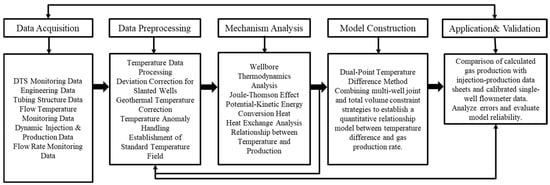
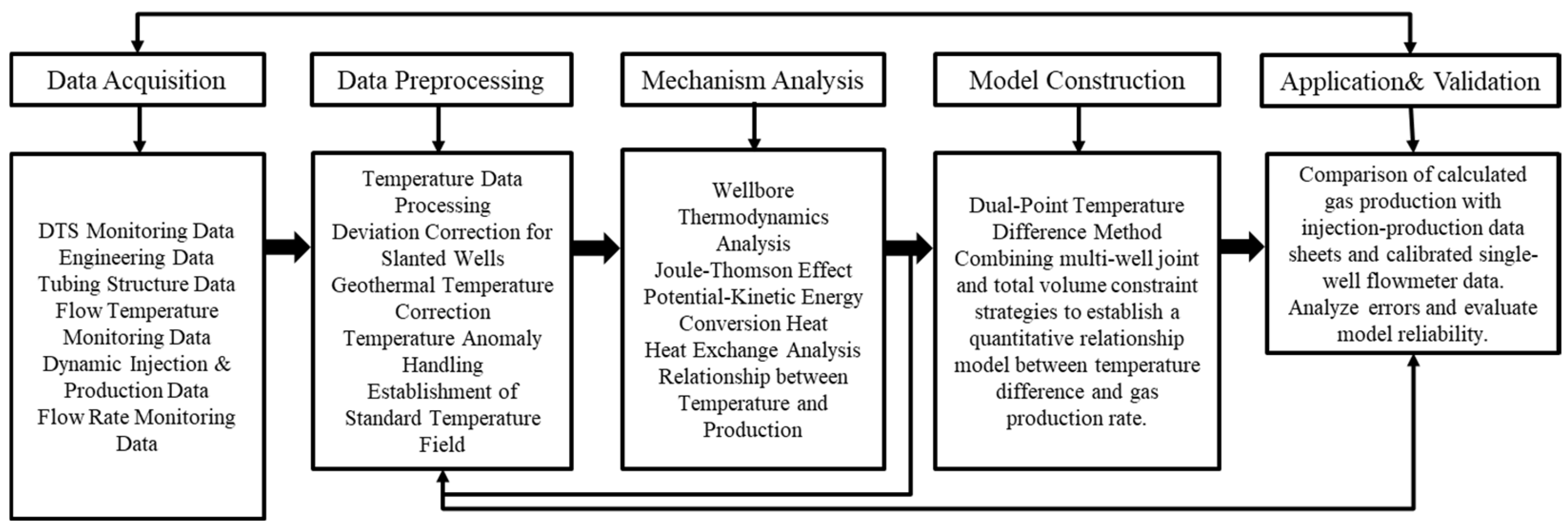
To achieve real-time, high-precision evaluation of injection and production rates for deviated wells in the Sudong Underground Gas Storage (UGS), a quantitative technical workflow was developed, with Distributed Temperature-Sensing (DTS) data at its core. This approach overcomes the complexity and parameter dependency inherent in traditional coupled wellbore thermo-fluid models. By employing standardized data preprocessing and an innovative “Dual-Point Temperature Difference Method,” a generalized gas-production calculation model is developed for deviated well environments. The technical workflow comprised five core modules: data acquisition, data preprocessing, mechanistic analysis, model construction, and application verification (Figure 1).
Figure 1.
Technical research roadmap for the relationship between UGS temperature and gas production rate.
The data acquisition module collected two categories of data: DTS monitoring data and wellbore engineering data. The DTS data included time-varying temperature profiles covering the entire well section (from the wellhead to the packer) for 11 fiber-optic-monitored wells. Engineering data consisted of well deviation logs (for trajectory correction), wireline temperature surveys (for validation), wellhead ultrasonic flowmeter data (for model fitting and verification), and production dynamic records (for identification of operating conditions). The data preprocessing module aimed to construct a spatially unified and standardized temperature field by performing wellbore trajectory straightening, geothermal correction, and temperature anomaly extraction. The mechanistic analysis module focused on the comprehensive impact of the Joule–Thomson (J-T) effect, potential-to-kinetic energy conversion, and heat exchange on wellbore temperature, based on thermodynamic theory, and defined the nonlinear coupling between temperature and flow rate. The model construction module established a quantitative relationship between temperature difference and flow rate using the innovative “Dual-Point Temperature Difference Method,” integrated with multi-well joint modeling and total-volume constraint strategies. Finally, the model was applied to calculate the flow rates of individual wells, which were validated against high-precision master meters and calibrated single-well meters to evaluate reliability and analyze errors.
3.1. DTS Data Standardization and Trajectory Correction
The 11 fiber-optic-monitored wells in the Sudong UGS are all deviated wells, resulting in significant spatial distortions and baseline discrepancies in the raw DTS data. To map time-varying temperature data from discrete Measured Depths (MD) to a unified, comparable spatial reference system, wellbore trajectory straightening and geothermal correction were applied to construct a “Standard Temperature Cube”.
Since the monitored wells are deviated, the MD measured along the fiber length does not directly reflect the true vertical variation in the geothermal gradient. This distortion warps the actual formation temperature distribution, causing temperature responses at the same vertical depth to be misaligned across different wells. To resolve this, the Minimum Curvature Method was employed for high-precision spatial correction of DTS data.
The Minimum Curvature Method is widely recognized as one of the most accurate methods for trajectory calculation. It discretizes the wellbore trajectory into small segments and assumes that each segment’s curvature is minimal and uniform. Based on wellbore survey data, the inclination angle () and azimuth angle () corresponding to the MD () were extracted. The True Vertical Depth (TVD) increment () for each segment was calculated as follows:
where is the incremental length and is the wellbore dogleg angle. In simplified applications, the following recursive formula was used:
where is the dogleg curvature coefficient used to correct radian errors. The raw temperature was remapped to the corrected vertical depth based on the three-dimensional coordinates. This process eliminated spatial projection distortions caused by well deviation and provided a basis for multi-well temperature field analysis.
3.2. Geothermal Correction and Anomaly Extraction
Baseline discrepancies arise from natural variations in geothermal background conditions at different well locations and from system errors in the DTS during long-distance monitoring. Therefore, to extract the dynamic thermal anomalies () caused by fluid flow, the static geothermal field must be removed. Well ZC0 was selected as the reference well for dynamic thermal anomaly extraction because it provides one of the deepest effective fiber deployments and the most continuous, high-quality DTS datasets during production periods among all monitoring wells (Table 2).
Table 2.
Summary of fiber deployment and data availability for monitoring wells.
A standard geothermal profile for the block was established using the average geothermal gradient (3 °C/100 m) and detailed static temperature logs from ZC0. The standard static geothermal profile is defined as:
where is the wellhead surface temperature and is the reference depth. The geothermal-corrected temperature anomaly for any well at depth is calculated as the difference between the measured temperature (TVD corrected) and the static geothermal background:
This operation removed the static geothermal influence, allowing DTS data from multiple wells to be normalized into a unified reference system, thereby highlighting the dynamic thermal signals induced by fluid flow.
3.3. Thermodynamic Mechanism and the Dual-Point Model
During gas production, natural gas flows from the high-pressure reservoir into the wellbore, primarily influenced by the Joule–Thomson (J-T) effect and potential-to-kinetic energy conversion. The J-T effect is the temperature change that occurs when a real gas expands through a porous medium or a wellbore restriction. In the UGS production phase, gas expands as it flows into the lower-pressure wellbore, typically resulting in an expansion cooling effect. A higher flow rate leads to a larger total enthalpy drop and a more pronounced temperature decrease. Additionally, as the fluid is lifted from deep formations, it works against gravity, increasing its potential energy and further lowering the temperature. This lift-induced temperature drop is positively correlated with vertical depth and flow rate.
Wellbore temperature is also affected by heat conduction, convection, and radiation between the fluid and the formation. This heat exchange process exhibits thermal hysteresis, creating a nonlinear coupling between the fluid temperature and flow rate . Traditional single-point measurement is susceptible to fluctuations in the original reservoir temperature (e.g., the cold reservoir effect after injection). To eliminate this interference, this study proposes a dual-point differential model. Two characteristic points were selected: upstream (near the bottomhole, approx. 2500 m) and downstream (near the wellhead, approx. 1000 m). Let the temperatures at these two points be and , respectively:
Because the temperature drop during gas expansion and lifting is positively correlated with flow velocity, this differential operation effectively cancels systematic biases caused by the geothermal background. Experimental data indicated that the temperature difference follows a logarithmic physical law with respect to the gas flow rate ; that is, the temperature difference increases with flow rate, but the sensitivity reaches saturation as the flow rate increases.
4. Data Processing and Comparative Analysis
In the study area, 11 fiber-optic monitoring wells were deployed, all of which were deviated wells with a maximum inclination of 42°. The complex spatial trajectories of these deviated wells, characterized by varying inclination and azimuth, influenced the spatial distribution of temperature data acquired by the sensing cables. Analyzing temperature data directly based on measured depth (MD) is prone to interference from wellbore deviation, which can disrupt spatial continuity, thereby distorting the actual formation temperature distribution. Therefore, to ensure the authenticity and accuracy of the spatial distribution of the temperature monitoring data, a wellbore trajectory straightening treatment was applied to all 11 wells.
First, based on wellbore survey records, the inclination and azimuth data for each well were extracted to establish a conversion function from MD to True Vertical Depth (TVD). Using the incremental coordinate method, the wellbore trajectory was discretized into numerous small segments. The three-dimensional coordinate changes for each segment were calculated to reconstruct the spatial trajectory. For the raw temperature profile data obtained by DTS, the temperature values were remapped to the corrected TVD and the actual spatial coordinates for each sensing point. After straightening, the spatial distribution of temperature data became more continuous, eliminating spatial projection distortion caused by wellbore inclination and providing a foundation for comparative analysis of the temperature field across multiple wells.
During multi-well data comparison and subsequent fusion, discrepancies in formation-temperature baselines across wells must be addressed. Due to variations in well site locations, geological conditions, and well depths, the static geothermal baselines differ slightly. Furthermore, instrument system errors, such as temperature drift of the fiber-optic cable itself, may be introduced during long-distance monitoring. Consequently, well ZC0, which featured complete data and the deepest fiber deployment, was selected as the standard reference well. A standard geothermal profile was established using the detailed static temperature profile of ZC0 and regional geothermal gradient data. Subsequently, the raw temperature data from the remaining wells were corrected and normalized to a unified baseline through geothermal gradient fitting and lag-temperature baseline comparison, ensuring comparability and fusibility within the same reference system.
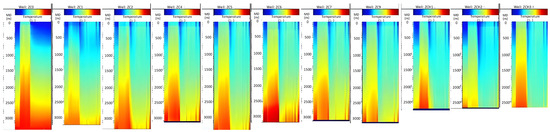
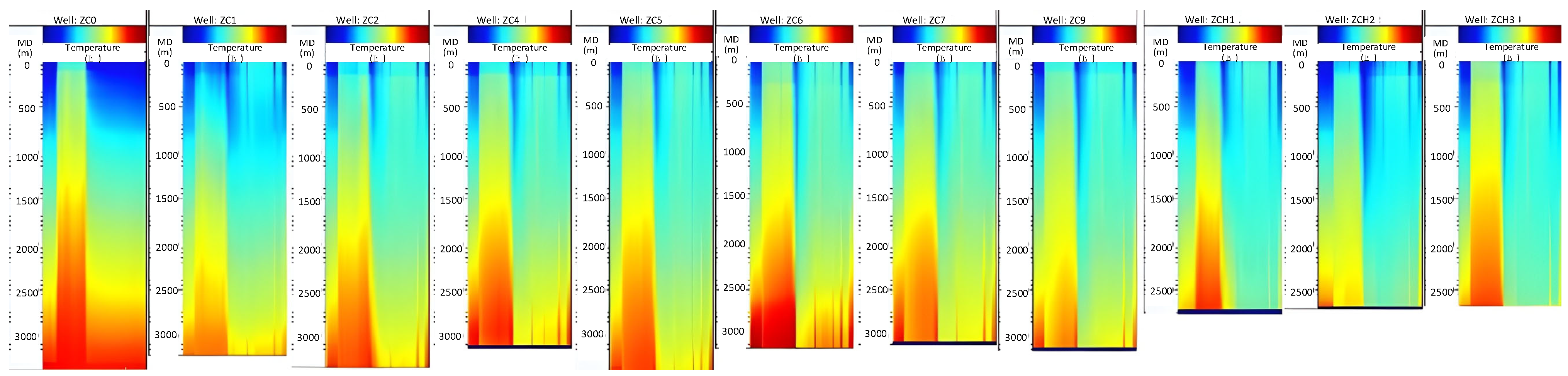
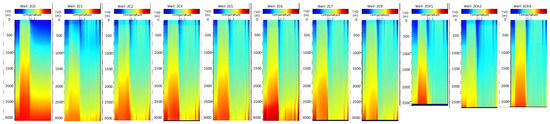
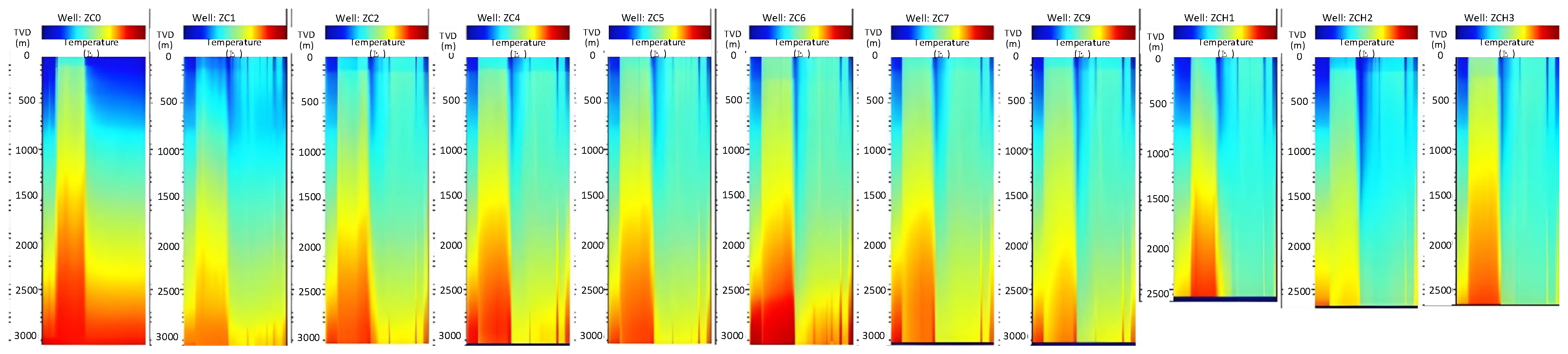
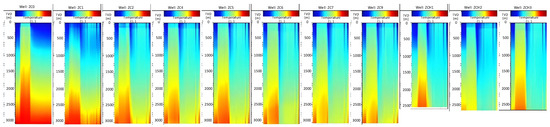
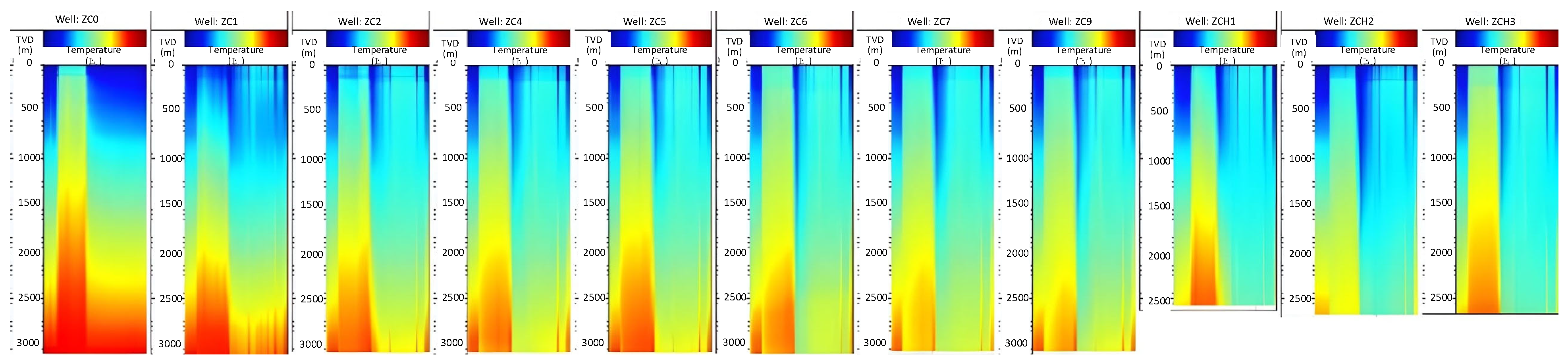
The raw DTS data from the 11 fiber-optic monitored wells were processed using the aforementioned algorithms. Figure 2, Figure 3 and Figure 4 present a step-by-step visualization of the data standardization process, including raw DTS profiles, wellbore-straightened temperature distributions, and the final standardized temperature field. All figures use a unified true vertical depth (TVD) scale to ensure direct comparability among wells. In Figure 2, before correction, temperature responses at the same TVD showed significant misalignment due to inclination. After applying wellbore trajectory straightening, the DTS temperature data were remapped from MD to TVD. As shown in Figure 3, the temperature profiles of all 11 wells become spatially aligned, and major thermal stratification features exhibit strong vertical continuity across wells. This confirms that the wellbore deviation-induced spatial distortion has been effectively eliminated. Figure 4 further illustrates the DTS temperature profiles after geothermal baseline normalization using the reference well ZC0. By correcting static geothermal differences among wells, the temperature field is transformed into a unified “standard temperature field,” which serves as the foundation for subsequent dynamic thermal anomaly extraction and quantitative production analysis.
Figure 2.
Raw DTS temperature profiles of monitoring wells in Sudong UGS.
Figure 3.
DTS temperature profiles after “wellbore straightening” in Sudong UGS.
Figure 4.
DTS temperature profiles after establishing the “standard temperature field” in Sudong UGS.
Following the standardization of spatial and geothermal baselines, the core of data processing shifted to extracting dynamic thermal anomaly signals. During gas production, the wellbore temperature exhibits significant cooling due to the Joule–Thomson (J-T) effect. By performing time-series slicing on the “standard temperature cube,” the temperature responses under different production intensities were compared. It was found that although the fiber only extended to the packer, the expansion-induced cooling from the production layer propagated upward along the wellbore. To eliminate interference from reservoir background temperature fluctuations during injection-production cycles, real-time temperatures at characteristic depths (2500 m and 1000 m) were automatically extracted. Data processing indicated that as the production rate increased from 20 × 104 to 60 × 104 , the temperature response at 2500 m was more rapid, while the cooling at 1000 m showed a slight lag due to heat exchange with shallow formations. By calculating the dynamic temperature difference () between these two points, a core physical quantity characterizing the single-well production intensity was successfully extracted, providing a high signal-to-noise ratio input for subsequent quantitative modeling.
To further verify the accuracy of the standardized temperature data and the scientific validity of the quantitative evaluation model, a “blind test” comparison was conducted between the corrected DTS data and traditional wireline temperature logs, which are recognized as the “gold standard” in oilfield evaluation, as shown in Table 3. A comparative experiment was designed in which well ZC0, featuring the most complete data sequence and a representative wellbore structure, was selected as the core comparison well.
Table 3.
Experimental design for the comparison between wireline and DTS temperature measurements.
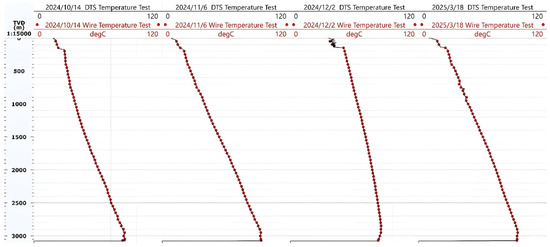
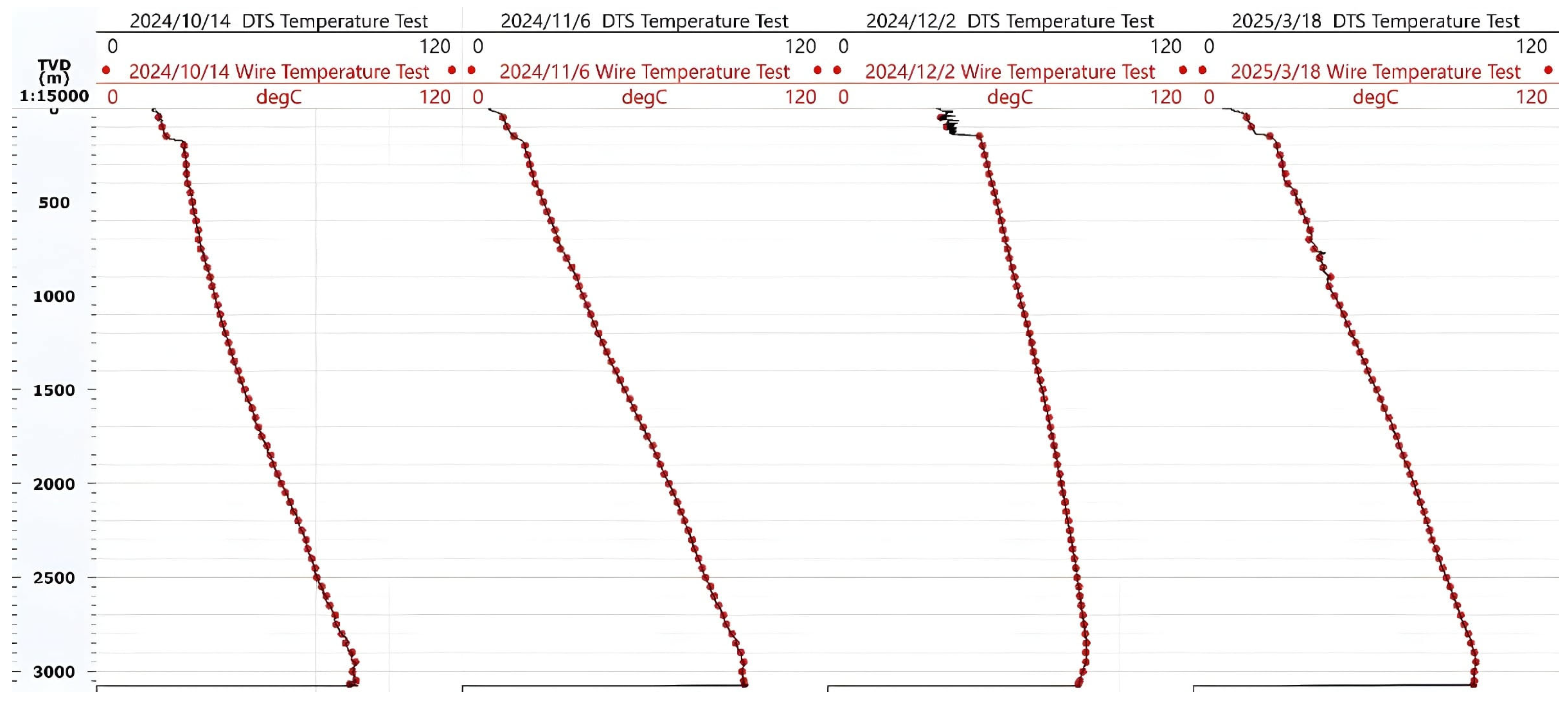
Figure 5 compares wireline and DTS temperature data for well ZC4. The study spanned a complete injection-production cycle from 14 October 2024, to 18 March 2025, covering four key nodes: the injection period, the autumn equilibrium, the production period, and the spring steady phase. During the comparison, the point-measured data from the wireline thermometer (accuracy ) were spatially overlaid with the DTS continuous profiles after TVD correction and normalization. The blind test results showed remarkable overlap between the two curves across the 3100 m well section. Notably, during the early production stage with intense pressure changes, DTS not only accurately captured the significant temperature drop caused by the J-T effect but also delicately characterized the gradient distribution of heat transferring upward along the string.
Figure 5.
Comparison between wireline temperature log and DTS data for well ZC4.
To quantitatively assess the correction effect, the root mean square error (RMSE) was introduced as an evaluation metric, as shown in Table 4. At the four test nodes, the average RMSE between DTS and wireline temperatures ranged from 0.12 °C to 0.25 °C. In a UGS environment with burial depths exceeding 3000 m and complex thermophysical conditions, this error level is significantly lower than the deviations observed with traditional analytical models. The extremely low RMSE and high consistency demonstrate that the corrected DTS data are sufficient to replace traditional contact-based temperature measurement tools.
Table 4.
Error analysis of wireline and DTS temperature measurements.
5. Gas Production Calculation Model
To establish a quantitative evaluation method for gas production that is independent of surface metering instruments, this study analyzed the thermodynamic response characteristics of the wellbore temperature field. Starting with a mechanistic analysis of single wells and extending to multi-well collaborative modeling, a generalized gas production calculation model for the Sudong Underground Gas Storage (UGS) group was constructed.
5.1. Theoretical Model for Gas Production
The evolution of the wellbore temperature field is a macroscopic manifestation of the coupling between fluid dynamics and thermodynamics. During gas production, the flow from the reservoir to the wellhead follows the principle of energy conservation. Neglecting instantaneous fluctuations in wellbore convective heat transfer, the temperature distribution under steady-state flow is simplified as:
where is the fluid temperature, is the depth, cp is the specific heat capacity of the gas at constant pressure, is the Joule–Thomson coefficient, is the original formation temperature, and is the comprehensive heat transfer relaxation parameter. The formula indicates that the wellbore temperature gradient is constrained by gravitational work (the first term), expansion cooling (the second term), and radial heat exchange (the third term). In deep wells of the Sudong UGS, the expansion cooling (J-T effect) intensifies significantly as the flow rate Q increases, leading the fluid temperature to deviate from the static geothermal temperature.
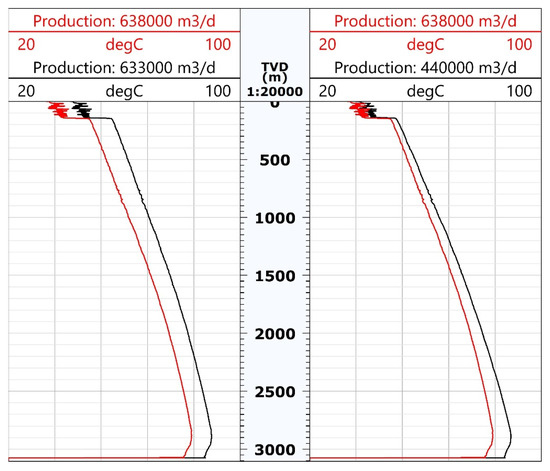
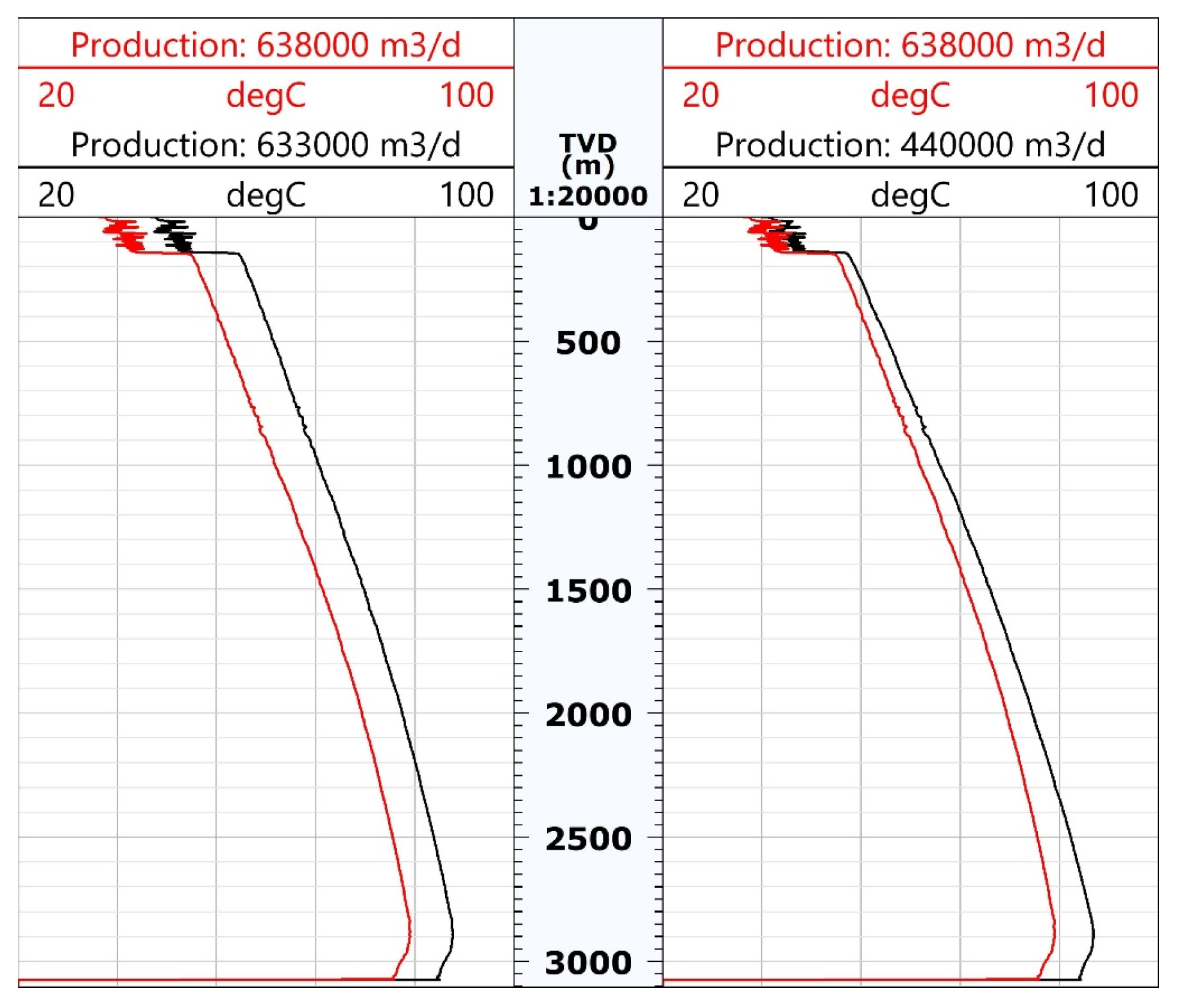
During the injection phase, the temperature of natural gas pumped into each well via surface compressors is basically consistent; thus, the wellbore temperature reflects the gas velocity. In contrast, during the production phase, the wellbore temperature is determined by both the production rate and the reservoir gas temperature. A regression analysis was performed on the production rate and characteristic temperature difference for a single well (taking ZC4 as an example) (Table 5, Figure 6). Statistical data indicated (Table 5) that as the daily production rate of a single well increased from to , the temperature difference between 2500 m and 1000 m showed a clear downward trend, decreasing from 21.12 °C to 18.51 °C. This phenomenon suggests a significant correlation between production rate and temperature difference within specific depth intervals. However, because the reservoir baseline temperature fluctuates due to injection and production history, relying solely on absolute temperature for metering often introduces substantial errors.
Table 5.
Relationship between production rate and temperature for well ZC4.
Figure 6.
Change trend between production rate and temperature for well ZC4.
Comparisons with coiled-tubing fiber-optic profiles at other domestic UGS facilities revealed that prior gas injection affects the temperature of the surrounding reservoir; higher injection volumes result in lower reservoir temperatures. It must be emphasized that the fiber in this work only reaches the packer and does not extend to the reservoir. However, since the gas originates from the reservoir, the wellbore temperature is heavily influenced by the reservoir’s thermal state.
To effectively eliminate interference from reservoir temperature fluctuations and geothermal gradient variations, a “Dual-Point Temperature Difference Method” is innovatively proposed. Temperature data from two characteristic depths—2500 m and 1000 m—were selected to calculate the difference:
To investigate the sensitivity of to production rate, data from well ZC4 were processed under different conditions. It was observed that at low production rates (), the fluid residence time is longer, allowing for sufficient heat exchange with the formation. In this case, the includes significant geothermal recovery interference. However, as exceeds , convective heat transfer becomes dominant. The increased velocity suppresses radial conduction, allowing the J-T cooling signal to be maintained over long distances.
From a thermodynamic perspective, calculating ∆T between 2500 m (near-reservoir) and 1000 m (near-surface) can be viewed as a spatial integration of the net energy loss along the wellbore segment, accounting for expansion cooling, gravitational work, and radial heat exchange. Calculating between 2500 m (near-reservoir) and 1000 m (near-surface) is equivalent to constructing a “thermodynamic integrator” that captures the net energy loss over the 1500 m interval.
Under high-Reynolds-number flow conditions, both frictional pressure loss and convective heat transfer coefficients increase nonlinearly with flow rate, while radial heat exchange with the formation gradually approaches a quasi-saturated state. The analysis indicated that exhibits the highest sensitivity to the logarithm of flow rate reflecting the diminishing incremental cooling response as flow rate continues to increase.
As the wellbore heat transfer coefficient varies nonlinearly with the Reynolds number, the cooling rate induced by the J-T effect reaches saturation at high flow rates due to stabilized radial heat exchange. Therefore, instead of a linear relationship, a logarithmic form provides a physically reasonable approximation for describing the asymptotic behavior of ∆T at high flow rates. A significant logarithmic relationship was found between the production rate and the characteristic temperature difference :
where and are model coefficients. It should be noted that K is a physics-constrained semi-empirical scaling factor derived from field data. Although differences in well pressure, gas composition, and completion geometry can influence the absolute value of K, the wells considered in this study have similar reservoir and completion characteristics, allowing a single representative K to be applied for demonstration. For wells with varying conditions, K can be calibrated individually using field measurements or numerical modeling. In addition, this formulation is a physics-constrained semi-empirical model, derived from thermodynamic considerations and validated by field observations, rather than a closed-form analytical solution of the governing energy equation. The physical essence of this method is to exploit the J-T effect and the difference in heat-exchange rates to eliminate “common-mode interference” (i.e., reservoir temperature changes) through differential operation, thereby extracting a flow-sensitive characteristic.
To verify the model’s robustness, a systematic validation was conducted across different time scales and operating conditions. For each well and scenario, the standard deviation (Std.) and 95% confidence interval (CI) of the predicted production rates were calculated based on the variability of the measured temperature difference ∆T. Uncertainty propagation from temperature measurements to flow rate estimates was performed using a Monte Carlo simulation with 10,000 iterations, introducing random perturbations of ±0.05 °C to reflect typical DTS measurement noise. The results indicate that under steady-flow conditions, the propagated uncertainty contributes less than ±2% to the final flow rate estimates.
It should be emphasized that the model is most accurate under quasi-steady thermal conditions. During transient phases, such as well restart or rapid production changes, the upstream and downstream temperature points require time to reach thermal equilibrium. In these scenarios, the model uncertainty may increase to 3–5% during the first 24 h, after which the system stabilizes, and the model provides reliable production estimates. Users should consider this transient correction period when interpreting short-term variations immediately following operational changes.
A quantitative robustness evaluation under different time scales and operating conditions, including standard deviations and 95% confidence intervals, is summarized in Table 6.
Table 6.
Robustness validation of the model across time scales and operating conditions.
Sensitivity analysis indicated that the choice of characteristic depths is decisive, as summarized in Table 7. Depths shallower than 800 m are susceptible to seasonal surface temperature fluctuations, while depths exceeding 2700 m suffer from temperature instability due to dogleg-induced turbulence. To quantitatively justify the selection of the 1000 m–2500 m interval, we calculated the signal-to-noise ratio (SNR) of the temperature difference ∆T across multiple candidate depth intervals for all monitored wells. The 1000 m–2500 m interval consistently yielded the highest average SNR, minimizing interference from both surface temperature fluctuations and dogleg-induced turbulence. Moreover, simulation results show that even with a geothermal gradient variation from 2.8 to 3.5 °C/100 m, the impact on Qi inversion remains negligible (<2%), confirming the robustness of this depth selection. Therefore, this interval provides an optimal balance between signal strength and stability, offering a systematic, quantitative criterion for selecting characteristic depth.
Table 7.
Summary of parameter sensitivity analysis.
Although a constant geothermal gradient was initially assumed, field measurements across multiple wells indicate that the gradient exhibits spatial variability of approximately ±0.3 °C/100 m due to local lithological differences and formation heterogeneity. To assess the impact of this variability on temperature anomaly extraction, ∆Ti was recalculated for wells with the highest and lowest measured gradients. The results demonstrate that the inversion error introduced by spatial gradient variations remains below 3%, indicating that the dual-point differential method effectively mitigates the influence of moderate geothermal heterogeneity. For regions with larger deviations, site-specific correction factors derived from baseline temperature logs can be applied to further enhance the robustness and accuracy of production estimation across the UGS.
Although single-well models validated the physical laws, coefficients and fitted from single wells lack universality due to geological variations and potential metering errors. Therefore, a “multi-well joint, total-volume constraint” strategy was adopted. By combining micro-thermal responses with macroscopic total production, the model avoids uncertainty from single-meter drift. The modeling process is illustrated in Figure 7.
Figure 7.
Workflow for establishing the generalized single-well gas production relationship model.
5.2. Total Gas Production Calculation Model for the UGS Area
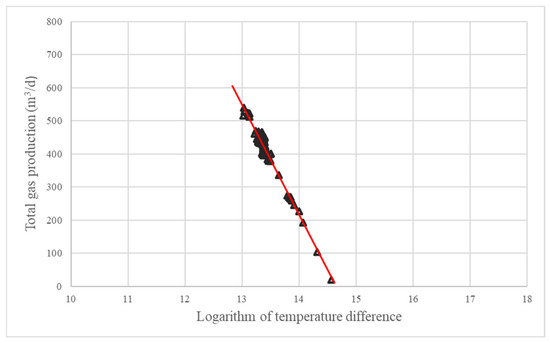
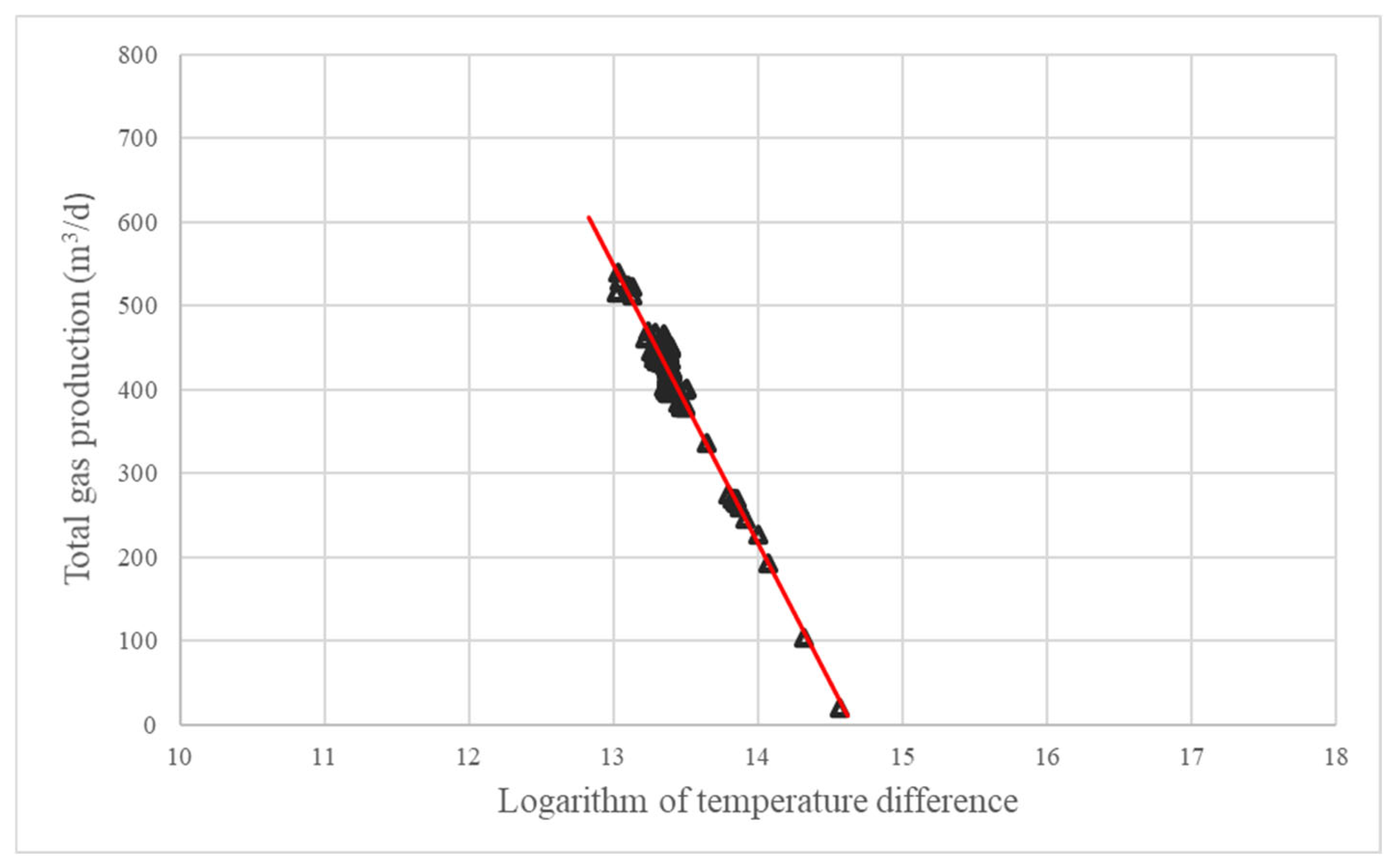
Total production data for 8 monitored wells were used to establish the relationship between the total daily production and the sum of logarithmic temperature differences:
As showed in Figure 8, regression analysis yielded an , indicating that the model explains the variables exceptionally well. The slope quantitatively describes the thermodynamic characteristics of the reservoir fluid. At the average pressure of the Sudong UGS (20–29 MPa), this value reflects the production displacement per unit change in temperature difference. The stability of this value suggests high consistency in the formation and fluid components.
Figure 8.
Relationship between daily total production and temperature difference in Sudong UGS.
The generalized single-well formula was derived from the total volume model. Data from 10 wells were utilized. The slope was kept as the universal coefficient. The total intercept of 4664 was averaged across the 10 wells to obtain . Physically, represents the “quasi-static thermal compensation,” or the baseline flux required to maintain wellbore thermal equilibrium under ideal conditions. This allocation effectively absorbs systematic errors arising from completion quality or annular-filling differences.
In summary, the generalized calculation model for daily single-well gas production in the Sudong UGS is determined as:
where is the daily production rate () and is the measured temperature difference (°C). This model enables real-time, quantitative, and accurate evaluation of single-well gas production using only DTS monitoring data.
6. Model Application Results and Discussion
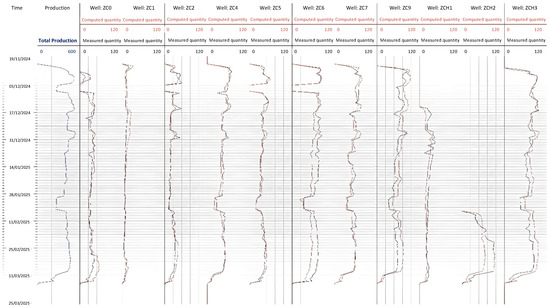
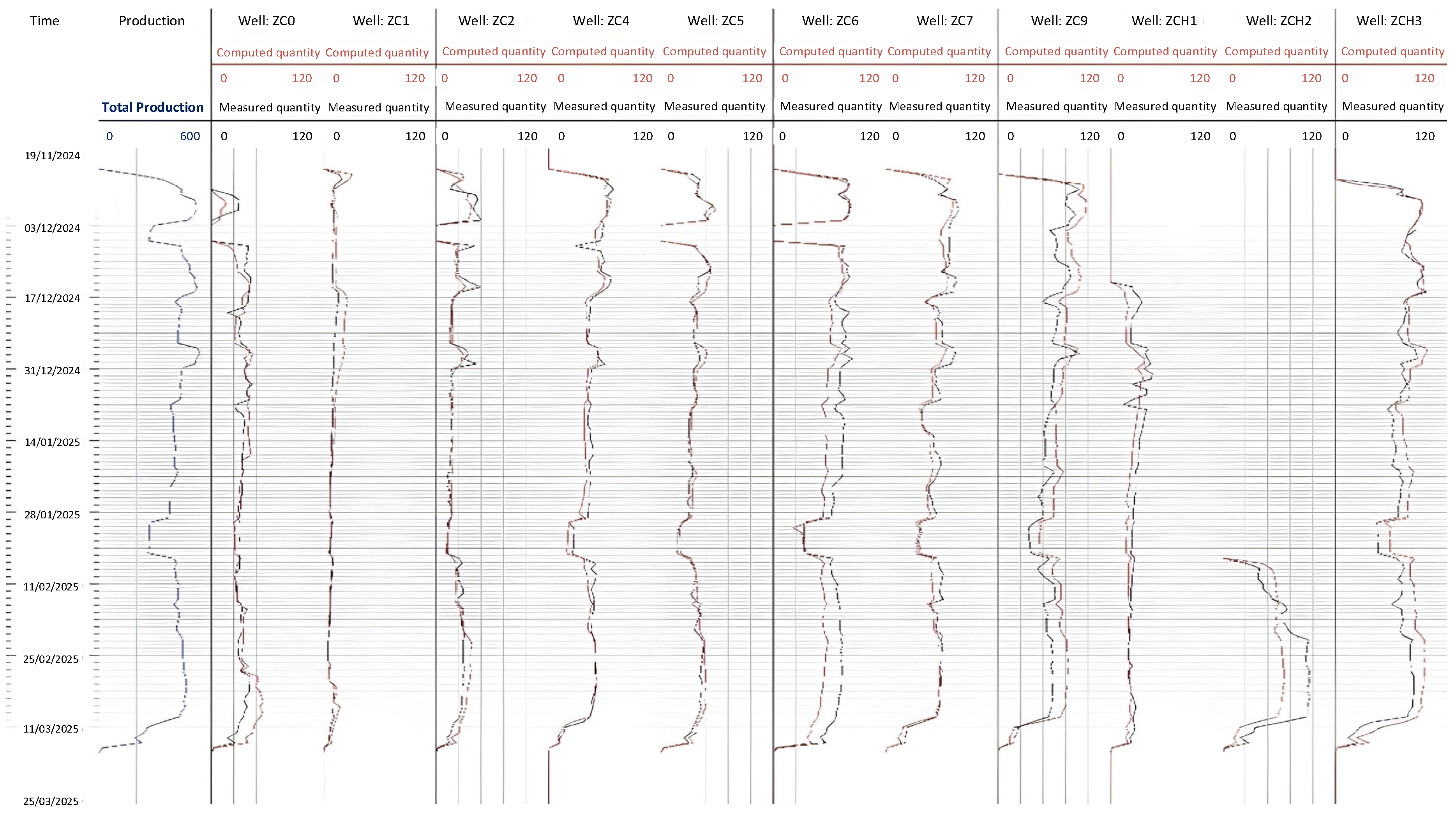
The established generalized model was applied to calculate the daily gas production for 11 fiber-optic monitoring wells in the Sudong UGS. The monitoring period spanned 113 days, from 23 November 2024, to 16 March 2025. Figure 9 presents the calculated daily gas production results for these 11 wells. In the figure, the red curves represent daily gas production calculated from DTS temperature data, while the blue curves represent measurements from surface ultrasonic flowmeters. As shown in Figure 9, the calculated gas production aligns well with the metered values, exhibiting a high degree of correlation and perfectly consistent dynamic trends.
Figure 9.
Comparison of DTS-calculated and metered gas production rates for monitoring wells in the UGS.
It should be emphasized that the DTS-based method is fundamentally independent of traditional flow metering devices. The surface ultrasonic flowmeters are used here solely as a reference for comparison and validation, to illustrate the model’s accuracy and diagnostic capability. Model coefficients K and C are determined entirely from temperature difference signals (∆T) and underlying thermodynamic considerations, without any direct calibration using flowmeter readings. Consequently, even in cases where flowmeters experience drift or blockage (e.g., wells ZC6, ZC9, ZCH3), the DTS-based approach provides an unbiased and physically consistent estimate of production.
Despite overall agreement, significant systematic deviations were observed in three wells: ZC6, ZC9, and ZCH3. The DTS-calculated cumulative production for well ZC6 was 12.62 lower than the metered value, whereas for well ZC9, the calculated value was 12.51 higher than the meter reading. Specifically, the fact that the DTS-calculated volume for ZC9 was significantly higher than the meter reading suggested potential under-measurement or flowmeter blockage. Conversely, for ZC6, the DTS-calculated volume was considerably lower, implying an upward drift in the meter’s reading. Subsequent inspections confirmed that the ultrasonic flowmeters in these three wells suffered from substantial measurement errors. After recalibration, the corrected meter results were highly consistent with the model’s predictions. The statistical results summarized in Table 8 show that the relative error of the DTS-based model is generally within an acceptable range for most wells. In contrast, larger errors are concentrated in wells affected by flowmeter malfunction or drift. This demonstrates that the DTS-based calculation model not only provides reliable production estimates but also serves as an effective diagnostic tool for identifying metering anomalies.
Table 8.
Statistics of calculated and metered gas production for single wells in Sudong UGS.
The primary advantages of this model lie in its non-intrusive nature and self-adaptability. It does not depend on the physical condition of wellhead throttling devices but rather relies on the fundamental energy conservation principles of the fluid itself. For deep, high-temperature, high-pressure, and highly deviated wells such as those in the Sudong UGS, this physics-based temperature inversion method circumvents issues related to mechanical wear and electronic drift.
Beyond being a production calculation tool, this model establishes a “virtual master meter” verification system based on physical mechanisms. When surface measurements experience “data drift” due to liquid loading or probe contamination, the fiber-optic inversion results provide the “physical truth” independent of mechanical structures. This offers a robust basis for correcting inventory calculations and ensuring the accuracy of reservoir capacity assessments.
It should be noted that the current model has been calibrated and validated using data from the Sudong UGS. For application to other reservoirs or UGS sites, recalibration of the model coefficients K and C would be required to account for site-specific conditions, such as reservoir pressure, temperature gradients, gas composition, and well completion characteristics. Baseline DTS measurements and limited flowmeter data can be used to perform initial calibration and validate the model for the new site. Additionally, spatial variations in geothermal gradients and wellbore geometries should be considered, and site-specific correction factors can be applied to maintain the robustness and accuracy of production estimation. These steps ensure that the dual-point differential method can be reliably adapted to diverse UGS environments while preserving the underlying thermodynamic and flow-sensitive principles.
7. Conclusions
To address the challenges of evaluating gas production in underground gas storage (UGS) with deviated well structures, a “Dual-Point Temperature Difference Method” based on Distributed Temperature-Sensing (DTS) data was proposed. This method achieved high-precision inversion of single-well gas production without relying on traditional wellhead metering instruments. The core innovations and conclusions are summarized as follows:
A unified temperature field was constructed through deviated wellbore straightening and geothermal correction. By using the temperature anomaly difference (∆T) between characteristic points upstream and downstream of the production layer as a flow-sensitive feature, environmental temperature interference is effectively eliminated, yielding a quantitative model with clear physical mechanisms and strong engineering applicability.
The proposed method demonstrates robust corrective capabilities under instrument anomaly conditions. It provides a feasible pathway for multi-well, full-period, non-contact dynamic monitoring, significantly enhancing the reliability and intelligence of UGS operations and monitoring.
To further leverage the potential of distributed fiber-optic sensing in UGS facilities, the following research priorities are identified: (1) Multi-parameter Fusion: Further integrate DTS with Distributed Acoustic Sensing (DAS) and real-time downhole pressure data to construct multi-parameter joint inversion models, thereby improving flow identification accuracy under complex operating conditions. (2) Digital Twin Integration: Promote the integration of DTS data into UGS digital twin systems to develop real-time visualized dynamic evaluation platforms, supporting optimized injection-production decision-making and early warning for anomalies. (3) Full-Cycle Monitoring: Extend this methodology to flow evaluation during the injection phase to achieve integrated monitoring across the entire injection-production cycle, providing technical support for predicting remaining gas distribution and reservoir capacity management.
Author Contributions
Conceptualization, S.Y. and P.C.; methodology, S.Y., P.C., G.M. and Z.H.; writing—original draft preparation, S.Y., P.C., G.M., Z.H. and Z.Z.; writing—review and editing, S.Y., P.C., G.M., Z.H. and Z.Z.; supervision, S.Y.; project administration, S.Y. All authors have read and agreed to the published version of the manuscript.
Funding
This research received no external funding.
Data Availability Statement
The original contributions presented in this study are included in the article. Further inquiries can be directed to the corresponding author.
Acknowledgments
The authors have reviewed and edited the output and take full responsibility for the content of this publication.
Conflicts of Interest
Suhao Yu, Peng Chang, Ge’er Meng and Ziqiang Hao were employed by No. 5 Gas Production Plant, Changqing Oilfield Company. The remaining author declares that the research was conducted in the absence of any commercial or financial relationships that could be construed as a potential conflict of interest.
References
- Zhang, Y.; Oldenburg, C.M.; Zhou, Q.; Pan, L.; Freifeld, B.M.; Jeanne, P.; Tribaldos, V.R.; Vasco, D.W. Advanced monitoring and simulation for underground gas storage risk management. J. Pet. Sci. Eng. 2022, 208, 109763. [Google Scholar] [CrossRef] [Scilit]
- Luo, L.; Xu, T.; Wang, J.; Wang, C.-C.; Xu, D.; Lee, A.; Barclay, C.; Soga, K.; Wu, Y. Real-time well integrity monitoring in underground gas storage wells using distributed temperature and strain sensing: A field demonstration. Struct. Health Monit. 2025. [Google Scholar] [CrossRef] [Scilit]
- Hasan, A.R.; Kabir, C.S. Wellbore heat-transfer modeling and applications. J. Pet. Sci. Eng. 2012, 86, 127–136. [Google Scholar] [CrossRef] [Scilit]
- Hasan, A.R.; Kabir, C.S.; Wang, X. Wellbore two-phase flow and heat transfer during transient testing. SPE J. 1998, 3, 174–180. [Google Scholar] [CrossRef] [Scilit]
- Hasan, A.R.; Kabir, C.S.; Lin, D. Analytic wellbore-temperature model for transient gas-well testing. SPE Reserv. Eval. Eng. 2005, 8, 240–247. [Google Scholar] [CrossRef] [Scilit]
- Nakamoto, R.; Leggett, S. Development of a Transient Wellbore Heat Transfer Model Validated with Distributed Temperature Sensing Data. Sensors 2025, 25, 6583. [Google Scholar] [CrossRef] [Scilit] [PubMed]
- Shi, W.; Wang, Q.; Yan, H.; Fu, X.; Kuo, Y.-M.; Zhou, R. Semi-analytical model of heat transport around a well with wellbore mixing effect under multi-step flow rate. J. Hydrol. 2023, 625, 130068. [Google Scholar] [CrossRef] [Scilit]
- Yang, B.; Zhang, H.; Wu, B.; Lv, K.; Zhou, Y.; Li, X.; Yang, Z.; Yuan, R. Joule–Thomson Effect on Bottom Hole Temperature in Ultra-High-Temperature and High-Pressure Gas Wells. ACS Omega 2025, 10, 10302–10307. [Google Scholar] [CrossRef] [Scilit] [PubMed]
- Farzaneh-Gord, M.; Rahbari, H.R.; Zangeneh, J. Effects of natural gas compositions on its Joule–Thomson coefficients and Joule–Thomson inversion curves. Cryogenics 2020, 111, 103169. [Google Scholar] [CrossRef] [Scilit]
- Lipus, M.P.; Raab, T.; Reinsch, T.; Henninges, J.; Schmidt-Hattenberger, C.; Aldaz Cifuentes, S.R. Applications of Distributed Fiber Optic Strain Sensing for Real-Time Wellbore Integrity Monitoring. In Proceedings of the World Geothermal Congress 2020+1, Reykjavik, Iceland, 24–27 October 2021; Available online: https://publica.fraunhofer.de/entities/publication/c37b27d8-ef2f-48e2-a729-ec6cb9262d69 (accessed on 24 February 2026).
- Zou, X.; Wang, T.; Hu, X.; Han, W.; Hu, H.; Yang, C. Gas leakage physical simulation and its distributed optical fiber sensing experiments in the casing annulus of injection-production pipe column for underground gas storage. Geoenergy Sci. Eng. 2024, 242, 213252. [Google Scholar] [CrossRef] [Scilit]
- Cherubini, A.; Richard, S.; Jestin, C.; Calbris, G.; Lanticq, V. Real-time downhole monitoring using DAS and DTS: A new technology for leak detection and well integrity. In Proceedings of the International Petroleum Technology Conference, Bangkok, Thailand, 1–3 March 2023; IPTC: Bangkok, Thailand, 2023; p. D022S026R003. [Google Scholar] [CrossRef] [Scilit]
- Luo, H.; Li, H.; Lu, Y.; Li, Y.; Guo, Z. Inversion of distributed temperature measurements to interpret the flow profile for a multistage fractured horizontal well in low-permeability gas reservoir. Appl. Math. Model. 2020, 77, 360–377. [Google Scholar] [CrossRef] [Scilit]
- Kabir, C.S.; Izgec, B.; Hasan, A.R.; Minnesota-Duluth, U.; Wang, X.; Lee, J. Real-time estimation of total flow rate and flow profiling in dts-instrumented wells. In Proceedings of the IPTC 2008: International Petroleum Technology Conference, Kuala Lumpur, Malaysia, 3–5 December 2008; European Association of Geoscientists & Engineers: Bunnik, The Netherlands, 2008; p. cp-148-00103. [Google Scholar] [CrossRef] [Scilit]
- Liu, J.; Li, S.; Liu, Q.; Liu, Z.; Li, L.; Xiao, G. Temperature field analysis on the highly-deviated wellbore in backwashing condition. J. Pet. Sci. Eng. 2018, 161, 515–529. [Google Scholar] [CrossRef] [Scilit]
- Khankishiyev, O.; Salehi, S.; Hasanov, G.; Hu, Z. Application of Distributed Temperature Sensing (DTS) in Geothermal Wells. In Proceedings of the 49th Workshop on Geothermal Reservoir Engineering, Stanford, CA, USA, 12–14 February 2024; Stanford Geothermal Program, Stanford University: Stanford, CA, USA, 2024; Volume 49. [Google Scholar]
- Jiang, Z.; Zhang, C.; Xu, Z.; Song, W. Gas Leak Detection and Leakage Rate Identification in Underground Utility Tunnels Using a Convolutional Recurrent Neural Network. Appl. Sci. 2025, 15, 8022. [Google Scholar] [CrossRef] [Scilit]
- Yang, X.; Tartakovsky, D.M.; Horne, R.N. Fracture Characterization by Temperature Log Interpretation Based on Machine Learning. Geotherm. Resour. Counc. Trans. 2023, 47, 2385–2394. [Google Scholar]
- Yang, X.; Horne, R.N.; Tartakovsky, D.M. Fracture characterization via AI-assisted analysis of temperature logs. J. Geophys. Res. Mach. Learn. Comput. 2024, 1, e2024JH000263. [Google Scholar] [CrossRef] [Scilit]
- Han, B.; Wang, S.; Zhang, Z.; Wang, Y. Numerical simulation of geothermal reservoir thermal recovery of heterogeneous discrete fracture network-rock matrix system. Energy 2024, 305, 132306. [Google Scholar] [CrossRef] [Scilit]
- Liu, J.; Wang, W.; Zhang, J.Z.J.; Xiao, G.H. A numerical simulation study on wellbore temperature field of water injection in highly deviated wells. J. Pet. Sci. Technol. 2017, 7, 3–12. [Google Scholar]
- Zhao, X.; Yang, N.; Liang, H.; Wei, M.; Ma, B.; Qiu, D. The Wellbore Temperature and Pressure Behavior during the Flow Testing of Ultra-Deepwater Gas Wells. Fluid Dyn. Mater. Process. 2024, 20, 2523–2540. [Google Scholar] [CrossRef] [Scilit]
- Ramazanov, A.S.; Chekhonin, E.; Akchurin, R.; Vakhitova, G.; Valiullin, R.; Popov, Y. Determination of geothermal temperature and temperature gradient via measurements in the production well sump. Geoenergy Sci. Eng. 2023, 229, 212163. [Google Scholar] [CrossRef] [Scilit]
- Maurer, V.; Aichholzer, C.; Richard, A.; Harlé, P.; Hehn, R.; Genter, A.; Duringer, P. Geothermal reservoir temperature estimation derived from gradient wells in a continental rift context (Upper Rhine Graben). In Proceedings of the 43rd Stanford Geothermal Workshop, Stanford, CA, USA, 12–14 February 2018; Stanford Geothermal Program, Stanford University: Stanford, CA, USA, 2018; pp. 12–14. [Google Scholar]



Disclaimer/Publisher’s Note: The statements, opinions and data contained in all publications are solely those of the individual author(s) and contributor(s) and not of MDPI and/or the editor(s). MDPI and/or the editor(s) disclaim responsibility for any injury to people or property resulting from any ideas, methods, instructions or products referred to in the content. |
© 2026 by the authors. Licensee MDPI, Basel, Switzerland. This article is an open access article distributed under the terms and conditions of the Creative Commons Attribution (CC BY) license.