Article

Planning Method for Power System Considering Flexible Integration of Renewable Energy and Heterogeneous Resources

1
State Grid Shandong Electric Power Company, Jinan 250003, China
2
College of New Energy and Electrical Engineering, China Three Gorges University, Yichang 443002, China
*
Author to whom correspondence should be addressed.
Processes 2026, 14(6), 984; https://doi.org/10.3390/pr14060984
Submission received: 1 March 2026 / Revised: 15 March 2026 / Accepted: 17 March 2026 / Published: 19 March 2026

Abstract

The large-scale grid integration of distributed renewable energy enhances the flexible regulation capacity of the power system. However, the inherent randomness and volatility of its output, coupled with weak coupling access characteristics, pose severe challenges to the safe and stable operation of the power system. To address these issues, this paper proposes a power system planning method suitable for urban power grids. To accurately characterize the uncertainty of renewable energy output, the method incorporates the concept of multi-scenario stochastic optimization and introduces a dynamic scenario generation method for wind and solar power based on nonparametric kernel density estimation and standard multivariate normal distribution sequence sampling. This method generates a set of typical daily dynamic output scenarios for wind and solar power that closely match actual output characteristics. Considering the spatiotemporal response characteristics of flexible resources, the Soft Open Point (SOP) DC link enables flexible cross-node power transmission and spatiotemporal coupling regulation of flexible resources. Therefore, this paper constructs a mathematical model for the grid integration of flexible resources based on the SOP DC link. By integrating operational constraints such as power flow constraints in the power grid and source-load uncertainty constraints, a power system planning model is established. However, traditional convex optimization methods require approximate simplifications of the model, which can easily lead to a loss of accuracy. Although the Particle Swarm Optimization (PSO) algorithm is suitable for nonlinear optimization, it is prone to getting trapped in local optima. Therefore, this paper introduces an improved PSO algorithm based on refraction opposite learning, which enhances the algorithm’s global optimization capability by expanding the particle search space and increasing population diversity. Finally, simulation verification is conducted based on an improved IEEE-39 bus test system, and the results show that the proposed scenario generation method achieves a sum of squared errors of only 4.82% and a silhouette coefficient of 0.94, significantly improving accuracy compared to traditional methods such as Monte Carlo sampling.

1. Introduction

Currently, global energy pressures and environmental issues are becoming increasingly prominent. Traditional fossil fuels are non-renewable and will inevitably deplete over time, while also causing severe environmental problems [1]. Therefore, seeking new energy sources to supplement or even replace traditional fossil fuels has become a crucial breakthrough for addressing current energy challenges [2]. The Distributed Generator (DG) technology, born out of this necessity, is set to become the primary form of clean energy utilization and an important direction for the development of smart grids. The large-scale integration of DGs into power grid can increase the proportion of clean energy; however, their inherent intermittency, volatility, and uncertainty will affect the operation of power grid, posing issues related to power quality, voltage control, and stability [3].
Faced with a series of challenges, such as continuously growing loads, limited development space for power grid, and difficulties in expanding grid scale, scholars both domestically and abroad are actively conducting research on transmission networks with certain regulatory capabilities under the context of smart grids to accommodate the high-penetration and large-scale integration of distributed power sources [4,5,6]. Specifically, transmission networks integrate advanced information and communication technologies, power electronics, and intelligent control to enable transmission networks to accommodate a certain proportion of distributed power sources, with flexible network topologies, enhanced observability, and the ability to achieve coordinated and optimized management [7,8].
Traditional voltage control strategies employ static reactive power compensation equipment, such as On-Load Tap Changers (OLTCs) or capacitor banks [9]. Using OLTC distribution transformers and capacitors on feeders with DG integration is an effective measure to counteract DG-induced voltage disturbances [10]. However, due to varying historical conditions and development levels, OLTCs are rarely used in domestic distribution transformers, with low-voltage side capacitor compensation being more prevalent. Currently, the lag in transmission network communication system construction limits the centralized control of low-voltage capacitors. When DGs participate in automatic voltage regulation in transmission networks, it may cause instability in OLTCs on some distribution transformers [11], necessitating coordinated control between DGs and OLTC transformers. Reference [12] proposes a nonlinear constrained optimization voltage control model for medium-voltage ADNs, considering active power losses and the reactive power output costs of various reactive power sources, with the objective of minimizing voltage regulation costs and coordinating OLTCs, capacitors, DG outputs, and reactive power inputs from the upper grid. Reference [13] introduces an improved algorithm for active voltage control in medium-voltage transmission networks, coordinating the active and reactive power outputs of DG units with OLTCs. It sets the reference voltage for Automatic Voltage Control (AVC) based on the difference between line node voltages and their upper and lower limits, thereby enabling automatic control of OLTCs. Additionally, installing an appropriate amount of dynamic reactive power compensation equipment on distribution transformers with DG integration to reduce frequent voltage fluctuations is an effective measure to prevent OLTC instability. For instance, reference [14] proposes a composite regulation method using OLTCs and Static Var Compensators (SVCs) to keep voltage deviations within acceptable limits.
Energy storage devices are increasingly recognized as vital components in grid operation [15]. Energy storage technology largely addresses the randomness and volatility issues associated with new energy generation, effectively regulating grid voltage, frequency, and phase changes caused by new energy generation, and alleviating grid peak-shaving pressures. Reference [16] establishes a multi-objective optimization allocation model for energy storage systems in ADNs from the perspective of active power regulation capabilities and centralized control. Reference [17] develops a supercapacitor energy storage system model for standalone photovoltaic power generation, indicating that coordination with supercapacitor energy storage systems can effectively stabilize the output voltage of photovoltaic systems under varying illumination conditions and load disturbances. References [18,19] also explores the use of flywheel energy storage devices as power regulators and storers in isolated wind power generation systems, employing system current feedforward control methods to centrally regulate wind power and energy storage from a time-domain perspective, effectively improving power quality. To fully leverage the advantages of various energy storage technologies and achieve complementary benefits, scholars have conducted research on hybrid energy storage systems [20,21,22], which can improve system power quality and enhance grid-connection stability. Reference [23] proposes a centralized reactive power control method that coordinates DGs, Distribution Static Synchronous Compensators (DSTATCOMs), OLTCs, and capacitors. It utilizes capacitors to meet basic reactive power demands, DSTATCOMs to ensure that the voltage of critical loads remains within acceptable limits, and OLTCs, in coordination with other means, to maintain the overall voltage level of the entire feeder. References [24,25], from the perspective of accommodating more DGs, proposes a reactive voltage coordinated control system composed of DSTATCOMs and microgrids. The former serves as a fast, continuous reactive power source for small-capacity reactive power regulation [26], while DGs act as discrete control means for large-capacity stepped reactive power regulation, working together to achieve coordinated reactive power control in transmission networks. Reference [27] designs a nonlinear controller for transmission networks with simultaneous integration of DSTATCOMs and DGs, converting nonlinear control into linear control using local feedback to provide rapid reactive power compensation for transmission networks with DG integration.
Existing research has conducted extensive exploration into voltage regulation and the utilization of flexible resources following the grid integration of distributed generation. However, two significant shortcomings remain:
(1)
There is a lack of spatiotemporal coupling in the scheduling of flexible resources. Most existing research focuses on the optimal allocation and control of fixed flexible resources, which suffer from insufficient spatiotemporal scheduling flexibility and struggle to adapt to the dynamic spatiotemporal variations in the output of distributed renewable energy.
(2)
There are limitations in characterizing the uncertainty of renewable energy and solving the models. Some studies employ parameter estimation methods to characterize the probability distribution of wind and solar power output, which are prone to significant deviations from actual output. Meanwhile, for power grid planning models incorporating flexible resources, traditional deterministic optimization or convex optimization methods struggle to handle the inherent non-convex and nonlinear characteristics of the models, while conventional intelligent optimization algorithms are prone to getting trapped in local optima, leading to insufficient model solution accuracy and global optimization capabilities.
To address these issues, this paper conducts research on flexible planning methods for urban power systems, with core innovations manifested in two aspects:
Firstly, a flexible resource integration method incorporating spatiotemporal coupling regulation is proposed. A mathematical model for the grid integration of heterogeneous flexible resources, such as distributed energy and MESS, is constructed based on the SOP DC link. By leveraging the continuous power flow regulation capability of the SOP and the spatiotemporal transfer characteristics of the MESS, cross-node power transmission and spatiotemporal coupling regulation of flexible resources are achieved, breaking through the scheduling limitations of traditional fixed flexible resources and enhancing the dynamic response capability of the power grid to fluctuations in distributed energy output.
Secondly, a high-precision uncertainty characterization and global optimization solution framework is constructed. This framework does not require pre-setting sample probability distributions and can accurately capture the spatiotemporal correlations of wind and solar power output, improving scenario generation accuracy. Simultaneously, an improved PSO algorithm based on refraction opposite learning and Tent chaotic mapping is designed.
The organizational structure of this paper is as follows: Section 2 first elaborates on the generation method for typical wind and solar scenarios to accurately characterize the uncertainty of renewable energy output. Subsequently, Section 3 establishes a power grid voltage regulation strategy and mathematical model considering MESS participation, clarifying the collaborative regulation mechanism between the SOP and MESS. Then, Section 4 designs an improved PSO algorithm for model solution. Section 5 conducts simulation verification based on an improved IEEE-39 bus test system to validate the effectiveness and feasibility of the proposed method, providing technical support for the flexible grid integration of high-penetration distributed renewable energy. Finally, Section 6 concludes the paper.

2. Typical Scenario Generation Method

2.1. Non-Parametric Kernel Density Estimation Probability Model

Currently, research on the probability distribution of wind and solar power output mainly encompasses parametric estimation models and non-parametric kernel density estimation models. The parametric estimation methods typically assume that wind speed follows a Weibull distribution and solar irradiance follows a Beta distribution, fitting the distribution parameters based on historical data. However, due to the high uncertainty associated with wind and solar power output, the probability distributions fitted based on historical data may exhibit significant deviations from the actual distributions. In contrast, non-parametric kernel density estimation does not require assuming a specific probability distribution for the samples; instead, it directly estimates the probability density through weighted interpolation using kernel functions.
Let the historical power output samples of wind and solar at time t be denoted as x m t , y m t , t = 1 , 2 , , T , m = 1 , 2 , , M . Then, the non-parametric kernel density estimation for wind and solar power output at different times is given by:
f ( x t ) = 1 M W m = 1 M H ( x t x m t W )
f ( y t ) = 1 M W m = 1 M H ( y t y m t W )
where f ( x t ) and f ( y t ) represent the probability density functions of wind and solar power at time t, respectively; T is the time interval for optimization, which is set to 24 in this paper; M is the number of historical wind and solar power data points at different times; W is the bandwidth; and H(·) is the Gaussian kernel function.
The output of wind and solar power does not fluctuate arbitrarily within a certain period. The non-parametric kernel density estimation yields marginal probability distributions for each individual time point. If inverse transform sampling is directly applied to the probability distributions at different times, the temporal correlation will be overlooked, which represents a static scenario generation method. To address this, this paper introduces a standard multivariate normal distribution Z N ( 0 , t ) to characterize the dynamic correlation across different times, as shown in Equation (3) below:
t = σ 11 σ 12 σ 1 T σ 21 σ 22 σ 2 T σ T 1 σ T 2 σ T T
Here, the covariance σ a b = cov ( Z a , Z b ) between the power outputs of wind and solar resources at moments a and b represents the correlation at different time instants.
The covariance of a standard multivariate normal distribution can reflect the temporal correlation in the power outputs of wind and solar resources. This paper employs the construction of an exponential covariance function to characterize the covariance at different time instants. An indicator min I η is introduced to represent the minimization of the difference in probability density between the dynamic scenarios generated by the standard multivariate normal distribution and the fluctuations at adjacent historical time instants, thereby determining the optimal η . That is,
σ a , b = cov ( Z a , Z b ) = exp ( a b η )
min I η = 1 N g G p d f ( g ) p d f Δ ( g )
Here, η represents the strength of correlation in the power outputs of wind and solar resources at different time instants; G denotes the set of equidistant sampling points g within the probability density interval; N is the sampling size; p d f ( g ) represents the probability density of fluctuations in the dynamic scenarios generated by the multivariate normal distribution; p d f Δ ( g ) represents the probability density of fluctuations at adjacent time instants in the historical data.

2.2. Scenario Generation and Selection Based on Dynamic Wind and Solar Power Outputs

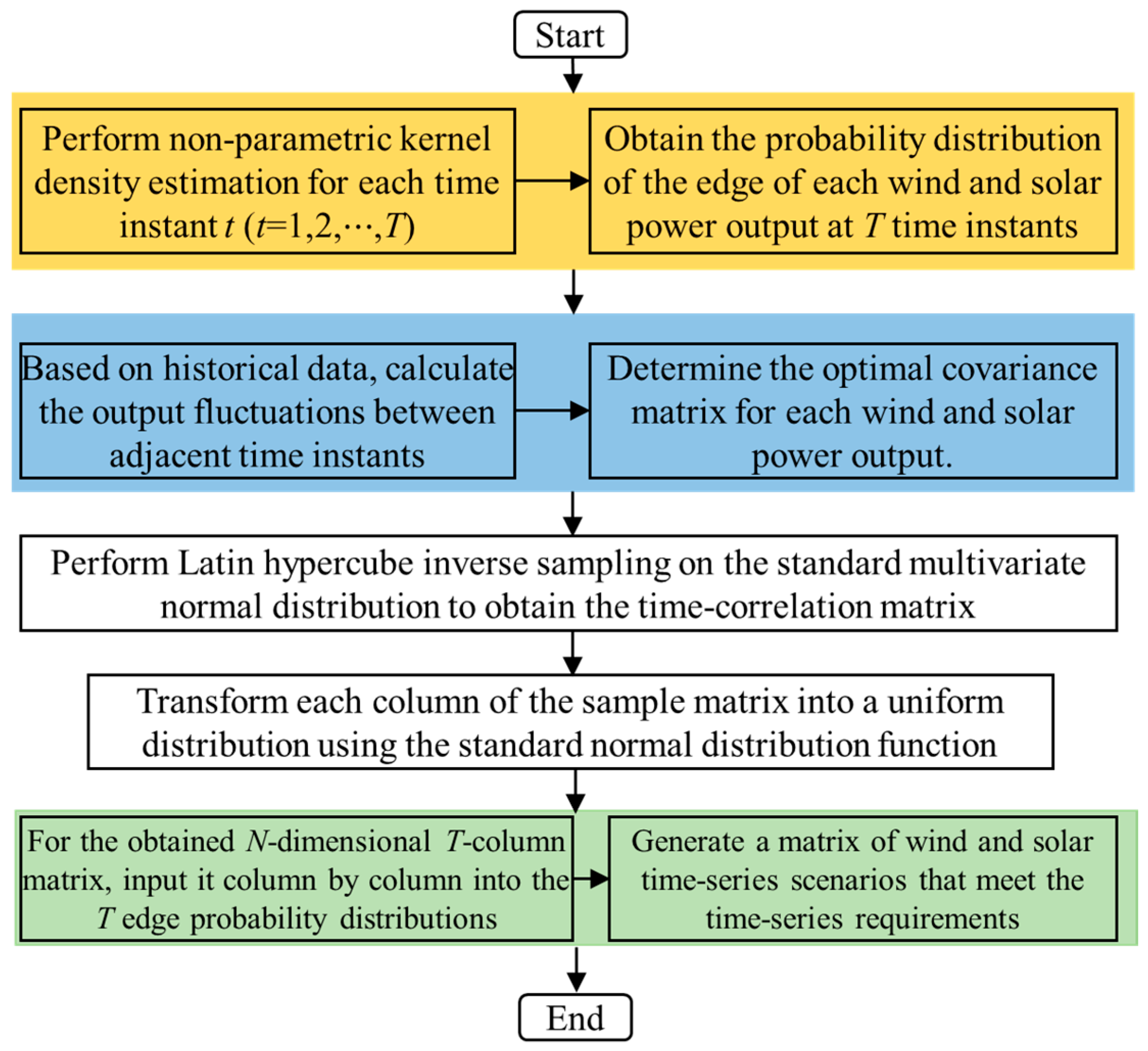
By employing the aforementioned non-parametric kernel density estimation, the marginal probability distributions of wind and solar power outputs at time t are obtained, and the covariance matrix that best characterizes the temporal correlation of wind and solar power outputs is determined. Latin hypercube sampling (LHS) is performed on the standard multivariate normal distribution to generate an N-dimensional, T-column matrix of standard normal samples. Each column of the sample matrix is then transformed into a uniform distribution using the standard normal distribution function. These uniform samples are subsequently substituted into the marginal probability distributions for inverse transform sampling, ultimately yielding scenarios that satisfy the temporal characteristics of individual wind and solar power outputs. The specific process is illustrated in Figure 1.
When generating a large set of scenarios, there tends to be a high degree of similarity among them. To address this, the K-means++ clustering algorithm can be employed to effectively cluster these scenarios and subsequently select representative scenarios from each cluster to reduce computational workload. Compared to the traditional K-means method, K-means++ is more precise in selecting initial values, thereby mitigating the risk of getting trapped in local optimal solutions. The process of wind–solar scenario reduction based on K-means++ mainly comprises the following steps.
(1)
Randomly select a set of data from the generated data as a centroid.
(2)
For each set of data c, calculate its shortest distance D(c) to the existing centroids.
(3)
Calculate the probability ρ ( c ) of each data point c serving as a new centroid, and randomly select a data point as the new centroid based on this probability, as shown in (6) below.
ρ ( c ) = D ( c ) 2 D ( c ) 2
(4)
Repeat steps 2 and 3 until K centroids have been selected, where K represents the number of clustered scenarios to be retained in the end.
(5)
After initializing the clustering points, perform clustering to select appropriate typical scenarios.
It should be noted that this paper employs the Elbow Method and the Silhouette Coefficient Method to determine the optimal number of clusters. The Elbow Method identifies the optimal number of clusters by analyzing the pattern of change in the sum of squared errors (SSE) with respect to the number of clusters K. Its core formula is as follows:
S S E = k = 1 K ϖ γ k ϖ ϖ k 2
Here, γ k represents the k-th cluster; ϖ k is the centroid of that cluster; and ϖ denotes the data points within the cluster. As K increases, the SSE gradually decreases. However, when K reaches a certain value, the rate of decrease in SSE significantly slows down, forming an inflection point. The value of K at this inflection point is the optimal number of clusters.
The silhouette coefficient (SC) provides a comprehensive measure of the intra-cluster compactness d t r a , n and inter-cluster separation d t e r , n of data points, with its formula given as:
S C = 1 N n = 1 N d t e r , n d t r a , n max ( d t r a , n · d t e r , n )
where d t r a , n represents the average distance from data point n to other points within the same cluster; d t e r , n denotes the average distance from data point n to the nearest points in other clusters. The larger the SC value, the more suitable it is for determining the optimal number of clusters.

3. Active Power Grid Voltage Regulation Strategy Considering the Participation of Mobile Energy Storage Systems

3.1. Spatiotemporal Transfer and Energy Constraint Model of Mobile Energy Storage Systems

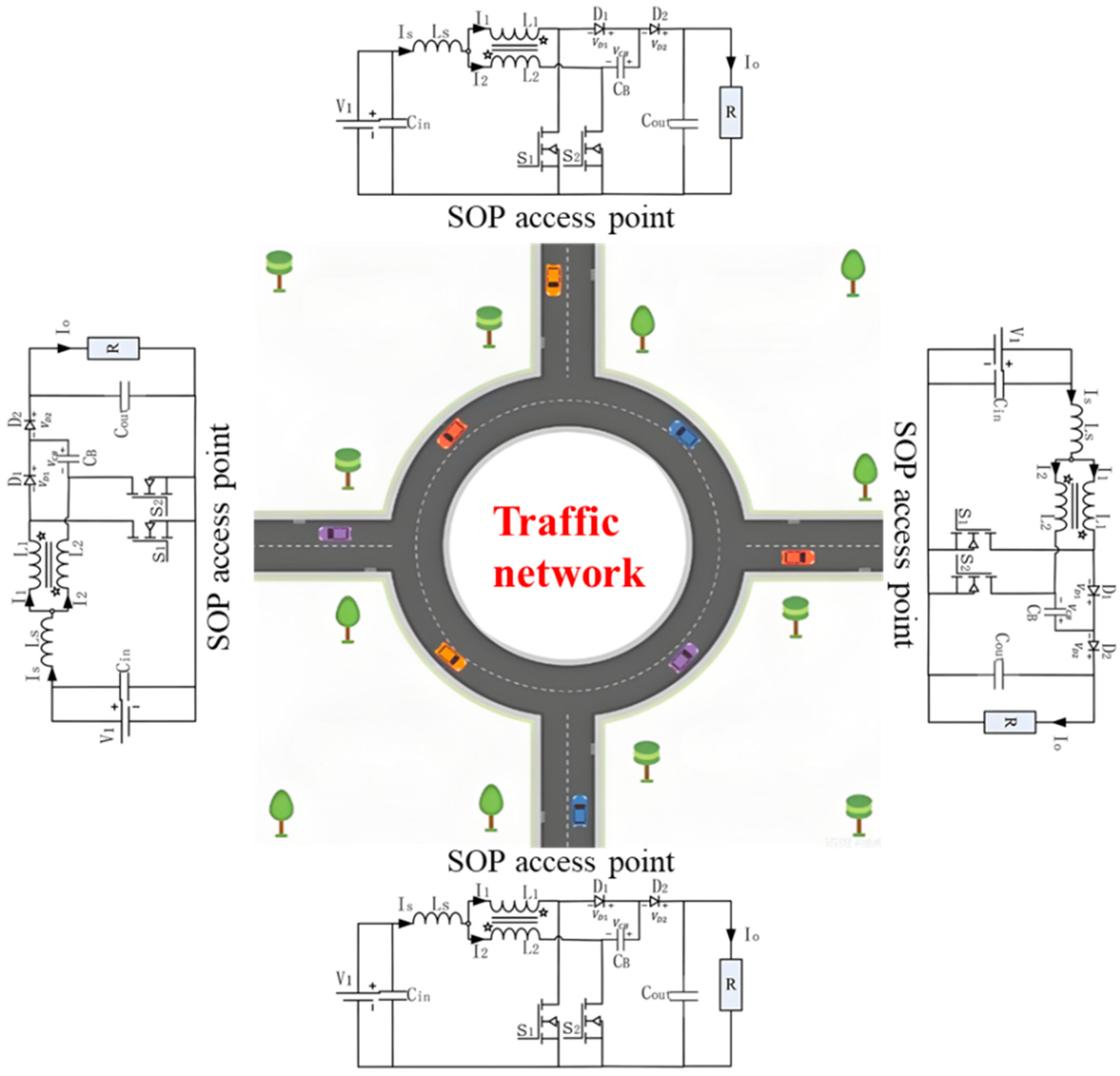
In this paper, the Mobile Energy Storage System (MESS) utilizes electric vehicles as carriers, equipped with lithium-ion battery energy storage devices, and adopts a point-to-point dispatching strategy based on the DC side of the Soft Open Point (SOP). This strategy circumvents the issues of low model-solving efficiency or even insolvability caused by searching for optimal charging and discharging nodes in large-scale power grids, demonstrating greater universality in enhancing transmission grid resilience and operational optimization. A schematic diagram of the transportation network for MESS between the DC sides of SOPs is shown in Figure 2. The proposed SOP DC-side point-to-point scheduling strategy breaks through spatiotemporal and coordination limits of traditional flexible resource scheduling, achieving deep coupling optimization. It uses the SOP DC link as a hub, integrating MESS’s spatiotemporal transfer with SOP’s power flow regulation, and designs a point-to-point mode to enhance engineering versatility. It enables spatiotemporal coupling regulation via energy interaction, upgrading from “fixed-node” to “spatiotemporal dynamic coordinated” regulation. Also, it is compatible with discrete equipment operations, constructing a flexible scheduling system that unleashes scheduling flexibility and boosts grid response and stability. In Figure 2, nodes are predefined SOP DC-side access points, acting as energy exchange interfaces and the sole medium for MESS charging/discharging. Paths are feasible grid scheduling channels, reflecting topology connectivity, power capacity, and MESS movement feasibility. MESS movement between SOP DC sides enables spatiotemporal energy transfer and grid power regulation, combining MESS storage with SOP flow control for optimal power allocation and voltage stability.
The dispatching strategies are illustrated by Equations (9)–(12). Equation (9) represents the uniqueness constraint on spatial location, which restricts the MESS to being at only one location at time t; Equation (10) denotes the spatial continuity constraint, specifying that the endpoint at time t serves as the starting point at time t + 1; (11) is the initial location constraint; and Equation (12) restricts the MESS from retracing its path at time t + 1, allowing it to either remain at DC side m or move to an adjacent DC side n.
( m , n ) M I k . m n , t = 1 , k K , t T
( m , n ) M I k . m n , t = ( m , n ) M I k . m n , t + 1 , t [ 2 , T ]
( m , n ) M I k . m n , 1 = I k , m n , c , k K
I k , m n , t + I k , m n , t + 1 1 , k K , m n , t [ 1 , T 1 ]
Here, K is the set of MESS; m and n represent the m-th and n-th SOP’s DC sides, respectively; I k . m n , t is a binary variable indicating the passage status of the k-th MESS at time t, a value of 1 indicates that the k-th MESS is on the path mn at time t; when m = n, it indicates that the k-th MESS is located at the SOP DC side m at time t; I k . m n , 1 is a variable representing the position of the k-th MESS at the initial time period t = 1; I k , m n , c is a constant, and by altering its value, different initial position distributions of MESS can be achieved. In Equation (12), the practical basis for prohibiting immediate retracing lies in the fact that short-period retracing of MESS causes frequent charging/discharging state switching, leading to energy losses, reduced storage efficiency, severe power fluctuations on the SOP DC side, disrupted node power balance, and voltage oscillations, which goes against grid fluctuation mitigation goals, and also increases model-solving complexity. Under most normal operating conditions, this restriction does not eliminate feasible or optimal scheduling solutions as the core of MESS scheduling is spatiotemporal energy regulation via the SOP DC side and the optimal solution is usually a unidirectional transfer. Only in extreme cases might short-term retracing be theoretically better, but such scenarios can be handled and the engineering benefits of the restriction outweigh the theoretical losses.
The energy constraints are shown in Equations (13)–(16). Equation (13) represents the charging and discharging power constraint for MESS at the SOP DC side m, indicating that no charging or discharging operations can be performed during the transfer process; Equation (14) restricts MESS from performing charging and discharging operations simultaneously; Equation (15) describes the relationship between the SOC and the charging/discharging power; Equation (16) limits the range of SOC.
0 P c h , k , m , t I k , m n , t P c h , k , max 0 P d i s , k , m , t I k , m n , t P d i s , k , max
u c h , k , t + u d i s , k , t ( m , n ) M I k . m n , t 0 m M P c h , k , m , t u c h , k , t P c h , k , max 0 m M P d i s , k , m , t u d i s , k , t P d i s , k , max
S O C k , t + 1 = S O C k , t + m M ( P c h , k , m , t η P d i s , k , m , t / η )
S O C k , min S O C k , t S O C k , max
Here, P c h , k , m , t and P d i s , k , m , t represent the charging and discharging power, respectively, of the k-th MESS at the SOP DC side m at time t; P c h , k , max and P d i s , k , max denote the maximum charging and discharging power of the k-th MESS, respectively; u c h , k , t and u d i s , k , t are the charging and discharging status indicators of the k-th MESS at time t, respectively; S O C k , t represents the state of charge of the k-th MESS at time t; η is the charging and discharging efficiency; S O C k , max and S O C k , min are the maximum and minimum SOC of the k-th MESS, respectively. It should be noted that this scheduling constraint does not directly introduce quantitative indicators from the traffic system but transforms transportation delay, road availability, and traffic uncertainty into timing, path, and scenario constraints on the power system side, achieving an integrated consideration of traffic factors and power system scheduling. This approach not only aligns with the core objective of the research focused on the flexible integration of the power system but also ensures the engineering practicality of the scheduling strategy.
SOP is an intelligent power electronic device that replaces traditional interconnection switches. It possesses the capability of continuous power flow regulation and can also be controlled over relatively long time scales. Considering the discrete nature of OLTC tap adjustments and the number of CBs switching operations, the system coordinates its operation on an hourly time scale to align with the characteristics of OLTC and CBs. Since SOP relies on the connected feeders for power transmission and has the ability to regulate power flow spatially, when both nodes on either side of the SOP experience excessively high load demands or excessive PV output simultaneously, effective power flow transfer on a spatial scale becomes unattainable, revealing a slight inadequacy in regulation capability and making it prone to voltage violations and line overloads. By integrating MESS into the SOP through a DC link, the spatial–temporal coupling between MESS and SOP can be achieved, enabling voltage support at both ends.
The constraints on active power transmission by SOP are as follows:
P s o p , m , i , t + P s o p , m , j , t + P s o p L , m , i , t + P s o p L , m , j , t = 0
P s o p L , m , i , t = η s o p , m P s o p , m , i , t 2 + Q s o p , m , i , t 2
P s o p L , m , j , t = η s o p , m P s o p , m , j , t 2 + Q s o p , m , j , t 2
Here, P s o p , m , i , t and P s o p , m , j , t represent the active power transmitted across sides i and j of the m-th SOP node at time t, respectively; Q s o p , m , i , t and Q s o p , m , j , t denote the reactive power injected into sides i and j of the m-th SOP node at time t, respectively; P s o p L , m , i , t and P s o p L , m , j , t are the active power losses on sides i and j of the m-th SOP node at time t, respectively; η s o p , m is the loss coefficient of the m-th SOP.
The SOP capacity constraints are expressed as follows:
P s o p , m , i , t 2 + Q s o p , m , i , t 2 S s o p , m , i
P s o p , m , j , t 2 + Q s o p , m , j , t 2 S s o p , m , j
Here, S s o p , m , i and S s o p , m , j represent the converter capacities of port i and port j, respectively, of the m-th SOP. The energy interaction between MESS and SOP, as shown in Equation (22), represents active power balance:
P s o p , m , i , t + P s o p , m , j , t + P s o p L , m , i , t + P s o p L , m , j , t = ( P d i s , k , m , t P c h , k , m , t )

3.2. Objective Function and Constraints for the Voltage Control Model

The objective of this planning is to maintain the operational safety of the power grid voltage across various planned scenarios, with minimizing voltage deviation as the scheduling goal, as shown in Equation (23) below:
min t = 1 T i = 1 I U i , t U i , N U i , N
Here, U i , t represents the voltage magnitude at node i at time t; U i , N represents the per-unit value of node i.
The constraints considered in this paper mainly include:
(1)
Uncertainty model of distributed generation sources
Affected by various environmental factors, the actual output of distributed wind turbines and distributed photovoltaic systems may deviate to a certain extent from their predicted output. An uncertainty model for the output of distributed generation sources is established as follows:
0 Δ P d q , t Δ P d q , t , max P d q , t = P ^ d q , t + a Δ P d q , t , max
Here, P ^ d q , t and P d q , t represent the predicted and actual output of distributed generation sources, respectively; Δ P d q , t and Δ P d q , t , max denote the output fluctuation and the maximum output fluctuation of distributed generation sources, respectively; a represents the uncertainty level.
Through historical data analysis, it is evident that the actual output of distributed generation sources may exceed the uncertainty boundaries. If the output of distributed generation sources surpasses the maximum acceptable upper bound, forced curtailment of wind or solar power becomes necessary. Conversely, if the output falls below its uncertainty lower bound, power balance should be maintained through methods such as load shedding. The operational risk model for distributed generation sources is established as follows:
R i s k = t = 1 T w = 1 N w β w p d p e + p d p u p d p max ( P d p , t P d p e P d p u ) + β d p d p e + p d p u p d p max ( P d p , t P d p e P d p u ) P r ( P d p , t ) d P d p , t
Here, P r ( P d p , t ) represents the probability distribution function of the output of distributed generation sources; P d p e and P d p u are the upper and lower bounds of the output of distributed generation sources, respectively; Nw is the number of distributed generation sources; β w is the penalty cost coefficient for wind curtailment; β d is the penalty cost coefficient for load shedding.
To facilitate solution, the model is transformed as follows:
R i s k = π w t = 1 T w = 1 N w s = 1 N s U d p , t , s W C d p , t , s + π d t = 1 T w = 1 N w s = 1 N s V d p , t , s L S d p , t , s
s = 1 N s U d p , t , s = 1 ,     U d p , t , s [ 0 , 1 ]
s = 1 N s V d p , t , s = 1 ,     V d p , t , s [ 0 , 1 ]
P d p u = s = 1 N s U d p , t , s W U d p , t , s
P d p e = s = 1 N s V d p , t , s W L d p , t , s
Here, Ns represents the number of divided risk scenarios;   U d p , t , s and V d p , t , s are the upper and lower bounds of the uncertainty set for distributed generation sources; W U d p , t , s and W L d p , t , s are matrices representing the upper limits of the wind power uncertainty set where the actual output of distributed generation sources is greater than or less than the predicted value, respectively; W C d p , t , s and L S d p , t , s are risk matrices for scenarios where the output of distributed generation sources exceeds or falls below the predicted value, respectively.
(2)
Demand Response Uncertainty
Due to the potential variability in users’ willingness to respond in real-world situations, a demand-side response uncertainty model is established.
0 Δ P d r , t Δ P d r , t . max P d r , t = P ^ d r , t + b Δ P d r , t . max
Here, P ^ d r , t and P d r , t represent the composite forecasted power and actual power, respectively; Δ P d r , t and Δ P d r , t . max denote the load power fluctuation and the maximum output fluctuation, respectively; b represents the uncertainty level.
(3)
Transmission Network Constraints
η l , S I χ l ,     l Ω c o n ,     S I Ω s c e
Here, η l , S I is a binary variable. When the line is in a closed state, η l , S I equals 1; Ω c o n represents the set of newly constructed transmission lines; Ω s c e denotes the set of non-scenario or non-contingency cases. In practical scenarios, the transmission network only allows certain specific lines to be disconnected, and its constraint is as follows:
η l , S I χ l ( 1 ο l ) ,     l Ω c o n ,     S I Ω s c e η l , S I 1 ο l ,     l Ω e x t ,     S I Ω s c e
Here, ο l is an indicator variable representing whether line l is allowed to be disconnected; χ l is a binary variable indicating whether construction is to be carried out at the candidate new transmission line l.
(4)
Power flow constraints
P G m P L m = U m U n ( G m n cos θ m n + B m n sin θ m n ) Q G m Q L m = U m U n ( G m n sin θ m n B m n cos θ m n )
where P G m and P L m represent the active input power and active load demand at node m, respectively; Q G m and Q L m denote the reactive input power and reactive load demand at node m, respectively; Bmn is the susceptance between nodes m and n.
(5)
Supply-demand balance constraints:
P i + P d p , i P L = P k , d r
Here, P d p , i and P k , d r represent the output of the i-th distributed generation source and the adjustable amount of the k-th load, respectively.

4. Solution Strategy Based on an Improved Particle Swarm Optimization

The model is inherently nonlinear and non-convex. Due to its simplicity, practicality, and fast convergence, the particle swarm optimization (PSO) algorithm is widely applied. However, the algorithm is prone to getting trapped in local optima during the later stages of the search. To address this issue, this paper proposes an improved version of the traditional PSO algorithm.

4.1. Introduction to the Principles of the Initial Algorithm

Researchers have proposed the PSO algorithm based on the foraging behaviors of bird flocks and fish schools. In this algorithm, each unknown solution to an optimization problem can be abstracted as a particle within a D-dimensional search space. During the iterative process, particles search for the optimal solution by leveraging information sharing among the swarm, learning from the best particle, and dynamically adjusting their own velocities and positions based on the collective flight experience. When the algorithm concludes its iterations, the fitness value of the best particle represents the optimal solution to the optimization objective. This algorithm is characterized by its simple form and fast convergence, making it widely applied in optimal scheduling of power systems.
The particle swarm consists of N particles. The position of the i-th particle can be represented as Xi = (xi1, xi2, xid, …, xiD), where xid denotes the position of the i-th component of the particle in the d-th dimension, and D represents the dimensionality of the problem to be optimized. The velocity of the particle can be expressed as Vi = (vi1, vi2, vid, …, viD), where vid represents the velocity of the i-th component of the particle in the d-th dimension. The velocity and position updates of the particles are as follows:
v i d ( t + 1 ) = w v i d ( t ) + c 1 r 1 ( p b e s t i d x i d ( t ) ) + c 2 r 2 ( g b e s t i d x i d ( t ) )
x i d ( t + 1 ) = x i d ( t ) + v i d ( t + 1 )
Here, v i d ( t + 1 ) and x i d ( t + 1 ) represent the velocity and position of particle i at generation t + 1; ω is the inertia weight; c1 and c2 are learning coefficients; r1 and r2 are random numbers uniformly distributed between [0, 1]; p b e s t i d and g b e s t i d are the individual best value and global best value of the particle, respectively. From Equation (36), it can be seen that the update formula of the PSO algorithm is composed of the particle’s velocity from the previous iteration, the particle’s individual self-cognition, and the particle’s social cognition.

4.2. Population Initialization Method Based on Refraction Opposition-Based Learning

Opposition-based learning utilizing the refraction principle can broaden the search space of particles, thereby enhancing population diversity. Introducing this strategy in the initial stage of the algorithm can strengthen the global search capability of the particle population. The specific expression is as follows:
x i , j o p = ( x j min + x j max ) / 2 + ( x j min + x j max ) / ( 2 k n ) x i , j / ( k n )
Here, x i , j represents the value of the j-th dimension for the i-th particle; x i , j o p is the opposite solution based on refraction opposition-based learning; x j min and x j max are the minimum and maximum values of the j-th dimension in the particle population, respectively; k is the refractive index; n is the ratio of the incident ray to the reflected ray, and in this paper, n is taken as 1. When k = 1 and n = 1, the above expression becomes:
x i , j o p = ( x j min + x j max ) x i , j
Equation (39) represents the general opposition-based learning formula. It can be observed that general opposition-based learning is a special case of refraction opposition-based learning. By adjusting the refractive index k, the diversity of the algorithm’s population can be enhanced, while simultaneously improving the algorithm’s optimization accuracy, thereby further strengthening its global optimization capability.

4.3. Tent Chaotic Mapping of the Optimal Individual

In the later stages of algorithm convergence, the population is prone to getting trapped in local optima. To enhance the randomness of the search and improve the ability to escape from local optima, Tent chaotic mapping is employed to learn from the optimal individual in the current particle population. The chaotic sequences generated by this mapping possess advantages such as ergodicity and uniform distribution. The specific operations are as follows:
X T = 2 x t             0 x t 0.5 2 ( 1 x t )     0.5 < x t 1
In the equation, X T represents the chaotic sequence; x t is a randomly generated number with a uniform distribution.
P i , d c h a o s = P i , d + X T × ( P d b e s t P i , d )
P i , d n e w = η P i , d + ( 1 η ) P i , d c h a o s
Here, η is a random number that follows a random distribution, with η ∈ [0, 1]; P d b e s t represents the value of the d-th dimension of the optimal particle; P i , d c h a o s is the chaotic perturbation generated by X T ; P i , d n e w is the particle position after chaotic perturbation applied to P i , d .

5. Case Study

5.1. Introduction to the Testing System

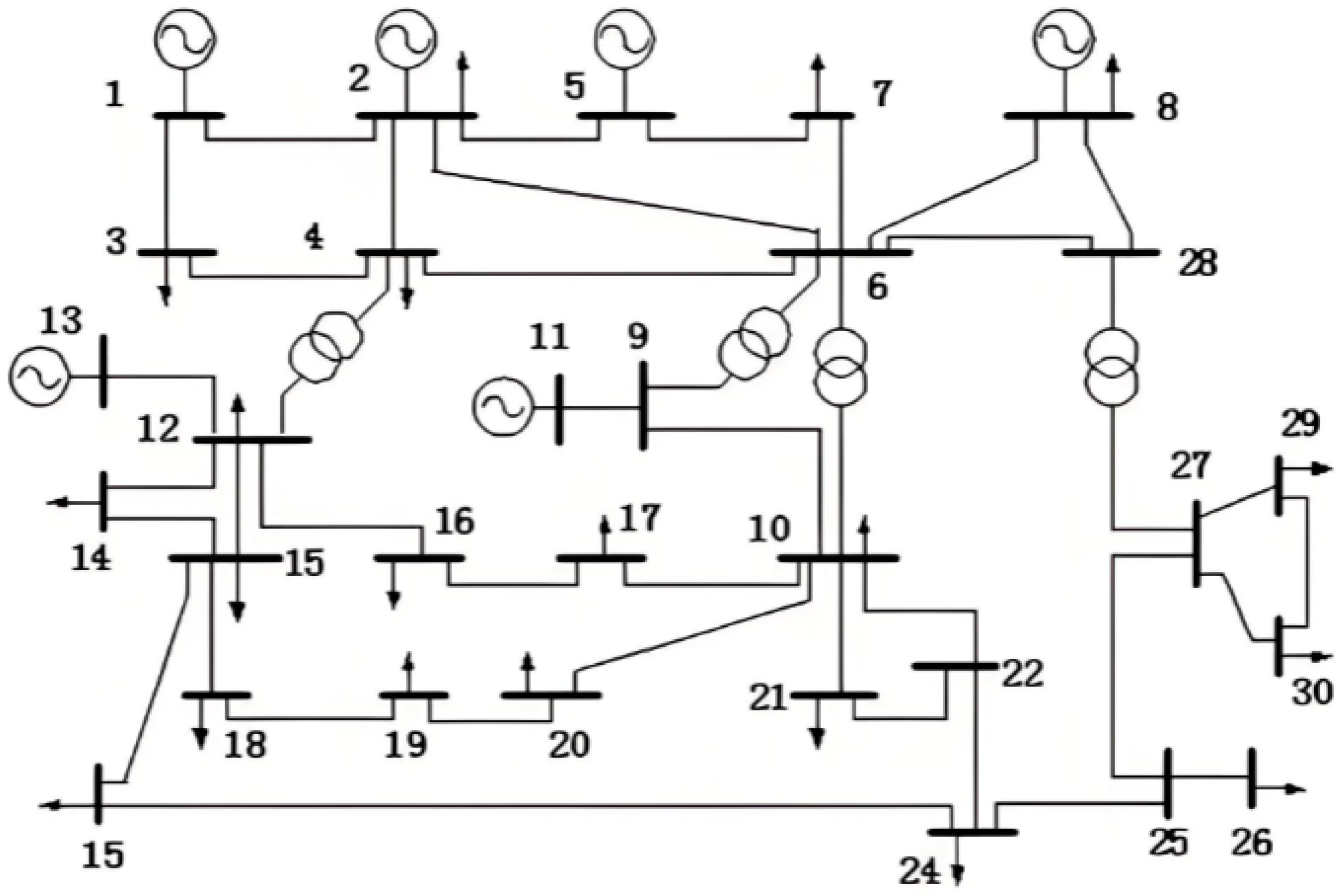
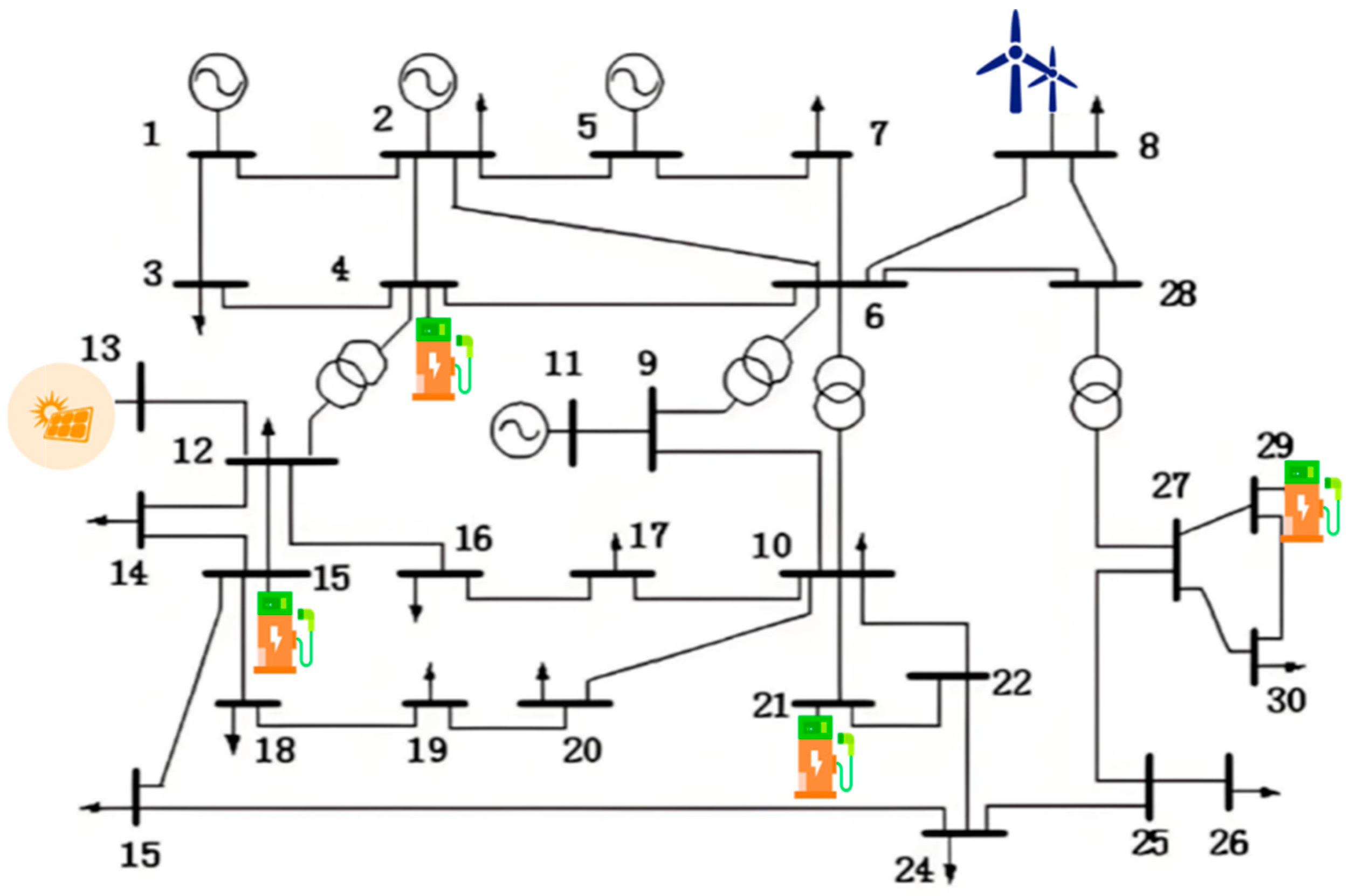
To demonstrate the effectiveness of the proposed method in this paper, a standard IEEE-30 bus test system was utilized for verification and analysis, with the topological structure of the test system shown in Figure 3 below.

5.2. Descriptive Analysis of Uncertainty Scenarios

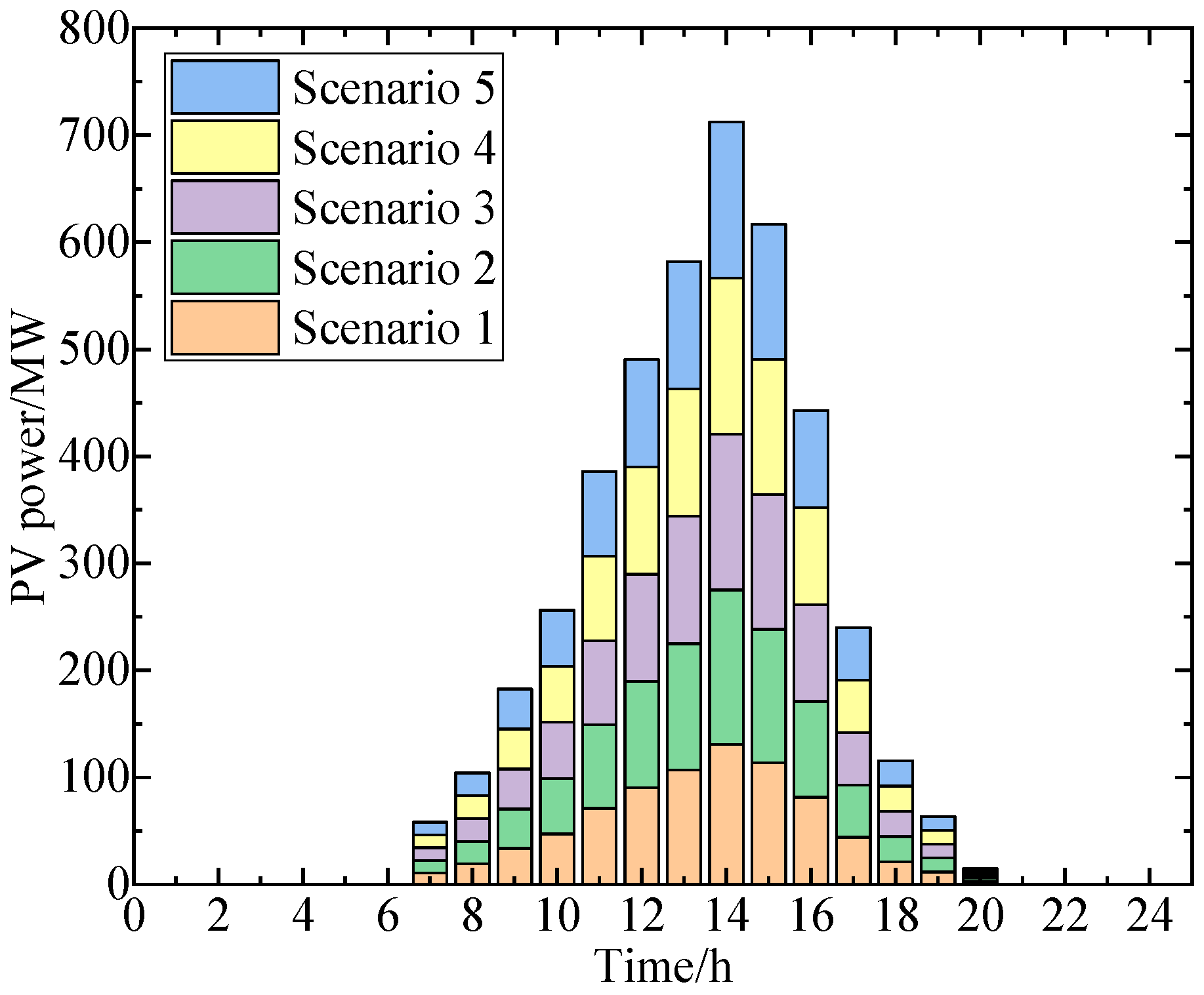
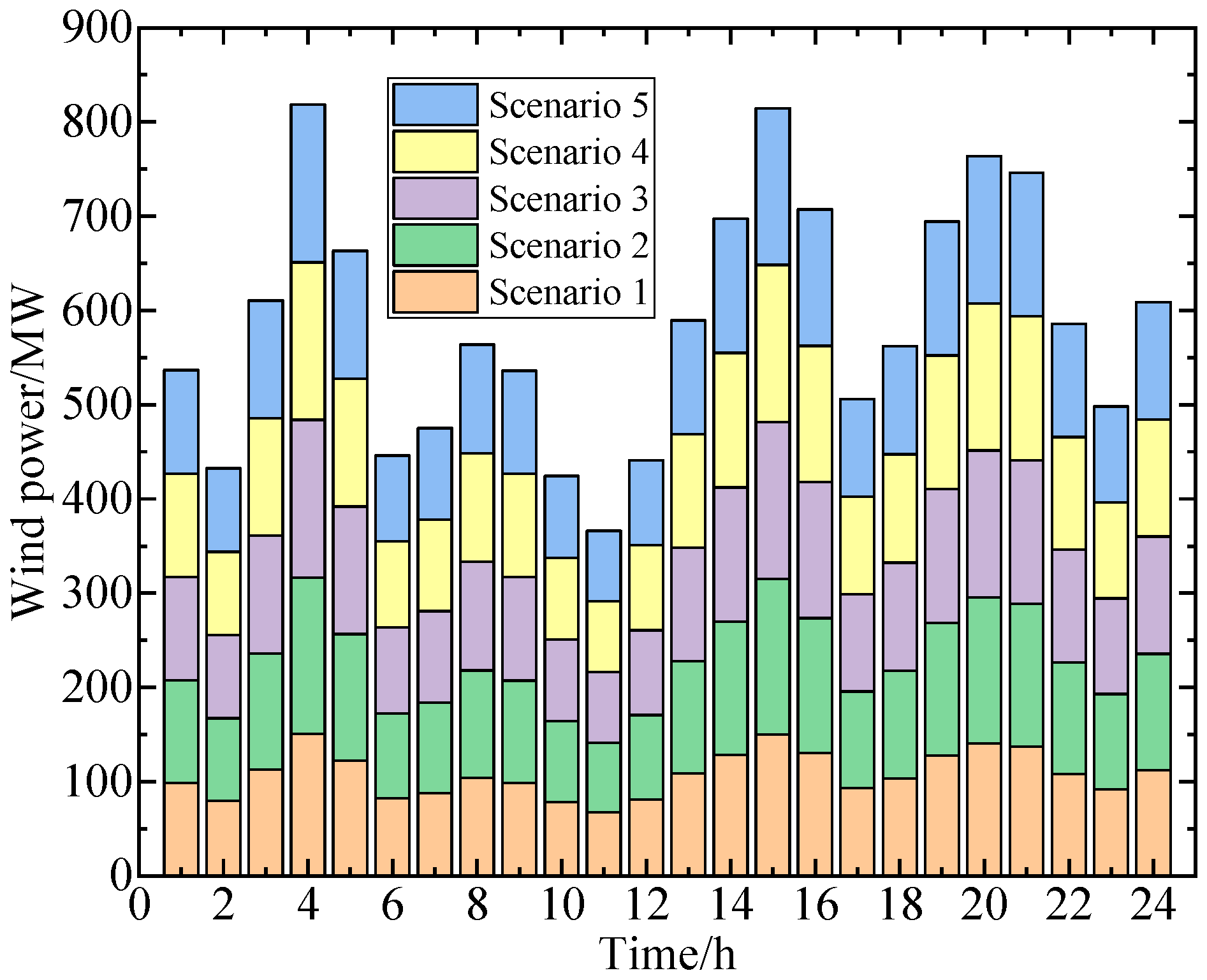
This paper employs a multi-scenario generation strategy to characterize the uncertainty of renewable energy output. The typical scenario sets for wind and photovoltaic power output generated using the proposed method are illustrated in Figure 4 and Figure 5 below.
The method proposed in this paper generates more accurate typical scenarios for wind and solar renewable energy, primarily due to its integration of non-parametric kernel density estimation and standard multivariate normal distribution sequence sampling techniques. Non-parametric kernel density estimation does not require specific probabilistic distribution assumptions for samples, enabling more flexible characterization of the uncertainty in wind and solar power output. Meanwhile, the standard multivariate normal distribution effectively captures the dynamic correlations of wind and solar output across different time intervals, avoiding the issue of neglecting temporal correlations inherent in static scenario generation methods. By combining these two approaches, the proposed method can generate typical scenarios that more closely resemble actual wind and solar power output characteristics, thereby enhancing the accuracy of scenario generation.
To visually demonstrate the precision of the generated scenarios, various methods were employed for comparison, with the relevant accuracy comparison results presented in Table 1 below. When selecting the kernel function, given that the Gaussian kernel function is continuously differentiable, has good smoothness, and its tail decay characteristics align well with the random fluctuation patterns of wind and solar power outputs, enabling it to accurately fit the probability distributions at different time periods and avoid the discontinuity issues associated with step-type kernel functions, it is thus chosen to characterize the uncertainty in wind and solar power outputs. For bandwidth selection, the cross-validation method is employed, traversing a preset range to select the value that minimizes the deviation between the estimated and actual densities. Meanwhile, considering the time-series characteristics of wind and solar power outputs, adaptive bandwidths are set for different time periods, with smaller bandwidths during peak output periods to enhance accuracy and moderately larger bandwidths during flat output periods to ensure smoothness. This method exhibits low sensitivity to the choices of kernel function and bandwidth. The estimation deviations of commonly used smooth kernel functions are within 3%. When the bandwidth determined through cross-validation fluctuates within ±20% of the optimal value, the changes in the SSE and silhouette coefficient for typical scenarios do not exceed 0.5% and 0.02, respectively. Furthermore, corrections for spatiotemporal correlations further offset the estimation biases caused by bandwidth fluctuations, ensuring the stability of the estimation results and preventing significant changes in the final dynamic scenarios due to minor adjustments.
Observing the table above, it can be found that compared with common methods such as the Monte Carlo sampling method, Latin hypercube sampling method, and the time series analysis method based on the ARMA model, the advantage of the proposed method in this paper lies in its comprehensive consideration of both the uncertainty and dynamic correlation of wind and solar power output. While Monte Carlo and Latin hypercube sampling methods can generate a large number of random scenarios, they often overlook the correlation between wind and solar power outputs at different time intervals. Although the ARMA model can describe the dynamic characteristics of time series, it may have limitations when dealing with nonlinear and non-stationary wind and solar power output data. By combining non-parametric kernel density estimation with a standard multivariate normal distribution, the proposed method not only accounts for the uncertainty of wind and solar power output but also accurately captures its dynamic correlation. As a result, the generated scenarios are more accurate, with minimal errors and silhouette coefficients closer to 1, indicating an optimal balance between the separation and compactness of the scenarios. Using the Root Mean Square Error (RMSE) of kernel density fitting and the Kolmogorov–Smirnov (K-S) test statistic as evaluation metrics, the degree of alignment between the probability distributions of scenarios generated by each method and the actual power output distributions is quantified. A smaller RMSE indicates a smaller fitting deviation, while a K-S statistic closer to 0 signifies a higher degree of distributional consistency. For the proposed method, the RMSE values of kernel density fitting for wind power and photovoltaic scenarios are 0.021 and 0.018, respectively, and the K-S test statistics are 0.063 and 0.057, respectively, both significantly lower than those of traditional methods. In contrast, the RMSE values for wind power and photovoltaic scenarios generated using Monte Carlo sampling reach 0.045 and 0.041, respectively, with K-S statistics of 0.135 and 0.121. This method employs a hierarchical design to simultaneously handle marginal distribution characteristics and temporal dependencies. For marginal distributions, it abandons the fixed distribution assumption of parametric estimation and uses nonparametric kernel density estimation with a Gaussian kernel function to perform weighted interpolation on historical samples at each time node, directly fitting to obtain the marginal probability density functions. This approach accurately captures the differences in power outputs and their fluctuation characteristics across different time periods. Regarding temporal dependencies, it introduces a standard multivariate normal distribution to construct a time-series correlation model, constructs an exponential covariance function to represent the covariances at different times, and determines the optimal temporal correlation strength by minimizing the probability density differences in fluctuations between dynamic scenarios and adjacent historical time moments. Subsequently, through Latin hypercube sampling, distribution conversion, and inverse transform sampling, the generated scenarios adhere to both the marginal distributions and the temporal dynamic correlations, achieving a unified depiction of the two.
The consistency of the temporal correlation structure is evaluated using the deviation in Pearson correlation coefficients of power outputs at different times and the similarity of covariance matrices as metrics to verify each method’s ability to reproduce the actual temporal correlation structure in generated scenarios. Here, the correlation coefficient deviation is the absolute value of the difference between the correlation coefficients of the generated scenarios and the actual power outputs, while the similarity of covariance matrices is measured by the trace distance, with a value closer to 1 indicating higher similarity. In the validation of temporal correlation for wind power output, the correlation coefficient deviations of the scenarios generated by the proposed method at 1 h, 2 h, and 4 h intervals are 0.032, 0.045, and 0.051, respectively, with a covariance matrix similarity of 0.942. For photovoltaic output, the corresponding correlation coefficient deviations are 0.028, 0.039, and 0.046, with a covariance matrix similarity of 0.956. In contrast, for traditional methods such as Monte Carlo and Latin hypercube sampling, which do not account for temporal correlation, the correlation coefficient deviations all exceed 0.15, and the covariance matrix similarity is below 0.7.

5.3. Effectiveness Analysis of the Planning Scheme

The grid structure obtained by adopting the planning strategy proposed in this paper is shown in Figure 6 below. Nodes 4, 15, 21, and 29 are the permitted access nodes for MESS. Among them, a wind farm and a photovoltaic power station are installed at nodes 8 and 13, respectively, while nodes 1, 2, 5, and 11 retain the original thermal power generating units within the system.
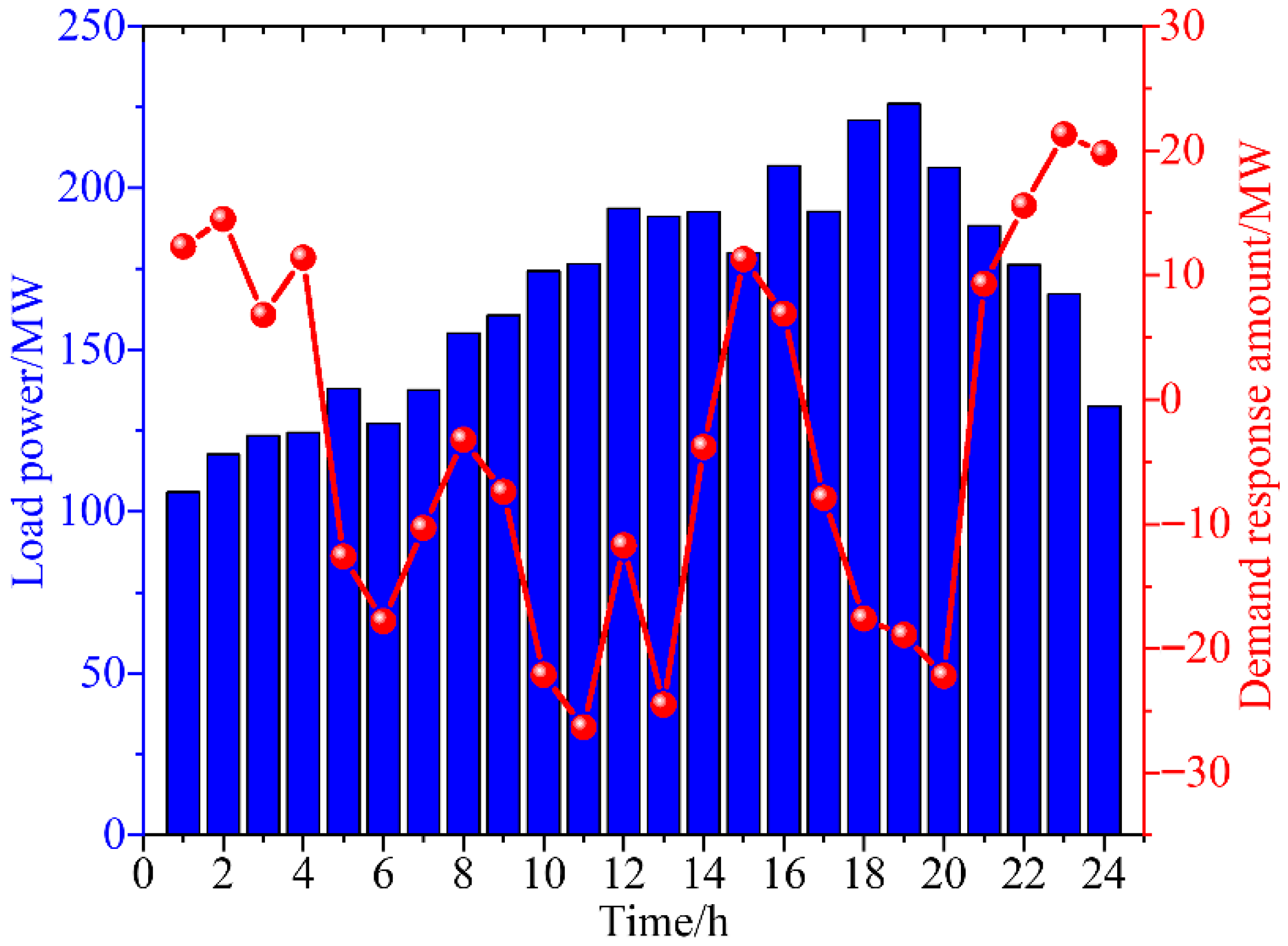
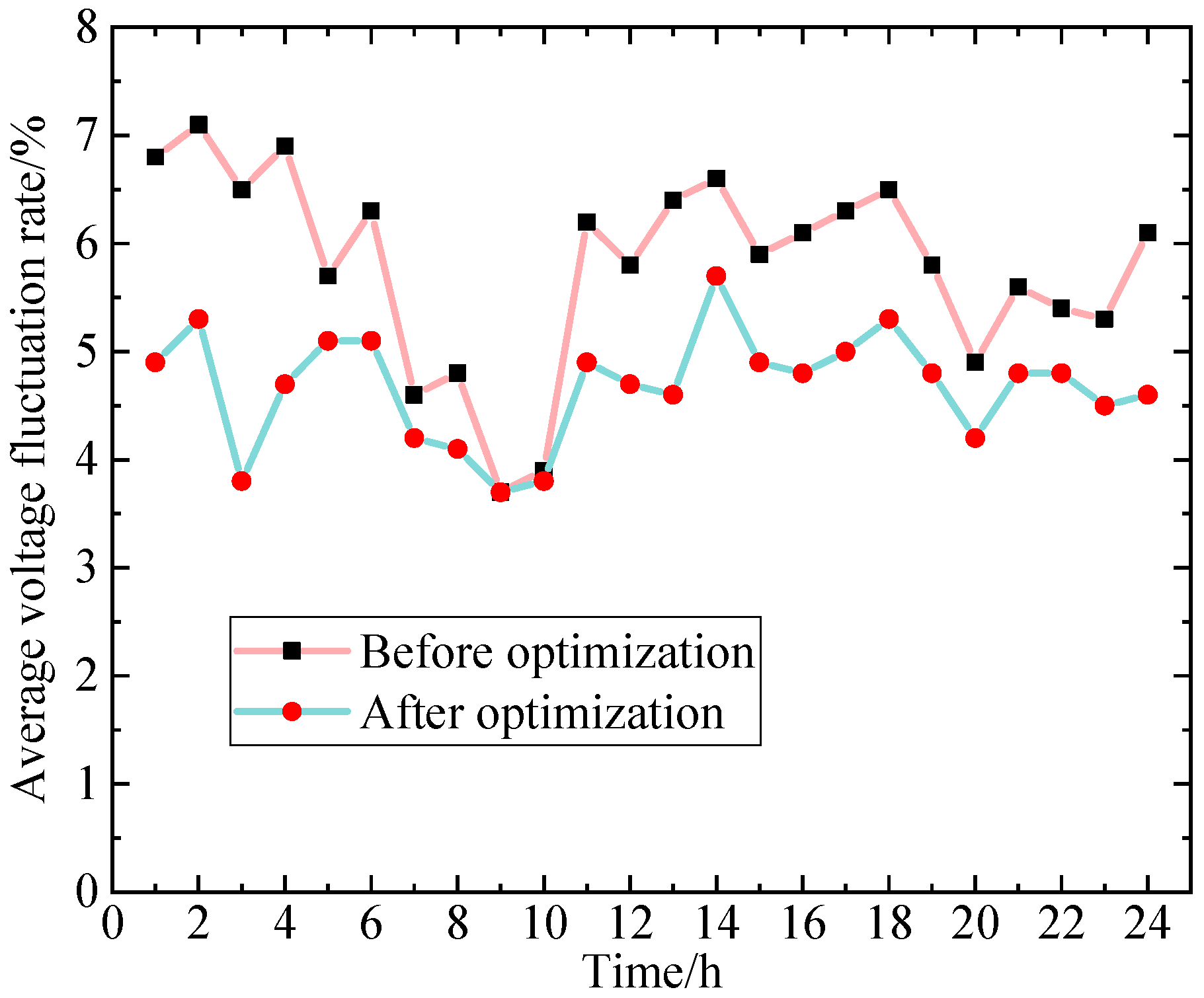
Furthermore, this paper selects a typical day, with the load and demand response conditions on this day illustrated in Figure 7 below. The average voltage fluctuation rates before and after optimization on this typical day are shown in Figure 8.
After optimization, the voltage fluctuation rate is significantly reduced, primarily because the proposed method precisely characterizes the dynamic uncertainty of renewable energy output through multi-scenario stochastic optimization and leverages the spatiotemporal coupling regulation capabilities of MESS and SOP. Specifically, the typical scenarios generated by non-parametric kernel density estimation and standard multivariate normal distribution sequence sampling techniques more closely resemble actual wind and solar power output characteristics, enabling dispatch strategies to proactively respond to output fluctuations. Meanwhile, MESS achieves flexible charging/discharging and spatial relocation through the SOP’s DC link, effectively mitigating voltage fluctuations during peak load periods and low renewable energy output periods, thereby enhancing the voltage stability of the power grid.
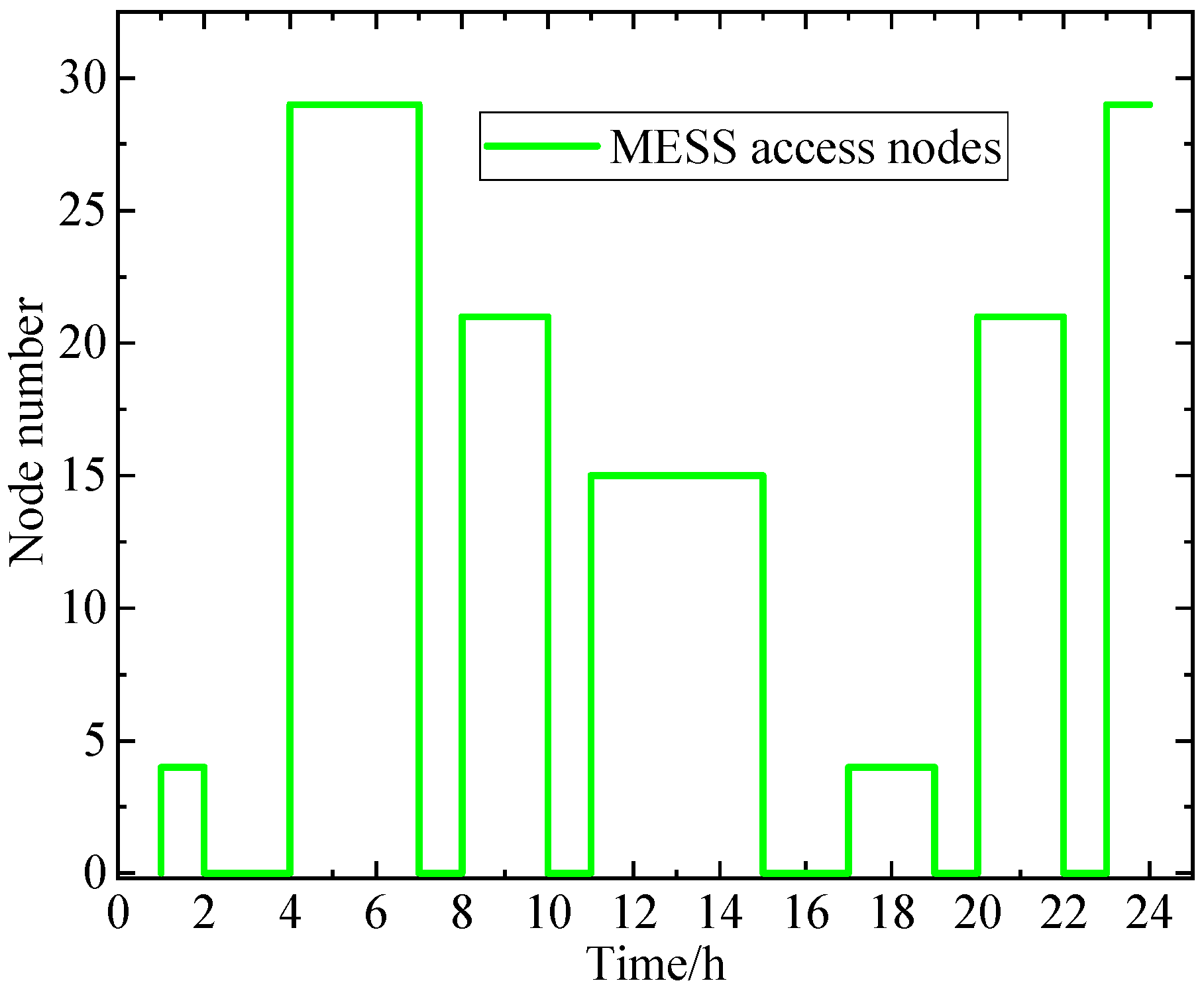
Figure 9 illustrates the dynamic regulation process of MESS. The flexibility of MESS is manifested in its mobility based on electric vehicle carriers and the rapid charging/discharging capability of lithium-ion battery energy storage. Through a point-to-point dispatch strategy on the DC side of SOP, MESS can dynamically transfer between different nodes, enabling flexible regulation in both spatial and temporal dimensions. The advantages of deploying MESS in the system are as follows: On one hand, its synergy with SOP enhances the power flow regulation capability of the grid, avoiding the regulation lag issues associated with traditional static reactive power compensation devices such as OLTCs. On the other hand, the energy spatiotemporal transfer characteristic of MESS allows for rapid response to local voltage violations and line overloads, significantly improving the grid’s adaptability to high-penetration renewable energy integration, thereby optimizing overall operational efficiency and economic performance.
This paper conducts a quantitative comparison of the improved PSO algorithm with the traditional PSO algorithm, Monte Carlo optimization, and convex relaxation optimization in terms of the number of iterative convergence steps, solution time consumption, and the success rate of finding the optimal solution. The number of tests is set to 50. The results are as follows in Table 2:
The number of convergence iterations for the improved PSO algorithm in this paper is reduced by over 50% compared to the traditional PSO algorithm, and the average time per solution is decreased by 60% to 80% compared to traditional methods, directly verifying the improvement in solution efficiency. Due to the tendency to get trapped in local optima, low sampling efficiency, and convex relaxation approximation errors, traditional methods exhibit 16% to 30% instances of no solution/non-convergence in 50 repeated tests. In contrast, the proposed algorithm achieves zero instances of no solution/non-convergence by leveraging enhanced population diversity through refraction opposite learning and the local optimum escape capability of Tent chaotic mapping, quantitatively demonstrating its effectiveness in avoiding no-solution scenarios.
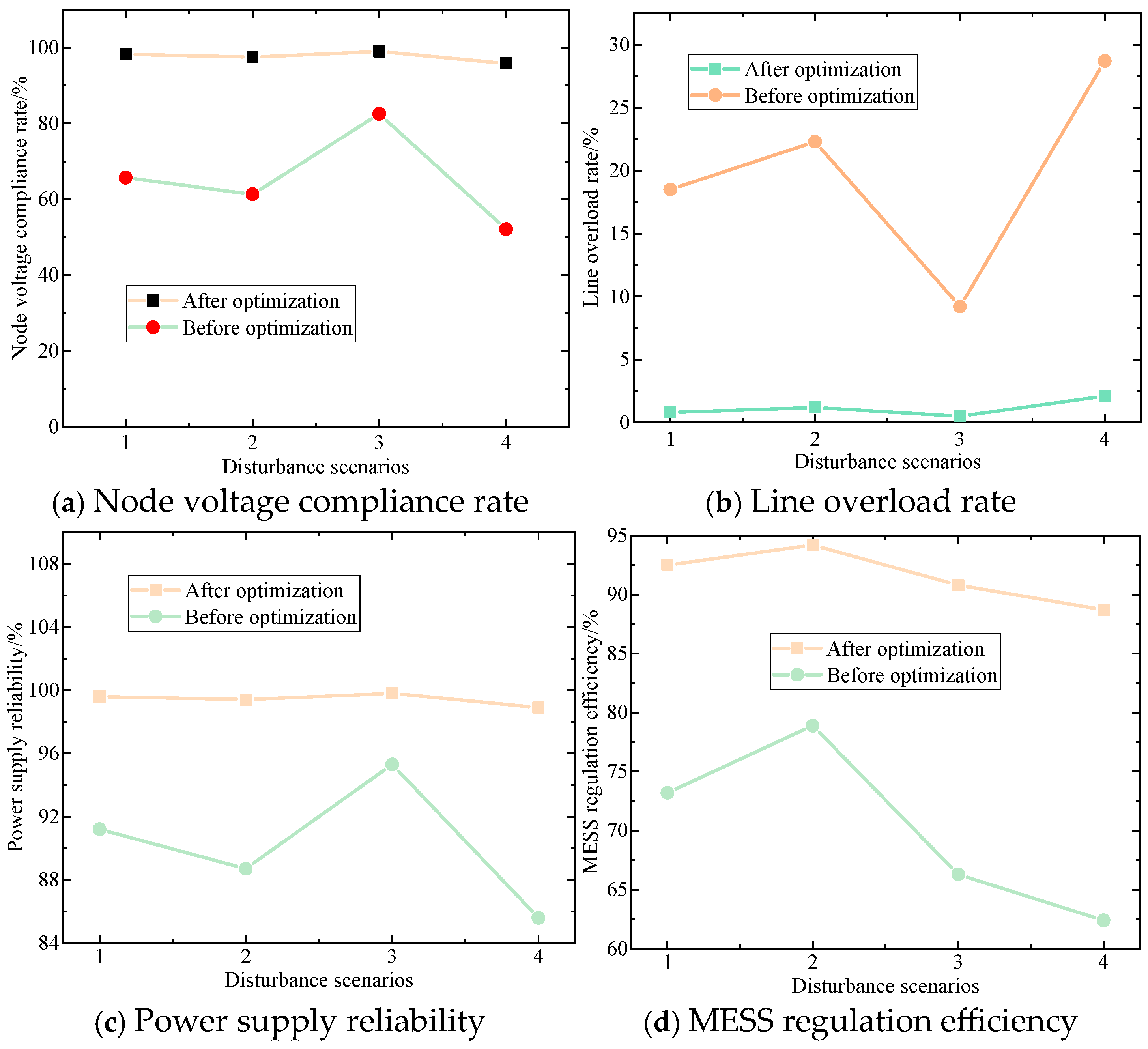
To further verify the operational stability of the proposed planning method in power systems under the flexible integration of renewable energy and heterogeneous flexible resources, this paper designs multi-dimensional robustness tests for typical disturbance scenarios such as sudden changes in renewable energy output, significant load fluctuations, and failures of flexible devices. These tests quantitatively validate the engineering reliability of the proposed method, with the results shown in Figure 10 below. Four different scenarios are set up as follows:
  • Extreme sudden changes in renewable energy output: The wind power output at Node 8 drops by 60% within 0.2 s, and the photovoltaic output at Node 13 surges by 50% within 0.2 s, simulating extreme weather conditions such as sudden wind stoppage and intense sunlight.
  • Large-scale load fluctuations: The total system load increases by 30% within 0.5 s, and the loads at key nodes (4, 15, 21, 29) increase by 40%, simulating peak load impacts on the power grid.
  • Single SOP device failure: The SOP device at Node 15 fails and exits operation, losing its power flow regulation function at that node, simulating a single-device failure scenario for flexible regulation equipment.
  • Multiple disturbances superimposition: On the basis of a 30% increase in the total system load, disturbances such as a 40% drop in wind power output at Node 8 and an SOP failure at Node 21 are superimposed, simulating complex operational conditions with multiple disturbances in actual power grids.
Under extreme sudden changes in renewable energy output and large-scale load fluctuations, the node voltage compliance rate of the optimized system remains above 97%, and the line overload rate is below 1.2%. The core reason is that MESS achieves rapid spatiotemporal energy transfer through the point-to-point scheduling strategy on the SOP DC side, adjusting charging and discharging power in real time according to disturbance conditions to compensate for power deficits and suppress voltage and power flow fluctuations. Meanwhile, SOP flexibly regulates power flow between nodes, preventing line overloads caused by concentrated power flow. Under the disturbance of a single SOP device failure, the system still maintains a node voltage compliance rate of 99%, with a line overload rate of only 0.5%. This is because the proposed planning method adopts a distributed SOP access structure, where each SOP node provides mutual backup. When a single SOP fails, the remaining SOP nodes can take over its regulation functions, effectively withstanding the impacts of multiple superimposed disturbances and ensuring the safe and stable operation of the system. The drawback of this method in engineering applications lies in its heavy reliance on accurate models and data inputs. In practical engineering scenarios, the complex variability of renewable energy output and environmental disturbances may lead to prediction deviations in the model. Meanwhile, although the improved Particle Swarm Optimization algorithm enhances global search capabilities, the increased computational complexity may affect real-time performance and impose high hardware computing requirements, thus limiting its application in resource-constrained scenarios.

6. Conclusions

This paper presents a comprehensive power system planning method tailored for urban power grids, addressing the challenges posed by the integration of distributed renewable energy sources with inherent randomness and volatility. The key findings and contributions of this study are as follows:
(1)
Firstly, the proposed dynamic scenario generation method, leveraging nonparametric kernel density estimation and standard multivariate normal distribution sequence sampling, effectively captures the uncertainty of renewable energy output. By generating a set of typical daily dynamic output scenarios for wind and solar power, this method demonstrates a remarkable improvement in accuracy, with a sum of squared errors of only 4.82% and a silhouette coefficient of 0.94, significantly outperforming traditional methods such as Monte Carlo sampling. This enhancement ensures that the generated
(2)
The introduction of an improved PSO algorithm based on refraction opposite learning addresses the limitations of traditional convex optimization methods and standard PSO algorithms. By expanding the particle search space and increasing population diversity, the improved PSO algorithm significantly enhances global optimization capability, avoiding premature convergence to local optima. This advancement ensures that the power system planning model is solved with higher efficiency and accuracy, with an average improvement in solving efficiency of 52.3%.
The method not only enhances the accuracy and efficiency of power system planning but also improves the system’s flexibility and resilience in the face of renewable energy integration challenges. Future research could further explore the application of this method in larger-scale power systems and consider additional factors such as market mechanisms and policy incentives to promote the widespread adoption of renewable energy sources.

Author Contributions

Conceptualization, N.Y., Z.L. and L.Z.; methodology, N.Y. and Y.Z.; software, Y.L.; validation, Z.L., Y.W. and S.S.; formal analysis, Y.W.; investigation, Z.L.; resources, S.S., Y.L., L.Z. and Y.Z.; data curation, Z.L., Y.W. and S.S.; writing—original draft preparation, Z.L.; writing—review and editing, Y.W., N.Y. and S.S.; visualization, Y.L.; supervision, N.Y. and L.Z.; project administration, Z.L., Y.W. and N.Y. All authors have read and agreed to the published version of the manuscript.

Funding

This work is supported by the science and technology project of State Grid Shandong Electric Power Company: Research on Joint Planning Methods for Wide-Area Distributed Energy Systems Considering Flexible Weak Coupling (No. 520626250010).

Data Availability Statement

Data is contained within the article.

Conflicts of Interest

Authors Yuejiao Wang, Shumin Sun, Zhipeng Lu, Yiyuan Liu were employed by the company State Grid Shandong Electric Power Company. The remaining authors declare that the research was conducted in the absence of any commercial or financial relationships that could be construed as a potential conflict of interest. The State Grid Shandong Electric Power Company had no role in the design of the study; in the collection, analyses, or interpretation of data; in the writing of the manuscript, or in the decision to publish the results.

Nomenclature

VariablesMeanings
f ( x t ) and f ( y t ) The probability density functions of wind and solar power at time t
TThe time interval for optimization
MThe number of historical wind and solar power data points at different times
H(·)The Gaussian kernel function
η The strength of correlation in the outputs of wind and solar resources at different time instants
GThe set of equidistant sampling points g within the probability density interval
NThe sampling size
p d f ( g ) The probability density of fluctuations generated by the multivariate normal distribution
p d f Δ ( g ) The probability density of fluctuations at adjacent time instants in the historical data
γ k The k-th cluster
ϖ k The centroid of that cluster
ϖ The data points within the cluster
d t r a , n The average distance from data point n to other points within the same cluster
d t e r , n The average distance from data point n to the nearest points in other clusters
KThe set of MESS
m and nThe m-th and n-th SOP’s DC sides
I k . m n , t A binary variable indicating the passage status of the k-th MESS at time t
I k . m n , 1 A variable representing the position of the k-th MESS at the initial time period t = 1
P c h , k , m , t and P d i s , k , m , t The charging and discharging power of the k-th MESS at the SOP DC side m at time t
P c h , k , max and P d i s , k , max The maximum charging and discharging power of the k-th MESS
u c h , k , t and u d i s , k , t The charging and discharging status indicators of the k-th MESS at time t
S O C k , t represents the state of charge of the k-th MESS at time t
S O C k , max and S O C k , min The maximum and minimum SOC of the k-th MESS
P s o p , m , i , t and P s o p , m , j , t The active power transmitted across sides i and j of the m-th SOP node at time t
Q s o p , m , i , t and Q s o p , m , j , t The reactive power injected into sides i and j of the m-th SOP node at time t
P s o p L , m , i , t and P s o p L , m , j , t The active power losses on sides i and j of the m-th SOP node at time t
η s o p , m The loss coefficient of the m-th SOP
S s o p , m , i and S s o p , m , j The converter capacities of port i and port j of the m-th SOP
U i , t The voltage magnitude at node i at time t
U i , N The per-unit value of node i
P ^ d q , t and P d q , t The predicted and actual output of distributed generation sources
Δ P d q , t and Δ P d q , t , max The output fluctuation and the maximum output fluctuation of distributed generation sources
P r ( P d p , t ) The probability distribution function of the output of distributed generation sources
P d p e and P d p u The upper and lower bounds of the output of distributed generation sources
NwThe number of distributed generation sources
β w The penalty cost coefficient for wind curtailment
β d The penalty cost coefficient for load shedding
NsThe number of divided risk scenarios
U d p , t , s and V d p , t , s The upper and lower bounds of the uncertainty set for distributed generation sources
W U d p , t , s and W L d p , t , s Matrices representing the upper limits of the wind power uncertainty set
W C d p , t , s and L S d p , t , s Risk matrices for scenarios where the output of distributed generation sources exceeds or falls below the predicted value
P ^ d r , t and P d r , t The composite forecasted power and actual power
Δ P d r , t and Δ P d r , t . max The load power fluctuation and the maximum output fluctuation
η l , S I A binary variable. When the line is in a closed state
Ω c o n The set of newly constructed transmission lines
Ω s c e The set of non-scenario or non-contingency cases
ο l An indicator variable representing whether line l is allowed to be disconnected
χ l A binary variable indicating whether construction is to be carried out at the candidate new transmission line l
P G m and P L m The active input power and active load demand at node m
Q G m and Q L m The reactive input power and reactive load demand at node m
BmnThe susceptance between nodes m and n
P d p , i and P k , d r The output of the i-th distributed generation source and the adjustable amount of the k-th load
v i d ( t + 1 ) and x i d ( t + 1 ) The velocity and position of particle i at generation t + 1
c1 and c2Learning coefficients
r1 and r2Random numbers uniformly distributed between [0, 1]
p b e s t i d and g b e s t i d The individual best value and global best value of the particle
x i , j The value of the j-th dimension for the i-th particle
x i , j o p The opposite solution based on refraction opposition-based learning
x j min and x j max The minimum and maximum values of the j-th dimension in the particle population
X T The chaotic sequence
x t A randomly generated number with a uniform distribution
P d b e s t The value of the d-th dimension of the optimal particle
P i , d c h a o s The chaotic perturbation generated by X T
P i , d n e w The particle position after chaotic perturbation applied to P i , d

References

  1. Zhao, Y.; Zhang, G.; Hu, W.; Huang, Q.; Chen, Z.; Blaabjerg, F. Meta-Learning Based Voltage Control for Renewable Energy Integrated Active Distribution Network Against Topology Change. IEEE Trans. Power Syst. 2023, 38, 5937–5940. [Google Scholar] [CrossRef]
  2. Yang, N.; Lin, D.; Ding, L.; Yang, C.; Zhang, L.; Yang, Y.; Ye, X.; Xiong, Z.; Huang, Y. Optimal Planning for Charging Stations within Multi-coupled Networks Considering Load-Balance Effects. Energy 2025, 336, 138481. [Google Scholar] [CrossRef]
  3. Bian, A.; Wang, Y.; Luo, Y. A novel chaotic differential variation snake optimization algorithm for parameters estimation of photovoltaic cell and module models. Smart Power Energy Secur. 2025, 1, 133–153. [Google Scholar] [CrossRef]
  4. Zhao, Z.; Yang, J.; Wen, F.; Agüero, J.R.; Du, Y.; Jacob, M.V. Towards resilient power systems: A review of wildfire mitigation strategies. Smart Power Energy Secur. 2025, 1, 175–185. [Google Scholar] [CrossRef]
  5. Guo, L.; Yang, G.; Liu, Y.; Zhang, Y.; Wang, Z.; Yu, H.; Wang, Y.; Wang, C. Topology and Parameter Identification of Three-Phase Low-Voltage Distribution Network and Voltage Control Strategy Based on User Smart Meter Measurements: A Data-Driven Approach. IEEE Trans. Instrum. Meas. 2025, 74, 9006413. [Google Scholar] [CrossRef]
  6. Zhang, B.; Kong, K.; Zhang, L.; Zhang, Q.; Cai, Y.; Zhao, C. Coordinated Power Control Strategy of PV Inverters and VSCs in DC-Interconnected Low-Voltage Distribution Networks. IEEE Trans. Ind. Appl. 2025, 61, 8001–8014. [Google Scholar] [CrossRef]
  7. Yang, Z.; Wang, H.; Liao, W.; Bak, C.L.; Chen, Z. Protection Challenges and Solutions for AC Systems with Renewable Energy Sources: A Review. Prot. Control Mod. Power Syst. 2025, 10, 18–39. [Google Scholar] [CrossRef]
  8. Yang, N.; Xu, G.; Fei, Z.; Li, Z.; Du, L.; Guerrero, J.M.; Huang, Y.; Yan, J.; Xing, C.; Li, Z. Two-Stage Coordinated Robust Planning of Multi-Energy Ship Microgrids Considering Thermal Inertia and Ship Navigation. IEEE Trans. Smart Grid 2025, 16, 1100–1111. [Google Scholar] [CrossRef]
  9. An, H.; Yi, J.; Xing, Y.; Zhang, G.; Bamisile, O.; Li, J.; Huang, Q.; Xing, Y. A Robust V2G Voltage Control Scheme for Distribution Networks Against Cyber Attacks and Customer Interruptions. IEEE Trans. Smart Grid 2024, 15, 3966–3978. [Google Scholar] [CrossRef]
  10. Yuan, X.; Zeng, F.; Miu, H.; Hou, Y.; Xu, D.; Zhang, X.; Mei, S. Study on Modelling and Capacity Planning of Electric-thermal-Hydrogen Integrated Energy Systems. High Volt. Appar. 2024, 60, 34–47. [Google Scholar] [CrossRef]
  11. Li, Y.; Lu, C.; Tang, Y.; Fang, C.; Cui, Y. Dynamic Control and Time-Delayed Channel Scheduling Co-Design for Voltage Control in Active Distribution Networks. IEEE Trans. Smart Grid 2024, 15, 1837–1848. [Google Scholar] [CrossRef]
  12. Yang, N.; Shen, X.; Liang, P.; Ding, L.; Yan, J.; Xing, C.; Wang, C.; Zhang, L. Spatial-temporal Optimal Pricing for Charging Stations: A Model-Driven Approach Based on Group Price Response Behavior of EVs. IEEE Trans. Transp. Electrif. 2024, 10, 8869–8880. [Google Scholar] [CrossRef]
  13. Yu, P.; Wan, C.; Qin, H.; Lao, K.-W.; Song, Y.; Ju, P. Centralized-Distributed Coordinated Voltage Control of Active Distribution Networks with Renewables. IEEE Trans. Sustain. Energy 2025, 16, 1504–1517. [Google Scholar] [CrossRef]
  14. Wang, Y.; Hu, W.; Cao, D.; Zhao, P.; Abulanwar, S.; Chen, Z.; Blaabjerg, F. Local Distribution Voltage Control Using Large-Scale Coordinated PV Inverters: A Novel Multi-Agent Deep Reinforcement Learning-Based Approach. IEEE Trans. Smart Grid 2025, 16, 2683–2686. [Google Scholar] [CrossRef]
  15. Salama, H.S.; Magdy, G.; Bakeer, A.; Vokony, I. Adaptive coordination control strategy of renewable energy sources, hydrogen production unit, and fuel cell for frequency regulation of a hybrid distributed power system. Prot. Control Mod. Power Syst. 2022, 7, 472–489. [Google Scholar] [CrossRef]
  16. Wei, X.; Zhang, X.; Wang, G.; Hu, Z.; Zhu, Z.; Chan, K.W. Online Voltage Control Strategy: Multi-Mode Based Data-Driven Approach for Active Distribution Networks. IEEE Trans. Ind. Appl. 2025, 61, 1569–1580. [Google Scholar] [CrossRef]
  17. Yang, N.; Hao, J.; Li, Z.; Ye, D.; Xing, C.; Zhang, Z.; Wang, C.; Huang, Y.; Zhang, L. Data-Driven Decision-Making for SCUC: An Improved Deep Learning Approach Based on Sample Coding and Seq2Seq Technique. Prot. Control Mod. Power Syst. 2025, 10, 13–24. [Google Scholar] [CrossRef]
  18. Wei, L.; Ge, L.; Li, J.; Du, T.; Li, X. Overview of Optimal Control Technology for Distributed Photovoltaic Clusters. High Volt. Appar. 2025, 61, 1–9. [Google Scholar] [CrossRef]
  19. Huo, Y.; Li, P.; Ji, H.; Yu, H.; Zhao, J.; Xi, W.; Wu, J.; Wang, C. Data-Driven Predictive Voltage Control for Distributed Energy Storage in Active Distribution Networks. CSEE J. Power Energy Syst. 2024, 10, 1876–1886. [Google Scholar] [CrossRef]
  20. Xia, Y.; Li, Z.; Xi, Y.; Wu, G.; Peng, W.; Mu, L. Accurate Fault Location Method for Multiple Faults in Transmission Networks Using Travelling Waves. IEEE Trans. Ind. Inform. 2024, 20, 8717–8728. [Google Scholar] [CrossRef]
  21. Ingalalli, A.; Kamalasadan, S. Decentralized State Estimation-Based Optimal Integral Model Predictive Control of Voltage and Frequency in the Distribution System Microgrids. IEEE Trans. Smart Grid 2023, 14, 1790–1803. [Google Scholar] [CrossRef]
  22. Zhang, B.; He, C. Decentralized Voltage and Var Control of Active Distribution Network Based on Parameter-Sharing Deep Reinforcement Learning. IEEE Access 2025, 13, 115090–115101. [Google Scholar] [CrossRef]
  23. Gao, F.; Hou, H.; Dong, Z.Y.; Tang, J.; Yan, Y.; Zhang, J.; Xie, C. A two-stage resilience planning for integrated electricity-gas energy system considering hydrogen refueling stations during typhoons. Smart Power Energy Secur. 2025, 1, 25–35. [Google Scholar] [CrossRef]
  24. Li, K.; Guo, H.; Feng, C.; Yu, S.; Tang, Y. Modeling strategic behaviors of renewable-storage system in low-inertia power system. Prot. Control Mod. Power Syst. 2025, 10, 28–40. [Google Scholar] [CrossRef]
  25. Saxena, A.; Shankar, R. An Interactive Operating Demand Response Approach for Hybrid Power Systems Integrating Renewable Energy Sources. Prot. Control Mod. Power Syst. 2024, 9, 174–194. [Google Scholar] [CrossRef]
  26. Lu, Y.; Zou, S.; Liu, L.; Zhao, H.; Bao, T.; Xu, J. Generation Control of High Percentage Renewable Energy Systems Based on Knowledge Sharing. High Volt. Appar. 2024, 60, 33–45. [Google Scholar] [CrossRef]
  27. Wan, Y.; Ni, T.; Wu, X.; Hou, H.; Dong, Z.Y.; Xu, J.; Luo, C. Panoramic probabilistic optimizer: Refined annual 8760-h load curve for long-term load forecasting. Smart Power Energy Secur. 2025, 1, 122–132. [Google Scholar] [CrossRef]
Figure 1. Flowchart for typical scenario generation.
Processes 14 00984 g001
Figure 2. Schematic Diagram of MESS Transportation Network.
Processes 14 00984 g002
Figure 3. Topological structure of the test system.
Processes 14 00984 g003
Figure 4. Typical scenario sets for PV power.
Processes 14 00984 g004
Figure 5. Typical scenario sets for wind power.
Processes 14 00984 g005
Figure 6. Network Topology under the Proposed Planning Scheme.
Processes 14 00984 g006
Figure 7. Load and demand response conditions.
Processes 14 00984 g007
Figure 8. Average voltage fluctuation rates before and after optimization.
Processes 14 00984 g008
Figure 9. Dynamic regulation process of MESS.
Processes 14 00984 g009
Figure 10. Validation Results of Stability and Robustness.
Processes 14 00984 g010
Table 1. Comparison of Accuracy Across Different Scenario Generation Methods.
MethodSSE/%Silhouette CoefficientRoot Mean Square Error/%Normalized Error/%
The proposed method4.820.940.0588.7
Monte Carlo sampling method7.140.820.12523.5
Latin hypercube sampling method6.880.850.10719.8
Time series analysis method based on Autoregressive Moving Average (ARMA) model6.310.910.09715.2
Table 2. Quantitative comparison between different methods.
MethodNumber of Convergence IterationsAverage Time per Solution/sSuccess Rate of Finding Optimal SolutionNumber of Instances with No Solution or Non-Convergence
PSO algorithm2035268%8
Monte Carlo optimization64713752%15
Convex relaxation1353370%10
The proposed method871796%0
Disclaimer/Publisher’s Note: The statements, opinions and data contained in all publications are solely those of the individual author(s) and contributor(s) and not of MDPI and/or the editor(s). MDPI and/or the editor(s) disclaim responsibility for any injury to people or property resulting from any ideas, methods, instructions or products referred to in the content.