


Abstract
The processing of Brazil nuts generates by-products such as cracked kernels and press cakes that are frequently undervalued despite their rich biochemical composition. This study provides a comparative compositional evaluation of partially defatted Brazil nut flour applied to gluten-free cookies, focusing on sugars, tocopherols, selected phenolic acids, and mineral composition. Cookies formulated with Brazil nut flour were compared with control formulations and, descriptively, with commercial gluten-free products. The incorporation of Brazil nut flour resulted in consistent compositional enrichment, including higher levels of γ- and α-tocopherols, gallic and caffeic acids, and essential minerals, alongside a lower sucrose content relative to control cookies. From a food biochemistry perspective, these results indicate an improved nutritionally relevant of the formulated cookies. The findings support the compositional potential of Brazil nut by-products as upcycled ingredients for nutritionally improved gluten-free baked products and provide a foundation for future studies addressing biological activity, bioaccessibility, and functional validation.
1. Introduction
The growing awareness among consumers regarding the relationship between diet, health, and well-being has driven the demand for innovative food products developed using sustainable and eco-friendly technologies [1]. In this context, functional foods have gained increasing attention due to their ability to deliver bioactive compounds that provide health-promoting effects and may contribute to the prevention of chronic diseases, including metabolic, neurological, and cardiovascular disorders, as well as cancer, diabetes, and premature aging. As a result, a wide range of functional products—such as yogurts, milk, juices, breads, cereals, and cookies—has been introduced into the global market [2].
Cookies are widely consumed worldwide due to their convenience, affordability, pleasant sensory characteristics, and extended shelf life. However, gluten-free cookies often fail to meet nutritional expectations, as their formulations are typically based on refined starches, sugars, and fats, resulting in low contents of essential nutrients such as vitamins, minerals, dietary fiber, and bioactive compounds [3,4,5,6]. In addition, commercial gluten-free cookies frequently rely on relatively high sucrose levels to compensate for textural and sensory limitations associated with the absence of gluten. From a nutritional perspective, excessive sugar intake has been widely discussed as a concern in diets characterized by frequent consumption of processed foods, highlighting the relevance of strategies aimed at improving the sugar profile of gluten-free products. Consequently, the development of nutritionally enhanced gluten-free cookies has become an important research focus. One promising strategy to improve their nutritional and functional quality is the incorporation of alternative raw materials rich in bioactive compounds and micronutrients [7,8]. Due to their wide acceptance and ready-to-eat nature, cookies represent an excellent vehicle for the delivery of functional ingredients, making them particularly attractive for food engineering and product innovation studies.
From a food science perspective, nuts are defined as edible seeds with high lipid content, typically enclosed within a hard shell. Botanically, they are classified as dry fruits composed of an inedible husk and a single seed [9]. The term “tree nuts” broadly encompasses nuts that grow on trees, including almonds, Brazil nuts, cashews, hazelnuts, macadamias, pecans, pine nuts, pistachios, and walnuts, regardless of strict botanical classification [10]. Tree nuts are widely recognized for their high nutritional value, providing lipids rich in unsaturated fatty acids, proteins, minerals, vitamins, and a variety of bioactive compounds.
Among these, the Brazil nut (Bertholletia excelsa HBK), native to the Amazon rainforest, stands out as a non-timber forest product of considerable socio-economic importance. The extraction and commercialization of Brazil nuts generate income for numerous Amazonian communities organized in cooperatives and small-scale agro-industrial systems [11]. Despite their economic relevance, product diversification within these cooperatives remains limited, and the valorization of by-products generated during processing is often overlooked [12,13,14]. Industrial processing of Brazil nuts, particularly oil extraction, generates cracked or broken kernels and press cakes with reduced commercial value due to shorter shelf life and susceptibility to chemical and microbiological degradation with consequences at the nutritional and sensory level.
Brazil nut kernels are recognized as excellent sources of high-quality proteins, energy, and essential minerals especially selenium (Se), magnesium (Mg), and calcium (Ca) as well as polyphenols, flavonoids, unsaturated fatty acids, and dietary fiber [15]. Regular consumption of Brazil nuts has been associated with reduced cardiovascular risk factors and improved antioxidant, anti-inflammatory, antimutagenic, and anticarcinogenic activities, in addition to beneficial effects on lipid profiles and microvascular function [16,17,18]. These attributes have motivated research into the development of value-added food products incorporating Brazil nut derivatives as functional ingredients.
In this context, cracked kernels and press cakes derived from Brazil nut oil extraction represent promising raw materials for upcycling into nutritious food ingredients. Previous studies have demonstrated the feasibility of using Brazil nut press cake in gluten-free cookie formulations [19]. However, comprehensive chemical characterization integrating sugars, tocopherols, phenolic compounds, and mineral composition across raw materials, derived flours, formulated products, and commercial gluten-free cookies remains scarce. Such integrated profiling is essential to better understand the nutritional and functional potential of Brazil nut by-products and to support their application in food processing.
Therefore, the present study aimed to evaluate the chemical profile of Brazil nut cracked kernels, partially defatted Brazil nut flour, and gluten-free cookies formulated with this by-product, focusing on sugars, tocopherols, phenolic compounds, and mineral composition. The results were systematically compared with those of local commercially available gluten-free cookies to assess the nutritional enhancement and functional potential provided by the incorporation of Brazil nut flour into gluten-free baked products.
2. Materials and Methods
2.1. Cookies Formulation
The gluten-free cookies were obtained in a previous study [19], following the methods described by Martendal et al. [20]. Brazil nut cracked kernels, donated by Uniagro Indústria e Comércio de Alimentos Ltda (Porto Alegre, Rio Grande do Sul, Brazil), were pressed to produce partially defatted Brazil nut flour (BNF) according to Polmann et al. [21].
Cookie formulations were prepared by varying the concentrations of BNF (0 = control; 10 and 20 g of BNF/100 g of flour mix). The other ingredients—rice flour, cassava starch, corn starch, brown sugar, soy lecithin, vanilla essence, baking soda, and the vegetable fat Lévia+E, donated by Cargill Agrícola SA (Itumbiara, Goiás, Brazil)—were added in previously defined amounts [19].
Three commercial cookies were purchased from the local market in Florianópolis, Brazil, and used for comparison. The selection criteria were: (i) gluten-free cookies containing oilseeds and (ii) preferably containing Brazil nuts or, alternatively, cashew nuts. The ingredients listed on the labels (excluding additives) were as follows: Commercial Cookie 1—cassava starch, vegetable oils (soybean, corn, and cottonseed), potato starch, polydextrose fiber, inverted brown sugar, soy fiber, Brazil nuts, and soy flour; Commercial Cookie 2—corn starch, sunflower oil, cashew nuts, golden flaxseed, salt, ground cinnamon, quinoa flour, and amaranth flour; and Commercial Cookie 3—cassava starch, corn flour, vegetable oils (corn and/or sunflower and/or cottonseed and/or palm), soy extract (soy-derived protein ingredient), cane molasses, demerara sugar (less-refined sucrose-based sugar), and Brazil nuts. This information was obtained from the product labels.
The samples were grounded, homogenized, vacuum-packed in plastic bags formed by the co-extrusion of polyamides, polyethylenes, and modified polyethylenes, donated by Spel Embalagens (Atibaia, São Paulo, Brazil), and stored frozen until analysis.
2.2. Determination of Sugar Content
Approximately 1 g of each sample, was solubilized in 10 mL of ultrapure water and vortexed for 2 min. Sugar extraction was performed in an ultrasonic bath (Eco-Sonics, Ultronique, Indaratuba, São Paulo, Brazil) operating at 25 kHz and 264 W at 50 °C for 20 min. The extract was then centrifuged at 4000 rpm for 20 min, and the supernatant was filtered through a 0.45 µm PVDF filter. Monosaccharides and disaccharides were analyzed using a quaternary low-pressure ultra-high-performance liquid chromatography system equipped with a fluorescence detector and a refractive index detector (UHPLC-RID, Shimadzu Nexera RID-20A, Shimadzu Corporation, Quioto, Japan), according to the methodology described by AlYammahi et al. [22]. Separation was performed using a Sugar SH1011 column (8.0 × 300 mm, 6 µm, Shodex, Tokyo, Japan) maintained at 35 °C, with a mobile phase of 5 mmol/L H2SO4 and a flow rate of 0.6 mL/min. The identification and quantification of fructose, glucose, and sucrose were conducted by comparing the retention times and peak areas of the samples with those of analytical standards, under identical chromatographic conditions. Analysis was performed in duplicate.
2.3. Tocopherols Analysis
Samples of 5 g of nut-based cookies were weighed into an Erlenmeyer flask, in duplicate, followed by the addition of 40 mL of hexane. Ultrasonic-assisted extraction was performed in an ultrasonic bath operating at 25 kHz and 264 W at 50 °C for 2 h. The extract was then centrifuged (Eppendorf 5702 centrifuge, Barkhausenweg, Hamburg, Germany) at 4000 rpm for 15 min at room temperature. The solvent was subsequently removed using a vacuum evaporator at 40 °C. Tocopherol analysis was conducted in duplicate, using an ultra-high-performance liquid chromatography system equipped with a fluorescence detector (UHPLC-FD, Shimadzu Nexera RF-20A, Shimadzu Corporation, Quioto, Japan), according to method used by Ghafoor et al. [23]. Separation was carried out using a LiChroCart® Si-60 Lichrosphere® column (250 × 4 mm, 5 μm, Merck, Darmstadt, Germany) maintained at 50 °C, which provided high efficiency for tocopherol separation. The mobile phase consisted of 99.5% (v/v) hexane and 0.5% (v/v) methanol. The identification and quantification of α-, γ-, and δ-tocopherols were performed by comparing the retention times and peak areas of the samples with those of analytical standards, under identical chromatographic conditions.
2.4. Phenolic Compounds Analysis
The phenolic compounds in Brazil nut-based food products (2 g) were extracted using a solid–liquid extraction procedure with methanol/ultrapure water (80:20, v/v) in an ultrasound bath (Eco-Sonics, Ultronique, Brazil) for 2 h. The extract was then centrifuged at 4000 rpm for 15 min at room temperature. The resulting supernatant was filtered through a 0.45 µm PVDF filter and transferred to a vial for analysis. Individual phenolic compounds were identified and quantified using an ultra-high-performance liquid chromatography system equipped with a diode array detector (UHPLC-DAD, Shimadzu Nexera XR-SPD-M20A, Shimadzu Corporation, Quioto, Japan), in duplicate, according to the methodology described by Chiste et al. [24]. Separation was performed on a Spherisorb ODS2 column (80 Å, 5 µm, 4.6 mm × 150 mm, Waters, Milford, MA, USA) maintained at 40 °C, with a linear gradient mobile phase composed of acetonitrile and 0.1% formic acid (15:85, v/v) at a flow rate of 0.7 mL/min. The relative percentage of each phenolic compound was determined by calculating the total peak area of all identified compounds at 336 nm. Although calibration curves were prepared for eight phenolic acids and catechin, only gallic acid and caffeic acid were detected above the detection limits in the analyzed samples (Table 1). The remaining phenolic compounds were analyzed but not detected (ND) under the applied conditions.
Table 1.
Quantification of sugars, tocopherols, and phenolic compounds in Brazil nut kernel, Brazil nut-based food products, and gluten-free commercial cookies.
2.5. Determination of Mineral Composition
Exactly 0.5 g of the dry ash sample was weighed into a glass tube, followed by the addition of 10 mL of concentrated nitric acid (HNO3) and 30% (m/v) hydrogen peroxide (H2O2). The mixture was subjected to mineralization using a MARS 6 microwave digestion system (CEM Corporation, Stallings, NC, USA). The digested material was then diluted with deionized distilled water to a final volume of 50 mL and filtered through a 0.45 µm PVDF filter. The mineral content was analyzed in duplicate, according to the method previously described by Wojdyło et al. [25]. Selected minerals, including magnesium (Mg), potassium (K), calcium (Ca), phosphorus (P), sodium (Na), iron (Fe), selenium (Se), zinc (Zn), manganese (Mn), and copper (Cu), were quantified using inductively coupled plasma optical emission spectrometry (ICP-OES, Shimadzu ICPE 9820, Shimadzu Corporation, Quioto, Japan). Standard calibration curves (R2 ≥ 0.9990) were constructed for all minerals using certified reference standards.
2.6. Statistical Analysis
Sugar composition (fructose, glucose, and sucrose), bioactive compounds (α- and γ-tocopherol, gallic acid, and caffeic acid), and mineral contents determined in Brazil nut-based products were analyzed using one-way analysis of variance (ANOVA). When applicable, mean values were compared using Tukey’s post hoc test at a 95% confidence level (p < 0.05). All statistical analyses were performed using Minitab® Web App (Minitab LLC 2023, State College, PA, USA), which provides validated tools for analysis of variance and multiple comparison procedures. Commercial gluten-free cookies were included exclusively for descriptive comparison and were not subjected to inferential statistical analyses, as they represent independent products obtained from different manufacturers under non-controlled formulation and processing conditions.
Principal component and cluster analysis were performed to analyze the relationships between gluten-free cookies (formulated and commercials) and raw materials (Brazil nut kernels and partially defatted Brazil nut flour) on sugars, bioactive compounds and minerals content. All analyses were performed using SPSS software version 29.0 (SPSS IBM, Chicago, IL, USA).
3. Results and Discussion
Despite the increasing number of studies reporting the nutritional enrichment of gluten-free cookies using nut-derived ingredients, most previous works remain primarily focused on compositional improvements, with limited integration of functional and biochemical attributes in the final baked product. In this context, earlier studies have often evaluated individual nutritional parameters in isolation, without systematically addressing how the incorporation of nut by-products influences the overall biochemical profile and functional quality of gluten-free cookies.
The statistical analysis enabled a controlled comparative evaluation among samples, providing evidence of relative differences and compositional patterns under the studied experimental conditions. The consistency across multiple biochemical parameters reinforces the reliability of the relative differences among formulations. Commercial gluten-free cookies are used solely as descriptive reference benchmarks to contextualize the biochemical profile of the formulated cookies, without inferential interpretation. All interpretations are based on compositional analyses conducted under controlled conditions, without biological or bioavailability validation.
3.1. Sugar Content in Brazil Nut Products
The sugar composition of Brazil nut kernels, partially defatted flour, gluten-free cookies, and commercial gluten-free cookies is presented in Table 1. Sucrose was the predominant carbohydrate detected in all analyzed samples, whereas glucose and fructose were present at comparatively low concentrations. This profile is consistent with previous reports indicating sucrose as the main sugar in Brazil nuts and related products [10,26,27].
Mechanical pressing of the cracked kernels resulted in an increase in total sugar concentration in the partially defatted flour, which can be attributed to the concentration effect caused by lipid removal. The relative proportions of glucose and fructose suggest partial sucrose hydrolysis, a phenomenon that may occur during processing or extraction under mildly acidic conditions [28].
Cookies formulated with 10% and 20% Brazil nut flour showed significant differences in total sugar content across the experimental formulations (p < 0.05). When compared descriptively with commercial gluten-free cookies included as reference products, the BNF-enriched cookies displayed lower fructose (10.17–14.20 mg/100 g), glucose (16.10–17.26 mg/100 g), and sucrose (66.90–86.60 mg/100 g) levels, particularly for sucrose, which ranged from 152.08 to 302.20 mg/100 g in commercial formulations. Sucrose levels were markedly reduced in the formulated cookies, while commercial products showed substantially higher concentrations of this disaccharide. This contrast may reflect formulation strategies commonly adopted in commercial gluten-free cookies, which often rely on higher sugar contents to improve texture and palatability [3,4,5,6].
From a nutritional perspective, the lower sucrose content observed in Brazil nut flour-based cookies represents a relevant advantage, especially considering current dietary recommendations aimed at reducing added sugar intake. Diets characterized by lower glycemic load and enriched with bioactive compounds have been associated with reduced postprandial oxidative stress and improved metabolic outcomes [29]. Therefore, the incorporation of Brazil nut flour contributes not only to nutritional enhancement but also to a more favorable biochemical profile of gluten-free baked products.
3.2. Tocopherol Levels in Brazil Nut Products
Vitamin E, a key bioactive compound in the lipid fraction of Brazil nuts, is a collective term for tocopherols (α-, β-, γ-, and δ-), which are potent lipid-soluble antioxidants that protect the kernels from oxidative degradation. These compounds have been associated with reduced risk of coronary heart disease (CHD) by inhibiting LDL cholesterol oxidation. The recommended daily intake of vitamin E for healthy adults is 15 mg/day [30].
The tocopherol content in oils extracted from Brazil nut-based food products analyzed in this study is presented in Table 1. The results indicate that mechanical pressing of cracked Brazil nut kernels led to an enrichment of tocopherols in the partially defatted flour, which exhibited higher concentrations of α-tocopherol (6.50 µg/g) and γ-tocopherol (36.40 µg/g) compared to the cracked kernels (4.73 and 21.70 µg/g, respectively). These tocopherols are recognized as the predominant isomers in Brazil nuts. In comparison, the tocopherol levels in this study were lower than those reported by Funasaki et al. [31], who documented α-tocopherol concentrations ranging from 37.92 to 74.48 µg/g and γ-tocopherol levels between 106.88 and 171.80 µg/g. Similarly, Wojdyło et al. [25] found higher levels of α-tocopherol (72.55 µg/g) and γ-tocopherol (74.35 µg/g), with a lower δ-tocopherol concentration (5.90 µg/g) in Brazil nut flour.
The vitamin E content in plant-based foods is influenced by multiple factors, including species, variety, and maturity stage, as well as environmental conditions such as climate, growing season, sunlight exposure, and soil composition. Moreover, the heterogeneous distribution of tocopherols within the nut may contribute to observed variations. Post-harvest factors, including processing methods, storage duration and conditions, sample preparation techniques, and analytical methodologies, also play a critical role in determining final tocopherol concentrations [32,33].
The tocopherol profile of cookies supplemented with Brazil nut flour showed a clear enrichment in both α- and γ-tocopherol as the level of supplementation increased. Cookies formulated with 10% and 20% Brazil nut flour contained significantly higher concentrations of γ-tocopherol (12.10 and 18.30 µg/g, respectively) compared to the control cookies (0.65 µg/g), with γ-tocopherol being the predominant isoform. A similar trend was observed for α-tocopherol, which increased from 0.32 µg/g in control cookies to 3.92 and 7.40 µg/g in cookies containing 10% and 20% Brazil nut flour, respectively. No δ-tocopherol was detected in any of the samples analyzed.
Commercial gluten-free cookies exhibited a comparable tocopherol pattern, with γ-tocopherol remaining the dominant isoform; however, their overall tocopherol contents were lower when compared descriptively with cookies formulated with 20% Brazil nut flour. In commercial products, α-tocopherol ranged from 2.25 to 4.30 µg/g, while γ-tocopherol varied between 11.60 and 13.40 µg/g.
These findings suggest that the inclusion of Brazil nut flour is associated with higher tocopherol levels, particularly α-tocopherol, but also contributes to a more nutritionally balanced product. Tocopherols, especially in their α- and γ-forms, are important lipid-soluble antioxidants, and their presence in higher concentrations can add functional value to food products [34]. Thus, cookies enriched with Brazil nut flour represent a promising alternative for consumers seeking both improved nutritional quality and potential sustainable use through their diet.
Previous studies have suggested that Brazil nuts contain a balanced ratio of α- and γ-tocopherol, although the γ-isomer is typically more abundant [35]. The tocopherol levels in Brazil nut kernels and their by-products in this study were lower than the values reported by da Costa et al. [36], who found 72.55 µg/g of α-tocopherol and 74.35 µg/g of γ-tocopherol. Funasaki et al. [31] analyzed Brazil nuts from seven different Amazon rainforest regions and found α-tocopherol levels ranging from 37.92 μg/g (Manicoré 2-AM) to 74.48 μg/g (Manicoré 1-AM), while γ-tocopherol concentrations varied between 106.88 μg/g (Manicoré 2-AM) and 171.80 μg/g (Xapuri-AC). The tocopherol levels quantified in this study are consistent with those reported by Vasquez-Rojas et al. [15] for Brazil nuts and their by-products obtained from the local market in Madrid, Spain.
These factors include the composition of the lipid matrix in which they are embedded, which is known to vary among plant species and even among cultivars of the same species, as reported in the literature [34]. Additionally, differences in storage conditions, processing of the raw materials, and the specific baking procedures employed during cookie production may further influence tocopherol retention.
3.3. Phenolic Compound Profile of Brazil Nut Products
The concentrations of phenolic compounds in the analyzed Brazil nut products are presented in Table 1. Among the eight phenolic standards evaluated, only gallic acid (retention time = 2.9 min) and caffeic acid (retention time = 7.5 min) were detected as the main phenolic compounds in the extracts. Statistical analysis revealed significant differences (p < 0.05) in phenolic compound content among the experimentally formulated cookies, whereas the flour and commercial cookies were included exclusively for descriptive comparison.
Cracked Brazil nut kernels contained caffeic acid at 3.40 µg/g and gallic acid at 2.82 µg/g, whereas the partially defatted Brazil nut flour obtained by mechanical processing exhibited higher concentrations of these phenolic compounds, reaching 9.69 µg/g and 4.70 µg/g, respectively. No phenolic acids were detected in the control gluten-free cookies. Cookies supplemented with 10% and 20% Brazil nut flour contained caffeic acid at 2.10 and 2.20 µg/g and gallic acid at 6.10 and 6.30 µg/g, respectively (Table 1). The observed reduction in phenolic acid content in the final baked products can be attributed to thermal degradation during the baking process, as well as potential interactions with other cookie ingredients that may limit extractability or stability. Cookies without the addition of Brazil nut flour (Control) did not present any of the analyzed phenolic compounds.
Commercial cookies showed descriptive differences in phenolic compound content among brands. Gallic acid levels ranged from 6.50 µg/g in Commercial Cookies 2 to 17.20 μg/g in Commercial Cookies 3, while intermediate values were observed for Commercial Cookies 1 (10.80 μg/g). Caffeic acid was not detected in Commercial Cookies 1, whereas Commercial Cookies 2 and 3 exhibited measurable concentrations of 0.78 and 0.90 μg/g, respectively. These variations are likely associated with differences in formulation, raw material composition, and processing conditions among commercial products.
The gallic acid content in Brazil nuts has been reported to range between 23.30 and 81.84 μg/g, according to John & Shahidi [37]. However, these authors also detected other phenolic acids, such as protocatechuic acid, ellagic acid, vanillic acid, and taxifolin, which were not identified in the present study. The range reported by Vasquez-Rojas et al. [15], from 6.3 µg/g of gallic acid equivalents in Brazil nut (BN) to 17.7 µg/g in the sediment fraction (BM-D), is consistent with the values observed in the present study.
A study conducted by Gomes & Torres [38] optimized the extraction of antioxidant phenolic compounds from Brazil nut cake using an ethanol–water (40:60; v/v) solution, with 2.5 min of homogenization followed by a 1 h extraction at 60 °C, yielding 70.0 mg/100 g of gallic acid. Additionally, these authors quantified protocatechuic acid, 2,4-dihydroxybenzoic acid, p-hydroxybenzoic acid, p-coumaric acid, sinapic acid, and catechin. Furthermore, Brazil nut oil has been reported to have a limit of detection (LOD) for both gallic acid and caffeic acid. Since phenolic compounds are naturally present in nuts and fruits, their occurrence in derived food products is expected, although influenced by several variables such as extraction method, storage conditions, and the solubility of phenolics within the food matrix [32].
Gallic acid is widely recognized as one of the most significant plant polyphenols due to its health-promoting properties and possible contribution to reducing the risk of developing chronic diseases. Some benefits of its consumption include antibacterial, antiviral, anticancer, anti-inflammatory, neuroprotective, and metabolic disease-modulating effects [39,40]. Several studies have demonstrated that gallic acid inhibits bacterial growth by disrupting membrane structure, altering bacterial metabolism, and preventing biofilm formation [41].
Woźniak et al. [42] examined ten types of nuts and found that Brazil nuts contained three flavonoids (epicatechin, pinostrobin, and galangin) and three phenolic acids (vanillic acid, caffeic acid, and sinapic acid). The caffeic acid content (1.124 µg/g) reported in their study was comparable to the values obtained in the present analysis. Caffeic acid is known for its multiple biological properties, including antioxidant, anti-inflammatory, and anti-diabetic effects [43,44].
Phenolic compounds may contribute, at least in part, to the sustainable use associated with Brazil nut consumption, such as reductions in blood glucose levels and blood pressure, as well as antimicrobial, anti-inflammatory, and anticancer effects [35]. Therefore, further research on the phenolic composition of Brazil nuts could add value to this industrial by-product and expand its potential applications in functional foods.
3.4. Mineral Profile of Brazil Nut Products
Brazil nuts contain a wide range of minerals in significant amounts. These minerals are associated with various sustainable use and may help prevent nutritional deficiencies [10]. The mineral composition of cookies supplemented with increasing levels of Brazil nut flour showed a marked enrichment in major minerals, particularly potassium (K), phosphorus (P), magnesium (Mg), and calcium (Ca), whereas sodium (Na) levels remained comparatively low across all formulations. Specifically, cookies containing 10% and 20% Brazil nut flour exhibited Mg contents ranging from 789.0 to 937.5 µg/g, P from 1620.0 to 2610.0 µg/g, Ca from 542.5 to 829.0 µg/g, and K from 2005.0 to 2010.0 µg/g (Table 2).
Table 2.
Mineral composition in Brazil nut kernel, Brazil nut-based food products, and gluten-free commercial cookies.
The potassium levels observed across raw materials, formulated cookies, and commercial products should be interpreted considering formulation-dependent dilution effects, moisture content, and ingredient matrix interactions, which may lead to non-linear concentration patterns after baking.
Among elements, selenium (Se) and zinc (Zn) were the most abundant in Brazil nut–enriched cookies, with Se concentrations increasing from 50.6 µg/g (10% BNF) to 79.2 µg/g (20% BNF), while Zn ranged from 54.9 to 61.6 µg/g. These were followed by iron (Fe), which increased substantially with Brazil nut flour incorporation, reaching 138.5 µg/g in cookies formulated with 20% BNF, and manganese (Mn), which ranged from 4.90 to 6.67 µg/g. In contrast, commercial gluten-free cookies presented lower Mg levels (354.0–715.5 µg/g) and lower Zn concentrations (0.0–19.7 µg/g), while exhibiting higher Na contents (41.4–91.5 µg/g) and higher Mn levels (6.34–16.70 µg/g) compared with cookies formulated with 20% Brazil nut flour. Selenium contents in commercial cookies ranged from 40.0 to 59.5 µg/g, remaining below those observed in the 20% BNF formulation. The parameter total mineral is presented as a compositional indicator rather than a nutritionally weighted metric, since the physiological relevance of minerals depends on their individual biological roles and recommended intake levels.
The values obtained for essential minerals are consistent with those reported by Santos et al. [45] and Welna & Szymczycha-Madeja [46], while higher concentrations were documented by Moreda-Piñeiro et al. [47] and Woźniak et al. [42]. Similarly, Cicero et al. [32] reported comparable mineral compositions in commercial Brazil nut oil. Furthermore, the mineral content determined in this study aligns with values reported by Vasquez-Rojas et al. [15] for Brazil nuts and related by-products available in the Madrid (Spain) market.
Comparisons among raw material groups showed that Brazil nut flour (defatted cake) exhibited significantly higher concentrations (p < 0.05) of essential mineral elements except for Zn after mechanical pressing, compared to the raw broken nuts. An average of 173 μg/g of Se was found in the raw broken kernel and 254 μg/g in the defatted cake, indicating that fat reduction increases the detectable concentration of this compound. This effect is likely due to the increased proportion of proteins, as selenium is associated with the protein fraction in the forms of selenomethionine and selenocysteine [28]. The selenium content in Brazil nut cake is directly influenced by the mineral concentration in the raw nut, which varies according to the soil characteristics of the harvesting region [35]. Santos et al. [45] reported selenium levels of 11.48 μg/g in raw nuts and 143.17 μg/g in the resulting cake. Similarly, Souza and Menezes [48] found 2.4 μg/g in raw nuts and 7.13 μg/g in the pressed cake.
Most other minerals also increased following lipid extraction from the cake. The values obtained for essential elements are consistent with those reported by Santos et al. [45], Welna et al. [46], and de Brito et al. [49], while much higher concentrations were reported by Moreda-Piñeiro et al. [47] and Woźniaket al. [42].
Brazil nuts are widely recognized as one of the richest dietary sources of selenium [36]. In the present study, selenium concentrations in cookie digests ranged from 40 μg/g (cookie brand 2) to 79.15 μg/g (cookie with 20% Brazil nut flour). The cookie containing 20% Brazil nut flour exhibited significantly higher selenium levels among the experimental formulations (p < 0.05). Descriptively, selenium levels in commercial cookies were lower. These results were substantially higher than the values observed by de Brito et al. [49] who reported 1.2 µg/g Se in Brazil nut cookies from the local market in Belém, PA, Brazil.
Selenium is recognized as an essential micronutrient for most organisms and plays a vital role in the human diet. It mediates redox signaling, influencing oxidative stress, inflammation, and lipid metabolism. Moreover, selenium deficiency has been linked to an increased risk of cardiovascular disease (CVD) and various types of cancer [50]. However, the recommended dietary allowance (RDA) for selenium is 55 μg/day for adults, and the tolerable upper intake level (UL) is 400 μg/day [51]. Therefore, the elevated selenium content in Brazil nut flour must be considered when establishing safe portion sizes for consumption.
The rising consumer awareness regarding the relationship between nutrition, health status, and well-being has increased the demand for novel food products [1]. From a broader perspective, exploring and developing new products using cracked Brazil nut cake flour as an upcycled food raw material can offer socio-economic benefits through the valorization of local ingredients and the creation of employment opportunities in Brazil nut flour production by cooperatives or the food industry. According to Tonetto et al. [52], whole nuts compared to broken Brazil nuts differ in microbiological and nutritional quality. However, broken nuts are less expensive and therefore have the potential to replace whole nuts in cookies and other baked products, as currently reported in the literature.
Cookies have emerged as a convenient and widely consumed snack due to their pleasant taste, long shelf life, ready-to-eat nature, and convenience for daily diets. As such, cookies represent a promising vehicle for the delivery of micronutrients such as minerals and other bioactive compounds (e.g., phenolic compounds and tocopherols), which is a trending topic in the field of food science, technology, and engineering [7,8].
3.5. Integrated Biochemical Effects of Brazil Nut Flour Incorporation
Taken together, the results demonstrate that the incorporation of partially defatted Brazil nut flour promotes an integrated improvement in the biochemical composition of gluten-free cookies. The formulated products combined lower sucrose content with higher levels of antioxidant compounds (tocopherols and phenolic acids) and essential minerals, resulting in a more balanced and health-oriented nutritional profile.
From an integrated food biochemistry perspective, these combined effects distinguish Brazil nut flour-based cookies from commercial gluten-free products and reinforce the functional potential of Brazil nut by-products. The simultaneous enhancement of antioxidant capacity and micronutrient content supports the development of gluten-free baked products aligned with current trends in functional foods, health-oriented diets, and sustainable food processing.
3.6. Principal Component Analysis
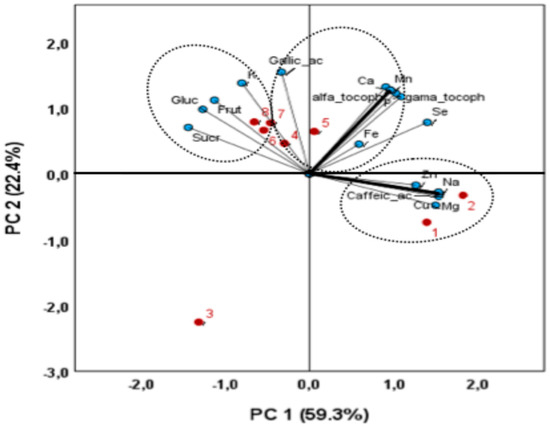
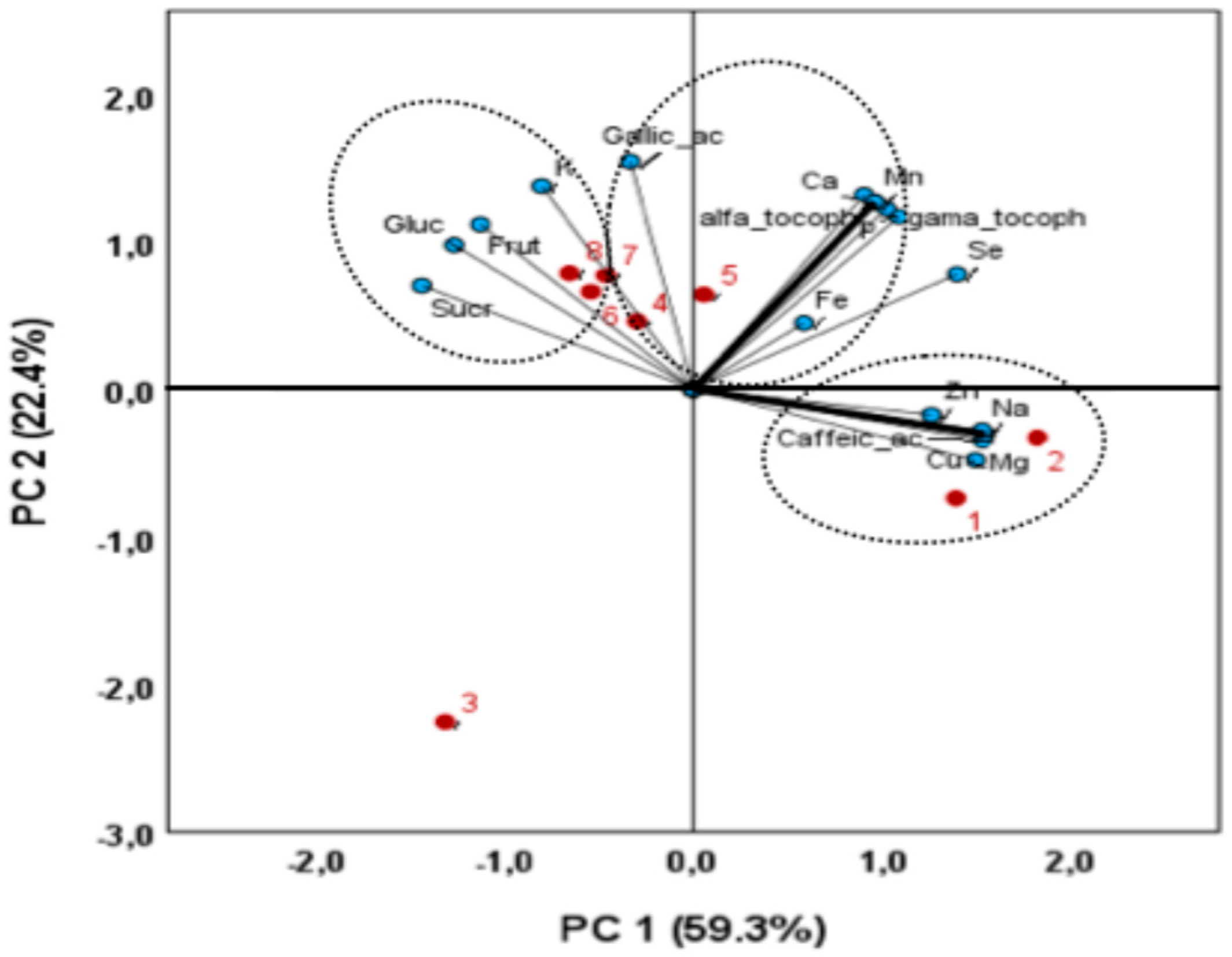
To better understand and explain the influence of adding Brazil nut flour (BNF) on the sugars composition, tocopherols, phenolic compounds, and mineral composition of gluten-free cookies, a principal component analysis (PCA) was performed. This statistical multivariate technique allows better understanding of the relationship between the variables due to the reduction in their linear combinations. The corresponding loading plots that established the relative importance of each variable are show in Figure 1.
Figure 1.
Principal Component Analysis (PCA) biplot showing the relationship between sugars, tocopherols, phenolic compounds, and mineral composition in Brazil nut kernel, Brazil nut-based products, and gluten-free cookies. Sample markers (1–8) represent: 1, cracked kernels; 2, partially defatted Brazil nut flour; 3, gluten-free cookies (control); 4, gluten-free cookies with 10% BNF; 5, gluten-free cookies with 20% BNF; 6–8, commercial gluten-free cookies. Variable vectors represent the measured biochemical parameters. The first two principal components explain 59.3% (PC1) and 22.4% (PC2) of the total variance, respectively. Variables: Frut (frutose); Gluc (glucose); Sucr (sucrose); alfa_tocoph (α-tocopherol); gama_tocoph (γ-tocopherol); Gallic_ac (gallic acid); Caffeic_ac (caffeic acid); Mg (magnesium); K (potassium); Ca (calcium); P (phosphorus); Na (sodium); Se (selenium); Zn (zinc); Fe (iron); Cu (copper); Mn (manganese). Samples: 1 (Cracked kernels); 2 (Partially defatted flour); 3 (Gluten-free cookies, Control); 4 (Gluten-free cookies, 10% BNF); 5 (Gluten-free cookies, 20% BNF); 6 (Commercial Cookies 1); 7 (Commercial Cookies 2); 8 (Commercial Cookies 3). BNF: Partially defatted Brazil nut flour.
The multivariate approach revealed global patterns and key associations among variables, explaining 81.7% of the total variance. Most of the separation occurred among the first principal component (PC1) which explained 59.3% of the variance. This factor was strongly positively correlated with tocopherols (α-tocopherol and γ-tocopherol), caffeic acid and all minerals (except potassium), and negatively correlated with sugars composition (fructose, glucose and sucrose). This distribution highlights PC1 as a biochemical axis reflecting nutritional and functional quality, in which higher micronutrient and antioxidant contents are inversely related to sugar concentration.
The second PC (PC2, 22.4% of the variance) was positively loaded with gallic acid and contributed to differentiating samples based on phenolic composition. Although gallic acid was present in lower absolute concentrations compared to minerals and tocopherols, its contribution to PC2 highlights its relevance as a discriminating bioactive compound among the different matrices.
After a cluster analysis, one group was formed by the sample 1 (Cracked kernels) and sample 2 (Partially defatted flour) assigned as a Brazil nut raw materials group used in cookies production. These samples were positioned on the positive side of PC1 axis and on the negative side of PC2 and were characterized by higher content of Zn, Na, Cu, Mg and caffeic acid.
For the cookies, they were grouped into three groups. One group consisted of all commercial cookie samples (Samples 6, 7, and 8) and was located on the positive side of the PC2 axis and on the negative side of PC1. These samples were positively related to sugar content (frut, gluc and sucr). Other group was formed by Gluten-free cookies formulated with 10% BNF (sample 4) and Gluten-free cookies formulated with 20% BNF (sample 5). These samples were positively related to gallic acid and tocopherols (α-tocopherol and γ-tocopherol). Finally, the last group was only formed by Gluten-free cookies without BNF added (sample 3) and was not correlated to any of the variables.
Gluten-free cookies formulated with 10% and 20% BNF were clearly separated from commercial gluten-free cookies in the PCA space, reflecting contrasting compositional profiles, particularly regarding sugar content and bioactive compounds. This multivariate separation corroborates the univariate results discussed previously and confirms that BNF incorporation shifts the overall chemical profile of the cookies toward a more nutritionally favorable composition.
Overall, the multivariate analysis confirms that the incorporation of Brazil nut flour not only increases individual nutrients but promotes a coordinated improvement in the biochemical profile of gluten-free cookies. By integrating lower sugar content with higher levels of antioxidants and essential minerals, BNF-enriched cookies occupy a distinct compositional space that differentiates them from both control and commercial products. These results demonstrate the effectiveness of PCA as a tool to validate the functional and nutritional impact of Brazil nut by-products in gluten-free food formulations.
The present study was designed to address this gap by examining whether partially defatted Brazil nut flour can act as a functional ingredient capable of enhancing multiple biochemical attributes in gluten-free cookies, beyond conventional formulation-based enrichment approaches. By integrating sugar composition, bioactive compounds, and mineral content in a single analytical framework, this work advances current knowledge on the functional use of Brazil nut by-products in gluten-free bakery products, while avoiding the fragmented assessments commonly reported in the literature.
4. Conclusions
This study provides an integrated biochemical evaluation of Brazil nut kernels, partially defatted Brazil nut flour, and gluten-free cookies formulated with this by-product, in comparison with commercially available gluten-free cookies. The results demonstrate that the incorporation of partially defatted Brazil nut flour leads to a consistent compositional enrichment of gluten-free cookies by enriching them with health-related compounds, including γ- and α-tocopherols, phenolic acids (gallic and caffeic acids), and essential minerals such as selenium, magnesium, phosphorus, zinc, and iron.
From a food biochemistry perspective, the enhanced levels of antioxidant compounds and micronutrients observed in the formulated cookies highlight the compositional and nutritional potential of Brazil nut by-products as ingredients for the development of nutritionally improved gluten-free foods. In addition, the lower sucrose content observed in the enriched cookies, compared to commercial gluten-free products, represents a nutritionally relevant compositional characteristic, particularly in the context of formulations aiming to reduce added sugar levels.
Beyond nutritionally relevant, the results reinforce the value of Brazil nut processing by-products as upcycled food ingredients, contributing to the sustainable use of agro-industrial residues in gluten-free baked products. It should be noted that the present findings are based on compositional and analytical data, and no biological activity or bioavailability assessments were performed. Accordingly, this work provides a compositional foundation for future studies addressing biological effects, bioaccessibility, and functional validation of Brazil nut-derived ingredients. Overall, this research advances current knowledge on the biochemical composition of Brazil nut-derived ingredients and supports their application in gluten-free baked products, contributing to recent developments and perspectives at the interface of food biochemistry, health, and sustainable product formulation.
Overall, this research advances current knowledge on the biochemical composition of Brazil nut-derived ingredients and supports their application in gluten-free baked products, contributing to recent developments and perspectives at the interface of food biochemistry, health, and sustainable product formulation. Future studies may build on these compositional findings by evaluating sensory acceptance, glycemic response, and the bioavailability of nutrients in Brazil nut flour–enriched gluten-free cookies.
Author Contributions
Conceptualization, M.M.C.F., S.D.J. and P.M.A.; methodology, E.d.S.S., C.D.L. and S.D.J.; validation, L.d.S.F., A.L.S.F., C.D.L. and S.N.e.S.; formal analysis, L.d.S.F., A.L.S.F., P.M.A. and A.M.J.; investigation, E.d.S.S., C.D.L., S.N.e.S., A.L.S.F. and D.G.S.; resources, P.M.A., M.M.C.F. and S.D.J.; data curation, L.d.S.F., E.d.S.S., C.D.L., A.L.S.F. and S.N.e.S.; writing—original draft preparation, E.d.S.S.; writing—review and editing, M.M.C.F., A.M.J., A.C.C. and P.M.A.; supervision, P.M.A., M.M.C.F. and S.D.J.; project administration, M.M.C.F.; funding acquisition, M.M.C.F., P.M.A. and S.D.J. All authors have read and agreed to the published version of the manuscript.
Funding
This research was funded by Conselho Nacional de Pesquisa e Desenvolvimento Científico e Tecnológico (CNPq, SESCOOP 2022), Fundação de Amparo à Pesquisa do Estado do Amazonas (FAPEAM) (grant number 01.02.016301.00568/2021-05) and by Coordenação de Aperfeiçoamento de Pessoal de Nível Superior (CAPES) (finance code 001 and grant number 88887.909577/2023-00-PRAPG).
Data Availability Statement
The original contributions presented in the study are included in the article, further inquiries can be directed to the corresponding authors.
Acknowledgments
The authors gratefully acknowledge Universidade do Estado do Amazonas—UEA, UFSC, CNPq, FAPEAM and CAPES for supporting this research. We also would like to thank Uniagro Indústria e Comércio de Produtos Alimentícios Ltda and Cargill Agrícola SA for the donation of Brazil nuts and vegetable fat, respectively.
Conflicts of Interest
The authors declare no conflicts of interest.
References
- Rai, S.; Wai, P.P.; Koirala, P.; Bromage, S.; Nirmal, N.P.; Pandiselvam, R.; Nor-Khaizura, M.A.R.; Mehta, N.K. Food product quality, environmental and personal characteristics affecting consumer perception toward food. Front. Sustain. Food Syst. 2023, 7, 1222760. [Google Scholar] [CrossRef] [Scilit]
- Baker, M.T.; Lu, P.; Parrella, J.A.; Leggette, H.R. Consumer acceptance toward functional foods: A scoping review. Int. J. Environ. Res. Public Health 2022, 19, 1217. [Google Scholar] [CrossRef] [Scilit]
- Paciulli, M.; Rinaldi, M.; Cavazza, A.; Ganino, T.; Rodolfi, M.; Chiancone, B.; Chiavaro, E. Effect of chestnut flour supplementation on physico-chemical properties and oxidative stability of gluten-free biscuits during storage. LWT 2018, 98, 451–457. [Google Scholar] [CrossRef] [Scilit]
- Aguiar, E.V.; Santos, F.G.; Krupa-Kozak, U.; Capriles, V.D. Nutritional facts regarding commercially available gluten-free bread worldwide: Recent advances and future challenges. Crit. Rev. Food Sci. Nutr. 2023, 63, 693–705. [Google Scholar] [CrossRef] [Scilit] [PubMed]
- Gagneten, M.; Archaina, D.A.; Salas, M.P.; Leiva, G.E.; Salvatori, D.M.; Schebor, C. Gluten-free cookies added with fibre and bioactive compounds from blackcurrant residue. Int. J. Food Sci. Technol. 2021, 56, 1734–1740. [Google Scholar] [CrossRef] [Scilit]
- Scherf, K.A. Immunoreactive cereal proteins in wheat allergy, non-celiac gluten/wheat sensitivity (NCGS) and celiac disease. Curr. Opin. Food Sci. 2019, 25, 35–41. [Google Scholar] [CrossRef] [Scilit]
- Kumar, K.A.; Sudha, M.L. Effect of fat and sugar replacement on rheological, textural and nutritional characteristics of multigrain cookies. J. Food Sci. Technol. 2021, 58, 2630–2640. [Google Scholar] [CrossRef] [Scilit]
- Pinto, D.; Moreira, M.M.; Vieira, E.F.; Švarc-Gajić, J.; Vallverdú-Queralt, A.; Brezo-Borjan, T.; Delerue-Matos, C.; Rodrigues, F. Development and characterization of functional cookies enriched with chestnut shells extract as source of bioactive phenolic compounds. Foods 2023, 12, 640. [Google Scholar] [CrossRef] [Scilit]
- Esperança, V.J.d.R.; Corrêa de Souza Coelho, C.; Tonon, R.; Torrezan, R.; Freitas-Silva, O. A review on plant-based tree nuts beverages: Technological, sensory, nutritional, health and microbiological aspects. Int. J. Food Prop. 2022, 25, 2396–2408. [Google Scholar] [CrossRef] [Scilit]
- Polmann, G.; Badia, V.; Danielski, R.; Ferreira, S.R.S.; Block, J.M. Nuts and Nut-Based Products: A Meta-Analysis from Intake Health Benefits and Functional Characteristics from Recovered Constituents. Food Rev. Int. 2022, 39, 5021–5047. [Google Scholar] [CrossRef] [Scilit]
- da Silva, A.J.B.; Sevalho, E.d.S.; Miranda, I.P.d.A. Potential of native palms from the Brazilian Amazon for bioeconomy: A network analysis of scientific and technological production. Cienc. Florest. 2021, 31, 1020–1046. [Google Scholar] [CrossRef] [Scilit]
- Lima, D.S.; Egea, M.B.; Cabassa, I.d.C.C.; de Almeida, A.B.; de Sousa, T.L.; de Lima, T.M.; Loss, R.A.; Volp, A.C.P.; Dall’Oglio, E.L.; Hernandes, T.; et al. Technological quality and sensory acceptability of nutritive bars produced with Brazil nut and baru almond coproducts. LWT 2021, 137, 110467. [Google Scholar] [CrossRef] [Scilit]
- Paiva, L.C.d.M.; Guedes, M.C.; Ferreira, D.Q.; Rodrigues, E.G.; Machado, F.P.; Fernandes, C.P. Preparation of nut-based milk alternative: Evaluation of an Amazonian nut (Bertholletia excelsa) beverage with annatto nanodispersion. Food Chem. Adv. 2023, 3, 100506. [Google Scholar] [CrossRef] [Scilit]
- Mariosa, P.H.; Pereira, H.d.S.; Kluczkovski, A.M.; Vinhote, M.L.A. Agroindustrial cooperatives in the Brazilian nuts value chain: A new extractive paradigm in the Amazon. Rev. Econ. Sociol. Rural 2024, 62, e277617. [Google Scholar] [CrossRef] [Scilit]
- Vasquez-Rojas, W.V.; Martín, D.; Miralles, B.; Recio, I.; Fornari, T.; Cano, M.P. Composition of brazil nut (Bertholletia excelsa HBK), its beverage and by-products: A healthy food and potential source of ingredients. Foods 2021, 10, 3007. [Google Scholar] [CrossRef] [Scilit] [PubMed]
- Hou, L.; Rashid, M.; Chhabra, M.; Chandrasekhar, B.; Amirthalingam, P.; Ray, S.; Li, Z. The effect of Bertholletia excelsa on body weight, cholestrol, and c-reactive protein: A systematic review and meta-analysis of randomized controlled trials. Complement. Ther. Med. 2021, 57, 102636. [Google Scholar] [CrossRef] [Scilit]
- Silveira, B.K.S.; da Silva, A.; Rocha, D.M.U.P.; Waskow, K.; Martino, H.S.D.; Bressan, J.; Hermsdorff, H.H.M. Brazil Nut (Bertholletia excelsa HBK) Consumption in Energy-Restricted Intervention Decreases Proinflammatory Markers and Intestinal Permeability of Women with Overweight/Obesity: A Controlled Trial (Brazilian Nuts Study). J. Nutr. 2024, 154, 2670–2679. [Google Scholar] [CrossRef] [Scilit]
- de Araújo, B.A.N.; Campos, L.M.T.d.S.d.; Souza, G.T.; Abreu, G.d.M.; Almeida, C.d.O.R.P.d.; Figueiredo, M.S. Brazil nut (Bertholletia excelsa HBK) and Brazil nut oil: Effects on oxidative stress and potential therapeutic health benefits from human, animal, and cell culture models. Nutr. Rev. 2025, 83, e471–e485. [Google Scholar] [CrossRef] [Scilit]
- Fabri, A.L.S.; dos Santos, L.L.; Tribuzi, G.; Barrreto, P.L.M.; Amboni, R.D.d.M.C.; Feltes, M.M.C. Brazil nut flour as a functional ingredient: Effects on texture, composition and sensory profile of reduced-sugar gluten-free cookies. J. Am. Oil Chem. Soc. 2025, 1, 12. [Google Scholar] [CrossRef] [Scilit]
- Martendal, L.F.; Silva, M.L.T.; da Silva Simão, R.; Block, J.M.; de Moraes, J.O.; Geraldo, A.P.G.; Feltes, M.M.C. Formulation of nutritious gluten-free cookies with upcycled pecan nut cake flour. JSFA Rep. 2023, 3, 129–136. [Google Scholar] [CrossRef] [Scilit]
- Polmann, G.; Badia, V.; Frena, M.; Teixeira, G.L.; Rigo, E.; Block, J.M.; Feltes, M.M.C. Enzyme-assisted aqueous extraction combined with experimental designs allow the obtaining of a high-quality and yield pecan nut oil. LWT 2019, 113, 108283. [Google Scholar] [CrossRef] [Scilit]
- AlYammahi, J.; Hai, A.; Krishnamoorthy, R.; Arumugham, T.; Hasan, S.W.; Banat, F. Ultrasound-assisted extraction of highly nutritious date sugar from date palm (Phoenix dactylifera) fruit powder: Parametric optimization and kinetic modeling. Ultrason. Sonochem. 2022, 88, 106107. [Google Scholar] [CrossRef] [Scilit]
- Ghafoor, K.; Uslu, N.; Al-Juhaimi, F.; E.Babiker, E.; Ahmed, I.A.; Yıldız, M.U.; Alswahmi, O.N.; Özcan, M.M. Tocopherol Contents of pulp oils extracted from ripe and unripe avocado fruits dried by different drying systems. J. Oleo Sci. 2021, 70, 21–30. [Google Scholar] [CrossRef] [Scilit]
- Chisté, R.C.; Costa, E.L.N.; Monteiro, S.F.; Mercadante, A.Z. Carotenoid and phenolic compound profiles of cooked pulps of orange and yellow peach palm fruits (Bactris gasipaes) from the Brazilian Amazonia. J. Food Compos. Anal. 2021, 99, 103873. [Google Scholar] [CrossRef] [Scilit]
- Wojdyło, A.; Turkiewicz, I.P.; Tkacz, K.; Nowicka, P.; Bobak, Ł. Nuts as functional foods: Variation of nutritional and phytochemical profiles and their in vitro bioactive properties. Food Chem. X 2022, 15, 100418. [Google Scholar] [CrossRef] [Scilit]
- Cavalcante, M.C.; Galetto, L.; Maués, M.M.; Filho, A.J.S.P.; Bomfim, I.G.A.; Freitas, B.M. Nectar production dynamics and daily pattern of pollinator visits in Brazil nut (Bertholletia excelsa Bonpl.) plantations in Central Amazon: Implications for fruit production. Apidologie 2018, 49, 505–516. [Google Scholar] [CrossRef] [Scilit]
- Dodevska, M.; Markovic, J.K.; Sofrenic, I.; Tesevic, V.; Jankovic, M.; Djordjevic, B.; Ivanovic, N.D. Similarities and differences in the nutritional composition of nuts and seeds in Serbia. Front. Nutr. 2022, 9, 1003125. [Google Scholar] [CrossRef] [Scilit]
- Zhang, J.; Zhou, H.; Li, H.; Ying, Z.; Liu, X. Research progress on separation of selenoproteins/Se-enriched peptides and their physiological activities. Food Funct. 2021, 12, 1390–1401. [Google Scholar] [CrossRef] [Scilit]
- Alongi, M.; Anese, M. Re-thinking functional food development through a holistic approach. J. Funct. Foods 2021, 81, 104466. [Google Scholar] [CrossRef] [Scilit]
- Aksoz, E.; Korkut, O.; Aksit, D.; Gokbulut, C. Vitamin E (α-, β + γ- and δ-tocopherol) levels in plant oils. Flavour Fragr. J. 2020, 35, 504–510. [Google Scholar] [CrossRef] [Scilit]
- Funasaki, M.; Menezes, I.S.; Barroso, H.D.S.; Zanotto, S.P.; Carioca, C.R.F. Tocopherol profile of Brazil nut oil from different geographic areas of the Amazon region. Acta Amaz. 2013, 43, 505–509. [Google Scholar] [CrossRef] [Scilit]
- Cicero, N.; Albergamo, A.; Salvo, A.; Bua, G.D.; Bartolomeo, G.; Mangano, V.; Dugo, G. Chemical characterization of a variety of cold-pressed gourmet oils available on the Brazilian market. Food Res. Int. 2018, 109, 517–525. [Google Scholar] [CrossRef] [Scilit] [PubMed]
- Zaaboul, F.; Liu, Y. Vitamin E in foodstuff: Nutritional, analytical, and food technology aspects. Compr. Rev. Food Sci. Food Saf. 2022, 21, 964–998. [Google Scholar] [CrossRef] [Scilit] [PubMed]
- Shahidi, F.; De Camargo, A.C. Tocopherols and tocotrienols in common and emerging dietary sources: Occurrence, applications, and health benefits. Int. J. Mol. Sci. 2016, 17, 1745. [Google Scholar] [CrossRef] [Scilit] [PubMed]
- Cardoso, B.R.; Duarte, G.B.S.; Reis, B.Z.; Cozzolino, S.M. Brazil nuts: Nutritional composition, health benefits and safety aspects. Food Res. Int. 2017, 100, 9–18. [Google Scholar] [CrossRef] [Scilit]
- da Costa, P.A.; Ballus, C.A.; Teixeira-Filho, J.; Godoy, H.T. Phytosterols and tocopherols content of pulps and nuts of Brazilian fruits. Food Res. Int. 2010, 43, 1603–1606. [Google Scholar] [CrossRef] [Scilit]
- John, J.A.; Shahidi, F. Phenolic compounds and antioxidant activity of Brazil nut (Bertholletia excelsa). J. Funct. Foods 2010, 2, 196–209. [Google Scholar] [CrossRef] [Scilit]
- Gomes, S.; Torres, A.G. Optimized extraction of polyphenolic antioxidant compounds from Brazil nut (Bertholletia excelsa) cake and evaluation of the polyphenol profile by HPLC. J. Sci. Food Agric. 2016, 96, 2805–2814. [Google Scholar] [CrossRef] [Scilit]
- Bai, J.; Zhang, Y.; Tang, C.; Hou, Y.; Ai, X.; Chen, X.; Meng, X. Gallic acid: Pharmacological activities and molecular mechanisms involved in inflammation-related diseases. Biomed. Pharmacother. 2021, 133, 110985. [Google Scholar] [CrossRef] [Scilit]
- Hadidi, M.; Liñán-Atero, R.; Tarahi, M.; Christodoulou, M.C.; Aghababaei, F. The potential health benefits of gallic acid: Therapeutic and food applications. Antioxidants 2024, 13, 1001. [Google Scholar] [CrossRef] [Scilit]
- Keyvani-Ghamsari, S.; Rahimi, M.; Khorsandi, K. An update on the potential mechanism of gallic acid as an antibacterial and anticancer agent. Food Sci. Nutr. 2023, 11, 5856–5872. [Google Scholar] [CrossRef] [Scilit]
- Woźniak, M.; Waśkiewicz, A.; Ratajczak, I. The content of phenolic compounds and mineral elements in edible nuts. Molecules 2022, 27, 4326. [Google Scholar] [CrossRef] [Scilit]
- Alam, M.; Ahmed, S.; Elasbali, A.M.; Adnan, M.; Alam, S.; Hassan, M.I.; Pasupuleti, V.R. Therapeutic implications of caffeic acid in cancer and neurological diseases. Front. Oncol. 2022, 12, 860508. [Google Scholar] [CrossRef] [Scilit] [PubMed]
- Ganguly, R.; Singh, S.V.; Jaiswal, K.; Kumar, R.; Pandey, A.K. Modulatory effect of caffeic acid in alleviating diabetes and associated complications. World J. Diabetes 2023, 14, 62–75. [Google Scholar] [CrossRef] [Scilit] [PubMed]
- Santos, O.V.; Corrêa, N.C.F.; Carvalho, R.N.; Costa, C.E.F.; França, L.F.F.; Lannes, S.C.S. Comparative parameters of the nutritional contribution and functional claims of Brazil nut kernels, oil and defatted cake. Food Res. Int. 2013, 51, 841–847. [Google Scholar] [CrossRef] [Scilit]
- Welna, M.; Szymczycha-Madeja, A. Improvement of a sample preparation procedure for multi-elemental determination in Brazil nuts by ICP-OES. Food Addit. Contam. Part A 2014, 31, 658–665. [Google Scholar] [CrossRef] [Scilit]
- Moreda-Piñeiro, J.; Herbello-Hermelo, P.; Domínguez-González, R.; Bermejo-Barrera, P.; Moreda-Piñeiro, A. Bioavailability assessment of essential and toxic metals in edible nuts and seeds. Food Chem. 2016, 205, 146–154. [Google Scholar] [CrossRef] [Scilit]
- de Souza, M.L.; de Menezes, H.C. Processing of Brazil nut and meal and cassava flour: Quality parameters. Food Sci. Technol. 2004, 24, 120–128. [Google Scholar] [CrossRef] [Scilit]
- Brito, R.C.M.; Junior, J.B.P.; Dantas, K.D.G.F. Quantification of inorganic constituents in Brazil nuts and their products by inductively coupled plasma optical emission spectrometry. Food Res. Int. 2019, 100, 9–18. [Google Scholar] [CrossRef] [Scilit]
- Alcântara, D.B.; Dionísio, A.P.; Artur, A.G.; Silveira, B.K.; Lopes, A.F.; Guedes, J.A.; Zocolo, G.J. Selenium in Brazil nuts: An overview of agronomical aspects, recent trends in analytical chemistry, and health outcomes. Food Chem. 2022, 372, 131207. [Google Scholar] [CrossRef] [Scilit]
- National Institutes of Health. Selenium Fact Sheet for Health Professionals. 2024. Available online: https://ods.od.nih.gov/factsheets/Selenium-HealthProfessional/ (accessed on 13 April 2025).
- Tonetto, M.L.; Teixeira, G.L.; Amboni, R.D.d.M.C.; Block, J.M.; Bornhorst, G.M.; Laurindo, J.B.; Feltes, M.M.C. Upcycling Brazil nut press cake as an ingredient of an innovative spread and evaluation of its nutritional, functional, and sensory properties. J. Sci. Food Agric. 2025, 105, 4306–4316. [Google Scholar] [CrossRef] [Scilit] [PubMed]

Disclaimer/Publisher’s Note: The statements, opinions and data contained in all publications are solely those of the individual author(s) and contributor(s) and not of MDPI and/or the editor(s). MDPI and/or the editor(s) disclaim responsibility for any injury to people or property resulting from any ideas, methods, instructions or products referred to in the content. |
© 2026 by the authors. Licensee MDPI, Basel, Switzerland. This article is an open access article distributed under the terms and conditions of the Creative Commons Attribution (CC BY) license.