


Abstract
In order to solve the problems of low calorific value and pipeline corrosion caused by high concentration of CO2 in oil-associated gas, and promote the resource utilization of associated gas, this study used validated grand canonical Monte Carlo (GCMC) and molecular dynamics (MD) simulation to investigate the adsorption characteristics of 11 different topological structures (straight-channel MFI/BEA, cage-channel LTA/FAU/CHA) and cation types (Ca2+, Na+, H+) of commercial zeolites for CO2 and alkanes (CH4, C2H6, C3H8) at 0%~90% RH. The results showed that the CO2 adsorption capacity of all zeolites decreased with increasing humidity, but straight-channel zeolites (ZSM5-300, BETA-25) had excellent moisture resistance, with only a 20.8% and 30.6% decrease in capacity at 90% RH, respectively. The performance of cage-channel zeolite drops sharply under high humidity. Topology structure and cation synergistically regulate separation efficiency, maintaining stable diffusion order in straight channels. Ca2+ enhances dry state capacity but is prone to hydrophilic failure. The adsorption heat of CO2 on straight-channel zeolite is 25–38 kJ/mol, resulting in lower regeneration energy consumption. ZSM5-300 is preferred for PSA (CH4/CO2 kinetic separation coefficient of 809.52 at 90% RH), and NaFAU is preferred for TSA (CO2 adsorption capacity of 3.6 mmol/g and selectivity of 502.6 at 90% RH). This study clarifies the core structure-activity relationship and provides key theoretical support for the decarbonization of oil-associated gas.
1. Introduction
Oil-associated gas produced during the oil field extraction process is rich in hydrocarbon components such as CH4, C2H6, and C3H8, which can be recycled and utilized, and is an important commercial energy source. However, high concentrations of CO2 not only significantly reduce the calorific value of the gas but also cause corrosion of the transportation pipeline, severely restricting the direct utilization of associated gas [1,2,3]. Therefore, achieving efficient separation of CO2 and alkanes has become a key prerequisite for the resource recovery of associated gas in oil fields, and is also a core technical problem that urgently needs to be solved in the industrial field.
Among numerous CO2 separation technologies, adsorption separation technology has become the preferred alternative to traditional technologies such as distillation and absorption due to its advantages of small equipment footprint, low operating costs, and short start-up process [4,5]. As the core functional material of this technology, zeolite is considered one of the ideal adsorbents for oil-associated gas decarbonization, thanks to its regular crystal structure, excellent thermal stability, and adjustable pore and surface properties [6,7]. Previous studies have shown that the topology, silicon–aluminum ratio, and compensatory cation type of zeolites significantly regulate their adsorption selectivity for CO2 and alkanes by affecting the number of adsorption sites, pore size, and surface interactions [8,9,10]. The wide humidity characteristics of oil field-produced gas (relative humidity 20%~90%) can lead to competition between water molecules and CO2 for adsorption active sites, further exacerbating the degradation of adsorbent performance and posing severe challenges to separation efficiency [11,12].
Although there have been many studies on CO2 adsorption by zeolites, significant shortcomings remain. Most focus on dry or single humidity conditions [13,14], lacking systematic exploration of adsorption thermodynamics and kinetics over a wide humidity range; the micro-mechanism of synergistic regulation by topology, cation type, and humidity is unclear, and there is a lack of in-depth analyses of gas diffusion under a wide humidity range [15,16]. Traditional experimental methods have long cycles and high costs, making it hard to screen adsorbents for pressure swing adsorption (PSA) or temperature swing adsorption (TSA) [17,18]. Molecular simulation can obtain key microscopic parameters via Monte Carlo (GCMC) and molecular dynamics (MD) methods, reveal adsorption and separation mechanisms, and provide scientific guidance for adsorbent screening [19,20,21,22,23,24,25,26,27,28,29].
This study used GCMC and MD simulation techniques to systematically explore the adsorption and diffusion characteristics of 11 commercial zeolites with different topological structures (straight-channel MFI, BEA; cage-channel LTA, FAU, CHA) and cation types (Ca2+, Na+, H+) for CO2 and typical alkanes (CH4, C2H6, C3H8) over a wide humidity range of 0%~90% RH. By analyzing key parameters such as the adsorption capacity and separation coefficient, the influence mechanism of topology, cation type, and humidity was clarified, and a multidimensional screening system of “thermodynamics–kinetics–moisture resistance” was established to determine the optimal adsorbents for PSA/TSA industrial processes, providing key theoretical support for the precise screening of decarbonization adsorbents for oil-associated gas.
2. Computational Methods and Details
2.1. Models
The molecular sieve configurations (BETA-25, ZSM5-300, HLTA, HFAU, HCHA, NaLTA, NaFAU, NaCHA, CaLTA, CaFAU, CaCHA) used in this study are from the database of zeolite structures [30]. For example, BETA-25 molecular sieve is a three-dimensional structure of a twelve-membered ring cross-pore system, which has twelve-membered ring straight pores (0.76 nm × 0.64 nm) in the [100] and [010] directions and twisted twelve-membered ring pores (0.55 nm × 0.55 nm) in the [001] direction. The 1 × 1 × 1 unit cell is used in the simulation, with parameters of a = b = 1.2661 nm, c = 2.6416 nm, α = β = γ = 90° The programming method following the Löwenstein avoidance rule is used to randomly replace Si atoms with Al atoms in the original zeolite. The molecular formula of the molecular sieve after equilibrium is BETA-25 (H5Al5Si59O128). The adsorbates were optimized by the DMol3 quantum mechanics module.
2.2. Adsorbate–Adsorbent Interaction Potential
In this study, the geometric structure optimization after modeling was carried out under the Universal force field, and the COMPASSII force field was selected for thermodynamic and dynamic calculations. The interactive parameters, ε and σ, can be obtained according to the mixed calculation rule of Lorentz–Botherlot, as follows:
where σi and σj are the collision diameters (Å); εi and εj are the potential energy well depths (kcal/mol); and subscripts i and j refer to the types of atoms or molecules.
2.3. Molecular Simulation Methods
2.3.1. GCMC Simulations
The GCMC method is used to study the adsorption behavior of different component molecules on the molecular sieve structure model. All GCMC simulations are conducted using the Sorption and Forcite modules in Materials Studio software (2025). The parameter settings are shown in Table 1. Set the temperature to 303 K, maintain the total pressure of 100 kPa, and set the partial pressures of water to 1.27 kPa (RH = 30%), 2.55 kPa (RH = 60%), and 3.83 kPa (RH = 90%).
Table 1.
Simulation parameters.
2.3.2. MD Simulations
The molecular dynamics (MD) method is used to simulate the diffusion process of gas in zeolite in order to obtain the diffusion coefficient of the gas in the zeolite. Before MD simulations, it is necessary to load a gas molecule into the zeolite and obtain a low-energy configuration, and then optimize its structure. In MD simulations, the NVT ensemble is used, with an initial velocity set to random. The Nose hot bath method is used, with a time step of 1 fs and a total simulation time set to 200 ps, with the first 50 ps used for the equilibrium structure and the last 150 ps used for the result calculations. The self-diffusion coefficient of a gas can be calculated from the Einstein equation:
where is the mean squared displacement (MSD) of gas molecules. When the slope of the log MSD–log t curves is 1, the simulation results converge. At this point, 1/6 of the slope of the MSD-t curve is the self-diffusion coefficient. When the gas concentration is quite low, the thermodynamic correction diffusion coefficient is approximately equal to the self-diffusion coefficient obtained from the simulation. The change in humidity is realized by the number of water molecules in the zeolite. After deriving the zeolite structure model with different numbers of water molecules, the subsequent adsorption and diffusion of gas molecules on the zeolite under different humidities conditions are carried out.
3. Results
3.1. Validation of Model and Simulation
The adsorption isotherms of pure components were computed and compared to experimental data to validate the parameters of the force field in previous work [31,32]. The calculated adsorption isotherms of CO2 and H2O were compared with the literature values [33]. The simulation results show good agreement with the experimental data. The simulation method, zeolite models, and force field parameters were well verified by the comparison results.
3.2. Adsorption Isotherms of Mixture
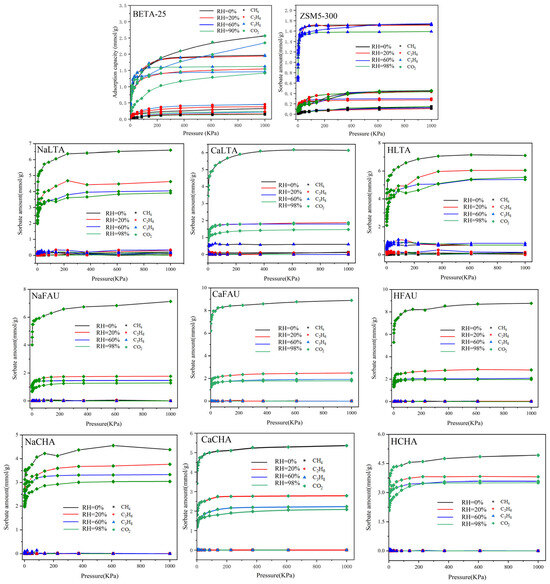
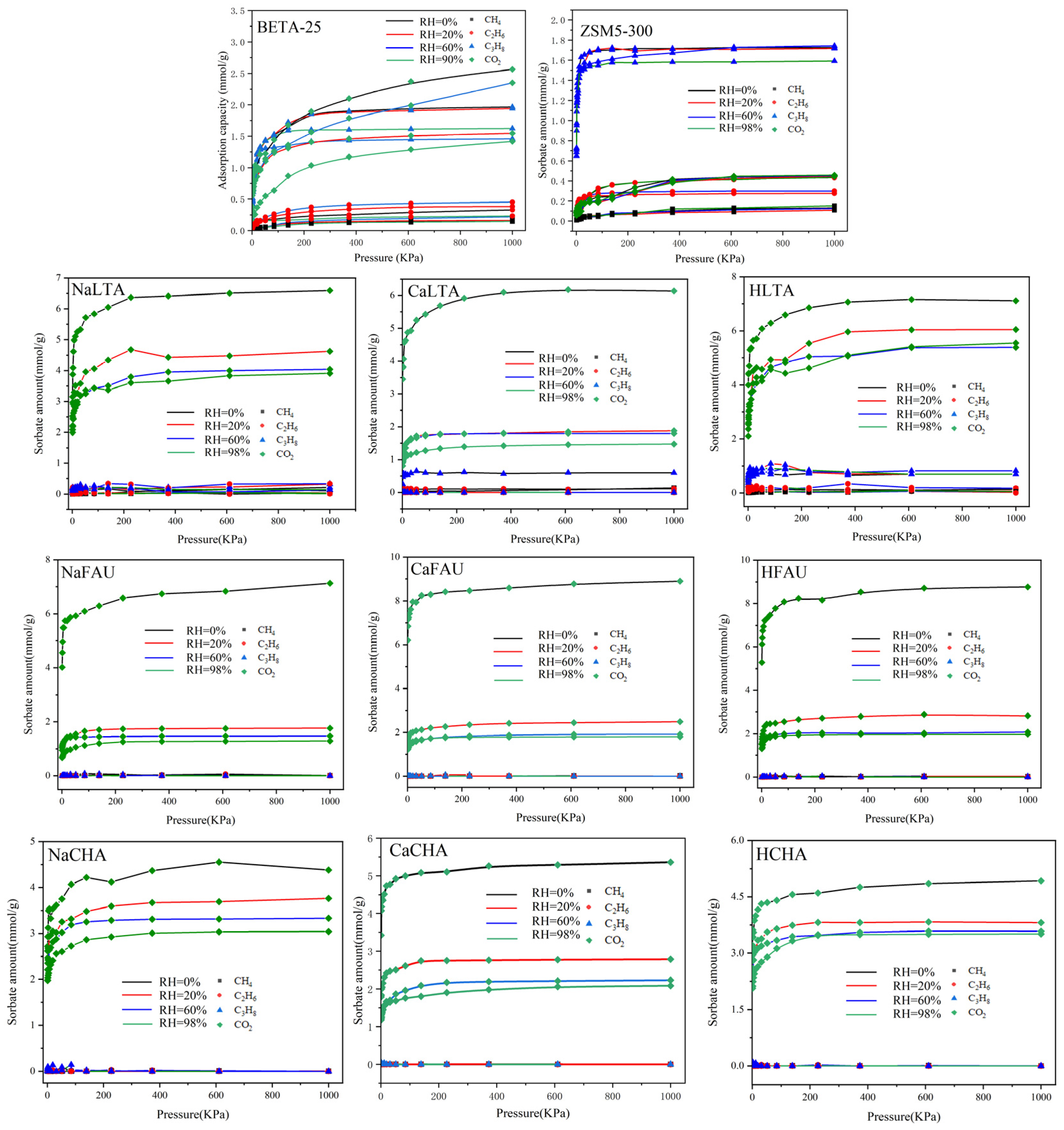
Figure 1 shows the adsorption isotherms of alkanes and CO2 in 11 zeolites under different humidities. The qCO2 and the separation coefficient of CO2/alkanes (αtheCO2/CnH2n+2 = qCO2/(qCH4+ qC2H6+ qC3H8)) at 100 kPa are shown in Table 2. The qCO2,100 kPa of 11 zeolite decreased with the increase in humidity, due to the competition between water molecules and CO2 for adsorption active sites (CO2 is a polar molecule, and the hydrogen bond/dipole interaction between water molecules and zeolite preempts the adsorption sites). Cation priority is Ca2+ > Na+ > H+ (under dry conditions); the strong electrostatic effect of Ca2+ enhances the adsorption of CO2. The adsorption capacity of cage-channel structure (LTA, FAU, CHA) is generally higher than that of straight-channel (ZSM5-300, BETA-25), because the pore volume of cage-channel structure is larger; But ZSM5-300 and BETA-25 had the smallest decrease in qCO2 (for example, in ZSM5-300, qCO2, 0% RH = 0.24 mmol/g, qCO2, 90% RH = 0.19 mmol/g, decrease of 20.8%), reflecting the advantage of moisture resistance, due to the size limit of the straight-channel structure reduced the occupied sites of water molecule.
Figure 1.
Adsorption isotherms at different humidities.
Table 2.
Separation performance of alkanes/CO2 in 11 zeolites at different humidities.
From the calculation results of adsorption heat (Figure S1), the adsorption heat of CO2 is higher than that of alkanes in all zeolites and decreases with humidity; the CO2 adsorption heat of straight-channel zeolites is 25–38 kJ/mol, resulting in lower regeneration energy consumption. Humidity has a two-way effect on separation coefficients: 9 zeolites (e.g., HLTA, HCHA) show decreased coefficients with humidity, while NaFAU and ZSM5-300 increase to 502.6 and 10.00 at 90% RH, and the selectivity of cage-channel zeolites declines sharply under high humidity.
It can also be seen from Table 2 that the selectivity for long-chain alkanes is stronger. In all zeolites, αtheCO2/C3H8 and αtheCO2/C2H6 are higher than αtheCO2/CH4 because the adsorption affinity of long-chain alkanes is weaker than that of CH4. CH4 is the main combustible component in the produced gas of the oil field, and the αtheCO2/CH4 of ZSM5-300 and BETA-25 is still ≥10 under high humidity, meeting the industrial demand of preferentially capturing CO2 and retaining CH4. CHA zeolite has the best selectivity (drying conditions): αtheCO2/CnH2n+2 of HCHA, NaCHA, and CaCHA are all >1000 (0% RH), and the confinement effect of cage-channel structure enhanced the selectivity of CO2, but the moisture resistance is poor (in NaCHA at 90% RH, αtheCO2/CnH2n+2 = 19.0), decreasing by 99.6%. The direct channel zeolite has the best moisture resistance selectivity: αtheCO2/CnH2n+2 of ZSM5-300 and BETA-25 at 90% RH are 10.00 and 2.70, respectively. Although the value is lower than that of the CHA type, it has strong stability. H+ zeolites have the best selective moisture resistance, and Ca2+ zeolites are only suitable in a dry environment.
3.3. Self-Diffusion from Mixture
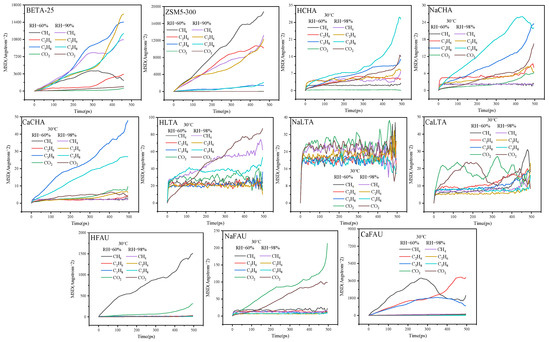
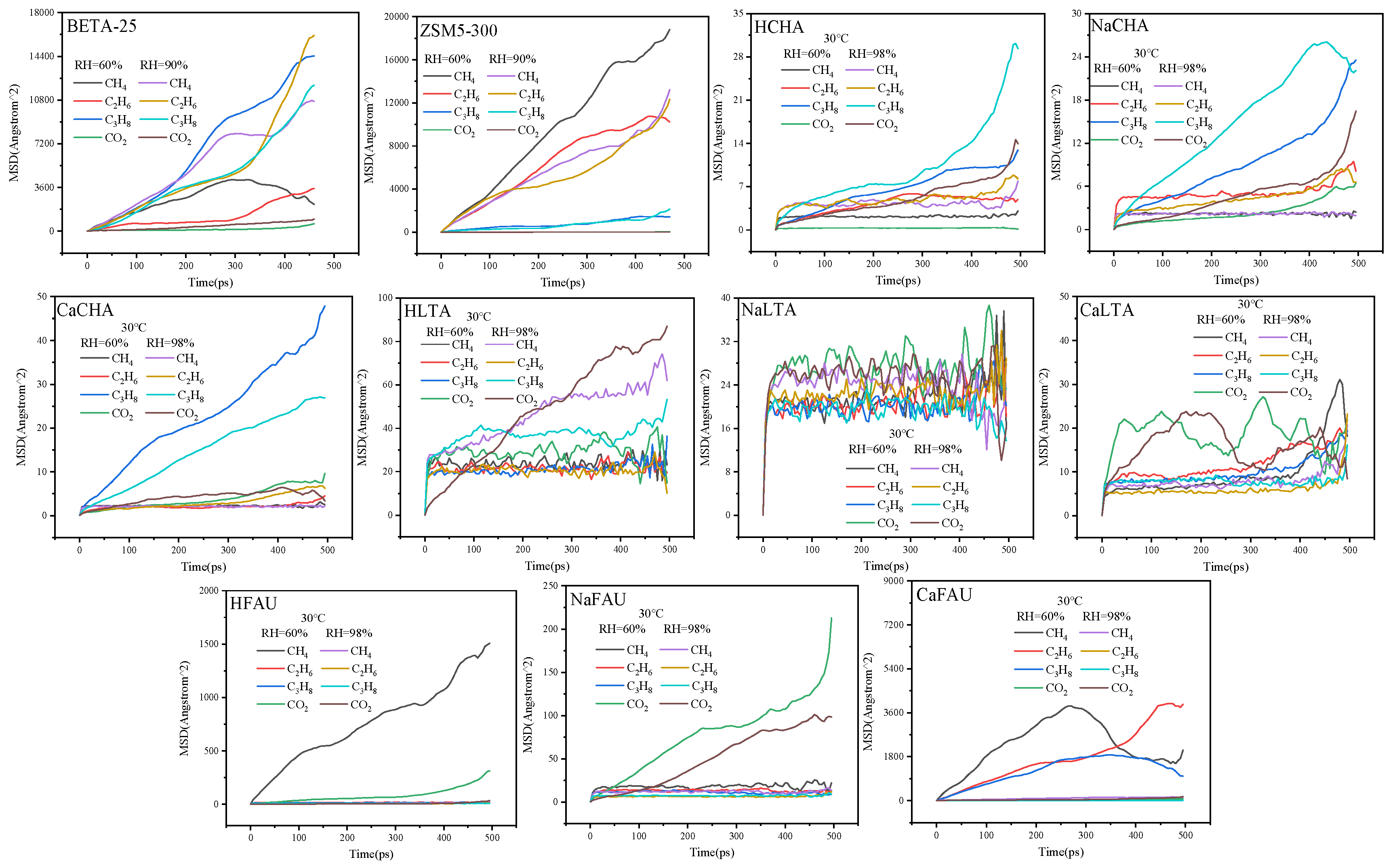
Based on the thermodynamic study, the diffusion of mixed components in zeolite in a wet atmosphere was calculated. The root mean square displacement versus time curves of high concentration alkanes and CO2 on 11 molecular sieves under different humidities are shown in Figure 2 (Figure S2). The diffusion coefficient (Ds) results calculated by the Einstein equation and kinetic separation coefficient αkin (DsCnH2n+2/DsCO2) are shown in Table 3.
Figure 2.
Diffusion curves of 11 zeolites at different humidities.
Table 3.
Diffusion and kinetic separation coefficient of 11 zeolites at different humidities.
The stability of most zeolites is poor, except ZSM5-300 and BETA-25. The kinetic separation coefficients of the other 9 zeolites fluctuate significantly with the increase in humidity. For example, the separation coefficient of CaCHA at 0% RH is 11.47, and it decreases to 0.0217 at 90% RH, with a decrease of 99.8%. The kinetic separation coefficient was 62.58% at 0% RH and 11.60% at 90% RH, a decrease of 81.5%.
The straight-channel structure has significant advantages: the straight-channel topology of ZSM5-300 (MFI type) and BETA-25 (BEA type) can maintain the size screening effect of gas diffusion (CH4 > C2H6 > C3H8 > CO2), which is not damaged even under high humidity. However, cage-channel structures (LTA, FAU, CHA) are prone to being occupied by water molecules, resulting in disordered diffusion order (for example, the diffusion coefficient of HLTA at 90% RH is higher than that of C3H8).
The type of cation determines moisture resistance. Ca-zeolite: The adsorption capacity is high under dry conditions (0% RH), but the kinetic separation performance is very sensitive to humidity. Na-zeolite: NaFAU is the only zeolite whose separation coefficient increases with the increase in humidity, reflecting the weak interaction between Na+ and water molecules. H-zeolite: The separation coefficient of HLTA, HFAU, and other dry conditions is medium, and generally decreases under high humidity.
From the perspective of industrial application requirements, ZSM5-300 is preferred. The dynamic separation performance is better than that of other zeolites under medium and high humidity (20–90% RH). At 90% RH, αkinCH4/CO2 (809.52) and αkinC2H6/CO2 (1738.09) are the highest values, and are suitable for gas production scenarios in wet oil fields. In addition, BETA-25 zeolite is used as an alternative. The performance is balanced in the full humidity range, without extreme fluctuations. αkinCH4/CO2 under dry (0% RH) and high humidity (90% RH) conditions is 33.61 and 19.09, respectively, which is suitable for the working conditions with large humidity fluctuations. Ca-zeolite should be avoided.
3.4. Evaluation of Zeolite in Industrial Application
As the core functional material of pressure swing adsorption (PSA) and temperature swing adsorption (TSA), the performance of adsorbent directly determines the treatment efficiency, energy consumption cost, and operation stability of industrial plants. Under the complex working conditions of high humidity (20–90% RH) and multi-component (CO2+CH4+C2H6+C3H8) of oil field-produced gas, combined with the industrial design objectives and operating characteristics of PSA/TSA, 11 commercial zeolite adsorbents were systematically screened and sorted based on the adsorption thermodynamics (capacity, selectivity, adsorption heat), kinetics (diffusion coefficient, kinetic separation coefficient) and moisture resistance data obtained from the previous molecular simulation, and the industrial adaptation boundary and application priority of each adsorbent were determined.
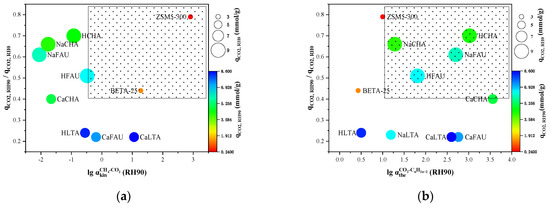
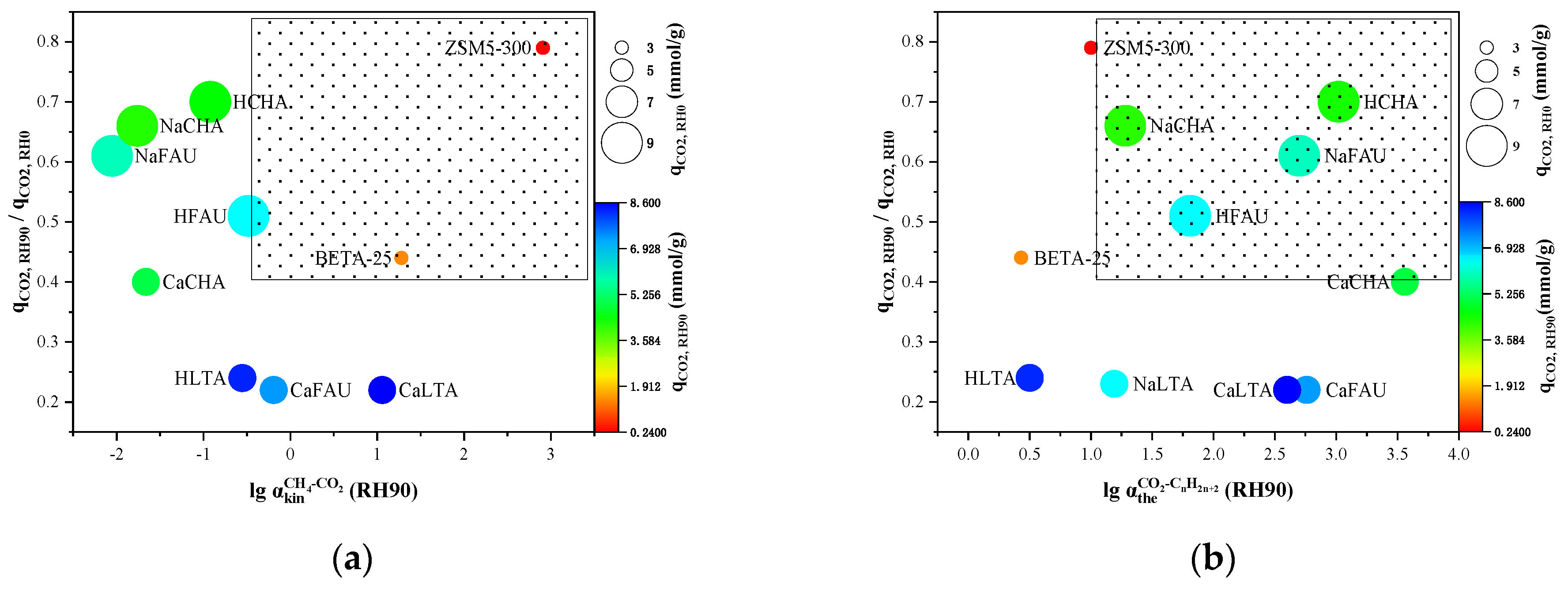
The PSA process takes a “rapid adsorption–desorption cycle” as its core advantage, with core requirements for adsorbents including dynamic performance, cycle stability, and low regeneration energy consumption. Figure 3a shows that adsorbents with moisture resistance (defined as the ratio of carbon dioxide adsorption capacity under high humidity and dry conditions, qCO2, 90%RH/qCO2, 0%RH) > 0.4 and kinetic separation coefficient > 0.32 (lgαkin = −0.5) are ZSM5-300 and BETA-25. ZSM5-300 becomes the preferred PSA adsorbent due to excellent kinetic separation performance and high moisture resistance, while BETA-25 is an alternative with balanced performance; Na+ and H+ zeolites have insufficient kinetics, and Ca2+ zeolites have poor moisture resistance, making them unsuitable for PSA processes.
Figure 3.
Comprehensive comparison of multidimensional performance ((a) for kinetics, (b) for thermodynamics).
The core of the TSA process is “high-capacity adsorption and mild regeneration”, with requirements for adsorbents focusing on adsorption capacity, thermal stability, and regeneration economy. Figure 3b shows that adsorbents with moisture resistance >0.4 and thermodynamic equilibrium separation coefficient > 10 (lgαthe = 1) are NaCHA, NaFAU, HCHA, and HFAU. NaFAU becomes the preferred TSA adsorbent due to its CO2 adsorption capacity of 3.6 mmol/g (the highest among 11 zeolites) and selectivity of 502.6 at 90% RH, with HFAU, NaCHA, and HCHA as alternatives.
4. Conclusions
The CO2 adsorption capacity of all zeolites decreases with humidity, but straight-channel zeolites (ZSM5-300, BETA-25) have excellent moisture resistance, with a capacity decrease of only 20.8% and 30.6% at 90% RH. The performance of cage-channel zeolite drops sharply under high humidity. Topology structure and cation synergistically regulate the separation efficiency; the straight-channel structure maintains stable diffusion order, Ca2+ enhances the adsorption capacity of dry CO2, but hydrophilicity leads to a decrease in separation efficiency, H-zeolite maintains balanced moisture resistance selectivity. The adsorption heat of CO2 on straight-channel zeolite is 25–38 kJ/mol, resulting in lower regeneration energy consumption. The selection criteria for adsorbents in industrial PSA/TSA processes have been clarified: based on the PSA process requirement, ZSM5-300 is the preferred adsorbent for the PSA process; BETA-25 can be used as an alternative due to its balanced performance; NaFAU is the optimal choice for the TSA process; and HFAU and NaCHA can be used as supplementary alternatives.
Supplementary Materials
The following supporting information can be downloaded at https://www.mdpi.com/article/10.3390/pr14030542/s1: Figure S1: Variations in adsorption heat of 4 components at different humidities for 11 zeolites with adsorption capacity; Figure S2: Diffusion curves of alkane and CO2 at different humidities for 11 zeolites; Figure S3: Comparison of isotherms between those of the literature.
Author Contributions
Methodology, X.J.; Investigation, Z.W.; Writing—review & editing, S.W.; Resources, Y.Y.; software, Y.C.; validation, Y.L.; Visualization, Z.L.; Writing—original draft preparation, C.Z. All authors have read and agreed to the published version of the manuscript.
Funding
This work was supported by the Huaneng Group Technology Project: Development of Rotary Low-temperature Adsorbent Materials and Prototype Fabrication for Carbon Capture (HNKJ25-H50), National Key Research and Development Program of China (2024YFE0210200), the National Natural Science Foundation of China (52370107, 52570116), the Beijing Nova Program (20240484685), the Beijing Natural Science Foundation (No. L233015), and Young Scientific and Technological Top-notch Talents Project of the “Tianshan Elite” Training Program in Xinjiang Uygur Autonomous Region—Research on Key Technologies for Capture of Low-concentration Complex Carbon Sources in Oilfields (Project No.: 2022TSYCCY0005).
Data Availability Statement
Not applicable.
Conflicts of Interest
Author Xu Jiang was employed by the company Xinjiang Petroleum Engineering Co., Ltd. Author Zhiqiang Wang was employed by the company China Nuclear Power Engineering Co., Ltd., Zhengzhou Branch. The remaining authors declare that the research was conducted in the absence of any commercial or financial relationships that could be construed as a potential conflict of interest.
References
- Cui, W.; Hu, T.; Bu, X. Metal-organic framework materials for the separation and purification of light hydrocarbons. Adv. Mater. 2020, 32, 1806445. [Google Scholar] [CrossRef] [Scilit]
- Satyapal, S.; Filburn, T.; Trela, J. Performance and properties of a solid amine sorbent for carbon dioxide removal in space life support applications. Energy Fuel 2001, 15, 250–255. [Google Scholar] [CrossRef] [Scilit]
- Kapdi, S.S.; Vijay, V.K.; Rajesh, S.K.; Prasad, R. Biogas scrubbing, compression and storage: Perspective and prospectus in Indian context. Renew. Energy 2001, 30, 1195–1202. [Google Scholar] [CrossRef] [Scilit]
- Chue, K.T.; Kim, J.N.; Yoo, Y.J.; Cho, S.H.; Yang, R.T. Comparison of activated carbon and zeolite 13X for CO2 recovery from flue gas by pressure swing adsorption. Ind. Eng. Chem. Res. 1995, 34, 591–598. [Google Scholar] [CrossRef] [Scilit]
- Mcewen, J.; Hayman, J.D.; Yazaydin, A.O. A comparative study of CO2, CH4 and N2 adsorption in ZIF-8, Zeolite-13X and BPL activated carbon. Chem. Phys. 2013, 412, 72–76. [Google Scholar] [CrossRef] [Scilit]
- Akhtar, F.; Liu, Q.L.; Hedin, N.; Bergström, L. Strong and binder free structured zeolite sorbents with very high CO2-over-N2. Energy Environ. Sci. 2012, 5, 7664–7673. [Google Scholar] [CrossRef] [Scilit]
- Raksajati, A.; Ho, M.T.; Wiley, D.E. Reducing the Cost of CO2 Capture from Flue Gases Using Phase-change Solvent Absorption. Energy Procedia 2014, 63, 2280–2288. [Google Scholar] [CrossRef] [Scilit]
- Liu, Z.; Li, X.; Shi, D.; Guo, F.Z.; Zhao, G.; Hei, Y.; Xiao, Y.; Zhang, X. Superior Selective CO2 Adsorption and Separation over N2 and CH4 of Porous Carbon Nitride Nanosheets: Insights from GCMC and DFT Simulations. Langmuir 2023, 39, 6613–6622. [Google Scholar] [CrossRef] [Scilit] [PubMed]
- Zhao, Y.L.; Feng, Y.H.; Zhang, X.X. Molecular simulation of CO2/CH4 self- and transport diffusion coefficients in coal. Fuel 2014, 165, 19–27. [Google Scholar] [CrossRef] [Scilit]
- Wang, Y.; Levan, M.D. Adsorption Equilibrium of Carbon Dioxide and Water Vapor on Zeolites 5A and 13X and Silica Gel: Pure Components. J. Chem. Eng. Data 2009, 54, 2839–2844. [Google Scholar] [CrossRef] [Scilit]
- Hutson, N.D.; Zajic, S.C.; Yang, R.T. Influence of Residual Water on the Adsorption of Atmospheric Gases in Li−X Zeolite: Experiment and Simulation. Ind. Eng. Chem. Res. 2000, 39, 1775–1780. [Google Scholar] [CrossRef] [Scilit]
- Rege, S.U.; Yang, R.T.; Qian, K.Y.; Buzanowski, M.A. Air pre-purification by Pressure Swing Adsorption Using Single/Layered Beds. Chem. Eng. Sci. 2001, 56, 2745–2760. [Google Scholar] [CrossRef] [Scilit]
- Bai, J.L.; Huang, J.M.; Yu, Q.Y.; Demir, M.; Kilic, M.; Altay, B.N.; Hu, X.; Wang, L.L. N-doped porous carbon derived from macadamia nut shell for CO2 adsorption. Fuel Process. Technol. 2023, 249, 107854. [Google Scholar] [CrossRef] [Scilit]
- Bai, J.L.; Huang, J.M.; Jiang, Q.; Jiang, W.H.; Demir, M.; Kilic, M.; Altay, B.N.; Wang, L.L.; Hu, X. Synthesis and characterization of polyphenylene sulfide resin-derived S-doped porous carbons for efficient CO2 capture. Colloids Surf. A Physicochem. Eng. Asp. 2023, 674, 131916. [Google Scholar] [CrossRef] [Scilit]
- Harlick, P.; Tezel, F.H. An experimental adsorbent screening study for CO2 removal from N2. Microporous Mesoporous Mater. 2004, 76, 71–79. [Google Scholar] [CrossRef] [Scilit]
- Li, Y.; Yi, H.; Tang, X.; Li, F.; Yuan, Q. Adsorption separation of CO2/CH4 gas mixture on the commercial zeolites at atmospheric pressure. Chem. Eng. J. 2013, 229, 50–56. [Google Scholar] [CrossRef] [Scilit]
- Fu, D.L.; Davis, M.E. Carbon dioxide capture with zeotype materials. Chem. Soc. Rev. 2022, 51, 9340–9370. [Google Scholar] [CrossRef] [Scilit]
- Li, Z.Y.; Liu, Y.S.; Zhang, C.Z.; Yang, X.; Ren, J.L.; Jiang, L.J. Methane recovery from coal bed gas using modified activated carbons: A combined method for assessing the role of functional groups. Energy Fuels 2015, 29, 6858–6865. [Google Scholar] [CrossRef] [Scilit]
- Sun, J.; Chen, C.; Zhang, Y.; Li, W.; Song, Y. Competitive adsorption characteristics based on partial pressure and adsorption mechanism of CO2/CH4 mixture in shale pores. Chem. Eng. J. 2022, 430, 133172. [Google Scholar] [CrossRef] [Scilit]
- Dziejarski, B.; Serafin, J.; Hernández, D.F.; Naumovska, E.; Sreńscek-Nazzal, J.; Klomkliang, N.; Tam, E.; Krzyżyńska, R.; Andersson, K.; Knutsson, P. Tailoring highly surface and microporous activated carbons (Acs) from biomass via KOH, K2C2O4 and KOH/K2C2O4 activation for efficient CO2 capture and CO2/N2 selectivity: Characterization, experimental and molecular simulation insights. Chem. Eng. J. 2025, 524, 169677. [Google Scholar] [CrossRef] [Scilit]
- Zhang, Y.; Li, D.; Xin, G.; Ren, S. A review of molecular models for gas adsorption in shale nanopores and experimental characterization of shale properties. ACS Omega 2023, 8, 13519–13538. [Google Scholar] [CrossRef] [Scilit]
- Golchoobi, A.; Pahlavanzadeh, H. Molecular simulation, experiments and modelling of single adsorption capacity of 4A molecular sieve for CO2–CH4 separation. Sep. Sci. Technol. 2016, 51, 2318–2325. [Google Scholar] [CrossRef] [Scilit]
- Prats, H.; Bahamon, D.; Alonso, G.; Giménez, X.; Gamallo, P.; Sayós, R. Optimal Faujasite structures for post combustion CO2 capture and separation in different wing adsorption processes. J. CO2 Util. 2017, 19, 100–111. [Google Scholar] [CrossRef] [Scilit]
- Flanigen, E.M. Zeolite and molecular sieves. An historical perspective. In Studies in Surface Science & Catalysis; Elsevier: Amsterdam, The Netherlands, 2001; Volume 137, pp. 11–35. [Google Scholar]
- Fu, Y.G.; Liu, Y.S.; Li, Z.Y.; Zhang, Q.L.; Yang, R.T. Insights into adsorption separation of N2/O2 mixture on FAU zeolites under plateau special conditions: A molecular simulation study. Sep. Purif. Technol. 2020, 251, 117405. [Google Scholar] [CrossRef] [Scilit]
- Deng, H.; Yi, H.H.; Tang, X.L.; Yu, Q.F.; Ning, P.; Yong, L.P. Adsorption equilibrium for sulfur dioxide, nitric oxide, carbon dioxide, nitrogen on 13X and 5A zeolites. Chem. Eng. J. 2012, 188, 77–85. [Google Scholar] [CrossRef] [Scilit]
- Shi, K.; Chen, J.; Pang, X.; Jiang, F.; Hui, S.; Pang, H.; Ma, K.; Cong, Q. Effect of wettability of shale on CO2 sequestration with enhanced gas recovery in shale reservoir: Implications from molecular dynamics simulation. J. Nat. Gas Sci. Eng. 2022, 107, 104798. [Google Scholar] [CrossRef] [Scilit]
- Al-Naddaf, Q.; Rownaghi, A.A.; Rezaei, F. Multicomponent adsorptive separation of CO2, CO, CH4, N2, and H2 over core-shell zeolite-5A-MOF-74 composite adsorbents. Chem. Eng. J. 2019, 384, 123251. [Google Scholar] [CrossRef] [Scilit]
- Yang, R.T. Adsorbents Fundamentals and Applications; John Wiley & Sons: Hoboken, NJ, USA, 2003. [Google Scholar]
- Database of Zeolite Structures. Available online: https://www.iza-structure.org/databases (accessed on 20 December 2025).
- Wang, S.; Jiang, X.; Wang, Y.; Liu, J.; Qiu, X.; Liu, L.; Gao, S.; Yang, X.; Ma, J.; Zhang, C. Molecular Simulation of Adsorption of CO2 from a Combustion Exhaust Mixture of Zeolites with Different Topological Structures. Processes 2024, 12, 2730. [Google Scholar] [CrossRef] [Scilit]
- Wang, Y.; Jiang, X.; Yang, X.; Wang, S.; Qiu, X.; Liu, L.; Gao, S.; Li, Z.; Zhang, C. Molecular Simulation of Adsorption Separation of CO2 from Combustion Exhaust Mixture of Commercial Zeolites. Processes 2023, 11, 2987. [Google Scholar] [CrossRef] [Scilit]
- Zhang, J.; Burke, N.; Zhang, S.; Liu, K.; Pervukhina, M. Thermodynamic analysis of molecular simulations of CO2 and CH4 adsorption in FAU zeolites. Chem. Eng. J. 2014, 113, 54–61. [Google Scholar] [CrossRef] [Scilit]

Disclaimer/Publisher’s Note: The statements, opinions and data contained in all publications are solely those of the individual author(s) and contributor(s) and not of MDPI and/or the editor(s). MDPI and/or the editor(s) disclaim responsibility for any injury to people or property resulting from any ideas, methods, instructions or products referred to in the content. |
© 2026 by the authors. Licensee MDPI, Basel, Switzerland. This article is an open access article distributed under the terms and conditions of the Creative Commons Attribution (CC BY) license.