


Abstract
The safe pretreatment of phosphogypsum involves a multivariable control process with strong coupling and nonlinear behavior, which limits the effectiveness of conventional control methods. To address this issue, an intelligent control strategy combining fuzzy control with a deep deterministic policy gradient (DDPG) algorithm is proposed. A multi-input multi-output control model is established using pH, moisture content, and flow rate as key variables, and a DDPG agent is employed to adaptively adjust the gain of the fuzzy controller. Simulation results demonstrate that the proposed method achieves faster response and improved stability, yielding a pH settling time of approximately 2.5 s and a steady-state moisture-content error on the order of 0.02 under representative operating conditions.
1. Introduction
With the rapid expansion of China’s phosphorus chemical industry, phosphogypsum—an inevitable bulk by-product of wet-process phosphoric acid production—has become a major source of solid waste. Owing to the presence of residual acidic substances, heavy metals, and other harmful impurities, long-term accumulation or improper disposal of phosphogypsum can severely contaminate soil and water bodies, hinder the development of green manufacturing, and pose persistent risks to ecological security and public health. At present, both the safe pretreatment [1,2,3] and resource utilization of phosphogypsum face several longstanding technical bottlenecks. These include low washing efficiency, incomplete impurity removal, coarse flotation control, large control fluctuations, inefficient operation, and insufficient automation and intelligent regulation. These limitations constitute major constraints that impede the high-value and environmentally sustainable utilization of phosphogypsum.
Driven by the increasing trend toward industrial intelligence, extensive research efforts have recently focused on developing automation and optimization strategies for phosphogypsum treatment. Due to the multivariable interactions, dynamic nonlinearities, and strong cross-coupling inherent in the safe pretreatment process, achieving efficient, robust, and coordinated control has emerged as a critical scientific challenge. The proportional–integral–derivative (PID) controller [4] is among the earliest control strategies applied in phosphogypsum processing. For example, Yang Minmin and colleagues [5,6,7] deployed PID control in an intelligent system for producing wet-process α-hemihydrate gypsum, achieving satisfactory regulation of temperature, pressure, and other key process parameters. Although PID control is simple, economical, and effective for single-variable regulation, conventional PID architectures design separate controllers for each variable and essentially neglect inter-variable coupling. As a result, their robustness deteriorates easily, and instability or significant time delays may occur, especially under frequently varying operating conditions.
To address these issues, researchers have introduced fuzzy control techniques, which forgo explicit mathematical modeling and instead employ fuzzy rule bases to adaptively handle nonlinear processes. Fuzzy control provides high robustness and strong tolerance to uncertainties, making it suitable for scenarios characterized by significant feedstock fluctuations and limited model accuracy. Some studies have extended fuzzy control to multivariable systems by coordinating multiple fuzzy controllers. However, because fuzzy rules are mostly derived from expert knowledge, the coordination among controllers can become insufficient under strong coupling conditions, resulting in performance degradation or oscillatory disturbances. Building on these efforts, Xu Wenmin [8] proposed a fuzzy-PID hybrid control strategy [9,10] that integrates the nonlinear processing capability of fuzzy logic with the rapid dynamic response of PID control. This hybrid approach improves transient response and steady-state accuracy for certain coupled variables and exhibits faster reaction than standalone fuzzy controllers. Nevertheless, its inherent structure still relies on parallel or cascaded single-variable loops and lacks global optimization capability. Moreover, its fuzzy rules and PID parameters typically require manual tuning, limiting adaptability under varying coupling intensities or external disturbances.
In response to the limitations of conventional control strategies, recent advances in intelligent control have increasingly adopted machine learning techniques [11] to enhance industrial process regulation. Among them, reinforcement learning (RL) [12,13,14] has emerged as a powerful paradigm for solving complex control problems. RL agents autonomously learn optimal control policies through iterative interactions with the environment, thereby eliminating the need for accurate physical models. Their strong self-learning, adaptive, and decision-making capabilities make RL particularly suitable for processes exhibiting pronounced nonlinearity, uncertainty, and time-varying behavior. Phosphogypsum treatment often requires fine and continuous manipulation of variables such as valve openings—an inherently continuous control task. The deep deterministic policy gradient (DDPG) algorithm [15,16], a widely used RL method designed specifically for continuous action spaces, can generate continuous control outputs directly, making it highly advantageous for industrial process applications.
Motivated by these developments, this study proposes an intelligent hybrid control framework—F-DDPG—that integrates fuzzy control with the DDPG algorithm and applies it to key stages of phosphogypsum treatment. It is worth noting that more recent deep reinforcement learning algorithms for continuous control, such as Twin Delayed Deep Deterministic Policy Gradient (TD3) and Soft Actor–Critic (SAC), have been reported to improve training stability in some applications. However, DDPG remains a widely adopted baseline in industrial process control due to its relatively simple actor–critic structure, direct handling of continuous action spaces, and ease of integration with existing control frameworks. In this study, DDPG is selected as a representative continuous-control reinforcement learning algorithm to investigate its integration with fuzzy control, rather than to benchmark the absolute performance of different reinforcement learning methods. In this method, deviations and rates of change of key process variables (e.g., pH, moisture content, and flow rate) serve as inputs, while a DDPG agent is trained to autonomously adjust the weighting factors of the fuzzy controller outputs. This enables dynamic adaptation to nonlinear disturbances and coupling effects under complex and variable operating conditions. A comprehensive industrial-scale simulation environment was constructed in Simulink (version R2021b), and training and evaluation were conducted using the MATLAB (R2021b) Deep Learning Toolbox. The results demonstrate that F-DDPG significantly enhances control accuracy, reduces control-signal fluctuations, shortens response time, and improves system stability. This research provides a systematic and intelligent control solution for phosphogypsum treatment and offers a technical reference for improving the efficiency and stability of industrial pretreatment processes.
2. F-DDPG Control Model Design
2.1. Model Development
With the continuous advancement of intelligent manufacturing technologies, phosphogypsum—one of the typical bulk by-products generated during phosphate fertilizer production—has received increasing attention in terms of its resource utilization and environmentally sustainable treatment. In the pretreatment stage, the precision, stability, and responsiveness of process parameter control directly influence product quality, energy consumption, and overall environmental performance. To meet these industrial requirements, this study develops an F-DDPG control methodology tailored to the phosphogypsum pretreatment process and establishes a corresponding F-DDPG control model. This model provides the theoretical foundation for subsequent simulation experiments and intelligent control strategy design.
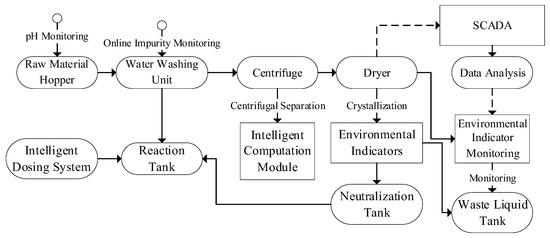
As illustrated in Figure 1, the phosphogypsum pretreatment system consists of a multi-stage physical and chemical processing chain extending from raw-material feeding to final drying. In this work, the considered pretreatment process represents a typical wet pretreatment stage commonly adopted for phosphogypsum prior to dewatering and drying, including washing and chemical neutralization operations. The study focuses on a representative multivariable control problem rather than a specific industrial installation.
Figure 1.
Intelligent system flow diagram of the inherently safe pretreatment equipment for phosphogypsum.
Within this context, pH, moisture content, and slurry flow rate are selected as the primary controlled variables, as they directly influence neutralization effectiveness, washing and dewatering performance, and overall process stability. These variables are strongly coupled in practice, and independent single-loop control is often insufficient under varying operating conditions. Therefore, simultaneous multivariable control of pH, moisture content, and flow rate provides a practically relevant benchmark for evaluating advanced intelligent control strategies in phosphogypsum pretreatment processes. The system comprises a raw-material silo, an intelligent dosing module, a washing unit, a centrifuge, a dryer, and a supervisory monitoring and data acquisition control system (SCADA). The overall process exhibits pronounced nonlinear behavior, strong coupling among key variables, and frequent parameter disturbances. These characteristics render the achievement of stable, accurate, and robust control with smooth actuation particularly challenging, thereby highlighting the need for advanced intelligent control approaches such as the F-DDPG method proposed in this work.
Within the above system architecture, pH, moisture content, and system flow rate constitute the key control parameters governing stable and efficient operation. These variables are affected not only by fluctuations in raw-material properties, dosing accuracy, and slurry concentration, but also by their inherent interdependencies. Consequently, traditional PID control or standalone fuzzy control approaches often exhibit slow response, limited adaptability, and insufficient precision when confronted with multivariable coupling and highly dynamic operating conditions.
In the method proposed in this study, the fuzzy controller first generates the baseline valve-control signals using the deviations in pH, moisture content, and flow rate as inputs. Concurrently, the DDPG agent learns from the temporal evolution of these deviations, as well as historical control feedback, to dynamically adjust the weighting coefficient (k-value) applied to the fuzzy controller outputs. Through this mechanism, the F-DDPG framework achieves intelligent, adaptive, and fine-grained regulation of the input variables, enabling improved handling of nonlinear disturbances and process coupling.
Following the modeling approach described above, this study reconstructs the dynamic control behaviors of the key variables in the phosphogypsum harmless-treatment system within the MATLAB/Simulink environment. The resulting model not only maintains strong consistency with real industrial operating conditions but also provides a reliable platform for algorithm evaluation, thereby laying a solid foundation for subsequent controller design and comparative simulation analyses.
The phosphogypsum pretreatment process is modeled as a nonlinear coupled dynamic system with three controlled variables: pH (), moisture content (), and slurry flow rate (). For clarity and consistency with the rest of the paper, , , and denote the measured values of pH, moisture content, and flow rate, respectively, and , , and denote the normalized valve-opening commands of the acid–alkali valve, water-addition valve, and flow-control valve. The manipulated variables are the acid–alkali valve opening (), water-addition valve opening (), and flow-control valve opening ().
The discrete-time dynamic model of the process is expressed as:
where = 0.01 s is the sampling time, and represent first-order process dynamics, denote cross-coupling coefficients between different control channels, and represent bounded disturbances and modeling uncertainties.
The numerical parameters used in simulations are summarized in Table 1.
Table 1.
Plant model parameters and disturbance settings used in simulations.
The coupled discrete-time model in Equations (1)–(3) is used as the controlled plant for all comparative simulations. Since the study is control-oriented and aims to capture representative coupling and nonlinear characteristics of wet phosphogypsum pretreatment processes, the plant coefficients are reported in a normalized form. The same normalized plant model and disturbance/noise configuration are used for all controllers to ensure a fair and reproducible comparison. Here, denotes a bounded additive disturbance applied at each sampling step in the discrete-time state update, while measurement noise is added to the measured states prior to error computation.
All control inputs are subject to physical constraints. The valve openings are limited to ∈ [0, 1], and the maximum rate of change of each actuator is constrained to 0.05 per sampling step. Measurement noise and feed disturbances are modeled as band-limited white noise added to each controlled variable.
2.2. Structure of the F-DDPG Control Model
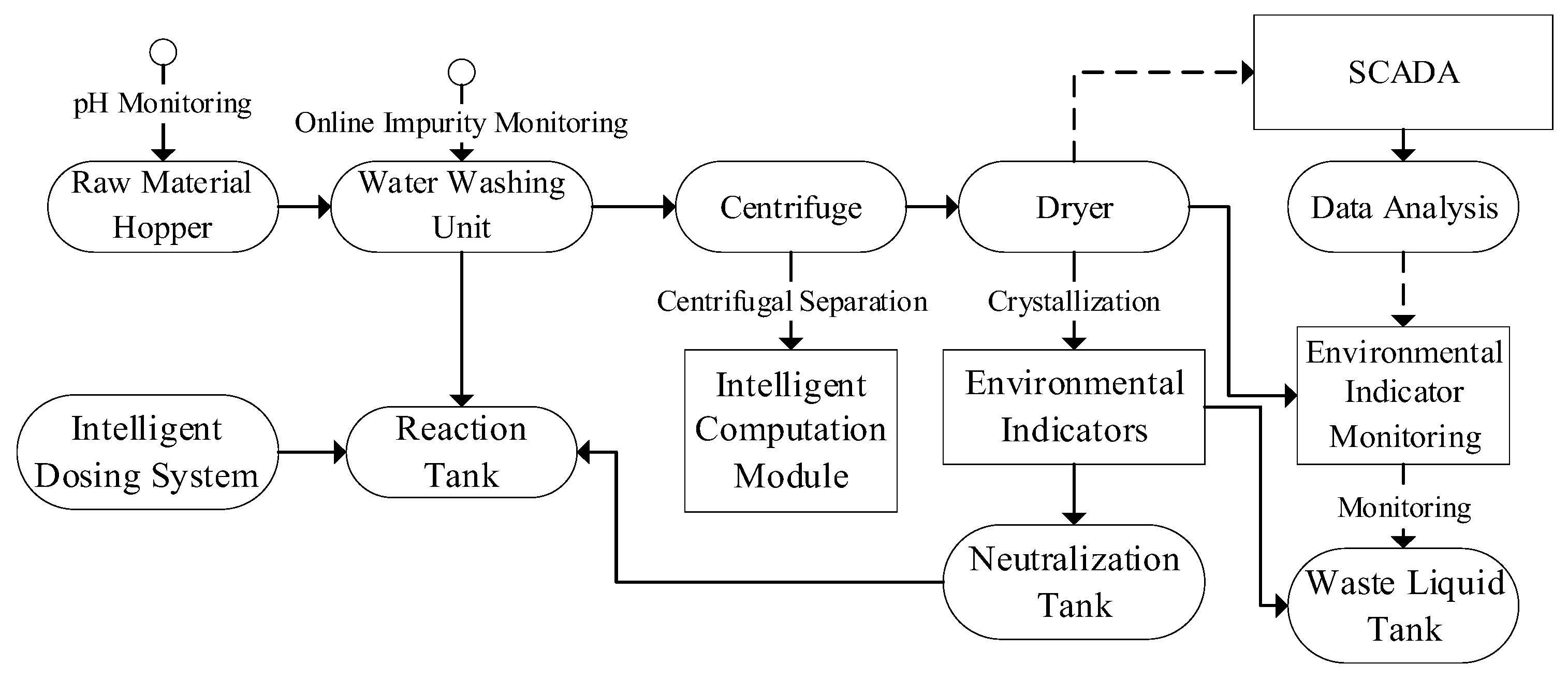
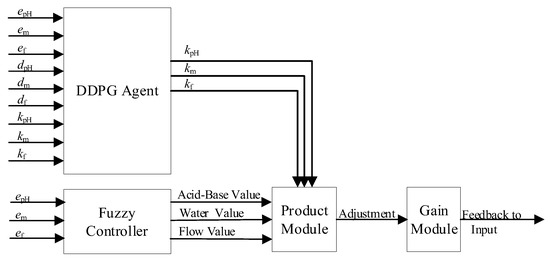
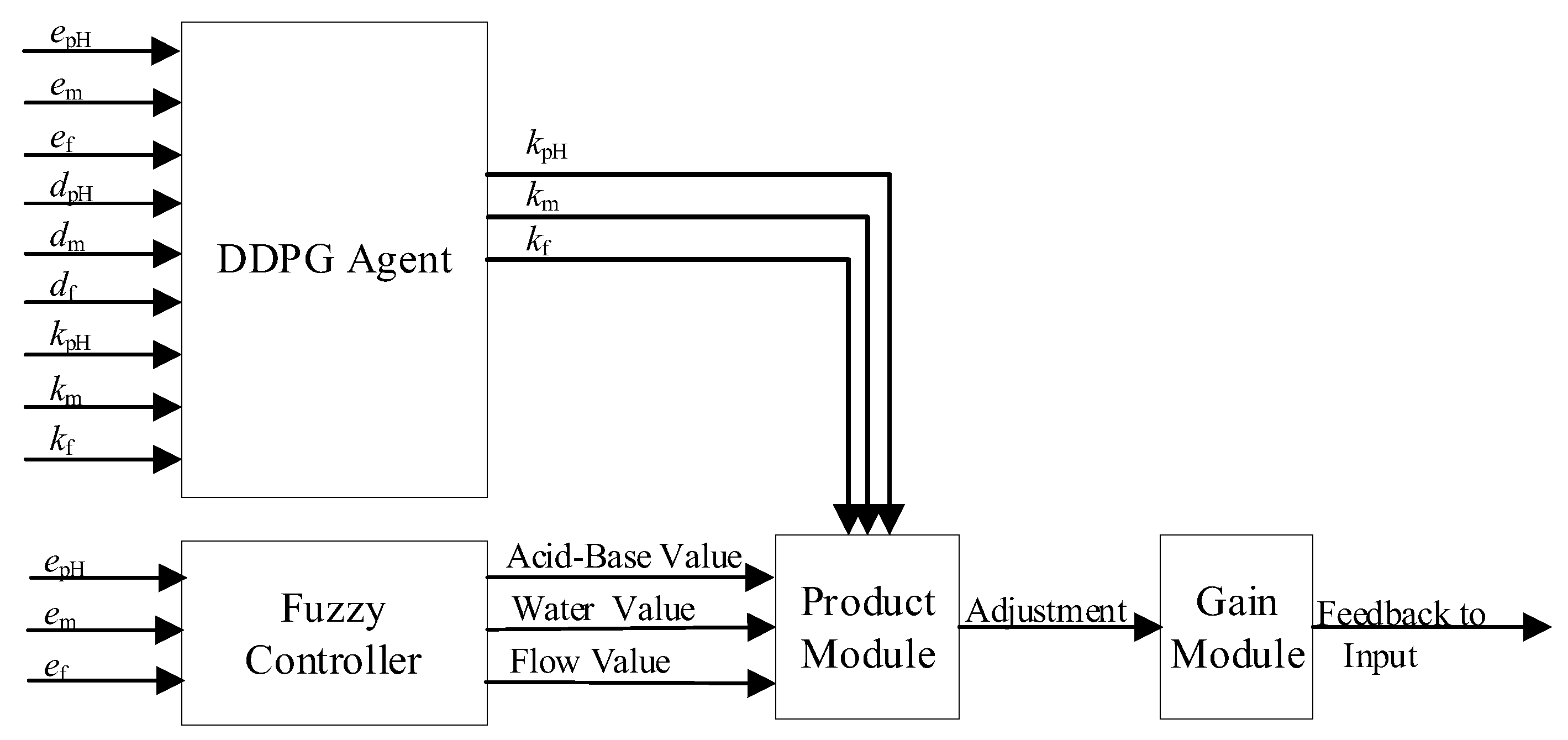
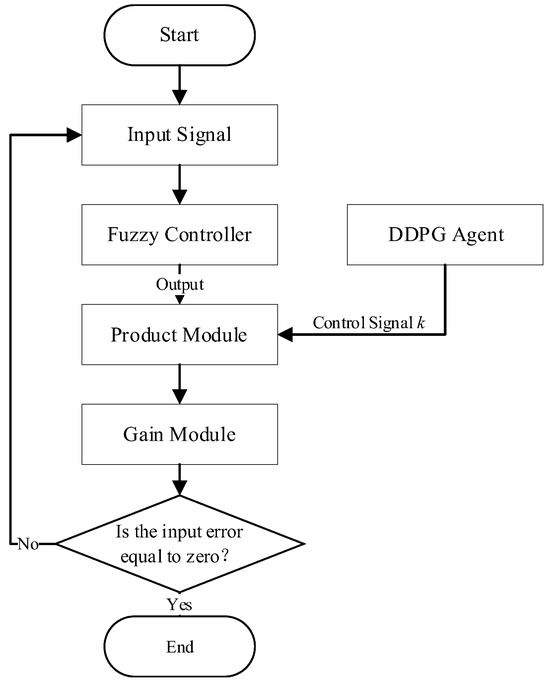
Based on the logical relationships and control requirements of the phosphogypsum pretreatment system, the F-DDPG control model developed in the Simulink platform consists of a three-input–three-output fuzzy controller and a DDPG agent configured with nine inputs and three outputs. The outputs of these two modules are integrated through a product operator and subsequently applied to a gain module, thereby realizing closed-loop regulation of the system inputs.
The fuzzy controller receives three input signals—corresponding to pH, moisture content, and flow rate—each determined by its error value and the rate of change of the error. The controller generates three output signals representing the control intensities for the acid–alkali valve opening, water-addition valve opening, and flow-control valve opening. By appropriately adjusting the gain values applied to these outputs, the model refines the amplitude of the fuzzy-control signals, thereby improving control precision and enhancing convergence performance. The three input signals are merged through a multiplexer before entering the fuzzy controller; afterward, the controller outputs are separated into three independent channels using a demultiplexer and fed back to their respective control loops with distinct gain coefficients, forming a closed-loop adaptive regulation structure.
As illustrated in Figure 2, the fuzzy controller and the DDPG agent operate cooperatively within the modeling framework. The output of the DDPG agent is decomposed by a demultiplexer into three gain-adjustment channels—, , and —which modulate the response characteristics of each corresponding target variable. The DDPG agent receives nine input signals, merged through a multiplexer, including the error values , the error-rate values , and the gain parameters , the latter of which are fed back from the agent’s previous outputs. The outputs of the DDPG agent are multiplied by the fuzzy-controller outputs to dynamically adjust the feedback intensities, thereby achieving intelligent, adaptive, and fine-grained control of the system.
Figure 2.
F-DDPG control model.
In addition, gain modules are incorporated into each output channel to adjust the feedback proportions, thereby enabling weighted contributions of different feedback signals to their respective control parameters. For instance, in the water-valve–opening control path, feedback from pH and moisture content is introduced with a proportional coefficient of 4:15. This configuration reflects the fact that the water-valve opening exerts a significantly stronger influence on moisture content than on pH. Similarly, in the acid–alkali-valve control path, the proportional coefficient between pH and moisture-content feedback is set to 1:6, indicating that the acid–alkali valve primarily regulates pH, whereas its impact on moisture content is comparatively limited.
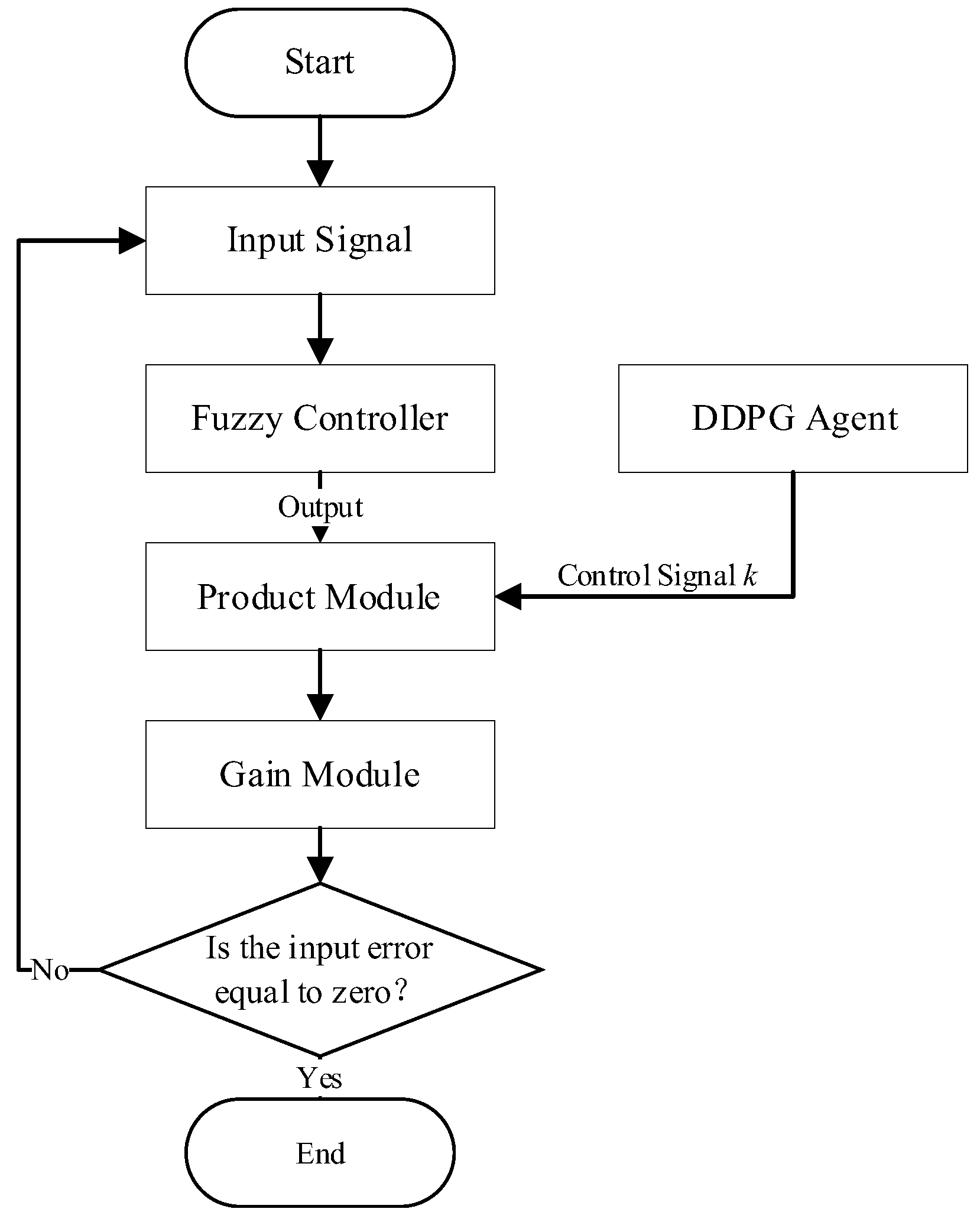
The overall workflow of the F-DDPG control model is illustrated in Figure 3.
Figure 3.
Flowchart of the F-DDPG control model.
2.3. Design of the Fuzzy Controller
To enhance both the interpretability and practical applicability of the control strategy, this study adopts a Mamdani-type fuzzy controller. This type of controller represents control logic through IF–THEN rules, enabling intuitive rule construction and effective incorporation of expert knowledge. Owing to its high transparency and strong ability to emulate human decision-making behavior, the Mamdani approach is well-suited for automatic control in complex industrial processes. Compared with the Sugeno-type controller, the Mamdani model captures operators’ empirical understanding of pH, moisture content, and flow rate more effectively, thereby improving the robustness and interpretability of the overall control strategy. Furthermore, the linguistic fuzzy outputs generated by the Mamdani model are fully compatible with the dynamic adjustment mechanism implemented by the DDPG agent, providing a solid foundation for the integrated hybrid-control framework.
According to fuzzy-control principles, the intelligent phosphogypsum control system utilizes six input variables:, , , , , and .The error and error-rate signals are first combined to form three composite signals, denoted as , , and . The inputs of the fuzzy controller are constructed as composite signals by combining the control error and its rate of change for each controlled variable. Specifically, the composite inputs are defined as:
where denotes the control error of each controlled variable, and represents the time derivative of the corresponding error. The error derivatives are computed using backward finite differences as:
To reduce the influence of measurement noise, the derivative signals are filtered using a first-order low-pass filter. In this study, the weighting parameters are selected as = 1.0 and = 0.2 for all control channels, providing a balance between steady-state accuracy and transient responsiveness.
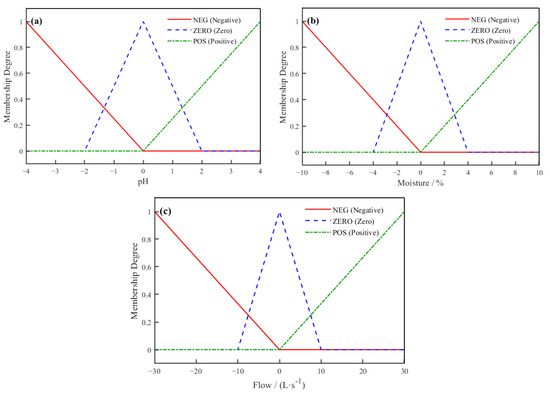
The output variables correspond to the opening degrees of the water valve, the acid–alkali valve, and the flow-control valve. After the input variables are fuzzified, their universes of discourse are determined based on the expected variation ranges and the precision requirements of the control task. The domains of , , and are each partitioned into three fuzzy categories: NEG (Negative), ZERO, and POS (Positive).
The design procedure of the fuzzy controller includes the following steps:
- (1)
- Define the input and output variables.
- (2)
- Select the membership functions.
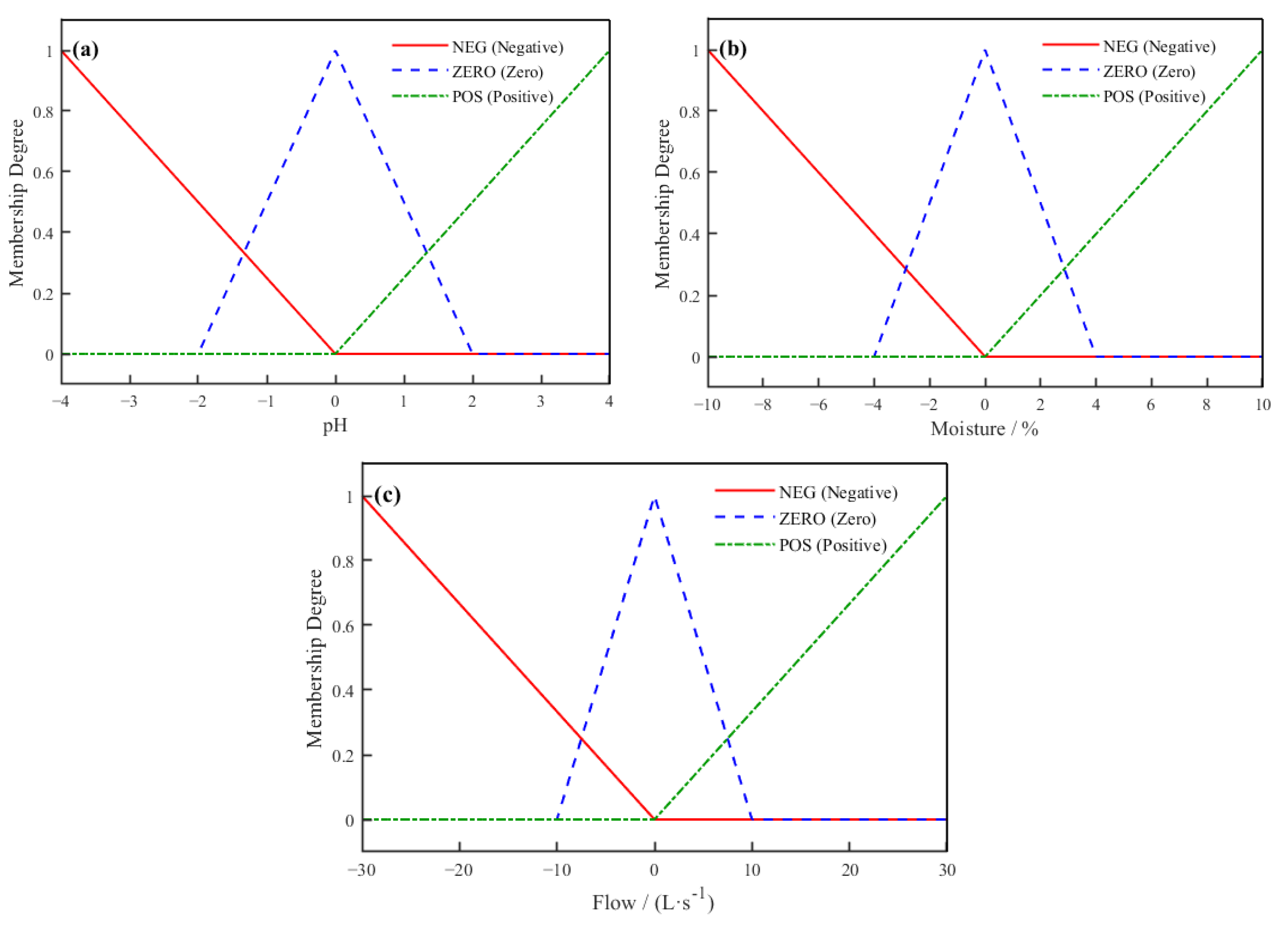
In this study, triangular membership functions are employed to represent the degree of membership for each variable owing to their simplicity, computational efficiency, and suitability for real-time applications. The membership functions for , , and are illustrated in Figure 4a–c.
Figure 4.
Membership functions for various parameters: (a) pH, (b) moisture content, (c) flow rate.
- (3)
- Design the fuzzy rule base.
The fuzzy rule base constitutes the core component of the fuzzy control system, defining the mapping relationships between the input and output variables (see Table 1). Its logic is expressed through a set of IF–THEN rules, where each rule associates the fuzzy sets of the input variables with the corresponding fuzzy sets of the output variables. For example, when the pH level is low (acidic), the moisture content remains within the normal range, and the system flow rate is high, the controller should maintain the current water-valve state, increase the acid-dosing level, and elevate the flow rate. Through such rule mappings, the fuzzy controller performs real-time inference and decision-making throughout system operation.
- (4)
- Select the defuzzification algorithm.
Based on the defined membership functions and the established fuzzy rule base, defuzzification is applied to convert the linguistic fuzzy outputs into quantitative control signals. In this study, the centroid (center-of-gravity) method is adopted for defuzzification due to its numerical stability and widespread use in industrial fuzzy control applications. The resulting crisp values determine the final opening degrees of the water, acid–alkali, and flow-control valves, thereby enabling closed-loop regulation of key parameters within the phosphogypsum pretreatment process. The chosen defuzzification method ensures numerical stability and facilitates seamless integration with the subsequent DDPG-based adaptive adjustment mechanism.
To illustrate how the fuzzy controller maps the input fuzzy sets to the corresponding control actions, the complete fuzzy rule base is summarized in Table 1. These rules clearly demonstrate the control logic embedded in the proposed fuzzy controller.
Table 2 presents the fuzzy rule base used in the proposed controller, which defines the mapping mechanism between the input fuzzy sets and the corresponding control actions.
Table 2.
Complete fuzzy rule base for the F-DDPG control system.
2.4. Design of the DDPG Agent
2.4.1. Fundamentals of the DDPG Algorithm
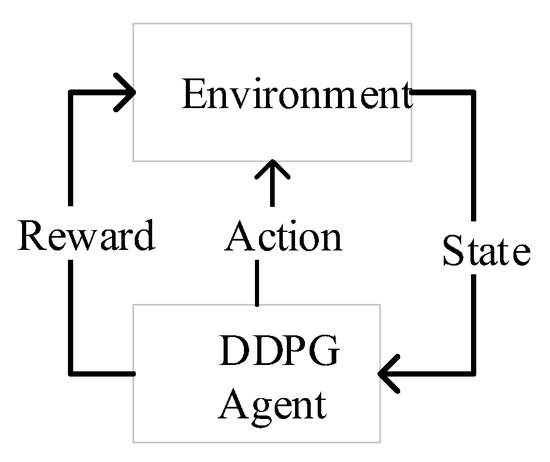
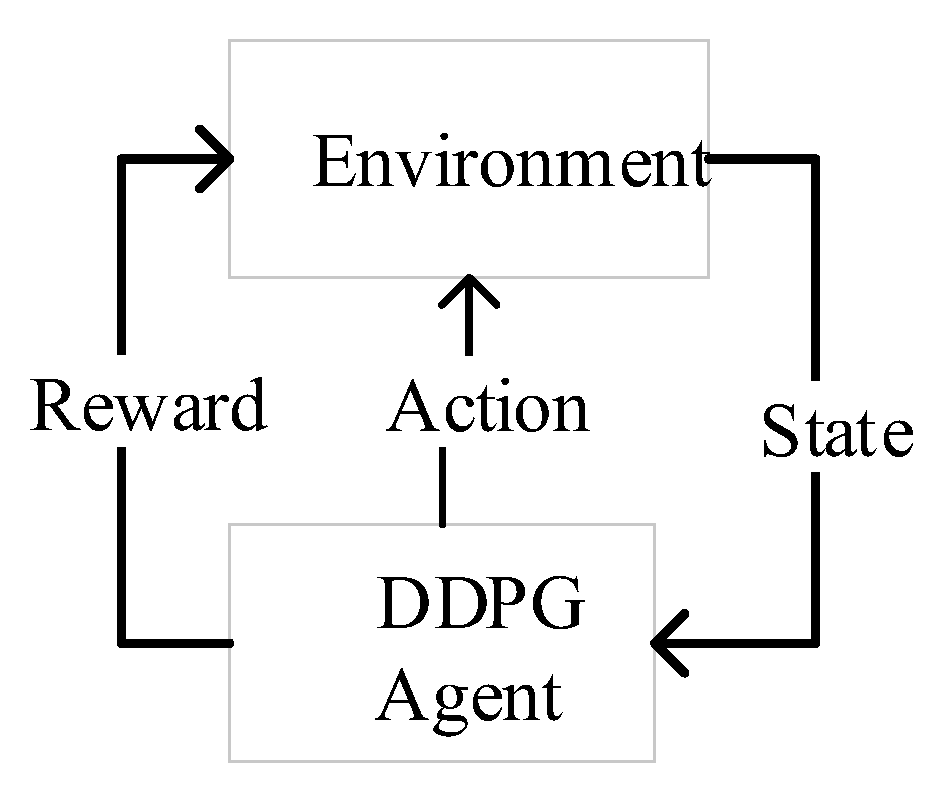
Deep Deterministic Policy Gradient (DDPG) is a deep reinforcement learning algorithm built upon the actor–critic framework, in which an agent learns optimal control policies through trial-and-error interactions with the environment. As illustrated in Figure 5, the agent selects an action based on the current state, the environment returns a reward, and the next state, and the agent continuously updates its policy with the objective of maximizing the long-term cumulative reward. Because DDPG does not rely on an explicit or accurate model of the controlled process, it is highly suitable for nonlinear, time-varying, and strongly coupled systems. Its inherent adaptivity and generalization capability make it an effective solution for complex industrial control problems.
Figure 5.
DDPG algorithm schematic.
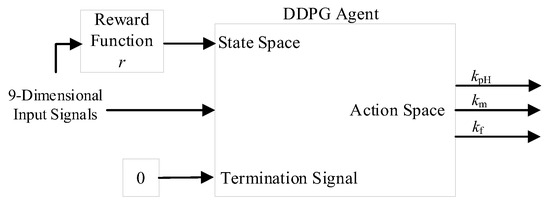
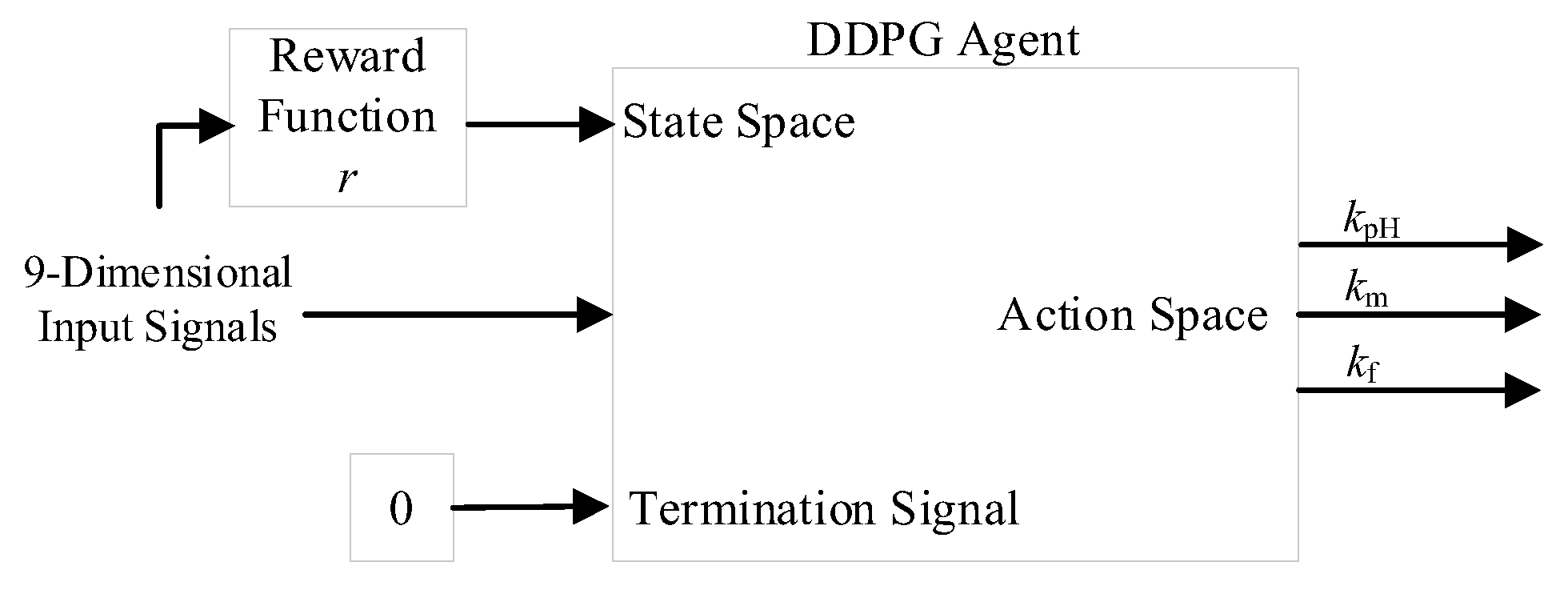
To enhance the adaptability of the fuzzy controller to complex disturbances and multivariable coupling, the DDPG algorithm is incorporated into the traditional fuzzy-control framework to perform online optimization of the fuzzy controller’s output gain coefficients, thereby forming the proposed F-DDPG control method. The DDPG algorithm trains an agent through interactions with a simulated environment, and in this study, the DDPG agent is implemented within the MATLAB/Simulink platform. The overall structure of the designed agent is illustrated in Figure 6.
Figure 6.
Overall structure of the DDPG agent.
2.4.2. Structure of the DDPG Agent
The DDPG agent is constructed following the standard state–action–reward formulation.
- State space.
The state vector consists of nine components, including the error terms, their derivatives, and the adjustable gain coefficients, denoted as
- 2.
- Action space.
The action vector is composed of the three gain coefficients used to modulate the outputs of the fuzzy controller, denoted as each constrained within the interval . By adjusting these coefficients, the DDPG agent achieves online adaptation of the fuzzy-control behavior.
- 3.
- Reward function.
The reward function integrates three components: an error term , an error-derivative term , and a control-effort term . These terms evaluate control accuracy, dynamic smoothness, and control-signal magnitude, respectively.
The error term penalizes deviations of the controlled variables, with higher weights assigned to pH and moisture content to reflect their greater impact on process performance:
The error-derivative term suppresses rapid fluctuations, promoting smooth system response and avoiding oscillatory control actions:
The control-effort term constrains the magnitude of the gain adjustments, preventing excessive or abrupt control inputs and reducing actuator stress:
It should be noted that the control-effort term is introduced as a proxy indicator to penalize excessive or abrupt control actions, rather than as a direct measurement of physical energy consumption.
The complete reward function is obtained by combining the three components:
This weighted multi-objective formulation balances accuracy, stability, and energy consumption, and its structure is consistent with the design principles of classical control cost functions such as those in Linear Quadratic Regulators and Model Predictive Control. The weight selection reflects the relative importance of each variable to product quality and system stability, and is further refined through iterative simulation-based tuning. Although no unified theory yields the optimal weight configuration, prior studies—such as Ahmad et al. [17]—have demonstrated that the reward structure and weighting significantly influence the performance of DDPG agents. The proposed reward design thus provides clear physical meaning, process relevance, and effective guidance for strategy learning and control optimization.
2.4.3. Construction of the DDPG Agent
The DDPG agent is trained using the Reinforcement Learning Toolbox in MATLAB. DDPG is built on the actor–critic architecture, which is well-suited for control tasks involving high-dimensional and continuous action spaces. The architecture consists of an Actor network, responsible for generating actions, and a Critic network, which evaluates the corresponding action-value function (Q-value).
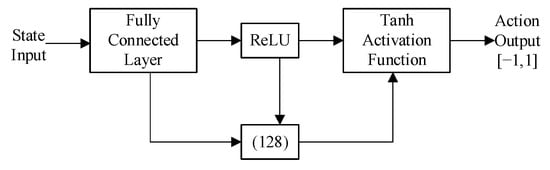
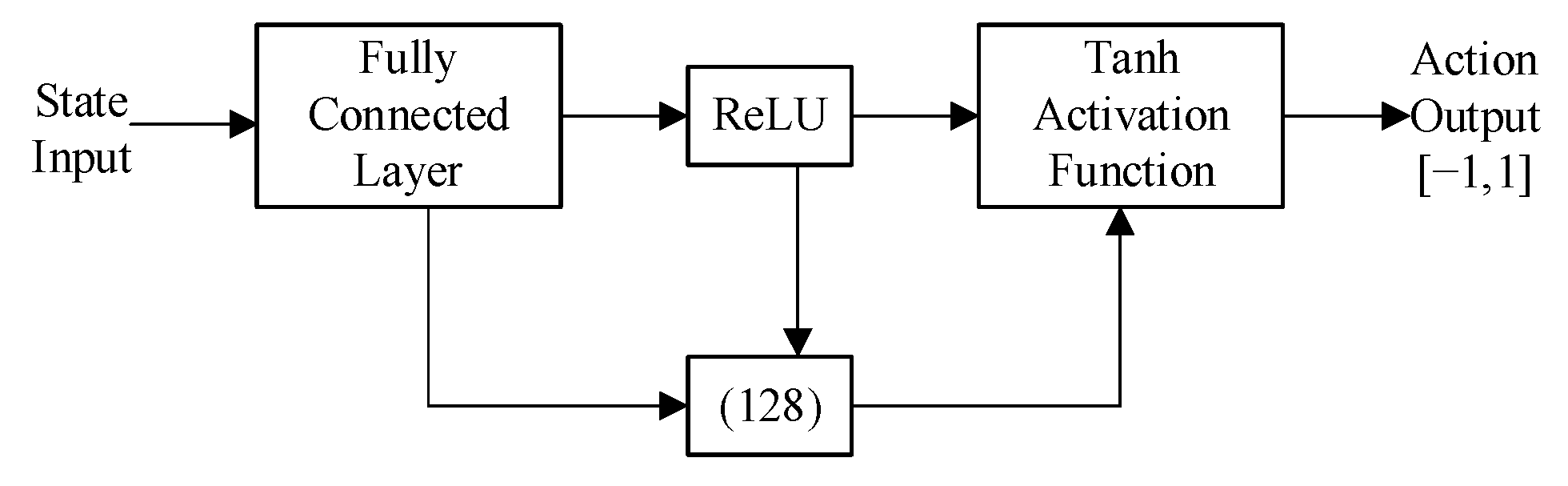
The input to the Actor network is a 9-dimensional vector composed of the key process state variables. The network contains two fully connected hidden layers with 128 neurons each, both employing rectified linear unit (ReLU) activation. The output layer produces a 3-dimensional action vector and uses a hyperbolic tangent (tanh) activation function to bound the output within the interval , as illustrated in Figure 7.
Figure 7.
Actor network structure diagram.
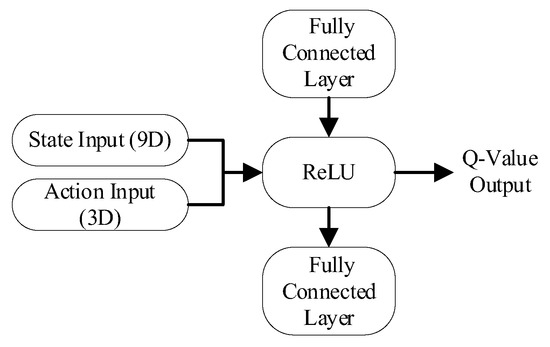
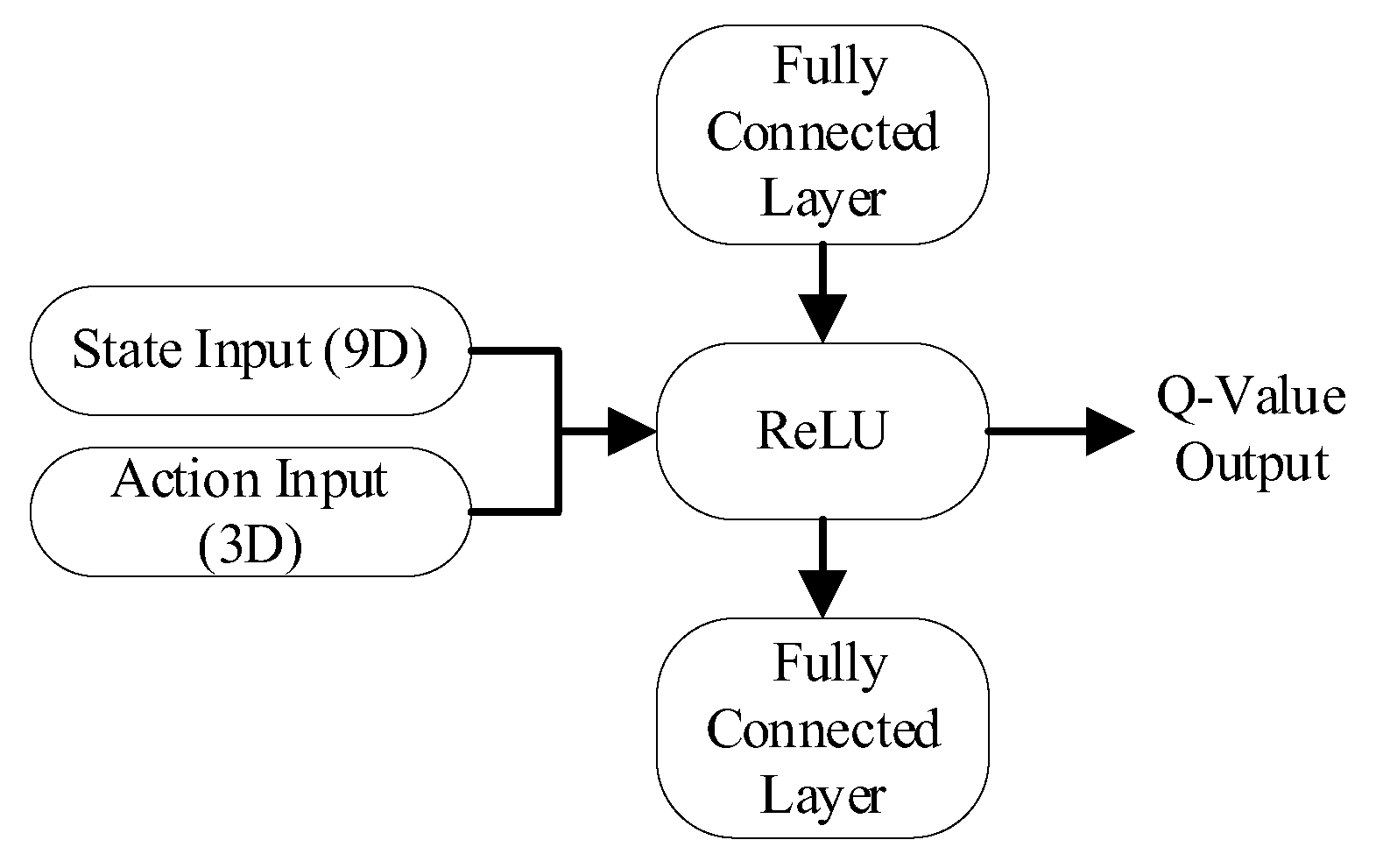
The Critic network receives the state vector and action vector as its inputs. These two inputs are first processed separately through fully connected layers to extract their respective feature representations. The extracted features are then concatenated in an intermediate layer, followed by a ReLU activation, and subsequently mapped to a scalar Q-value, as illustrated in Figure 8. This network structure enables the Critic to effectively learn the coupling relationships between states and actions, thereby improving the accuracy of the action-value estimation.
Figure 8.
Structure of the Critic network.
The actor–critic structure effectively captures the joint relationships between states and actions, thereby improving the accuracy of value estimation in continuous control tasks. Based on this architecture, the DDPG agent exhibits good training stability and sample efficiency throughout the learning process.
2.5. Description of the Controller Integration Mechanism
The F-DDPG control method adopts a hybrid architecture that combines a fuzzy controller with a DDPG agent, operating in a cascaded fusion mode. The fuzzy controller generates baseline control signals according to the predefined rule base, providing directional and magnitude adjustments for the pH, moisture content, and flow rate errors. The DDPG agent computes adaptive gain coefficients for each control channel, dynamically adjusting the proportional contribution of the fuzzy controller’s outputs. The final control action is obtained by multiplying the fuzzy output by the learned gain, meaning that the DDPG agent does not directly manipulate the system. Although the actor-network output is bounded within [−1, 1] by the tanh activation function, the gain coefficients applied to the fuzzy controller are not used directly. To ensure control safety and loop stability, the raw action outputs are mapped to strictly positive and bounded gain values before being applied to the control signals.
Specifically, the final gain coefficients are computed as:
where denotes the raw action output of the actor network, and = 0.2 and = 2.0. This mapping prevents sign inversion of the control action and ensures physically meaningful actuation while preserving the adaptive capability of the DDPG agent. The lower and upper bounds = 0.2 and = 2.0 were selected based on practical control considerations. The lower bound ensures that the fuzzy baseline controller always maintains a minimum effective authority, preventing loss of regulation due to excessively small gains, while the upper bound limits the maximum amplification of control actions to avoid actuator saturation and oscillatory behavior under strong coupling. This bounded supervisory gain design is consistent with common industrial practice for adaptive gain scheduling. Additional simulation observations indicate that moderate variations in the gain bounds around the selected values do not alter the qualitative performance trends of the proposed controller. Within a reasonable range, the F-DDPG framework consistently preserves its advantages in convergence speed, stability, and robustness, demonstrating that the control performance is not overly sensitive to the exact choice of and .
Instead, it functions as a supervisory regulator that endows the fuzzy controller with adaptive capability, enabling online optimization at the parameter level.
This integrated design preserves the stability and interpretability inherent to expert-rule-based fuzzy control, while introducing the real-time learning capability required to handle nonlinearities and coupling disturbances. It is particularly suitable for industrial environments characterized by strong variable correlations and frequently changing operating conditions. The system can rely on the fuzzy rules to achieve acceptable performance during the initial stage, while the DDPG agent gradually improves its policy through training, enhancing both response accuracy and robustness. Compared with standalone DDPG control, the proposed approach reduces the risk of oscillations during early exploration. Compared with a fixed-rule fuzzy controller, it significantly improves adaptability to time-varying and coupled dynamics. As such, the F-DDPG method offers a well-founded theoretical basis and strong engineering feasibility.
3. Simulation Results and Comparative Analysis
3.1. Simulation Environment Setup
To validate the effectiveness of the proposed F-DDPG control method in the phosphogypsum pretreatment process, a closed-loop simulation model was constructed in MATLAB/Simulink. The model incorporates dosing regulation, drying and dewatering dynamics, and multivariable feedback-control mechanisms. Operating-condition disturbances—such as variations in feed concentration and sensor noise—were introduced to emulate the dynamic behavior of real industrial environments.
All simulations were performed on a Windows 10 (64-bit) platform using MATLAB R2021b and the Reinforcement Learning Toolbox. The hardware configuration consisted of an Intel Core i5-7300HQ (2.50 GHz) CPU, 8 GB RAM, an NVIDIA GeForce GTX 1050Ti GPU with 2 GB VRAM, and a storage system comprising a 256 GB SSD and a 1 TB HDD. No parallel computing or multi-GPU acceleration was employed; all training and simulation tasks were executed under a single-thread CPU and a single-GPU setting.
System parameters were configured as follows: the total simulation time was 10 s; the target values for the controlled variables were pH = 5.5, moisture content = 12%, and flow rate = 100 L/min, consistent with typical industrial phosphogypsum processing conditions. The DDPG training parameters were set as follows: actor learning rate of , critic learning rate of , maximum steps per episode of 400, and a total of 300 training episodes. In addition, several commonly adopted hyperparameters in DDPG-based control applications were employed in this study. The discount factor was selected as γ = 0.99. The replay buffer size was set to 1 × 10⁶, and the minibatch size was chosen as 128. Target networks were updated using a soft update mechanism with a coefficient τ = 0.005. Exploration during training was achieved by adding Ornstein–Uhlenbeck noise to the actor output, with an initial variance of 0.2.
All reported simulation results were obtained by averaging over five independent training runs with different random seeds to reduce the influence of stochastic variability. Due to the control-oriented nature of this study, the reported results are intended to demonstrate typical performance trends rather than statistical optimality across multiple random seeds.
For a fair comparison, all baseline controllers were carefully tuned under the same plant model, operating conditions, and actuator constraints as the proposed F-DDPG controller. The PID controller parameters were manually tuned following standard engineering practices, aiming to achieve a compromise between fast response and minimal overshoot for each control loop. Anti-windup protection and identical saturation limits were applied to all control channels.
The fuzzy controller employed the same membership functions and rule base as those used in the fuzzy component of the proposed F-DDPG framework, with fixed output scaling factors. The fuzzy–PID controller combined fuzzy logic with conventional PID control, where the fuzzy inference system was used to adjust the effective control gain online, while the underlying PID parameters remained constant.
The final parameter settings of all baseline controllers are summarized in Table 3. These parameters were selected to ensure stable closed-loop behavior and reasonable transient performance, rather than to achieve global optimality, thereby providing a consistent and reproducible benchmark for performance comparison.
Table 3.
Parameter settings of baseline controllers used for comparison.
All baseline controllers were implemented under identical plant models, actuator saturation limits, and rate constraints to ensure a fair comparison.
The methods included in the comparative evaluation were: PID control, fuzzy control, fuzzy–PID control, and the proposed F-DDPG control approach. The performance metrics considered in the analysis include error-convergence speed, steady-state accuracy, control smoothness, and robustness of dynamic response.
3.2. Comparative Analysis of Control Performance
3.2.1. Comparison Under Baseline Conditions
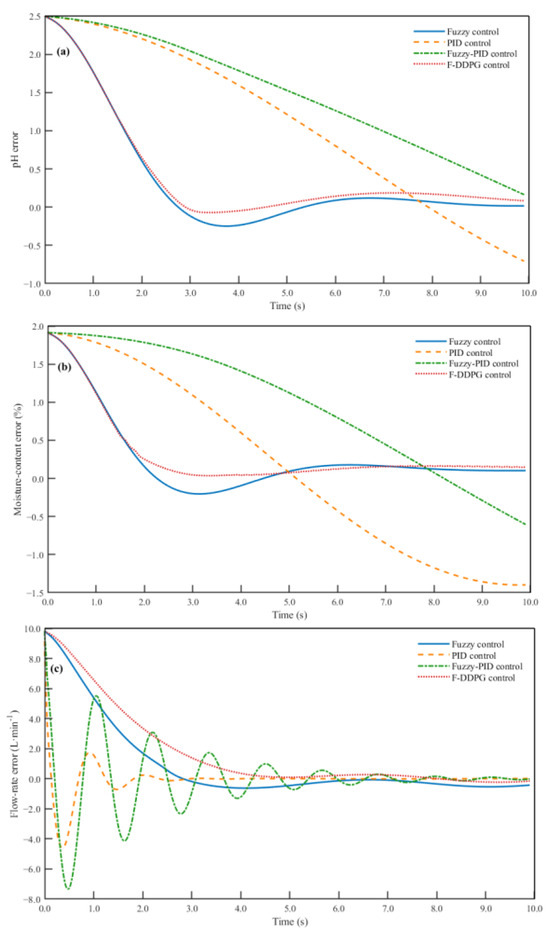
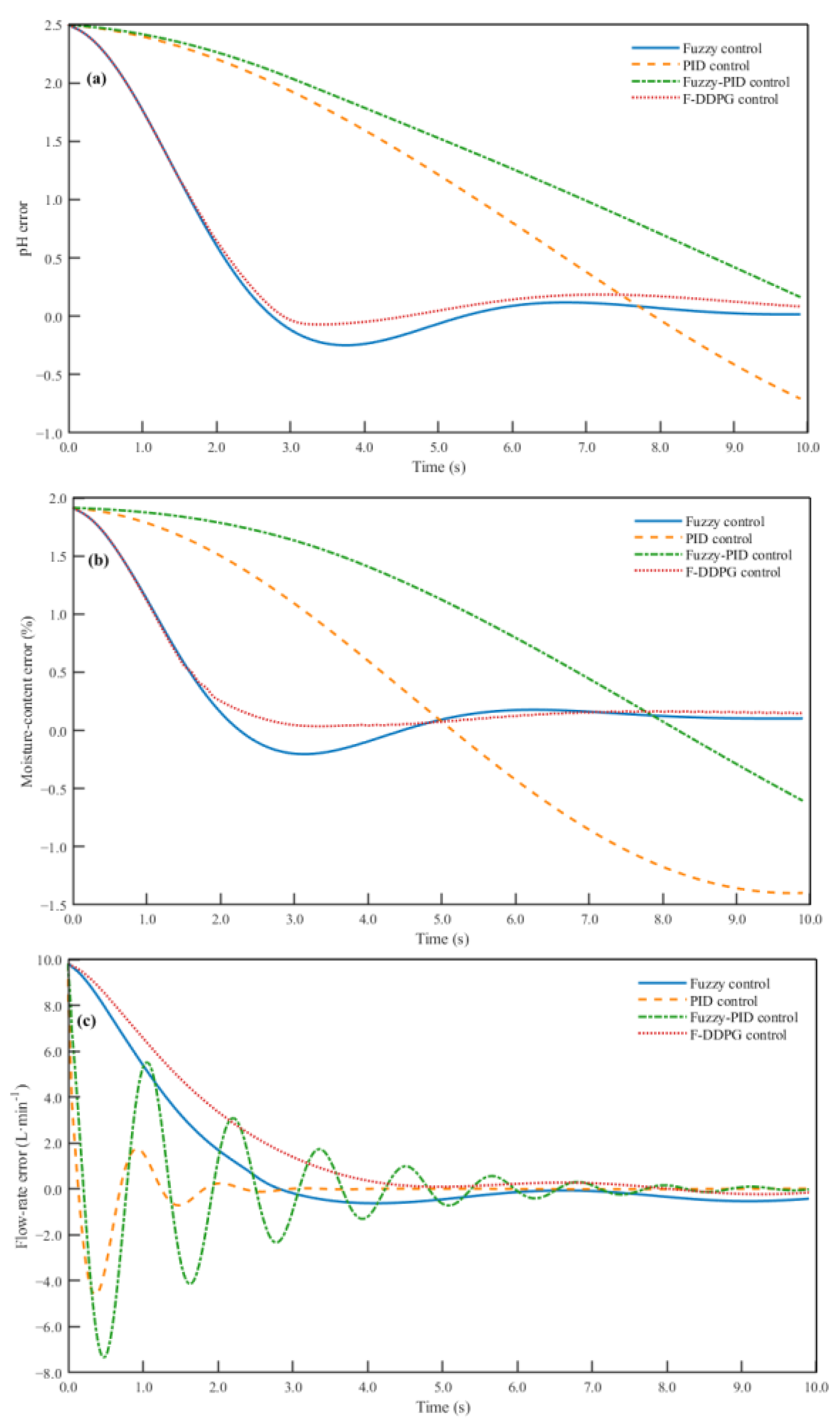
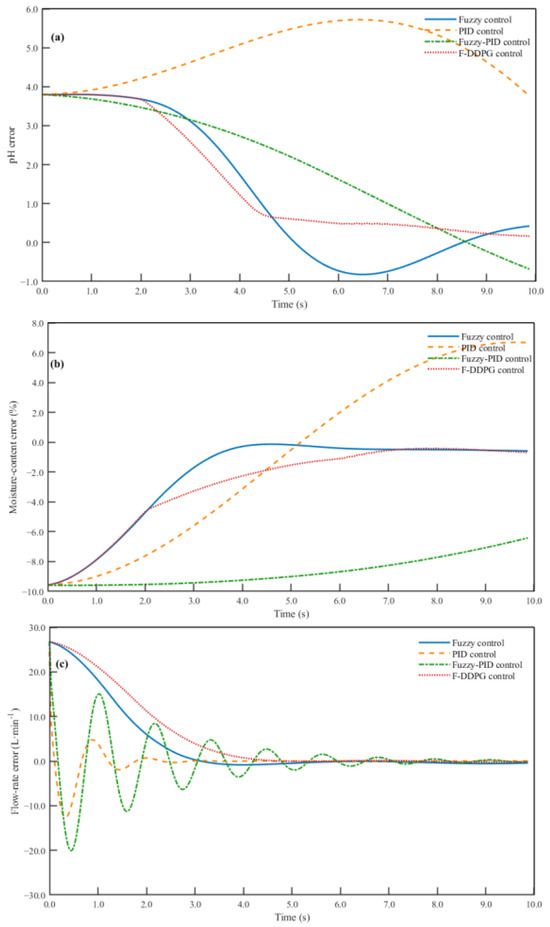
Figure 9a–c illustrate the error curves of pH, moisture content, and flow rate under different control methods.
Figure 9.
Error comparison for different controlled variables: (a) pH, (b) moisture content, (c) flow rate.
Significant differences in control performance are observed among the four methods in the multivariable coupled scenario. Under PID control, the overall response is noticeably delayed: the pH error does not fully converge even after 8 s, the moisture content exhibits under-regulation in the steady-state stage, and the flow rate, while eventually converging, requires a long settling time and shows limited accuracy, revealing insufficient capability for handling variable coupling. Fuzzy-PID control achieves improvements over classical PID control; however, the pH and moisture-content errors converge slowly, and high-frequency oscillations occur in the flow rate response. Compared with these methods, fuzzy control shows a faster initial nonlinear response, with pH and moisture-content errors decreasing rapidly within 3–4 s, but its steady-state performance is less satisfactory, exhibiting noticeable fluctuations, overshoot, and oscillatory behavior.
In contrast, the proposed F-DDPG control method achieves consistently improved performance across all three indicators. The pH error stabilizes at approximately 0.1 within 4 s, the moisture content displays minimal fluctuation without significant overshoot, and the flow rate response shows well-damped behavior with rapid convergence and no observable oscillation. These results indicate that the F-DDPG controller enables online adaptive optimization and can effectively handle the coupling relationships among variables, thereby achieving high-precision, coordinated control under multi-objective constraints.
3.2.2. Verification of Control Performance Under Different Initial Operating Conditions
To further examine the adaptability of the F-DDPG control method to variations in feed conditions, two additional representative initial operating conditions were designed in addition to the baseline case (initial pH of 3.0, moisture content of 10%, and flow rate of 90 L·min−1). The specific settings are summarized in Table 4.
Table 4.
Initial process setpoints under different operating conditions.
Experiment A corresponds to a mildly deviated operating condition (pH = 4.0, moisture content = 14%, flow rate = 110 L·min−1), representing a scenario with slightly higher feed acidity, increased moisture content, and elevated slurry flow rate. Experiment B corresponds to a severely deviated condition (pH = 1.7, moisture content = 21.5%, flow rate = 73 L·min−1), representing an extreme case with strong acidity, excessively high moisture content, and insufficient flow rate. Experiment C corresponds to the operating condition discussed in Section 3.2.3 and is therefore not elaborated here. In all three cases, the setpoints are kept unchanged (pH 5.5, moisture content 12%, flow rate 100 L·min−1) to evaluate the controller’s ability to achieve consistent regulation under different initial errors.
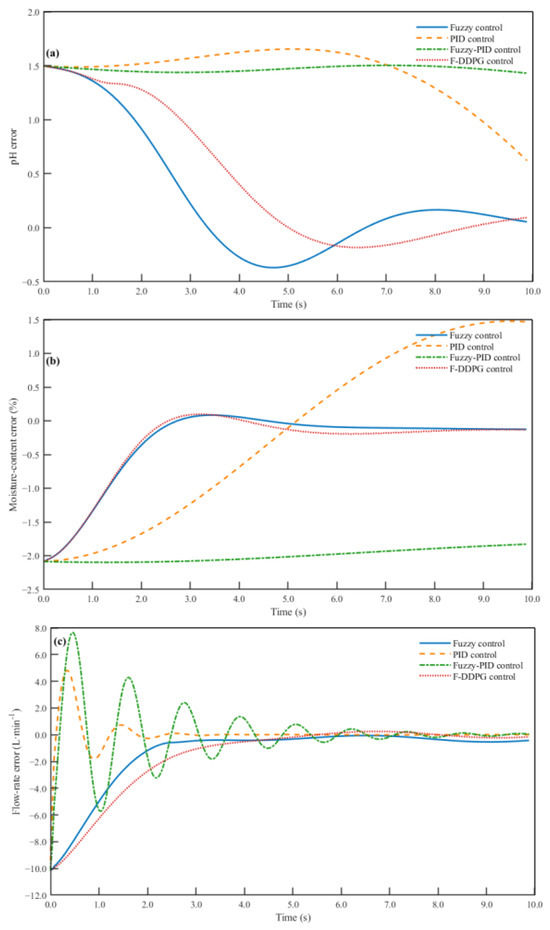
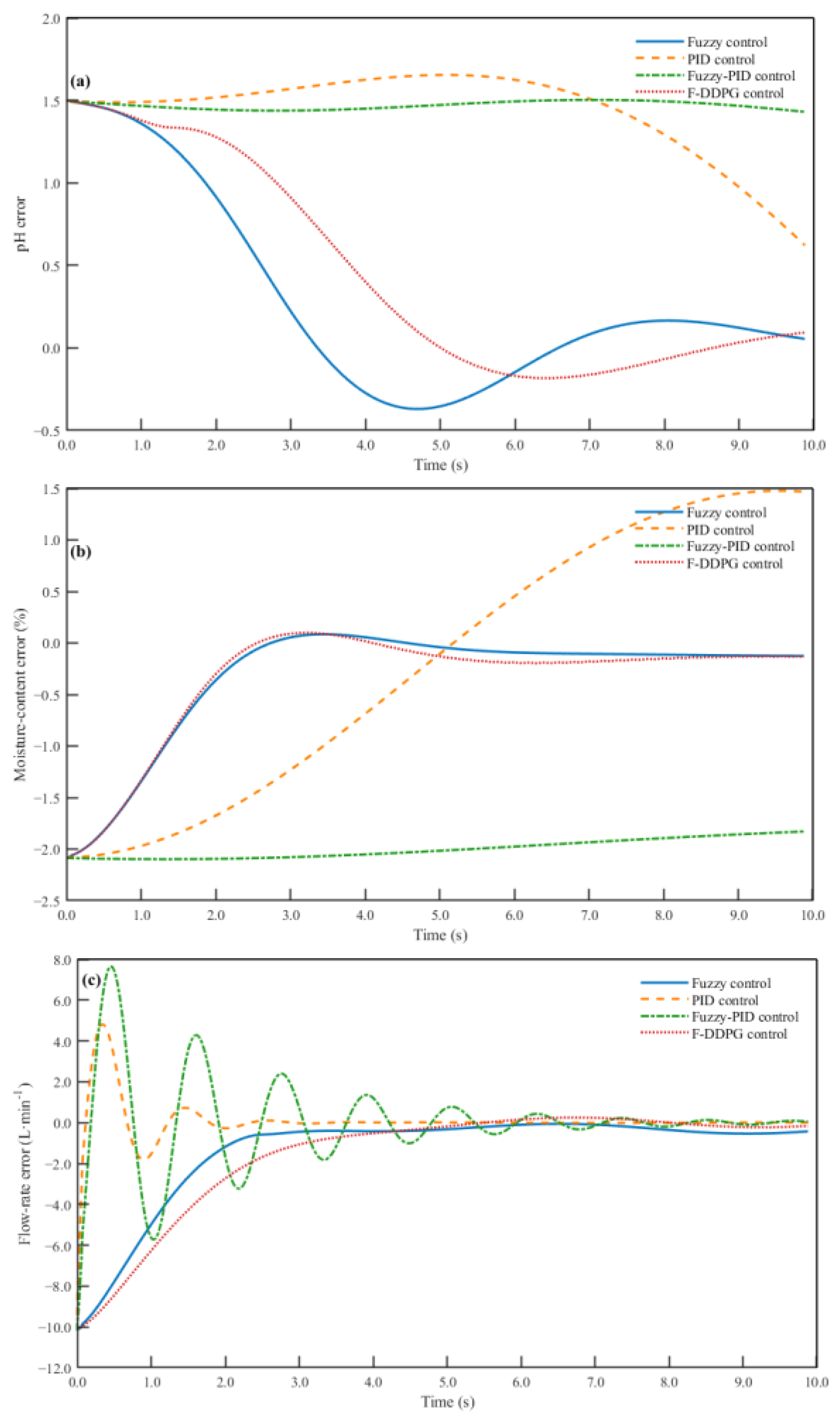
Figure 10a–c present the dynamic error responses of pH, moisture content, and flow rate under Experiment A.
Figure 10.
Error comparison of different variables in Experiment A: (a) pH, (b) moisture content, (c) flow rate.
For the pH channel, all four control methods start with an initial error of approximately 1.5. The PID controller maintains a positive error bias throughout 4–6 s, indicating slow convergence toward the setpoint. The fuzzy-PID controller exhibits almost no overshoot; however, its overall decay rate is relatively slow. In contrast, the proposed F-DDPG controller significantly reduces the pH error within 2–3 s and converges to zero at approximately 6 s, without noticeable oscillations during the entire transient process.
In terms of moisture content regulation, the PID controller shows a continuously increasing trend, resulting in a large steady-state error. Both fuzzy control and fuzzy-PID control are capable of eliminating the steady-state error, but they exhibit different degrees of overshoot and subsequent readjustment. The F-DDPG controller crosses the zero-error point at around 3 s and then rapidly attenuates, achieving a near-zero steady-state error with a smoother transient response.
The comparison in the flow-rate channel indicates that the fuzzy-PID controller produces pronounced oscillations during 0–4 s, with a peak error approaching 8 L·s−1. By contrast, the error fluctuations under F-DDPG control remain within a much smaller range, and its final convergence speed is comparable to that of fuzzy control while exhibiting a smaller overshoot.
Overall, the results of Experiment A demonstrate that under mildly deviated operating conditions, the proposed F-DDPG controller achieves a superior balance between response speed and overshoot, outperforming conventional PID and fuzzy-PID controllers across all three controlled variables.
Figure 11a–c illustrate the simulation results under Experiment B, which represents a severely deviated operating condition. Owing to the extremely low initial pH value of 1.7 and the significantly increased deviations in moisture content and flow rate, the initial system errors are substantially larger than those in the baseline condition.
Figure 11.
Error comparison of different variables in Experiment B: (a) pH, (b) moisture content, (c) flow rate.
As observed in the pH channel, the PID controller exhibits a pronounced positive deviation, and the time required to recover to the target value is significantly prolonged. In the moisture content channel, the error under PID control even shows a monotonically diverging trend, indicating that the conventional PID parameters are no longer capable of coordinating the three coupled variables under this operating condition. The fuzzy controller maintains relatively small overshoot in both the pH and moisture content channels; however, its dynamic response remains comparatively sluggish. For the fuzzy-PID controller, the flow-rate error undergoes an evident oscillatory decay process, with a large oscillation amplitude during the first 4 s, which may lead to frequent actuator actions in practical applications.
In contrast, the proposed F-DDPG controller demonstrates superior robustness across all three variables. The pH error converges within ±0.5 at approximately 6 s, the moisture content error decreases monotonically with a near-zero steady-state error, and the flow-rate error rapidly attenuates after a brief transient period, followed only by small-amplitude, low-frequency oscillations. These results indicate that the F-DDPG controller can maintain stability and convergence even under severely deviated operating conditions, effectively avoiding the performance degradation commonly observed in PID-based controllers when operating points vary over a wide range.
The results obtained from Experiments A and B demonstrate that the F-DDPG controller maintains stable and consistent control performance across different initial operating conditions and error magnitudes, highlighting its strong adaptability and superior generalization capability with respect to varying process states, in comparison with conventional PID and fuzzy-PID controllers.
3.2.3. Robustness Analysis Under Disturbance Conditions
To further evaluate the disturbance rejection capability of the proposed F-DDPG control method, Experiment C was constructed based on the operating condition of Experiment A. In Experiment C, the same initial values were maintained (pH = 4.0, moisture content = 14%, and flow rate = 110 L·min−1). At t = 3 s, stochastic disturbances were introduced into the error signals of all three control channels by superimposing a band-limited white noise signal with a step function. Specifically, band-limited white noise with a bandwidth of 20 Hz was added to the measured pH, moisture content, and flow-rate signals, with standard deviations of = 0.02, = 0.05, and = 0.30, respectively. In addition, bounded step-like disturbances were injected at t = 3 s, with disturbance magnitudes uniformly sampled within the ranges reported in Table 1. These disturbances were applied to emulate realistic sensor noise and process fluctuations encountered in industrial pretreatment operations.
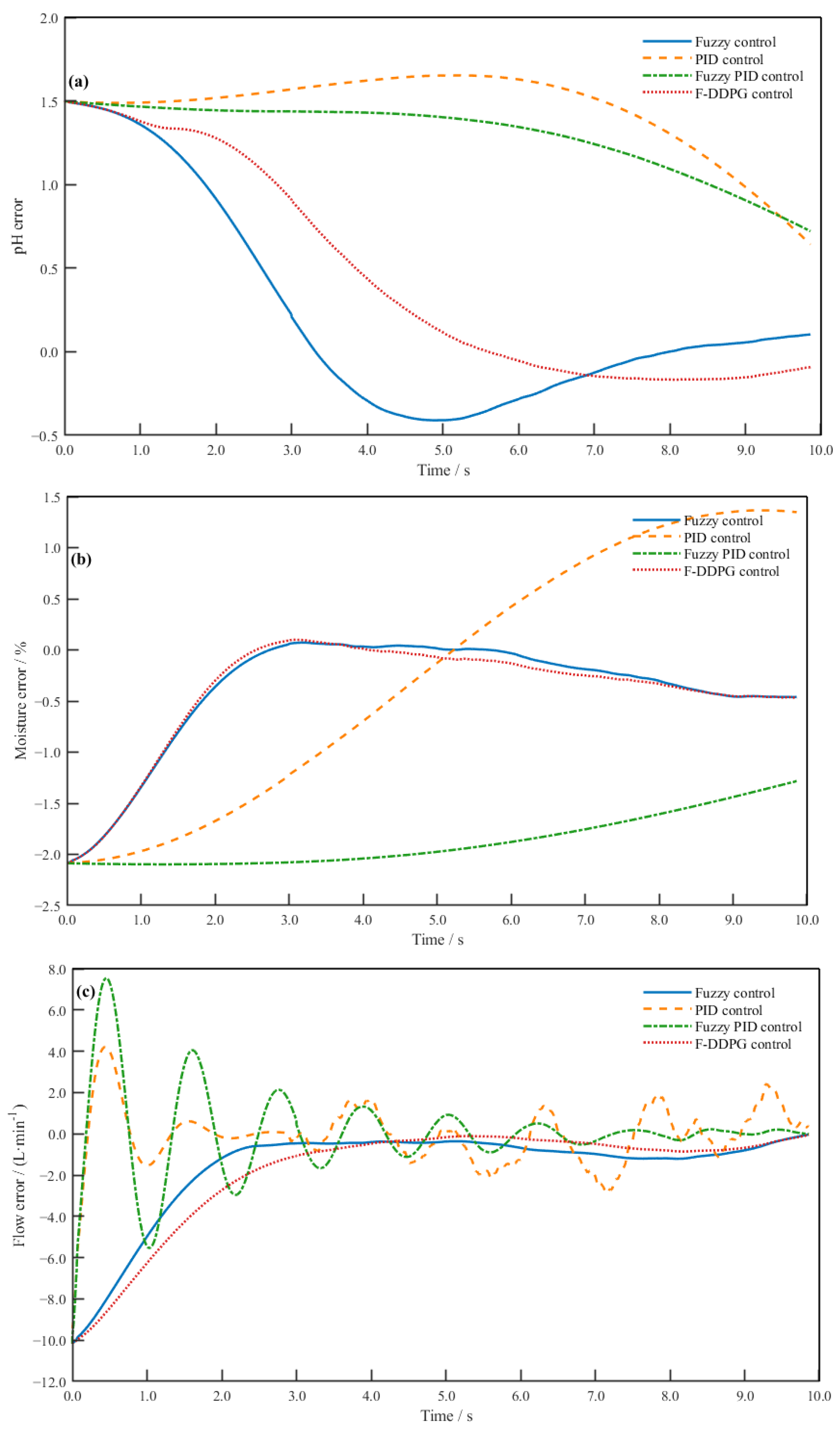
Figure 12a–c present the error responses of the four control methods under Experiment C. After the disturbance is introduced, the PID controller exhibits pronounced random fluctuations in both the pH and flow-rate errors, indicating a high sensitivity of the control process to noise. The fuzzy-PID controller produces sustained oscillations in the flow-rate channel, with oscillation amplitudes that remain significant for an extended period after the disturbance, making it difficult to achieve rapid attenuation.
Figure 12.
Error comparison of different variables in Experiment C: (a) pH, (b) moisture content, (c) flow rate.
In contrast, although the pH and moisture-content errors under F-DDPG control are affected by the disturbance at approximately t = 3 s, the resulting error peaks are significantly smaller than those observed with the other three control methods. Moreover, the errors rapidly reconverge to a narrow region around zero within approximately 2 s. The fluctuation amplitude of the flow-rate error is also markedly reduced, and high-frequency noise components are effectively suppressed. Overall, the dynamic response of the F-DDPG controller under disturbance conditions is considerably smoother, without large overshoot or prolonged oscillations.
These results demonstrate that the integration of DDPG-based online gain optimization significantly enhances the performance of the fuzzy control framework, enabling the F-DDPG controller to achieve superior convergence speed, steady-state accuracy, and robustness under both varying operating conditions and stochastic disturbances, which is well aligned with the stringent stability and robustness requirements of phosphogypsum safe pretreatment processes.
3.3. Quantitative Comparison of Control Performance
To ensure a fair and reproducible quantitative comparison, the performance metrics used in Table 3 are defined as follows. The steady-state error is defined as the absolute difference between the controlled variable and its reference value at the end of the simulation horizon, normalized by the corresponding setpoint and expressed as a percentage. The settling time is defined as the time required for the system response to enter and remain within a ±5% band around the reference value. Overshoot is defined as the maximum normalized deviation beyond the reference value during the transient response. The peak number N denotes the number of significant overshoot peaks observed before the response settles within the specified tolerance band.
Based on the above definitions, the quantitative control performance of the four methods in the multivariable coupled system is summarized in Table 5.
Table 5.
Control method performance comparison.
The results show that PID control exhibits large steady-state errors, slow convergence, and pronounced coupling interference, making it difficult to achieve high-precision control. Fuzzy control and fuzzy-PID control offer improvements in initial response and regulation speed; however, they still suffer from overshoot and unstable oscillations in the moisture-content and flow rate responses. In particular, fuzzy-PID control tends to generate multiple overshoot peaks under strong coupling conditions due to cross-interference between variables. In contrast, the proposed F-DDPG control method achieves superior performance across all metrics: it yields smaller steady-state errors (e.g., a pH error of only 0.01), lower overshoot, fewer oscillations (only one peak), and a faster average convergence rate of 0.8 s−1. Enabled by its self-learning mechanism, the F-DDPG controller effectively suppresses interference propagation among coupled variables and achieves coordinated optimization of pH, moisture content, and flow rate, demonstrating excellent robustness and strong potential for engineering applications.
Compared with traditional fuzzy control, the F-DDPG method is more capable of handling complex operating conditions and nonlinear coupling characteristics. It significantly enhances the intelligence and stability of process control, providing strong technical support for the efficient and robust control of phosphogypsum treatment processes. This work establishes both theoretical and practical foundations for advancing the intelligent and green transformation of the phosphorus chemical industry.
4. Conclusions
With the continuous advancement of China’s “dual-carbon” strategy and the development of “zero-waste cities,” the resource utilization of phosphogypsum—one of the major industrial by-products—has led to increasing demand for higher control accuracy and intelligence. Traditional control strategies are unable to cope with the strongly nonlinear, highly coupled, and disturbance-prone operating conditions in the phosphogypsum pretreatment process, substantially limiting the improvement of its stable and reliable operation. To address these challenges, this study proposes an F-DDPG control method and applies it to the key process stages of phosphogypsum harmless-treatment.
The research mainly includes: constructing a multivariable dynamic control model, designing the F-DDPG control strategy, and conducting systematic simulation experiments and comparative performance analyses. The results indicate that the proposed F-DDPG method exhibits stable training behavior and improves overall control performance. Owing to its strong engineering feasibility and scalability, the F-DDPG controller provides a promising technical pathway for intelligent optimization in multi-coupled control systems and offers an effective solution for achieving high-efficiency and robust control in phosphogypsum treatment processes.
Author Contributions
Conceptualization, X.Z.; methodology, C.X.; software, C.X.; validation, C.X. and X.Z.; formal analysis, C.X.; investigation, C.X.; data curation, C.X.; writing—original draft preparation, C.X.; writing—review and editing, X.Z.; visualization, C.X.; supervision, X.Z.; project administration, X.Z.; funding acquisition, X.Z. All authors have read and agreed to the published version of the manuscript.
Funding
This research was funded by the Major Program (JD) of Hubei Province, grant number 2025BEA005.
Data Availability Statement
The data presented in this study are available from the corresponding author upon reasonable request.
Acknowledgments
During the preparation of this manuscript, the authors used ChatGPT 5.2 (OpenAI) for language polishing and clarity improvement. The authors have reviewed and edited the content and take full responsibility for the final manuscript.
Conflicts of Interest
The authors declare no conflicts of interest.
Abbreviations
The following abbreviations are used in this manuscript:
| DDPG | Deep Deterministic Policy Gradient |
| RL | Reinforcement Learning |
| PID | Proportional–Integral–Derivative |
| MIMO | Multi-Input Multi-Output |
References
- Yang, X.J.; Zhong, J.; Liu, L.; Li, S.H. Research progress on harmless treatment technology of phosphogypsum and its application in soil conditioning. Chem. Miner. Process. 2025, 54, 57–64. [Google Scholar] [CrossRef]
- Bie, L.L.; Zhang, L.; Zhou, X.H.; Wei, B.; Lin, S. Predictive analysis of leachate generation in a phosphogypsum stockpile in Hubei. J. Wuhan Inst. Eng. 2022, 44, 180–185. [Google Scholar] [CrossRef]
- Ding, Y.B.; Feng, S.X.; Yu, L.H.; Li, H.; Xia, X.; Tian, Y.; Wu, C.; Duan, G. Effect of pretreatment on harmful impurities of phosphogypsum and on properties of II-anhydrite. J. Mater. Cycles Waste Manag. 2025, 27, 1914–1931. [Google Scholar] [CrossRef] [Scilit]
- Liu, N.; Chai, T.Y.; Zhang, Y.J.; Gao, W. Data-driven optimal tuning of PID controller parameters. Sci. China Inf. Sci. 2025, 68, 172201. [Google Scholar] [CrossRef] [Scilit]
- Yang, M.M. Research on Intelligent Control System for Novel Wet-Process α-Hemihydrate Gypsum Production. Master’s Thesis, University of Jinan, Jinan, China, 2014. Available online: https://kns.cnki.net/kcms2/article/abstract?v=cpyCR_1GzmDr9qpegc4nLH-NxL-4UdybWE1OFDaXeznZmX-X4j9K1s0Yk2yAAM6Yyuk8JF9PyRLqjr4lov5jYGCGaYKJfmQVIk4KvZUSugCZuiviqtnEmIlKwfKcS9SUJ1N4OTUHCvDv3gRy3PAWsEmn4Dm2-ZHZ4n5iEEl1bO4=&uniplatform=NZKPT (accessed on 25 November 2025).
- Luan, X.F. Design and Development of Automatic Control System for α-Gypsum Powder Production Line. Master’s Thesis, University of Jinan, Jinan, China, 2013. Available online: https://kns.cnki.net/kcms2/article/abstract?v=cpyCR_1GzmBJ8leyMTpwxJNZ0XkgDbMfV78t8PbSXI_V-WElwjG_iejD4wucduc5xFxEnETbHVdW76ukLNdgEL9KixFk3JIQgcA65MPfvEMs-Sl6XzQgVyff-miduW1TybTSmuIDEY-2S0EgbBY1u-w1S5lQD1Sbk7DEfmh2hzw=&uniplatform=NZKPT (accessed on 25 November 2025).
- Lei, P. Research on Temperature Control Algorithm for Desulfurization Gypsum Drying and Calcination System. Master’s Thesis, Chongqing University, Chongqing, China, 2009. Available online: https://kns.cnki.net/kcms2/article/abstract?v=cpyCR_1GzmCgBUosEXhBdcQQ6mHHqkLPndVWFUoOJ3J8BDyHaBpq8EVSHdWf-P4RJfm1pShqGAy0HFUhxF84QAT0xv5Q5mNmerJkM100yT7uzC9KAlf6Iw2nLXkxXSbFp0bx8diBEOQmDu9kletZMK0dva2kFYuv-KQpmcSZbO8=&uniplatform=NZKPT (accessed on 25 November 2025).
- Xu, W.M. Research on Intelligent Control System for Fluidized Gypsum Calcination Process. Master’s Thesis, University of Jinan, Jinan, China, 2012. Available online: https://kns.cnki.net/kcms2/article/abstract?v=cpyCR_1GzmD78wAbpVr_J_N8ziRAo5oYIfb2TXuQ9oQMcA8g1-bJcteKjQoymgIpC7M3Wxp-pZATBv3lb7VlVJNVkCzphHHnNSi9xozdk04iE04Dbr6OJEg82psTlZTvy3vchJ6cz2NZtLZocOtmdZSGd-QE6GR30xFKRP8wgLw=&uniplatform=NZKPT (accessed on 25 November 2025).
- Zhu, M.J.; Zhang, H.L.; Ma, L.X. Control Strategy of Ammonia Desulfurization Based on Smith Predictive Fuzzy PID. Electron. Sci. Technol. 2023, 36, 80–87. [Google Scholar] [CrossRef]
- Zhang, Z. Study on Solidification of Fluorine and Soluble Phosphorus and Moisture Content Control Method in Phosphogypsum. Master’s Thesis, Chongqing University, Chongqing, China, 2019. [Google Scholar] [CrossRef]
- Liu, Y.L.; Bai, Y.; Cui, B.; Li, Y. Survey on automated feature engineering for machine learning. J. Comput. Appl. Softw. 2025, 42, 1–10, 40. [Google Scholar] [CrossRef]
- Gao, Y.; Chen, S.F.; Lu, X. A review of reinforcement learning research. Acta Autom. Sin. 2004, 30, 86–100. [Google Scholar] [CrossRef]
- Wang, R.; Wen, G.X.; Liu, Y.J.; Yu, F.; Wu, J. Fuzzy optimized control of flexible-joint robotic systems based on reinforcement learning. Sci. China Inf. Sci. 2025, 55, 1471–1485. [Google Scholar] [CrossRef] [Scilit]
- Chen, S.W.; Li, J.J.; Zou, X.X.; Luo, X.; Cui, X. Low-carbon economic dispatch of electro–thermal coupled systems based on twin delayed DDPG reinforcement learning. Mod. Electr. Power 2025, 42, 314–321. [Google Scholar] [CrossRef]
- Liu, J.C.; Chen, X.M.; Deng, Y.L. Chip eutectic bonding temperature control based on improved DDPG–PID method. Semicond. Technol. 2024, 49, 973–980. [Google Scholar] [CrossRef]
- Wu, M.; Wang, X.L.; Jiang, Y.D.; Zhong, L.; Mo, F.Y. Coordinated temperature control using deep deterministic policy gradient and fuzzy PID. Control Theory Appl. 2022, 39, 2358–2365. [Google Scholar] [CrossRef]
- Ahmad, F.; Zhang, X.F.; Tang, Z.F.; Sabah, F.; Azam, M.; Sarwar, R. Deep deterministic policy gradients with a self-adaptive reward mechanism for image retrieval. J. Supercomput. 2025, 81, 336. [Google Scholar] [CrossRef] [Scilit]

Disclaimer/Publisher’s Note: The statements, opinions and data contained in all publications are solely those of the individual author(s) and contributor(s) and not of MDPI and/or the editor(s). MDPI and/or the editor(s) disclaim responsibility for any injury to people or property resulting from any ideas, methods, instructions or products referred to in the content. |
© 2026 by the authors. Licensee MDPI, Basel, Switzerland. This article is an open access article distributed under the terms and conditions of the Creative Commons Attribution (CC BY) license.