


Abstract
The investigation primarily focuses on synthesizing Polyvinyl Chloride (PVC)-coordination polymer (CP) polymeric membranes that employ L-Cu-NO3 (1∞[Cu3L2(NO3)]NO3·2MeOH·2H2O based on the Schiff base H2L, where H2L stands for N,N’-bis[(2-hydroxybenzilideneamino)-propyl]-piperazine)) as a coordination polymer. The membrane’s capacity to hold moisture is greatly improved by the addition of CPs. The water contact angle dropped from 73.4° for the PVC to about 71° for the composite membrane, indicating that the CP–PVC polymer interactions improved the hydrophilicity. Impedance spectroscopy (EIS) was used to determine the membranes response to the tested concentrations of phenol solution at pH 9.11 in the concentration range of 10−10 to 10−2 mol·L−1. A PVC membrane with a 0.6 wt% L-Cu-NO3 deposit on a Cu electrode yields the best response. Between 10−8 and 10−5 mol·L−1 phenol, a linear dependence was found. The detection limit was 4.64 × 10⁻⁸ mol·L−1.
1. Introduction
Phenols are primarily derived from industrial wastewater, coking plant effluent, and municipal sewage. The industries responsible for the phenolic compound reversal in water are associated with explosives, fertilizers, paint, paint removers, textiles, plastics, and drugs [1,2].
According to the US Environmental Protection Agency (EPA), the maximum concentration of total phenolic compounds in domestic water is 1 mg·L−1 [1,2]. Phenolic compounds are known to harm living organisms and are put on the list of priority pollutants in many countries. These compounds have a toxic effect on human life and the environment (they have a slow degradation rate), and even at low concentrations, the contaminated water has an unpleasant taste and odor [1,2,3,4,5]. Because of this, new methods are being put into practice to develop a simple and effective procedure of determination [4].
For phenol sensors, various polymer membranes are used as the sensitive layer, depending on the sensor’s operating principle (electrochemical, optical, etc.) and performance requirements (sensitivity, selectivity, stability). The main types of polymeric membranes used in electrochemical sensors, due to their ability to interact directly with phenol and facilitate electron transfer, are intrinsic conducting polymers (ICPs) [6], molecularly imprinted polymers (MIPs) [7], hydrogels, and natural/synthetic polymers [8]. MIPs are an advanced technology in which the polymer is synthesized in the presence of the phenol molecule (template) [9]. After the phenol is removed, specific recognition sites remain that are specific to the shape and chemical properties of phenol. This process gives the membrane exceptional selectivity for phenol, reducing interference. Hydrogels and natural/synthetic polymers are often used for their ability to swell in water, allowing phenol to diffuse to an active site (e.g., an immobilized enzyme). Polymers, such as polyvinyl alcohol (PVA) or polyurethanes, and PVC can be used as an encapsulation matrix for the sensing elements. Membranes with good selectivity are developed by incorporating ionophores and active ingredients in a polyvinyl chloride (PVC) matrix. Conductive materials should be used in our membranes. Since it contains chloride, which is polar and has excellent mechanical stability, PVC is a non-conductive material. PVC is well known to be a chemically and mechanically stable compound that is stiff and has a low cost [10,11]. In an effort to streamline the measurement procedure, different ionophores are taken into account. SnO2/CdO microcubes (MCs) with conducting coating binders and glassy carbon electrodes (GCEs) have been reported as selective electrodes for the capture of p-nitrophenol, with a 0.13 pM detection limit [12]. Ag2O/Sb2O3 nanoparticles (NPs)/GCE electrodes were reported in the literature for the detection of 3-methoxyphenol in real environmental effluents, with a selectivity and detection limit of 11.67 μA μM−1 cm−2 and 0.08 pM, respectively [13]. Carbon nanotubes coated with chromium (III) oxide nanoparticles reacted to 4-methoxyphenol; the linear range was 0.01–0.1 mM, and the limit of detection was 0.06428 ± 0.0002 nM [14].
The diversity of coordination polymers (CPs) leads to a wide range of applications, including gas storage, fluid separation, catalysis, sensing, inclusion, and biomedicine, among others. There are thousands of structures reported so far, but the majority of them are built up from divalent cations (Zn+2, Cu+2, Co+2, Ni+2, Cd+2, etc.) and organic linkers (carboxylates, phosphonates, etc.) [15,16]. In membrane sensors, the coordination polymers have tunable structures, allowing them to change properties in response to specific analytes, enabling the detection of various substances. For example, Co(II)-based coordination polymers, {[Co3(L)2(H2O)8]·6H2O}n and [Co(L)(H2O)(4,4′-dipy)0.5]n (H3L = 2-(4-carboxyphenyl)-1H-imidazole-4,5-dicarboxylic acid and 4,4′-dipy = 4,4′-bipyridine), and modified glassy carbon electrodes (GCEs), exhibited an excellent electrochemical sensing effect for L-tryptophan (L-Try) [17]. A novel cobalt(II)coordination polymer (Co-CP), formulated as {[Co3(4Py-bbs)2(terephthalate)3(H2O)2]·(DMF)6}n (4Py-bbs = bis((1-(pyridine-4-ylmethyl)-1H-benzo[d]imidazol-2-yl)methyl)sulfane), exhibited a good response toward hydrazine, with the linear response ranging from 0.1 μM to 4 mM at 0.5 V [18]. Co-based coordination polymers (CoCPs), based on a 4,4′-bis(1H-benzo[d]imidazol-1-yl)-1,1′-biphenyl (BMB) ligand, and carbonized to obtain a carbide coordination polymer (C-CoCP) were able to detect hydroquinone and catechol [19].
While PVC-based membranes, coordination-polymer-modified electrodes, and electrochemical sensors for phenol detection have been previously reported, the originality of this study lies in the combined use of a CP-incorporated PVC membrane with impedance-based detection, together with a systematic evaluation of reproducibility, membrane composition, and phenol sensing performance under mildly basic conditions. Our study focuses on manufacturing PVC-CP polymeric membranes using L-Cu-NO3 (1∞[Cu3L2(NO3)]NO3·2MeOH·2H2O based on the Schiff base H2L, where H2L stands for N,N’-bis[(2-hydroxybenzilideneamino)-propyl]-piperazine)) as a CP. The optimum response is produced by a PVC membrane with a 0.6 wt% L-Cu-NO3 deposit on a Cu electrode. Impedance spectroscopy (EIS) was used to determine the changes in the responses of the developed prototypes for the tested concentrations of the phenol solution, which were carried out at pH 9.11, in the concentration range of 10−10 to 10−2 mol·L−1. The linear range of detection was in the concentration range of 10−8 to 10−5 mol·L−1. The detection limit was 4.64 × 10⁻⁸ mol·L−1. This membrane can be applied to the real sample of river water, resulting in good accuracy and precision.
2. Materials and Methods
2.1. Materials
All chemicals, including phenol (bp 181.8 °C), polyvinyl chloride-PVC (mol wt~48,000, K-Wert 55–57, density 1.4 g/cm3), dioctylsebacate-DOS (density 0.914 g/mL at 25 °C, initial Bp and boiling range 212 °C at 1 hPa), and Tetrahydrofuran-THF (purity ≥ 99.9%, Bp: 65–67 °C), were obtained from commercial sources (Sigma Aldrich Chemie GmbH, München, Germany) ) and used without further purification, except the bi-distilled water.
2.2. Synthesis of CPs
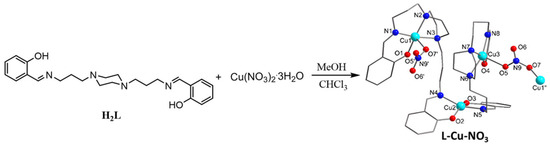
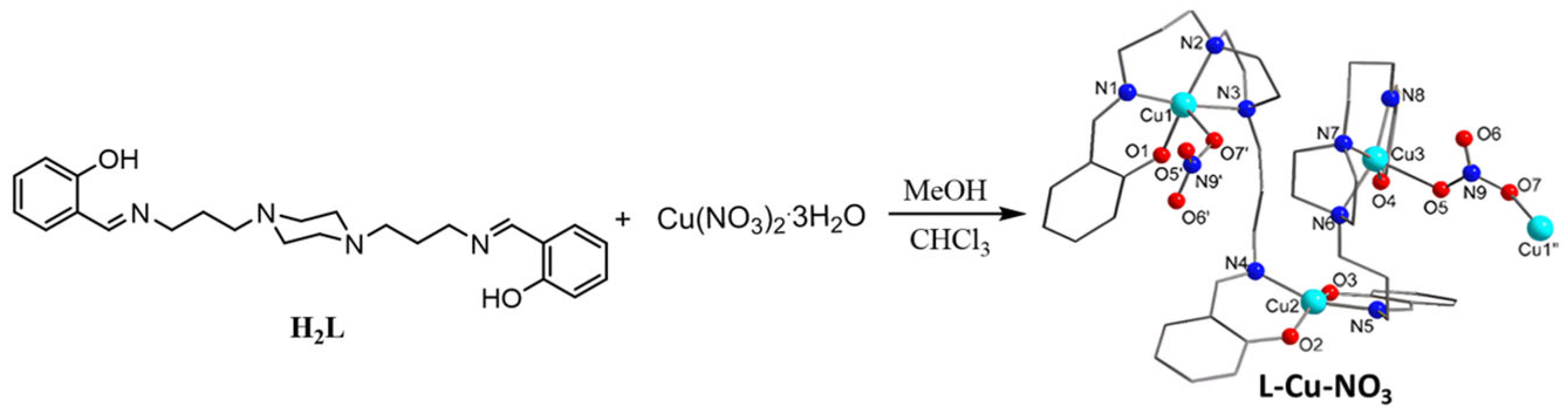
The reagents were all provided by Sigma-Aldrich and used without further purification. The complex 1∞ [Cu3L2(NO3)]NO3·2MeOH·2H2O (CP), denoted as L-Cu-NO3, was synthesized by a direct metal ligand reaction using a 2:1 stoichiometric ratio of Cu(NO3)2∙3H2O and N,N’-bis[(2-hydroxybenzilideneamino)-propyl]-piperazine) (H2L) according to the reaction presented in Scheme 1 [20].
Scheme 1.
Reaction of Schiff base and copper salt.
2.3. Membrane Preparation
PVC, THF, plasticizer, and CP were used to obtain the membranes. Before preparation, the CP was dried under dynamic vacuum at 120 °C for 24 h. The CP and 10% of the THF amount were mixed together, and then the PVC and the remaining amount of THF were added and mixed to obtain a transparent solution. This solution was transferred onto a Petri glass plate. The films were dried for 24 h at room temperature. The notation, composition, and membrane thickness are presented in Table 1.
Table 1.
Notation, composition, and membrane thickness.
The resulting membrane was characterized by ATR-FTIR, optical microscopy, contact angle, water retention, and electrical resistance.
2.4. Electrode Preparation
For this purpose, copper C101/CW004A bars (Epi System SRL, Brasov, Romania) were used to cut disc plates. Before each measurement, all the electrodes had been mechanically polished with SiC paper of different grades from 400 to 2400 and then mirror polished with diamond sprays with different grain sizes (6, 3, and 1 µm). The freshly prepared electrode was immediately covered with membranes. The membranes were prepared at the CP–PVC–plasticizer ratio mentioned in Table 1. A 10 mm diameter piece from each membrane was cut out and assembled on the copper or iron electrode surface, and the membrane–electrode assembly was carefully inserted in a Teflon holder with an exposed area of 1 cm2. The electrochemical measurements were carried out at room temperature, and prior to each measurement, the modified electrode was soaked in NaOH solution at pH 9.11 for 1 h. The detection limit of each sensor was established at the point of intersection of the final low concentration level segments of the calibration plot and extrapolated linear mid-range.
2.5. Instrumentation
FTIR spectra were recorded on a Jasco-FT/IR-4200 instrument (JASCO Corporation, Tokyo, Japan) in the range of 400–4000 cm−1 on compressed KBr pellets. For the pH measurement, an HI 2221 Calibration Check pH/ORP Meter from Hanna Instruments was used. An automatic analyzer with a CE-440 Elemental Analyzer from Exeter Analytical Inc. was used to find out what the compounds’ carbon and hydrogen elements were. We used a Zeiss Stemi 508 microscope (Carl Zeiss Microscopy GmbH, Gottingen, Germany) to investigate the membrane that formed on the metal surface. The surface roughness Ra parameter (average roughness) (Equation (1)) was calculated as the arithmetic average of the gray level (Equation (2)) [21]. The reported average roughness values represent the mean of five independent measurements.
The membrane thickness was determined using the Positector 2000 instrument (New York, NY, USA). To determine the thickness, the membrane was placed on a metal support, and at least five measurements were taken for each membrane. The average thickness of the membranes was approximated from five measurements.
Water absorption measurements. The dried membranes were immersed in distilled water for 24 h after their initial weight was measured. After 24 h, the membranes were removed from the water and gently wiped with a tissue to remove any water deposited on the membrane surface before being weighed again (Equation (3)).
To measure the contact angle under ambient conditions, a drop of 3 µL of distilled water was placed on the membrane surface, an image was captured using a Crenova USB digital microscope with 300× magnification and a 5 M pixel image sensor, and the contact angle was then determined from the digital images and analyzed with Crenova software (Crenova version 7.1.6.0), which is capable of measuring tiny objects easily and precisely (as small as 0.001 mm).
Porosity of membranes (ε) is the fraction of voids in the membrane structure and represents the ratio between the total pore volume and the apparent volume of the membrane. Porosity was determined gravimetrically, using water as the wetting agent, considering it to be the volume of water in the membrane relative to the geometric volume of the membrane (Equation (4)).
2.6. Electrochemical Characterization
Electrochemical impedance spectroscopy (EIS) and cyclic voltammetry (CV) were performed using Autolab 302N EcoChemie (Netherlander, 2007) in a 100 mL electrochemical cell to assess the effectiveness of membranes deposited on copper electrodes in phenol detection. The working electrode has an exposed area of 1 cm2. Potentials were measured using an Ag/AgCl 3 M KCl reference electrode at room temperature.
To estimate limit of detection (LOD), the formula is often used as shown in Equation (5).
3. Results
3.1. Characterization
3.1.1. CP Characterization
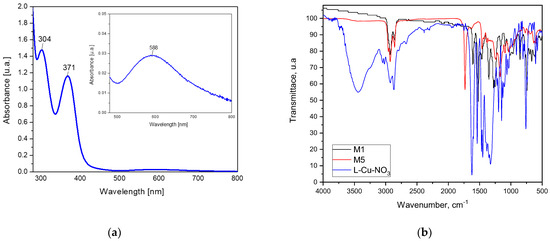
Comprehensive details on the synthesis and structural characterization of 1∞[Cu3L2(NO3)](NO3)·2MeOH·2H2O (L-Cu-NO3) are reported in our previous work [20]. Briefly, the crystallographic studies revealed that L-Cu-NO3 consists of trinuclear {Cu3L2}2+ units linked through nitrato bridging ligands forming a one-dimensional chain. The electronic spectrum was recorded in dimethylsulfoxide solution (5·10−5 M) and shows an absorption band at 304 nm, assigned to the π→π* transition of the aromatic ring, and a second band at 371 nm characteristic to the metal to ligand charge transfer transition (Figure 1). A broad band centered at 588 nm is attributed to the overlapping d-d transitions of two copper (II) ions exhibiting different coordination geometries [22].
Figure 1.
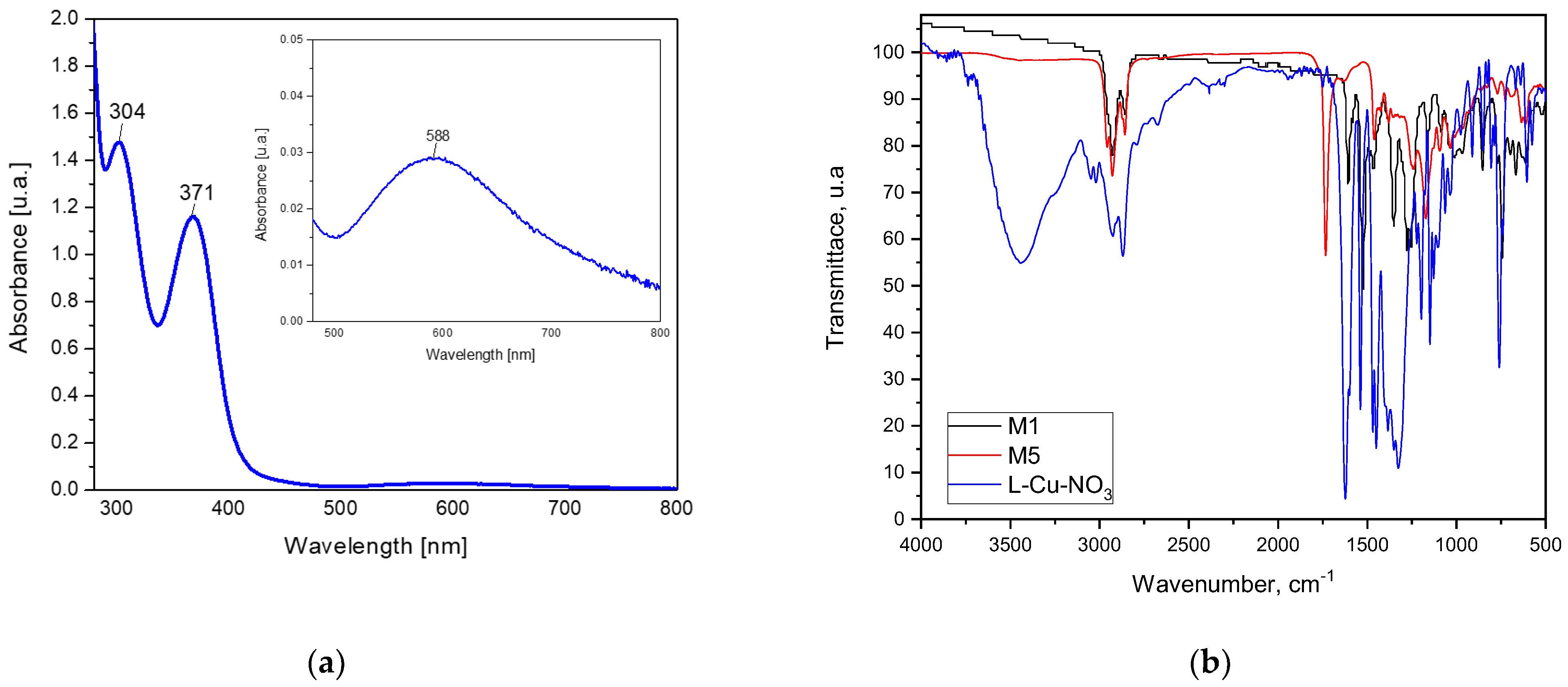
(a) Electronic spectra of L-Cu-NO3 recorded in DMSO (5·10−5 M) and (b) ATR-FTIR of L-Cu-NO3, M1, and M5.
The FTIR spectrum shows a band at 3460 cm−1, corresponding to the νOH vibration of water molecules present in the system. A band at a 2867 cm−1 wavelength is assigned to the symmetric stretching vibration δN-CH2. The characteristic imine vibration band, νC=N, is observed at 1623 cm−1. The phenoxide vibration, νC-O(phenoxide), is identified at 1327 cm−1, while the intense band at 1384 cm−1 and the medium band at 853 cm−1 are attributed to the vibration of the ionic nitrate group. The vibrational bands of the bidentate coordinating nitrate group are identified at 1450 and 1196 cm−1. The band observed at 466 cm−1 can be assigned to the νCu-N vibration [23].
3.1.2. Membrane Characterization
By incorporating a CP, the membrane improved its structural properties and achieved sensing ability. The prepared membranes were characterized by ATR-FTIR, optical microscopy, water retention, and contact angle. The thickness of the prepared membranes was between 130 μm and ~151 μm (Table 1).
ATR-FTIR spectra were recorded for all prepared membranes. All membranes containing CPs present similar ATR-FTIR patterns. Figure 1b presents the ATR-FTIR spectra of the unmodified PVC membrane (M1) and the PVC membrane modified with a 0.8 wt% CP (M5), together with the spectrum of the CP complex, for comparison.
The IR spectrum of the unmodified M1 membrane shows the characteristic absorption bands of PVC. Medium bands in the 2927–2850 cm−1 region are assigned to the stretching vibrations of aliphatic C–H groups. In the 1600–1500 cm−1 region, C–C stretching and δ(CH) deformation vibrations are observed, while the band at 1330 cm−1 is attributed to CH deformation. The band at 1461.9 cm−1 corresponds to the deformation vibration of CH2 groups (δCH2). The region between 1250 and 1000 cm−1 contains several bands (1162, 1088, and 1015 cm−1) characteristic of C–Cl stretching vibrations in PVC. At lower wavenumbers, bands around 834 cm−1 and in the 680–620 cm−1 range are assigned to C–Cl deformation vibrations. In the case of the M5 membrane, the IR spectrum exhibits slight band shifts and additional absorption features, indicating the successful incorporation of CPs into the PVC. The band observed at 2858 cm−1 is assigned to symmetric –CH2-N- stretching vibrations associated with CPs. The strong band at 1733 cm−1 is attributed to C=O groups, most likely originating from the plasticizer used, confirming its integration into the membrane structure. The band situated at 1633 cm−1 is attributed to the ν(C=N) stretching vibration of CPs, while the band at 1382 cm−1 can be assigned to νC-O(phenoxide), vibrations of phenoxide groups. Additionally, the absorption band observed at 596 cm−1 is characteristic of metal–ligand vibrations, attributed to ν(Cu–O). The polymeric matrix is identifiable in the M5 membrane through the presence of characteristic PVC bands in the 636–770 cm−1 region, assigned to ν(C–Cl) vibrations, and in the 1030–1095 cm−1 region, corresponding to δ(C–Cl) vibrations.
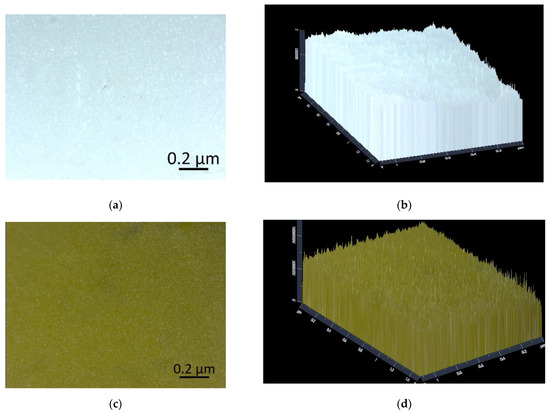
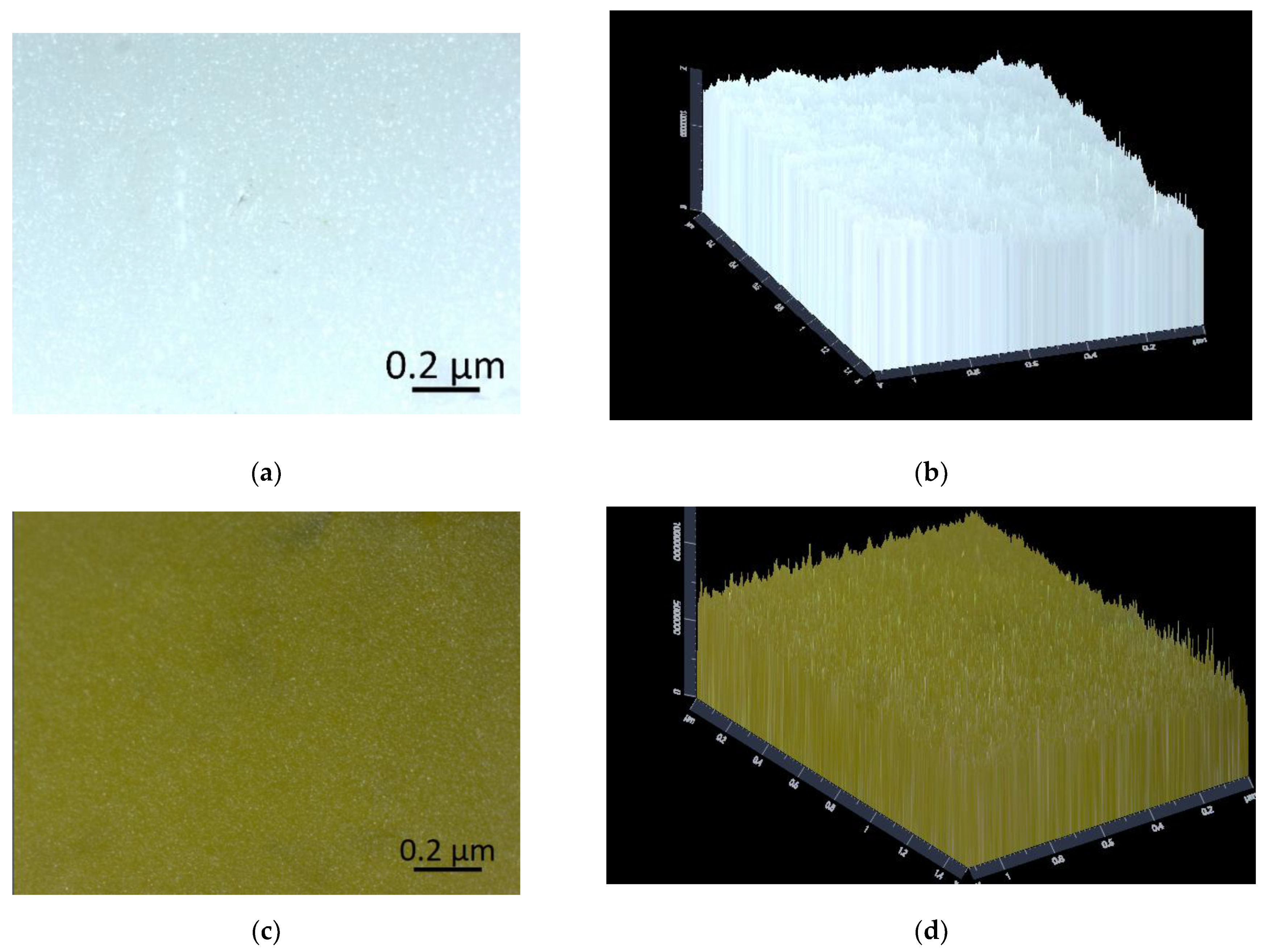
Optical images of membranes M1 and M2 are shown in Figure 2. PVC surface morphology can limit the adhesion sites for oily phenol droplets, which may limit the membrane’s ability in applications involving phenol quantification.
Figure 2.
Microscope image (a) M1-2D, (b) M1-3D, (c) M2-2D, and (d) M2-3D.
Porosity. The pure PVC membrane (M1) demonstrates a relatively smooth surface with a low average roughness (Ra) of approximately 4.90 μm and a uniform and homogeneous structure. In contrast, the optical images of the modified membranes reveal a significantly rougher surface due to the embedding of CPs within the PVC matrix from 4.91 μm for M1 to approximately 6.57 μm to M5 (Table 1). The enhanced surface texture provides more active sites for phenol adhesion, improving the sensing efficiency.
Water absorption refers to a material’s ability to store water within its structure. This was measured by the weight gain of the sample when exposed to humidity or a water bath. The values determined for the prepared membranes were presented in Table 2.
Table 2.
Water absorption, porosity, and contact angle for prepared membrane.
The water absorption increases with the increase in CP amount added to the PVC membrane. The higher absorption percent was obtained in the case of M5, the membrane with the highest content of CPs. This suggests that the incorporation of CPs significantly enhances the membrane’s ability to retain moisture. Such properties should be beneficial for applications requiring improved flexibility and durability in varying environmental conditions.
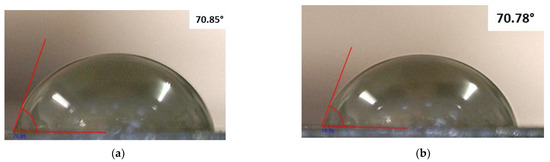
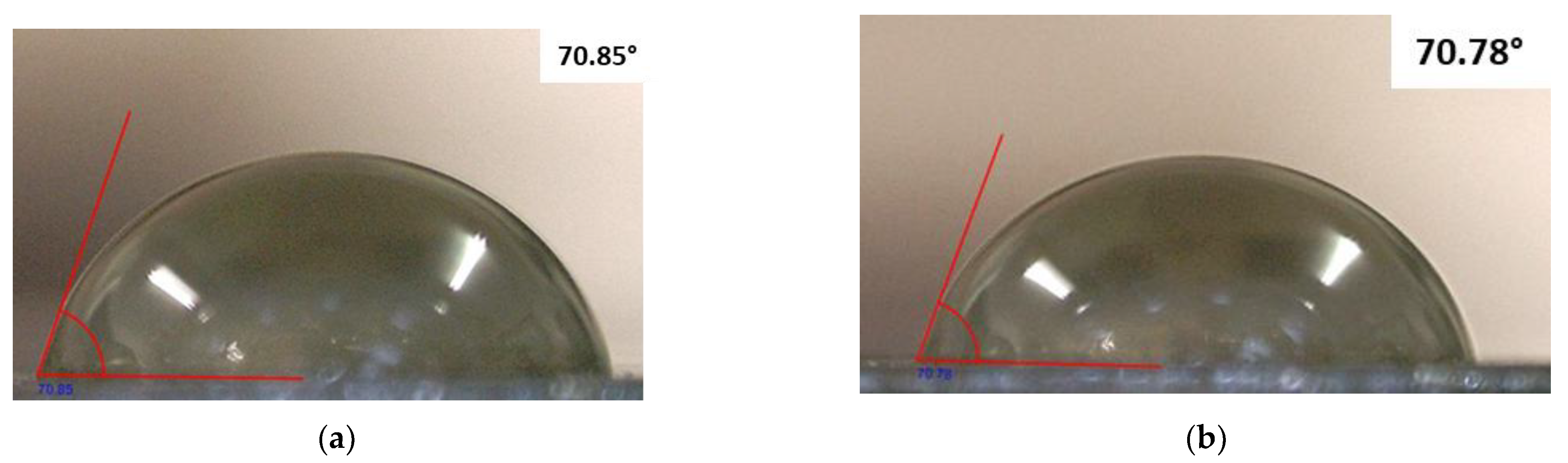
The water contact angle of analyzed membranes decreased from 73.4° for the PVC to ~71° for the composite membrane analyzed in the present study, evidencing improvement of the hydrophilicity due to CP–PVC polymer interactions (Table 2). Figure 3 presents the water contact angle for M4 and M5 membranes with angles of 70.85° and 70.87°, respectively.
Figure 3.
Water angle contact: (a) M4 and (b) M5.
The addition of a CP improves the hydrophilicity of the membrane, as indicated by the decrease in the water contact angle. The most hydrophilic membrane surface obtained in this study was found in the PVC membrane with the addition of 0.10% weight CP, with a contact angle of 70.78°. The decrease in the water contact angle of PVC membranes upon addition of a CP can be attributed to several interconnected factors related to surface chemistry and morphology; this change causes the liquid to spread more easily across the surface due to stronger interactions between the liquid and the new polymer surface. Coordinated polymers often contain functional groups such as hydroxyl, carboxyl, or amino groups that are inherently hydrophilic. When these polymers are incorporated into the PVC matrix, they migrate or orient toward the membrane surface, increasing surface polarity and affinity for water. The presence of coordinated polymers modifies the surface energy of the membrane. Higher surface energy materials tend to attract water more strongly, leading to a lower water contact angle [24]. In addition, the increased surface roughness combined with hydrophilic features enhances wettability, thereby reducing the contact angle and achieving sensing capacity. The decreased water contact angle of various membranes due to modification has been reported by researchers [25] who observed similar trends in their studies, highlighting the role of surface chemistry in enhancing membrane performance. The infrared measurements are supported by the quantitative data, which confirm that integrating CPs within the PVC matrix results in beneficial interfacial interactions that enhance the overall performance of the membrane.
The interaction of phenol with the membrane material changes the electrical properties, causing a detectable change in the measured impedance, correlated with the concentration of phenol. The modified electrodes can detect changes in the membrane’s resistance; a capacitive membrane operates by detecting changes in the dielectric constant of a membrane, frequently taking advantage of changes in surface stress.
3.2. Electrochemical Investigation
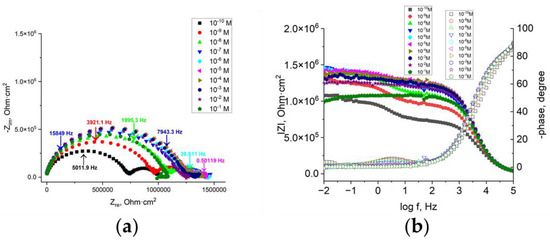
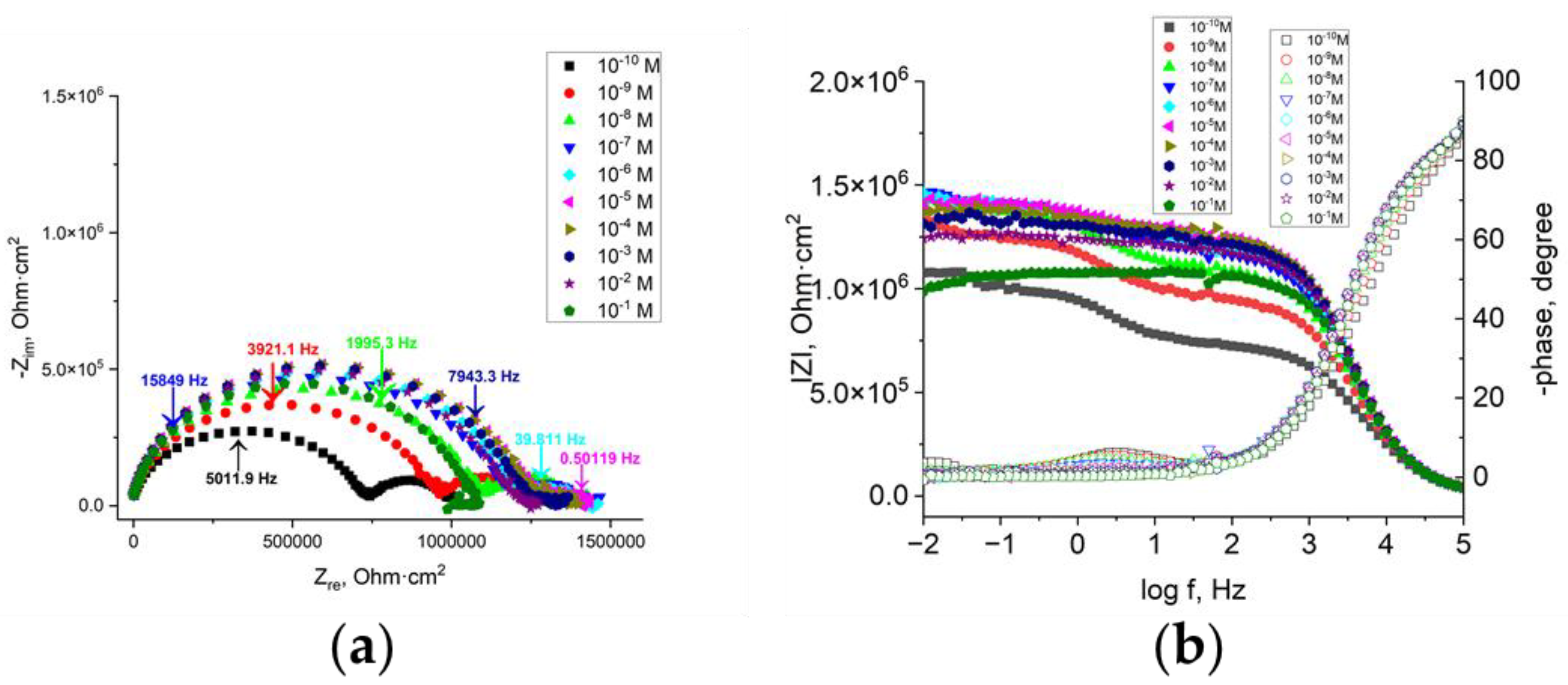
Impedance spectroscopy (EIS) was used to determine the changes in the responses of the developed prototypes for the tested concentrations of phenol solution that were carried out at pH 9.11, in the concentration range of 10−10 to 10−2 mol·L−1. The Nyquist and Bode graphs for membrane M5 deposited on copper are presented in Figure 4.
Figure 4.
EIS spectra: (a) Nyquist and (b) Bode diagram for M5/Cu immersed in tested concentrations of phenol solution at pH 9.11, in the concentration range of 10−10 to 10−2 mol·L−1.
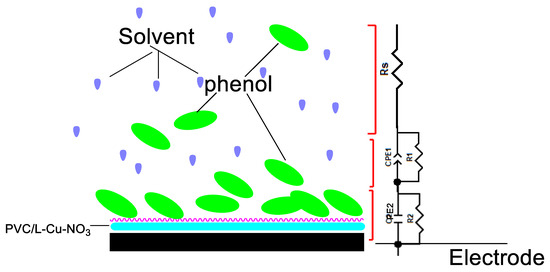
In the Nyquist plots double semicircles are observed, with their centers on the real axis. The first semicircle observed at the highest frequencies represents the interface between the membrane surface and the solution. Due to excess positive charge on the membrane surface, it attracts oppositely charged ions from the solution (phenolate ions) and forms this double layer. The second semicircle observed represents the membrane phase and provides information about the performance and interface characteristics of the material, such as the rate of diffusion or the condition of a coating. The diameter of the semicircles decreases with the concentration of phenol in the solution. The diameter of this semicircle is directly proportional to the charge transfer resistance. A larger diameter means a higher resistance to charge transfer. This indicates a decrease in membrane resistance or an increase in membrane conductance. The circuit of Figure 5 is used to model the experimental EIS data and includes two RC parallel RC circuit connected in series. The first RC parallel circuit represents the aqueous solution–membrane interface and the second one represent the membrane phase. Phenolate ions attached to electrode surface and changes in electrical characteristics (impedance or capacitance) of a sensing layer were detected (Figure 5). Upon immersion of the M5 membrane in a phenolic solution, the interaction of phenol with the CP-modified membrane may proceed via two main pathways: (i) adsorption mediated by noncovalent interactions. In this case, phenol molecules interact through hydrogen bonding between the hydroxyl group of phenol and donor atoms, such as imine nitrogen and oxygen atoms, present in the coordination polymer complex. Also, π–π interactions between the aromatic ring of phenol and the aromatic moieties of the coordination polymer may contribute to phenol retention within the membrane and (ii) phenolate coordination to Cu(II) centers. At pH 9.11, phenol is partially deprotonated, enabling the phenolate anion to interact with Cu(II) ions through ligand exchange with weakly coordinated nitrate molecules from apical positions, leading to the formation of Cu–O(phenolate) bonds. The impedance measurements were recorded on membranes deposited on copper metal. At the highest range of frequencies, the overall impedance |Z| of the membrane system is determined by the resistance of the solution (Rs). The membrane resistance (R2) decreases with decreases in phenol concentration in the solution. The membrane surface has positive charges due to metal ions and the N,N’-bis[(2-hydroxybenzilideneamino)-propyl]-piperazine unit. Most of the positive charges are neutralized by phenolate ions. The phenolate ions attached to the membrane surface increase the resistance. The phenolate ions attached to the membrane surface apply an ionic pressure that decreases with the decreasing phenol concentration in the solution. The electrochemical impedance parameters by fitting EIS data with the EEC model are shown in Table 3.
Figure 5.
Schematic diagram of EEC.
Table 3.
Experimental values of the circuit parameters for M5 modified electrodes versus phenolate concentration.
Thus, with a decrease in phenol concentration, membrane resistance (R2) increases. The CPE exponents of the CPE1-T and CPE2-T for the membranes were <1, which was consistent with the semicircle deformation phenomena and are related to the surface roughness of membranes [26]. The capacity of the double layer decreases with the phenol concentration, probably due to the formation of an organic film on the surface of the electrode.
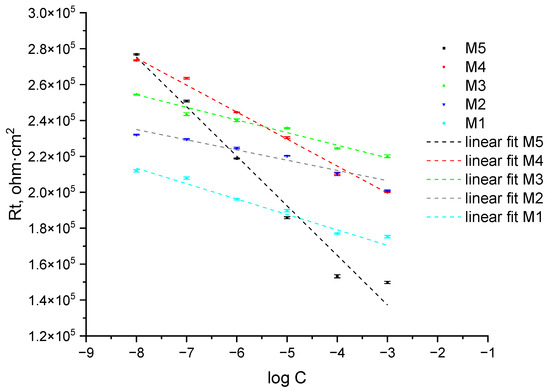
Calibration curves were constructed using the total resistance (Rt = R1 + R2) and the respective phenol concentration. A clear change was observed in the Rt versus total phenol concentration, revealing modifications in the electrode’s impedance behavior upon phenolate binding, highlighting a decrease in the system impedance with rising phenolate concentrations. The resistance of a membrane decreases with increasing concentrations of the analyte due to the increase in the number of mobile charge carriers (ions) available to carry electrical current through the membrane (Figure 5). At a higher concentration of analyte in solution, more ions were present at the solution–membrane interface and within the pores of the membrane. These ions act as charge carriers and facilitate the swelling and create wider and less obstructed pathways for ion migration through the membrane structure. This process reduces interactions between ions, water, and the membrane matrix, increasing ion mobility. Increased mobility and number of ions leads to a higher electrical conductance of the membrane and, implicitly, a lower total resistance (Figure 6).
Figure 6.
Calibration curves of Rt versus [phenolate] for all membranes.
The linear range of detection was in the concentration range of 10−8 to 10−5 mol·L−1 for membranes with a CP concentration higher than 0.4% wt membrane (M3, M4, and M5) on the copper substrate. The Residual Sum of Squares (RSS) is a statistical measure that shows how well a regression model fits data. It is the sum of the squared differences between the actual and predicted values. A low RSS indicates that the model gave a good fit, while a high RSS suggests a poor fit, and a value of zero means the model is a perfect fit. Membranes M4 and M3 present with a good RSS and fit. Considering that the RSS value for M5 was higher than that of M4, it follows that a higher concentration of CP increases the difficulty of reproducibility in incorporation into the PVC matrix. Taking into account both the RSS values and overall reproducibility, M4 demonstrates more consistent performance for phenol detection. The Pearson correlation measures the strength of the linear relationship between two variables. Values between ±0.50 and ±1 suggest a strong correlation. Also, the membrane M4 presents the strongest correlation. R-Square, known as the Coefficient of Determination (COD), tells about how well the model explains the variability of the data around the mean, and a higher adjusted R-squared value also indicates a better-fitting model, relative to its complexity. The best values were shown by M4. The M4-COD value means that 0.9965% of the variance in the dependent variable can be predicted from the independent variable(s). After analyzing the linearization of the calibration data, M4 showed an excellent correlation, with minimal measurement errors. In contrast, M3 and M5 had a weaker correlation, with larger errors. Thus, we can conclude that the M4 membrane is more reliable and accurate for measurements. This indicates that the electrochemical performance of the sensor reaches its optimum when the CP content is 0.6% wt, providing linearization in the range 10−8 to 10−5 mol·L−1 and the detection limit was 4.64 × 10⁻⁸ mol·L−1. The membrane M4 presents a promising result and a larger detection range than ZnO-functionalized graphene oxide (GO)-modified glassy carbon electrodes (5–155 μM) [27], or nitrogen graphdiyne (NGDY) amperometric sensors (0.02–5 μM) (Table 4) [28].
Table 4.
Linearization data for all membranes used in phenol detection.
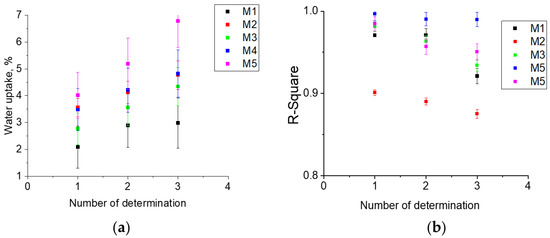
Membrane swelling affects both the resistance and mechanical stability of the membrane, potentially leading to the creation of water transport channels over time. A high degree of swelling leads to lower ohmic resistances and can cause mechanical stresses and dimensional discrepancies, limiting the membrane’s adhesion to the electrode. It was observed that the water absorption values increase with the number of determinations. Higher water absorption was obtained for M5, but this phenomenon leads to a decrease in the membrane’s adhesion to the electrode and to larger errors. These errors can significantly impact the overall performance and reliability of the system. Therefore, it is crucial to optimize the swelling properties to balance reproducibility and the mechanical integrity of the membrane. The best performance was observed for the M4 membrane, which showed the smallest variations in water absorption in successive measurements and higher R-squared values (Figure 7a,b).
Figure 7.
Variation of (a) water uptake and (b) R-squared values during successive determination.
3.3. Formatting of Mathematical Components
The arithmetic average of the gray level can be expressed as shown in Equation (1):
where g1, g2 … gn are the gray level values of a surface image along one line.
Ra = Σ(|g1 − gm| + |g2 − gm| + … + |gn − gm|)/n
The mean of the gray values (gm) is determined as shown in Equation (2):
gm = Σ(g1 + g2 + … + gn)/n
The water absorption of the samples was calculated using the Equation (3):
where
- = weight of wet membrane, after 24 h immersion (g);
- = weight of dry membrane, before immersion (g).
The water absorption value is given by the arithmetic media of six determinations.
Porosity was determined gravimetrically, using water as the wetting agent, considering it to be the volume of water in the membrane relative to the geometric volume of the membrane, Equation (4):
where Vw = absorbed water volume (cm3);
- Vt = total volume of membrane (cm3).
To estimate limit of detection (LOD), the formula is often used as shown in Equation (5):
where σ is the standard deviation of the measurement error or residuals (in our case, this can be estimated from the RSS); b is the slope of the regression.
LOD = (3 × σ)/|b|
4. Conclusions
The PVC membrane’s moisture retention capacity is significantly enhanced by the incorporation of CPs. The water contact angle decreased from 73.4° for pristine PVC to approximately 71° for the composite membrane, indicating that CP–PVC polymer interactions improve membrane hydrophilicity. Electrochemical impedance spectroscopy (EIS) was employed to evaluate the membrane response to synthetic phenol solutions at pH 9.11 over a concentration range of 10−10 to 10−2 mol·L−1. Among the tested configurations, the PVC membrane containing 0.6 wt% L-Cu-NO3 deposited on a Cu electrode exhibited the best sensing performance. A linear response was observed in the phenol concentration range of 10−8 to 10−5 mol·L−1, with a detection limit of 4.64 × 10⁻⁸ mol·L−1. By integrating this CP, promising chemical interactions with phenol were achieved, which facilitates the detection process. Initial results suggest increased sensitivity and remarkable selectivity toward this substance, making these membranes an excellent choice for the development of advanced sensors. Additionally, the ability of these membranes to maintain their integrity and stability under synthetic phenol basic conditions highlights promising developments for industrial applications. Continuing research in this direction will offer valuable insights into the use of PVC membranes with coordination polymers for phenol detection and for the development of innovative solutions in environmental protection.
Author Contributions
A.-M.C.: Investigation, Data curation, Writing—original draft; M.T.-L.M.: Conceptualization, Methodology, Supervision, Writing—original draft, Writing—review and editing; I.B.: Investigations, Data curation, Methodology, Writing—original draft, Writing—review and editing; V.M.: Data curation, Software, Writing—review and editing; A.V.: Formal analysis, Software; Writing—original draft, Writing—review and editing; A.B.: Data curation, Writing—review and editing; N.P.: Supervision, Methodology, Data curation, Formal analysis, Project administration, Writing—original draft, Writing—review and editing. All authors have read and agreed to the published version of the manuscript.
Funding
This work was partially supported by Program no. 2, from the “Coriolan Dragulescu” Institute of Chemistry, Timisoara, Romania, and by project “ICT—Interdisciplinary Center for Smart Specialization in Chemical Biology (RO-OPENSCREEN)”, MySMIS code: 127952, Contract no. 371/20.07.2020, co-financed by the European Regional Development Fund under the Competitiveness Operational Program 2014–2020.
Data Availability Statement
Data will be made available on request.
Conflicts of Interest
The authors declare that they have no known competing financial interests or personal relationships that could have appeared to influence the work reported in this paper.
References
- Hashim, H.S.; Yap, W.F.; Sheh Omar, N.A.; Muhamad Fauzi, N.I.; Wan, M.E.M. Recent advances of priority phenolic compounds detection using phenol oxidases-based electrochemical and optical sensors. Measurement 2021, 18, 117724. [Google Scholar] [CrossRef] [Scilit]
- El-Kosasy, A.M.; Riad, S.M.; Abd El-Fattah, L.E.; Abd El-Kader Ahmad, S. Novel poly (vinyl chloride) matrix membrane electrodes for the determination of phenolic pollutants in waste water. Water Res. 2003, 37, 1769–1770. [Google Scholar] [CrossRef] [Scilit]
- Chen, K.; Zhang, Z.-L.; Liang, Y.-M.; Liu, W.A. Graphene-Based Electrochemical Sensor for Rapid Determination of Phenols in Water. Sensors 2013, 13, 6204–6216. [Google Scholar] [CrossRef] [Scilit] [PubMed]
- Huang, W.; Zhou, D.; Liu, X.; Zheng, X. Electrochemical determination of phenol using CTAB-functionalized montmorillonite electrode. Environ. Technol. 2009, 30, 701–706. [Google Scholar] [CrossRef] [Scilit] [PubMed]
- Ojala, M.; Ketola, R.A.; Virkki, V.; Sorsa, H.; Kotiaho, T. Determination of phenolic compounds in water using membrane inlet mass spectrometry. Talanta 1997, 44, 1253–1259. [Google Scholar] [CrossRef] [Scilit] [PubMed]
- Faisal, M.; Alam, M.M.; Ahmed, J.; Asiri, A.M.; Jalalah, M.; Alruwai, R.S.; Rahman, M.M.; Harraz, F.A. Sensitive Electrochemical Detection of 4-Nitrophenol with PEDOT:PSS Modified Pt NPs-Embedded PPy-CB@ZnO Nanocomposites. Biosensors 2022, 12, 990. [Google Scholar] [CrossRef] [Scilit]
- Sergeyeva, T.A.; Slinchenko, O.A.; Gorbach, L.A.; Matyushov, V.F.; Brovko, O.O.; Piletsky, S.A.; Sergeeva, L.M.; Elska, G.V. Catalytic molecularly imprinted polymer membranes: Development of the biomimetic sensor for phenols detection. Anal. Chim. Acta 2010, 659, 274–279. [Google Scholar] [CrossRef] [Scilit]
- Hamid, A.A.; Alam, J.; Shukla, A.K.; Ali, F.A.A.; Alhoshan, M. Sustainable removal of phenol from wastewater using a biopolymer hydrogel adsorbent comprising crosslinked chitosan and κ-carrageenan. Int. J. Biol. Macromol. 2023, 251, 126340. [Google Scholar] [CrossRef] [Scilit]
- Zhang, X.; Miao, S.; Zhou, J.; Zhou, T.; Gan, T.; Tang, Y. Paper-based molecularly imprinted electrochemical sensor integrated with Pt single atom decorated porous hollow carbon polyhedrons for enhanced phenolic pollutants monitoring in wastewaters. Sens. Actuators B Chem. 2025, 445, 138592. [Google Scholar] [CrossRef] [Scilit]
- Padilha, L.F.; Borges, C.P. PVC membranes prepared via non-solvent induced phase separation process. Braz. J. Chem. Eng. 2019, 36, 497–509. [Google Scholar] [CrossRef] [Scilit]
- Mulyasuryani, A.; Mustaghfiroh, A.M. Development of Potentiometric Phenol Sensors by Nata de Coco Membrane on Screen-Printed Carbon Electrode. J. Anal. Methods Chem. 2019, 2019, 4608135. [Google Scholar] [CrossRef] [Scilit] [PubMed]
- Rahman, M.M. Selective capturing of phenolic derivative by a binary metal oxide microcubes for its detection. Sci. Rep. 2019, 9, 19234. [Google Scholar] [CrossRef] [Scilit] [PubMed]
- Siontorou, C.G.; Georgopoulos, K.N. A Ready-to-Use Metal-Supported Bilayer Lipid Membrane Biosensor for the Detection of Phenol in Water. Membranes 2021, 11, 871. [Google Scholar] [CrossRef] [Scilit] [PubMed]
- Rahman, M.M.; Balkhoyor, H.B.; Asiri, A.M. Phenolic sensor development based on chromium oxide-decorated carbon nanotubes for environmental safety. J. Environ. Manag. 2017, 188, 228–237. [Google Scholar] [CrossRef] [Scilit]
- Devic, T.; Serre, C. High valence 3p and transition metal based MOFs. Chem. Soc. Rev. 2014, 43, 6097–6115. [Google Scholar] [CrossRef] [Scilit]
- Zhang, C.; Mu, Y.; Zhang, W.; Zhao, S.; Wang, Y. PVC-based hybrid membranes containing metal-organic frameworks for Li+/Mg2+ separation. J. Membr. Sci. 2020, 596, 117724. [Google Scholar] [CrossRef] [Scilit]
- Liu, Y.; Zhao, Z.; Xin, R.; Li, D.; Dong, X.; Kushwaha, A.; Parvez, M.K.; Al-Dosari, M.S.; Kumar, A.; Huang, Y. Electrochemical sensing properties of cobalt-based coordination polymers for trace l-tryptophan in milk. Dalton Trans. 2025, 54, 6472–6485. [Google Scholar] [CrossRef] [Scilit]
- Teng, J.; Gao, R.; Cai, Q.; Ma, Y.; Wu, H. Bifunctional electrochemical sensor for L-ascorbic acid and hydrazine based on a two-dimensional cobalt(II) coordination polymer. Electrochim. Acta 2025, 542, 147507. [Google Scholar] [CrossRef] [Scilit]
- Zhang, Y.; Liu, W.; Yao, W.; Kang, L.; Gao, E.; Fedin, V.P. An electrochemical sensor based on carbon composites derived from bisbenzimidazole biphenyl coordination polymers for dihydroxybenzene isomers detection. Microchim. Acta 2023, 191, 20. [Google Scholar] [CrossRef] [Scilit] [PubMed]
- Buta, I.; Ardelean, A.; Lönnecke, P.; Novitchi, G.; Hey-Hawkins, E.; Andruh, M.; Costisor, O. Structural and magnetic properties of three one-dimensional nitrato-, azido- and phenoxido-bridged copper(II) coordination polymers. Polyhedron 2020, 190, 114766. [Google Scholar] [CrossRef] [Scilit]
- Narayanan, R.M.; Gowri, S.; Krishna, M.M. On Line Surface Roughness Measurement Using Image Processing and Machine Vision. In Proceedings of the World Congress on Engineering, London, UK, 2–4 July 2007; pp. 645–647. [Google Scholar]
- Lever, A.B.P. Inorganic Electronic Spectroscopy, 2nd ed.; Elsevier: New York, NY, USA, 1968; pp. 359–361. [Google Scholar]
- Nakamoto, K. Infrared and Raman Spectra of Inorganic and Coordination Compounds, 4th ed.; John Wiley & Sons, Inc. Publication: New York, NY, USA, 1986; pp. 225–233. [Google Scholar]
- Novio, F.; Ruiz-Molina, D. Hydrophobic coordination polymer nanoparticles and application for oil–water separation. RSC Adv. 2014, 4, 15293–15296. [Google Scholar] [CrossRef] [Scilit]
- Vatanpour, V.; Boroujeni, N.I.; Pasaoglu, M.E.; Mahmodi, G.; Mohammadikish, M.; Kazemi-Andalib, F.; Koyuncu, I. Novel infinite coordination polymer (ICP) modified thin-film polyamide nanocomposite membranes for simultaneous enhancement of antifouling and chlorine-resistance performance. J. Membr. Sci. 2022, 647, 120305. [Google Scholar] [CrossRef] [Scilit]
- Díaz, D.R.; Carmona, F.J.; Palacio, L.; Ochoa, N.A.; Hernández, A.; Prádanos, P. Impedance spectroscopy and membrane potential analysis of microfiltration membranes. The influence of surface fractality. Chem. Eng. Sci. 2018, 178, 27–38. [Google Scholar] [CrossRef] [Scilit]
- Arfin, T.; Rangari, S.N. Graphene oxide–ZnO nanocomposite modified electrode for the detection of phenol. Anal. Methods 2018, 10, 347–358. [Google Scholar] [CrossRef] [Scilit]
- Niu, K.; Gao, J.; Wu, L.; Lu, X.; Chen, J. Nitrogen-doped graphdiyne present Nitrogen-doped graphdiyne as a robust electrochemical biosensing platform for ultrasensitive detection of environmental pollutants. Anal. Chem. 2021, 93, 8656–8662. [Google Scholar] [CrossRef] [Scilit]

Disclaimer/Publisher’s Note: The statements, opinions and data contained in all publications are solely those of the individual author(s) and contributor(s) and not of MDPI and/or the editor(s). MDPI and/or the editor(s) disclaim responsibility for any injury to people or property resulting from any ideas, methods, instructions or products referred to in the content. |
© 2026 by the authors. Licensee MDPI, Basel, Switzerland. This article is an open access article distributed under the terms and conditions of the Creative Commons Attribution (CC BY) license.