


Abstract
Hydrothermal annealing can modify starch digestibility and techno-functional properties. This study evaluated annealing time (24–72 h; 67 °C, 70% moisture) in yellow sweet potato flour and starch subsequently recovered from the treated flours. In flour, rapidly digestible starch (RDS) decreased significantly (p < 0.05) from 41.5% in untreated flour to 37.5% after 72 h, with no significant differences among treated flours. Resistant starch (RS) increased significantly at each time, from 5.7% to 14.3% at 72 h. Total phenolic content and antioxidant activity decreased significantly after 24 h and partially recovered thereafter, remaining below untreated flour values. In recovered starch, RDS decreased significantly from 77.3% to 70.6%; the 48- and 72-h samples were significantly lower than the 24-h sample but did not differ from each other. RS increased from 17.3% to 25.5% and 25.8% at 48 and 72 h, respectively, without significant differences between these times. Descriptive analysis of single-run Rapid Visco Analyzer (RVA) profiles indicated less pronounced peaks during heating and greater viscosity development during cooling in both ingredients. Recovered-starch gel hardness decreased from 1.98 N to 0.83 N at 48 h. These findings characterize time-dependent changes in digestibility in both ingredients, gel texture in recovered starch, and phenolic content and antioxidant activity in flour, alongside observed changes in pasting behavior.
1. Introduction
Sweet potato (Ipomoea batatas L.) is an important root crop cultivated worldwide and recognized for its high carbohydrate content, nutritional value, and versatility in food applications. In addition to being a major source of starch, sweet potato contains dietary fiber and bioactive compounds that contribute to its growing interest as an ingredient for functional and value-added foods [1,2]. Among the different sweet potato varieties, yellow-fleshed cultivars have attracted attention because of their carotenoid content, while sweet potato flour has been explored as a functional ingredient in bakery and other food applications [3,4].
The functionality of sweet potato-derived ingredients is largely determined by the physicochemical characteristics of starch, which influence digestibility, pasting behavior, gel formation, and processing performance. Consequently, considerable efforts have been devoted to developing modification strategies capable of tailoring starch functionality while meeting current consumer demand for minimally processed and clean-label foods. Among these approaches, hydrothermal treatments have gained increasing attention because they can modify starch properties without the use of chemical reagents [5,6].
Annealing is a hydrothermal modification technique performed under excess-moisture conditions at temperatures above the glass transition temperature but below starch gelatinization. Under these conditions, molecular mobility is enhanced, leading to modifications in starch functionality while maintaining granular integrity [6,7]. Previous studies have shown that annealing can alter starch digestibility, resistant starch content, pasting characteristics, and other physicochemical properties in starches from different botanical sources [8,9,10]. For example, Trung et al. [9] reported decreased rapidly digestible starch and increased slowly digestible and resistant starch fractions following annealing of starches isolated from different sweet potato varieties. In contrast, Zhang et al. [10] observed that resistant starch content decreased with increasing treatment time or number of cycles during continuous and repeated annealing of sweet potato starch. Furthermore, Zhang et al. [11] reported that annealing applied to sweet potato flour modified its pasting properties and the textural characteristics of flour-based hydrogels. These changes are of particular interest because resistant starch has been associated with reduced digestibility and potential physiological benefits, whereas modifications in pasting and textural behavior may affect processing performance and product quality [12].
Although annealing has been investigated in several starch-rich materials [5,6,8], information regarding the influence of annealing duration on the digestibility and functional behavior of yellow sweet potato-derived ingredients remains limited. In particular, the consequences of applying annealing to the flour and subsequently recovering the starch from the treated material have received comparatively little attention. Evaluating these responses within the same processing sequence provides a more integrated perspective on how treatment duration influences both the flour and the starch recovered after processing.
Therefore, the objective of this study was to evaluate the effect of annealing duration (24, 48, and 72 h) on the digestibility and techno-functional properties of yellow sweet potato flour and starch subsequently recovered from the treated flours. This approach aims to improve our understanding of how the duration of hydrothermal treatment applied to a flour system influences the digestibility and techno-functional characteristics of the starch subsequently recovered from that system.
2. Materials and Methods
2.1. Materials
Yellow-fleshed sweet potatoes (Ipomoea batatas L.) were purchased in summer from a local wholesale market in Pachuca, Hidalgo, Mexico. The sweet potatoes were processed immediately after purchase without prior storage. Pepsin from porcine gastric mucosa (≥250 units/mg solid, catalog P7000), pancreatin from porcine pancreas (8 × USP, catalog P7545), amyloglucosidase from Aspergillus niger (≥260 U/mL, catalog A7095), and invertase from Saccharomyces cerevisiae (Grade VII, ≥300 units/mg solid, catalog I4504) were obtained from Sigma-Aldrich (St. Louis, MO, USA). The Total Starch Assay Kit (AA/AMG) and glucose oxidase–peroxidase (GOPOD) reagent were obtained from Megazyme International Ireland Ltd. (Wicklow, Ireland). Reagents used for the determination of total phenolic content and antioxidant activity were purchased from Sigma-Aldrich (St. Louis, MO, USA). These included Folin–Ciocalteu reagent, sodium carbonate, gallic acid, 2,2-diphenyl-1-picrylhydrazyl (DPPH), and Trolox. All reagents were of analytical grade.
2.2. Flour Preparation
Sweet potatoes were washed with potable water, peeled, and manually sliced into 1-cm-thick discs. The slices were immersed in a citric acid solution (3 g/L) at a sweet potato-to-solution ratio of 1:2 for 15 min to prevent enzymatic browning and subsequently dried in a forced-air convection oven (FO-19013, Across International, Livingston, NJ, USA) at 40 °C for 24 h. The dried slices were milled using a blender (NutriBullet Pro 900 W, NutriBullet, Los Angeles, CA, USA) to obtain a homogeneous flour and passed through a 100 μm mesh sieve to standardize particle size. The resulting native sweet potato flour (F0) was stored in airtight containers at room temperature until further use.
2.3. Hydrothermal Annealing Treatment
Hydrothermal annealing was performed following previously reported methodologies for starch modification [6,7]. Yellow sweet potato flour (250 g, dry basis) was adjusted to 70% moisture content (w/w) with distilled water and sealed in polyethylene bags. The samples were equilibrated at 4 °C overnight, following previously reported annealing procedures [13,14], and subsequently stabilized at 25 °C for 2 h. The equilibrated samples were transferred to hermetically sealed glass containers and annealed in the forced-air convection oven (FO-19013, Across International, Livingston, NJ, USA) at 67 °C for 24, 48, and 72 h. After treatment, samples were equilibrated at 25 °C for 4 h, dried at 40 °C for 24 h, and passed through a 100 μm mesh sieve. Native flour was designated as F0, whereas annealed flours treated for 24, 48, and 72 h were designated as F24, F48, and F72, respectively. All samples were stored in airtight containers until analysis.
2.4. Determination of Proximate Composition and Carbohydrate Profile
Moisture, ash, and protein contents of native and annealed yellow sweet potato flours were determined according to AACC Approved Methods [15]. Moisture content was measured by oven drying (Method 44-19) using a Heratherm OMS100 drying oven (Thermo Scientific, Thermo Electron LED GmbH, Langenselbold, Germany), ash content by incineration at 550 °C (Method 08-01), and crude protein by the Kjeldahl method (Method 46-13) using a Büchi K-350 distillation unit (BÜCHI Labortechnik AG, Flawil, Switzerland) and a nitrogen-to-protein conversion factor of 5.89. Total starch content in both flour and recovered starch samples was determined using the Total Starch Assay Kit, following AOAC Method 996.11 [16]. Free glucose content was determined by aqueous extraction followed by the glucose oxidase–peroxidase (GOPOD) assay. Briefly, 200 mg of flour was mixed with 10 mL of bidistilled water and continuously agitated for 30 min. Subsequently, a 50 μL aliquot was transferred into a microcentrifuge tube containing 950 μL of 80% ethanol and centrifuged at 12,851× g for 5 min. An aliquot (50 μL) of the resulting supernatant was mixed with 1.5 mL of GOPOD reagent, and absorbance was measured at 510 nm using a UV–Vis spectrophotometer (UV-2601, Rayleigh, Beijing Rayleigh Analytical Instrument Co., Ltd., Beijing, China). The free glucose content was calculated from the concentration obtained using the glucose standard calibration curve (y = 1.0026x + 0.0354, R2 = 0.9987), where y represents absorbance at 510 nm and x represents glucose concentration (mg/mL), considering the extraction volume, dilution factor, and dry mass of the flour sample, according to the following equation:
where C is the glucose concentration obtained from the calibration curve (mg/mL), V is the extraction volume (10 mL), DF is the dilution factor (20), and m is the dry mass of the flour sample (mg). All determinations were performed in triplicate, and results were expressed as a percentage of flour dry weight.
Free glucose (%) = (C × V × DF/m) × 100
2.5. Extraction of Bioactive Compounds and Determination of Total Phenolic Content and Antioxidant Activity
Total phenolic content and antioxidant activity were assessed in flour samples to characterize these properties in the whole flour matrix. Phenolic compounds were extracted according to the method described by Molina-Quijada et al. [17], with minor modifications. Briefly, 0.5 g of flour was extracted with 10 mL of 75% methanol under constant magnetic stirring for 2 h at room temperature and protected from light. The mixture was centrifuged at 12,851× g for 15 min at 4 °C using an Eppendorf Centrifuge 5810 R equipped with an FA-45-30-11 fixed-angle rotor (Eppendorf, Hamburg, Germany), and the supernatant was collected. The extraction procedure was repeated three times, and the pooled extracts were adjusted to a final volume of 30 mL. The extracts were protected from light and stored at 4 °C overnight before analysis.
2.5.1. Total Phenolic Content (TPC)
Total phenolic content was determined using the Folin–Ciocalteu method according to Hervert-Hernández et al. [18]. Briefly, 100 μL of extract was mixed with 100 μL of Folin–Ciocalteu reagent (1 N) and 20 μL of bidistilled water. After mixing and allowing the reaction to stand for 3 min, 2.8 mL of bidistilled water and 2.0 mL of sodium carbonate solution (7.5%) were added. The reaction mixture was incubated in the dark at room temperature for 1 h, and absorbance was measured at 750 nm using the UV–Vis spectrophotometer. Results were expressed as mg gallic acid equivalents (GAE) per 100 g of dry sample using a gallic acid calibration curve (y = 1.9318x + 0.0244, R2 = 0.9998), where y represents absorbance at 750 nm and x represents gallic acid concentration (mg/mL).
2.5.2. Antioxidant Activity
Antioxidant activity was determined using a modified DPPH radical scavenging assay based on Brand-Williams et al. [19] and Gayosso-García Sancho et al. [20]. A DPPH solution was prepared by dissolving 2.5 mg of DPPH in 80 mL of methanol (approximately 79.2 µM before absorbance adjustment). The absorbance was then adjusted to 0.700 ± 0.020 at 515 nm to standardize the initial spectrophotometric response across measurements. Briefly, 100 μL of extract was mixed with 3.9 mL of DPPH solution and incubated for 30 min in the dark at room temperature. Absorbance was then measured at 515 nm using the UV–Vis spectrophotometer. Methanol was used as the spectrophotometric blank, whereas the control consisted of the DPPH solution prepared in methanol without sample extract. Results were expressed as μmol Trolox equivalents (TE) per 100 g of dry sample using a Trolox calibration curve (y = 37.912x + 0.9446, R2 = 0.9907), where y represents DPPH radical inhibition (%) and x represents Trolox concentration (μmol/mL). All determinations were performed in triplicate.
2.6. Starch Isolation
Starch was isolated from untreated and annealed yellow sweet potato flours according to De la Rosa-Millán et al. [21], with minor modifications. Flour samples (F0, F24, F48, and F72) were suspended in a 1% (w/v) sodium bisulfite solution at a flour-to-solution ratio of 1:5 (g/mL) and stirred continuously for 6 h at room temperature. The suspensions were then passed through 50-, 100-, and 200-mesh sieves. The filtrates were centrifuged at 189× g for 10 min, followed by three consecutive centrifugation steps at 1897× g for 10 min each, using an Eppendorf Centrifuge 5810 R equipped with an A-4-62 swing-bucket rotor (Eppendorf, Hamburg, Germany). The resulting starch precipitates were dried at 45 °C overnight, ground, passed through a 50-mesh sieve, and stored until further analysis.
The moisture content of the recovered starches was determined according to AACC Approved Methods [15] and used for dry matter correction in subsequent in vitro starch digestibility calculations (Supplementary Table S2). The recovered starch samples were designated as S0, S24, S48, and S72, corresponding to starch recovered from F0, F24, F48, and F72, respectively.
2.7. Determination of In Vitro Starch Digestibility
In vitro starch digestibility was determined according to Englyst et al. [22], with modifications, as previously described by Espinosa-Solis et al. [23]. Yellow sweet potato flour and recovered starch samples (200 mg) were mixed with 2 mL of deionized water in glass tubes, heated in a boiling water bath for 20 min under continuous stirring, and equilibrated at 37 °C for 30 min. Four milliliters of a pepsin, guar gum, and HCl solution (0.05 M HCl) were added, and the samples were incubated at 37 °C for an additional 30 min. Then, 2 mL of 0.5 M sodium acetate buffer (pH 5.2) and six boiling beads were added. The tubes were incubated horizontally at 37 °C under agitation at 100 rpm for 30 min.
Digestion was initiated by adding 2 mL of an enzyme cocktail containing pancreatin, amyloglucosidase, and invertase to each sample at 1 min intervals. After 20 min of reaction, a 50 μL aliquot was collected and immediately transferred into a microcentrifuge tube containing 950 μL of 85% ethanol. The same procedure was repeated after 120 min. Samples were centrifuged at 12,851× g for 5 min, and 50 μL of the resulting supernatant was analyzed for glucose using the glucose oxidase–peroxidase (GOPOD) assay (Megazyme International Ireland Ltd.). The reaction mixture, containing 1.5 mL of GOPOD reagent, was incubated at 50 °C for 20 min, and absorbance was measured at 510 nm. Glucose concentrations were calculated using a glucose standard calibration curve. All determinations were performed in triplicate.
Rapidly digestible starch (RDS), slowly digestible starch (SDS), and resistant starch (RS) were calculated using the glucose amounts determined after 20 and 120 min of digestion according to the following equations:
where G20 and G120 correspond to the amount of glucose released after 20 and 120 min of digestion, respectively, and TS corresponds to the amount of total starch in the analyzed sample, determined using the Megazyme enzymatic assay described in Section 2.4. The factor 0.9 was used to convert glucose to its starch equivalent.
RDS (%) = (G20/TS) × 0.9 × 100
SDS (%) = (G120/TS) × 0.9 × 100 − RDS
RS (%) = 100 − RDS − SDS
2.8. Rapid Visco Analyzer (RVA) Pasting Properties
Pasting properties were evaluated using a Rapid Visco Analyser (RVA-4, Newport Scientific Pty Ltd., Warriewood, NSW, Australia) according to AACC Approved Methods [15], with modifications. Suspensions were prepared by dispersing 3 g of sample in distilled water to obtain a final weight of 28 g in the RVA canister. The suspension was equilibrated at 50 °C for 1 min, heated to 90 °C over approximately 4 min, held at 90 °C for approximately 5 min, and subsequently cooled to 50 °C over approximately 6 min. Paddle rotation speed was maintained at 160 rpm throughout the analysis. The total run time was 16 min. All samples were analyzed under identical hydration, thermal, and shear conditions. Viscosity was recorded as a function of time throughout the programmed temperature cycle. The resulting RVA profiles were examined descriptively to compare peak viscosity, viscosity changes during the high-temperature holding stage, and final viscosity after cooling.
2.9. Texture Profile Analysis
To characterize the mechanical properties of starch-based gels while reducing the contribution of non-starch flour constituents, texture profile analysis was performed on gels prepared from starch recovered from untreated and annealed yellow sweet potato flours. Starch suspensions were prepared at 20% solids using a 1:4 starch-to-water ratio. The suspensions were homogenized for 3 min and heated at 90 °C for 30 min under constant agitation. The resulting pastes were transferred into plastic syringes, sealed, cooled to 25 °C, and stored at 4 °C for 24 h. After storage, the gels were removed from the molds and cut into cylindrical specimens measuring 25 mm in diameter and 10 mm in height. Texture profile analysis was performed using a TA.XTplus Texture Analyzer (Stable Micro Systems, Surrey, UK) equipped with a P/25 cylindrical compression probe (25 mm diameter). Samples were subjected to two compression cycles to 30% of their initial height at a test speed of 2 mm/s. Hardness, adhesiveness, cohesiveness, springiness, and gumminess were obtained from the resulting force–time curves. All determinations were performed in triplicate.
2.10. Color Characteristics
The color parameters of yellow sweet potato flour and recovered starch samples were determined using a portable colorimeter (WR10QC, FRU, Shenzhen, China). Measurements were performed directly on the sample surfaces under conditions that minimized interference from ambient light. Color was expressed using the CIELAB system, including L* (lightness), a* (red–green axis), and b* (yellow–blue axis), as well as chroma (C*) and hue angle (h°), according to the colorimetric definitions established by ISO/CIE 11664-4:2019 [24]. Three independent experimental batches were analyzed for each treatment, and results were expressed as mean ± standard deviation.
2.11. Statistical Analysis
Except for the RVA measurements, which were obtained from single runs and interpreted descriptively, quantitative determinations were performed in triplicate, and results are expressed as mean ± standard deviation. Data were analyzed by one-way analysis of variance (ANOVA) to evaluate the effect of annealing duration separately within each sample type. For yellow sweet potato flour, F0, F24, F48, and F72 were compared. For recovered starch, S0, S24, S48, and S72 were compared. When significant differences were detected (p < 0.05), Tukey’s HSD test was applied for multiple mean comparisons. Statistical analyses were performed using IBM SPSS Statistics, version 28.0 (IBM Corp., Armonk, NY, USA).
3. Results
3.1. Proximate Composition and Carbohydrate Profile
The proximate composition and carbohydrate profile of native and annealed yellow sweet potato flours are presented in Table 1. Moisture content increased after 48 and 72 h of annealing, whereas ash and protein contents remained unchanged throughout the evaluated treatments. Total starch content was similar in F0, F24, and F48, but a significantly higher value was observed in F72. Free glucose content was significantly higher (p < 0.05) in annealed flours than in untreated flour, increasing from 8.91% in F0 to 12.07%, 13.06%, and 13.25% in F24, F48, and F72, respectively. No significant differences were observed among the annealed samples.
Table 1.
Proximate composition of native and annealed yellow sweet potato flours.
3.2. Total Phenolic Content and Antioxidant Activity
Hydrothermal annealing significantly affected both total phenolic content (TPC) and antioxidant activity of yellow sweet potato flour (Table 2). The native flour exhibited the highest TPC (499.6 mg GAE/100 g dw) and antioxidant activity (2774.4 μmol TE/100 g dw). After 24 h of annealing, both parameters decreased markedly, reaching 222.4 mg GAE/100 g dw and 823.4 μmol TE/100 g dw, respectively.
Table 2.
Total phenolic content and DPPH radical scavenging activity of native and annealed yellow sweet potato flours.
Prolonged annealing partially restored both properties. TPC increased from 222.4 mg GAE/100 g dw at 24 h to 345.4 and 396.4 mg GAE/100 g dw after 48 and 72 h, respectively. A similar trend was observed for antioxidant activity, which increased to 1597.5 and 1726.8 μmol TE/100 g dw after 48 and 72 h, respectively. Nevertheless, neither parameter recovered to the levels observed in the native flour.
The parallel behavior of TPC and antioxidant activity suggests a close association between phenolic compounds and the antioxidant capacity of yellow sweet potato flour. Significant differences (p < 0.05) were observed among all treatments for both variables.
3.3. In Vitro Starch Digestibility
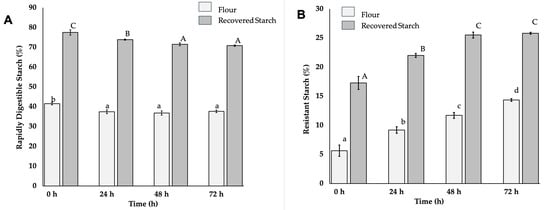
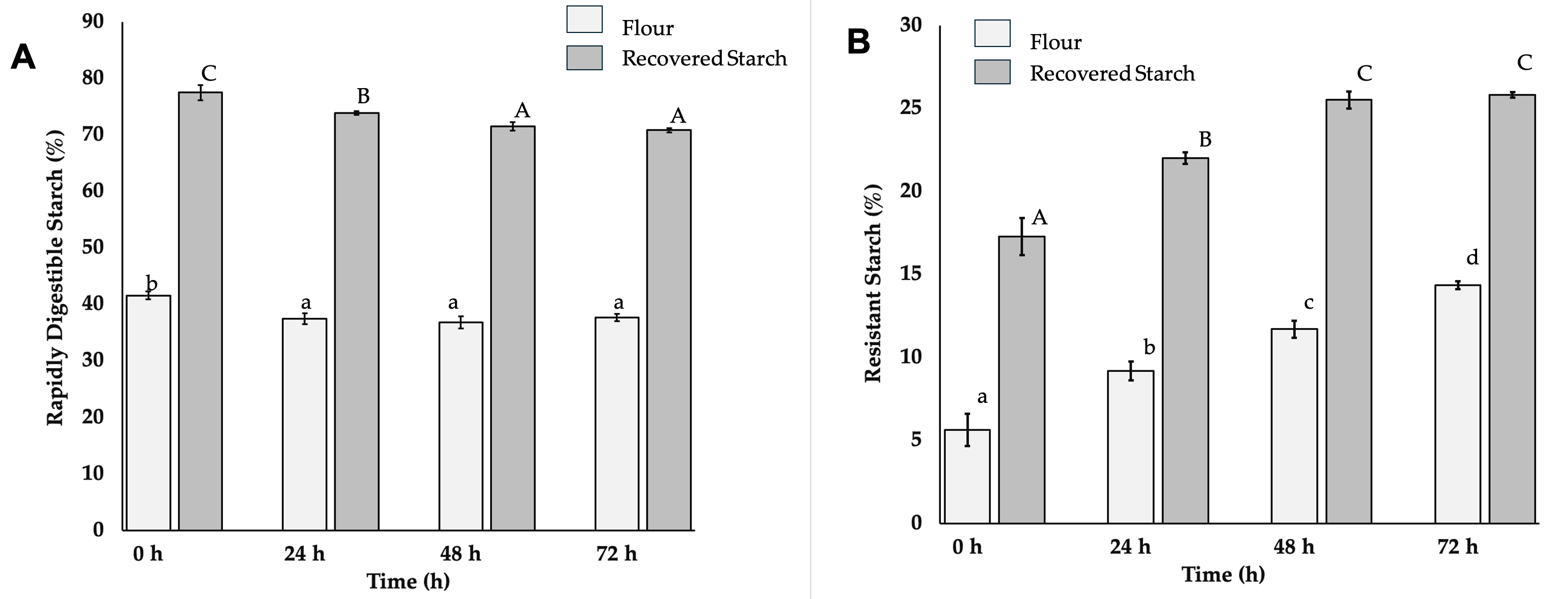
Hydrothermal annealing significantly modified the starch digestibility profile of yellow sweet potato flour and of the starch subsequently recovered from the corresponding flour samples (Figure 1). Rapidly digestible starch (RDS) is shown in Figure 1A. In flour, RDS decreased from 41.5% in F0 to 37.2%, 36.4%, and 37.5% in F24, F48, and F72, respectively. All three annealed flour samples exhibited significantly lower RDS than F0 (p < 0.05), with no significant differences among F24, F48, and F72. In the recovered starch samples, RDS decreased from 77.3% in S0 to 73.8%, 71.2%, and 70.6% in S24, S48, and S72, respectively. All three recovered starches from annealed flours exhibited significantly lower RDS than S0 (p < 0.05). Furthermore, S48 and S72 showed significantly lower RDS than S24, with no significant difference between S48 and S72.
Figure 1.
Effect of hydrothermal annealing on (A) rapidly digestible starch (RDS) and (B) resistant starch (RS) in yellow sweet potato flour and recovered starch. F0 = native flour; F24, F48, and F72 = flours annealed at 67 °C for 24, 48, and 72 h, respectively. S0, S24, S48, and S72 = starches recovered from F0, F24, F48, and F72, respectively. Bars represent mean ± SD (n = 3). Different lowercase letters indicate significant differences among flour samples, whereas different uppercase letters indicate significant differences among recovered starch samples (p < 0.05).
Resistant starch (RS) is shown in Figure 1B. In flour, RS increased progressively from 5.7% in F0 to 9.2%, 11.7%, and 14.3% after 24, 48, and 72 h of annealing, respectively. In the starch recovered from the corresponding flour samples, RS increased from 17.3% in S0 to 22.0%, 25.5%, and 25.8% in S24, S48, and S72, respectively. No significant difference in RS was observed between S48 and S72.
3.4. Pasting Properties
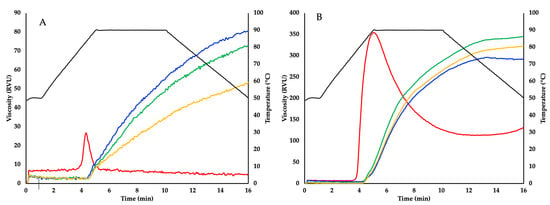
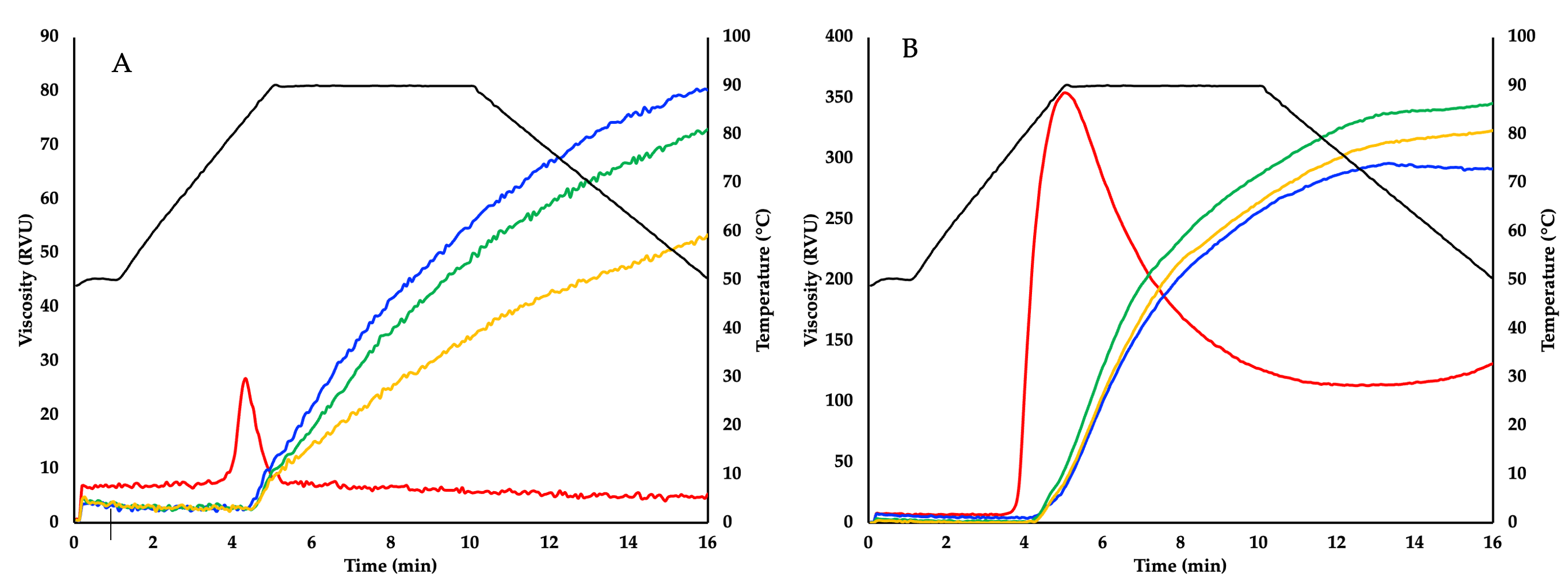
The RVA pasting profiles of yellow sweet potato flour are shown in Figure 2A. F0 exhibited a distinct viscosity peak during heating, whereas F24, F48, and F72 showed lower peak viscosities and greater viscosity development during cooling. Among the treated flour samples, F24 and F48 exhibited the highest viscosities at the end of the RVA cycle.
Figure 2.
Rapid Visco Analyzer (RVA) pasting profiles of (A) yellow sweet potato flours and (B) starches recovered from the corresponding flours. Flour samples: native flour (F0, red) and flours annealed at 67 °C for 24 h (F24, blue), 48 h (F48, green), and 72 h (F72, orange). Recovered starch samples: starch recovered from native flour (S0, red) and starches recovered from flours annealed for 24 h (S24, blue), 48 h (S48, green), and 72 h (S72, orange). The temperature profile is shown as a solid dark line.
The RVA pasting profiles of starch subsequently recovered from the corresponding flour samples are shown in Figure 2B. S0 exhibited a pronounced peak viscosity followed by a marked viscosity decrease during holding at elevated temperature. In contrast, S24, S48, and S72 showed lower peak viscosities and a smaller viscosity decline during holding, followed by greater viscosity development during cooling. The highest viscosities at the end of the RVA cycle were observed for S48 and S72.
3.5. Texture Profile Analysis
The texture profile parameters of gels prepared from starch recovered from the untreated and annealed yellow sweet potato flours are presented in Table 3. The treatment history of the flour significantly affected several textural properties of the subsequently recovered starch gels. Hardness decreased from 1.98 N in S0 to 1.44 N in S24 and reached its lowest value in S48 (0.83 N), followed by a partial increase in S72 (1.04 N).
Table 3.
Texture profile analysis (TPA) parameters of gels prepared from starch recovered from untreated and annealed yellow sweet potato flours and stored at 4 °C for 24 h.
Cohesiveness decreased from 0.86 in S0 to 0.45 in S24, followed by increases to 0.57 and 0.73 in S48 and S72, respectively. In contrast, springiness did not differ significantly among the recovered starch samples. Gumminess was significantly lower in S24, S48, and S72 than in S0, with no significant differences among the three starches recovered from annealed flours.
3.6. Color Characteristics
Annealing significantly affected the color characteristics of yellow sweet potato flour and recovered starch (Supplementary Table S1). In flour samples, lightness (L*) decreased from 61.99 in F0 to 49.93 in F72, whereas the a* and b* coordinates progressively increased from 8.29 to 13.02 and from 21.50 to 30.28, respectively, indicating a shift toward darker coloration with greater red and yellow components. The lowest L* value was observed in F72, although no significant differences were detected among F24, F48, and F72.
Similar changes were observed in recovered starch, although the response was not strictly progressive with annealing duration. Lightness decreased from 76.10 in S0 to 70.08 in S48, while a* and b* increased from 4.80 to 7.36 and from 15.98 to 21.03, respectively, indicating reduced lightness and increased red and yellow color components. In S72, L* increased slightly to 71.38, whereas a⁎ and b⁎ decreased to 6.85 and 20.19, respectively. The complete colorimetric results are presented in Supplementary Table S1.
4. Discussion
4.1. Proximate Composition and Carbohydrate Profile
The proximate composition of native yellow sweet potato flour was consistent with previous reports for sweet potato flours, in which starch represents the major carbohydrate fraction and protein and ash occur at comparatively lower levels [1,4].
Annealing produced changes in selected components of the compositional profile of the flour. Ash and protein contents remained unchanged across the evaluated treatments, whereas moisture content was higher in F48 and F72 than in F0 and F24. Total starch content was similar in F0, F24, and F48 but increased significantly in F72. Because annealing is a physical hydrothermal treatment and does not generate starch, this increase should be interpreted as a change in the measured starch content rather than as starch formation. The present data do not allow the underlying cause of this difference to be established.
Free glucose content was significantly higher in all annealed flours (12.07–13.25%) than in untreated flour (8.91%), with no significant differences among annealing times. This finding indicates that hydrothermal treatment was associated with an increase in measurable free glucose, although the mechanisms responsible for this change cannot be established from the present results.
Overall, the relative stability of ash and protein contents is consistent with previous reports emphasizing the effects of annealing on the physical and functional characteristics of starch-rich materials [6,7].
4.2. Total Phenolic Content and Antioxidant Activity
The effects of annealing duration on total phenolic content (TPC) and antioxidant activity of yellow sweet potato flour are presented in Table 2. Both parameters showed their greatest reduction after 24 h of treatment. TPC decreased from 499.6 mg GAE/100 g dw in F0 to 222.4 mg GAE/100 g dw in F24, while antioxidant activity decreased from 2774.4 to 823.4 μmol TE/100 g dw. With longer annealing times, both parameters increased progressively, although the values observed in F48 and F72 remained below those of the untreated flour.
The parallel response of TPC and antioxidant activity suggests that changes in the measurable phenolic fraction may have contributed to the variation in antioxidant capacity. However, the present results do not establish a direct causal relationship between these two variables, because other antioxidant compounds present in sweet potato flour may also contribute to the overall response.
The partial recovery observed after 48 and 72 h indicates that the effect of annealing was not characterized by a continuous loss of measurable phenolic compounds. Thermal and hydrothermal processing can modify the stability, release, and extractability of phenolic compounds, and the magnitude and direction of these changes depend on processing conditions and the characteristics of the food matrix [25,26,27]. Therefore, the increase in TPC observed between 24 and 72 h should not necessarily be interpreted as the formation of new phenolic compounds, but rather as a possible change in the fraction accessible to the extraction and analytical procedures used in this study.
Instrumental color measurements showed lower lightness (L*) in annealed flours than in untreated flour, accompanied by progressive increases in the a* and b* color coordinates (Supplementary Table S1). These changes could be partly attributed to the formation of colored compounds during hydrothermal treatment, including Maillard reaction products. The higher free glucose content observed in annealed flours provides evidence of the availability of a reducing sugar that could participate in Maillard reactions during hydrothermal treatment. As discussed by Kitchen and Williamson [28], such compounds may contribute to the Folin–Ciocalteu response and antioxidant activity measurements. Therefore, their possible formation could partly explain the recovery of apparent total phenolic content and DPPH radical scavenging activity observed after 48 and 72 h. However, the present color measurements do not establish the formation or contribution of specific Maillard reaction products. From a technological perspective, the color changes observed in both flour and recovered starch may influence their suitability for food applications, particularly in products where ingredient lightness and color consistency are important.
Overall, annealing duration influenced both TPC and antioxidant activity in yellow sweet potato flour, with an initial marked decrease followed by partial recovery at longer treatment times. Because individual phenolic compounds were not identified or quantified, the mechanisms responsible for this response cannot be established from the present data.
4.3. In Vitro Starch Digestibility
Hydrothermal annealing modified the starch digestibility profile of yellow sweet potato flour. Resistant starch (RS) increased progressively with treatment time, from 5.7% in F0 to 14.3% in F72, while rapidly digestible starch (RDS) decreased relative to the untreated flour. All annealed flours exhibited significantly lower RDS than F0 (p < 0.05), with no significant differences among F24, F48, and F72. This response is consistent with previous reports showing that annealing can reduce starch susceptibility to enzymatic digestion in sweet potato starch [9]. Under the conditions evaluated, the continued increase in RS up to 72 h indicates that treatment duration was an important factor governing the digestibility response of the flour.
The progressive increase in RS and reduction in RDS observed in yellow sweet potato flour could be associated with molecular rearrangements induced by the annealing treatment applied in this study. During annealing, increased mobility of amylose and amylopectin chain segments may favor the reorganization of intermolecular hydrogen bonds and more stable packing of existing amylopectin double helices within crystalline regions. These structural rearrangements could enhance molecular order and reduce starch susceptibility to enzymatic hydrolysis, as previously reported for annealed starches [6,8].
Changes in digestibility were also observed in the starch subsequently recovered from the treated flours. RDS decreased from 77.3% in S0 to 70.6% in S72, whereas RS increased from 17.3% in S0 to 22.0%, 25.5%, and 25.8% in S24, S48, and S72, respectively. RDS was significantly lower in all starches recovered from annealed flours than in S0 (p < 0.05). Furthermore, S48 and S72 exhibited significantly lower RDS than S24, with no significant difference between S48 and S72. Because no significant difference in RS was observed between S48 and S72, extending the annealing treatment of the flour beyond 48 h did not produce a further significant increase in RS in the subsequently recovered starch.
The lower RDS and higher RS values observed in starch isolated from annealed flours indicate that the effects of annealing on starch digestibility were not limited to the whole flour matrix, but were also retained in the starch fraction subsequently isolated from it. This suggests that the molecular rearrangements induced in starch granules during flour annealing were preserved after starch isolation and became more evident in the starch-enriched fraction. The absence of a significant difference in RS between S48 and S72 could be associated with progressively smaller molecular rearrangements during prolonged annealing. Under the conditions evaluated, these additional structural changes may have been insufficient to produce a further significant reduction in starch susceptibility to enzymatic hydrolysis, as the effects of annealing on starch digestibility depend on treatment duration and conditions [6,10].
Previous studies on sweet potato have primarily evaluated annealing applied directly to isolated starch. Trung et al. [9] reported an increase in RS after annealing sweet potato starch, whereas Zhang et al. [10] showed that the digestibility response depended on the annealing regime, with prolonged and repeated treatments producing different effects on RS and RS + SDS contents. Akanbi et al. [29] also reported reduced starch digestibility in modified orange-fleshed sweet potato starches, including annealed samples, compared with unmodified starch. Together, these findings emphasize that starch digestibility is strongly influenced by the modification conditions and treatment regime. In the present study, the results extend this information by showing that annealing applied to yellow sweet potato flour also modified the digestibility of the starch subsequently recovered from the treated material.
Overall, the findings indicate that annealing duration affected in vitro starch digestibility in yellow sweet potato flour and in the starch recovered after treatment. Longer annealing times progressively increased RS in the flour, whereas the RS content of the recovered starch approached a plateau after 48 h. These results are limited to in vitro starch digestibility and should not be interpreted as evidence of an in vivo glycemic response.
4.4. Pasting Properties
The pasting properties of yellow sweet potato flour and of the starch subsequently recovered from the corresponding flour samples are presented in Figure 2. The RVA profiles revealed a clear shift in viscosity development after annealing of yellow sweet potato flour. While F0 displayed a distinct viscosity peak during heating, the treated flours developed less pronounced peaks and greater viscosity during cooling. This change in the viscosity profile was most evident in F24 and F48, which reached the highest final viscosities among the flour samples. Rather than producing a uniform response, increasing annealing time therefore altered different stages of the pasting cycle to different extents.
A comparable change in profile shape was observed in starch recovered from the treated flours. S0 showed a pronounced peak followed by a marked viscosity loss during holding at high temperature, whereas S24, S48, and S72 exhibited lower peaks, smaller decreases during holding, and greater viscosity development during cooling. The latter behavior was especially evident in S48 and S72. In directly annealed sweet potato starch, Hu et al. [30] also reported reductions in peak viscosity and breakdown with increasing treatment time, showing that pasting behavior is highly sensitive to the intensity of annealing.
The response observed in the flour is also consistent with previous studies in more complex starch-containing systems. Purnomo et al. [31] reported annealing-induced changes in the pasting behavior of corn flour, whereas Zhang et al. [11] found increased pasting temperature and reduced breakdown in annealed sweet potato flour. Together, these reports indicate that hydrothermal treatment can modify viscosity development not only in isolated starch but also when starch remains embedded within a flour system.
The lower peak viscosities and smaller viscosity decreases during holding may be associated with restricted starch granule swelling and reduced susceptibility to disruption under heating and shear, as previously reported for annealed starch-containing systems [11,30]. The greater viscosity development during cooling may be attributed to the reassociation of starch chains and interactions among gelatinized starch components.
Because the RVA measurements were performed as single runs, the observed differences should be interpreted as descriptive trends rather than statistically established treatment effects. Although all samples were analyzed under identical experimental conditions, the absence of replicates limits the assessment of variability and reproducibility. Therefore, additional measurements would be required to confirm the statistical significance of the observed differences in pasting behavior.
4.5. Texture Profile Analysis
The textural properties of gels prepared from starch recovered from untreated and annealed yellow sweet potato flours are summarized in Table 3. A marked dependence on flour annealing duration was observed for several texture parameters. Hardness decreased significantly from 1.98 N in S0 to 1.44 N in S24 and 0.83 N in S48, with no significant difference between S48 and S72 (1.04 N).
Other texture parameters followed different response patterns. Cohesiveness was lower in all starches recovered from annealed flours than in S0. Springiness, in contrast, remained statistically unchanged. Gumminess was also significantly lower in S24, S48, and S72 than in S0, although no significant differences were detected among the three treatment times. Thus, the effect of flour annealing on the texture of the subsequently recovered starch was property-dependent rather than uniformly progressive with treatment time.
Previous studies have likewise shown that annealing can alter the textural behavior of sweet potato-based systems, although the direction of the response is not necessarily the same. Zhang et al. [11] reported treatment-dependent changes in hydrogels prepared from annealed sweet potato flour, whereas Mohamed et al. [32] reported treatment-dependent changes in the textural properties of directly treated sweet potato starch gels. Reductions in firmness-related parameters have also been reported for annealed corn starch [33]. These differences emphasize that gel texture after annealing depends on the characteristics of the material being treated, as well as on botanical source, processing conditions, starch isolation, and gel preparation procedures.
The reduction in gel hardness following annealing may be associated with restricted starch granule swelling and reduced dispersion of starch chains during gelatinization. These changes could limit the availability of amylose chains for intermolecular reassociation during cooling and refrigerated storage, potentially resulting in a gel network with lower resistance to compression. Similar reductions in swelling power and gel texture following annealing have been reported in maize and wheat starches by Liu et al. [34] and Biduski et al. [35], respectively. The contribution of starch chain reassociation to gel network formation has also been discussed by Gong et al. [36]. Interestingly, cohesiveness increased significantly among the treated starches, from 0.45 in S24 to 0.57 in S48 and 0.73 in S72, despite remaining below the value observed in S0 (0.86). This behavior may reflect differences in gel network organization, whereby resistance to initial compression and the ability to maintain structural integrity during successive compressions are affected differently by annealing duration.
The RVA and TPA results also provide complementary information on the functional behavior of starch recovered from annealed flours. Although these starches showed greater viscosity development during RVA cooling than S0, the corresponding gels exhibited significantly lower hardness. These observations are not necessarily contradictory, since RVA evaluates paste viscosity during heating and cooling under continuous shear, whereas TPA measures the mechanical resistance of gels prepared at a higher starch concentration and stored under refrigeration. Annealing-induced changes in starch granule swelling and molecular interactions could therefore influence viscosity development and gel network formation differently [6,11].
5. Conclusions
Hydrothermal annealing of yellow sweet potato flour produced time-dependent changes in starch digestibility and techno-functional properties. Resistant starch increased progressively in flour up to 72 h, whereas starch subsequently isolated from the treated flours showed no further significant increase between 48 and 72 h. The recovered starches also exhibited changes in pasting behavior and significantly lower gel hardness than the untreated control. In flour, total phenolic content and antioxidant activity decreased after 24 h and partially recovered with longer treatment times. Together, these findings demonstrate that extending annealing duration does not produce a uniform response across the evaluated properties.
These findings suggest opportunities for investigating the application of annealed yellow sweet potato flour in bakery products, such as bread and biscuits, considering its modified starch digestibility and functional characteristics. Similarly, starch isolated from annealed flours could be evaluated in products such as puddings and custards, where thickening behavior and gel texture are important quality attributes. Future research could assess the incorporation of these ingredients into such food formulations, focusing on processing performance, texture, sensory acceptance, and starch digestibility in the finished products. Since digestibility was evaluated in vitro, the findings should not be interpreted as evidence of physiological effects in humans.
Supplementary Materials
The following supporting information can be downloaded at https://www.mdpi.com/article/10.3390/pr14213560/s1, Table S1. Color parameters of yellow sweet potato flour and starch recovered from native and annealed flours. Table S2. Moisture content of starch recovered from untreated and annealed yellow sweet potato flours.
Author Contributions
Conceptualization, V.E.-S.; methodology, R.G.H.-N. and U.M.-R.; validation, M.d.l.L.S.-M. and E.H.-D.; formal analysis, G.E.-O.; investigation, V.E.C.-R.; resources, R.G.-B. and O.F.P.-T.; data curation, V.E.C.-R.; writing—original draft preparation, V.E.-S.; writing—review and editing, G.E.-O., C.d.P.S.-R. and N.R.E.B.-R.; visualization, L.Z.-A. All authors have read and agreed to the published version of the manuscript.
Funding
This research received no external funding.
Data Availability Statement
The data presented in this study are available from the corresponding author upon reasonable request.
Conflicts of Interest
The authors declare no conflicts of interest.
References
- Escobar-Puentes, A.A.; Palomo, I.; Rodríguez, L.; Fuentes, E.; Villegas-Ochoa, M.A.; González-Aguilar, G.A.; Olivas-Aguirre, F.J.; Wall-Medrano, A. Sweet Potato (Ipomoea batatas (L.) Lam) Phenotypes: From Agroindustry to Health Effects. Foods 2022, 11, 1058. [Google Scholar] [CrossRef] [Scilit]
- Laveriano-Santos, E.P.; López-Yerena, A.; Jaime-Rodríguez, C.; González-Coria, J.; Lamuela-Raventós, R.M.; Vallverdú-Queralt, A.; Romanyà, J.; Pérez, M. Sweet Potato Is Not Simply an Abundant Food Crop: A Comprehensive Review of Its Phytochemical Constituents, Biological Activities, and the Effects of Processing. Antioxidants 2022, 11, 1648. [Google Scholar] [CrossRef] [Scilit]
- Nogueira, A.C.; Sehn, G.A.R.; Rebellato, A.P.; Coutinho, J.P.; Godoy, H.T.; Chang, Y.K.; Steel, C.J.; Clerici, M.T.P.S. Yellow Sweet Potato Flour: Use in Sweet Bread Processing to Increase β-Carotene Content and Improve Quality. An. Acad. Bras. Cienc. 2018, 90, 283–293. [Google Scholar] [CrossRef] [Scilit] [PubMed]
- Pereira, N.; Ramos, A.C.; Alves, M.; Alves, V.D.; Moldão, M.; Abreu, M. Physical and Functional Properties of Sweet Potato Flour: Influence of Variety and Drying Method. Molecules 2025, 30, 1846. [Google Scholar] [CrossRef] [Scilit]
- Zavareze, E.R.; Dias, A.R.G. Impact of Heat-Moisture Treatment and Annealing in Starches: A Review. Carbohydr. Polym. 2011, 83, 317–328. [Google Scholar] [CrossRef] [Scilit]
- Fonseca, L.M.; El Halal, S.L.M.; Dias, A.R.G.; Zavareze, E.R. Physical Modification of Starch by Heat-Moisture Treatment and Annealing and Their Applications: A Review. Carbohydr. Polym. 2021, 274, 118665. [Google Scholar] [CrossRef] [Scilit] [PubMed]
- Jacobs, H.; Delcour, J.A. Hydrothermal Modifications of Granular Starch, with Retention of the Granular Structure: A Review. J. Agric. Food Chem. 1998, 46, 2895–2905. [Google Scholar] [CrossRef] [Scilit]
- Zheng, Y.; Chai, Z.; Kong, X.; Chen, S.; Ye, X.; Tian, J. Effect of Annealing Treatment on the Physicochemical Properties and Enzymatic Hydrolysis of Different Types of Starch. Food Chem. 2023, 403, 134153. [Google Scholar] [CrossRef] [Scilit] [PubMed]
- Trung, P.T.; Ngoc, L.B.; Hoa, P.N.; Tien, N.N.T.; Hung, P.V. Impact of Heat-Moisture and Annealing Treatments on Physicochemical Properties and Digestibility of Starches from Different Colored Sweet Potato Varieties. Int. J. Biol. Macromol. 2017, 105, 1071–1078. [Google Scholar] [CrossRef] [Scilit] [PubMed]
- Zhang, B.; Wu, H.; Gou, M.; Xu, M.; Liu, Y.; Jing, L.; Zhao, K.; Jiang, H.; Li, W. The Comparison of Structural, Physicochemical, and Digestibility Properties of Repeatedly and Continuously Annealed Sweet Potato Starch. J. Food Sci. 2019, 84, 2050–2058. [Google Scholar] [CrossRef] [Scilit] [PubMed]
- Zhang, Z.; Shang, M.; McClements, D.J.; Qiu, C.; Ji, N.; Dai, L.; Qin, Y.; Xiong, L.; Sun, Q. Effects of Annealing Temperature and Time on the Structural and Physicochemical Properties of Sweet Potato Flour Hydrogels. Food Chem. X 2023, 18, 100674. [Google Scholar] [CrossRef] [Scilit] [PubMed]
- Bojarczuk, A.; Skąpska, S.; Mousavi Khaneghah, A.; Marszałek, K. Health Benefits of Resistant Starch: A Review of the Literature. J. Funct. Foods 2022, 93, 105094. [Google Scholar] [CrossRef] [Scilit]
- Liu, H.; Gao, S.; Tian, G.; Zhang, S.; Liu, S. Comparative study: How dry heating treatment and annealing influence the multi-structure, physicochemical properties and in vitro digestibility of black highland barley starch. Front. Nutr. 2024, 11, 1453424. [Google Scholar] [CrossRef] [Scilit] [PubMed]
- Tian, G.; Liu, S.; Gao, S.; Liu, H. Comparing the effects of hydrogen-infused and plasma-activated waters on the structure, physicochemical properties, and in vitro digestibility of mung bean starch under annealing treatment. Front. Nutr. 2025, 12, 1665336. [Google Scholar] [CrossRef] [Scilit] [PubMed]
- AACC International. Approved Methods of the American Association of Cereal Chemists, 10th ed.; AACC International: St. Paul, MN, USA, 2000. [Google Scholar]
- AOAC International. Official Methods of Analysis of AOAC International; AOAC International: Gaithersburg, MD, USA, 2012. [Google Scholar]
- Molina-Quijada, D.M.A.; Medina-Juárez, L.A.; González-Aguilar, G.A.; Robles-Sánchez, R.M.; Gámez-Meza, N. Phenolic Compounds and Antioxidant Activity of Table Grape (Vitis vinifera L.) Skin from Northwest Mexico. CyTA J. Food 2010, 8, 57–63. [Google Scholar] [CrossRef] [Scilit]
- Hervert-Hernández, D.; Sayago-Ayerdi, S.G.; Goñi, I. Bioactive Compounds of Four Hot Pepper Varieties (Capsicum annuum L.), Antioxidant Capacity, and Intestinal Bioaccessibility. J. Agric. Food Chem. 2010, 58, 3399–3406. [Google Scholar] [CrossRef] [Scilit] [PubMed]
- Brand-Williams, W.; Cuvelier, M.E.; Berset, C. Use of a Free Radical Method to Evaluate Antioxidant Activity. LWT Food Sci. Technol. 1995, 28, 25–30. [Google Scholar] [CrossRef] [Scilit]
- Gayosso-García Sancho, L.E.; Yahia, E.M.; González-Aguilar, G.A. Contribution of Major Hydrophilic and Lipophilic Antioxidants from Papaya Fruit to Total Antioxidant Capacity. Food Nutr. Sci. 2013, 4, 93–100. [Google Scholar] [CrossRef]
- De la Rosa-Millán, J.; Lin, A.H.-M.; Osorio-Díaz, P.; Agama-Acevedo, E.; Hamaker, B.R.; Bello-Pérez, L.A. Influence of Annealing Flours from Raw and Pre-Cooked Plantain Fruit on Cooked Starch Digestion Rates. Starch-Stärke 2015, 67, 139–146. [Google Scholar] [CrossRef] [Scilit]
- Englyst, H.N.; Kingman, S.M.; Cummings, J.H. Classification and Measurement of Nutritionally Important Starch Fractions. Eur. J. Clin. Nutr. 1992, 46, S33–S50. [Google Scholar] [PubMed]
- Espinosa-Solis, V.; Roldan-Cruz, C.; Rosas-Flores, W.; Garcia-Tejeda, Y.V.; Fonseca-Florido, H.A. Physicochemical, Thermal, and Digestive Properties of Achira Starch Modified through Single and Dual Chemical Modifications. J. Food Sci. 2025, 90, e70193. [Google Scholar] [CrossRef] [Scilit] [PubMed]
- ISO/CIE 11664-4:2019; Colorimetry—Part 4: CIE 1976 L*a*b* Colour Space. International Organization for Standardization: Geneva, Switzerland, 2019.
- Ragaee, S.; Seetharaman, K.; Abdel-Aal, E.M. The Impact of Milling and Thermal Processing on Phenolic Compounds in Cereal Grains. Crit. Rev. Food Sci. Nutr. 2014, 54, 837–849. [Google Scholar] [CrossRef] [Scilit] [PubMed]
- Jiang, Z.; Han, Z.; Zhu, M.; Wan, X.; Zhang, L. Effects of Thermal Processing on Transformation of Polyphenols and Flavor Quality. Curr. Opin. Food Sci. 2023, 51, 101014. [Google Scholar] [CrossRef] [Scilit]
- Sęczyk, Ł.; Gawlik-Dziki, U.; Świeca, M. Influence of Phenolic–Food Matrix Interactions on In Vitro Bioaccessibility of Selected Phenolic Compounds and Nutrients Digestibility in Fortified White Bean Paste. Antioxidants 2021, 10, 1825. [Google Scholar] [CrossRef] [Scilit]
- Kitchen, B.; Williamson, G. Melanoidins and (poly)phenols: An analytical paradox. Curr. Opin. Food Sci. 2024, 60, 101217. [Google Scholar] [CrossRef] [Scilit]
- Akanbi, C.T.; Kadiri, O.; Gbadamosi, S.O. Kinetics of Starch Digestion in Native and Modified Sweet Potato Starches from an Orange-Fleshed Cultivar. Int. J. Biol. Macromol. 2019, 134, 946–953. [Google Scholar] [CrossRef] [Scilit] [PubMed]
- Hu, A.; Wang, X.; Li, L.; Xu, T.; Zheng, J. Effects of Annealing Time on Structure and Properties of Sweet Potato Starch. Cereal Chem. 2020, 97, 573–580. [Google Scholar] [CrossRef] [Scilit]
- Purnomo, E.H.; Yang, H.R.; Faridah, D.N.; Mojiono, M. Characterization of Physicochemical Properties of Annealed Corn Flour and Starch: A Verification of Meta-Analysis. Starch-Stärke 2024, 76, 2300293. [Google Scholar] [CrossRef] [Scilit]
- Mohamed, A.A.; Alamri, M.S.; Al-Quh, H.; Hussain, S.; Ibraheem, M.A.; Rehman, A.; Qasem, A.A. Effect of Shearing and Annealing on the Pasting Properties of Different Starches. Gels 2024, 10, 350. [Google Scholar] [CrossRef] [Scilit]
- Yu, K.; Wang, Y.; Wang, Y.; Guo, L.; Du, X. Effects of Annealing and Additives on the Gelatinization, Structure, and Textural Characteristics of Corn Starch. Int. J. Food Prop. 2016, 19, 1272–1281. [Google Scholar] [CrossRef] [Scilit]
- Liu, H.; Lv, M.; Wang, L.; Li, Y.; Fan, H.; Wang, M. Comparative study: How annealing and heat-moisture treatment affect the digestibility, textural, and physicochemical properties of maize starch. Starch-Stärke 2016, 68, 1158–1168. [Google Scholar] [CrossRef] [Scilit]
- Biduski, B.; Werlang, S.; Colussi, R.; Pinto, V.Z.; Zavareze, E.R.; Gutkoski, L.C.; Bertolin, T.E. Starches Properties from Soft, Medium-Hard, and Hard Brazilian Wheat upon Annealing. Starch-Stärke 2022, 74, 2100267. [Google Scholar] [CrossRef] [Scilit]
- Gong, Y.; Xiao, S.; Yao, Z.; Deng, H.; Chen, X.; Yang, T. Factors and modification techniques enhancing starch gel structure and their applications in foods: A review. Food Chem. X 2024, 24, 102045. [Google Scholar] [CrossRef] [Scilit] [PubMed]

Disclaimer/Publisher’s Note: The statements, opinions and data contained in all publications are solely those of the individual author(s) and contributor(s) and not of MDPI and/or the editor(s). MDPI and/or the editor(s) disclaim responsibility for any injury to people or property resulting from any ideas, methods, instructions or products referred to in the content. |
© 2026 by the authors. Licensee MDPI, Basel, Switzerland. This article is an open access article distributed under the terms and conditions of the Creative Commons Attribution (CC BY) license.