


Abstract
Carotenoids are lipophilic pigments with broad industrial relevance, especially as natural colorants in food and cosmetics. However, their conventional extraction typically relies on volatile organic solvents, raising environmental and safety concerns. In this study, we propose an alternative carotenoid extraction method from the pulp of tucumã fruits (Astrocaryum vulgare Mart.) using protic ionic liquids (PILs) in combination with ultrasound-assisted extraction (UAE). Three PILs were synthesized and characterized: 2-hydroxyethyl ammonium acetate (2-HEAA), 2-hydroxyethyl ammonium formate (2-HEAF), and 2-hydroxypropyl ammonium acetate (2-HPAA). Among them, 2-HEAA demonstrated the highest carotenoid extraction efficiency under conventional conditions (117 μg/g, dry basis), with no significant difference compared to ethanol (111.51 μg/g). Therefore, 2-HEAA was selected for optimization using UAE and the optimized conditions (0.17 g/L of 2-HEAA, 30 min, 1:10 solid–liquid ratio) resulted in a total carotenoid yield of 189 μg/g. UAE proved to be more effective than the conventional method, increasing yield by ~38%, while also reducing processing time. (all-E)-β-Carotene was the major compound (~89%), but its Z-isomers along with (all-E)-α-carotene and (all-E)-α-cryptoxanthin were also detected (>5%), and the carotenoid profile remained unchanged between solvents (2-HEAA vs. acetone). The combination of 2-HEAA in ethanol with UAE represents a promising alternative for carotenoid extraction from tucumã pulp, whose environmental performance and industrial applicability require further evaluation.
1. Introduction
The Amazon biome has emerged as one of the most promising regions in Brazil due to the diversity of its carotenoid-rich fruits [1]. Among these, tucumã (Astrocaryum vulgare Mart.) remains underexploited despite its nutritional value. Its intense yellow to orange pulp is rich in carotenoids, predominantly β-carotene, with reported concentrations ranging from 7.8 µg/g [2] to 10.7 µg/g [3]. Carotenoids, remarkable lipophilic pigments widely found in nature, provide attractive yellow, orange, and red colors to processed foods while also enhancing their nutritional value. This dual functionality as natural pigments and bioactive compounds supports their wide application in the food and cosmetic industries [4]. In addition, their physiological functions in the human body include provitamin A activity (notably β-carotene), immune system modulation, and antioxidant, anti-inflammatory, and antimicrobial effects [5]. Given this potential, the development of sustainable system extraction based on green technologies has become essential to ensure efficient carotenoid recovery while aligning with global efforts for environmentally responsible innovation [6].
Conventional methods for carotenoid extraction commonly employ volatile organic solvents such as acetone and hexane, which are highly volatile and pose significant environmental, health, and safety risks, limiting their used [7]. To overcome these limitations, ionic liquids (ILs) have been investigated as alternative extraction media because their tunable physicochemical properties can enhance the recovery and separation of bioactive compounds from biomass [8]. Several ionic liquids, particularly when combined with ultrasound-assisted extraction (UAE), have been successfully applied to carotenoid extraction, resulting in higher yields and enabling solvent recovery and reuse [9,10,11]. These findings underscore the effectiveness of ILs in extracting carotenoids from microalgae and fruits, especially native Brazilian. Although several studies have focused primarily on imidazolium-based aprotic IL, further investigation into protic ionic liquids is needed to assess their potential as greener alternative solvents and to better understand their behavior in carotenoid extraction.
Protic ionic liquids (PILs) offer tunable hydrogen-bonding interactions and can be synthesized through straightforward acid–base reactions, making them attractive candidates for extraction processes, yet their toxicity and biodegradability depend on their chemical composition [12,13,14]. The biocompatible PIL ethanolammonium caproate, used in a microwave-assisted liquid–solid extraction (PIL-MALSE), enabled rapid astaxanthin recovery from Haematococcus pluvialis by dissolving mannan in the cell wall, eliminating cell disruption steps and reducing extraction time to 50 s [15]. Similarly, ammonium-based PILs have improved carotenoid extraction from Rhodotorula glutinis, notably enhancing β-carotene, torularhodin, and toluene yields under higher hydrophobicity, temperature, and PIL concentration, with [hexanoic acid]−-based PIL yielding higher extraction efficiency than conventional solvents like Dimethyl Sulfoxide (DMSO) [16]. Therefore, PILs have demonstrated potential for carotenoid recovery and solvent recycling [16]. However, high viscosity may hinder mass transfer, while low volatility makes solvent removal difficult. Although selected PILs showed lower toxicity and higher biodegradability than the aprotic ionic liquids tested by Peric et al. [17], these advantages are compound-specific and do not establish food safety. Food applications require assessment of toxicity, impurities, residual PILs, and dietary exposure, together with regulatory compliance for the intended use. For instance, the PILs investigated in our study are not listed among the extraction solvents permitted under EU Directive 2009/32/EC [18]. Their evaluation as extraction media therefore does not imply approval or suitability for food production.
To the best of our knowledge, no studies have investigated the use of PILs for carotenoid extraction from Brazilian biodiversity fruits, such as tucumã fruits. This gap underscores the broader challenge of sustainably harnessing the Amazon biome, whose conservation is vital for mitigating climate change, biodiversity loss, and ensuring food security [19]. The prevailing economic model in the region remains heavily dependent on the exploitation of natural resources, highlighting the urgent need for incentives that promote the development of a regional bioeconomy through the application of green technologies to obtain sustainable, value-added products [20]. Such sustainable approaches can contribute to multiple United Nations Sustainable Development Goals (SDGs), including environmental conservation (SDG 15), income generation and social inclusion of traditional, indigenous, quilombola, and smallholder communities (SDGs 1 and 8), and food and nutrition security (SDG 2). They also encourage sustainable industrial innovation in the food sector (SDGs 9 and 12), while contributing to climate change mitigation (SDG 13) and the preservation of water and soil resources (SDG 6) [21].
Given the promising performance of aprotic ionic liquids in terms of extraction yield and purification, investigating the interaction of PILs with carotenoid-rich fruits represents a relevant and underexplored research avenue. In parallel, the use of ultrasound-assisted extraction has been shown to enhance carotenoid recovery, reduce solvent usage, and shorten extraction time compared to conventional techniques, being a valuable strategy to enhance carotenoid extraction [22,23]. The objective of this study was to investigate the potential of combining ultrasound-assisted extraction (UAE) with PIL to obtain carotenoid-rich extracts from tucumã fruits (Astrocaryum vulgare Mart.). UAE conditions were optimized, and the influence of PILs on carotenoid composition was assessed. This approach evaluates an alternative extraction system for the valorization of carotenoid-rich Amazonian fruits. To date, no optimized extraction protocol using PILs has been reported for Amazonian fruits specifically aiming to optimize carotenoid yield.
2. Materials and Methods
2.1. Reagents
Ethanolamine (98%), amino-2-propanol (93%) and all-trans-β-carotene (95%) were acquired from Sigma-Aldrich Co. LLC (St. Louis, MO, USA). Acetic acid, formic acid, petroleum ether, acetone, ethanol, petroleum ether and all other chemical salts and solvents of analytical grade were purchased from Synth (São Paulo, Brazil). Methyl tert-butyl ether (MTBE), methanol of chromatographic grade, were obtained from J. T. Baker (Phillipsburg, NJ, USA). For the chromatographic analysis, samples and solvents were filtered using membranes of 0.22 and 0.45 μm, respectively, both from Filtrilo (Paraná, Brazil).
2.2. Samples
Tucumã fruits (Astrocaryum vulgare Mart.) at full maturity, identified by their intense orange skin, were collected in Inhangapi, Pará, Brazil (latitude: 1°20′54″ South, longitude: 47°54′38″ West). Access to tucumã fruit was registered in the Brazilian National System for the Management of Genetic Heritage and Associated Traditional Knowledge (SisGen, registration A5085EA). The fruits were sanitized with sodium hypochlorite solution (100 mg/L) for 10 min. The pulp was manually separated from the peel and seed using stainless steel knives, frozen at −18 °C, and freeze-dried (LIOTOP, L101, São Paulo, Brazil) for 75 h. The dried pulp was ground and stored under vacuum, protected from light exposure until further analysis.
2.3. Synthesis and Characterization of Protic Ionic Liquids (PILs)
PILs were synthesized following the acid-base neutralization procedure described by Álvarez et al. [24] using ethanolamine or amino-2-propanol as bases and acetic or formic acid as proton donors. The resulting PILs were 2-hydroxyethyl ammonium acetate (2-HEAA), 2-hydroxypropylamine acetate (2-HPAA), and 2-hydroxyethyl ammonium formate (2-HEAF).
Briefly, the selected base was added to a three-necked round-bottom flask equipped with a separation funnel, a thermometer, and a reflux condenser coupled to an ultra-thermostatic bath (Quimis, model Q214M2, São Paulo, Brazil) maintained at 22 °C to prevent evaporation of volatile compounds. The selected organic acid was slowly added dropwise to the round-bottom flask containing the base under continuous magnetic stirring to ensure complete homogenization. The flask was maintained in an ice bath to control the reaction temperature at approximately 35 °C. After the acid addition, the mixture was stirred for 24 h at this temperature. Completion of the reaction was indicated by a visible change in color and the absence of byproducts such as crystalline residues. For purification, the PIL were transferred to sealed containers and subjected to a vacuum drying with magnetic stirring and heating (40–50 °C) for 10 h to remove residual water.
The physicochemical characterization included pH measurement with a digital potentiometer calibrated using buffer solutions (pH 7.0 and 4.0) [25], and acidity index determination by titration with NaOH using phenolphthalein as indicator [26]. Structural confirmation of the synthesized PIL was carried out using Fourier-transform infrared spectroscopy (FTIR) Agilent Cary 630, Agilent Technologies (Santa Clara, CA, USA) ATR mode, 4000–650 cm−1, resolution 4 cm−1, 16 scans).
2.4. Carotenoid Extraction
2.4.1. Conventional Solid–Liquid Extraction
Three synthesized PIL, namely 2-HEAA, 2-HPAA, and 2-HEAF, were evaluated for their efficiency in extracting carotenoids from the freeze-dried tucumã pulp. The PILs were dissolved in ethanol at a PIL concentration of 0.12 g/L. The extraction was performed by solid–liquid maceration in a mortar and pestle. For comparison, the same procedure was carried out using either acetone or ethanol as the pure solvent and the resulting extracts were directed to the carotenoid analyses.
2.4.2. Ultrasound-Assisted Procedure
Based on preliminary tests, the PIL that yielded the highest carotenoid recovery from tucumã pulp was selected for optimization using response surface methodology (RSM). A full 23 factorial design with three center points was employed to evaluate the effects of three independent variables: PIL concentration, solid–liquid ratio, and extraction time (Table 1). The design comprised 11 experiments, including three replicates at the center point, with total carotenoid yields as the response variable.
Table 1.
Levels of independent variables in the full 23 factorial design for optimizing ultrasound-assisted extraction of carotenoids from tucumã pulp using protic ionic liquids (PILs).
Extractions were performed by mixing 1.0 g of freeze-dried tucumã pulp with the PIL solution (diluted in ethanol as co-solvent) under light-protected conditions. The mixtures were subjected to ultrasound-assisted extraction in a bath-type ultrasonic device (SSBu 3.8 L, 40 kHz, SolidSteel, São Paulo, Brazil) for the extraction time specified in Table 1 at room temperature (25 °C), followed by vacuum filtration. The resulting extracts were directed to the carotenoid analyses.
Experimental data were analyzed using Statistica® version 7.0 software (StatSoft Inc., Tulsa, OK, USA) in a full factorial design at two levels (−1, +1) with three central points with a confidence level of 95%, p < 0.05. The regression coefficients were estimated by fitting the experimental data to a linear model. The model’s adequacy was evaluated using the coefficient of determination (R2), while its statistical significance was assessed through an F-test (Fisher–Snedecor) at a 90% confidence level. The fitted regression model was used to identify the extraction conditions that maximized total carotenoid yield within the investigated experimental range. The optimization was carried out using the Derringer–Suich desirability function implemented in Statistica®, with total carotenoid yield as the sole response to be maximized. The optimized conditions were experimentally validated through three independent extractions. The experimental mean total carotenoid content was compared with the model prediction, and the relative deviation (%) was obtained.
2.5. Carotenoid Analyis
2.5.1. Total Carotenoid Content by Spectrophotometry
After extraction and filtration, the extracts obtained by either the conventional or ultrasound-assisted procedure were subjected to liquid–liquid partitioning with petroleum ether and washed with distilled water as sample preparation for carotenoid analysis. Petroleum ether was used exclusively in this post-extraction analytical step and was not employed for solid–liquid extraction from tucumã pulp. The total carotenoid contents were determined spectrophotometrically at 450 nm using the specific extinction coefficient of β-carotene in petroleum ether ( = 2592) [27]. All the extractions and analyses were conducted in triplicate, and the results are presented as mean ± standard deviation (μg/g, dry weight basis).
2.5.2. Carotenoid Composition by HPLC-DAD
The carotenoid profiles extracted from tucumã pulp by the conventional or the ultrasound-assisted procedures were analyzed by high-performance liquid chromatography coupled with a diode arraydetector (HPLC-DAD), following the methodology described by De Rosso & Mercadante [28]. An aliquot of the carotenoid extracts used for the total carotenoid contents determination were evaporated under a gentle nitrogen flow and reconstituted in methanol/methyl tert-butyl ether (MTBE) (70:30, v/v) before injection into the HPLC system (Agilent 1260 Infinity, Agilent Technologies, Santa Clara, CA, USA). The chromatographic separation was performed on a YMC C30 column (5 μm, 250 mm × 4.6 mm) at 29 °C. The mobile phase consisted of a linear gradient of methanol/MTBE starting from 95:5 to 70:30 over 30 min, followed by 70:30 to 50:50 over 20 min, at a flow rate of 0.9 mL/min. UV–Vis spectra were recorded from 200 to 600 nm, and chromatograms were monitored at 450 nm. The identity of (all-E)-β-carotene was confirmed by coelution with an authentic standard and agreement of its UV-Vis spectrum. The remaining carotenoids were tentatively assigned from their elution order on the C30 column and UV-Vis characteristics, including absorption maxima, spectral fine structure (%III/II), and cis-peak intensity (%AB/AII), using previous HPLC-DAD-MS/MS characterization reported by our research group [2,28] as supporting evidence. The Z-isomers of β-carotene were assigned considering the hypsochromic shift relative to the E form, the presence of a Z-absorption band, and the reported chromatographic behavior. The carotenoids were quantified by external calibration using analytical curves with six β-carotene concentrations [1.56–50 µg/mL, R2 = 0.997, limit of detection (LOD): 0.08 µg/mL and limit of quantification (LOQ): 0.25 µg/mL]. LOD and LOQ values were calculated from the parameters of the analytical curves (standard deviation and slope). The contents of carotenoids were expressed as μg/g of freeze-dried extract (n = 3, dry basis).
3. Results and Discussion
3.1. Synthesis of Protic Ionic Liquid (PIL)
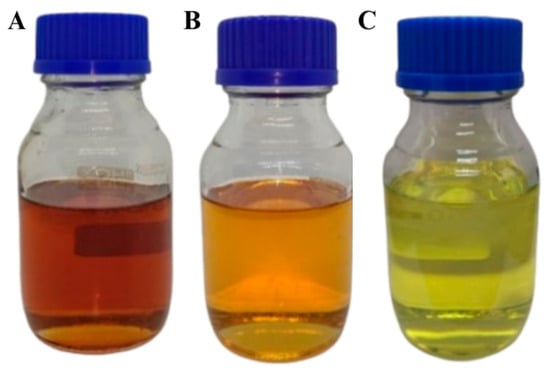
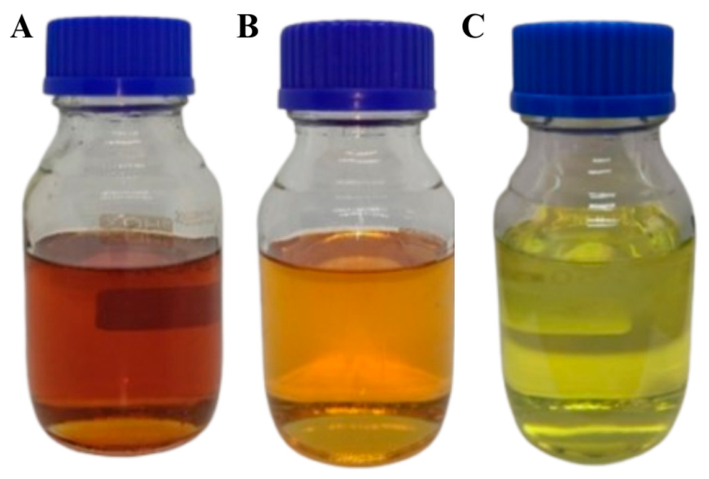
The synthesis of the protic ionic liquids (PILs) resulted in homogeneous liquids with slight color variations, ranging from orange to yellow (Figure 1A–C). Among them, 2-HEAA exhibited the darkest hue, characterized by a brownish-orange color, while 2-HPAA was the lightest, displaying a greenish-yellow shade. The physicochemical properties of the synthesized PILs, including molecular weight, pH, and acidity index, are summarized in Table 2. Notably, the PILs synthesized with acetic acid, namely 2-HEAA and 2-HPAA, exhibited pH values above 7, indicating a slightly alkaline solution, consistent with the formation of ionic liquids via protic ion transfer [29]. This behavior is expected when neutralization occurs between a weak acid and a relatively strong base, resulting in a basic final solution. Conversely, when neutralization takes place between a weak base and a strong acid, the resulting product is acidic, with a pH below 7.0 [29].This behavior is evidenced in the 2-HEAF, where the reaction between a moderate acid and a weak base resulting in an acidic final solution (pH = 4.32).
Figure 1.
Synthesized protic ionic liquids: (A) 2-HEAA (2-hydroxyethyl ammonium acetate); (B) 2-HEAF (2-hydroxyethyl ammonium formate); and (C) 2-HPAA (2-hydroxy propylamine acetate).
Table 2.
Physicochemical properties of the protic ionic liquids.
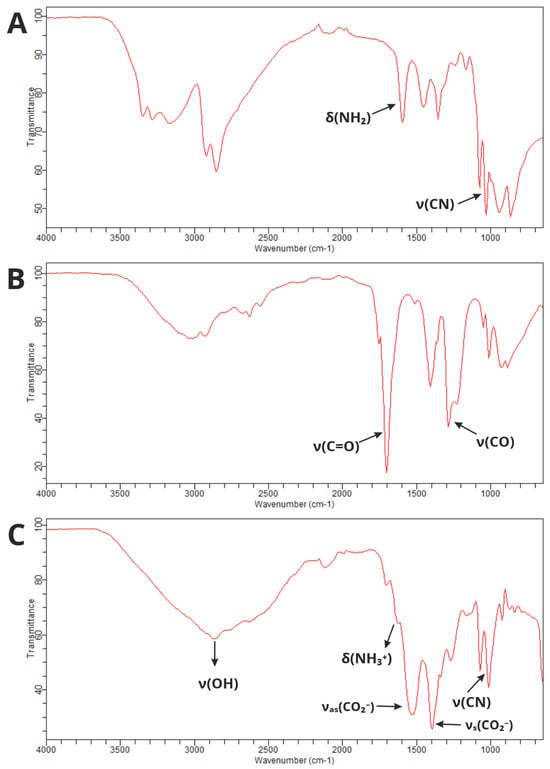
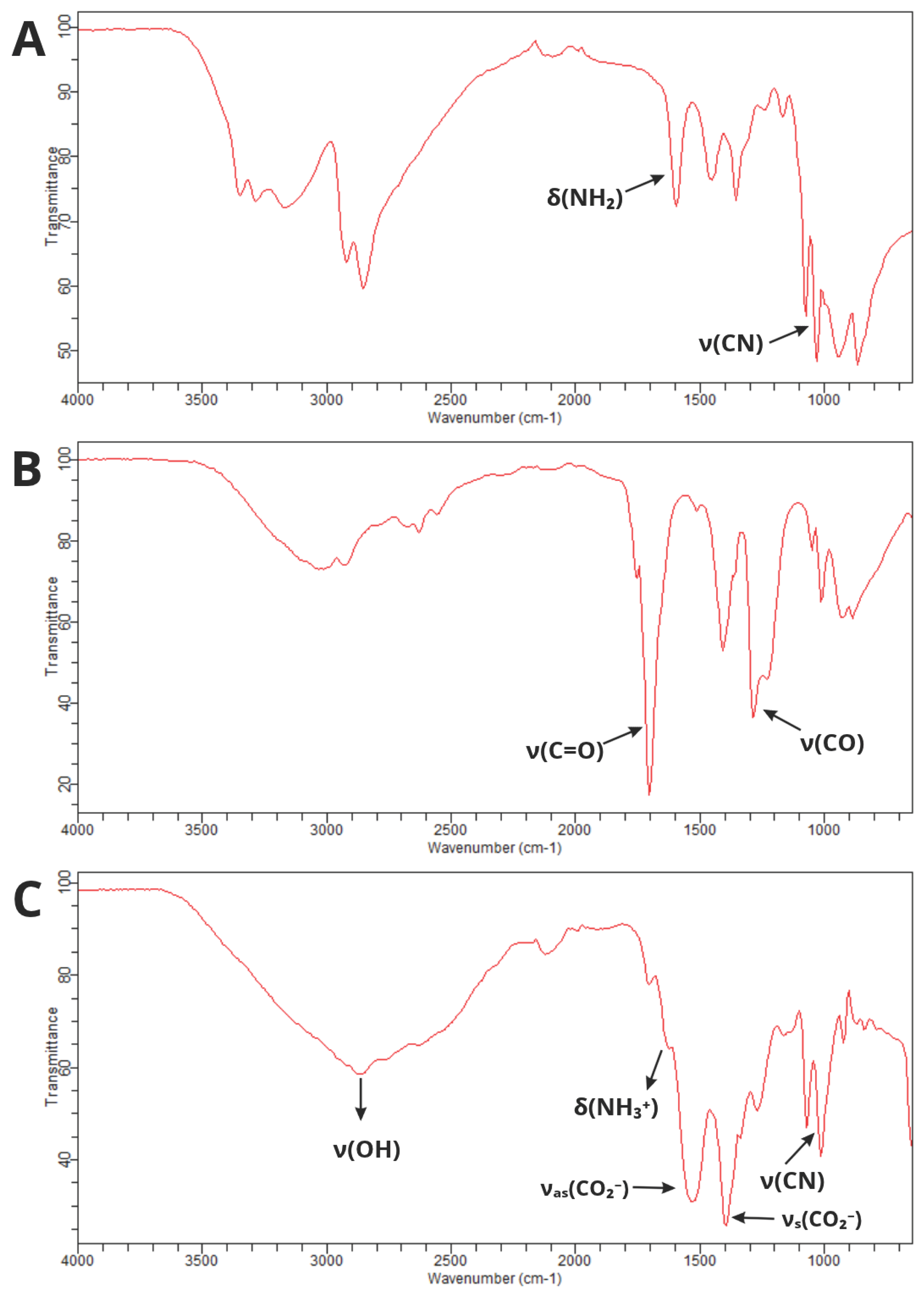
The formation and structure of the PIL was confirmed by FTIR spectroscopy (Figure 2A–C). The FTIR spectra were similar among the three synthesized PILs, supporting the efficiency of the neutralization reactions and the subsequent purification steps [30,31,32,33]. These spectra exhibited a broad band between 3500 and 2400 cm−1, characteristic of ammonium structures and encompassing the O–H stretching vibration, while the broad band centered around 1600 cm−1 results from the combined carbonyl stretching and in-plane N–H bending vibrations [33]. The spectra in Figure 2A–C highlight the differences between the solvents and the synthesized 2-HEAA PIL and Figure S1A–F shows the FTIR spectra of 2-HPAA and 2-HEAF, respectively.
Figure 2.
Infrared spectra in the wavenumber range 4000–650 cm−1 of (A) ethanolamine, (B) acetic acid, and (C) 2-hydroxyethyl ammonium acetate (2-HEAA).
In the higher-frequency region of the spectra (Figure 2A,C), a broad absorption band corresponding to O–H stretching appears between 2400 and 3600 cm−1, overlapping with N–H stretching vibrations [33,34,35]. In the spectrum shown in Figure 2B, the broad O–H stretching band spans the region from 2700 to 3600 cm−1, characteristic of carboxylic acids [36]. The weak C–H stretching vibrations of sp3-hybridized carbons appear near 2900 and 3000 cm−1 in the acetic acid spectrum. In contrast, the PIL 2-HEAA exhibits low-intensity bands between 2850 and 2950 cm−1, along with strong bands in the ethanolamine spectrum at approximately 2800 and 2900 cm−1 (Figure 2C).
The in-plane deformation of the NH2 group appears around 1600 cm−1, while the bands near 1000 and 1100 cm−1 correspond to C–N stretching vibrations, both of which are typical of amines (Figure 2A). Additionally, the bands observed at 1713 and 1265 cm−1 in Figure 2B are characteristic of C=O stretching and C–O bond vibrations, respectively, confirming the presence of acetic acid [36]. The broad band observed between 1200 and 1700 cm−1 in the spectrum shown in Figure 2C is attributed to the overlap of the acetate anion stretching vibrations and the NH deformation of the cation [33]. The band corresponding to the in-plane deformation of NH3+ at approximately 1600 cm−1 shows a slight increase in intensity compared to the δ(NH2) deformation band of the precursor base (ethanolamine). The band near 1500 cm−1 is associated with the asymmetric stretching vibration (νas(CO2−)) of the acetate group, while the band around 1400 cm−1 corresponds to its symmetric stretching (νs(CO2−)). Additionally, the bands observed at 1000 and 1100 cm−1 are assigned to C–N stretching vibrations [34,36].
3.2. Carotenoid Conventional Extraction
Three protic ionic liquids (PILs) were evaluated to identify the one with the highest capacity to extract carotenoids from the tucumã pulp using a conventional solid–liquid extraction method. PILs are a promising alternative to aprotic ionic liquids due to their simpler synthesis, lower cost, and greater environmental compatibility, making them attractive for separation and purification processes [13]. Ethanol was used as a co-solvent to facilitate handling and mass transfer, following approaches described for ionic liquid-based extraction systems [12,13]. Viscosity was not measured in this study and its contribution to the differences in carotenoid recovery cannot be established. Therefore, throughout this discussion, any mention of a PIL should be understood as referring to the corresponding PIL-based extraction solution, in which ethanol acts as a co-solvent.
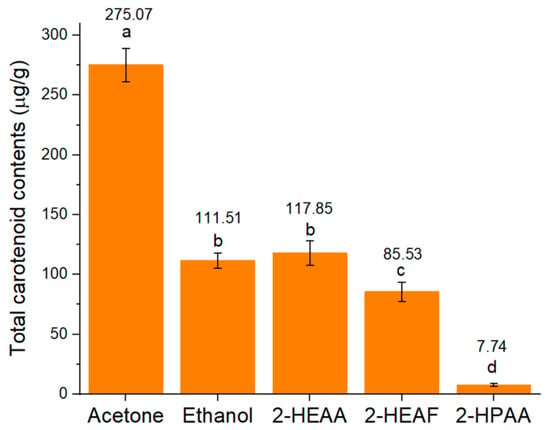
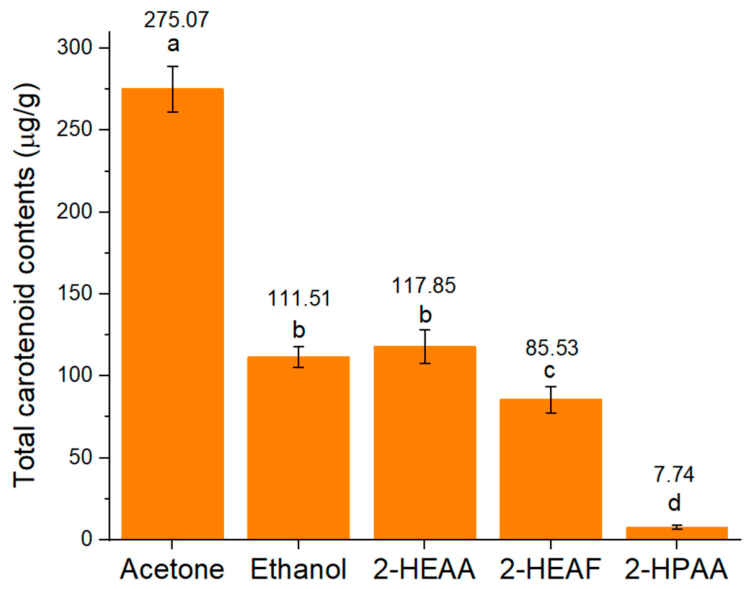
Among the tested PIL, 2-HEAA achieved the highest total carotenoid yield (117.85 ± 10.15 µg/g), demonstrating superior extraction efficiency compared to 2-HPAA (7.74 ± 1.11 µg/g) and 2-HEAF (85.53 ± 7.93 µg/g). As illustrated in Figure 3, the carotenoid yield obtained with 2-HEAA was approximately 1.4-fold higher than 2-HEAF, possibly due to the lower pH and higher polarity of 2-HEAF, which may have negatively affected carotenoid extraction. The elevated polarity of 2-HEAF is primarily from the presence of the formate anion, which is more polar than the acetate anion, as well as from the shorter alkyl chain in its cationic structure [30]. These characteristics reduce the affinity of 2-HEAF for nonpolar compounds such as β-carotene, whose hydrophobic nature limits its solubility in highly polar solvents [37]. Similarly, the higher yield obtained with 2-HEAA compared to 2-HPAA, about 15-fold greater, may be attributed to the same principle that the longer carboxylic side chain in 2-HEAA reduces overall polarity, thereby facilitating stronger hydrophobic interactions with nonpolar carotenoids and consequently improving extraction efficiency. Among the tested ionic liquids, 2-HEAA presented an intermediate polarity, allowing efficient extraction of both xanthophylls and carotenes. Its balanced polarity and capacity to form hydrogen bonds may explain its superior performance compared to more acidic or more hydrophobic PIL.
Figure 3.
Total carotenoid yields (µg/g) after conventional extraction using acetone, ethanol, and the protic ionic liquids with ethanol as co-solvent: 2-hydroxyethyl ammonium acetate (2-HEAA), 2-hydroxy propylamine acetate (2-HPAA), and 2-hydroxyethyl ammonium formate (2-HEAF). Means (n = 3) in bars followed by the same letters are not significantly different (p < 0.05).
The carotenoid yield achieved with 2-HEAA (117.85 ± 10.15 µg/g) was higher than previously reported values for the same tucumã species: 107.0 µg/g [3], 94.5 µg/g [38], and 83.9 µg/g [2]. It also exceeded the yield reported for tucumã pulp from another region of Brazil (Amapá) (72 µg/g) [39], as well as that of a different tucumã species (Astrocaryum aculeatum G. Mey.) (43 µg/g and 62.65 µg/g) [28,40]. These findings highlight the good carotenoid extraction performance of the PIL 2-HEAA from tucumã pulp, achieving yields higher than those previously reported in the literature. This reinforces the potential of 2-HEAA as a promising alternative for extracting carotenoids from plant matrices with high yield and selectivity, while offering a safer and more environmentally friendly alternative to conventional organic solvents. These results support the potential of the 2-HEAA–ethanol system for carotenoid recovery from tucumã pulp.
Nonetheless, carotenoid extraction with acetone yielded approximately 2.5 and 2.3 times more than that obtained with the pure ethanol and 2-HEAA, respectively. However, no statistically significant difference was observed between ethanol and 2-HEAA (Figure 3). Although acetone provided higher carotenoid yields, the 2-HEAA–ethanol system warrants further investigation as an alternative extraction medium since acetone is not considered GRAS (Generally Recognized as Safe) and presents limitations for food and nutraceutical applications. Furthermore, to the best of our knowledge, this is the first study regarding the extraction of carotenoids from tucumã pulp using protic ionic liquids.
3.3. Efficiency of Ultrasonic-Assisted Extraction with PIL
Based on the preliminary screening, 2-HEAA was assigned as the most effective PIL for carotenoid extraction from tucumã pulp (Figure 3). Consequently, 2-HEAA was selected for the process optimization using a full 23 factorial design combined with ultrasound-assisted extraction. The independent variables investigated were PIL concentration, solid–liquid ratio, and extraction time. The corresponding results, along with the effects of each variable, are presented in Table 3 and Figure 4. Under the tested conditions, total carotenoid content ranged from 27.31 to 185.15 μg/g, indicating that the extraction efficiency was strongly influenced by the selected parameters.
Table 3.
Total carotenoid yields for tucumã pulps as determined during the optimization of the ultrasound-assisted extraction procedure by the full 23 factorial design.
Figure 4.
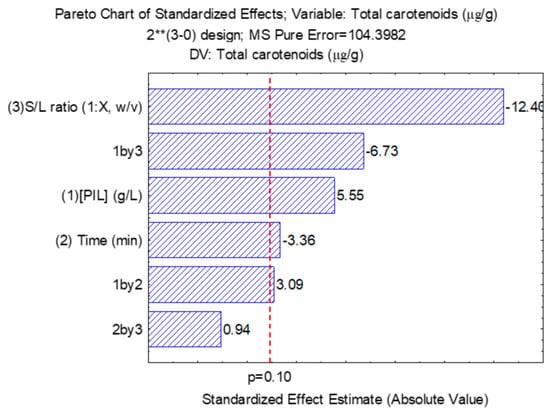
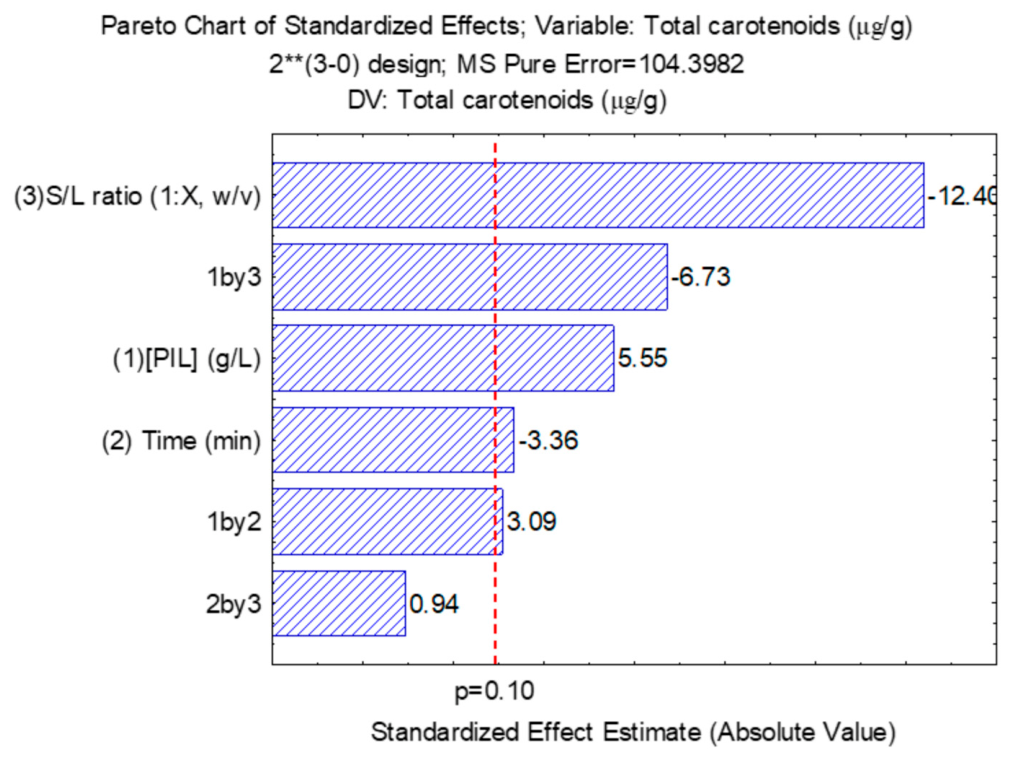
Pareto chart (p < 0.10) to the effect of the independent variables on the total carotenoid yields (μg/g) in tucumã pulp extracted with the protic ionic liquid (PIL) 2-hydroxyethyl ammonium acetate (2-HEAA) and ethanol as co-solvent.
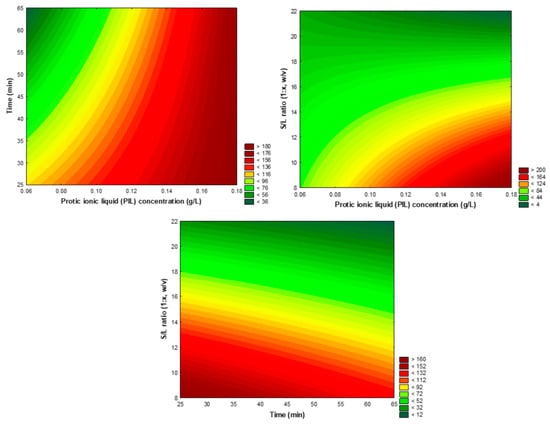
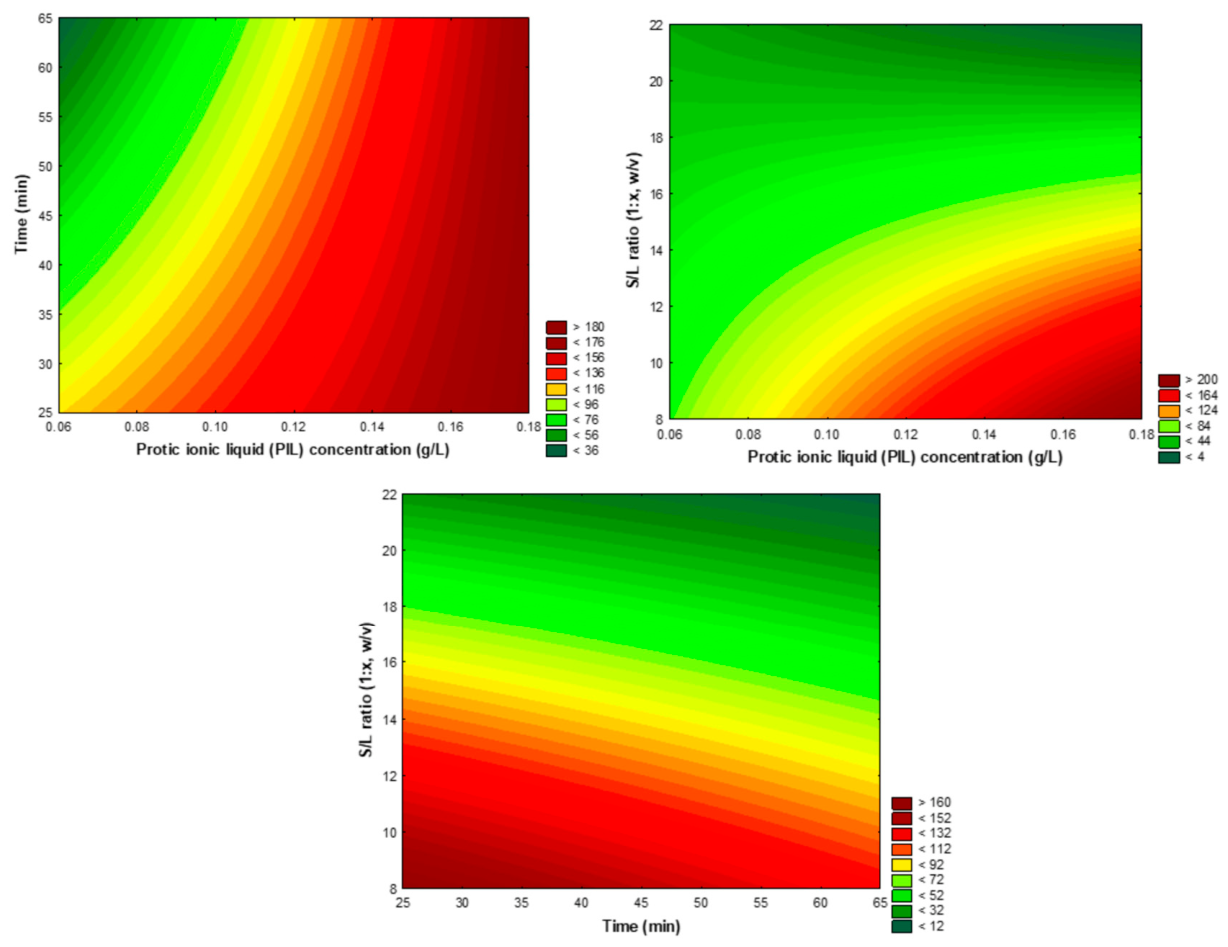
The efficiency of the 2-HEAA as solvent was primarily influenced by the solid–liquid ratio, which exhibited the most significant effect on carotenoid extraction (standardized effect = –12.4), as shown in the Pareto chart (Figure 4). The negative sign indicates that a lower solid–liquid ratio favored carotenoid recovery. Similarly, extraction time also showed a negative effect, suggesting that shorter durations improved extraction efficiency. However, the magnitude of this effect was relatively small (–3.36). In contrast, PIL concentration had a positive effect (+5.55), indicating that increasing the concentration of 2-HEAA enhanced carotenoid yields. To further illustrate the process behavior within the tested range, response surface contour plots were constructed (Figure 5). The contour plots showed that high carotenoid yields can be achieved under the tested conditions by adjusting extraction time, solid–liquid ratio and PIL concentration. Although extraction time exhibited some effect, the variation in carotenoid yield across different time intervals was not substantial, suggesting that this parameter was not a critical factor within the evaluated range. In contrast, the solid–liquid ratio exhibited a more pronounced impact, with lower ratios favoring higher carotenoid yields.
Figure 5.
Contour curves were plotted to illustrate the trends observed in the extraction of carotenoids (μg/g) from tucumã by ultrasound-assisted extraction using the protic ionic liquid (PIL) 2-hydroxyethyl ammonium acetate (2-HEAA) and ethanol as co-solvent.
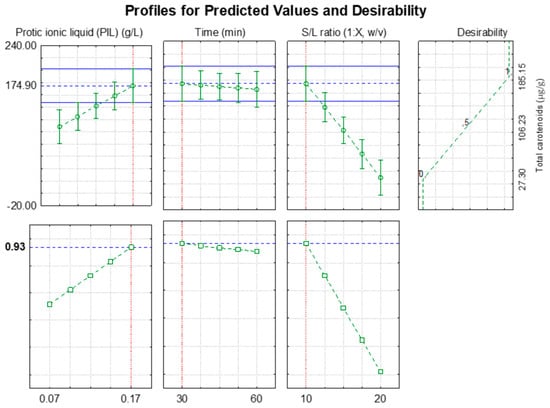
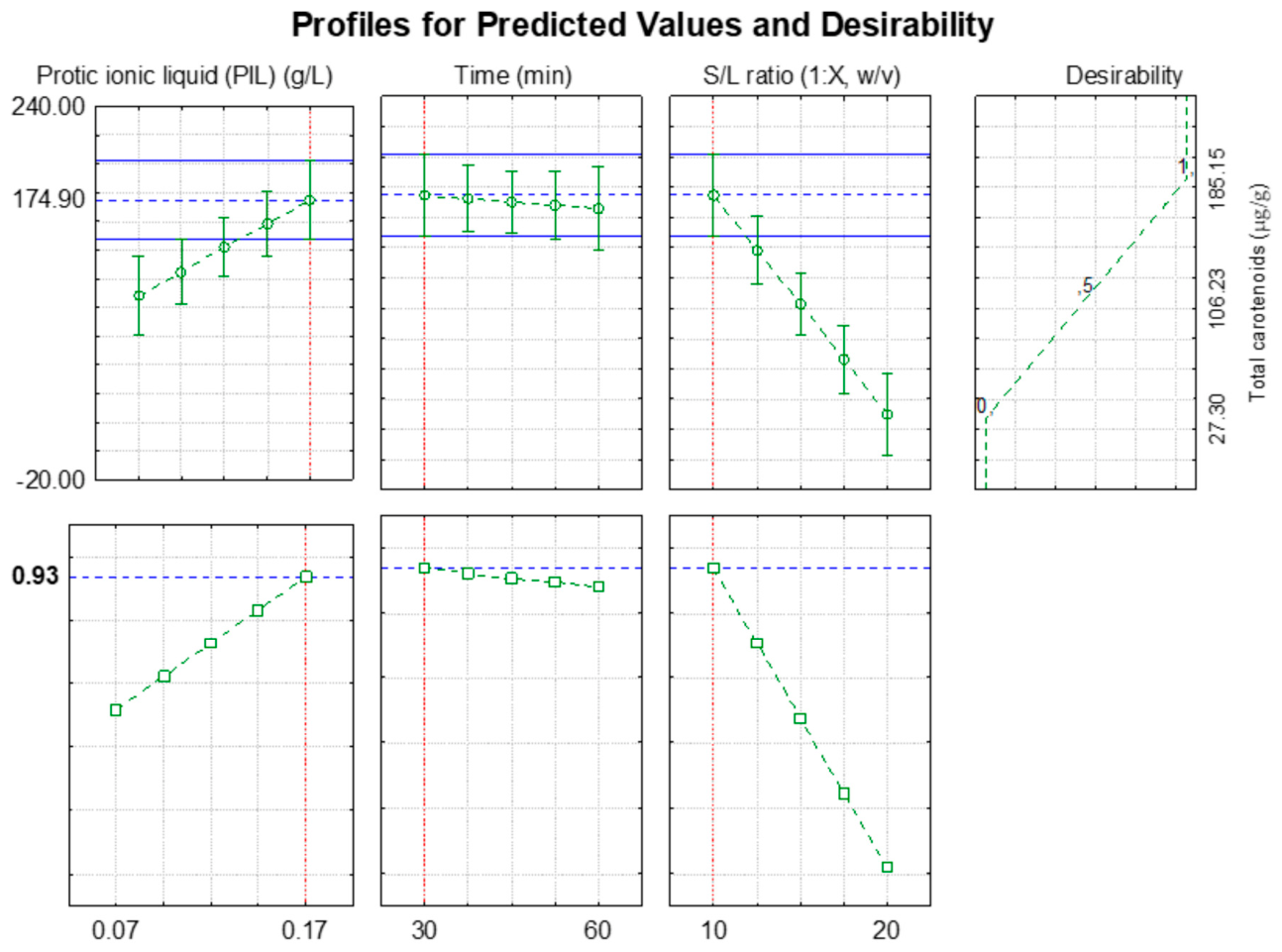
In addition to the analysis of the contour plots, the desirability function (Figure 6) was applied to suggest the optimal conditions within the tested range, which predicted a total carotenoid yield of 174.90 µg/g under conditions of PIL concentration of 0.17 g/L, solid–liquid ratio of 1:10 (m/v), and extraction time of 30 min. The selected conditions yielded a desirability value of 0.93 on a scale from 0 (undesirable) to 1 (fully desirable), indicating that the predicted carotenoid yield closely approached the maximization target defined in the optimization settings. Experimental evaluation of the selected conditions yielded 189.21 ± 22.55 µg/g, compared with the predicted value of 174.90 µg/g, corresponding to a positive relative deviation of 8.18%. The prediction was within one standard deviation of the experimental mean, supporting agreement at this tested condition. Importantly, when the same optimized conditions of PIL concentration and solid/liquid ratio were used, but extraction time reduced to 10 min, the total carotenoid yielded 167.51 µg/g (Table 3, run 2), which was about 96% of the predicted value. These findings are consistent with the contour plots, which indicated that extraction time had a minimal effect on carotenoid yield. This is further supported by the fact that the only difference between runs 4 and 2 was the extraction time, confirming its limited influence within the tested range. Overall, the results suggest that the total carotenoid yield can be reliably estimated using the proposed extraction model.
Figure 6.
Desirability function indicated for the optimized ultrasound-assisted extraction of carotenoids from tucumã pulp by ultrasound-assisted extraction using the protic ionic liquid (PIL) 2-hydroxyethyl ammonium acetate (2-HEAA) and ethanol as co-solvent.
According to the literature, Mussagy et al. [16] reported increased carotenoid recovery from Rhodotorula glutinis as aqueous ammonium-based PIL concentrations increased from 75 to 90% (v/v), with additional effects of ion hydrophobicity and temperature. Similarly, 2-HEAA concentration positively affected recovery in our study, although the solid–liquid ratio had a stronger influence. However, the different extraction media and matrices preclude assuming the yeast cell-permeabilization mechanism for tucumã pulp. Murador et al. [41] obtained higher carotenoid contents from orange peel with imidazolium-based IL-assisted UAE (32.8 µg/g) than with acetone (7.88 µg/g). Conversely, acetone remained more effective in our conventional screening, demonstrating that IL performance is matrix- and condition-dependent. Our contribution is the evaluation of amino alcohol-based PILs for tucumã pulp, achieving 189.21 µg/g with 2-HEAA–ethanol UAE, approximately 60.5% above conventional extraction with the same PIL, which reflected the combined extraction conditions.
3.4. Carotenoid Profile of Tucumã Extract by HPLC-DAD
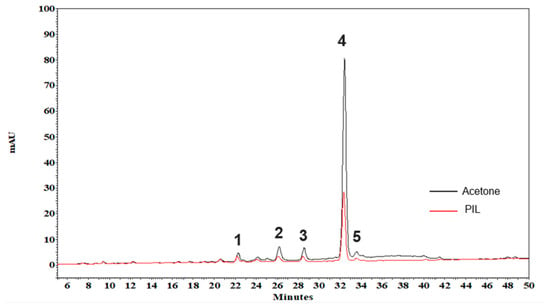
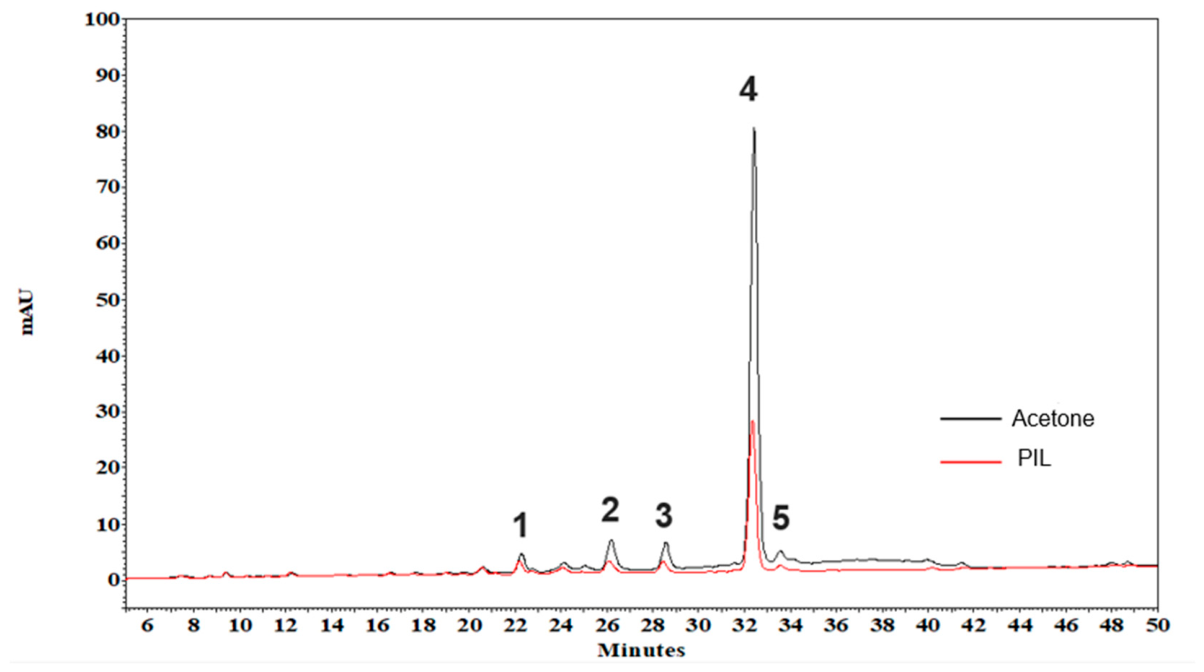
The carotenoid profile was obtained and quantified by HPLC-DAD using extracts obtained from the conventional extraction with acetone and the optimized ultrasound-assisted extraction using the protic ionic liquid 2-HEAA, revealing five major carotenoids (Figure 7 and Table 4). The profiles were similar for both solvents, with β-carotene identified as the major carotenoid, followed by α-carotene and α-cryptoxanthin. β-Carotene has also been reported in other articles as the major carotenoid in tucumã pulp, with yields of 107 ± 31 μg/g [3] and 92 μg/g [38]. Also previously identified minor carotenoids include β-zeacarotene (5.9 ± 3.1 μg/g) and γ-carotene (2.0 ± 1.6 μg/g) [3], as well as α-carotene at 2.5 μg/g [38].
Figure 7.
Chromatogram, obtained by HPLC-DAD, of carotenoid extracts from tucumã pulp extracted with acetone or the protic ionic liquid (PIL) 2-hydroxyethyl ammonium acetate (2-HEAA) and ethanol as co-solvent. 1. (all-E)-α-Cryptoxanthin; 2. 13Z-β-Carotene; 3. (all-E)-α-Carotene; 4. (all-E)-β-Carotene and 5. 9Z-β-Carotene.
Table 4.
Carotenoid composition in the extracts obtained from conventional extraction with acetone and the optimized ultrasound-assisted extraction using the protic ionic liquid 2-hydroxyethyl ammonium acetate (2-HEAA) and ethanol as co-solvent.
According to the classification proposed by Britton & Khachik [42], which defines carotenoid sources based on individual content as follows: low (0–1 μg/g), moderate (1–5 μg/g), high (5–20 μg/g), and very high (>20 μg/g). The freeze-dried tucumã pulp can be considered a high to very high source of carotenoids, particularly β-carotene and α-carotene.
4. Conclusions
The search for sustainable alternatives for carotenoid extraction is a promising area of research, driven by the growing market demand for natural pigments to replace synthetic dyes. In addition, increasing attention has been directed toward replacing volatile and environmentally harmful organic solvents, such as acetone, with more efficient and eco-friendly extraction systems. In this context, the protic ionic liquid 2-hydroxyethyl ammonium acetate (2-HEAA) demonstrated high efficiency in extracting carotenoids from freeze-dried tucumã pulp. Combining 2-HEAA in ethanol with UAE increased carotenoid recovery from 117.85 µg/g under conventional extraction to 189.21 µg/g under the selected UAE conditions. This significant increase in yield did not alter the carotenoid profile, as β-carotene remained the predominant compound, accounting for approximately 89% of the total carotenoids quantified, indicating no degradation or selective loss of compounds due to the use of the ionic liquid.
The extraction process using 2-HEAA was efficient, faster than the conventional method, required shorter processing times, and consumed smaller volumes of solvent. Therefore, the combination of 2-HEAA with ethanol, as co-solvent, and ultrasound-assisted extraction represents a promising approach for carotenoid extraction, achieving high yields under optimized conditions: 2-HEAA concentration of 0.17 g/L, solid–liquid ratio of 1:10 (w/v), and extraction time of 30 min.
The present study demonstrates extraction performance rather than the environmental superiority of a complete production process. Solvent recovery, energy consumption, PIL residues, and toxicological and environmental properties require further assessment to establish overall sustainability and industrial suitability.
Supplementary Materials
The following supporting information can be downloaded at: https://www.mdpi.com/article/10.3390/pr14213460/s1, Supplementary Figure S1. Infrared spectra in the wavenumber range 4000–650 cm−1 of (A) Amino-2-propanol, (B) acetic acid, (C) 2-HPAA, (D) Ethanolamine, (E) formic acid and (F) 2-HEAF.
Author Contributions
Conceptualization: M.C.S.A., G.R.d.S., R.C.C. Methodology: M.C.S.A., G.R.d.S., R.C.C. Validation: M.C.S.A. Formal analysis: M.C.S.A., R.C.C. Investigation: M.C.S.A., G.R.d.S., R.C.C. Resources: G.R.d.S., R.C.C. Data curation: M.C.S.A., G.R.d.S., R.C.C. Writing—original draft: C.R.-S., M.C.S.A., R.C.C. Writing—review and editing: C.R.-S., V.V.d.R., M.C.S.A., G.R.d.S., R.C.C. Visualization: M.C.S.A., G.R.d.S., and R.C.C. Supervision: G.R.d.S. and R.C.C. Project administration: R.C.C. Funding acquisition: G.R.d.S. and R.C.C. All authors have read and agreed to the published version of the manuscript.
Funding
This research was funded by Coordenação de Pessoal de Nível Superior (CAPES, Brazil- Finance code 001) and Conselho Nacional de Desenvolvimento Científico e Tecnológico (CNPq, Brazil, Projects 408181/2021-4 and 314929/2021-5).
Data Availability Statement
All data related to this manuscript are available in the form of Figures and Tables in the manuscript and Supplementary Materials. Further inquiries can be directed to the corresponding authors.
Acknowledgments
All authors thank Universidade Federal do Pará (UFPA) through PROPESP, Pará, Brazil, for their support.
Conflicts of Interest
The authors declare no conflicts of interest.
Abbreviations
The following abbreviations are used in this manuscript:
| IL | Ionic Liquid |
| FTIR | Fourier-Transform Infrared Spectroscopy |
| HPLC-DAD | High-Performance Liquid Chromatography coupled with a Diode Array Detector |
| NMR | Nuclear Magnetic Resonance Spectroscopy |
| PILs | Protic Ionic Liquids |
| RSM | Response Surface Methodology |
| 2-HEAA | 2-Hydroxyethyl Ammonium Acetate |
| 2-HPAA | 2-Hydroxypropylamine Acetate |
| 2-HEAF | 2-Hydroxyethyl Ammonium Formate |
References
- Machado, A.P.d.F.; do Nascimento, R.d.P.; Alves, M.d.R.; Reguengo, L.M.; Marostica Junior, M.R. Brazilian Tucumã-Do-Amazonas (Astrocaryum Aculeatum) and Tucumã-Do-Pará (Astrocaryum vulgare) Fruits: Bioactive Composition, Health Benefits, and Technological Potential. Food Res. Int. 2022, 151, 110902. [Google Scholar] [CrossRef] [Scilit] [PubMed]
- Noronha Matos, K.A.; Praia Lima, D.; Pereira Barbosa, A.P.; Zerlotti Mercadante, A.; Campos Chisté, R. Peels of Tucumã (Astrocaryum vulgare) and Peach Palm (Bactris gasipaes) Are by-Products Classified as Very High Carotenoid Sources. Food Chem. 2019, 272, 216–221. [Google Scholar] [CrossRef] [Scilit] [PubMed]
- Rodriguez-Amaya, D.B. Assessment of the Provitamin A Contents of Foods—The Brazilian Experience. J. Food Compos. Anal. 1996, 9, 196–230. [Google Scholar] [CrossRef] [Scilit]
- Rodriguez-Amaya, D.B. Carotenoids as Food Colorants and Precursors of Aroma Compounds. In Food Carotenoids: Chemistry, Biology and Technology; Wiley-Blackwell: Hoboken, NJ, USA, 2015; pp. 199–224. ISBN 978-1-118-73330-1. [Google Scholar]
- Terao, J. Revisiting Carotenoids as Dietary Antioxidants for Human Health and Disease Prevention. Food Funct. 2023, 14, 7799–7824. [Google Scholar] [CrossRef] [Scilit] [PubMed]
- De Jesus, S.S.; Filho, R.M. Recent Advances in Lipid Extraction Using Green Solvents. Renew. Sustain. Energy Rev. 2020, 133, 110289. [Google Scholar] [CrossRef] [Scilit]
- Saini, R.K.; Keum, Y. Carotenoid Extraction Methods: A Review of Recent Developments. Food Chem. 2018, 240, 90–103. [Google Scholar] [CrossRef] [Scilit] [PubMed]
- Soares, B.; Passos, H.; Freire, C.S.R.; Coutinho, J.A.P.; Silvestre, A.J.D.; Freire, M.G. Ionic Liquids in Chromatographic and Electrophoretic Techniques: Toward Additional Improvements in the Separation of Natural Compounds. Green Chem. 2016, 18, 4582–4604. [Google Scholar] [CrossRef] [Scilit] [PubMed]
- Neves, B.V.; de Souza Mesquita, L.M.; Nass, P.; Jacob-Lopes, E.; Zepka, L.Q.; Braga, A.R.C.; De Rosso, V.V. Environmentally Friendly Extraction Process of Pitanga Carotenoids via Ionic Liquids as a New Alternative Towards Azo Dye Replacement. Processes 2026, 14, 1601. [Google Scholar] [CrossRef] [Scilit]
- Ramos-Souza, C.; Nass, P.; Jacob-Lopes, E.; Zepka, L.Q.; Braga, A.R.C.; De Rosso, V.V. Changing Despicable Me: Potential Replacement of Azo Dye Yellow Tartrazine for Pequi Carotenoids Employing Ionic Liquids as High-Performance Extractors. Food Res. Int. 2023, 174, 113593. [Google Scholar] [CrossRef] [Scilit] [PubMed]
- De Souza Mesquita, L.M.; Ventura, S.P.M.; Braga, A.R.C.; Pisani, L.P.; Dias, A.C.R.V.; De Rosso, V.V. Ionic Liquid-High Performance Extractive Approach to Recover Carotenoids from: Bactris gasipaes Fruits. Green Chem. 2019, 21, 2380–2391. [Google Scholar] [CrossRef] [Scilit]
- Capelo, S.B.; Méndez-Morales, T.; Carrete, J.; López Lago, E.; Vila, J.; Cabeza, O.; Rodríguez, J.R.; Turmine, M.; Varela, L.M. Effect of Temperature and Cationic Chain Length on the Physical Properties of Ammonium Nitrate-Based Protic Ionic Liquids. J. Phys. Chem. B 2012, 116, 11302–11312. [Google Scholar] [CrossRef] [Scilit] [PubMed]
- Ventura, S.P.M.; E Silva, F.A.; Quental, M.V.; Mondal, D.; Freire, M.G.; Coutinho, J.A.P. Ionic-Liquid-Mediated Extraction and Separation Processes for Bioactive Compounds: Past, Present, and Future Trends. Chem. Rev. 2017, 117, 6984–7052. [Google Scholar] [CrossRef] [Scilit] [PubMed]
- Greaves, T.L.; Drummond, C.J. Protic Ionic Liquids: Evolving Structure–Property and Expanding Applications. Chem. Rev. 2015, 115, 11379–11448. [Google Scholar] [CrossRef] [Scilit] [PubMed]
- Fan, Y.; Niu, Z.; Xu, C.; Yang, L.; Chen, F.; Zhang, H. Biocompatible Protic Ionic Liquids-Based Microwave-Assisted Liquid-Solid Extraction of Astaxanthin from Haematococcus pluvialis. Ind. Crops Prod. 2019, 141, 111809. [Google Scholar] [CrossRef] [Scilit]
- Mussagy, C.U.; Hucke, H.U.; Ramos, N.F.; Ribeiro, H.F.; Alves, M.B.; Mustafa, A.; Pereira, J.F.B.; Farias, F.O. Tailor-Made Solvents for Microbial Carotenoids Recovery. Appl. Microbiol. Biotechnol. 2024, 108, 234. [Google Scholar] [CrossRef] [Scilit] [PubMed]
- Peric, B.; Sierra, J.; Martí, E.; Cruañas, R.; Garau, M.A.; Arning, J.; Bottin-Weber, U.; Stolte, S. (Eco)Toxicity and Biodegradability of Selected Protic and Aprotic Ionic Liquids. J. Hazard. Mater. 2013, 261, 99–105. [Google Scholar] [CrossRef] [Scilit] [PubMed]
- European Parliament. Council of the European Union Directive 2009/32/EC of the European Parliament and of the Council of 23 April 2009 on the Approximation of the Laws of the Member States on Extraction Solvents Used in the Production of Foodstuffs and Food Ingredients. Off. J. Eur. Union 2009, L141, 3–11. [Google Scholar]
- da Silva, R.F.B.; Millington, J.D.A.; Viña, A.; Dou, Y.; Moran, E.; Batistella, M.; Lapola, D.M.; Liu, J. Balancing Food Production with Climate Change Mitigation and Biodiversity Conservation in the Brazilian Amazon. Sci. Total Environ. 2023, 904, 166681. [Google Scholar] [CrossRef] [Scilit] [PubMed]
- Freitas, L.C.; Santos, R.W.S.; dos; Reis, F.R.; Haminiuk, C.W.I.; Corazza, M.L.; Masson, M.L. Green Extraction Technologies: A Path to the Amazon Bioeconomy Development. Trends Food Sci. Technol. 2024, 147, 104462. [Google Scholar] [CrossRef] [Scilit]
- Costa, F.d.A.; Assad, E.D.; Bebbington, D.H.; Brondizio, E.S.; Fearnside, P.M.; Garrett, R.; Hecht, S.; Heilpern, S.; McGrath, D.; Oliveira, G.; et al. Complex, Diverse and Changing Agribusiness and Livelihood Systems in the Amazon. Acta Amazon. 2024, 54, spe1. [Google Scholar] [CrossRef] [Scilit]
- Chuyen, H.V.; Roach, P.D.; Golding, J.B.; Parks, S.E.; Nguyen, M.H. Ultrasound-Assisted Extraction of GAC Peel: An Optimization of Extraction Conditions for Recovering Carotenoids and Antioxidant Capacity. Processes 2020, 8, 8. [Google Scholar] [CrossRef] [Scilit]
- Briones-Labarca, V.; Giovagnoli-Vicuña, C. Enhanced Bioaccessibility of Carotenoids, Antioxidants, and Minerals from Red Lobster by-Products through High-Hydrostatic Pressure and Ultrasound Extraction. Processes 2025, 13, 10. [Google Scholar] [CrossRef] [Scilit]
- Álvarez, V.H.; Mattedi, S.; Martin-Pastor, M.; Aznar, M.; Iglesias, M. Synthesis and Thermophysical Properties of Two New Protic Long-Chain Ionic Liquids with the Oleate Anion. Fluid Phase Equilib. 2010, 299, 42–50. [Google Scholar] [CrossRef] [Scilit]
- AOAC. Official Methods of Analysis; AOAC: Rockville, MD, USA, 2012. [Google Scholar]
- Keogh, J.; Tiwari, M.S.; Manyar, H. Esterification of Glycerol with Acetic Acid Using-Based Brønsted-Acidic Ionic Liquids. Ind. Eng. Chem. Res. 2019, 58, 17235–17243. [Google Scholar] [CrossRef] [Scilit]
- Davies, B.H. Carotenoids. In Chemistry and Biochemistry of Plant Pigments; Academic Press: Cambridge, MA, USA, 1976; Volume 2, pp. 38–165. [Google Scholar]
- De Rosso, V.V.; Mercadante, A.Z. Identification and Quantification of Carotenoids, by HPLC-PDA-MS/MS, from Amazonian Fruits. J. Agric. Food Chem. 2007, 55, 5062–5072. [Google Scholar] [CrossRef] [Scilit] [PubMed]
- Penttilä, A.; Uusi-Kyyny, P.; Alopaeus, V. Distillable Ionic Liquid 2-(Hydroxy)Ethylammonium (2-HEAA): Density, Vapor Pressure, Vapor–Liquid Equilibrium, and Solid–Liquid Equilibrium. Ind. Eng. Chem. Res. 2014, 53, 19322–19330. [Google Scholar] [CrossRef] [Scilit]
- Hosseini, S.M.; Alavianmehr, M.M.; Gutiérrez, A.; Khalifeh, R.; Moghadasi, J.; Aparicio, S. On the Properties and Structure of 2-Hydroxyethylammonium Formate Ionic Liquid. J. Mol. Liq. 2018, 249, 233–244. [Google Scholar] [CrossRef] [Scilit]
- Bagány, N.C.; Dimitrić, N.; Belić, S.; Vraneš, M.; Gadžurić, S. Volumetric Properties of Amino Alcohol-Based Protic Ionic Liquids: Influence of Counterions. J. Chem. Eng. Data 2022, 67, 956–965. [Google Scholar] [CrossRef] [Scilit]
- Buarque, F.S.; Camêlo, L.C.A.; Soares, C.M.F.; Mattedi, S.; Ferreira, A.F.B.; Feitosa, F.X.; Souza, R.L.; de Sant’Ana, H.B.; Lima, Á.S. Binary Mixture of Double Protic Ionic Liquid: Density, Viscosity, Refractive Index, Surface Tension, and Derivative Properties. J. Chem. Eng. Data 2021, 66, 4309–4325. [Google Scholar] [CrossRef] [Scilit]
- Camargo, D.; Andrade, R.S.; Ferreira, G.A.; Mazzer, H.; Cardozo-Filho, L.; Iglesias, M. Investigation of the Rheological Properties of Protic Ionic Liquids. J. Phys. Org. Chem. 2016, 29, 604–612. [Google Scholar] [CrossRef] [Scilit]
- Schmitzhaus, T.E.; Ortega Vega, M.R.; Schroeder, R.; Muller, I.L.; Mattedi, S.; Malfatti, C.D.F. An Amino-Based Protic Ionic Liquid as a Corrosion Inhibitor of Mild Steel in Aqueous Chloride Solutions. Mater. Corros. 2020, 71, 1175–1193. [Google Scholar] [CrossRef] [Scilit]
- Alvarez, V.H.; Mattedi, S.; Martin-Pastor, M.; Aznar, M.; Iglesias, M. Thermophysical Properties of Binary Mixtures of {ionic Liquid 2-Hydroxy Ethylammonium Acetate + (Water, Methanol, or Ethanol)}. J. Chem. Thermodyn. 2011, 43, 997–1010. [Google Scholar] [CrossRef] [Scilit]
- Barbosa, L. Infrared Spectroscopy in the Characterization of Organic Compounds, 1st ed.; Federal University of Viçosa: Viçosa, Brazil, 2007. [Google Scholar]
- Buchweitz, V.; Dauti, K.; Alhadid, A.; Minceva, M. Evaluation of Green and Biobased Solvent Systems for the Extraction of Β-Carotene and Lipids from Rhodosporidium toruloides. ACS Omega 2025, 10, 4132–4142. [Google Scholar] [CrossRef] [Scilit] [PubMed]
- Rodriguez-Amaya, D.B.; Kimura, M.; Godoy, H.T.; Amaya-Farfan, J. Updated Brazilian Database on Food Carotenoids: Factors Affecting Carotenoid Composition. J. Food Compos. Anal. 2008, 21, 445–463. [Google Scholar] [CrossRef] [Scilit]
- Dos Santos, M.d.F.G.; Mamede, R.V.S.; Rufino, M.d.S.M.; De Brito, E.S.; Alves, R.E. Amazonian Native Palm Fruits as Sources of Antioxidant Bioactive Compounds. Antioxidants 2015, 4, 591–602. [Google Scholar] [CrossRef] [Scilit] [PubMed]
- Barreto, G.P.M.; Benassi, M.T.; Mercadante, A.Z. Bioactive Compounds from Several Tropical Fruits and Correlation by Multivariate Analysis to Free Radical Scavenger Activity. J. Braz. Chem. Soc. 2009, 20, 1856–1861. [Google Scholar] [CrossRef] [Scilit]
- Murador, D.C.; Braga, A.R.C.; Martins, P.L.G.; Mercadante, A.Z.; de Rosso, V.V. Ionic Liquid Associated with Ultrasonic-Assisted Extraction: A New Approach to Obtain Carotenoids from Orange Peel. Food Res. Int. 2019, 126, 108653. [Google Scholar] [CrossRef] [Scilit] [PubMed]
- Britton, G.; Khachik, F. Carotenoids in Food. In Carotenoids: Volume 5: Nutrition and Health; Britton, G., Pfander, H., Liaaen-Jensen, S., Eds.; Birkhäuser Verlag: Basel, Switzerland, 2009; pp. 45–66. ISBN 978-3-7643-7501-0. [Google Scholar]

Disclaimer/Publisher’s Note: The statements, opinions and data contained in all publications are solely those of the individual author(s) and contributor(s) and not of MDPI and/or the editor(s). MDPI and/or the editor(s) disclaim responsibility for any injury to people or property resulting from any ideas, methods, instructions or products referred to in the content. |
© 2026 by the authors. Licensee MDPI, Basel, Switzerland. This article is an open access article distributed under the terms and conditions of the Creative Commons Attribution (CC BY) license.