


Abstract
To address brine discharge pipe blockage caused by salt crystallization in natural gas storage facilities within salt caverns, this study employed GROMACS molecular dynamics simulations to develop a three-dimensional regulatory model integrating interfacial polarity, roughness, and diffusion fields. By constructing and comparing four representative interface models, rough iron, smooth iron, epoxy resin, and polytetrafluoroethylene interfaces in sodium chloride solution, the study systematically revealed the coupled microscopic mechanisms of ion adsorption, diffusion, and ordering. The rough iron interface exhibits a nanotrapping effect, increasing the sodium ion concentration to 3.8 times that of the bulk solution. In contrast, the epoxy resin interface forms a hydrated buffer layer, thereby reducing adsorption energy. Conversely, the PTFE interface exhibits superior anti-crystallization performance, extending the induction period by 3.2 times through synergistic effects of ultra-low adsorption energy, high diffusion coefficient, and weak interfacial tension. By integrating these key parameters, an innovative interfacial anti-crystallization index was established, exhibiting a significant negative correlation with crystallization mass in experiments. Furthermore, a nanostructure modification strategy featuring nano-pore arrays was proposed. This approach reduces effective adsorption sites while enhancing ion diffusion rates, thereby decreasing crystallization rates. Such atomically precise control offers novel pathways for designing advanced anti-crystallization coatings.
1. Introduction
Total natural gas consumption in China continues to rise, and underground salt cavern gas storage facilities, as efficient and safe methods for natural gas peak shaving and storage, are being widely deployed in energy hub regions across central, eastern, and western China [1,2]. During the operation of such facilities, brine discharge systems serve as key engineering facilities for the construction, operation, and maintenance of salt caverns. The operational stability and service life of these systems are directly related to the safety and economic efficiency of gas storage facilities [3]. However, during long-term operation, salt recrystallization often occurs on the inner walls of brine discharge tubing, leading to blockages. Such blockages not only significantly reduce brine discharge efficiency and increase maintenance costs but may also pose safety hazards, including local blockages and structural corrosion [4].
Current research on salt crystallization in the brine-drainage tubing of salt cavern gas storage has produced preliminary findings across three main areas: macroscopic observation, conventional mitigation, and microscopic investigation. Studies on macroscopic mechanisms have been particularly active, with researchers examining influencing factors from multiple perspectives. For instance, Xu and colleagues reported that dynamic changes in brine composition during cavern construction, along with pressure fluctuations within the tubing, often trigger crystal blockage under operational conditions [5]. The work by Xia Y further quantified the issue: through comparisons of laboratory experiments and field data, distinct differences in crystallization intensity were demonstrated across various depths and operational phases [6]. These macro-scale observations help sketch the evolutionary characteristics of salt crystallization.
However, questions remain about how fundamental processes operate at the microscopic level, such as ion adsorption, nucleation, and crystal growth. Clearly, while macroscopic observations describe manifestations, they fall short of explaining the underlying mechanisms. This may well represent the core bottleneck hindering further progress. Without probing the microscopic realm to uncover details of ion interactions and early-stage crystallization, any mitigation strategy risks are merely reactive. Bridging macroscopic patterns with microscopic mechanisms to construct a cross-scale understanding has thus become an urgent need for advancing the field.
Current technologies for controlling crystallization in brine drainage tubing for salt cavern gas storage still largely follow a traditional reactive-response, empirical-optimization approach. Scale inhibitor injection is the most widely applied measure, relying on a chelating effect to interfere with ion crystallization and thereby delay tubing blockage. However, this method exhibits clear drawbacks. The chemicals rapidly deplete in the high-flow brine, and their long-term addition may pose risks to the reservoir and surrounding environment [7]. Is it possible to preemptively inhibit crystallization under hydrodynamic conditions? The numerical simulation work by Xu offers a new direction; optimizing the setting depth of the gas injection tubing effectively improves the flow velocity distribution within the wellbore, mitigating localized salt concentration accumulation [7]. Should crystallization already form and cause a blockage, the composite blockage-removal technology developed by Wang offers an alternative strategy. This technique combines high-pressure physical flushing with targeted chemical blockage removal, enhancing overall operational efficiency in field practice [8]. Corrosion protection of the tubing is also interwoven with the crystallization issue. The coating replacement strategy based on periodic maintenance proposed by Li, while aiming to extend tubing service life, fails to address a critical question of whether the coating interface itself may alter crystallization behavior or even induce new scale formation [9]. Objectively speaking, the aforementioned technologies have achieved certain results in engineering applications, alleviating urgent field pressures. Ultimately, these approaches still rely on empirical trial and error, lacking a profound understanding of the microscopic mechanisms governing crystal nucleation and growth. Precisely for this reason, the effectiveness of control measures often exhibits significant uncertainty as operational conditions such as brine composition, temperature, and pressure fluctuate. This very unpredictability underscores the theoretical bottleneck confronting the current technological framework.
The maturation of molecular simulation techniques, particularly the deepened application of molecular dynamics methods in studying material surface and interface behaviors, has unlocked new possibilities for exploring the microscopic mechanisms of salt crystallization. The power of this computational tool lies in its ability to reveal atomic-scale processes that are difficult to observe through traditional experiments. In related materials research, molecular simulation has already demonstrated its value [10]. For instance, the work by Zhang and colleagues used simulation to elucidate the crosslinked network structure of epoxy resins and their composites, explaining differences in the macroscopic performance of coating materials from a microscopic perspective and providing a crucial basis for material optimization [11]. The research by Magnico Pierre and coworkers applied molecular simulation to the salt cavern storage environment, investigating the adsorption and diffusion behavior of high-helium gas within it, which preliminarily verified the applicability of the technique for complex salt cavern interface systems [12]. The simulation study on polytetrafluoroethylene and its modified materials by Guo and colleagues [13] and the results about the relationship between the diffusion coefficient and the anion size by Lahrar [14] provided valuable guidance for the rational selection of anti-crystallization coating materials.
Regarding the core issue of salt crystallization itself, some frontier work has begun to engage with the domain of ion behavior at the solution-solid interface. Employing Molecular Dynamics simulation, Chen et al. meticulously analyzed the dynamic processes at the hydrogen gas-brine interface, revealing how gas components subtly influence ion distribution and energy states near the interface [15]. The simulation study by Arachchige et al. focused on the initiation mechanism of corrosion in steel immersed in saltwater, with their findings indirectly reflecting the catalytic effect of surface defects on ion adsorption and aggregation [16]. However, although these studies are highly enlightening, they often focus on the specific property analysis of a single interface or remain at the level of relatively ideal static configuration simulations. A fundamental challenge still lies ahead: the synergistic coupling among multiple physical factors, such as interface polarity, microscopic roughness, and dynamic diffusion fields, has not yet been systematically revealed or quantified. More importantly, the behaviors observed at the microscopic scale, such as ion adsorption and cluster formation and how they can be reliably quantitatively correlated with the macroscopic visible crystallization rate and morphological features, have not yet been able to establish such a unified theoretical framework across scales. This lack of correlation makes it difficult for the insights gained from molecular simulations to be fully transformed into systematic principles guiding engineering practice.
Although current research has outlined the macroscopic patterns of salt crystallization and accumulated corresponding prevention and control experience, the microscopic mechanism remains unclear. How do material interfaces regulate ionic behavior? How do multiple factors interact synergistically? These fundamental questions have not yet been systematically answered. Therefore, this study focuses on the typical salt crystallization problem within the drainage pipe column of salt cavern gas storage facilities, relying on the Gromacs version 2023.2 molecular dynamics simulation platform [17], using a classical force field and constructing an interface model that is close to the actual working conditions, aiming to systematically analyze the interaction mechanism between typical interface materials such as iron, polytetrafluoroethylene, and epoxy resin and high-concentration sodium chloride solutions. Based on the simulation results, this study proposes a novel three-dimensional interface regulation mechanism for polarity, roughness, and the diffusion field. This mechanism clearly shows that the interface characteristics and ionic migration behavior are not simply superimposed but rather exhibit a profound intrinsic coupling. Does the interface inhibit or induce crystallization? The microscopic path is thus revealed. To further convert the mechanism into a practical tool, we developed a comprehensive evaluation index, the interface anti-crystallization index to quantify the inherent anti-crystallization ability of different coating materials. The predictive efficacy of this index has been verified through a series of experimental data. Through the mutual confirmation of theoretical simulation and experimental verification, this work not only deepens understanding of the microscopic initial process of salt crystallization but also provides a solid physical mechanism basis for the rational design of anti-crystallization coatings. To a certain extent, it fills a gap in the current theoretical system, and its value lies not only in deepening basic understanding but also in providing a direction for the precise selection of engineering materials and performance optimization.
2. Multiscale Simulation of Interface Ion Interactions
2.1. Interface Microstructure and Ion Adsorption
To explore the microscopic mechanism of salt crystallization on the inner wall of the saltwater discharge pipeline, this study employed the molecular dynamics method [18]. Multiple representative interface models were constructed, and a systematic comparison was conducted within a unified physical and chemical framework to evaluate the different regulatory effects of these models on ion behavior in solution [19].
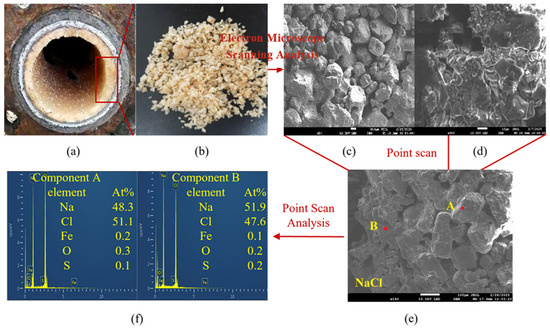
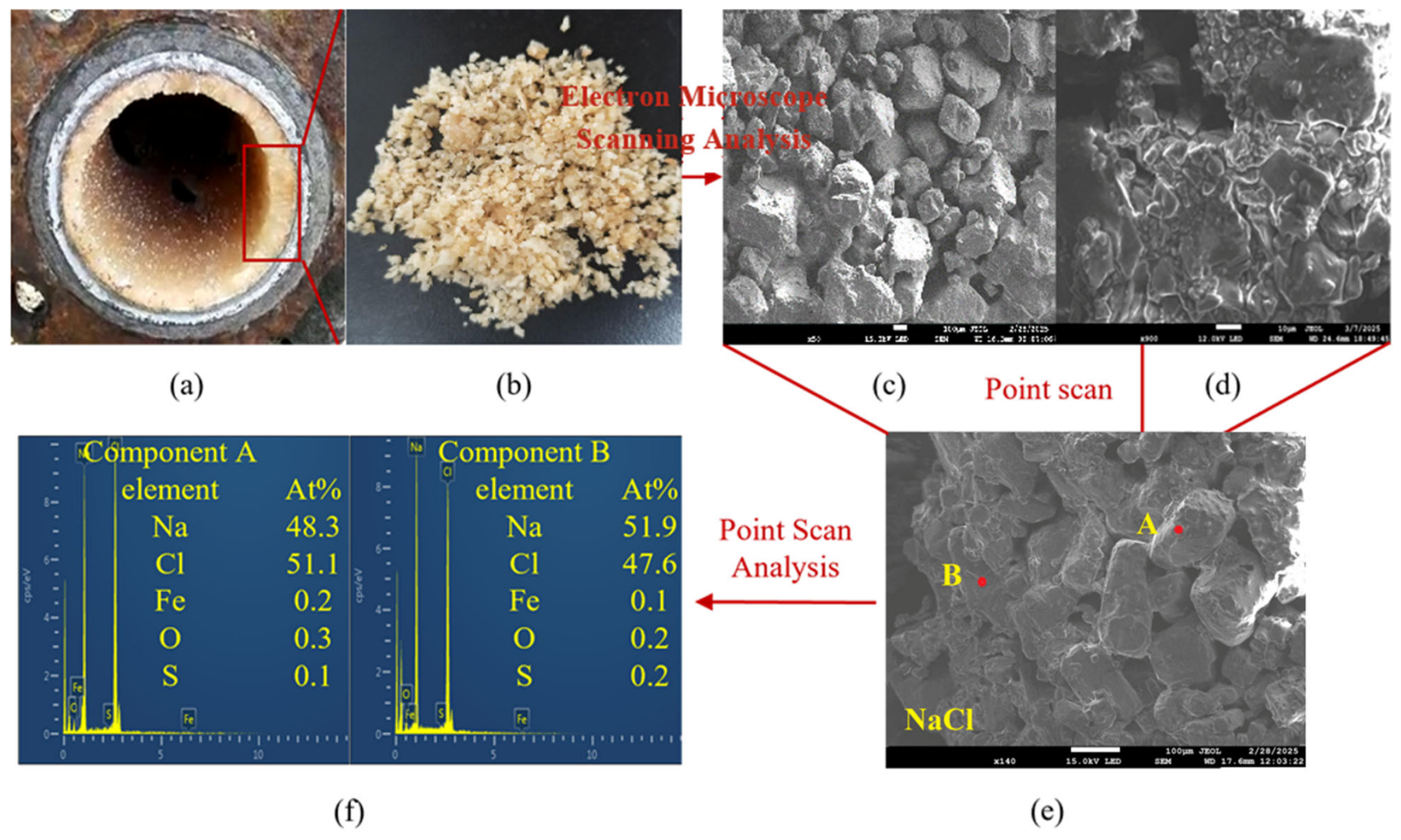
Salt deposits collected from the site were characterized by optical microscopy, scanning electron microscopy (SEM), and point-scan elemental analysis (Figure 1). The point-scan spectra confirmed that NaCl was the dominant crystalline phase across the sampled deposits (Figure 1f). All interface models were constructed in water solutions containing 3.5 moles/liter of sodium chloride. This selected concentration range effectively simulated the high-ionic-strength environment of underground saltwater [5,20]. To eliminate artifacts caused by limited boundaries, a three-dimensional periodic system was established using periodic boundary conditions [21]. For flat-interface models, the simulation cell was 2.0 nm × 2.0 nm × 3.0 nm, which was sufficient to balance the dynamic equilibrium between the interface and the bulk solution. In the model, Na+ and Cl− were uniformly distributed in the solution region at an equal molar ratio. After sufficient energy minimization, the system stress was gradually released, and the molecular simulation was initiated in a quasi-static manner [22]. The nano-hole model used a separate 20 nm × 20 nm × 20 nm periodic unit cell, which is consistently described in Section 4.2.
Figure 1.
Characterization of salt deposits collected from the on-site brine discharge tubing: (a) field site of crystallization in the brine discharge tubing; (b) field-sampled yellow salt deposit; (c) optical micrograph of the salt-block outer wall at 50× magnification; (d) optical micrograph of the salt-block outer wall at 900× magnification; (e) SEM image of the salt deposit surface; (f) point-scan elemental analysis of components A and B, showing Na, Cl, and Fe signals.
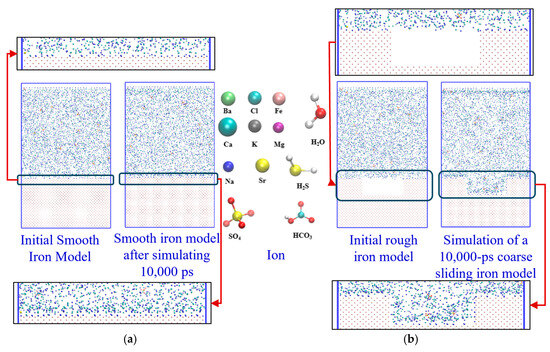
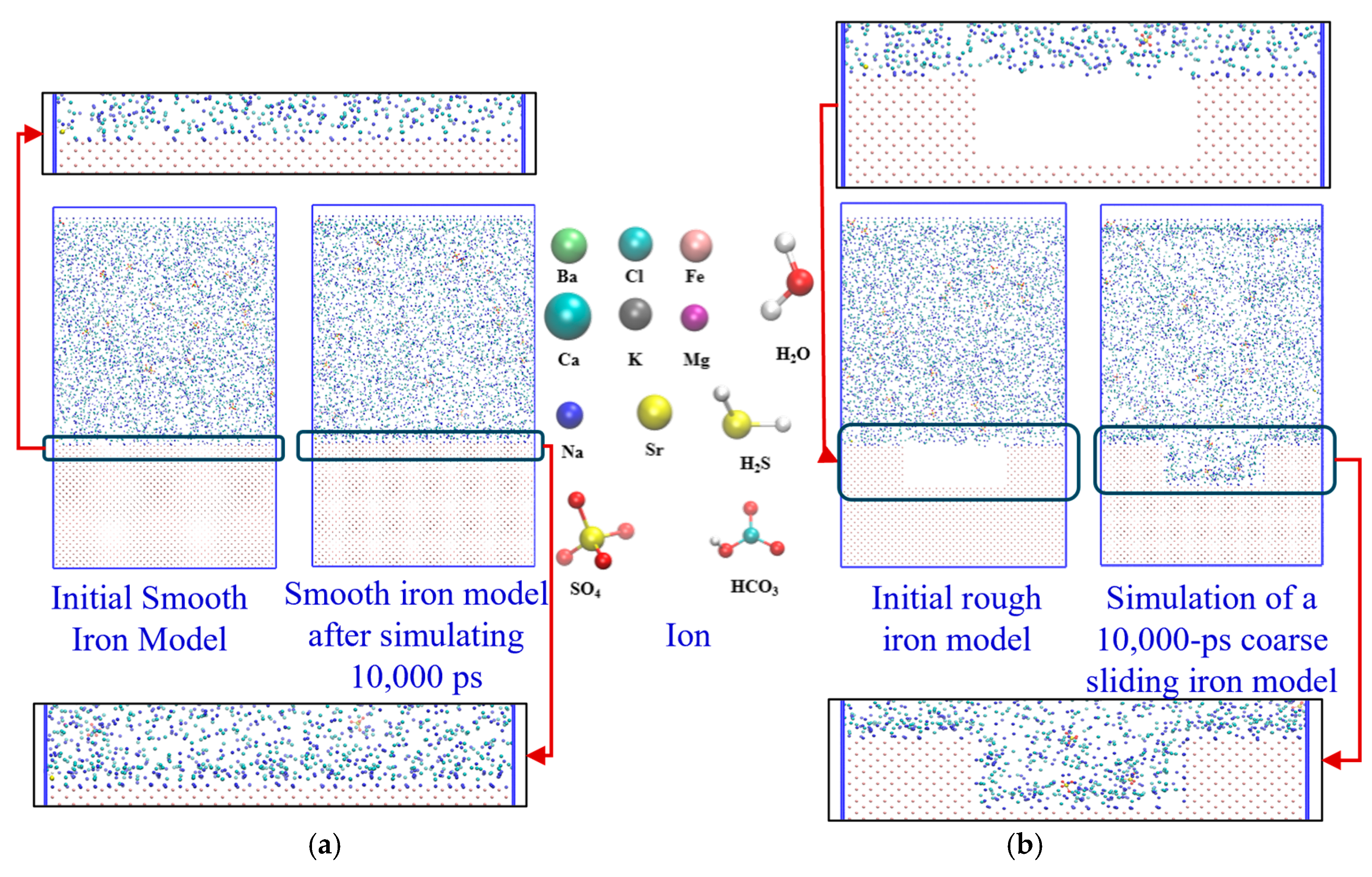
When selecting the interface materials for this study, the actual operating environment of the brine discharge pipe column in the underground salt cavern gas storage reservoir was fully considered. Iron is the most common metal matrix in this scenario, and its excellent mechanical strength and mature processing capabilities have enabled its wide application in engineering [15]. However, its high chemical activity is a double-edged sword. Under long-term brine erosion, the metal surface gradually forms complex micro-roughness structures [16]. These microscopic geometric defects often serve as sites for the preferential growth of salt crystals. Therefore, when constructing the metal interface model, we clearly distinguished between two states: the idealized smooth interface (Figure 2a) and the more realistic step-like rough interface (Figure 2b). This design intention is to capture the behavioral differences of the metal surface from its pristine state to its long-term usage state. The construction of the step structure is based on the physical principle of surface orientation defects in metal crystals and on artificially set crystal-plane misalignment, which generate active adsorption areas with local energy barriers [23]. The rough iron surface was constructed with a step height of 0.5 nm (approximately two Fe atomic layers), a step width of 1.0 nm, and a periodic arrangement along the z-direction. These geometric parameters define the preferential adsorption sites used in all rough-interface simulations.
Figure 2.
Molecular simulation of metal interface models: (a) initial to 10,000 ps simulation changes for the idealized smooth interface; (b) initial to 10,000 ps simulation changes for the step-like rough interface.
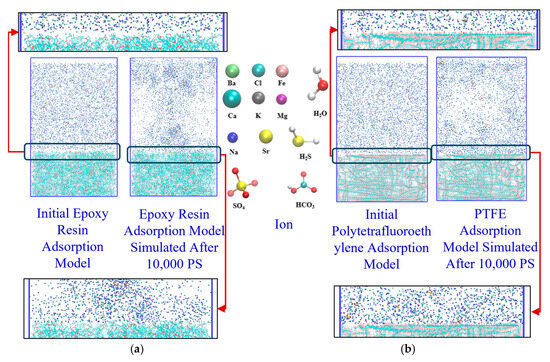
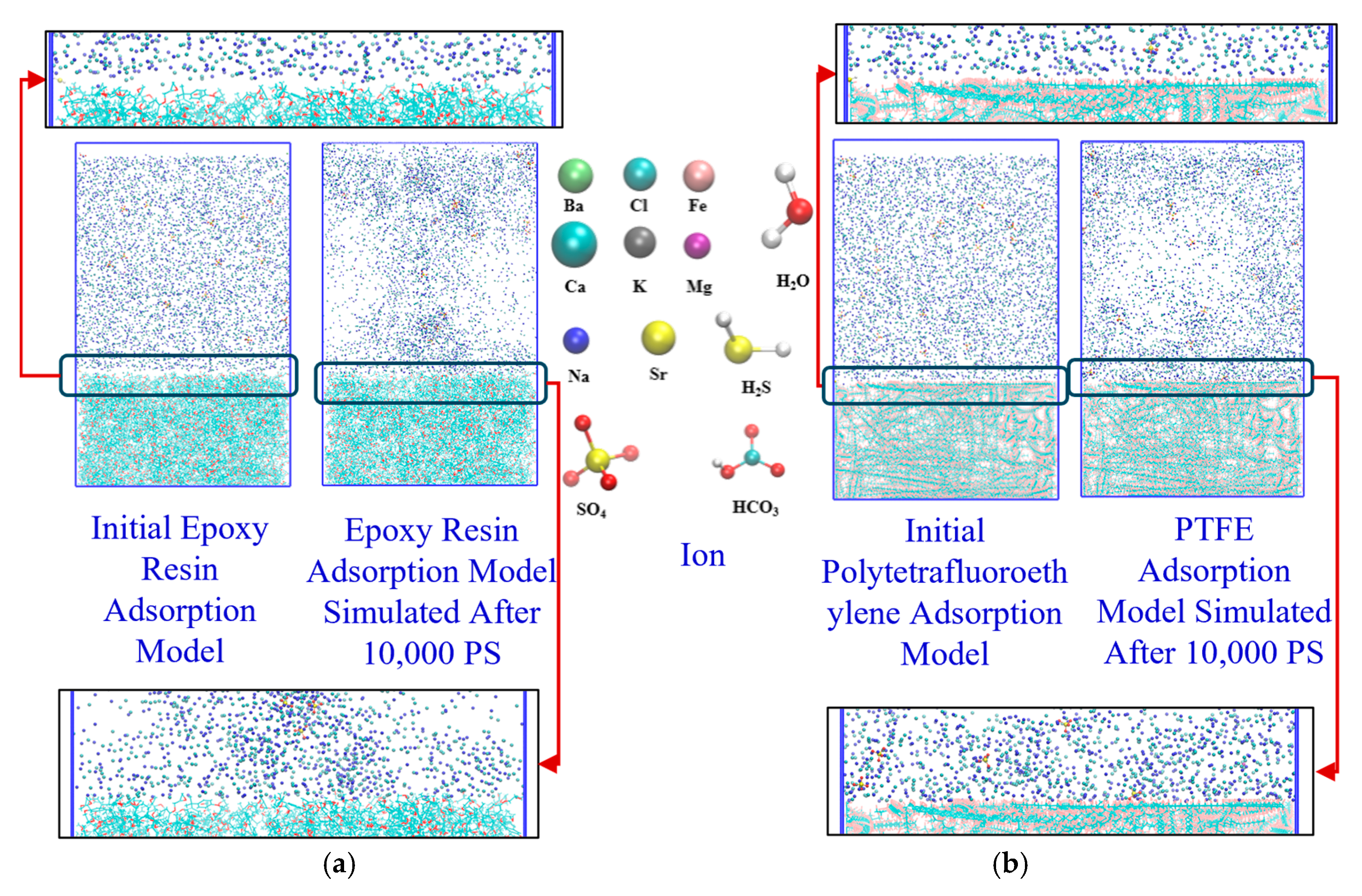
In addition to the metal interfaces, this study also analyzed the widely used anti-corrosion and anti-crystallization coatings in engineering. Specifically, we constructed two typical polymer interface models: epoxy resin (Figure 3a) and polytetrafluoroethylene (Figure 3b) [13,24]. Epoxy resin is widely used for coating metal surfaces due to its excellent adhesion and mechanical protection properties. However, its molecular structure contains numerous polar groups, which may enhance ion adsorption. Polytetrafluoroethylene has high hydrophobicity and extremely low surface energy, which give it a natural resistance to salt crystallization. Through molecular dynamics simulations of these two types of polymer interfaces, we analyzed how surface polarity and molecular chain flexibility jointly regulate ion interface behavior [25,26].
Figure 3.
Two polymer interface models: (a) simulation evolution from initial adsorption to 10,000 ps for the epoxy resin model; (b) simulation evolution from initial adsorption to 10,000 ps for the polytetrafluoroethylene model.
During the model construction process, to ensure that the atomic arrangement at the material surface is consistent with the actual situation, the atomic level of the metal surface was precisely defined by combining crystallographic parameters and material database information [27]. For the polymer surface, a systematic molecular dynamics pre-processing was carried out until the system reached sufficient conformational convergence and an equilibrium interface tension. Especially in the polymer model, the inter-chain entanglement effect [28] and non-uniform density distribution were introduced to simulate the molecular chain migration and swelling behavior of the real coating in a liquid environment, making the interface properties closer to those under actual engineering conditions.
2.2. Simulation Process and Parameter Settings
During the simulation initialization stage, to eliminate any non-physical defects introduced during model construction, we performed a 100 ps energy minimization on each system using the steepest descent algorithm to reduce the system potential energy to a reasonably stable range [29]. The subsequent equilibrium process was divided into two key stages. Firstly, under the NVT ensemble, the system was gradually heated to 298 K [30]. To avoid sudden temperature increases that cause molecular structure distortions, the Berendsen heat bath coupling mechanism was introduced, allowing the temperature to smoothly reach the set value within 200 ps [31,32]. Secondly, the simulation was carried out under the NPT ensemble for a continuous 10 ns production simulation [30]. The system pressure was stabilized at 1 bar using the Parrinello–Rahman method. The selection of the force field was based on material characteristics, with detailed distinctions. For the metal interface, the EAM classical potential function based on the embedded-atom method was used to accurately describe the interaction between iron atoms and water molecules [30]. For the polymer system, the OPLS-AA force field was selected for the epoxy resin interface, which is relatively reliable at describing polar organic molecules [33]. Equilibration was assessed from the final 1 ns of the NPT trajectory: temperature remained within ±1 K of 298 K, pressure remained within ±10 bar of 1 bar, the total potential-energy drift was less than 0.1 kJ/mol/ns, and the interface RMSD stabilized below 0.05 nm. Interfacial tension was calculated from the difference between the normal and tangential components of the pressure tensor using the Irving–Kirkwood route and was averaged over the final 1 ns of the 10 ns NPT production run. Water molecules were described using the TIP3P model, which has been extensively validated for aqueous electrolyte simulations.
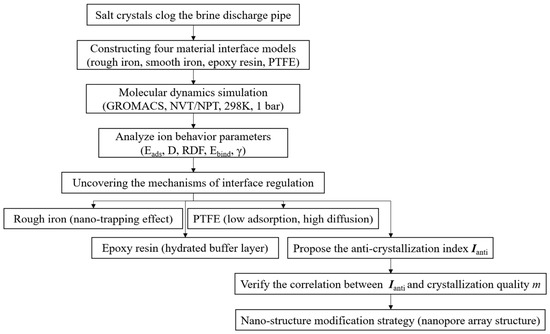
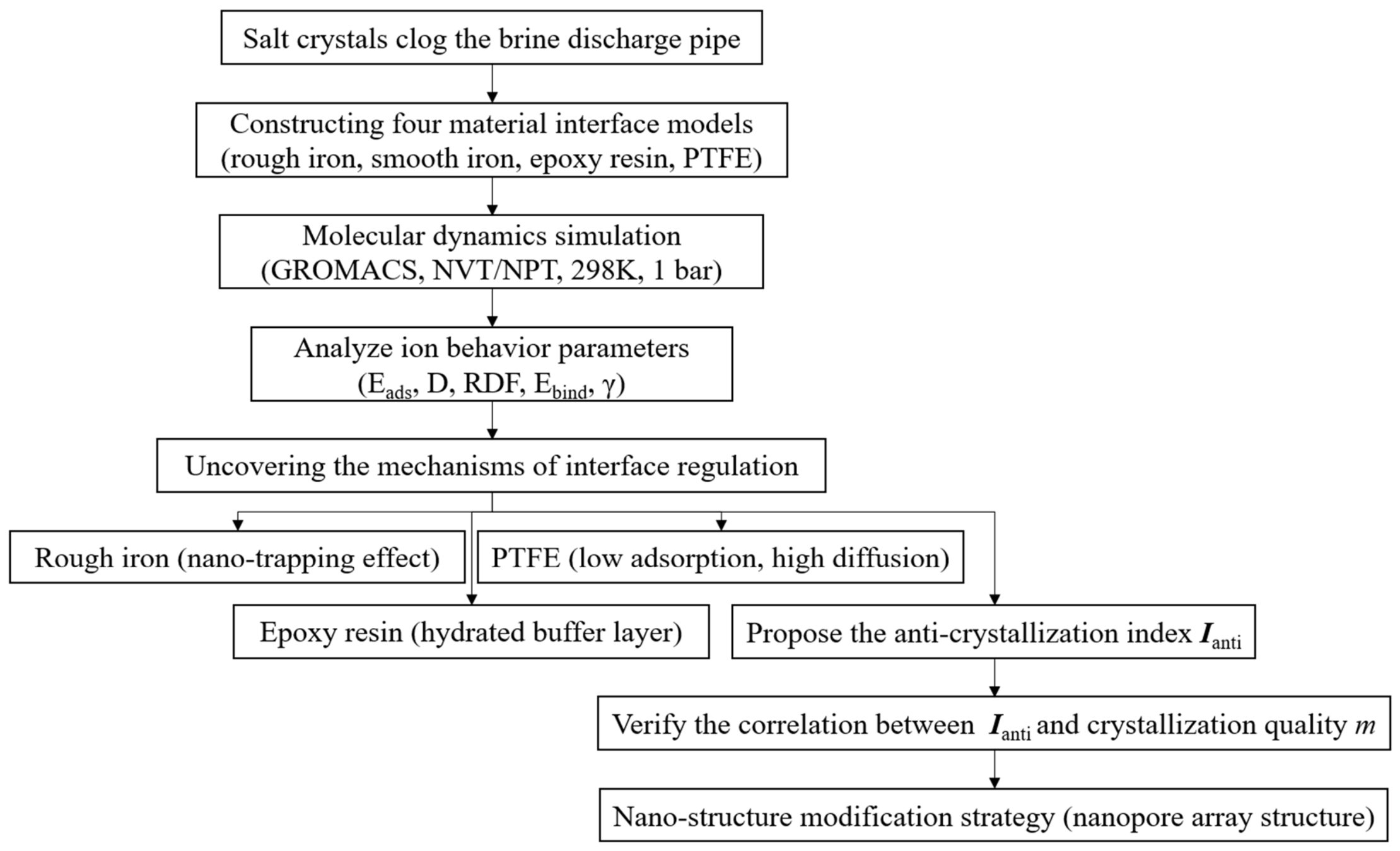
In contrast, for the polytetrafluoroethylene interface, the CHARMM force field, which performed well in the simulation of hydrophobic polymers, was adopted [34]. The ion parameters used the parameter set by Joung and Cheatham, which accurately reproduces the diffusion characteristics and hydration structures of Na+ and Cl− in aqueous solutions [35]. Throughout the simulation, long-range electrostatic interactions were handled using the particle–particle particle–mesh Ewald method, and the van der Waals interaction cutoff radius was set to 1.2 nanometers. Data were collected at a frequency of once per ps, providing sufficient time resolution for subsequent dynamic analysis [36]. The research flowchart is as follows (Figure 4):
Figure 4.
Flowchart.
2.3. Experimental Validation
Static crystallization tests were performed using coupons of rough Fe, smooth Fe, epoxy resin, and PTFE. Before testing, the coupons were polished, ultrasonically cleaned in acetone and deionized water, and dried. Each coupon was immersed in 100 mL of 3.5 mol/L NaCl solution in a sealed glass vessel at 298 ± 1 K. After 24 h under static conditions, the coupon was removed, gently rinsed with saturated NaCl solution, dried at 313 K for 2 h, and weighed on an analytical balance. Three independent measurements were performed for each material, and the mean crystallization mass m was used for validation. The linear least-squares correlation between Ianti and m gave R2 = 0.95, confirming that a higher Ianti corresponds to a lower crystallization mass.
3. Interface Property Regulation of Salt Crystallization Mechanisms
3.1. Ion Adsorption Mechanisms in Interface Microstructures
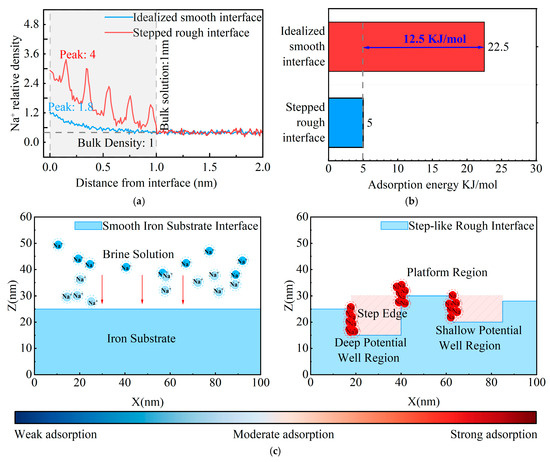
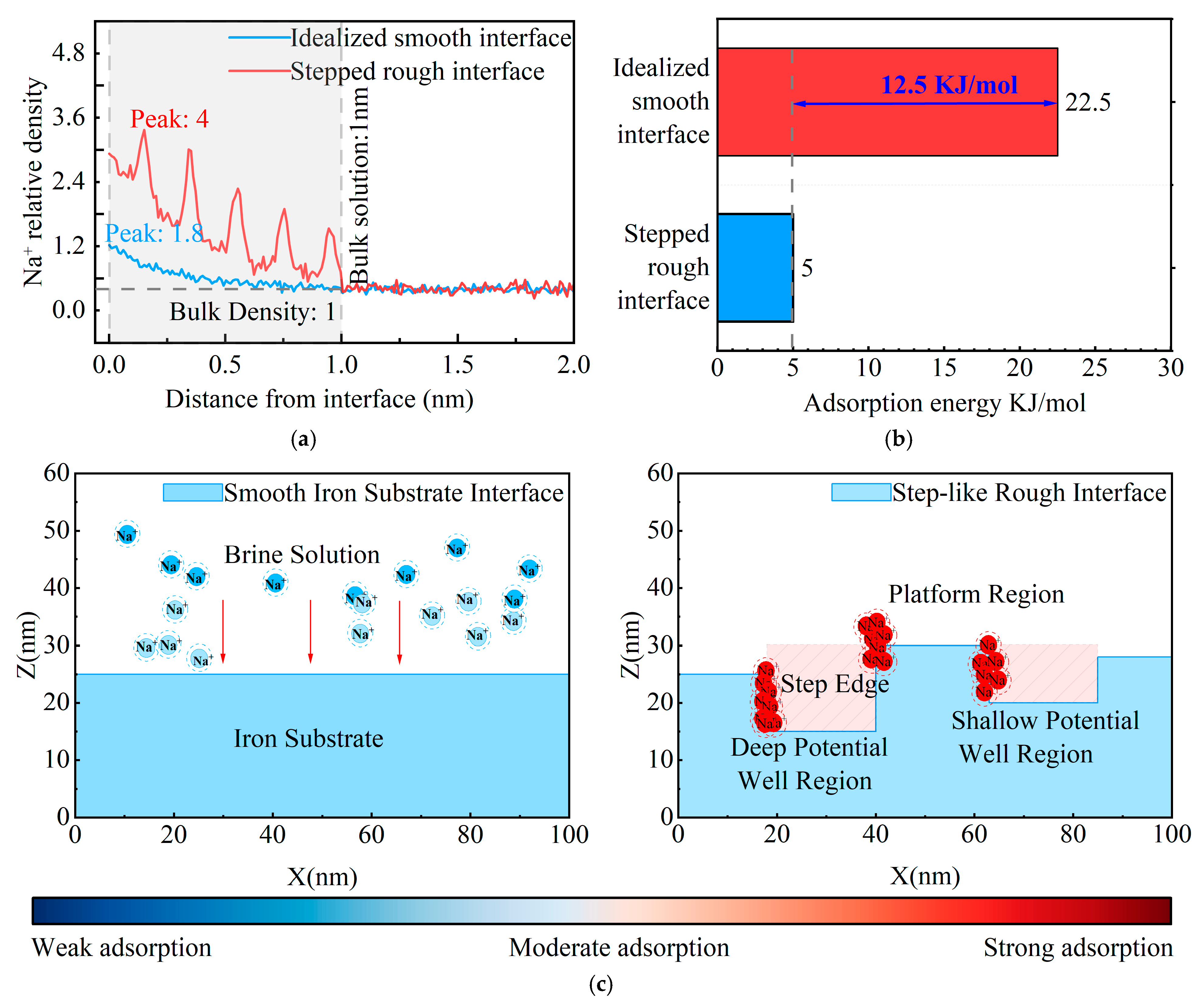
The microscopic geometric morphology of the solid–liquid interface, especially on the surface of iron-based materials, decisively influences ion adsorption behavior. The steps and defects on the rough iron interface form what is known as the nanotrap effect, which significantly alters the ion distribution near the interface [37,38]. The analysis based on the radial distribution function of sodium ions indicates that the adsorption energy at the rough surface step sites is 12.5 kJ/mol higher than that on the smooth interface (Figure 5a). This energy difference leads to a sodium ion density of 3.8 times the bulk phase concentration within the 0–1 nanometer region of the interface (Figure 5b). These data suggest that the surface roughness not only enhances ion adsorption but also substantially creates a local environment conducive to crystal nucleation. The steps and defects, as high-energy adsorption sites, can effectively capture and enrich Na+, thereby providing a structural basis for the subsequent heterogeneous nucleation and growth of crystals (Figure 5c).
Figure 5.
Molecular dynamics mechanism of Na+ ion adsorption regulated by iron-based interface microstructure: (a) Na+ density near the iron-based interface; (b) comparison of step site adsorption energies; (c) coordinated adsorption in deep and shallow potential wells at ideal smooth and step-like rough interfaces.
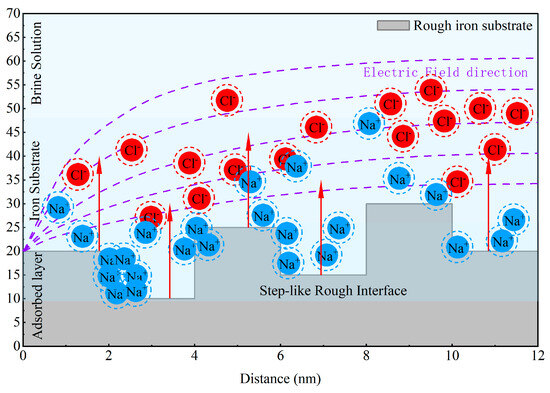
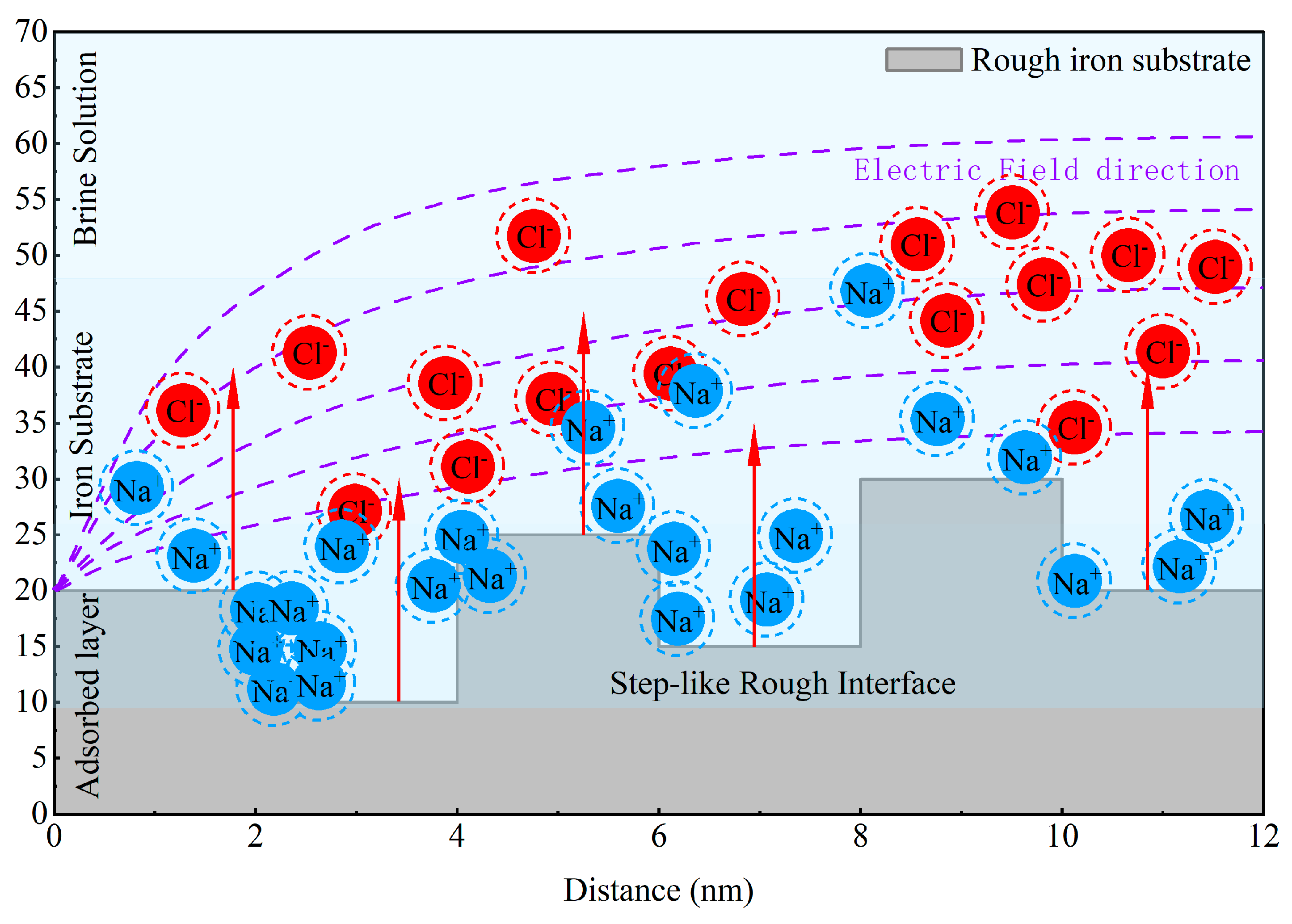
Further simulation of the electrostatic field showed that, compared with a smooth surface, the rough iron interface exhibits a significantly enhanced electric potential gradient of 0.03 V/nm, which is three times greater than the 0.01 V/nm observed on the smooth surface. This stronger electric field fundamentally alters the behavior of ions near the interface. It not only significantly enhances the adsorption strength of cations such as Na+, but also drives the directional migration and enrichment of anions such as Cl− [39]. The result is a more compact and stable double layer at the interface. In this double layer, Cl− is arranged closely as the counter-ion layer, further consolidating the stability of the entire interface structure. This electric-field-induced double-layer effect not only enhances ion adsorption at the interface but also provides conditions for the preferential orientation of crystal growth. This electric-field-induced double-layer effect is one of the key factors that enable the rough iron interface to exhibit stronger adsorption capacity and excellent crystallization performance (Figure 6).
Figure 6.
Formation of an electric double-layer structure induced by an electric field.
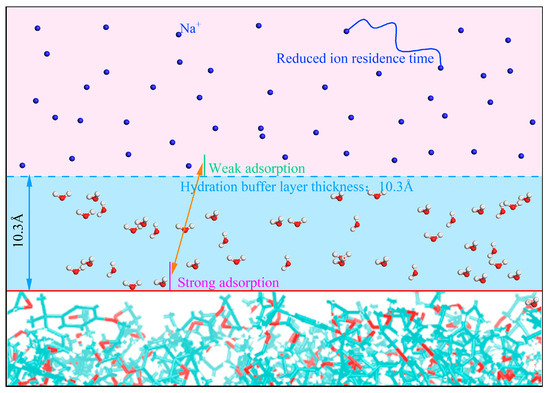
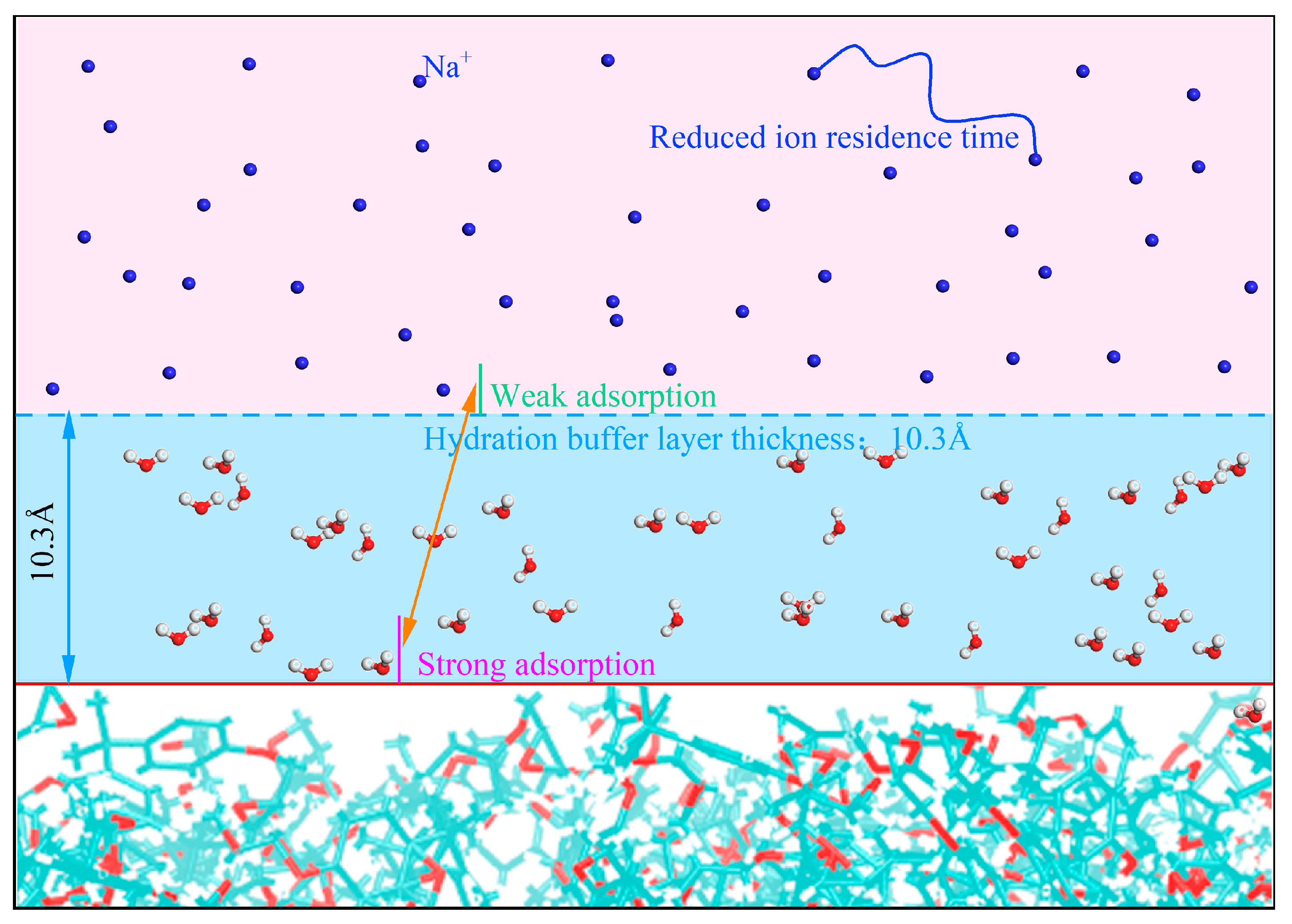
Compared with the rough iron interface, the epoxy resin exhibits a more regular interface structure and lacks strong adsorption sites similar to those on metals. However, this does not mean that such interfaces are completely inert. The polar hydroxyl groups distributed on the epoxy resin surface can form hydrogen bonds with surrounding water molecules, thereby forming a dynamic “hydration buffer layer” at the interface. This hydration layer, maintained by the hydrogen bond network, has a thickness of approximately 10.3 Å. This hydration layer effectively isolates direct contact between ions in the solution and the surface of the polymer matrix [40]. The single hydrogen bond formed between the hydroxyl groups on the epoxy resin interface and water molecules has a bond energy of −12.3 kJ/mol. It is precisely this stable hydration structure that significantly reduces the effective adsorption energy of ions at the interface by 48%, thereby reducing the residence time and concentration of Na+ at the interface (Figure 7).
Figure 7.
Molecular mechanism of Na+ adsorption regulation by the hydrated buffer layer at the epoxy resin interface.
The presence of hydroxyl groups on the epoxy resin surface leads to a certain degree of ion retention. The hydroxyl functional groups distributed on the epoxy resin surface, although forming a hydration layer that inhibits adsorption, still result in the retention of some ions. Quantitative analysis shows that when the surface hydroxyl density reaches 2.3 per nm2, approximately 5.6% of the ions remain in the interface region. This phenomenon reveals that although the hydration buffer layer significantly weakens the overall adsorption capacity of ions, due to the still sufficiently high density of hydroxyl groups, a certain interface ion capture effect is maintained. The surfaces of polymer materials indeed lack strong adsorption sites like those in metal defects, and their total ion adsorption capacity is usually low. However, this does not mean that their interfaces are inert. The surface polarity and hydrogen-bond network jointly constitute a regulatory mechanism that affects the distribution and dynamics of ions in a manner distinct from geometric capture.
3.2. Diffusion Field Effects at Hydrophobic Interfaces
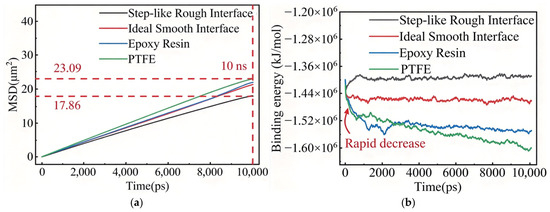
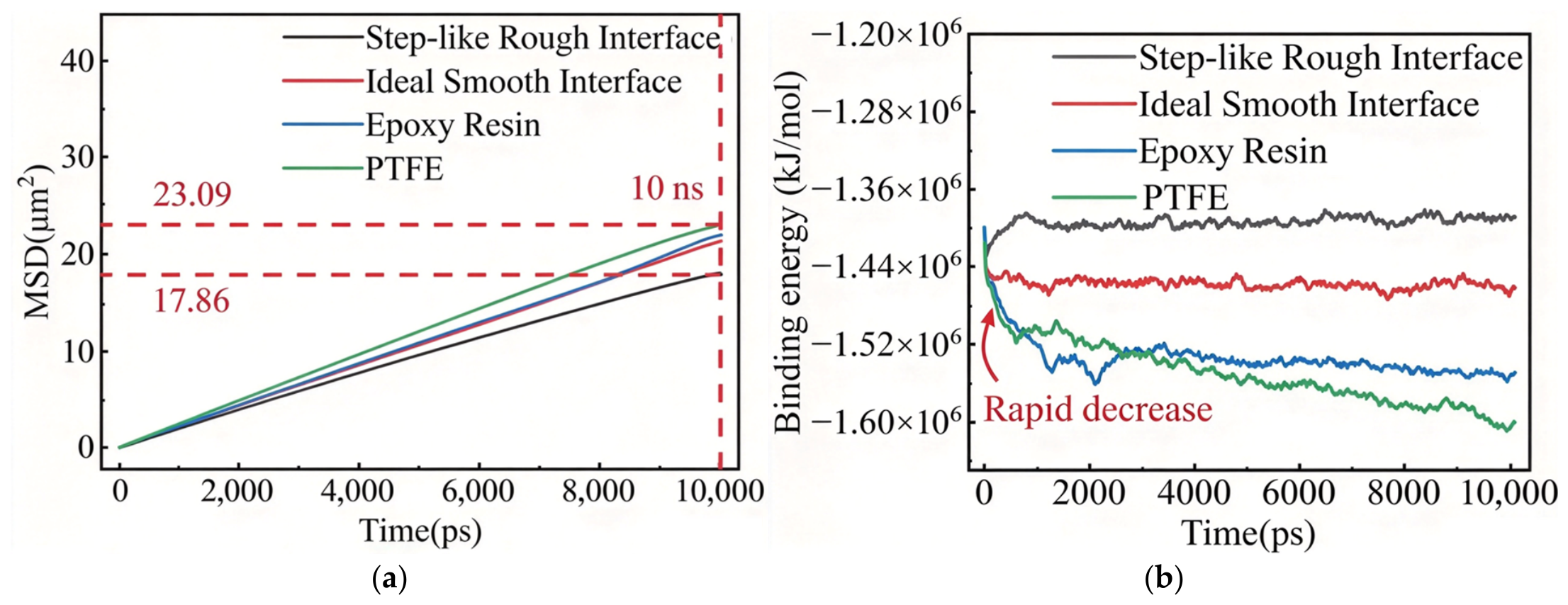
The results of molecular dynamics simulations indicate that the interface of polytetrafluoroethylene exhibits unique liquid-like migration characteristics [41]. Taking Na+ as an example, its average displacement on the PTFE surface reaches 23.09 nm2 within 10 ns, which is significantly higher than 17.86 nm2 on the rough iron interface, with an increase of 1.3 times (Figure 8a). This high migration property is directly attributed to the fact that there are almost no active sites near the PTFE interface that can strongly bind ions. The ions maintain a high kinetic energy and a very low binding state near the interface, and their movement pattern is similar to that of free diffusion in solution. The interaction between the PTFE interface and the ions is extremely weak, and the system’s total binding energy is the lowest among all the studied systems. A higher interface binding energy means that the activation energy barrier required for the transformation of dispersed ions into ordered crystal nuclei is lower. The higher the binding energy, the lower the initial energy of the ion-interface composite system, and the system is more likely to cross the energy threshold required for nucleation (Figure 8b) [42].
Figure 8.
Ion diffusion kinetics and binding thermodynamics at different interfaces: (a) mean square displacement (MSD) curves of Na+ at different interfaces; (b) NaCl binding energy at different interfaces.
To quantify the influence of the interface on the diffusion path, we introduce the curvature factor κ, defined as the ratio of the actual diffusion path length to the straight-line distance between the ions’ starting and ending points. This parameter is used to precisely describe the degree of curvature in the ions’ motion near the interface [43]. The κ value of the rough iron interface is as high as 2.8, indicating that the ions’ path through the rough interface layer is extremely tortuous, with frequent inelastic scattering and surface collisions. The high-curvature path directly confirms the strong interference and trajectory disruption caused by microscopic geometric defects in the ions’ movement direction. In contrast, the κ value of the PTFE interface is only 1.1, which is very close to the theoretical value of 1 in the ideal free diffusion state. This means that the ions move almost in a straight line on the surface, and the diffusion process is highly smooth, with negligible constraints.
These kinetic differences ultimately manifest in the ions’ local residence times. We compared the average residence time τ of Na+ on different interfaces. The τ of the rough iron interface is 8.2 ns, while that of the PTFE interface is only 2.1 ns, which is 3.9 times that of the former. The longer residence time increases the probability that ions aggregate, interact, and form a local high-concentration environment near the interface, thereby providing a more generous and stable time window for the formation of nuclei.
3.3. Interface Polarity and Crystallization Thermodynamics
This study has, for the first time, established a quantitative relationship between the interface polarity parameters and the crystallization activation energy.
where ΔG* is the crystallization activation energy, kJ/mol, and P is the surface density of the interface polar groups, nm2. Based on experimental data, the rough iron interface exhibits strong polarity due to its high density of hydroxyl and oxide structures, with a measured p value of 4.5 per nm2. Correspondingly, its activation energy for crystallization, ΔG*, is 596 kJ/mol. In contrast, the PTFE interface contains virtually no polar functional groups, with a p value approaching 0, while ΔG* significantly increases to 821 kJ/mol. Further calculations indicate that a decrease of 1 polar group per nm2 in interface polarity density leads to an average increase of 50 kJ/mol in crystallization activation energy.
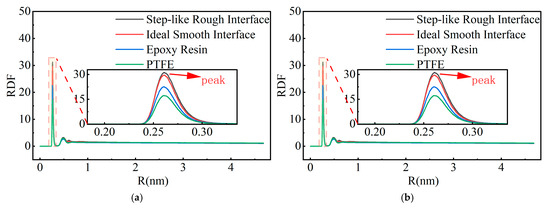
Based on the radial distribution function, we further explored the influence of interface polarity on nucleation behavior at the microstructural level (Figure 8a) [44]. We introduced the structural order degree η to describe the stability of the spatial arrangement of ion pairs, defined as the ratio of the height of the first main peak of the RDF to the full width at half maximum. This parameter reflects the regularity of the first coordination layer formed by Na+ and Cl− near the interface. The analysis results showed that on the rough iron interface with strong polarity, the η value of the Na+-Cl− coordination layer was 2.3 times higher than that on the polytetrafluoroethylene interface. This significant difference not only confirmed that high polarity interfaces can enhance the adsorption ability of ions (Figure 9b) but also revealed that a higher-order degree means that the ions adsorbed on the interface are not randomly arranged but rather present a spatially directional arrangement closer to the crystal prototype.
Figure 9.
Ion pair ordering and adsorption energy at different interfaces: (a) radial distribution function of Na+-Cl− at different interfaces; (b) adsorption energy of NaCl at different interfaces.
4. Anti-Crystallization Coating Design
4.1. Anti-Crystallization Index Development and Application
Based on the complex synergistic effects among interface adsorption, ion diffusion, and interface free energy [45,46,47], this study innovatively proposed a comprehensive anti-crystallization index Ianti. Its physical meaning lies in comprehensively characterizing the material surface’s interference ability on the microscopic process of crystallization initiation. Specifically, when the interface adsorption energy is low, the ion diffusion coefficient D is high, and the interface tension γ is large, the surface exerts the weakest traction on ion aggregation and the formation of ordered structures, thereby exhibiting optimal anti-crystallization performance. This means that the higher the Ianti value, the greater the material’s potential for anti-crystallization:
where is the adsorption energy of ions or precursors at the interface, kJ/mol; D is the diffusion coefficient at the interface, m2/s; and γ is the interfacial tension, N/m.
An ideal anti-crystallization interface should simultaneously possess low adsorption energy, a high ion diffusion coefficient, and weak interfacial tension. As shown in Table 1, based on key parameters from simulation calculations, the Ianti values of the four materials differ significantly.
Table 1.
Key parameters from molecular simulations and anti-crystallization index evaluation for different interface materials. The interfacial tensions were obtained from the normal and tangential pressure tensor components using the Irving–Kirkwood method and averaged over the final 1 ns of the NPT production run.
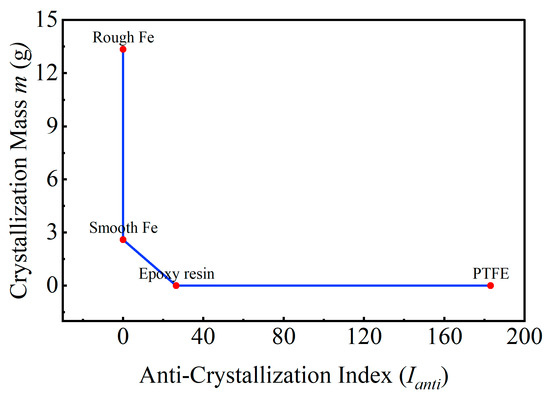
To establish a more robust correlation, we introduced the experimentally measured static crystallization mass, m, as a verification benchmark. Through fitting, a clear negative correlation between Ianti and m was discovered. This relationship indicates that the larger the index value, the less the final crystalline mass, and the better the anti-crystallization effect:
where m is the experimentally measured static crystallization mass, mg. The Eads−1 term highlights that weak adsorption interfaces make it more difficult to stabilize ionic coordination structures, thereby suppressing nucleation. The introduction of the diffusion coefficient D reflects that, under conditions of high mobility, ions find it harder to aggregate stably for nucleation, effectively counteracting the tendency toward spatial ordering. The interfacial tension γ−1 term reveals that high-tension interfaces, due to their lack of interfacial compatibility, are unfavorable for structural relaxation and the formation of initial nucleation expansion (Figure 10).
Figure 10.
Correlation between Ianti and crystallization mass.
4.2. Interface Nanostructured Modification
In high-salt or complex liquid environments, the material’s surface ability to interfere with the crystallization process directly determines its anti-scaling performance. Traditional methods that rely on surface chemical modification often fail to ensure stability and durability under extreme conditions [48]. Based on this, this paper proposes a dual-functional interface design strategy that integrates polar-group shielding and the construction of diffusion channels. This approach aims to synergistically inhibit the nucleation process from both thermodynamic and kinetic perspectives, providing a new theoretical path for the development of a new generation of anti-crystallization materials.
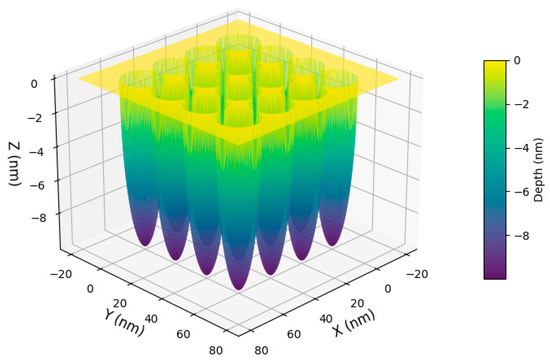
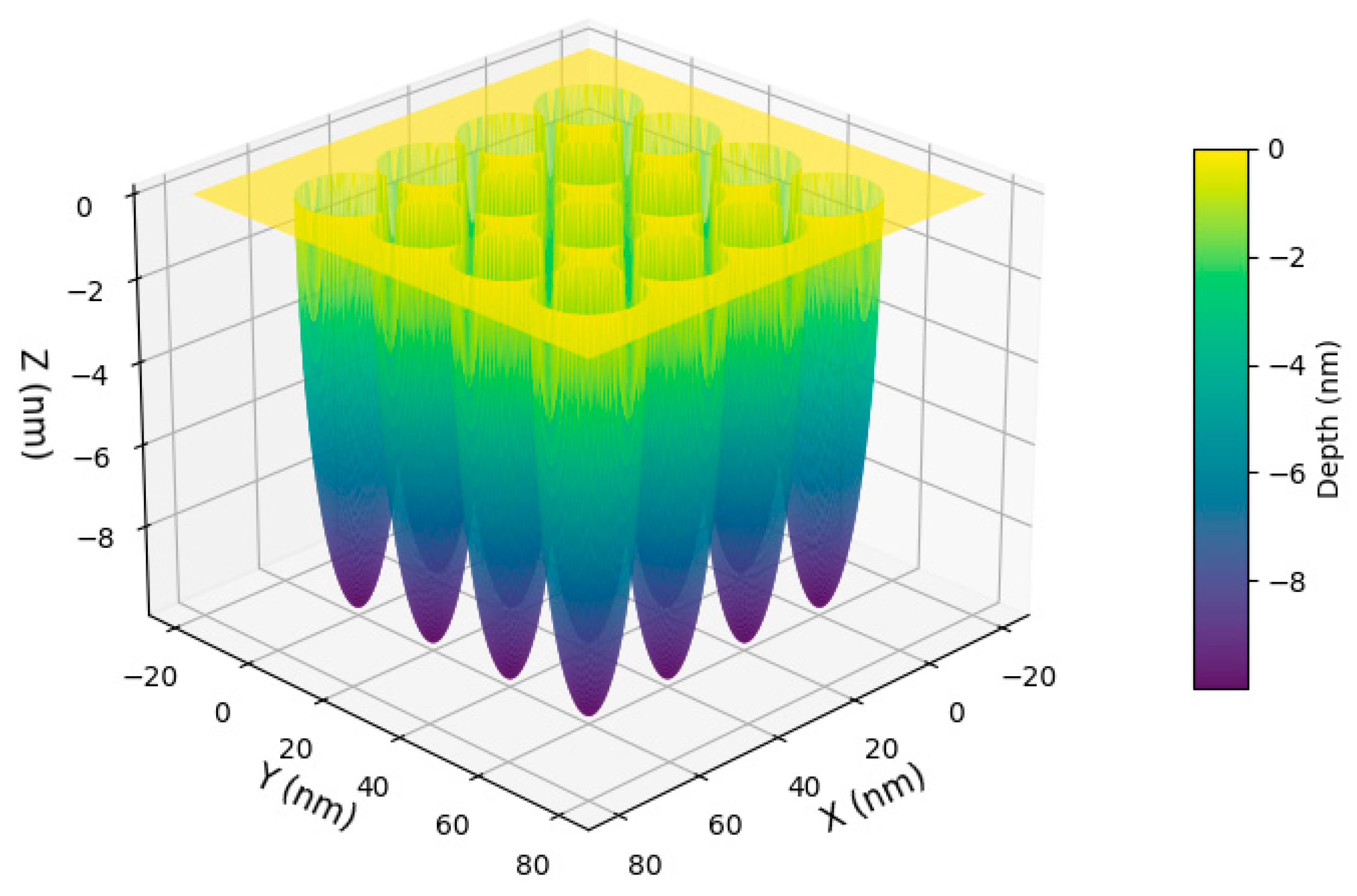
The implementation of this strategy involves two levels. Firstly, using micro- and nanostructures to shield the surface polar sites spatially reduces the number of effective adsorption sites and weakens the initial aggregation tendency of ions. Secondly, by constructing nanoscale diffusion channels, it enhances local fluid disturbance and ion migration and hinders the evolution of ion clusters towards stable nuclei. Specifically, we prepared a regularly arranged hemispherical depression array on the polytetrafluoroethylene surface, with a spacing of 20 nanometers and a depth of 15 nanometers (Figure 11). This structure, known as a nano-hole, possesses both spatial steric hindrance and flow-field modulation functions, demonstrating significant anti-crystallization potential [49]. For the nano-hole calculations, a separate 20 nm × 20 nm × 20 nm periodic unit cell was used. The lateral cell length equals the 20 nm array pitch, the depression depth is 15 nm, and a 5 nm brine layer remains above the PTFE surface. Figure 11 displays a 4 × 4 periodic extension (80 nm × 80 nm) for visualization only.
Figure 11.
Three-dimensional surface map of a hemispherical concave array.
Molecular dynamics simulations show that after introducing the nano-hole structure, the interface adsorption energy decreased by 2.1 kJ/mol, indicating that the binding ability of ions to the surface was effectively weakened. This is mainly because some surface interaction points were embedded inside the depressions, significantly reducing their spatial accessibility. At the same time, the ion diffusion coefficient near the interface increased by approximately 18%. This change can be attributed to the micro-scale vortex effect induced by the nano-hole structure, where liquid forms periodic rotational diffusion paths between micro-etch cavities, interfering with the stable coordination behavior of ions and inhibiting the local concentration and structural ordering processes required for nucleation [50].
The crystallization rate was quantified as the linear slope of the number of ions belonging to ordered NaCl clusters versus simulation time over the 2–10 ns interval of the 10 ns production run. Ordered clusters were identified using a Na-Cl cutoff distance of 0.35 nm and a minimum cluster size of six ions, and the same criterion was applied to all systems. More significantly, the nanostructure reduced the effective adsorption site density at the interface from 12 sites/nm2 to 5 sites/nm2. This change directly weakened the interface’s ability to capture ion clusters and increased the system’s thermodynamic stability. Combined with the kinetic perturbation brought about by diffusion enhancement, both factors synergistically reduced the crystallization rate in the simulated system by approximately 22%. This further validates the efficient inhibition of the nucleation process by this structure at the physical level.
From the perspective of energy distribution, the nano-hole structure disrupts the homogeneity of the flat-interface potential energy distribution, forming a periodic pattern of alternating low-energy traps and high-energy barriers. This design makes the movement paths of ion clusters near the interface more complex and random, significantly reducing the probability of a stable nucleus formation. Unlike traditional modification methods that rely on specific chemical environments or molecular structures, this physical structure-based interface potential energy regulation mechanism demonstrates superior environmental adaptability and engineering feasibility.
5. Conclusions
This study was conducted using the GROMACS molecular dynamics simulation platform and analyzed the interaction process between the sodium chloride solution in the desalination pipe column of the salt cave gas storage facility and different materials at the atomic scale. By constructing a series of interface models with different roughness and chemical properties, such as smooth iron, rough iron, epoxy resin, and polytetrafluoroethylene, and comprehensively applying multi-parameter analysis methods, including ionic adsorption energy, diffusion coefficient, and interfacial tension, the intrinsic mechanism of how interface characteristics regulate salt crystallization behavior was deeply revealed. The molecular dynamics trajectories and thermodynamic calculations clarified the adsorption, diffusion, and ordered dynamics of ions near the interface. In contrast, the microscopic characterization results, such as the radial distribution function, mean-square displacement, and potential distribution, further clarified the key laws governing the synergistic influence of interface polarity, roughness, and the diffusion field on crystal nucleation. The main findings of this study are as follows:
- (1)
- An innovative three-dimensional interface regulation model of polarity, roughness, and diffusion field was proposed, and the interface anti-crystallization index Ianti was constructed based on it. This index quantitatively evaluates the material’s anti-crystallization performance by integrating three core parameters: adsorption energy, diffusion coefficient, and interfacial tension. The verification shows that Ianti exhibits a significant negative correlation with experimentally measured crystallization quality, with an R2 of 0.95.
- (2)
- The microscopic interaction mechanism of different material interfaces was clarified. The rough iron interface, due to its geometric defects, exhibits a nanotrap effect, leading to a sodium ion adsorption density 3.8 times the bulk phase concentration. The epoxy resin interface forms a stable hydrated buffer layer via surface hydroxyl groups, thereby reducing ionic adsorption energy by 48%. The polytetrafluoroethylene interface shows unique advantages, with its extremely low adsorption energy, higher diffusion coefficient, and weaker interfacial tension working together to extend the crystallization induction period by 3.2 times.
- (3)
- An active modification strategy for interface nanostructuring for engineering applications was proposed. The designed nano-hole array structure, with an accurate configuration of 20-nanometer spacing and 15-nanometer depth, simultaneously provided spatial shielding of polar groups and strengthened diffusion channels. This structure reduced the effective adsorption site density by 58%, increased the diffusion coefficient by approximately 18%, and ultimately decreased the crystallization rate by 22%, thereby significantly improving the interface anti-crystallization performance.
Author Contributions
Conceptualization, X.L.; Methodology, X.L., W.C. and T.M.; Validation, T.M.; Formal analysis, W.W., J.L. and Y.W. (Yueying Wang); Investigation, X.L., W.C., J.L. and Y.W. (Yueying Wang); Resources, X.L. and W.W.; Data curation, W.C., W.W., Y.W. (Yajun Wang) and Y.W. (Yueying Wang); Writing—original draft, T.M. and Y.W. (Yajun Wang); Writing—review and editing, Y.W. (Yueying Wang); Visualization, J.L. and Y.W. (Yajun Wang); Supervision, X.L. All authors have read and agreed to the published version of the manuscript.
Funding
This work was jointed supported by the National Science and Technology Major Project [2025ZD1403006-04], and Major Science and Technology Project of China Oil and Gas Pipeline Network Group Co., Ltd., entitled “Research and Application of Key Technologies for Efficient Utilization of Underground Space”, and its sub-project “Research on Key Technologies for Site Screening and Evaluation of Aquifer Gas Storage” [No. SJSG202402].
Data Availability Statement
The data presented in this study are available on request from the corresponding author.
Acknowledgments
The authors appreciate the administrative and technical support provided during the project implementation. We are also grateful for the valuable suggestions from the anonymous reviewers for improving this manuscript.
Conflicts of Interest
Author Xulin Leng, Wei Chen, Wenquan Wang, Jiqin Liu and Tao Ma were employed by the PipeChina Engineering Technology Innovation Co., Ltd. The remaining authors declare that the research was conducted in the absence of any commercial or financial relationships that could be construed as a potential conflict of interest.
References
- Zhang, B.; An, G.; Liu, T.; Wang, W.; Zhao, M.; Gao, Y. Prediction of Salt Formation Distribution for the Pingdingshan Underground Salt Cavern Gas Storage Facility. Salt Sci. Chem. Eng. 2021, 50, 5–9+13. [Google Scholar] [CrossRef]
- Chen, F.; Zou, X.; Hu, H.; Chen, J. A real-time monitoring method of natural gas leakage and diffusion in well site of salt cavern gas storage. Measurement 2025, 245, 116649. [Google Scholar] [CrossRef] [Scilit]
- Kang, Y.; Yuan, G.; Guan, Y.; Fu, P.; Yuan, Y.; Tian, S. Optimization design of gas injection and brine discharge process parameters in salt cavern gas storage. Int. J. Thermofluids 2025, 27, 101128. [Google Scholar] [CrossRef] [Scilit]
- Xie, D.; Jiang, T.; Liao, Y.; Ren, G.; He, T.; Ben, J.; Li, J.; Zhang, C.; He, Y. Study on salt crystals fouling on the tubing surface for energy storage salt cavern during debrining. Chem. Eng. Sci. 2025, 301, 120743. [Google Scholar] [CrossRef] [Scilit]
- Guichun, X.; Yongqiang, J. Analysis of Casing Blockage Causes and Measures During the Chamber Formation Process of Salt Cave Gas Storage Facilities. Salt Sci. Chem. Eng. 2020, 49, 12–15. [Google Scholar] [CrossRef]
- Xia, Y.; Yuan, G.; Ban, F.; Zhuang, X.; Li, J. Challenges of constructing salt cavern gas storage in China. IOP Conf. Ser. Earth Environ. Sci. 2017, 94, 012153. [Google Scholar] [CrossRef] [Scilit]
- Nan, X. Optimization Study on the Bottom Depth of the Gas Injection and Salt Extraction Tubular String in Salt Cave Gas Storage Facilities. Master’s Thesis, China University of Petroleum (Beijing), Beijing, China, 2024. [Google Scholar] [CrossRef]
- Wang, Y. Research on the Crystal Blockage Pattern and Unblocking Methods of the Salt Cave Gas Storage Well’s Salt Drainage Tubing Column. Master’s Thesis, Chongqing University, Chongqing, China, 2023. [Google Scholar] [CrossRef]
- Lee, B.; Ruigeng, W.; Yinzhen, W.; Yongang, Z.; Zhigang, L. Analysis of the Corrosion Resistance of Plasma Sprayed NiCr-Cr3C2 Coating to Oilfield Produced Liquids. Hot Work. Technol. 2013, 42, 131–133. [Google Scholar] [CrossRef]
- Jialiang, L.; Xianfeng, L.; Baisheng, N.; Menghan, L. Impact of supercritical CO2 exposure time on the pore structure evolution and fractal characteristics of lacustrine shale. Geoenergy Sci. Eng. 2026, 266, 214658. [Google Scholar] [CrossRef] [Scilit]
- Wenqing, Z.; Zhaichen, L.; Tianyu, W.; Shengdong, L.; Gang, S. Molecular Simulation Research and Progress on the Crosslinking Structure and Macroscopic Properties of Epoxy Resin and Its Composite Materials. J. Compos. Mater. 2019, 36, 269–276. [Google Scholar] [CrossRef]
- Pierre, M.; Quy-Dong, T. Collisions, adsorption and self diffusion of gas in nanometric channels by molecular dynamics and stochastic simulation and the case of helium gas in graphitic slit pore. Int. J. Heat Mass Transf. 2023, 214, 124371. [Google Scholar] [CrossRef] [Scilit]
- Rui, G.; Jin, Z.; Xiang, R.; Min, H. Performance simulation of PTFE and ePTFE based on molecular simulation. Opt. Fibers Cables Their Appl. Technol. 2021, 3, 1–5+14. [Google Scholar] [CrossRef]
- Lahrar, E.H.; Belhboub, A.; Simon, P.; Merlet, C. Ionic liquids under confinement: From systematic variations of the ion and pore sizes toward an understanding of the structure and dynamics in complex porous carbons. ACS Appl. Mater. Interfaces 2020, 12, 1789–1798. [Google Scholar] [CrossRef] [Scilit]
- Chen, P.; Lin, R.; Ma, S.; Li, H.; Fu, Y.; Donga, Q.; Liu, R.; Wang, Z.; Huang, C.; Qiao, Y. Interfacial structure and adsorption at hydrogen–brine interfaces regulated by cushion gases (N2, CO2): A molecular dynamics simulation. Fuel 2026, 410, 137878. [Google Scholar] [CrossRef] [Scilit]
- Arachchige, L.J.; Li, C.; Wang, F. Recent advances in understanding iron/steel corrosion: Mechanistic insights from molecular simulations. Curr. Opin. Solid State Mater. Sci. 2025, 35, 101216. [Google Scholar] [CrossRef] [Scilit]
- Chen, Y.; Yang, J. Acceleration of the GROMACS Free-Energy Perturbation Calculations on GPUs. ACS Omega 2025, 10, 22858–22873. [Google Scholar] [CrossRef] [Scilit]
- Huang, X.; Ren, B.; Min, F.; Chen, J.; Zhu, J.; Hu, S. Synergistic adsorption of flocculant on quartz surface: Insights from experiment and molecular dynamics simulation. Colloids Surf. A Physicochem. Eng. Asp. 2026, 736, 139677. [Google Scholar] [CrossRef] [Scilit]
- Wu, B.; Wang, J.; Cao, Y.; Zhou, L.; Sun, S.; Lou, H.; Jiang, X. Dissolution Characteristics at the Quartz-Water Interface in Different Environments: Insights from Molecular Dynamics Simulations. ACS Omega 2026, 11, 7105–7114. [Google Scholar] [CrossRef] [Scilit]
- Piroozi, G.; Kouhi, M.M.; Shafiei, A. Novel intelligent models for prediction of hydrogen diffusion coefficient in brine using experimental and molecular dynamics simulation data: Implications for underground hydrogen storage in geological formations. J. Energy Storage 2025, 118, 116297. [Google Scholar] [CrossRef] [Scilit]
- Amoroso, E.; Bonanno, G.; Klun, G.; Morabito, V. Two solutions for ordinary differential inclusions with periodic boundary conditions. J. Math. Anal. Appl. 2026, 559, 130533. [Google Scholar] [CrossRef] [Scilit]
- Guénolé, J.; Nöhring, W.G.; Vaid, A.; Houllé, F.; Xie, Z.; Prakash, A.; Bitzek, E. Assessment and optimization of the fast inertial relaxation engine (fire) for energy minimization in atomistic simulations and its implementation in lammps. Comput. Mater. Sci. 2020, 175, 109584. [Google Scholar] [CrossRef] [Scilit]
- Venkata, A.K.; Lakshmi, O.A.; Tyagi, M.; Sridharan, M.B. Physical and multi-stimuli luminescence properties with defect correlation in (100) and (010) oriented Eu:β-Ga2O3 single crystals. Mater. Res. Bull. 2026, 196, 113888. [Google Scholar] [CrossRef] [Scilit]
- Hu, J.; Cao, J.; Li, H.; Chen, Y.; Hu, Y.; Zhao, Q.; Zhang, X. Study on mechanical and tribological properties of polytetrafluoroethylene and graphene oxide reinforced epoxy coatings based on MD simulation. Smart Mater. Manuf. 2026, 4, 100116. [Google Scholar] [CrossRef] [Scilit]
- Chen, S.; Cheng, W.; Guo, C.; Yin, Z.; Li, Q.; Ren, J.; Liao, B.; Ying, M. Effects of surface polarity on ferromagnetic properties and magnetic anisotropy of Gd-implanted GaN wafers. Chem. Eng. J. 2025, 526, 170996. [Google Scholar] [CrossRef] [Scilit]
- Jakes, J.E.; Frihart, C.R.; Beecher, J.F.; Moon, R.J.; Stone, D.S. Experimental method to account for structural compliance in nanoindentation measurements. J. Mater. Res. 2008, 23, 1113–1127. [Google Scholar] [CrossRef] [Scilit]
- Hellenbrandt, M. The inorganic crystal structure database (ICSD)—Present and future. Crystallogr. Rev. 2004, 10, 17–22. [Google Scholar] [CrossRef] [Scilit]
- Jie, X.; Wei, L.; Chuangzhuang, Z.; Chao, G.; Zhongren, C. The evolution behavior of the ultra-high molecular weight polyethylene chain winding structure in a “semi-dilute solution. Polym. Bull. 2015, 7, 43–51. [Google Scholar] [CrossRef]
- Mondal, T.; Ghosh, D. Steepest descent method for multiobjective optimization problems of interval-valued maps. Numer. Algorithms 2025, 102, 2407–2458. [Google Scholar] [CrossRef] [Scilit]
- Huang, Z.; Zheng, L.; Yang, W. An accurate and efficient NPT ensemble molecular dynamics simulation method. J. Chem. Phys. 2026, 164, 014103. [Google Scholar] [CrossRef] [Scilit]
- Seiji, U.; Yoshitaka, T. Modeling Intermolecular and Intramolecular Modes of Liquid Water Using Multiple Heat Baths: Machine Learning Approach. J. Chem. Theory Comput. 2020, 16, 2099–2108. [Google Scholar] [CrossRef] [Scilit]
- Sose, A.T.; Gustke, T.; Bejagam, K.K.; Wang, F.; Savara, A.; Deshmukh, S.A. Development and Bayesian Uncertainty Quantification of Coarse-Grained Models of Metals Based on Embedded Atom Method Potentials. J. Chem. Theory Comput. 2025, 21, 12481–12496. [Google Scholar] [CrossRef] [Scilit]
- Hu, X.R. Study on the Mechanical and Thermal Properties of Soy Protein Isolate Modified Carbon Nanotubes/Epoxy Resin. Ph.D. Thesis, Huazhong University of Science and Technology, Wuhan, China, 2022. [Google Scholar] [CrossRef]
- Suh, D.; Thodika, A.R.A.; Kim, S.; Nam, K.; Im, W. CHARMM-GUI QM/MM Interfacer for a Quantum Mechanical and Molecular Mechanical (QM/MM) Simulation Setup: 1. Semiempirical Methods. J. Chem. Theory Comput. 2024, 20, 5337–5351. [Google Scholar] [CrossRef] [Scilit]
- Li, W.; Guo, C.; Dong, Z.; Xu, Y.; Zou, L.; Qi, J. Study on the diffusion mechanism and influencing factors of hydrogen in saline solutions based on molecular dynamics simulation. J. Mol. Liq. 2026, 442, 129029. [Google Scholar] [CrossRef] [Scilit]
- Liao, W.; Li, S.; Zhang, H.; Liu, Y.; Sun, Y.; Wang, M. Experimental studies and molecular dynamics simulations on the curing mechanism and performance of epoxy resin/polyurethane dual-crosslinked asphalt system. J. Mol. Liq. 2026, 442, 129093. [Google Scholar] [CrossRef] [Scilit]
- Zhao, Y.L.; Xie, Y.; Zhang, X.; Li, X.Y.; Bai, X.; Li, J.R. Engineering nano-trap distribution in metal-organic frameworks enables boost of SF6/N2 separation. Green Chem. Eng. 2026, 7, 131–136. [Google Scholar] [CrossRef] [Scilit]
- Chen, F.; Prasetyo, N.; Sakaki, S.; Ki, O.; Kitagawa, S. Benchmark Paraffin Adsorption in a Super-Hydrophobic Porous Coordination Polymer with Blade-Like Circular Phenyl Nanotraps. Angew. Chem. 2025, 137, e202423371. [Google Scholar] [CrossRef] [Scilit]
- Zhicheng, L. Study on the Double Layer Structure and Mechanical Properties of Ionic Liquids at the Solid-Liquid Interface. Ph.D. Thesis, Southeast University, Nanjing, China, 2018. [Google Scholar]
- Zhao, R.; Gu, J.; Shang, Z.; Cheng, X.; Liang, C.; Wang, D.; Wang, S.; Meng, J. Dynamic hydration layer and ion-release synergy in coatings: Unraveling the key to sustainable anti-scaling during boiling and energy conservation. Nano Today 2026, 67, 102964. [Google Scholar] [CrossRef] [Scilit]
- Zhao, C.; Zhang, S.; Fan, Q.; Wang, W.; Zhao, J.; Yi, S. Understanding wetting behaviors on rough PTFE surfaces towards n-octane/water mixture separation by molecular dynamics simulation. Mater. Today Commun. 2024, 40, 109935. [Google Scholar] [CrossRef] [Scilit]
- Wang, C.; Dang, T.; Fillon, M.; Fan, X.; Xie, Z.; Cao, J. The investigation of correspondence between molecular dynamics simulations and experiments of PTFE-PAI polymer coating with Si3N4. Prog. Org. Coat. 2026, 212, 109867. [Google Scholar] [CrossRef] [Scilit]
- Chung, D.-W.; Ebner, M.; Ely, D.R.; Wood, V.; García, R.E. Validity of the Bruggeman relation for porous electrodes. Model. Simul. Mater. Sci. Eng. 2013, 21, 074009. [Google Scholar] [CrossRef] [Scilit]
- Wang, X. Research on the Structure of the NaCl/Oil System Mixed Solution. Master’s Thesis, Hebei University of Technology, Tianjin, China, 2021. [Google Scholar] [CrossRef]
- Hong, X. The Mechanism of the Influence of Interface Adsorption on the Confined Migration of Crude Oil. Ph.D. Thesis, University of Science and Technology of China, Hefei, China, 2024. [Google Scholar] [CrossRef]
- Haoliang, L.; Huaxuan, H.; Chao, Z.; Kai, W.; Yonghong, C.; Bing, X. Molecular dynamics simulation of the diffusion kinetic properties of [EMIm]+Cl–+AlCl3 ionic liquid based on the potential function of deep learning. Acta Physica Sin. 2025, 74, 363–377. [Google Scholar] [CrossRef] [Scilit]
- Zerón, I.M.; Míguez, J.M.; Algaba, J.; Mendiboure, B.; Blas, F.J. Unveiling the Methane Hydrate–Water Interfacial Free Energy through Direct Molecular Simulation at Coexistence Conditions. J. Colloid Interface Sci. 2025, 705, 139477. [Google Scholar] [CrossRef] [Scilit]
- Wong, T.-S.; Kang, S.H.; Tang, S.K.Y.; Smythe, E.J.; Hatton, B.D.; Grinthal, A.; Aizenberg, J. Bioinspired self-repairing slippery surfaces with pressure-stable omniphobicity. Nature 2011, 477, 443–447. [Google Scholar] [CrossRef] [Scilit]
- Varol, O.O.; Akın, M.; Dinçer, İ. Investigation of the Effect of Surface Coating Resin Application on Salt Crystallization Resistance in Ignimbrites with Different Welding Degrees. Geoheritage 2025, 17, 15. [Google Scholar] [CrossRef] [Scilit]
- Hsiao, C.-T.; Chahine, G.L.; Liu, H.-L. Scaling Effect on Prediction of Cavitation Inception in a Line Vortex Flow. J. Fluids Eng. 2003, 125, 53–60. [Google Scholar] [CrossRef] [Scilit]

Disclaimer/Publisher’s Note: The statements, opinions and data contained in all publications are solely those of the individual author(s) and contributor(s) and not of MDPI and/or the editor(s). MDPI and/or the editor(s) disclaim responsibility for any injury to people or property resulting from any ideas, methods, instructions or products referred to in the content. |
© 2026 by the authors. Licensee MDPI, Basel, Switzerland. This article is an open access article distributed under the terms and conditions of the Creative Commons Attribution (CC BY) license.