


Abstract
Avocado fruits unsuitable for consumption are often used to produce oil, prized by food and cosmetic industries. This research assessed how press-extraction temperatures (20 °C and 80 °C) and cultivars affected avocado oil color, antioxidants, fatty acids composition, physico-chemical parameters, saponification value, nutritional and health-related indices and stability. Fruits and oils from cultivars Fuerte, Gween, Hass, Topa Topa, and Zutano were evaluated, and significant differences (p ≤ 0.05) among varieties as well as between extraction temperatures were detected for most traits. Fresh avocado pulp contained 13.6–15.7 g/100 g lipids; the extraction yield was 36.5% at 20 °C and 49.8% at 80 °C. In general, 20 °C better preserved chlorophyll (61.5 mg/kg) than 80 °C (43.8 mg/kg). The carotenoid β-cryptoxanthin was lower in the samples extracted at 80 °C. Gween oil had the highest tocopherol content (on average, 229.8 mg/kg); β-tocopherol (susceptible to extraction temperature) was the most abundant (49.10%), followed by α-tocopherol (38.15%) and γ-tocopherol (12.75%). The oils extracted at 80 °C showed higher density, viscosity and acidity but inferior refractive index, peroxide and iodine than those extracted at 20 °C. The oxidative stability index at 110 °C, measured by Rancimat, decreased in oils extracted at 80 °C compared to those extracted at 20 °C (9.1 vs. 10.4 h). Pressure-extracted avocado oil maintained excellent qualitative and technological properties at both extraction temperatures, thus suggesting its suitability for several food uses, including salad dressing and, thanks to its thermal stability, cooking.
1. Introduction
The avocado (Persea americana Mill.) is a subtropical and tropical fruit that belongs to the Lauraceae family and is native to southern Mexico and Central America. The avocado germplasm embraces three major gene pools: Mexican (P. americana subsp. drymifolia), West Indian (P. americana subsp. americana) and Guatemalan (P. americana subsp. nubigena), with more than 500 different cultivars [1]. The world avocado production in 2021 was 8.69 million metric tonnes; the largest producer was Mexico (28.13%), followed by Colombia (11.28%), Peru (8.95%), Indonesia (7.71%) and the Dominican Republic (7.30%) [2]. Haas is the most cropped and commercialised variety worldwide [3]. Over the last twenty years, the demand for this fruit has increased significantly in Europe, the United States and, recently, China, leading to an intensification of the production and, consequently, raising ecological and environmental concerns for the impact on ecosystems and biodiversity due to deforestation and landscape conversion [4].
The avocado fruit is mainly consumed fresh but can be also used in the production of purees, oil and guacamole sauce [5,6]. The mesocarp (about 65% of total fruit weigh) displays a valuable nutritional profile, characterized by a higher protein concentration than other fruits, the presence of an appreciable amount of fibre (6.7 g/100 g fresh edible part), and a good content of lipids (14.7 g/100 g fresh edible part; USDA, 2024), mainly monounsaturated (65–71%) and polyunsaturated (11–16%) fatty acids (2019), as well as of minerals such as iron, calcium, magnesium and selenium [7]. Furthermore, the pulp is an excellent source of antioxidants, such as chlorophyll, carotenoids, tocols and sterols [8,9], while the simple sugars are relatively scarce [10], making it suitable for people with diabetes.
In the seeds, the fatty acids are produced in the plastids, then they are moved to the cytosol and later the oil is assembled in the endoplasmic reticulum [11]. The fatty acids are mainly stored in the idioblasts (specialized cells with a suberized wall) as single large oil drops [12] but are present also as small droplets dispersed in the cytoplasm of the parenchyma cells [13]. Oil extraction is an excellent alternative to requalify avocados downgraded for their poor appearance or defects and therefore unsuitable for direct consumption [14]. The avocado oil, appreciated in gastronomy for its delicate and butter-like flavour, has a dark green colour for the presence of chlorophylls and carotenoids, and in recent years has attracted great interest due to its sizeable content of monounsaturated fatty acids and its unsaponifiable fraction (mainly phytosterols and polycosanols), which play a significant role in reducing the risk of cancer and cardiovascular diseases [15].
Because of its interfacial properties [16], the oil is also widely utilised by the food industry in the production of structured lipids as well as a source of phospholipids to manufacture emulsions and natural surfactants [16,17]. Furthermore, it is widely used in the cosmetics market for skin and hair hydration, and is suitable to produce creams, shampoos and soaps [9,18]. In 2018 the largest world producer of avocado oil is Mexico (21 million metric tons, i.e., 90% of the total), followed by Kenya (6%) and New Zealand (3%). Between 2016 and 2018, Mexico exported 17 thousand tons/year to the United States, Italy, Spain, France, South Korea, Germany, the Netherlands, China and Japan [19].
Several techniques are employed to recover the oil from the pulp, including pressing, cold-pressing, centrifugation, solvent extraction, supercritical fluid extraction and ultrasonication. Mechanical methods generally yield less oil, while chemical methods achieve higher yields by using solvents, mainly hexane, but require additional refining steps for solvent removal. Advantages and limitations of the different extraction approaches are summarised in several studies [20,21,22]. The methods that are environmentally friendly, economically sustainable and that guarantee good oil quality are currently fine-tuned for integration into the industrial processes [18].
While several studies have tested avocado oil quality, very little information is available on the effect of different temperatures on cultivars or avocado oils extracted by mechanical pressure. Hence, the aim of this research was to evaluate the effect of extraction temperature (20 °C and 80 °C) and cultivars (Fuerte, Gween, Hass, Topa Topa and Zutano) on yield, composition and technological quality of mechanically press-extracted avocado oils.
2. Materials and Methods
2.1. Materials
The avocado oils of the cultivars Fuerte, Gween, Hass, Topa Topa and Zutano (Supplementary Figure S1) were kindly provided by the Instituto de la Investigación Tecnológica Agroindustrial (IITA, Chimbote, Peru). The fruits of the different cultivars were purchased in markets and retail stores of the cities of Nuevo Chimbote and Moro (Ancash, Peru). The incompletely ripe fruits were washed, disinfected and stored at room temperature until they reached an adequate level of ripeness but avoiding over-ripening, which increases the content of oil [23] but also of free fatty acids and other oxidation products [24] while lowering the volatile terpenoids [25]. The oils were extracted by mechanical pressure. Briefly, the pulp was manually separated from the exocarp and the seed, cut into thin slices and dried at 50 °C for 24 h in a plate dryer (Cinoxtron, Lima, Peru). Subsequently, the oils were extracted with a PH 1020 mechanical press (Neo Industries LLC, South Bend, IN, USA) at two different temperatures (20 °C and 80 °C). Before extraction, the dried avocado flakes were allowed to reach the target temperature prior to pressing. During the extraction at 20 °C, no increase in temperature due to friction was recorded. Before the extraction at 80 °C, both the dried avocado flakes and the extraction container were preheated in oven to 80 °C. The extracted oils were then centrifuged at 5000 rpm for 5 min. Three batches of oils for each species and extraction conditions were obtained. The oil samples were stored in amber bottles, sealed and kept at −20 °C until the analysis.
2.2. Methods
2.2.1. Oil Extraction Yield
The oil extraction yield, expressed as g/100 g, was determined gravimetrically according to Equation (1):
All the following tests were performed on three independent samples of each cultivar and extraction condition.
2.2.2. Pulp
Composition
The moisture, protein and ash content of the avocado pulp were determinate according to AACC methods 44-15.02, 46-10.01 and 08-01.01 [26], respectively, the lipid content was determinate as described in ISO method 6492:1999 [27], the total dietary fibre was determined with a dedicated kit (Megazyme, Bray, Ireland) and the remaining available carbohydrates were computed by difference.
2.2.3. Oils
Colour
The CIElab coordinates L* (brightness), a* (green-red) and b* (blue-yellow) were determined with a Chroma Meter CR-II tristimulus colorimeter (Minolta Italia SpA, Milan, Italy) using a standard white reflector plate and a type C light source.
Chlorophylls
Chlorophylls were determined according to Borello & Domenici [28] as follows: 0.2 g oil was weighed into a flask and diluted with 1.8 mL cyclohexane; further dilutions were prepared from the stock solution to obtain an absorbance value between 0.2 and 0.8. The diluted solutions were loaded into a quartz cuvette (1 cm optical path), and the absorbance was measured at 670 nm with a V650 double-beam spectrophotometer (Jasco Corporation, Tokyo, Japan) zeroed with cyclohexane. Total chlorophyll content is expressed as mg pheophytin A/kg oil.
Carotenoids and Tocopherols
In a 5 mL volumetric flask, 1 g oil was diluted with hexane:2-propanol (99:1 v/v). The solution was filtered through a 0.45 μm PTFE membrane (Millipore, Carrigtwohill, County Cork, Ireland). Normal phase chromatographic separation of carotenoids and tocopherols was performed as described by Estivi et al. [29] in a system composed of: Rheodyne injector with a 50 μL loop; L-2130 Elite LaChrom pump (Hitachi, Tokyo, Japan); Alltima Si column 250 mm × 4.6 mm, 5 μm (Alltech Associates Inc., Deerfield, IL, USA) thermostated at 20 °C and equipped with an Alltech SI 7.5 mm × 4.6 mm pre-column (Alltech Associates Inc., Deerfield, IL, USA).
The carotenoids were quantified at 445 nm using a PhotoDiode Array 2996 detector (Waters S.p.A., Sesto San Giovanni, Italy) using hexane:2-propanol 95:5 (v/v) as the mobile phase at a flow rate of 1.5 mL/min. The tocopherols were quantified using an 821 FP fluorimetric detector (Jasco Corporation, Tokyo, Japan) controlled by Empower 2 software through the SAT/IN interface (Waters Chromatography Division, Millipore, Milford, UK), using as mobile phase n-hexane:ethyl acetate:acetic acid 97.3:1.8:0.9 (v/v/v) with a flow rate of 1.6 mL/min. The identification of the compounds was accomplished through their UV–Vis spectra and retention times. Quantitative analysis was conducted using external calibration curves generated with authentic standards [29]. Total carotenoid and total tocopherol contents were calculated as the sum of the identified compounds. The results are expressed in mg/kg. The analyses were performed in duplicate.
Physico-Chemical Parameters
The refractive index was measured at 25 °C according to AOAC method 921.08 [30], using a digital refractometer (Rudolph Research Analytical, Hackettstown, NJ, USA) kept at 21.5 °C. Oil density was assessed with IUPAC method 2.101 [31] and oil viscosity with the D2983 standard method (ASTM International; www.astm.org). The acid value was determined by direct titration with the AOAC method Cd 3d-63 [30], the peroxide value with AOCS method Cd 8b-90 [32], and the iodine value as in AOCS method Cd 1–25 [32]. The specific extinctions at 232 nm (K232) and at 268 nm (K268) were assessed according to ISO method 3656:2011 [33].
Fatty Acids Composition
The fatty acids composition was assessed by gas chromatography of their acid methyl ester. The oil was methylated at 90 °C with a 75:25:1 (v/v/v) methanol/hexane/sulphuric acid mix for 2.5 h under reflux, then the sample was extracted in a separatory funnel with diethyl ether and water. The ether phase was washed three times with water, dried with anhydrous sodium sulphate, and analysed by gas chromatography, following Method 2.302 [31] as described by Rodríguez et al. [34] using a GC-2010 gas chromatograph (Shimadzu, Kyoto, Japan) with a flame ionization detector, an AOC-20Si autosampler (Shimadzu, Kyoto, Japan) and a SP®−2560 capillary column (100 m × 0.25 mm, 0.2 μm; Restek Corporation, Bellefonte, PA, USA). The operating conditions were: carrier He at 261.5 kPa and 30 mL/min; oven temperature 100 °C for 4 min, increased by 3 °C/min to 240 °C, held at 240 °C for 10 min; injection temperature 225 °C; flame ionization detector temperature 250 °C.
Saponification Value
The theoretical saponification value (SV) was computed following Asbbane et al. [35]. The average molecular weight (AMW) of fatty acids was calculated by summing up the contribution (MWi) of each fatty acid (FA):
The average molecular weight of triglycerides (MWTG) was calculated as follows:
The saponification value was appraised as:
Nutritional and Health-Related Indices
The indices were computed from the fatty acids composition according to Rodriguez et al. [36]: desirable fatty acids index (DFA), sum of hypercholesterolemic fatty acids (OFA), hypocholesterolemic/hypercholesterolemic ratio (HH), atherogenicity index (AI), thrombogenicity index (TI), oleic desaturation ratio (ODR), oleic acid/(linolenic + linoleic acids) ratio [OL/(ALA + LA)]. The formulas to determine the indices are detailed in Supplementary Table S1.
Oils Oxidative Stability Index (OSI)
The OSI, in hours, was evaluated by AOCS method Cd 12b-92 [32] using a Rancimat 743 apparatus (Metrohm Schweiz AG, Zofigen, Switzerland). The tests were performed at 110, 120, 130, and 140 °C using 3.0 ± 0.1 g oil at an air flow rate of 20 L/h.
Statistical Analysis
A two-way ANOVA was performed to compare the effect of cultivar (CV), extraction temperature (T) and their interaction on all parameters and compounds. To highlight the differences due to the cultivars, the two extraction temperature results of colour coordinates, total chlorophylls, carotenoids and tocopherols, and spectrophotometric indices were also processed by one-way ANOVA. When significant differences were found (p ≤ 0.05), the least significant difference (LSD) was calculated using Fisher’s method at a 0.05 significance level. Pearson’s linear correlations of the means were calculated. The analyses were performed with the statistical program STATGRAPHICS® Centurion 18 (Statgraphics Technologies Inc., The Plains, VA, USA). A correlation heatmap was generated using Google Colab. Mean and standard deviation values were calculated using Microsoft® Office Excel 2016 (Redmond, WA, USA).
To investigate the structure of the dataset, the Principal Component Analysis (PCA), a technique that generates new variables through linear combinations of the original parameters, was performed using The Unscrambler X 10.2 software (CAMO Software AS, Oslo, Norway). A cluster analysis was also carried out with software STATGRAPHICS® Centurion 18 (Statgraphics Technologies Inc., The Plains, VA, USA). using the squared Euclidean distances and the Nearest-Neighbour method.
3. Results and Discussion
3.1. Pulp
Composition
Table 1 presents the fresh mesocarp (pulp) composition of the five avocado cultivars. On average the moisture content was 67.8 ± 10.0 g/100 g, the lipid content 24.4 ± 8.9 g/100 g, the protein content 1.5 ± 0.4 g/100 g, the ash content 1.9 ± 0.9 g/100 g, and the fibre content 1.5 ± 0.5 g/100 g. These values are comparable to those described by the USDA [10] and by Galvão et al. [37], who reported 72.2–76.4% moisture, 11.9–16.2% lipids and 1.4–2.1% proteins. Similarly, Huaman-Alvino et al. [38], testing 11 genotypes grown in the Peruvian Andes, observed a dry matter content of the pulp ranging from 18.4 and 39.3% (i.e., a moisture between 81.6 and 60.7%) and a lipid content varying between 10.5 and 23.3% fresh weight. Besides its high lipids content, avocado pulp has a protein concentration superior to most other fruits, whose values generally hover around 1% [39]. Additionally, it contains a significant amount of digestible fibre, mainly cellulose, pectin, and hemicellulose [40].
Table 1.
Moisture and composition (g/100 g ± standard deviation) of the pulp of the five avocado cultivars. Different letters indicate significant difference (p ≤ 0.05) between samples.
On average, the lipids represented 74.7% of total solids, while proteins, ash, digestible fibre and residual carbohydrates were 4.7%, 5.7%, 4.5% and 10.4%, respectively.
3.2. Oils
3.2.1. Extraction Yield
The ANOVA (not shown) detected significant differences (p ≤ 0.05) among cultivars, extraction temperatures and their interaction. The average extraction yield at 20 °C was 36.5 g/100 g dry pulp corresponding to 49.0 g/100 g lipid content, but at 80 ° C a significant oil yield increase (49.8 g/100 g dry pulp and 66.7 g/100 g lipid, respectively) was observed, probably because high temperatures break down cellular structures, ease oil release, improve lipid fluidity and consequently increase the overall efficiency of the process. Among cultivars (Table 2), Zutano had the best yield (43.0% at 20 °C and 55.4% at 80 °C), while Hass showed the lowest extraction rate at 20 °C (31.6%) and Gween at 80 °C (43.8%). Woolf et al. [9] reported that the oil yield from different batches of Hass varied from 12.6% to 15.1% of fresh weight (corresponding to about 47–56% DM at 73% humidity) and depended on the ripeness of the fruit as well as from the different processing parameters. Vilca et al. [41] reached a similar conclusion after extracting oil from Hass and Fuerte at 40 and 80 °C using the supercritical carbon dioxide technique, albeit their yields (36–38%) were lower than those obtained under similar conditions. They explained that this result was probably linked to fruit maturity, because ripeness influences both physical structure and chemical composition. Comparing different extraction methods, Pérez-Saucedo et al. [42] observed extraction rates straddling from 39% (cold centrifugation) to 45.4% (ultrasound + cold centrifugation) up to a maximum of 66.6% (Soxhlet).
Table 2.
Yield and physico-chemical indices (mean ± standard deviation) of oils extracted by press extraction at 20 °C and 80 °C from five cultivars of avocado. Different lower case or capital letters indicate significant difference (p ≤ 0.05) among oils obtained at 20 °C or 80 °C, respectively.
3.2.2. Colour
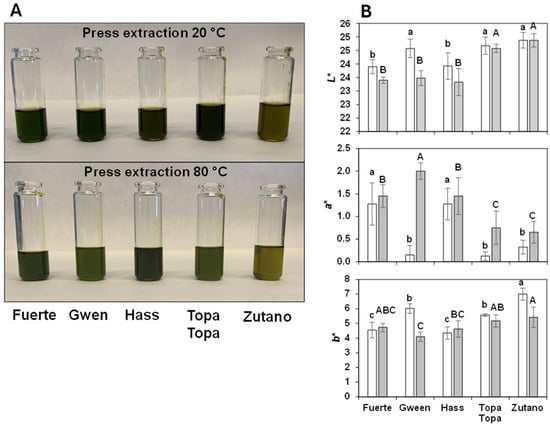
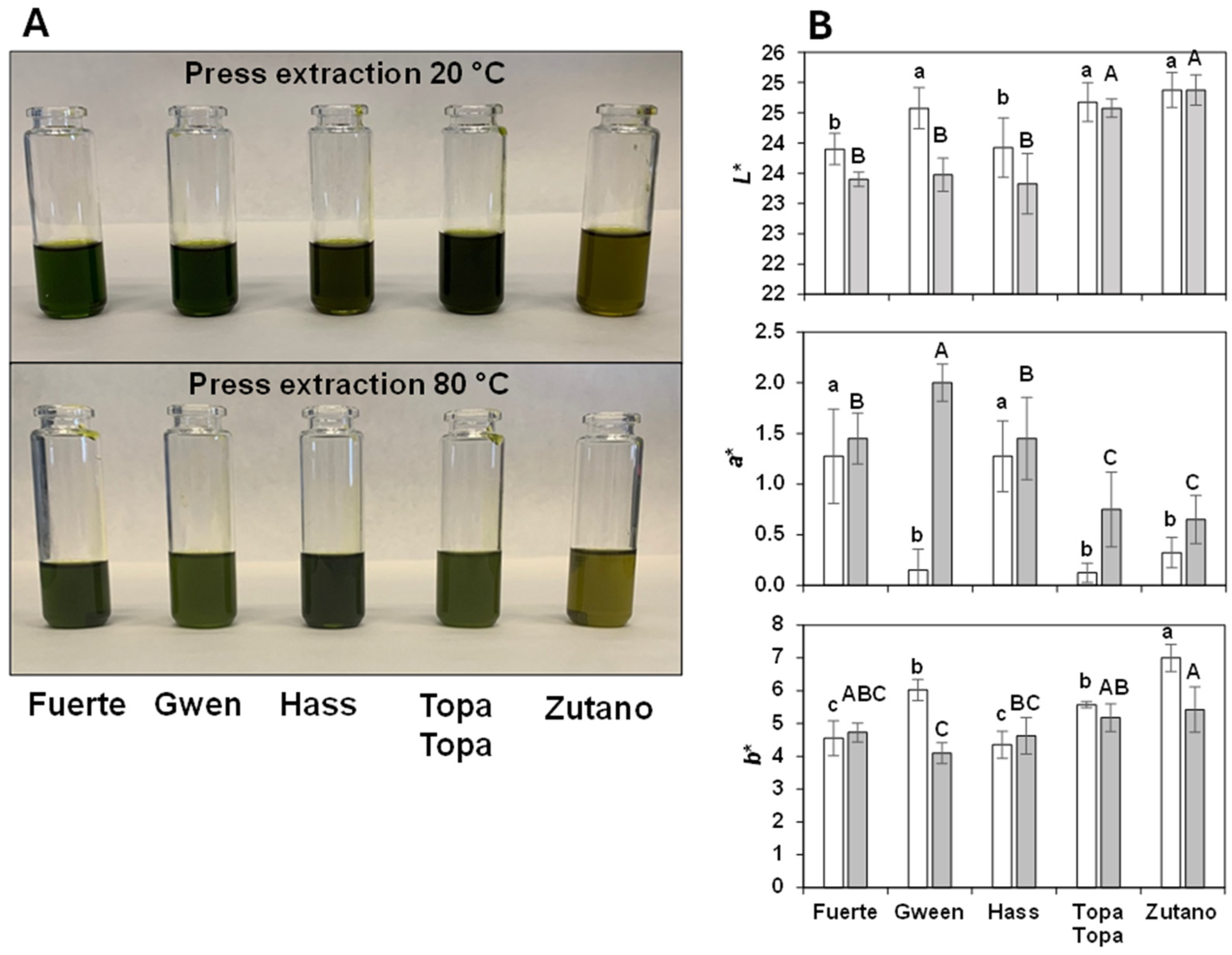
The avocado oils obtained by mechanical extraction at 20 °C and 80 °C as well as their CIElab colour coordinates are presented in Figure 1.
Figure 1.
Images (A) and color coordinates (B) of oils from the pulp of five varieties of P. americana (Fuerte, Gwen, Hass, Topa Topa and Zutano) press-extracted at two temperatures (20 °C, white bar; 80 °C, gray bar). Error bars represent the standard deviation; different letters indicate significant differences (p ≤ 0.05) among samples.
The analysis of variance (not shown) detected highly significant differences (p ≤ 0.01) due to cultivar, extraction temperature and their interaction for all the traits; for L* the interaction was significant at p ≤ 0.05. In general, the oils extracted at 20 °C showed greater brightness, although the most luminous ones (Topa Topa and Zutano) did not change with the extraction temperature, unlike Fuerte, Gwen and Hass, whose brightness decreased in oils extracted at 80 °C. For a*, the values were just above 0, both for the oils extracted at 20 °C (from 0.1 to 1.3) and for those extracted at 80 °C (from 0.7 to 2.0), with the exception of Gween, where the extraction temperature had a greater influence (0.2 at 20 °C; 2.0 at 80 °C); overall, the higher extraction temperature led to a slight shift towards a reddish hue. The coordinate b* exhibited a more varied behaviour: although on average the oils extracted at 20 °C (range: 4.4–7.0) had slightly higher values than those extracted at 80 °C (range: 4.1–5.4), this effect was mainly due to Gween and Zutano, because the other three avocado oils presented similar scores across temperatures. Overall, the Gween oil colour was sensitive to the extraction temperature, while the others were more stable. For a cold-pressed oil from the cultivar Hass, Chimuti et al. [43] reported a much lower brightness value (L* = 5.5), while a* (−0.6) and b* (2.8) were only slightly inferior to our results.
3.2.3. Chlorophyll Content
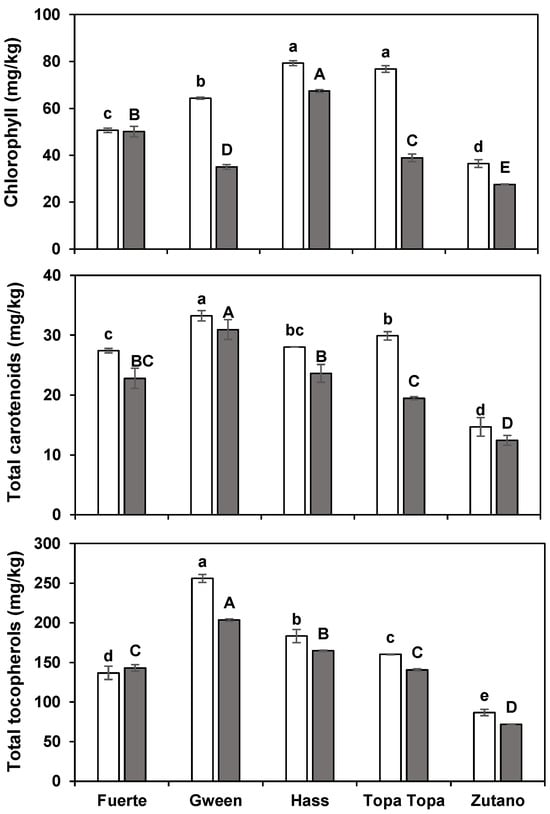
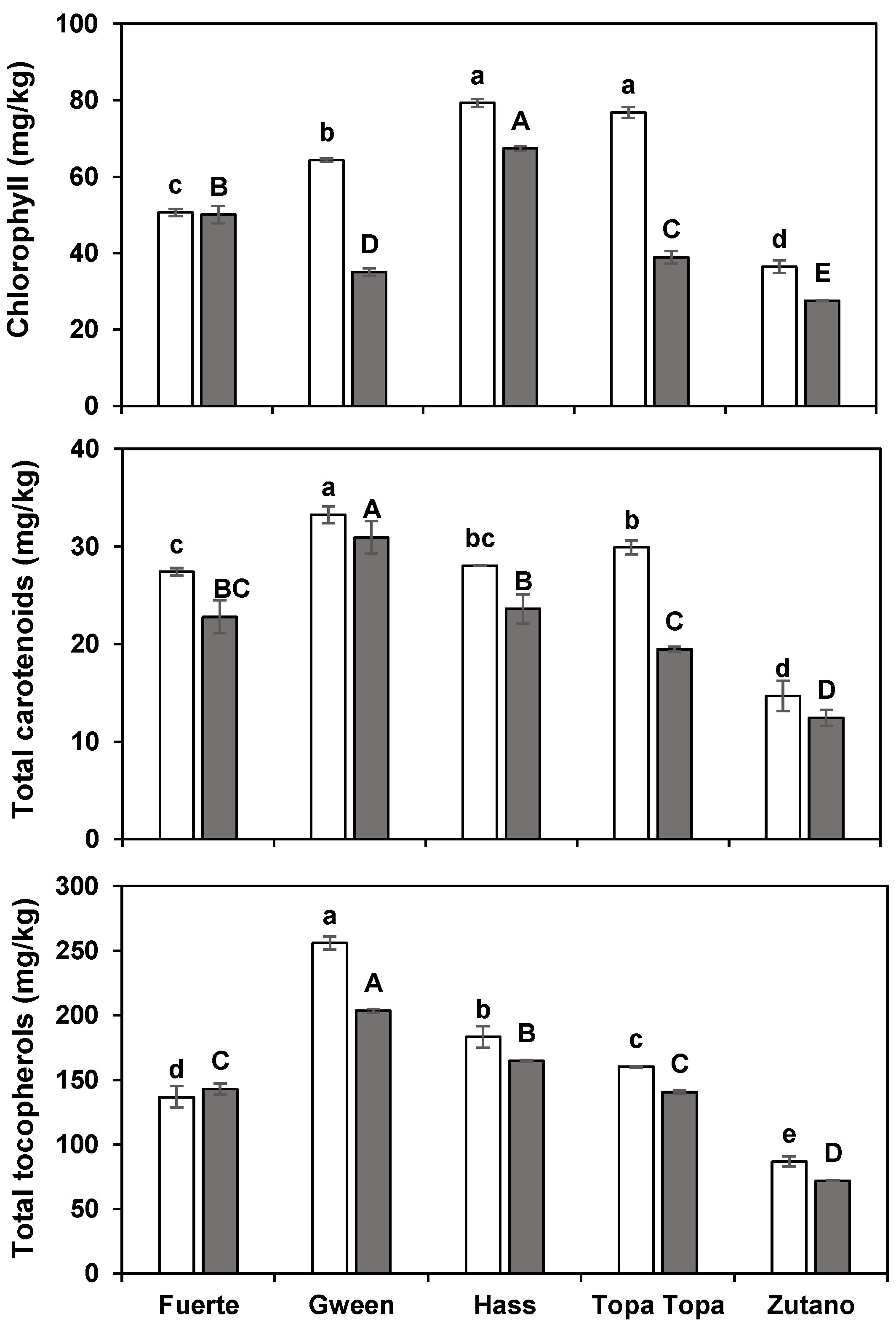
Chlorophyll is a valued component of the antioxidant potential of avocado oil, but after cold pressing may impart some bitterness to the product. Additionally, chlorophyll shows pro-oxidative effects, because it behaves as a photosensitiser by transferring energy from the light to triplet oxygen, producing singlet oxygens, which are highly reactive with the unsaturated fatty acids [44]. The chlorophyll content of the avocado oils obtained by pressure extraction at 20 °C and 80 °C is presented in Figure 2.
Figure 2.
Total content of chlorophylls, carotenoids and tocopherols (mg/kg), of oils from the pulp of five varieties of P. americana (Fuerte, Gwen, Hass, Topa Topa and Zutano) press-extracted at two temperatures (20 °C, white bar; 80 °C, gray bar). Error bars represent the standard deviation; different letters indicate significant differences (p ≤ 0.05) among samples.
The ANOVA (not presented) revealed a significant effect (p ≤ 0.01) of cultivar and extraction temperature, as well as of their interaction. The 20 °C treatment better recovered the chlorophyll (on average, 61.5 mg/kg) than the 80 °C (on average, 43.8 mg/kg). Only Fuerte showed a stable content at both temperatures, while the biggest differences were observed in Topa Topa (76.8 mg/kg at 20 °C and 38.9 mg/kg at 80 °C) and Gween (64.3 mg/kg at 20 °C and 35.0 mg/kg at 80 °C). Wong et al. [45] observed 8–28 mg/kg in avocado oils extracted by cold pressing, while the chlorophyll contents reported for a commercial avocado oil (22.3–69.8 mg/kg) and for Hass and Fuerte oils extracted by supercritical carbon dioxide (36.1–85.5 mg/kg) [41], as well as for Hass oil (3.0–43.8 mg/kg) after solvent extraction [46] fall within our range of values.
3.2.4. Carotenoids Content
Figure 2 depicts the total carotenoid content of the oils. Carotenoids are well-known inhibitors of photo-oxidation: they quench singlet oxygen and triplet excited states of photosensitizers via energy transfer, owing to their low-lying triplet excited state; then the excitation energy is dissipated as heat [44]. The ANOVA (not shown) revealed a significant effect of cultivar (p ≤ 0.001), extraction temperature (p ≤ 0.001) and their interaction (p ≤ 0.01). The oils extracted at 80 °C presented a significant carotenoids content reduction compared to those extracted at 20 °C. Among cultivars, the oil from Gween was the richest (on average, 32.1 mg/kg), while that of Zutano was the poorest (on average, 13.6 mg/kg). The pigments detected were, in decreasing order of quantity, β-cryptoxanthin, trans-lutein, (α + β)-carotene, violaxanthin and zeaxanthin (Supplementary Table S2). When the extraction was performed at 80 °C, the β-cryptoxanthin content was approximately halved in Fuerte, Topa Topa and Zutano oils, while the lutein decreased strongly only in Topa Topa and Zutano oils. The temperature was not a significant factor for (α + β)-carotene and zeaxanthin, while violaxanthin in most cases increased slightly. Our results are like those reported by Tan [20] for cold-pressed avocado oil, i.e., 11.10–46.9 mg β-carotene/kg. Carotenoids content is influenced by fruit ripeness, so extracting oil from overripe fruits leads to lower carotenoids concentration [46].
The carotenoids are easily degraded by heat, as reported for orange juice by Fratianni et al. [47] and confirmed in avocado oil treated at 100 °C and 180 °C [48]. However, Krumreich et al., [8] demonstrated that avocado oil extracted by pressing and solvent after pulp drying at 60 °C contained higher total carotenoids (103–105 and 85–89 μg/g oil/g fruit, respectively) than oils extracted from pulp dried at 40 °C (75 and 72 μg/g oil/g fruit, respectively), and attributed this result to the inactivation of lipase and lipoxygenases enzymes: probably their drying temperature was not enough to degrade the carotenoids but helped their release from the idioblasts and increased their solubility, leading to higher concentrations [46]. However, this effect was not observed in our mechanically extracted samples, because the pulp was dried at 50 °C but the extraction was performed at 80 °C, inactivating the enzymes but also boosting the degradation of the pigments.
3.2.5. Tocopherols Content
Figure 2 shows the total tocopherol content of the oils obtained by mechanical pressing at 20 °C and 80 °C, while Supplementary Table S3 reports their composition. The ANOVA revealed a significant effect of cultivar, temperature and interaction (p ≤ 0.001). The extraction temperature had a significant effect on tocols content, except for the oils from Fuerte. A variation between cultivars was highlighted: the oil from Gween had a higher content (on average, 229.8 mg/kg), whereas those from Zutano had the lowest (on average 79.4 mg/kg). Overall, β-tocopherol was the most abundant compound (49.10%), followed by α-tocopherol (38.15%) and γ-tocopherol (12.75%). However, β-tocopherol was sensitive to the extraction temperature, with a >50% decrease at 80 °C, while α-tocopherol and γ-tocopherol were largely unchanged. All the tocopherols are free radicals scavengers and inhibit lipid oxidation, thus they contribute to preventing rancidity and safeguard oil quality over time.
The cultivar exerted a significant influence on tocopherols composition. The cv. Hass showed the greatest presence of α-tocopherol, Gween of β-tocopherol and Fuerte of γ-tocopherol. Manaf et al. [49] observed that oil extracted from fruit of three Indonesian varieties (Merah Bundar, Ijo Bundar, and Ijo Panjang) had higher tocopherol content than that from two commercial varieties (Fuerte and Shepard). Similarly, the oil extracted by the Soxhlet system from Hass showed higher α-tocopherol contents than two other varieties (Fuerte and Pinkerton) cropped in Turkey [50]. In fact, the greatest α-tocopherol content in the pulp of 11 varieties cultivated in Peru was spotted in cv. Haas [38]. Likewise, β-tocopherol concentration varied broadly, with the highest values spotted in La Molina, Veronica and Hass, and the lowest in Goodfriend and Duke; on the other hand, these last two varieties had the greatest γ-tocopherol content [38]. The accumulation of tocopherols is influenced by both environmental conditions [51] and genetic factors, particularly those affecting genes encoding enzymes involved in the biosynthetic pathways, [52].
3.2.6. Physico-Chemical Characteristics
The two-way ANOVA showed highly significant differences (p ≤ 0.001) for extraction temperature, cultivar and their interaction for all traits, except for acid value, where only the temperature effect was significant, and the iodine value, where instead only the cultivar effects were significant. Table 2 reports the physico-chemical properties of the oils extracted from the five avocado varieties at 20 °C and 80 °C. Most of the samples extracted at 80 °C had refractive indices marginally lower than those extracted at 20 °C, except for Topa Topa and Gween. The highest refractive index was 1.4693 (Fuerte) and the lowest 1.4691 (Hass). These results are within the range (1.44 and 1.47 for stove drying at 50 °C and freeze-drying at −35 °C, respectively) described by Guillén-Sánchez and Paucar-Menacho [53] and close to the value (1.4680) reported by Aktar & Adal [54] for centrifuge-extracted oil. Furthermore, they are like oils of similar composition (i.e., olive oil: 1.46–1.47 at 20 °C) [19]. All the refractive indices swung in a narrow range, confirming also the absence of solids floating in the oil.
The average density of the oil was 0.9265 g/cm3 at 20 °C and 0.9303 g/cm3 at 80 °C. Zutano had the lowest density at both extraction temperatures (on average, 0.8920 g/cm3), and Topa Topa the highest (0.9500 g/cm3). Lopez-Vega et al. [23] reported a relative density of 0.915 g/mL for cold pressed oil of the Hass variety grown in Colombia and Aktar & Adal [54] found a density (0.91 g/mL) like that of olive oil.
The samples extracted at 80 °C had viscosities superior to those extracted at 20 °C, with the exceptions of Zutano and Topa Topa. The highest value (104.69 mm2/s) was achieved at 80 °C by Haas, while the lowest (74.52 mm2/s) at 20 °C by Gwen. Logaraj et al. [55] stated that avocado oil has non-Newtonian behaviour, and its intrinsic viscosity is moderate. However, Alcântara et al. [56] found that the viscosity decreased sharply with increasing temperature and showed Newtonian fluid behaviour, with viscosity independent from shear rate, as observed also by De Souza et al. [57].
The acidity index, one of the most important parameters for determining the quality of oils, increased from 0.67 mg KOH/g oil at 20 °C to 0.78 mg KOH/g oil at 80 °C. As mentioned above, the differences between varieties were not significant. Fuerte and Gwen oils presented the minimum difference between temperatures (7.4 and 8.6%, respectively), while the other three oils had increases above 20%. Lopez-Vega et al. [23] in Hass oil determined an acidity index around 0.4 ± 0.07 g/100 g, while Woolf et al. [9] found an acidity index ≤ 1% for extra virgin avocado oil and ≤2% for virgin oil, and stressed that, although it is not necessary to process the fruit immediately after ripening, long delays should be avoided.
The peroxide index (PI) showed relatively high values, averaging 19.56 and 24.58 meq O2/kg at 20 and 80 °C, respectively, indicating the presence of primary oxidation products. Lower values have been reported for press-extracted avocado oils, ranging from 4.5 meq O2/kg [8] to 8.9 meq. O2/kg [48], although higher ranges, such as 10.0–19.2 and 17.5–18.5 meq O2/kg, have also been observed [23,53]. Moreover, commercial avocado oils purchased in Spain showed a broad PI range of 4.50–29.48 meq O2/kg [58]. The values obtained in the present study exceeded the maximum level of 15 meq O2/kg recommended for cold-pressed and virgin vegetable oils [19], suggesting that some oxidation had already occurred during raw-material preparation and/or oil extraction. Nevertheless, these results should be interpreted with caution, as the current Codex Alimentarius standard does not establish specific PI limits or quality categories based on this parameter for avocado oil. Lipid oxidation is strongly affected by temperature, water activity, light exposure, and oil composition, while prolonged heating and exposure to oxygen may promote the formation of oxidation products. In addition, susceptibility to oxidation increases with the degree of fatty acid unsaturation, because double bonds represent preferential sites for oxidative attack and hydroperoxide formation [59]. Our high PI may possibly be attributed to the combined effects of pulp drying and oxygen exposure during processing, since the press used in this study operated as an open system and, unlike industrial equipment, did not protect the samples from contact with oxygen.
The iodine index, a direct estimate of the double bonds present in oil, confirmed that all the oils were well within the 75–94 g I2/100 g threshold adopted for extra virgin olive oil [60]. While the extraction temperature did not have influence on the results, Fuerte and Gween presented the greatest values (>84 g I2/100 g), while the other three varieties were significantly lower (<82.5 g I2/100 g). Our results were comparable, albeit slightly inferior, to those (85.8–92.1 g I2/100 g) described for avocado oils from Australia, Mexico, USA and New Zealand by Tan et al. [61]. The biosynthesis of fatty acids is affected by genetics as well as by environmental factors such as light, temperature, water availability, soil constituents, physical damage and plague attacks. The iodine test results confirm that pressing extraction is fundamental to ensure the quality of the oil.
K232 is associated with intermediate oxidation, while K268 is linked to the carbonyl compounds that form during secondary oxidation because of hydroperoxide degradation [48]. The results showed a broad variation among cultivars: the oils from Zutano, Topa Topa and Hass had higher oxidative degradation values than those from Fuerte and Gween (Table 2). The oxidation parameters tend to increase in oils exposed to high temperatures, but no clear trend was recorded in this study [48]. The spectrophotometric indices were superior to the limits established for extra virgin (K232: 2.5 and K268: 0.22) and virgin (K232: 2.6 and K268: 0.25) olive oils [10,60,62,63]. Conventional avocado oil extraction methods often apply moderate heating (40–50 °C) to dry the pulp and to weaken the cell walls. Heat and presence of oxygen may lead to oxidation and quality loss, especially when the temperatures do not inactivate the oxidation enzymes. Furthermore, the high content of chlorophyll, that has pro-oxidation properties [53], might lead to the formation of secondary products [24]. Nevertheless, avocado oils with low K232 and K268 values can be achieved improving fruit quality and processing [24,64,65], although avocado-specific thresholds should be consider that these values “increase with time and an oil should meet the limit not only at the time of production but throughout its shelf-life” [24].
3.2.7. Fatty Acids Composition
The fatty acids detected in the avocado oils were oleic, palmitic, linoleic, palmitoleic, and eicosanoic (Table 3). Overall, the unsaturated fatty acids represented almost 80% of the total. The oleic acid was the predominant unsaturated fatty acid (on average, 56.5%), followed by linoleic (12.9%) acid and palmitoleic acid (9.5%), while the palmitic acid (20.4%) was the main saturated fatty acid, followed by eicosanoic acid (0.7%). Between the samples extracted at 20 °C and the samples extracted at 80 °C the differences were small, and the lower temperature recovered slightly less saturated fatty acids (20.6% vs. 21.6%). The Zutano oil displayed the highest oleic acid concentration, while the Gwen oil had the lowest (Table 3), along with the highest saturated and polyunsaturated acids contents.
Table 3.
Fatty acid composition (% ± standard deviation) of oils obtained from different cultivars of avocado by mechanical extraction at 20 °C and 80 °C. Different lower case or capital letters indicate significant difference (p ≤ 0.05) among oils obtained at 20 °C or 80 °C, respectively. SV: saponification value.
The fatty acid composition fluctuates widely according to avocado variety and ripening stage [9], as well as geographical origin [61]. Avocado oil is praised for its high unsaturated fatty acids content, mainly oleic (21.7–71.4%), linoleic (7.0–22.5%) and palmitoleic (0.3–18.6%), as well for its low saturated acids concentration, mostly palmitic acid (9.3–34.1%) [9,24,41,61,66]. The proposed standards of the Codex Alimentarius [60] indicated ranges of 49.7–71.4% for oleic acid, 11.0–26.0% for palmitic acid, 4.0–17.1% for palmitoleic acid, 7.8–19.0% for linoleic acid and 0.1–1.3% for stearic acid, i.e., results similar to ours. Other oils rich in oleic acid are those from olives (55–83%) [67], macadamia (40–51%) [68], high oleic sunflower (60.6–83.7%) [69], and those engineered soybean canola and, again, sunflower (72–84%, 65–76% and 80–92%, respectively [11].
As the fruit ripens, the triglyceride content in the pulp increases: Woolf et al. [9] found that during ripening in the Fuerte avocado the oleic acid increased from 37 to 50%, the palmitic acid remained constant at 22%, the linoleic acid decreased from 14 to 11%, the linolenic acid decreased slightly from 0.3 to 0.1%, while the palmitoleic acid remained fairly stable at 10% of total lipids. Therefore, the high unsaturated acids presence suggests that avocado oil is suitable as salad dressing, while the high oleic acid content hints to a good stability during cooking.
3.2.8. Saponification Value
The saponification value (Table 3) is inversely related to the molecular weight the triglycerides chain length [70] and is an important parameter in the food, chemical and cosmetics industries because is important in determining the amount of alkali required to transform the lipids into soap, and thus to optimise the production process and to reduce its costs. Furthermore, it impacts consistency, solubility and viscosity of the product [71]. The SV were similar between extraction temperatures but differed among varieties. Overall, Zutano had the lowest SV at both temperatures (on average, 194.16 mg KOH/g oil), while Gween had the greatest (196.42 mg KOH/g oil), values that are like those of most vegetable oils [19].
3.2.9. Nutritional and Health-Related Indices
The ANOVAs of the nutritional and health-related indices of the fatty acids (Table 4) showed significant differences (p ≤ 0.01) between extraction temperatures, between samples as well as for their interaction. All the oils exhibited a nutritionally favourable lipids profile. The DFA varied from 75.58% (Gween 80) to 81.75% (Zutano 80), whereas the OFA ranged from 17.62% (Zutano 80) to 23.82% (Gween 80), results not far from those (86.1 and 83.7%, and 13.2 and 15.6%, respectively) reported by Asbbane et al. [70] in argan and olive oils, indicating that nutritionally desirable fatty acids predominated over hypercholesterolemic saturated fatty acids. This observation was further supported by the relatively high HH ratio (2.62–4.22), signaling a good balance between hypocholesterolemic and hypercholesterolemic fatty acids. The oils also exhibited low AI (0.103–0.149) and TI (0.352–0.476), indicating a modest potential to promote atherosclerosis and thrombosis. Likewise, the low S/P ratio (0.19–0.33) confirmed the predominance of unsaturated over saturated fatty acids, further supporting the favorable nutritional quality of the lipid fraction. The low oleic desaturation ratio (13.72–24.47%) and the high OL/(ALA + LA) ratio (3.09–6.29), comparable to the olive oil values (16.0% and 5.26) [70], indicated that oleic acid was present at substantially greater levels than the combined linoleic and α-linolenic acids, highlighting the oleic acid-rich nature of the oils.
Table 4.
Nutritional quality indices (% ± standard deviation) of oils obtained from different cultivars of avocado by mechanical extraction at 20 °C and 80 °C. DFA: index of desirable fatty acids; OFA: sum of hypercholesterolemic fatty acids; HH: hypocholesterolemic/hypercholesterolemic ratio; AI: atherogenicity index; TI: thrombogenicity index; ODR: oleic desaturation ratio; [OL/(ALA + LA)]: oleic acid/(linolenic + linoleic) acids ratio. Different lower case or capital letters indicate significant difference (p ≤ 0.05) among oils obtained at 20 °C or 80 °C, respectively.
Overall, these indices indicate that these oils are characterized by a high proportion of nutritionally desirable fatty acids and low predicted atherogenic and thrombogenic potential. From a technological point of view, the high proportion of monosaturated fatty acids relative to polyunsaturated acids may render these oils resistant to oxidative deterioration and suitable for cooking and frying.
3.2.10. Oxidative Stability Index (OSI)
The OSI values of the oils (Table 5) were significantly different (p ≤ 0.01) because of different cultivars, extraction temperature and their interaction. While all the oils extracted at 20 °C had an OSI at 110 °C >10 h, with an average of 10.40 ± 0.3 h, those extracted at 80 °C ranged from >10 h (Hass and Gween) to <8 h (Fuerte), with an average of 9.14 ± 1.11 h. The OSI decreased as the working temperature augmented from 110 °C to 140 °C (Table 4), dipping to values ranging from 1.26 to 0.65 h (average: 0.95 ± 0.21 h) in oils extracted at 20 °C and from 1.17 to 0.65 h (average: 0.86 ± 0.18 h) in oils extracted at 80 °C. The acceleration of chemical reactions is influenced by the increase in temperature. In fact, Navas Hernández [72] indicates that the speed of chemical reactions tends to double for every 10 °C increase.
Table 5.
Oxidative stability index (OSI; hours; mean ± standard deviation) of oils press-extracted at 20 °C and 80 °C from five avocado cultivars. Different lower case or capital letters indicate significant difference (p ≤ 0.05) among oils obtained at 20 °C or 80 °C, respectively.
The avocado oil has better OSI at 110 °C than several other vegetable oils. Tan et al. [73] tested several vegetable oils and found oxidative stability indices inferior to 10 h in eight out of twelve, viz. canola, corn, grapeseed, olive, peanut, safflower, soybean and sunflower. Studying the properties of innovative species, Villanueva et al. [74] and Rodríguez et al. [75] at 110 °C determined OSI of 1.49 ± 0.00 h and 0.50 ± 0.01 h for chia (Salvia hispanica) and sacha inchi (Plukenetia volubilis) oils respectively, which are similar to the OSI of avocado oil at 140 °C, but largely inferior at the same temperature (110 °C).
3.2.11. Correlation, Principal Component Analysis, and Cluster Analysis
The linear correlations among variables and their significance are reported in Supplementary Figure S2. The correlation analysis highlighted significant relationships between endogenous antioxidants and oxidative stability. Carotenoid content was positively correlated with OSI 110 (r = 0.65, p ≤ 0.05) and OSI 120 (r = 0.64, p ≤ 0.05), suggesting a contribution of these compounds to the resistance of the oils to oxidation. Tocols and carotenoids were also strongly and positively correlated (r = 0.90, p ≤ 0.001), thus oils richer in one antioxidant contained higher levels of the other. Conversely, K268 showed strong negative correlations with both tocols (r = −0.77, p ≤ 0.01) and carotenoids (r = −0.79, p ≤ 0.01). Since K268 is associated with the formation of secondary oxidation products, these relationships suggest that higher concentrations of endogenous antioxidants were associated with a lower oxidative deterioration of the oils. Overall, the significant correlations support a protective role of the antioxidant fraction, particularly carotenoids and tocols, although their individual contributions cannot be completely separated because of their strong intercorrelation.
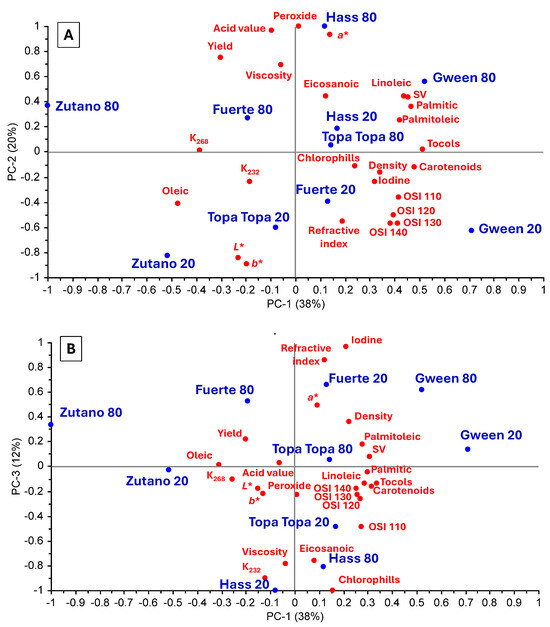
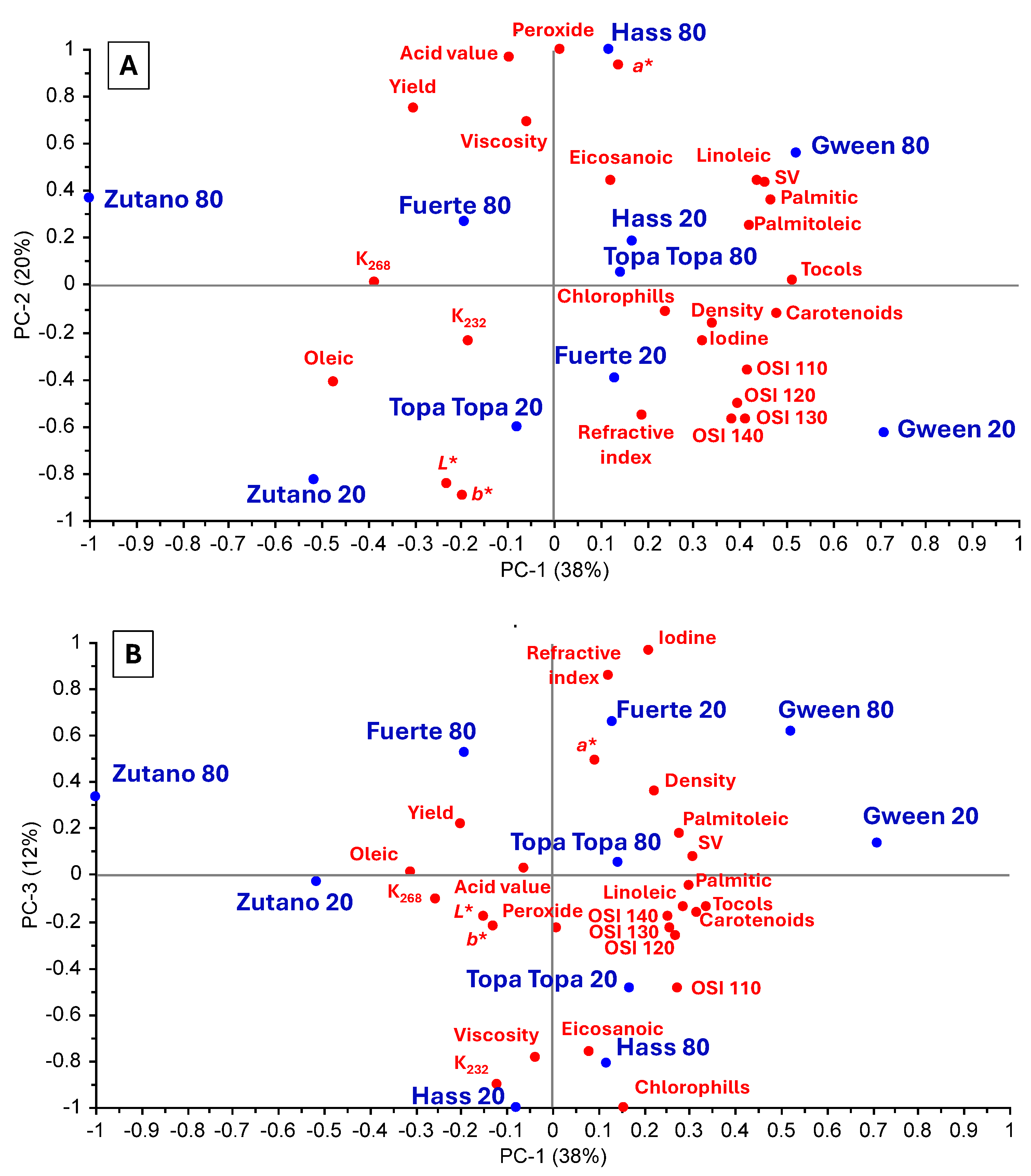
The first three factors of the Principal Component Analysis explained 70% of the total variance, with PC1 accounting for 38%, PC2 for 20%, and PC3 for 12% (Figure 3). PC1 primarily discriminated the oils according to their fatty acid composition, antioxidant content, and quality characteristics. Positive PC1 scores were associated with higher palmitic, linoleic, and linolenic acids concentrations, greater tocol, carotenoid, and chlorophyll contents, increased density, refractive index and oxidative stability index (OSI). In contrast, samples with negative PC1 scores were characterized by higher oleic acid, K232 and K268 values, indicating a distinct lipid profile associated with greater levels of oxidation products. PC2 mainly reflected differences in extraction performance and physicochemical properties. Positive scores were associated with better oil yield, acid value, peroxide value, viscosity, and eicosanoic acid content, whereas negative PC2 scores were related to higher brightness and, to a lesser extent, refractive index. The positive scores of PC3 were instead mainly related to iodine value and refractive index, while the negative ones were linked to chlorophyll content, K232, viscosity and eicosanoic acid.
Figure 3.
Biplots of the scores and loadings for PC1 vs. PC2 (A) and PC1 vs. PC3 (B) from the PCA performed using 25 parameters evaluated in oils press-extracted at two temperatures (20 °C and 80 °C) from the pulp of five varieties of P. americana (Fuerte, Gwen, Hass, Topa Topa and Zutano). OSI: oxidative stability index; SV: saponification value.
The PCA also highlighted differences among cultivars and extraction temperatures. Oils obtained from the Gween cultivar were consistently located on the positive side of PC1, indicating their association with higher concentrations of saturates and polyunsaturated fatty acids and antioxidant compounds. Gween80 related to palmitic, palmitoleic and linoleic acids, and with a higher saponification value, whereas Gween20 showed a strong association with tocols, carotenoids, OSI, density, and refractive index, suggesting that its higher oxidative stability may be related to a richer antioxidant composition. Conversely, the Zutano oils were clearly separated on the negative side of PC1 and were associated with higher oleic acid, K232, and K268 values. Hass80 was characterised by its association with acid value, peroxide value, and viscosity, while Hass20, Topa Topa and Fuerte samples occupied intermediate positions, showing a more balanced chemical composition.
The position of OSI, close to tocols and carotenoids and opposite to K232 and K268, suggests that oxidative stability is positively associated with the concentration of endogenous antioxidants and negatively associated with the accumulation of oxidation products. Although oils richer in polyunsaturated fatty acids are generally more susceptible to oxidation, the PCA indicates that the presence of antioxidants may partially offset this effect, thus emphasizing that the oxidative stability is the product of a shifting balance between fatty acid composition and naturally occurring antioxidants.
The separation between oils extracted at 20 °C and 80 °C was largely cultivar dependent. A clear temperature effect was observed for Gween and Zutano, whose samples were well separated in the PCA space, indicating that extraction temperature markedly influenced their chemical composition. Conversely, the Topa Topa and Fuerte oils extracted at the two temperatures clustered relatively close to each other, suggesting a smaller effect on these cultivars. Overall, the PCA demonstrated that both cultivar and press extraction temperature contributed to the variability in avocado oil composition, although the magnitude of the temperature effect was mainly linked to the cultivar.
The oil yield assessed relatively to the lipid content of the pulp confirms a clear technological advantage of pressing at 80 °C, since oil recovery increased in all cultivars (from 43–60% at 20 °C to 54–78% at 80 °C). However, the PCA evidenced that the yield was not directly associated with tocols, carotenoids, or OSI, indicating that improved extraction efficiency was not linked to better oil quality. Therefore, although pressing at 80 °C improved oil recovery, it may involve a cultivar-dependent trade-off with antioxidant retention and oxidative quality.
A cluster analysis performed using the Nearest Neighbour method and squared Euclidean distance (Supplementary Figure S3) substantially confirmed the PCA results. Zutano 80 was the most different sample, loosely linked to Zutano 20 and Topa Topa 20. Fuerte 20 and Fuerte 80, as well as Gween 20 and Gween 80 formed two small clusters (as evident also in the PCA), while Hass 20, Hass 80 and Topa Topa 80 had an intermediate position.
4. Conclusions
Our results demonstrate that avocado oil extracted by pressure at both low (20 °C) and high (80 °C) temperature has excellent qualitative and technological properties. Furthermore, although a certain variation exists among varieties, the good fatty acids composition and the high content of natural antioxidants, such as carotenoids and tocols, are relevant factors in fostering the oxidative stability indices of the oils. Hence, pressure-extracted avocado oils are ideal for several food uses, including salad dressing and, thanks to their good thermal stability, might also be suitable for cooking. Within a circular economy framework aimed at reducing the burden of industrial waste disposal, the extraction of high-value edible oil from flawed avocado fruits enables the recovery of their economic value while reducing waste.
Supplementary Materials
The following supporting information can be downloaded at https://www.mdpi.com/article/10.3390/pr14172842/s1, Figure S1: Fruits of the avocado varieties tested; Figure S2. Correlation heatmap showing linear Pearson’s correlation coefficients (r) between selected variables. The color scale indicates the direction and strength of the correlations, with positive (red) and negative (blue) correlations represented by color intensity proportional to the magnitude of r. Statistical significance is indicated by asterisks: p ≤ 0.05 (*), p ≤ 0.01 (**), and p ≤ 0.001 (***). PI, peroxide value; OSI, oxidative stability index; Figure S3. Dendrogram of the cluster analysis of avocado oil samples according to the Nearest-Neighbor method and squared Euclidean distance; Table S1: Nutritional and health-related indices; Table S2: Carotenoids of oils press-extracted at 20 °C and 80 °C from five avocado cultivars; Table S3: Tocopherols of oils press-extracted at 20 °C and 80 °C from five avocado cultivars.
Author Contributions
Conceptualization, G.R., E.A., L.L.-H., J.Z.-V. and A.H.; methodology, G.R., E.A., L.E. and A.H.; software, L.E., A.B. and A.H.; validation, E.A., L.L.-H., J.Z.-V., A.B. and A.H.; formal analysis, F.C., L.E., A.C., L.L.-H., and J.Z.-V.; investigation, E.A., L.L.-H., and J.Z.-V.; resources, G.R. and E.A.; data curation, E.A., L.E., L.L.-H., J.Z.-V., A.B. and A.H.; writing—original draft preparation, G.R., L.E., A.B. and A.H.; writing—review and editing, A.B. and A.H.; visualization, E.A.; supervision, G.R., A.B. and A.H. All authors have read and agreed to the published version of the manuscript.
Funding
This research received no external funding.
Data Availability Statement
The datasets used and/or analysed during the current study are available from the corresponding author on reasonable request.
Conflicts of Interest
The author Andrea Brandolini is employed by the Research Centre for Animal Production and Aquaculture (CREA-ZA), Consiglio per la Ricerca in agricoltura e l’analisi dell’economia agraria. The remaining authors declare that the research was conducted in the absence of any commercial or financial relationships that could be construed as a potential conflict of interest.
References
- Yahia, E.M. Avocado: An Introduction to the Fruit and Its Pre- and Postharvest Processing; Burleigh Doods Science Publish: Cambridge, UK, 2023. [Google Scholar]
- FAO FAOSTAT. Available online: https://www.fao.org/faostat/en/#data/QCL/visualize (accessed on 17 January 2025).
- Tan, C.X.; Chong, G.H.; Hamzah, H.; Ghazali, H.M. Comparison of Subcritical CO2 and Ultrasound-Assisted Aqueous Methods with the Conventional Solvent Method in the Extraction of Avocado Oil. J. Supercrit. Fluids 2018, 135, 45–51. [Google Scholar] [CrossRef] [Scilit]
- Denvir, A.; Arima, E.Y.; González-Rodríguez, A.; Young, K.R. Ecological and Human Dimensions of Avocado Expansion in México: Towards Supply-Chain Sustainability. Ambio 2022, 51, 152–166. [Google Scholar] [CrossRef] [Scilit]
- Daiuto, É.R.; Vieites, R.L.; de Carvalho, L.R.; Simon, J.W.; Russo, V.C. Sensory Analysis of Cold-Stored Guacamole Added with α-Tocopherol and Ascorbic Acid. Rev. Ceres 2011, 58, 140–148. [Google Scholar] [CrossRef] [Scilit]
- Duarte, P.F.; Chaves, M.A.; Borges, C.D.; Mendonça, C.R.B. Avocado: Characteristics, Health Benefits and Uses. Ciênc. Rural 2016, 46, 747–754. [Google Scholar] [CrossRef] [Scilit]
- Cicero, N.; Albergamo, A.; Salvo, A.; Bua, G.D.; Bartolomeo, G.; Mangano, V.; Rotondo, A.; Di Stefano, V.; Di Bella, G.; Dugo, G. Chemical Characterization of a Variety of Cold-Pressed Gourmet Oils Available on the Brazilian Market. Food Res. Int. 2018, 109, 517–525. [Google Scholar] [CrossRef] [Scilit]
- Krumreich, F.D.; Borges, C.D.; Mendonça, C.R.B.; Jansen-Alves, C.; Zambiazi, R.C. Bioactive Compounds and Quality Parameters of Avocado Oil Obtained by Different Processes. Food Chem. 2018, 257, 376–381. [Google Scholar] [CrossRef] [Scilit]
- Woolf, A.; Wong, M.; Eyres, L.; McGhie, T.; Lund, C.; Olsson, S.; Wang, Y.; Bulley, C.; Wang, M.; Friel, E.; et al. Avocado Oil. In Gourmet and Health-Promoting Specialty Oils; Moreau, R.A., Kamal-Eldin, A., Eds.; AOCS Press: Champaign, IL, USA, 2009; pp. 73–125. [Google Scholar] [CrossRef] [Scilit]
- USDA Avocados, Raw, All Commercial Varieties—USDA FoodData Central Food Details. Available online: https://fdc.nal.usda.gov/food-details/171705/nutrients (accessed on 30 January 2025).
- Zambelli, A. Current Status of High Oleic Seed Oils in Food Processing. JAOCS J. Am. Oil Chem. Soc. 2021, 98, 129–137. [Google Scholar] [CrossRef] [Scilit]
- Platt, K.A.; Thomson, W.W. Idioblast Oil Cells of Avocado: Distribution, Isolation, Ultrastructure, Histochemistry, and Biochemistry. Int. J. Plant Sci. 1992, 153, 301–310. [Google Scholar] [CrossRef] [Scilit]
- Yang, S.; Hallett, I.; Rebstock, R.; Oh, H.E.; Kam, R.; Woolf, A.B.; Wong, M. Cellular Changes in “Hass” Avocado Mesocarp during Cold-Pressed Oil Extraction. J. Am. Oil Chem. Soc. 2018, 95, 229–238. [Google Scholar] [CrossRef] [Scilit]
- Eyres, L.; Sherpa, N.; Hendriks, G. Avocado Oil: A New Edible Oil from Australasia. Lipid Technol. 2001, 13, 84–88. [Google Scholar]
- Forero-Doria, O.; García, M.F.; Vergara, C.E.; Guzman, L. Thermal Analysis and Antioxidant Activity of Oil Extracted from Pulp of Ripe Avocados. J. Therm. Anal. Calorim. 2017, 130, 959–966. [Google Scholar] [CrossRef] [Scilit]
- Züge, L.C.B.; Maieves, H.A.; Silveira, J.L.M.; da Silva, V.R.; Scheer, A.d.P. Use of Avocado Phospholipids as Emulsifier. LWT 2017, 79, 42–51. [Google Scholar] [CrossRef] [Scilit]
- Caballero, E.; Soto, C.; Olivares, A.; Altamirano, C. Potential Use of Avocado Oil on Structured Lipids MLM-Type Production Catalysed by Commercial Immobilised Lipases. PLoS ONE 2014, 9, e107749. [Google Scholar] [CrossRef] [Scilit]
- da Silva Santos, V.; Fernandes, G.D. Cold Pressed Avocado (Persea americana Mill.) Oil. In Cold Pressed Oils: Green Technology, Bioactive Compounds, Functionality, and Applications; Ramadan, M.F., Ed.; Elsevier: Amsterdam, The Netherlands, 2020; pp. 405–428. [Google Scholar]
- Codex Alimentarius Standard for Named Vegetable Oils (CXS 210-1999) Adopted in 1999. Revised in 2001, 2003, 2009, 2017 and 2019. Available online: https://www.fao.org/fao-who-codexalimentarius/sh-proxy/tr/?lnk=1&url=https%253A%252F%252Fworkspace.fao.org%252Fsites%252Fcodex%252FStandards%252FCXS%2B210-1999%252FCXS_210e.pdf (accessed on 1 September 2026).
- Tan, C.X. Virgin Avocado Oil: An Emerging Source of Functional Fruit Oil. J. Funct. Foods 2019, 54, 381–392. [Google Scholar] [CrossRef] [Scilit]
- Pinheiro Pantoja, K.R.; Melo Aires, G.C.; Ferreira, C.P.; Lima, M.d.C.d.; Menezes, E.G.O.; Carvalho Junior, R.N.d. Supercritical Technology as an Efficient Alternative to Cold Pressing for Avocado Oil: A Ccomparative Approach. Foods 2024, 13, 2424. [Google Scholar] [CrossRef] [Scilit]
- Satriana, S.; Supardan, M.D.; Arpi, N.; Wan Mustapha, W.A. Development of Methods Used in the Extraction of Avocado Oil. Eur. J. Lipid Sci. Technol. 2019, 121, 1800210. [Google Scholar] [CrossRef] [Scilit]
- Lopez-Vega, L.A.; Gil-Cortez, J.M.; Sierra-Sarmiento, M.A.; Hoyos-Leyva, J.D. Hass Avocado Oil Extraction: In the Way of Malaxation Process Optimization. LWT 2021, 152, 112312. [Google Scholar] [CrossRef] [Scilit]
- Green, H.S.; Wang, S.C. Extra Virgin Grade Avocado Oil Can Be Achieved Using Whole Fruits or Only Mesocarp. Appl. Food Res. 2022, 2, 100190. [Google Scholar] [CrossRef] [Scilit]
- Xagoraris, M.; Galani, E.; Valasi, L.; Kaparakou, E.H.; Revelou, P.K.; Tarantilis, P.A.; Pappas, C.S. Estimation of Avocado Oil (Persea Americana Mill., Greek “Zutano” Variety) Volatile Fraction over Ripening by Classical and Ultrasound Extraction Using HS-SPME–GC–MS. Compounds 2022, 2, 25–36. [Google Scholar] [CrossRef] [Scilit]
- AACC International. Approved Methods of Analysis, 11th ed.; Cereals & Grains Association: St. Paul, MN, USA, 1999. [Google Scholar]
- ISO 6492:1999; Animal Feeding Stuffs—Determination of Fat Content. International Organization for Standardization: Genève, Switzerland, 1999.
- Borello, E.; Domenici, V. Determination of Pigments in Virgin and Extra-Virgin Olive Oils: A Comparison between Two near UV-Vis Spectroscopic Techniques. Foods 2019, 8, 18. [Google Scholar] [CrossRef] [Scilit]
- Estivi, L.; Pascual Chagman, G.J.; Santa Cruz Olivos, J.E.; Savasi, P.; Brandolini, A.; Hidalgo, A. Changes in Colour, Tocopherols and Carotenoids during the Germination of Lupin Seeds. J. Food Compos. Anal. 2023, 124, 105682. [Google Scholar] [CrossRef] [Scilit]
- AOAC International. Official Methods of Analysis of AOAC INTERNATIONAL, 22nd ed.; Latimer, G.W., Ed.; Oxford University Press: Oxford, UK, 2023. [Google Scholar]
- IUPAC. Standard Methods for the Analysis of Oils, Fats and Derivatives, 7th ed.; Dieffenbacher, A., Pocklington, W.D., Eds.; Blackwell Scientific Publications: London, UK, 1987. [Google Scholar]
- AOCS. Official Methods and Recommended Practices of the AOCS, 8th ed.; Collison, M.W., Ed.; AOCS Headquarters: Champaign IL, USA, 2025. [Google Scholar]
- ISO3656:2011; Animal and Vegetable Fats and Oils-Determination of Ultraviolet Absorbance Expressed as Specific UV Extinction. International Organisation for Standardisation: Geneva, Switzerland, 2011.
- Rodríguez, G.; Squeo, G.; Estivi, L.; Quezada Berru, S.; Buleje, D.; Caponio, F.; Brandolini, A.; Hidalgo, A. Changes in Stability, Tocopherols, Fatty Acids and Antioxidant Capacity of Sacha Inchi (Plukenetia volubilis) Oil during French Fries Deep-Frying. Food Chem. 2021, 340, 127942. [Google Scholar] [CrossRef] [Scilit]
- Asbbane, A.; Hallouch, O.; Oubannin, S.; Gagour, J.; Ait Bouzid, H.; Gharby, S. Lipid Oxidation of Argan Compared to Virgin Olive, and Cactus Oils: Rancimat Test for Kinetic and Thermodynamic Analysis. Chem. Pap. 2024, 78, 8619–8634. [Google Scholar] [CrossRef] [Scilit]
- Rodriguez, G.; Cervi, A.; Citti, F.; Aguirre, E.; Estivi, L.; Arevalo-Oliva, M.; Muñoz-Agreda, J.; Barco-Jara, M.; Cordova-Chang, A.; Muñoz-Saenz, J.; et al. Characterization of Cold-Pressed Oils Extracted from Seeds of Different Capsicum Species. Food Prod. Process. Nutr. 2026, 8, 64. [Google Scholar] [CrossRef]
- Galvão, M.d.S.; Narain, N.; Nigam, N. Influence of Different Cultivars on Oil Quality and Chemical Characteristics of Avocado Fruit. Food Sci. Technol. Int. 2014, 34, 539–546. [Google Scholar] [CrossRef] [Scilit]
- Huaman-Alvino, C.; Chirinos, R.; Gonzales-Pariona, F.; Pedreschi, R.; Campos, D. Physicochemical and Bioactive Compounds at Edible Ripeness of Eleven Varieties of Avocado (Persea americana) Cultivated in the Andean Region of Peru. Int. J. Food Sci. Technol. 2021, 56, 5040–5049. [Google Scholar] [CrossRef] [Scilit]
- Paull, R.E.; Duarte, O. Avocado. In Tropical Fruits, Volume 1; Paull, R.E., Duarte, O., Eds.; CABI: Wallingford, CT, USA, 2011; Volume 1, pp. 153–184. [Google Scholar]
- Ford, N.A.; Spagnuolo, P.; Kraft, J.; Bauer, E. Nutritional Composition of Hass Avocado Pulp. Foods 2023, 12, 2516. [Google Scholar] [CrossRef] [Scilit]
- Vilca, R.; Espinoza-Silva, C.; Alfaro-Cruz, S.; Ponce-Ramírez, J.C.; Quispe-Neyra, J.; Alvarado-Zambrano, F.; Cortés-Avendaño, P.; Condezo-Hoyos, L. Hass and Fuerte Avocado (Persea americana sp.) Oils Extracted by Supercritical Carbon Dioxide: Bioactive Compounds, Fatty Acid Content, Antioxidant Capacity and Oxidative Stability. J. Supercrit. Fluids 2022, 190, 105750. [Google Scholar] [CrossRef] [Scilit]
- Pérez-Saucedo, M.R.; Jiménez-Ruiz, E.I.; Rodríguez-Carpena, J.G.; Ragazzo-Sánchez, J.A.; Ulloa, J.A.; Ramírez-Ramírez, J.C.; Gastón-Peña, C.R.; Bautista-Rosales, P.U. Properties of the Avocado Oil Extracted Using Centrifugation and Ultrasound-Assisted Methods. Food Sci. Biotechnol. 2021, 30, 1051–1061. [Google Scholar] [CrossRef] [Scilit]
- Chimuti, N.; Takalani, T.K.; Anyasi, T.A. Organoleptic and Physicochemical Properties of “Hass” Avocado (Persea americana Mill.) Oil Extract Obtained Using Cold Press Technology. Food Res. 2021, 5, 360–365. [Google Scholar] [CrossRef] [Scilit]
- Ferreiro, N.; Veloso, A.C.A.; Pereira, J.A.; Rodrigues, N.; Peres, A.M. Assessing the Shelf-Life of Olive Oil under Different Storage Conditions: A Review of Predictive Models. Food Eng. Rev. 2025, 17, 608–626. [Google Scholar] [CrossRef] [Scilit]
- Wong, M.; Ashton, O.B.O.; McGhie, T.K.; Requejo-Jackman, C.; Wang, Y.; Woolf, A.B. Influence of Proportion of Skin Present during Malaxing on Pigment Composition of Cold Pressed Avocado Oil. J. Am. Oil Chem. Soc. 2011, 88, 1373–1378. [Google Scholar] [CrossRef] [Scilit]
- Ashton, O.B.O.; Wong, M.; McGhie, T.K.; Vather, R.; Wang, Y.; Requejo-Jackman, C.; Ramankutty, P.; Woolf, A.B. Pigments in Avocado Tissue and Oil. J. Agric. Food Chem. 2006, 54, 10151–10158. [Google Scholar] [CrossRef] [Scilit]
- Fratianni, A.; Cinquanta, L.; Panfili, G. Degradation of Carotenoids in Orange Juice during Microwave Heating. LWT 2010, 43, 867–871. [Google Scholar] [CrossRef] [Scilit]
- Resende, L.M.B.; de Souza, V.R.; Ferreira, G.M.D.; Nunes, C.A. Changes in Quality and Phytochemical Contents of Avocado Oil under Different Temperatures. J. Food Sci. Technol. 2019, 56, 401–408. [Google Scholar] [CrossRef] [Scilit]
- Manaf, Y.N.; Rahardjo, A.P.; Yusof, Y.A.; Desa, M.N.M.; Nusantoro, B.P. Lipid Characteristics and Tocopherol Content of the Oils of Native Avocado Cultivars Grown in Indonesia. Int. J. Food Prop. 2018, 21, 2758–2771. [Google Scholar] [CrossRef] [Scilit]
- Ghafoor, K.; Uslu, N.; Al-Juhaimi, F.; Babiker, E.E.; Ahmed, I.A.M.; Uğur Yıldız, M.; Alswahmi, O.N.; Özcan, M.M. Tocopherol Contents of Pulp Oils Extracted from Ripe and Unripe Avocado Fruits Dried by Different Drying Systems. J. Oleo Sci. 2021, 70, 21–30. [Google Scholar] [CrossRef] [Scilit]
- Flores, M.; Saravia, C.; Vergara, C.E.; Avila, F.; Valdés, H.; Ortiz-Viedma, J. Avocado Oil: Characteristics, Properties, and Applications. Molecules 2019, 24, 2172. [Google Scholar] [CrossRef] [Scilit]
- Ramos-Aguilar, A.L.; Ornelas-Paz, J.; Tapia-Vargas, L.M.; Gardea-Béjar, A.A.; Yahia, E.M.; Ornelas-Paz, J.d.J.; Ruiz-Cruz, S.; Rios-Velasco, C.; Ibarra-Junquera, V. Comparative Study on the Phytochemical and Nutrient Composition of Ripe Fruit of Hass and Hass Type Avocado Cultivars. J. Food Compos. Anal. 2021, 97, 103796. [Google Scholar] [CrossRef] [Scilit]
- Guillén-Sánchez, J.; Paucar-Menacho, L.M. Oxidative Stability and Shelf Life of Avocado Oil Extracted Cold and Hot Using Discard Avocado (Persea americana). Sci. Agropecu. 2020, 11, 127–133. [Google Scholar] [CrossRef] [Scilit]
- Aktar, T.; Adal, E. Determining the Arrhenius Kinetics of Avocado Oil: Oxidative Stability under Rancimat Test Conditions. Foods 2019, 8, 236. [Google Scholar] [CrossRef] [Scilit]
- Logaraj, T.V.; Bhattacharya, S.; Udaya Sankar, K.; Venkateswaran, G. Rheological Behaviour of Emulsions of Avocado and Watermelon Oils during Storage. Food Chem. 2008, 106, 937–943. [Google Scholar] [CrossRef] [Scilit]
- Alcântara, A.L.; Lima, L.; Alves, F.; Vierra, A. Tópicos Em Ciências e Tecnologia de Alimentos: Resultados de Pesquisas Acadêmicas. In Tópicos em Ciência e Tecnologia de Alimentos: Resultados de Pesquisas Acadêmicas—Vol. 2; Blucher Open Access: São Paulo, Brazil, 2017; Volume 2, pp. 103–120. [Google Scholar]
- de Souza Jorge, T.S.; Polachini, T.C.; Dias, L.S.; Jorge, N.; Telis-Romero, J. Physicochemical and Rheological Characterization of Avocado Oils. Ciênc. Agrotecnologia 2015, 39, 390–400. [Google Scholar] [CrossRef] [Scilit]
- Rodríguez-Juan, E.M.; Lobo-Prieto, A.; García-González, D.L.; Tena, N.; Aparicio-Ruiz, R.; Díaz-Montaña, E.J.; Morales, M.T. Quality and Purity of Commercial Avocado Oils under the New Codex Alimentarius Standard: A Comparative Analysis with Virgin Olive Oils. J. Food Compos. Anal. 2026, 155, 109221. [Google Scholar] [CrossRef] [Scilit]
- Gharby, S.; Asbbane, A.; Nid Ahmed, M.; Gagour, J.; Hallouch, O.; Oubannin, S.; Bijla, L.; Goh, K.W.; Bouyahya, A.; Ibourki, M. Vegetable Oil Oxidation: Mechanisms, Impacts on Quality, and Approaches to Enhance Shelf Life. Food Chem. X 2025, 28, 102541. [Google Scholar] [CrossRef] [Scilit]
- Codex Alimentarius Standard for Olive Oils and Olive Pomace Oils. CXS 33-1981 in2024. Revised in 1989, 2003, 2015, 2017. Amended in 2009, 2013, 2021. 2021. Available online: https://openknowledge.fao.org/server/api/core/bitstreams/5f1da41a-8c28-4531-a565-d0df3a28f6c6/content (accessed on 1 September 2026).
- Tan, C.X.; Tan, S.S.; Tan, S.T. Influence of Geographical Origins on the Physicochemical Properties of Hass Avocado Oil. J. Am. Oil Chem. Soc. 2017, 94, 1431–1437. [Google Scholar] [CrossRef] [Scilit]
- CDFA—California Department of Food and Agriculture. Grade and Labeling Standards for Olive Oil, Refined-Olive Oil and Olive-Pomace Oil; State of California, Department of Food and Agriculture (CDFA): California, CA, USA, 2014. [Google Scholar]
- COI/T.15/NC No. 3/Rev. 22 2026; Trade Standard Applying to Olive Oils and Olive Pomace Oils. IOC—International Olive Council: Madrid, Spain, 2026.
- Aparicio, R.; Roda, L.; Albi, M.A.; Gutiérrez, F. Effect of Various Compounds on Virgin Olive Oil Stability Measured by Rancimat. J. Agric. Food Chem. 1999, 47, 4150–4155. [Google Scholar] [CrossRef] [Scilit]
- Ramírez-Anaya, J.d.P.; Manzano-Hernández, A.J.; Tapia-Campos, E.; Alarcón-Domínguez, K.; Castañeda-Saucedo, M.C. Influence of Temperature and Time during Malaxation on Fatty Acid Profile and Oxidation of Centrifuged Avocado Oil. Food Sci. Technol. 2018, 38, 223–230. [Google Scholar] [CrossRef] [Scilit]
- Nasri, C.; Halabi, Y.; Harhar, H.; Mohammed, F.; Bellaouchou, A.; Guenbour, A.; Tabyaoui, M. Chemical Characterization of Oil from Four Avocado Varieties Cultivated in Morocco. OCL 2021, 28, 19. [Google Scholar] [CrossRef] [Scilit]
- Boskou, D.; Blekas, G.; Tsimidou, M. Olive Oil Composition. In Olive Oil: Chemistry and Technology: Second Edition; AOCS Press: Champaign, IL, USA, 2006; pp. 41–72. [Google Scholar]
- Aquino-Bolaños, E.N.; Mapel-Velazco, L.; Martín-del-Campo, S.T.; Chávez-Servia, J.L.; Martínez, A.J.; Verdalet-Guzmán, I. Fatty Acids Profile of Oil from Nine Varieties of Macadamia Nut. Int. J. Food Prop. 2017, 20, 1262–1269. [Google Scholar] [CrossRef] [Scilit]
- Dunford, N.T.; Martínez-Force, E.; Salas, J.J. High-Oleic Sunflower Seed Oil. In High Oleic Oils: Development, Properties, and Uses; AOCS Press: Champaign, IL, USA, 2022; pp. 109–124. [Google Scholar]
- Asbbane, A.; Nid Ahmed, M.; Adnan, M.; Chouacha, W.; Bouyahya, A.; Al Abdulmonem, W.; Alorini, M.; Sakar, E.H.; Giuffrè, A.M.; Gharby, S. Effects of Blending Argan Oil with Walnut and Olive Oils: Modeling Chemical Quality, Oxidative Stability, and Sensory Acceptability. Food Chem. X 2026, 36, 103878. [Google Scholar] [CrossRef] [Scilit]
- Achaw, O.-W.; Danso-Boateng, E. Soaps and Detergents. In Chemical and Process Industries; Springer: Cham, Switzerland, 2021; pp. 1–37. [Google Scholar]
- Navas Hernández, P.B. Componentes Minioritarios y Propiedades Antioxidantes de Aceites Vírgenes y Tortas Residuales Obtenidos Por Presión En Frio a Partir de Fuentes Vegetales Convencionales y No Convencionales. Ph.D. Thesis, Univeridad de Castilla-La Mancha, Departamento de Química Analítica y Tecnología de Alimentos de la Universidad de Castilla, Ciudad Real, Spain, 2010. [Google Scholar]
- Tan, C.P.; Che Man, Y.B.; Selamat, J.; Yusoff, M.S.A. Comparative Studies of Oxidative Stability of Edible Oils by Differential Scanning Calorimetry and Oxidative Stability Index Methods. Food Chem. 2002, 76, 385–389. [Google Scholar] [CrossRef] [Scilit]
- Villanueva, E.; Rodríguez, G.; Aguirre, E.; Castro, V. Influencia de Antioxidantes En La Estabilidad Oxidativa Del Aceite de Chia (Salvia Hispanica L.) Por Rancimat. Sci. Agropecu. 2017, 8, 19–27. [Google Scholar] [CrossRef] [Scilit]
- Rodríguez, G.; Aguirre, E.; Córdova-Chang, A.; Muñoz-Saenz, J.C.; Baquerizo, M.; Brandolini, A.; Villanueva, E.; Hidalgo, A. Modification of the Nutritional Quality and Oxidative Stability of Lupin (Lupinus mutabilis Sweet) and Sacha Inchi (Plukenetia volubilis L.) Oil Blends. Molecules 2022, 27, 7315. [Google Scholar] [CrossRef] [Scilit]

Disclaimer/Publisher’s Note: The statements, opinions and data contained in all publications are solely those of the individual author(s) and contributor(s) and not of MDPI and/or the editor(s). MDPI and/or the editor(s) disclaim responsibility for any injury to people or property resulting from any ideas, methods, instructions or products referred to in the content. |
© 2026 by the authors. Licensee MDPI, Basel, Switzerland. This article is an open access article distributed under the terms and conditions of the Creative Commons Attribution (CC BY) license.