Article

The Role of Photoelectric and Dense-Medium Cyclone Separation as a Precursor to Flotation in the Beneficiation of a Phosphate Ore


1
Wengfu (Group) Co., Ltd., Guiyang 550002, China
2
School of Resources and Safety Engineering, Wuhan Institute of Technology, Wuhan 430073, China
3
State Key Laboratory of Green and Efficient Development of Phosphorus Resources, Guiyang 550014, China
4
Mining College, Guizhou University, Guiyang 550025, China
*
Authors to whom correspondence should be addressed.
Processes 2026, 14(17), 2843; https://doi.org/10.3390/pr14172843
Submission received: 29 July 2026 / Revised: 31 August 2026 / Accepted: 2 September 2026 / Published: 4 September 2026
(This article belongs to the Section Separation Processes)

Abstract

To satisfy the industrial standards for phosphate products, phosphate ore must undergo beneficiation for the removal of gangue minerals such as carbonate minerals, silicate minerals, and clay minerals. Reverse flotation is commonly used to remove carbonate minerals from apatite. However, reverse flotation removes carbonate gangue minerals but fails to eliminate silicate and clay minerals. The use of pre-concentration (such as dense-medium cyclones and photoelectric sorting) in phosphate ore beneficiation enables the early rejection of gangue before the ore enters the fine-grinding and complex flotation circuits, thereby providing a range of technical and economic benefits. In addition, pre-concentration holds the potential to reject silicate and clay minerals in the beneficiation of phosphate ore. The phosphate ore investigated in this study was obtained from Hubei, China. It is characterized by well-defined gangue banding, which facilitates the liberation of some gangue minerals at relatively coarse comminution sizes (−15 + 0.5 mm). Based on these characteristics, photoelectric separation and dense-medium cyclone separation were employed as pre-concentration methods prior to reverse flotation, with the aim of achieving economically viable recoveries and marketable product grades. The results indicate that the combined dense-medium cyclone separation–reverse flotation process was the most effective for this phosphate ore, producing a final concentrate with a P2O5 grade of 31.08% and a recovery of 81.91%. Comparative evaluation reveals notable differences in gangue removal efficiency among the tested processes. While both reverse flotation and the combined photoelectric separation–reverse flotation process effectively removed dolomite, the dense-medium cyclone separation–reverse flotation process demonstrated superior overall performance by enabling the simultaneous removal of both silicate and dolomite impurities.

1. Introduction

Phosphate rock represents a non-renewable strategic mineral resource that serves as a critical raw material for the chemical industry [1,2,3]. As the primary source for manufacturing phosphorus fertilizers, yellow phosphorus, phosphoric acid, and various phosphate compounds, it finds extensive applications across agriculture, pharmaceuticals, food processing, national defense, sugar refining, and new energy sectors [4,5,6]. Global phosphate resources are predominantly concentrated in four regions, namely, China, Morocco, the United States, and Western Sahara, which collectively account for approximately 80% of worldwide reserves [7]. China possesses abundant phosphate rock resources, with its reserves accounting for approximately 5% of the global total, ranking second worldwide after Morocco [8]. The gradual depletion of high-grade deposits has necessitated the development of efficient processing methods for low-grade ores characterized by poor quality, fine dissemination, and complex mineralogy. This situation underscores the pressing need for economically viable processing technologies for such refractory phosphate ores [9]. To meet fertilizer production standards ((P2O5 > 30%, CaO/P2O5 < 1.6, MgO < 1%, Fe2O3 + Al2O3)/P2O5 < 3.5%), phosphate rock containing quartz, dolomite, and other impurities beyond these criteria requires mineral processing for gangue removal.
Flotation remains the principal beneficiation technique for phosphate ores, with several established methodologies, including direct flotation, reverse flotation, direct-reverse flotation, reverse-direct flotation, and double reverse flotation [10,11,12,13,14,15,16]. Among these methodologies, magnesium removal via reverse flotation has gained widespread adoption in China due to its operational simplicity and efficiency, though its effectiveness is primarily limited to dolomite rejection.
Photoelectric separation has emerged as an important pre-concentration technology offering several advantages for ore processing, including high efficiency, precision, environmental friendliness, and cost-effectiveness [17,18,19,20]. This method proves particularly suitable for phosphate ore beneficiation, as demonstrated by Yu et al. [21] in their study of Sichuan phosphate deposits. Their findings revealed that photoelectric separation could effectively reject silicate gangue minerals prior to flotation, thereby reducing both operational costs and reagent consumption while simultaneously improving overall process efficiency and lowering grinding costs.
Physical separation techniques play a pivotal role in phosphate ore processing. For sedimentary deposits containing quartz and clays, conventional methods such as sizing, scrubbing, and desliming effectively remove clay impurities. For high-MgO sedimentary phosphates, various gravity separation techniques, including heavy-media cyclones, jigs, and spirals, have shown promise for dolomite removal. Lalam et al. found that dense medium separation, conducted at a cut-off density of 2.76, yielded a preconcentrate with 27% P2O5 and a recovery rate of 90% [22]. Liu [12] found that spiral gravity separation combined with direct-reverse flotation reduced reagent consumption while increasing phosphate recovery by 5.4%. Yang [23] evaluated a combination of shaking table gravity separation and flotation and concluded that shaking table gravity separation significantly reduced mass flow to downstream flotation processes. Lawver [24] revealed that heavy-medium cyclones at lower densities (2.4–2.6) could produce concentrates with <1% MgO at 47–64% BPL recovery from feed material containing ~1.73% MgO. Combination use of gravity separation and flotation reduces the amount of flotation chemicals and improves beneficiation efficiency [25,26,27]. Nevertheless, most previous studies have focused on individual separation techniques or specific impurity-removal targets, and the relative advantages of different pre-concentration strategies under comparable processing conditions remain unclear.
More importantly, existing studies have rarely addressed the beneficiation of low-grade phosphate ore from the perspective of a systematic comparison of complete flowsheets. Although reverse flotation, photoelectric separation, and dense-medium separation have each been investigated independently, a direct comparison of (i) single reverse flotation, (ii) photoelectric separation followed by reverse flotation, and (iii) dense-medium cyclone separation followed by reverse flotation using the same phosphate ore and comparable evaluation criteria is still lacking. Consequently, it remains unclear whether pre-concentration can provide benefits beyond P2O5 upgrading, particularly with respect to the selective rejection of SiO2, MgO, Fe2O3, and Al2O3, which ultimately determine the quality and potential industrial utilization of the resulting phosphate concentrates.
To address this knowledge gap, this study establishes and systematically compares three beneficiation flowsheets, namely single reverse flotation, photoelectric separation–reverse flotation, and dense-medium cyclone–reverse flotation. Photoelectric separation and dense-medium cyclone separation were employed as pre-concentration stages prior to reverse flotation, and their effects on subsequent flotation performance were systematically evaluated. The operating parameters of each flowsheet were optimized under comparable conditions, and the resulting products were comprehensively compared in terms of P2O5 grade, P2O5 recovery, and the removal of major impurity components, including SiO2, MgO, Fe2O3, and Al2O3. The results provide a basis for selecting appropriate pre-concentration–flotation configurations for the efficient utilization of low-grade and impurity-rich phosphate ores.

2. Materials and Methods

2.1. Materials

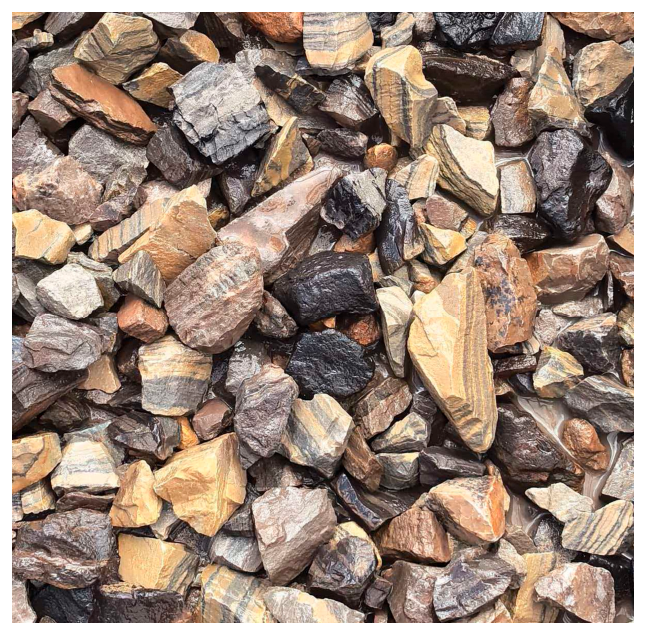
Phosphate ore samples for this study were obtained from a mine in Hubei Province, China. The ore exhibits a banded structure, with significant color differences between the bands (Figure 1). The chemical composition of the raw ore was determined by means of X-ray fluorescence (XRF) spectroscopy using an XRF spectrometer (Bruker S8 TIGER, Bruker AXS, Karlsruhe, Germany), with detailed results provided in Table 1. As shown in Table 1, the phosphate ore contains 20.87% P2O5, classifying it as a medium-to-low-grade collophane. The major impurity elements are SiO2 (19.52%), MgO (5.31%), Fe2O3 (2.20%), and Al2O3 (1.84%).
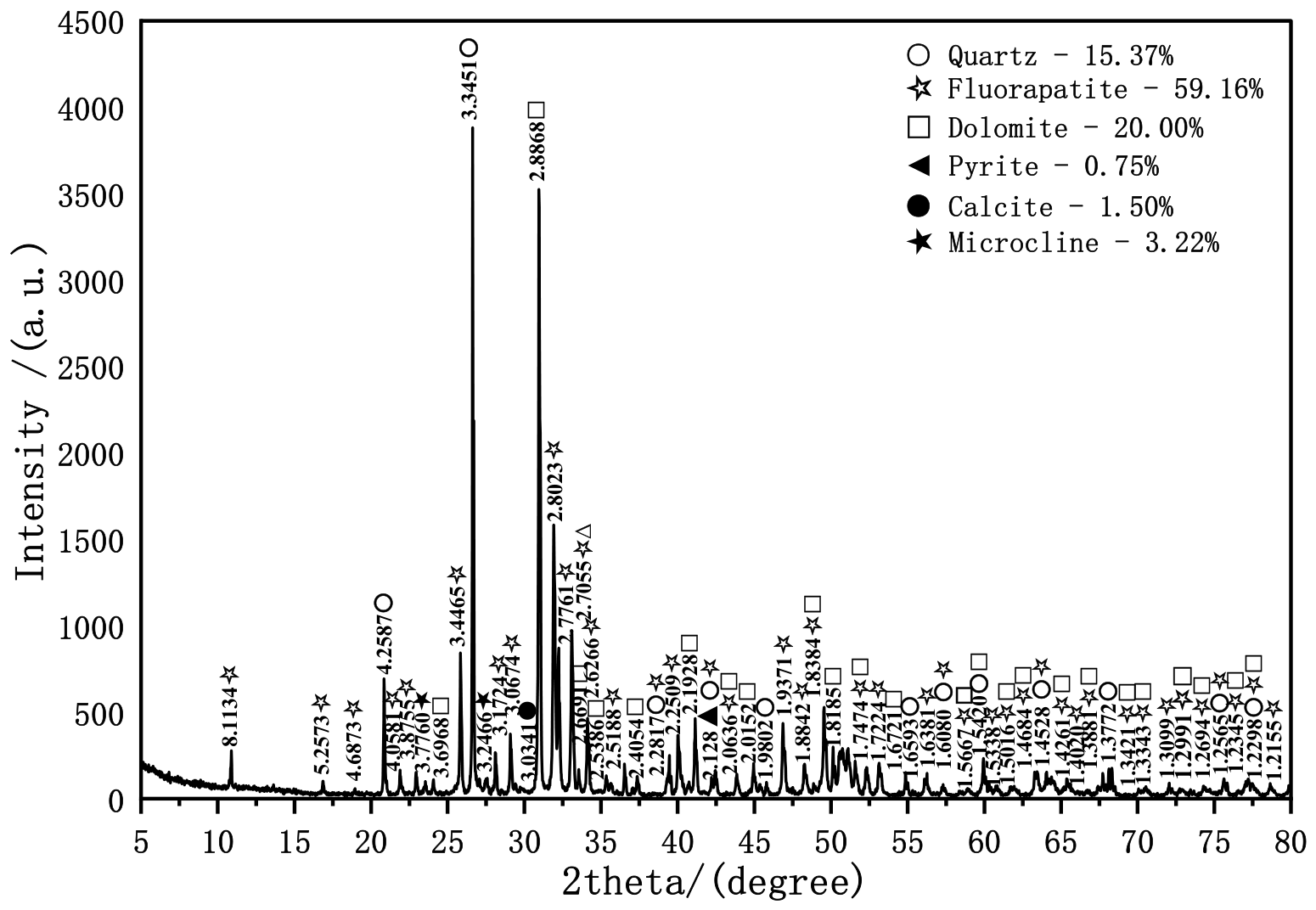
Quantitative X-ray Diffraction (XRD, Bruker AXS GmbH, Karlsruhe, Germany) analysis (Table 2, Figure 2) indicates that fluorapatite (59.16 wt%) is the dominant valuable mineral, while the gangue is primarily composed of dolomite (20.00 wt%) and quartz (15.37 wt%), with minor amounts of microcline (3.22 wt%), calcite (1.52 wt%), and pyrite (0.75 wt%). Combined with the XRF results, P2O5 is predominantly associated with fluorapatite, MgO with dolomite, SiO2 with quartz and microcline, Fe2O3 with pyrite, and Al2O3 with microcline. To achieve economically viable recoveries and marketable product grades, efficient separation of these gangue minerals is required. However, conventional reverse flotation for magnesium removal selectively eliminates dolomite only. Therefore, photoelectric sorting and dense-medium cyclone separation were introduced as pre-concentration steps to remove other gangue minerals.
Analytical-grade phosphoric acid (H3PO4) and sulfuric acid (H2SO4) purchased from Sinopharm Chemical Reagent (Shanghai, China) were used as the depressant for phosphate minerals and as pH modifiers. KM-6, a fatty acid-based collector with functional groups of –COO and –SO3, was synthesized in the laboratory. H3PO4, H2SO4, and KM-6 were used at a dosage range of 2.0–7.0, 5.0–25.0, and 0.6–1.5 kg/t, respectively. Tap water was used for flotation experiments, while distilled water was employed for reagent preparation.

2.2. Methods

2.2.1. Flotation

Flotation experiments were conducted at room temperature using an XFD flotation machine (XFDIV; Jilin Mine Exploration Machinery Factory, Changchun, Jilin, China) with a cell volume of 0.5 L. During each test, the depressant was first added and conditioned for a specified period, followed by the addition of the collector. Flotation was then initiated, and froth was collected until it became barren. Both froth and tailings products were subsequently collected, dried, weighed, sampled, and analyzed to determine yield, grade, and recovery. In selected experiments, additional concentrating and scavenging stages were incorporated. The detailed flotation flowsheet is presented in a subsequent section. To prepare samples for reverse flotation, the phosphate ore was first crushed and ground to the desired particle size.
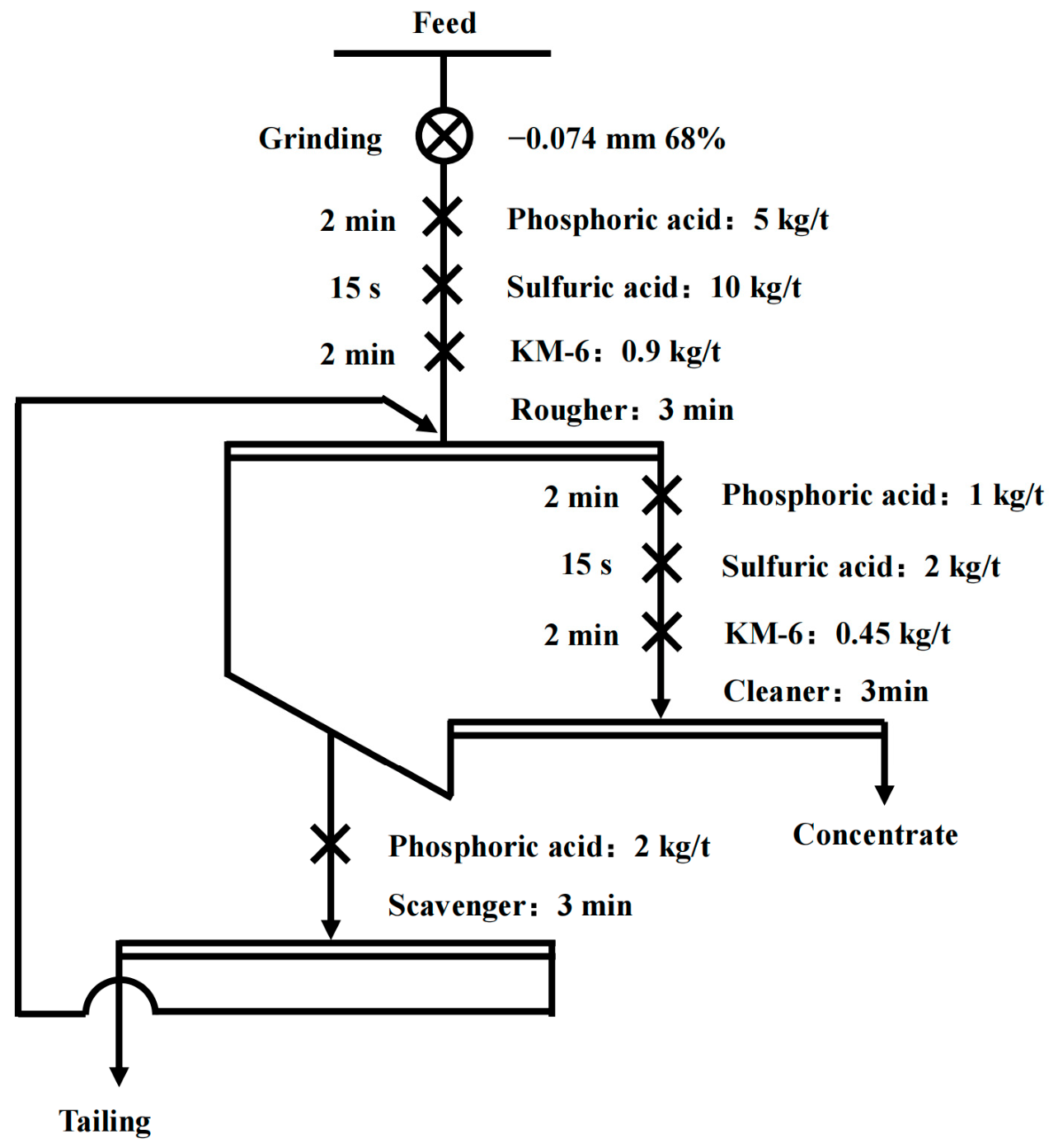
Through systematic experimentation, the optimal flotation conditions and process flowsheet for the phosphate ore were established. Under the following conditions—grinding fineness of −0.074 mm accounting for 68.00%; phosphoric acid and sulfuric acid dosages of 5 and 10 kg/t in the roughing stage, respectively; phosphoric acid dosage of 1 kg/t and sulfuric acid dosage of 2 kg/t in the concentrating stage; phosphoric acid dosage of 2 kg/t in the scavenging stage; and a total collector dosage of 1.35 kg/t—a closed-circuit reverse flotation test was conducted. The corresponding process flowsheet is presented in Figure 3.

2.2.2. Combined Photoelectric Separation–Flotation

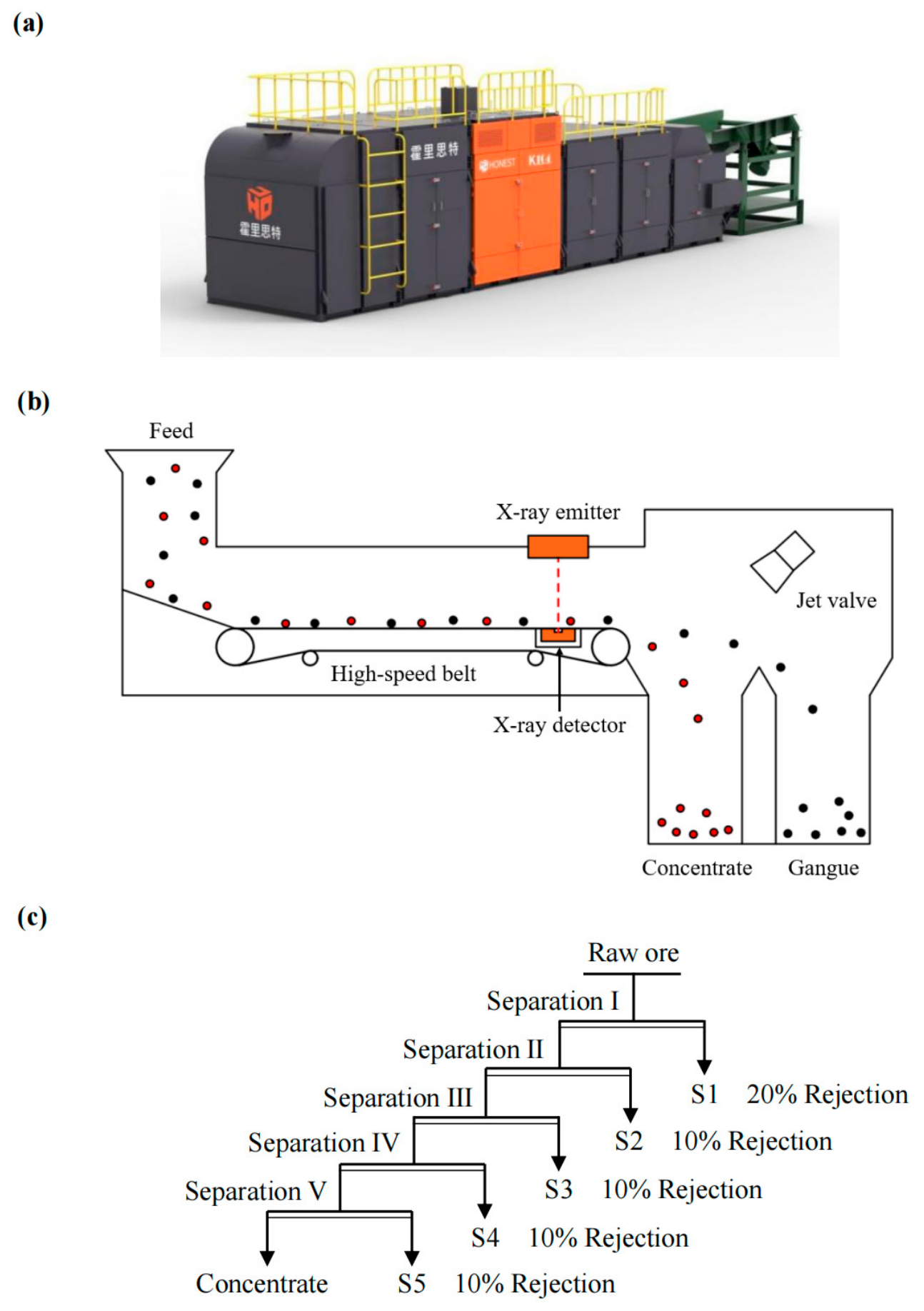
For photoelectric separation, the raw ore was crushed and screened to obtain a −40 + 10 mm fraction. Pre-concentration was performed using an X104 photoelectric separator produced by Huzhou Honesort Intelligent Technology Co., Ltd., Huzhou, Zhejiang, China, based on differences in mineral optical properties to remove tailings. The physical photo of the X104 intelligent separator, a schematic diagram of photoelectric separation, and the flowsheet of photoelectric separation are shown in Figure 4.
To investigate the distribution of elemental grades within the phosphate ore, a representative portion of the raw sample was scanned using an X104 intelligent separator to obtain ore images. Based on intelligent recognition algorithms, sequential rejection at progressively increasing rates was applied, and the raw ore was partitioned into five fractions (S1–S5). The multi-stage rejection procedure was conducted as follows:
The separation process was conducted in a stepwise manner with progressively increasing rejection rates. In the first stage, a total rejection rate of approximately 20% was applied to the raw ore, yielding tailings S1. In the second stage, a total rejection rate of approximately 30% was applied, producing middlings S2. This procedure was repeated in subsequent stages with total rejection rates of approximately 40% and 50%, generating middlings S3 and S4, respectively. In the final stage, a total rejection rate of approximately 60% was applied, resulting in the separation of middlings S5 and concentrate S6. All products obtained from the multi-stage separation were individually weighed, sampled, and analyzed. The resulting concentrate was combined with the −10 mm fraction, then crushed, homogenized, and ground to produce feed for reverse flotation.
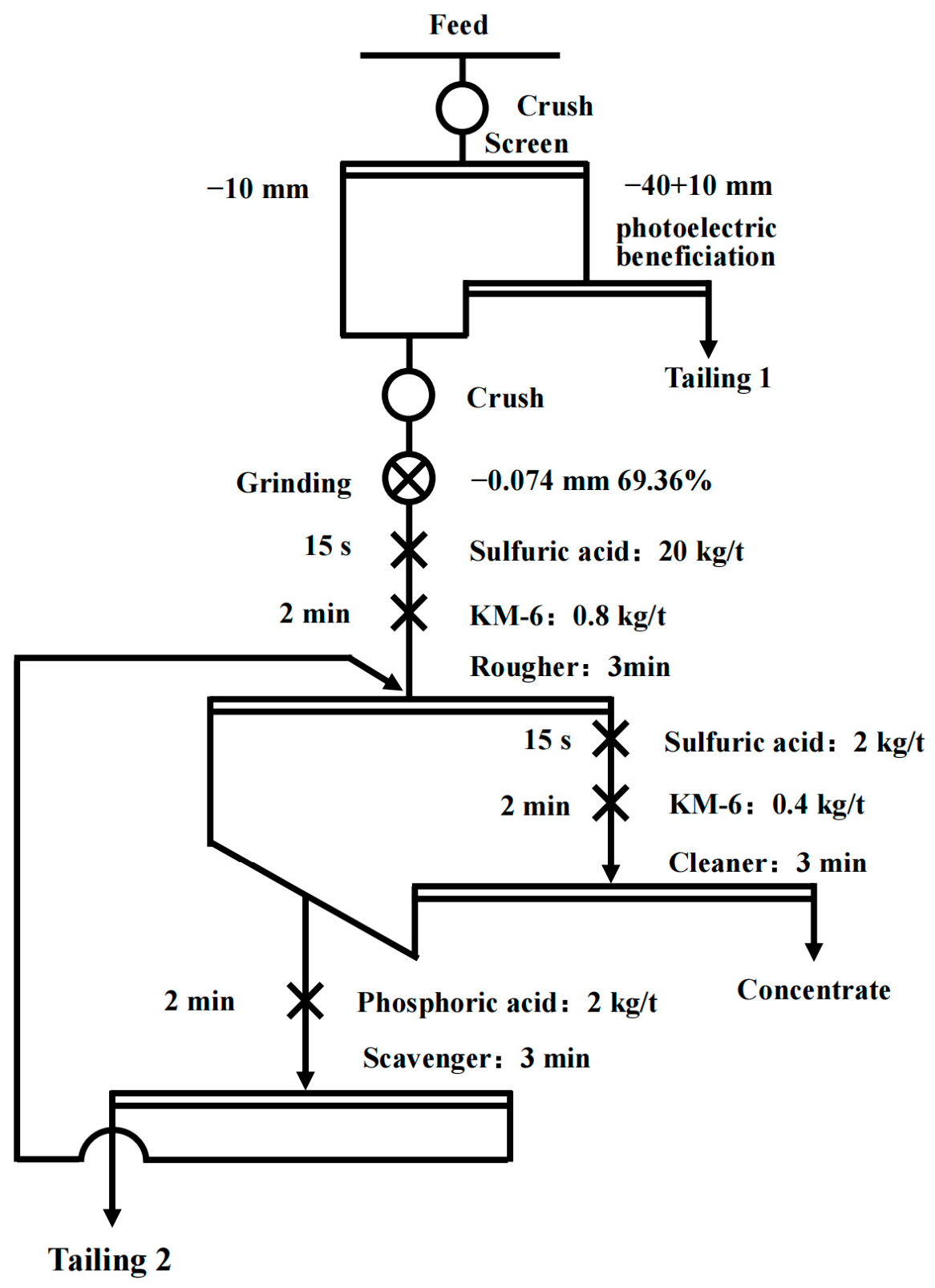
Through extensive experimentation, the optimal combined photoelectric separation–flotation flowsheet for this phosphate ore was determined. Under the conditions of a grinding fineness of −0.074 mm accounting for 69.36%, sulfuric acid dosages of 20 kg/t in the roughing stage and 2 kg/t in the concentrating stage, a phosphoric acid dosage of 2 kg/t in the scavenging stage, and collector dosages of 0.8 kg/t and 0.4 kg/t in the roughing and concentrating stages, respectively, a closed-circuit reverse flotation test was conducted. The overall process flowsheet is shown in Figure 5.

2.2.3. Combined Dense-Medium Cyclone Separation–Flotation

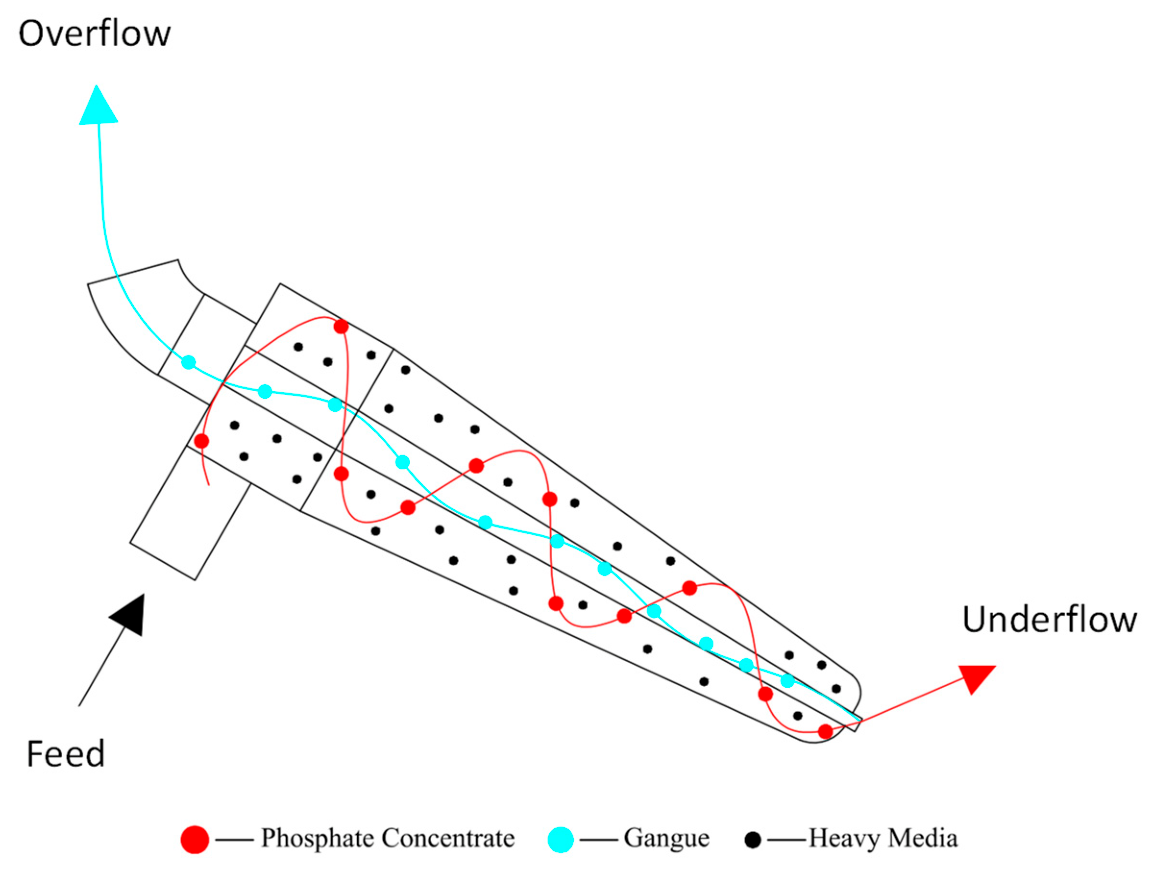
Dense-medium cyclone separation (Weihai Haiwang Hydrocyclone Co., Ltd., Weihai, Shandong, China) was employed to remove gangue minerals based on differences in density. For this process, the raw phosphate ore was crushed and screened to obtain a −15 + 0.5 mm size fraction. The principle of dense-medium cyclone separation is illustrated in Figure 6. By changing the experimental conditions, the tailings yield was adjusted to approximately 10%, 20%, 30%, and 40%.
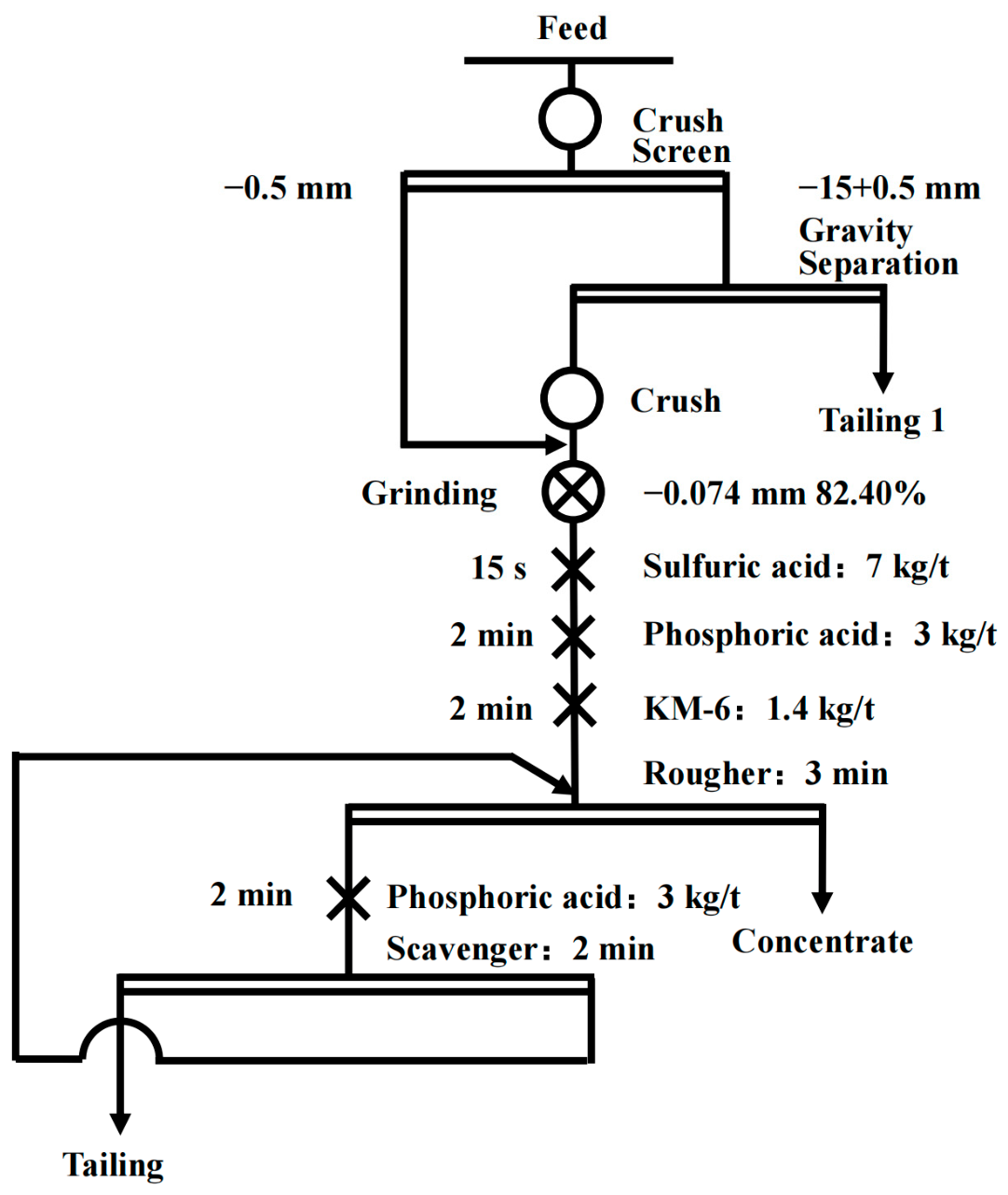
The beneficiation concentrate obtained from dense-medium cyclone separation was then combined with the −0.5 mm fraction, followed by crushing, homogenization, and grinding to prepare feed samples for single-stage reverse flotation. Through extensive experimentation, the optimal combined dense-medium cyclone separation–flotation flowsheet for this phosphate ore was determined. Under the conditions of a grinding fineness of −0.074 mm accounting for 82.40%, a sulfuric acid dosage of 7 kg/t and phosphoric acid dosage of 3 kg/t in the roughing stage, a phosphoric acid dosage of 3 kg/t in the scavenging stage, and a collector dosage of 1.4 kg/t in the roughing stage, a closed-circuit reverse flotation test was conducted. The overall process flowsheet is shown in Figure 7.

3. Results and Discussion

3.1. Single Reverse Flotation Results

Single reverse flotation was conducted, with the results shown in Table 3. The phosphate concentrate exhibited a yield of 67.25%, a P2O5 grade of 28.12%, and a recovery of 90.61%. A multi-element analysis of the reverse flotation concentrate (Table 4) indicated P2O5, SiO2, MgO, Fe2O3, and Al2O3 contents of 28.12%, 19.41%, 0.81%, 1.15%, and 1.87%, respectively. Compared with the raw ore, P2O5 content increased from 20.87% to 28.12%, while that of MgO and Fe2O3 decreased from 5.31% to 0.81% and from 2.20% to 1.15%, respectively; all other components remained essentially unchanged. These results suggest that the enhancement in P2O5 grade is primarily attributed to the removal of MgO (dolomite) and Fe2O3 (pyrite) impurities. The results are similar to those reported by Li et al. [28]. In the single reverse flotation process, phosphoric acid and sulfuric acid serve as depressants for fluorapatite, while the collector adsorbs onto dolomite and pyrite surfaces, rendering them hydrophobic and thereby promoting their floatability [29], thus facilitating the efficient removal of dolomite and pyrite. However, as single-stage reverse flotation for magnesium removal selectively targets dolomite and pyrite while leaving silicate minerals largely unaffected, the resultant P2O5 grade remains below 30%, thereby failing to meet the required P2O5 content standard for phosphate concentrate [10]. Consequently, pre-beneficiation using photoelectric or gravity separation was considered to remove a portion of other gangue minerals and reduce overall beneficiation costs.

3.2. Combined Photoelectric Separation–Flotation Results

As single-stage reverse flotation did not meet beneficiation requirements, pre-concentration via photoelectric separation was conducted prior to flotation. The X104 photoelectric separator is suitable for feed with particle sizes of −40 + 10 mm. Accordingly, the phosphate ore was crushed to below 40 mm and screened using a 10 mm sieve. The −40 + 10 mm fraction, accounting for 50.72% of the total feed, with a P2O5 grade of 17.69% and a P2O5 distribution of 43%, was used as the feed for the photoelectric separator (Table 5).
The influence of the tailings proportion on photoelectric separation performance is shown in Figure 8. As the tailings proportion increased, the P2O5 grades of both the concentrate and the tailings exhibited an upward trend, while the overall recovery gradually decreased, consistent with the principles of mineral beneficiation. Comprehensive analysis of the P2O5 grade and recovery indicates that a tailings proportion of 38.69% at the photoelectric separation stage provides optimal separation performance. Under these conditions, the concentrate achieves a P2O5 grade of 22.12% with a stage recovery of 76.66%, while the tailings exhibit a P2O5 grade of 10.67%. Compared with the feed, the P2O5 grade of the concentrate increased by 4.43%, while the tailings exhibited a relatively low P2O5 grade of 10.67%, indicating that partial rejection of low-grade tailings is feasible. Photoelectric–flotation separation was conducted and the results are shown in Table 6.
Through photoelectric–flotation separation, a phosphate concentrate with a yield of 59.30%, a P2O5 grade of 29.84%, and a recovery of 77.71% was obtained, representing an 8.97% increase in P2O5 grade. Multi-element analysis of the combined photoelectric separation–flotation concentrate (Table 7) indicated P2O5, SiO2, MgO, Fe2O3, and Al2O3 contents of 29.85%, 18.39%, 0.63%, 1.08%, and 1.82%, respectively. Compared with the raw ore, P2O5 content increased from 20.87% to 29.85%, MgO content decreased from 5.31% to 0.63%, SiO2 content decreased from 19.52% to 18.39%, and Fe2O3 content decreased from 2.20% to 1.08%, while all other components remained essentially unchanged. These results indicate that the P2O5 grade enhancement is due to the removal of dolomite and pyrite impurities, similar to single-stage reverse flotation. Nevertheless, the present results are not in full agreement with those reported by Li et al., who documented that the COM Tertiary XRT B2400 photoelectric sorter (TOMRA Systems ASA, Drengsrudhagen, Norway) at a Saudi Arabian phosphate plant delivered marked separation performance, with a yield of 66.67%, P2O5 recovery of 85.49%, and SiO2 rejection of 60.20% [30]. Furthermore, they vary from the findings of Peng et al., who observed reductions of 1.68%, 3.07%, 0.09%, and 0.03% in the MgO, SiO2, Al2O3, and Fe2O3 contents, respectively, using the HPY-P60 X-ray intelligent photoelectric sorter (Ganzhou HPY Technology Co., Ltd., Ganzhou, Jiangxi, China) [31]. The observed disparity in gangue rejection efficiency may arise from differences in the mineralogical properties of the feed ores, photoelectric sorting equipment, and processing conditions.

3.3. Combined Dense-Medium Cyclone Separation–Flotation Results

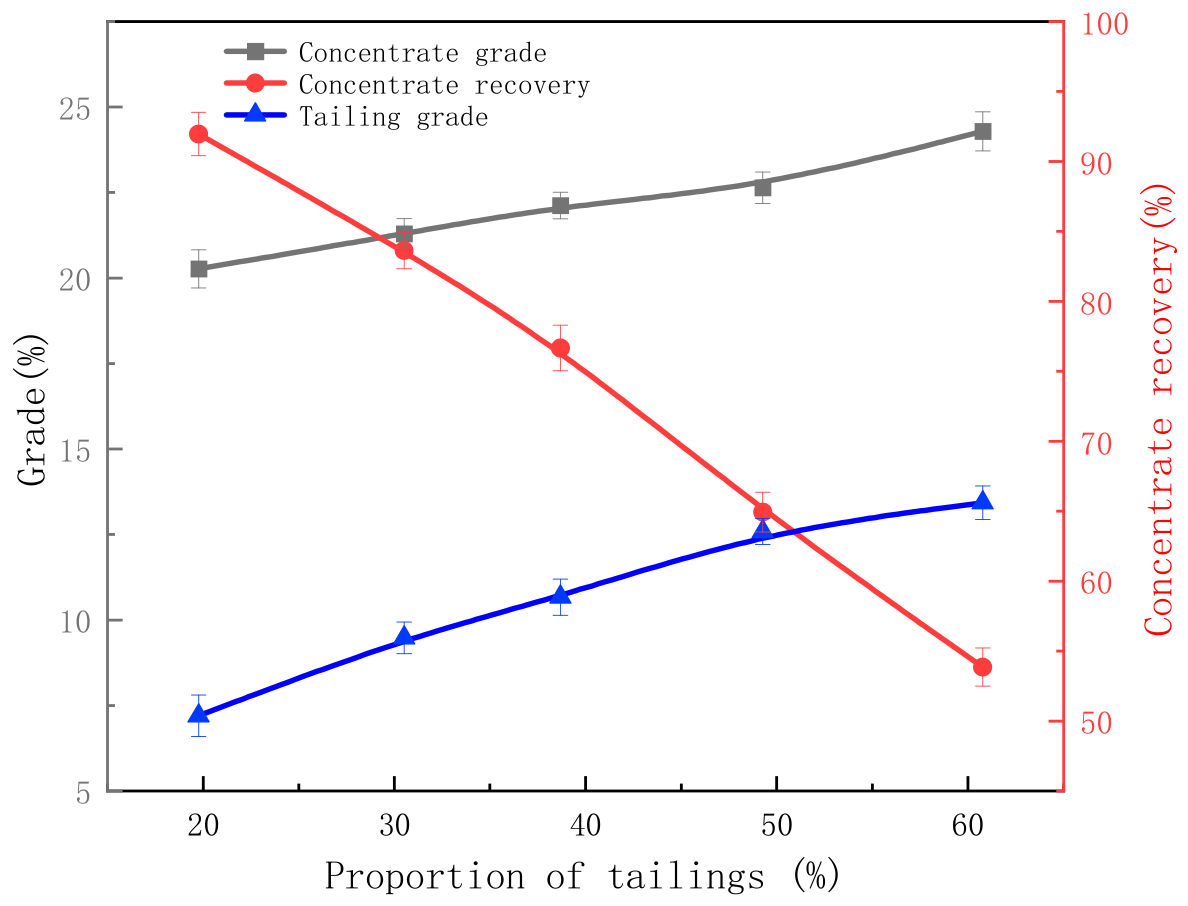
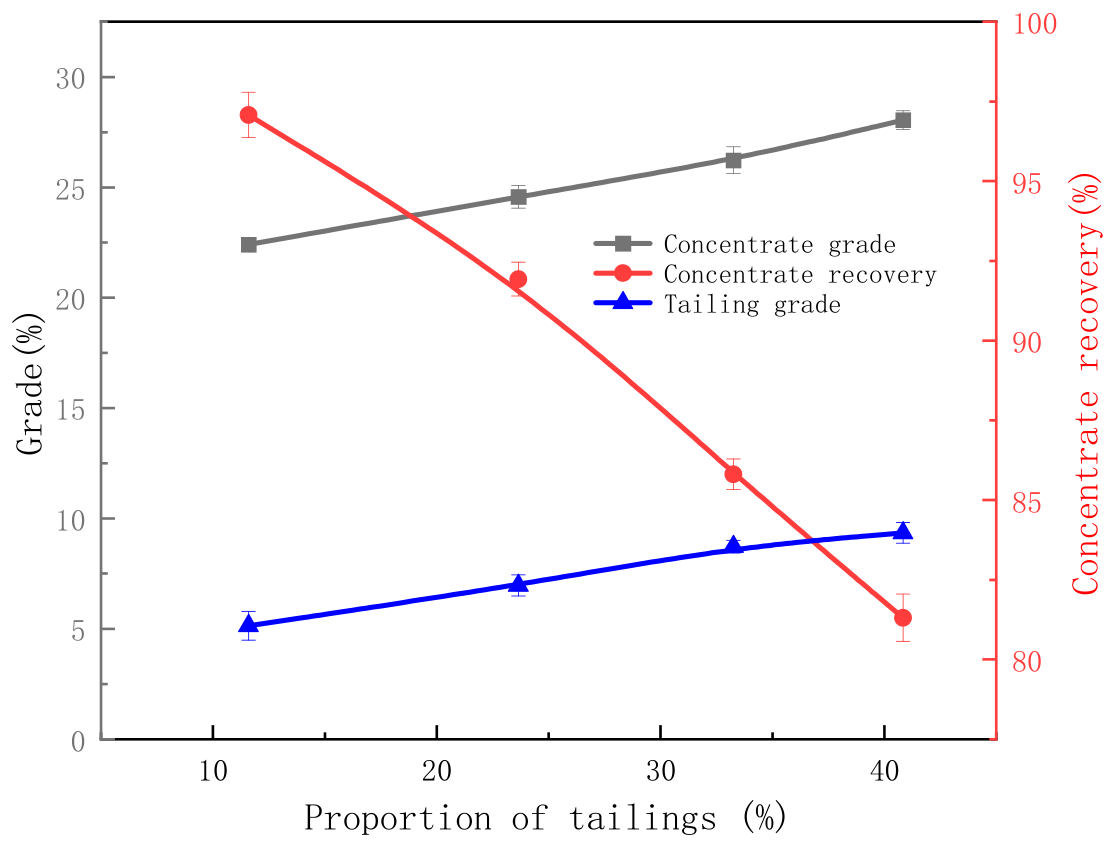
As single-stage reverse flotation and combined photoelectric separation–flotation did not meet beneficiation requirements, pre-concentration via dense-medium cyclone separation was introduced prior to flotation. The dense-medium cyclone is suitable for feed with particle sizes of −15 + 0.5 mm. Accordingly, the phosphate ore was crushed to below 15 mm and screened using a 0.5 mm sieve. The −15 + 0.5 mm fraction, accounting for 85.34% of the total feed, with a P2O5 grade of 20.41% and a P2O5 distribution of 83.46%, was used as the feed for the dense-medium cyclone separation (Table 8).
The influence of the tailings proportion on dense-medium cyclone separation performance is shown in Figure 9. As the tailings proportion increased, the P2O5 grades of both the concentrate and the tailings exhibited an upward trend, while the overall recovery gradually decreased, consistent with the principles of mineral beneficiation. Comprehensive analysis of the P2O5 grade and recovery indicates that a tailing proportion of 23.65% at the photoelectric separation stage provides optimal separation performance. Under these conditions, the concentrate achieves a P2O5 grade of 24.57% with a stage recovery of 91.93%, while the tailings exhibit a P2O5 grade of 6.96%. Compared with the feed, the P2O5 grade of the concentrate increased by 4.41%, while the tailings exhibited a relatively low P2O5 grade of 6.96%, indicating that partial rejection of low-grade tailings is feasible. These findings align with those of previous studies, which have demonstrated that dense-medium cyclone separation is effective in preconcentrating phosphate ores by separating lighter gangue minerals from heavier apatite. However, more substantial improvements in phosphate concentrate grade have been documented in the literature, including a 6.48% increase in P2O5 grade with a recovery of 90% from a Moroccan ore [22], and a 7.14% increase with a recovery of 85.60% from a Yichang phosphate ore in China [3]. These discrepancies in P2O5 grade and recovery across studies are likely attributable to variations in ore mineralogy and processing parameters.
Dense-medium cyclone separation–flotation was conducted, and the results are shown in Table 9. Through this process, a phosphate concentrate with a yield of 54.28%, a P2O5 grade of 31.49%, and a recovery of 81.91% was obtained, representing a 10.62% increase in P2O5 grade. Multi-element analysis of the combined dense-medium cyclone separation–flotation concentrate (Table 10) revealed P2O5, SiO2, MgO, Fe2O3, and Al2O3 contents of 31.49%, 15.68%, 0.71%, 1.09%, and 1.51%, respectively. Compared with the raw ore, P2O5 content increased from 20.87% to 31.49%, while that of MgO, SiO2, and Fe2O3 decreased from 5.31% to 0.71%, 19.52% to 15.68%, and 2.20% to 1.09%, respectively; all other components remained essentially unchanged. These results indicate that the improvement in P2O5 grade is primarily attributable to the removal of MgO, SiO2, Fe2O3, and Al2O3 impurities. It can be concluded that the combined dense-medium cyclone separation–flotation process not only removes dolomite but also effectively eliminates quartz, microcline, and pyrite. As shown in Table 11, the densities of fluorapatite, dolomite, quartz, microcline, calcite, and pyrite are 3.15–3.20, 2.85, 2.65, 2.54–2.57, 2.71, and 5.02 g/cm3, respectively [32]. Among these minerals, quartz and microcline have relatively low densities, differing significantly from that of fluorapatite. In addition, the feed particle size for heavy medium separation is smaller than that for photoelectric sorting, and the gangue minerals are more readily liberated. Therefore, they are relatively easier to separate through heavy medium separation.

3.4. Comparison of Technical Indicators

In addition to P2O5 grade and recovery, the effective removal of impurity components, including MgO, SiO2, Fe2O3, and Al2O3, is critical for improving the quality and downstream processability of phosphate concentrates. MgO-bearing gangue minerals, particularly dolomite and other carbonate minerals, are undesirable because they can increase acid consumption during phosphoric acid production and consequently reduce the economic efficiency of phosphate processing [33]. Similarly, excessive SiO2 dilutes the P2O5 content of the concentrate and increases the proportion of inert gangue entering subsequent processing stages [34]. Fe- and Al-bearing minerals are also important impurities because they can increase acid consumption and promote the formation of insoluble compounds during phosphoric acid production, which may adversely affect filtration and phosphoric acid recovery [34].
The potential utilization of the concentrates obtained from the three separation routes was further evaluated based on their P2O5 grade, recovery, and the contents of major impurity components (SiO2, MgO, Fe2O3, and Al2O3). The results are shown in Table 12.
The single reverse flotation process produced a concentrate containing 28.12% P2O5 with a relatively high P2O5 recovery of 90.61%. However, the concentrate still contained 19.41% SiO2, 0.81% MgO, 1.15% Fe2O3, and 1.87% Al2O3. The corresponding MER value was approximately 13.62%, indicating a relatively high impurity burden. Its relatively high P2O5 recovery indicates that the single reverse flotation route may be attractive when phosphorus recovery is prioritized, and the concentrate could potentially be used as a lower-grade phosphate feed after blending with higher-quality phosphate rock or subjected to further impurity removal.
The combined photoelectricity–flotation process increased the P2O5 grade to 29.84%, while the recovery decreased to 77.71%. Compared with single reverse flotation, the contents of SiO2, MgO, Fe2O3, and Al2O3 decreased to 18.39%, 0.63%, 1.08%, and 1.82%, respectively. The lower MgO and combined Fe2O3 + Al2O3 contents indicate an improvement in concentrate quality, with MER value decreasing to approximately 11.83%. These values are closer to the impurity levels considered favorable for wet-process phosphoric acid production [35,36]. However, the SiO2 content remains as high as 18.39%, which is substantially higher than that of many commercially traded phosphate concentrates and would remain the principal limitation for direct use in conventional phosphoric acid production [37]. Therefore, this concentrate may be more suitable as a blending feedstock or as an intermediate product requiring additional silica removal rather than as a premium-grade phosphate concentrate.
The combined dense-medium cyclone–flotation route generated the highest-quality concentrate among the three flowsheets, with 31.49% P2O5 and 81.91% P2O5 recovery. Importantly, the SiO2 content decreased substantially to 15.68%, while MgO, Fe2O3, and Al2O3 were reduced to 0.71%, 1.09%, and 1.51%, respectively. The corresponding MER values were approximately 10.51%. Thus, compared with the other two products, the dense-medium cyclone–flotation concentrate exhibits the most favorable overall chemical quality and a P2O5 grade above 30%. Commercial phosphate-rock specifications commonly use P2O5 contents around 30% or higher as a benchmark for marketable phosphate rock [10]. However, its relatively high SiO2 content remains a potential limitation for direct application in high-efficiency wet-process phosphoric acid plants [38]. Therefore, this product is best regarded as a potentially marketable intermediate-grade phosphate concentrate, particularly for blending with higher-grade, low-silica phosphate rock, while further silica removal would be desirable for high-end phosphoric acid production.

4. Conclusions

The investigated phosphate ore exhibits well-defined gangue banding. Photoelectric separation and dense-medium cyclone separation were applied as pre-concentration methods prior to reverse flotation to achieve economically viable recoveries and marketable product grades.
Using a single reverse flotation process, a phosphate concentrate with a P2O5 grade of 28.12% and a recovery of 90.61% was obtained. The combined photoelectric separation–flotation process produced a concentrate with a grade of 29.84% and a recovery of 77.71%. In contrast, the combined dense-medium cyclone–flotation process yielded the highest concentrate quality, achieving a grade of 31.49% with a recovery of 81.91%.
Reverse flotation and combined photoelectric separation–reverse flotation were effective in removing dolomite and pyrite gangue minerals from the phosphate ore, while combined dense-medium cyclone–reverse flotation enabled the removal of dolomite, quartz, microcline, and pyrite minerals. Thus, combined dense-medium cyclone–reverse flotation enabled the acquisition of a high-quality phosphate concentrate.

Author Contributions

Conceptualization, Z.L., D.H. and W.X.; methodology, Z.L.; validation, Z.L., D.H. and Y.T. (Yun Tang); formal analysis, W.X., Y.T. (Yuan Tang) and W.L.; investigation, H.L. and Z.Z.; resources, L.S. and H.S.; data curation, W.X. and H.S.; writing—original draft preparation, H.L. and Z.Z.; writing—review and editing, Z.L. and Y.F.; visualization, Y.T. (Yuan Tang) and W.L.; supervision, H.S. and Y.T. (Yun Tang); project administration, L.S.; funding acquisition, Z.L. and D.H. All authors have read and agreed to the published version of the manuscript.

Funding

This research was funded by the Scientific and Technological Innovation Platform Research Project of Guizhou Province (CXPTXM [2025] 016), Open foundation of State Key Laboratory of Efficient Utilization for Low-Grade Phosphate Rock and Its Associated Resources (WFKF(2023)005), Hubei Provincial Science and Technology Program (2024DJC089), The National Natural Science Foundation of China (No. 52204279), Hubei Provincial Science and Technology Program (2025BCB065), The Central Government’s Special Project for Supporting Local Science and Technology Development in Hubei Province (2025CSA015).

Data Availability Statement

The original contributions presented in this study are included in the article. Further inquiries can be directed to the corresponding authors.

Acknowledgments

We would like to express our gratitude to Postdoctoral Research Workstation of Wengfu (Group) Co., Ltd. for their support in this project.

Conflicts of Interest

Zhili Li received financial support from Wengfu (Group) Co., Ltd. for this study. The funding sponsors had no role in the design of the study; in the collection, analyses, or interpretation of data; in the writing of the manuscript; and in the decision to publish the results.

References

  1. Mew, M.C.; Steiner, G.; Geissler, B. Phosphorus supply chain—Scientific, technical, and economic foundations: A transdisciplinary orientation. Sustainability 2018, 10, 1087. [Google Scholar] [CrossRef] [Scilit]
  2. Geissler, B.; Hermann, L.; Mew, M.C.; Steiner, G. Striving toward a circular economy for phosphorus: The role of phosphate rock mining. Minerals 2018, 8, 395. [Google Scholar] [CrossRef] [Scilit]
  3. Ruan, Y.; He, D.; Chi, R. Review on beneficiation techniques and reagents used for phosphate ores. Minerals 2019, 9, 253. [Google Scholar] [CrossRef] [Scilit]
  4. Yu, L.; Yu, P.; Bai, S. A critical review on the flotation reagents for phosphate ore beneficiation. Minerals 2024, 14, 828. [Google Scholar] [CrossRef] [Scilit]
  5. Liu, C.; Zhu, Y.; Bao, S.; Ren, L.; Zhu, Y.; Xu, W.; Yang, S. Exploration of disodium methylenebis naphthalene sulfonatea as a novel depressant for the flotation separation of apatite from dolomite. Sep. Purif. Technol. 2024, 341, 126967. [Google Scholar] [CrossRef] [Scilit]
  6. Wang, J.; Dai, H.X.; Guo, Y.H. The Processing Method and Progress of Phosphate Resources. Adv. Mater. Res. 2013, 634–638, 3558–3562. [Google Scholar] [CrossRef] [Scilit]
  7. Ober, J.A. Mineral Commodity Summaries; USGS Report; U.S. Geological Survey, National Minerals Information Center: Reston, VA, USA, 2018; 200p. [CrossRef] [Scilit]
  8. Ding, S.; Yin, L.; Zhang, T.; Lv, L.; Tang, W.; Tang, S. Resource utilization of phosphate tailings by calcination and leaching with dilute H3PO4 solution. Miner. Eng. 2025, 222, 109172. [Google Scholar] [CrossRef] [Scilit]
  9. Sun, K.; Liu, T.; Zhang, Y.; Liu, X.; Wang, B.; Xu, C. Application and mechanism of anionic collector sodium dodecyl sulfate (SDS) in phosphate beneficiation. Minerals 2017, 7, 29. [Google Scholar] [CrossRef] [Scilit]
  10. Sis, H.; Chander, S. Reagents used in the flotation of phosphate ores: A critical review. Miner. Eng. 2003, 16, 577–585. [Google Scholar] [CrossRef] [Scilit]
  11. Abouzeid, A.Z.M. Physical and thermal treatment of phosphate ores—An overview. Int. J. Miner. Process. 2008, 85, 59–84. [Google Scholar] [CrossRef] [Scilit]
  12. Liu, X.; Zhang, Y.; Liu, T.; Cai, Z.; Chen, T.; Sun, K. Beneficiation of a sedimentary phosphate ore by a combination of spiral gravity and direct-reverse flotation. Minerals 2016, 6, 38. [Google Scholar] [CrossRef] [Scilit]
  13. Derhy, M.; Taha, Y.; Hakkou, R.; Benzaazoua, M. Review of the main factors affecting the flotation of phosphate ores. Minerals 2020, 10, 1109. [Google Scholar] [CrossRef] [Scilit]
  14. Yang, X.; Tamm, K.; Piir, I.; Kuusik, R.; Trikkel, A.; Tõnsuaadu, K. Evaluation of Estonian phosphate rock by flotation. Miner. Eng. 2021, 171, 107127. [Google Scholar] [CrossRef] [Scilit]
  15. Zou, H.; Cao, Q.B.; Liu, D.W.; Chen, X.M.; Jiao, Y. Flotation features of fluorapatite with ricinoleic acid: The role of hydrogen bonds between collectors. Chem. Pap. 2021, 75, 1949–1958. [Google Scholar] [CrossRef] [Scilit]
  16. Aleksandrova, T.; Elbendari, A.; Nikolaeva, N. Beneficiation of a low-grade phosphate ore using a reverse flotation technique. Miner. Process. Extr. Metall. Rev. 2022, 43, 22–27. [Google Scholar] [CrossRef] [Scilit]
  17. Kolacz, J. Advanced sorting technologies and its potential in mineral processing. AGH J. Min. Geoeng. 2012, 36, 39–48. [Google Scholar]
  18. Gülcan, E.; Gülsoy, Ö.Y. Performance evaluation of optical sorting in mineral processing—A case study with quartz, magnesite, hematite, lignite, copper and gold ores. Int. J. Miner. Process. 2017, 169, 129–141. [Google Scholar] [CrossRef] [Scilit]
  19. Luo, X.; He, K.; Zhang, Y.; He, P.; Zhang, Y. A review of intelligent ore sorting technology and equipment development. Int. J. Miner. Metall. Mater. 2022, 29, 1647–1655. [Google Scholar] [CrossRef] [Scilit]
  20. Qin, G.; Sun, L.; Liu, Y.; Zhang, X.; Jing, X.; Ji, Q. Current Status and Prospects of Mineral Sorting Technology Research at Home and Abroad. In E3S Web of Conferences; EDP Sciences: Les Ulis, France, 2024. [Google Scholar] [CrossRef] [Scilit]
  21. Yu, X.; Yang, M.; Mao, S.; Yu, F.; He, T. Research on application of X-ray separation technology in beneficiation of phosphate rock. Ind. Miner. Process. 2020, 49, 31–33, 39. (In Chinese) [Google Scholar] [CrossRef]
  22. Lalam, K.; Chhiti, Y.; Khouakhi, M.E.; Abidi, A.; Chebak, A. Laboratory Comparison of Dense Medium Separation and Acid Leaching for Preconcentration of Coarse Rejects from Phosphate Washing Plant. Minerals 2024, 14, 996. [Google Scholar] [CrossRef] [Scilit]
  23. Yang, M. Test on gravity-flotation complex process of mid-low grade phosphate rock in Dianchi region. Chem. Miner. Process. 2004, 5, 3–5. (In Chinese) [Google Scholar]
  24. Lawver, J.E.; Wiegel, R.L.; Snow, R.E.; Hwang, C.L. Phosphate reserves enhancement by beneficiation. Min. Congr. J. 1982, 68, 27–31. [Google Scholar]
  25. Falconer, A. Gravity separation: Old technique/new methods. Phys. Sep. Sci. Eng. 2003, 12, 31–48. [Google Scholar] [CrossRef] [Scilit]
  26. El-Boraey, H.A.; El-Shennawy, A.A.; Masoud, A.M.; Gado, H.S.; Bekair, A.A. Beneficiation of low-grade phosphate ore using desliming and gravity separation technique. J. Chem. Biol. Phys. Sci. 2017, 7, 301. [Google Scholar]
  27. Lv, B.; Chai, X.; Deng, X.; Jiao, F.; Fang, C.; Xing, B. Recovery of residual carbon from coal gasification fine slag by a combined gravity separation-flotation process. J. Environ. Manag. 2023, 348, 119351. [Google Scholar] [CrossRef] [Scilit] [PubMed]
  28. Li, C.X.; Cheng, R.J.; Luo, H.H. Study on collector for reverse flotation of certain phosphorite in Guizhou. Adv. Mater. Res. 2013, 734–737, 1086–1092. [Google Scholar] [CrossRef] [Scilit]
  29. Dong, L.; Cui, Y.; Lan, S.; Zhang, T.; Mao, Y.; Shen, P.; Liu, D. Advances in phosphate ores flotation: Cleaning reagents, green practices and perspectives. Miner. Eng. 2026, 239, 110120. [Google Scholar] [CrossRef] [Scilit]
  30. Li, N.; Zhang, S.H.; Peng, H.; Fu, L.; Lu, Y.J. Application practice and evaluation of photoelectric separation in a phosphate mining industry. Non-Met. Mines 2018, 41, 73–75. (In Chinese) [Google Scholar]
  31. Peng, H.; Peng, Y.Q.; Liao, X.; Ma, W.H.; Li, J.; Li, Z.L. Industrial test and sorting mechanism research on X-ray photoelectric sorting of Haikou phosphate ore in Yunnan. Nonferrous Met. (Miner. Process. Sect.) 2026, 5, 130–136. (In Chinese) [Google Scholar] [CrossRef]
  32. Klein, C.; Dutrow, B. Manual of Mineral Science; John Wiley & Sons: Hoboken, NJ, USA, 2007. [Google Scholar]
  33. Puvvada, S.; Thompson, P.; Miller, J.D. Dolomite rejection from crushed pebble phosphate by attrition scrubbing. Miner. Eng. 2019, 143, 105932. [Google Scholar] [CrossRef] [Scilit]
  34. Zhu, Y.; Lin, S.; Cortez, J.N.; Xiang, L. Separation and Beneficiation of Low-Grade Phosphate Rock: A Comprehensive Review. Chem. Eng. J. Adv. 2026, 27, 101352. [Google Scholar] [CrossRef] [Scilit]
  35. Ryszko, U.; Rusek, P.; Kołodyńska, D. Quality of Phosphate Rocks from Various Deposits Used in Wet Phosphoric Acid and P-Fertilizer Production. Materials 2023, 16, 793. [Google Scholar] [CrossRef] [Scilit] [PubMed]
  36. Puvvada, S.; Lin, C.L.; Miller, J.D. High speed X-ray computed tomography for plant-site analysis of pebble phosphate. Miner. Eng. 2019, 130, 129–141. [Google Scholar] [CrossRef] [Scilit]
  37. Fayiga, A.O.; Nwoke, O.C. Phosphate rock: Origin, importance, environmental impacts, and future roles. Environ. Rev. 2016, 24, 403–415. [Google Scholar] [CrossRef] [Scilit]
  38. Clapperton, A.; Bazin, C.; Downey, D.; Marois, J.-S. Production of a phosphate concentrate from the tailings of a niobium ore concentrator. Minerals 2020, 10, 692. [Google Scholar] [CrossRef] [Scilit]
Figure 1. Macrograph of the phosphate ore.
Processes 14 02843 g001
Figure 2. XRD pattern of phosphate ore.
Processes 14 02843 g002
Figure 3. Single reverse flotation flowsheet.
Processes 14 02843 g003
Figure 4. (a) Physical photo of X104 photoelectric separator, (b) schematic diagram of photoelectric separation, and (c) flowsheet of photoelectric separation.
Processes 14 02843 g004
Figure 5. Flowsheet of combined photoelectric–flotation separation.
Processes 14 02843 g005
Figure 6. Schematic diagram of dense-medium cyclone separation.
Processes 14 02843 g006
Figure 7. Flowsheet of combined dense-medium cyclone separation–flotation.
Processes 14 02843 g007
Figure 8. The influence of the tailings proportion on photoelectric separation performance.
Processes 14 02843 g008
Figure 9. The influence of tailings proportion on dense-medium cyclone separation performance.
Processes 14 02843 g009
Table 1. Chemical composition of phosphate ore (wt%).
ComponentsCaOP2O5SiO2MgOFe2O3Al2O3FSO3Other
Content36.9720.8719.525.312.201.841.501.1710.62
Table 2. Mineral composition of phosphate ore (wt%).
ComponentsFluorapatiteDolomiteQuartzMicroclineCalcitePyrite
Content59.1620.0015.373.221.500.75
Table 3. Single reverse flotation test results.
ProductYield/%P2O5 Grade/%P2O5 Recovery/%
Concentrate67.2528.1290.61
Tailing32.755.989.39
Feed100.0020.87100.00
Table 4. Multi-element analysis results of reverse flotation concentrate (wt%).
ComponentsCaOP2O5SiO2MgOFe2O3Al2O3FSO3Other
Content37.9528.1219.410.811.151.872.011.237.45
Table 5. Particle size and P2O5 content distribution analysis of phosphate ore for combined photoelectric–flotation separation.
ProductYield/%P2O5 Grade/%P2O5 Distribution/%
−10 mm fraction49.2824.1457.00
−40 + 10 mm fraction50.7217.6943.00
Feed100.0020.87100.00
Table 6. Results of the photoelectric–flotation separation process under the optimum experimental conditions.
ProductYield/%P2O5 Grade/%P2O5 Distribution/%
Concentrate57.3029.8477.71
Tailing 119.6210.6710.03
Tailing 223.0811.0912.26
Feed100.0020.87100.00
Table 7. Multi-element analysis results of combined photoelectric separation–flotation concentrate (wt%).
ComponentsCaOP2O5SiO2MgOFe2O3Al2O3FSO3Other
Content38.1329.8418.390.631.081.822.061.206.85
Table 8. Particle size composition of phosphate ore for combined dense-medium cyclone–flotation separation.
ProductYield/%P2O5 Grade/%P2O5 Distribution/%
−0.5 mm fraction14.6623.5516.54
−15.0 + 0.5 mm fraction85.3420.4183.46
Feed100.0020.87100.00
Table 9. Results of combined dense-medium cyclone–flotation separation process.
ProductYield/%P2O5 Grade/%P2O5
Distribution/%
Concentrate54.2831.4981.91
Tailing 19.896.383.02
Tailing 235.838.7815.07
Feed100.0020.87100.00
Table 10. Multi-element analysis of the combined dense-medium cyclone–flotation separation concentrate (wt%).
ComponentsCaOP2O5SiO2MgOFe2O3Al2O3FSO3Other
Content38.2931. 4915.680.711.091.512.171.257.81
Table 11. The density of various minerals.
MineralsFluorapatiteDolomiteQuartzMicroclineCalcitePyrite
Density (g/cm3)3.15–3.202.852.652.54–2.572.715.02
Table 12. Comparison of concentrate indexes for different process routes.
Process RouteP2O5 Grade/%P2O5
Recovery/%
SiO2
Content/%
MgO
Content/%
Fe2O3
Content/%
Al2O3
Content
Single reverse flotation28.1290.6119.410.811.151.87
Combined photoelectricity-flotation29.8477.7118.390.631.081.82
Combined dense-medium cyclone–flotation31.4981.9115.680.711.091.51
Disclaimer/Publisher’s Note: The statements, opinions and data contained in all publications are solely those of the individual author(s) and contributor(s) and not of MDPI and/or the editor(s). MDPI and/or the editor(s) disclaim responsibility for any injury to people or property resulting from any ideas, methods, instructions or products referred to in the content.