Article

Corrosion Behavior of 304 Stainless Steel in Mixed Amine Absorbents

1
Guoneng Jinjie Energy Co., Ltd., Yulin 719319, China
2
School of Power and Mechanical Engineering, Wuhan University, Wuhan 430072, China
*
Author to whom correspondence should be addressed.
Processes 2026, 14(17), 2841; https://doi.org/10.3390/pr14172841
Submission received: 11 August 2026 / Revised: 31 August 2026 / Accepted: 2 September 2026 / Published: 4 September 2026

Abstract

Against the backdrop of global warming, carbon dioxide capture technologies are advancing rapidly. The chemical absorption method using organic amines as absorbents is one of the most widely used technologies in industry. Mixed organic amine absorbents show great promise for practical application; however, few studies have investigated their corrosion behavior on 304 stainless steel. This paper studied the corrosion behavior of 304 stainless steel in mixed amine solutions through immersion coupon tests, electrochemical tests, and long-term corrosion tests. The results showed that in the mixed amine solution under CO2 saturated load, the corrosion rate of 304 stainless steel increased from 0.0016 mm/a to 0.0065 mm/a (at 30 wt% amine concentration) as the temperature rose from 40 to 60 °C. With increasing amine concentration in the range of 15 to 30 wt%, the corrosion rate first increased and then decreased, reaching a maximum value of 0.0065 mm/a. As the chloride ion concentration increased from 0 to 200 mg/L, the corrosion rate increased from 0.0065 mm/a to 0.0099 mm/a, while the susceptibility to pitting corrosion remained extremely low. Calculated Ea, ΔH, and ΔS values jointly demonstrated that the corrosion process under the experimental conditions was predominantly controlled by the interfacial electrochemical charge transfer reaction. After 72 h of immersion, the surface of 304 stainless steel remained in a stable passive state, resulting in very low corrosion rates under all tested conditions and no visible corrosion on the coupon surfaces. Long-term corrosion tests indicated that corrosion predominantly occurred during the initial immersion stage, and the material exhibited good self-passivation performance during long-term service.

1. Introduction

Global warming is becoming an increasingly pressing issue, and carbon dioxide emissions are considered to be one of the primary causes of global warming. To mitigate global warming, carbon capture, utilization, and storage technologies targeting CO2 from coal-fired flue gas have attracted extensive research and industrial attention. Chemical absorption is the most widely used carbon capture technology in industry, using absorbents to absorb carbon dioxide. Organic amine-based absorbents have become the dominant industrial option owing to their excellent absorption efficiency and regeneration performance [1]. According to the number of hydrocarbon groups connected to a nitrogen atom, organic amines can be classified into primary amines, secondary amines, and tertiary amines, each exhibiting distinct absorption performance and corrosion characteristics [2]. Primary and secondary amines have fast absorption rates and high absorption capacities, but they require high energy for regeneration, are prone to degradation, and are highly corrosive. Tertiary amines, on the other hand, have high chemical stability, are resistant to degradation, require low energy for regeneration, and are relatively less corrosive; however, they have slow absorption rates and low absorption capacities [3,4]. Mixed amines, formulated by blending multiple single-component organic amines, can combine the advantages of individual organic amines, offering benefits such as high absorption rates, high absorption capacities, and low regeneration energy consumption [5]. They have become a hot topic of research; however, their corrosiveness remains relatively high. A 150,000 t/a flue gas CO2 capture project deployed at a coal-fired power plant in China used a mixed amine absorbent, and long-term operational data from Guoneng Jinjie Energy Co., Ltd. indicate that the equipment suffered severe unexpected corrosion during system operation.
Corrosion has become a major factor limiting the long-term stable use of organic amine absorbents. Existing studies have confirmed that organic amine solutions exhibit significant corrosiveness toward carbon steel after absorbing carbon dioxide [6]. Furthermore, CO2, O2, and thermally stable salts in organic amine solutions promote the corrosion of carbon steel [7]. Gouedard [8] et al. further indicated that the accumulation of thermally stable salts is a dominant factor affecting the corrosion of organic amine solutions, and their formation is closely related to the degradation of organic amines. To ensure the safe and stable operation of equipment, researchers have proposed using stainless steel for critical components in carbon capture systems. Consequently, some research has been conducted on the corrosion behavior of stainless steel in organic amine solutions. Fan [9] et al. investigated the corrosion behavior of 304L stainless steel in amine-based CO2 capture systems and pointed out that temperature and chloride ion concentration are key factors affecting the corrosion characteristics of 304L stainless steel. Tian [10] et al. conducted an in-depth study on the effect of chloride ions in amine solutions on the corrosion of 304L stainless steel. Their conclusions demonstrated that in a lean amine solution with chloride ion concentration lower than 500 mg/L, which corresponds to the conventional chloride level in practical natural gas purification units, no pitting corrosion occurs on 304L stainless steel, confirming its applicability for long-term service in industrial production systems.
However, existing research mainly focuses on the corrosion of 304 stainless steel in single-amine systems, while studies on the corrosion behavior of 304 stainless steel in mixed amine systems are relatively scarce. In particular, the independent and synergistic effects of temperature, amine concentration, and chloride ions on the corrosion performance of 304 stainless steel have not been systematically clarified, and there is a notable research gap in the long-term corrosion behavior of 304 stainless steel under mixed amine systems. Therefore, this study employs methods such as immersion coupon testing, electrochemical testing, and surface analysis to systematically investigate the corrosion behavior of 304 stainless steel in mixed amine solutions under conditions of different temperatures, amine concentrations, and chloride ion concentrations and to examine its corrosion behavior during long-term service. The outputs of this study are expected to provide reliable experimental support and theoretical reference for material selection and targeted corrosion prevention in industrial flue gas CO2 capture systems.

2. Materials and Methods

2.1. Preparation of Mixed Amine Solutions

The mixed amine absorbent used in this experiment was formulated by blending a tertiary amine (AM1, C5H13NO2, CAS No. 105-59-9, Shanghai Macklin Biochemical Co., Ltd., Shanghai, China), a primary amine (AM2,C4H11NO, CAS No. 124-68-5, Shanghai Macklin Biochemical Co., Ltd., Shanghai, China), and a polyamine (AM3,C4H13N3, CAS No. 111-40-0, Shanghai Macklin Biochemical Co., Ltd., Shanghai, China) containing both primary and secondary amine groups. The volume ratio of AM1, AM2, and AM3 was fixed at 2:1:1. Deionized water was mixed with the mixed amine in specific proportions to obtain a series of mixed amine solutions with total amine concentration of 15 wt%, 20 wt%, 25 wt%, and 30 wt%, respectively. Pure CO2 gas was then bubbled through the prepared mixed amine solutions to achieve CO2 absorption saturation. During this process, samples were taken every 30 min to measure the CO2 load in the amine solution until the CO2 load ceased to increase; aeration was then immediately stopped. At this point, the CO2 load in the amine solution reached saturation, and the CO2 saturation loads corresponding to different amine concentrations are shown in Table 1. From the data in Table 1, it can be seen that the molar loading ratio and pH value of the solutions with different amine concentrations under CO2-saturated loading conditions were basically at the same level. The CO2 load detection method adopted in this work is consistent with the procedure described in Section 2.2 of Reference [11].
Coal-fired flue gas contains a certain amount of chloride ions. During the operation of the carbon capture system, chloride ions from the flue gas dissolve into the absorption solution, introducing chloride contaminants into the amine solution. In the absorption solution of a coal-fired power plant’s flue gas carbon capture system, the chloride ion concentration is approximately 20 mg/L. Chloride ions are considered one of the most dangerous anions causing localized corrosion of stainless steel. In order to investigate the effect of chloride ions in the mixed amine solution on the corrosion behavior of 304 stainless steel, analytical-grade sodium chloride (Sinopharm Chemical Reagent Co., Ltd., Taicang, China) was added to the pre-prepared saturated CO2-loaded amine solutions to adjust the chloride ion concentrations to 0, 50, 100, and 200 mg/L, respectively. Although the previous literature on natural gas purification units concluded that chloride ions below 500 mg/L will not induce pitting corrosion of 304L stainless steel, this study mainly focuses on the effect of chloride ions on the corrosion of 304 stainless steel during the carbon capture process from coal-fired flue gas. The maximum chloride ion concentration set in this test is 10 times the typical value in real industrial absorbents, which fully covers the upper limit of chloride enrichment in practical engineering. The experimental data obtained in this study can provide direct theoretical guidance for corrosion risk assessment and process parameter optimization in on-site production.

2.2. Immersion Coupon Testing

Two sizes of 304 stainless steel specimens (Yangzhou Keli Environmental Protection Equipment Co., Ltd., Yangzhou, China) were used in the immersion coupon test. The size of the test specimens used to measure the corrosion rate was 40 × 13 × 2 mm, and the size of the test specimens used for surface characterization was 10 × 10 × 2 mm. Before the test, the surfaces of the test specimens were sanded smooth with sandpaper, then washed sequentially with acetone and anhydrous ethanol, dried, weighed, and stored in a desiccator for standby.
Three large-sized specimens (40 × 13 × 2 mm) and one small-sized specimen (10 × 10× 2 mm) were each suspended in 500 mL glass bottles, which were then fully filled with the previously prepared mixed amine solution. Under this configuration, the ratio of solution volume to total exposed surface area of all coupons was calculated to be 12.39 mL/cm2. The sealed bottles were placed in a constant-temperature water bath to conduct the immersion test at the specified test temperature. After 72 h, the test was terminated, and the test specimens were taken out for further processing. Residual amine solution adsorbed on the specimen surfaces was rinsed off with deionized water, and the dried specimens were then characterized using scanning electron microscope (SEM, Oxford Instruments, Abingdon, UK). The corrosion products attached to the specimen surfaces were removed following the acid cleaning procedure specified in the subsequent section, and the weight loss of each clean specimen was measured to calculate the corrosion rate. The corrosion rate detection method is consistent with the procedure described in Section 2.3.1 of Reference [11].
Specimen Acid Cleaning Procedure: After retrieval, the test specimens were rinsed with deionized water to remove any residual amine solution. They were then immersed in a 5 vol% nitric acid (Sinopharm Chemical Reagent Co., Ltd., Taicang, China) solution for 20 min to dissolve corrosion products from the specimen surface. Subsequently, the specimens were immediately rinsed with deionized water, followed by immersion in an 80 g/L sodium hydroxide (Sinopharm Chemical Reagent Co., Ltd., Taicang, China) solution for 30 s for neutralization. After another deionized water rinse, the specimens were immersed in anhydrous ethanol (Sinopharm Chemical Reagent Co., Ltd., Taicang, China) for 2 min, then removed, dried, and weighed to determine the mass loss. In parallel, a set of non-corroded control specimens underwent the identical acid cleaning procedure to determine the mass loss attributable solely to the cleaning process (i.e., acid cleaning blank). The measured mass loss for the control specimens was 0 g, confirming the negligible impact of the cleaning method on the weight measurement. The entire acid cleaning procedure was conducted in strict accordance with the international standard ISO 8407:2021(E) [12] and the referenced corrosion testing standard (e.g., GB/T 18175-2014 [13]).
The corrosion rate was calculated according to Equation (1):
v = ( m 0 m 1 )   ×   8760   ×   10 S   ×   t   ×   ρ
where m0 is the mass of the coupons before corrosion (g); m1 is the mass of the coupons after removing corrosion products (g); 8760 is the conversion factor for hours to years; 10 is the conversion factor for millimeter to centimeter; S is the total surface area of the coupons (cm2); t is the corrosion time (h); and ρ is the density of 304 stainless steel (7.92 g/cm3).
Based on the corrosion rates obtained from immersion tests at different temperature, amine concentration, and CO2 saturation loads, the apparent activation energy (Ea) was calculated using the Arrhenius equation, which is shown in Equation (2):
k = A e x p ( E a R T )
where k is the corrosion rate (mm/a); A is the pre-exponential factor; Ea is the apparent activation energy (J/mol); R is the thermodynamic constant (8.314 J/(mol·K)); and T is the thermodynamic temperature (K).
Taking the natural logarithm of Equation (2) yields Equation (3):
l n k = E a R · 1 T + l n A  
A plot was constructed with lnk as the ordinate and 1/T as the abscissa. A linear regression equation was obtained by fitting the three experimental data points, and the slope (m) of the fitted line was subsequently derived. Accordingly, the calculation formula for the apparent activation energy Ea is expressed in Equation (4):
E a = m R  
Meanwhile, the activation enthalpy (ΔH) and activation entropy (ΔS) were calculated using the Eyring transition state theory. The rate constant expression of the Eyring transition state theory is presented in Equation (5):
k = k B T h exp S R exp H R T  
where k is the corrosion rate (mm/s); kB is the Boltzmann constant (1.3806 × 10⁻²³ J/K); h is the Planck constant (6.626 × 10⁻³⁴ J·s); T is the thermodynamic temperature (K); R is the thermodynamic constant (8.314 J/(mol·K)); ΔS is the activation entropy (J/(mol·K)); and ΔH is the activation enthalpy (J/mol).
For aqueous solution corrosion systems, the calculation formula for ΔH is defined in Equation (6):
H = E a R T  
where Ea is the apparent activation energy (J/mol).
Taking the natural logarithm of Equation (5) gives Equation (7):
l n k T = H R · 1 T + l n k B h + S R  
A plot was drawn with ln(k/T) as the ordinate and 1/T as the abscissa. The three data points were fitted to obtain a linear regression equation, from which the intercept (b) of the fitted line was acquired. Consequently, the calculation formula for ΔS is derived as Equation (8):
S = R b l n k B h  

2.3. Electrochemical Testing

The main instruments used for the electrochemical tests were a constant-temperature water bath and a CS310H electrochemical workstation (Wuhan Corrtest Instruments Co., Ltd., Wuhan, China). The tests employed a three-electrode system, with a saturated calomel electrode (SCE) as the reference electrode, a platinum electrode as the auxiliary electrode, and a 304 stainless steel electrode as the working electrode. All tests were performed in a thermostatic water bath to maintain the desired temperature. The effects of temperature and amine concentration on corrosion behavior were investigated through electrochemical impedance spectroscopy (EIS) and dynamic potential polarization tests. The effect of chloride ions was specifically assessed through cyclic potentiodynamic polarization (CPP) measurements.
The electrolytic cell was placed in a constant-temperature water bath. An appropriate amount of mixed amine solution was added to the cell; after 30 min, when the solution reached the test temperature, the electrodes were immersed in the mixed amine solution. Next, the open-circuit potential was measured with a time setting of 3600 s; once the open-circuit potential stabilized, the measurement was terminated and the data was saved. Next, an electrochemical impedance spectroscopy (EIS) test was performed, with the scanning frequency set to 0.01–100,000 Hz and the amplitude set to 5 mV; the data were saved upon completion of the test; then, a dynamic potential polarization curve test was conducted, with the voltage range defined as −0.25 V to +0.25 V relative to the open-circuit potential and the scanning rate adjusted to 2 mV/s; the data were saved upon completion of the test. Electrochemical corrosion parameters were determined by fitting the electrochemical impedance spectrum and dynamic potential polarization curves. To assess the effect of chloride ions, cyclic potentiodynamic polarization (CPP) testing was carried out with a voltage scan range of −0.5 V to 1.5 V (vs. SCE) and a scan rate of 20 mV/s.

2.4. Long-Term Corrosion Testing

To investigate the corrosion behavior of 304 stainless steel under long-term exposure to mixed amine solution, immersion coupon tests were conducted under the conditions of 60 °C, 30 wt% amine concentration, CO2 saturated load, and a chloride ion concentration of 20 mg/L. The amine solution was agitated using a magnetic stirrer at a speed of 100 r/min to simulate the flow conditions of the absorption solution. The long-term corrosion coupon tests were conducted for durations of 30, 60, and 90 days. Upon completion of each test period, the coupons were retrieved, rinsed, and dried. Their surfaces were subsequently characterized by scanning electron microscopy (SEM) coupled with energy dispersive spectroscopy (EDS), while their weight loss was measured to calculate the corrosion rates.
The short-term immersion and electrochemical tests were designed to investigate the effects of temperature, amine concentration, and chloride ions on corrosion, thereby enabling the accurate determination of intrinsic thermodynamic and kinetic parameters of the corrosion process. In contrast, the long-term test implemented a low stirring speed (100 rpm) to approximate the hydrodynamic environment of actual industrial amine systems. This approach aims to study the corrosion evolution of 304 stainless steel under service-relevant conditions and to provide practical guidance for field operation and material selection.

3. Results and Discussion

3.1. Effect of Temperature

3.1.1. Results of Immersion Testing

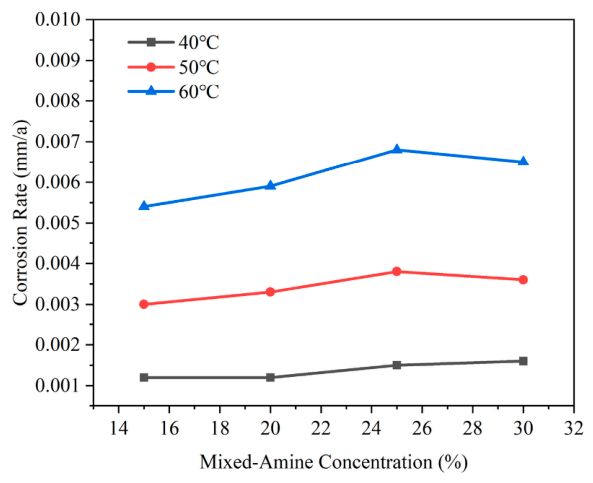
Under the conditions of 40–60 °C, 15–30 wt% amine concentration, and CO2 saturated load, the relationship between the corrosion rate of the test specimens and the temperature/amine concentration of the mixed amine solution is shown in Figure 1. SEM images of the test specimen surfaces are shown in Figure 2, Figure 3 and Figure 4.
After the immersion test, all coupon surfaces under different temperature and amine concentration conditions still maintained good metallic luster, with no obvious corrosion products, pitting pits, or surface discoloration observed. As shown in Figure 2, Figure 3 and Figure 4, the surface features of specimens tested at different temperatures were dominated by scratches resulting by mechanical polishing, and no micro-scale corrosion pits, cracks, or corrosion products were detected. The plotted corrosion rate curves indicate that the corrosion rate of 304 stainless steel increased monotonically with the rise in amine solution. At an amine concentration of 30 wt%, the measured corrosion rates at 40, 50, and 60 °C were 0.0016, 0.0036, and 0.0065 mm/a, respectively. Such extremely low corrosion magnitude accounts for the negligible variation in surface morphology, and no detectable corrosion products were attached to the specimen surfaces.

3.1.2. Electrochemical Testing Results

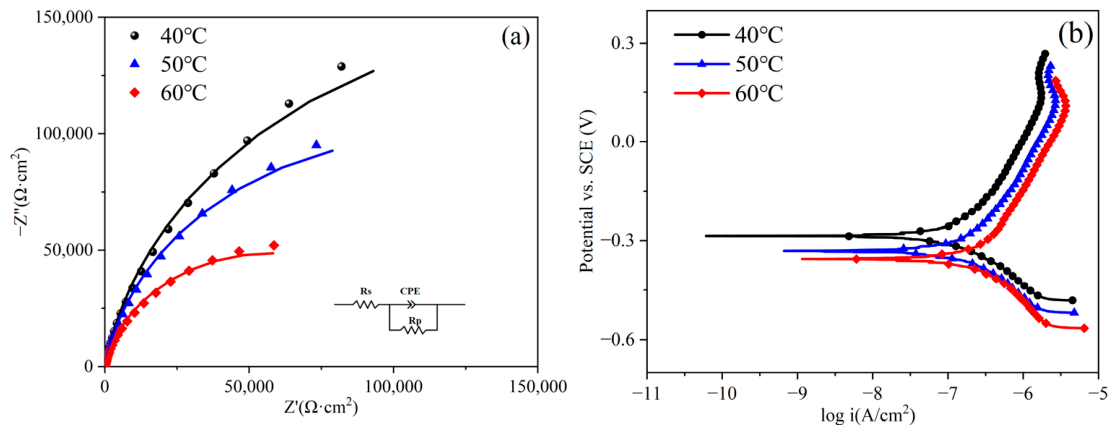
Figure 5 shows the electrochemical impedance spectra (EIS) and dynamic potential polarization curves of 304 stainless steel in a mixed amine solution with 30 wt% amine concentration under CO2 saturated load at test temperatures of 40, 50, and 60 °C, respectively. The corresponding fitted electrochemical parameters are presented in Table 2. In the mixed amine solutions at 40, 50, and 60 °C, the electrochemical impedance spectra of 304 stainless steel exhibited a compressed capacitive arc [14]. As the temperature increased, the radius of the capacitive arc gradually decreased, and the charge transfer resistance (Rp) gradually decreased, indicating that higher temperatures promoted the charge transfer process. Simultaneously, the magnitude of the constant-phase element (CPE, Y0) increased monotonically with temperature, while the CPE exponent (n) initially showed a slight increase and then a marked decrease. This trend suggests that higher temperature aggravated the defects and inhomogeneity of the passive film on 304 stainless steel, thereby exposing more underlying active metal sites and enhancing the overall corrosion susceptibility. Under these conditions, the polarization curves exhibit distinct passive region characteristics. With increasing temperature, the corrosion potential (E0) gradually shifts in the negative direction, and both the corrosion current density (I0) and the corrosion rate (v) gradually increased, indicating that higher temperatures promote corrosion. However, it should be noted that the Rp values remained on the order of 105 Ω·cm2 across all tested temperatures, which suggests that the system remained in a stable passivated state [15]. Therefore, although the temperature increase promoted corrosion, it did not cause the passivation film to destabilize and therefore did not result in significant corrosion.
It is noteworthy that under identical conditions, the corrosion rate obtained by the immersion coupon tests was higher than that derived from the electrochemical polarization curve. Under the same conditions of 60 °C, 30 wt% amine concentration, and CO2 saturated load, the corrosion rate measured by the immersion coupon test was approximately 0.0065 mm/a, while the corrosion rate obtained via the electrochemical polarization curve under the same condition was 0.0029 mm/a, showing a difference of about 2.3 times. This discrepancy originates from the inherent properties of the two testing methods: the immersion coupon method yields a long-term average corrosion rate over the entire immersion period, covering the full evolution process from the dissolution of the initial passive film to the gradual growth of the corrosion product layer, and can statistically count the total mass loss contributed by both uniform corrosion and localized pitting corrosion. In contrast, the electrochemical polarization test only captures the instantaneous interfacial charge transfer response within the time scale of several seconds to several minutes and cannot reflect the average corrosion contribution over the complete long-term immersion cycle. In this specific system, the passive film rapidly formed on the surface of 304 stainless steel will temporarily reduce the interfacial reaction activity during the short-term potentiodynamic scanning, leading to an underestimated corrosion current density; meanwhile, the pre-polishing and pre-activation operations on the specimen before the electrochemical test further widen the deviation from the result of the long-term immersion coupon test. This 2.3-fold difference falls within the normal discrepancy range of the two testing methods in amine-based CO2 corrosion systems, and the variation trend of corrosion rate with temperature obtained by both methods is completely consistent, which confirms that this absolute value deviation will not change the final conclusion.

3.2. Effect of Amine Concentration

3.2.1. Results of Immersion Testing

As shown in the SEM images of specimen surfaces after experiments in Figure 2, Figure 3 and Figure 4, the surfaces of specimens after exposure to different amine concentrations were primarily characterized by scratches caused by mechanical polishing, and no fine corrosion pits, cracks, or corrosion products were observed. As shown by the corrosion rate curves in Figure 1, as the amine concentration increased, the corrosion rate of the 304 stainless steel coupons fluctuated within a narrow range, showing a slight growth trend.

3.2.2. Results of Electrochemical Testing

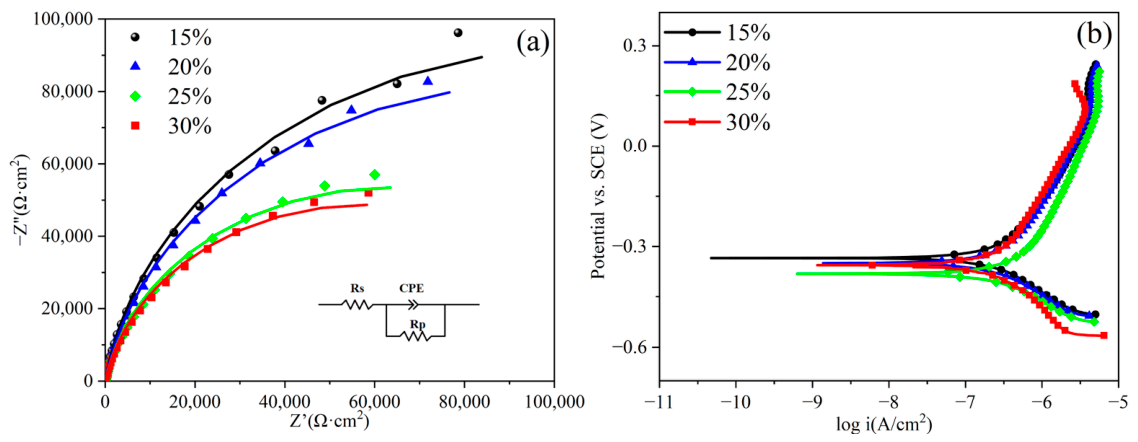
With the test temperature maintained at 60 °C and CO2 saturation load kept constant, the electrochemical impedance spectra and dynamic potential polarization curves of 304 stainless steel in mixed amine solutions under conditions where the amine concentration was varied to 15, 20, 25, and 30 wt% are shown in Figure 6. The fitted data are presented in Table 3. In mixed amine solutions with amine concentrations ranging from 15 wt% to 30 wt%, the electrochemical impedance spectra of 304 stainless steel exhibited a compressed capacitive arc. As the amine concentration increased, the radius of the capacitive arc gradually decreased, and the charge transfer resistance (Rp) gradually decreased, indicating that higher amine concentrations promoted the charge transfer process. As the amine concentration increased, the CPE-Y0 and CPE-n increased monotonically, indicating that higher amine concentrations aggravated the defects and inhomogeneity of the passive film on 304 stainless steel, exposing more underlying metal substrate and consequently increasing the overall corrosion susceptibility. Meanwhile, the polarization curves of 304 stainless steel under various amine concentration conditions all exhibited distinct passivation zone characteristics. With increasing amine concentration, the corrosion potential (E0) shifted negatively. Notably, both the corrosion current density (I0) and the corrosion rate (v) exhibited a trend of first increasing and then decreasing; both reached their maximum values at an amine concentration of 25 wt%. This indicates that at lower amine concentrations, corrosion of 304 stainless steel was promoted, but at excessively high amine concentrations, corrosion of 304 stainless steel actually began to decelerate. Since Rp remained on the order of 105 Ω·cm2, this indicates that the system remained in a stable passivated state. Although the increase in amine concentration promoted corrosion, it did not cause the passive film to destabilize and thus did not result in significant corrosion.
It is also worth noting that the test results at different amine concentrations show that the corrosion rate obtained by the immersion coupon method was also higher than that derived from the electrochemical polarization curve under the same conditions. The phenomenon and its underlying causes are consistent with those observed in the tests at different temperatures. Moreover, the variation trend of corrosion rate with amine concentration obtained by the two methods was completely identical, which confirms that this absolute deviation will not alter the final conclusion.

3.2.3. Results of Kinetic and Thermodynamic Parameters

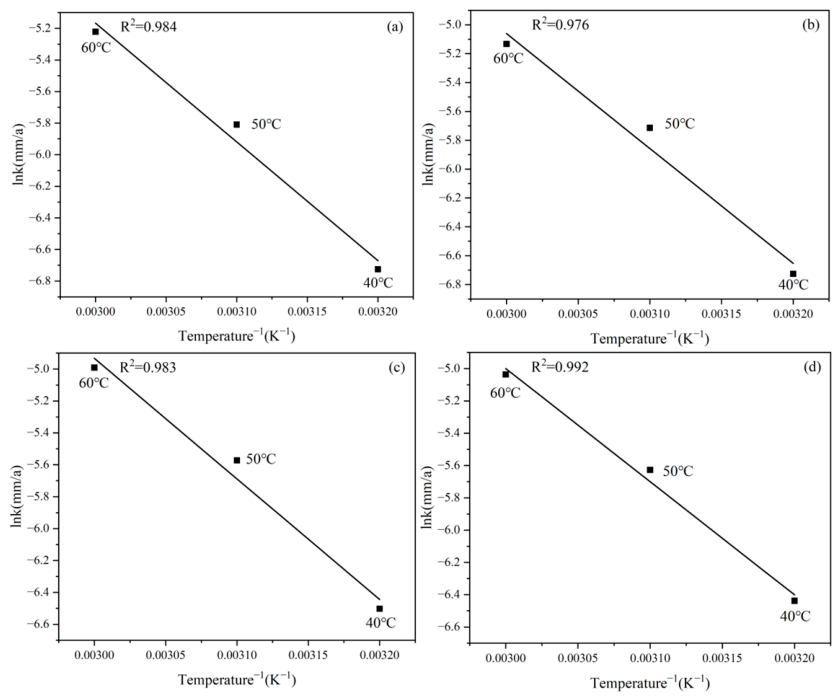
Based on the corrosion rates obtained from immersion tests under the conditions of 40–60 °C, 15–30 wt% amine concentrations, and saturated CO2 loading, the thermodynamic and kinetic parameters of the corrosion process were calculated using the Arrhenius equation and the Eyring transition state theory. The Arrhenius plots at different amine concentrations are shown in Figure 7.
As shown in Figure 7, a high correlation coefficient (R2 > 0.98) for the lnk versus 1/T plot indicates that the corrosion process well followed the Arrhenius law within the tested temperature range. It suggests that no obvious change in corrosion mechanism or rate-determining step occurred over the investigated temperatures, and the calculated apparent activation energy was statistically reliable. The calculated apparent activation energy (Ea) of this system at amine concentrations of 15, 20, 25, and 30 wt% was 65.36, 69.24, 65.68, and 60.87 kJ/mol, respectively, all falling within the typical value range of charge-transfer-controlled corrosion reactions. This result indicates that the corrosion rate was highly sensitive to temperature changes, and temperature elevation can significantly accelerate the interfacial electrochemical corrosion behavior. The average calculated activation enthalpy (ΔH) at amine concentrations of 15, 20, 25, and 30 wt% was 62.67, 66.55, 63.00, and 58.19 kJ/mol, respectively, all positive values, demonstrating that the formation of transition state complexes during corrosion was an endothermic process, and higher temperatures can provide sufficient energy to promote the corrosion reaction. In addition, the calculated activation entropy (ΔS) at amine concentrations of 15, 20, 25, and 30 wt% was −244.28, −231.74, −241.35, and −256.34 J/(mol·K), respectively, all negative values, which indicates that the structural order of the transition state species was higher than that of the initial reactants. This phenomenon mainly originates from the directional rearrangement and ordered arrangement of ions at the metal–solution interface during the formation of activated species. Therefore, the electrochemical test results, combined with the thermodynamic and kinetic parameters, collectively confirm that the corrosion process under the experimental conditions was mainly controlled by the interfacial electrochemical charge transfer reaction.

3.3. Effect of Chloride Ions

3.3.1. Results of Immersion Testing

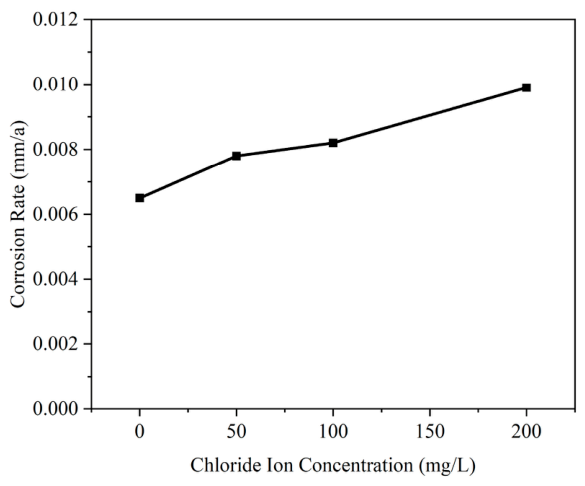
In the mixed amine solution at 60 °C with 30 wt% amine concentration and CO2 saturated load, sodium chloride was added to control the chloride ion concentration at 0, 50, 100, and 200 mg/L, respectively. Test specimens were immersed in the mixed amine solution for 72 h to investigate the effect of chloride ions on the corrosion behavior of 304 stainless steel. The corrosion rate curves obtained from the experiments are shown in Figure 8, and the surface morphologies of the test specimens are shown in Figure 9.
After immersion, the surface of the 304 stainless steel specimens showed no significant changes, maintaining a good metallic luster with no obvious corrosion product deposits or localized pitting. The results show that as the chloride ion concentration increased, the corrosion rate of 304 stainless steel gradually increased. The SEM images show that the surface of the specimens exhibited only polishing marks, with no obvious pitting or localized corrosion features discernible. This indicates that, in the mixed amine solution, chloride ions did increase the corrosion of 304 stainless steel, but the increase was very small, and the corrosion rate remained very low.

3.3.2. Results of Electrochemical Testing

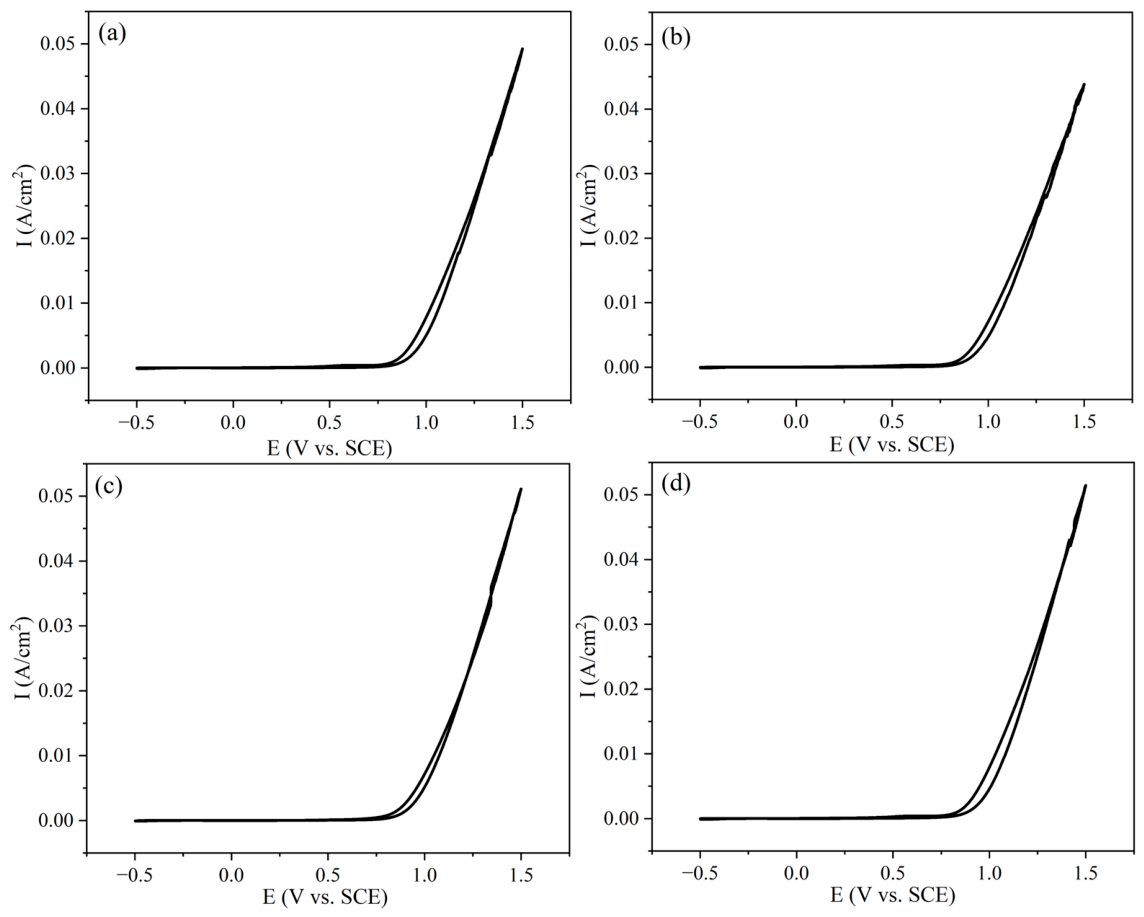
Chloride ions primarily cause pitting corrosion in stainless steel. To further investigate the pitting susceptibility of 304 stainless steel in chloride-containing mixed amine solutions, cyclic potentiodynamic polarization (CPP) tests were conducted. The CPP curves are shown in Figure 10. They reveal that the curves for 304 stainless steel are nearly identical across all chloride ion concentrations. In the range of −0.5 V to 0.8 V, the current density remained at a consistently low level with no significant changes; from 0.8 V to 1.5 V, the current density increased gradually as the potential rose. The reverse-scan curves essentially coincided with the forward-scan curves, and no obvious hysteresis loops were observed, indicating that the passivation film on the 304 stainless steel remained intact. These results show that when the chloride ion concentration in the mixed amine solution is below 200 mg/L, the passive film on the surface of 304 stainless steel possessed good self-healing capability and showed extremely low susceptibility to pitting corrosion.

3.4. Results of Long-Term Corrosion Testing

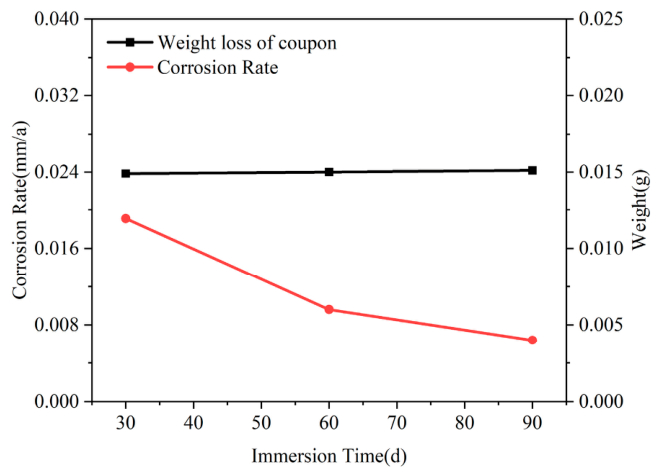
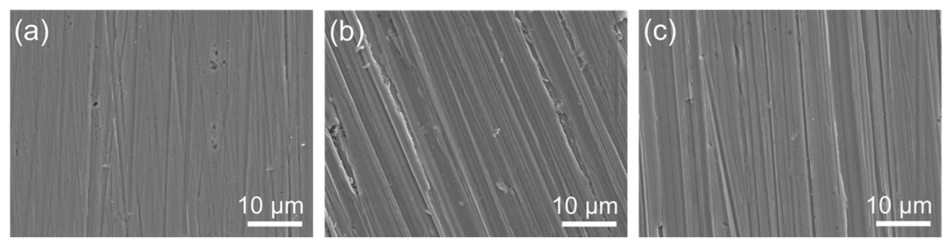
To investigate the corrosion behavior of 304 stainless steel under long-term service conditions, long-term immersion coupon tests were conducted in mixed amine solutions at 60 °C, with a mixed amine concentration of 30 wt%, a CO2 saturated load, and a chloride ion concentration of 20 mg/L. A magnetic stirrer was used to agitate the mixed amine solution at a speed of 100 r/min to simulate the flow conditions of the absorption solution. The weight loss and corrosion rates of the test specimens after 30, 60, and 90 days of immersion are shown in Figure 11, the corresponding surface morphologies in Figure 12, and the EDS results in Table 4.
After prolonged exposure to a mixed amine solution, the surface of the 304 stainless steel coupons retained its bright metallic luster, with no visible corrosion products or localized corrosion pits. SEM observations confirmed only residual polishing marks on the specimen surfaces, with no detectable pitting or localized attack. As evidenced by the EDS characterization results (Table 4), the coupon surfaces were dominated by Fe, O, and C, with trace amounts of Cr and Ni detected. This observation confirms that a relatively thin FeCO3 passive film had formed on the surface of 304 stainless steel. Although the corrosion rate decreased with immersion time, dropping from 0.0191 mm/a to 0.0064 mm/a, the total weight loss of the test specimens after 30, 60, and 90 days of immersion was 0.0149, 0.0150, and 0.0151 g, respectively, indicating that corrosion of 304 stainless steel in the mixed amine solution predominantly occurred in the initial immersion stage. During this initial phase, the original passive film on the metal surface dissolved and reorganized upon contact with the amine solution; as the immersion time increased, a new passive film of FeCO3 gradually formed, which suppresses further diffusion of corrosive species toward the steel matrix and significantly retards subsequent corrosion [16]. In the mixed amine solution, 304 stainless steel exhibited good self-passivation capability under long-term service conditions.

4. Conclusions

In a mixed amine solution under CO2 saturated load, within the temperature range of 40–60 °C, the increase in temperature promoted the charge transfer process, thereby accelerating the corrosion of 304 stainless steel. Within the amine concentration range of 15–30 wt%, the increase in amine concentration similarly promoted the charge transfer process, thereby accelerating the corrosion of 304 stainless steel; however, the corrosion rate first increased and then decreased, reaching its maximum at an amine concentration of 25 wt%. Within the chloride ion concentration range of 0–200 mg/L, the corrosion rate of 304 stainless steel increased with rising chloride ion concentration, while the susceptibility to pitting corrosion remained very weak. The results of Ea, ΔH, ΔS, and other parameters demonstrated that the corrosion process under the experimental conditions was mainly controlled by the interfacial electrochemical charge transfer reaction.
When 304 stainless steel was immersed in the mixed amine solution for 72 h, the corrosion rates were very low under different temperatures, amine concentrations, and chloride ion concentrations. No obvious corrosion products adhered to the test specimen surfaces, and no visible pitting was observed. This is attributed to the fact that the surface of 304 stainless steel remained in a stable passive state throughout the immersion. Although increases in temperature, amine concentration, and chloride ion concentration promoted corrosion, they did not cause the passive film to destabilize; the specimens retained an intact film, thus preventing significant corrosion degradation.
When 304 stainless steel coupons were immersed in the mixed amine solution at 60 °C, with a 30 wt% mixed amine concentration, a CO2 saturated load, and agitated flow conditions for 30, 60, and 90 days, the corrosion rate exhibited a decreasing trend with increasing immersion time. However, the total weight loss of the test specimens was essentially the same under different immersion times. This indicates that in this mixed amine solution, corrosion of 304 stainless steel predominantly takes place in the initial immersion stage, where the original passive film on its surface dissolves and reorganizes, and a newly passive film effectively inhibits further corrosion. In other words, 304 stainless steel exhibits good self-passivating capability under long-term service conditions.

Author Contributions

Conceptualization, S.L., Q.N. and Y.Z.; methodology, Y.L. and Y.Z.; software, H.C., Q.N. and J.L.; validation, P.Z., L.W. and H.C.; formal analysis, S.L.; investigation, S.L., H.C. and Q.N.; resources, Y.L. and Y.Z.; data curation, S.L., H.C. and Q.N.; writing—original draft preparation, Q.N.; writing—review and editing, Y.Z. and H.C.; visualization, H.C. and Q.N.; supervision, Y.Z., L.W. and P.Z.; project administration, L.W.; funding acquisition, Y.L. and Y.Z. All authors have read and agreed to the published version of the manuscript.

Funding

This research was funded by the Guoneng Jinjie Energy Co., Ltd., grant number GJNY-23-13.

Data Availability Statement

The original contributions presented in this study are included in the article. Further inquiries can be directed to the corresponding author.

Conflicts of Interest

Author Shuifei Li, Pengfei Zhu, Yongping Liu, Lang Wang and Jun Li were employed by the company Guoneng Jinjie Energy Co., Ltd. The remaining authors declare that the research was conducted in the absence of any commercial or financial relationships that could be construed as potential conflicts of interest. The authors declare that this study received funding from the Guoneng Jinjie Energy Co., Ltd. The funder was not involved in the study design, collection, analysis, interpretation of data, the writing of this article or the decision to submit it for publication.

References

  1. Rochelle, G.T. Amine scrubbing for CO2 capture. Science 2009, 325, 1652–1654. [Google Scholar] [CrossRef] [Scilit] [PubMed]
  2. Wang, M.; Lawal, A.; Stephenson, P.; Sidders, J.; Ramshaw, C. Post-combustion CO2 capture with chemical absorption: A state-of-the-art review. Chem. Eng. Res. Des. 2011, 89, 1609–1624. [Google Scholar] [CrossRef] [Scilit]
  3. Stergioudi, F.; Baxevani, A.; Florou, C.; Michailidis, N.; Nessi, E.; Papadopoulos, A.I.; Seferlis, P. Corrosion behavior of stainless steels in CO2 absorption process using aqueous solution of monoethanolamine (MEA). Corros. Mater. Degrad. 2022, 3, 422–438. [Google Scholar] [CrossRef] [Scilit]
  4. Wang, Y.W. Stability Research of Organic Amine Absorbents for CO2 Capture: Synergistic Degradtion-Corrosion Inhibition and Electrodialysis Reclaiming. Ph.D. Thesis, Zhejiang University, Hangzhou, China, 2025. [Google Scholar] [CrossRef]
  5. Zhao, F.; Cui, C.X.; Dong, S.L.; Xu, X.Y.; Liu, H.L. An overview on the corrosion mechanisms and inhibition techniques for amine-based post-combustion carbon capture process. Sep. Purif. Technol. 2023, 304, 122091. [Google Scholar] [CrossRef] [Scilit]
  6. Gunasekaran, P.; Veawab, A.; Adisorn, A. Corrosivity of amine-based absorbents for CO2 capture. Energy Procedia 2017, 114, 2047–2054. [Google Scholar] [CrossRef] [Scilit]
  7. Kittel, J.; Gonzalez, S. Corrosion in CO2 post-combustion capture with alkanolamines—A review. Oil Gas Sci. Technol. 2013, 69, 915–929. [Google Scholar] [CrossRef] [Scilit]
  8. Gouedard, C.; Picq, D.; Launay, F.; Carrette, P.-L. Amine degradation in CO2 capture. I. A review. Int. J. Greenh. Gas Control 2012, 10, 244–270. [Google Scholar] [CrossRef] [Scilit]
  9. Fan, X.H.; Wang, Y.Q.; Li, X.Y.; Tang, D.Z.; Fang, K.; Sun, C.; Sun, J.P. Corrosion behavior of 304L stainless steel in amine CO2 capture system. Pet. New Energy 2025, 37, 39–46. [Google Scholar] [CrossRef]
  10. Tian, F.Y.; Yin, Q.L.; Zhu, J.; Chen, L. On corrosion resistance of 304L stainless steel in heat exchanger with lean amine solution. Petrochem. Equip. Technol. 2024, 45, 32–35+40+5–6. [Google Scholar] [CrossRef]
  11. Hu, Z.P.; Ren, H.B.; Chen, H.; Zhou, T.S.; Yan, L.; He, X.L.; Liu, H.B.; Cao, S.A.; Zeng, Y.B. Study on corrosion characteristics of Q235B carbon steel in mixed amine absorbents. Processes 2026, 14, 1626. [Google Scholar] [CrossRef] [Scilit]
  12. ISO 8407:2021(E); Corrosion of Metals and Alloys—Removal of Corrosion Products from Corrosion Test Specimens. International Organization for Standardization: Geneva, Switzerland, 2021.
  13. GB/T 18175-2014; Determination of Corrosion Inhibition Performance of Water Treatment Agents-Rotation Specimen Method. Standards Press of China: Beijing, China, 2014.
  14. Sun, Y.; Remias, J.E.; Neathery, J.K.; Liu, K. Electrochemical study of corrosion behaviour of carbon steel A106 and stainless steel 304 in aqueous monoethanolamine. Corros. Eng. Sci. Technol. 2011, 46, 724–731. [Google Scholar] [CrossRef] [Scilit]
  15. Ma, I.A.W.; Ammar, S.; Kumar, S.S.A.; Ramesh, K.; Ramesh, S. A concise review on corrosion inhibitors: Types, mechanisms and electrochemical evaluation studies. J. Coat. Technol. Res. 2022, 19, 241–268. [Google Scholar] [CrossRef] [Scilit]
  16. Fischer, K.B.; Daga, A.; Hatchell, D.; Rochelle, G.T. MEA and piperazine corrosion of carbon steel and stainless steel. Energy Procedia 2017, 114, 1751–1764. [Google Scholar] [CrossRef] [Scilit]
Figure 1. The corrosion rate of 304 stainless steel coupons at different temperatures and amine concentrations.
Processes 14 02841 g001
Figure 2. SEM images of the 304 stainless steel coupons at different amine concentrations at 40 °C: (a) 15 wt%, (b) 20 wt%, (c) 25 wt%, (d) 30 wt%.
Processes 14 02841 g002
Figure 3. SEM images of the 304 stainless steel coupons at different amine concentrations at 50 °C: (a) 15 wt%, (b) 20 wt%, (c) 25 wt%, (d) 30 wt%.
Processes 14 02841 g003
Figure 4. SEM images of the 304 stainless steel coupons at different amine concentrations at 60 °C: (a) 15 wt%, (b) 20 wt%, (c) 25 wt%, (d) 30 wt%.
Processes 14 02841 g004
Figure 5. The EIS spectra and polarization curves of 304 stainless steel at different temperatures: (a) EIS spectra and (b) polarization curves.
Processes 14 02841 g005
Figure 6. The EIS spectra and polarization curves of 304 stainless steel at different amine concentrations: (a) EIS spectra and (b) polarization curves.
Processes 14 02841 g006
Figure 7. Arrhenius plots (lnk vs. 1/T) at different amine concentrations: (a) 15 wt%, (b) 20 wt%, (c) 25 wt%, (d) 30 wt%.
Processes 14 02841 g007
Figure 8. Corrosion rate curve of 304 stainless steel at different chloride ion concentrations in mixed amine solution.
Processes 14 02841 g008
Figure 9. SEM images of 304 stainless steel at different chloride ion concentrations in mixed amine solution: (a) 0 mg/L, (b) 50 mg/L, (c) 100 mg/L, (d) 200 mg/L.
Processes 14 02841 g009
Figure 10. The CPP curves of 304 stainless steel at different chloride ion concentrations in mixed amine solution: (a) 0 mg/L, (b) 50 mg/L, (c) 100 mg/L, (d) 200 mg/L.
Processes 14 02841 g010
Figure 11. The weight loss and corrosion rates of the test specimens after 30, 60, and 90 days of immersion.
Processes 14 02841 g011
Figure 12. SEM images of the test specimens after 30, 60, and 90 days of immersion: (a) 30 days, (b) 60 days, (c) 90 days.
Processes 14 02841 g012
Table 1. CO2 saturation load values corresponding to amine solutions with different amine concentrations.
Amine Concentration (wt%)15202530
CO2 saturation load (L/L, volume of CO2 gas/volume of amine solution)28404858
molar loading ratio (mol CO2/mol amine)0.700.750.720.73
pH8.328.258.358.44
Table 2. The electrochemical fitting data of 304 stainless steel at different temperatures.
T
(°C)
Rs
(Ω·cm2)
Rp
(Ω·cm2)
Y0
−1·sn·cm−2)
nba
(mV)
bc
(mV)
I0
(μA/cm2)
E0
(V)
V
(mm/a)
406.633.37 × 1056.30 × 10−50.9023267.8154.20.12−0.290.0009
506.132.29 × 1057.71 × 10−50.9035386.8200.50.23−0.330.0017
607.191.16 × 1051.01 × 10−40.8897468.6222.80.39−0.350.0029
Remark: I0 was obtained by the Tafel extrapolation method.
Table 3. The electrochemical fitting data of 304 stainless steel at different amine concentrations.
C
(wt%)
Rs
(Ω·cm2)
Rp
(Ω·cm2)
Y0−1·sn·cm−2)nba
(mV)
bc
(mV)
I0
(μA/cm2)
E0
(V)
V
(mm/a)
156.482.11 × 1057.48 × 10−50.9115401.1202.00.40−0.330.0030
207.051.92 × 1057.93 × 10−50.8987488.6216.20.48−0.350.0036
257.591.27 × 1059.27 × 10−50.8913576.1246.10.73−0.380.0054
307.191.16 × 1051.01 × 10−40.8897468.6222.80.39−0.350.0029
Remark: I0 was obtained by the Tafel extrapolation method.
Table 4. EDS results of the specimens immersed for 30, 60, and 90 days.
Element30-Day Immersion60-Day Immersion90-Day Immersion
wt.%at.%wt.%at.%wt.%at.%
C3.8310.217.2216.358.4118.72
O13.7632.6425.2444.1839.0357.45
Fe73.4251.3756.5032.8144.8719.26
Cr5.474.126.814.624.733.14
Ni3.521.664.232.042.961.43
Total100100100100100100
Disclaimer/Publisher’s Note: The statements, opinions and data contained in all publications are solely those of the individual author(s) and contributor(s) and not of MDPI and/or the editor(s). MDPI and/or the editor(s) disclaim responsibility for any injury to people or property resulting from any ideas, methods, instructions or products referred to in the content.