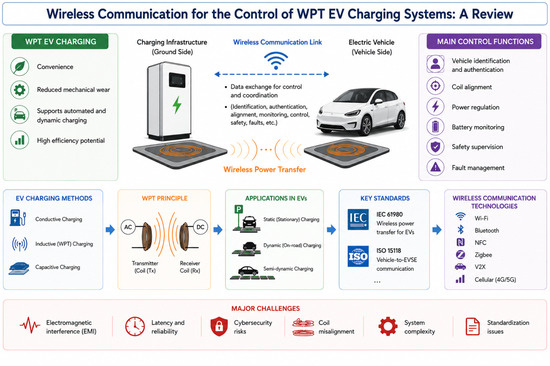
1. Introduction
The rapid growth of electric vehicles (EVs) has increased the need for charging infrastructure that is efficient, safe, easy to use, and compatible with future smart transportation systems. Traditional conductive charging is still the most used solution because it is well-established and efficient. However, it still presents several limitations, including manual cable handling, connector wear, exposure to environmental conditions, accessibility constraints, and limited suitability for fully automated charging scenarios [
1]. These limitations have sparked increased interest in wireless power transfer (WPT) as a charging technology option for electric mobility applications.
Wireless power transfer allows electrical energy to be transferred from a charging unit on the ground to a receiver on the vehicle without needing physical contact. In electric vehicle (EV) applications, this method usually relies on magnetic coupling between a transmitting coil on the ground and a receiving coil under the vehicle. This setup can support both stationary charging, where the vehicle is parked while charging, and dynamic charging, where the vehicle receives energy while moving. By removing plug-in connectors, wireless power transfer can make charging easier for users, reduce wear and tear on mechanical parts, improve safety in tough conditions, and provide automated charging for self-driving cars, public transport systems, and smart mobility infrastructures [
2,
3,
4].
However, WPT-based EV charging systems also face some technical issues. The efficiency and stability of power transfer rely on how well the coils align, variations in the air gap, the compensation design, converter setup, operating frequency, electromagnetic compatibility, and thermal behavior. To keep the system safe, the hardware must monitor voltage, current, and battery temperature every second. It also has to check the area for stray objects or living things that could disrupt power transfer. Relying only on advanced power electronics and coil design is not enough. These systems also need dependable sensors, quick communication links, and fast control logic to work properly [
5].
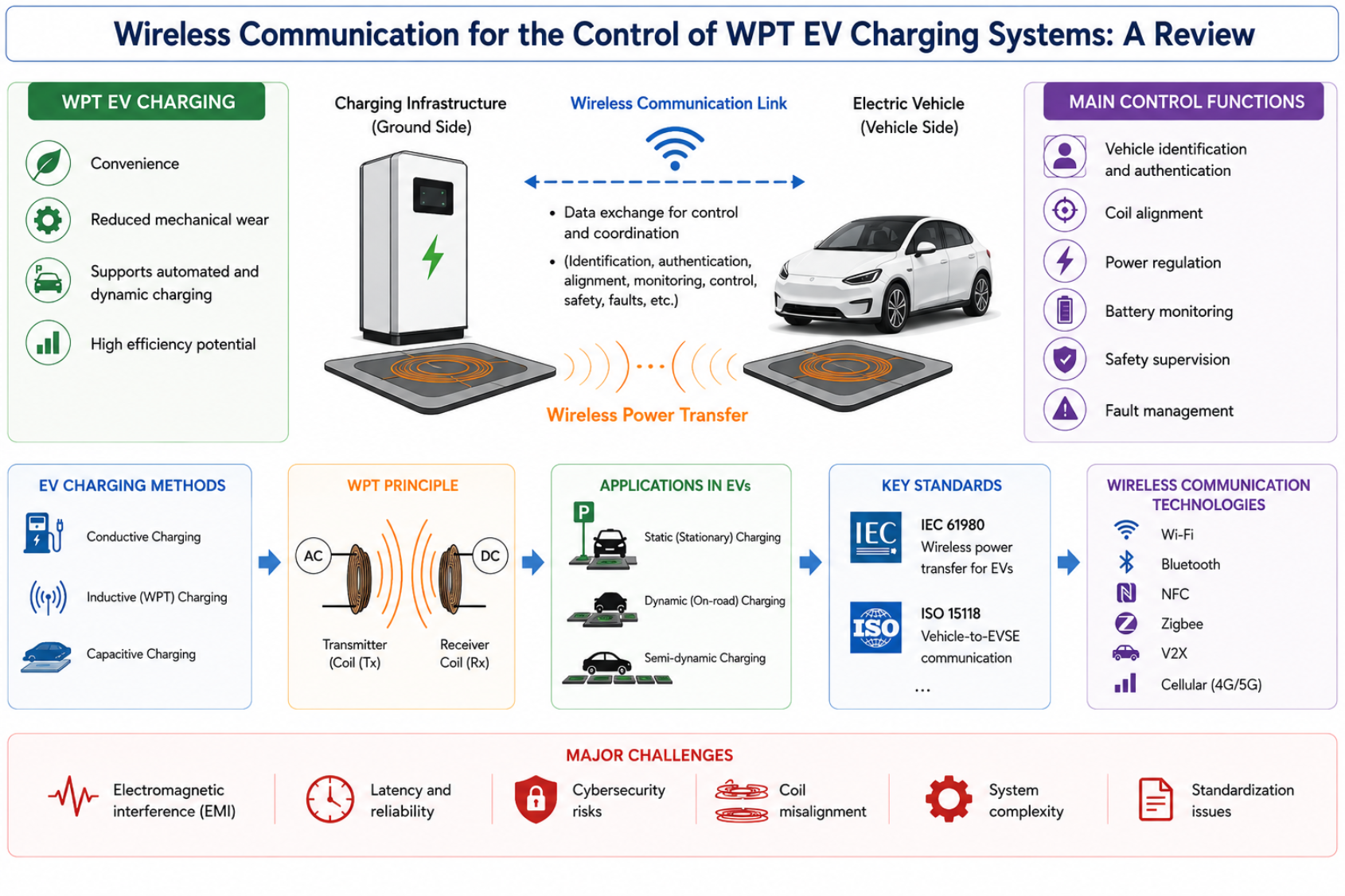
Wireless communication is a fundamental component of WPT EV chargers because, unlike conductive charging systems, there is no physical communication path through a charging cable. The vehicle-side and infrastructure-side subsystems must exchange information through a wireless link to initialize the charging session, identify the vehicle, authenticate the user, verify compatibility, support coil alignment, regulate transferred power, monitor the battery state, detect faults, and coordinate safe shutdown procedures. As a result, wireless connectivity should not be regarded as a secondary data exchange layer, but rather as an essential element of the charger control architecture [
5].
From a control perspective, a WPT EV charger can be considered a cyber–physical energy system in which electromagnetic energy transfer, power electronics, embedded sensors, wireless communication, and control algorithms interact in real time. The communication link allows feedback to flow between the vehicle and the charger. This lets the system adjust the transferred power based on operating conditions like the state of charge, requested power, coupling coefficient, misalignment, temperature, and safety needs. As a result, communication latency, reliability, synchronization, packet loss, cybersecurity, and interoperability directly influence the performance, efficiency, and safety of the charging process [
6,
7].
Several wireless communication technologies have been investigated for EV charging and wireless power transfer (WPT) applications. These include Wi-Fi, Bluetooth, near-field communication (NFC), Zigbee, cellular networks, and vehicle-to-everything (V2X) communication. Each technology has its own advantages and limitations regarding range, data rate, latency, energy use, reliability, cost, and suitability for real-time control.
Short-range technologies may be suitable for identification and pairing, while higher-performance communication systems are required for smart charging, dynamic WPT, backend supervision, and grid-interactive operation.
Standardization also plays a central role in the development of interoperable and safe WPT EV charging systems. Standards such as SAE J2954 [
8], IEC 61980 [
6], and ISO 15118 [
7] provide important frameworks for wireless power transfer, communication, alignment, safety, electromagnetic compatibility, and vehicle–infrastructure coordination. ISO 15118 is highly relevant because it defines the communication interface between the electric vehicle and the electric vehicle supply equipment, supporting charging session management, authentication, Plug & Charge, smart charging, and bidirectional power transfer functions. When combined with WPT-specific standards, ISO 15118 contributes to secure and interoperable control of wireless EV charging systems [
6,
7,
8].
Although several recent reviews published between 2023 and 2025 have discussed WPT technologies for EVs, most of them focus mainly on coil structures, compensation networks, converter topologies, efficiency improvement, standards, or dynamic charging concepts. Comparatively fewer studies analyze wireless communication as an integral part of the control system. In particular, the relationship between wireless communication technologies, closed-loop power control, authentication, coil alignment, fault handling, cybersecurity, and dynamic WPT coordination remains fragmented in the literature.
Therefore, another review is needed to synthesize WPT EV charging from a communication–control perspective rather than only from a power-transfer perspective. The main gap addressed by this review is the lack of a structured analysis showing how wireless communication supports the control architecture of WPT EV chargers and how different communication technologies meet the requirements of specific control functions.
The unique contribution of this review is to link wireless communication technologies, WPT control requirements, standards, cybersecurity mechanisms, dynamic WPT coordination, and future research challenges within a unified framework. Compared with recent surveys, this review focuses specifically on how wireless communication supports vehicle identification, authentication, coil alignment, closed-loop power regulation, safety supervision, fault management, and safe shutdown in WPT-based EV charging systems.
The remainder of this paper is organized as follows.
Section 2 presents the review methodology.
Section 3 introduces EV charging methods.
Section 4 discusses WPT architecture and power conversion stages.
Section 5 presents standards, connectivity, and wireless communication technologies.
Section 6 analyzes wireless connectivity for control and coordination of WPT EV chargers.
Section 7 discusses challenges, mitigation strategies, and future research directions. Finally,
Section 8 concludes the paper.
2. Review Methodology
To improve the transparency and reproducibility of this review, a structured literature selection process was followed. The literature search was conducted using major scientific databases, including Scopus, Web of Science, IEEE Xplore, ScienceDirect, SpringerLink, MDPI, and Google Scholar. The search focused on publications related to wireless power transfer for electric vehicles, wireless communication technologies, control architectures, dynamic wireless charging, cybersecurity, interoperability, and standardization.
The main search terms included: “wireless power transfer electric vehicles”, “WPT EV charging”, “wireless communication WPT control”, “dynamic wireless power transfer”, “EV wireless charging control”, “ISO 15118 wireless charging”, “SAE J2954”, “IEC 61980”, “V2X communication EV charging”, and “cybersecurity EV charging”. The search covered studies published between 2015 and 2026, with particular attention given to recent works published between 2023 and 2026.
The inclusion criteria were studies focused on WPT systems for EV charging, wireless communication for EV charging control, static or dynamic WPT, EV–EVSE communication standards, cybersecurity, interoperability, and control-oriented WPT architectures. The exclusion criteria were duplicated publications, studies unrelated to EV charging, papers focused only on generic wireless communication without connection to WPT control, and publications without sufficient technical relevance to the scope of this review.
The selected studies were classified into five main categories: WPT architectures, communication technologies, control functions, standards and interoperability, and challenges with mitigation strategies. This classification was used to synthesize the literature and identify the main research gaps addressed in this review.
3. Electric Vehicles and Charging Methods
3.1. Electric Vehicles
Electric vehicles are often seen as a good way to lower greenhouse gas emissions and energy use in the transport sector. They are different from regular vehicles that use internal combustion engines, as electric vehicles use power from motors driven by energy stored in batteries. The progress of battery technology, power electronics, charging systems and energy management systems is important to the development of electric vehicles.
Electric vehicles can be classified into several types based on their powertrain structure and energy source. They include battery electric vehicles, plug-in hybrid electric vehicles, hybrid electric vehicles and fuel cell electric vehicles. Battery electric vehicles and plug-in hybrid electric vehicles are the types that are most dependent on charging infrastructure as they require outside electricity to refill their batteries [
9].
3.1.1. Battery Electric Vehicles
Battery electric vehicles (BEVs) are powered entirely by one or more electric motors supplied by a rechargeable battery pack. They produce no tailpipe emissions when being driven and do not utilize an internal combustion engine. BEVs need to be charged from external conductive or wireless charging systems. Their performance is heavily reliant on battery capacity, charging power, and, more importantly, energy efficiency, as well as the existence of charging infrastructure.
3.1.2. Plug-In Hybrid Electric Vehicles
Plug-in hybrid electric vehicles combine an electric motor, a rechargeable battery, and an internal combustion engine. They can run in electric mode for short distances and switch to the combustion engine when the battery runs out or when more power is needed. PHEVs can be charged from the electrical grid, which means they work with both standard plug-in charging and wireless charging options.
3.1.3. Hybrid Electric Vehicles
Hybrid electric vehicles use both an internal combustion engine and an electric motor. Their battery typically charges through regenerative braking and engine operation instead of external charging. Because of this, HEVs rely less on charging infrastructure than BEVs and PHEVs.
3.1.4. Fuel Cell Electric Vehicles
Fuel cell electric vehicles use hydrogen fuel cells to generate electricity for the electric motor. Although they are electrically driven, their refueling process is based on hydrogen rather than electrical charging. For this reason, FCEVs are generally considered separately from battery charging technologies.
3.2. EV Charging Methods
The development of EVs requires reliable and efficient charging methods. EV charging technologies can be broadly classified into conductive charging and wireless charging. Conductive charging uses a physical cable and connector to transfer electrical energy, while wireless charging transfers power without direct electrical contact. Charging methods may also be classified according to charging power, current type, and operating mode.
3.3. Conductive Charging
Increasing battery capacity can extend the driving range of an EV, but it also increases vehicle mass, cost, charging time, and resource requirements. Therefore, WPT, especially dynamic WPT, can be considered as a complementary solution to reduce range anxiety without relying only on larger battery packs. Another way to improve EV usability is to increase charging speed, which is directly related to charging power. This is particularly important when long charging times become a limitation for users. This has allowed the rise of so-called fast-charging stations with a high-power rating.
EV battery chargers can be on board the vehicle or the charging station itself. For charging stations‚ space and weight are not an issue. However‚ this leads to a high infrastructure cost by deploying many existing charging stations to ensure that EV users have the possibility to access an available charge. Another solution is to embed the charging device in the vehicle‚ for example‚ in case fast charging infrastructure has not yet been installed at sufficient locations to make this charging method convenient for users. This solution would increase the availability of charging for users.
In this context, conductive charging standards have been developed to ensure interoperability, safety, and compatibility between EVs and charging infrastructures. These standards vary by region. In North America, SAE J1772 [
10] is widely used, while China mainly adopts GB/T 20234, and Europe relies on IEC 62196. SAE J1772 defines AC charging levels, typically including 120 V and 240 V operation, with power levels reaching approximately 17 kW. In contrast, IEC 62196, derived from IEC 61851 [
11], classifies charging modes according to the charging configuration, power level, and communication requirements between the EV and the charging infrastructure [
10,
12].
The IEC 62196 [
13]/IEC 61851 standards define four EV charging modes. In mode 1‚ slow charging occurs from a standard domestic socket at a maximum of 16 A. In mode 2‚ semi-fast charging occurs from a standard domestic socket up to 32 A using an in-cable protection and control device. Mode 3 is defined for AC charging using dedicated EV Supply Equipment (EVSE) that can provide higher currents and communicate between the vehicle and charger‚ and Mode 4 is DC fast or ultra-fast charging, where an external charger supplies DC power directly to the battery and provides communication, protection, and control functions [
10,
11].
Overall, the development of high-power charging and standardized charging interfaces has improved EV usability and charging accessibility. However, conductive charging still depends on physical connectors, manual handling, and extensive charging infrastructure deployment. These limitations have motivated the exploration of wireless power transfer (WPT) as a complementary charging solution capable of improving user convenience, reducing connector wear, and supporting automated charging scenarios.
3.4. Wireless Charging
Conductive charging transfers electrical energy through a physical cable and connector, whereas inductive wireless charging transfers energy without direct electrical contact. In inductive WPT, power is transferred through magnetic coupling between a ground-side transmitter coil and a vehicle-side receiver coil. WPT can also improve connector longevity, reduce equipment replacement and decrease maintenance requirements. As a result of these advantages, WPT has received increasing attention as a convenient and safe solution for supplying power to electric vehicles and other electrical systems. For EV battery charging, capacitive power transfer (CPT) and inductively coupled power transfer (ICPT) are among the most relevant non-radiative WPT methods. Among them, ICPT is the most widely investigated technology for EV applications because it relies on magnetic coupling between a ground-side transmitter coil and a vehicle-side receiver coil. In this system, a high-frequency alternating current flows through the transmitter coil and generates a time-varying magnetic field. When the receiver coil is placed within this magnetic field, a voltage is induced on the vehicle side, then rectified and regulated to charge the battery. Compared with conductive charging, ICPT eliminates the need for physical electrical contact, which improves user convenience, reduces connector wear, and supports automated charging scenarios. However, its performance depends strongly on coil alignment, air-gap distance, compensation topology, and control strategy [
14].
ICPT can be applied in two main configurations: static wireless charging and dynamic wireless charging.
- •
Static charging:
In static charging, the vehicle is parked above a ground charging pad, and energy is transferred while the vehicle remains stationary. This solution can be installed in parking spaces, residential garages, taxi stations, bus stops, and fleet depots. Several industrial and research projects have demonstrated static inductive charging systems for passenger cars and electric buses, with power levels ranging from a few kilowatts to more than 100 kW depending on the application.
- •
Dynamic charging:
Dynamic wireless power transfer (DWPT) allows EVs to be charged while moving. In this configuration, transmitter coils are embedded along selected road sections and activated only when a vehicle passes over them. This concept, often referred to as an electric road, can reduce range anxiety, limit vehicle downtime, and potentially decrease the required onboard battery capacity, thereby reducing vehicle weight and cost [
3,
4].
In DWPT, the coupling condition changes continuously because the vehicle moves over successive transmitter segments. Unlike static charging, where the transmitter and receiver coils remain fixed relative to each other, dynamic charging involves continuous variations in coil alignment, air-gap distance, and coupling coefficient. These variations can reduce power transfer efficiency and create power fluctuations if they are not properly controlled. Therefore, DWPT systems require accurate vehicle detection, transmitter segment activation, fast communication, and robust control strategies to maintain efficient and safe power transfer. More generally, both static and dynamic ICPT-based EV charging systems require efficient coil design, alignment tolerance, reliable communication, safety monitoring, and cost-effective infrastructure.
Recent work on dynamic wireless charging has also investigated charging control strategies for multiple EVs using short-segment transmitter coils, highlighting the importance of transmitter segment activation, power regulation, and efficiency optimization in moving charging scenarios [
15].
The charging technologies discussed in this chapter are summarized in
Table 1 according to their operating principles, advantages and limitations. Conductive charging technology includes both AC and DC charging techniques. While AC charging technology is applicable to low-power applications, DC charging is employed for higher power needs. Wireless charging technology, on the other hand, eliminates cable handling and facilitates automation. Limitations in wireless technology include alignment, air gaps and high infrastructure cost and complexity control.
4. Wireless Power Transfer for Electric Vehicles
Wireless Power Transfer (WPT) for electric vehicles refers to the contactless transmission of electrical energy from a charging station to the vehicle battery. Unlike conductive charging, which needs a physical cable and connector, WPT uses electromagnetic coupling between a ground-side transmitting pad and a vehicle-side receiving pad. This technology is appealing for EV applications because it improves user convenience, reduces wear on connectors, increases safety in tough environments, and allows for automatic charging.
In EV applications, WPT is mainly implemented using magnetic-field-based inductive power transfer. The basic principle is like a loosely coupled transformer. A high-frequency alternating current flows through the transmitting coil, producing a time-varying magnetic field. When the receiving coil mounted underneath the vehicle is placed within this magnetic field, an induced voltage appears across the receiver terminals. This voltage is then rectified, regulated, and supplied to the battery pack.
4.1. General Architecture of WPT EV Charging Systems
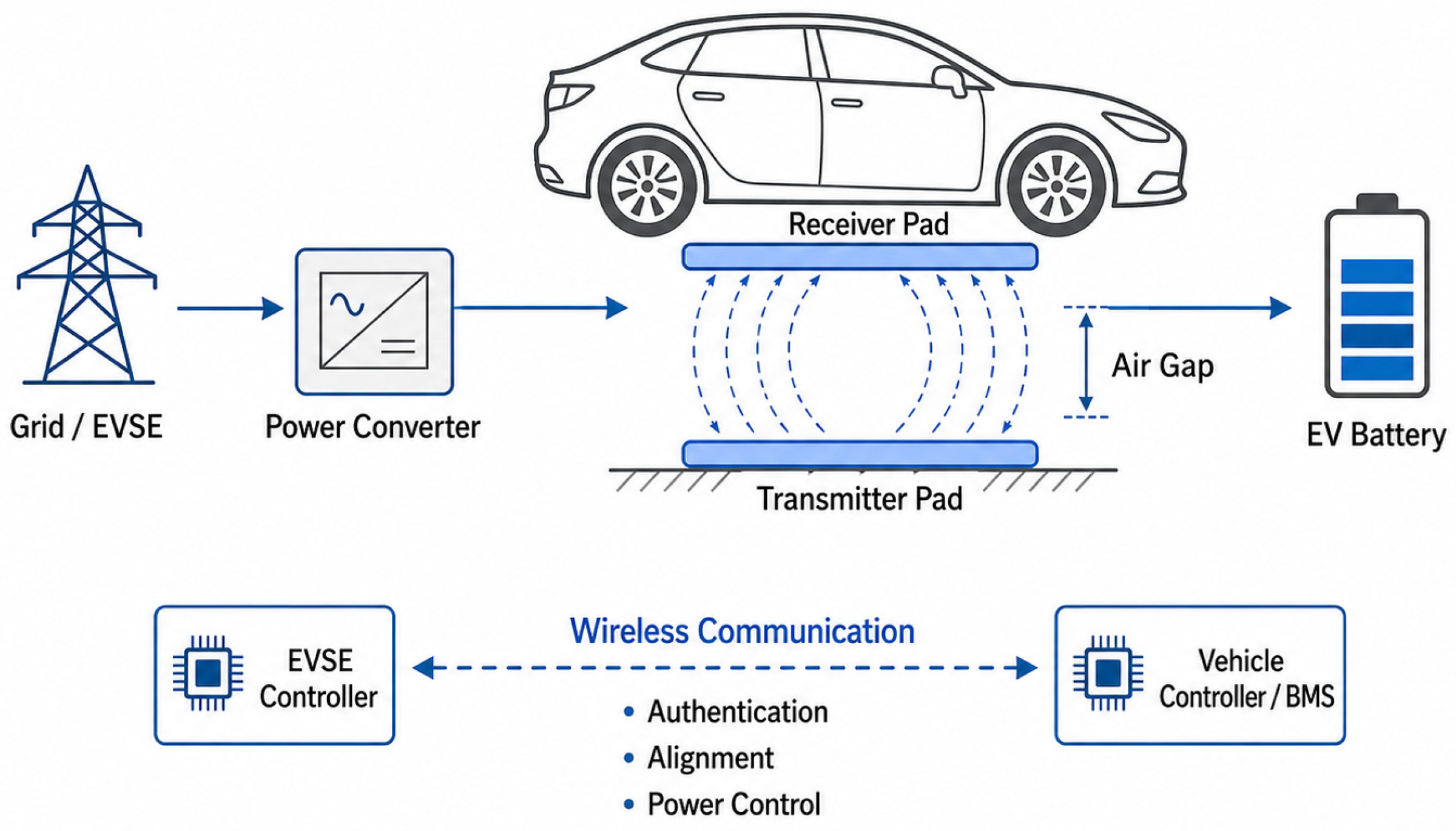
Figure 1 shows a simplified diagram of an EV wireless charging system. In inductive WPT, a transmitter coil installed on the ground generates a time-varying magnetic field. When the receiver coil mounted under the vehicle is positioned within this magnetic field, an induced voltage is produced on the vehicle side. This process, known as electromagnetic induction, enables contactless power transfer between the charging infrastructure and the EV [
11].
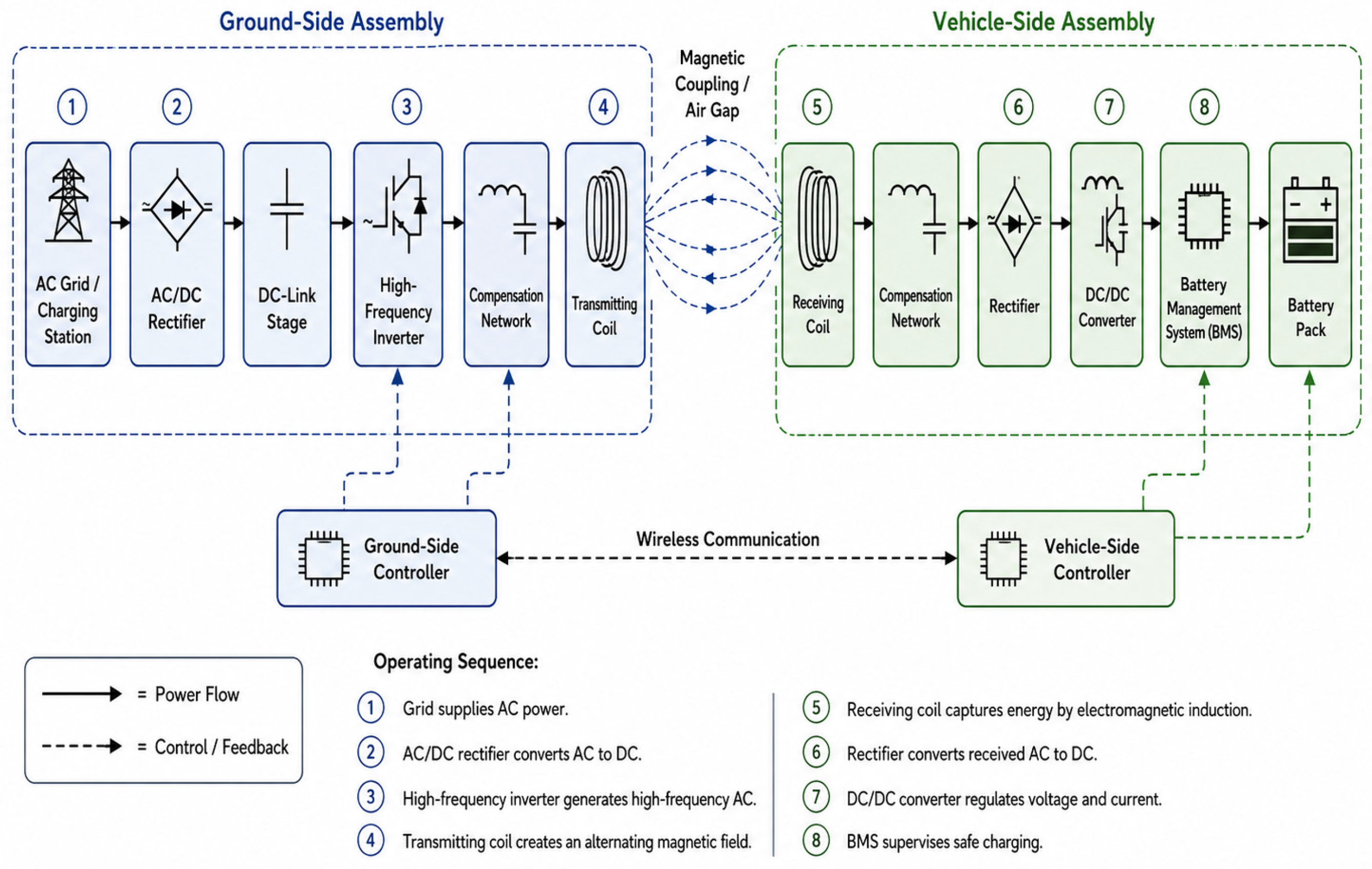
A typical WPT EV charging system consists of two main parts: the ground-side assembly and the vehicle-side assembly.
The ground-side assembly includes the grid interface, AC/DC rectifier, DC-link stage, high-frequency inverter, compensation network, transmitting coil, and ground-side controller. The vehicle-side assembly includes the receiving coil, compensation network, rectifier, DC/DC converter, battery management system, battery pack, and vehicle-side controller [
16].
The operating sequence can be summarized as follows:
The grid supplies AC power to the charging station.
The AC power is converted into DC using an AC/DC rectifier.
A high-frequency inverter converts the DC voltage into high-frequency AC.
The transmitter coil generates an alternating magnetic field.
The receiver coil captures part of the magnetic field by electromagnetic induction.
The received AC power is rectified into DC.
A DC/DC converter regulates voltage and current according to battery requirements.
The battery management system supervises safe charging.
This architecture shows that WPT EV charging is not limited to energy transfer only. It requires a complete integration of power electronics, electromagnetic coupling, sensing, communication, and control.
The general architecture of a WPT EV charging system is shown in
Figure 2. The system is divided into a ground-side assembly and a vehicle-side assembly. The power path includes AC/DC conversion, high-frequency inversion, compensation networks, magnetic coupling, rectification, DC/DC conversion, and battery charging. The control path links the ground-side and vehicle-side controllers through wireless communication.
4.2. Main Power Conversion Stages
The first stage of the system is the AC/DC conversion stage, where the grid voltage is converted to a stable DC-link voltage. Power factor correction can be implemented here to improve the grid-side performance and reduce the harmonic distortion.
The second stage of the WPT system is the high-frequency inverter that converts the DC-link voltage to high-frequency AC. The operating frequency of the high-frequency inverter is decided by several factors, including the WPT design, standard requirements, coil characteristics, compensation topology and the required alternating magnetic field strength to achieve a good power transfer ability.
The third stage of the WPT system is the magnetic coupling stage, consisting of the transmitter coil, the air gap and the receiver coil. This is considered the heart of the WPT system. Several variables can affect the efficiency of this stage, including the coupling coefficient, coil geometry, air-gap distance and lateral and vertical misalignment, as well as the shielding design.
The fourth stage of the system is the vehicle-side rectification and regulation stage. It converts the induced AC voltage from the receiver coil to DC via a DC/DC converter. This stage aims to meet the requirements of the vehicle battery, such as the charging voltage and current, state of charge, temperature and safety limits, by regulating the received DC voltage from the WPT system.
4.3. Compensation Capacitors
In a wireless power transmission system, the coils are separated by distance. Therefore, the mutual inductance and the coupling coefficient are greatly affected. This results in a large leakage inductance between the two coils and a small mutual inductance. This limits the power transmission capability of the primary coil to the secondary coil.
To obtain a higher mutual inductance, the leakage inductance needs to be compensated. This further helps work at resonant frequencies, so the impedance is purely resistive. Compensation can be performed by inserting capacitors with primary and secondary inductance.
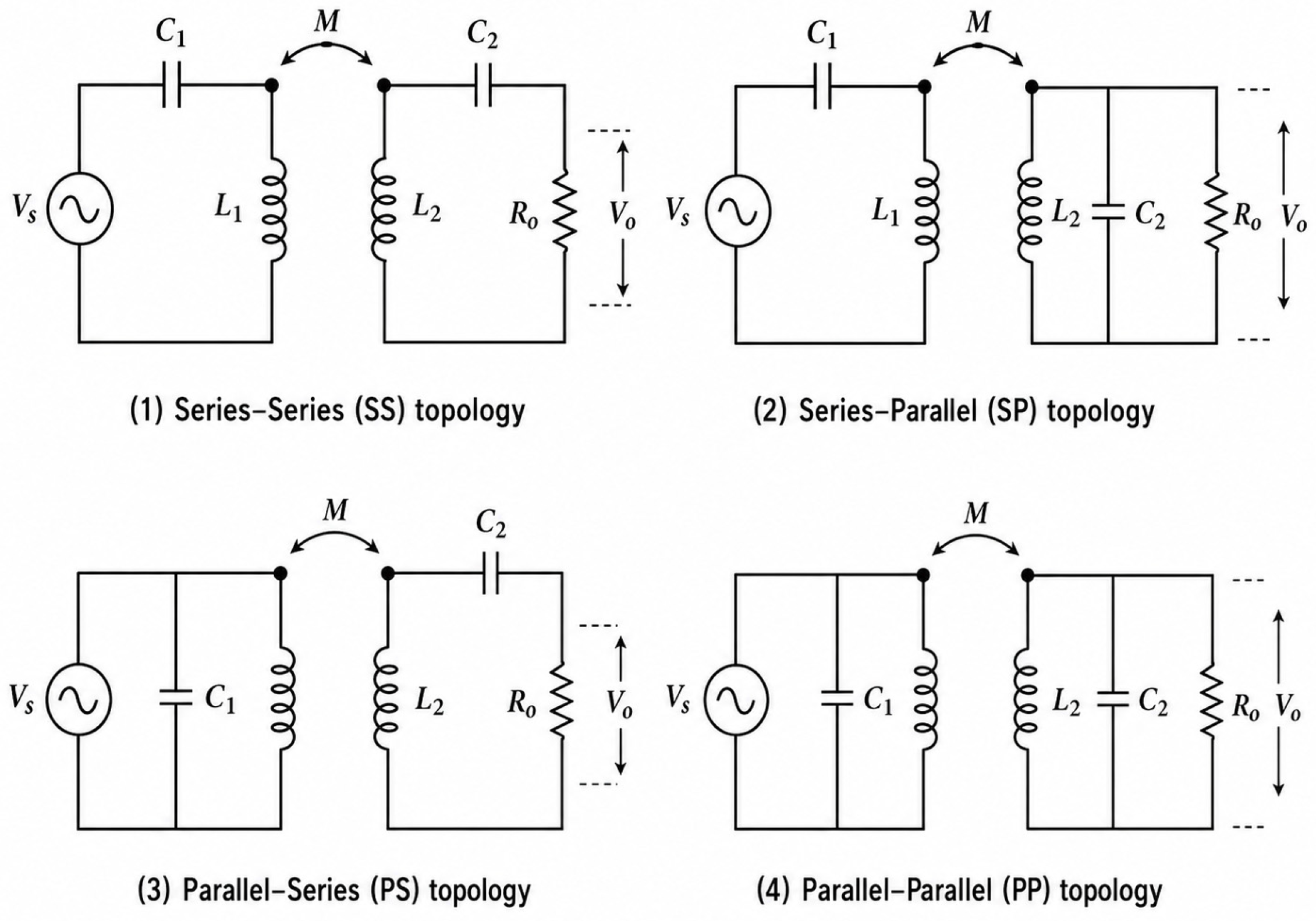
To compensate coil inductance and achieve greater energy transmission, capacitors are inserted in the primary and secondary coils in series or in parallel and adjusted to resonate at the power frequency. Therefore, four basic topologies of resonant WPTS can be established as shown in
Figure 3: series–series (SS), series–parallel (SP), parallel–series (PS), and parallel–parallel (PP) [
17].
Table 2 summarizes the most common compensation topologies used in WPT EV charging systems, highlighting their circuit arrangement and main technical features [
18,
19].
5. Standards, Connectivity and Wireless Communication
The deployment of wireless power transfer (WPT) systems for electric vehicles requires not only efficient power transfer, but also reliable standards, communication protocols, and connectivity technologies. In WPT EV chargers, the charging process involves two physically separated subsystems: the ground-side charging infrastructure and the vehicle-side receiving system. Therefore, standardized communication is necessary to ensure interoperability, safety, authentication, power regulation, alignment assistance, fault detection, and user authorization.
Unlike conductive charging, which can support communication through the charging cable, WPT systems require a wireless link between the EV and the charging station. This wireless link can be considered a critical layer of the overall WPT architecture because it supports data exchange, real-time control, monitoring, and safety supervision. Such systems require a suite of technologies including power electronics, magnetic coupling, sensing, communication and control mechanisms.
5.1. Role of Standards in WPT EV Charging
Standards are necessary to achieve the widespread application of WPT EV chargers. They define the requirements, e.g., interoperability, safety, EMC, communication, positioning and performance. If standards were not defined, then it would not be assured that EVs and wireless charging stations made by different manufacturers were interoperable, which would hinder the wide adoption of the WPT technology.
The most relevant standards for WPT EV charging are SAE J2954, IEC 61980, ISO 15118, and ISO 19363. These standards cover different but complementary aspects of wireless EV charging.
SAE J2954 focuses mainly on wireless power transfer for light-duty plug-in and electric vehicles. It defines requirements related to power classes, operating frequency, alignment methodology, interoperability, electromagnetic compatibility, safety, and efficiency [
8]. This standard is important because it provides a common technical framework for automotive WPT systems.
SAE J2836/6 is also relevant because it defines use cases for wireless charging communication between plug-in electric vehicles and wireless EV supply equipment. It supports the discussion of communication requirements related to WEVSE detection, charging process coordination, and charging monitoring [
20].
IEC 61980 addresses electric vehicle wireless power transfer systems. It covers general requirements, communication, and specific requirements for magnetic-field WPT systems. IEC 61980-2 is relevant because it deals with communication and activities between the EV and the WPT charging infrastructure [
6]. It also includes aspects related to positioning and system coordination.
ISO 15118 defines the vehicle-to-grid communication interface between the EV and the electric vehicle supply equipment. Although it is widely associated with conductive charging, it is also important for WPT because it supports authentication, Plug & Charge, smart charging, bidirectional power transfer, and charging session management. ISO 15118-20 extends the communication framework toward advanced charging use cases, including wireless power transfer and V2G operation [
7].
ISO 19363 is also relevant for magnetic-field wireless power transfer systems because it addresses safety and interoperability requirements for electrically propelled road vehicles. It complements SAE J2954 and IEC 61980 by focusing on magnetic-field WPT operation, safety, compatibility, and system-level requirements [
21].
5.2. Standardization Framework for WPT EV Chargers
The standards used in WPT EV charging systems (
Table 3) can be grouped according to their main functions.
These standards are complementary. SAE J2954 is closely related to WPT performance and interoperability, IEC 61980 provides system-level requirements for WPT infrastructure and communication, while ISO 15118 supports EV–EVSE data exchange and energy management.
5.3. ISO 15118 for EV–EVSE Communication
ISO 15118 is an international standard that defines high-level communication between the electric vehicle and the electric vehicle supply equipment. It enables the exchange of information required for charging session management, authorization, authentication, charging parameters, payment, smart charging, and bidirectional power transfer [
7].
This standard is particularly important for advanced EV charging systems because it supports Plug and Charge, which allows automatic identification and authorization of the vehicle without manual user intervention. It also supports smart charging functions, such as load management and demand response, which can help improve grid integration and reduce charging costs.
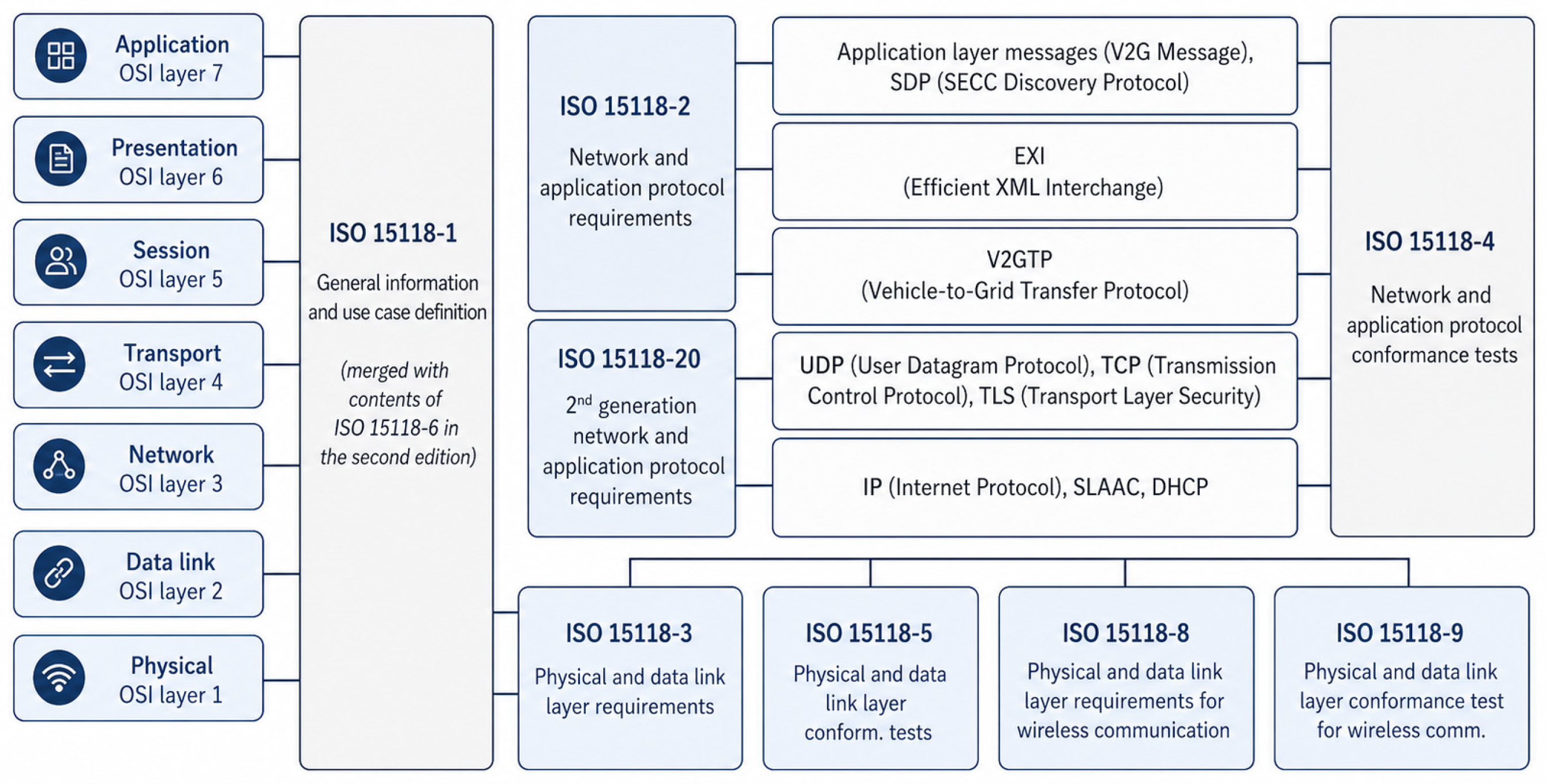
ISO 15118 defines the communication framework between the electric vehicle communication controller and the supply equipment communication controller. This framework supports the exchange of information related to session establishment, authorization, authentication, charging parameters, smart charging, and bidirectional power transfer.
Figure 4 provides a simplified overview of the ISO 15118 communication framework and illustrates how high-level communication is organized between the vehicle side and the charging infrastructure side [
22].
As shown in
Figure 4, ISO 15118 is organized according to a layered communication approach. The upper layers manage session establishment, message exchange, authorization, authentication, and charging-related services, while the lower layers depend on the physical communication medium used by the specific implementation. In conductive charging, communication may rely on wired physical and data-link layers. In WPT-based charging, wireless high-level communication is required because there is no physical charging cable between the vehicle and the ground-side infrastructure.
In WPT-based EV charging, this wireless communication link supports the exchange of control and monitoring data required for vehicle identification, authentication, compatibility verification, coil alignment support, power regulation, battery monitoring, fault detection, and safe shutdown coordination. For this reason, ISO 15118 should be considered as part of a broader communication and control framework for wireless EV charging systems.
The ISO 15118 series includes different parts that address different communication layers and use cases. ISO 15118-3 specifies physical and data link layer requirements for wired communication, while ISO 15118-8 addresses physical and data link layer requirements for wireless communication [
7,
23]. ISO 15118-20 extends the standard to second-generation network and application layer requirements and supports advanced functions such as bidirectional power transfer and more complex charging services.
ISO 15118 also provides secure EV–EVSE communication mechanisms, including session establishment, message exchange, authentication, digital signatures, and data integrity [
24,
25]. These functions are important for safe, interoperable, and intelligent wireless charging, especially when combined with WPT-specific standards such as SAE J2954, IEC 61980, and ISO 19363.
It should also be noted that Wi-Fi, cellular, V2X, or other wireless technologies may be used in specific implementations to support data exchange between the EV and the charging infrastructure. However, Wi-Fi should not be presented as the default communication medium of ISO 15118 unless it refers to a specific implementation or prototype. In WPT systems, the choice of wireless technology depends on the required range, latency, reliability, cybersecurity level, interoperability, and control function.
5.4. Wireless Communication Technologies for WPT EV Chargers
Several wireless communication technologies can be used in WPT EV charging systems. Their suitability depends on the required range, data rate, latency, energy consumption, security level, and application scenario [
12,
26].
Near-Field Communication (NFC) is suitable for short-range identification, pairing, and authorization. Its very limited range can improve security, but it cannot support continuous control or high-data-rate communication [
26].
Bluetooth and Bluetooth Low Energy (BLE) can support short-range communication between the EV and the charger. They are low-cost and energy-efficient, making them useful for pairing, diagnostics, and local communication. However, their limited range and possible interference may reduce their suitability for safety-critical control.
Wi-Fi provides higher data rates and IP-based connectivity. It can support data exchange, supervision, diagnostics, and communication with backend systems. Nevertheless, Wi-Fi may suffer from congestion, higher power consumption, and security vulnerabilities if not properly protected.
Zigbee is suitable for low-power monitoring and sensor networks. It supports mesh networking and can be useful for distributed sensing around the charging area. However, its data rate is limited, which makes it less suitable for high-speed control applications.
Vehicle-to-Everything (V2X) communication enables interaction between the EV, charging infrastructure, road infrastructure, and traffic management systems. It is especially promising for dynamic WPT, electric roads, autonomous vehicles, and smart mobility systems.
Cellular networks, including 4G, 5G, and future 6G, can support wide-area communication, backend supervision, smart charging, fleet management, and dynamic WPT coordination; 5G and 6G are particularly attractive due to their low latency, high reliability, and massive connectivity capabilities [
27].
Table 4 summarizes the main characteristics of the wireless communication technologies discussed above and compares their suitability for different WPT EV charger control functions.
Table 4.
Comparative analysis of wireless communication technologies for WPT EV charger control.
Table 4.
Comparative analysis of wireless communication technologies for WPT EV charger control.
| Technology | Frequency Band | Data Rate | Latency | Range | Reliability | Cybersecurity Exposure | Cost | Energy Use | Suitable WPT Functions |
|---|
| NFC | 13.56 MHz | Low | Very low | Very short | High for proximity | Low–medium | Low | Very low | Identification, pairing, authentication |
| Bluetooth/BLE | 2.4 GHz | Low–medium | Low–moderate | Short | Medium | Medium | Low | Very low | Pairing, diagnostics, local monitoring |
| Zigbee | 2.4 GHz/Sub-GHz | Low | Moderate | Short–medium | Medium, mesh support | Medium | Low | Very low | Sensor networks, monitoring |
| Wi-Fi | 2.4/5/6 GHz | High | Low–moderate | Medium | Medium | Medium–high | Medium | Medium–high | Data exchange, diagnostics, supervision |
| V2X | 5.9 GHz/ C-V2X | Medium–high | Low | Medium–long | High for mobility | Medium–high | Medium–high | Medium | Dynamic WPT, segment coordination |
| Cellular 4G/5G | Licensed bands | High | Low with 5G | Wide-area | High | Medium–high | High | Medium–high | Backend coordination, fleet management, smart charging |
6. Wireless Connectivity for Control and Coordination of WPT EV Chargers
6.1. Communication Requirements in WPT Control Architecture
In WPT EV chargers, wireless communication is required to coordinate the interaction between the ground-side infrastructure and the vehicle-side receiver. Unlike conductive charging, where the cable can support both power transfer and communication, WPT systems depend on a wireless link to exchange operational, safety, and control data. For this reason, communication is not only a data exchange layer, but also a key part of the charger control architecture [
5].
This communication link connects the infrastructure-side controller and the vehicle-side controller. It enables the exchange of essential information such as vehicle identification, charging authorization, coil alignment status, battery state of charge, voltage, current, temperature, requested power, transferred power, and fault status. These data are needed before charging starts, during power transfer, and during safe shutdown procedures.
From a system perspective, a WPT EV charger can be viewed as a cyber–physical energy system. The physical layer includes electromagnetic coupling, power converters, compensation networks, the battery, and thermal behavior, while the cyber layer includes sensing, wireless communication, authentication, monitoring, and control algorithms. Therefore, communication delay, interruption, packet loss, or cybersecurity weakness can directly affect charging efficiency, stability, and safety [
6,
7].
6.2. Closed-Loop Control and Data Exchange in WPT EV Chargers
The control of WPT EV chargers relies on feedback exchanged between the electric vehicle and the charging infrastructure. Through wireless communication, the charger receives real-time information about the battery state, coil alignment, coupling condition, air gap, temperature, voltage, current, and safety limits [
5,
6]. Based on these data, the controller adjusts the transferred power according to the operating conditions [
5].
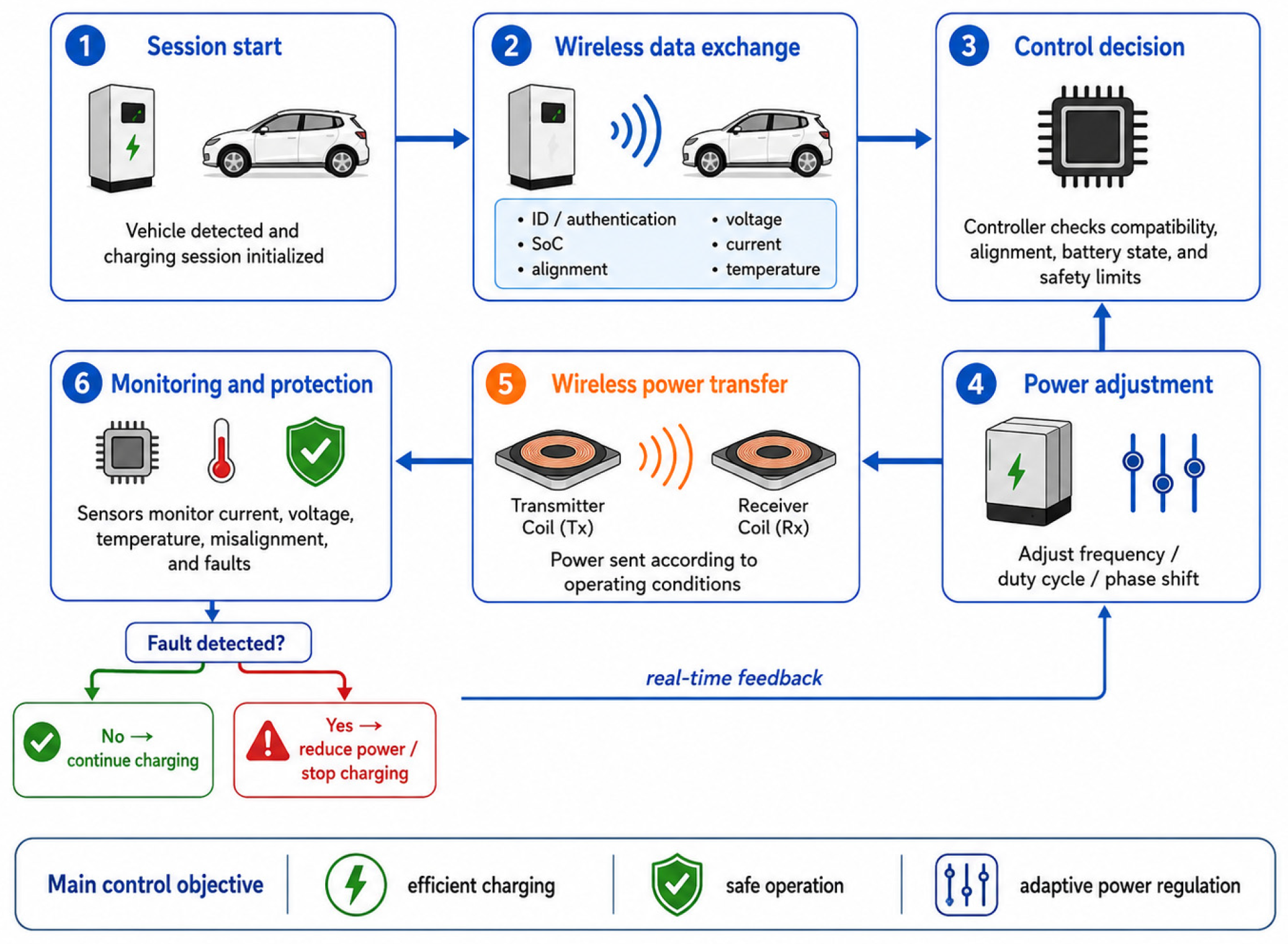
In a typical closed-loop control process, the charging system first determines the power requested by the vehicle. This requested power is then checked against several operating limits, including battery constraints, thermal conditions, alignment quality, and safety requirements. If the system detects poor alignment, excessive temperature, abnormal voltage or current, or communication instability, the controller can reduce the transferred power or stop the charging session.
Wireless communication is therefore essential because it provides the feedback needed for adaptive power regulation. If the communication link is delayed, interrupted, or unreliable, the controller may rely on outdated battery, alignment, or temperature information. This can reduce efficiency, affect power regulation, and increase safety risks. For this reason, reliable and low-latency communication is required to maintain stable, adaptive, and safe wireless charging.
In a typical operating sequence, the vehicle and charger first exchange identification and authentication data. The system then verifies compatibility, charging authorization, and coil alignment conditions. During charging, sensors continuously monitor electrical, thermal, and battery parameters. If an abnormal condition is detected, such as overheating, overcurrent, misalignment, foreign object detection, or communication loss, the system reduces the transferred power or stops charging safely [
6].
Table 5 summarizes the main data exchanged between the EV and the charging infrastructure and the corresponding control actions during closed-loop WPT charging operation.
Table 5.
Data exchange and control actions during closed-loop operation of WPT-based EV chargers.
Table 5.
Data exchange and control actions during closed-loop operation of WPT-based EV chargers.
| Control Step | Data Exchanged | Control Action |
|---|
| Vehicle detection | Vehicle presence, charger availability | Start communication session |
| Identification and authentication | Vehicle ID, user authorization, certificates | Accept or reject charging |
| Compatibility check | Power class, battery requirements, communication protocol | Confirm system compatibility |
| Alignment verification | Coil position, coupling condition, air gap | Allow charging, guide alignment, or reduce power |
| Power regulation | SoC, voltage, current, temperature, requested power | Adjust transferred power |
| Safety monitoring | Fault status, overheating, object detection, communication status | Continue, reduce power, or stop charging |
| Safe shutdown | Stop command, fault information | Interrupt power transfer safely |
The closed-loop operation of a WPT-based EV charger can be summarized through a sequence of communication and control actions. First, the vehicle and the charging infrastructure exchange identification and authentication data. Then, compatibility, coil alignment, and battery requirements are verified before power transfer begins. During charging, real-time information such as voltage, current, temperature, battery state, alignment status, and fault signals is exchanged between both sides. Based on these data, the controller can continue normal charging, adjust the transferred power, reduce the power level, or stop the charging process safely. This control and coordination process is illustrated in
Figure 5.
6.3. Control Functions Enabled by Wireless Connectivity
Wireless communication in applications including control and operation for WPT-based EV charging systems plays a key role. It enables the proper functioning and execution of important tasks such as vehicle identification and charging authorization, coil alignment during and possibly before the charging, adjustment of power levels with respect to battery state of charge, safety, as well as condition monitoring of the battery. This type of communication further supports safety supervision. For example, in the event of a fault in the system, a proper communication link will enable the controller to decide on the best course of action to prevent hazards.
Before the charging process starts, the vehicle must be identified and authenticated to ensure that it is compatible with the WPT infrastructure. Standards such as ISO 15118 support this process by defining the communication between the electric vehicle and the charging station, including session management, authorization, authentication, and Plug and Charge functions [
7].
Coil alignment is another important factor in WPT charging. If the coils are not properly aligned, the magnetic coupling can be reduced, which leads to lower efficiency and higher power losses. Wireless communication allows the vehicle and the charger to exchange positioning and alignment information. In static WPT systems, this information can help guide the driver or an automated parking system. In dynamic WPT systems, it becomes even more critical, since the vehicle moves over several transmitter segments during charging [
28,
29].
Wireless communication also plays an important role in dynamic power regulation. Through this communication link, the charger can adjust the transferred power according to several factors, such as the battery state of charge, the required power level, the coupling coefficient, the air gap, temperature and safety limits. This adjustment can be achieved by controlling parameters such as the inverter frequency, duty cycle, phase shift, DC-link voltage or the compensation network. However, if the communication link is delayed or unstable, the controller may use outdated information, which can reduce charging efficiency and create safety risks.
Safety monitoring also relies heavily on communication. The system must be able to detect faults such as overvoltage, overcurrent, overheating, foreign or living object detection, coil misalignment, communication loss and unauthorized access. When a fault happens, the vehicle and the charger need to coordinate quickly in order to reduce or stop power transfer safely [
30,
31,
32].
Finally, wireless communication allows the battery management system to send important information such as state of charge, state of health, voltage limits, current limits and temperature. This enables battery-aware charging, smart charging and future vehicle-to-grid applications. For these reasons, wireless communication is needed for safe, adaptive and intelligent WPT EV charging [
7].
6.4. Mapping Communication Technologies to WPT Control Requirements
The suitability of wireless communication technology for WPT EV charging depends on the control function that must be supported. Short-range technologies such as NFC and Bluetooth are mainly suitable for identification, pairing, and local monitoring. Wi-Fi can support higher data-rate communication for diagnostics and local supervision, but it may require strong cybersecurity protection and careful management of interference. Zigbee is more suitable for low-power sensor networks around the charging area. V2X and cellular communication are more relevant for dynamic WPT, road-side coordination, backend supervision, fleet management, and smart charging.
Table 6 summarizes the relationship between WPT control functions and suitable communication technologies. This mapping shows that no single communication technology is optimal for all WPT control tasks. Instead, practical WPT EV chargers may require a hybrid communication architecture, where short-range communication supports local identification and pairing, while low-latency and wide-area communication supports dynamic charging, fault handling, and backend coordination.
6.5. Cybersecurity and Authentication in WPT Communication
Cybersecurity is a critical aspect of WPT-based EV charging systems because the communication link between the electric vehicle and the charging infrastructure is wireless and may be exposed to external attacks [
25,
32,
33,
34]. Unlike conductive charging, where communication can take place through a physical cable, WPT systems depend on wireless data exchange for vehicle identification, authentication, charging authorization, power regulation, safety monitoring, billing, and shutdown coordination. Therefore, any attack on the communication link may affect not only data privacy, but also charging safety and system reliability.
Authentication is one of the first security requirements in WPT EV charging. Before power transfer begins, the charging infrastructure must verify that the vehicle and user are authorized to access the service. Similarly, the vehicle must be able to verify that it is communicating with a legitimate charging station. Standards such as ISO 15118 support this process through secure EV–EVSE communication, Plug and Charge functions, certificate-based authentication, session establishment, and message integrity mechanisms [
7,
24,
25].
Several cybersecurity threats can affect WPT communication. Spoofing attacks may occur when an attacker tries to imitate a legitimate vehicle or charging station. This can lead to unauthorized charging, incorrect billing, or unsafe control actions. Replay attacks occur when previously valid messages are captured and reused to start or manipulate a charging session. Man-in-the-middle attacks may allow an attacker to intercept or modify exchanged data, such as charging parameters, battery information, or power commands. In addition, denial-of-service attacks can interrupt communication and prevent the charger from receiving important control or safety information.
To reduce these risks, WPT EV charging systems should use mutual authentication, encrypted communication, digital certificates, secure session management, timestamps, nonces, and message integrity checks. In case of abnormal communication behavior, such as invalid certificates, repeated messages, missing packets, or communication timeout, the controller should switch to a safe fallback mode. This may include reducing the transferred power or stopping the charging process until secure communication is restored.
Table 7 summarizes the main cybersecurity threats in WPT EV charging communication and possible protection mechanisms.
Cybersecurity should therefore be integrated into the control architecture of WPT EV chargers from the design stage. Secure communication is necessary not only for user authentication and billing, but also for safe power regulation, reliable fault management, and trustworthy coordination between the vehicle and the charging infrastructure.
7. Challenges, Mitigation Strategies, and Future Research Directions
Although WPT EV charging offers important advantages in terms of convenience, automation, and reduced mechanical wear, its large-scale deployment still faces several technical, economic, and standardization challenges. These challenges are related not only to the wireless power transfer stage, but also to sensing, communication, control, cybersecurity, and infrastructure integration.
One of the main technical challenges is coil misalignment. When the transmitter and receiver coils are not properly aligned, the magnetic coupling decreases, which reduces the transferred power and overall efficiency. Air-gap variations between the ground-side pad and the vehicle-side receiver can also affect the coupling coefficient and create power fluctuations. To mitigate these issues, WPT systems can use alignment sensors, parking assistance, magnetic positioning, adaptive compensation networks, and real-time power control. In dynamic WPT, this issue becomes more complex because the vehicle is moving and the coupling condition changes continuously.
Thermal stress is another important limitation. Power losses in coils, converters, compensation components, and metallic objects near the charging area can lead to overheating. Possible solutions include optimized coil design, ferrite shielding, thermal sensors, cooling systems, and thermal derating strategies. In this case, wireless communication allows temperature information to be exchanged between the vehicle and the infrastructure so that the controller can reduce power or stop charging when necessary.
From the communication point of view, latency, packet loss, synchronization errors, and electromagnetic interference can affect the stability and safety of WPT control. If the controller receives delayed or incomplete information about battery state, alignment, voltage, current, or temperature, it may make incorrect control decisions. Therefore, robust and low-latency communication technologies, redundant messages, timeout detection, retransmission mechanisms, and local fallback control should be considered.
Cybersecurity is also a critical issue because WPT systems rely on wireless communication for identification, authentication, charging authorization, billing, control, and fault management. Attacks such as spoofing, replay attacks, man-in-the-middle attacks, data tampering, and denial-of-service attacks may compromise the charging session or affect system safety. To reduce these risks, WPT EV chargers should integrate mutual authentication, digital certificates, encrypted communication, timestamps, nonces, message integrity checks, and secure session management. Standards such as ISO 15118 can support secure EV–EVSE communication, especially when combined with WPT-specific standards.
Infrastructure cost remains another major barrier, especially for dynamic WPT systems that require road-embedded coils, segmented power supply, communication modules, and control units. Possible mitigation strategies include modular charging pad design, selective deployment in high-demand zones, standardization of interoperable components, and integration with existing smart road and charging infrastructure. However, more cost–benefit studies are still needed to compare WPT deployment with conventional AC and DC charging systems.
The previous discussion shows that the challenges of WPT EV charging are interconnected and involve power transfer, communication, control, cybersecurity, cost, and standardization aspects. To provide a clearer synthesis,
Table 8 summarizes the main challenges, their technical impacts, possible mitigation strategies, and remaining research gaps.
As shown in
Table 8, the deployment of WPT EV charging is limited by several interconnected technical, communication, safety, and economic challenges. Among these challenges, cost and energy efficiency are particularly important for large-scale deployment because they directly affect the feasibility of WPT compared with conventional AC and DC charging systems. Therefore, a complementary discussion on cost and efficiency is necessary to better evaluate the practical potential of WPT technologies.
In addition to technical challenges, the cost of WPT charging should be compared with conventional AC and DC charging solutions. AC charging generally has the lowest infrastructure cost because it requires simpler power electronics and is suitable for home, workplace, and low-power public charging. DC fast charging has a higher cost due to high-power converters, cooling systems, grid reinforcement, and installation requirements. Static WPT has a medium-to-high cost because it requires a ground-side charging pad, a vehicle-side receiver, compensation networks, sensors, alignment systems, and communication modules. Dynamic WPT has the highest infrastructure cost because it requires road-embedded transmitter coils, a segmented power supply, road-side controllers, communication infrastructure, and road construction work. Therefore, the economic feasibility of WPT should be evaluated not only from the charger hardware perspective, but also from installation, maintenance, interoperability testing, communication infrastructure, and road integration costs [
9,
19,
24,
28].
Table 9 summarizes the qualitative cost comparison between AC charging, DC fast charging, static WPT, and dynamic WPT in terms of relative infrastructure cost, main cost drivers, advantages, and limitations.
Table 9.
Qualitative cost comparison between AC charging, DC fast charging, static WPT, and dynamic WPT.
Table 9.
Qualitative cost comparison between AC charging, DC fast charging, static WPT, and dynamic WPT.
| Charging Solution | Relative Infrastructure Cost | Main Cost Drivers | Main Advantages | Main Limitations |
|---|
| AC charging | Low | AC charger, installation, protection devices | Simple installation, low cost, suitable for homes and workplaces | Low charging power and long charging time |
| DC fast charging | High | High-power converters, transformer, cooling, grid upgrade, installation | High charging power and short charging time | High cost, grid impact, thermal constraints |
| Static WPT | Medium to high | Ground pad, vehicle receiver pad, compensation network, sensors, alignment system, communication module | Contactless charging, automation, reduced connector wear | Alignment sensitivity, higher complexity, interoperability needs |
| Dynamic WPT | Very high | Road-embedded coils, segmented power supply, road-side controllers, communication infrastructure, road works | Charging while driving, reduced range anxiety, possible battery downsizing | Very high deployment cost, complex maintenance, strong standardization requirements |
Future research should therefore focus on integrated communication–control–power design rather than treating power transfer, communication, and control as separate layers. Promising research directions include low-latency V2X and 5G/6G communication for dynamic WPT, cybersecurity-by-design, artificial intelligence for fault detection and energy management, digital twins for real-time monitoring, and interoperable WPT infrastructures based on harmonized standards. These developments are necessary to make future WPT EV chargers safer, more reliable, cost-effective, and suitable for large-scale smart mobility systems.
8. Conclusions
This review examined the role of wireless communication in the control and coordination of WPT-based EV charging systems. Unlike conductive charging, WPT does not provide a physical communication path through a charging cable. Therefore, the vehicle and the charging infrastructure must rely on wireless data exchange to initialize the charging session, identify and authenticate the vehicle, verify compatibility, support coil alignment, regulate transferred power, monitor battery and thermal conditions, detect faults, and coordinate safe shutdown procedures.
The review showed that wireless communication should not be considered only as an auxiliary data exchange layer. It is a key element of the control architecture because the performance, efficiency, and safety of WPT charging depend on the timely and reliable exchange of control and monitoring data. Communication latency, packet loss, synchronization errors, cybersecurity vulnerabilities, and interoperability limitations can directly affect power regulation, fault handling, and safe operation.
The comparison of wireless communication technologies indicates that no single technology is suitable for all WPT control functions. Short-range technologies such as NFC and Bluetooth/BLE are more appropriate for identification, pairing, and local monitoring, while Wi-Fi can support local supervision, diagnostics, and higher data-rate exchange. Zigbee can be useful for low-power sensing and monitoring, whereas V2X and cellular technologies are more relevant for dynamic WPT, backend coordination, fleet management, and smart charging applications. Therefore, future WPT EV chargers may require hybrid communication architectures that combine local, low-latency, secure, and wide-area communication capabilities.
Standards such as SAE J2954, IEC 61980, ISO 15118, and ISO 19363 are essential for improving interoperability, safety, communication, alignment, authentication, and system coordination. In particular, ISO 15118 supports secure EV–EVSE communication, Plug and Charge, smart charging, and bidirectional power transfer, while WPT-specific standards provide requirements related to wireless power transfer, positioning, and safety.
Despite recent progress, several challenges still limit the large-scale deployment of WPT EV charging systems. These include coil misalignment, air-gap variation, thermal stress, electromagnetic interference, communication latency, packet loss, cybersecurity risks, infrastructure cost, and interoperability issues. Possible mitigation strategies include adaptive control, alignment assistance, thermal monitoring, shielding, low-latency communication, secure authentication, fallback control, modular infrastructure, and harmonized standardization.
Overall, wireless communication can support safe, adaptive, and intelligent WPT EV charging when it is properly integrated with sensing, control, cybersecurity, and power transfer systems. Future research should focus on communication–control–power co-design, cybersecurity-by-design, dynamic WPT coordination, quantitative performance evaluation, interoperability testing, and cost-effective deployment models. These directions are necessary to move WPT EV charging from promising prototypes toward reliable and scalable smart mobility infrastructure.