


Abstract
Photovoltaic (PV) generation, a vital component of renewable energy, is key to supporting energy supply and reducing reliance on traditional energy sources. Given the substantial energy consumption of oilfield well groups, increasing the proportion of PV energy is imperative. Furthermore, as oilfields enter mid-to-late production stages, wells experience reduced oil production with increased energy consumption, necessitating intermittent pumping schedules. This paper addresses the optimized scheduling of pumping unit well groups within a photovoltaic-grid microgrid. The article aims to minimize the difference between the well group system’s total energy consumption and the PV power generation. A nonlinear mixed-integer programming (NMIP) model is constructed, incorporating a PV power forecasting model, a well group energy consumption model, and relevant constraints. An improved Particle Swarm Optimization (PSO) algorithm, integrating a hybrid coding scheme and multiple improvement strategies, is proposed to efficiently solve the NMIP model. The resulting optimal intermittent pumping schedule maximizes on-site PV power consumption, effectively mitigating PV energy wastage and potential grid stability issues associated with direct grid integration. The effectiveness of the proposed optimization algorithm is validated through numerical simulation case studies.
1. Introduction
Driven by energy structure transformation and the increasing adoption of renewable energy, photovoltaic (PV) power generation has emerged as a significant energy supply method. In oil extraction, pumping unit well groups, being energy-intensive, encounter challenges in energy supply while maintaining oil production targets. Low-permeability reservoirs are particularly susceptible to liquid supply shortages in cluster wells during late-stage production. To mitigate “empty pumping” and “dry pumping” issues, intermittent pumping is a common strategy to ensure adequate liquid supply and maintain production efficiency. Current intermittent pumping scheduling often relies on manual experience; however, this approach can result in elevated energy consumption, increased operational costs, and potential problems such as pipeline freezing and blockage [1]. Therefore, a key challenge for oilfields aiming to achieve integrated “source-grid-load-storage” systems lies in the intelligent scheduling of intermittent pumping for well groups. This requires optimizing well operation efficiency, maximizing PV power utilization, and minimizing the consumption of fossil-based energy sources.
In recent years, substantial research effort has been devoted to the scheduling of renewable-energy–powered microgrids and active distribution networks under variable demand-side and supply-side conditions. For example, a “Dominated GSO” algorithm was proposed for optimal scheduling of renewable microgrids with penetration of electric vehicles and energy storages, considering demand response programs (DRPs). Similarly, optimal scheduling of active distribution networks with high penetration of plug-in hybrid electric vehicles (PHEVs), accounting for grid congestion and air-pollution constraints under DR programs, has been demonstrated. Moreover, chance-constrained scheduling of compressed-air energy storage (CAES) in combination with DRP has been developed to maximize wind-power harvesting in congested transmission systems while ensuring operational flexibility [2,3,4]. These studies validate the feasibility and advantages of combining renewable generation, storage, demand-side flexibility, and advanced optimization under uncertainty.
Despite these advances, most existing studies focus on general microgrid or distribution-network scheduling and rarely address the specific operational and geological constraints associated with oilfield pumping well groups. In particular, the problem of integrating intermittent pumping scheduling in beam-pumping well groups with on-site renewable generation (PV), under the constraints of reservoir dynamics and oil-production requirements, remains largely unexplored.
Current research on intermittent pumping scheduling for well groups in oilfields primarily focuses on formulating planning models and solving them to obtain optimized scheduling strategies. For example, mixed-integer programming models have been developed to minimize energy consumption, incorporating constraints such as surface facilities, multiphase flow, and nonlinear reservoir characteristics [5]. Other work has aimed at optimizing offshore platform production and layout to meet production demands under operational constraints [6]. Nonlinear mixed-integer programming models have further been used to minimize operating costs and determine optimal intermittent pumping schedules and layouts for well sites [7,8,9]. However, these models rarely consider the variability and randomness of renewable power generation, particularly PV, as a primary energy source.
Oilfields often deploy substantial PV generation facilities. However, the inherent randomness and volatility of PV output can lead to grid instability if directly integrated. Utilizing PV power as the primary energy source in a PV–grid microgrid system enables on-site consumption of PV energy, representing a crucial step toward improving PV utilization and reducing fossil-energy consumption. Nevertheless, existing intermittent pumping scheduling studies seldom incorporate PV power supply dynamics and lack methodologies to fully exploit PV generation while ensuring safe and efficient oil production under geological and operational constraints [10].
Furthermore, current research predominantly employs traditional solution algorithms or commercial solvers to address scheduling planning models. For example, branch-and-bound, column-generation branch-and-price, and Lagrangian relaxation techniques have been applied to solve multi-stage mixed-integer linear or nonlinear programming models for offshore and onshore well operations [11,12,13,14,15,16]. While these methods are well-established and capable of effectively solving scheduling models, the sheer number of wells requiring optimized scheduling in oilfield operations—combined with the significantly increased nonlinear characteristics introduced by considering photovoltaic power—leads to reduced solution efficiency and scalability.
Accordingly, research has begun to explore the use of efficient metaheuristic algorithms such as Particle Swarm Optimization (PSO) and Artificial Bee Colony (ABC) for planning and scheduling models. The ABC algorithm has been successfully applied to zero-wait flow shop and flexible job shop scheduling problems [17,18]. However, its application to well-group optimization scheduling is rarely reported. Compared to ABC and other algorithms, PSO offers advantages such as high computational efficiency, rapid convergence, straightforward on-site implementation, and low cost. Therefore, PSO has been extensively applied to microgrid optimization scheduling and well-group optimization scheduling [19,20]. For example, Yang X. F. extracted data features characterizing the degree of pump-off in beam-pumping wells from historical power data and established a scheduling planning model based on these features to guide the characteristic values corresponding to well start/stop times, then employed PSO to optimize and solve for the optimal start/stop characteristic values [20]. However, these studies did not consider the issue of PV power consumption. Due to the randomness and volatility of PV power generation, the nonlinear characteristics of well-group scheduling planning models are significantly enhanced, making it difficult to directly apply existing PSO algorithms to solve the planning and scheduling models for intermittent pumping well groups in PV–grid microgrids, thus necessitating further improvement.
In summary, this paper investigates an intermittent pumping beam pumping unit well group system operating within a PV-grid microgrid. First, a nonlinear integer programming scheduling model for the intermittent pumping well group under a PV-grid microgrid is constructed, with the objective of optimally consuming PV power generated by the pumping unit well group and incorporating relevant constraints. Second, based on the characteristics of the scheduling planning model, a hybrid coding scheme and multiple improvement strategies are introduced to enhance the PSO algorithm. This ultimately enables the efficient solution of the planning and scheduling model for the intermittent pumping well group in the PV-grid microgrid, obtaining the optimal scheduling strategy for the well group and maximizing the consumption of PV power. The specific contributions of this paper are as follows: (1) Considering the integration of renewable energy consumption, a nonlinear integer programming scheduling model for intermittent pumping well groups incorporating photovoltaic power generation is constructed. Compared to existing intermittent pumping well group planning and scheduling models, the model constructed in this paper is more comprehensive. (2) An improved PSO algorithm suitable for solving nonlinear integer programming models is proposed, which can effectively solve the well group intermittent pumping scheduling strategy and significantly improve the solution efficiency.
The paper is organized as follows: Section 2 describes the problem and research purpose; Section 3 constructs a nonlinear mixed integer programming model for the pumping unit well groups; Section 4 designs an improved Particle Swarm Optimization algorithm; Section 5 presents case simulations and result analysis, and Section 6 concludes the paper.
2. Problem Description
As low-permeability oil wells enter the later stages of oil extraction, the liquid supply becomes insufficient, leading to a decrease in liquid production and a significant increase in oil extraction energy consumption. Therefore, intermittent pumping scheduling is required to optimize the system’s energy efficiency. However, scheduling oil wells according to traditional intermittent pumping rules faces two main issues: (1) It is likely to cause large groups of wells to be switched on or off simultaneously, leading to “empty pumping” problems; (2) It results in substantial energy consumption, leading to resource waste. In recent years, to support the dual-carbon policy, large-scale development of clean energy has been implemented domestically. As a major energy consumer, the oil industry has introduced a large amount of PV and wind power. However, PV power generation is characterized by volatility and randomness, making it difficult to directly integrate into the grid. Additionally, as energy storage devices for oilfields are still under development, storing large amounts of PV power is challenging. Therefore, utilizing pumping unit well groups for local consumption of green electricity is a key method for oilfields to efficiently use clean energy and reduce fossil energy consumption, in response to the national dual-carbon policy.
In addition, to ensure the normal operation of the pumping unit well groups, both PV power and the high-voltage grid are used as energy sources. When the PV power is insufficient to meet the demand of the pumping unit well group, power from the high-voltage grid is used as a supplement. If there is excess PV generation, considering the high storage costs, other measures, such as grid feedback or other flexible loads, are taken to consume the surplus solar energy. In summary, the system studied in this paper is the intermittent pumping oil well group system in a photovoltaic-electrical microgrid.
The research objective of this paper is to design an improved particle swarm optimization-based mixed-integer nonlinear optimization scheduling method, considering various practical constraints, to achieve the optimal scheduling of the oil pumping well group in a photovoltaic-electrical microgrid, thereby maximizing the utilization rate of photovoltaic power.
3. Mathematical Model
The construction of the photovoltaic output model and the oil pump well model in the dynamic programming model needs to satisfy the following assumptions: (1) The assumption of uniform solar radiation. (2) The assumption of a uniform reservoir, where the reservoir geological parameters are constant.
3.1. Objective Function
To maximize the consumption of photovoltaic power, this paper sets the sum of the energy consumption of the intermittent pumping well group system and the deviation from the predicted photovoltaic power during a certain time period as the optimization objective. The objective function is thus constructed as follows:
where is the photovoltaic power supply at time period , is the power demand of well at time period , and is the switch status of well at time period (1 indicates the well is on, 0 indicates the well is off). is the well number, with , and is the time period number, with .
This objective function reflects the difference between the photovoltaic power supply and the power demand of the pumping unit wells.
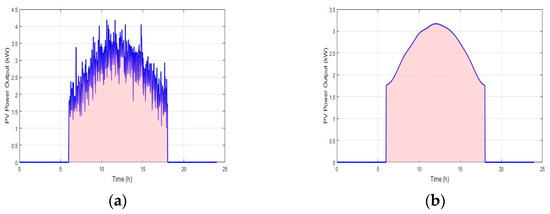
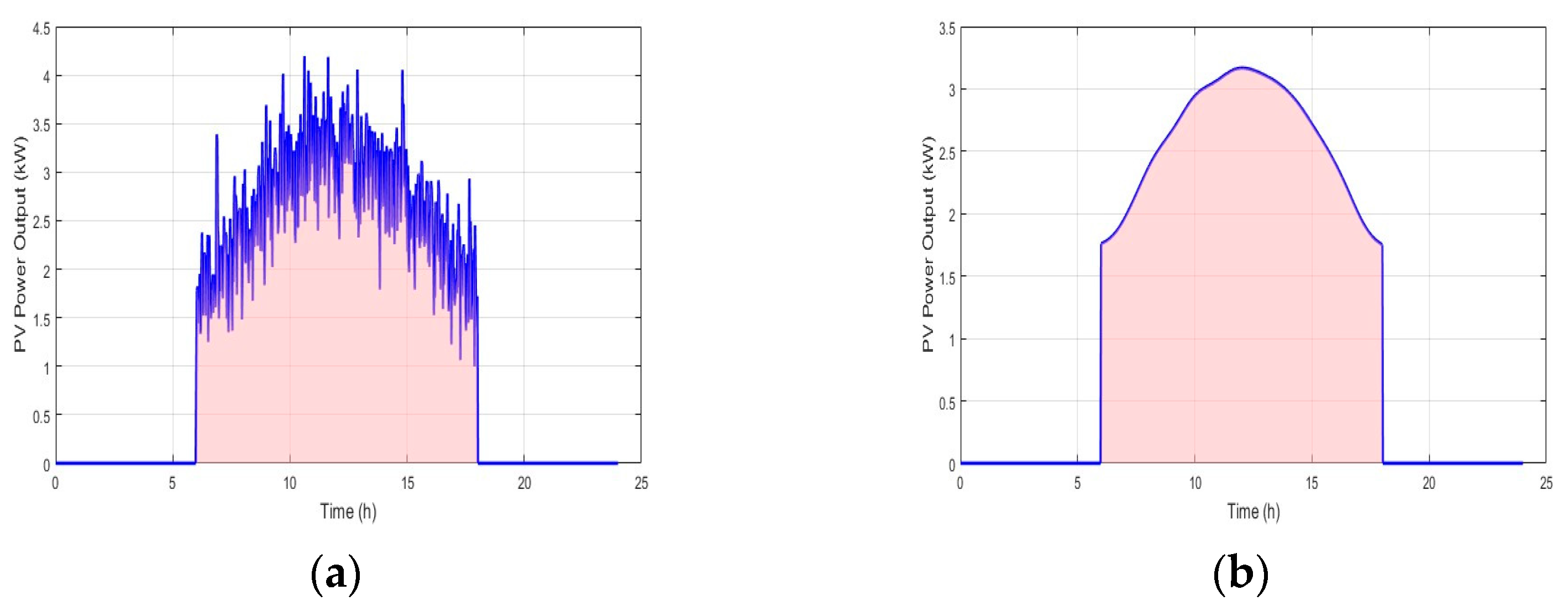
Currently, short-term photovoltaic power forecasting is relatively mature. Since the scheduling only requires the photovoltaic power curve for the next few days, the forecasted power curves are relatively easy to obtain. In this paper, an approximate power forecasting model [21] is used, and the model’s curve is smoothed for further calculations. Figure 1 and Table 1 illustrate the comparison between the raw and smoothed total PV generation over a certain time period. The results indicate that the smoothing introduces an error of less than 2%, which is fully acceptable for scheduling and planning purposes.
Figure 1.
(a) PV Curve Before Smoothing. (b) PV Curve After Smoothing.
Table 1.
Comparison of Errors Between Smoothed and Unsmoothed PV Curves.
The power consumption of pumping well systems is nonlinearly related to factors such as stroke length, pump diameter, stroke frequency, and production rate. However, within the small variation range under normal operating conditions, this relationship can be approximated as linear, as the degree of nonlinearity is relatively weak. Furthermore, stroke frequency—an important variable affecting power consumption—typically exhibits minimal fluctuations within a single day. Therefore, in this study, the relationship between power consumption, stroke frequency, and production rate is approximated as linear. Based on historical production data from the wells, a linear regression method is used to establish a surrogate model relating power consumption to stroke frequency and production rate [10].
where is a Boolean variable indicating the on/off status of the unit. denotes the stroke frequency of pumping unit at time , which corresponds to the crank speed of the pumping unit. is the oil production rate of well per unit time during time period . The parameters are coefficients of the surrogate model.
3.2. Constraints for Intermittent Pumping Scheduling
- (1)
- Production Decline Constraint
When a well is active, its production rate gradually decreases over time. Once the production drops below a predefined lower limit, it no longer meets the production requirements. At this point, the well must be shut down to allow recovery. The threshold is determined based on historical production data of each well [16].
where denotes the production decline rate for well , denotes the production capacity recovery rate for well , denotes the lower production limit for well .
- (2)
- Daily Cumulative Production Constraint for Individual Wells
The total cumulative production of each well over the entire scheduling period must exceed a predefined minimum production threshold . Typically, the goal is to ensure that the daily cumulative production after intermittent pumping remains approximately consistent with that before scheduling.
where represents the minimum daily cumulative production required for well .
- (3)
- Daily Cumulative Production Constraint for the Well Group
The total production of the entire well group over the scheduling period must exceed a specified minimum threshold.
where denotes the minimum daily cumulative production required for the entire well group.
Operating Time Constraint.
During the total scheduling period, the operating time of each well must be greater than the minimum required runtime and less than the maximum allowable runtime. Generally, each well is required to operate daily, but not for the full 24 h.
where refers to the minimum required operating time, while denotes the maximum allowable operating time.
- (4)
- Operating State Constraint
When implementing intermittent scheduling for the well group, simultaneously starting or shutting down a large number of cluster wells may negatively impact production. Therefore, a staggered operation constraint is imposed on large-scale, low-efficiency well groups. This constraint ensures that the number of wells operating at any given time must not be less than the minimum required number , nor exceed the maximum allowed number .
where represents the minimum required number of operating wells, while denotes the maximum allowable number of operating wells.
The selection of sucker-rod pumped wells shall be based on the following prerequisites:
- Wells where the supply-production coordination cannot be achieved even under the minimum operating parameters of the existing equipment.
- Daily liquid production is less than 3 m3/d and volumetric pump efficiency is lower than 30%.
3.3. Overall Optimization Model
The complete nonlinear mixed-integer programming (MINLP) model of the problem, along with its associated constraints, is formulated as follows:
The formulation of this problem is based on the actual operational conditions of well groups, with comprehensive consideration of the integration of new energy sources. This approach accounts for most real-world scenarios and maintains logical consistency. Although certain simplifications have been made in the modeling process, they remain within the acceptable range of engineering approximation. Traditional integer programming methods typically assume that the objective function is linear; however, when the objective function is nonlinear, classical linear programming solvers become inapplicable. Furthermore, nonlinear programming problems generally exhibit multiple local optima rather than a single global optimum. As a result, conventional solution methods may converge only to a local optimum rather than the global one, particularly as the problem complexity increases. Therefore, a new algorithm is required to effectively solve such nonlinear mixed-integer programming problems.
4. Improved Particle Swarm Optimization Algorithm
In this article, the Particle Swarm Optimization (PSO) algorithm is employed to solve a nonlinear mixed 0–1 integer programming scheduling problem. Each particle represents a specific scheduling solution, indicating then on/off operational status of multiple wells across different time intervals.
To address the limitations of the traditional PSO—such as slow convergence and susceptibility to local optima—several enhancements are introduced in this paper to improve its performance.
4.1. Hybrid Particle Encoding Strategy
To address the limitations of the traditional PSO—such as slow convergence and susceptibility to local optima—this paper introduces the following improvements to enhance algorithm performance: Improved Particle Swarm Optimization Algorithm.
4.1.1. Dynamic Local Search Mechanism
Considering the unique characteristics of the oil well scheduling problem, a multi-level hybrid encoding strategy is designed. Each particle adopts a segmented encoding structure, which is specifically defined as
where is control variable encoding segment (binary well on/off status), represented in a linearized form of a 2D matrix. is a parameter variable encoding segment, used to represent continuous parameters related to well conditions. is an auxiliary variable encoding segment (hybrid), including discrete integer variables and logical control variables.
The mapping from the particle encoding vector to the actual scheduling scheme is implemented through the following mapping functions: . The scheduling scheme is defined as
Meanwhile, a validity-checking mechanism is established: . The encoding length is dynamically adjusted based on problem complexity and convergence status. The particle encoding is initialized using a constraint-guided strategy. Through the hybrid encoding approach, the coverage of the theoretical solution space is adjusted, significantly reducing the complexity of constraint validation, enhancing constraint satisfaction efficiency, and improving the overall solution speed and effectiveness.
4.1.2. Multiple Enhancement Strategies
- (1)
- Particle Stagnation Detection Mechanism
Stagnation Degree Evaluation:
where represents the stagnation evaluation value of particle at the -th iteration, represents the best fitness value of particle at the -th iteration, represents the size of the sliding window. When the stagnation duration reaches , particle is determined to be in a stagnation state.
- (2)
- Multi-Scale Neighborhood Search
To enhance the particles’ ability to escape local optima, a dynamic local search mechanism is embedded in the position update process. Specifically, for particles stagnating at local optima, the search radius and step size are dynamically adjusted based on the quality evaluation of their neighboring solutions, thereby improving the precision and efficiency of local search. Additionally, a heuristic perturbation strategy is designed to enable the local search process to adapt across different search phases, further enhancing global exploration capability.
where represents the new position of particle at the -th iteration, represents the position of particle at the -th iteration, represents the velocity of particle at the -th iteration, represents the historical best position of particle , is the dynamic step-size factor, is the dimension-dependent search intensity matrix, denotes the perturbation strength based on the convergence state, and represents the Gaussian noise term.
- (3)
- Hierarchical Local Search and Update Strategy
For continuous variables, a gradient-guided local search is applied in combination with standard PSO updates. For binary (0–1) variables, a flip-probability-based local search is employed using a Sigmoid function to guide the state transitions. For other discrete integer variables, a differential evolution-based refinement strategy is used.
By integrating the above enhancements—including real-time status monitoring and dynamic parameter adjustment—the algorithm avoids the inefficient blind search typical in traditional approaches, significantly improving convergence efficiency. The multi-scale neighborhood search effectively mitigates premature convergence, while the hierarchical search mechanism offers a more accurate solving framework for mixed-integer programming problems, maintaining diversity and adaptability. Compared to conventional single-mode local searches, this strategy balances global exploration and refined, intelligent local exploitation.
- (4)
- Optimized Constraint-Handling Strategy
To address the complex constraints in nonlinear mixed 0–1 integer programming problems, this study adopts an improved penalty function method. Compared with traditional penalty approaches, the proposed method integrates a dynamic weight adjustment mechanism, which not only penalizes constraint violations but also guides particles gradually toward the feasible solution space. To further enhance the effectiveness of constraint handling, a solution-repair strategy is introduced to modify infeasible solutions, ensuring both the feasibility and diversity of the population.
where represents the original objective function; refers inequality constraints; represents equality constraints; is a fixed penalty coefficient for inequality constraints; is a fixed penalty coefficient for equality constraints.
where is a fixed repair step size.
Table 2 presents the variants of the improved PSO algorithm and their key innovations. For 0–1 variables, projection onto the feasible domain can be achieved through a rounding operation. With these enhancements, the improved particle swarm optimization (PSO) algorithm proposed in this study achieves faster convergence and higher solution quality when tackling nonlinear mixed 0–1 integer scheduling problems. It provides an efficient computational approach for solving such complex optimization tasks.
Table 2.
Summary of PSO Variants and Key Innovations.
4.2. Algorithm Flow
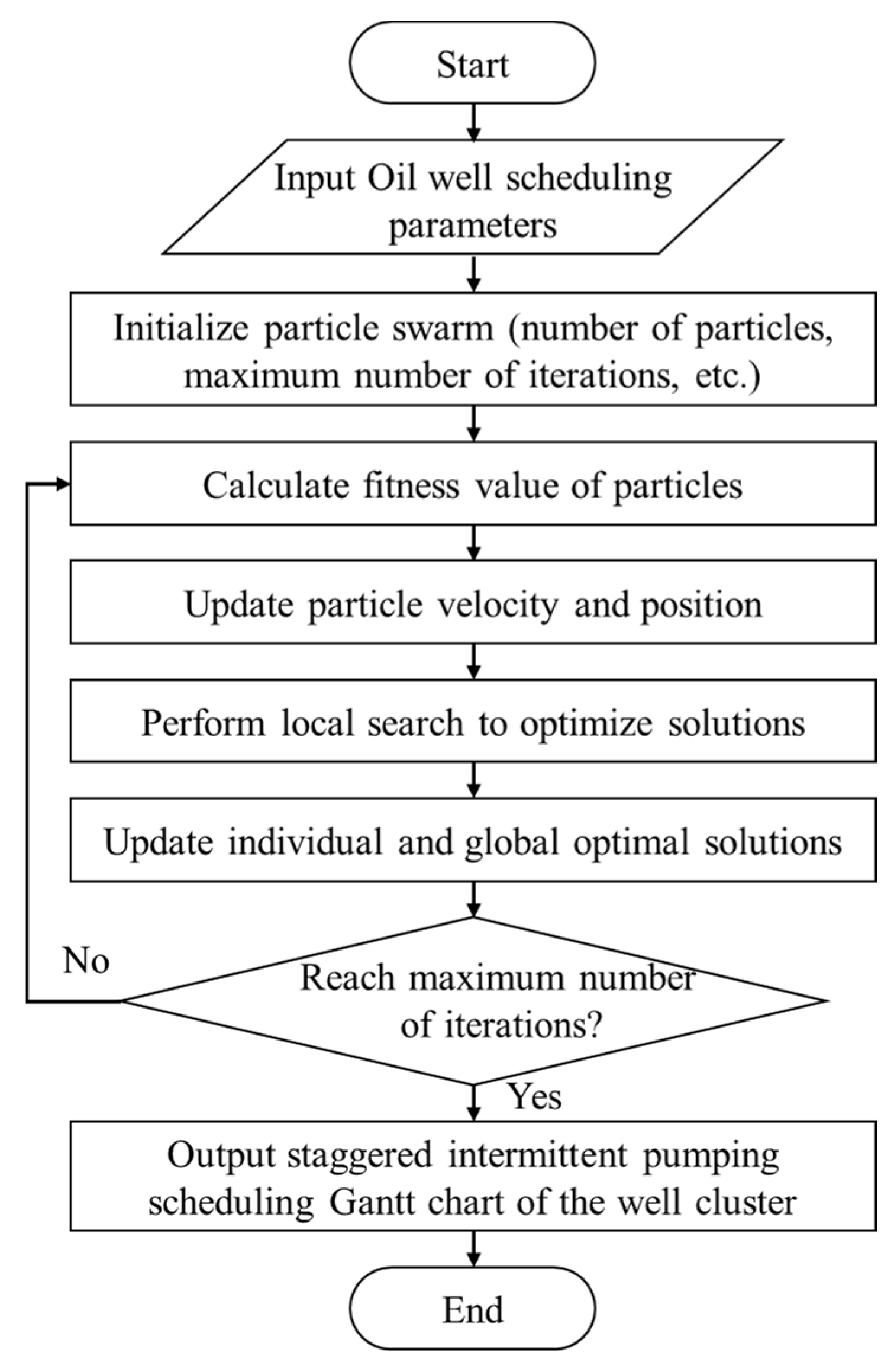
The staggered intermittent pumping scheduling optimization model solving process is as follows:
Step 1. Set the scheduling start time, at which point the well group enters the scheduling process;
Step 2. Input the scheduling parameters of the oil wells, including the minimum operating time for each well, the minimum required production, the production decline lower bound for each well, the minimum required production of the well group, and the maximum and minimum numbers of wells allowed to be switched on or off at each time period within the well group;
Step 3. Initialize the particle swarm, setting parameters such as the number of particles and the maximum number of iterations;
Step 4. Calculate the fitness value of each particle, i.e., the objective function value, update the particles’ velocity and position, and perform position and velocity constraint handling;
Step 5. Conduct local search on each particle to improve solution quality, updating the particles’ best individual solutions and the swarm’s global best solution;
Step 6. After iterations end, output the staggered intermittent pumping schedule of the well group during the scheduling period, the fitness value change curve, the photovoltaic power curve, and the well group power consumption curve.
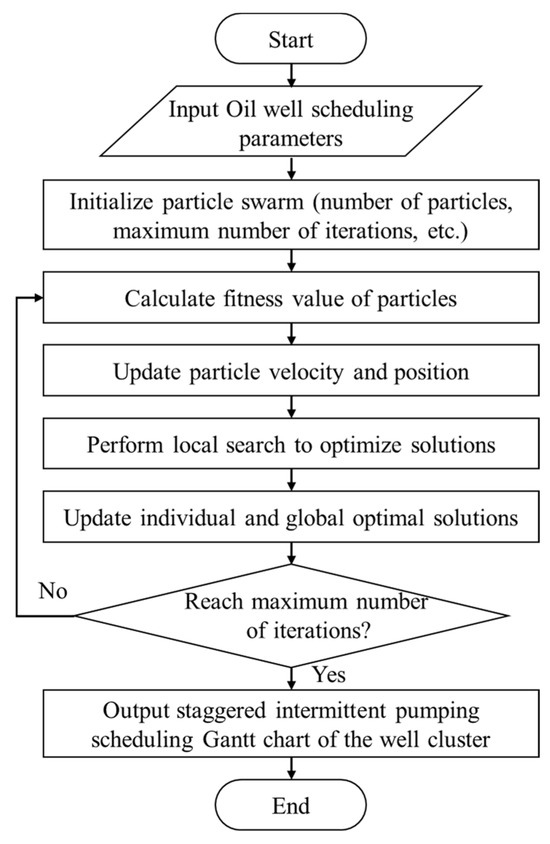
The overall flowchart is shown in Figure 2.
Figure 2.
Flowchart of the Staggered Intermittent Pumping Scheduling Optimization Model Solution.
This algorithm introduces multiple innovations for solving complex nonlinear mixed 0–1 integer programming scheduling problems, establishing an efficient and robust computational framework. Its core contributions include the design of an encoding scheme tailored for mixed variables with hierarchical optimization, the development of a multi-level adaptive mechanism for dynamic parameter adjustment, enhancement of local search capabilities to improve solution precision, and the implementation of an intelligent constraint-handling system to ensure feasibility.
4.3. Benchmark Validation
To verify the stability and global optimality of the proposed improved PSO algorithm, five benchmark instances (Kacem01–Kacem05) from the widely used standard test set proposed by Kacem et al. [22] were employed.
The comparative results on the benchmark instances are presented in Table 3. denotes the best fitness value obtained by the algorithm, corresponding to the minimized maximum completion time of each instance. is used to evaluate the solution accuracy of the algorithm, representing the average relative percentage deviation.
Table 3.
Benchmark Instance Results Comparison.
5. Simulation and Result Analysis
To validate the effectiveness of the proposed optimization algorithm, a simulation study is conducted on ten intermittent rod-pumping wells. The goal is to derive the optimal scheduling strategy for the well group using the proposed method. The scheduling horizon is set to 24 h, and considering on-site production and safety requirements, the minimum scheduling unit is defined as 2 h. That is, each well must operate for at least 2 consecutive hours once started, resulting in a total of 12 discrete time slots for the entire scheduling period. The simulation is divided into two parts. The first part aims to verify the algorithm’s ability to maximize PV power utilization, using the widely adopted commercial solver Gurobi as a benchmark. The second part tests the robustness of the proposed method under insufficient PV power conditions (e.g., cloudy or rainy weather), ensuring the safety and stability of the intermittent well group.
5.1. Case1: Performance Validation Under Sufficient Photovoltaic Power
This case focuses on validating that the proposed algorithm can efficiently compute an optimal scheduling strategy for the intermittent well group while maximizing PV power consumption. The commercial solver Gurobi is employed for comparison. Relevant simulation parameters are given as follows: ; and (some data was omitted due to confidentiality policies).
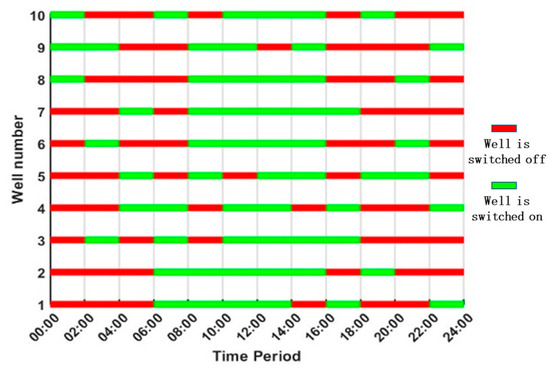
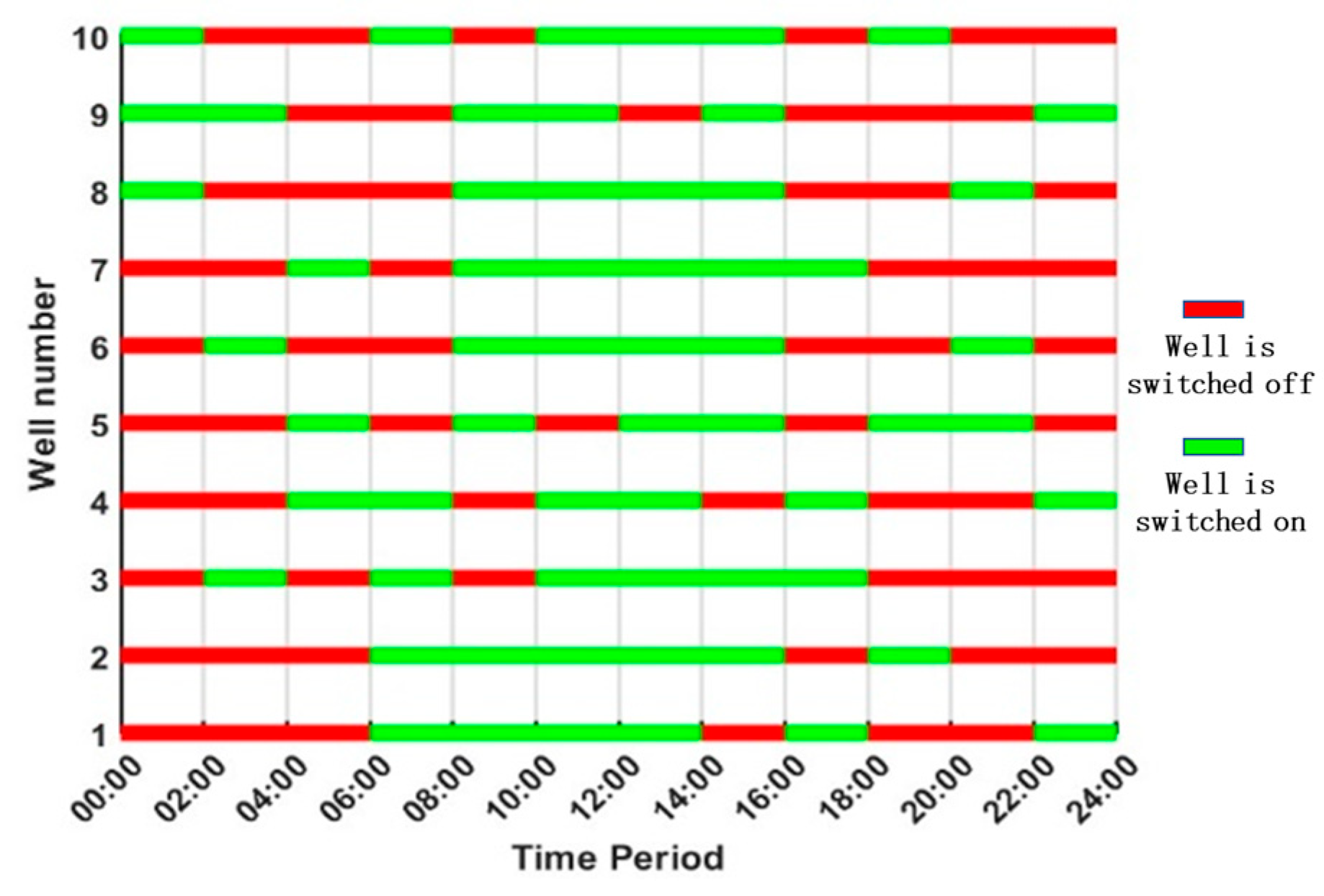
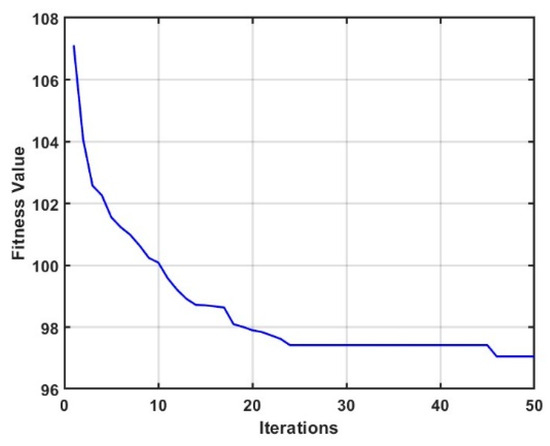
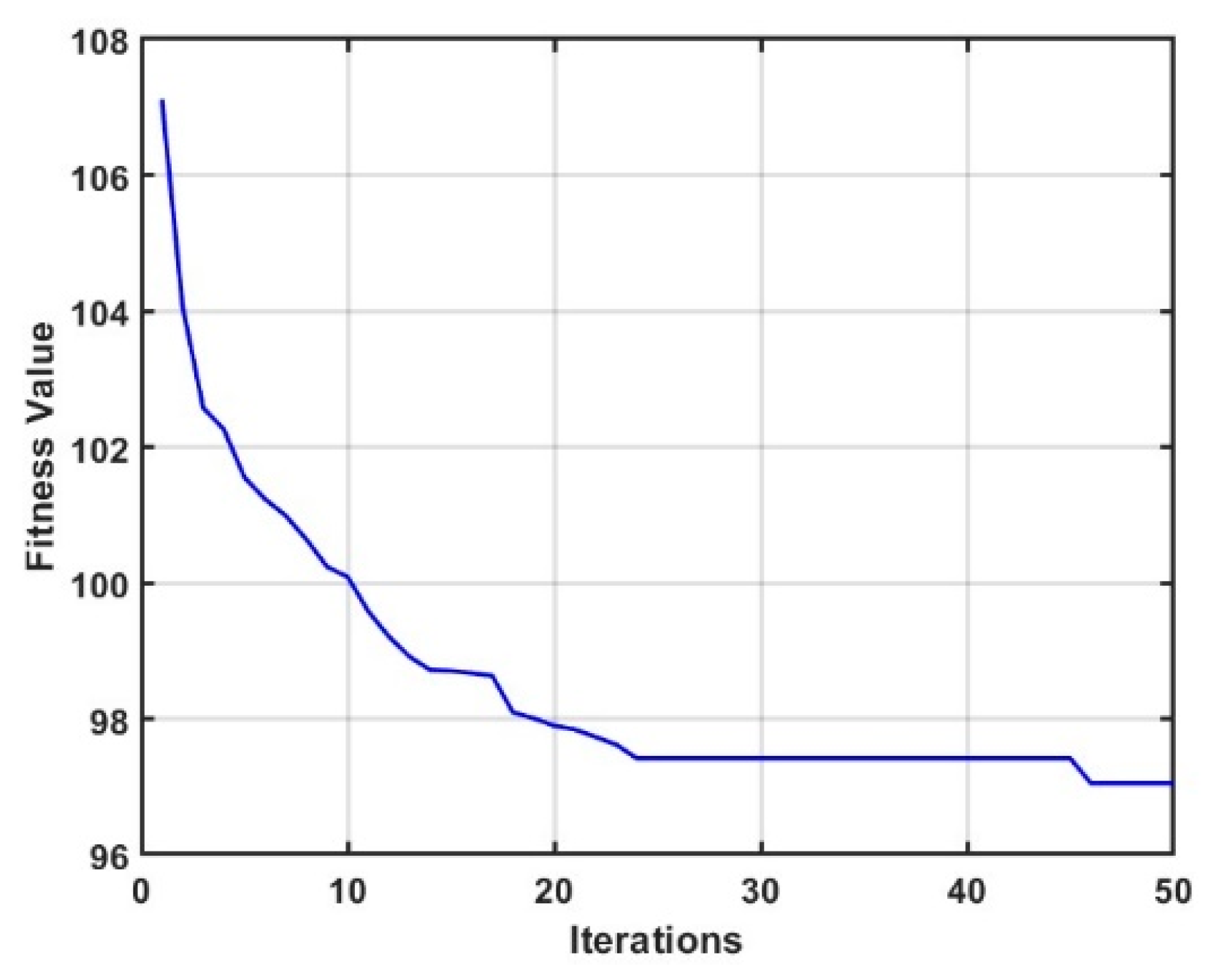
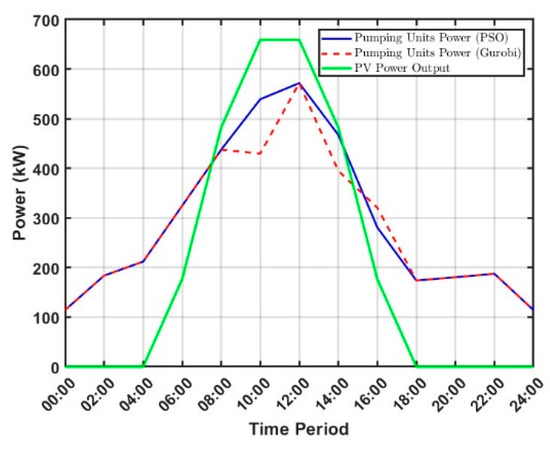
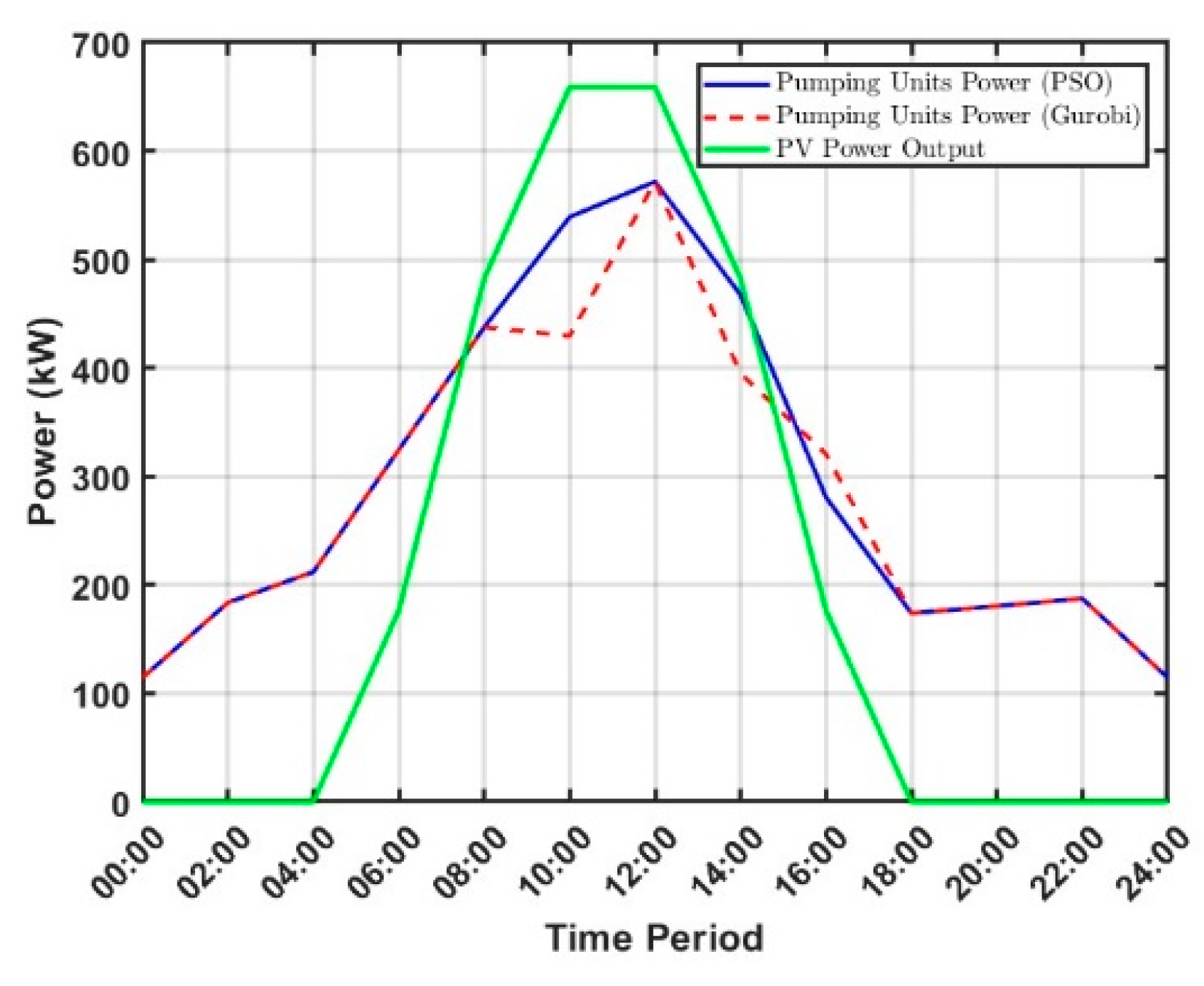
Figure 3, Figure 4 and Figure 5 illustrate the simulation results. Figure 3 presents the well scheduling Gantt chart. It is evident that the proposed improved Particle Swarm Optimization (PSO) algorithm effectively determines a feasible and optimized scheduling strategy, satisfying all operational constraints. Figure 4 shows the fitness value evolution curve. The rapid improvement in early iterations demonstrates the algorithm’s strong initial global search capability, enabling quick identification of promising solutions. In later stages, the curve stabilizes, indicating strong local optimization ability and robustness against premature convergence to local optima. Figure 5 compares PV generation with the total power consumption of the well group under the proposed algorithm and Gurobi. The proposed method closely aligns the well group’s power consumption with available PV power, achieving better PV absorption compared to Gurobi. To quantitatively assess PV utilization under both methods, Table 4 reports the PV power absorption rates over different time slots. Results clearly show that the proposed algorithm outperforms Gurobi in PV utilization across all time periods. In summary, the simulation results confirm that the proposed algorithm can effectively derive optimal scheduling strategies for intermittent wells and significantly enhance local PV power consumption.
Figure 3.
Gantt Chart of Well Group Scheduling of Case1.
Figure 4.
Fitness Value Variation Curve of Case1.
Figure 5.
Comparison of PV Power and Total Power Consumption of Pumping Units of Case1.
Table 4.
Photovoltaic Power Utilization Rate.
5.2. Case 2: Robustness Evaluation Under Low PV Conditions
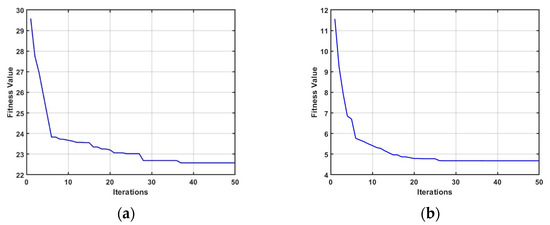
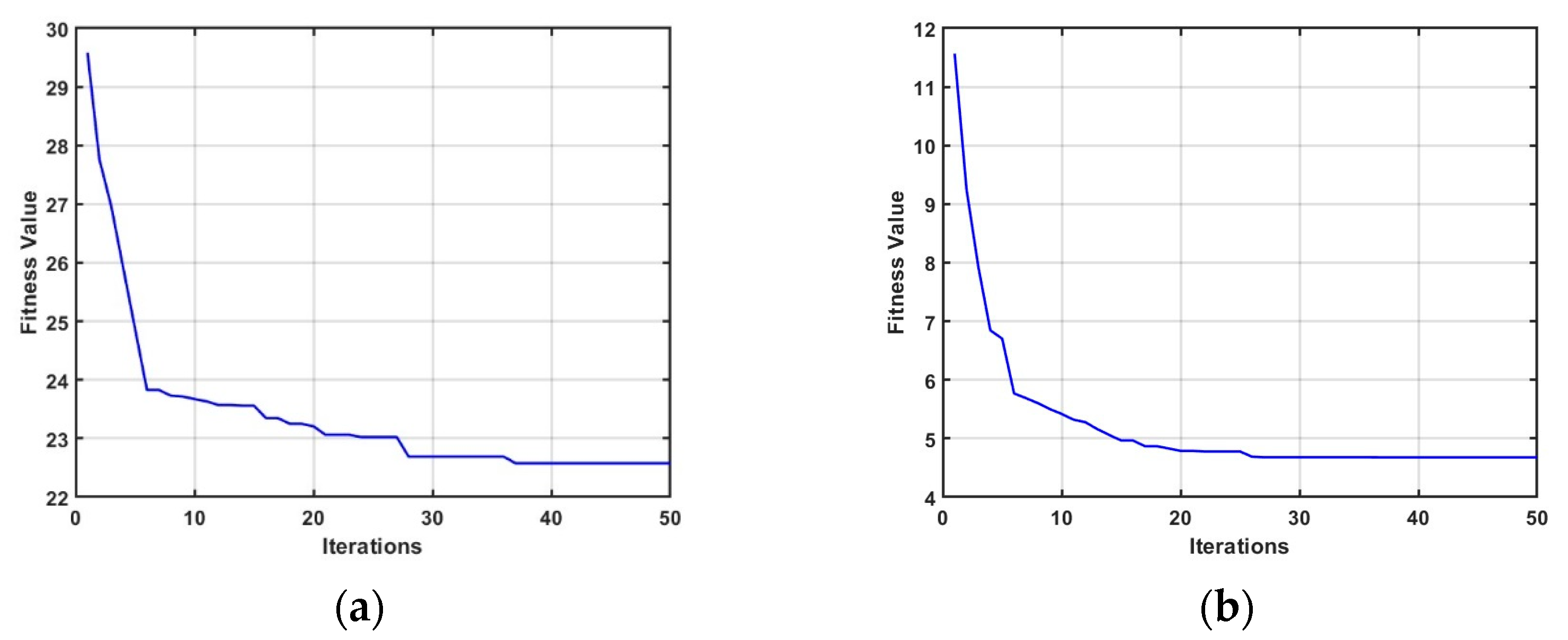
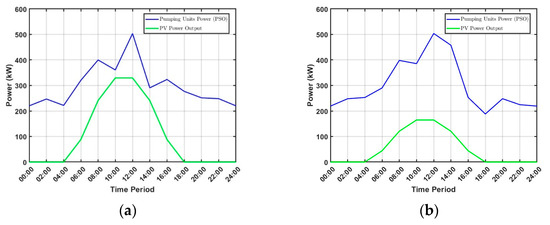
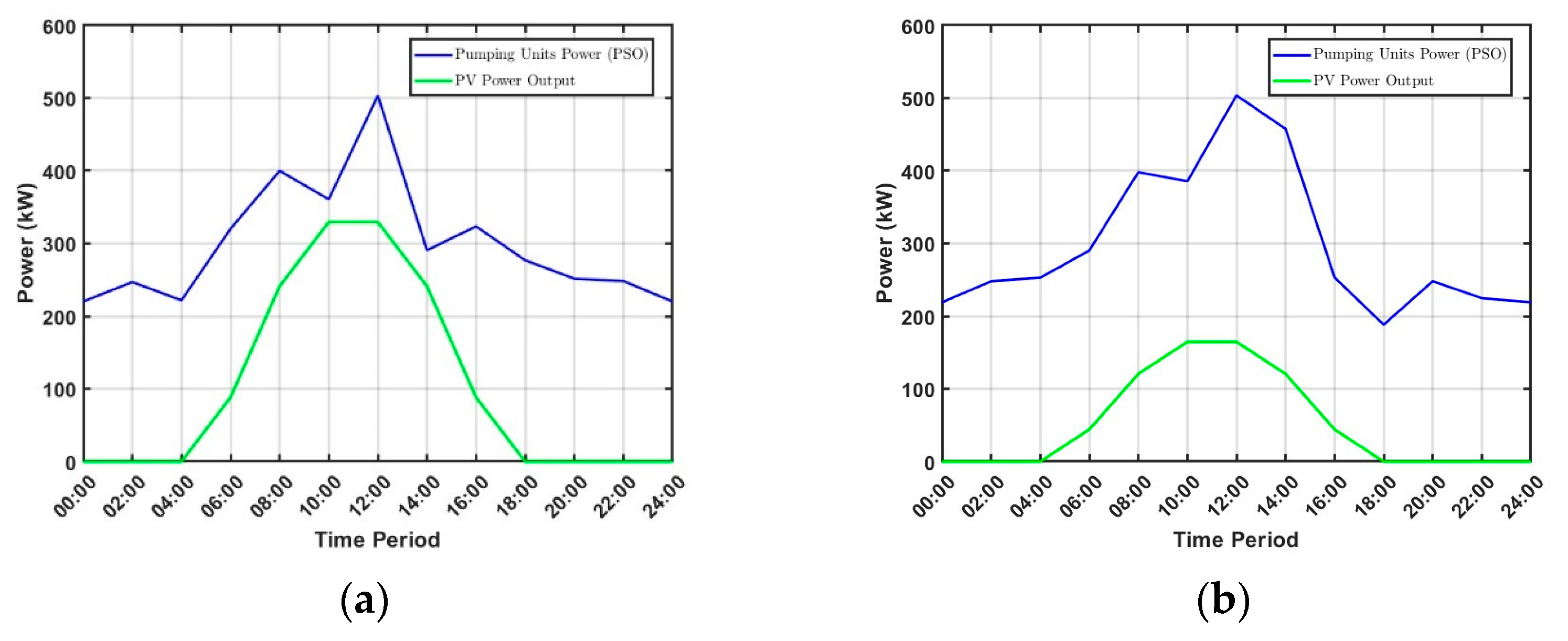
This simulation aims to verify whether the proposed optimization algorithm can still ensure stable operation of the intermittent well group under low PV power conditions, such as during cloudy or rainy weather. Series a corresponds to cloudy conditions, while Series b corresponds to overcast conditions. The parameters are adjusted as follows: .
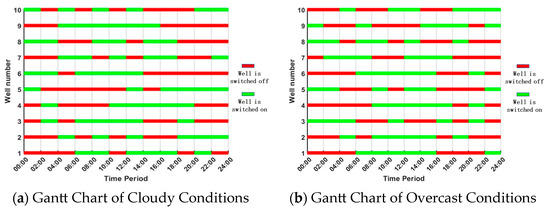
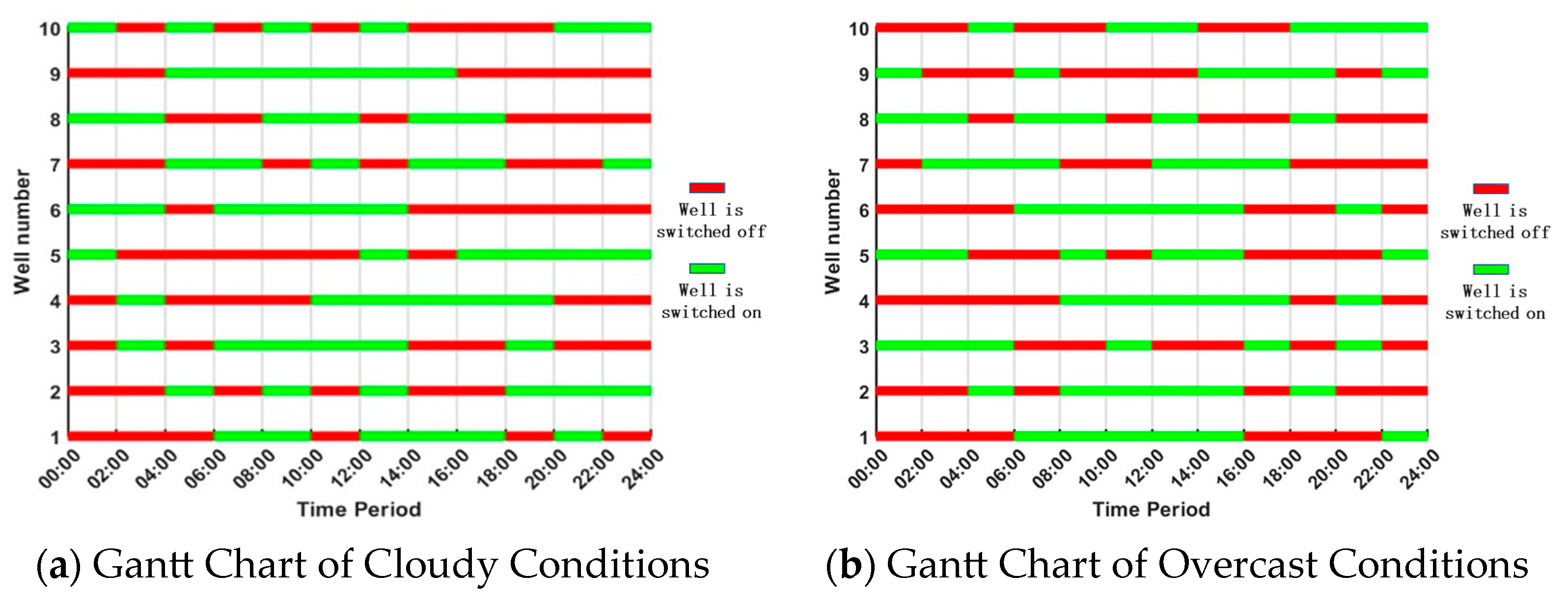
The simulation results are shown in Figure 6, Figure 7 and Figure 8. Figure 6 presents the Gantt chart of well group scheduling. It can be observed that even under insufficient PV power, the scheduling strategy remains feasible and complies with the corresponding well-switching constraints, demonstrating the robustness of the proposed algorithm. Figure 7 illustrates the fitness value evolution curve, showing the algorithm’s rapid convergence and high efficiency. Figure 8 compares the PV power output with the total power consumption of the well group. The PV power is significantly lower than the consumption throughout the scheduling horizon, indicating that under low PV availability, the algorithm does not suppress the wells’ energy demand. Instead, it ensures that the basic production requirements of the system are met.
Figure 6.
Gantt Chart of Well Group Scheduling of Case 2.
Figure 7.
Fitness Value Variation Curve of Case 2. (a) Fitness Value Variation Curve of Cloudy Conditions; (b) Fitness Value Variation Curve of Overcast Conditions.
Figure 8.
Comparison of PV Power and Total Power Consumption of Pumping Units of Case 2. (a) Comparison of Power of Cloudy Conditions; (b) Comparison of Power of Overcast Conditions.
In summary, the proposed algorithm is capable of handling varying PV power conditions. It achieves optimal scheduling of intermittent well operations while maintaining system stability and maximizing the utilization of available renewable energy. The algorithm demonstrates excellent convergence performance, strong constraint-handling ability, broad applicability, and high computational efficiency and solution quality.
6. Conclusions
This paper comprehensively considers the production constraints of pumping wells and the photovoltaic power model, establishing a nonlinear integer programming model with the objective of minimizing the difference between the system’s total energy consumption and photovoltaic power supply. A specially improved particle swarm optimization algorithm is employed to efficiently solve this mixed-integer nonlinear programming model, yielding high-quality global optimal solutions. This enables the optimal scheduling of intermittent pumping well groups and achieves full utilization of photovoltaic power. The study lays a theoretical foundation for the further utilization of photovoltaic energy in oilfields and provides a basis for realizing the integrated “source-grid-load-storage” system in oilfields, offering valuable insights for the efficient use of photovoltaic power generation in oilfield operations.
Future work will focus on the scheduling and coordinated operation of energy storage systems, wind power generation, and intelligent distribution networks. The proposed algorithm is expected to scale effectively to larger well groups and more complex multi-energy systems; however, its performance under highly stochastic field conditions remains to be empirically validated. Continued field experiments will be essential to evaluate its robustness and to identify potential limitations under real-world operational uncertainties.
Author Contributions
Conceptualization, G.Q., C.Z., Y.Y. and J.F.; Methodology, G.Q., C.Z. and Y.Y.; Software, G.Q., C.Z. and Y.Y.; Validation, G.Q., C.Z., Y.Y. and F.L.; Formal analysis, G.Q., C.Z., Y.Y. and F.L.; Investigation, G.Q., C.Z. and J.F.; Resources, G.Q., C.Z. and J.F.; Data curation, G.Q., C.Z. and J.F.; Writing—original draft, G.Q., C.Z. and F.L.; Writing—review and editing, G.Q., C.Z. and F.L.; Visualization, D.Z.; Supervision, D.Z.; Project administration, D.Z. All authors have read and agreed to the published version of the manuscript.
Funding
This research was supported by the National Natural Science Foundation of China under Grant 61973315.
Data Availability Statement
The original contributions presented in this study are included in the article. Further inquiries can be directed to the corresponding author.
Conflicts of Interest
The authors declare no conflict of interest.
References
- Li, K.; Xu, W.; Han, Y.; Wang, Y.; Ge, F. Prediction and modeling for interval time of the intermittent pumping well based on parallel system. In Proceedings of the IEEE 8th Data Driven Control and Learning Systems Conference (DDCLS), Dali, China, 24–27 May 2019. [Google Scholar] [CrossRef]
- Taghizadegan, N.; Cheshmeh Khavar, S.; Abdolahi, A.; Arasteh, F.; Ghoreyshi, R. Dominated GSO algorithm for optimal scheduling of renewable microgrids with penetration of electric vehicles and energy storages considering DRP. Int. J. Ambient. Energy 2022, 43, 6380–6391. [Google Scholar] [CrossRef]
- Salehi, J.; Abdolahi, A. Optimal scheduling of active distribution networks with penetration of PHEV considering congestion and air pollution using DR program. Sustain. Cities Soc. 2019, 51, 101709. [Google Scholar] [CrossRef]
- Abdolahi, A.; Gazijahani, F.S.; Alizadeh, A.; Kalantari, N.T. Chance-constrained CAES and DRP scheduling to maximize wind power harvesting in congested transmission systems considering operational flexibility. Sustain. Cities Soc. 2019, 51, 101792. [Google Scholar] [CrossRef]
- Kosmidis, V.D.; Perkins, J.D.; Pistikopoulos, E.N. A mixed integer optimization formulation for the well scheduling problem on petroleum fields. Comput. Chem. Eng. 2005, 29, 1523–1541. [Google Scholar] [CrossRef]
- Carvalho, M.C.A.; Pinto, J.M. A bilevel decomposition technique for the optimal planning of offshore platforms. Braz. J. Chem. Eng. 2006, 23, 67–82. [Google Scholar] [CrossRef]
- De Souza, J.N.M.; De Medeiros, J.L.; Costa, A.L.H.; Nunes, G.C. Modeling, simulation and optimization of continuous gas lift systems for deepwater offshore petroleum production. J. Pet. Sci. Eng. 2010, 72, 277–289. [Google Scholar] [CrossRef]
- Zhang, Z.; Tan, C.; Gao, X.; Zuo, X.; Chen, T. A mixed integer linear programming model for production scheduling of non-pipelined wells. In Proceedings of the IEEE 15th International Conference on Control and Automation, Edinburgh, UK, 16–19 July 2019. [Google Scholar] [CrossRef]
- Gao, X.; Xie, Y.; Wang, S.; Wu, M.; Wang, Y.; Tan, C.; Zuo, X.; Chen, T. Offshore oil production planning optimization: An MINLP model considering well operation and flow assurance. Comput. Chem. Eng. 2020, 133, 106674. [Google Scholar] [CrossRef]
- Gao, X.; Li, C.; Tan, C. A mixed integer nonlinear optimization method for inter well pumping between pumping units in a non energy storage opto electric microgrid. Oil Drill. Prod. Technol. 2023, 45, 773–782. [Google Scholar] [CrossRef]
- Iyer, R.R.; Grossmann, I.E.; Vasantharajan, S.; Cullick, A.S. Optimal planning and scheduling of offshore oil field infrastructure investment and operations. Ind. Eng. Chem. Res. 1998, 37, 1380–1397. [Google Scholar] [CrossRef]
- Gunnerud, V.; Foss, B.A.; McKinnon, K.I.M.; Nygreen, B. Oil production optimization solved by piecewise linearization in a Branch & Price framework. Comput. Oper. Res. 2012, 39, 2469–2477. [Google Scholar] [CrossRef][Green Version]
- Gunnerud, V.; Foss, B. Oil production optimization—A piecewise linear model, solved with two decomposition strategies. Comput. Chem. Eng. 2010, 34, 1803–1812. [Google Scholar] [CrossRef]
- Knudsen, B.R.; Grossmann, I.E.; Foss, B.; Conn, A.R. Lagrangian relaxation based decomposition for well scheduling in shale-gas systems. Comput. Chem. Eng. 2014, 63, 234–249. [Google Scholar] [CrossRef]
- Lang, J.; Tang, L.X. Batch scheduling problem of oil well considering ramping constraints in oilfield production. Acta Autom. Sin. 2019, 45, 388–397. [Google Scholar] [CrossRef]
- Tan, C.; Li, Y.; Gao, X.; Ai, X.; Kui, G.; Sun, Y.; Feng, G. Scheduling optimization of staggered peak intermittent pumping of pumping well group in cluster well site. J. Xi’an Shiyou Univ. (Nat. Sci. Ed.) 2021, 36, 83–90. [Google Scholar] [CrossRef]
- Li, H.; Li, X.; Gao, L. A discrete artificial bee colony algorithm for the distributed heterogeneous no-wait flowshop scheduling problem. Appl. Soft Comput. 2021, 100, 106946. [Google Scholar] [CrossRef]
- Li, J.; Pan, Q.; Gao, K. Pareto-based discrete artificial bee colony algorithm for multi-objective flexible job shop scheduling problems. Int. J. Adv. Manuf. Technol. 2011, 55, 1159–1169. [Google Scholar] [CrossRef]
- Xu, Z. Microgrid Optimization Scheduling Research Based on an Improved Particle Swarm Optimization Algorithm. Ph.D. Dissertation, Shenyang Agricultural University, Shenyang, China, 2024. [Google Scholar] [CrossRef]
- Yang, X. Cooperative Optimization of Staggered Peak and Intermittent Pumping Operation for Beam Pumping Unit Well Groups. Ph.D. Dissertation, China University of Petroleum (Beijing), Beijing, China, 2023. [Google Scholar] [CrossRef]
- Huang, X.; Lai, C.; Li, J.; Chen, L.; Duan, K. Quantile regression combined with PSO-LSTM power prediction method of photovoltaic power generation system. Autom. Instrum. 2024, 290–294. [Google Scholar] [CrossRef]
- Kacem, I.; Hammadi, S.; Borne, P. Approach by localization and multiobjective evolutionary optimization for flexible job-shop scheduling problems. In IEEE Transactions on Systems, Man, and Cybernetics, Part C (Applications and Reviews); IEEE: New York, NY, USA, 2002; pp. 1–13. [Google Scholar] [CrossRef]

Disclaimer/Publisher’s Note: The statements, opinions and data contained in all publications are solely those of the individual author(s) and contributor(s) and not of MDPI and/or the editor(s). MDPI and/or the editor(s) disclaim responsibility for any injury to people or property resulting from any ideas, methods, instructions or products referred to in the content. |
© 2025 by the authors. Licensee MDPI, Basel, Switzerland. This article is an open access article distributed under the terms and conditions of the Creative Commons Attribution (CC BY) license (https://creativecommons.org/licenses/by/4.0/).