


Abstract
Small and medium-sized enterprises (SMEs) hear that generative artificial intelligence (GenAI) can optimize operations and marketing, yet many entrepreneurs remain unsure how to adopt it. The land-grant university Cooperative Extension System is well positioned to bridge this gap, but empirical evidence of Extension’s impact on SME GenAI adoption is scarce. This mixed-methods study evaluates Colorado State University Extension’s GenAI educational program, comprising 20 workshops and technical consultations for 236 entrepreneurs and business owners. Grounded in a TAM–TOE framework, surveys from 129 respondents show gains in perceived usefulness, ease of use, self-efficacy, and intention to use GenAI (mean increases of approximately 1.3–1.5 points on a 5-point scale; d ≈ 0.85–0.88). Behavioral data indicate that 90% of participants had tried at least one GenAI task since attending. Structured interviews with 21 SME owners highlight how specific GenAI resources (prompt guides, supervised exercises, and technical consultations) functioned as scaffolds, positioned Extension as a trusted curator, and exposed governance, cost, and equity barriers. They also reveal an emergent governance gap: individual acceptance and use ran ahead of organizational readiness. No interviewee described an acceptable-use policy, an assigned owner for AI decisions, or guidance on business data entry in their enterprise, and five stated explicitly that none existed. The findings refine TAM–TOE applications in SMEs by showing how Extension functions as a knowledge-transfer and de-risking mechanism within the entrepreneurial ecosystem.
1. Introduction
Generative artificial intelligence (GenAI), a rapidly evolving subset of artificial intelligence (AI), is increasingly embedded in entrepreneurial practice [1,2]. GenAI tools such as ChatGPT, Gemini, Claude, Copilot, and Perplexity are now routinely used by entrepreneurs and business owners to streamline operations, generate content, and improve marketing outcomes [1,3]. Building on broader AI research in entrepreneurship, a study identified three ways AI can support entrepreneurial activity: searching for technical solutions across large knowledge domains; using social-sentiment analysis and natural language processing (NLP) to extract customer needs from online content; and leveraging existing firm data assets to predict customer reactions [4]. While such applications highlight the promise of AI for enhancing opportunity recognition and production, concerns about labor displacement, income distribution, and broader social consequences remain unresolved, and the specific implications for entrepreneurs are still underexplored [5].
Small and medium-sized enterprises (SMEs) are typically distinguished from large companies by thresholds in employee count (e.g., fewer than 500 employees in the US, fewer than 250 in the European Union), annual revenues, or total assets [6]. For SMEs, GenAI adoption may amplify entrepreneurial rewards by improving efficiency and decision-making, yet limited internal capacity and uncertainty about where to start can inhibit uptake [4]. The Cooperative Extension System of public land-grant universities fulfills the institutions’ outreach function; it occupies a distinctive position within the entrepreneurial ecosystem, offering practice-oriented guidance focused on emerging technologies [7,8]. But empirical evidence on their role in SME GenAI adoption is rare.
The adoption of new technologies by SMEs has been theorized extensively. The Technology–Organization–Environment (TOE) framework [9] locates firm-level adoption in the interplay of technological, organizational, and environmental conditions. The absorptive-capacity perspective [10] holds that a firm’s capacity to recognize, assimilate, and apply external knowledge depends on its prior related knowledge. More recent work on SME digital transformation extends these foundations, emphasizing organizational readiness and the reconfiguration of routines that digital tools demand [11]. A common thread runs through the literature: adoption is treated as effortful. Since earlier enterprise technologies imposed real costs of access, integration, and skill, individual acceptance and organizational adoption were tightly linked, and much of the theory implicitly treats the former as an indicator of the latter.
GenAI is taken up by individuals almost effortlessly, so individual acceptance no longer signals that a firm is ready to use it. This study asks what that separation reveals about SME adoption theory and how a public intermediary, university Extension, shapes the path from individual acceptance to organizational readiness. It draws on a mixed-methods evaluation of a Colorado State University (CSU) Extension GenAI program (129 survey respondents, 21 interviews). It makes two contributions: it provides one of the first practice-based accounts of Extension’s role in SME GenAI adoption, and it discovers, from interview evidence, an emergent governance gap between individual acceptance and organizational readiness, stated as a proposition for future testing. The following are the three specific research questions:
- RQ1: Following participation in an Extension GenAI program, what changes do SME owners report in their GenAI-related perceptions (perceived usefulness, perceived ease of use, self-efficacy, intention) and early-use behaviors?
- RQ2: Through what mechanisms, and with what role for Extension and other ecosystem actors, do participants move from GenAI awareness toward organizational use?
- RQ3: What organizational and governance barriers persist even when individual GenAI readiness is high?
2. Context and Theoretical Framework
While entrepreneurship research frequently discusses AI, it less often distinguishes GenAI as a specific subset of the broader AI hierarchy [3,12,13]. The distinction is consequential because non-technical users engage almost exclusively with consumer-facing GenAI tools (e.g., ChatGPT, Gemini, Copilot, Claude) to draft documents, create marketing materials, and prototype ideas [14]. For them, “AI” means the tools they use, not the machine learning or deep learning model development that AI engineers treat as “doing AI” [15,16]. Table 1 summarizes these contrasting perspectives. Conflating the full AI stack with these application-layer tools risks distorting adoption and governance analyses in entrepreneurial contexts.
Table 1.
Distinguishing between GenAI and AI from different perspectives.
This distinction underpins the study’s design: the CSU Extension program focuses on using GenAI tools to generate content and optimize business workflows rather than teaching participants to code or build AI infrastructure. Accordingly, the analysis centers on how non-technical entrepreneurs use GenAI for business tasks, avoiding confusion between consumer use and engineering labor. Since GenAI operates at the application layer and can be used without requiring advanced technical skills, individuals can use it almost effortlessly, often adopting it long before organizations implement guidance. This low individual barrier creates the possibility that individual acceptance runs ahead of organizational governance; the interviews examined whether it did.
SMEs face challenges when adopting GenAI, including a lack of technical knowledge, implementation costs, and limited information technology (IT) infrastructure, as well as concerns about the complexity of GenAI solutions, financial risk, delays in implementation, and ethical or acceptance issues [6,17]. Within public land-grant universities, similar constraints shape Extension’s capacity: GenAI has evolved rapidly, and most professionals are still catching up in skills to provide education at scale. At the same time, a group of pioneers has begun to demonstrate what is possible through AI engineering and GenAI programming in Extension [2,18].
In this context, CSU Extension launched a GenAI educational program, “Mastering GenAI for Business Growth: Tools, Tips, and Viral Strategies.” From 2025 to 2026, an Extension faculty member delivered 20 workshops and follow-up technical consultations to 236 entrepreneurs and business owners, who came from 32 Colorado counties and several other states. The program was designed to ensure broad access to GenAI tools and strategies tailored for small businesses and early-stage ventures. Delivery was ecosystem-based, partnering with Rural Community Assistance Corporation, Logan County Economic Development Corporation, Rocky Mountain MicroFinance Institute, Colorado Startup Week, Boulder Startup Week, and CSU Spur to reach diverse audiences from both urban and rural areas. The program articulated short-term outcomes (e.g., increased knowledge of GenAI tools and use cases) and longer-term outcomes (e.g., behavior change and sustained AI adoption).
Conceptually, this work sits within broader debates on the digital transformation of innovation and entrepreneurship. Existing research highlights three key themes, openness, affordability, and creativity, that characterize digital tools and platforms [19]. GenAI is highly open (accessible via low-cost or free interfaces), rich in affordability for content creation and analysis, and strongly generative in the sense that it can be recombined for new applications in marketing, planning, and service delivery. However, realizing these qualities in SMEs depends on both individual-level acceptance and the organizational and environmental conditions in which adoption occurs.
2.1. Intermediaries in SME Technology Adoption and Cooperative Extension System
SMEs rarely adopt new technologies without external support. Research on innovation intermediaries shows that third parties, such as business support organizations, chambers of commerce, and publicly funded advisory services, help reduce the search, learning, and trust costs that often prevent SMEs from adopting new technologies [20,21]. This intermediary role is reflected in support systems across different countries and regions. In the US, Small Business Development Centers (SBDCs) provide no-cost advising and low-cost training to roughly one million small businesses and entrepreneurs each year [22]. In the European Union, European Digital Innovation Hubs offer test-before-invest services and skills training to SMEs across all member states [23]. Similarly, Growth Hubs in the UK serve as regional intermediaries connecting businesses with relevant support and expertise [24,25].
Despite the established role of these intermediaries in supporting SME innovation, existing research has focused primarily on digitalization in general. The limited research examining AI adoption has largely treated AI as an enterprise-level technology that firms formally procure, integrate, and deploy [26]. This perspective reflects a more traditional model of technology adoption, in which organizations make formal investment decisions and provide structured implementation and training processes [27]. However, GenAI introduces a different adoption dynamic: individual employees can independently access GenAI tools before their organizations make formal procurement or integration decisions. This shift from organization-led implementation to employee-initiated use raises new questions about the role of innovation intermediaries in helping SMEs responsibly adopt GenAI. As of September 2026, no study identified in this review has examined how a public intermediary shapes employee-initiated GenAI adoption in SMEs. Addressing this gap is the focus of the present study.
The Cooperative Extension System of land-grant universities is the public intermediary studied here. This system was established to translate university research into practical education for the public [28]. Extension operates through county offices staffed by educators who are university faculty or staff. It is funded jointly by federal, state, and county governments, and its programs are free or low cost to participants. For most of its history, the public associates Extension with agriculture because it often serves agricultural stakeholders [2]. Over the past three decades, its portfolio has broadened to community and economic development, including educational programs for entrepreneurs and small businesses [8,29]. The GenAI program evaluated in this study sits in that newer portfolio.
The Cooperative Extension System is specific to the US, but its defining features are not. It is public and trusted because it has provided research-based, non-commercial service for over a century. Each of these features has a counterpart elsewhere: the European Digital Innovation Hubs are publicly co-funded and regionally anchored [23]; the UK Growth Hubs are run by local partnerships [25]; and Australia’s “Regional Development Australia” committees connect small firms in non-metropolitan areas to government programs [30]. Therefore, this study speaks to any intermediary that combines public backing with local delivery, and the design principles in Section 5.3 are written so that such an intermediary could apply them.
2.2. Theoretical Framework
The separation between individual technology use and organizational adoption has been documented in the shadow IT and IT consumerization literature, which describes how employees adopt unauthorized software and consumer technologies before formal organizational approval [31,32,33]. However, GenAI presents additional governance challenges [8]. First, employees may enter sensitive business information, such as customer records or draft contracts, into third-party AI tools, creating data privacy and confidentiality risks. Second, GenAI produces probabilistic outputs that can appear credible despite containing errors, making verification difficult for users without relevant expertise. Third, its low barriers to access allow employees to use it without IT involvement, often leaving organizational leaders unaware of its adoption. Together, these characteristics can widen the gap between individual GenAI use and organizational oversight, making it less visible and more difficult to govern than earlier forms of shadow IT.
Absorptive capacity provides a complementary lens for understanding why individual GenAI learning does not necessarily translate into organizational adoption. Cohen and Levinthal define absorptive capacity as a firm’s ability to recognize the value of external knowledge, assimilate it, and apply it to commercial ends [10]. Zahra and George further distinguish four processes: knowledge acquisition and assimilation (potential absorptive capacity), and transformation and exploitation (realized absorptive capacity) [34]. In this study, Extension workshops primarily facilitate individual participants’ knowledge acquisition, as reflected in the learning gains reported in Section 4.1. However, individual knowledge does not automatically become organizational capacity. Its organizational value depends on whether SMEs can assimilate, integrate, and apply that knowledge through shared practices, appropriate policies, and assigned responsibilities. Since the study does not separately measure all four dimensions of absorptive capacity, the concept serves as an interpretive lens rather than an independently tested construct. The divergence between individual knowledge acquisition and organizational capacity to embed and govern GenAI use is conceptualized as an emergent governance gap, which is further examined through qualitative interviews and developed as a proposition in Section 5.2.
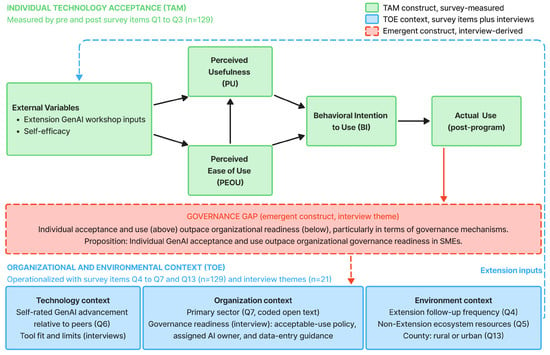
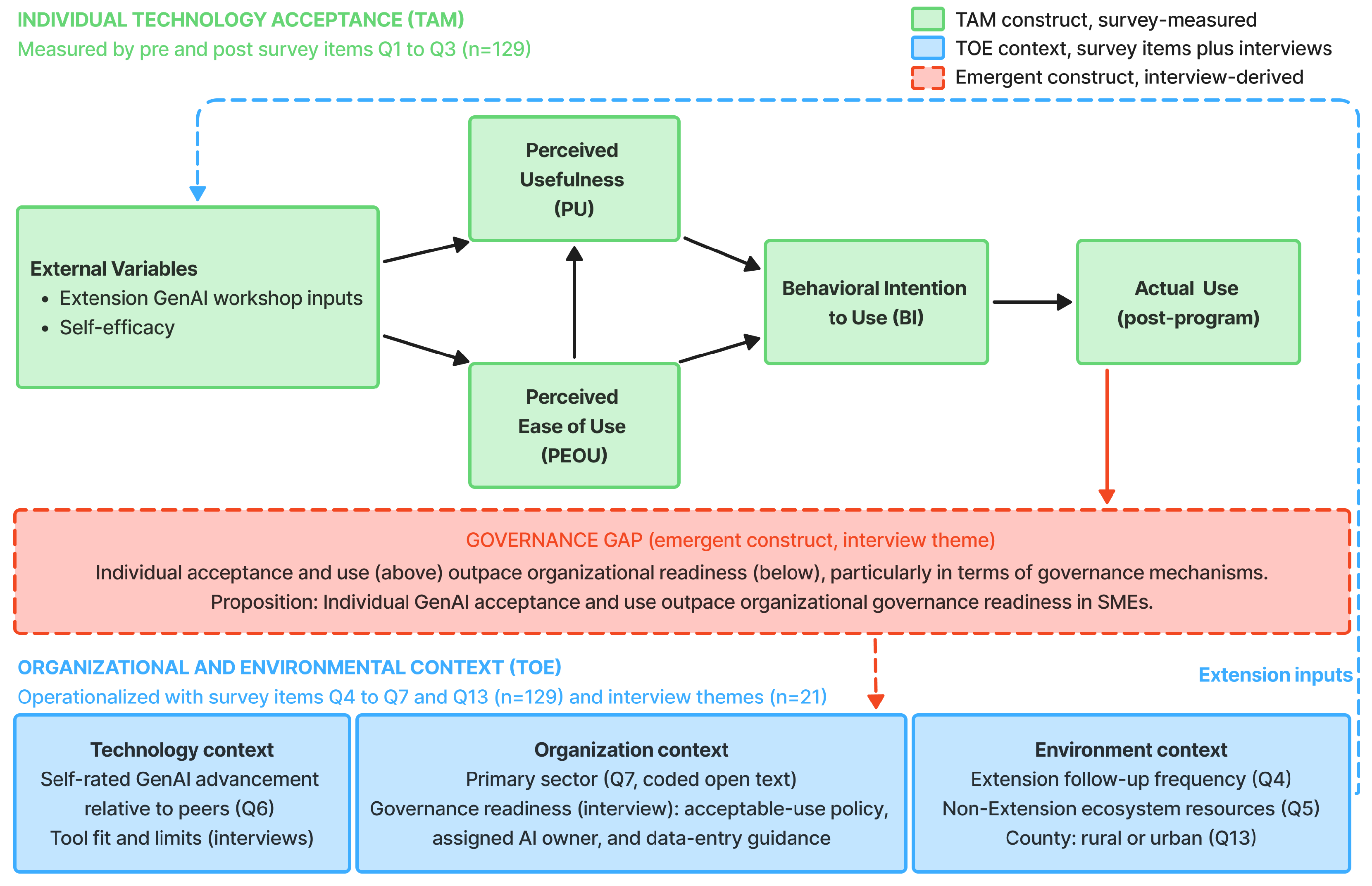
To examine these dynamics across individual, organizational, and environmental levels, this study integrates the Technology Acceptance Model (TAM) [35] with the Technology–Organization–Environment (TOE) framework [9] (Figure 1). TAM explains individual technology acceptance through perceived usefulness (PU) and perceived ease of use (PEOU), which predict behavioral intention (BI) to use technology [35,36,37]. Following this specification, the study models PU and PEOU as direct predictors of BI; attitude toward using was not measured. Self-efficacy is included as an external variable that influences PEOU [37] and is particularly relevant to hands-on technology training. TOE complements TAM by accounting for the technological characteristics, organizational readiness, and environmental conditions that shape technology adoption, including external support, competitive pressures, and regulatory environments [17,38,39,40]. Both frameworks have been applied to examine emerging technology adoption in SMEs, including GenAI [38,41,42].
Figure 1.
Theoretical framework integrating the Technology Acceptance Model (TAM) and the Technology–Organization–Environment (TOE). Note. The framework integrates two levels. The individual level follows the TAM [35,37] and is measured by survey items Q1 to Q3 (), while the organizational level follows the three TOE contexts [9] and is operationalized through survey items Q4 to Q7 and Q13 (), supplemented by interview themes (). The governance gap is an emergent construct derived from the interviews. Extension is situated within the TOE environment context and modeled as an external influence on individual-level TAM constructs. Absorptive capacity [10,34] provides an interpretive lens for understanding how knowledge gained by individual participants may be assimilated, transformed, and exploited at the organizational level; its four dimensions are not separately measured in this study.
In this integrated framework, TAM captures the individual-level pathway of GenAI acceptance, while TOE situates individual use within the broader organizational and entrepreneurial ecosystem. The survey measures TAM constructs, including PU, PEOU, self-efficacy, and BI, while the organizational and environmental dimensions of TOE inform the examination of organizational readiness and external support through survey items and interview themes. External support includes the Extension GenAI educational program, technical consultations, and other entrepreneurial ecosystem actors, such as economic development corporations, chambers of commerce, and peer forums. Positioned within the TOE environment context, Extension may influence individual acceptance by increasing participants’ PU, PEOU, and self-efficacy. Accordingly, the study expects greater Extension engagement (workshops, educational materials, and technical consultations) to be positively associated with these TAM constructs, which, in turn, are expected to be associated with stronger BI and broader GenAI use. Drawing on TOE and absorptive capacity, the study further expects organizational readiness, particularly governance capacity, to lag behind individual acceptance. This potential divergence is examined through qualitative interviews (RQ3).
2.3. GenAI Educational Program Design
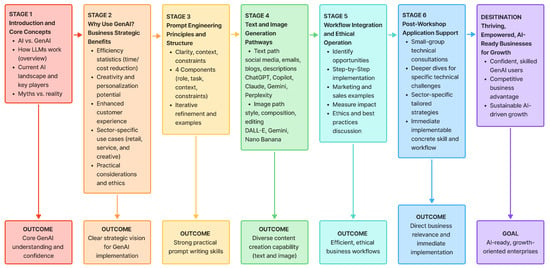
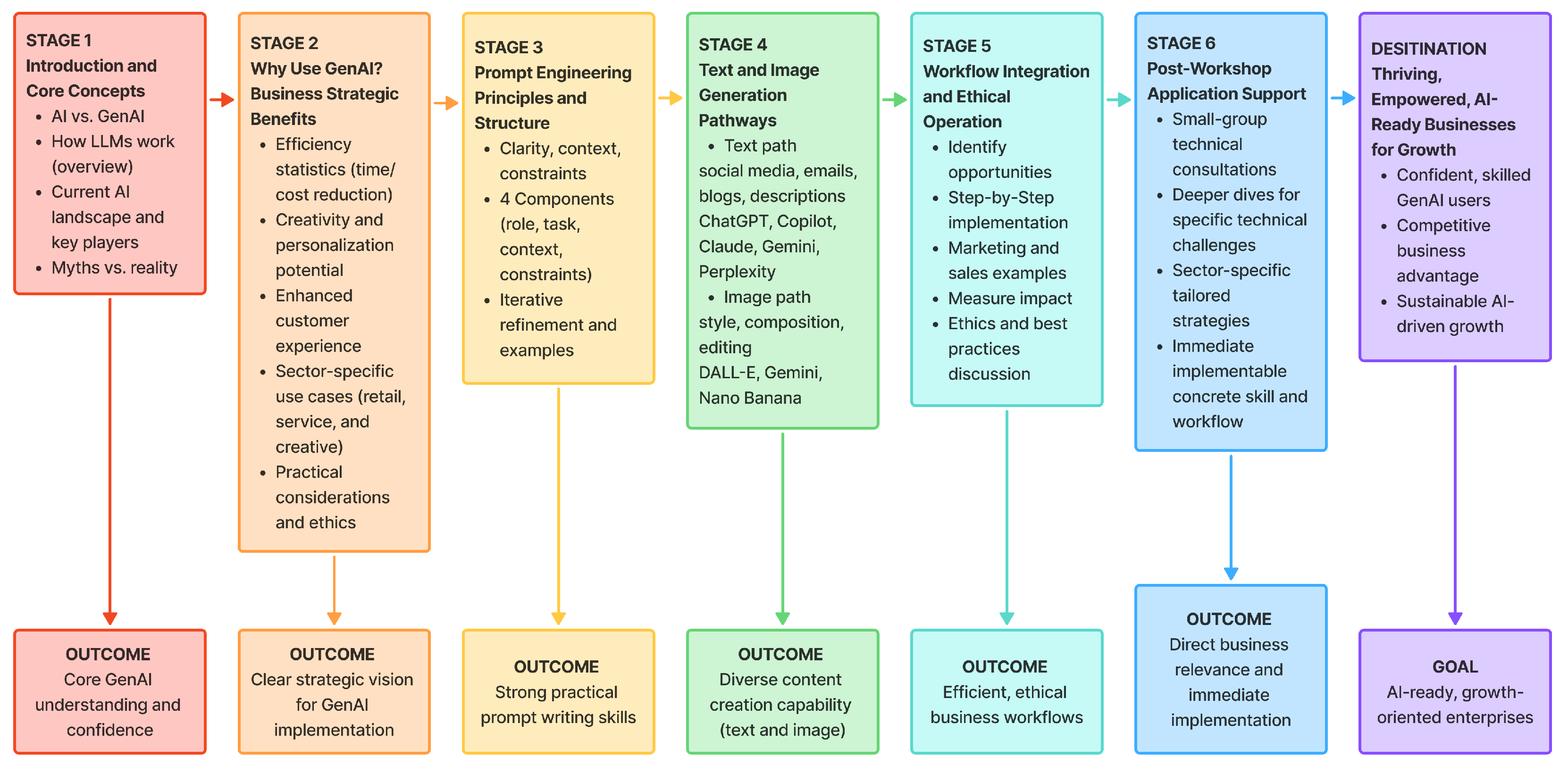
Each two-hour “Mastering GenAI for Business Growth: Tools, Tips, and Viral Strategies” workshop was structured to combine presentations with real-world examples, supervised exercises, and interactive group discussion (Figure 2). Each session is built around the following three primary questions for participating entrepreneurs.
Figure 2.
Structure and content flow of CSU Extension’s “Mastering GenAI for Business Growth: Tools, Tips, and Viral Strategies” educational program.
Why use GenAI? The workshop explored the strategic benefits and practical implications for businesses. Detailed explanations and sector examples (e.g., retail, service, creative industries) illustrated how GenAI can drive efficiency, boost productivity (e.g., content writing time reduction), enhance creativity, personalize customer experiences, and achieve cost savings (e.g., content production cost reduction).
How to create text and images using GenAI tools? The workshop provided comprehensive instruction on practical content generation. Participants learned the essential principles of prompt engineering, including clarity, context, constraints, examples, and the iterative refinement process. Detailed teaching emphasized the four key components of an effective prompt: role (who), task (what), context (why/how), and constraints (limits/format) [3]. Pre- and post-prompt examples demonstrate the impact of detailed prompting. Supervised exercises involved crafting various text and images across a variety of GenAI tools, including ChatGPT, Copilot, Claude, Gemini, Perplexity, DALL-E, and Nano Banana (Gemini 2.5 Flash Image, Google). Participants used the publicly available version of each tool current at the time of their workshop; these tools are updated continuously and do not carry stable version numbers.
Regarding text generation, instructions and exercises focused on crafting social media content, marketing emails, blog posts, product descriptions, and brainstorming ideas, with detailed prompt examples provided for each use case. Regarding image generation, exercises covered varying visual styles, composition, lighting, and advanced techniques across multiple tools. The workshop detailed the entire image generation and editing workflow, specifically with Gemini and Nano Banana. It includes screenshots of the interface and multiple examples showcasing how to change prompt details for different image styles and advanced effects.
How can entrepreneurs effectively integrate GenAI tools into their own operations? Strategies for workflow integration were presented, guiding entrepreneurs on identifying opportunities, selecting appropriate tools, implementing step-by-step, measuring impacts, and discussing ethical considerations and best practices (transparency, accuracy, bias, privacy, security) [8,43]. Marketing workflow examples (content plan, post creation, image generation, scheduling) and sales examples (personalized email generation) illustrated practical applications.
Workshops were followed by small-group technical consultations (one to five entrepreneurs). These sessions provided deeper dives to address sector-specific needs, overcome specific technical challenges, and develop tailored strategies. The technical consultations aimed to ensure each participant left with at least one concrete GenAI skill or workflow they could implement immediately in their business operations.
3. Research Methods
This study adopts an explanatory sequential mixed-methods design [44], in which a quantitative strand is followed by a qualitative strand that helps interpret and explain the quantitative results. The two strands are assigned distinct and complementary roles rather than being treated as parallel tests of the same claim. The quantitative survey is used to describe the magnitude and breadth of participants’ reported change in GenAI-related perceptions and early-use behaviors. That is to establish how much participants report shifting and across how many constructs and tasks. The qualitative interviews are used to explain how and under what conditions those shifts occurred: which program components participants credited, what mechanisms they described, and where adoption stalled. Integration occurs at two points: in the design, where interview questions were mapped onto the same TAM–TOE constructs measured in the survey (Table 2); and in the interpretation, where each qualitative theme is linked back to the specific survey pattern it helps account for (Section 4). Framing the strands this way, the description of scale comes from the survey, and the explanation of mechanism and condition comes from the interviews. This study positions the qualitative evidence as the primary source of theoretical insight, with the survey establishing the scope of the phenomenon it explains.
Table 2.
Mapping of survey items and interview questions to Technology Acceptance Model (TAM) constructs and Technology–Organization–Environment (TOE) contexts, with evidence type.
The study evaluated CSU Extension’s GenAI educational program from 2025 to 2026. The research protocol was approved by the Colorado State University (CSU) Institutional Review Board under the exempt review category (IRB ID 7089, 28 July 2025), as the study involved minimal-risk survey and interview procedures with adult participants. Survey and interview data were collected from 29 July 2025 to 8 May 2026, and data analysis was conducted from 9 May to 30 August 2026. Informed consent was obtained from all participants. Survey respondents read a consent form on the first page of the Qualtrics survey (Qualtrics XM, Provo, UT, USA), which explained the research purpose, time commitment, anonymous data collection, voluntary participation, and contact information for the researcher and the IRB, and selected “I consent” before any questions were displayed. Interviewees gave verbal consent at the start of each interview and reconfirmed it before audio recording began. The IRB approved consent without signatures for both strands: the survey was anonymous, and the interviews were conducted remotely, where paper signature forms would have created identifiable records the study did not need.
The principal investigator (PI), a CSU Extension faculty member, delivered the GenAI educational program, designed this research, and conducted all data collection. The study is exposed to researcher and social-desirability bias. To mitigate this, interview prompts were worded neutrally and framed as having no right answers, responses were anonymized, and coding deliberately searched for disconfirming (negative) cases; analytic memos documented each coding decision. These steps reduce but do not eliminate the bias inherent in a single-researcher design.
3.1. Survey Design and Quantitative Data Collection
The survey consisted of 13 questions and was conducted via Qualtrics 1 to 100 days after the GenAI educational program. The instrument was kept to 13 questions, with single items for two constructs, so that working business owners could complete it in a few minutes; items were adapted from established TAM and self-efficacy measures [35,37]. Questions used a five-point Likert scale unless otherwise noted and were organized using a retrospective pre-test (then/now) design to reduce response-shift bias [45,46]. Questions Q1–Q6 captured GenAI-related constructs aligned with the TAM-TOE framework; Q9–Q13 were standard demographic items recommended by CSU Extension for statewide reporting.
- Q1–Q2: Pre–post acceptance and readiness. Q1 comprised three perceived usefulness items. Q2 comprised four items: one for perceived ease of use (Q2a), two for self-efficacy (Q2b, Q2d), and one for behavioral intention (Q2c).
- Q3: Actual behavior (timing of first GenAI use). For eight GenAI-related tasks, respondents indicated when they first tried each activity.
- Q4–Q5: Extension and ecosystem support. Q4 captured the frequency of Extension follow-up activities since the GenAI educational program. Q5 asked which non-Extension ecosystem resources respondents had contacted for AI-related support.
- Q6: Self-positioning on GenAI advancement. Respondents rated how advanced their GenAI use was compared with other people.
- Q7: Primary industry/sector. Open-text item allowing respondents to describe their sector or business type.
- Q8: Other questions or comments.
- Q9–Q13: Demographic profile. These items document race (Q9), ethnicity (Q10), gender (Q11), age (Q12), and county (Q13), using standardized code frames adopted by CSU Extension.
Table 2 summarizes how these survey questions and interview questions map onto the TAM-TOE framework, including perceived usefulness (PU), perceived ease of use (PEOU), self-efficacy, behavioral intention to use (BI), and organizational–environmental supports.
3.2. Structured Interviews and Qualitative Data Collection
To deepen understanding of how Extension support influenced actual GenAI use, the qualitative strand drew on structured interviews with participants in the GenAI educational program. Interviewees were recruited via email from the larger pool of 236 attendees who had indicated a willingness to be contacted for follow-up research. All 21 interviewees owned or operated a business. Some, in the course of their work, advise clients or industry partners; where a quoted statement concerns those organizations rather than the speaker’s own enterprise, the label says so.
Interviews were conducted remotely and followed a 12-question structured guide (Table 2). The questions covered: business context; takeaways from GenAI educational program; GenAI tools and tasks used after the program; the role of Extension in moving from learning to doing; other ecosystem actors that helped or hindered GenAI adoption; concrete benefits observed; ongoing barriers and risks; and expectations in how Extension supports technology adoption. Each interview was scheduled for 15–20 min, was conducted with explicit consent for audio recording, and was transcribed word-for-word to capture responses.
Interview data were analyzed using thematic analysis [47]. According to a study [48], if 30% of the relevant population mentions a particular topic, and there are at least 5 instances related to that topic, then a sample size of approximately 21 interviews is adequate. The PI read all transcribed texts in full to gain familiarity with the data and to note preliminary patterns. Responses were first coded deductively against PU, PEOU, self-efficacy, intention, and behavior. Governance was not a pre-specified code. It emerged inductively from responses to interview Q9 and Q11 and was then applied deductively across all 21 transcripts in a second pass, with three sub-codes: no acceptable-use policy, no assigned owner for AI decisions, and no guidance on business data entry. In addition, similar codes were iteratively clustered into higher-order themes that captured common patterns across participants while preserving sector-specific nuance. Finally, these themes were reviewed against the full dataset to check for negative cases and ensure that interpretations did not overstate consensus. During analysis, analytic memos were used to document coding decisions and theme development, enhancing transparency and trustworthiness.
This mixed-methods design allows the quantitative survey to estimate the magnitude and breadth of change in GenAI readiness. Since this study used a retrospective, single-group post-intervention design without a control group, the reported pre–post differences describe participants’ perceived change and cannot be interpreted as the net causal effect of the program. The qualitative data illuminate the mechanisms and contextual conditions through which Extension and other ecosystem actors influence SME GenAI adoption.
4. Research Results
From 2025 to 2026, the CSU Extension GenAI educational program comprised 20 workshops and technical consultations. A total of 236 entrepreneurs and business owners participated. Of these, 129 (54.7%) completed the post-program survey, and 21 participated in subsequent structured interviews. Survey respondents were predominantly white, aged 35 to 54, and slightly more often male, with a substantial share identifying as Hispanic or Latino. They came from 32 Colorado counties and from outside the state: by the 2023 Rural-Urban Continuum Codes of the US Department of Agriculture (USDA) [49], 78 (60.5%) lived in metropolitan counties, 35 (27.1%) in nonmetropolitan counties, and 16 (12.4%) outside Colorado. Those who reported a sector (Q7) spanned 14 sectors of the North American Industry Classification System (NAICS) [50], and all 21 interviewees owned or operated a business in manufacturing, construction, retail, professional and technical services, education, or the arts.
4.1. Quantitative Shifts: Establishing the Baseline of Adoption
All quantitative analyses (descriptive statistics, paired t-tests, Cohen’s , Cronbach’s , and Spearman’s rank correlations) were conducted in Microsoft Excel (Microsoft 365; Microsoft Corporation, Redmond, WA, USA). For each TAM-related construct, “then” and “now” composite scores were computed for the three-item PU scale and the two-item self-efficacy scale, item scores were used for PEOU and intention, and paired t-tests assessed then–now differences for each construct. Effect sizes were expressed as Cohen’s for dependent samples, calculated as the mean of the difference scores (now–then) divided by the standard deviation of those difference scores [51]. Descriptive statistics (means, standard deviations, and percentages) and Spearman’s rank correlations were also calculated to summarize adoption behaviors and associations with Extension and ecosystem touchpoints.
To establish the baseline impact of the Extension GenAI educational program, quantitative analyses assessed pre-to-post shifts in participants’ technology adoption constructs. As detailed in Table 3, paired t-tests revealed significant increases across all Technology Acceptance Model (TAM) variables. After participating, average ratings increased to 4.3–4.5 on a 5-point scale for perceived usefulness (PU), perceived ease of use (PEOU), self-efficacy, and adoption intention. Across all constructs, pre–post differences were large (mean to points) and statistically significant, with substantial effect sizes (Cohen’s – for dependent samples). These large shifts in PU, PEOU, self-efficacy, and intention suggest a link between the Extension GenAI educational program and shifts in core TAM constructs.
Table 3.
Pre–post changes in GenAI readiness ().
Behavioral data support these perceptual shifts. Q3 asked when participants first tried each of eight GenAI tasks. Every workshop included supervised and hands-on exercises, so first use during the workshop reflects program design rather than adoption; 100% of participants reported first trying at least one task during the workshop. The adoption indicator is first use after the program: 90% first tried at least one task in the weeks or months after the workshop, and respondents tried a mean of 3.25 of the 8 tasks. Between 71% and 75% of respondents had tried marketing, images, social-media posts, follow-up questions, translation, and brainstorming; and for marketing, posts, and follow-ups, most first use came within one month after the workshop (50% to 61% of respondents). More than half of respondents first tried images and brainstorming during the workshop, where they were the main hands-on exercises. Data analysis (23%) and automated correspondence (26%) remained second-wave uses, and data analysis in particular began almost entirely after the program.
Three further items describe the context of that use. Q4 asked how many times since the workshop respondents had searched Extension-produced AI materials, contacted an Extension specialist about AI, or attended office hours or webinars. About half had contacted a specialist at least once. Most had searched the materials no more than once, and a small group used them 3 or more times. Q5 asked which other ecosystem actors respondents had contacted since the workshop. Peer business forums or social-media groups dominated (73.6%), followed by colleges or universities other than Extension (15.5%); SBDC advisors, chambers of commerce, economic development corporations, mentors, and commercial vendors were each named by fewer than 9% of respondents.
Q6 asked respondents to rate how advanced their use of AI was compared with other people, from 1 (far behind) to 5 (far ahead). The mean was 3.52 (SD 0.81); 55% rated themselves ahead or far ahead and 7% behind. Self-rating was positively associated with the readiness constructs and with the number of tasks tried. Q4 to Q7 and Q13 are the survey’s organizational-level measures and operationalize the environment and technology contexts in Figure 1.
Taken together, the survey establishes the scope of the phenomenon: participants reported large, consistent shifts across all TAM constructs, adopted an average of 3.25 GenAI tasks, and concentrated their first use during or shortly after the program. What the survey cannot show is why these shifts occurred, which program elements drove them, or why individual readiness did not always translate into organizational use. The interviews address each of these questions in turn and are organized below around the survey patterns they help explain. Themes 1–3 unpack the perceived usefulness and ease-of-use gains by identifying the concrete scaffolds participants credited; Theme 4 accounts for the shift in adoption intention by characterizing Extension’s role as a trusted intermediary; Themes 5–6 explain both the reported time-savings and the ceiling on deeper adoption; Theme 7 focuses on the absent organizational governance; and Theme 8 surfaces the organizational and equity barriers that persist even where individual readiness scores were high. In this way, the qualitative strand does not merely accompany the survey but explains the mechanisms and boundary conditions underlying it. To unpack the mechanisms driving these perceptual changes, the qualitative interview data (summarized in Table 4) must be examined.
Table 4.
Summary of qualitative themes from interviews with SME owners (n = 21).
4.2. Qualitative Mechanisms of Adoption: Scaffolding and Immediate Utility
When asked what came to mind first about the GenAI educational program, the most common responses were not abstract ideas but very concrete scaffolds: ready-to-use prompt guides and examples, hands-on exercises, and introductions to specific tools they had not previously tried. Participants contrasted this with prior experiences of AI that felt too technical or too generic. Participants recalled the Extension GenAI educational program as a pivotal resource, noting that it was instrumental in “showing me what to ask” and “giving me a starting point.” Others emphasized its practical impact, stating, “It finally made AI feel usable, not scary,” or highlighting long-term utility, “The prompt guide and cheat sheet are taped next to my monitor. I use it every week.” In other words, the GenAI educational program translated a fuzzy notion that “AI can help” into practical scripts and workflows tailored to small business tasks. This helps explain the high survey scores on perceived usefulness and skill gain: rather than simply raising awareness, the GenAI educational program supplied immediately deployable patterns, for example, marketing prompts, customer-persona prompts, and data-cleanup prompts, that owners could copy, adapt, and reuse.
Interviewees described a wide range of behaviors after the GenAI educational program, almost all aligned with everyday small-business needs: marketing and communication (e.g., drafting emails, flyers, social posts, landing-page copy); operations and administration (e.g., cleaning data, summarizing documents, drafting proposals); ideation and decision support (e.g., brainstorming offers, programming ideas, or messaging); and early experiments with tools and agents (e.g., custom assistants, automation attempts). Some participants started from near zero, while others had experimented beforehand but credited the GenAI educational program with deepening and structuring their use, for example, moving from casual querying to systematic use for data cleanup or proposal generation.
The interview data revealed that the CSU Extension educational program supported adoption not only by explaining GenAI, but by providing “scaffolding” that transitioned the technology from a conceptual novelty to immediate operational utility. Participants emphasized that tangible artifacts provided during the workshops lowered the cognitive barrier to entry and prompted immediate experimentation. For example, a retail business owner reported utilizing the program’s GenAI prompt guide and cheat sheet to create Facebook posts, and stated the following during the interview:
Owner (retail, rural county): “I like the GenAI prompt guide and cheat sheet because they actually save me time. I don’t have to dig through Google anymore. I’ve tried ChatGPT and a couple of other tools, and it’s just easier. I use that prompt guide almost every day. It really helps me get things moving. I use it to find examples, which is super handy, especially for research-type stuff in my business. It can’t auto-post for me, so I still have to go into Facebook and do the actual posting myself. But having ChatGPT generate the blurbs makes it much faster and a lot more convenient.”
Beyond physical artifacts, the program helped SMEs conceptualize GenAI not as a simple software program, but as a digital collaborator. One marketing specialist noted she “tends to personify them... as extensions of our team” to brainstorm ideas, create efficiency, and identify “blind spots or gaps in our thinking”. This operational utility was deeply tied to solving high-stakes, real-world business problems. For example, a technology services owner utilized ChatGPT to resurrect a client’s computer suffering from a “Blue Screen of Death” following a Windows update. She noted that ChatGPT “walked me through a variety of things that didn’t work until we finally hit on one that did,” ultimately saving the machine. Similarly, an entrepreneur in the health care industry reported using the program’s recommended tools the very same day to experiment with an image generation tool (Nano Banana) to update corporate headshots:
Entrepreneur (health care, urban county): “I have been using Claude quite a bit. I actually went through your cheat sheet today and tinkered with our headshots that are a few years old, and had the Nano Banana app update the color of our jackets and hair, and update the jewelry we were wearing. So that was a little bit played around with today, based on what you shared.”
By providing these tangible starting points, the GenAI educational program translated the “hype” of AI into practical scripts and workflows tailored to small business tasks. With the hands-on practice and resources it provided, business owners felt more confident trying example prompts and exploring new features in various GenAI tools. The survey did not measure attitude toward using GenAI, so the interviews were coded for it as a check on the individual-level results. Attitude was coded only where an interviewee evaluated the act of using GenAI itself, such as “I really like using it for my newsletters” or “it’s just easier”; praise for the workshop or the instructor was coded separately and excluded. All interviewees expressed positive affect toward using GenAI; two also expressed mixed affect, mostly tied to distrust of generated content. These statements are qualitative evidence that individual acceptance was high in this sample. They are not a measured construct and are not placed on the TAM path in Figure 1.
4.3. Extension as a Trusted Curator and De-Risking Mechanism
Across the interviews, Extension’s contribution was described less as a one-off educational event and more as a trusted bridge within the entrepreneurial ecosystem. Entrepreneurs reported valuing Extension’s role in filtering through a noisy, fast-moving tool landscape to highlight a shortlist of trustworthy options. Rather than chasing every new product, they appreciated a non-commercial entity pointing to GenAI tools that work for SMEs.
While the Cooperative Extension System is historically associated with agricultural support and outreach, the qualitative data revealed that the GenAI educational program expanded participants’ perceptions of the institution’s utility. For many SME owners, the initiative challenged preconceived notions of Extension’s scope. As one participant noted, their prior awareness of CSU Extension was primarily “from an agricultural standpoint,” typically encountering specialists “at a farmers’ market or a community event.” They admitted they did not expect resources regarding “AI and large language models” from the organization. However, the participant characterized this modernization of services as a “refreshing and innovative” move. This shift in perception preceded Extension’s role as a technology curator; by updating its knowledge-transfer mechanisms to address contemporary digital needs, Extension captured the attention of a broader entrepreneurial demographic before establishing itself as a trusted technological curator.
Consistent with research regarding university-SME knowledge transfer, the CSU Extension educational program functioned as a de-risking mechanism [52]. In a saturated market where SMEs face “so many options to choose from” and fear going down unproductive “rabbit holes,” the institutional backing of the university provided necessary validation. As one participant from a rural county highlighted during the interview:
Entrepreneur (agriculture, rural county): “Just the fact that CSU Extension is doing things for small businesses, I think it’s a pretty big deal. And co-hosting the GenAI workshop with Logan County Economic Development Corporation, which is convenient and helpful for our female entrepreneurs in the rural area.”
Entrepreneurs and business owners valued the Extension resources because they carried the “backing and credibility of CSU.” As one participant from an urban county stated during the interview:
Owner (engineering, urban county): “I would say that I’m an endlessly curious and voracious reader. I really liked the fact that the Extension resources have the backing and credibility of CSU, because I think one of the things that I’m wary of, since I do counsel clients around its use, is just to ensure that the tools that I recommend and that I utilize are legitimate, safe, and secure, protecting personal information. So that’s probably how I gather most of our information. It’s a lot of reading and kind of critical assessment of the sources of information that I come upon.”
This credibility is essential for SMEs attempting to ensure the tools they integrate into their workflows are “legitimate, safe and secure, protecting personal information.” Thus, Extension acts not merely as an educator, but as a trusted filter for safe technology adoption. This qualitative finding is consistent with the survey. The sum of the three Q4 items was positively associated with post-program perceived usefulness (), ease of use (), self-efficacy (), and the number of tasks tried in Q3 (; first three ; last ; , Spearman’s rank correlations). These are cross-sectional associations among participants who chose how much to follow up; they do not show that follow-up caused higher readiness or wider use.
In addition, the interview data highlighted the boundaries of GenAI’s utility, reinforcing the need for Extension to teach evaluation alongside basic tool usage. For entrepreneurs operating in highly technical or innovative fields, such as cybersecurity, blind trust in GenAI outputs remains a barrier. One participant working at the “bleeding edge” noted that while GenAI is highly efficient for “rehashing existing information and summarizing,” it currently fails to extrapolate or “create a completely new idea.” This limitation is compounded by the risk of AI hallucinations. Referencing well-known instances of AI models generating dangerous or nonsensical advice, such as suggesting the addition of glue or rocks to a recipe, the participant expressed a need for tools that provide a “confidence score” or explicit source citations (similar to Perplexity). This insight underscores a nuance: beyond simply curating safe software, Extension programming would need to include verifying AI-generated outputs so they do not take inaccurate ideas as the standard for high-stakes business decisions.
4.4. The Governance Gap: Transitioning from Individual to Organizational Adoption
As participants moved from initial individual experimentation to broader organizational deployment, a barrier emerged that sits in the organization context of TOE rather than in the individual constructs of TAM. Interviewees noted that the primary barrier to scaling SME adoption is often not a lack of technological capacity, but a lack of organizational governance.
While individual entrepreneurs can quickly adopt GenAI without “red tape,” scaling this technology within a company introduces the risk of “shadow IT.” One owner observed that without clear guidelines:
Owner (education and communications, urban county; statement concerns organizations the owner advises): “I can use AI tools every day, but when I think about them inside organizations, especially to support employees, I see a lot of problems. With my background in crisis comms, reputation, cybersecurity, and data breaches, I worry that without clear guardrails and governance, AI becomes a huge risk. Even if a company bans AI, staff still use it, and that’s where you start seeing proprietary or confidential client information getting fed into large language models, a whole new category of crisis in the making. I’m now working with organizations to build those policies and governance pieces, often as an extension of their existing comms protocols, because I see some dangerous trends emerging if they do not.”
Another four entrepreneurs and business owners stated that their enterprises have no policy or people on AI governance. The other 16 interviewees did not mention governance. As the interview guide did not ask about it directly, their silence cannot be read as absence, but no interviewee described having a policy, an owner, or data guidance, and none treated governance as something already settled. This introduces risks regarding the accidental ingestion of “proprietary information” or “confidential client information” into large language models. Interviewees described this governance gap as the “biggest deterrent to implementing it as a systematic organizational approach,” forcing SMEs to pause adoption until they can establish internal policy frameworks.
Furthermore, the data revealed a second pattern regarding digital readiness: GenAI adoption can occasionally outpace basic digital literacy. One participant observed a colleague who successfully “wrote a book using AI,” yet struggled with foundational software, fumbling with “how you use the chapter headings” in Microsoft Word. This phenomenon suggests that while GenAI tools are highly accessible entry points for content creation, they can leave users stranded if they lack the traditional digital skills required to format and distribute that content. These barriers nuance the generally positive survey scores, demonstrating that individual readiness to adopt can coexist with significant organizational friction.
CSU Extension was not the sole actor in participants’ GenAI journeys. In the interviews, a few participants also drew on SBDCs and local economic-development organizations, online courses, peer networks, and startup weeks, although these actors were rarely named in the survey. Extension’s comparative advantage lay in connecting GenAI to local small-business realities, while other ecosystem actors provided sector-specific knowledge. At the same time, the interviews suggested that better coordination among these supports, for example, joint events with economic development corporations and chambers of commerce, could amplify impact.
In combination with the survey findings, the interviews show that the Extension GenAI educational program acts as a scaffold and helps SMEs convert abstract awareness into concrete, time-saving use; positions Extension as a bridge and curator within the entrepreneurial ecosystem; and surfaces a governance gap between individual and organizational adoption that programming has yet to address. These three roles directly address RQ1 (shifts in perceptions and behaviors), RQ2 (mechanisms and ecosystem roles), and RQ3 (barriers and equity concerns). The qualitative insights deepen understanding of how and under what conditions the land-grant university Extension can support GenAI adoption in SMEs. They also yield design principles, hands-on prompts, curated tool stacks, privacy guidance, and high-touch support that can inform Extension programming in other states and contexts.
5. Discussion and Conclusions
Returning to the research questions, the mixed-methods findings show that (RQ1) participants reported large pre–post differences in core TAM constructs and triggered early adoption behaviors; (RQ2) these shifts were mediated by concrete scaffolds and by Extension’s role as a trusted knowledge broker within the entrepreneurial ecosystem; and (RQ3) the barriers that persisted reflect constraints in the organization context of TOE, chiefly the absence of governance structures. This design does not support causal inference; the pre–post difference reflects changes in participants’ perceptions rather than the net effect of the program. These contributions are discussed in relation to existing theory and practice.
5.1. The University Extension as a Trusted Knowledge Broker
Recent surveys place SME GenAI use between 9% and 31% of firms in national samples [53,54] and far higher in self-selected samples of engaged firms [55]. The 90% post-program use in this study belongs to the second group and should be read as a ceiling for motivated participants, not as a population estimate. Where the studies converge is on the order of events. Employees adopt first: 78% of GenAI users in a 31-country survey brought their own tools to work, and the share was 80% in small and medium-sized firms [56]. Owners follow with little structure: about half of US small firms using AI reported no accompanying investment in training, equipment, or process change [54], and SME leaders in Spain described adoption that was partly employee-driven and limited by distrust of output rather than by access [57]. Governance, when it is measured at all, is measured as a capability of firms that already have it [58]. None of these studies observes individual acceptance and organizational readiness in the same firms. The interviews reported here do, and that is where the emergent governance gap becomes visible.
This study extends the existing literature on technology transfer by demonstrating the role of land-grant university Extension programs in the GenAI era. Previous research underscores that universities act as knowledge transfer nodes within SME innovation systems, bridging the gap between complex technological advancements and practical commercial application [52,59]. The findings refine this theory by showing that in the context of GenAI, a landscape characterized by rapid market saturation and misinformation, the primary mechanism of knowledge transfer is de-risking.
Entrepreneurs are overwhelmed by the sheer volume of GenAI tools. Participants explicitly stated they valued the Extension resources because they carried the “backing and credibility of CSU,” which helped them ensure the tools they adopted were “legitimate, safe, and secure.” This aligns with existing research [60], which posits that entrepreneurial learning is heavily impacted by the credibility and practical applicability of the knowledge transfer process. The Extension program did not just teach GenAI; it acted as a trusted institutional filter, reducing perceived risk and enabling SMEs to bypass the “rabbit hole” of unverified consumer tools.
5.2. Theoretical Shift: From Individual Acceptance to Organizational Governance
The main theoretical contribution of this study is the conceptualization of a governance gap as an emergent construct. In this study, the governance gap is defined as the condition in which individuals in a firm have adopted GenAI tools, shown by high perceived usefulness, intention, and reported use, while the firm has none of the three readiness markers: an acceptable-use policy, an assigned owner for AI decisions, and guidance on which business data may be entered into GenAI tools. The three markers are the three sub-codes that emerged from the interviews (Table 4, Theme 7). They are observable, they can be asked about directly, and each is a yes-or-no condition at the firm level, which distinguishes the construct from the individual-level perceptions that TAM measures.
Absorptive capacity explains why the gap persists. Individuals acquire GenAI knowledge through use and through programs such as this one; the survey shows that acquisition in this sample was substantial. Assimilation and exploitation are organizational stages. They require routines that turn one person’s skill into shared practice, and the three markers above are the minimum such routines. No interviewee described any of the three in their own enterprise; 5 stated explicitly that none existed, and the remaining 16 did not raise governance at all, which is itself consistent with the gap but is not evidence of it. Nothing in a workshop creates these routines. The shadow IT literature shows that firms eventually close this kind of gap for consumerized tools through policy or sanctioned alternatives [33]. Three features of GenAI make closure slower. The tool ingests unstructured business data, its output cannot be verified without expertise, and adoption involves no procurement step at which the firm would notice. Classical adoption models treat ease of use as an enabler. For GenAI, ease of use is what lets individual acceptance run ahead, so the binding constraint moves from the individual to the organizational level.
Therefore, this study advances the following proposition rather than a tested hypothesis: in SMEs, individual acceptance of GenAI will precede and exceed organizational governance readiness, and the gap will be larger in firms without a designated technology decision-maker. Testing it requires measuring both levels in the same firms. A two-wave design that surveys the owner and at least one employee of each firm, with TAM items for the individual level and the three markers for the organizational level, would allow the gap to be sized and its predictors estimated. This reframing does not overturn TAM or TOE but relocates the decisive variable. Since this design is cross-sectional and qualitative on this point, the study frames governance readiness as a boundary condition to be tested through longitudinal or multi-firm process data, rather than one that this study confirms.
5.3. Conclusions and Practical Implications
The Cooperative Extension System can support GenAI adoption among SMEs by providing practical scaffolding and institutional trust. The governance gap sets the next task. The implications below are organized by audience. SME owners and managers should establish an acceptable-use policy that covers permitted tools, prohibited inputs, and review of generated content before external use. Also, a specific individual should be designated to oversee AI-related decision-making. Furthermore, business information should be reviewed before entering into a GenAI tool. For example, public information may be entered into any GenAI tool; internal information may be entered only into enterprise tools whose terms exclude training on user data; customer personal information, financial records, and trade secrets are not entered at all.
For Extension and other intermediaries, the finding that individual readiness did not translate into organizational readiness implies three changes. Each GenAI workshop would need to add a governance module that walks participants through the policy preparation. A post-workshop policy clinic, in the small-group format already used for technical consultations, would let owners draft their own policy with guidance. Program evaluation would need to track organizational outcomes, whether a policy was adopted and an owner named, alongside the individual outcomes reported here.
For policymakers, funding for intermediary programs could be tied to organizational readiness measures rather than to participant counts, which reward exposure over adoption. Public agencies could publish sector-neutral model policies that SMEs can adopt without legal review, which is the main barrier small firms cited to writing their own. For researchers, the proposition in Section 5.2 is testable with the two-wave, owner-and-employee design described there, and the three markers give it a measurement model that does not yet exist in the SME GenAI literature.
5.4. Limitations and Future Research
This study has limitations in sampling, design, measurement, and analysis. The sample is self-selected: participants chose to attend a GenAI program, so they are likely more receptive than the SME population. It is bounded: rural and small-town Colorado, with 12.4% of survey respondents from outside the state, reached through one public university intermediary. The findings generalize analytically rather than statistically. The mechanism, individual acquisition without organizational assimilation, is not specific to this region, and the three governance markers can be measured in any SME population, but the rates reported here should not be read as population estimates.
The design is a retrospective single-group post-intervention design without a control group. The pre–post differences describe perceived change and cannot be read as the net effect of the program. The retrospective pretest limits response-shift bias but is open to recall and social desirability bias. Surveys were collected over approximately 9 months, and the interval between workshop and survey ranged from 1 to 100 days. The study covers early adoption and perceived benefits, not longer-term outcomes such as revenue.
Ease of use and intention were measured with single items, no confirmatory factor analysis was conducted, and the results are descriptive rather than a structural model test. Even though programs targeted SMEs and all participants are SME owners, specific firm size was not collected, and many respondents left the sector item blank. Governance readiness was not measured in the survey; it emerged from the interviews, which is why it is stated as a proposition rather than a finding.
The author delivered the program, conducted the interviews, and coded the transcripts alone. Interviewees may have been more positive about the program when speaking to its instructor, and single-coder analysis has no inter-coder check; analytic memos and a search for negative cases reduce but do not remove these risks. Some interviewees advise clients as part of their work, so part of the governance evidence describes those organizations rather than the speaker’s own enterprise; each such quotation is labeled. The survey was anonymous, so the overlap between the two samples cannot be determined, and the strands are treated as complementary rather than as triangulation of the same respondents. Future research should test the proposition with a two-wave owner-and-employee design, measure the three governance markers directly, and compare intermediaries across regions and countries.
Funding
The Article Processing Charge (APC) was funded by a grant from Colorado State University Office of Vice President for Research (OVPR) Capacity-Building for Integrating AI into Research and Development.
Institutional Review Board Statement
The research protocol was approved by the Colorado State University (CSU) Institutional Review Board under the exempt review category (IRB ID 7089, 28 July 2025).
Informed Consent Statement
Informed consent was obtained from all participants. Survey respondents consented electronically before the survey began, and interviewees gave verbal consent before each interview and before audio recording; the IRB approved consent without signatures for both strands.
Data Availability Statement
The data presented in this study are not publicly available due to privacy and confidentiality commitments made to participants under the approved IRB protocol.
Conflicts of Interest
The author declares no potential conflict of interest with respect to the research, authorship, and publication of this article.
Abbreviations
The following abbreviations are used in this manuscript:
| GenAI | Generative artificial intelligence |
| SMEs | Small and medium-sized enterprises |
| TAM | Technology Acceptance Model |
| TOE | Technology–Organization–Environment |
References
- Kalota, F. A primer on generative artificial intelligence. Educ. Sci. 2024, 14, 172. [Google Scholar] [CrossRef] [Scilit]
- Dong, X.A. Revolutionizing agritourism with AI and machine learning: A case study of Prairie Ridge Buffalo Ranch in Colorado. Tour. Cases 2025. [Google Scholar] [CrossRef] [Scilit]
- Hill, P.A.; Dong, X.A.; Miller, A.L. Transforming text to images: Prompt engineering principles for generative AI use in Extension. J. Ext. 2025, 63, 9. [Google Scholar] [CrossRef] [Scilit]
- Chalmers, D.; MacKenzie, N.G.; Carter, S. Artificial intelligence and entrepreneurship: Implications for venture creation in the fourth industrial revolution. Entrep. Theory Pract. 2021, 45, 1028–1053. [Google Scholar] [CrossRef] [Scilit]
- Giuggioli, G.; Pellegrini, M.M. Artificial intelligence as an enabler for entrepreneurs: A systematic literature review and an agenda for future research. Int. J. Entrep. Behav. Res. 2023, 29, 816–837. [Google Scholar] [CrossRef] [Scilit]
- Oldemeyer, L.; Jede, A.; Teuteberg, F. Investigation of artificial intelligence in SMEs: A systematic review of the state of the art and the main implementation challenges. Manag. Rev. Q. 2024, 75, 1185–1227. [Google Scholar] [CrossRef] [Scilit]
- Hill, P.A.; Narine, L.K.; Miller, A.L. Prompt engineering principles for generative AI use in extension. J. Ext. 2024, 62, 20. [Google Scholar] [CrossRef] [Scilit]
- Dong, X.A.; Hill, P.A. From access to governance: Generative AI literacy for Extension professionals and small businesses, and a governance-aware design framework. AI 2026, 7, 440. [Google Scholar] [CrossRef] [Scilit]
- Tornatzky, L.G.; Fleischer, M. The Processes of Technological Innovation; Lexington Books: Lexington, MA, USA, 1990. [Google Scholar]
- Cohen, W.M.; Levinthal, D.A. Absorptive capacity: A new perspective on learning and innovation. Adm. Sci. Q. 1990, 35, 128–152. [Google Scholar] [CrossRef] [Scilit]
- Verhoef, P.C.; Broekhuizen, T.; Bart, Y.; Bhattacharya, A.; Qi, J.; Fabian, N.; Haenlein, M. Digital transformation: A multidisciplinary reflection and research agenda. J. Bus. Res. 2021, 122, 889–901. [Google Scholar] [CrossRef] [Scilit]
- Dwivedi, Y.K. Generative artificial intelligence (GenAI) in entrepreneurial education and practice: Emerging insights, the GAIN framework, and research agenda. Int. Entrep. Manag. J. 2025, 21, 82. [Google Scholar] [CrossRef] [Scilit]
- Kusetogullari, A.; Kusetogullari, H.; Andersson, M.; Gorschek, T. GenAI in entrepreneurship: A systematic review of generative artificial intelligence in entrepreneurship research: Current issues and future directions. arXiv 2025. [Google Scholar] [CrossRef] [Scilit]
- Li, Y.; Ring, J.K.; Jin, D.; Bajaba, S. Elevating entrepreneurship with generative artificial intelligence. J. Innov. Knowl. 2025, 10, 100820. [Google Scholar] [CrossRef] [Scilit]
- LeCun, Y.; Bengio, Y.; Hinton, G. Deep learning. Nature 2015, 521, 436–444. [Google Scholar] [CrossRef] [Scilit] [PubMed]
- Sengar, S.S.; Hasan, A.B.; Kumar, S.; Carroll, F. Generative artificial intelligence: A systematic review and applications. Multimed. Tools Appl. 2025, 84, 23661–23700. [Google Scholar] [CrossRef] [Scilit]
- Schwaeke, J.; Peters, A.; Kanbach, D.K.; Kraus, S.; Jones, P. The new normal: The status quo of AI adoption in SMEs. J. Small Bus. Manag. 2025, 63, 1297–1331. [Google Scholar] [CrossRef] [Scilit]
- Hill, P.A.; Narine, L.K. Ensuring responsible and transparent use of generative AI in Extension. J. Ext. 2023, 61, 13. [Google Scholar] [CrossRef] [Scilit]
- Nambisan, S.; Wright, M.; Feldman, M. The digital transformation of innovation and entrepreneurship: Progress, challenges and key themes. Res. Policy 2019, 48, 103773. [Google Scholar] [CrossRef] [Scilit]
- Howells, J. Intermediation and the role of intermediaries in innovation. Res. Policy 2006, 35, 715–728. [Google Scholar] [CrossRef] [Scilit]
- Mole, K.F.; Hart, M.; Roper, S.; Saal, D.S. Broader or deeper? Exploring the most effective intervention profile for public small business support. Environ. Plan. A Econ. Space 2011, 43, 87–105. [Google Scholar] [CrossRef] [Scilit]
- Kaplan, S.; Raimondi, R. The impact of publicly funded small business advisory services: Firm take-up and performance in the United States. arXiv 2026. [Google Scholar] [CrossRef] [Scilit]
- Carpentier, E.; D’Adda, D.; Nepelski, D.; Stake, J. European Digital Innovation Hubs Network: Activities and AI Skills Development; Publications Office of the European Union: Luxembourg, 2026; Available online: https://data.europa.eu/doi/10.2760/1997861 (accessed on 30 October 2026).
- Bone, J.; Gonzalez-Uribe, J.; Haley, C.; Lahr, H. The Impact of Business Accelerators and Incubators in the UK; Department for Business, Energy & Industrial Strategy: London, UK, 2019. Available online: https://www.gov.uk/government/publications/the-impact-of-business-accelerators-and-incubators-in-the-uk (accessed on 30 October 2026).
- Wilson, R.; Martin, M.; Jamieson, D. ‘Whose Business Growth Hub Is It Anyway?’ Co-production of a new approach to business support for the North East of England. In The North East After Brexit: Impact and Policy; Liddle, J., Shutt, J., Eds.; Emerald Publishing Limited: Bingley, UK, 2019; pp. 119–138. [Google Scholar] [CrossRef] [Scilit]
- Arroyabe, M.F.; Arranz, C.F.A.; Fernandez De Arroyabe, I.; Fernandez de Arroyabe, J.C. Analyzing AI adoption in European SMEs: A study of digital capabilities, innovation, and external environment. Technol. Soc. 2024, 79, 102733. [Google Scholar] [CrossRef] [Scilit]
- Poon, P.-L.; Yu, Y.T. Investigating ERP systems procurement practice: Hong Kong and Australian experiences. Inf. Softw. Technol. 2010, 52, 1011–1022. [Google Scholar] [CrossRef] [Scilit]
- Gould, F.I.; Steele, D.; Woodrum, W.J. Cooperative Extension: A century of innovation. J. Ext. 2014, 52, 3. [Google Scholar] [CrossRef] [Scilit]
- Franz, N.K.; Townson, L. The nature of complex organizations: The case of Cooperative Extension. New Dir. Eval. 2008, 5–14. [Google Scholar] [CrossRef] [Scilit]
- Rao, K.K.; Mackenzie, C.; Subedi, S. The dynamic capabilities approach and regional business resilience: An Australian case study. Reg. Stud. Reg. Sci. 2024, 11, 175–191. [Google Scholar] [CrossRef] [Scilit]
- Harris, J.; Ives, B.; Junglas, I. IT consumerization: When gadgets turn into enterprise IT tools. MIS Q. Exec. 2012, 11, 99–112. Available online: https://aisel.aisnet.org/misqe/vol11/iss3/4 (accessed on 1 November 2026).
- Silic, M.; Back, A. Shadow IT–A view from behind the curtain. Comput. Secur. 2014, 45, 274–283. [Google Scholar] [CrossRef] [Scilit]
- Haag, S.; Eckhardt, A. Shadow IT. Bus. Inf. Syst. Eng. 2017, 59, 469–473. [Google Scholar] [CrossRef] [Scilit]
- Zahra, S.A.; George, G. Absorptive capacity: A review, reconceptualization, and extension. Acad. Manag. Rev. 2002, 27, 185–203. Available online: https://journals.aom.org/doi/10.5465/amr.2002.6587995 (accessed on 1 November 2026). [CrossRef] [Scilit]
- Davis, F.D. Perceived usefulness, perceived ease of use, and user acceptance of information technology. MIS Q. 1989, 13, 319–340. [Google Scholar] [CrossRef] [Scilit] [PubMed]
- Davis, F.D.; Venkatesh, V. A critical assessment of potential measurement biases in the technology acceptance model: Three experiments. Int. J. Hum.-Comput. Stud. 1996, 45, 19–45. [Google Scholar] [CrossRef] [Scilit]
- Venkatesh, V.; Davis, F.D. A theoretical extension of the Technology Acceptance Model: Four longitudinal field studies. Manag. Sci. 2000, 46, 186–204. [Google Scholar] [CrossRef] [Scilit]
- Bin-Nashwan, S.; Li, J.Z.; Jiang, H.; Bajary, A.R.; Ma’aji, M.M. Does AI adoption redefine financial reporting accuracy, auditing efficiency, and information asymmetry? An integrated model of TOE-TAM-RDT and big data governance. Comput. Hum. Behav. Rep. 2024, 17, 100572. [Google Scholar] [CrossRef] [Scilit]
- Bryan, J.D.; Zuva, T. A review on TAM and TOE framework progression and how these models integrate. Adv. Sci. Technol. Eng. Syst. J. 2021, 6, 137–145. [Google Scholar] [CrossRef] [Scilit]
- Chatterjee, S.; Rana, N.P.; Dwivedi, Y.K.; Baabdullah, A.M. Understanding AI adoption in manufacturing and production firms using an integrated TAM-TOE model. Technol. Forecast. Soc. Change 2021, 170, 120880. [Google Scholar] [CrossRef] [Scilit]
- Qu, C.; Kim, E. Investigating AI adoption, knowledge absorptive capacity, and open innovation in Chinese apparel MSMEs: An extended TAM-TOE model with PLS-SEM analysis. Sustainability 2025, 17, 1873. [Google Scholar] [CrossRef] [Scilit]
- Yang, J.; Blount, Y.; Amrollahi, A. Artificial intelligence adoption in a professional service industry: A multiple case study. Technol. Forecast. Soc. Change 2024, 201, 123251. [Google Scholar] [CrossRef] [Scilit]
- Dong, X.A.; Hill, P.A. Navigating text-to-speech (TTS): Ethical leadership in the use of generative AI for Extension. J. Ext. 2026, 64, 5. [Google Scholar] [CrossRef] [Scilit]
- Creswell, J.W.; Plano Clark, V.L. Designing and Conducting Mixed Methods Research, 3rd ed.; SAGE: Thousand Oaks, CA, USA, 2018. [Google Scholar]
- Jayaratne, K.S.U.; Kumar Chaudhary, A.; Diaz, J.M. Knowledge testing options in pre-test post-test evaluation design: Implications for Extension program evaluation. Adv. Agric. Dev. 2025, 6, 64–75. [Google Scholar] [CrossRef] [Scilit]
- Nielsen, R.B. A retrospective pretest-posttest evaluation of a one-time personal finance training. J. Ext. 2011, 49, 4. [Google Scholar] [CrossRef] [Scilit]
- Ahmed, S.K.; Mohammed, R.A.; Nashwan, A.J.; Ibrahim, R.H.; Abdalla, A.Q.; Ameen, B.M.M.; Khidhir, R.M. Using thematic analysis in qualitative research. J. Med. Surg. Public Health 2025, 6, 100198. [Google Scholar] [CrossRef] [Scilit]
- Fugard, A.J.B.; Potts, H.W.W. Supporting thinking on sample sizes for thematic analyses: A quantitative tool. Int. J. Soc. Res. Methodol. 2015, 18, 669–684. [Google Scholar] [CrossRef] [Scilit]
- U.S. Department of Agriculture, Economic Research Service. Rural-Urban Continuum Codes; U.S. Department of Agriculture, Economic Research Service: Washington, DC, USA, 2024. Available online: https://www.ers.usda.gov/data-products/rural-urban-continuum-codes/documentation (accessed on 2 November 2026).
- Executive Office of the President, Office of Management and Budget. North American Industry Classification System: United States, 2022; Bernan Press: Lanham, MD, USA, 2022. Available online: https://www.census.gov/naics/ (accessed on 2 November 2026).
- Lakens, D. Calculating and reporting effect sizes to facilitate cumulative science: A practical primer for t-tests and ANOVAs. Front. Psychol. 2013, 4, 863. [Google Scholar] [CrossRef] [Scilit] [PubMed]
- Corral de Zubielqui, G.; Jones, J.; Seet, P.S.; Lindsay, N. Knowledge transfer between actors in the innovation system: A study of higher education institutions (HEIS) and SMES. J. Bus. Ind. Mark. 2015, 30, 436–458. [Google Scholar] [CrossRef] [Scilit]
- Organisation for Economic Co-operation and Development. Generative AI and the SME Workforce: New Survey Evidence; OECD Publishing: Paris, France, 2025. [Google Scholar] [CrossRef] [Scilit]
- U.S. Small Business Administration, Office of Advocacy. AI in Business: Small Firms Closing In; Research Spotlight; U.S. Small Business Administration: Washington, DC, USA, 2025. Available online: https://advocacy.sba.gov/wp-content/uploads/2025/09/Research-Spotlight-AI-in-Business-Small-Firms-Closing-In_-092425.pdf (accessed on 1 November 2026).
- Rodríguez Benito, M.E.; Hernández Zelaya, S.L.; Reyes Reina, F.E. The influence of generative AI on business management: Emerging patterns from Spanish SMEs. Adm. Sci. 2026, 16, 163. [Google Scholar] [CrossRef] [Scilit]
- Microsoft; LinkedIn. 2024 Work Trend Index Annual Report: AI at Work Is Here. Now Comes the Hard Part; Microsoft: Redmond, WA, USA, 2024; Available online: https://www.microsoft.com/en-us/worklab/work-trend-index/ai-at-work-is-here-now-comes-the-hard-part (accessed on 1 November 2026).
- Peñarroya-Farell, M.; Vaziri, M.; Soto Rivera, S.K.; Miralles, F. A complex leadership perspective on generative AI adoption in SMEs: The interplay of TAM, TMT, and RBV. Adm. Sci. 2025, 15, 494. [Google Scholar] [CrossRef] [Scilit]
- Hasani, T. When does generative AI adoption pay off? Ethical governance as a dynamic capability in SMEs. Inf. Manag. 2026, 63, 104436. [Google Scholar] [CrossRef] [Scilit]
- Grady, R.; Pratt, J. The UK technology transfer system: Calls for stronger links between higher education and industry. J. Technol. Transf. 2000, 25, 205–211. [Google Scholar] [CrossRef] [Scilit]
- Cowdean, S.; Whitby, P.; Bradley, L.; McGowan, P. Entrepreneurial learning in practice: The impact of knowledge transfer. Ind. High. Educ. 2019, 33, 30–41. [Google Scholar] [CrossRef] [Scilit]

Disclaimer/Publisher’s Note: The statements, opinions and data contained in all publications are solely those of the individual author(s) and contributor(s) and not of MDPI and/or the editor(s). MDPI and/or the editor(s) disclaim responsibility for any injury to people or property resulting from any ideas, methods, instructions or products referred to in the content. |
© 2026 by the author. Licensee MDPI, Basel, Switzerland. This article is an open access article distributed under the terms and conditions of the Creative Commons Attribution (CC BY) license.